S. Regina* | M. Elayaraja | R. Nagadeepa | A. Asiya Mariam
© 2026 The authors. This article is published by IIETA and is licensed under the CC BY 4.0 license (http://creativecommons.org/licenses/by/4.0/).
OPEN ACCESS
Wearable antennas have received a lot of attention in biomedical applications due to their ability to facilitate wireless communication and continuous health monitoring. However, achieving a compact size, low power absorption, stable performance close to the body, and dependable signal transmission is still a significant challenge for the current designs of wearable antennas. To fill this research void, this research work proposes a wearable notch antenna for biomedical applications based on a Teflon (PTFE) substrate. The proposed antenna's notch structure improves impedance matching and radiation characteristics while simultaneously ensuring user safety. Key parameters such as return loss, Voltage Standing Wave Ratio (VSWR), gain, directivity, and specific absorption rate (SAR) were analyzed at the operating frequency of 2.755 GHz during the antenna design and performance evaluation using Computer Simulation Technology (CST) software. According to simulation results, the antenna achieves a VSWR of 1.223, indicating low reflection, and a return loss of -19.95 dB, confirming efficient signal transmission. Additionally, the antenna's gain of 5.05 dBi and directivity of 6.773 dBi guarantee effective radiation performance. The SAR value of 0.0016 W/kg falls well within safe exposure limits for wearable applications. These results support the antenna’s suitability for reliable biomedical applications.
notch antenna, Teflon substrate, wearable, biomedical, specific absorption rate
The fast growth of technologies for wireless communication has revolutionized the healthcare sector, particularly through the development of wearable devices that enable continuous monitoring and real-time diagnosis of patients. Central to the functionality of these devices is the antenna, which plays a pivotal role in ensuring efficient two-way signal transmission. The design of antennas for biomedical applications poses unique challenges, as they must operate effectively within the human body environment, characterized by complex electromagnetic properties and strict safety regulations. This paper explores the design of a wearable notch antenna utilizing a Teflon substrate, specifically tailored for biomedical applications. Wearable antennas in biomedical devices serve essential functions, such as monitoring vital signs, tracking patient movements, and enabling wireless data transmission for remote diagnostics. These antennas must provide reliable performance while being compact, lightweight, and biocompatible to ensure patient comfort and safety. Teflon is an ideal choice for various applications due to its unique properties. Its excellent biocompatibility makes it safe for long-term contact with human tissue, which is particularly beneficial in medical and healthcare devices. Additionally, its low loss tangent minimizes signal loss, low dielectric constant, and improves antenna efficiency and communication clarity. Teflon's remarkable stability under diverse environmental conditions ensures reliable, long-lasting performance, creating it especially suitable for wearable biomedical devices and other sensitive applications that demand durability and consistent functionality. The notch antenna design is particularly advantageous in biomedical contexts, where it is crucial to filter out unwanted frequency bands and minimize interference from other wireless systems operating in the vicinity. This helps to enhance the reliability of the signal transmission, ensuring that critical medical data is transmitted without interruption or distortion. The rising need for wearable biomedical systems for real-time health monitoring has increased the need for antennas capable of delivering reliable performance under practical operating conditions. Despite significant developments in wearable antenna technology, several challenges still exist, including large antenna size, frequency shifts caused by the close proximity of the human body, reduced radiation efficiency, limited operating bandwidth, and performance degradation under bending or deformation conditions. Such limitations can negatively affect communication quality and restrict the effectiveness of wearable healthcare devices. The primary objective of this work is to overcome these issues through the development of a compact and stable antenna structure intended for wearable biomedical applications. The proposed antenna is constructed to enhance reliable radiation and maintain impedance matching while minimizing the influence of body-loading effects that commonly occur in wearable environments. The selected operating frequency of 2.755 GHz provides a practical balance between antenna miniaturization and signal propagation performance for short-range biomedical communication systems. Lower operating frequencies generally require larger antenna structures, whereas higher frequencies may experience increased propagation losses and sensitivity to body interactions. Therefore, selecting 2.755 GHz helps achieve a suitable trade-off between size reduction and communication efficiency.
Teflon was selected as the substrate material because of its favorable electrical and physical traits, including low dielectric loss and stable dielectric behavior. Its low loss tangent helps reduce power dissipation and supports improved radiation performance, while its material stability assists in maintaining consistent antenna operation under varying conditions.
Furthermore, a notch feature has been included in the antenna design to revise the current distribution and improve impedance behaviour. The introduction of the notch enables effective resonance adjustment and enhanced impedance matching without increasing the overall antenna dimensions. As a result, the proposed structure addresses key wearable antenna requirements such as compactness, operational stability, and improved electromagnetic performance.
Through iterative design optimization, the antenna's structural parameters were directly improved, resulting in its resonance at 2.755 GHz. The overall antenna dimensions are 55 mm × 55 mm, with the substrate thickness is 2 mm. This frequency falls within the S-band (2-4 GHz), which has been extensively studied for short-range body area network communications due to its favorable tissue interaction characteristics and reduced propagation loss at body-proximate distances. However, this frequency does not align with conventional biomedical spectrum allocations, such as the 2.4 GHz ISM band or the MICS band that spans 402-405 MHz.
Thus, the proposed antenna works at a frequency of 2.755 GHz. Additionally, the specific absorption rate (SAR) is a critical parameter in wearable antenna design, as it measures the rate at which energy is absorbed by the human body. The proposed antenna achieves a better SAR value, well within the safety limits set by international standards, ensuring that it is safe for prolonged use in close contact with human tissue. Through this detailed investigation, the paper aims to contribute to the growing body of research on wearable antennas for biomedical applications, offering insights into the design considerations and performance evaluation of antennas intended for safe and effective use in healthcare environments. The results presented here underscore the potential of the proposed Teflon-based notch antenna to meet the stringent requirements of modern wearable biomedical devices, paving the way for more reliable and safe wireless communication resolution in the healthcare industry.
The fast development of technologies for wireless communication has made body-centric wireless systems a fundamental pillar of modern healthcare and personal well-being monitoring. At the heart of these systems lies the antenna, whose performance directly governs the reliability, safety, and efficiency of any Wireless Body Area Network (WBAN) or biomedical telemetry link. A broad spectrum of antenna topologies, substrate materials, and design methodologies has been investigated in response to the diverse and often conflicting requirements of wearable and implantable biomedical applications.
Among the earliest demands addressed in the literature is the need for a wide operational bandwidth. Smida et al. [1] demonstrated a wideband wearable antenna architecture tailored specifically for biomedical telemetry, establishing a foundation for subsequent broadband on-body designs. Slot-based geometries have also been exploited for biomedical purposes; Sukhija and Sarin [2] provide a compact solution suited to medical frequency bands. Miniaturization has emerged as an equally pressing concern, particularly for dual-band operation. Le and Yun [3] achieved significant size reduction for two resonant frequencies to target WBAN standards, while Musa et al. [4] subsequently presented a compact dual-band wearable structure whose design and performance were analyzed in detail for similar WBAN applications.
Ultra-wideband (UWB) technology has attracted substantial attention as a means of simultaneously satisfying bandwidth and localization requirements in body-worn systems. However, UWB antennas are susceptible to interference from existing narrowband services, motivating the incorporation of notch-band rejection features. Geyikoglu [5] introduced a flexible UWB antenna with dual band-notch characteristics for wearable textile biomedical devices, whereas Lakrit et al. [6] proposed a compact flexible elliptical coplanar-waveguide (CPW)-fed UWB structure with triple notch bands intended for broader wireless communication scenarios. Pushing the concept further, Zhao et al. [7] reported a miniaturized wearable UWB antenna incorporating as many as five independent band-notched responses for medical use cases. The broader design space of switchable and tunable notch-band implementations across UWB and UWB-MIMO antennas was systematically surveyed by Modak et al. [8], who provided a comprehensive taxonomy of the approaches reported in the field.
Human safety compliance, quantified through the SAR, is a non-negotiable criterion in any on-body or near-body antenna design. Anuragi and Ranjan [9] investigated a compact flexible UWB antenna exhibiting low SAR values, validating its suitability for wearable IoT health monitoring. Ziani et al. [10] explored a PTFE substrate antenna optimized for SAR performance, underlining the role of substrate material selection in achieving regulatory compliance. The influence of substrate choice was further examined by Panda et al. [11], who evaluated wearable microstrip patch antennas fabricated on several different flexible materials in the context of health monitoring systems. More recently, Abdulkareem and Ramasamy [12] reported a flexible wearable antenna satisfying WBAN specifications, reinforcing the continued relevance of CPW feeding for on-body platforms.
Ground-plane and surface-wave engineering techniques have been employed to mitigate the detrimental outcome of the antenna performance on the human body. Jiang et al. [13] leveraged a metasurface-based ground structure to realize a compact, low-profile antenna for medical WBAN devices, demonstrating that engineered electromagnetic surfaces can simultaneously suppress backward radiation and maintain front-hemisphere gain. Kisioglu [14] followed a complementary approach by integrating metamaterial inclusions into a low-profile UWB antenna architecture for WBANs and provided a thorough SAR analysis alongside the electromagnetic performance evaluation. Addressing on-arm deployment specifically, Zahran et al. [15] designed a thin wideband bracelet-style antenna with low SAR, demonstrating that geometrically conformal topologies can meet both radiation and safety requirements.
The mechanical flexibility and conformability of wearable antennas introduce additional design complexity, as bending and body proximity alter the electrical characteristics of the radiating structure. Ferreira et al. [16] systematically examined how bending deformation affects the radiation and impedance characteristics of wearable textile antennas, providing design guidelines for robust on-body performance. Building on the textile antenna concept, De et al. [17] demonstrated bandwidth-enhanced UWB textile antennas capable of supporting a diverse set of WBAN and IoT application scenarios. Extending the UWB-MIMO paradigm to flexible platforms, Du et al. [18] validated the antenna applicability to both WBAN and Internet of Things (IoT) contexts. At millimeter-wave frequencies, Ahmad et al. [19] designed and analyzed a low-profile Vivaldi-type MIMO antenna operating in the millimeter-wave band for wearable WBAN deployment, illustrating that higher-frequency implementations are increasingly viable as component miniaturization advances.
The use of Electromagnetic Band Gap (EBG) substrates provides an alternative strategy for suppressing surface waves and reducing body-coupling losses. Zhu and Langley [20] introduced an EBG substrate, demonstrating that periodic surface structures can be seamlessly integrated into fabric-based radiators to improve both isolation and radiation efficiency. Finally, beyond on-body sensing, implantable antennas represent a distinct and particularly demanding sub-domain of biomedical wireless systems. Shabana et al. [21] evaluated an implantable antenna from electromagnetic, SAR, and thermal perspectives, offering a holistic assessment framework that accounts for the coupled electrical and thermal interactions within biological tissue. Taken together, these contributions underscore that the central challenges in wearable and biomedical antenna engineering—namely compact size, mechanical flexibility, wide bandwidth, multi-band or notch-band selectivity, low SAR, and resilience to body-proximity effects—continue to drive innovation and motivate the present work.
The design of a wearable notch antenna for biomedical applications requires meticulous attention to various factors, including operating frequency, substrate material, antenna geometry, and performance characteristics. The primary goal is to develop an antenna that is compact, lightweight, and capable of efficient operation in nearness to human tissues. A notch antenna is particularly advantageous in this context as it allows for the suppression of specific frequency bands, thereby reducing interference from other wireless systems and enhancing the reliability of signal transmission. This section provides a detailed overview of the design process for the proposed wearable notch antenna, with a focus on the use of a Teflon substrate. Teflon was selected due to its excellent biocompatibility, low loss tangent, and low dielectric constant, making it an ideal material for antennas intended for wearable biomedical applications. The Teflon substrate not only supports efficient signal transmission by minimizing losses but also ensures that the antenna is safe for prolonged use in close contact with human tissue. The selection and optimization of the antenna’s geometry to achieve the desired performance characteristics, including return loss, directivity, impedance matching, and gain. The design of the notch feature is crucial, as it is specifically tailored to filter out unwanted frequency bands, ensuring that the antenna operates effectively within the designated medical frequency range. The design process also involves extensive simulation and iterative refinement to meet the stringent requirements of wearable biomedical devices. This includes ensuring that the antenna meets SAR limits for safety, as well as optimizing its mechanical flexibility and durability for integration into wearable systems. The final antenna design is validated through comprehensive performance analysis, demonstrating its suitability for reliable and safe use in biomedical applications, with the Teflon substrate playing a key role in achieving these results.
(i) Schematic front-view layout
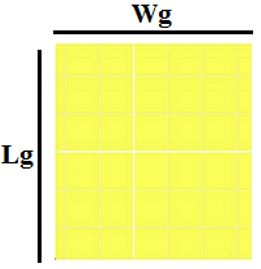
(ii) Schematic back-view layout
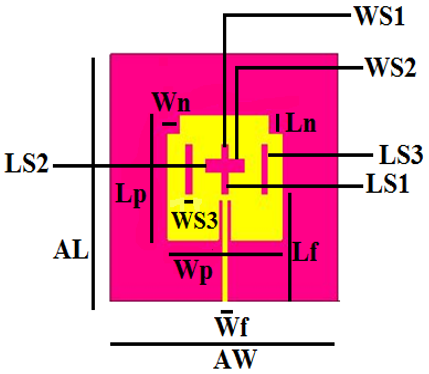
Figure 1. The layout design of the proposed antenna
The design incorporates two rectangular-shaped slots with dimensions of LS3 × WS3 into the patch, and these slots have the same dimensions. Other slots with dimensions of LS1 × WS1 and LS2 × WS2 are embedded as a cross shaped within the radiating patch. Additionally, L-shaped notches are etched at the ends of the patch. The design layout is depicted in Figure 1. The dimensions of these slots are meticulously adjusted to ensure that the resonances align with the targeted frequencies. Initial antenna dimensions are calculated using the equations provided below, with final optimized parameters determined through parametric analysis. This analysis helps in identifying the ideal positions, types, and sizes of the slots. The width of the patch antenna is calculated as follows:
$W_P=\frac{v_0}{2 f_r} \sqrt{\frac{2}{\varepsilon_r+1}}$ (1)
In this context, the free space velocity of the light is denoted by $v_0$ the relative permittivity is indicated by $\varepsilon_r$ and the resonating frequency is denoted by $f_r$. It is essential to account for the substrate material’s dielectric constant efficiently, due to the extension of the electromagnetic field beyond the substrate, creating fringing fields in the surrounding air. As a result, the effective dielectric constant is generally lower than the substrate material's relative dielectric constant. The actual physical length of the patch antenna is determined as follows:
$L_p=L_{e f f}-2 \Delta L$ (2)
The effective length of the patch antenna which accounts for the fringing fields is denoted by $L_{\text {eff}}$. This can be obtained by the following formula:
$L_{\text {eff}}=\frac{v_0}{2 f_0 \sqrt{\varepsilon_{\text {reff}}}}$ (3)
Since the fringing fields of the patch extend by a distance ∆L at both ends of its length, the effective dielectric constant and the width-to-height ratio $\frac{W_p}{h_s}$ ccounts for this increasing length ∆L. ∆L can be determined by the following equation,
$\Delta L=0.412 h_s \frac{\left(\varepsilon_{\text {reff }}+0.3\right)\left(\frac{W_p}{h_s}+0.264\right)}{\left(\varepsilon_{\text {reff }}-0.258\right)\left(\frac{W_p}{h_s}+0.8\right)}$ (4)
The effective dielectric constant of the wearable antenna is denoted by $\varepsilon_{\text {reff}}$, and the substrate’s height is denoted by $h_s$ and the radiation coefficient is indicated by ρ.
$\varepsilon_{\text {reff}}=\frac{\varepsilon_r+1}{2}+\frac{\varepsilon_r-1}{2}\left(1+\frac{12 h_s}{w_p}\right)^{-\frac{1}{2}}$ (5)
$V S W R=\frac{1+\rho}{1-\rho}$ (6)
Return loss $=-10 \log \left(\frac{1}{p^2}\right)$ (7)
Thus, the wearable notch antenna, resonating at 2.755 GHz, is designed specifically for biomedical applications. The simulation results validate that the antenna successfully meets the required specifications.
With overall dimensions of 55 mm × 55 mm × 2 mm, the proposed wearable notch antenna is constructed on a Teflon (PTFE) substrate and is suitable for biomedical wearable applications. The radiating patch, ground plane, microstrip feed line, notch, and multiple slot structures of the antenna, all play a significant role in the electrical performance of the device. The primary radiating element for producing electromagnetic waves at the desired operating frequency of 2.755 GHz is the radiating patch, which has dimensions of 28 mm × 28 mm. The antenna's resonant frequency and radiation efficiency are heavily influenced by the patch's size.
The ground plane, which is 55 mm by 55 mm, helps to maintain stable radiation characteristics and serves as a reference surface for the distribution of currents. Additionally, it reduces backward radiation directed at the human body, which is necessary for wearable devices to function safely and effectively.
The transfer of input power from the source to the radiating patch is accomplished by means of the microstrip feed line, which has dimensions of 1.2 mm × 33 mm. Good impedance matching and minimizing reflection losses necessitate precise feed dimensions. In order to enhance resonant response and enhance impedance matching, a notch structure of size 4 mm × 6 mm is implemented. This modification improves bandwidth performance and reduces return loss.
In addition, the patch is embedded with four slot structures to alter the distribution of the surface current path. The two slots are rectangular in shape, while the other two of the slots combine to form a cross-shaped structure. Slot 1 is 10 mm × 4 mm, Slot 2 is 5.5 mm × 11 mm, and Slots 3 and 4 are each 9 mm × 4 mm. The current path is extended, resonance tuning is improved, and radiation characteristics are enhanced by these slot configurations. Consequently, they help the antenna effectively achieve the desired operating frequency and improve gain.
The optimized geometrical parameters of the proposed antenna are shown in Table 1.
Table 1. The refined design parameters of the proposed wearable notch antenna
|
Parameters |
Values (in mm) |
|
Lp (Patch Length) |
28 |
|
Wp (Patch Width) |
28 |
|
Lg (Ground Length) |
55 |
|
Wg (Ground Width) |
55 |
|
h (Substrate thickness) |
2 |
|
Wf (Feed Width) |
1.2 |
|
Lf (Feed Length) |
33 |
|
Wn (Notch Width) |
4 |
|
Ln (Notch Length) |
6 |
|
AL (Antenna Length) |
55 |
|
AW (Antenna Width) |
55 |
|
LS1 (Slot 1 Length) |
10 |
|
WS1 (Slot 1 Width) |
4 |
|
LS2 (Slot 2 Length) |
5.5 |
|
WS2 (Slot 2 Width) |
11 |
|
LS3 (Slots 3 & 4 each Length) |
9 |
|
WS3 (Slots 3 & 4 each Width) |
4 |
The substrate material Teflon, also known as Polytetrafluoroethylene (PTFE), is widely employed as a substrate material in antenna design due to its favorable mechanical, electrical, and thermal characteristics. Material properties of Teflon are depicted in Table 2.
The material exhibits a low relative permittivity of 2.1, which supports efficient electromagnetic wave propagation and reduces surface wave losses, thereby improving antenna radiation performance. In addition, its extremely low loss tangent value of 0.0002 minimizes dielectric losses and contributes to higher radiation efficiency and gain.
PTFE possesses very low electrical conductivity (10⁻²⁵-10⁻²³ S/m), indicating its excellent insulating capability and preventing unwanted current leakage through the substrate. Since the material is non-magnetic with a magnetic permeability close to unity (1.0 H/m), it does not significantly affect the magnetic field distribution within the antenna structure. From a thermal perspective, PTFE has a thermal conductivity of 0.25 W/K·m and a heat capacity of 1.0 kJ/K·kg, allowing moderate heat transfer and stable thermal performance under varying operating conditions.
Table 2. Material properties
|
Parameters |
Values |
|
Relative permittivity (εr) |
2.1 |
|
Loss tangent (tanδ) |
0.0002 |
|
Magnetic permeability (µm) |
1.0 H/m |
|
Electrical conductivity (σe) |
10⁻²⁵–10⁻²³ S/m |
|
Thermal conductivity (σT) |
0.25 W/K·m |
|
Young's modulus (E) |
0.4–0.55 GPa |
|
Material density (ρ) |
2200 kg/m³ |
|
Heat capacity (C) |
1.0 kJ/K·kg |
|
Tensile strength (Su) |
20–35 MPa |
|
Melting point (Tm) |
327 ℃ |
|
Dielectric strength (E_ds) |
60–170 kV/mm |
The material density of approximately 2200 kg/m³ contributes to structural stability while maintaining acceptable weight characteristics. Mechanically, PTFE provides a Young’s modulus ranging from 0.4-0.55 GPa and tensile strength between 20–35 MPa, ensuring adequate flexibility and durability for antenna fabrication. Furthermore, the high melting point of 327 °C enables the material to withstand elevated temperatures during manufacturing and operation.
PTFE also exhibits excellent dielectric strength ranging from 60–170 kV/mm, allowing it to sustain high electric fields without dielectric breakdown. These combined properties make PTFE a suitable substrate material for high-frequency and wearable antenna applications.
The design and electromagnetic investigation of the proposed Teflon-based wearable notch antenna were done using Computer Simulation Technology (CST) software, a widely used full-wave simulation environment for microwave and antenna applications.
The time-domain solver from CST was used in the simulations, which made it possible to conduct precise and inexpensive wideband electromagnetic analysis. A waveguide port excitation was used to excite the antenna through a 50Ω microstrip feed line. A microstrip line connected the radiating patch directly to the feeding arrangement, enhancing the radiation characteristics and providing stable current return paths. The ground plane was on the back side of the substrate. Copper was used as the conductor material to model the radiating patch and ground plane. All directions used open boundary conditions, with the boundary positioned sufficiently far from the antenna structure to mimic free-space radiation and minimize artificial reflections. For the purpose of performing precise far-field analysis, the boundary spacing was kept approximately one-quarter wavelength away from the radiating structure. In critical areas, such as the feed line, conductor edges, slot structures, and notch regions, where there is a high current density and rapid field variations, automatic mesh refinement and adaptive tetrahedral meshing were utilized to enhance computational accuracy. Iteratively, the mesh was improved until convergence was achieved. The S-parameter results stabilization, with variation remaining below 0.02 between successive adaptive passes, served as the foundation for the definition of the convergence criterion. A mesh-independence study was also conducted to verify the numerical reliability by comparing key antenna performance parameters like return loss, gain, and resonant frequency, while gradually increasing the mesh density. The reproducibility of the proposed antenna design was confirmed, and further mesh refinement had no effect on the simulation results because there were no discernible variations at the final mesh level.
The software provides advanced computational techniques for analyzing electromagnetic behavior and is suitable for evaluating wearable antenna structures operating in biomedical frequency ranges. Prior to the simulation process, all relevant settings, including material characteristics, solver parameters, meshing conditions, and boundary specifications, were properly configured to ensure numerical stability and accurate results.
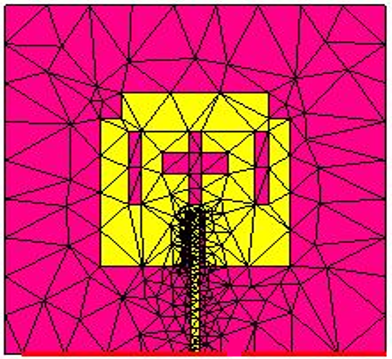
Figure 2 illustrates the meshing arrangement used for the antenna model. An adaptive tetrahedral meshing technique was employed to discretize the entire three-dimensional structure into smaller finite elements for numerical computation. The antenna geometry included the radiating section, notch features, feed line, and Teflon substrate.
Figure 2. Simulation setup—Mesh analysis of the proposed antenna
The tetrahedral mesh approach was selected because of its ability to efficiently model structures with irregular shapes and complex geometrical details. Unlike regular mesh techniques that may introduce geometric approximation errors, tetrahedral elements provide improved conformity to curved and slotted regions of the antenna design.
The mesh distribution across the structure was automatically optimized according to the electromagnetic field behavior. High-density mesh elements were generated in regions where rapid field variations and current concentrations are expected, particularly around the feed section, conductor boundaries, and notch regions.
Increased mesh refinement in these areas enhances the accuracy of electromagnetic calculations. Conversely, larger mesh elements were assigned to regions with relatively smooth field variations, such as portions of the dielectric substrate, reducing computational complexity and simulation time without affecting solution quality.
For the simulation environment, open boundary conditions were applied around the complete antenna structure as presented in Figure 3. The antenna system consisting of the radiating patch, feed structure, ground plane, and dielectric substrate was enclosed within a computational boundary region designed to emulate free-space conditions. The open boundary setup allows electromagnetic waves radiated from the antenna to propagate outward without reflection. This arrangement minimizes unwanted interactions between the radiated fields and the outer simulation boundaries, ensuring more realistic antenna performance analysis.
The integration of adaptive mesh refinement and open-space boundary implementation improves both simulation efficiency and numerical precision. This simulation configuration enables accurate extraction of important antenna parameter characteristics such as return loss, gain, radiation pattern, and SAR. Consequently, the adopted simulation methodology provides a reliable platform for evaluating the performance characteristics of the proposed wearable notch antenna for biomedical applications.
Figure 3. Boundary setup of proposed antenna
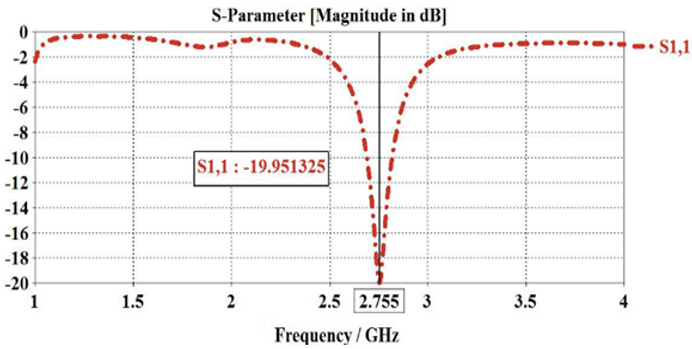
The simulation of the designed wearable notch antenna reveals that the S11 parameter achieves a return loss of -19.95 dB at the resonant frequency of 2.755 GHz, as depicted in Figure 4. This significant return loss indicates excellent impedance matching and minimal signal reflection, which enhances the antenna's efficiency. The low return loss demonstrates that the antenna effectively transmits signals with minimal energy loss, making it highly effective for biomedical applications. This performance metric confirms that the antenna meets the stringent requirements for reliable operation in wearable biomedical devices.
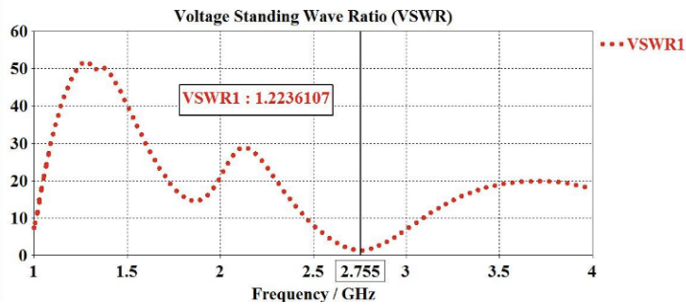
The simulation results of the designed wearable notch antenna reveal a Voltage Standing Wave Ratio (VSWR) of 1.223 at the resonant frequency of 2.755 GHz, as shown in Figure 5. This low VSWR value indicates efficient power transmission and minimal signal reflection, highlighting the antenna's excellent impedance matching.
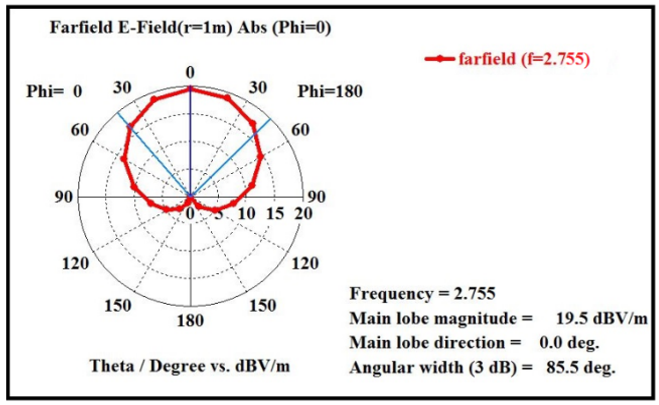
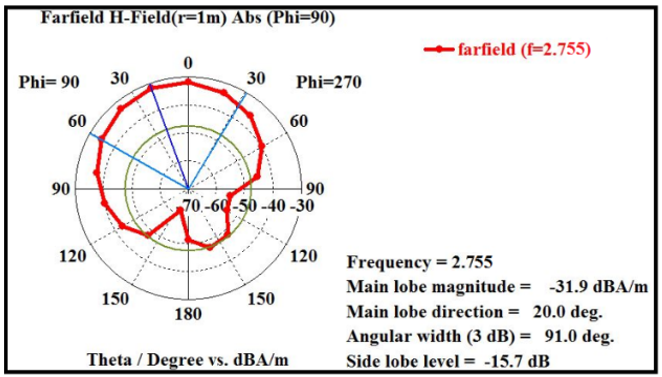
The simulation of the wearable notch antenna, utilizing a Teflon substrate, reveals detailed E pattern and H pattern of radiation at the frequency of 2.755 GHz, as shown in Figures 6 and 7. The E-field pattern demonstrates the distribution of the electric field around the antenna, while the H-field pattern illustrates the magnetic field distribution. These patterns provide insights into the antenna's directional characteristics and radiation efficiency, confirming that the antenna effectively radiates and receives signals with optimal performance for biomedical applications.
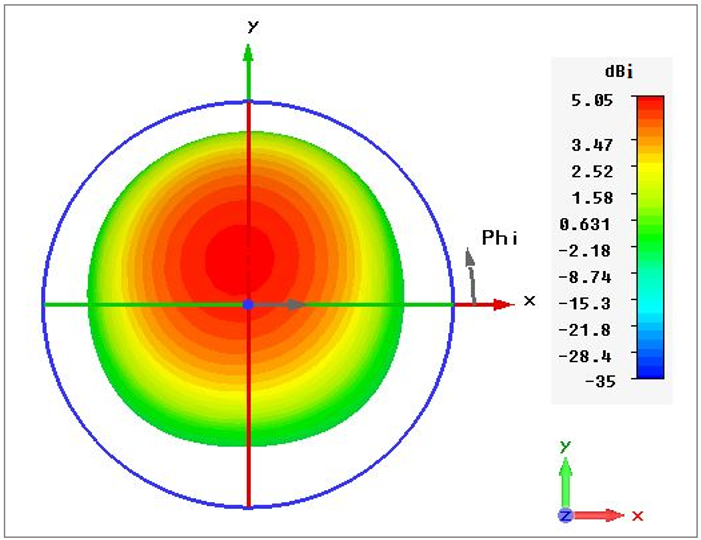
The simulation of the wearable notch antenna, using a Teflon substrate, shows a gain of 5.05 dBi at 2.755 GHz. This high gain indicates that the antenna provides strong signal amplification and effective radiation in the desired direction, enhancing its performance in biomedical applications, as shown in Figure 8.
Figure 4. Return loss of the proposed antenna
Figure 5. Voltage Standing Wave Ratio (VSWR) of the proposed antenna
Figure 6. E-field radiation pattern of the proposed antenna
Figure 7. H-field radiation pattern of the proposed antenna
Figure 8. Gain of the proposed antenna
Figure 9. Directivity of the proposed antenna
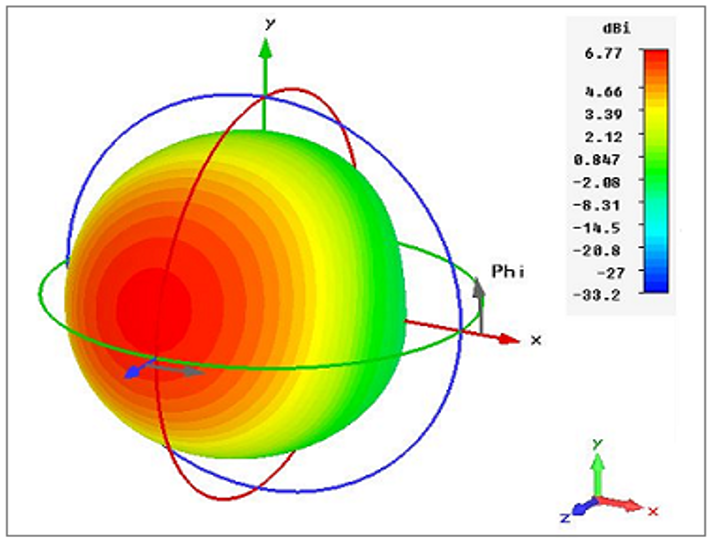
The simulation of the wearable notch antenna, using a Teflon substrate, shows a directivity of 6.773 dBi at 2.755 GHz. This directivity value indicates that the antenna has a focused radiation pattern, enhancing its ability to direct and receive signals effectively. The high directivity contributes to improved signal strength and clarity, making the antenna well-suited for precise biomedical applications. The directivity of the proposed antenna is shown in Figure 9.
SAR is an important parameter used to evaluate the amount of electromagnetic energy absorbed by human body tissues when a wearable antenna operates in close proximity to the body. In biomedical and wearable communication systems, maintaining a low SAR value is essential to ensure user safety and to comply with international electromagnetic exposure regulations. The obtained SAR value is significantly lower than the safety limits recommended by the Federal Communications Commission (FCC). Hence, it is confirming the safety working operation of the proposed antenna for long-term usage.
The remarkably low SAR value is mainly attributed to the effective antenna structure and the dielectric characteristics of the Teflon substrate, which help in minimizing unnecessary radiation toward the human body. Due to this reduced energy absorption, the antenna causes minimal thermal effects on surrounding biological tissues, making it highly suitable for wearable biomedical applications such as health monitoring, patient tracking, remote diagnostics, and WBANs. In addition to ensuring safety, the low SAR performance also enhances the reliability and stability of the antenna when used near the human body, which is a critical requirement for practical wearable systems.
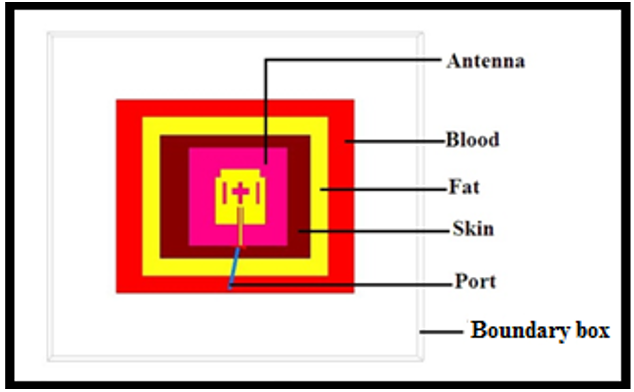
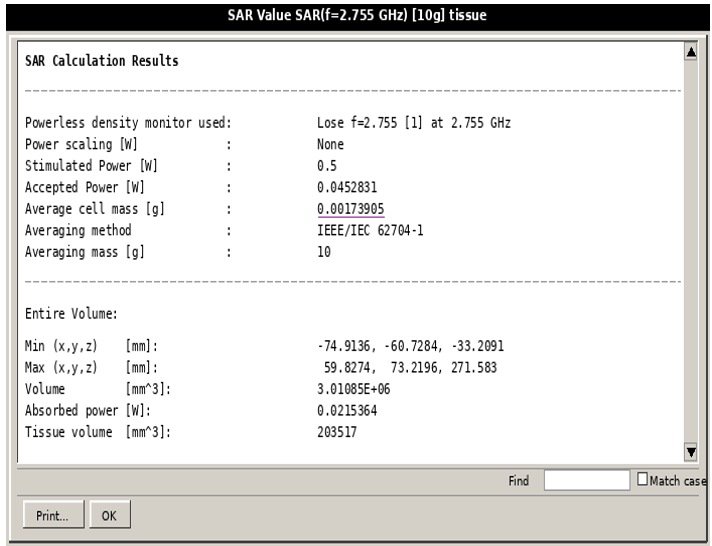
SAR evaluation was carried out using a multilayer tissue model composed of skin, fat, and blood-equivalent materials. The proposed antenna was positioned close to the tissue layers, and numerical simulations were performed to quantify the absorption of electromagnetic energy by the biological tissues. The human tissue model, consisting of multiple biological layers, was used for SAR investigation, as shown in Figure 10.
Figure 10. Multi-layer human body tissue model
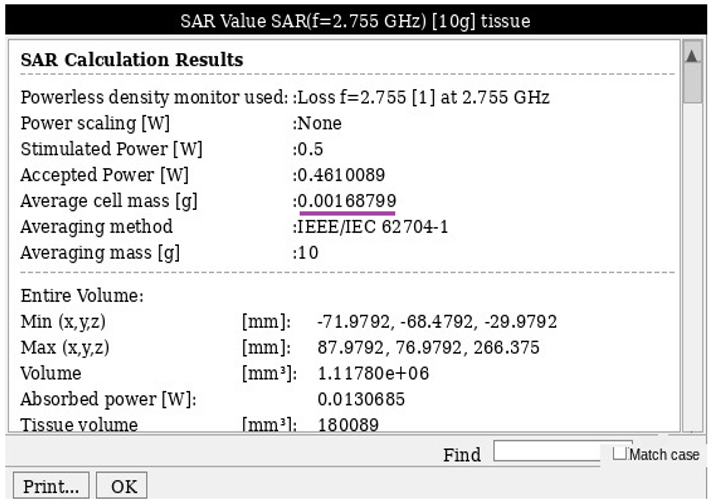
Figure 11. Specific absorption rate (SAR) report of the proposed antenna at flat condition
Figure 12. Specific absorption rate (SAR) report of the proposed antenna at bending condition
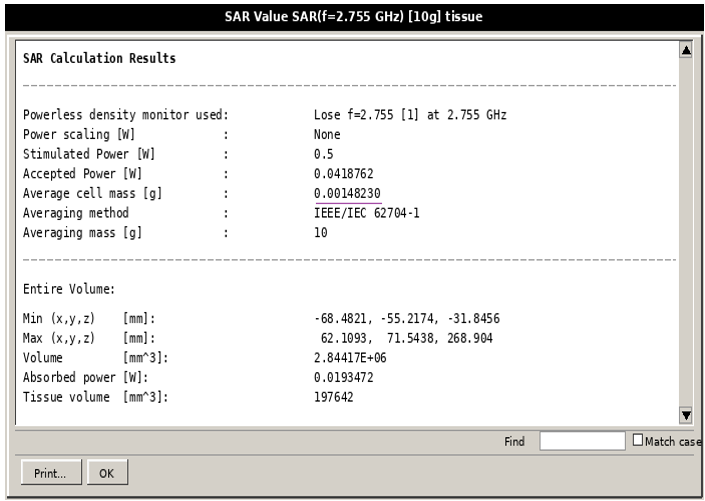
Figure 13. Specific absorption rate (SAR) report of the proposed antenna at near body condition
The simulated performance analysis of the proposed wearable notch antenna designed on a Teflon substrate demonstrates an exceptionally low SAR value of 0.0016 W/kg under flat condition. The SAR values obtained under bending and near-body conditions are 0.0014 W/kg and 0.0017 W/kg, respectively. The corresponding SAR distributions are depicted in Figures 11, 12, and 13. The results demonstrate that the SAR values under all investigated conditions remain within the acceptable safety range.
Furthermore, the proposed antenna successfully combines efficient radiation characteristics with excellent biocompatibility and user safety. The low electromagnetic interaction with body tissues reduces potential health risks and improves user comfort during prolonged operation. Therefore, the simulated SAR results validate that the wearable notch antenna is an appropriate candidate for modern biomedical devices, where both high communication performance and strict safety considerations are equally important.
The proposed wearable notch antenna operating at 2.755 GHz was evaluated and compared with previously reported biomedical antennas from the literature and it is displayed in Table 3. The proposed antenna exhibits a SAR value of 0.0016 W/kg. Compared with the referenced studies, the proposed antenna demonstrates extremely low SAR characteristics suitable for biomedical applications. Although a few existing designs show slightly better return loss values, the proposed antenna overall has a good return loss of -19.95 dB, indicating effective impedance matching. It has a high gain of 5.05 dBi, this value is higher than all other existing antennas except [9].
Table 3. Comparative analysis of the proposed antenna with existing literature
|
Ref. |
Frequency (GHz) |
Substrate Material |
Flexibility |
Return Loss (dB) |
Gain (dBi) |
SAR (W/kg) |
|
[1] |
2.4 |
RT/duroid 5880 |
Semi-Flexible |
- |
2.50 |
6 |
|
[2] |
2.45 |
FR4 |
Rigid |
−23.22 |
- |
- |
|
[9] |
5.8 |
Jeans |
Flexible |
NA |
5.11 |
0.693 |
|
[10] |
5.8 |
PTFE (PolytetraFluoroethylene) |
Flexible |
- |
4.72 |
0.027 |
|
[18] |
2.85-10.85 |
Liquid crystal polymer |
Flexible |
- |
3 |
1.06 |
|
[21] |
2.402 |
Rogers RT/Duroid 6010LM |
Semi-Flexible |
−22 dB |
−28 |
0.385 |
|
Proposed |
2.755 |
Teflon |
Flexible |
−19.95 |
5.05 |
0.0016 |
In conclusion, the biomedical applications favor the proposed wearable notch antenna based on a Teflon substrate. A VSWR of 1.223 in the simulated results at 2.755 GHz indicates effective power transmission and appropriate impedance matching. The antenna's calculated SAR value of 0.0016 W/kg shows that it only exposes human tissues to a small amount of electromagnetic radiation. This value falls well within the established safety range. The return loss of -19.95 dB confirms low reflection losses and effective impedance matching. Additionally, the antenna's ability to efficiently radiate in the intended direction is demonstrated by its directivity of 6.773 dBi and gain of 5.05 dBi. The overall results of the simulation show that it could be used in secure and safe environments for wearable biomedical applications.
[1] Smida, A., Iqbal, A., Alazemi, A.J., Waly, M.I., Ghayoula, R., Kim, S. (2020). Wideband wearable antenna for biomedical telemetry applications. IEEE Access, 8: 15687-15694. https://doi.org/10.1109/ACCESS.2020.2967413
[2] Sukhija, S., Sarin, R.K. (2017). A U-shaped meandered slot antenna for biomedical applications. Progress in Electromagnetics Research M, 62: 65-77. https://doi.org/10.2528/PIERM17082101
[3] Le, T.T., Yun, T.Y. (2020). Miniaturization of a dual-band wearable antenna for WBAN applications. IEEE Antennas and Wireless Propagation Letters, 19(8): 1452-1456. https://doi.org/10.1109/LAWP.2020.3005658
[4] Musa, U., Shah, S.M., Majid, H.A., et al. (2023). Design and analysis of a compact dual-band wearable antenna for WBAN applications. IEEE Access, 11: 30996-31009. https://doi.org/10.1109/ACCESS.2023.3262298
[5] Geyikoglu, M.D. (2023). A novel UWB flexible antenna with dual notch bands for wearable biomedical devices. Analog Integrated Circuits and Signal Processing, 114(3): 439-450. https://doi.org/10.1007/s10470-023-02146-y
[6] Lakrit, S., Das, S., Ghosh, S., Madhav, B.T.P. (2020). Compact UWB flexible elliptical CPW-fed antenna with triple notch bands for wireless communications. International Journal of RF and Microwave Computer-Aided Engineering, 30(7): e22201. https://doi.org/10.1002/mmce.22201
[7] Zhao, Z., Zhang, C., Lu, Z., et al. (2023). A miniaturized wearable antenna with five band-notched characteristics for medical applications. IEEE Antennas and Wireless Propagation Letters, 22(6): 1246-1250. https://doi.org/10.1109/LAWP.2022.3228177
[8] Modak, S., Daasari, S., Shome, P.P., Khan, T. (2022). Switchable/tunable band-notched characteristics in UWB and UWB-MIMO antennas: A comprehensive review. Wireless Personal Communications, 128: 2131-2154. https://doi.org/10.1007/s11277-022-10036-1
[9] Anuragi, K., Ranjan, P. (2025). Investigation of a compact and flexible UWB antenna with low SAR for wearable IoT health monitoring applications. International Journal of Communication Systems, 38(5): 1. https://doi.org/10.1002/dac.70246
[10] Ziani, D., Mokaddem, A., Mohammed, B., Rouissat, M., Merahi, B., Lorenz, P. (2025). High effective flexible microstrip antenna with PTFE (Polytetrafluoroethylene) substrate for SAR applications under sub-6 GHz band. Biomedical Materials and Devices, 4: 2358-2368. https://doi.org/10.1007/s44174-025-00389-z
[11] Panda, S., Gupta, A., Acharya, B. (2020). Wearable microstrip patch antennas with different flexible substrates for health monitoring system. Materials Today: Proceedings, 45(4): 4002-4007. https://doi.org/10.1016/j.matpr.2020.09.127
[12] Abdulkareem, S.B., Ramasamy, K. (2025). A flexible wideband wearable CPW antenna for WBAN application. Frequenz, 79(3-4): 127-134. https://doi.org/10.1515/freq-2024-0142
[13] Jiang, Z.H., Brocker, D., Sieber, P.E., Werner, D.H. (2014). A compact, low-profile metasurface-enabled antenna for wearable medical body-area network devices. IEEE Transactions on Antennas and Propagation, 62(8): 4021-4030. https://doi.org/10.1109/TAP.2014.2327650
[14] Kisioglu, H. (2025). Design, performance, and SAR analysis of a low-profile metamaterial-integrated UWB antenna for wireless body area networks. International Journal of Numerical Modelling: Electronic Networks, Devices and Fields, 38(6): e70133. https://doi.org/10.1002/jnm.70133
[15] Zahran, S.R., Abdalla, M.A., Gaafar, A. (2019). New thin wide-band bracelet-like antenna with low SAR for on-arm WBAN applications. IET Microwaves, Antennas and Propagation, 13(8): 1219-1225. https://doi.org/10.1049/iet-map.2018.5801
[16] Ferreira, D., Pires, P., Rodrigues, R.G., Caldeirinha, R.F.S. (2017). Wearable textile antennas: Examining the effect of bending on their performance. IEEE Antennas and Propagation Magazine, 59: 54-59. https://doi.org/10.1109/MAP.2017.2686093
[17] De, A., Roy, B., Bhattacharya, A., Bhattacharjee, A.K. (2021). Bandwidth-enhanced ultra-wide band wearable textile antenna for various WBAN and Internet of Things (IoT) applications. Radio Science, 56(11): 1-16. https://doi.org/10.1029/2021RS007315
[18] Du, C., Yang, Z., Zhong, S. (2022). A compact coplanar waveguide-fed band-notched four-port flexible ultra-wide band-multi-input-multi-output slot antenna for wireless body area network and Internet of Things applications. International Journal of RF and Microwave Computer-Aided Engineering, 32(9): e23289. https://doi.org/10.1002/mmce.23289
[19] Ahmad, J., Hashmi, M., Bakytbekov, A., Falcone, F. (2024). Design and analysis of a low profile millimeter-wave band Vivaldi MIMO antenna for wearable WBAN applications. IEEE Access, 12: 70420-70433. https://doi.org/10.1109/ACCESS.2024.3401865
[20] Zhu, S., Langley, R.J. (2009). Dual-band wearable textile antenna on an EBG substrate. IEEE Transactions on Antennas and Propagation, 57(4): 926-935. https://doi.org/10.1109/TAP.2009.2014527
[21] Shabana, A., El-Bakry, A., Mahdy, S. (2025). Implantable antenna for biomedical applications: Electromagnetic, SAR, and thermal performance evaluation. Scientific Reports, 15: 35404. https://doi.org/10.1038/s41598-025-21600-7