Jaya S. Mane | Snehal Bhosale* | Shabana Urooj
© 2025 The authors. This article is published by IIETA and is licensed under the CC BY 4.0 license (http://creativecommons.org/licenses/by/4.0/).
OPEN ACCESS
In today’s digital world, there is a growing demand for safe and accurate authentication. This leads biometric authentication to become an important part of an identity verification system. Traditional unimodal biometric verification systems, such as fingerprint, face, or iris recognition, struggle with accuracy due to noisy input images and spoofing attacks. To overcome these issues, this study presents a multimodal biometric recognition framework that combines fingerprint and iris traits using a deep learning approach. Fingerprint features are extracted using a custom Convolutional Neural Network (CNN), while iris features are obtained from a ResNet50 backbone. Each modality is classified independently, and the final identity prediction is produced through score-level fusion of the softmax outputs. The system is evaluated on a multimodal dataset comprising paired fingerprint and iris samples from the same individuals, with an 80:20 train–test split. The unimodal fingerprint and iris classifiers achieved accuracies of 89.4% and 92.1%, respectively, whereas the fused system reached 96.8% with improved precision, recall, and F1-scores. Cross-validation further confirmed the stability of the multimodal results. The findings show that combining complementary biometric traits strengthens recognition performance and reduces the errors observed in unimodal systems, demonstrating the practical advantage of deep learning-driven fusion in biometric authentication.
iris recognition, Convolutional Neural Network, deep learning, feature extraction, feature-level fusion, ResNet50, score-level fusion, fingerprint recognition
For digital services such as e-governance, online banking, and access control systems, person identification has become an important security feature. Traditional authentication methods as passwords and tokens, have security issues such as theft, duplication, and memorability. On the other hand, as a biometric system is purely based on a person’s physiological and behavioral features proven to be a more secure and convenient way of authentication [1]. For biometric authentication, various physical and behavioral characteristics of individuals are collected and processed to build the system. Over a period of time, different biometric modalities-based recognition systems like face recognition [2], palmprint recognition [3], iris recognition [4], and handwritten signature recognition [5] have been developed.
Fingerprint and iris are found to be more universal, permanent, and distinct among the various other biometric modalities [6]. Performance of unimodal biometric systems that are based on one biometric modality only is often affected due to noisy data, non-universality of the feature, and sample misrepresentation. These systems are also exposed to spoofing attempts easily [7]. This leads to the need for a more robust system. A multimodal biometric system resolves these issues by considering multiple modalities for authentication system development.
As a multimodal biometric system integrates the information from multiple biometric features, it improves reliability, reduces error, and increases resistance to attacks [8, 9]. Advancements in deep learning frameworks support efficient extraction of complex features and representation. In fingerprint, iris, and face recognition systems, Convolutional Neural Networks (CNNs) and pretrained models like ResNet predict better performance [10, 11]. The implementation of deep learning methods and effective fusion techniques in multimodal biometric systems is still in an evolving phase to face challenges related to unimodal systems [12, 13].
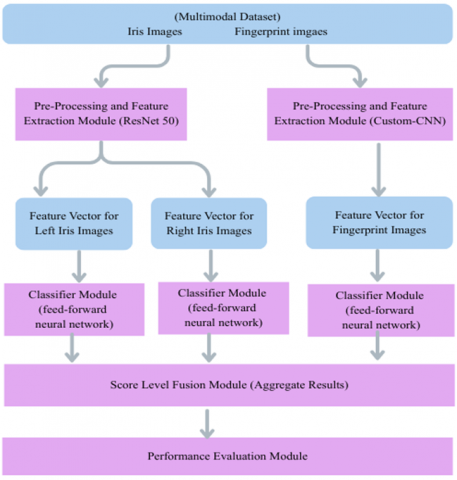
In this study, we propose a deep learning based multimodal biometric authentication system which uses fingerprint and iris modalities of the same person. Iris feature extraction is carried out using the ResNet50 model pretrained on ImageNet, whereas fingerprint features are extracted using a custom CNN. Each modality has undergone an independent classifier module after the feature extraction. A score level fusion is applied to combine the results produced after classification, and the final prediction is done. The proposed system is examined on a multimodal dataset of fingerprint and iris images. The outcomes are compared with the unimodal systems. Results show that a multimodal approach attains higher accuracy, precision, recall, and robustness, hence confirming the effectiveness of a deep learning based fusion approach for a multimodal biometric verification system.
The contributions of this work are as follows:
1) Design and implement a multimodal biometric system to combine fingerprint and iris modalities using a deep learning framework.
2) Development of a custom CNN for fingerprints and ResNet50 for iris images for robust representation of biometric features.
3) Apply a score-level fusion strategy to combine classifier outputs and improve recognition performance.
4) Evaluate the system using accuracy, precision, recall, F1-score, and ROC analysis, along with comparative analysis against unimodal systems.
The proposed system introduces a high security authentication approach by applying deep learning models to address the limitations of unimodal systems.
El-Rahiem et al. [14] proposed a multimodal biometric authentication approach using ECG signals and finger vein biometric images and applying deep fusion techniques. It improves the reliability and security of the system by combining biometric modalities using a deep learning framework. Singh et al. [15] provided large-scale authentication services. By integrating finger knuckle print and fingernail data using a deep learning-based system,
Heidari and Chalechale [16] highlighted the importance of multimodal techniques and demonstrated how several characteristics can improve overall authentication performance. Using bio-hashing techniques, Singh et al. [17] have suggested a safe template creation method for finger dorsal pictures. With a focus on distinct dorsal characteristics, they created the Finger-Dorsal Feature Extraction Net (FDFNet). With Equal Rejection Rates (ERR) of 0.0008%, 0.002%, and 0.003%, respectively, under 64-bit map testing, templates from major knuckles considerably outperformed those from minor knuckles and nails in evaluation on two publicly accessible finger knuckle datasets.
By examining the application of multimodal biometrics in sectors such as banking and law enforcement, Deol et al. [18] expanded the scope of application. Their study developed a scale-invariant transformation feature using fuzzy set exponentially weighted moving averages (FEWWO) combined with water wave optimization (WWO), achieving an impressive accuracy rate of 99.2%. Similarly, Choi et al. [19] developed Blind-Touch, a machine learning and homomorphic encryption-based fingerprint identification system that protects privacy. Their method proved effective for web and cloud-based deployments, with F1-scores of 98.2% on the SOKOTO dataset and 93.6% on the PolyU dataset, with a matching time of 0.65 seconds for a database of 5,000 fingerprints.
Deshmukh and Yannawar [20] made another addition by proposing a hybrid authentication technique that integrates brainwave signals and fingerprint images. The model applied cosine similarity and a Deep Maxout Network and achieved an accuracy of 0.926, a sensitivity of 0.940, an F1-score of 0.921, and a specificity of 0.928. To address the limitations of unimodal systems, Neware et al. [21] developed a multimodal biometric identification model based on facial features, finger knuckle patterns, and iris scans. It improves robustness and reliability.
Li et al. [22] proposed a Robust and Sparse Least Square Regression (RSLSR) architecture for a biometric system that utilizes both the finger vein and finger knuckle print. It shows resistance to spoofing attacks and thus enhance security. The architecture enables robust projection learning, noise decomposition, and discriminant sparse representation. Experimental evaluations on multiple datasets reported recognition accuracies as 93.84% on SDUMLA-fv, 99.85% on Data-fv, 86.08% on PULSVein-Contactless, 93.52% on PolyU-fkp, and 99.84% on Data-fkp.
Kumar et al. [23] developed the SU-NBO-driven ERMOTMBA model, based on fingerprints, palm prints, and finger vein images, which uses median filtering. By further combining Deep Belief Networks, CNNs, and Bi-LSTM architectures for feature-level fusion, backed by ensemble classification, resulting in an overall recognition accuracy of 95.20%.
The proposed structure combines fingerprint and iris modalities into a multimodal biometric recognition system based on deep learning. The goal is to take advantage of these characteristics' complementary nature in order to get around the drawbacks of unimodal systems and offer more trustworthy authentication. The design of the system involves five major stages: dataset organization, preprocessing, feature extraction, classification, and fusion of modality-specific decisions.
3.1 System architecture
The overall workflow of the system is depicted in Figure 1. It begins with the acquisition of fingerprint and iris samples, followed by preprocessing to normalize the data for uniform input representation. Feature extraction is carried out using deep learning architectures designed specifically for each modality: a custom CNN for fingerprint images and a pretrained ResNet50 model for iris images. The extracted feature vectors are passed through independent classifiers, and the final decision is obtained using a score-level fusion scheme.
Figures 2 and 3 illustrate a sample fingerprint and iris image, respectively, of user 1 from the dataset. For each individual, the database contains 10 fingerprint images—one for each finger—and a total of 10 iris images, comprising 5 scans of the left eye and 5 scans of the right eye. All images are captured and systematically stored to ensure comprehensive biometric coverage for every user.
3.2 Dataset preparation
The dataset used in this study consists of fingerprint and iris images collected from multiple individuals. Each sample set contains grayscale fingerprint images, left iris images, and right iris images. To ensure fairness across modalities, the number of samples per class is truncated to the minimum available, thereby balancing the dataset. Labels are assigned to individuals, ranging from 0 to N–1, where N is the number of subjects. The dataset is partitioned into training (80%) and testing (20%) subsets, and labels are one-hot encoded for classification.
The dataset used here is freely available and can be downloaded from Kaggle [24]. The dataset contains iris and fingerprint biometric samples collected from 45 individuals. For each subject, five high-resolution iris images are provided for the left eye and five for the right eye, capturing the fine textural patterns unique to each iris. In addition, the dataset includes ten fingerprint images per individual, representing all ten fingers with one scan per finger. These fingerprint samples preserve distinctive ridge structures that are commonly used in authentication and security applications.
Figure 1. System architecture
Figure 2. Sample fingerprints of all fingers of the left hand of user 1
Figure 3. Sample right and left iris of user 1
3.3 Pre-processing
Fingerprint images are resized to 128×128 pixels and converted to grayscale, ensuring consistency in input dimensions for the CNN. Iris images are resized to 224×224 pixels in RGB format, matching the input requirements of ResNet50. Standard preprocessing steps, such as normalization, are applied to enhance model training stability.
3.4 Feature extraction
A custom CNN is developed for extracting discriminative features from fingerprint images. The network comprises multiple convolutional and pooling layers, followed by dense layers that transform the features into a fixed-length vector. The architecture can be summarized as:
The proposed fingerprint feature extraction approach is based on a custom CNN architecture, as shown in Figure 4, specifically designed to automatically identify and extract meaningful features directly from raw fingerprint images. The model is structured with two convolutional blocks, where each block includes a convolutional layer followed by a ReLU activation function and a max-pooling operation. These layers progressively reduce the spatial resolution of the input while enhancing the depth of the extracted features. 32 3×3 filters are used in the first block, and 64 filters of the same size are used in the second block. After that, the feature maps are compressed into a one-dimensional vector and fed through a layer of 128 neurons that is fully connected. As the last feature vector, this dense representation is appropriate for tasks like matching or classification. The architecture creates a compact and discriminative representation that provides dependable identification performance by methodically recording fine-grained fingerprint patterns.
Figure 4. Custom Convolutional Neural Network (CNN) architecture for fingerprint feature extraction
This CNN design effectively balances accuracy and computational efficiency for fingerprint processing by extracting hierarchical features that progress from simple ridge textures to more complex minutiae patterns, enabling the network to learn highly discriminative representations. The final Dense layer produces a compact 128-dimensional embedding that is robust and suitable for tasks such as fingerprint comparison, classification, or seamless fusion with other biometric modalities like iris features.
The iris images are processed using a ResNet50 model pretrained on the ImageNet dataset. The classification head is removed, and the output from the convolutional base is flattened to obtain feature representations. The system can capture rich, high-level representations of iris textures because of this transfer learning technique, which eliminates the need for intensive training from the beginning.
3.5 Classification
Independent feed-forward classifiers made up of the following layers process the feature vectors derived from the two modalities.:
The classifier consists of three fully connected layers: the first Dense layer with 256 neurons uses a ReLU activation function and is followed by a Dropout layer with a 0.3 rate to reduce overfitting; the second Dense layer contains 128 neurons with ReLU activation to further refine the learned feature representation; and the final Dense layer uses a Softmax activation function with N neurons, where N is the number of classes, to generate normalized probability scores for each class and produce the final prediction.
The Adam optimizer and categorical cross-entropy loss are used to individually train each classifier across 30 epochs. Each modality can learn discriminative representations independently of the others because of this modular approach.
3.6 Score-level fusion
After classification, the softmax probability distributions from the fingerprint, left iris, and right iris classifiers are aggregated to produce the final decision. The fusion process is defined as shown in Eq. (1).
${{Y}_{fused~}}=\frac{{{Y}_{fp~}}+{{Y}_{left~}}+{{Y}_{right}}}{3}$ (1)
These denote the predicted probability vectors from the respective classifiers. The final identity is determined as shown in Eq. (2).
${{Y}_{final}}=argmax\left( {{Y}_{fused}} \right)$ (2)
In the score-level fusion method, the modality's matching score is calculated separately. A system with a score-level fusion method is easily extendible by adding an identification score for the new modality. It is the widely used fusion method over other fusion techniques. The feature-level fusion method combines different features extracted from various modalities and forms a single template. It removes noise during this process, but the system is not easily extendible. It generates computational overload for further extension of the system considering the new modality [12].
3.7 Evaluation metrics
The system is evaluated using a comprehensive set of performance measures, including:
This combination of metrics provides a detailed assessment of the multimodal system compared to unimodal baselines.
4.1 Unimodal performance
To establish a baseline, unimodal biometric systems were evaluated individually for fingerprint and iris modalities. The fingerprint classifier, trained using the custom CNN architecture, achieved a recognition accuracy of 89.4%, while the iris classifier based on ResNet50 achieved 92.1%. Precision, recall, and F1-scores also followed a similar trend, with iris outperforming fingerprint due to the richer textural features available in iris patterns. However, both unimodal systems demonstrated limitations when tested with noisy or partially degraded samples, confirming the inherent weaknesses of single-modality approaches.
4.2 Multimodal system performance
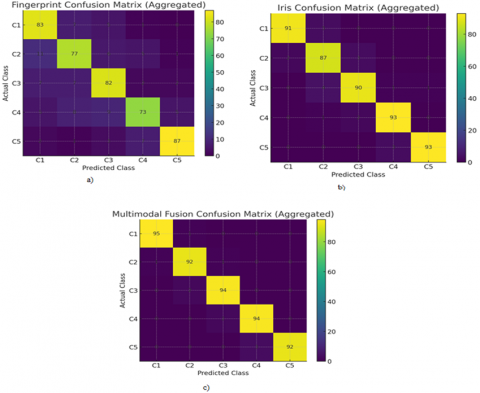
The proposed multimodal biometric recognition system combined fingerprint and iris features through score-level fusion. The multimodal model achieved a recognition accuracy of 96.8% with consistently high precision, recall, and F1-score, which is significantly higher than the unimodal baselines as shown in Figure 5.
In comparison to unimodal systems, the confusion matrix further demonstrated a decrease in misclassification rates as shown in Figure 6. Aggregated confusion matrix for the fingerprint classifier shows notable cross-class confusion, particularly between C2–C3 and C3–C4, caused by partial impressions and low-contrast ridge features. Aggregated confusion matrix for the iris classifier displays strong diagonal dominance with occasional errors due to off-angle captures or segmentation imperfections. Aggregated confusion matrix for the multimodal fusion system illustrates significantly reduced misclassification and enhanced class separation, confirming the benefit of using both modalities together.
These outcomes demonstrate how well score-level fusion integrates complementary biometric features. Through the use of softmax scores instead of raw features, the system was able to reduce deficiencies and balance modality-specific strengths. This demonstrates how well the suggested method handles variances in biometric data in the actual world.
To evaluate the stability of the system, a 5-fold cross-validation procedure was performed for all three models. As shown in Table 1, the fingerprint classifier achieved an average accuracy of 89.4% with a standard deviation of 1.7%, while the iris classifier reached 92.1% ± 1.1%. The multimodal system demonstrated the highest stability, with an average accuracy of 96.8% and a standard deviation of 0.7%. Similar patterns were observed across precision, recall, F1-score, and AUC values, where the multimodal system consistently outperformed the unimodal counterparts with noticeably lower variance. These results indicate that combining modalities not only improves accuracy but also produces more reliable predictions across folds.
Figure 5. System performance
Table 1. Cross validation
|
Model |
Accuracy Mean |
Accuracy SD |
Precision Mean |
Precision SD |
Recall Mean |
Recall SD |
F1 Mean |
F1 SD |
AUC Mean |
AUC SD |
|
Fingerprint |
89.4 |
1.7 |
88.2 |
1.9 |
87.6 |
2.1 |
87.9 |
1.8 |
0.91 |
0.015 |
|
Iris |
92.1 |
1.1 |
91.4 |
1.3 |
91.0 |
1.2 |
91.2 |
1.1 |
0.94 |
0.012 |
|
Multimodal |
96.8 |
0.7 |
96.1 |
0.8 |
95.9 |
0.9 |
96.0 |
0.7 |
0.98 |
0.006 |
4.3 Comparative analysis with existing systems
To further assess the effectiveness of the proposed approach, its results were compared with those of similar studies that were included in the survey. Cherrat et al. [25] based on facial biometrics, finger veins, and fingerprints show a 99.49% accuracy rate with decision-level fusion. Mustafa et al. [26] used GLCM with KNN and decision rules for an iris-fingerprint system that attains 95% accuracy. Gavisidappa et al. [27] integrated face, iris, and fingerprint and achieved 97.09% accuracy with handcrafted features and a Multi-SVM classifier. Aizi and Ouslim [28] based on an iris-fingerprint fusion system revealed 95% accuracy by using fuzzy logic and decision trees.
Figure 6. Aggregated confusion matrix for a) fingerprint, b) iris and c) the multimodal fusion system
Table 2. Comparative analysis with existing systems
|
System |
Modalities Used |
Method |
Accuracy (%) |
|
Cherrat et al. [25] |
Face, Finger Veins, Fingerprint |
Decision-level fusion |
99.49 |
|
Mustafa et al. [26] |
Iris, Fingerprint |
GLCM + KNN + Decision Rules |
95.00 |
|
Gavisidappa et al. [27] |
Face, Iris, Fingerprint |
Handcrafted Features + Multi-SVM |
97.09 |
|
Aizi and Ouslim [28] |
Iris, Fingerprint |
Fuzzy Logic + Decision Tree |
95.00 |
|
Proposed System (2025) |
Iris, Fingerprint |
CNN + ResNet50 (Deep Learning) + Score-Level Fusion |
96.8 |
The performance of the proposed framework was compared with several multimodal systems reported in recent literature, as shown in Table 2. Systems combining three modalities (e.g., fingerprint, finger vein, and face) reported higher accuracies exceeding 99%, which is expected given the additional biometric information available. Methods relying on handcrafted features or traditional classifiers achieved varied performance between 95% and 97%, largely influenced by dataset characteristics and sensitivity to acquisition conditions.
In contrast, the proposed model uses only two modalities and operates on a dataset with fewer samples per subject, yet still achieves 96.8%, which places it near the top of existing two-modality systems. The use of deep feature extraction (CNN for fingerprints and ResNet50 for iris) provides stronger generalization than handcrafted features, which often depend heavily on illumination consistency and sensor type. The comparative results show that the proposed framework achieves a favorable balance between model complexity, dataset requirements, and recognition accuracy.
To overcome the limitations of unimodal biometric systems, this work is based on a multimodal biometric dataset comprising iris and fingerprint samples from the same individuals. It employed a deep learning based approach. Feature extraction is done by a custom CNN and ResNet50 from fingerprint and iris images, respectively. Two distinct modalities were classified using feed-forward neural networks. A score-level fusion technique was then used to integrate the outputs, resulting in a 96.8% recognition accuracy. The accuracy, precision, recall, F1-score, and robustness to noisy inputs significantly outperformed those of unimodal systems. According to a comparison analysis with earlier studies, the proposed methodology enables the flexibility and adaptability of deep learning models while reaching competitive performance, in contrast to traditional handcrafted feature extraction strategies that are often dataset-specific. The findings demonstrate that the proposed framework provides a reliable solution for secure authentication in real-world applications such as border control, e-governance, and high-security access systems.
The system can be expanded in future studies by incorporating more biometric modalities, such as voice, face, or ear, and by looking at more intricate fusion strategies, like attention-based fusion mechanisms or hybrid feature–score fusion. Additional testing on larger and more diverse datasets is therefore necessary to assess scalability and generalization, even though real-time deployment studies might provide insights into performance in real-world scenarios with different surroundings and acquisition limits. Last but not least, the use of explainable AI techniques will enable a thorough and deployable multimodal biometric authentication framework, enhancing interpretability and confidence in biometric judgment.
[1] Daas, S., Yahi, A., Bakir, T., Sedhane, M., Boughazi, M., Bourennane, E. (2021). Multimodal biometric recognition systems using deep learning based on the finger vein and finger knuckle print fusion. IET Image Processing, 14(15): 3859-3868. https://doi.org/10.1049/iet-ipr.2020.0491
[2] Abdulameer, M.H., Kareem, R. (2023). Face identification approach using Legendre moment and singular value decomposition. International Journal of Computing and Digital Systems, 13(1): 1-15. http://doi.org/10.12785/ijcds/130132
[3] Bachay, F.M., Abdulameer, M.H. (2022). Hybrid deep learning model based on autoencoder and CNN for palmprint authentication. International Journal of Intelligent Engineering & Systems, 15(3): 488-499. http://doi.org/10.22266/ijies2022.0630.41
[4] Mohammed, R.T., Kaur, H., Alankar, B., Chauhan, R. (2022). Recognition of human iris for biometric identification using Daugman’s method. IET Biometrics, 11(4): 304-313. https://doi.org/10.1049/bme2.12074
[5] Hafs, T., Bennacer, L., Boughazi, M., Nait-Ali, A. (2016). Empirical mode decomposition for online handwritten signature verification. IET Biometrics, 5(3): 190-199. https://doi.org/10.1049/iet-bmt.2014.0041
[6] Sayeed, F., Ahmed, K.R., Swamy, S.M. (2025). Development of a multimodal biometric recognition system with feature optimization and deep learning. Multimedia Tools and Applications, 84: 38399-38422. https://doi.org/10.1007/s11042-025-20709-1
[7] Prerna, P., Indora, S., Atal, D.K. (2025). Multi-modal biometric system: Technological applications and future trends. In 2025 3rd International Conference on Self Sustainable Artificial Intelligence Systems (ICSSAS), Erode, India, pp. 573-583. https://doi.org/10.1109/ICSSAS66150.2025.11080766
[8] Sumalatha, U., Prakasha, K.K., Prabhu, S., Nayak, V.C. (2025). Multimodal biometric authentication: A novel deep learning framework integrating ECG, fingerprint, and finger knuckle print for high-security applications. Engineering Research Express, 7(1): 015207. http://doi.org/10.1088/2631-8695/ad9aa0
[9] Nagamani, K., Geethika, K., Snehith, P., Manas, G. (2025). Deep learning approach for multimodal biometric recognition system based on face, iris and finger vein traits. International Journal on Sciences and Technology, 16(2). http://doi.org/10.71097/ijsat.v16.i2.5843
[10] Hattab, A., Behloul, A. (2024). Face-iris multimodal biometric recognition system based on deep learning. Multimedia Tools and Applications, 83: 43349-43376. https://doi.org/10.1007/s11042-023-17337-y
[11] Kadhim, O.N., Abdulameer, M.H., Al-Mayali, Y.M.H. (2024). A multimodal biometric system for iris and face traits based on hybrid approaches and score level fusion. BIO Web of Conferences, 97: 00016. https://doi.org/10.1051/bioconf/20249700016
[12] Mane, J.S., Bhosale, S. (2023). Advancements in biometric authentication systems: A comprehensive survey on internal traits, multimodal systems, and vein pattern biometrics. Revue d’Intelligence Artificielle, 37(3): 709-718. https://doi.org/10.18280/ria.370319
[13] Mane, J.S., Bhosale, S. (2024). Synergistic approaches in multimodal biometric authentication with machine learning and deep learning paradigms. International Journal of Intelligent Systems and Applications in Engineering, 12(18s): 587-596. https://ijisae.org/index.php/IJISAE/article/view/5006.
[14] El-Rahiem, B.A., El-Samie, F.E.A., Amin, M. (2022). Multimodal biometric authentication based on deep fusion of electrocardiogram (ECG) and finger vein. Multimedia Systems, 28: 1325-1337. https://doi.org/10.1007/s00530-021-00810-9
[15] Singh, A., Vashist, C., Gaurav, P., Nigam, A. (2022). A generic framework for deep incremental cancelable template generation. Neurocomputing, 467: 83-98. https://doi.org/10.1016/j.neucom.2021.09.055
[16] Heidari, H., Chalechale, A. (2022). Biometric authentication using a deep learning approach based on different level fusion of finger knuckle print and fingernail. Expert Systems with Applications, 191: 116278. https://doi.org/10.1016/j.eswa.2021.116278
[17] Singh, A., Arora, A., Patel, S.H., Jaswal, G., Nigam, A. (2019). FDFNet: A secure cancelable deep finger dorsal template generation network secured via. bio-hashing. In 2019 IEEE 5th International Conference on Identity, Security and Behavior Analysis (ISBA), Hyderabad, India, pp. 1-9. https://doi.org/10.1109/ISBA.2019.8778520
[18] Deol, G., Priyadarsini, P.I., Nallagattla, V.G., Amarendra, K., Seelam, K., Latha, B.R.A. (2024). A multimodal face and fingerprint authentication system using fuzzy set exponential water wave optimization. Journal of the Institution of Engineers (India): Series B, 105: 1743-1756. https://doi.org/10.1007/s40031-024-01073-4
[19] Choi, H., Woo, S.S., Kim, H. (2024). Blind-touch: Homomorphic encryption-based distributed neural network inference for privacy-preserving fingerprint authentication. Proceedings of the AAAI Conference on Artificial Intelligence, 38(20): 21976-21985. https://doi.org/10.1609/aaai.v38i20.30200
[20] Deshmukh, R., Yannawar, P. (2024). Deep learning based person authentication system using fingerprint and brain wave. International Journal of Computational and Digital Systems, 15(1): 723-739. https://doi.org/10.12785/ijcds/150153
[21] Neware, S., Jain, S., Singh, S., Badri, U., Jain, Y., Jadhao, A. (2024). A novel multimodal biometric authentication system based on fusion of face, finger knuckle and iris traits. Grenze International Journal of Engineering and Technology, 2524-2528.
[22] Li, S.Y., Zhang, B., Wu, L.F., Ma, R.J., Ning, X. (2024). Robust and sparse least square regression for finger vein and finger knuckle print recognition. IEEE Transactions on Information Forensics and Security, 19: 2709-2719. https://doi.org/10.1109/TIFS.2024.3352389
[23] Kumar, K.P., Prasad, P.E.S.N.K., Suresh, Y., Babu, M.R., Kumar, M.J. (2024). Ensemble recognition model with optimal training for multimodal biometric authentication. Multimedia Tools and Applications, 83: 63497-63521. https://doi.org/10.1007/s11042-024-18541-0
[24] Mehendale, N. Multimodal_Iris_Fingerprint_Biometric_data. https://www.kaggle.com/datasets/ninadmehendale/multimodal-iris-fingerprint-biometric-data, accessed on Sep. 21, 2025.
[25] Cherrat, E.M., Alaoui, R., Bouzahir, H. (2020). A multimodal biometric identification system based on advanced cascading of fingerprint, finger vein and face images. TELKOMNIKA Indonesian Journal of Electrical Engineering, 17(3): 1562-1570. https://doi.org/10.11591/ijeecs.v17.i3.pp1562-1570
[26] Mustafa, A.S., Abdulelah, A.J., Ahmed, A.K. (2020). Multimodal biometric system iris and fingerprint recognition based on fusion technique. International Journal of Advanced Science and Technology, 29(3): 7423-7432.
[27] Gavisiddappa, G., Mahadevappa, S., Patil, C.M. (2019). Multimodal biometric authentication system using modified ReliefF feature selection and multi support vector machine. International Journal of Intelligent Engineering and Systems, 13(1): 1-12. https://doi.org/10.22266/ijies2020.0229.01
[28] Aizi, K., Ouslim, M. (2022). Score level fusion in multi-biometric identification based on zones of interest. Journal of King Saud University - Computer and Information Sciences, 34(1): 1498-1509. https://doi.org/10.1016/j.jksuci.2019.09.003