
Laksanee Boonkhao* | Chiraporn Labcom | Chutamas Sangsuk | Rungsinee Boonthon | Julaporn Khumrat | Pharadee Thongworn | Supawan Hongsrimuang | Manoon Yawanopas | Kitthiwat Pongpattarasirikul | Pongsak Rattanachaikunsopon | Krittiya Karun
© 2026 The authors. This article is published by IIETA and is licensed under the CC BY 4.0 license (http://creativecommons.org/licenses/by/4.0/).
OPEN ACCESS
Thailand developed the Road Safety Organization (RSO) tool in 2024. This cross-sectional descriptive study assessed RSO implementation, barriers, and support needs among 135 enterprises with at least 50 employees in Ubon Ratchathani and Si Sa Ket Provinces, Thailand. One staff member responsible for road safety represented each enterprise. Data were collected using an online questionnaire and analyzed using descriptive statistics. Overall, 56 respondents (41.5%) selected RSO Level 1 or higher for their enterprises in an unverified self-assessment. Responses to individual practice questions were partly inconsistent with these selections; therefore, the proportion of enterprises meeting all cumulative RSO criteria could not be determined. Road safety policies were reported by 62.2% of enterprises, helmet or seatbelt requirements by 71.9%, compliance monitoring by 53.3%, and communication channels by 68.9%. However, only 43.0% had road safety manuals, 28.1% had responsible committees, 31.9% allocated dedicated funding, and 34.8% conducted program monitoring and evaluation. Major barriers included the absence of designated personnel (52.6%) and limited funding (45.9%). Common support needs included helmets (91.2%), training (89.6%), operational guidelines (88.1%), and implementation monitoring (86.7%). RSO implementation remained incomplete, particularly in formal governance, resource allocation, and systematic evaluation. Practical guidance, training, technical assistance, and organizational resources are needed to support sustainable implementation.
Road Safety Organization, road traffic, injury, prevention, enterprises
The World Health Organization has reported that approximately 1.19 million people die in traffic accidents globally each year. Many individuals sustain injuries in vehicle crashes, with some suffering disabilities as a result [1, 2]. This highlights the severe impact of traffic accidents on public health and underscores the need for improved road safety measures. Statistically, men are three times more likely than women to die in vehicle-related accidents. Furthermore, road accidents impose a significant financial burden on the economy, costing about 3% of a country's gross domestic product (GDP). The United Nations General Assembly has set a challenging goal, which is to reduce the number of deaths and injuries from road accidents by half by the year 2030 [3].
Thailand ranks ninth in the world for traffic accidents [4]. The death rate from traffic accidents from 2021 to 2023 was 26.55, 24.09, and 21.99 per 100,000 population, respectively [5]. Data from the Road Safety Information Center, as of April 20, 2026, showed that the cumulative number of road accident fatalities in 2026 was 4,360. Of those deaths, 83% were caused by motorcycles, and 58.28% of those fatalities were in the working-age group (25–60 years) [6]. The main causes of road accidents were speeding; drunk driving; driving while drowsy; the poor condition of vehicles and equipment; environmental factors, such as slippery roads; pedestrians cutting in front of vehicles, and failures of signal traffic lights and road signs [7]. In Northeastern Thailand, road accidents continue to be a recurring problem. Data from the Thai Road Accident Information Center (ThaiRSC) indicated that in 2025, Ubon Ratchathani Province had a total of 18,507 injuries and 214 deaths, while Si Sa Ket Province had approximately 8,990 injuries and 225 deaths. In both provinces, over 40% of accidents had occurred among working-age individuals aged 25–60, and more than 90% of these accidents had involved motorcycles [8]. Accidents predominantly affect working-age individuals, who are mainly employed across both public and private sectors, as well as in local enterprises. In 2024, Ubon Ratchathani Province recorded a total of 5,537 enterprises that employed over 61,676 people [9]. In Si Sa Ket Province, in 2024, there were a total of 4,402 establishments employing over 56,665 people [10].
Previous studies have found that organizations with effective road safety practices can help to reduce road accidents among their employees [11-13]. Jacobsen et al. observed twenty-seven significant risk factors for road crashes, categorized into six domains, including one focused on organizational aspects [14]. Guibert et al. conducted a study which demonstrated that compared to other drivers, on-duty drivers had a lower risk of being held accountable for accidents [15].
Thailand developed the Road Safety Organization (RSO) tool in 2024 through the Provincial Road Safety Action Plan Support Project with the support of the Thai Health Promotion Foundation. The goal was to empower organizations and enterprises to take the lead in road safety by systematically managing the travel risks of their employees. The developed RSO tool is aligned with the Thai Ministry of Labor's regulations regarding safety management standards, B.E. 2565, which requires establishments with 50 or more employees to establish safety management standards comprising policy definition, safety organization management, plan development, plan evaluation and review, and continuous improvement of the system. However, the RSO tool provides a systemic perspective on preventing and resolving road accidents, comprising five levels: commitment, operation, oversight and support, safety culture, and safety network. This involves upgrading the capabilities of personnel to effectively implement the RSO tool. The aim is to promote sustainable behavioral changes and reduce undesirable incidents, especially among high-risk groups such as motorcycle users [16, 17], night shift/overtime workers [18], and delivery/service drivers [19, 20].
Given the continuing burden of road traffic injuries among working-age populations and the recent introduction of the RSO framework in Thailand, information regarding its implementation in enterprises remains limited. This study therefore aimed to assess the implementation status and individual components of the RSO framework among enterprises in Ubon Ratchathani and Si Sa Ket Provinces, Northeastern Thailand. It also described the barriers encountered by enterprises and their needs for support in implementing organizational road safety measures. The findings are expected to provide baseline information for government agencies, organizational leaders, and occupational safety personnel to plan practical guidance, training, technical assistance, and resource support for the progressive and sustainable implementation of the RSO framework.
This research was a cross-sectional descriptive study. Data were collected from February to April 2026 using a Google Forms questionnaire administered to personnel responsible for road safety management in enterprises in Ubon Ratchathani and Si Sa Ket Provinces, Northeastern Thailand.
2.1 The population and sample
The population consisted of representatives responsible for road safety in enterprises in Ubon Ratchathani and Si Sa Ket Provinces with 50 or more employees. This included 165 enterprises in Ubon Ratchathani Province and 38 enterprises in Si Sa Ket Province, totaling 203 individuals from 203 enterprises.
The sample group was determined using the following formula for calculating population proportions:
$n=\frac{N Z^2 a / 2[p(1-p)]}{\left[e^2(N-1)\right]+\left[Z^2 \frac{a}{2} p(1-p)\right]}$
where,
n = sample size
N = population (203 eligible enterprises)
Zα/2 = the coefficient under the standard normal curve at a 95-confidence level, Zα/2 = 1.96
p = 0.50 represents the assumed proportion
e = the precision of the estimate (0.05)
Because no reliable previous estimate of the proportion of enterprises implementing the RSO system was available, a proportion of 0.50 was used to provide the most conservative sample-size estimate.
$n=\frac{(203)\left(1.96^2\right)[(0.5)(1-0.5)]}{\left[0.05^2(203-1)\right]+\left[1.96^2(0.5(1-0.5)]\right.}=133.04$
The calculated sample size for the study was 133 enterprises. Following eligibility screening, the final analytical sample comprised 135 enterprises, exceeding the minimum required sample size of 133 enterprises.
Convenience sampling was used to recruit representatives from enterprises in Ubon Ratchathani and Si Sa Ket Provinces. A total of 183 questionnaires were initially received through Google Forms. Following eligibility screening, 48 questionnaires from enterprises with fewer than 50 employees were excluded because they did not meet the predefined eligibility criterion. The final analytical sample therefore comprised 135 respondents, each representing one eligible enterprise with 50 or more employees. All analyses were conducted using data from these 135 enterprises.
2.2 Research tools
There were three sections to the questionnaire:
Section 1 collected general information about the respondents and their enterprises. The respondents were personnel responsible for road safety management within their enterprises. This section comprised 16 closed-ended questions concerning respondent characteristics and enterprise profiles.
Section 2 assessed RSO implementation in the participating enterprises. It consisted of 10 closed-ended questions concerning specific road safety practices, including policies, manuals, management structures, safety activities, risk assessment, resource allocation, monitoring and evaluation, and communication processes. These 11 questions were used to describe individual RSO implementation components and were not used to calculate the enterprise’s overall RSO level.
A separate item asked respondents to select the highest RSO level they considered their enterprise to have achieved after reviewing 16 reference criteria across five cumulative levels: Level 1, Commitment (four criteria); Level 2, Operational Implementation (five criteria); Level 3, Oversight and Support (four criteria); Level 4, Safety Culture (one criterion); and Level 5, Safety Network (two criteria). Respondents could also select “not implemented.” The resulting level was an overall self-assessment. The separate questions on individual road safety practices did not cover all 16 criteria and were analyzed descriptively; they were not used to verify or recalculate the selected level. Thus, the reported levels do not represent independently confirmed compliance with the cumulative criteria. The reference criteria presented to respondents are shown in Table 1.
Section 3 assessed the barriers to RSO implementation and the support needs of participating enterprises. It comprised six closed-ended questions concerning implementation barriers and nine closed-ended questions concerning the types of support required for effective and sustainable RSO implementation.
The content validity was examined by three experts, and the Item Objective Congruence (IOC) Index ranged from 0.67 to 1.00.
Table 1. Road Safety Organization (RSO) reference criteria presented to respondents for the overall self-assessment
|
RSO Implementation Status/Level |
Criteria |
Assessment Criteria |
|
Not implemented |
The respondent considers that the enterprise has not completed all Level 1 criteria. |
Classified as not having implemented the RSO system. |
|
Level 1: Commitment |
1. Establishment of a road safety policy 2. Availability of a road safety manual 3. Establishment of an RSO committee and designation of responsible personnel 4. Development of personnel competencies in the knowledge and skills necessary for RSO implementation |
The enterprise must complete all four indicators. |
|
Level 2: Operational Implementation |
1. Development of road safety indicators 2. Risk assessment 3. Development of a risk-control plan 4. Budget allocation 5. Implementation of the operational plan |
The enterprise must complete all five Level 2 indicators and must have completed all Level 1 indicators. |
|
Level 3: Oversight and Support |
1. Risk control and monitoring 2. Road safety communication within the organization 3. Evaluation and review of operations 4. Continuous improvement and development |
The enterprise must complete all four Level 3 indicators and must have completed all indicators required for Levels 1 and 2. |
|
Level 4: Safety Culture |
1. Implementation of activities to promote and enhance road safety awareness |
The enterprise must complete the Level 4 indicator and must have completed all indicators required for Levels 1–3. |
|
Level 5: Safety Network |
1. Establishment of a road safety committee or working group involving the organization and community or network partners 2. Establishment of a community road safety management system |
The enterprise must complete both Level 5 indicators and must have completed all indicators required for Levels 1–4. |
2.3 Data collection and analysis
Data collection was carried out by individuals responsible for road safety within the enterprise organizations, such as safety officers or human resource officers. They entered the Office of Labor Protection and Welfare in each province under the guidance of labor protection and welfare officers to complete the Google Forms questionnaire. Before the fieldwork started, all of the research assistants completed a standardized training to ensure that they all would use the surveys in the same way and would follow ethical guidelines.
Continuous variables were summarized using means and standard deviations, while categorical variables were summarized using frequencies and percentages. For multiple-response items, each response option was analyzed separately, and the percentages may not sum to 100%.
3.1 General characteristics
The average age of the respondents was 35.37 years (SD = 8.84). Of the respondents, 86.7% held a bachelor’s degree, and 46.7% worked as safety officers, the average work experience in their organizations was 8.74 years (SD = 7.65). Regarding the establishments located in Ubon Ratchathani Province, 61.5% had more than 100 employees, and 28.9% of them were retail/wholesale enterprises. Of the employees, 80.7% commuted to work by car, followed by motorcycles (76.3%). Regarding off-work driving accidents, 71.9% reported incidences among employees in the past three years, resulting in fatalities and permanent disabilities (6.2% and 3.1%, respectively). Work-related road traffic accidents involving employees during the previous three years were reported by 44.4% of enterprises, with 3.3% of these accidents resulting in fatalities and 3.3% leading to disabilities. Of the workplaces, 80.7% had encouraged their employees to obtain motorcycle or car driving licenses, while 75.6% had promoted the purchase of mandatory motor vehicle insurance. In these workplaces, 63.0% had initiated projects that were related to preventing and controlling traffic accidents, and 79.3% had conducted road traffic injury prevention campaigns, of which morning talks were the most frequently reported communication method (72.0%) (Table 2).
Table 2. The general characteristics (n = 135)
|
General Characteristics |
Numbers |
Percentages |
|
General information of the respondents |
||
|
Age (years): Mean = 35.37, S.D. = 8.84, Minimum = 23, Maximum = 58 |
||
|
Educational level |
||
|
Secondary education |
3 |
2.2 |
|
Vocational certificate / Higher vocational certificate |
9 |
6.7 |
|
Bachelor’s degree |
117 |
86.7 |
|
Higher than bachelor’s degree |
6 |
4.4 |
|
Current position |
||
|
Safety officer (Safety/EHS) |
63 |
46.7 |
|
Human resources (HR) |
30 |
22.2 |
|
Executive/Manager |
2 |
1.5 |
|
Administrative/ Office staff member |
9 |
6.7 |
|
Accounting/Finance |
6 |
4.4 |
|
Technical/Engineering |
6 |
4.4 |
|
Academic/Specialist |
7 |
5.2 |
|
Others |
12 |
8.9 |
|
Work experience in the enterprise (years): Mean = 8.74, S.D. = 7.65, Minimum = 1, Maximum = 33.0 |
||
|
Enterprise information |
||
|
Location of the enterprise |
|
|
|
Ubon Ratchathani Province |
104 |
77.0 |
|
Si Sa Ket Province |
31 |
23.0 |
|
Number of employees in the enterprise (persons) |
||
|
50 – 99 |
52 |
38.5 |
|
≥100 |
83 |
61.5 |
|
Types of enterprises |
||
|
Retail/Wholesale |
39 |
28.9 |
|
Manufacturing industry |
36 |
26.7 |
|
Construction/Engineering |
7 |
5.2 |
|
Utilities |
11 |
8.2 |
|
Automotive/Machinery |
15 |
11.1 |
|
Service/Hotel |
4 |
3.0 |
|
Healthcare/Medical services |
8 |
5.9 |
|
Transportation/Logistics |
6 |
4.4 |
|
Finance/Banking |
1 |
0.7 |
|
State Enterprise |
8 |
5.9 |
|
The commuting methods of the employees (multiple responses were allowed) |
||
|
Walking |
19 |
14.1 |
|
Motorcycle |
103 |
76.3 |
|
Car |
109 |
80.7 |
|
Public transportation |
10 |
7.4 |
|
Others |
3 |
2.2 |
|
Employees’ experiences of non-work-related accidents within the past 3 years |
||
|
Never |
38 |
28.1 |
|
Yes |
97 |
71.9 |
|
Impacts on employees, who had experienced non-work-related accidents (multiple responses were allowed) (n = 97) |
||
|
Minor injuries (first aid required) |
77 |
79.4 |
|
Hospital admission |
67 |
69.1 |
|
Disability |
3 |
3.1 |
|
Death |
6 |
6.2 |
|
Others |
7 |
7.2 |
|
Employees’ experience of work-related accidents within the past 3 years |
||
|
Never |
75 |
55.6 |
|
Yes |
60 |
44.4 |
|
Impacts on employees who experienced work-related accidents (multiple responses were allowed) (n = 60) |
||
|
Minor injuries (first aid required) |
38 |
63.3 |
|
Hospital admission |
29 |
48.3 |
|
Disability |
2 |
3.3 |
|
Death |
2 |
3.3 |
|
Others |
6 |
10.0 |
|
Campaign to encourage employees to acquire a motorcycle/car driving license |
||
|
No |
26 |
19.3 |
|
Yes |
109 |
80.7 |
|
Promotion of motor vehicle accident victim protection insurance (compulsory insurance) |
||
|
No |
33 |
24.4 |
|
Yes |
102 |
75.6 |
|
Implementation of projects related to road traffic accident prevention and control |
|
|
|
No |
50 |
37.0 |
|
Yes |
85 |
63.0 |
|
Implementation of campaign activities to promote road traffic accident prevention and control |
||
|
No |
28 |
20.7 |
|
Yes (Communication Methods) (multiple responses were allowed) |
107 |
79.3 |
|
Morning talks |
77 |
72.0 |
|
Toolbox talks |
8 |
7.5 |
|
KYT (Kiken Yochi Training) |
28 |
26.2 |
|
Notice boards/Public relations signs |
64 |
59.8 |
|
Public address system |
10 |
9.3 |
|
Others |
14 |
13.1 |
3.2 Implementation of the Road Safety Organization in the enterprises
In the overall self-assessment, 56 of 135 respondents (41.5%) selected Level 1 or higher as the highest RSO level achieved by their enterprise, while 79 (58.5%) selected “not implemented.” These classifications were based on respondents’ selections and were not independently verified against all 16 criteria, with 62.2% instituting policies to prevent and control traffic accidents, 43.0% using road safety manuals, and 28.1% appointing committees to be responsible for the work. Moreover, 71.9% had established regulations requiring their personnel to wear helmets or seatbelts at all times; 53.3% were checking for the wearing of helmets or seatbelts at all times while riding or driving; 43.0% had assessed the risk of transportation routes related to the company's core business, and 15.6% had assessed the risk related to employees' shuttle routes. With regard to the funding, 31.9% of the budget had been allocated to preventing and controlling road traffic accidents, 34.8% to monitoring the project/activity and evaluation, and 68.9% to establishing communication channels that could assist in preventing and controlling road traffic accidents (Table 3).
Table 3. Road Safety Organization (RSO) implementation among participating enterprises (n = 135)
|
Characteristics |
Numbers |
Percentages |
|
Respondent-selected overall RSO status |
||
|
Not implemented |
79 |
58.5 |
|
Level 1 or higher reported |
56 |
41.5 |
|
RSO level selected among 56 respondents |
|
|
|
Level 1: Commitment |
11 |
19.6 |
|
Level 2: Operational implementation |
18 |
32.1 |
|
Level 3: Oversight and support |
12 |
21.5 |
|
Level 4: Safety culture |
10 |
17.9 |
|
Level 5: Safety network |
5 |
8.9 |
|
Presence of a road traffic injury prevention and control policy |
||
|
No |
51 |
37.8 |
|
Yes |
84 |
62.2 |
|
Availability of a road safety manual |
||
|
No |
77 |
57.0 |
|
Yes |
58 |
43.0 |
|
Establishment of a responsible Road Safety Committee |
||
|
No |
97 |
71.9 |
|
Yes |
38 |
28.1 |
|
Enforcement of helmet or seatbelt usage for personnel while driving |
||
|
No |
38 |
28.1 |
|
Yes |
97 |
71.9 |
|
Monitoring of personnel compliance with helmet or seatbelt usage during driving |
||
|
No |
63 |
46.7 |
|
Yes |
72 |
53.3 |
|
Conduct of risk assessment for work-related transportation routes |
||
|
No |
77 |
57.0 |
|
Yes |
58 |
43.0 |
|
Risk assessment of the employees’ transportation routes |
||
|
No |
46 |
34.0 |
|
Yes |
21 |
15.6 |
|
Not applicable |
68 |
50.4 |
|
Allocation of funding for road traffic injury prevention and control |
||
|
No |
92 |
68.1 |
|
Yes |
43 |
31.9 |
|
Monitoring and evaluation of road safety programs or activities |
||
|
No |
88 |
65.2 |
|
Yes |
47 |
34.8 |
|
Availability of communication channels for road traffic injury prevention and control |
||
|
No |
42 |
31.1 |
|
Yes |
93 |
68.9 |
3.3 Barriers and support needs for implementing Road Safety Organization measures in the enterprises
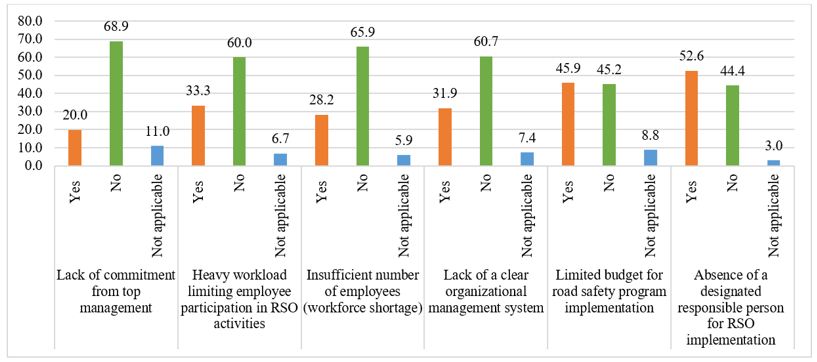
The most frequently reported barrier was the absence of a designated person responsible for RSO implementation (52.6%), followed by a limited budget for road safety programs (45.9%). Other reported barriers were heavy workloads that limited employee participation (33.3%), the lack of a clear organizational management system (31.9%), an insufficient number of employees (28.2%), and a lack of commitment from top management (20.0%) (Figure 1).
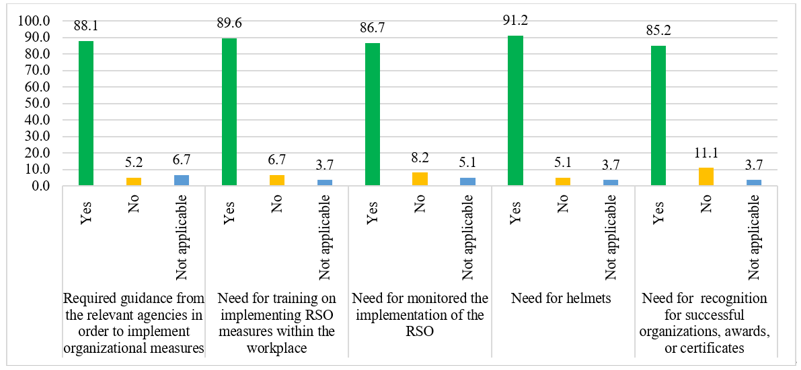
Regarding the most frequently reported need was the provision of helmets (91.2%), followed by training on workplace RSO measures (89.6%), guidance from relevant agencies on implementing organizational measures (88.1%), monitoring of RSO implementation (86.7%), and recognition through awards or certificates (85.2%) (Figure 2).
Figure 1. The barriers to implementing Road Safety Organization (RSO) in the enterprises
Figure 2. The support needs for implementing Road Safety Organization (RSO) in the enterprises
4.1 General characteristics of respondents and enterprises
The results indicated that the majority of respondents had moderate work experience and were well-educated, safety-related professionals (86.7% had bachelor's degrees). Despite these findings, a significant percentage of workers commuted by vehicles (80.7%) and motorbikes (76.3%), while 71.9% reported accidents unrelated to their jobs. This indicated a pattern of high-risk travel in Thailand, which is in line with regional and worldwide data showing motorcycle riders to be the most vulnerable demographic for traffic-related injuries, especially in Southeast Asia [21-23]. Furthermore, both work-related and non-work-related accidents were substantial, suggesting that daily commuting practices carry risks to road safety beyond occupational exposure. This reflected earlier studies that highlighted the need for an integrated approach to employee road safety that extends beyond work-related travel [15, 24, 25]. Despite being relatively low, the existence of fatalities and impairments highlighted the seriousness of the results, which were in line with statistics from throughout the world and indicate that road traffic injuries have a major impact on mortality, disability, and economic burden [26-28].
4.2 The results of the implementation of the Road Safety Organization in enterprises
In the overall self-assessment, 41.5% of respondents selected Level 1 or higher for their enterprises. This proportion represents perceived implementation status and should not be interpreted as the proportion independently confirmed to meet all cumulative RSO criteria. Individual practice responses showed uneven implementation: 62.2% reported a road safety policy, whereas 43.0% reported a manual, 28.1% a responsible committee, and 31.9% dedicated funding. This pattern suggests that RSO implementation was uneven across its organizational components, particularly in relation to formal governance and resource allocation, which is consistent with earlier research demonstrating that it is necessary to have operational frameworks and resource allocation, as well as formal policies [13, 14]. On a positive note, behavioral enforcement strategies including monitoring (53.3%) and helmet/seatbelt regulations (71.9%) were comparatively higher. Behavior-related measures were reported more frequently than formal system-level governance measures. However, the descriptive design does not permit conclusions regarding why these differences occurred, which is in line with data showing that behavioral safety initiatives are frequently put into place earlier since they are less costly and complicated [12]. However, risk assessment and program monitoring and evaluation were reported by fewer than half of the participating enterprises, indicating areas where systematic road safety management could be strengthened. This is consistent with international research advocating risk assessment and ongoing monitoring in road safety management systems [3, 14].
4.3 The results of the barriers and support needs for Road Safety Organization implementation
The survey found a number of organizational and structural obstacles, including a lack of accountable staff members (52.6%), small budgets (45.9%), unclear management procedures (31.9%), and workload restrictions (33.3%). These results indicated that organizational preparedness is still inadequate, particularly with regard to resource allocation and governance. Similar challenges have been documented in the literature on occupational safety, in which it was revealed that the implementation of safety systems is hampered by a lack of financial backing and leadership commitment [11, 13]. The high reported need for training (89.6%), guidance from relevant agencies on implementing organizational measures (88.1%), and monitoring of RSO implementation (86.7%) indicated that enterprises may require additional technical support, as well as direction. This illustrates the necessity of multi-sectoral approaches, as stressed by the WHO, wherein government, organizations, and communities must coordinate in order to ensure road safety [3].
The high reported needs for helmet provision and vehicle maintenance suggest that some enterprises may require additional basic road safety resources, supporting the notion that management flaws co-exist with gaps in infrastructure and equipment. Additionally, the high need for employee feedback systems emphasizes the significance of having a safety culture that is participatory, which is in line with research demonstrating that participation from staff members greatly enhances safety compliance and results [12].
This study has several limitations. First, convenience sampling was used; therefore, the participating enterprises may not be representative of all eligible enterprises in the two provinces. Second, the overall RSO level was self-reported and could not be retrospectively validated against all 16 cumulative criteria. Some aggregate responses to the individual practice questions were inconsistent with the reported levels. For example, 56 respondents selected Level 1 or higher, although only 38 reported a responsible road safety committee in the separate practice question; likewise, 45 selected Level 2 or higher, although only 43 reported allocating funding. These discrepancies may reflect differences in how respondents interpreted the questions or inaccuracies in self-reporting, but the available data do not permit us to determine their causes or correct the classifications. Consequently, the proportion of enterprises that actually fulfilled each RSO level cannot be established from this study. Third, the descriptive cross-sectional design does not permit assessment of causal relationships or independent determinants of RSO implementation. Nevertheless, the findings provide useful baseline information regarding implementation status, barriers, and support needs in the participating enterprises.
This study provides a descriptive assessment of RSO implementation among 135 enterprises with 50 or more employees in Ubon Ratchathani and Si Sa Ket Provinces, Thailand. Although 56 respondents (41.5%) selected Level 1 or higher, this figure represents an unverified self-assessment rather than confirmed attainment of the RSO criteria. The individual practice responses identified gaps in manuals, responsible committees, budget allocation, and program evaluation. Future assessments should collect responses to every criterion and verify reported levels using organizational records.
The reported barriers included limited management prioritization, heavy workloads, workforce shortages, unclear management systems, limited funding, and the absence of designated personnel responsible for RSO implementation. Enterprises also reported needs for practical guidelines, training, follow-up support, protective equipment, vehicle maintenance, improved infrastructure, and collaboration with relevant agencies.
These findings indicate that RSO implementation remains incomplete across many participating enterprises. Strengthening implementation should emphasize completion of the sequential RSO indicators, beginning with organizational commitment and progressing toward operational implementation, oversight and support, safety culture, and safety networks. Government agencies and organizational leaders should provide practical guidance, technical assistance, training, and adequate resources to support sustainable implementation. Future studies should use probability sampling, independently validated RSO measures, and appropriately powered multivariable or longitudinal designs to examine determinants and changes in RSO implementation over time.
We extend our appreciation to the staff members of the enterprises in Ubon Ratchathani Province and Si Sa Ket Province, as well as to the Thai Health Promotion Foundation (Grant No.: 67-00583-20) and Ubon Ratchathani University for financial support of this project.
[1] Thaw, W.E.E., Phanprasit, W., Amnatsatsue, K., Bunnagamchairat, A., Bundhamcharoen, K. (2020). Using disability-adjusted life years to assess the burden of road traffic injuries in Nay Pyi Taw, Myanmar. medRxiv preprint. https://doi.org/10.1101/2020.04.26.20080325
[2] Khalaf, M.K., Rosen, H.E., Mitra, S., et al. (2023). Estimating the burden of disability from road traffic injuries in 5 low- and middle-income countries: Protocol for a prospective observational study. JMIR Research Protocols, 12: e40985. https://doi.org/10.2196/40985
[3] World Health Organization. (2026). Road traffic injuries. https://www.who.int/news-room/fact-sheets/detail/road-traffic-injuries.
[4] Thailand Development Research Institute (TDRI). (2025). Review of road traffic injury and fatality statistics in Thailand, 2021–2023. https://tdri.or.th/road-safety/.
[5] Department of Disease Control (TH). (2024). Road traffic accident situation in Thailand. Nonthaburi: Ministry of Public Health. https://www.ddc.moph.go.th/dip/journal_detail.
[6] Thai RSC. (2026). Road accident report data for the past 24 hours, as of April 20, 2026, at 08:00. https://www.thairsc.com/.
[7] Ministry of Transport of Thailand. (2024). Road traffic accident situation analysis report. https://www.otp.go.th/uploads/tiny_uploads/PDF/2568-02/25022025-Report_RoadAccident-2566.pdf.
[8] Thai RSC. (2026). A comparison of road accident statistics in Thailand. https://www.thairsc.com/data-compare.
[9] Ubon Ratchathani Provincial Statistical Office. (2024). Number of establishments and employees in 2024. https://ubon.nso.go.th/reports-publications/provincial-statistics-report/ubon-ratchathani-province-statistics-report-2025.html.
[10] Si Sa Ket Provincial Statistical Office. (2024). Number of establishments and employees in 2024. https://sisaket.nso.go.th/reports-publications/provincial-statistics-report/sisaket-provincial-statistical-report-2567.html.
[11] Byrnes, K.P., Rhoades, D.L., Williams, M.J., Arnaud, A.U., Schneider, A.H. (2022). The effect of a safety crisis on safety culture and safety climate: The resilience of a flight training organization during COVID-19. Transport Policy, 117: 181-191. https://doi.org/10.1016/j.tranpol.2021.11.009
[12] Sajithkumar, S.K. (2023). The importance of safety management practices in reducing accidents. International Journal of Scientific Development and Research, 8(3): 493-496.
[13] Bakar, H., Rusli, R., Adinegoro, Y., Baharudin, M.R. (2025). Enhancing workplace road safety through the work-related road safety support program. Environment-Behaviour Proceedings Journal, 10(34): 237-242. https://doi.org/10.21834/e-bpj.v10i34.7364
[14] Jakobsen, M.D., Seeberg, K.G.V., Møller, M., et al. (2023). Influence of occupational risk factors for road traffic crashes among professional drivers: Systematic review. Transport Reviews, 43(3): 533-563. https://doi.org/10.1080/01441647.2022.2132314
[15] Guibert, N., Martin, J.L., Gadegbeku, B., Lagarde, E., Charbotel, B. (2024). The risk of road traffic crashes for occupational drivers: A responsibility study with comparison to the general population. Work, 77(2): 511-522. https://doi.org/10.3233/WOR-220578
[16] Möller, H., Senserrick, T., Rogers, K., et al. (2020). Crash risk factors for novice motorcycle riders. Journal of Safety Research, 73: 93-101. https://doi.org/10.1016/j.jsr.2020.02.003
[17] Duri, B. (2025). E-commerce at the last-mile: Media narratives on safety and working conditions of motorcycle delivery drivers. Journal of Infrastructure, Policy and Development, 9(3): 11564. https://doi.org/10.24294/jipd11564
[18] Sirikurnpiboon, S., Wacharasint, S. (2026). Cohort study incidence and risk factors of road traffic accidents among healthcare workers in Bangkok metropolitan area. Journal of the Department of Medical Services, 51(1): 102-109.
[19] Iacobucci, E., McDonald, N.C., Naumann, R.B., Kucera, K.L. (2023). Examining injury trends in parcel delivery drivers in the United States: Challenges and opportunities. American Journal of Industrial Medicine, 66(6): 441-453. https://doi.org/10.1002/ajim.23473
[20] Mao, A., Song, J., Shan, Y. (2025). Investigation of non-fatal occupational injury and their causes among food delivery riders in China. International Journal of Occupational Safety and Ergonomics, 31(3): 640-647. https://doi.org/10.1080/10803548.2025.2455288
[21] Sae-Tae, N., Lim, A., Dureh, N. (2020). Determinants of severe injury and mortality from road traffic accidents among motorcycle and car users in Southern Thailand. International Journal of Injury Control and Safety Promotion, 27(3): 286-292. https://doi.org/10.1080/17457300.2020.1774616
[22] Sapsirisavat, V., Mahikul, W. (2021). Drinking and night-time driving may increase the risk of severe health outcomes: A 5-year retrospective study of traffic injuries among international travelers at a university hospital emergency center in Thailand. International Journal of Environmental Research and Public Health, 18(18): 9823. https://doi.org/10.3390/ijerph18189823
[23] Vinish, V., Chakrabarty, J., Vijayan, S., et al. (2023). Prevalence of road traffic injuries in South East and South Asian region—A systematic review. Journal of Neurosciences in Rural Practice, 14(2): 214-223. https://doi.org/10.25259/jnrp_25_2022
[24] Ponsin, A., Fort, E., Hours, M., Charbotel, B., Denis, M.A. (2020). Commuting accidents among non-physician staff of a large university hospital center from 2012 to 2016: A case-control study. International Journal of Environmental Research and Public Health, 17(9): 2982. https://doi.org/10.3390/ijerph17092982
[25] Kullgren, A., Stigson, H., Rizzi, M., Tingvall, C. (2023). Fatalities in value chains—An attempt to classify road traffic crashes in accordance with the United Nations General Assembly resolution 74/299. Traffic Safety Research, 5: 000027. https://doi.org/10.55329/mcmr2018
[26] James, S.L., Lucchesi, L.R., Bisignano, C., et al. (2020). Morbidity and mortality from road injuries: Results from the global burden of disease study 2017. Injury Prevention, 26(Suppl 2): i46-i56. https://doi.org/10.1136/injuryprev-2019-043302
[27] Xu, Y., Chen, M., Yang, R., Wumaierjiang, M., Huang, S. (2022). Global, regional, and national burden of road injuries from 1990 to 2019. International Journal of Environmental Research and Public Health, 19(24): 16479. https://doi.org/10.3390/ijerph192416479
[28] Gu, D., Ou, S., Liu, G. (2025). Global burden of road injuries and their attributable risk factors from 1990 to 2021: A systematic analysis for the global burden of disease study 2021. Preventive Medicine Reports, 53: 103051. https://doi.org/10.1016/j.pmedr.2025.103051