Ahmed Raad Al-Adhadh* | Muna Saad Ibrahim Alkarkoosh | Talib K.Q Alsheakayree | Hussein Kareem Sultan
© 2026 The authors. This article is published by IIETA and is licensed under the CC BY 4.0 license (http://creativecommons.org/licenses/by/4.0/).
OPEN ACCESS
The mechanical response of stabilized soils to tensile and flexural loading is critical to the durability of geotechnical systems such as pavements, embankments, and slopes. The investigated soils included a poorly graded sandy soil containing 5% fines and a high-plasticity clayey soil composed of 5% sand, 38.61% silt, and 56.39% clay. However, these properties remain insufficiently explored for geopolymer-treated soils. This study evaluates the flexural and tensile behavior of sandy and clayey soils stabilized with a Class C fly ash-based geopolymer under ambient curing conditions. In addition to flexural strength (FS) and indirect tensile strength (ITS), the California Bearing Ratio (CBR) was evaluated to assess bearing performance, and the results were compared with those of soils stabilized with 5% cement. An experimental program was conducted using geopolymer contents of 5-20% for sand and 10-20% for clay, with activator ratios of 0.4 and 0.6 of the fly ash at 28 days. Flexural and ITS were determined using three-point bending and Brazilian tests, while CBR tests assessed subgrade performance. The results show that both strengths increased with increasing geopolymer dose. A similar trend was observed for compressive strength. Strong linear correlations were observed between flexural and compressive strength, with R² values of 0.96 for sand and 0.91 for clay, while ITS was approximately 18% of compressive strength. Soils stabilized with geopolymer outperformed those stabilized with cement in tensile and flexural behavior. At 20% fly ash content, geopolymer-treated sandy soil achieved approximately 59% higher unconfined compressive strength (UCS), 57% higher FS, and 48% higher ITS than soil stabilized with 5% ordinary Portland cement (OPC). A significant increase in CBR was also observed. The results demonstrate the suitability of fly ash-derived geopolymer as a sustainable material for enhancing soil strength and cracking resistance.
fly ash, geopolymer, flexural strength, tensile strength, California Bearing Ratio, soil stabilization
Soil stabilization is widely used to improve the engineering performance of weak soils, enabling them to meet construction requirements. Chemical stabilization with ordinary Portland cement (OPC) and lime has been widely used as a method, as it improves the strength, durability, and workability of the material [1-3]. However, the traditional binders come with a high environmental price tag. Cement manufacturing accounts for about 8-10% of global CO₂ emissions and is also highly energy-intensive [4-6]. These considerations have spurred greater interest in more sustainable stabilization strategies. In this regard, geopolymer can be an alternative technology, as it uses industrial by-products such as fly ash, which are activated by an alkaline solution [7]. The relatively high calcium content (>10%) of the Class C fly ash means that it has cementing and pozzolanic properties that can be used for ambient curing conditions [8].
The compressive strength of geopolymer-stabilized soils has been studied extensively, but there is limited research on tensile and flexural strength (FS) [9-11]. The importance of this gap lies in the fact that many geotechnical structures are subjected to tensile stresses, which may result in cracks and eventually affect their performance [12]. Pavements, embankments, slopes, and subgrades of runways are commonly cracked due to conditions of differential settling, desiccation, and repeated loading. Surface distress commonly occurs as a result of fatigue cracking in pavement layers, particularly near the base of stabilized layers [13]. Two methods of indirect tensile testing and three-point bending are commonly used to assess these behaviors.
Despite limited studies on geopolymer-treated soils, indirect tensile strength (ITS) can be around 10% of unconfined compressive strength for low-calcium systems [14], and geopolymer based on metakaolin exhibited higher tensile performance in comparison to cement-treated soils [15]. Likewise, FS results observed with geopolymer mixtures suggest that they have a very good performance and, at times, lower FS than cement-based stabilization [16].
Along with strength properties, the California Bearing Ratio (CBR) is a common method to determine the suitability of stabilized soils for pavement construction [17]. The CBR values of geopolymer-treated soils in previous studies showed significant improvement, sometimes more than 1000% for clayey soil [18]. Although various studies have been carried out on the compressive strength and durability of geopolymer-stabilized soils, not much research has been done on the flexural and indirect tensile behavior of geopolymer-stabilized soils for Class C fly ash-based systems under ambient-cured conditions. The studies conducted earlier have focused on unconfined compressive strength (UCS) as a major performance parameter, while tensile-related properties regulating crack formation and propagation in embankments, pavements, and subgrades have not been adequately characterized. Moreover, there is little guidance available on the relationships between compressive, flexural, and tensile strengths of geopolymer-treated soils, while a few comparisons with conventional cement stabilization can be found in the literature.
In order to fill these gaps, this study compares the FS, ITS, and CBR of ambient-cured sandy and clayey soils stabilized with a class C fly ash-based geopolymer. It also examines the impact of different amounts of geopolymer, the ratio between activator and soil, and the addition of sand to improve mechanical performance; it correlates unconfined compressive strength/FS/ITS ratios with one another; and it compares the performance between cement-stabilized soils and geopolymer-stabilized soils. The results yield new insights into the cracking resistance and bearing performance of geopolymer-treated soils in pavement and geotechnical applications.
2.1 Materials and sample preparation
This study examined five different types of soil. These included a poorly graded sandy soil with 5% fines and a high-plasticity clayey soil containing 5% sand, 38.61% silt, and 56.39% clay. Three engineered clay mixtures were developed using the base clay with 10%, 20%, and 30% sand, respectively. Table 1 shows the chemical composition of Class C fly ash as precursor material.
Table 1. Chemical compositions of the fly ash using Energy Dispersive Spectroscopy (EDS)
|
Element |
C |
O |
Na |
Mg |
Al |
Si |
S |
K |
Ca |
Fe |
|
Fly Ash |
1.04 |
11.96 |
3.02 |
3.1 |
16.21 |
37.23 |
0.9 |
1.3 |
16.57 |
4.21 |
The values represent normalized weight percentages of detected elements. An alkaline activator solution including sodium hydroxide (NaOH) and sodium silicate (Na₂SiO₃). Based on the AF characterization [19], an empirical Na₂SiO₃/NaOH mass ratio of 2.0 was adopted, which was found to yield promising strength and durability performance of geopolymer-stabilized soft soils with respect to Class C fly ash under ambient curing conditions with this activator composition. This ratio remains constant throughout the study, allowing consistent control of effects caused by the fly ash content, the reactivity of the mixtures, and the type of soil. Soil and fly ash were first mixed dry for 5 min to obtain a uniform binder distribution before preparing specimens. The alkaline activator solution was prepared by mixing NaOH and Na₂SiO₃ for 5 min, followed by 5-10 min at ambient temperature to allow equilibration. Next, water was added to the activator solution to obtain the desired liquid content, and this solution was then slowly added to the dry materials. The mixture was then mixed for an additional 3-5 min until a homogeneous mixture was achieved. All specimens were prepared at the optimum moisture content (OMC), determined from Modified Proctor compaction tests, and compacted to their corresponding target dry density. Specimens were wrapped in plastic bags to limit water loss and retained within the molds for 24 h at room temperature. The specimens were then demoulded and cured in water until the required 28 days of age for testing. Fly ash contents of sandy soil and clayey soil (i.e., 5%, 10%, 15% & 20%). Activators at two different ratios, activator-to-fly ash (AC/FA), namely, 0.4 and 0.6, were studied. In contrast, other specimens of sandy and clayey soils were prepared with 5% cement by dry soil weight for comparison purposes. After 28 days of curing, the specimens were assessed for UCS, FS, and ITS to compare geopolymer-based stabilization with conventional OPC stabilization.
2.2 Experimental program
In order to check the FS, ITS, and CBR of untreated and geopolymer-treated soils at a 28-day curing period, a comprehensive experimental program was conducted. A center-point loading configuration was used for FS tests. Flexural testing of stabilized soil materials was performed according to the experimental protocol established in ASTM D1635 [20]. However, the loading arrangement for this experiment was changed from a third-point loading configuration (as in ASTM D1635 [20]) to three-point bending. The rectangular beam specimens, 35 mm × 35 mm × 140 mm, were supported at both ends and had a clear span length L of 100 mm. A single loading nose at midspan was used to apply a vertical load at a constant crosshead displacement rate of about 1 mm/min to failure [19]. Both load and displacement were measured using a calibrated load cell and a Linear Variable Differential Transformer (LVDT), respectively. FS was determined based on the mid-point loading equation:
$F S=\frac{3 P L}{2 b h^2}$
where, FS is the flexural strength, the applied load at failure in N, the span length (L) in mm, the specimen width (b) in mm, and the specimen thickness (h) in mm.
ITS tests were conducted in accordance with the Brazilian standard NBR 7222 using cylindrical specimens with dimensions of 50 mm in diameter and 100 mm in height. Specimens were subjected to diametric loading at a constant displacement rate of 0.1 mm/min using a uniaxial compression machine. A wide strip loading configuration was used to ensure uniform stress distribution. The ITS was calculated as:
$I T S=\frac{2 P}{\pi h d}$
where, ITS is the indirect tensile strength (MPa), P is the maximum applied load (N), h is the specimen height (mm), and d is the specimen diameter (mm).
Untreated and geopolymer-treated soils were tested for CBR per ASTM D1883 [21]. The specimens were compacted at the OMC and maximum dry density in five layers of 56 blows per layer with a 4.5 kg hammer. The treated specimens were left to cure for 28 days in ambient conditions, and then soaked in water for 4 days before testing. The testing was carried out with a standard CBR testing machine with a 50 kN proving ring.
3.1 Flexural strength
Under three-point bending, all specimens exhibited a predominantly linear load-deflection response up to failure, with no noticeable plastic deformation. Failure occurred abruptly when the tensile stress at the bottom fiber exceeded the tensile capacity of the material, leading to crack initiation and rapid propagation through the beam depth. This brittle failure behavior is typical of stabilized soils and is comparable to that observed in cementitious materials such as concrete [22].
3.1.1 Effect of geopolymer content and soil type
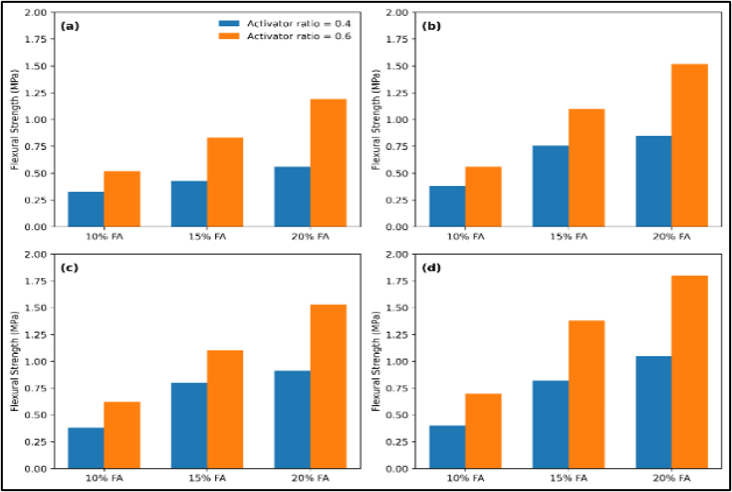
Figures 1 and 2 present the variation in the FS for sandy and clayey soils stabilized with various doses of geopolymer. FS generally increased consistently with increasing fly ash content and activator ratio for all soil types. For sandy soil, FS increased from 0.35 MPa at 5% fly ash to 1.25 MPa at 20% fly ash for the activator ratio of 0.4. At a higher ratio of 0.6, FS further increased from 0.43 MPa to 2.02 MPa over the same range. The improvement at the activator ratio of 0.6 compared to that of 0.4 was approximately 21%, 93%, 56%, and 61% for fly ash contents of 5%, 10%, 15%, and 20%, respectively. For clayey soils, a similar trend was observed. At 20% fly ash and an activator ratio of 0.6, FS values were 1.18 MPa for the untreated clayey soil and increased to 1.52 MPa, 1.56 MPa, and 1.81 MPa for the engineered soils with 10%, 20%, and 30% sand, respectively. Sand significantly increased the FS, with soil containing 30% sand exhibiting approximately 52% higher strength than untreated clayey soil at the same geopolymer content. The observed improvement in FS is likely associated with geopolymerization reactions and the possible formation of calcium silicate hydrate (CSH) and calcium aluminate hydrate (CAH), which may enhance bonding between soil particles and improve the matrix of the stabilized soil [23, 24]. With increasing activator content up to 0.6, the dissolution of fly ash was more complete, which led to the formation of a denser geopolymer structure and higher alkalinity [25]. Sand also adds extra silica to clay soils to form gel, greater particle packing and reduced porosity, and a more stable granular framework to enhance load transfer, all of which are beneficial [26]. In general, these results confirm that geopolymer composition and the percentages of sand in soil significantly influence the flexural properties of stabilized soils, and that the tensile resistance can be significantly enhanced by increasing the ratio of the amount of geopolymer to the amount of soil and by optimizing the percentage of sand content in soil.
Figure 1. Effect of geopolymer composition on flexural strength (FS) behavior of sandy soil
Figure 2. Flexural strength (FS) of geopolymer-stabilized soils as a function of fly ash content and activator-to-fly ash ratio for the four types of soils: (a) clayey soil; (b) clayey soil + 10% sand (S1); (c) clayey soil + 20% sand (S2); and (d) clayey soil + 30% sand (S3)
3.1.2 Correlation with compressive strength
Figure 3 illustrates the relationship between FS and the UCS for all soils stabilized with geopolymer. A strong linear correlation was observed for both sandy and clayey soils, indicating that FS can be reliably predicted from UCS. Similar findings were observed by Do et al. [27]. For sandy soil, the relationship can be expressed as FS = 0.2351 × UCS (R² = 0.96), while for clayey soil, FS = 0.2173 × UCS (R² = 0.91). The slightly higher slope for sandy soil suggests a greater contribution of the granular matrix to flexural resistance [28]. These correlations are particularly useful for practical applications, as UCS is more commonly measured in geotechnical practice, allowing indirect estimation of FS. The obtained FS/UCS ratios (16-18%) are consistent with values reported for cement-stabilized soils [29] and geopolymer-based materials [30], supporting the validity of the present results.
Figure 3. Relationship between unconfined compressive strength (UCS) and flexural strength (FS) of geopolymer-stabilized soils
3.2 Indirect tensile strength
3.2.1 Effect of geopolymer content and soil type
Figures 4 and 5 present the variation in the ITS for sandy and clayey soils stabilized with different geopolymer contents. In general, ITS increased significantly with increasing fly ash and activator dose for all soils. For sandy soil, ITS increased from 0.27 MPa at 5% fly ash to 0.92 MPa at 20% fly ash at an activator ratio of 0.4. At a higher ratio of the activator up to 0.6, ITS further increased from 0.37 MPa to 1.25 MPa for the same range. The improvement of the ITS at 0.6 activator ratio compared to 0.4 ranged from approximately 28% to 37%, highlighting the strong influence of the activator on tensile strength development. For clayey soils, a similar increasing trend was observed. At 20% fly ash and an activator ratio of 0.6, ITS values reached 0.78 MPa for the base clayey soil and increased to 0.84 MPa, 0.86 MPa, and 0.89 MPa for engineered soils with 10%, 20%, and 30% sand, respectively. The tensile strength of the clay slightly improved with sand, changing from about 4% to 10% when added to the base clay. The observed improvements in ITS may be attributed to geopolymerization reactions and the possible development of sodium aluminosilicate hydrate (NASH) and calcium aluminosilicate hydrate (CASH) gels reported in the literature, which may enhance bonding between particles [31]. A higher dose of activator will increase the extent of geopolymerization and, therefore, tensile resistance in sandy soil. Sand added to clayey soils also helps to increase the silica available for gel formation and improves the particle packing, thus increasing the crack resistance, which is less significant than the FS. Overall, it can be seen that the geopolymer composition and soil type both have significant effects on the tensile behavior, with higher activator ratios and optimized sand content leading to greater resistance to crack initiation and propagation.
Figure 4. Effect of fly ash content and activator-to-fly ash ratio on the indirect tensile strength of geopolymer-stabilized sandy soil
Figure 5. Effect of fly ash content and activator-to-fly ash ratio on the indirect tensile strength of geopolymer-stabilized soils: (a) clayey soil; (b) clayey soil + 10% sand (S1); (c) clayey soil + 20% sand (S2); and (d) clayey soil + 30% sand (S3)
3.2.2 Correlation with compressive strength
The relationship between the ITS and the UCS of geopolymer-treated soils is shown in Figure 6. A strong linear correlation was found, with ITS values about 18% of UCS for all combined soil composites (R² = 0.94). This ratio is higher than the normal ratio of about 10% for cemented soils [32] and suggests that geopolymer-stabilized soils have relatively greater tensile properties than compressive properties. This improved tensile behavior is believed to be due to the presence of geopolymer gels, which provide better bonding between particles and contribute to the formation of a more cohesive and crack-free matrix. This property is very useful from a practical point of view, in geotechnical applications where tensile stresses are important, such as pavement base, embankments, and reinforced earth structures.
Figure 6. Relationship between the unconfined compressive strength (UCS) and indirect tensile strength (ITS) of geopolymer-stabilized soils, showing strong linear correlations for clay-based and sand-based composites
3.3 Strength comparison between geopolymer- and ordinary Portland cement-treated soils
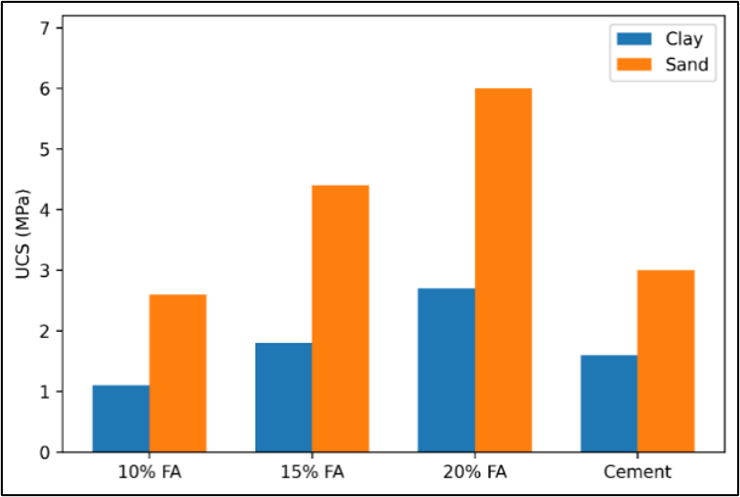
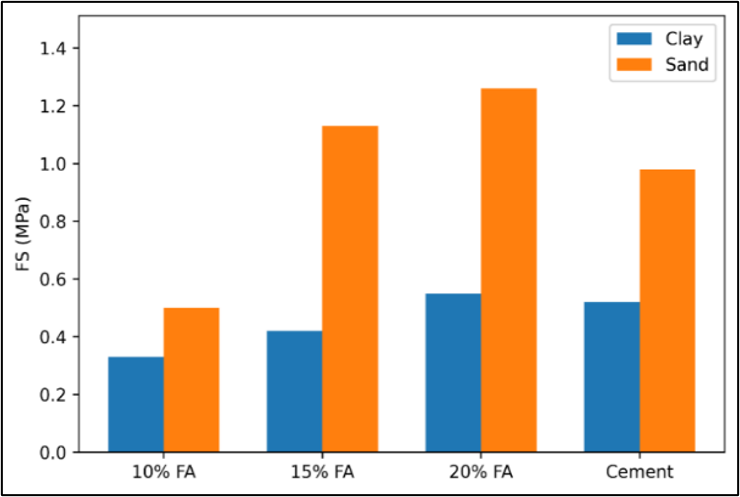
Figures 7-9 compare the UCS, FS, and ITS of geopolymer-treated soils with those of soils stabilized using 5% cement. Geopolymer-treated fly ash content >15% has resulted in improved UCS values compared to the UCS values of the cemented soils. The UCS of geopolymer-treated specimens (6.15 MPa) was about 59% higher than the UCS of cemented soil (3.89 MPa) in the case of sandy soil with 20% fly ash. In the case of clayey soil, geopolymer stabilization with the same amount of fly ash produced 2.68 MPa, which was around 27% higher than that of cemented soil (2.13 MPa). A similar trend was observed for FS. In all cases, the FS value of geopolymer-treated sandy soil remained higher than that of the cemented soil. The FS values for clayey soils were similar to or slightly higher than those of the cemented soils, especially at fly ash concentrations exceeding 15%. The FS of geopolymer-treated soils was about 57% and 22% higher than that of cemented soils for sandy soil and clayey soil, respectively, at 20% fly ash. For ITS, geopolymer-treated soils also demonstrated superior performance compared to cemented soils. The ITS of geopolymer-treated soils increased by about 84% and 28%, respectively, over the values for the corresponding cemented soils, reaching 0.92 MPa and 0.59 MPa at 20% fly ash for sandy soil and clayey soil, respectively.
Figure 7. Comparison of the unconfined compressive strength (UCS) of geopolymer and cement-treated soils
Figure 8. Comparison of flexural strength (FS) of geopolymer and cement-treated soils
Figure 9. Comparison of indirect tensile strength (ITS) of geopolymer and cement-treated soils
These findings are similar to those reported by Wang et al. [33], where geopolymer-treated soils showed higher tensile strength than cement-stabilized soils. The better performance of geopolymer-treated soils may be attributed to the combined effects of pozzolanic and geopolymeric reactions, which likely promote the development of cementitious binding products. The possible formation of CSH and NASH type phases, as reported in previous studies, may enhance bonding between particles and contribute to a denser and more cohesive matrix. Moreover, alkaline activation facilitates a better dispersion of the binder in the soil structure, enabling better development of strength and crack resistance. In general, the findings indicate that geopolymer stabilization is a better alternative than cement, especially in improving tensile-related properties and resistance to cracking, which is greatly important in pavement and geotechnical applications.
3.4 California Bearing Ratio
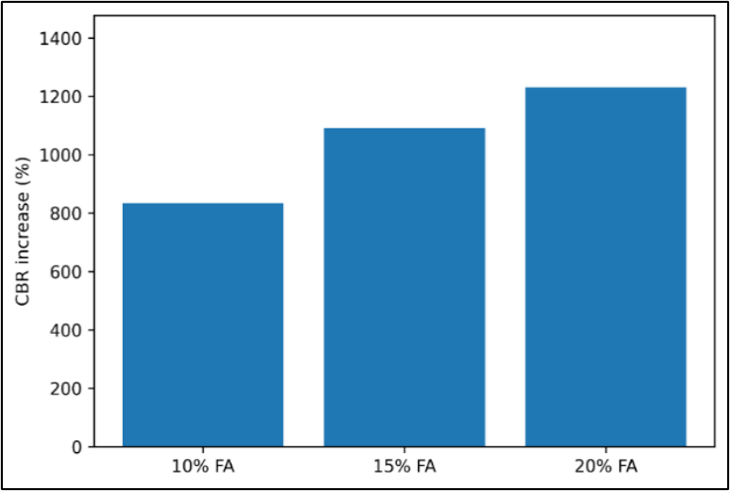
The CBR values of the untreated and treated sandy and clayey soils are shown in Figure 10. An improvement in CBR was observed for both soils when stabilized using geopolymer. Increased CBR values of 10%, 15%, and 20% fly ash content with a 0.4 activator ratio resulted in an increase in untreated CBR value from 22% to 177%, 228%, and 335%, respectively, representing increases of approximately 705%, 936%, and 1422% in CBR values, respectively, for the sandy soil as shown in Figure 11. In the same way, the untreated CBR value for clayey soil was 6.2%, which rose to 60.1%, 77.8%, and 85.9%, respectively, for the same amounts of fly ash, which is equivalent to an increase of about 832%, 1090%, and 1230%, respectively, as shown in Figure 12. The improvement in CBR values is indicative of the improvement in bearing capacity of geopolymer-treated soils. This behavior can be attributed to the formation of cementitious geopolymer gel that binds soil particles, reduces compressibility, and increases stiffness [34]. In addition, improved particle interlocking contributes to greater resistance against penetration under loading [35]. The obtained CBR values significantly exceed the typical requirements for subgrade materials (2-10%) and, in some cases, approach those required for base course materials (80-100%). These findings demonstrate the suitability of geopolymer for pavement applications and suggest the potential for reducing pavement layer thickness, leading to more economical and sustainable designs.
Figure 10. Comparison of California Bearing Ratio (CBR) of geopolymer-treated sandy and clayey soils at different fly ash contents
Figure 11. Increase in California Bearing Ratio (CBR) of geopolymer-treated sandy soil
Figure 12. Increase in California Bearing Ratio (CBR) of geopolymer-treated clayey soil
The improvement in flexural and tensile strength of geopolymer-treated soils can be attributed to microstructural development during the geopolymerization process. Alkaline activation dissolves silica and alumina from fly ash, forming oligomeric species that subsequently polycondense into a three-dimensional aluminosilicate network [36]. In high-calcium Class C fly ash systems, both NASH and CASH gels are formed, resulting in a hybrid binder system. These reaction products fill voids and create strong interparticle bonds, enhancing resistance to tensile separation and increasing the energy required for crack initiation and propagation [37]. The relatively high ITS/UCS ratio further indicates that geopolymer gels are particularly effective in improving tensile performance relative to compressive strength. The incorporation of sand into clayey soils further enhances mechanical behavior through several mechanisms. The presence of sand particles can also contribute silica available for geopolymerization, especially if sufficient activator is available. Further, sand has a beneficial effect on particle packing, and it also reduces the void ratio, creating a denser matrix and hence better load transfer characteristics. Sand is also added to enhance the crack resistance due to the resistance to crack propagation by the micro-aggregates of the sand. This positive effect, however, is very much a function of the activator ratio. The improvement is greater at an activator ratio of 0.6 than at 0.4, indicating that sufficient alkalinity is needed to optimize the activation of both the fly ash surface and the silica-rich sand surface [38]. Engineeringly, the strong correlations found between the FS, ITS, and UCS give practical engineering tools to design. These relationships allow the estimation of tensile and flexural properties from the UCS tests, which makes the material characterization easier and allows for field implementation. In addition, the better performance of geopolymer-treated soils over cemented soils indicates the possibility of using geopolymer as a sustainable alternative binder. The significant increase in the CBR values demonstrates enhanced bearing capacity, indicating suitability for pavement applications. This improvement can enable the reduction of pavement layer thickness, thus creating a more economical and sustainable pavement design. Overall, geopolymer stabilization offers a promising approach for improving both the mechanical performance and environmental sustainability of geotechnical systems.
The FS, ITS, and CBR tests were conducted to assess the strength of sandy and clayey soils stabilized with fly ash geopolymer. The results showed that as the fly ash content and activator ratio increased, the FS and ITS also increased, with the highest values being 2.02 MPa and 1.25 MPa at the activator ratio of 0.6 and fly ash content of 20% in the sandy soil, and 1.18-1.82 MPa and 0.78-0.9 MPa at the same conditions in clayey soil, respectively. Admixture of sand with clayey soils increased the FS by 52% and ITS by 4-11%. There were strong linear correlations between FS, ITS, and UCS, with the value of FS being around 16-18% of UCS and ITS being around 18% of UCS, which is better tensile performance than conventional cemented soils. The mechanical properties of geopolymer-treated specimens were better compared to those of 5% cement, where the UCS increased by 26-58%, FS increased by 21-58%, and ITS increased by 29-49% at 20% content of fly ash. The CBR values were also significantly improved for both sandy and clayey soils, ranging from 22% to 335% and 6.4% to 85.9%, respectively, which are well beyond the normal subgrade requirements and are approaching base course requirements. The beneficial effect of sand content was more pronounced at higher activator ratios, highlighting the importance of adequate alkalinity for effective geopolymerization. The correlations that have been established from a practical standpoint allow the estimation of tensile and flexural properties from UCS, thus simplifying design procedures. In conclusion, the results have shown that geopolymer binders made with Class C fly ash are an effective and sustainable option to traditional binders, with superior mechanical properties and application potential in pavement and geotechnical structures where tensile stress is the key factor.
Ahmed Raad Al-Adhadh contributed to conceptualization, methodology, experimental investigation, data collection, formal analysis, interpretation of results, writing of the original draft, and review and editing of the manuscript. Muna Saad Ibrahim Alkarkoosh contributed to supervision, methodology review, validation of results, interpretation of findings, and review and editing. Talib K. Q. Alsheakayree contributed to technical guidance, methodology review, validation, interpretation of results, and writing. Hussein Kareem Sultan contributed to experimental support, data verification, resources, validation, and review and editing. All authors have read and approved the final version of the manuscript.
[1] Gidday, B.G., Mittal, S. (2020). Improving the characteristics of dispersive subgrade soils using lime. Heliyon, 6(2): e03384. https://doi.org/10.1016/j.heliyon.2020.e03384
[2] Consoli, N.C., Foppa, D. (2014). Porosity/cement ratio controlling initial bulk modulus and incremental yield stress of an artificially cemented soil cured under stress. Geotechnique Letters, 4(1): 22-26. https://doi.org/10.1680/geolett.13.00081
[3] Al-Adhadh, A.R., Daud, N.N.N., Yusuf, B., Al-Rkaby, A.H. (2025). Effect of fines on the geotechnical properties of cement treated sandy soils. Tikrit Journal of Engineering Sciences, 32(3): 1-14. https://doi.org/10.25130/tjes.32.3.11
[4] Mohammed, A.A., Nahazanan, H. (2023). Calcined shale and palm oil fuel ash as partial replacements for calcium-based binders to enhance compaction properties of marine clay. Journal of Natural Fibers, 20(2): 2282057. https://doi.org/10.1080/15440478.2023.2282057
[5] Al-Adhadh, A.R., Daud, N.N.N., Yusuf, B., Al-Rkaby, A.H. (2024). Supplementary cementitious materials in sandy soil improvement: A review. Journal of Building Pathology and Rehabilitation, 9: 138. https://doi.org/10.1007/s41024-024-00496-2
[6] Al-Adhadh, A.R., Nik Daud, N.N., Yusuf, B., Al-Rkaby, A.H. (2024). Investigating the effect of utilizing a sustainable stabilizer as a partial replacement of cement on soil compressibility and permeability. Key Engineering Materials, 1005: 79-85. https://doi.org/10.4028/p-Aj9hmc
[7] Luhar, I., Luhar, S. (2022). A comprehensive review on fly ash-based geopolymer. Journal of Composites Science, 6(8): 219. https://doi.org/10.3390/jcs6080219
[8] Provis, J.L., Van Deventer, J.S.J. (2009). Geopolymers: Structures, Processing, Properties and Industrial Applications. Woodhead Publishing. https://doi.org/10.1533/9781845696382
[9] Abdullah, H.H., Shahin, M.A., Sarker, P. (2019). Use of fly-ash geopolymer incorporating ground granulated slag for stabilisation of kaolin clay cured at ambient temperature. Geotechnical and Geological Engineering, 37: 721-740. https://doi.org/10.1007/s10706-018-0644-2
[10] Zimar, Z., Robert, D., Zhou, A., Giustozzi, F., Setunge, S., Kodikara, J. (2022). Application of coal fly ash in pavement subgrade stabilisation: A review. Journal of Environmental Management, 312: 114926. https://doi.org/10.1016/j.jenvman.2022.114926
[11] Kelechi, S.E., Adamu, M., Uche, O.A.U., Okokpujie, I.P., Ibrahim, Y.E., Obianyo, I.I. (2022). A comprehensive review on coal fly ash and its application in the construction industry. Cogent Engineering, 9(1): 2114201. https://doi.org/10.1080/23311916.2022.2114201
[12] Consoli, N.C., de Moraes, R.R., Festugato, L. (2011). Split tensile strength of monofilament polypropylene fiber-reinforced cemented sandy soils. Geosynthetics International, 18(2): 57-62. https://doi.org/10.1680/gein.2011.18.2.57
[13] Nazari, M., Ghabchi, R., Zaman, M., Commuri, S. (2017). Influence of tensile strain at failure on flexural properties of a cementitiously stabilized subgrade soil. International Journal of Geomechanics, 17(2): 04016057. https://doi.org/10.1061/(ASCE)GM.1943-5622.0000731
[14] Rios, S., Ramos, C., Viana da Fonseca, A., Cruz, N., Rodrigues, C. (2019). Mechanical and durability properties of a soil stabilised with an alkali-activated cement. European Journal of Environmental and Civil Engineering, 23(2): 245-267. https://doi.org/10.1080/19648189.2016.1275987
[15] Wang, S.N., Zhang, X.J., Zhang, P., Chen, Z.W. (2023). Strength performance and stabilization mechanism of fine sandy soils stabilized with cement and metakaolin. Sustainability, 15(4): 3431. https://doi.org/10.3390/su15043431
[16] Bhavita Chowdary, V., Ramanamurty, V., Pillai, R.J. (2021). Experimental evaluation of strength and durability characteristics of geopolymer stabilised soft soil for deep mixing applications. Innovative Infrastructure Solutions, 6: 40. https://doi.org/10.1007/s41062-020-00407-7
[17] Katte, V.Y., Mfoyet, S.M., Manefouet, B., Wouatong, A.S.L., Bezeng, L.A. (2019). Correlation of California bearing ratio (CBR) value with soil properties of road subgrade soil. Geotechnical and Geological Engineering, 37: 217-234. https://doi.org/10.1007/s10706-018-0604-x
[18] Murmu, A.L., Dhole, N., Patel, A. (2020). Stabilisation of black cotton soil for subgrade application using fly ash geopolymer. Road Materials and Pavement Design, 21(3): 867-885. https://doi.org/10.1080/14680629.2018.1530131
[19] Huang, T., Hou, L., Dai, G., Yang, Z., Xiao, C. (2024). Investigation on strength and flexural behavior of PVA fiber-reinforced and cemented clayey soil. Buildings, 14(8): 2433. https://doi.org/10.3390/buildings14082433
[20] ASTM International. (2019). ASTM D1635/D1635M-19: Standard test method for flexural strength of soil-cement using simple beam with third-point loading. ASTM International, West Conshohocken, PA. https://doi.org/10.1520/D1635_D1635M-19
[21] ASTM International. (2021). ASTM D1883-21: Standard test method for California Bearing Ratio (CBR) of laboratory-compacted soils. ASTM International, West Conshohocken, PA. https://doi.org/10.1520/D1883-21
[22] Mbaraga, A.N., Jenkins, K.J., van de Ven, M. (2014). Influence of beam geometry and aggregate size on the flexural strength and elastic moduli of cement-stabilized materials. Transportation Research Record: Journal of the Transportation Research Board, 2401(1): 22-29. https://doi.org/10.3141/2401-03
[23] Simatupang, M., Mangalla, L.K., Edwin, R.S., et al. (2020). The mechanical properties of fly-ash-stabilized sands. Geosciences, 10(4): 132. https://doi.org/10.3390/geosciences10040132
[24] Naeem, Z.T., Al-Adhadh, A.R., Wazi, T.H. (2024). Evaluating the strength and durability properties of geopolymer-stabilized soft soil for deep mixing applications. WSEAS Transactions on Environment and Development, 20: 757-765. https://doi.org/10.37394/232015.2024.20.72
[25] Hadi, M.N.S., Al-Azzawi, M., Yu, T. (2018). Effects of fly ash characteristics and alkaline activator components on compressive strength of fly ash-based geopolymer mortar. Construction and Building Materials, 175: 41-54. https://doi.org/10.1016/j.conbuildmat.2018.04.092
[26] Mir, B.A., Sridharan, A. (2013). Physical and compaction behaviour of clay soil–fly ash mixtures. Geotechnical and Geological Engineering, 31: 1059-1072. https://doi.org/10.1007/s10706-013-9632-8
[27] Do, H.D., Pham, V.N., Nguyen, H.H., Huynh, P.N., Han, J. (2021). Prediction of unconfined compressive strength and flexural strength of cement-stabilized sandy soils: A case study in Vietnam. Geotechnical and Geological Engineering, 39: 4947-4962. https://doi.org/10.1007/s10706-021-01805-z
[28] Arthur, E., Schjønning, P., Moldrup, P., de Jonge, L.W. (2012). Soil resistance and resilience to mechanical stresses for three differently managed sandy loam soils. Geoderma, 173-174: 50-60. https://doi.org/10.1016/j.geoderma.2012.01.007
[29] Mandal, T., Edil, T.B., Tinjum, J.M. (2018). Study on flexural strength, modulus, and fatigue cracking of cementitiously stabilised materials. Road Materials and Pavement Design, 19(7): 1546-1562. https://doi.org/10.1080/14680629.2017.1325772
[30] Phoo-ngernkham, T., Sata, V., Hanjitsuwan, S., Ridtirud, C., Hatanaka, S., Chindaprasirt, P. (2016). Compressive strength, bending and fracture characteristics of high calcium fly ash geopolymer mortar containing portland cement cured at ambient temperature. Arabian Journal for Science and Engineering, 41: 1263-1271. https://doi.org/10.1007/s13369-015-1906-4
[31] Sargent, P., Hughes, P.N., Rouainia, M., White, M.L. (2013). The use of alkali activated waste binders in enhancing the mechanical properties and durability of soft alluvial soils. Engineering Geology, 152(1): 96-108. https://doi.org/10.1016/j.enggeo.2012.10.013
[32] Cristelo, N., Cunha, V.M.C.F., Gomes, A.T., Araújo, N., Miranda, T., de Lurdes Lopes, M. (2017). Influence of fibre reinforcement on the post-cracking behaviour of a cement-stabilised sandy-clay subjected to indirect tensile stress. Construction and Building Materials, 138: 163-173. https://doi.org/10.1016/j.conbuildmat.2017.02.010
[33] Wang, S.N., Xue, Q.P., Zhu, Y., Li, G.Y., Wu, Z.J., Zhao, K. (2021). Experimental study on material ratio and strength performance of geopolymer-improved soil. Construction and Building Materials, 267: 120469. https://doi.org/10.1016/j.conbuildmat.2020.120469
[34] Nasir, H., Singh, D. (2026). Review of the engineering behaviour of fly ash-based geopolymers in soil stabilization studies. Innovative Infrastructure Solutions, 11: 152. https://doi.org/10.1007/s41062-026-02553-w
[35] Chandra, K.S., Krishnaiah, S., Reddy, N.G., Hossiney, N., Peng, L. (2021). Strength development of geopolymer composites made from red mud–fly ash as a subgrade material in road construction. Journal of Hazardous, Toxic, and Radioactive Waste, 25(1): 04020068. https://doi.org/10.1061/(ASCE)HZ.2153-5515.000057
[36] Azam, M.S. (2023). Use of alkali activated incineration ash and coal based flyash along with pet bottle strip reinforcement in stabilizing road subgrade soil. Ph.D. dissertation. Department of Civil Engineering, Military Institute of Science & Technology. https://library.mist.ac.bd/vufind/Record/TP-2217.
[37] Yu, J.R., Chen, Y.H., Chen, G., Wang, L. (2020). Experimental study of the feasibility of using anhydrous sodium metasilicate as a geopolymer activator for soil stabilization. Engineering Geology, 264: 105316. https://doi.org/10.1016/j.enggeo.2019.105316
[38] Cristelo, N., Glendinning, S., Fernandes, L., Pinto, A.T. (2013). Effects of alkaline-activated fly ash and Portland cement on soft soil stabilisation. Acta Geotechnica, 8: 395-405. https://doi.org/10.1007/s11440-012-0200-9