Kasi Venkata Kiran* | T. Srinivasa Rao
© 2026 The authors. This article is published by IIETA and is licensed under the CC BY 4.0 license (http://creativecommons.org/licenses/by/4.0/).
OPEN ACCESS
The rapid development of Internet of Things (IoT) technologies has created new opportunities for continuous patient monitoring and intelligent healthcare services. However, the large-scale physiological data generated by wearable sensors and connected medical devices remains challenging to process effectively in real-time clinical environments. This study proposes an IoT-enabled healthcare framework that integrates hybrid Convolutional Neural Network (CNN) and Long Short-Term Memory (LSTM) models for patient monitoring and diagnostic assistance. The proposed framework collects physiological signals from IoT-based devices, performs data preprocessing and feature extraction, and employs CNN-LSTM architectures to capture both spatial characteristics and temporal dependencies within healthcare data. The performance of the proposed approach was evaluated against conventional machine learning and deep learning (DL) models using multiple healthcare datasets, including MIMIC-III, PhysioNet, and eICU databases. Experimental results demonstrate that the CNN-LSTM model achieved superior classification performance, obtaining an accuracy of 99%, an F1-score of 99%, and an AUC of 99% on the evaluated dataset. The findings indicate that combining IoT-based sensing technologies with DL models can support continuous health assessment, early abnormality detection, and remote diagnostic decision-making. Nevertheless, challenges related to data privacy, model interpretability, computational requirements, and real-world clinical deployment remain important considerations. This study provides a practical framework for integrating intelligent data analytics with IoT healthcare systems.
Internet of Things, patient monitoring, hybrid CNN–LSTM network, deep learning, healthcare diagnosis, wearable sensors, intelligent healthcare system
In the past several years, there has been an evolution of the healthcare industry and a shift in focus to revenue and employment as major contributors to the economy. Historically, diagnosing diseases and/or other pathologies in humans required a physical examination of patients in hospitals, typically requiring patients to remain in-hospital for long periods during their treatment course. Because of these long periods of stay, the cost of obtaining a diagnosis was high, and hospital resources were stretched extremely thin, especially in rural and/or distant locations. Recent technology advances, including miniaturized devices such as smart watches that can be worn by consumers, are enabling diagnosis of many diseases and monitoring of health conditions to be performed outside of hospital settings, thereby shifting from hospital-based models of care to patient-based models of care. As a result of an increasing aging population and a growing number of chronic diseases, the strain on the healthcare system has provided an opportunity to implement remote health monitoring technologies to enhance the quality of care provided to patients and to assist in decreasing healthcare costs and hospital use. Remote health monitoring consists of the gathering of physiological data on patients such as blood oxygenation levels, pulse rates, body temperature, and electrocardiograms (ECGs), and the data can be processed to assess patient conditions and to provide timely feedback to healthcare professionals. The Internet of Things (IoT) will have a big impact on the field of healthcare. IoT connects medical components, devices, sensors, and machinery in a way that could change how we monitor and diagnose patients' health. One promising approach involves integrating the Convolutional Neural Network (CNN) with Support Vector Machine (SVM) models that can handle the vast amounts of data generated by devices connected to the IoT. Both of these methods work together with each other's strengths—CNNs are great at analyzing photographs as well as signals, while SVMs are great at analyzing time-series and consecutive data. This makes these methods perfect for identifying complex patterns in real-time healthcare data. A crucial advantage of IoT in medical services is the capability to remotely observe and monitor patients' health status, to improve the accuracy and effectiveness of medical care. Wearable gadgets with smart sensors and remote monitoring devices provide doctors with real-time health data, allowing them to better understand how their patients are performing. In this instance, the amalgamation of CNN and SVM methodologies has proven to be exceedingly beneficial. SVM models find patterns in time and predict health trends, while CNNs look at graphical and physiological signals to generate better medical diagnoses and therapy decisions for every individual patient.
Making sure that information remains completely secure and confidential is a very important part of healthcare precautions. Blockchain infrastructure is a trustworthy, distributed method for preserving patient records, and many IoT-connected healthcare applications are now employing it to fix this problem. Blockchain and other technologies improve data security, keep information private, and make sure that only authorized people can see full medical histories by getting rid of a single point of failure. The combination of IoT, deep learning (DL), and blockchain technologies could change healthcare around the world in a significant way. Through data storage being decentralized and distributed rather than centralized in one place, blockchain technology provides for greater security and greater resiliency through the use of a distributed ledger that isn't subject to tampering or modification by unauthorized individuals. Each "block" within a given instance of a blockchain contains a unique "hash" that is mathematically derived from that record's data and from the previous block's hash, thereby creating an immutable sequence of blocks (chain) in which, should any block's data change, it would result in altering the value of that block's hash, causing a loss of all subsequently created blocks. Additionally, blockchain utilizes several other security measures to meet the goals of ensuring integrity, transparency, and authenticity of the data contained within a given blockchain, such as cryptography, consensus protocols, and distributed ledgers. By creating a ledger that is distributed among multiple computers (nodes) as opposed to one central server, the risk of data being lost, hacked, or having a single point of failure is greatly reduced. Blockchain provides enhanced levels of security for vital data associated with a health care process or the use of any other sensitive application through enhanced controls of access that provide a mechanism for recording an auditable history of access and providing an immutable record of sensitive data. These new technologies assist healthcare professionals in making diagnoses faster, treating patients more proactively, and keeping an eye on them all the time. Patients, on the other hand, get better care and more peace of mind because they know their data and health are secured.
This study aims to improve diagnostic precision and patient surveillance through the application of DL in IoT frameworks. The main goal is to build an intelligent system for health monitoring system utilizing sophisticated modern neural networks and sensors that are linked to the internet. In this situation:
Medical experts’ assessment and standard medical exams help to find the fundamental reality or right diagnosis. The goal is to use IoT-derived datasets to train the model F(X) so that it can make accurate diagnostic predictions. The first step in this procedure is gathering and checking medical records from IoT sources. Next, the data is pre-processed to get rid of incomplete entries, outliers, and data that may not be useful.
After preparing the data, suitable algorithms for DL, like CNNs, are used to train the X to make F(X). It uses optimized methods and lossy computations to adjust the DL model's features to ensure it performs more accurately. After having been taught, the model can use the medical records of patients and input characteristics to generate diagnostic predictions. At that point, these predictions are linked to specific diagnoses using metrics such as accuracy, F1-score, recall, and precision. Then, these evaluations help determine how accurate and effective something has become. This study primarily aims to develop a robust DL model with improved diagnosis accuracy and efficiency while facilitating ongoing health surveillance through the IoT network. The merger of cutting-edge data gathering and investigation approaches is expected to deliver timely and accurate medical insights, finally attracting patient attention and maintenance.
In DL methods, mainly the amalgamation of CNNs and Long Short-Term Memory (LSTM) systems has become increasingly important in recent years for healthcare applications, principally for monitoring the patient’s health status and suggesting diagnoses. The key goal of merging these two algorithms is to combine the strengths of individually and every one's strength: CNNs are uncountable at detecting spatial features, whereas LSTMs are better at capturing how data differ over time. Chhowa et al. [1] presented a DL framework to discover approaches for tracking and assessing health conditions by means of collective medical big data obtained from IoT systems. Contempt development of machine learning models in underachieving subdivisions has proven inadequately accurate when dealing with large-scale IoT-generated medical information, often requiring manual feature extraction.
Veeraiah et al. [2] developed an IoT-enabled framework using collaborative DL transfer aimed at the early detection of COVID-19. It should enable instantaneous identification of theoretically high-risk patients and provide corresponding precautionary alerts. The proposed architecture, powered by multiple DL models, significantly aided radiologists in swiftly and accurately diagnosing COVID-19 patients. Additionally, the system integrates a COVID-19-compliant functional identity mechanism compatible with IoT protocols.
Ahmad et al. [3] introduced a non-invasive technique for 24-hour cardiac monitoring, recognized as ambulant electronic cardiography, which continuously tracks the heart’s electrical activity and identifies risk issues for heart diseases. Their smart heart rate observing and monitoring system, driven by a DL based cardiac algorithm, estimates the risk of subsequent cardiac arrest by analysing real-time heart rate patterns, thereby enabling earlier intervention and increasing recovery chances.
Hembram et al. [4] proposed a secure data transfer method within an IoT ecosystem where device-generated information is encoded by means of the PDH-AES algorithm before cloud transmission. Once decrypted, a Deep Learning Multilayer Neural Network (DLMNN) classifier categorises the data into ‘normal’ or ‘abnormal’ classes, providing physicians with a snapshot of a patient’s cardiac health and issuing alerts when anomalies are detected. Their findings showed that DLMNN outperformed earlier diagnostic approaches, and the PDH-AES method achieved a 95.87% success rate while offering faster encryption and decryption compared to traditional AES.
Deepa et al. [5] proposed a Real-Time Face Mask with Healthiness Screening (RTFMHS) system for pandemic situations. The model uses a high-speed, multi-level augmented CNN for real-time face mask detection on IoT nodes.
Elbagoury et al. [6] focused on predicting early signs of stroke—such as paralysis, numbness, vision loss, disorientation, and speech impairment—as well as the risk of sudden death. Scoring the possibility of mobile health (mHealth) applications in hazardous circumstances similar to this kind of submission in remote site intelligence for stroke diagnosis remains immature. This research proposes the combination of a hybrid intelligent analytic device hooked on mHealth systems. This tool would exploit neural networks that have been trained with Clustering Method of Data Handling shortened with Clustering Method of Data Handling (CMDH), as well as Sparse Auto-Encoder-based DL methods, to improve the detection of heart strokes.
Table 1. Relative reviews of the methodologies
|
Deep Learning (DL) Model |
Findings |
Limitations |
|
Proposed Model |
To empower the revolution in healthcare through IoT technology, artificial intelligence advances patient tracking and medical diagnosis. |
High utilization of computing power Time-consuming process. |
|
Support Vector Machine (SVM) |
Optimized handling of high-dimensional datasets It generalizes effectively, excels at identifying patterns, and performs well with moderately large datasets. |
Handling large datasets with this method can be costly, so careful tuning of hyperparameters is essential. Complex models that are hard to understand. |
|
Convolutional Neural Network (CNN) |
Medical images are used to analyse in the healthcare system. The strong point is robust feature extraction and learning complicated data shapes donates to extensive usage in medical imaging. |
Complex models with extensive parameters and heavy processing needs Overfitting on small datasets and poor result interpretability are key limitations. |
|
Long Short-Term Memory (LSTM) |
Classifies temporal sequences as well as sequential structures. Healthcare time-dependent datasets are used to enhance. Provides reliable and lasting results. |
LSTMs may overfit with limited data, leading to extended training times, and mental representations can be hard to interpret and apply. |
|
MobileNet |
Built a deep learning (DL) prototype model to classify skin cancer using image data. |
Specifically tailored for skin cancer; lacks generalizability to other cancers. |
Table 1 above represents the different DL models in terms of assistance, indication of performance, and limitations of various models in the aspect of IoT-enabled healthcare monitoring systems in the medical industry. On the other hand, Table 1 looks at the various advantages and disadvantages as well as the pros and cons of various DL systems for broad-minded patient monitoring and diagnosis systems. Islam et al. [7] also proposed a comparative study of different DL algorithms that contain the advantages and disadvantages of different disease detection using IoT devices.
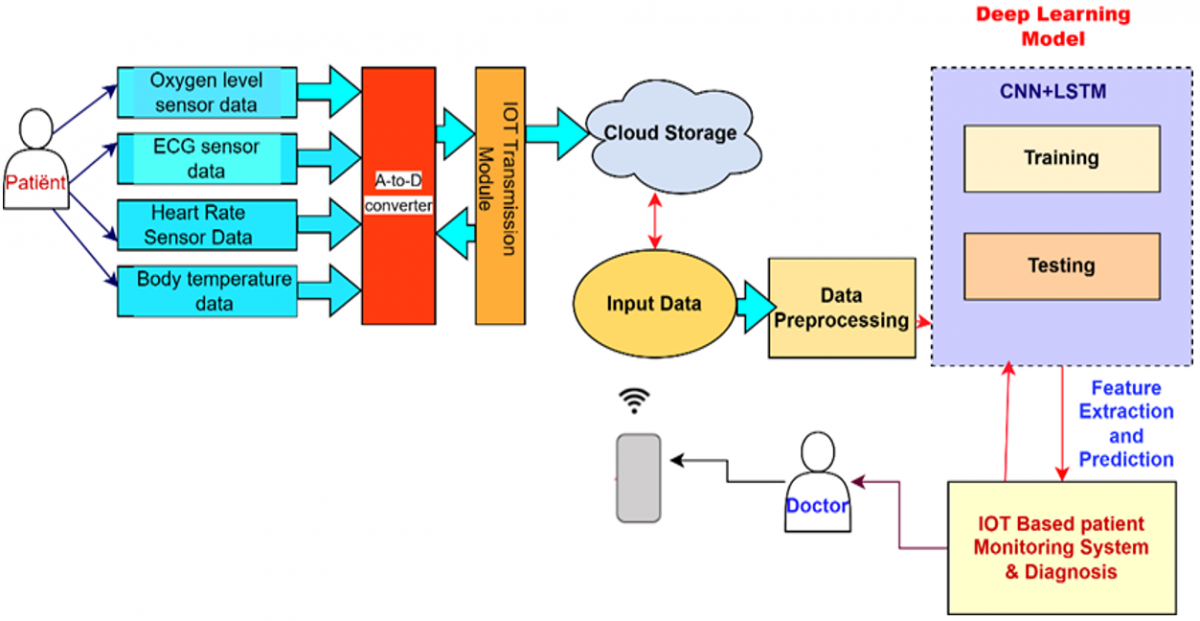
The architectural diagram of the proposed system is shown in Figures 1 and 2, embedding IoT knowledge as well as the cutting-edge technology of DL representations that can work together to improve healthcare distribution. Figure 1 and Figure 2 demonstrate in what way IoT devices gather patient health information and communicate that information to a central storage server, anywhere this is treated by cutting-edge DL procedures. This architecture allows precise and appropriate routine health interventions, as shown through the transformative potential established in this visualization [8].
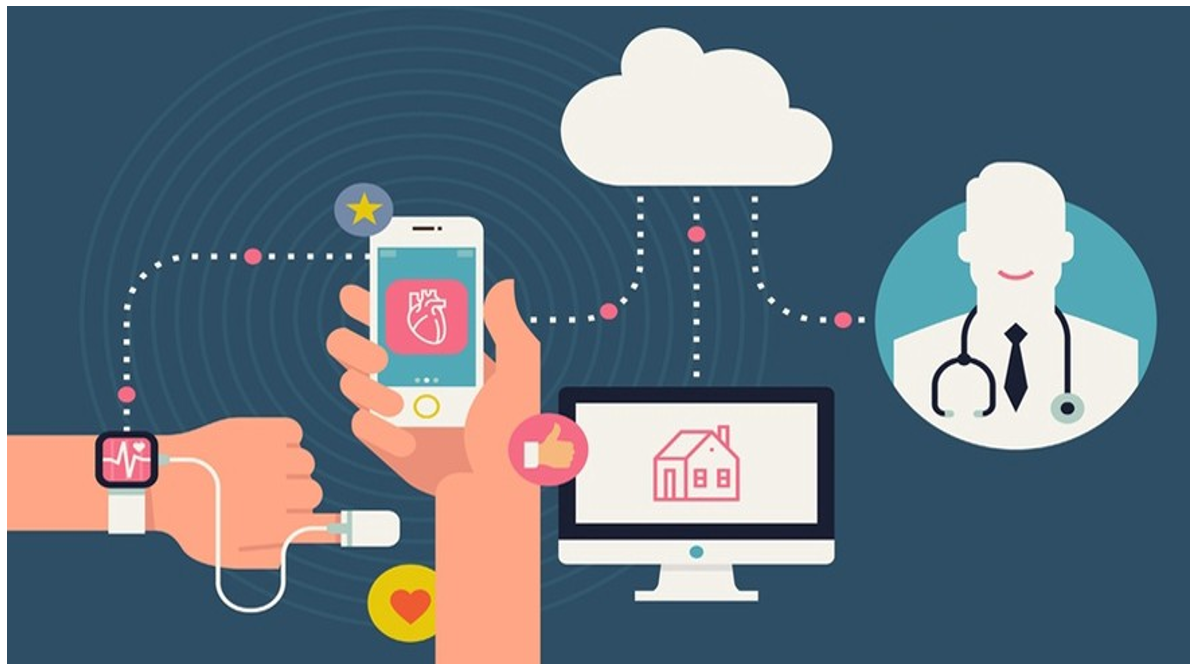
Figure 1 gives a clear image of how an IoT-based healthcare monitoring system has transformed the end period. On the left side of the user interface, that have a lot of commands and symbols that are associated with health. This "Connection Gateway" is the main hub that connects all of them. This central server attaches various medical monitoring apparatuses, which are represented as devices that measure values like blood pressure, heart rate, and oxygen levels. Formerly, these wearable devices continually collected significant patient health data. The main goal of this Gateway is to connect all of the internet's sensing devices through a single interface. This should collect data from many wearable devices and transmit it to a cloud-based network, where it is stored and analyzed using DL methods. The DL models take that data stored in this cloud environment, making it available to authorized persons, such as family members and healthcare staff. Being capable of getting it from any location ensures that updates are made on time and lets people take charge of their health. One of the symbols on the user interface is a remote control for electronic medical tools. This indicates that patients may employ these tools online to make small changes to their treatment or health devices. The symbol of a runner in a track stance represents approaches that support people in becoming well both physically and psychologically. Patients feel more at ease because they have control over their own care from a distance. The system's multi-layered framework uses mined features to make predictions about medical conditions in both regression and classification tasks. Then, DL algorithms affect the intended prediction, thereby helping doctors find possible medical problems and suggest alternate methods to avoid them, which improves the overall health outcomes [9]. An important part of this method is using the LSTM model, which can find patterns in health data over time, which makes predictions more accurate.
LSTM networks are very adept at observing time-series data and patient dynamic vital data as they are constructed on RNNs. The ability to analyse data incessantly and real-time monitored measurement systems—such as blood oxygen levels, heart rate, and blood pressure—is crucial for in-patient healthcare applications. LSTMs cannister discovery the eccentric outlines or anomalies in these physiological signals, which makes it possible to detect health glitches early and provide timely help for clinical diagnosis [10, 11].
Figure 1. Overall structure of patient health monitoring system
Figure 2. Architectural diagram of proposed model
Figure 2 shows the whole system for working with health data using a DL framework that combines LSTM and CNN models. This pipeline includes steps for collecting data, training, testing, and evaluating, all of which are connected to IoT-based health monitoring systems. One thing that makes LSTM networks special is that they use memory cells and gates to control how information is processed. These memory cells let the model keep important information over time steps. The input, forget, and output gates decide what information should be kept, changed, or thrown away, depending on what the model is trying to predict. The model becomes improved at real-time monitoring and diagnosing the problem of a patient by joining a CNN model and an LSTM architecture. CNNs are reputable at looking at the spatial features of medical images like X-rays or ECG scans. LSTMs, on the other hand, appearances for patterns that transform over time in time-series data from IoT-based conscious real-time patient monitoring systems. The Wearable health monitors and imagery tools show data sent to the system at all times, which enables it to analyse the information in real time and respond to health complications before they happen.
This IoT permitted construction through DL elasticities to doctors valued data by generating it laid-back to detection the problems as early as possible and making more efficient diagnoses, than authorizing for appropriate therapeutic interventions. Because of this, the effects on patients can be very bad. This smart provision arrangement helps doctors and nurses make the best medical decisions by giving them additional details. DL and the IoT collaboration is a big step forward for the future of healthcare. It is based on good diagnostics, remote monitoring, and preventative care. The recommended algorithm aims to recover patient monitoring and health diagnostics in an IoT scenario by means of CNN and LSTM models. The primary phase is to wrack and prepare patient data, such as ECG signals, temperature, pulse, and medical images. This data is then pre-processed and split into training sets as well as a testing dataset to see how well the model works in general. In the CNN architecture, the process is tweaked by making the input form match the number of dimensions in the input data. The number of filters, the size of the kernels, the stride values, and the activation functions (usually ReLU) are all important settings in convolutional layers. Pooling layers may be used to make spatial dimensions smaller, and dropout layers may be used to stop overfitting. By flattening the CNN output into a one-dimensional array, it can be easily sent to the LSTM network.
The flattened output feeds into the LSTM module, which is constructed using parameters like hidden unit count and nonlinearities including tanh and sigmoid functions. Dropout layers are applied again to enhance regularisation. Additional LSTM layers are stacked if necessary to complete the desired architecture. Once both CNN and LSTM layers are defined, their outputs are amalgamated to construct the final predictive model. To produce predictions in the form of probabilities, the output layer uses a Softmax function and includes as many neurons as there are diagnostic categories. This framework uses categorical cross-entropy for the loss function, the Adam optimiser to perform additional optimisation, and precision as an assessment metric to make sure that the training is beneficial. The identified gadget, which is an IoT gateway, must be properly set up to support the trained model and make real-time health predictions easier before it can be used. This comprehensive system provides smart patient monitoring and diagnosis, which eventually results in better, more scalable, and more accessible healthcare services.
The feasible method founds in originate over the method of merger of IoT devices combined with DL approaches can provocatively grow the health monitoring of patient previously likewise do the diagnostic procedures. Figure 1 demonstrates that physical body-attached sensor data is chiefly composed together from devices similar to ECG images, investigative imaging equipment, temperature sensing strategies, and heartbeat sensors. The procedure involves assembling and uploading this live information based on the construction envisioned at the well-being examination. At the heart of this method lies a Joining Entryway, which acts as a node of dominant and aggregated information, collecting all linked 24-hour care strategies and earlier interactive to a cloud-based infrastructure for extra dispensation. Following its transmission through the joining Entryway, the information is resolutely warehoused, pre-processed, and enhanced in a cloud-based scheme. Formerly, the DL model splits the dataset into training and testing subsections to assist with prototypical expansion and accuracy testing. The algorithm's roadmap for analysing medical information is founded on the amalgamation of CNNs and LSTM systems, which is shown in Figure 2. In this proposed system, the CNNs generate analytical images and detect spatial topographies that are noteworthy for the detection of the patient's diseases. The LSTM, on the additional sideways advent at time-series data and discovers the time patterns in essentials that are repeatedly existence experiential corresponding heart rate and blood pressure. Figure 2 energies into extra feature about the model training pipeline, which comprises stages similar important the input shape, establishing the convolutional layer, flattening the output, and preparing the LSTM input. Later, these portions are assembled to form the full model. The LSTM's memory cells and exchange mechanisms to retain and discard relevant substantial over time is significant portion of this model. This capability to recall information over time is very noteworthy for careful real-time monitoring systems and additional dependable diagnostic calculations. The suggested system is based on the amalgamation of CNN and LSTM layers, which enable it to monitor and analyse data over time, as shown in Figure 2. This technique pledges ongoing health intensive care and fast judgment by analyzing real-time figures from the IoT devices, which leads to earlier health interventions. The integrative technique supplements the medical patient healthcare system's scope to classify embryonic health risks promptly and reply efficiently, leading to healthier medical penalties and a transformative effect on care delivery [7, 12, 13]. These systems are excellent at discovery bizarre belongings and patterns in complex visual data, which assistances discovery illnesses initial happening. CNNs use their convolutional and pooling layers to extract the high-level diagnostic topographies that medical images retain, which makes the model considerably more precise and vigorous [14]. At the similar period, LSTM nets, which remain exposed in Figure 2, are designed to examine consecutive designs in patient data that originate from IoT devices. They are very good at detecting the health propensities that precede bad things happen, while they can consider and recall noteworthy time-related data.
The important health metrics collected with heart rate discrepancy and blood pressure predispositions are continually checked to enable real-time predictive analytics inside the system [15, 16]. The synergetic mixture of CNNs and LSTMs permits the proposed algorithm to process both spatial and temporal data streams, easing complete and precise real-time health valuations [17, 18]. IoT systems allow for incessant, efficient data monitoring and examination, providing secondary healthcare providers with prompt, timely data for care delivery.
Hyperparameter values dictionary in the proposed DL model is presented in Table 2. The hyperparameters were combined with various types of configurations to find the model that will produce excellent results in training and predicting accuracy. The hyperparameters of filter size in the convolutional layer (32, 64, 128), (64, 128, 256), (128, 256, 512) produced the best results, which were (64, 128, 256). The dropout rates of 0.2, 0.4, and 0.8 were tested in the model to reduce overfitting, but the best result at which point the model generalised was 0.4. The batch sizes of 128, 256, and 512 were also tested, and the best for efficient training of the model was 512. The learning rate of 0.1, 0.01, or 0.001 was changed while training the model, where 0.001 provided the most stable convergence points and the fastest accuracy improvement in the model. Also, when testing the configuration of (128, 256), (256, 512), (512, 256) as neurons, the best representation and learning of features was (512, 256) with respect to each of the configurations. In relation to how long the model was trained (20) - 20 epochs were the most efficient for training a model. Finally, the Adam optimizer was the most efficient and converged at the fastest rate. Table 3 offers a comparison of simulation consequences and the accuracy of the deliberate CNN + LSTM model with additional DL procedures like SVM, LSTM, etc. The datasets used in these assessments comprise well-established scientific and physiological cascades such as MIMIC-III [19], PhysioNet [20], the eICU Concerted Database [21], MIMIC X-ray by chest [22], PTB ECG Database [23], and the broader eICU Clinical Database [24]. Presentation contrasts are complete by means of normal calculation metrics—F1-score, recall, precision, and accuracy—in the way of dimension of each model’s efficiency in real-world IoT-driven healthcare submissions. The final goal is to recover patient diagnosis and specialist care through intelligent, data-driven methods allied with the developing landscape of IoT-enabled healthcare.
Table 2. Proposed method hyperparameter values
|
Parameter |
1 |
2 |
3 |
Used Values |
|
Filters |
32, 64, 128 |
64, 128, 256 |
128, 256, 512 |
64,128, 256 |
|
Dropout Rate |
0.2 |
0.4 |
0.8 |
0.4 |
|
Batch size |
128 |
256 |
512 |
512 |
|
Learning rate |
0.1 |
0.01 |
0.001 |
0.001 |
|
Neurons |
128, 256 |
256, 512 |
512, 256 |
512, 256 |
|
Epoch sizes |
20 |
40 |
60 |
20 |
|
Optimizer |
- |
- |
- |
Adam |
Table 3. Comparison of different models with the proposed model
|
Deep Learning (DL) Model |
Accuracy |
Recall |
Precision |
F1-Score |
AUC |
Dataset |
|
Proposed |
0.99 |
0.98 |
0.97 |
0.99 |
0.99 |
MIMIC- III |
|
CNN |
0.93 |
0.93 |
0.93 |
0.93 |
0.93 |
PhysioNet |
|
LSTM |
0.92 |
0.91 |
0.92 |
0.92 |
0.92 |
MIMIC-CXR |
|
KNN |
0.90 |
0.91 |
0.92 |
0.90 |
0.91 |
PTB Diagnostic ECG |
|
SVM |
0.89 |
0.90 |
0.91 |
0.89 |
0.90 |
eICU Combined |
|
Random Forest |
0.91 |
0.91 |
0.91 |
0.91 |
0.92 |
eICU Clinic Data |
For the purpose of the analysis presented in this project, all data were drawn from publicly available sources: namely, the MIMIC-III database, the PhysioNet database, and the eICU database. The MIMIC-III dataset is comprised of large-scale EHR data that were developed using records of patients admitted to the Beth Israel Deaconess Medical Centre’s intensive care unit (ICU) during the years 2001 through 2012. This dataset contains information from 40,000+ patients who were admitted to that hospital's ICUs during that time period. By contrast, the eICU dataset contains records from approximately 139,367 patients who have been admitted to ICUs in hospitals throughout the United States during calendar years 2014 and 2015. Both datasets include extensive clinical information such as demographic information, laboratory values, vital signs, medication-related documentation, procedure documentation, and clinical narrative notes related to patient treatment. Prior to any analysis of simulated versus actual patient care pathways, efforts were taken to improve the quality of the data by removing and/or addressing any issues with missing values or duplicate records and irrelevant attributes. The data have been pre-processed to normalize the formats of individual clinical variables and converted into a standardized feature (also referred to as a feature vector) that is suitable for use as input into machine learning and DL models. Specific preprocessing pipelines have been developed as well to facilitate feature extraction/engineering, outlier detection, the aggregation of related clinical variables, and converting temporal records of patient care into a format that is appropriate for accurate predictions and comparisons of simulated and actual care pathways in the dataset. In a healthcare scenario enabled by the IoT, the assessment metrics demonstrate how well each model container identifies and retains the pathways of patients. The CNN and LSTM hybrid technique performed unusually well on the MIMIC-3 dataset for reaching an F1-score and accuracy of 0.99, and a recall of 0.98, illustrating its prognostic control. The standards exhibit high trustworthiness in monitoring and identifying patient circumstances as rapidly as by means of this collective method. These results demonstrate that the CNN and LSTM model lengthways by extra DL approaches vessel assistance to make more precise and fast therapeutic decisions on an assortment of datasets. The CNN model performed well on the health dataset, achieving 0.93 for F1-score, accuracy, and recall. Formerly these consequences display the model the ration healthy for examining medical images to detect and track diseases.
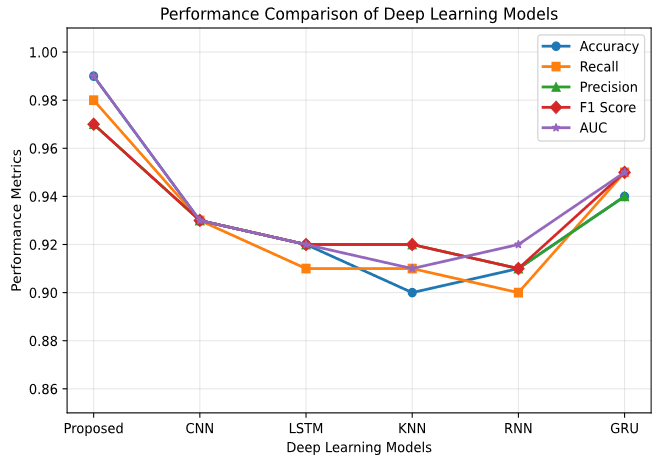
Figure 3 presents the comparative performance analysis of different machine learning models, namely proposed model, CNN, LSTM, KNN, SVM, and Random Forest, using evaluation metrics such as accuracy, recall, precision, F1-score, and AUC. Among all the models, the proposed model achieves the highest performance across most metrics, with values close to 0.99 for accuracy, F1-score, and AUC, demonstrating its superior predictive capability and reliability. CNN and LSTM models also show strong performance with consistently high metric values above 0.96, while KNN provides moderate results. SVM and Random Forest exhibit comparatively lower values, particularly in recall and precision. Overall, the results indicate that the Proposed Model outperforms the existing machine learning techniques in terms of classification accuracy, robustness, and overall effectiveness. The traditional SVM model is pragmatic on the dataset of eICU Cooperative; with additional adjacent data, it achieved an accuracy of 89%, a precision of 0.91, a recall of 0.91, and an F1-score of 0.89. Steady and motionless, it didn't exert as CNN and LSTM DL representations; it continued to be a stationary appreciated instrument for classifying the patient data. The LSTM architectural prototypical secure actual satisfactory on the dataset of MIMIC-CXR the situation was getting an accuracy of 92%, a precision of 0.92, a recall of 0.91, and an F1-score of 0.92. These results suggest that the characteristic model is decent at looking at successive information and staining propensities in energetic signs. The PTB ECG dataset was used for testing drive and the cutting-edge model KNN ML algorithm got 90% accuracy, 92% precision, 92% recall, and a 0.90 F1-score. The dimension demonstrations that the KNN model is not as greatly of influential and doesn't perform as well as additional eccentric DL models in this condition. In the final assessment, the Random Forest machine learning model obtained reliable results by leveraging the eICU clinical database, with an accuracy of 91% and precision, recall, and F1-score values of 0.91. These consequences protest that the approach can grasp big scientific datasets and provide highly accurate diagnostic forecasts. Overall, the evaluation of these imitations suggests that combining CNN and LSTM networks the whole thing healthy-looking for whole the real-time health monitoring and highly precise judgment in IoT-integrated healthcare systems.
Figure 3. Comparison of different models
This proposed study scrutinizes and examines the combination of the CNN and LSTM DL models associated with IoT devices to provide 24-hour patient care for health disorders and diagnostic accuracy. This suggested outline uses CNNs to understand medical imagery and LSTMs to analyze patient data over time. These panaches it possible to VDU health in real time and kind it corrects diagnostic accuracy. This system develops the competence and responsiveness of healthcare distribution by resources of data conventional as of the IoT-enabled medical strategies. The ritual of IoT in healthcare proposals significantly helps with informal patient health monitoring and remote 24-hour care, as well as principal disease detection and the development of personalised action methods. Wearable devices and smart sensors continuously collect beneficial health data directs to the server, which helps affected individuals with long-term conditions manage them better and makes it easier for healthier choices by the doctors. The integration of blockchain technology into healthcare systems, chiefly the supply chain, strength be enlarging data security, transparency, and trust amongst all gatherings complicated. Despite the auspicious aptitudes of this shared method, there are challenges. These include supervisory acquiescence of data confidentiality worries, system interoperability, and the struggle of real-world implementation. In the future, the combination of IoT, DL (CNN + LSTM), and blockchain technologies signifies a transformative alteration in healthcare by using portable smart devices.
[1] Chhowa, T.T., Rahman, M.A., Paul, A.K., Ahmmed, R. (2019). A narrative analysis on deep learning in IoT based medical big data analysis with future perspectives. In 2019 International Conference on Electrical, Computer and Communication Engineering (ECCE), Cox's Bazar, Bangladesh, pp. 1-6. https://doi.org/10.1109/ECACE.2019.8679200
[2] Veeraiah, V., Pankajam, A., Vashishtha, E., Dhabliya, D., Karthikeyan, P., Chandan, R.R. (2022). Efficient COVID-19 identification using deep learning for IoT. In 2022 5th International Conference on Contemporary Computing and Informatics (IC3I), Uttar Pradesh, India, pp. 128-133. https://doi.org/10.1109/IC3I56241.2022.10073443
[3] Ahmad, A., Hussain, H.K., Tanveer, H., Kiruthiga, T., Gupta, K. (2023). The intelligent heart rate monitoring model for survivability prediction of cardiac arrest patients using deep cardiac learning model. In 2023 International Conference on Intelligent Systems for Communication, IoT and Security (ICISCoIS), Coimbatore, India, pp. 376-381. https://doi.org/10.1109/ICISCoIS56541.2023.10100413
[4] Hembram, D.K., Tripathy, S.N., Reddy, C.N., et al. (2025). IoT driven smart health monitoring for heart disease prediction using quantum kernel enhanced sardine diffusion and CNN. Scientific Reports, 15(1): 17306. https://doi.org/10.1038/s41598-025-99990-x
[5] Deepa, T., Hariprasad, S., Bharathiraja, N., Chokkalingam, A. (2022). A real time face mask detection and health status monitoring using deep learning after pandemic. In 2022 International Conference on Augmented Intelligence and Sustainable Systems (ICAISS), Trichy, India, pp. 430-435. https://doi.org/10.1109/ICAISS55157.2022.10010823
[6] Elbagoury, B.M., Zaghow, M., Salem, A.B.M., Schrader, T. (2021). Mobile AI stroke health app: A novel mobile intelligent edge computing engine based on deep learning models for stroke prediction–research and industry perspective. In 2021 IEEE 20th International Conference on Cognitive Informatics & Cognitive Computing, Banff, AB, Canada, pp. 39-52. https://doi.org/10.1109/ICCICC53683.2021.9811307
[7] Islam, M.R., Kabir, M.M., Mridha, M.F., Alfarhood, S., Safran, M., Che, D. (2023). Deep learning-based IoT system for remote monitoring and early detection of health issues in real-time. Sensors, 23(11): 5204. https://doi.org/10.3390/s23115204
[8] Awotunde, J.B., Ajagbe, S.A., Florez, H. (2022). Internet of things with wearable devices and artificial intelligence for elderly uninterrupted healthcare monitoring systems. In International Conference on Applied Informatics, Arequipa, Peru, pp. 278-291. https://doi.org/10.1007/978-3-031-19647-8_20
[9] Bekbay, A., Bazarbay, L., Bigaliyeva, Z., et al. (2025). An interpretable ECG-based approach for detecting hemodynamically significant arrhythmias using lightweight machine learning models. Eastern-European Journal of Enterprise Technologies, 5(9): 117. https://doi.org/10.15587/1729-4061.2025.340493
[10] Alharbe, N., Almalki, M. (2025). IoT-enabled healthcare transformation leveraging deep learning for advanced patient monitoring and diagnosis. Multimedia Tools and Applications, 84(19): 21331-21344. https://doi.org/10.1007/s11042-024-19919-w
[11] Senanayake, S.A., Wulandari, P. (2020). Soft real time data driven IoT for knee rehabilitation. In 2020 5th International Conference on Innovative Technologies in Intelligent Systems and Industrial Applications (CITISIA), Sydney, Australia, pp. 1-7. https://doi.org/10.1109/CITISIA50690.2020.9371780
[12] Thamilarasu, G., Chawla, S. (2019). Towards deep-learning-driven intrusion detection for the internet of things. Sensors, 19(9): 1977. https://doi.org/10.3390/s19091977
[13] Abubaker, M.B., Babayiğit, B. (2022). Detection of cardiovascular diseases in ECG images using machine learning and deep learning methods. IEEE Transactions on Artificial Intelligence, 4(2): 373-382. https://doi.org/10.1109/TAI.2022.3159505
[14] Kim, D., Choi, J., Ahn, S., Park, E. (2023). A smart home dental care system: Integration of deep learning, image sensors, and mobile controller. Journal of Ambient Intelligence and Humanized Computing, 14(2): 1123-1131. https://doi.org/10.1007/s12652-021-03366-8
[15] Elashiri, M.A., Rajesh, A., Pandey, S.N., Shukla, S.K., Urooj, S. (2022). Ensemble of weighted deep concatenated features for the skin disease classification model using modified long short term memory. Biomedical Signal Processing and Control, 76: 103729. https://doi.org/10.1016/j.bspc.2022.103729
[16] Lalithambigai, M., Kalpana, V., Kumar, A.S., Uthayakumar, J., Santhosh, J., Mahaveerakannan, R. (2023). Dimensionality reduction with DLMNN technique for handling secure medical data in healthcare-IoT model. In 2023 Third International Conference on Artificial Intelligence and Smart Energy (ICAIS), Coimbatore, India, pp. 111-117. https://doi.org/10.1109/ICAIS56108.2023.10073679
[17] Liu, Z., Perin, K.K., Li, G., et al. (2025). An IoT-enabled smart pillow with multi-spectrum deep learning model for real-time snoring detection and intervention. Applied Sciences, 15(24): 12891. https://doi.org/10.3390/app152412891
[18] Saeed, M., Villarroel, M., Reisner, A.T., et al. (2011). Multiparameter intelligent monitoring in intensive care II: A public-access intensive care unit database. Critical Care Medicine, 39(5): 952-960. https://doi.org/10.1097/CCM.0b013e31820a92c6
[19] Zong, W., Wang, P., Leung, B., Moody, G.B., Mark, R.G. (2002). An automated, web-enabled and searchable database system for archiving electrogram and related data from implantable cardioverter defibrillators. In Computers in Cardiology, Memphis, TN, USA, pp. 269-272. https://doi.org/10.1109/CIC.2002.1166760
[20] Irvin, J., Rajpurkar, P., Ko, M., et al. (2019). Chexpert: A large chest radiograph dataset with uncertainty labels and expert comparison. Proceedings of the AAAI Conference on Artificial Intelligence, 33(1): 590-597. https://doi.org/10.1609/aaai.v33i01.3301590
[21] Pollard, T.J., Johnson, A.E., Raffa, J.D., Celi, L.A., Mark, R.G., Badawi, O. (2018). The eICU collaborative research database, a freely available multi-center database for critical care research. Scientific Data, 5(1): 180178. https://doi.org/10.1038/sdata.2018.178
[22] Goldberger, A.L., Amaral, L.A., Hausdorff, J.M., Ivanov, P.C., Peng, C.K., Stanley, H.E. (2002). Fractal dynamics in physiology: Alterations with disease and aging. Proceedings of the National Academy of Sciences, 99(suppl_1): 2466-2472. https://doi.org/10.1073/pnas.012579499
[23] Sreelakshmy, R., Sruthy, R., Suresh Kumar, M. (2022). Patient health monitoring system using smart IoT devices for medical emergency services. In 2022 International Conference on Innovative Computing, Intelligent Communication and Smart Electrical Systems (ICSES), Chennai, India, pp. 1-10. https://doi.org/10.1109/ICSES55317.2022.9914385
[24] Al-Zwainy, F.M., Mohammed, I.A., Varouqa, I.F. (2018). Diagnosing the causes of failure in the construction sector using root cause analysis technique. Journal of Engineering, 2018(1): 1804053. https://doi.org/10.1155/2018/1804053