Shahad M. Ali | Ahmed S. Abbas | Kadhim K. Resan | Mohammed Ali Abdulrehman* | Shireen H. Challoob | Ali A. Salman
© 2025 The authors. This article is published by IIETA and is licensed under the CC BY 4.0 license (http://creativecommons.org/licenses/by/4.0/).
OPEN ACCESS
The purpose of this study was to assess the potential of pozzolanic additives to enhance the mechanical and durability characteristics of plastic concrete modified with bentonite, which generally has a low strength and high porosity. While bentonite was kept at 10% of the cement weight, silica fume, metakaolin, and Class F fly ash were utilised as partial cement substitutes at 5%, 10%, and 15%, respectively. The compressive strength, tensile strength, water permeability, and water absorption of the concrete mixes were evaluated after 28 days. According to the results, 10% silica fume produced the best results, with a much higher strength and lower permeability. Fly ash had minor effects, especially on the long-term durability, but metakaolin also improved the microstructure. The matrix densification and enhanced interfacial transition zones were validated using Field Emission of Scanning Electron Microscope (FESEM) analysis. These results imply that adding pozzolanic additives can successfully counteract the disadvantages of bentonite, allowing concrete to be used in long-lasting and water-retaining construction applications.
plastic concrete, betonite, permeability, pozzolanic additives
Concrete is the most commonly used building material worldwide and serves as the foundation for infrastructure development because of its accessibility, workability, and mechanical strength. Notwithstanding these benefits, conventional Portland cement concrete has several drawbacks, most notably brittleness, microcracking vulnerability, high permeability, and issues with long-term durability in harsh environments. Recent studies have focused on altering the concrete matrix by adding cementitious materials and nano/micro-scale additives to address these shortcomings. These modifications improve the mechanical and permeability-related properties of concrete [1]. Because of its distinct physicochemical characteristics, bentonite has drawn more attention from researchers in recent years than any other additive. Montmorillonite, the primary component of bentonite, is a naturally occurring clay with a large specific surface area, expansive behavior, and high water absorption. Owing to these properties, bentonite can improve the distribution of pore sizes in the cement matrix and decrease pore connectivity. Consequently, bentonite-containing concrete exhibits notable enhancements in impermeability and crack sealing properties. By encouraging the swelling of microcracks and densifying the microstructure, researchers showed that adding up to 5% bentonite improved the self-healing capacity of cementitious composites [2]. In addition to bentonite, several pozzolanic materials are commonly used to enhance the performance of concrete. Fly ash, a class F pozzolan with a high concentration of amorphous silica and alumina, is a byproduct of burning coal in thermal power plants. Long-term strength gain and decreased permeability are caused by the reaction of FA with calcium hydroxide released during cement hydration to form more calcium silicate hydrate (C–S–H). According to studies, adding fly ash in place of 15–30% of cement improves resistance to sulfate attack, alkali-silica reaction, and chloride ion penetration, in addition to increasing compressive and tensile strength over time [3, 4]. Another high-performance pozzolan with a fine particle size and high reactivity is metakaolin, which is produced by calcining pure kaolinite clay at temperatures between 600 and 800℃. Metakaolin improves the early age and long-term strength of concrete by densifying the interfacial transition zone (ITZ) between the aggregates and cement paste. The researchers verified that adding 10–20% metakaolin by weight of cement lowers total porosity, improves resistance to chemical attack, and improves the microstructure of concrete, which lowers permeability and capillary suction [5, 6]. An ultrafine amorphous silica byproduct produced during the manufacturing of silicon and ferrosilicon alloys is silica fume, which is sometimes referred to as micro silica. Silica fume is a highly reactive pozzolan and filler, with particle sizes almost 100 times smaller than those of cement. By filling tiny voids and quickly reacting with free lime to create more C-S-H gel, the porosity and permeability of concrete are dramatically lowered. The inclusion of 5–10% silica fume increases the resistance to sulfate and chloride ion ingress, decreases water absorption, and improves the compressive and flexural strengths. A new method for improving concrete performance is provided by the combination of bentonite and various SCMs such as fly ash, metakaolin, and silica fume. Although SCMs aid in matrix refinement and pozzolanic reactivity, bentonite adds sealing and swelling properties that reduce permeability and microcracking. Because Portland cement is partially replaced by this dual mechanism, concrete may have better mechanical performance, a longer lifespan, and a smaller environmental impact [7].
To improve the mechanical strength, decrease the permeability, and refine the interfacial transition zones (ITZ), bentonite and pozzolanic additives are predicted to interact to decrease the pore connectivity and promote the formation of C–S–H and C–A–H gels. The anticipated performance improvement examined in this study was based on these mechanisms.
Although much research has been conducted on how fly ash, metakaolin, and silica fume affect concrete performance separately, few thorough studies have compared how they affect bentonite-modified plastic concrete. This study fills this knowledge gap by assessing the impact of these additives at different dosages on the mechanical and permeability properties of plastic concrete with a consistent 10% bentonite content. Finding the best pozzolanic material to overcome the drawbacks of bentonite, specifically its propensity to increase porosity and decrease mechanical strength, is the goal. It is anticipated that the combination of bentonite and specific pozzolanic materials will result in concrete with denser microstructure and greater resilience. The structure of the paper is as follows: the materials and experimental procedure are described in detail in Section 2, the results are shown in Section 3, the discussion is given in Section 4, and the conclusions are summarised in Section 5.
To create a cementitious system that is more resilient to water and long-lasting, this experimental study examined the effects of pozzolanic additives on the mechanical strength and permeability properties of bentonite plastic concrete. As the main binding agent, Ordinary Portland Cement (OPC) Type I, which complies with ASTM C150 [8], was used in all mixtures at a consistent dosage of 300 kg/m³. This type of cement is frequently used in structural applications and offers the hydration kinetics and initial strength required for consistent blend comparison. All concrete mixtures contained 10% by weight of cement of bentonite, a naturally occurring swelling clay that is rich in montmorillonite. Bentonite improves the water retention and sealing behavior of concrete owing to its high specific surface area, layered structure, and remarkable water absorption capacity. It also helps lower permeability by improving pore connectivity and encouraging microcrack self-healing through swelling in moist environments. Three highly reactive supplementary cementitious materials—fly ash, metakaolin, and silica fume—were selected to partially replace OPC to further enhance performance. Silica fume (SF), an ultrafine amorphous silica byproduct of the silicon and ferrosilicon alloy industries, is well-known for its high pozzolanic reactivity and capacity to increase cement matrix strength, decrease permeability, and densify it. It was added at 5%, 10%, and 15% replacement levels. Calcination of pure kaolinite clay yields metakaolin (MK), a highly reactive aluminosilicate material with a high surface area and strong pozzolanic activity that can refine the interfacial transition zone, improve chemical resistance, and greatly increase early age strength. It was added at replacement levels of 5%, 10%, and 15%, similar to silica fume. Class F fly ash (FA), the third additive, is a finely divided residue primarily composed of aluminosilicate glass from coal-fired power plants. Fly ash enhances workability, lowers heat of hydration, and contributes to long-term strength and impermeability owing to its comparatively lower calcium content and long-term pozzolanic behavior. Additionally, it was added at cement weight percentages of 5%, 10%, and 15%. All pozzolanic materials complied with the physical and chemical requirements listed in ASTM C618 [9]. To guarantee consistent workability and separate the effects of the pozzolanic substitutions, a constant water-to-cement (w/c) ratio of 0.6 was used for all mixes. To enable a clearer interpretation of the effects of bentonite and SCMs on the behavior of both fresh and hardened concrete, no chemical admixtures such as superplasticizers or retarders were added. The chemical and physical characteristics of the cement, bentonite, fly ash, silica fume, and metakaolin are listed in Tables 1 and 2, respectively. Table 3 lists the precise mix-design proportions used in this study.
Table 1. Chemical content of cement, FA, MK, SA, and bentonite
|
Chemical Component |
Cement |
FA |
MK |
SF |
Bentonite |
|
SiO₂ |
19.1 |
42.3 |
53.0 |
94.0 |
58.5 |
|
Al₂O₃ |
6.0 |
27.2 |
38.2 |
0.5 |
18.3 |
|
Fe₂O₃ |
4.0 |
7.1 |
2.5 |
0.3 |
5.0 |
|
SO₃ |
3.4 |
0.87 |
0.1 |
0.2 |
1.0 |
|
CaO |
64.1 |
12.8 |
0.2 |
0.5 |
2.1 |
|
K₂O |
0.5 |
0.6 |
1.1 |
1.5 |
2.7 |
|
Na₂O |
0.2 |
0.9 |
0.1 |
1.1 |
2.5 |
|
TiO₂ |
0.2 |
0.8 |
1.4 |
0.1 |
0.4 |
|
MnO |
– |
0.04 |
0.02 |
0.01 |
0.1 |
|
MgO |
1.6 |
6.4 |
0.3 |
0.2 |
3.0 |
|
P₂O₅ |
0.9 |
0.5 |
0.2 |
0.1 |
0.3 |
|
Loss on Ignition |
3.03 |
1.9 |
1.5 |
2.0 |
8.0 |
Table 2. Physical properties of cement, FA, MK, SA, and bentonite
|
Physical Properties |
Cement |
FA |
MK |
SF |
Bentonite |
|
Color |
Grey-light white |
Grey |
White to cream |
Light grey |
Light grey to brown |
|
Nature of Material |
Powder |
Powder |
Powder |
Ultrafine powder |
Fine powder |
|
Specific Surface Area (m²/kg) |
360 |
610 |
1720 |
>20,000 (BET) |
378 |
|
Specific Gravity (g/cm³) |
3.12 |
2.39 |
2.65 |
2.20 |
2.60 |
|
Moisture Content (%) |
3.3 |
0.81 |
0.9 |
1.0 |
12 |
Table 3. Mix design details for bentonite plastic concrete
|
Mix ID |
Cement (kg/m³) |
Bentonite (%) (add) |
Pozzolan Type |
Pozzolan Content (%) (replace) |
Water/Cement Ratio |
|
CTRL |
300 |
10 |
None |
0 |
0.6 |
|
SF-05 |
300 |
10 |
Silica Fume |
5 |
0.6 |
|
SF-10 |
300 |
10 |
Silica Fume |
10 |
0.6 |
|
SF-15 |
300 |
10 |
Silica Fume |
15 |
0.6 |
|
MK-05 |
300 |
10 |
Metakaolin |
5 |
0.6 |
|
MK-10 |
300 |
10 |
Metakaolin |
10 |
0.6 |
|
MK-15 |
300 |
10 |
Metakaolin |
15 |
0.6 |
|
FA-05 |
300 |
10 |
Fly Ash |
5 |
0.6 |
|
FA-10 |
300 |
10 |
Fly Ash |
10 |
0.6 |
|
FA-15 |
300 |
10 |
Fly Ash |
15 |
0.6 |
The bentonite plastic concrete mixture was prepared by first dry-mixing the dry ingredients (Ordinary Portland Cement (OPC)), bentonite powder, and pozzolanic material (silica fume, metakaolin, or fly ash) for two–three minutes in a 250-liter mechanical pan mixer. This was done to ensure that the ingredients were evenly distributed. Dry blending was followed by a gradual addition of the premeasured mixing water over 1-2 minutes, followed by another 3-4 minutes of mixing. The mixing process was continued until a consistent, cohesive, and workable plastic concrete slurry was obtained. To reduce air entrapment and segregation, the mixture was cast into the molds in layers using standard compaction techniques once it reached the ideal consistency. To enable bentonite to contribute to the water retention and sealing properties of the mix, care was taken throughout the process to ensure that it was fully activated and dispersed. After one day, the prepared specimens were demolded for additional controlled curing and covered with plastic sheets to prevent moisture loss. After the samples were removed from the molds (two days later), they were left to cure outside for 26 days at a temperature between 25 and 35℃.
The purpose of the experimental program was to assess how pozzolanic replacement—specifically, fly ash, metakaolin, and silica fume—affects the mechanical strength, permeability, and water absorption of bentonite plastic concrete. As shown in Table 3, ten concrete mixes were prepared, comprising one control mix (CTRL) and nine modified mixes that included pozzolans at different replacement levels (5%, 10%, and 15%).
3.1 Compressive strength
Compressive strength tests were conducted using 100 mm × 100 mm × 100 mm cubic concrete specimens in compliance with BS 12390-3 [10]. To evaluate the strength development over time, tests were conducted at a curing age of 28 d. A uniaxial compressive load was applied at a regulated rate of 0.5 MPa/s until failure using a calibrated universal testing machine (UTM). To guarantee dependability and reduce experimental error, three specimens were tested for each mix and curing age, and the average compressive strength was reported.
3.2 Splitting tensile strength
In compliance with ASTM C496 [11], a splitting tensile test was used to ascertain the indirect tensile strength of the concrete. Standard cylindrical specimens measuring 150 mm in diameter and 300 mm in height were used for this test. A compressive line load was applied along the length of the specimen, and each cylinder was positioned horizontally between the platens of a universal testing machine (UTM). The specimen failed in tension along its vertical diameter owing to this configuration, which created tensile stresses perpendicular to the direction of the applied load. Three specimens were tested for each mix and age at 28 days after curing, and the representative value was the average splitting tensile strength. This technique offers important information about the tensile strength and resistance to cracking of bentonite plastic concrete mixtures with different pozzolanic additives.
3.3 Water permeability
The test was conducted in accordance with DIN 1048 Part 5 [12], using cylindrical specimens measuring 100 mm in diameter and 200 mm in height. After 28 d of water curing, the specimens were subjected to a constant water pressure of 5 bar (0.5 MPa) for 72 h. A chisel and hammer were used to split the specimens along their longitudinal axis after they had been exposed to a water pressure of 0.5 MPa for 72 h (150 × 300 mm). Subsequently, the penetration depth was measured. A calibrated scale was used to record depth. At the end of the testing period, the specimens were split longitudinally, and the maximum depth of water penetration was measured using a graduated scale. Three specimens were tested for each mix and age, and the average penetration depth was recorded as the water-permeability index. This method is particularly suitable for assessing the efficacy of bentonite and pozzolanic additives in lowering capillary porosity and improving the impermeability of the concrete matrix.
3.4 Absorption reduction
Concrete cubes measuring 100 × 100 × 100 mm were used to measure water absorption in compliance with ASTM C642 [13]. After 24 h of oven drying at 100–110℃ until a constant weight (W₁) was reached, each specimen was cooled to room temperature in a desiccator. After 48 h of complete submersion in water, the saturated surface dry weights (W₂) of the specimens were measured. The following formula was used to determine the percentage of water absorption:
Water Absorption (%) = ((W₂ – W₁) / W₁) × 100
This process provides supplementary information to the permeability test results by enabling a reliable estimation of the open porosity and moisture ingress capacity of concrete mixes.
3.5 Field-emission scanning electron microscopy
Field-emission scanning electron microscopy (FESEM) was used to investigate the microstructural properties of the hardened concrete composites. Small fractured fragments from the interior of the 28-day cured specimens were gathered to avoid surface contamination. These fragments were first oven-dried at 50℃ to remove residual moisture and subsequently covered with a thin layer of gold using a sputter coater to ensure adequate conductivity and clarity during scanning.
4.1 Compressive strength
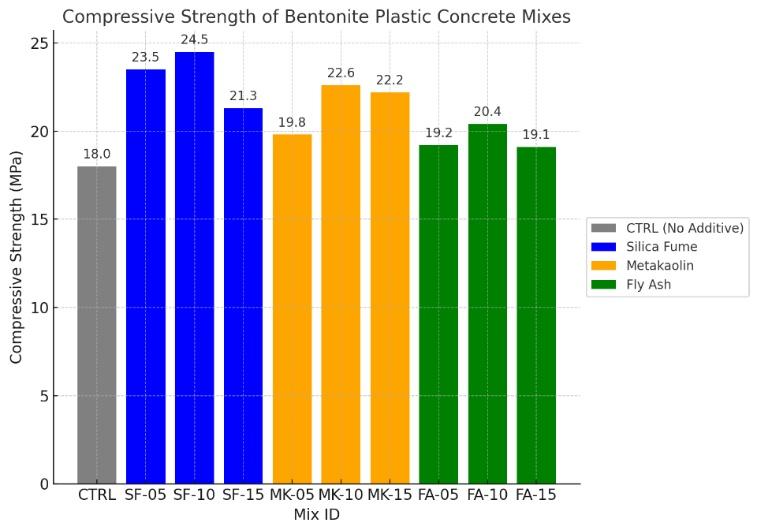
Table 4 and Figure 1 show the compressive strength results for the specimens. The experimental data show how different pozzolanic materials affect the compressive strength of concrete, including 10% bentonite. Consistent with the known negative effects of bentonite on the cementitious matrix due to its swelling nature and high water absorption, which increase porosity and lower cohesion, the control mix (CTRL), without any pozzolanic substitution, displayed the lowest compressive strength (18.0 MPa). With SF-05, SF-10, and SF-15 reaching 23.5 MPa, 24.5 MPa, and 21.3 MPa, respectively, the inclusion of silica fume (SF) displayed the most notable increase in strength. The best performance was obtained with 10% silica fume (SF-10), suggesting an ideal dosage that maximizes pozzolanic activity without sacrificing workability. The high surface area and ultrafine particles of silica fume help to improve pozzolanic reactions, producing extra calcium silicate hydrate (C–S–H) that densifies the matrix and fills microvoids [14]. MK-05, MK-10, and MK-15 generated 19.8 MPa, 22.6 MPa, and 22.2 MPa, respectively, and metakaolin (MK) also helped improve the compressive strength. Reacting with calcium hydroxide, metakaolin is a thermally activated aluminosilicate that forms C–S–H and C–A–H phases, thereby improving and refining the pore structure. The peak strength found at 10% validates earlier results, indicating this level as a reasonable compromise between performance and material cost [15]. Class F fly ash (FA), on the other hand, showed only modest increases in early age performance. FA-05, FA-10, and FA-15 had compressive strengths of 19.2, 20.4, and 19.1 MPa, respectively. Compared with other pozzolans, fly ash reacts more slowly; hence, at 28 d, it provides only minor improvements. However, its long-term performance is better because of the constant pozzolanic activity generated over long curing times [16]. Overall, silica fume offers the best improvement in early compressive strength, especially at 10% dosage, followed by metakaolin at the same proportion. Fly ash is less successful in short-term mechanical performance but is still useful for durability and long-term strength. These results support the deliberate selection of pozzolanic materials to counteract the weakening effect of bentonite in blended cement systems.
Table 4. All tests results for bentonite plastic concrete mixes
|
Mix ID |
CTRL |
SF-05 |
SF-10 |
SF-15 |
MK-05 |
MK-10 |
MK-15 |
FA-05 |
FA-10 |
FA-15 |
|
Compressive Strength MPa |
18.0 |
23.5 |
24.5 |
21.3 |
19.8 |
22.6 |
22.2 |
19.2 |
20.4 |
19.1 |
|
Tensile Strength MPa |
2.35 |
2.76 |
2.81 |
2.61 |
2.49 |
2.61 |
2.55 |
2.66 |
2.71 |
2.54 |
|
Water Permeability (×10⁻⁷ m/s) |
4.2 |
2.6 |
2.1 |
2.5 |
3.1 |
2.8 |
3.0 |
3.2 |
2.9 |
3.1 |
|
Water Absorption |
7.03 |
4.82 |
4.28 |
4,77 |
5.48 |
5.32 |
5.56 |
5.61 |
5.15 |
5.32 |
|
Reduction in Absorption (%) |
0 |
31.4 |
39.1 |
32.1 |
22.0 |
24.3 |
20.9 |
20.2 |
26.7 |
24.3 |
Figure 1. Compressive strength results for bentonite plastic concrete mixes
4.2 Splitting tensile strength
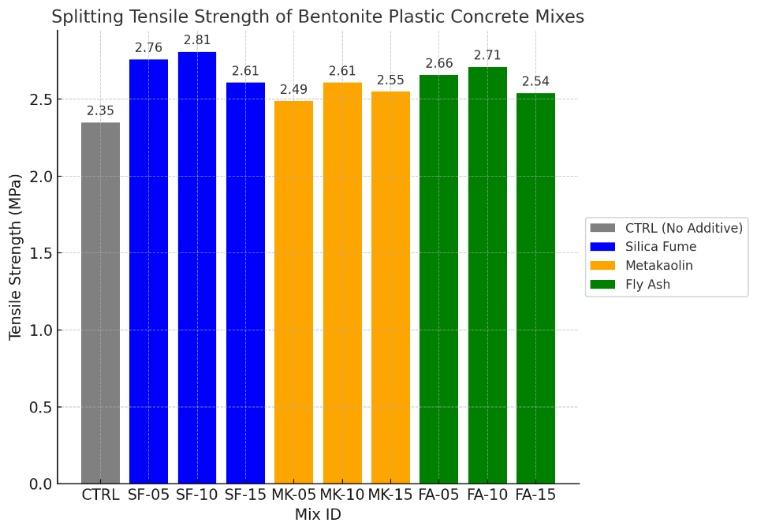
The 2’s results of the splitting tensile strength test presented in Table 4 and Figure 2 clearly show the differences in the concrete mixes, including bentonite and different pozzolanic materials. Reflecting the well-known negative impact of bentonite on the tensile performance of concrete owing to its swelling and water-retentive nature, which weakens interfacial bonding and increases porosity, the control mix (CTRL), which consisted of 10% bentonite and no pozzolanic additives, recorded the lowest tensile strength of 2.35 MPa [16]. Among all the additives, silica fume (SF) showed the highest increase in tensile strength. Following closely behind were SF-05 at 2.76 MPa and SF-15 at 2.61 MPa, with SF-10 reaching a maximum value of 2.81 MPa. The ultrafine particle size and high pozzolanic reactivity of silica fume are responsible for this notable improvement, as denser microstructures and improved interfacial transition zones follow [14]. Under splitting loads, these microstructural developments help increase the tensile strength and improve the crack resistance. The tensile performance was also from metakaolin (MK). With MK-05 at 2.49 MPa, MK-10 and MK-15 attained 2.61 MPa and 2.55 MPa, respectively. Metakaolin enhances mechanical characteristics by generating extra C–S–H and C–A–H phases and optimizing the pore system [15]. However, its smaller surface area than that of silica fume may restrict its influence on early tensile strength enhancement. With FA-10 at 2.71 MPa, FA-05 at 2.66 MPa, and FA-15 at 2.54 MPa (FA) surprisedly displayed competitive tensile strength performance. Long-term reactivity maintains the matrix better over time; despite its slow pozzolanic reaction, the rounded form and improved workability associated with fly ash help distribute stress under splitting tension [17]. Ultimately, the use of active pozzolanic materials—especially silica fume at 10%—which offers the best balance between reactivity and mechanical gain, will greatly improve the tensile performance of bentonite-modified concrete. Class F fly ash is particularly effective when sustainability and long-term performance are prioritized, and metakaolin also shows great potential for tensile improvement.
Figure 2. Tensile strength results for bentonite plastic concrete mixes
4.3 Water permeability
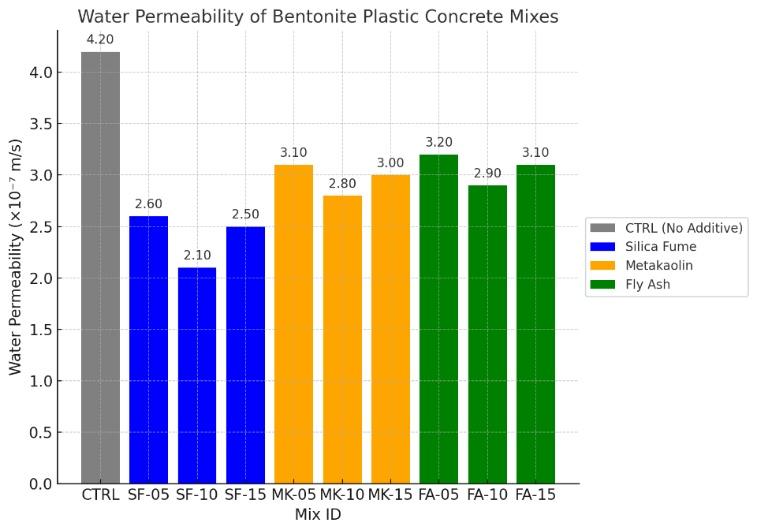
Table 4 shows and Figures 3 illustrates the water permeability results of all concrete mixes, including 10% bentonite and various pozzolanic materials. In the absence of any pozzolanic addition, the control mix (CTRL) recorded the highest water permeability value of 4.2 × 10⁻7 m/s, indicating a highly porous matrix resulting from bentonite inclusion. Bentonite's low particle size and swelling capacity help to improve water absorption and pore connectivity, so undermining the concrete's resistance to fluid ingress [18]. In terms of lowering permeability among the altered mixtures, silica fume (SF) turned the most successful. At 2.1 × 10⁻7 m/s, the SF-10 mix displayed the lowest permeability; SF-15 (2.5 × 10⁻⁷ m/s) followed in second place, then SF-05 (2.6 × 10⁻⁷ m/s). Apart from filling capillary pores, the ultra-fine particles of silica fume react rapidly with calcium hydroxide to generate extra C–S–H gel, thereby greatly densifying the matrix [19]. Consistent with the literature, the best performance at 10% dosage balanced workability, reactivity, and microstructure refinement. Furthermore, a significant reduction in permeability was observed for metakaolin (MK). MK-05 and MK-15 produced 3.0 × 10⁻⁷ and 3.0 × 10⁻⁷, respectively, while MK-10 noted 2.8 × 10⁻7 m/s. The capacity of metakaolin to generate both C–S–H and C–A–H phases, which lower the pore size and disturb capillary flow, makes it rather effective. On the other hand, the lower surface area and less consistent particle packing [20] could lead to a somewhat higher permeability than SF. Class F fly ash (FA) showed a more subdued effect, on the other hand. Better than FA-05 (3.2 × 10⁻⁷ m/s) and FA-15 (3.1 × 10⁻⁷ m/s), with FA-10 a came out at 2.9 × 10⁻7 m/s. Although fly ash helps generate long-term pozzolanic activity, its slow reactivity at the early curing stages reduces its effect on short-term permeability. However, it increases workability and, over time, lowers porosity with longer curing times [21, 22]. The results in Table 4 and Figure 3 show that pozzolanic additions greatly improve the impermeability of bentonite-modified concrete. The best performance was obtained using silica fume at 10% replacement, followed by metakaolin; fly ash had modest effects, particularly for long-term durability enhancement.
Figure 3. Water permeability results for bentonite plastic concrete mixes
4.4 Water absorption reduction
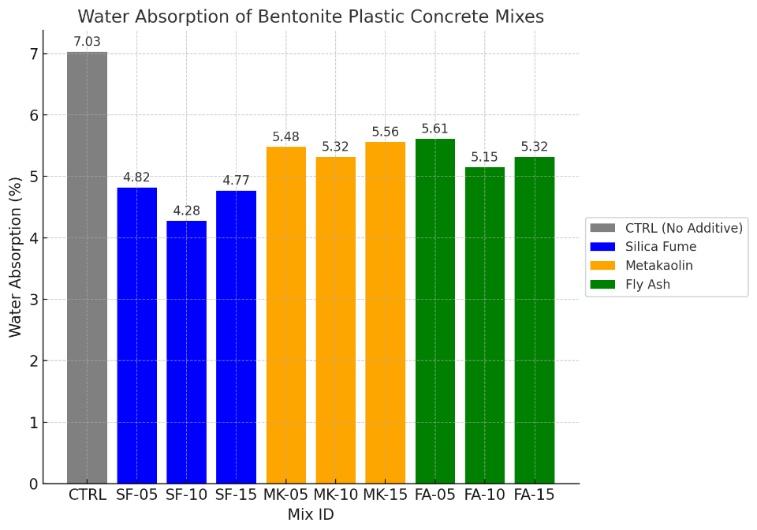
When pozzolanic additives such silica fume, metakaolin, and fly ash are included as show in Table 2 and Figure 4, the water absorption results clearly show a durability improvement in bentonite plastic concrete.
Figure 4. Water absorption results for bentonite plastic concrete mixes
Reflecting the naturally porous character of bentonite-blended concrete without additional cementing materials, the control mix (CTRL) showed the highest water absorption at 7.03%. Especially in the SF-10 mix, silica fume drastically lowered absorption to 4.28%. Runganga et al. [22] who noted that silica fume's fine particle size and high pozzolanic reactivity help to improve the microstructure and lower water ingress support this result. With MK-10 reaching a water absorption value of 5.32%, which corresponds with the results of Siddique and Klaus [19] who claimed that metakaolin lowers pore connectivity and refines the cementitious matrix, so lowering the water absorption, metakaolin was also effective. Fly ash, on the other hand, showed a slower impact; FA-10 obtained 5.15%, a result consistent with the study of Fode et al. [17] who showed that fly ash's pozzolanic activity causes additional C–S–H gel to develop over time, so reducing permeability and absorption over time. These findings confirm that 10% silica fume or metakaolin replaces regular Portland cement to produce best effects in lowering water absorption and improving the durability of bentonite-based concrete.
4.5 FESEM of best mixtures
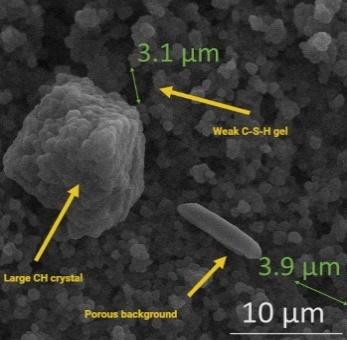
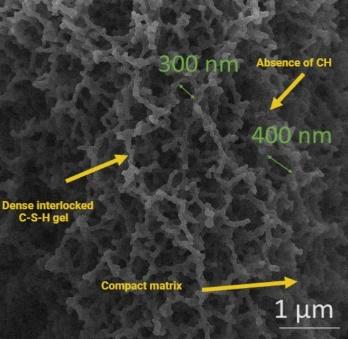
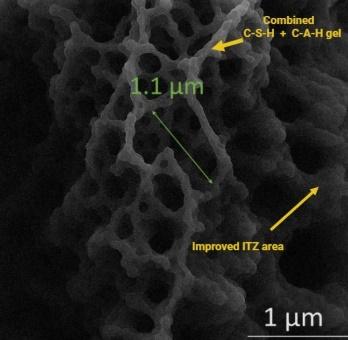
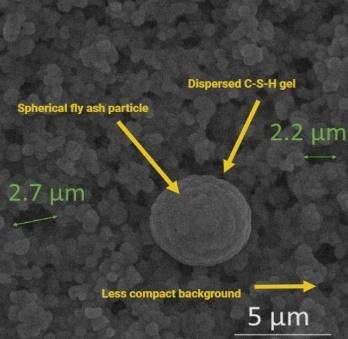
Figures 5-8 show the FESEM images of four selected concrete mixes: the control mix (CTRL) and concretes with 10% replacement of silica fume (SF-10), metakaolin (MK-10), and fly ash (FA-10). These micrographs show the effect of various pozzolanic materials on the microstructure, porosity, and hydration products of bentonite-modified plastic concrete, which correlate with the mechanical and durability properties. The microstructure of the control mix (CTRL), shown in Figure 5. The matrix shows visible microcracks and many voids, and appears to be porous and loosely compacted. Together with a discontinuous, weakly bonded calcium silicate hydrate (C–S–H), large crystalline calcium hydroxide (CH) deposits are observed. The low compressive and tensile strengths, as well as the high permeability and water absorption noted for this mix, can be explained by the porous and poorly integrated interfacial transition zones (ITZ) surrounding the bentonite particles. In contrast, Figure 6, which matches the SF-10 mix, shows a quite homogeneous and dense matrix. An extensive pozzolanic reaction is indicated by a well-distributed and compact C–S–H gel network dominating the microstructure with minimal visible CH residues. The ITZ appears almost pore-free, and the pore structure is improved. Along with its lowest permeability and water absorption values among all mixes, this image supports the remarkable performance of SF-10 in terms of compressive and tensile strength. Figure 7 displays the compact matrix microstructure of the MK-10 mix. Visible both C–S–H and calcium aluminate hydrate (C–A–H) phases help to improve microstructural integrity. Although some voids still existed, their frequency was lower than that of the control. Although it is still less polished than the SF-10 mix, the ITZ is much better than that of the Ctrl. This design helps explain the observed changes in mechanical characteristics, as well as the lower permeability and water absorption. Finally, Figure 8 shows spherical Class F fly ash particles embedded in a matrix of dense C–S–H gel. Although the general compactness was less than that in SF-10 and MK-10, the matrix still showed better densification than the control, even though some fly ash particles seemed to have partially reacted. The ITZ had some residual porosity, but it appeared to be improved. These qualities correspond to the modest increases in strength and durability observed in the FA-10 mix.
Overall, the FESEM images (Figures 5-8) provide strong visual evidence of how various pozzolanic materials affect the microstructure of bentonite-based plastic concrete. Whereas adding silica fume produced the most refined and dense microstructure, the control mix exhibited a weak and porous network. While fly ash offers slow microstructural development with the possibility of long-term improvement, metakaolin also greatly increases internal compactness. These microstructural changes explain the trends in the mechanical and durability performances of each combination.
Figure 5. FESEM for control mixture
Figure 6. FESEM for SF-10 mixture
Figure 7. FESEM for MK-10 mixture
Figure 8. FESEM for FA-10 mixture
This study shows that adding pozzolanic materials to bentonite-modified plastic concrete, specifically silica fume, metakaolin, and Class F fly ash, can significantly improve the mechanical and durability properties of the material. Because of the expansive nature and high water retention capacity of bentonite, the control mix with 10% bentonite and no pozzolanic replacement showed the lowest compressive and tensile strengths as well as the highest permeability and water absorption values. 10% silica fume (SF-10) produced the best overall results among the tested additives, with the lowest values for water permeability (2.1 × 10⁻⁷ m/s) and water absorption (4.28%), a 36% increase in compressive strength, and a noticeable improvement in tensile strength. Significant improvements in strength and pore refinement were also achieved with 10% replacement metakaolin (MK-10), which decreased absorption to 5.32%. The same dosage of fly ash (FA-10) produced slight but steady improvements, which were particularly advantageous for long-term durability. These results were corroborated by the FESEM images, which showed a moderately compacted matrix in MK-10, a dense and homogeneous microstructure in SF-10, and spherical fly ash particles inside a partially densified matrix in FA-10. In contrast, the control mix displayed weak ITZ zones and a porous, poorly bonded structure with noticeable CH crystals. Overall, the findings demonstrate that pozzolanic materials can mitigate the negative effects of bentonite, particularly its increased porosity and decreased strength. Because of its high reactivity and ultrafine particles, silica fume was the most effective, followed by metakaolin. Despite its slower initial reactivity, fly ash improves the microstructural integrity over time. The combination of bentonite and SCMs offers a sustainable method for creating concrete with enhanced mechanical performance, impermeability, and potential for use in structures requiring durability under environmental stress.
The created mixes show promise for use in cut-off walls, tunnels, and other subterranean or hydraulic structures where water resistance and durability are crucial because of their enhanced mechanical and impermeability qualities.
The authors are grateful to the institutions that helped make this research possible. The Department of Applied Sciences at the University of Technology, Baghdad, and the College of Engineering at Al-Mustafa University, Baghdad, are thanked for providing access to their laboratory and tools needed for this study. The success of the experimental work in this project was greatly influenced by the useful technical and academic support provided by the Department of Materials Engineering at the College of Engineering, Mustansiriyah University. I am indebted to the School of Materials and Mineral Resources Engineering at Universiti Sains Malaysia for their cooperation and input in the analysis of this research. The research objectives were achieved through cooperation among these institutions.
[1] Yao, Y., Liu, C., Liu, H., Zhang, W., Hu, T. (2023). Deterioration mechanism understanding of recycled powder concrete under coupled sulfate attack and freeze–thaw cycles. Construction and Building Materials, 388: 131718. https://doi.org/10.1016/j.conbuildmat.2023.131718
[2] Zhang, Z., Li, J., Ma, T., Li, Y., Chen, Y., Ma, H. (2025). Effect of nano-montmorillonite on the self-healing properties of asphalt from thermodynamic and molecular dynamic. Journal of Testing and Evaluation, 53(4). https://doi.org/10.1520/JTE20240320
[3] Liu, X., Qu, M., Nguyen, A.P.T., Dilley, N.R., Yazawa, K. (2021). Characteristics of new cement-based thermoelectric composites for low-temperature applications. Construction and Building Materials, 304: 124635. https://doi.org/10.1016/j.conbuildmat.2021.124635
[4] Zhang, G., Li, W., Zhang, Y., Huang, Y., Zhang, Z., Chen, Z. (2020). Analysis and reduction of process energy consumption and thermal deformation in a micro-structure wire electrode electric discharge machining thin-wall component. Journal of Cleaner Production, 244: 118763. https://doi.org/10.1016/j.jclepro.2019.118763
[5] Reddy, K.C., Subramaniam, K.V. (2021). Investigation on the roles of solution-based alkali and silica in activated low-calcium fly ash and slag blends. Cement and Concrete Composites, 123: 104175. https://doi.org/10.1016/j.cemconcomp.2021.104175
[6] Almusawi, A., Shoman, S., Lupanov, A.P. (2023). Assessment of the effectiveness and the initial cost efficiency of hot recycled asphalt using polymer modified bitumen. Case Studies in Construction Materials, 18: e02145. https://doi.org/10.1016/j.cscm.2023.e02145
[7] Zhang, Y., Wang, Q., Zhou, M., Fang, Y., Zhang, Z. (2020). Mechanical properties of concrete with coarse spontaneous combustion gangue aggregate (SCGA): Experimental investigation and prediction methodology. Construction and Building Materials, 255: 119337. https://doi.org/10.1016/j.conbuildmat.2020.119337
[8] ASTM International. (2024). Standard specification for Portland cement. ASTM C150/C150M-24. https://doi.org/10.1520/C0150_C0150M-24
[9] ASTM International. (2025). Standard specification for coal ash and raw or calcined natural pozzolan for use in concrete. ASTM C618-23e1. https://doi.org/10.1520/C0618-23E01
[10] DIN Media. (2019). Testing hardened concrete – Compressive strength of test specimens. BS EN 12390-3:2019, 2019. https://doi.org/10.31030/3045735
[11] ASTM International. (2017). Standard test method for splitting tensile strength of cylindrical concrete specimens. ASTM C496/C496M-17.
https://doi.org/10.1520/C0496_C0496M-17
[12] fur Normung, D. (1991). Testing concrete: Testing of hardened concrete (specimens prepared in mould). DIN 1048 Part 5 1991, in Germany.
[13] ASTM International. (2021). Standard test method for density, absorption, and voids in hardened concrete. ASTM C642 21. https://doi.org/10.1520/C0642-21
[14] Mendes, T.M., Repette, W.L., Reis, P.J. (2017). Effects of nano-silica on mechanical performance and microstructure of ultra-high performance concrete. Cerâmica, 63: 387-394. https://doi.org/10.1590/0366-69132017633672037
[15] Nana, A., Alomayri, T.S., Venyite, P., Kaze, R.C., et al. (2022). Mechanical properties and microstructure of a metakaolin‑based inorganic polymer mortar reinforced with quartz sand. Silicon, 14: 263-274. https://doi.org/10.1007/s12633-020-00816-4
[16] Xiao, T., Liang, X., Du, S. (2024). Development of high‑volume fly ash concrete with improved interfacial transition zone. Journal of Building Engineering, 87: 109050. https://doi.org/10.1016/j.jobe.2024.109050
[17] Fode, T.A., Jande, Y.A.C., and Kivevele, T. (2024). Effects of raw and different calcined bentonite on durability and mechanical properties of cement composite material. Case Studies in Construction Materials, 20: e03012. https://doi.org/10.1016/j.cscm.2024.e03012
[18] Pedro, D., de Brito, J., Evangelista, L. (2018). Durability performance of high‑performance concrete made with recycled aggregates, fly ash and densified silica fume. Cement and Concrete Composites, 93: 63-74. https://doi.org/10.1016/j.cemconcomp.2018.07.002
[19] Siddique, R., Klaus, J. (2009). Influence of metakaolin on the properties of mortar and concrete: A review. Applied Clay Science, 43(3-4): 392-400. https://doi.org/10.1016/j.clay.2008.11.007
[20] Thomas, M.D.A., Matthews, J.D. (1992). The permeability of fly ash concrete. Materials and Structures, 25: 388-396. https://doi.org/10.1007/BF02472254
[21] Ahmed, M.S., Kayali, O., Anderson, W. (2009). Evaluation of binary and ternary blends of pozzolanic materials using the rapid chloride permeability test. Journal of Materials in Civil Engineering, 21(9): 446-454. https://doi.org/10.1061/(ASCE)0899-1561(2009)21:9(446)
[22] Runganga, D., Okonta, F., Musonda, I. (2024). Strength and durability properties of high-volume fly ash (HVFA) binders: A systematic review. CivilEng, 5(2): 435-460. https://doi.org/10.3390/civileng5020022