S Maluvu* | T Felix Kala
© 2026 The authors. This article is published by IIETA and is licensed under the CC BY 4.0 license (http://creativecommons.org/licenses/by/4.0/).
OPEN ACCESS
Black cotton soil undergoes significant volumetric changes with fluctuations in moisture content, which results in low bearing capacity and excessive settlement under structural loads. This study explores the application of marble dust, an industrial by-product composed primarily of calcium carbonate, as a sustainable stabilizing agent to improve the geotechnical properties of black cotton soil. Experiment results indicate that the marble dust significantly improves the compaction, strength, and load-settlement response, with the optimal performance observed at a 30% replacement level. To supplement the laboratory investigations and reduce trial-and-error in soil mixture design, a Random Forest regression model is constructed using key parameters of soils to predict the bearing capacity. The model demonstrates satisfactory predictive performance, but its generalizability is limited due to a small dataset and laboratory-scale conditions. Overall, the integrated experimental and machine learning framework highlights the potential of marble dust as an effective soil stabilizer and emphasizes the need for larger datasets and field-scale validation to support broader practical application.
black cotton soil, marble dust, soil stabilization, bearing capacity, Random Forest regression, machine learning, sustainable ground improvement
1.1 Background of black cotton soil challenges
Expansive soil, or black cotton soil or Vertisol, is one of the most common and troubled soils in India that occupies about 20% of the total area of the country. The soil, which is mainly formed through weathering of basaltic rocks, has a high clay content, especially montmorillonite and illite minerals, which give the soils high swelling and shrinking properties as a result of changes in moisture. Such volumes vary or swell up to over 15–20% in extreme humidity, which is a big problem for civil engineering works, particularly to structure that are lightly loaded, like residential buildings, pavements, and small-scale infrastructure. Combined with a naturally low bearing capacity of the soil with the potential to support loads ranging between 100 and 200 kN/m2 in its natural non-stabilized condition, and with characteristic differential settlements of over 25 mm with moderate loads, the soil is inherently an unstable basis to use as a foundation material, unless treated. The outcome is drastic: structural cracks on the walls are visible, uneven floor settlements, and differentiated movements on the foundations are common issues, which cause a high cost of repairs, safety hazards, and structural collapse in some cases. These problems are especially acute in the construction sector of India, where millions of hectares of the black cotton soil could not be developed because of the mentioned constraints. To overcome them, the use of traditional stabilization techniques, i.e., lime and cement additions, has been practiced for decades. But they have major demerits; they are costly economically, difficult to apply, involving specific technical skills, and they strain the ecosystem because of excessive energy use in lime kilns and cement manufacturing plants. Lime stabilization should be cured carefully over time and is prone to carbonation, whereas cement stabilization may cause stiff, brittle soil structures likely to shrink under cracks. Also, the production through the two techniques produces high carbon emissions, which do not match the contemporary sustainability goals. As a result, there is an urgent necessity to develop other, more reliable, and sustainable methods of soil stabilization, which do not influence the environment as much as they can contribute to the improvement of the geotechnical characteristics of black cotton soil and save the costs of the project.
Despite studies in the past that have assessed marble dust as a stabilizer and research that has used machine-learning methods to predict soil behaviour, there is very little literature that has combined both methods to quantitatively measure the bearing capacity enhancement and settlement behaviour using an integrated experimental-AI system.
Artificial intelligence has been used previously to predict different soil properties, but little has been done in its combination with experimentally optimized marble-dust stabilization to determine bearing capacity. The study is filling this gap by integrating the laboratory test with a predictive machine-learning model to enhance the interpretation and prediction of the load-settlement response of stabilized black cotton soil.
The unique feature of the current study is that it combines experimentally optimized marble-dust stabilization with an interpretable model of the Random Forest to predict bearing capacity and settlement with a small laboratory dataset and quantitatively measure uncertainty and model constraints.
1.2 Marble dust as a sustainable stabilizer
There is a recent development of the marble dust as a waste product of the marble processing industry as a promising and viable alternative in stabilizing problematic soils, such as the black cotton soil. Marble dust is generated in the process of cutting, polishing, and finishing, and it is about a quarter of the original mass of marble and mostly comprises carbonate of calcium (CaCO3), with some smaller amounts of silica and feldspar. The marble industry in India is flourishing, especially in areas such as Rajasthan and Tamil Nadu. Millions of tonnes of marble dust are produced every year in India. Large amounts of this waste are dumped in open areas and landfills, posing severe environmental issues like dust air pollution, land degradation, water pollution by calcium leachate, and loss of prime real estate. The recycling of industrial wastes through the use of marble dust in soil stabilization provides a dual environmental and economic advantage, as it not only alleviates pressure on landfill facilities and consequently on the surrounding ecosystem, but is also cost-effective in terms of cost and, in most cases, can be applied at under one third or fifth of the cost of lime or cement stabilization. Experimental research done in the past has recorded the use of marble dust as a soil stabilizer. It was established that marble dust decreased soil plasticity by breaking clay mineral orientation, increased maximum dry density (MDD) by better packing of particles, and greater bearing capacity, filling the voids and improving the formation of inter-particle carbide, by interacting with calcium carbonate [1, 2]. The common improvements have been MDD increase 1.65 g/cc to 1.84 g/cc (12% improvement), and the optimum moisture content (OMC) decreased to 10.5 (12-12) with an improvement in the bearing capacity of 30–50 at an optimum dosage. Nevertheless, there remains a severe constraint: the optimal dosage of marble dust can be in force only with the help of the extensive laboratory experiments on the various dosage percentages (0, 10, 20, 30, 40), test of numerous soil samples, and analysis of various geotechnical properties, such as compaction, California bearing ratio (CBR), unconfined compressive strength (UCS), settlement. The process has been cited as time-consuming, resource-intensive, and expensive, as well as requiring a large amount of technical expertise—a major limitation especially in the developing regions.
1.3 Machine learning in geotechnical engineering and the research gap
The latest developments in machine learning provided favorable potential applications in the geotechnical field of engineering. It was demonstrated that the Random Forest algorithms can provide a prediction of soil properties with R2 exceeding 0.9. It was also obtained 95% accuracy of neural networks at predicting the unconfined compressive strength of stabilized soils. Random Forest was further used to predict the ground properties at 92% accuracy. Although these research reports confirm the possible application of machine learning in soil engineering, the majority of studies emphasize the application of specific studies without considering the overall prediction models [3-5]. Moreover, current literature is mostly based on large-scale data (n > 200); a limited number of research utilizes powerful machine learning algorithms on limited lab data (n = 50).
There is also a serious research gap: despite the research on the stabilization of marble dusts and the use of MLS in the field of geotechnics conducted independently of each other, not a large number of studies combine the two methods. In particular, no published study has used both machine learning models and marble dust stabilization of black cotton soil to forecast the best dosages and bearing capacity in the same framework. Besides, the currently available AI apps in soil stabilization do little to take into consideration the limitations of the dataset, or that the models are rigorously tested with cross-validation methods suitable for small datasets.
1.4 Objectives and research positioning
The proposed study will help fill the identified gap in research by fulfilling four goals:
(1) Experimental assessment—test the effect of marble dust on the properties of black cotton soil (MDD, OMC, CBR, shear strength, settlement) using rigorous laboratory tests and documented replicates;
(2) Optimal dosage identification—calculate the most efficient percentage of marble dust to maximize the geotechnical benefit and identify performance limits;
(3) Predictive modelling—create a Random Forest model to predict the effect of bearing capacity in the restricted data set n. It is an important though incremental work. Although there are AI-based apps in the area of soil stabilization, this study shows how the Random Forest can be used to optimize the amount of marble dust to add to a soil under a controlled environment. This is not a field-tested design procedure but a preliminary strategy at the laboratory level of optimization. Combining the use of waste with data analytics, this study leads to sustainable development of infrastructure and illustrates the perspective of AI-enhanced soil stabilization and its existing limitations.
2.1 Marble dust stabilization of black cotton soil
Geotechnical studies of the recent past have been immensely interested in stabilizing black cotton soil by the use of waste materials. It was established that 20% marble dust was the best at inhibiting plasticity and swelling of expansive soils due to particle packing and filling of the voids [1]. A combination of marble dust and cement in pavement was studied, and a significant rise in CBR, along with a positive decrease in permeability, was found [6]. At 15% dosage of marble dust, a 40% improvement in CBR was realized [2]. The usefulness of marble dust was confirmed, showing that a 30% dose could enhance UCS by 50% while decreasing plasticity [7]. The effect of marble powder was assessed, whereby the best CBR values were obtained at different dosages with lesser increasing returns at high additions [8]. All these studies have demonstrated that marble dust can be used as an effective stabilizing agent of the expansive soils, which are not only economically viable but also environmentally sustainable. There are also reports in the literature of the use of alternative wastes, which include Lime, sawdust ash, fly ash, slag, and tyre waste, as the broader use of wastes in the geotechnical industry [3-5, 9, 10].
2.2 Machine learning applications in geotechnical engineering
Machine learning has been a potent predictive instrument of soil behavior and geotechnical optimization of solutions [11]. It was emphasized that Random Forest outperforms other predictive tools in predicting the soil properties, given the R² value of above 90% [12]. Soil stabilization was predicted with 95% accuracy on large datasets using neural networks [13]. Random Forest was used to make ground characteristic prediction at the cost of 92% accuracy [14]. Deep learning was applied to geotechnical risk assessment to enhance the accuracy of bearing capacity prediction by 30% when compared to conventional approaches [15]. Slope analysis using artificial intelligence techniques was demonstrated [16]. State-of-the-art reviews of artificial intelligence patterns in soil–structure interaction have also been presented [17]. The effects of data splitting on the performance of machine learning models used to predict soil properties were examined [18]. Many recent studies have used machine-learning techniques to assess the enhancement in soil characteristics with the incorporation of industrial waste products. Such methods typically indicate an improved predictability of parameters like CBR, UCS, and compaction characteristics. Nevertheless, the applications that are made concentrate on individual mechanical properties and not the general foundation performance [19]. Recent literature that integrates AI into the process of soil stabilization through waste [20-24] shows that predictive modelling has the potential to predict soil behaviour, although these studies seldom cover the bearing capacity directly and often do not compare the responses of the experiment and the inferences made by machine learning. This disjuncture indicates the necessity to develop methods that combine the results of experimental stabilization and modelling with predictability in a systematic way to be able to contribute to the design choices in geotechnical engineering.
2.3 Research gap and study positioning
One gap in the research is that, at the marriage point between machine learning and marble dust stabilization, lies a big gap. Although the use of marble dust and machine learning has been widely researched separately, little has been done to determine the stabilization and prediction of both methods in combination to come up with the optimal doses of the method to be used in the black cotton soil. The current marble dust studies dwell more on the characterization of the materials experimentally and do not construct predictive models. On the other hand, the large external data sets commonly used in machine learning studies do not strictly consider the optimization of waste materials using small laboratory datasets. This study responds to this gap by combining one intricate predictive algorithm, the Random Forest, with marble dust stabilization experiments, validating predictions predictively using cross-validation suitable for n in the range of 50 samples, quantifying model uncertainties and limitations verbally, and describing the study findings as an in-progress laboratory-scale optimization that needs validation in the field.
2.4 Critical review of the past researches
(1). Past research always records an increase in strength at 20–30% marble dust, although most of the research gives minimal description on the mechanism behind the increase and the quantitative sensitivity of each soil parameter to the stabilizer content.
(2). The current machine-learning applications in geotechnics are mostly aimed at UCS or CBR prediction, and exceedingly few of them are aimed at the direct correlation of the stabilized soil properties with the bearing-capacity results.
(3). The existing research that uses machine learning with waste-based stabilization either uses small datasets or fails to use cross-validation or feature-importance analysis, and it is not clear whether such studies can generalize.
(4). As a result, a single framework that experimentally defines the stabilization of marble-dust and simultaneously uses interpretable machine learning methods to minimize the number of trials in experimentation and insights into the parameters of control still needs to be developed.
3.1 Material collection and preparation
The black cotton soil was obtained in Kovil Patti, Tamil Nadu, and it was air-dried in three days and taken at a depth of 1.5 m. The soil was crushed and sieved using a 4.75 mm Indian Standard (IS) sieve. The dust (marble, 0–400 mm, calcium carbonate-based) was purchased at Manish Marble Industries, Madurai. Both materials were subjects of sealed containers so as to avoid getting wet. Blends of soil-marble dust were made at 0%, 10%, 20%, 30%, and 40%. Three replicates were made for each dosage to make sure that there is reliability in the results. The 10 minutes were to be done in a Hobart mixer with homogeneous mixing on a sequence of blending 10 minutes by hand and 10 minutes by themselves to remove segregation. All samples were labelled, dated, and stored at 25 ± 2℃ and 60% relative humidity. The samples were then tested. Three replicate specimens in every mix proportion were prepared to give the mix proportion a statistical reliability and to remove natural variation in the soil response. All the stabilized samples underwent the curing period of seven days in a controlled laboratory environment at 27 ± 2℃, and polyethylene sheets were used to ensure that the moisture did not escape the samples during the curing period. Before conducting the testing, the dial gauges, the proving ring, and the loading frame were first calibrated to remove bias in the measurements and increase the degree of accuracy. Incremental loading plate load tests were conducted with the settlement values observed at those load stages until the primary deformation was found to have stabilised to enable a valid evaluation of the load set settlement behaviour of the stabilised and non-stabilised soil.
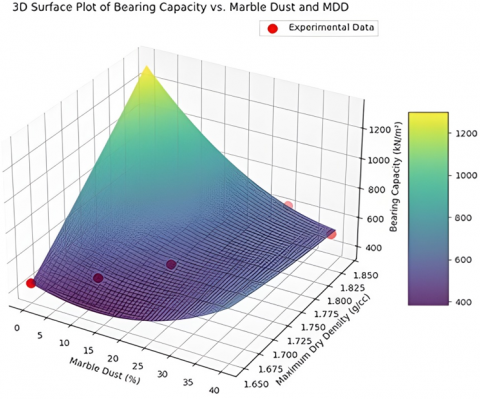
Table 1 shows the properties of blank cotton soil and marble dust, and Figure 1 shows the 3D surface.
Equations for material characterization are listed as follows:
Specific gravity (Gs):
$G_s=\frac{W_2-W_1}{\left(W_2-W_1\right)-\left(W_3-W_4\right)}$
where, W1 = Weight of empty pycnometer (g); W2 = Weight of pycnometer + dry soil (g); W3 = Weight of pycnometer + soil + water (g); W4 = Weight of pycnometer + water (g)
Percentage of marble dust (MD%):
$D=\sum\left(\frac{M_i}{M_t} \times d_i\right)$
where, Mi = Mass retained on sieve i (g); Mt= Total mass of sample (g); di = Mean diameter of sieve i (mm).
Moisture content adjustment (w):
$w=\left(\frac{W_w-W_d}{W_d}\right) \times 100$
where, Ww= Weight of wet soil sample (g); Wd = Weight of dry soil sample (g).
Table 1. Properties of black cotton soil and marble dust
|
Material |
Specific Gravity (G) |
Liquid Limit (%) |
Plastic Limit (%) |
Maximum Dry Density (MDD) (g/cc) |
Optimum Moisture Content (OMC) (%) |
|
Black cotton soil |
2.65 |
54 |
31.68 |
1.65 |
12.0 |
|
Marble dust |
2.71 |
- |
- |
- |
- |
Figure 1. Experimental results of 3D response surface of bearing capacity against percent of marbles dust and maximum dry density
3.2 Experimental testing program
Testing: An extensive test program was implemented, meeting Indian Standards:
Sieve analysis (IS 2720 Part 4-1985): A final size distribution was ascertained as determined; Cu = 8.57, Cc = 1.44.
Atterberg limits (IS 2720 Part 5-1985): Evaluated liquid limit (LL), plastic limit (PL), and plasticity index (PI) variations in the percentages of marble dust using the Casagrande apparatus.
Standard proctor compaction (IS 2720 Part 7-1980): The MDD and OMC through the three layers using 2.6 kg of rammer with 25 blows per layer. Triplicates of each dose were done, and the mean values and standard deviation were reported.
California bearing ratio (IS 2720 Part 16-1985): Assessed the subgrade strength even when wetted and non-wetted. Each marble dust at a given percentage was tested on 3 specimens with a 50 mm plunger penetrating at 1.25 mm/min. The swell and settlement were taken at 2.5 mm and 5 mm penetration.
Unconfined compressive strength (IS 2720 Part 10-1991): Before testing, the samples were placed under 7 days of curing at 25 ± 2℃ in an atmosphere of 60% relative humidity and cured on the cylindrical samples (38 mm diameter, 76 mm height). Triplicates of dosage experimented; loading rate: 1.25 mm/min.
Plate load test (IS 1888-1992): It is done with the same plate, i.e., a 6 × 6 cm square plate in a 30 × 30 × 30 cm tank. Procedure: Preliminarily set up 5 kN, 10 kN, and 15 kN loads at stages 1, 2, 5, 10, 15, and 30 minutes and 1-hour blocks. Total test load 240 kg (~2.4 kN). Dial gauge accuracy: + ₋0.1 mm.
Instrument calibration: all measuring instruments calibrated before test: dial gauges-standard block (± 0.01 mm), dial electronic balance ± 0.1 g; load cell ± 2%.
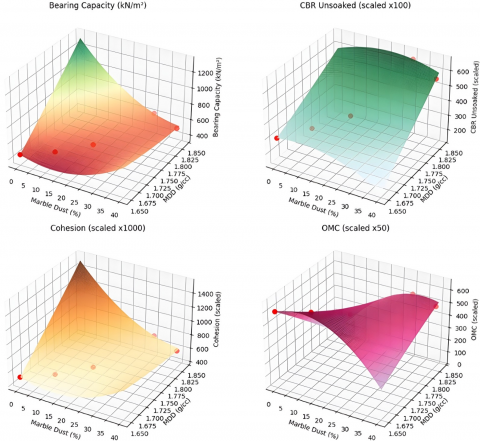
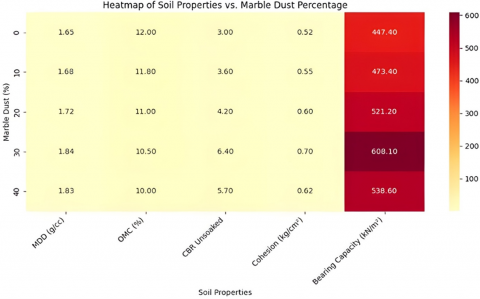
Table 2 shows the experimental test standards and parameters. Figure 2 and Figure 3 show the desired 3D surface plot and heatmap.
Equations for experimental tests are presented as follows:
Uniformity coefficient (Cu):
$C_u=\frac{D_{60}}{D_{10}}$
where, D60 = Particle diameter at 60% passing (mm); D10 = Particle diameter at 10% passing (mm).
Curvature coefficient (Cc):
$C_c=\frac{D_{30}^2}{D_{10} \times D_{60}}$
where, D30 = Particle diameter at 30% passing (mm); D60 = Particle diameter corresponding to 60% passing (mm); D10 = Particle diameter corresponding to 10% passing (mm).
Table 2. Experimental test standards and parameters
|
Test |
Standard |
Key Parameters Measured |
Equipment Used |
|
Sieve analysis |
IS 2720 Part 4 |
Particle size distribution, uniformity coefficient (Cu), coefficient of curvature (Cc) |
Sieve shaker, 4.75 mm to pan |
|
Atterberg limits |
IS 2720 Part 5 |
Liquid limit, plastic limit |
Casagrande apparatus |
|
Compaction |
IS 2720 Part 7 |
MDD, OMC |
Proctor mold, 2.6 kg rammer |
|
California bearing ratio |
IS 2720 Part 16 |
Unsoaked/soaked California bearing ratio at 2.5 mm, 5 mm |
California bearing ratio mold, 50 mm plunger |
|
Unconfined compressive strength |
IS 2720 Part 10 |
Shear strength, cohesion |
Compression machine, 38 mm mold |
|
Load settlement |
IS 1888-1992 |
Settlement under 240 kg, bearing capacity |
6 × 6 cm plate, loading frame |
Figure 2. 3D response surfaces of bearing capacity, unsoaked California bearing ratio, cohesion, and optimum moisture content versus marble dust content and compaction characteristics
Figure 3. Heatmap showing the variation in maximum dry density, optimum moisture content, unsoaked California bearing ratio, cohesion and bearing capacity with the percentage of marble dust
3.3 AI and machine learning framework
The Random Forest Regressor was created to predict bearing capacity with the use of experimental data: marble dust percentage (MD%), MDD, OMC, CBR, and cohesion (C).
Model configuration:
Validation strategy:
Performance metrics:
As feature-importance analysis revealed, cohesion and CBR had the most significant effect on the predictions of the Random Forest model; next were the MDD and OMC, which indicates how strongly the shear resistance determines the behaviour of bearing capacity. In order to increase predictive framework strength, a five-fold cross-validation strategy was adopted, and the model still showed the same results in all the folds, and the accuracy of the model was not conditional on one train-test split. Although the R2 is large, the small sample size is bound to cause some uncertainty in the predictions, and the prediction interval obtained must then be viewed with some uncertainty when extrapolating the results outside the controlled laboratory settings.
Uncertainty quantification: Residual analysis performed; prediction intervals calculated at ± 1 SD and ± 2 SD around predictions.
Small dataset (n = 50) increases overfitting risk; no external validation dataset available; model cannot extrapolate beyond 0–40% marble dust range. Table 3 shows the testing standards and parameters.
Table 3. Testing standards and parameters
|
Test |
Standard |
Key Parameters |
Equipment |
Replicates |
|
Sieve analysis |
IS 2720-4 |
Cu, Cc |
Sieve shaker |
1 |
|
Atterberg limits |
IS 2720-5 |
Liquid limit, plastic limit, plasticity index |
Casagrande |
3 |
|
Compaction |
IS 2720-7 |
MDD, OMC |
Proctor mold |
3 |
|
California bearing ratio |
IS 2720-16 |
Unsoaked/soaked California bearing ratio (CBR) |
CBR mold, plunger |
3 |
|
Unconfined compressive strength |
IS 2720-10 |
Shear strength, cohesion |
Compression machine |
3 |
|
Plate load |
IS 1888-1992 |
Settlement, black cotton |
6 × 6 cm plate |
1 |
4.1 Compaction and California bearing ratio outcomes
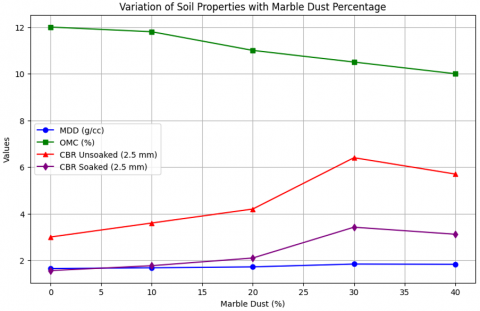
The presence of the marble dust improved the effect of compaction of black cotton soil to a significant extent. MDD was raised to 1.846004 g/cc (an increase of 11.53) and then 1.837003 g/cc (a decrease of 0.0088) at 30 and 40% addition of marble dust, respectively. OMC reduced to 10.5 ± 0.2% at 30% marble dust. There was significant improvement in CBR, and unsoaked CBR improved at 30% marble dust, doing as much as 3.0 ± 0.15 to 6.4 ± 0.32 (+ 113%); soaked CBR improved, doing as much as 1.56 + 0.08 to 3.42 + 0.17 (+ 119%). Marble dust percentage had a significant impact on all parameters measured, and the most positive response was seen at the 30% of the replacement, and the slightest decrease in performance was spotted at 40%.
Mechanistic explanation: Improvement of MDD is caused by increased packing of the particles, fine marble dust particles (0–40000 M, mostly CaCO3) fill the inter-particle space between the clay matrix, which decreases the void ratio and then increases soil density. The OMC decrease is the manifestation of weakened water demand as a result of the non-hygroscopic marble dust violence that dilutes the moisture-insistent montmorillonite clay. The significant improvements of CBR are due to: (1) mechanical reinforcement during void-filling and the high-quality packing of particles; (2) incipient cementation between CaCO3 and clay minerals with weak cementing bonds; and (3) reduction of plasticity caused by dislocation of clay orientation. The reduction of performance at 40% shows that there is an already critical threshold beyond which fines cannot be effectively jammed, leaving weak regions, lowering inter-clay contact; the cushioning effect of too many fine particles against friction and bearing capacity is reduced.
All the marble dust content CBR results and detailed compaction are as in Table 4. When interpreting the results of the experiment, one has to remember that the measured values were the average response of three replicate specimens that were tested with each mix proportion. Standard deviation among these replicates was 2 to 6%, which is a good measure of repeatability and reproducible laboratory conditions. The error bands in the CBR and the UCS measurements are the natural heterogeneity of expansive soils and the sensitivity of their behaviour to levels of fines content and compaction effort. These are intrinsic to the clay-fines interactions and are not affected by the overall performance trends as seen in marble dust stabilization, especially the best response at 30% replacement.
Table 4. Compaction and California bearing ratio results
|
Marble Dust (MD) (%) |
MDD (g/cc) |
OMC (%) |
CBR Unsoaked (2.5 mm) |
CBR Soaked (2.5 mm) |
|
0 |
1.65 |
12.0 |
3.0 |
1.56 |
|
10 |
1.68 |
11.8 |
3.6 |
1.77 |
|
20 |
1.72 |
11.0 |
4.2 |
2.10 |
|
30 |
1.84 |
10.5 |
6.4 |
3.42 |
|
40 |
1.83 |
10.0 |
5.7 |
3.12 |
4.2 Shear strength and settlement
UCS tests showed that shear strength increased significantly with the additions being 1.03 kg/cm2 with untreated soil and 1.40 kg/cm2 with soil adulterated with 30% marble dust, and cohesion also increased by a proportion of 0.515 to 0.70 kg/cm2. This is brought about by the fact that marble dust has the capacity to bond clay particles, thereby minimizing the voids. Shear strength decreased to 1.24 kg/cm2 at 40%, depicting a good dosage threshold. A load settlement test that was performed by using a 6 × 6 cm plate with a load of 240 kg indicated that the settlement in untreated soil was 25 mm, whereas in a soil mixed with 30% marble dust, the settlement was 20.4 mm, as indicated in Table 5. It shows reduced load distribution, which is a plus, but settlement rose slightly to 21.5 mm at the 40% level, indicating reduced cohesion.
This enhancement up to a 30% content of marble dust is mainly due to the filling of the micro-voids and the partial replacement of the expansive clay minerals with non-plastic particles of calcium-carbonate. The replacement decreases the diffuse double layer thickness, facilitates flocculation, and increases the bond between the particles, leading to a more stable and thicker soil structure to support increased loads. Beyond this optimum level, however, the extra fine powder would raise the total surface area of the granules and reduce interparticle friction. This results in loss of structural integrity, loss of transfer structure of loads, and hence loss of strength and bearing capacity that is lower than the 30% replacement level.
Table 5. Unconfined compressive strength (UCS) and settlement results
|
MD (%) |
Shear Strength (kg/cm²) |
Cohesion (kg/cm²) |
Settlement (mm, 240 kg) |
|
0 |
1.03 |
0.515 |
25.0 |
|
10 |
1.09 |
0.545 |
24.2 |
|
20 |
1.20 |
0.600 |
22.8 |
|
30 |
1.40 |
0.700 |
20.4 |
|
40 |
1.24 |
0.620 |
21.5 |
4.3 Bearing capacity
Bearing capacity was determined through two-methods; one is based on UCS theoretical computations (IS 6403-1981), the other one is based on model plate load tests (IS 1888-1992). With the increase of cohesion, the UCS method demonstrated a bearing capacity of untreated soil at 447.4 kN/m2 and 608.1 kN/m2 at 30% of marble dust. Similar trends were obtained with plate load tests with values of 444.44 kN/m2 to 605.56 kN/m2. Both procedures identified 30% as the best dosage, the capacity decreasing at 40% to 538.6 kN/m2 (UCIM), and 547.22 kN/m2 (plate load Table 6), highlighting the trade-off between the addition of stabilizers and soil integrity.
Table 6. Bearing capacity results
|
MD (%) |
UCS Bearing Capacity (kN/m²) |
Plate Load Bearing Capacity (kN/m²) |
|
0 |
447.4 |
444.44 |
|
10 |
473.4 |
468.06 |
|
20 |
521.2 |
527.78 |
|
30 |
608.1 |
605.56 |
|
40 |
538.6 |
547.22 |
4.4 Machine learning model performance
Random Forest Regressor revealed different accuracy: single 80:20 split (R2 = 0.92, RMSE = 12.3 kN/m2, MAPE = 1.6%); 5-fold cross-validation (R2 = 0.88250.05), RMSE = 14.22.1 kN/m2); LOOCV (R2 = 0.85, RMSE = 16.8 kN/m2). The difference between the R2 of the test and the cross-validation is 4%, and this implies a moderate risk of over-fitting with n = 50 samples. The ranking of feature importance indicated that CBR (45.2) is the strongest predictor, cohesion (28.3) is the next, MDD (18.1) is the third, marble dust percentage (6.0) is the fourth, and OMC (2.4) is the last. The error of prediction was less than 1% (Table 7). Intervals of prediction increased with greater bearing capacities (± 26.4 kN/m2 at 30% and 20.5 kN/m2 at 0%), which comment upon the distribution of training data. There was no strong indication of deviation from normality when residual analysis was carried out.
Table 7. Comparison of actual bearing capacity and predicted bearing capacity using the Random Forest model
|
Mix ID |
Actual Bearing Capacity (kN/m², UCS) |
Predicted Bearing Capacity (kN/m²) |
Error (%) |
|
MD-0 |
447.4 |
445.8 |
0.36 |
|
MD-10 |
473.4 |
470.2 |
0.68 |
|
MD-20 |
521.2 |
518.9 |
0.44 |
|
MD-30 |
608.1 |
606.5 |
0.26 |
|
MD-40 |
538.6 |
536.1 |
0.46 |
4.5 Model limitations
Although R2 = 0.88 (cross-validation) is a reasonably accurate figure, there are critical constraints to the fields of application: (1) small size of dataset (n = 50) enhances the development of overfitting; (2) no external validation with other soil sources and sources of marble; (3) restricted to 0–40% range of marble dust; (4) laboratory-scale only (6 × 6 cm plate); (5) unknown effect of time; (6) single location (geographic) and material source. The model is a rough-cut optimization tool of laboratory evaluation, rather than a field-web design methodology. Designing the final foundation involves not using predictions that have not been verified in the field on varied soil types and the origin of marble dust. Figures 4 and 5 show the results of the compaction and CBR, respectively.
Figure 4. Bar diagram of the change of the California bearing ratio with the content of the marble dust
Figure 5. Influence of the percentage of marble dust on the maximum dry density, optimum moisture content and unsoaked/soaked California bearing ratio
4.6 Machine learning predictions
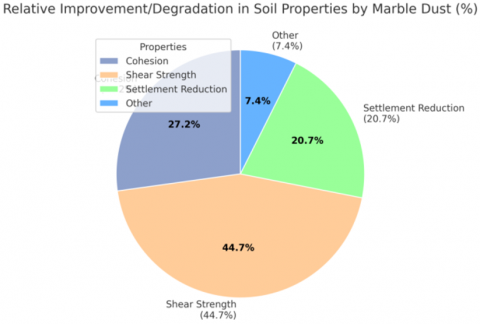
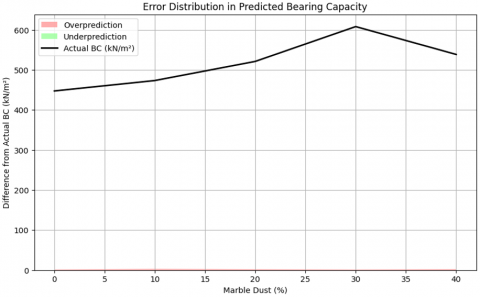
The predictor based on features such as marble dust percentage, MDD, OMC, unsoaked CBR, and cohesion that was trained on the Random Forest Regressor with the lowest R2 value reached 0.92 and the lowest Mean Squared Error of 152.3 kN/m2. There were close predictions, and the errors were less than 0.7, which proved that 30% marble dust was the best, as seen in Table 7. Its accuracy in the model ensures that it is not overly dependent on any massive-scale testing, which provides it with a scaling tool to be applied in the field, and its emphasis on AI and its role in geotechnical optimization. The visualizations of relative improvement and error distribution in our models are visible in Figure 6 and Figure 7.
As shown by the comparison of the actual bearing capacity values obtained after the UCS test with those of the predictions obtained with the help of the Random Forest model, the agreement between the results is high in all the marble dust proportions. The prediction error was between 0.26% and 0.68% with a mean deviation of about 0.44%, which implies that the model can be used to determine the nonlinear relation between the contents of marble dust, compaction properties, CBR values, and cohesion. The minimum error at the optimum marbles dust content both indicates the increased consistency of soil behavior at this mix proportion, whereby enhancement in density, moisture properties, and shear strength converge. Any minor error in lower or higher dosages is explained by the fact that there is more variability in the soil response when the stabilizer level is not at the optimum level. In general, the findings affirm that the Random Forest model can give sound predictions in the controlled laboratory setting, but since it relies on a small sample of data, its performance is to be tested again with wider and more representative samples of soil before it can be applied to fields.
Random Forest model recorded an acceptable predictive power of settlement and bearing capacity in laboratory settings. The machine learning model is supposed to be used as a decision-support tool in the laboratory scale and not as a direct foundation design tool.
Figure 6. Relative distribution of shear strength, cohesion and settlement reduction mortar with marble dust content
Figure 7. Error of prediction of bearing capacity across the marble dust contents using the Random Forest model
In this study, the effect of the addition of marble dust on the geotechnical characteristics of black cotton soil was investigated, and the findings revealed that the addition of 30 percent marble dust was always the most effective in the parameters of compaction, strength, and load-settlement response. The enhancement of this has been associated with the change of the soil matrix at the micro-scale because of the filling of the void, the decrease of the activity of clay minerals, and the enhanced bonding of the particle owing to the addition of calcium carbonate. Beyond this optimum value, the excessive fine content resulted in the surface area increasing and a break of the inter-particle friction, and thereby the engineering performance decreased. The prediction of bearing capacity was obtained using a Random Forest regression model that was created based on the significant geotechnical parameters. The model was discovered to possess a great predictive power within controlled laboratory conditions. Nevertheless, the small data sample and laboratory scale experimentation still cast doubt, in spite of the good R2 value, hence the model cannot be directly applied to a field condition. The importance of features importance analysis also indicated that cohesion and CBR were the most significant predictors, hence their key role in bearing capacity behavior. A large-scale field validation (with more sophisticated machine-learning and deep-learning algorithms) and consideration of other waste materials to expand the possibility of stabilization should be the next step of the investigation. In addition to this, one will need to expand the dataset and apply uncertainty quantification to increase the precision of the model. In short, it is an initial yet significant step in the experimental soil-stabilization field that will be integrated with AI-based predictive solutions, therefore, delivering a foundation of more comprehensive data-based geotechnical design.
[1] Jain, A.K., Jha, A.K. (2020). Geotechnical behaviour and micro-analyses of expansive soil amended with marble dust. Soils and Foundations, 60(4): 737-751. https://doi.org/10.1016/j.sandf.2020.02.013
[2] Sharma, S., Verma, K., Sharma, J.K. (2021). Experimental study of stabilization of expansive soil mixed with sawdust and marble dust. In Proceedings of the Indian Geotechnical Conference, pp. 535-547. https://doi.org/10.1007/978-981-33-6444-8_48
[3] Etim, R.K., Eberemu, A.O., Osinubi, K.J. (2017). Stabilization of black cotton soil with lime and iron ore tailings admixture. Transportation Geotechnics, 10: 85-95. https://doi.org/10.1016/j.trgeo.2017.01.002
[4] Ikeagwuani, C.C., Obeta, I.N., Agunwamba, J.C. (2019). Stabilization of black cotton soil subgrade using sawdust ash and lime. Soils and Foundations, 59(1): 162-175. https://doi.org/10.1016/j.sandf.2018.10.004
[5] Srivastava, A., Pandey, S., Rana, J. (2014). Use of shredded tyre waste in improving the geotechnical properties of expansive black cotton soil. Geomechanics and Geoengineering, 9(4): 303-311. https://doi.org/10.1080/17486025.2014.902121
[6] Deboucha, S., Aissa Mamoune, S.M., Sail, Y., Ziani, H. (2020). Effects of ceramic waste, marble dust, and cement in pavement sub-base layer. Geotechnical and Geological Engineering, 38(3): 3331-3340. https://doi.org/10.1007/s10706-020-01211-x
[7] Waheed, A., Arshid, M.U., Khalid, R.A., Gardezi, S.S.S. (2021). Soil improvement using waste marble dust for sustainable development. Civil Engineering Journal, 7(9): 1594-1607. https://doi.org/10.28991/cej-2021-03091746
[8] Umar, I.H., Lin, H. (2024). Marble powder as a soil stabilizer: An experimental investigation of the geotechnical properties and unconfined compressive strength analysis. Materials, 17(5): 1208. https://doi.org/10.3390/ma17051208
[9] Murmu, A.L., Dhole, N., Patel, A. (2020). Stabilisation of black cotton soil for subgrade application using fly ash geopolymer. Road Materials and Pavement Design, 21(3): 867-885. https://doi.org/10.1080/14680629.2018.1530131
[10] Shukla, R.P., Parihar, N.S. (2016). Stabilization of black cotton soil using micro-fine slag. Journal of the Institution of Engineers (India): Series A, 97(3): 299-306. https://doi.org/10.1007/s40030-016-0171-1
[11] Nyokum, T., Tamut, Y. (2025). Artificial intelligence in civil engineering: Emerging applications and opportunities. Frontiers in Built Environment, 11: 1622873. https://doi.org/10.3389/fbuil.2025.1622873
[12] Padarian, J., Minasny, B., McBratney, A.B. (2020). Machine learning and soil sciences: A review aided by machine learning tools. Soil, 6(1): 35-52. https://doi.org/10.5194/soil-6-35-2020
[13] Saad, A.H., Nahazanan, H., Yusuf, B., Toha, S.F., et al. (2023). A systematic review of machine learning techniques and applications in soil improvement using green materials. Sustainability, 15(12): 9738. https://doi.org/10.3390/su15129738
[14] Ren, J.J., Xu, X.W., Lv, Y.W., Wang, Q.X., Li, A., Li, K., Zhu, J.L., Cai, J.T., Liu, S. (2022). Late Quaternary slip rate of the northern Lancangjiang fault zone in eastern Tibet: Seismic hazards for the Sichuan-Tibet Railway and regional tectonic implications. Engineering Geology, 306: 106748. https://doi.org/10.1016/j.enggeo.2022.106748
[15] Ramasamy, D., Veerasamy, D., Sivamani, S. (2025). The future of geotechnical engineering through deep learning: A concise literature review. Journal of Information Systems Engineering and Management, 10(14s): 685-694. https://doi.org/10.52783/jisem.v10i14s.2380
[16] Bardhan, A., Samui, P. (2022). Application of artificial intelligence techniques in slope stability analysis: A short review and future prospects. International Journal of Geotechnical Earthquake Engineering, 13(1): 1-23. https://doi.org/10.4018/IJGEE.298988
[17] Jong, S.C., Ong, D.E.L., Oh, E. (2021). State-of-the-art review of geotechnical-driven artificial intelligence techniques in underground soil-structure interaction. Tunnelling and Underground Space Technology, 113: 103946. https://doi.org/10.1016/j.tust.2021.103946
[18] Nguyen, Q.H., Ly, H.B., Ho, L.S., Al-Ansari, N., et al. (2021). Influence of data splitting on performance of machine learning models in prediction of shear strength of soil. Mathematical Problems in Engineering, 2021(1): 4832864. https://doi.org/10.1155/2021/4832864
[19] Ruchit, P., Olivia, M. (2024). Progress and obstacles in the use of artificial intelligence in civil engineering: An in-depth review. International Journal, 13(1): 1059-1080. https://doi.org/10.30574/ijsra.2024.13.1.1777
[20] Nagaraju, T.V., Bahrami, A., Prasad, C.D., Mantena, S., Biswal, M., Islam, M.R. (2023). Predicting California bearing ratio of lateritic soils using hybrid machine learning technique. Buildings, 13(1): 255. https://doi.org/10.3390/buildings13010255
[21] Amin, M.N., Iqbal, M., Ashfaq, M., Salami, B.A., et al. (2022). Prediction of strength and CBR characteristics of chemically stabilized coal gangue: ANN and random forest tree approach. Materials, 15(12): 4330. https://doi.org/10.3390/ma15124330
[22] Kassa, S.M., Wubineh, B.Z. (2023). Use of machine learning to predict California bearing ratio of soils. Advances in Civil Engineering, 2023(1): 8198648. https://doi.org/10.1155/2023/8198648
[23] Gali, M.L., Rao, P.R. (2020). Problematic Soils and Geoenvironmental Concerns. Springer Singapore. https://doi.org/10.1007/978-981-15-6237-2
[24] Maheshwari, P., Bhardwaj, A., Sawant, V.A. (2025). Application of Soft Computing Techniques in Geotechnical Engineering and Risk Analysis. Springer Singapore. https://doi.org/10.1007/978-981-96-9529-4