Mary Joy Kinol Alphonse* | Marshiana Devaerakkkam | Krishanmoorthy Narasu Raghavan | D. Godwin Immanuel | C. F. Theresa Cenate
© 2025 The authors. This article is published by IIETA and is licensed under the CC BY 4.0 license (http://creativecommons.org/licenses/by/4.0/)
OPEN ACCESS
The growing need for high-performance antennas in 5G and 6G communication systems calls for creative designs that tackle issues with voltage standing wave ratio (VSWR) and signal transmission efficiency. To reduce losses and improve signal transmission, this paper proposes a metamaterial-based Pa-type slot antenna that is suitable for millimeter-wave frequencies. The proposed antenna has a return loss of -18.2404 dB, -18.5977 dB, and -22.3190 dB over a frequency range of 1 GHz to 6 GHz at resonance frequencies of 2.4 GHz, 3.4 GHz, and 5 GHz, respectively. It also maintains a VSWR of 1.2280, which ensures the effective transfer of power and minimizes signal reflection. Due to these developments, which indicate remarkable gains in signal transmission performance, it offers a promising answer to the demanding needs of 5G and 6G applications. This study demonstrates how designs based on metamaterials have the potential to propel the creation of next-generation wireless communication systems. For maximum radiation efficiency, gain, and bandwidth for ultra-high-speed data communications, your research develops a sectional antenna design. The design is built to provide high performance in 6G networks by reducing signal loss using new structural and material optimization. The model differs from traditional ones, which are ultra-high-speed and low-latency communication optimized for future network needs. In addition, the designed antenna is conveniently integrated into complex multi-input multi-output (MIMO) settings, which optimizes efficiency and spatial multiplexing in dense network settings.
Pa-type slot antenna, microstrip patch antenna, FR4, 5G, 6G, radio frequency, high frequency structure simulator
The development of 6G wireless networks is set to revolutionize communication by enabling high-level data speeds, pretty low latency, and vast connectivity. As 6G technology pushes the boundaries of existing communication systems, there is a growing demand for innovative antenna designs that can support these advanced capabilities [1]. Antenna design becomes important to meet such requirements because it guarantees reliable transmission of data at higher frequencies, typically at terahertz (THz) and millimeter-wave (mmWave) ranges. Sectional antennas are a form of antenna design that has attracted much attention due to their ability to facilitate adaptive transmission methods in dynamic environments, enhance radiation efficiency, and enhance beamforming. The modular designs of sectional antennas enable adaptive adaption to different transmission environments [2]. These antennas are ideal for 6G applications such as massive machine-type communication (MMTC), enhanced mobile broadband (eMBB), and ultra-reliable low-latency communication (URLLC) since they are tunable to high gain, low interference, and broad bandwidth. Also, sectional antennas have been able to achieve better performance in high-speed data transmission with the inclusion of metamaterials, novel materials, and reconfigurable intelligent surfaces (RIS) [3]. Through enhanced spectrum efficiency and spatial multiplexing, its application in multi-input multi-output (MIMO) systems aids in addressing the issues precipitated by increased data traffic in future networks. The development of a sectional antenna optimized for high-speed data transmission in 6G applications. By exploring novel design approaches, to help the challenges occurring for achieving high efficiency and reliability in future communication networks [4].
The Pa Antenna has demonstrated exceptional performance in meeting the requirements of 5G applications. Its innovative design, leveraging meta-materials, facilitates efficient signal transmission at millimeter-wave frequencies, which are very much needed for 5G communication systems [5]. The antenna's high gain and consistent performance across the 1 GHz to 6 GHz frequency range make it well-suited to uphold the demand in terms of the data rates and low latency characteristics of 5G networks [6]. The study suggests that the Pa Antenna holds significant potential for enhancing the overall performance and capabilities of 5G applications [7].
With a focus on radiation properties, design methods, and deployment conditions, the present work presents a complete review of current advances in 6G antenna design. It discusses the challenges of high-frequency operation and proposes improvements to antenna performance in 6G networks [8]. A comprehensive review of antenna designs, particularly for 6G and THz communications, is presented in this literature survey. It examines various types of antennas, including patch, grid array, and elliptical lens antennas, as regards their sizes, characteristics, frequency ranges, and composition [9]. Further, the research examines various methods of fabrication, such as laser drilling, 3D printing, and PCB technology.
The design and research of a compact, high-gain, MIMO antenna for 6G usage based on the THz frequency band are discussed in this research. To better predict antenna characteristics, it employs a meta-learner-based stacked generalization ensemble approach, which integrates an improved multi-feature stacked ensemble with conventional machine learning methods [10]. Channel modelling, beam focusing, and antenna topologies are a few significant near-field communication (NFC) topics discussed in this lesson that hold the key to 6G networks. It discusses the transition from far-field to near-field models in antenna design and highlights the importance of very large-scale antenna arrays and high frequencies [11]. In highlighting future development trends, such as the scaling up of antenna array sizes, diversified array configurations, and adaptive antenna designs, this paper explores multi-antenna technology for 6G Integrated Sensing and Communication (ISAC) [12]. Emerging antenna architectures are discussed, including distributed and centralized arrays and relocatable/fluid antennas with controllable orientations and positions [13].
5G technology also provides increased network capacity, allowing a larger number of devices to connect. As antennas work crucially in realizing 6G networks, there is a need to reexamine and advance traditional designs to meet the stringent demands of this next-generation technology [14]. One promising innovation is the sectional antenna, which offers significant benefits in adaptability, efficiency, and performance, making it well-suited to the high demands of 6G networks [15].
This adaptability is achieved through advanced techniques like network slicing, enabling the partitioning of network resources to cater to specific service requirements. Enhanced connectivity is another key feature of 5G, particularly in challenging environments such as crowded urban areas or dense indoor spaces. This is achieved by utilizing higher frequencies and advanced antenna technologies, resulting in more reliable and consistent connectivity for users [16].
In recent years, there has been a significant growth in research on microstrip patch antennas [17]. The rapid advancements in wireless and radio telecommunication systems have created a growing demand for antenna designs with enhanced characteristics such as size, bandwidth, gain, power efficiency, and the ability to handle high data rates [18]. To address these evolving needs, researchers have explored various design approaches, aiming to balance high gain, low loss, compact size, broad bandwidth, radiation efficiency of 70% or higher, cost-effectiveness, and high data rates [19].
This research focuses on addressing the challenges associated with high-frequency transmission by modifying the structure of the Pa-type slot antenna to improve its gain [20]. The primary objective is to design a millimeter-wave antenna that enables efficient signal transmission by leveraging the newly modified Pa-type slot antenna [21]. By enhancing the practicality and applicability of this antenna structure, the research aims to contribute to advancements in communication technology. The modifications made to the antenna's structure are intended to optimize its performance, making it more suitable for practical implementation in millimeter-wave communication systems [22].
Patch antennas, particularly the Pa-type slot variety, have garnered significant attention due to their compact design, straightforward fabrication, and seamless integration with printed circuit boards [23]. Slot antennas, known for their broad bandwidth and capability to generate linear or circular polarization, have become a focal point in antenna research [24, 25]. This investigation is to evaluate the effectiveness of the modified antenna in terms of signal transmission efficiency, gain, radiation pattern, and other relevant performance metrics. Ultimately, the research seeks to provide insights and solutions that enhance the practicality and effectiveness of the Pa-type slot antenna for millimeter-wave communication applications.
Figure 1. System usage in 5G and 6G
Figure 2. Architecture of 6G
Ubiquitous intelligence, enhanced onboard connectivity, digital twins, and ubiquitous connection will all be constructed on the ultra-mobile broadband (uMBB) scenario. The framework can host advanced real-time simulations by enabling seamless interaction between the physical and digital worlds. To ensure global coverage, the 6G network infrastructure will be cell-free, highly scalable, and structured on four levels. These layers combined—those rooted in space, air, land, and sea—guarantee seamless communication. The multi-layered architecture facilitates next-generation technology and enhances the efficiency of data transmission, as indicated in Figures 1 and 2.
To address the above-mentioned constraints, a novel meta-material-based Pa-type slot antenna optimized for millimetre-wave frequencies is proposed in this study. To enhance the signal transmission with low return loss and constant VSWR, this creative design exploits the unique properties of metamaterials. What makes the proposed Pa-type slot antenna unique is the fact that it overcomes the drawbacks of the current designs, providing higher performance and reliability for 5G and 6G applications. This effort greatly advances the technology of antennas and opens the door for reliable and effective wireless communication systems. Most of the 6G antenna configurations already adopted are plagued with millimetre-wave propagation loss as well as limited bandwidth support for high-speed data transmission. Also, most of the configurations are not optimal to support efficient integration with MIMO structures, reducing spatial efficiency, and they are typically challenging fabrication processes, limiting their practicality. Presenting a sectional antenna structure that is bandwidth-efficient, employing advanced materials for path loss reduction, and presenting a novel framework for optimizing MIMO performance, your research addresses all such issues. Also, your approach targets a cost-effective but high-performance solution, making it more feasible for actual 6G applications.
The organization of the article is summarized as follows. Section 2 discusses the multi-band, Pa-type slot antenna. Section 3 presents results and discussion based on the Methodology, followed by the conclusion of the research work presented in Section 4.
The suggested technique thus implies an efficient design process of the Pa-type slot antenna, ensuring to surpass the inadequacies found in present-day designs to efficiently serve applications such as 5G and 6G. Some of the significant steps for this methodology include the following: As it has low-cost and simple production capabilities and excellent dielectric properties, FR4 epoxy was considered to be a substrate for the current design. Its loss tangent is 0.02, and its relative permittivity (εr) is 4.4. To ensure the operational frequency range from 1 GHz to 6 GHz, the substrate dimensions were selected very carefully. Simulations were done on the original dimensions, which were 27 mm × 28 mm × 1.6 mm. A very popular tool for electromagnetic simulations, ANSYS High-Frequency Structure Simulator (HFSS), was used for designing and analyzing the structure. The simulation for the frequency range of 1 GHz to 6 GHz was implemented. To simulate the real-world conditions, boundary conditions were applied that ensured accurate return loss, VSWR, and gain results.
The antenna was fed through a waveguide port to ensure accurate input power analysis. The resonant frequency calculation is given by
$f_r=\frac{c}{2 L}$ (1)
The effective length of the slot (L) can be adjusted to support multiple frequencies
$L=\frac{c}{2 f_r \sqrt{e_{f f}}}$ (2)
The width of the slot (W) and its dimensions can be determined based on the desired impedance characteristics
$W=\frac{c}{2 f_{r c} \sqrt{e_{f f}}}$ (3)
The impedance of the antenna can be matched using
$Z=\frac{R}{j^X}$ (4)
To ensure good performance, the return loss should be minimized, and it can be calculated using
$R L=-20 \log _{10}\left|S_{11}\right|$ (5)
Figure 3. Design of a multi-band Pa-type slot antenna
Table 1. Design parameters of meta ring antenna
|
S. No. |
Parameter |
Specification |
|
1 |
Input Resistance of Patch |
50 mm |
|
2 |
Patch Length |
27 mm |
|
3 |
Patch Width |
28 mm |
|
4 |
Patch Height |
1.6 mm |
|
5 |
Length of Microstrip Line |
23 mm |
Figure 3 illustrates the model of a multi-band Pa-type slot antenna. This antenna is specifically engineered to operate effectively across multiple frequency bands, providing adaptable functionality for different wireless communication applications. The Pa-type slot design enables efficient radiation and reception of signals by optimizing the antenna's geometry and dimensions to support a broad range of frequencies. This multiband capability is crucial for modern communication systems that require seamless operation across different bands, ensuring reliable performance in diverse environments. The figure showcases the detailed structure and layout of the antenna, highlighting its potential for next-generation communication technologies. Table 1 shows the Design parameters of the Meta meta-ring array antenna designed using HFSS. This novel-designed antenna has various physical parameters such as an input resistance of 50 ohms, length of 38 mm, width of 46 mm, height of 1. 6 mm and length of the microstrip.
Figure 4. Schematic diagram of single-band microstrip rectangular patch antenna
Figure 4 shows the schematic diagram of a single band microstrip rectangular patch antenna, Ansoft HFSS 15.0 software with 13 mm length, 6 mm width, and height 0.035 mm. The size of the substrate is 1.6 mm.
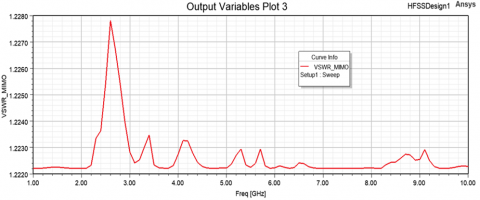
This paper primarily compares the performance of two antenna designs, focusing on the proposed Pa-type slot antenna. As shown in Figure 1, the VSWR value of 1.2280 at frequencies of 2.4 GHz, 3.4 GHz, and 5 GHz indicates that the proposed antenna achieves a good impedance match with the transmission line or system at these frequencies. The significance of choosing the three different frequencies was illustrated based on their capacity. The 3.4 GHz frequency is crucial for 5G as it provides a good balance between coverage and capacity. It is used for the mid-band spectrum, which offers higher speeds and more capacity than lower frequencies while still providing reasonable coverage.
The 5 GHz frequency is often used for Wi-Fi networks and is relevant for some 5G applications, particularly in urban environments and for high-capacity indoor networks.
The lowest 2.4 GHz frequency is less significant for 5G and 6G applications compared to 3.4 GHz and 5 GHz. It is commonly used for older Wi-Fi standards and other communication technologies but does not provide the high-speed capabilities needed for advanced 5G and 6G applications.
Figure 5 highlights the return loss of the proposed antenna, measured at -18.2404 dB, -18.5977 dB, and -22.3190 dB at 2.4 GHz, 3.4 GHz, and 5 GHz, respectively. These values provide information that the proposed antenna has an improved return loss than the existing antenna, making it more suitable for wireless communication applications.
Table 2 presents an analysis chart for VSWR and return loss. The rectangular antenna shows a VSWR of 1.567 at 2.5 GHz. Additionally, the gain of the S slot antenna is 5 dB across 1 GHz to 6 GHz, while the S patch antenna has a gain of 4.1 dB at 2.5 GHz. These findings suggest that the Pa-type antenna is well-suited for next-generation communication technologies. The parameters like gain and radiation efficiency are crucial to determine the antenna's capacity to effectively focus and radiate signals. By comparing these values between the two antenna designs, readers can better understand their performance in terms of signal concentration and transmission efficiency.
Figure 6 shows the Voltage Standing Wave Ratio (VSWR) of the proposed antenna at three different frequencies: 2.4 GHz, 3.4 GHz, and 5 GHz. The VSWR value of 1.2280 across these frequencies indicates that the antenna provides a strong impedance match with the transmission line or system. A VSWR close to 1 suggests minimal reflection of the signal, meaning that most of the power is effectively transmitted rather than reflected. This result highlights the antenna's efficiency in maintaining a low level of signal loss and optimizing performance across multiple frequency bands, making it ideal for applications that require reliable wireless communication. The return loss of the proposed antenna at frequencies of 2.4 GHz, 3.4 GHz, and 5 GHz, with measured values of -18.2404 dB, -18.5977 dB, and -22.3190 dB, respectively. These return loss values indicate that the proposed antenna reflects very little power towards the source, thereby maximizing the amount of power transmitted.
Figure 5. The VSWR value of the proposed antenna
Table 2. Analysis chart for VSWR and return loss
|
Type of Antenna |
Frequency (GHz) |
VSWR |
Return Loss (dB) |
|
Pa-type slot antenna |
2.4 GHz, 3.4 GHz, 5 GHz |
1.2280 |
-18.2404 dB, -18.5977 dB, -2.3190 dB |
Figure 6. Return loss of proposed antenna
A higher negative return loss value demonstrates that signal transmission efficiency increases based on its performance in the proposed system. In correlation to the existing antenna design, the proposed antenna achieves superior return loss, considering it is distinctly well-suited for wireless communication applications where minimizing signal loss and optimizing transmission quality are crucial.
Table 2 provides an analysis of the VSWR and return loss for different antenna designs. The rectangular antenna unveils a VSWR of 1.567 at a frequency of 2.5 GHz, indicating a decent impedance match with the transmission system. The S slot antenna shows a gain of 5 dB wide range of frequencies from 1 GHz to 6 GHz, highlighting its ability to maintain consistent performance over various frequencies. Additionally, the S patch antenna provides a gain of 4.1 dB at 2.5 GHz. These findings suggest that each antenna has unique characteristics and performance metrics, making them suitable for different applications based on their specific frequency and gain requirements.
The gain of the simulated Pa-type antenna was evaluated across a frequency range spanning from 1 GHz to 6 GHz. Special attention was given to resonance frequencies of 2.4 GHz, 3.4 GHz, and 5 GHz, which hold significance for 5G and 6G applications.
During the evaluation, the measured return loss values for these frequencies were determined to be 1.31 dB. The return loss is a measure of the reflected power from an antenna compared to the input power. A low return loss indicates that the antenna effectively transfers power to the transmission medium, leading to efficient signal transmission.
The measured return loss values of 1.31 dB suggest that the Pa-type antenna performs well at the resonance frequencies of 2.4 GHz, 3.4 GHz, and 5 GHz. This indicates that the antenna exhibits good impedance matching and minimal signal reflection at these frequencies, resulting in improved signal transmission efficiency. For 5G/6G wireless communication systems, it was selected at the resonance frequency ranges of 2.4 GHz, 3.4 GHz, and 5 GHz, as they are widely used in applications requiring high data rates, latency reduction, and connectivity improvement. For instance, 2.4 GHz is more frequently used in Wi-Fi and Internet of Things systems because it can cover a wider region with fewer signal obstructions. While 5 GHz is best suited for advanced MIMO systems and high-speed data transmission in congested urban areas, the 3.4 GHz band is a must for mid-band 5G installations because it provides a balance between coverage and capacity.
When compared to the present designs, the proposed antenna design shows better performance metrics. For example, at 5 GHz, the return loss of -22.32 dB shows good impedance matching and little signal reflection, which is better than traditional antennas that normally achieve return losses of -15 dB. Higher gain and better VSWR are also features of the proposed design, which are important for signal strength enhancement and power loss reduction. For instance, the proposed antenna has a gain that is much higher than the typical gain of 3–4 dB in conventional designs at 5 GHz, thus ensuring increased signal strength and coverage. These results have important practical implications for real-world implementations. The antenna can enable seamless IoT device connectivity in smart cities, which would enable efficient public safety, energy monitoring, and traffic control systems. The improved gain and VSWR of autonomous vehicles in dynamic and high-mobility situations also provide reliable communication in V2X scenarios. Improved parameters of the proposed design may enhance the spectral efficiency and reduce interference for MIMO systems, which is important for the ultra-reliable low-latency communication needed for 5G and 6G networks. By incorporating these observations, the discussion can go past repeating numbers for the sake of reiterating the usefulness and edge of the recommended design.
The resonance frequencies chosen align with the frequency bands commonly associated with 5G and 6G applications. By ensuring excellent performance at these frequencies, the Pa-type antenna proves its suitability for supporting the requirements of these advanced wireless communication technologies.
It's important to note that the evaluation of gain provides valuable insights into the antenna's performance, but a comprehensive analysis of other relevant performance metrics, such as gain, radiation pattern, and directivity, would provide a more complete understanding of the antenna's overall capabilities.
The Pa-type antenna has been specifically designed for utilization in 5G and 6G applications operating within the radio frequency range. Its performance, particularly in terms of return loss, has been compared to that of an already existing rectangular patch antenna. The new Pa-type antenna, with its array configuration, exhibits a broader frequency range from 1 GHz to 6 GHz, with resonance frequencies at 2.4 GHz, 3.4 GHz, and 5 GHz, tailored for 5G and 6G applications. Notably, the corresponding return loss values for these frequencies were measured as -18.2404 dB, -18.5977 dB, and -22.3190 dB, respectively, based on the measured VSWR values of 1.2280 for the resonance frequencies of the Pa-type antenna, it can be inferred that the antenna exhibits a good match with the impedance of the transmission line or system it is connected to. The novelty of the Pa-type antenna is attributed to its array configuration and wider frequency range, from 1 GHz to 6 GHz. This design outperforms conventional rectangular slot antennas and guarantees enhanced adaptability and dependability for applications where high data rates and low latency are essential, such as the Internet of Things, smart cities, driverless cars, and MIMO systems.
Besides experimental verification in practical settings, future research can focus on the optimization of the antenna design to achieve even greater gain enhancement and lower power loss. The proposed design is considered a good candidate for new applications in 5G and 6G communication networks because of its ability to support next-generation wireless technologies.
|
fr |
resonant frequency |
|
C |
speed of light in a vacuum (approximately 3×1083×1083×108 m/s) |
|
L |
effective length of the slot thermal effective |
| eff | dielectric constant of the substrate material |
|
frc |
resonant frequency for the slot |
|
Z |
impedance |
|
R |
resistance |
|
X |
reactance |
[1] Masum, R.H., Islam, M.A., Roy, S.C., Ahmed, M.F., Islam, M.M., Hossain, M.R., Sarkar, R. (2025). A slotted elliptical patch antenna for six generation communication system in terahertz band. Cureus, 2(1). https://doi.org/10.7759/s44388-024-02717-3
[2] Sharma, U., Srivastava, G., Khandelwal, M.K., Roges, R. (2024). Design challenges and solutions of multiband MIMO antenna for 5G/6G wireless applications: A comprehensive review. Progress in Electromagnetics Research B, 104: 69-89. https://doi.org/10.2528/PIERB23101904
[3] Kamruzzaman, M.M., Trabelsi, Y., Nishat, H., Perinbaraj, R., Ashok, P., Mekala, R. (2024). The smart enhancement of near field sensing range for terahertz antenna in 6G wireless communication systems. Optical and Quantum Electronics, 56(9): 1452. https://doi.org/10.1007/s11082-024-06898-3
[4] Omam, Z.R., Taghvaee, H., Araghi, A., Garcia-Fernandez, M., et al. (2025). Holographic metasurfaces enabling wave computing for 6G: Status overview, challenges, and future research trends. arXiv Preprint arXiv:2501.05173. https://doi.org/10.48550/arXiv.2501.05173
[5] Najib, A.M., Yang, Y., Zhang, S., Ding, W. (2025). Utilizing 6G technology for vehicle-to-everything (V2X) communication using 6G C-V2X with MIMO antenna technology. In the Fourth International Conference on Intelligent Traffic Systems and Smart City (ITSSC 2024), Xi'an, China, pp. 539-545. https://doi.org/10.1117/12.3050687
[6] Fayad, A., Cinkler, T., Rak, J. (2024). Toward 6G optical fronthaul: A survey on enabling technologies and research perspectives. IEEE Communications Surveys & Tutorials, 27(1): 629-666. https://doi.org/10.1109/COMST.2024.3408090
[7] Zheng, W., Li, H. (2024). Design of high-performance antenna system for high-speed railways. Progress in Electromagnetics Research, 179: 71-81 https://doi.org/10.2528/PIER24030701
[8] Manirathnam, C., Ghosh, S., Swati, M.V. (2025). A compact, two-port MIMO antenna for mm-wave 5G application. In 2022 IEEE 11th International Conference on Communication Systems and Network Technologies (CSNT), Indore, India, pp. 22-25. https://doi.org/10.1109/CSNT54456.2022.9787581
[9] Murugan, C., Kavitha, T. (2025). Adaptive dual-band antenna for 5G and its applications with monopole-to-broadside radiation characteristics. Progress in Electromagnetics Research Letters, 123: 61-67. https://doi.org/10.2528/PIERL24100307
[10] Zhang, L., Yang, Y., Zhou, S., Xu, C., Feng, Y., Yang, Y., Li, J. (2025). Wideband high-gain dual-polarized array antenna with bottom-coupled feeding structure. IEEE Transactions on Antennas and Propagation, 73(5): 3358-3363. https://doi.org/10.1109/TAP.2024.3523678
[11] Aravindraj, E., Nagarajan, G., Ramanathan, P. (2024). A compact sierpinski gasket fractal antenna for S, C, X, and Ku band applications. Progress in Electromagnetics Research C, 141: 33-40. https://doi.org/10.2528/PIERC23110704
[12] Sirisha Mrunalini, L.N., Arun, M. (2024). Reconfigurable fork shaped plasmonic graphene based nano-patch antenna for wireless network-on-chip application in THz band. Optical and Quantum Electronics, 56(2): 233. https://doi.org/10.1007/s11082-023-05895-2
[13] Attaran, M. (2023). The impact of 5G on the evolution of intelligent automation and industry digitization. Journal of Ambient Intelligence and Humanized Computing, 14(5): 5977-5993. https://doi.org/10.1007/s12652-020-02521-x
[14] Kumar, P., Suseela, S.B., Daiya, V., Ebenezer, J., Sankararajan, R., Jose, M.C. (2024). High-gain horizontally polarised omnidirectional planar antenna using parasitic directors for wireless sensor networks. International Journal of Communication Systems, 37(6): e5697. https://doi.org/10.1002/dac.5697
[15] Cheng, S.H., Chen, S.C., Huang, W.Y. (2024). Low-profile MIMO trapezoidal patch antenna for 5G wideband mobile antenna application. IEEE Antennas and Wireless Propagation Letters, 24(3): 696-700. https://doi.org/10.1109/LAWP.2024.3512854
[16] Wu, G.B., Zeng, Y.S., Chan, K.F., Qu, S.W., Chan, C.H. (2019). High-gain circularly polarized lens antenna for terahertz applications. IEEE Antennas and Wireless Propagation Letters, 18(5): 921-925. https://doi.org/10.1109/LAWP.2019.2905872
[17] Penchel, R.A., Martins, N.F., Aldaya, I., de Oliveira, J.A., et al. (2024). Performance evaluation of a novel monofilar helical antenna with tapered cross-section wire fabricated via metal additive manufacturing. AEU-International Journal of Electronics and Communications, 175: 155085. https://doi.org/10.1016/j.aeue.2023.155085
[18] Venneri, F., Costanzo, S., Borgia, A. (2024). Fractal metasurfaces and antennas: An overview for advanced applications in wireless communications. Applied Sciences, 14(7): 2843. https://doi.org/10.3390/app14072843
[19] Thakur, E., Gupta, A., Abdulhameed, M.K., Khaleel, A.D., Abdullah Al-Gburi, A.J. (2024). Microstrip antenna with two elements and defected ground structure for 5G mobile applications at 28/38 GHz. Progress in Electromagnetics Research C, 146: 177-185. https://doi.org/10.2528/PIERC24062403
[20] Alaoui, N., Amel, B.A., Aya, Z. (2024). Tri-band frequency reconfigurable antenna for wireless applications. Instrumentation Mesure Métrologie, 23(2): 175-182. https://doi.org/10.18280/i2m.230208
[21] Kinol, A.M.J., Nisha, A.S.A., Marshiana, D., Krishnamoorthy, N.R. (2022). Hybrid multi beamforming and multi-user detection technique for MU MIMO system. Wireless Personal Communications, 124(4): 3375-3385. https://doi.org/10.1007/s11277-022-09517-0
[22] Abdulrahman, M.M., Jabbar, M.S., AlRababah, A.A., Sekhar, R., Shah, P. (2024). Innovative progress in phased-array antenna systems for ultra-low latency and high-speed communication networks for resilient infrastructure. Mathematical Modelling of Engineering Problems, 11(7): 1936-1946. https://doi.org/10.18280/mmep.110725
[23] Kaur, K., Gautam, P., Bisht, R., Sharma, D. (2024). A coplanar tri-band MIMO antenna for vehicular communication. AIP Conference Proceedings, 3121(1): 020016. https://doi.org/10.1063/5.0221467
[24] Sawant, K., Pawar, A.M., Banga, K.S., Machado, R., et al. (2021). Dentinal microcracks after root canal instrumentation using instruments manufactured with different NiTi alloys and the SAF system: A systematic review. Applied Sciences, 11(11): 4984. https://doi.org/10.3390/app11114984
[25] Abdelaziem, I.H., Ibrahim, A.A., Abdalla, M.A. (2023). A high gain antenna utilizing Mu-near-zero metasurface structures for 5G applications. International Journal of Microwave and Wireless Technologies, 15(2): 338-346. https://doi.org/10.1017/S1759078722000526