Stopping Power and Range Calculations of Electrons Interaction with CH3OH, CH2O and CO2

Abrar Taha* | Rashid O. Kadhim
© 2025 The authors. This article is published by IIETA and is licensed under the CC BY 4.0 license (http://creativecommons.org/licenses/by/4.0/).
OPEN ACCESS
To compute the stopping power, range, and stopping duration of electrons in CH3OH, CH2O, and CO2 throughout the energy range of 0.01 to 1000 MeV, the Bethe equation was used. The MATLAB software was used for the calculation of the findings. A fitting equation was identified. This signifies a strong concordance between the obtained findings and the outputs of the E-STAR and SRIM2013 programs. The correlation coefficient was computed and found to be 0.999, indicating that this relationship was identified. This study aims to provide the latest mass spectrometry (SPE) data, emphasizing the attributes of electron beam therapy (EBT), a therapeutic modality that directs electrons to the tumor location.
stopping power, range, SRIM-2013 program, electrons
Ion implantation, particle physics, nuclear physics, radiation damage, and radiology are just a few of the fields that have benefited from the knowledge of charged particles' propensity to slow down and release energy. This understanding has been the subject of a substantial amount of attention over the course of the last century [1].
To precisely estimate how intermediate energy neutrons deposit energy in tissue, it is essential to comprehend the stopping capabilities and projected ranges of secondary charged particles of low energy [2].
In several fields of study and application, an understanding of the properties of ion behavior in diverse materials—such as air, tissue, and polymers—is essential. These include nuclear physics, radiation chemistry, radiation dosimetry, radiation biology (including cell mortality, cytogenesis alterations, mutagenesis, and DNA recombination), and radiotherapy. The stopping power of charged particles can be determined using a variety of methods, including self-supporting techniques, studying backscattering from the substrate with deposited absorbing layers, measuring energy loss through films directly, analysing gamma resonance shift, and indirectly verifying stopping power based on alpha energy losses in air [3].
The total mass specific energy (SPE) of an electron refers to the average energy loss per unit distance due to radiation, ionization, and excitation [4]. In the analysis of the SPE, it is crucial to quantify two distinct processes of energy loss: first, from electron collisions with the target's extra electrons (collisional SPE), and second, from interactions with the target's nuclear field (radiative SPE). The second component is crucial for light particles as its worth escalates with elevated energy levels [5].
The understanding of radiation's interaction with matter This will facilitate the determination of dose limits and enhance protection, as radiation therapy is based on diverse radiation types and their interactions with matter, energy dissipation, and the exposure levels permissible for the human body during medical procedures, accidents, or natural radioactivity.
A plethora of studies have been undertaken by many researchers on this topic. Tufan et al. [5] quantified the route length and stopping power of electrons with energies between 100 eV and 1 GeV in certain biological substances. El-Ghossain [6] calculated of electron interaction range and stopping power with various materials and human body parts. Evaluating the findings of Gümüs [7] on electron stopping power and range in materials like water and bone against the Penelope and ESTAR codes [8, 9]. Kadhim and Yassin [10] quantified the total electron-stopping power in human tissues (bone, brain, and eyes) at energy levels between 0.01 and 1000 MeV using the relative Beth–Bloch equation. Alina Kononov et al. [11] studied the repeatability of real-time time-dependent density functional theory calculations of electronic stopping power in warm dense matter in 2024.
This research constitutes a theoretical examination of the stopping capability of these organic compounds, applicable in medical and radiotherapeutic contexts.
Understanding the interactions of radiation with various materials Considering that radiation therapy relies on the interactions between different radiation types and matter, energy dissipation, and the radiation exposure levels individuals may experience during medical procedures, accidents, or natural radioactivity, this will facilitate the establishment of dose limitations and enhance protective strategies [5].
The aim of this research endeavor is to assess the halting power of the electron projectile and illustrate the magnitude of its impact on vehicles, and determine a mathematical equation that describes this behavior and mentions within the energy range the stopping power and stopping range. Which represent the average unit of energy dissipation to which charged particles are exposed along their path and the distance the radiation travels, respectively [12].
The stopping power of a given medium is the average unit of energy dissipation experienced by charge particles along their path length in that medium. There are two parts to stopping power: radiation and collisions. What primarily contributes to stopping power are collisions, which are brought about by the interaction of the particles with atomic electrons. Often, the idea of mass collision stopping power is employed to lessen the reliance on the medium's density [13].
Numerous physicists have tried to determine how much energy is wasted in matter, according to Bethe and Bloch. (-dE/dx) is a representation of the rate of energy loss, where dE/dx is the energy loss and is a negative number [13].
Due to the fact that quantum mechanics is based on the identity of the particles, it is not feasible to discern between the electrons that were struck and those that were incident after a collision. The electron that is left with a lower energy after a collision is considered to be the struck particle for determining the amount of energy that has been lost. Due to the identity of β-and its connection to atomic electrons, the equations that describe the collisions of substantially charged particles with atoms must satisfy specific symmetry conditions. This is in contrast to the situation with heavily charged particles [14].
The collisional stopping-power formulas for electrons and positrons can be written:
$\left( -\frac{dE}{dx} \right)_{col}^{\pm }=\frac{4\pi k_{0}^{2}{{e}^{4}}n}{{{m}_{e}}{{c}^{2}}{{\beta }^{2}}}\left[ ln\frac{m{{c}^{2}}\tau \sqrt{\tau +2}}{\sqrt{2}~I}+{{F}^{\pm }}\left( \beta \right) \right]$ (1)
where,
${{F}^{-}}\left( \beta \right)=\frac{1-{{\beta }^{2}}}{2}\left[ 1+\frac{{{\tau }^{2}}}{8}-\left( 2\tau +1 \right)ln2 \right]$ (2)
here,
$\tau =\frac{T}{m{{c}^{2}}}$ (3)
$\tau $ is the kinetic energy T of the β- or β+ particle expressed in multiples of the electron rest energy mc2 is the rest energy of the electron=0.511MeV.
E is the kinetic energy of the electron. N is the number of atoms per m3 in the absorber medium.
N=ρ No/A.
N is the number of atoms per m3 in the absorber medium N=ρ No/A.
No is the Avogadro number 6.62×10⁻³⁴ m2 kg/s.
ρ is the absorber density.
β=v/c is the ratio of the velocity charged particle to velocity of light 3×10⁸ m/sec.
Z/A are the ratio effective atomic number to atomic weight and can be find according to the Bragg's additively rule of the compound target.
I is the mean excitation potential of the absorber and can be found according to Bragg's additive rule of the compound target [15-19].
$I~\cong ~\left\{ 19.0~eV,~Z=1\left( hydrogen \right) \right\}$
$~~~~~~~~\cong ~11.2+11.7~Z~eV,~2\le Z\le 13$
$\cong ~52.8+8.71~Z~eV,~Z\ge 13$
This refers to the ability of radiation to hinder Bremsstrahlung, which is a measure of the quantum and nucleus inelastic collisions that contribute to the emission of electromagnetic radiation from a particular particle, is denoted by the symbol Srad and refers to the energy that is wasted, a basic component of electrons [20].
Ascertain the particular combination of ions and medium under consideration to determine the proper application order of the stopping power equations. Assuming an ion has an initial energy of E0, the subsequent equation computes its total range [9]:
$R\left( E \right)=\mathop{\int }_{E}^{0}-\frac{1}{S\left( E \right)}dE$ (4)
In this context, the term dE refers to a small but finite amount of energy dissipation, such as -0.01 MeV. There is a certain stopping-power equation that is currently in effect inside the energy range of E1-E2. (dE/dx) is the notation that is used to represent the values of the stopping powers that are to be calculated from that equation at intervals between dE. In order to continue with the calculation, another stopping-power equation that is valid in the energy area of E1-E2 would be used, and so on, until the ion energy hits E1.
Since f(β) is the same for two heavily charged particles at the same initial speed β, the ratio of their ranges is simple.
$\frac{R1\left( \beta \right)}{R2\left( \beta \right)}=\frac{z_{2}^{2}~M1}{z_{1}^{2}z~2~1M2}$ (5)
where, Z is the atomic number; M is the mass number; and the function f(β) depends only on the initial velocity of the heavily charged particle.
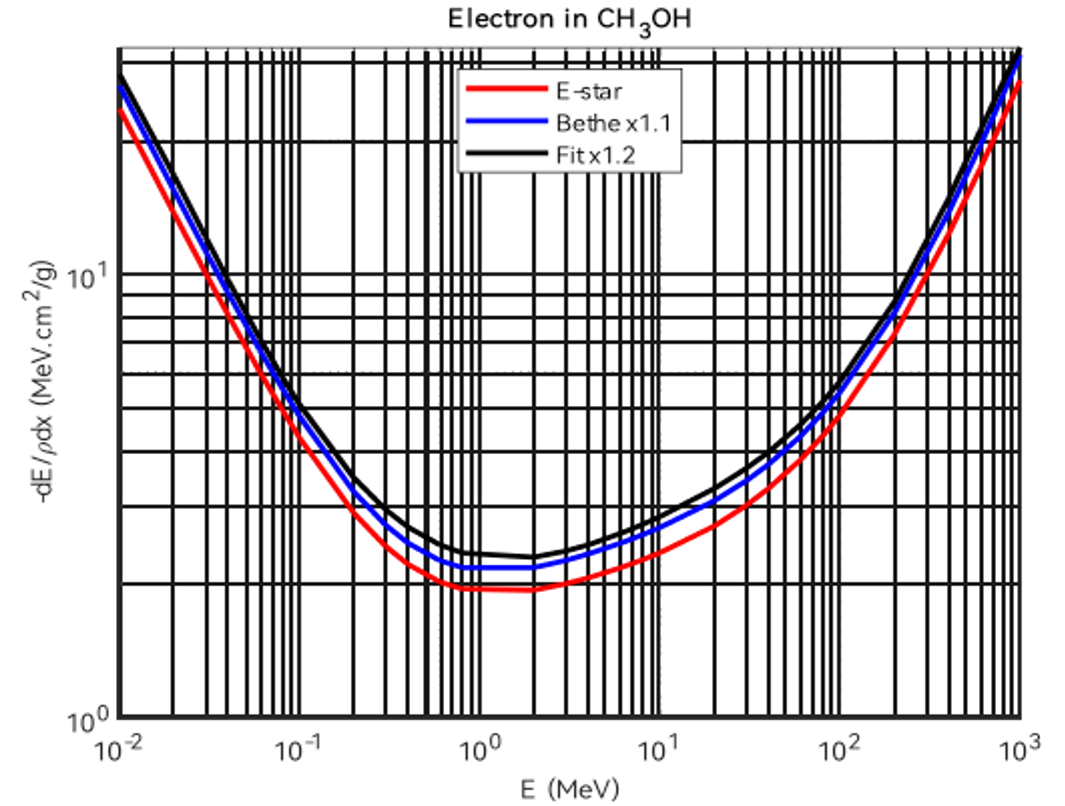
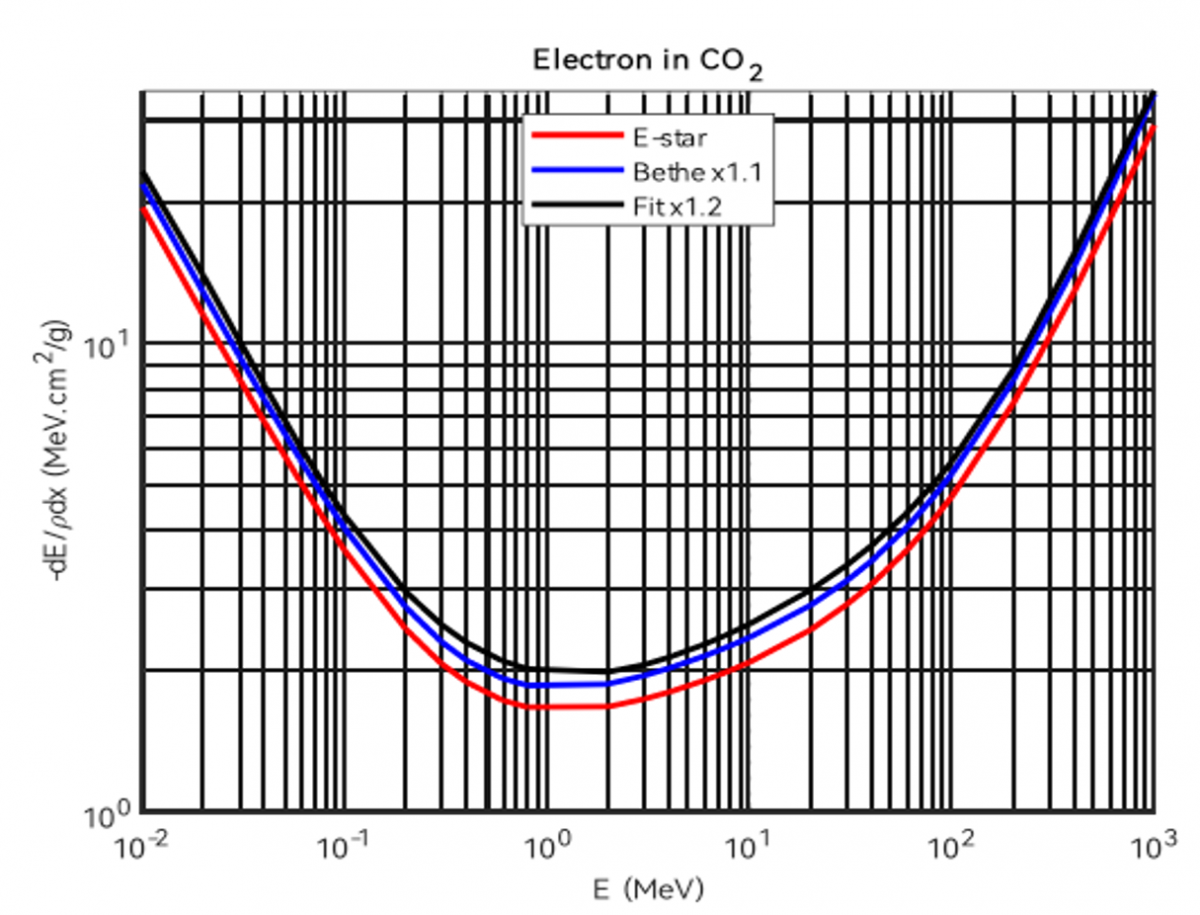
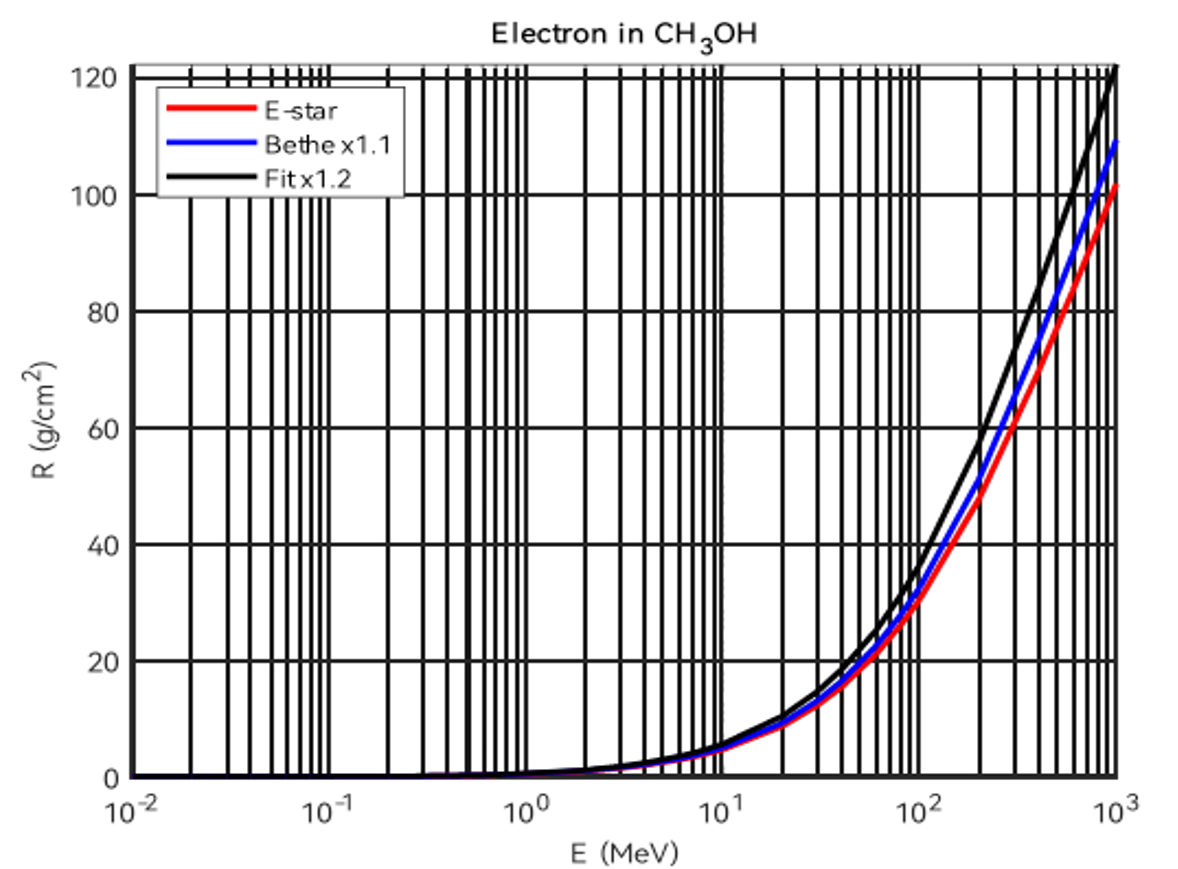
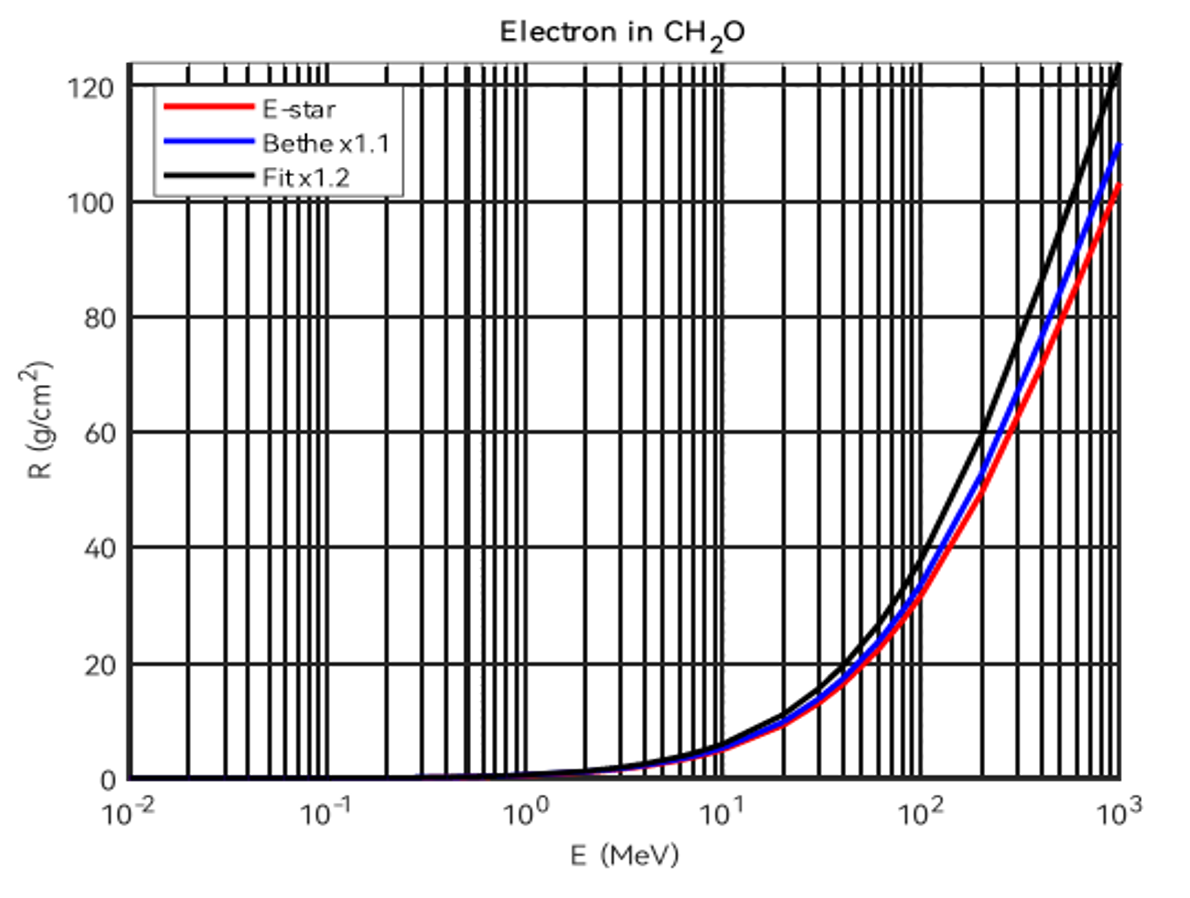
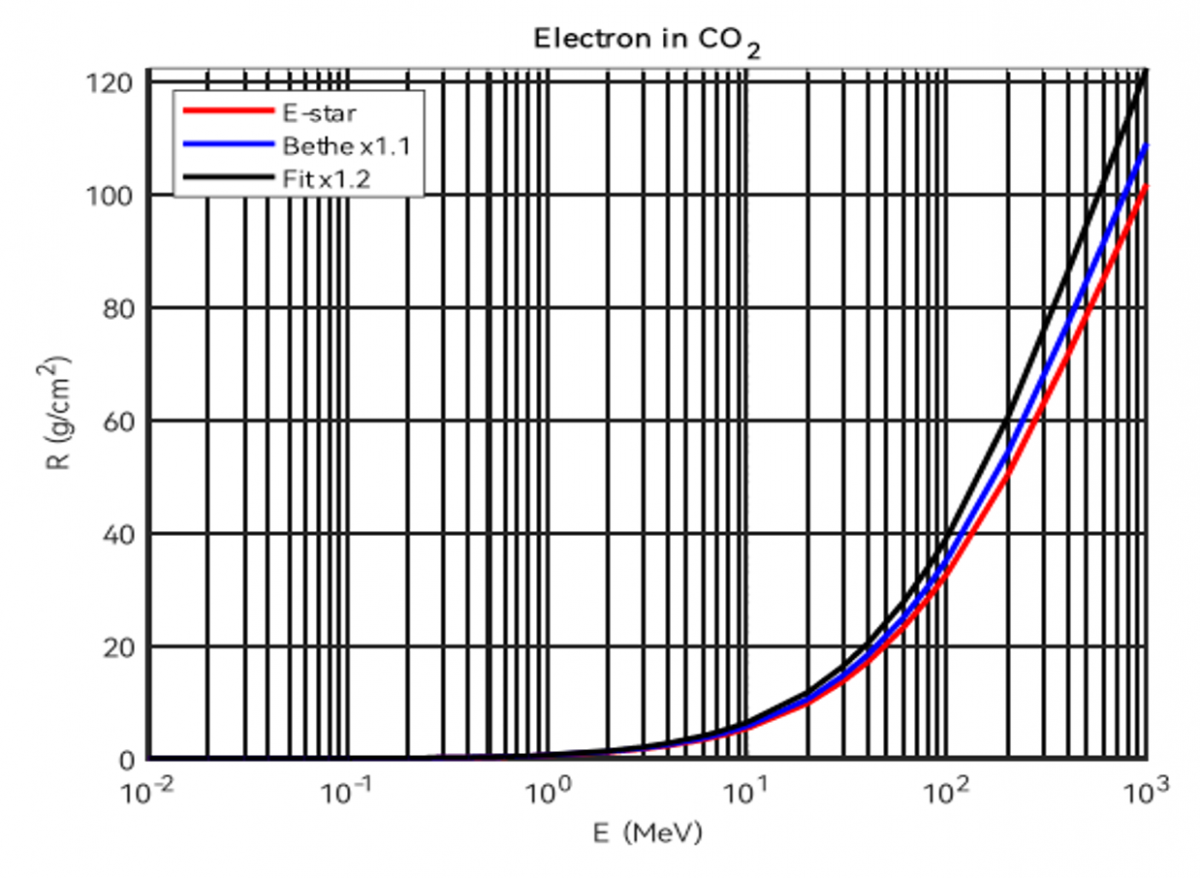
The Bethe formula for molecules was utilized to calculate the stopping power and stopping range. Tables 1-3 as well as Figures 1-3 provide the calculated values. The electron energy range considered was from (0.01 to 1000) MeV. The Bethe equation was employed for three different organic compounds CH3OH, CH2O and CO2.
The computation of stopping power applies to electrons traveling through matter in the same way as it applies to particles that are significantly charged. The "Collisional Stopping Power" is a representation of the interaction between incoming electrons and atomic electrons that leads to excitation and ionization. This interaction is calculated using Bethe's theory. Additionally, electromagnetic radiation often referred to as "Bremsstrahlung" is created when electrons are accelerated inside the coulomb field of nuclei. The stopping power that corresponds to the phrase "Radiative Stopping Power" is referred to by the word [21].
Table 1. Calculations of stopping power Stotal for electron in CH3OH
|
E(MeV) |
E-STAR |
Bethe |
Fitting |
|
0.010000 |
23.612764 |
24.183122 |
23.494868 |
|
0.020000 |
13.733548 |
14.028025 |
13.897836 |
|
0.030000 |
10.045227 |
10.245684 |
10.103190 |
|
0.040000 |
8.083800 |
8.237784 |
8.077503 |
|
0.060000 |
6.016792 |
6.124415 |
5.966747 |
|
0.080000 |
4.932625 |
5.017877 |
4.881420 |
|
0.100000 |
4.263412 |
4.335217 |
4.221688 |
|
0.200000 |
2.885839 |
2.931052 |
2.889494 |
|
0.300000 |
2.428612 |
2.465549 |
2.449422 |
|
0.400000 |
2.211635 |
2.245132 |
2.236502 |
|
0.600000 |
2.019431 |
2.051156 |
2.039479 |
|
0.800000 |
1.945973 |
1.977779 |
1.956540 |
|
2.000000 |
1.934421 |
1.978161 |
1.913869 |
|
3.000000 |
1.999205 |
2.051563 |
1.974519 |
|
4.000000 |
2.061739 |
2.121617 |
2.040407 |
|
6.000000 |
2.171042 |
2.242490 |
2.161915 |
|
7.000000 |
2.219935 |
2.295313 |
2.216522 |
|
8.000000 |
2.264827 |
2.344399 |
2.267600 |
|
10.000000 |
2.349102 |
2.434096 |
2.361119 |
|
20.000000 |
2.697645 |
2.795884 |
2.731234 |
|
30.000000 |
2.999005 |
3.097916 |
3.029375 |
|
40.000000 |
3.277468 |
3.376794 |
3.299030 |
|
60.000000 |
3.800200 |
3.904636 |
3.802761 |
|
80.000000 |
4.306147 |
4.415080 |
4.287851 |
|
100.000000 |
4.807708 |
4.918405 |
4.767505 |
|
200.000000 |
7.300085 |
7.418518 |
7.196229 |
|
400.000000 |
12.287181 |
12.498955 |
12.309569 |
|
600.000000 |
17.292639 |
17.700597 |
17.513786 |
|
800.000000 |
22.309355 |
22.998765 |
22.488719 |
|
1000.000000 |
27.321079 |
28.374663 |
27.000253 |
Table 2. Calculations of stopping power Stotal for electron in CH2O
|
E(MeV) |
E-STAR |
Bethe |
Fitting |
|
0.010000 |
21.757822 |
22.270464 |
21.643648 |
|
0.020000 |
12.697788 |
12.962559 |
12.858044 |
|
0.030000 |
9.302989 |
9.483019 |
9.358492 |
|
0.040000 |
7.493878 |
7.632499 |
7.487369 |
|
0.060000 |
5.584854 |
5.681890 |
5.536369 |
|
0.080000 |
4.582321 |
4.659252 |
4.532815 |
|
0.100000 |
3.962980 |
4.027863 |
3.922666 |
|
0.200000 |
2.686686 |
2.728026 |
2.690136 |
|
0.300000 |
2.262746 |
2.296985 |
2.282737 |
|
0.400000 |
2.061549 |
2.093068 |
2.085543 |
|
0.600000 |
1.883497 |
1.914118 |
1.903017 |
|
0.800000 |
1.815649 |
1.846992 |
1.826188 |
|
2.000000 |
1.806813 |
1.852229 |
1.787471 |
|
3.000000 |
1.868695 |
1.923710 |
1.844978 |
|
4.000000 |
1.928445 |
1.991755 |
1.907655 |
|
6.000000 |
2.033336 |
2.109474 |
2.024029 |
|
7.000000 |
2.080612 |
2.161116 |
2.076681 |
|
8.000000 |
2.124086 |
2.209227 |
2.126128 |
|
10.000000 |
2.206096 |
2.297458 |
2.217146 |
|
20.000000 |
2.549574 |
2.657184 |
2.582701 |
|
30.000000 |
2.850420 |
2.961157 |
2.881523 |
|
40.000000 |
3.130190 |
3.243787 |
3.153682 |
|
60.000000 |
3.660827 |
3.781966 |
3.664639 |
|
80.000000 |
4.177379 |
4.304885 |
4.158394 |
|
100.000000 |
4.690458 |
4.821978 |
4.647588 |
|
200.000000 |
7.244162 |
7.400826 |
7.132729 |
|
400.000000 |
12.356819 |
12.660005 |
12.382932 |
|
600.000000 |
17.488870 |
18.053327 |
17.727441 |
|
800.000000 |
22.631593 |
23.550661 |
22.823057 |
|
1000.000000 |
27.768987 |
29.130984 |
27.423175 |
Table 3. Calculations of stopping power Stotal for electron in CO2
|
E(MeV) |
E-STAR |
Bethe |
Fitting |
|
0.010000 |
19.539211 |
19.926640 |
19.431297 |
|
0.020000 |
11.464606 |
11.663810 |
11.617560 |
|
0.030000 |
8.420859 |
8.555908 |
8.473019 |
|
0.040000 |
6.793940 |
6.898029 |
6.787373 |
|
0.060000 |
5.073748 |
5.146191 |
5.027512 |
|
0.080000 |
4.168652 |
4.225806 |
4.121586 |
|
0.100000 |
3.609013 |
3.656826 |
3.570617 |
|
0.200000 |
2.454188 |
2.483805 |
2.457516 |
|
0.300000 |
2.070821 |
2.094645 |
2.089960 |
|
0.400000 |
1.889546 |
1.910824 |
1.912464 |
|
0.600000 |
1.730179 |
1.750283 |
1.749090 |
|
0.800000 |
1.671085 |
1.690934 |
1.681316 |
|
2.000000 |
1.674710 |
1.703205 |
1.656118 |
|
3.000000 |
1.738885 |
1.773239 |
1.715675 |
|
4.000000 |
1.799970 |
1.839692 |
1.779460 |
|
6.000000 |
1.907143 |
1.955214 |
1.897905 |
|
7.000000 |
1.955684 |
2.006225 |
1.951731 |
|
8.000000 |
2.000499 |
2.053950 |
2.002450 |
|
10.000000 |
2.085220 |
2.141989 |
2.096244 |
|
20.000000 |
2.444102 |
2.507192 |
2.477624 |
|
30.000000 |
2.761354 |
2.821680 |
2.792734 |
|
40.000000 |
3.056337 |
3.117198 |
3.080842 |
|
60.000000 |
3.618309 |
3.685022 |
3.622806 |
|
80.000000 |
4.167102 |
4.240643 |
4.146997 |
|
100.000000 |
4.712533 |
4.792368 |
4.666565 |
|
200.000000 |
7.429144 |
7.560126 |
7.308604 |
|
400.000000 |
12.866737 |
13.233913 |
12.897838 |
|
600.000000 |
18.322877 |
19.066053 |
18.585103 |
|
800.000000 |
23.789017 |
25.016879 |
23.996672 |
|
1000.000000 |
29.247887 |
31.061258 |
28.867840 |
Figure 1. Calculations of stopping power Stotal for electron in CH3OH
Figure 2. Calculations of stopping power Stotal for electron in CH2O
Figure 3. Calculations of stopping power Stotal for electron in CO2
The graphical representations of the halting power calculations conducted on CH3OH, CH2O, and CO2 are depicted in Figures 1-3, respectively. The MATLAB software was employed to perform these computations, and the results obtained were agreed to those obtained from the E-Star software. It is evident that the results of the present investigation and ESTAR [22] are in substantial agreement.
To emphasize the differences between the curves, coefficients were used to enhance them, since they were originally similar. A significant increase in stopping power was seen for electron energies ranging from 10 MeV to 1 MeV. The stopping power exhibits a gradual decline with increasing energy, finally reaching a value of 1 MeV, which is within the specific range of (10-2 to 1) MeV. A retarding force is generated when electrons from the target material impede electrons from the projectile. A decrease in stopping power arises from reduced attenuation in this area, attributable to an increase in the energy of the emitted electron. The energy in this area is inversely related to the stopping power. The braking mechanism generates the stopping force by transferring electrons from the medium to the projectile.
The atomic number of the target material may elucidate, especially about radiative stopping power. Moreover, stopping power is influenced by the value, particularly for targets with high atomic numbers.
Table 4 indicates that the maximum stopping power occurred at an energy level of 2 MeV and an electron velocity of 29.37 m/s, while the minimum stopping power was seen at an energy level of 1000 MeV and an electron velocity of 29.99 m/s. As the energy of a particle increases at low energy levels, the mass stopping power of the particle escalates correspondingly. When a positively charged particle traverses a material, it interacts via Coulomb forces with the negatively charged electrons and positively charged nuclei constituting the atoms of that substance. This is the rationale for the occurrence of this event. Consequently, low-energy particles (low velocity) possess sufficient time to engage with electrons and nuclei via inelastic collisions. This interaction may lead to a significant transfer of energy from the moving charged particle to the bound electron via ionization or excitation. This signifies that a high-energy particle has a reduced duration for interacting with atomic electrons and nuclei, leading to less energy loss, even when it has strong stopping power at lower energy levels. The CH3OH molecule had the maximum stopping power, measured at 1.913869.
Table 4. Stopping power calculations Stotal for compounds with velocity of electrons
|
Compound |
E(MeV) |
Ve(m/s)×107 |
($-\frac{dE}{\rho dx}$)min |
$\sum {{Z}_{2}}$ |
|
CH3OH |
2.00 |
29.37 |
1.91 |
22 |
|
CO2 |
2.00 |
29.37 |
1.65 |
18 |
|
CH2O |
2.00 |
29.37 |
1.78 |
16 |
|
Compound |
E(MeV) |
Ve(m/s)×107 |
($-\frac{dE}{\rho dx}$)max |
$\sum {{Z}_{2}}$ |
|
CH3OH |
1000 |
29.99 |
27.00 |
22 |
|
CO2 |
1000 |
29.99 |
28.86 |
18 |
|
CH2O |
1000 |
29.99 |
27.42318 |
16 |
Figure 4. Calculations of stopping rang for rang of electron in CH3OH
Figure 5. Calculations of stopping rang for rang of electron in CH2O
Figure 6. Rang calculations of electron in CO2
In order to determine the range value of electrons that may be lost along their journey in compounds CH3OH, CH2O, and CO2, Eq. (4) was used. This was done for the aim of estimating the overall range value. The data that was gathered as a result of this are shown in Figures 4-6. After analyzing the data, it was discovered that the paths tended to be straight at energy levels ranging from 0.01% to 1.01% MeV. This was brought to light by the findings of the investigation. This might be explained by the fact that during a single touch, the molecules do not move much apart from one another, and interactions take place simultaneously in all directions. As a consequence of this, the range begins to expand as the energy level rises from 12 MeV to more than 1000 MeV.
By using the fitting equation that is shown in Table 5, an equation was produced for the organic molecules CH3OH, CH2O, and CO2 that reflects the stopping power in the energy range of (0.01-1000) MeV and its constants. This equation was developed specifically for the chemicals. When specific conditions are met, it is feasible to use it to determine the stopping power of CH3OH, CH2O, and CO2.
Table 5. Correlation and fitting equation for halting power in CH3OH, CH2O, and CO2 compounds
|
${{S}_{fit}}\left( E \right)={{10}^{a+bx+c{{x}^{2}}+d{{x}^{3}}+e{{x}^{4}}+f{{x}^{5}}+g{{x}^{6}}+h{{x}^{7}}}}$ |
||||
|
Compound |
a |
b |
c |
d |
|
CH3OH |
0.28292 |
-0.06540 |
0.22962 |
-0.07546 |
|
CH2O |
0.25306 |
-0.06470 |
0.22882 |
-0.07369 |
|
CO2 |
0.21776 |
-0.05837 |
0.23076 |
-0.07149 |
|
${{S}_{fit}}\left( E \right)=1$ |
||||
|
Compound |
e |
f |
g |
h |
|
CH3OH |
-0.01398 |
0.01553 |
0.00073 |
-0.00085 |
|
CH2O |
-0.01277 |
0.01533 |
0.00058 |
-0.00082 |
|
CO2 |
-0.01186 |
0.01501 |
0.00043 |
-0.00079 |
Note: $x=lo{{g}_{10}}\left( E \right)$
For this investigation, the stopping power and stopping range were computed by using the Beathe equation in conjunction with MATLAB 2021 Software. The findings obtained by MATLAB, E-Star, and Bethe were compared. Due to the fact that the curves were initially comparable, coefficients were used in order to highlight the distinctions between them. When electron energies were raised from (10-2 to 1) MeV, there was a considerable increase in stopping power. As the amount of energy grows, the stopping force starts to decrease until it approaches 1 MeV, which is precisely within the range of (10-2 to 1) MeV. The force that causes the bullet to halt is produced when electrons from the target material block projectile electrons. As the energy of the electron grows, the attenuation in this region diminishes, which results in a reduction in stopping power. Power to halt is inversely related to the amount of energy present in this region. In order to generate braking force, the mechanism that is responsible for braking transfers electrons from the medium to the projectile. When the energy levels are between (0.01 and 1.01) MeV, the trajectories tend to become straighter. On a single contact, the molecules do not vary much from one another, and interactions may take place in any direction. As the energy grows from twelve to one thousand MeV, the range increases as well. A fitting equation has also been established, which has been reported as the most accurate equation for calculating the stopping power of CH3OH, CH2O, CO2.
The dose estimation in electron therapy is anticipated to be facilitated by the tables provided in the present work; these tables comprise fundamental values for electron interactions. That which is administered plainly. This study is useful as a database for applications of radiation interaction with matter and various applications in the field of medicine and space.
Altering the atomic media, such as by using ion shells or other light and heavy particles, or altering the compounds that are used for the same energy range, such as tissues or other compounds, are both suggestions for areas of research that might be pursued in the future. Moreover, the power range should be changed to one that is larger than one thousand megavolts.
[1] Tufan, M., Gűműş, H. (2008). Stopping power calculations of compounds by using Thomas-fermi-Dirac-Weizsäcker density functional. Acta Physica Polonica A, 114(4): 703-711. https://doi.org/10.12693/APhysPolA.114.703
[2] Affan, I.A.M., Colautti, P., Talpo, G., Watt, D.E. (1983). Calculated microdose spectra for intermediate energy neutrons (1 to 100 KeV). Radiation Protection Dosimetry, 5(3): 151-157. https://doi.org/10.1093/oxfordjournals.rpd.a082686
[3] L'Annunziata, M.F. (2012). Handbook of Radioactivity Analysis. Academic Press.
[4] Batra, R.K. (1987). Approximate stopping power of low energy electrons and positrons in matter. Nuclear Instruments and Methods in Physics Research Section B: Beam Interactions with Materials and Atoms, 28(2): 195-198. https://doi.org/10.1016/0168-583X(87)90104-2
[5] Tufan, M.Ç., Namdar, T., Gümüş, H. (2013). Stopping power and CSDA range calculations for incident electrons and positrons in breast and brain tissues. Radiation and Environmental Biophysics, 52: 245-253. https://doi.org/10.1007/s00411-013-0457-x
[6] El-Ghossain, M.O. (2017). Calculations of stopping power, and range of electrons interaction with different material and human body parts. International Journal of Scientific & Technology Research, 6(1): 114-118.
[7] Gümüş, H. (2019). Stopping power and range calculations of electrons for some human body tissues. ALKÜ Fen Bilimleri Dergisi, 93-100. https://dergipark.org.tr/en/download/article-file/657380.
[8] Nuclear Energy Agency (NEA). (2015). PENELOPE 2014: A code system for monte Carlo simulation of electron and photon transport. OECD Publishing. https://doi.org/10.1787/4e3f14db-en
[9] Berger, M.J., Courey, J.S., Zucker, M.A., Chang, J. (2017). Stopping power and range tables for electrons. National Institute of Standards and Technology (ESTARdatabase). https://physics.nist.gov/PhysRefData/Star/Text/method.html.
[10] Kadhim, R.O., Yassin, Z.A. (2020). Stopping power of electrons in bone, brain tissues, and eyes. La Prenda Medica Argentina, 106(4): 1-3. https://doi.org/10.47275/0032-745X220
[11] Kononov, A., White, A.J., Nichols, K.A., Hu, S.X., Baczewski, A.D. (2024). Reproducibility of real-time time-dependent density functional theory calculations of electronic stopping power in warm dense matter. Physics of Plasmas, 31(4). https://doi.org/10.1063/5.0198008
[12] Krane, K.S. (1987). Introductory Nuclear Physics, Oregon State University. John Wiley & Sons.
[13] Turner, J.E. (2008). Atoms, Radiation, and Radiation Protection. John Wiley & Sons. https://doi.org/10.1002/9783527616978
[14] Rancoita, P.G., Leroy, C. (2016). Principles of Radiation Interaction in Matter and Detection. World Scientific, pp. 48-77. https://doi.org/10.1142/9167
[15] National Research Council, Division on Earth, Life Studies, Commission on Life Sciences, & Committee on the Biological Effects of Ionizing Radiation (BEIR V). (1990). Health effects of exposure to low levels of ionizing radiation: BEIR V. National Academy Press, Washington, D.C.
[16] Ziegler, J.F. (1995). The stopping of energetic light ions in elemental matter HZETRN: Description of a free-space ion and nucleon transport and shielding computer program. NASA TP-3495. https://doi.org/10.1063/1.369844
[17] Tsoulfanidis, N., Landsberger, S. (2021). Measurement and Detection of Radiation. CRC Press, Boca Raton, pp. 262-246. https://doi.org/10.1201/9781003009849
[18] Tanır, G., Hicab, M., Keleş, S., Göker, I. (2012). On the stopping power for low energy positrons. Chinese Journal of Physics, 50(3): 425-433.
[19] Kadhim, R.O., Akon, A.A. (2019). Total stopping power calculation of electrons in (H2O and C22H10N2O5). International Journal of Academic and Applied Research, 3: 19-22.
[20] Srivastava, B.K., Mukherji, S. (1976). Range and stopping-power equations for heavy ions. Physical Review A. https://doi.org/10.1103/PhysRevA.14.718
[21] L'Annunziata, M.F. (Ed.). (2012). Handbook of Radioactivity Analysis. Academic Press.
[22] Ammi, H., Zemih, R., Mammeri, S., Allab, M. (2005). Mean excitation energies extracted from stopping power measurements of protons in polymers by using the modified Bethe–Bloch formula. Nuclear Instruments and Methods in Physics Research Section B: Beam Interactions with Materials and Atoms. https://doi.org/10.1016/j.nimb.2004.12.019