Haitham Jameel Abd | Murtada A. Ismael*
© 2025 The authors. This article is published by IIETA and is licensed under the CC BY 4.0 license (http://creativecommons.org/licenses/by/4.0/).
OPEN ACCESS
This paper exhibits an empirical exploration to compare the impact of the largest size of concrete coarse aggregate (LSCCA) on the direct shear behavior of self-consolidating concrete (SCC) and traditional vibrated concrete (TVC). The empirical schedule contains eight direct shear specimens (DSSs) having S-shape with an invariable size of 450 mm length×340 mm width×120 mm thickness. The employed LSCCA were 10 mm and 20 mm for SCC and TVC within normal strength (NS) and high strength (HS) stages. The outcomes declare that changing LSCCA from 10 mm to 20 mm has a considerable impact on enhancing the direct shear performance concerning raising the direct shear strength, stiffness, and ductility of SCC and TVC, but the impact on SCC is less significant than that of TVC. Also, the outcomes declare that the changing impact of LSCCA from 10 mm to 20 mm in the HS stage is more considerable than its impact in the NS stage on both SCC and TVC. As for SCC in the NS stage, the ultimate shear stress and highest displacement increase with percentages of 15.2% and 13.9%, and for the HS stage, the increases are with percentages of 9.9% and 8.4% sequentially. For the TVC, the increases in the ultimate shear stress and highest displacement are 21.2% and 16.7% in the NS stage and 13.6% and 14.4% in the HS stage sequentially.
concrete, direct, shear, coarse aggregate, size, self-consolidating concrete, conventional concrete
The shear that forms in the concrete members like brackets, deep beams, and corbels is called direct shear since it is not conjugated with flexure moment. The failure of concrete members that suffer from direct shear stresses is similar to the failure of concrete members that suffer from conventional shear accompanied by flexure in being oriented to be unexpected and without exhibiting preceding caution.
The design philosophy of reinforced concrete recommends that failure in structural elements should be of the ductile type, which gives visible signs of cracks that grow relatively slowly and take a sufficient time before final failure occurs. Therefore, there is a necessity to estimate accurately the capacity of concrete suffer from Direct Shear (DS) stresses so as to supply the proper reinforcement against shearing stresses to forbid abrupt failure [1, 2].
Shear transmission between the sides of the crack in concrete post-cracking is a considerable parameter in the bearing capacity of the structural element as it permits the redistribution of stresses within the concrete in the structural element and prevents concentrating these stresses in certain regions, thus maintaining a good percentage of the structural member’s resistance to the applied loads after cracking occurs resulting in delayed failure and making it more ductile. Shear transmission depends chiefly on the interlace of aggregate especially that of Coarse Aggregate (CA), since the coarse aggregate forms bridges between the two sides of the crack in the concrete post-cracking stage, providing an efficient transmission of shear stresses, thus, the amount and size of CA act as a curial cause in the concrete resistance against shear [3-5].
On the other side, Self-Consolidating Concrete (SCC) has been confirmed in the past two decades to be a preferable substitutional for traditional vibrated concrete (TVC), this is because it has significant specifications such as the potential to consolidate its ingredients in conditions when no existing concrete consolidating (vibrating) equipment, its capacity to inflow in the molds involving the crowded reinforcement by the effect of its own weight, less effort in the pouring stages, and quicker building and construction [6, 7]. Despite these significant specifications, several investigations illustrated that the resistance of SCC against shear loads is less efficacious than that of TVC [8-10], this difference is attributed to that the quantity of CA in SCC is lower than that in TVC, since the ratio of coarse aggregate to the rest components ranges from 75% to 110% in TVC [11], while this ratio in self-consolidating concrete is between 35% to 50% depending on the target compressive strength [7], hence the interlace system of CA in SCC is less efficacious, resulting in a reduction in the transition of shearing stress inside the concrete consequently the high shear stresses concentrate in specific regions within the concrete of the structural element causing early failure. Therefore, it is predicted that the strength of SCC structural elements fabricated from SCC against direct shear is less than that of TVC [12-15]. Based on the above, there is a need to know the extent of the difference between the behavior and bearing capacity of self-consolidating concrete and traditional vibrating concrete when subjected to direct shearing with using coarse aggregate of different maximum sizes in order to obtain an accurate assessment of the behavior and bearing capacity of both types by making a comparison between them.
In recent decades, there are many studies that have examined the subject of direct shear on different types of concrete. The most important of them can be mentioned here. Hsu et al. [16] developed an empirical expression to predict the strength of push-out and slip relationship of different compressive strength for DS samples made of concrete and carbon fiber reinforced polymer (CFRP) sheets.
French et al. [17] proposed modified models to evaluate the DS performance for (normal, high, and ultra) high-performance fiber-reinforced concrete (HPFC) under dynamic and static loads, the outcomes of these models were correlated with that of the original models. The investigators recommended that the proposed modified DS models can be used by analysts and designers.
Wu et al. [18] explored the shear transmission of UHPC. Two parameters were studied included: the impact of the micro-steel fiber volumetric ratio and stirrup reinforcement, the exploration focused on determining the shear resistance, shear sliding, and crack width. The outcomes illustrated that using a micro-steel fiber is able to improve the shear resistance of UHPC samples. The optimum volumetric ratio of micro-steel fiber was between 0% to 2.5%, the shear resistance and shear sliding raised considerably, and the width of the shear crack width decreased with the raising volumetric ratio of micro-steel.
Alimrani and Balazs [19] used three amounts of steel fiber (0, 40, and 80 kg/m3) to explore their impact on the DS performance of fibrous concrete under different temperature degrees ranges between 20℃ to 700℃. The outcomes revealed that there were considerable enhancements in DS capacity, toughness increased by raising fiber quantity at ambient. the enhancements were reduced at raised temperatures. Crack sliding had largely less stiffness than crack width, however, both raised temperature and fiber content reduced the stiffness.
Li and Wu [20] presented an investigation on the DS performance of concrete with a reused lump. Four parameters were studied in their investigation represented by: the ratio of replacement of concrete with reused lumps, lump transverse dimensions, the resistance of moist concrete shape, and the lump characteristics. The outcomes illustrated that the resistance of moist concrete and reused lump concrete were close. For specified specimen dimensions, the influence of lump dimensions on the concrete resistance including the reused lump can be neglected. For a specified lump characteristic, the specimen dimensions affected by the strength of concrete contained reused lumps similar to that of conventional concrete.
Liu et al. [21] investigated experimentally and numerically the impact of reused concrete aggregate amount on the microscopic and macroscale and performance of the sand– reused concrete aggregate admixtures with different reused concrete aggregate ratios. The outcomes demonstrated that the ratio of reused concrete aggregate had a considerable impact on the performance of sand-reused concrete aggregate admixture, the empirical and theoretical modeling outcomes demonstrated that the shear resistance raises with placing reused concrete aggregate to sand. The raising of the reused concrete aggregate amount made the shear resistance of the sand- reused concrete aggregate admixture increase. Also, the results reveal that each one of the specimens exhibited primary hardening before a post-largest strain softening. The reused concrete aggregate amount can considerably influence the various properties of acting forces.
Liu et al. [22] used the support vector regression as a machine learning method to establish a precise and applicable estimating expression for the DS resistance of joints made of precast concrete. The outcomes illustrated that the suggested method is beneficial to the expected performance of support vector regression expression. The impact of each input variable on the DS capacity of joints made of precast concrete is depicted and recognized, which can provide utility knowledge for improving new expressions for estimating the DS capacity of joints made of precast concrete.
Pan et al. [23] formed a theoretical model to determine the UHPC of DS capacity that is expected to be the combination of roles of fibers and matrix of UHPC. The size influence resulting from the formwork wall was considered in the computing of fiber contribution against the shear. The outcomes illustrated that both the specimen size and fiber ratio had a clear influence on the UHPC DS capacity. The model's findings and those of an experimental test agreed well.
Lu et al. [24] studied the influence of irregular stress in the NS stage on the glue joint DS performance. The empirical variables consisted of the joint surface coarseness, the plane of transverse stress in the NS stage, and the regularity of transverse stress in the NS stage. The outcomes demonstrated that all samples failed in brittle mode. After raising the rough joint surfaces, the strength against deformation, and peak resistance were slightly enhanced. Also, raising the plane elevation and regularity of lateral normal made the fissuring and largest load increase.
By evaluating all prior studies and research that focused on the direct shear performance of different types of concrete, it can find that all these studies did not present an evaluation for the bearing capacity of self-consolidating concrete under direct shear load and did not study the effect of changing the coarse aggregate maximum size on the direct shear of SCC and TVC. Therefore, this paper exhibits an empirical exploration on the effect of the coarse aggregate maximum size using two sizes of coarse aggregate (10 mm and 20 mm) on the direct shear capacity of SCC and TVC and making a comparison between the structural response of these types of concrete under direct shear load.
2.1 Specimen details
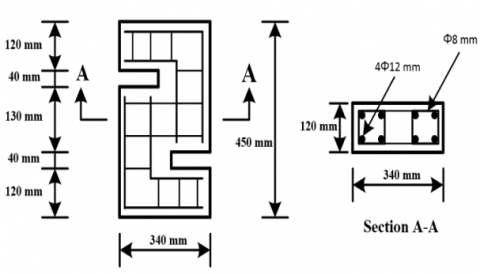
The empirical schedule comprised of eight direct shear specimens (DSSs) isolated to two bundles: Four DSSs fabricated from SCC and the others four specimens fabricated from TVC. In both bundles, normal strength concrete (NSC) was employed to construct two specimens (one utilizes 10 mm LSCCA and the other utilizes 20 mm), also high strength concrete (HSC) was employed in the same method of NSC to construct the other specimens of the two bundles as demonstrates in Table 1. The sizes 10 mm and 20 mm were chosen because these two sizes are the most commonly used in concrete mixtures for traditional vibrated concrete and self-consolidating concrete. Also, these two sizes provide the two most important properties of self-consolidating concrete which are the ability to flow and fill the mold due to the effect of weight, and the ability to penetrate through narrow spaces between Reinforcing steel. While the Larger sizes do not support these two properties. Furthermore, the difference between these two sizes is twice the small size (10 mm), which is expected to make the effect of using these two sizes clearer on the results. The DSSs were constructed to have the same S-shape, constant size, and identical steel rebar. Figure 1 illustrates the specimen dimensions and steel reinforcement arrangement.
Table 1. Details of DSSs
|
Bundle No. |
Concrete Type of Specimens |
Code of DSSs |
Concrete Strength |
LSCCA |
Mix Code |
|
One |
SCC |
DS1 |
Normal |
10 |
SN10 |
|
DS2 |
Normal |
20 |
SN20 |
||
|
DS3 |
High |
10 |
SH10 |
||
|
DS4 |
High |
20 |
SH20 |
||
|
Two |
TVC |
DS5 |
Normal |
10 |
TN10 |
|
DS6 |
Normal |
20 |
TN20 |
||
|
DS7 |
High |
10 |
TH10 |
||
|
DS8 |
High |
20 |
TH20 |
Figure 1. Dimensions of the DSSs and steel reinforcement details
2.2 Concrete
Many admixtures were performed to attain the desired compressive strengths of SCC and TVC. From these admixtures, four admixtures were appointed to attain the concrete at normal compressive strength (fc’) of approximately 28 N/mm2 and high compressive strength of approximately 52 N/mm2 for SCC and TVC. Admixtures of SCC were established depending on the European guidelines of SCC [7], whilst TVC admixtures were established as reported by ACI [25]. The component proportions of SCC admixtures are illustrated in Table 2 and that of TVC are illustrated in Table 3. The ingredients that were used in the admixtures of the two concrete types involved; Portland cement class I obey the Iraqi guidelines [26], Coarse Aggregate (CA) and Fine Aggregate (FA) attends to the Iraqi guidelines [27], the silica fume follows the European guidelines [7], Water reducer attend with ASTM [28], and water for hydration and water treatment.
Table 2. Constituents of SCC mix for m3
|
Mix Code |
Silica Fume (kg) |
Cement (kg) |
Water (liter) |
CA (kg) |
FA (kg) |
Water Reducer (liter) |
|
SN10 |
128 |
418 |
188 |
758 |
818 |
2.3 |
|
SN20 |
179 |
420 |
168 |
758 |
818 |
2.8 |
|
SH10 |
40 |
558 |
181 |
758 |
818 |
3.8 |
|
SH20 |
62 |
560 |
172 |
758 |
818 |
4.3 |
Note: CA: Coarse Aggregate; FA: Fine Aggregate
Table 3. Constituents of TVC mix for m3
|
Mix Code |
CA (kg) |
Cement (kg) |
FA (kg) |
Water (liter) |
Water Reducer (liter) |
|
TN10 |
1110 |
404 |
733 |
171 |
- |
|
TN20 |
1082 |
408 |
719 |
162 |
- |
|
TH10 |
1104 |
505 |
742 |
149 |
3.18 |
|
TH20 |
1085 |
507 |
717 |
136 |
4.27 |
2.3 Steel reinforcement
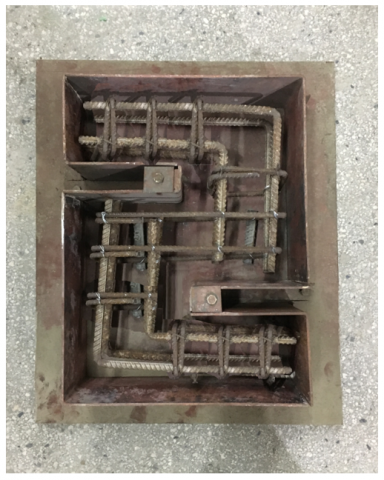
The DSSs were supplied by 12 mm rebars as longitudinal reinforcement and 6Փ8 mm ties on the two specimen parts (upper and lower). The region in which the stresses of DS are anticipated to develop (shear plane) was reinforced by 4Փ8 mm connected with two ties in the two specimen parts of the DS specimen to simulate its performance in the structural concrete parts that are reinforced with steel reinforcement. The rebars' yield and ultimate stresses are calibrated by steel tensile test conforms to ASTM [29]. The outcomes of the test are demonstrated in Table 4. Figure 2 clarifies the details of steel reinforcement in DSSs.
Table 4. The outcomes of the rebar test
|
Steel Rebar Diameter (mm) |
Stress at Yield (N/mm2) |
Ultimate Stress (N/mm2) |
|
8 |
462 |
548 |
|
12 |
496 |
667 |
Figure 2. Steel reinforcement details of the DSSs
2.4 Casting of DSSs
All DSSs were transversely poured with concrete. To determine the concrete compressive strength value of each admixture used for cast the DS specimens, samples were taken from each admixture and casted into cylinders to be tested at 28 days as stated by ASTM [30]. Table 5 clarifies the outcomes of the compressive strength test.
Table 5. Compressive strength of the SCC and TVC admixtures
|
Kind of Concrete |
Mix Code |
fc' (N/mm2) |
|
SCC |
SN10 |
28.8 |
|
SN20 |
28.2 |
|
|
SH10 |
52.7 |
|
|
SH20 |
52.5 |
|
|
TVC |
TN10 |
28.9 |
|
TN20 |
28.8 |
|
|
TH10 |
52.6 |
|
|
TH20 |
52.1 |
The compressive strength values for the two types of concrete (TVC and SCC) used in casting DSSs were selected to be about 28 N/mm2 for the NS stage and about 52 N/mm2 for the HS stage, since these values are the most practically used in casting structural elements that suffer from direct shear stresses. As reported by ACI [31], the definition of HSC is the concrete that its compressive strength exceeds 41 N/mm2.
2.5 Test setup
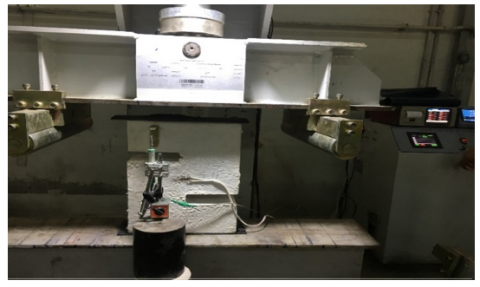
Beyond the water treatment of DSSs in accordance with the requirements of ASTM [32], the DSSs were colored neutral to distinguish the cracks. After that, the DSSs were examined one by one with the testing machine in the laboratory of the Engineering Faculty in Diyala. The DSSs were placed vertically in a machine so that the shear plane was parallel to the direction of loading. The lower face of DSSs was supported on a rigid steel base, while the upper face was gradually subjected to loading. The hydraulic lever of the test machine applies a load that starts to raise gradually with a constant rate of 0.5 kN/sec till it attains the ultimate capacity of DSSs. With each load step the testing machine records the vertical displacement using a Linear Variable Differential Transformer (LVDT) device with an accuracy of 0.001 mm as well as the concrete strain using a strain gauge that was installed vertically on the direct shear plane. The test ends as soon as the displacement increases without applying any further loading, that load represents the failure load. The appearance of cracks was monitored with the progress of loading and the necessary observations were recorded. Figure 3 clarifies the setup of one of the DSSs in the testing machine.
Figure 3. Test set up of DSSs
3.1 Impact of LSCCA on the ultimate shear stress and highest displacement
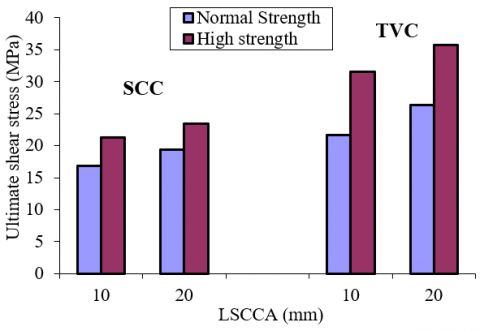
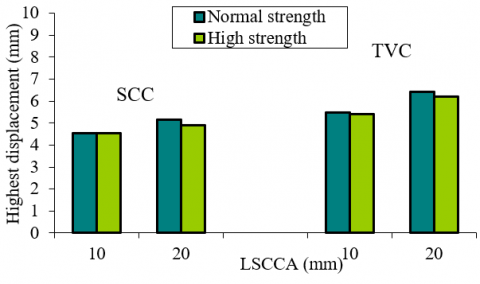
Table 6 and Figures 4 and 5 demonstrate the outcomes of the DSSs test. Generally, the outcomes notify that raising the LSCCA from 10 mm to 20 mm causes raising the ultimate shear stress and highest displacement of the two types of concrete and in both concrete strength stages (NS and HS). However, raising the LSCCA from 10 mm to 20 mm for SCC in the NS stage makes the ultimate shear stress and highest displacement increase with percentages of 15.2% and 13.9%, and in the HS stage, increase with percentages of 9.9% and 8.4% sequentially. Whilst for the TVC the increases are 21.2% and 16.7% in the NS stage and 13.6% and 14.4% in the HS stage.
Table 6. The results of the tested DSSs
|
Direct Shear Specimen |
Mix Code |
Ultimate Shear Stress (kN) |
Raising (%) |
Largest Displacement (kN) |
Raising (%) |
|
DS1 |
SN10 |
16.9 |
- |
4.54 |
- |
|
DS2 |
SN20 |
19.4 |
15.2 |
5.17 |
13.9 |
|
DS3 |
SH10 |
21.3 |
- |
4.54 |
- |
|
DS4 |
SH20 |
23.4 |
9.9 |
4.92 |
8.4 |
|
DS5 |
TN10 |
21.7 |
- |
5.50 |
- |
|
DS6 |
TN20 |
26.3 |
21.2 |
6.42 |
16.7 |
|
DS7 |
TH10 |
31.5 |
- |
5.41 |
- |
|
DS8 |
TH20 |
35.8 |
13.6 |
6.19 |
14.4 |
Figure 4. Ultimate shear stress of SCC and TVC DSSs
Figure 5. Highest displacement of SCC and TVC DSSs
This can be ascribed to the fact that raising the LSCCA enlarges the area of aggregate interlaces beside the crack which is the pivotal criterion in the transportation of the shear stresses across the faces of cracks in concrete, this leads to an increase in the redistribution of direct shear stresses within the concrete resulting in preventing concentrating these stresses in certain regions and producing an increase in the capacity against direct shear loads.
Also, the outcomes exhibit that the improvement in the ultimate shear stress and highest displacement for TVC is more considerable than for SCC, this variance can be attributed to the bigger amount of CA in TVC compared to SCC, thus the overall area of aggregate interlace between the cracks in TVC is larger than in SCC thus the efficiency of shear transmission and redistribution of the stresses becomes larger, making the TVC able to maintain its resistance against the direct shear loads after cracking with more percentage than SCC. Furthermore, these results illustrate that the impact of changing the LSCCA reduces in the HS stage of the two concrete types compared to the NS stage. The last performance may be ascribed to the fact that the paste matrix in HSC has a strength over than that of aggregate, thus the cracks in this case, have the capacity to permeate the aggregates because of the large stresses produced in the concrete as a consequence of large applied loads that resisted in HSC, therefore, the coarse aggregate will lose the ability to transfer shear stresses between the two sides of the crack, interlace of aggregate and stress redistribution within the concrete becomes less efficient, leading to early failure compared with the NS stage, in which the aggregate has a strength outperform that of paste matrix which endures premature cracks in contrast with the aggregate, therefore, the aggregate holds a large area of interlace in contrast with that of HSC.
Table 7 demonstrates a comparison between the direct shear performance of SCC and TVC that have the same LSCCA and same compressive strength in terms of ultimate shear stress and highest displacement. The comparison declares that the ultimate shear stress and highest displacement of TVC is larger than that of SCC that have the same LSCCA and same compressive strength. However, in the case of NS stage, the ultimate shear stress and highest displacement of TVC with the LSCCA of 10 mm is larger than that of SCC by percentages 29.9% and 14.1% sequentially, whilst, in the case of using LSCCA of 20 mm, TVC is larger than that of SCC with percentages 35.4% and 24.2%. On the other side, in the case of HS stage, the ultimate shear stress and highest displacement of TVC with the LSCCA of 10 mm is larger than of SCC with percentages by 47.9% and 19.2% sequentially, whilst, in the case of using the LSCCA of 20 mm, TVC is larger than of SCC by percentages 52.9% and 25.8%. The reason of being the difference percentages at the HS stage are larger than those at the NS stage is because the fact that TVC is able to bear high loads, especially when it is in the HS stage, and has the LSCCA of 20 mm in contrast with SCC as shown in the above results. This makes the difference percentages in the HS stage greater than those percentages in the HS stage.
Table 7. Direct shear performance comparison between SCC and TVC
|
Direct Shear Specimen |
Mix Code |
Ultimate Shear Stress (kN) |
Raising (%) |
Highest Displacement (kN) |
Raising (%) |
|
DS1 |
SN10 |
16.7 |
- |
4.82 |
- |
|
DS5 |
TN10 |
21.7 |
29.9 |
5.50 |
14.1 |
|
DS2 |
SN20 |
19.4 |
- |
5.17 |
- |
|
DS6 |
TN20 |
26.3 |
35.4 |
6.42 |
24.2 |
|
DS3 |
SH10 |
21.3 |
- |
4.54 |
- |
|
DS7 |
TH10 |
31.5 |
47.9 |
5.41 |
19.2 |
|
DS4 |
SH20 |
23.4 |
- |
4.92 |
- |
|
DS8 |
TH20 |
35.8 |
52.9 |
6.19 |
25.8 |
3.2 Impact of LSCCA on shear stress-displacement relationship
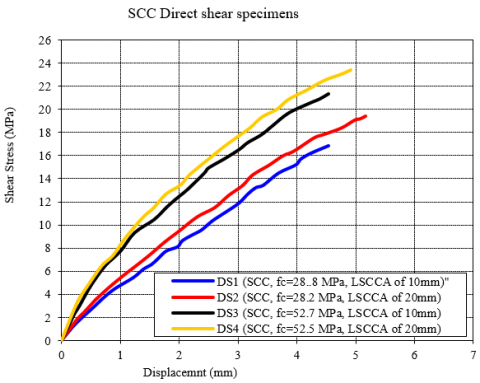
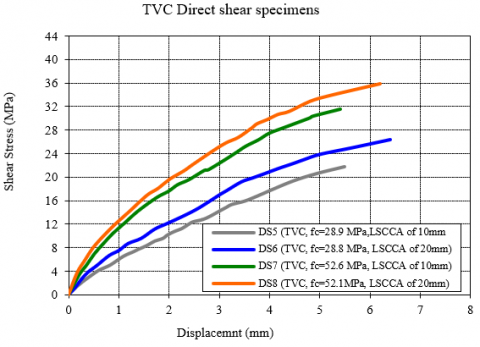
Figures 6 and 7 demonstrate the impact of the LSCCA on the shear stress-displacement relationship in the NS and the HS stages of SCC and TVC, it is evident that the impact of changing the LSCCA from 10 mm to 20 mm begin with a slight impact in early steps of loading and increases with the raising the load to be significant at ultimate shear stress for both types of concrete. Also, it is obvious that this impact is more considerable in the NS stage than in the HS stage. Moreover, the figures notify that raising the LSCCA causes a reduction in the displacement in all loading steps although raising the highest displacement, this performance indicates that the concrete with larger LSCCA becomes stiffer and more ductile.
Figure 6. Shear stress-displacement relationship of SCC-DSSs
Figure 7. Shear stress-displacement relationship of TVC-DSSs
3.3 Cracks in DSSs
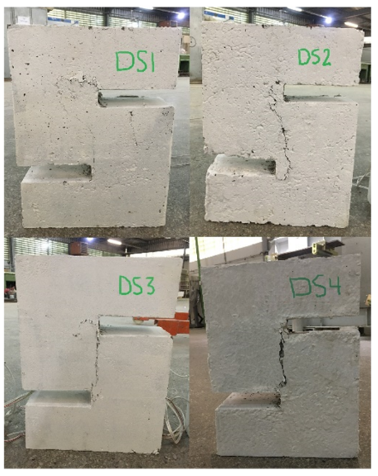
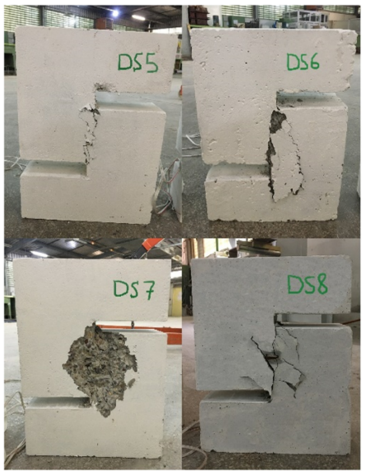
Figures 8 and 9 exhibit the pattern of cracks after the failure occurrences for the SCC and TVC sequentially, it is evident that the cracks in all the specimens formed and developed in the shear plane (the region of upper to lower prats’ connection of DSSs), thus all the specimens failed in direct shear failure mode. Also, Figure 8 demonstrates that changing the LSCCA from 10 mm to 20 mm in SCC makes the cracks wider, and this impact is more evident and more significant when changing the strength of concrete from NS stage to HS stage. It is apparent that the failure patterns of the SCC specimens are limited to one main crack with some very small and not extending and not expanding side cracks branching out from the main crack. As for the specimens in the TVC bundle, it is obvious that the failure pattern differed from that of the SCC bundle. However, in the DS5 specimen, the failure pattern notifies the presence of several cracks in the shear plane region, and changing the LSCCA to 20 mm in the DS6 specimen caused the formation of two large cracks, and their width increased with the progress of loading to make them met forming a large fracture in the shear plane. Moreover, changing the concrete strength from NS stage to the HS stage, made the cracks wider, by sequencing part of the outer covering fall from the shear region. Also, the increase the LSCCA from 10 mm to 20 mm in HS stage TVC leads to the formation of many wide cracks as illustrated in Figure 9.
Figure 8. Impact of changing the LSCCA on the SCC-DSSs
Figure 9. Impact of changing the LSCCA on the TVC-DSSs
An empirical exploration of the impact of the large size of concrete coarse aggregate on the capacity of concrete against the direct shear loads for traditional vibrated concrete (TVC) and self-consolidating concrete (SCC) was achieved in this paper. According to the outcomes attained by this exploration, then it can be concluded that:
1. Changing the large size of concrete coarse aggregate from 10 to 20 mm has a considerable impact on the enhancement of the direct shear performance in terms of raising the direct shear strength, stiffness, and ductility of SCC and TVC.
2. The impact of changing the large size of concrete coarse aggregate from 10 to 20 mm on the direct shear performance of self-consolidating concrete is less significant than that of traditional vibrated concrete.
3. The improvement represented by raising the direct shear strength, stiffness, and ductility because of changing the large size of concrete coarse aggregate from 10 to 20 mm is more remarkable in the normal strength stage than in the high strength stage on both self-consolidating concrete and traditional vibrated concrete.
4. The larger amount of coarse aggregate in the traditional vibrated concrete makes it more affected by changing the maximum size from 10 to 20 mm, this is evident through improving its structural performance against direct shear loads compared to self-consolidating concrete that has lower coarse aggregate content.
5. The failure patterns of the self-consolidating concrete specimens are limited to one main crack branches off from it some very small and not extending cracks. The failure pattern of the traditional vibrated concrete is characterized by the presence of several cracks in the shear plane region.
6. Changing the large size of concrete coarse aggregate from 10 mm to 20 mm in the self-consolidating concrete specimens makes the cracks wider, and this impact becomes more evident and more significant with changing the strength of concrete from normal to high, whilst changing the large size of concrete coarse aggregate from 10 mm to 20 mm in traditional makes the cracks to be wider resulting in fracture the plane of shear.
|
ASTM |
American Society for Testing and Materials |
|
CA |
Coarse Aggregate |
|
CFRP |
Carbon Fiber Reinforced Polymer |
|
DS |
Direct Shear |
|
DSSs |
Direct Shear Specimens |
|
FA |
Fine Aggregate |
|
HSC |
High Strength Concrete |
|
LVDT |
Linear Variable Differential Transformer |
|
LSCCA |
Largest Size of Concrete Coarse Aggregate |
|
NSC |
Normal Strength Concrete |
|
RCA |
Reused Concrete Aggregate |
|
SCC |
Self-Consolidating Concrete |
|
TVC |
Traditional Vibrated Concrete |
|
UHPC |
Ultra-High-Performance Concrete |
|
Symbols/Parameters |
|
|
fc' |
Concrete Compressive Strength |
[1] ACI Committee 318. (2019). Building code requirements for structural concrete (ACI 318-19) commentary on building code requirements for structural concrete (ACI 318R-19). American Concrete Institute, Farmington Hills, USA. https://doi.org/10.14359/51716937
[2] Darwin, D., Dolan, C.W., Nilson, A.H. (2016). Design of Concrete Structures. Fifteenth Edition, McGraw-Hill Education, New York, USA.
[3] Hsu, T.T.C., Mau, S.T., Chen, B. (1987). Theory on shear transfer strength of reinforced concrete. Structural Journal, 84(2): 149-160. https://doi.org/10.14359/2834
[4] Mattock, A.H., Johal, L., Chow, H.C. (1975). Shear transfer in reinforced concrete with moment or tension acting across the shear plane. PCI Journal, 20(4): 76-93. https://doi.org/10.15554/pcij.07011975.76.93
[5] Paulay, T., Loeber, P.J. (1974). Shear transfer by aggregate interlock. ACI Symposium Paper, 42: 1-16. https://doi.org/10.14359/17277
[6] Okamura, H., Ouchi, M. (2003). Self-compacting concrete. Journal of Advanced Concrete Technology, 1(1): 5-15. http://doi.org/10.3151/jact.1.5
[7] EFNARC. (2002). Specification and Guidelines for Self-compacting Concrete. European Federation of Specialist Construction Chemicals and Concrete System, pp. 5-15.
[8] Djelloul, O.K., Menadi, B., Wardeh, G., Kenai, S. (2018). Performance of self-compacting concrete made with coarse and fine recycled concrete aggregates and ground granulated blast-furnace slag. Advances in Concrete Construction, 6(2): 103-121. https://doi.org/10.12989/acc.2018.6.2.103
[9] Khaleel, O.R., Al-Mishhadani, S.A., Razak, H.A. (2011). The effect of coarse aggregate on fresh and hardened properties of self-compacting concrete (SCC). Procedia Engineering, 14: 805-813. https://doi.org/10.1016/j.proeng.2011.07.102
[10] John, O.O., Wale, A.O., Olusoji, O.J., Ihotu, O.D. (2016). Influence of aggregate size on self compacting concrete using Nafores 801 liquid as plasticizer. IOSR Journal of Mechanical and Civil Engineering, 13(5): 125-133. https://doi.org/10.9790/1684-130502125133
[11] Neville, A.M. (2012). Properties of Concrete. Trans-Atlantic Publications, USA.
[12] Hassan, A.A.A., Ismail, M.K., Mayo., J. (2015). Shear behavior of SCC beams with different coarse-to-fine aggregate ratios and coarse aggregate types. Journal of Materials in Civil Engineering, 27(11): 04015022. https://doi.org/10.1061/(ASCE)MT.1943-5533.0001276
[13] Ismael, M.A., Abd, H.J., Hameed, A.A. (2018). Effect of coarse aggregate size on shear behavior of self-compacting concrete and conventional concrete beams. International Journal of Engineering & Technology, 7(4.20): 359-363. https://doi.org/10.14419/ijet.v7i4.20.26135
[14] Parung, H., Tumpu, M., Tjaronge, M.W., Amiruddin, A.A., Walenna, M.A., Mansyur. (2023). Crack pattern of lightweight concrete under compression and tensile test. Annales de Chimie - Science des Matériaux, 47(1): 35-41. https://doi.org/10.18280/acsm.470105
[15] Amriou, A., Ziani, H., Deboucha, S., Bencheikh, M. (2021). Effect of gravel content on mechanical performance and porous structure of concrete. Annales de Chimie - Science des Matériaux, 46(1): 19-25. https://doi.org/10.18280/acsm.460103
[16] Hsu, C.T.T., Punurai, W., Jia, Y., Bian., H. (2006). Direct shear behavior of carbon fiber-reinforced polymer laminates and concrete. Journal of Testing and Evaluation, 34(3): 1-9. https://doi.org/10.1520/JTE12694
[17] French, R., Maher, E., Smith, M., Stone, M., Kim, J., Krauthammer, T. (2017). Direct shear behavior in concrete materials. International Journal of Impact Engineering, 108: 89-100. https://doi.org/10.1016/j.ijimpeng.2017.03.027
[18] Wu, P., Wu, C., Liu, Z., Hao, H. (2019). Investigation of shear performance of UHPC by direct shear tests. Engineering Structures, 183: 780-790. https://doi.org/10.1016/j.engstruct.2019.01.055
[19] Alimrani, N.S., Balazs, G.L. (2020). Investigations of direct shear of one-year old SFRC after exposed to elevated temperatures. Construction and Building Materials, 254: 119308. https://doi.org/10.1016/j.conbuildmat.2020.119308
[20] Li, Z., Wu, B. (2021). The direct shear behavior of recycled lump concrete. Materials and Structures, 54(226): 1-17. https://doi.org/10.1617/s11527-021-01823-6
[21] Liu, Y., Huang, S., Li, L., Xiao, H., Chen, Z., Mao, H. (2021). Experimental and numerical studies on the direct shear behavior of Sand–RCA (recycled concrete aggregates) mixtures with different contents of RCA. Materials, 14(11): 2909. https://doi.org/10.3390/ma14112909
[22] Liu, T., Wan, Z., Long, Z., Zeng, J., Wang, J., Zhang, J. (2022). Direct shear strength prediction for precast concrete joints using the machine learning method. Journal of Bridge Engineering, 27(5): 04022026. https://doi.org/10.1061/(ASCE)BE.1943-5592.0001866
[23] Pan, R., Song, X., He, W., Qin, L. (2023). Direct shear strength of UHPC considering size effect: Theoretical model and experimental verification. Journal of Building Engineering, 71: 106381. https://doi.org/10.1016/j.jobe.2023.106381
[24] Lu, W., Li, F., Zhu, L., Zhang, T., Zhou, Y., Peng, W., Zeng, B. (2023). Experimental study on the direct shear behavior of multiple shear keys at concrete glue joints subjected to uneven normal stress. Structure and Infrastructure Engineering, 1-17. https://doi.org/10.1080/15732479.2023.2191207
[25] ACI Committee 211. (1991). Standard Practice for Selecting Proportions for Normal, Heavyweight and Mass Concrete. American Concrete Institute, pp. 1-38.
[26] Central Agency for Standardization and Quality Control. (2009). Material Specifications and Construction Works-Portland Cement. Planning Council, Baghdad, Iraq, pp. 20-21.
[27] Central Agency for Standardization and Quality Control. (2009). Material Specifications and Construction Works-Coarse Aggregate. Planning Council, Baghdad, Iraq, pp. 5-9.
[28] ASTM C494/C494M-17 A. (2017). Standard specification for chemical admixtures for concrete. ASTM Standard, 4(2): 1-10. https://doi.org/10.1520/C0494_C0494M-17
[29] ASTM A615/A615M-22. (2022). Standard specification for deformed and plain carbon-steel bars for concrete reinforcement. ASTM Standards, 1(4): 1-8. https://doi.org/10.1520/A0615_A0615M-22
[30] ASTM C39/C39M-21. (2021). Standard test method for compressive strength of cylindrical concrete specimens. ASTM Standard, 4(2): 1-8. https://doi.org/10.1520/C0039_C0039M-21
[31] ACI Committee 363. (1992). State-of-the-art report on high-strength concrete (ACI363R-92). American Concrete Institute, Farmington Hills, Michigan, pp. 1-54.
[32] ASTM C192/C192M-14. (2014). Standard practice for making and curing concrete test specimens in the laboratory. ASTM Standard, 4(2): 1-8. https://doi.org/10.1520/C0192_C0192M-14