Saad Hadi A. Alahmed | Ahmed Nasser B. Alsammak* | Hasan A. Mohammed
© 2025 The authors. This article is published by IIETA and is licensed under the CC BY 4.0 license (http://creativecommons.org/licenses/by/4.0/).
OPEN ACCESS
The three-phase electrical generator is considered the essential and vital element of the power system, forming the nucleus of the electrical infrastructure and being one of the energy industry's most important and costly components. Therefore, an advanced and intelligent protection system is required to isolate it quickly from the system in cases of abnormal operating conditions or faults. This paper discusses different types of generator protection equipment currently in use, such as stator protection, rotor protection, and protection against abnormal conditions. It also reviews methodologies for protecting electrical machinery through continuous monitoring, and evaluation of changes in load current, stator temperature, resistance, and rotor speed fluctuations. It also discusses observations, gaps, challenges, and the increasing applications of artificial intelligence. In conclusion and recommendation, a structure of an intelligent relay capable of performing all electrical generator protection tasks is proposed. The new structure included the effect of changing the capability curve with air temperature.
generator protection relay, intelligent protection relay, multifunctions protection system, generator faults, stator faults, rotor faults, and generator capability curve
Many faults occur in electrical power systems. Therefore, it is essential to forecast all faults and take all necessary measures to ensure the power system's safety [1].
Differential relays that incorporate both restraint and blocking differential elements in parallel exhibit superior operational and second-order harmonic speed compared to differential relays that solely utilize a single differential element [2]. The negative sequence filter, integrated with the overcurrent relay, is a protective measure against imbalanced loading conditions [3]. The distinctions among various optimization techniques are defined by the duration required for prototyping and their robustness in industrial environments [4]. It is important to enhance the reliability of the power system by implementing generator maintenance scheduling and safeguarding the system [5].
With the replacement of electromechanical relays, the fundamental elements of relay protection and automation systems were improved [6], with semiconductor devices [7, 8], which are presently being supplanted by microprocessor terminals [9, 10], and Artificial Neural Networks (ANN) Protection Stages [11], thereby yielding increased efficiency and an elevated degree of functionality in relay protection, automation, and measurement [8]. The malfunctions associated with microprocessor systems arise from various factors, including overvoltage, random memory and software errors, and power supply disruptions, among others [10]. Hence, significant emphasis is placed on the evaluation of the electromagnetic environment and the regulation of grounding systems [12].
A substantial 25-28% of system failures can be attributed to the malfunctioning of relay protection and automation devices.
Modern generating units are complex systems comprising stator and rotor windings, exciter windings, power transformers, and prime movers with auxiliary components. These systems are prone to various faults, requiring electrical and mechanical protection strategies. Due to harsh operational conditions, advanced protection methods are essential like using Artificial Neural Network (ANN) algorithms and the Adaptive Neuro-Fuzzy Inference System (ANFIS) used [11]; these multifunction numerical relays are equipped with the capability to provide extensive protection, such as differential protection, ground fault protection for stator and field windings, out-of-step protection, as well as safeguards against over/under voltage and frequency variations, in conjunction with loss-of-excitation protection, relevant to generators of various scales. All at a negligible expense [13, 14], to maintain the generator in a secure operational state, the dynamic regulation of both real and reactive power through the application of FACT devices is crucial. It is equally essential to manage the implications of such controls [15].
This paper discusses different types of generator protection related to stators and rotors and their use against abnormal conditions. It also reviews the most conventional and intelligent methodologies for using generator protection systems and discusses observations, gaps, challenges, and opportunities.
Power systems are exposed to faults at many different time intervals, attributed to numerous factors; thus, it is imperative that these faults are anticipated and that appropriate safety measures are implemented within the power system [16].
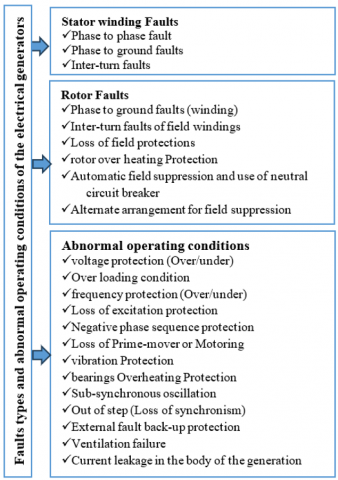
The selection of protection devices is contingent upon the specifications and classification of the generators and associated equipment. The protection of generators consists of multiple components designed to detect abnormal operating conditions or lead to the instability of power systems [17], enabling the disconnection of the generator and mechanical systems before potential damage occurs. Two key protective elements related to synchronizing issues are reverse power protection (when the generator operates as an electric motor) and loss-of-excitation protection (failure of the excitation system) [18, 19]. The electrical generator protection systems are shown in Figure 1. In addition to the aforementioned relays, differential protection, field failure protection [20], protection for rotor ground, protection for reverse power, and protection for negative sequence phase are also employed for generator protection. Vibration signals can also be used to protect power system devices such as generators, transformers, etc. [21]. Different faults and their corresponding protective devices are discussed in the following sections.
Figure 1. Types of various electrical generator malfunctions and unusual operation circumstances [22-24]
Generators often face external, internal, or combined faults. As part of the power system, it is crucial to quickly isolate faults to prevent severe generator damage [25].
Phase-to-phase faults and faults between the windings of the same phase are less common, but they can develop into ground faults. However, faults between the windings of the same phase are difficult to detect. There are several types of faults, including rotor variances and atypical operational states of the generator. Therefore, it is essential that the generator is protected not only against electrical faults and mechanical complications but also against negative interactions that may arise when the generator goes out of synchronization with the power system or due to the loss of field windings, and so on. In some cases, such as internal faults, the generator must be quickly isolated, and in situations such as the failure of field windings, it is imperative that an "alarm" be activated to notify the operator [22, 23].
Statistical analyses indicate that the generator is responsible for 5.5% of the failure rate observed in wind turbines, which subsequently contributes to 8.9% of the overall downtime [26]. As reported by the International Renewable Energy Agency (IRENA), approximately 30% of the total energy expenditure is allocated to operational and maintenance costs within the global onshore wind farm sector [27]. A comparable assessment of 23% has been corroborated by the National Renewable Energy Laboratory (NREL) based in the United States [28, 29].
A recent investigation conducted in 2022, encompassing generators from 57 wind farms, identified a total of 1,752 faults classified into 31 distinct types. Among these, 706 failures, representing 40.3%, were attributed to issues with generator bearings, while 452 failures, accounting for 25.8%, were linked to the carbon brushes in the doubly fed configuration.
Failures related to fans or heaters constituted 7.9%, whereas winding failures represented 7.1%. Additionally, 4.2% of failures associated with generator temperature anomalies were ascribed to alternative causes, as explained in Figure 2 [30, 31].
Figure 2. Failure data for wind turbine generators in 2022
Generator protection systems constitute assemblages that incorporate an array of protective measures for the generator. These protective measures are fundamentally predicated upon three principal factors: variations in load current magnitude, stator thermal conditions and impedance, and rotor rotational velocity [32].
A multitude of protection systems exist within generators, with the most prevalent among them being.
4.1 Overvoltage & undervoltage protection (Abnormal voltage protection)
In the absence of voltage rise, drop, or fluctuation from the rated value [27], this protection does not activate. It operates in two main scenarios: overvoltage conditions and undervoltage conditions [28]. Undervoltage conditions do not cause any negative impact or physical damage; however, there is a potential risk of overheating auxiliary motors. The importance of the overvoltage relay lies in preventing excessive dielectric stress, which could lead to insulation failure [29].
According to IEEE standards, voltage fluctuation ranges are classified, and acceptable limits are defined. The IEEE 1159-2019 standard categorizes voltage fluctuations into different classes, while IEEE 519-2022 provides guidelines on permissible limits. As per the IEEE C84.1-2020 standard, the utilization voltage (for end-user equipment) should remain within ±5% of the nominal voltage, while the service voltage (at the utility supply point) should stay within +5% to -2.5%.
Exceeding these limits can lead to significant damage, such as generator failure, reduced efficiency, increased electrical and mechanical faults, and decreased performance and equipment lifespan. Therefore, it is essential to adhere to these standards and take the necessary measures to ensure voltage stability and maintain equipment efficiency [30].
4.2 Earth fault and restricted earth fault protection (REF)
A restricted earth fault (REF) protection mechanism facilitates the precise identification of ground faults occurring in close proximity to the neutral point of a transformer or generator. The advantages derived from the sensitivity of the REF mechanism become particularly significant when the apparatus is grounded with low impedance, rendering the transformer phase differential element (87T) ineffective [31], Stator Earth Fault protection calculates the current passing through the neutral point of the generator or transformer without being restricted by any other value [32].
4.3 Overload & overcurrent protection
This protection detects any fault in the three phases of the generator. Any drop in the voltage of one of the phases may cause contact, even partial, with the ground or between the phases, which will lead to an increase in the main current of the generator due to the resulting short circuits. The relay begins to sense the current value once the voltage drops by a certain percentage from the rated value, as this protection depends on voltage. There are three options in this type, as follows.
In the first case, there is no need to adhere to the voltage, as this relay operates to detect an increase in current at the rated voltage, with a rise higher than the rated load current. The second case is used when the generating unit is directly connected to the grid without being constrained by the grid voltage. The third case, which is the one adopted in power generation stations, involves connecting generation stations indirectly through power transformers constrained by the grid voltage. Figure 3 illustrates the difference between the last two cases. The operation of this relay depends on time, with two types either fixed time (Definite Time) or inverse time, which depends on the curve of the relationship between current and voltage [33].
Figure 3. Overcurrent protection voltage control/voltage restrained
The inverse-time overcurrent relay Figure 4 is designed to isolate faults characterized by elevated current levels quickly.
The speed of fault clearance depends on the intensity of the
Various inverse-time relays present distinct time-current characteristics (TCCs), facilitating the selection of an appropriate relay tailored to the application's specific requirements. A selection of available options is enumerated below [34].
The defining equations pertinent to the previously mentioned categories of inverse-time overcurrent relays are articulated as follows [35].
Figure 4. Illustrates an increase in fault current, which results in a faster relay response
Standard inverse overcurrent relays:
$t_{o p}=\frac{0.14}{M^{0.02}-1} \times T M$ (1)
Very inverse overcurrent relays
$t_{o p}=\frac{13.5}{M-1} \times T M$ (2)
Extremely inverse overcurrent relays:
$t_{o p}=\frac{80}{M^2-1} \times T M$ (3)
where, top: operating time (s), TM: ratio of the input current to the pickup current, M: time multiplier or time dial setting thermal.
4.4 Over frequency & under frequency
The operational frequency of the system is maintained at 50 Hz during standard functioning. The frequency of the system is contingent upon the rotational velocity of the generator.
$n_s=\frac{120 \times f}{p}$ (4)
where, NS: synchronous speed [rpm], P: number of magnetic poles.
The difference between active power production and system requirements leads to an increase or decrease in the generator's rotational speed, resulting in the acceleration of the generator rotors and an overall increase in system frequency. The opposite occurs due to the sudden loss of significant generation capacity. Operating at an irregular frequency is inherently harmful, as it can negatively impact many aspects of the power system, jeopardizing the reliability and security of the entire generation facility [36]. When the frequency is irregular, it causes damage to electrical equipment. For example, the natural frequency (and its harmonics) of turbine blades is designed to be sufficiently separated from the nominal speed and its multiples to prevent mechanical resonance. If the turbine operates at speeds that differ from the specified parameters, the turbine blades may experience excessive mechanical stress, which could lead to the formation of cracks in the turbine structure [37].
4.5 Loss of excitation protection methods
There are two main concerns regarding Loss of Excitation (LOE) protection [38]:
The most popular techniques for (LOE) protection are:
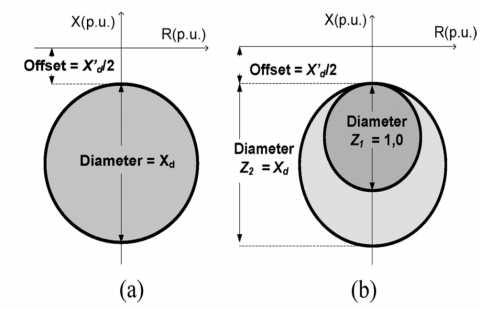
A single-phase offset mho relay product by Mason in 1949 [39], The distance relay was developed to avoid incorrect decisions between LOE protection and other abnormal operating conditions. The characteristics of the relay mho (diameter Xd and offset Xʹd).
In 1975, Berdy [40] made a change to the protection system. (The first diameter is equal to 1.0 p.u without an external time delay, and the second unit has a diameter equal to Xd) This is to ride through transient conditions and undesirable operations [40].
Currently, Mason’s scheme is recommended for generators with Xd˂ 1.2 p.u., as well as Berdy’s scheme for Xd˃ 1.2 p.u. Figure 5 illustrates Berdy’ and Mason's methods.
Figure 5. The proposed protection characteristics (LOE) by: (a) Mason and (b) Berdy
Undervoltage, impedance, timers, and directional elements are considered components of this technique for protect generator and transmission networks [41, 42], as shown in Figure 6. Using the following formulas, the first relay (Z2), the positive offset mho element, is configured with a 10% margin above the steady-state stability limit.
Diameter = 1.1Xd + Xs (5)
Offset = Xs (6)
Figure 6. Positive offset scheme
4.6 Generator watt/var capability
Figure 6 shows a typical capability curve for a generator with a cylindrical rotor. The generator's operating limits under steady state (continuous) conditions are shown by this capacity curve. The generator capability curve is usually distributed at the rated voltage of the generator. In the under-excited area, salient pole generators show a slightly different feature.
The curve also shows how the Automatic Voltage Regulator (AVR) limits steady-state operation to stay within the generator's limits. Three separate curves the stator winding limit, the rotor heating limit, and the stator end iron limit combine to form the generator capability shown in Figure 7 [28, 43].
Figure 7. A cylindrical rotor generator's typical generating capability curve and operating restrictions
4.7 Over flux protection
This suggests that the per unit voltage is divided by the per unit frequency and can be attributed to various factors, including turbine overspeed, load rejection on the machine resulting from the disconnection of a load block, The malfunctioning of the Automatic Voltage Regulator (AVR) during the operational state of the machine, over-excitation during the machine's unloaded condition, situations where the machine operates at a terminal voltage that exceeds its rated capacity, and instances where the machine functions at its rated or lower voltage in conjunction with reduced frequency can lead to operational issues [44].
This phenomenon can be mitigated by implementing a relay that measures the ratio of voltage to frequency (V/Hz relay), adjusting the speed accordingly so that the generated voltage is proportionately regulated [22, 26].
The diverse modalities of safeguarding implemented for the generator can be described into two classifications:
4.8 Other protective devices
Protective relays play a vital role in protecting generators from faults or abnormal operating conditions that could cause significant damage to the electrical generator, whether these faults originate internally or externally to the generator.
In addition to the power transformers and protection relays that are directly connected to the generator. Other devices include lightning arrestors, overspeed protection devices, instruments for measuring the temperature and vibration of shaft bearings, stator windings, transformer windings, transformer oil, and others, as well as monitoring lubrication systems such as oil flow, oil pressure, and oil temperature. Some of these protective arrangements are classified as non-trip types (Non-Trip Types) (provided that these protective arrangements do not cause damage to the electrical generator), meaning they are limited to issuing alarms in response to abnormal conditions. Table 1 provides a detailed enumeration of the additional protective relays used for safeguarding generators [33, 34].
Table 1. Generator protection elements
|
Device |
Description |
ANSI |
|
Current element |
Differential protection |
87G |
|
Over current |
51V |
|
|
Negative phase sequence |
46NPS |
|
|
Voltage element |
Over voltage |
59OV |
|
Under voltage |
27UV |
|
|
Volt / Hz |
24 |
|
|
Over frequency |
81O |
|
|
Under frequency |
81U |
|
|
VT – fuse failure |
60 |
|
|
Power element |
Reverse power |
32R |
|
Low forward power |
32L |
|
|
Neutral side protection |
Stator earth fault |
51N |
|
Neutral displacement |
59N |
|
|
Excitation protection |
Field failure |
40FF |
|
Rotor protection |
Rotor earth failure |
64F |
Many optimization techniques have been used as defect classifiers, such as algorithms based on Artificial Neural Networks (ANNs), which have shown to be useful in a variety of pattern and signature recognition applications.
These algorithms possess the capability to identify the normal functioning of the generators and transformers by discerning their waveform characteristics with greater precision and distinguishing them from fault current waveforms [45-48]. Compared to other intelligent algorithms, genetic algorithm optimization technology offers numerous benefits, including high accuracy and quick response times to produce ideal results [49]. Furthermore, alternative methodologies such as traditional techniques (including Stochastic Methods, Sequential Optimization, Goal Programming, Constraint Programming, Weighting Objectives, Linear Programming, Gradient-Based/Hill Climbing, etc.) and artificial intelligence solutions (comprising Particle Swarm Optimization, Pareto Multi-Objective Optimization, Simulated Annealing, Fuzzy Set Theory, Evolutionary Computation and Ant Colony Optimization,) are extensively applied in the realms of power system operation and control [50-52].
By reviewing most of the research related to the protection of electrical generators that utilize artificial intelligence, which contributes to improving operational efficiency, reducing failures, and providing predictive maintenance, major companies rely on technologies such as machine learning, artificial neural networks, fuzzy logic, support vector machines, etc. to enhance the performance of protection systems and ensure the stability of power systems [53].
Most research utilizes fuzzy logic in electrical generator protection devices, as it is used to process imprecise or ambiguous data, making it useful for predicting faults. It also aids in making accurate decisions regarding the operation and shutdown of the generator based on operational conditions [54].
Phadke et al. [55] discussed the significant role of wide-area monitoring (WAM) in enhancing power system protection, particularly in the context of modern challenges faced by power systems.
It highlights the limitations of existing protection systems, which often rely on fixed relay characteristics that do not adapt to varying system conditions.
The authors emphasize the need for adaptive and intelligent protection schemes, as well as the importance of a robust communication infrastructure to support these advancements.
The paper aims to explore new protection concepts that can mitigate the risks of blackouts caused by relay maloperations and wide area disturbances [55].
Hasani et al. [56] discussed the investigation of the impact of electrode shapes on the performance of gas discharge arresters (GDAs), which are crucial for overvoltage protection in low-voltage circuits.
GDAs function as insulators under normal conditions but can discharge when voltage exceeds the gas breakdown threshold, leading to electric arcs.
The study emphasizes the significance of electrode shape in preventing the reignition of arcs after extinguishing, as the geometry of the electrodes influences the electric field strength.
The authors utilize a differential evolution optimization algorithm to compute optimal electrode shapes for improved electric-field distribution [56].
Dumitrescu [57] discussed the design and modelling of an intelligent multifunctional protection system for an electric generator. It proposes a fuzzy safety analysis model to evaluate fail-safe behaviour in automation and protection systems.
The electric generator's protection and automation system (PAS) is crucial for detecting and isolating faults to maintain the system's operational state. By utilizing fuzzy logic and event-tree analysis, the PAS can effectively respond to various dangerous events with imprecision and uncertainty in data. This innovative approach allows for qualitative evaluation of events using verbal statements for probabilities and consequences.
The work mentions using fuzzy logic to account for imprecision and uncertainty in data while employing event-tree analysis, indicating a limitation in traditional deterministic approaches that do not consider such uncertainties.
The very high, low, and moderate probabilities are verbal statements for probabilities and consequences permitted by fuzzy event-tree logic, highlighting a limitation in traditional numerical probability assessments that may not capture qualitative aspects effectively [57].
Taalab et al. [58] discussed and address the critical issue of stator winding faults in synchronous generators, which can lead to significant damage and maintenance costs.
It highlights the limitations of conventional differential relays in detecting ground faults, particularly under high-impedance grounding conditions.
The authors suggest an internal fault detector algorithm based on artificial neural networks (ANNs) that makes use of the average and difference between the currents flowing into and out of the generator windings.
This proposed method demonstrates high sensitivity and stability in fault discrimination, surpassing traditional detection methods [58].
Cui et al. [59] proposed a multifunction intelligent relay (IR) scheme that includes fault detection, fault ride through (FRT) selective blocking features, islanding detection, and fault type recognition for inverter-based distributed generators; this system presents a thorough IR modelling approach to lower computational resources and allows the integration of these functionalities. The approach outperforms standard detection time in a hardware-in-the-loop (HIL) context.
This innovative protection system addresses protection functions in terms of dependability, security, and the challenges posed by inverter-based distributed generators, enhancing overall grid reliability and performance.
The work highlights the challenges introduced by inverters in distributed generation systems, emphasizing the need for a sophisticated interconnection protection relay to address these challenges.
It mentions the importance of reducing offline computational resource consumption while integrating multiple functions in the same intelligent relay, indicating a limitation in traditional protection schemes [59].
Abdi-Khorsand and Vittal [60] proposed a new technique for identifying possibly malfunctioning relays during the planning stage with the goal of preventing unintended system separation and preventing these relays from tripping during erratic power swings. By lowering voltage and frequency fluctuations during disruptions like the triple line outage examined in the Western Electricity Coordinating Council data, the proper design and installation of out-of-step protective relays, identified by the suggested method, enhance the power system's dynamic performance.
The work does not explicitly mention any limitations of the proposed method for detecting mis-operating relays in time domain simulations.
It focuses more on the benefits and results of the novel method in improving the dynamic performance of power systems rather than discussing any potential drawbacks or constraints [60].
Li et al. [61] developed an efficient method for diagnosing faults in the elevator of fixed-wing unmanned aerial vehicles (UAVs) using deep learning techniques to improve fault detection accuracy and enhance UAV system reliability. The research relied on designing a model based on the Transformer architecture to analyze sensor data and detect faults in the UAV elevator. Deep learning techniques, particularly the Transformer architecture, were used to process time-series data and classify faults with high accuracy. The model demonstrated superior performance in diagnosing faults, outperforming traditional methods in detecting complex failures. However, some limitations exist, including the need for a large amount of training data and the difficulty of generalizing the model to other types of UAVs [61].
Hou et al. developed an effective method for diagnosing rolling bearing faults using an enhanced model based on the Transformer architecture, aimed at improving the accuracy and efficiency of diagnosis in industrial systems. A new model called "Diagnosisformer" was proposed, which relies on optimizing the Transformer architecture to identify faults in rolling bearings. The model was trained on a dataset containing vibrational signals collected from various bearings. Deep learning techniques were employed, with the Transformer architecture optimized for processing time-series signals, along with automatic feature extraction techniques.
The proposed model demonstrated high accuracy in fault diagnosis compared to traditional methods, with enhanced capability to handle large and complex datasets. However, among the limitations are the need for a large amount of data for training and the difficulty in interpreting the decisions made by the model [62].
Bashirov et al. [63] address the creation and investigation of an intelligent electrical network protection and control system, with an emphasis on relay protection in an active-adaptive network. To improve the protection system's capabilities, it incorporates supervised machine learning, artificial neural networks, and digital twins; while the focus is on relay protection within the broader electrical network, the methodologies and technologies discussed could potentially be adapted for designing and modelling an intelligent multifunction protection system for electrical generators, leveraging advanced technologies like neural networks for enhanced functionality and reliability.
Research was conducted to establish the limits on the application of artificial intelligence in an intelligent security system for electrical network relay protection.
In order to answer queries about the application of a neural network in relay protection, the authors examined the complex by adding digital twins, physical models of the power supply system, and an artificial neural network [63].
In general, many software programs have been used by researchers for protection systems, including MATLAB and LabVIEW [64].
Table 2 offers a sample of protection elements used in electrical generators, methods used, the circuit outcomes, conclusions, and features. This work presents a sum of works that used generator protection relays in power systems.
Table 2. Samples of protection elements, methods used, and circuit outcomes
|
Ref. No. |
Methods Used |
The Circuit Outcomes |
Conclusions |
Features |
|
[65] |
A prototype of the SBP was developed using a digital signal processor and field programmable gate array (DSPFPGA). |
The ability to accurately locate faulted components using the current differential principle, coordinating effectively with primary protection systems. |
Distinguish internal faults under various conditions, demonstrating immunity to fault resistance, inrush currents, and CT saturation. |
The proposed SBP represents a significant improvement for future backup protections in Smart Grid systems. |
|
[66] |
Based on artificial neural networks, an intelligent modular protection system is simulated. |
Good results were obtained for precise coordination in power system protection. |
The proposed system based on neural networks ensures precise relay coordination. |
The use of relays as backup protection and coordination of parameters between relays. |
|
[67] |
Computer simulation, specifically the EMTDC transient simulator, is used to evaluate the functionality of protective relays in the transmission substation model. |
Monitoring and storing the operational response of each protective relay, control relays, and associated circuit breakers in an event database, and implementing corrective or preventive maintenance strategies. |
Microprocessor-based relays and other intelligent electronic devices (IEDs) are important in providing real-time data and information to aid in understanding system operation and response during events or commands. |
Computer simulations help understand the behaviour of the network and the protection system during faults and other disturbances, as well as assess the reliability of the protection system for different fault scenarios. |
|
[68] |
A method for real-time estimation of power system impedance aimed at enhancing the performance of power quality devices such as STATCOM. |
Experimental results have verified the identification method proposed in the work. |
The work presents a method for real-time power system impedance estimation. The experimental results have verified the identification method proposed in the work. |
Real-time power system impedance estimation to enhance the performance of power quality devices such as STATCOM. |
|
[69] |
The complete design is simulated using the Modelsim simulation tool. |
The motor speed gradually changes to the set speed and locks at the set speed, demonstrating the functionality of the synchronous generator protection unit. |
The generator protection unit offers easily reconfigurable features, multiple protections, and the implementation of necessary protective functions. |
Implementing all necessary protective functions for the generator. Easily reconfigurable, rather than focusing on high accuracy and processing speed for generator signals. |
|
[70] |
Employs a general-purpose software simulation tool to implement a finite state machine that models the proposed section of the protection scheme. |
Flexibility in implementing intelligent distribution systems while maintaining coordination with the re-closer independently of other devices. |
Coordination with the re-closer is independent of other devices, highlighting the standalone functionality of the sectionalized in the intelligent protection system. |
Providing accurate modeling of the device as part of an intelligent protection system and a design suitable for use in urban and rural areas. |
|
[71] |
Prototype IED was developed using DSP (Digital Signal Processor) and microprocessor technology. |
The description of the hardware, signal processing test results, and measurement accuracy of the prototype IED aiming to replace imported generator protection panels effectively. |
Intelligent Electronic Device (IED) for generators based on Digital Signal Processing (DSP) technology and microprocessor-based technology. |
Digital relay systems provide a wide range of functions for measurement, protection, control, monitoring, and communication. |
|
[72] |
Flexible test technology based on the LabVIEW software development platform. |
The testing of protection functions for low-voltage devices was efficient, automatic, and accurate. |
The system reflects flexibility, adaptability, and expandability of flexible test technology. |
Meeting the needs of protection functions testing and flexible testing technology. |
|
[73] |
Decoupling of sequence for valid equations. Fortescue transforms for fault analysis and protection design. |
Proposed protection configurations and possible improvements against internal faults. |
Predicts currents and voltages using Park equivalent circuit parameters. |
Model for internal fault analysis and assessment of conventional protection. |
|
[74] |
Analytical models utilize simplified differential-algebraic equations to describe dominant dynamics, while numerical models require accuracy and simplicity for stability prediction through time or frequency-domain response analysis. |
It differentiates the modeling needs for various types of stability studies based on a broad stability classification and two methodologies: analytical studies and numerical calculations. |
It differentiated modeling needs for various stability studies from a broad stability classification and methodologies. |
A general conceptual modeling framework was presented, linking stability characteristics to WTG components. |
|
[75] |
Detailed modeling of a diesel generator system. Development of a power electronic-based controller to reduce load levels. |
Excessive drivetrain loads and potential damage to critical components. Disturbances from the engine and load sides cause torque overloads. |
A detailed model was used to predict the effects of disturbances in diesel generator systems. The proposed active protection scheme reduces torsional stresses and over torque. |
Reducing fuel consumption and addressing disturbances. |
|
[76] |
calculating the eigenvalue of harmonics to detect inter-turn short circuit faults, where an increase in eigenvalue indicates a fault condition. |
The results indicate that FOCT can prevent significant damage by shortening protection operation time, thus enhancing generator safety. |
The successful operation of FOCT in several Chinese power plants indicates its reliability, although long-term stability in harsh environments remains to be validated. |
FOCT improves current differential protection performance by reducing operating time and increasing sensitivity, mitigating issues related to CT saturation. |
|
[77] |
a comprehensive analysis of protection schemes for synchronous generator-based electric grids, focusing on the design and implementation of robust protection systems. |
Implementation of dual fast protection schemes for critical components, enhancing fault-clearing efficiency. |
There is a need for innovative protection strategies to adapt to the evolving dynamics of modern power grids. |
a comprehensive analysis of protection schemes for synchronous generator-based electric grids. |
|
[78] |
Software design framework: hardware interface, data processing, database layers. |
Enables device interchange and plug-and-play functionality. |
Software design framework ensures logical control for general protection devices. |
The current devices are unable to be interchanged, and a proposal for a new design method is needed. |
|
[79] |
Utilizes the MATLAB/Simulink toolbox with the protection system. |
The designed protective devices operate efficiently based on the simulation results. |
The study will explore various protection systems, highlighting the use of digital logic algorithms. |
The system was developed using MATLAB/Simulink tools. The relays were implemented using a digital logic algorithm. |
|
[80] |
A particle swarm optimization (PSO) algorithm is utilized to solve the nonlinear programming problem associated with IIDG planning. |
When the DTO acted as a backup for the adjacent line, the average and minimum sensitivity values increased by 29.91% and 50.95%, respectively. |
The optimization results indicated that the minimum relay sensitivities after optimization met the required standards in all tested scenarios. |
A novel optimization model that integrates relay protection sensitivity into the planning of inverter interfaced distributed generators (IIDGs) in distribution networks (DNs). |
|
[81] |
Fuzzy logic-based multistage relaying model for cascaded intelligent fault protection scheme. |
Effectively detect and isolate faults in power systems, improving the overall reliability and efficiency of the system. |
The proposed model surpasses traditional protection systems in terms of fault detection and isolation. |
The use of fuzzy logic in fault protection systems is beneficial in enhancing the intelligence and efficiency of these systems. |
|
[82] |
Use of deep learning neural networks to develop intelligence in relay protection devices. |
The performance of the control system is examined through numerical simulations, demonstrating the feasibility and successful operation of the device. |
Simulated systems allow for easy modification of equipment parameters without additional cost, providing more productive solutions. |
Smart devices operate effectively without the constraints of the complexity of training the neural network. |
|
[83] |
Utilization of sensors such as the ACS-712 current sensor and ZMPT101b AC voltage sensor, along with measuring frequency using the AC voltage sensor signal without the need for an external zero crossing detector hardware circuit. |
Based on Arduino, a multifunctional electric meter is designed and implemented for a three-phase synchronous generator, capable of measuring load current, terminal voltage, and frequency. |
The multi-meter displays the measured parameters and protection status on an LCD screen, in addition to serial printing on the computer via USB cable, with smart monitoring capabilities using a Bluetooth module. |
Monitoring devices with power consumption for efficient energy management. It displays the protection status directly and the measured parameters on the LCD screen, in addition to serial printing on the computer via a USB cable. |
|
[84] |
It utilizes the Support Vector Machine (SVM) algorithm to classify and filter the relay protection action characteristics recorded by the fault recording data. |
The experimental results indicate that the method accurately reflects the actual situation of various relay protection actions, such as current quick-break protection and overcurrent protection. |
This method enhances the identification and classification of relay protection actions, ensuring they meet expected standards, thereby improving overall system reliability. |
The study emphasizes the importance of accurately analyzing relay protection actions to ensure the safe and reliable operation of power systems. |
|
[85] |
Designing an intelligent controller using Matlab/Simulink to interpret operating modes and activate the correct function based on network conditions. |
Feasibility and successful operation of the device. |
The proposed system mitigates threats in power networks such as short circuit current, voltage sag or swell, and voltages resulting from ferroresonance by utilizing elaborate switching in its unified structure. |
Coordination with the re-closer is independent of other devices, highlighting the standalone functionality of the sectionalizer in the intelligent protection system. |
|
[86] |
Uses MATLAB/SIMULINK and also involves the use of Arduino Mega 2560 microcontrollers to build the system and design the relay. |
A relay for comparison that offers protection against unbalanced voltage and reverses power through DQ transformation, along with exploring the concept of relay cascading for enhanced protection in industrial applications. |
Modeling, simulating, and developing a multifunction digital relay using MATLAB/SIMULINK for protection against voltage and frequency fluctuations, as well as overcurrent, for industrial applications. |
The equipment is analyzed under both normal and abnormal conditions, disturbances are intentionally created to obtain disturbance data, and equipment parameters can be easily adjusted without cost. |
|
[87] |
Overcurrent protection relay model and transfer station model were developed in MATLAB/Simulink. |
Investigation of communication operations and cybersecurity threats on relay operations. |
The integrated model of protective relay considers cyber-physical, communication, and cybersecurity. |
The role of Intelligent Electronic Devices (IEDs) in protecting power systems. |
|
[88] |
The research utilizes an auto-regression technique focused on the positive sequence component of current angles to detect fault directionality. |
Identified faults within the protected zone, ensuring proper detection of internal and external faults across different fault conditions. |
The system’s adaptability and insensitivity to parameter settings make it suitable for smart grids. |
Its design is resilient to fault types, fault arc characteristics, power flow direction, and swing frequency variations, making it ideal for close-in faults. |
The research studies mentioned in Table 2 [66-89] contain various constraints; however, they all share the limitation of not incorporating current, voltage, and temperature together to cover all protection aspects. These parameters have been integrated in this work, by the suggestion of a new intelligent multifunction protection relay system.
A generator's active or reactive power limitations must be restricted in order to guarantee efficient fault clearance when it is judged required.
Based on a review of previous research studies and the protections employed in modern power generation stations, which feature more than nine protection systems per generating unit, as referenced in the paragraphs above. Table 3 illustrates the differences between the generally used relays.
Table 3. The different relay types with features
|
Feature |
Electromechanical |
Solid State |
Digital |
|
Accuracy & sensitivity |
Better than electromechanical |
Best of them |
Good |
|
Lifetime |
Small |
Small |
Tall |
|
Undesired operating |
There is a chance |
There is a chance |
Almost never |
|
Reliability |
Good |
Not bad |
Excellent |
|
Discrimination capability |
Good |
Best of them |
Little |
|
Condition monitoring |
N.A |
Good |
N.A |
|
Multifunction |
Little |
Yes |
N.A |
|
Data communications |
N.A |
Yes |
N.A |
|
Remote operation |
N.A |
Yes |
N.A |
|
Disturbances immunity |
Low |
Very low |
High |
|
CT burden |
Low |
Low |
High |
|
Parameters setting |
Easy |
Very easy |
Difficult |
|
Range of settings |
Wide |
Very wide |
Limited |
|
Self-diagnostics |
N.A |
Yes |
N.A |
|
Metering |
N.A |
Yes |
N.A |
|
Event archiving |
N.A |
Yes |
N.A |
|
Size |
Small |
Compact |
Bulky |
|
Visual indication |
LEDs |
LCD |
Targets |
Harmonics pose a significant challenge to protective electrical devices, as they affect measurement accuracy and increase the likelihood of incorrect operation. Therefore, improving the reliability of these devices requires adopting modern technologies, such as intelligent relays, in addition to advancing signal processing algorithms, to ensure the stability and efficiency of power systems in challenging operational environments [89].
The main source of electrical power used in business settings is synchronous generators. Significant equipment damage, interruptions in electricity distribution, and financial consequences result from SG failure. Effective generator protection requires knowing the kind of fault, whether it is caused by rotor failures, stator problems, or unusual generator operating circumstances, and then implementing the proper mitigation techniques.
Many studies on generator protection have shown that implementing performance optimization methodologies within the system is crucial for maintenance cost reduction in addition to increasing the basics of protection systems targets such as speed, selectivity, reliability, and sensitivity. These studies' objectives and positive points were clarified, and their negative aspects were presented to identify and address them in the future.
All previous works did not include the incorporation of the capability curve and its constraints for the Intelligent relay or the effect of temperature on it, which can be added as an input-output training dataset.
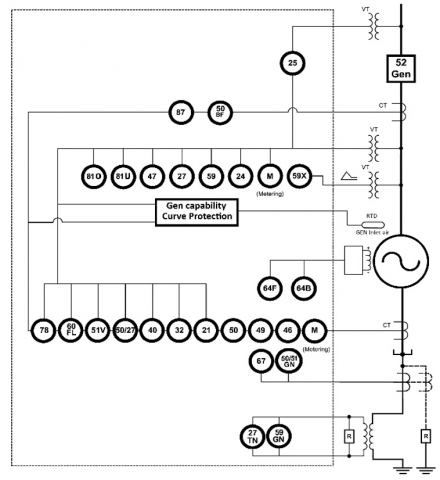
Figure 8. A proposed model for the smart relay, including ANSI code numbers
With the integration of artificial intelligence (AI) into practical applications and the significant advancements in finding optimal solutions, a smart relay specifically designed for generating units can be developed. This smart relay would encompass all the protections mentioned in the paragraphs above, incorporating all constraints and functioning both during faults and in issuing warning signals. Furthermore, it would ensure that operation continues for non-critical faults that do not necessitate the shutdown of the generating unit. Figure 8 illustrates a new structure for the proposed smart relay model, including changing the capability curve with air temperature in addition to the other signal clarified as ANSI code number, which is explained in Table 4.
When the temperature increases, the efficiency of electric generators generally decreases, and the value of the stator and rotor winding limit on the capability curve, in addition to the machine stability margin, also decreases. This case can be a proposal for future research.
Table 4. ANSI code number with the equivalent protection type
|
ANSI Code |
Protection Type |
|
25 |
Check synchronizer and permission |
|
21 |
Phase Distance |
|
24V/F |
Volts/Hertz |
|
27UV |
Undervoltage |
|
50/27 |
Inadvertent Energizing |
|
32R/32L |
Reverse power/low forward power |
|
40FF |
Loss of excitation (impedance) |
|
46NPS |
Negative sequence overcurrent (I22 t) |
|
47 |
Voltage phase reversal |
|
49 |
Stator thermal (Positive Sequence Overcurrent) |
|
50 |
Instantaneous Phase Overcurrent |
|
50BF |
Circuit Breaker failure detection |
|
51V |
Voltage-restrained phase overcurrent |
|
59OV |
Overvoltage |
|
59X |
Multi-purpose Overvoltage |
|
59GN/27TN |
100% stator ground |
|
60FL |
VT fuse failure |
|
64F/64B |
Field Ground Protection |
|
78 |
Out of Step |
|
81O/81U |
Over frequency/Under frequency |
|
87G |
Percentage differential Current |
|
M |
Metering for life/neutral side |
The authors would like to thank the University of Mosul (https://www.uomosul.edu.iq), Mosul, Iraq, and the College of Engineering Department of Electrical Engineering for supporting this work.
[1] Srivastava, M., Goyal, S.K., Saraswat, A., Gangil, G. (2020). Simulation models for different power system faults. In 2020 IEEE International Conference on Advances and Developments in Electrical and Electronics Engineering (ICADEE), Coimbatore, India, pp. 1-6. https://doi.org/10.1109/ICADEE51157.2020.9368915
[2] Qais, M., Khaled, U., Alghuwainem, S. (2018). Improved differential relay for bus bar protection scheme with saturated current transformers based on second order harmonics. Journal of King Saud University-Engineering Sciences, 30(4): 320-29. https://doi.org/10.1016/j.jksues.2016.10.003
[3] Wang, J., Hamilton, R. (2010). A review of negative sequence current. In 2010 63rd Annual Conference for Protective Relay Engineers, College Station, TX, USA, pp. 1-18. https://doi.org/10.1109/CPRE.2010.5469515
[4] Mohammed, H.A., Alsammak, A.N.B. (2023). An intelligent hybrid control system using ANFIS-optimization for scalar control of an induction motor. Journal Européen des Systèmes Automatisés, 56(5): 857-862. https://doi.org/10.18280/jesa.560516
[5] Kim, J., Geem, Z.W. (2015). Optimal scheduling for maintenance period of generating units using a hybrid scatter-genetic algorithm. IET Generation, Transmission & Distribution, 9(1): 22-30. https://doi.org/10.1049/iet-gtd.2013.0924
[6] Ransom, D.L. (2014). Upgrading relay protection: Be prepared for the next replacement or upgrade project. IEEE Industry Applications Magazine, 20(5): 71-79. https://doi.org/10.1109/MIAS.2013.2288404
[7] Baliga, B.J. (1996). Trends in power semiconductor devices. IEEE Transactions on Electron Devices, 43(10): 1717-1731. https://doi.org/10.1109/16.536818
[8] Shurygin, Y. (2019). Intelligent relay protection of electric power systems. In 2019 1st International Conference on Control Systems, Mathematical Modelling, Automation and Energy Efficiency (SUMMA), Lipetsk, Russia, pp. 656-660. https://doi.org/10.1109/SUMMA48161.2019.8947568
[9] Bolat, A., Cassano, L., Reviriego, P., Ergin, O., Ottavi, M. (2020). A microprocessor protection architecture against hardware trojans in memories. In 2020 15th Design & Technology of Integrated Systems in Nanoscale Era (DTIS), pp. 1-6. https://doi.org/10.1109/DTIS48698.2020.9080961
[10] Qin, B.L., Guzman-Casillas, A., Schweitzer, E.O. (2000). A new method for protection zone selection in microprocessor-based bus relays. IEEE Transactions on PowerDelivery, 15(3): 876-887. https://doi.org/10.1109/61.871347
[11] Alnaib, I.I., Alsammak, A.N.B., Sabry, S. (2022). Protection relay performance comparison for faults detection and classification based on ANN and ANFIS. In Control, Instrumentation and Mechatronics: Theory and Practice, pp. 545-555. https://doi.org/10.1007/978-981-19-3923-5_47
[12] Gryzlov, A.A., Grigor’Ev, M.A. (2018). Improving the reliability of relay-protection and automatic systems of electric-power stations and substations. Russian Electrical Engineering, 89: 245-248. https://doi.org/10.3103/S1068371218040077
[13] Abdel-Salam, M., Kamel, R., Sayed, K., Khalaf, M. (2017). Design and implementation of a multifunction DSP-based-numerical relay. Electric Power Systems Research, 143: 32-43. https://doi.org/10.1016/j.epsr.2016.10.033
[14] Shobole, A.A., Abafogi, M., Zaim, A., Amireh, Y. (2024). Multi agent system based adaptive numerical relay design and development, Part II: Hardware. Electric Power Systems Research, 226: 109889. https://doi.org/10.1016/j.epsr.2023.109889
[15] Tarraso, A., Lai, N.B., Baltas, G.N., Rodriguez, P. (2019). Power quality services provided by virtually synchronous FACTS. Energies, 12(17): 3292. https://doi.org/10.3390/en12173292
[16] Genc, I., Diao, R., Vittal, V., Kolluri, S., Mandal, S. (2010). Decision tree-based preventive and corrective control applications for dynamic security enhancement in power systems. IEEE Transactions on Power Systems, 25(3): .1611-1619. https://doi.org/10.1109/TPWRS.2009.2037006
[17] Al-Kaoaz, H.N.A., Alsammak, A.N.B. (2023). Utilizing hybrid renewable energy systems for enhancing transient stability in power grids: A comprehensive review. Journal Européen des Systèmes Automatisés, 56(4): https://doi.org/10.18280/jesa.560418
[18] Thompson, M.J. (2012). Fundamentals and advancements in generator synchronizing systems. In 2012 65th annual conference for protective relay engineers, College Station, TX, USA, pp. 203-214. https://doi.org/10.1109/CPRE.2012.6201234
[19] Ghanim, A.S., Alsammak, A.N.B. (2020). Modelling and simulation of self-excited induction generator driven by a wind turbine. Восточно-Европейский журнал передовых технологий, 6(8): 6-16. https://doi.org/10.15587/1729-4061.2020.213246
[20] Kerrigan, P.M., Kozminski, K.C., Marttila, R.J., Mazumdar, S., Mozina, C.J., Novosel, D.J., Patel, C. (1999). Application of multifunction generator protection systems. IEEE Transactions on Power Delively, 14(4): 1285-1294. https://doi.org/10.1109/61.796219
[21] Li, C., Chen, J., Yang, C., Yang, J., Liu, Z., Davari, P. (2023). Convolutional neural network-based transformer fault diagnosis using vibration signals. Sensors, 23(10): 4781. https://doi.org/10.3390/s23104781
[22] Doorwar, A., Bhalja, B., Malik, O.P. (2018). A new internal fault detection and classification technique for synchronous generator. IEEE Transactions on Power Delivery, 34(2): 739-749. https://doi.org/10.1109/TPWRD.2018.2879686
[23] Gopinath, R., Kumar, C.S., Ramachandran, K.I., Upendranath, V., Kiran, P.S. (2016). Intelligent fault diagnosis of synchronous generators. Expert Systems with Applications, 45: 142-149. https://doi.org/10.1016/j.eswa.2015.09.043
[24] Zielichowski, M., Szlezak, T. (2007). A new digital ground-fault protection system for generator–transformer unit. Electric Power Systems Research, 77(10): 1323-1328. https://doi.org/10.1016/j.epsr.2006.10.001
[25] Zidan, A., Khairalla, M., Abdrabou, A.M., Khalifa, T., Shaban, K., Abdrabou, A., El Shatshat, R., Gaouda, A.M. (2016). Fault detection, isolation, and service restoration in distribution systems: State-of-the-art and future trends. IEEE Transactions on Smart Grid, 8(5): 2170-2185. https://doi.org/10.1109/TSG.2016.2517620
[26] Al-Kaoaz, H.N.A., Alsammak, A.N.B. (2024). The impact of hybrid power generations on a power system's voltage stability. Journal Européen des Systèmes Automatisés, 57(2): 541-549. https://doi.org/10.18280/jesa.570223
[27] Al-kahdely, S.M.A., Alsammak, A.N.B. (2023). Normal operation and reverse action of on-load tap changing transformer with its effect on voltage stability. Bulletin of Electrical Engineering and Informatics, 12(2): 650-658. https://doi.org/10.11591/eei.v12i2.4556
[28] Patel, S., Stephan, K., Bajpai, M., et al. (2004). Performance of generator protection during major system disturbances. IEEE Transactions on Power Delivery, 19(4): 1650-1662. https://doi.org/10.1109/TPWRD.2003.820613
[29] Roberts, A. (2002). Stress grading for high voltage motor and generator coils. IEEE Electrical Insulation Magazine, 11(4): 26-31. https://doi.org/10.1109/57.400761
[30] Chowdhury, R., Alla, M., Fischer, N., Samineni, S. (2022). Restricted earth fault protection in low-impedance grounded systems with inverter-based resources. IEEE Transactions on Power Delivery, 38(1): 505-512. https://doi.org/10.1109/TPWRD.2022.3195741
[31] Bengtsson, T., Gajić, Z., Johansson, H., Menezes, J., Roxenborg, S., Sehlstedt, M. (2012). Innovative injection-based 100% stator earth-fault protection. In 11th IET International Conference on Developments in Power Systems Protection (DPSP 2012), Birmingham, UK, pp. 1-6. https://doi.org/10.1049/cp.2012.0112
[32] Cao, M., Guo, J., Xiao, H., Wu, L. (2022). Reliability analysis and optimal generator allocation and protection strategy of a non-repairable power grid system. Reliability Engineering & System Safety, 222: 108443. https://doi.org/10.1016/j.ress.2022.108443
[33] GE Vnovera, (2024). UR family G60 instruction manual generator protection system product version: 8.6x publication reference: G60-1601-0110-86x-2. https://www.gevernova.com/grid-solutions/app/viewfiles.aspx?prod=g60&type=3.
[34] GE Vernova, (2024). 8 Series 889 instruction manual generator protection system hardware version: C firmware version: 4.20 publication reference: 889-1601-0320-C420-1. https://www.gevernova.com/grid-solutions/app/viewfiles.aspx?prod=889&type=3.
[35] Sharaf, H.M., Zeineldin, H.H., Ibrahim, D.K., El-Zahab, E.D. (2014). Directional inverse time overcurrent relay for meshed distribution systems with distributed generation with additional continuous relay settings. In 12th IET International Conference on Developments in Power System Protection (DPSP 2014), pp. 12-19. https://doi.org/10.1049/cp.2014.0101
[36] Reimert, D. (2017). Protective Relaying for Power Generation Systems. CRC press. https://doi.org/10.1201/9781420030488
[37] Soleimanisardoo, A., Karegar, H.K., Zeineldin, H.H. (2018). Differential frequency protection scheme based on off-nominal frequency injections for inverter-based islanded microgrids. IEEE Transactions on Smart Grid, 10(2): 2107-2114. https://doi.org/10.1109/TSG.2017.2788851
[38] Dias, M.F., Elkateb, M.M. (1992). Case study into loss-of-excitation relays during simultaneous faults. II. In 3D Africon Conference. Africon'92 Proceedings (Cat. No. 92CH3215), Ezulwini Valley, Swaziland, pp. 430-433. https://doi.org/10.1109/AFRCON.1992.624514
[39] Mason, C.R. (1949). A new loss-of-excitation relay for synchronous generators. Transactions of the American Institute of Electrical Engineers, 68(2): 1240-1245. https://doi.org/10.1109/T-AIEE.1949.5060079
[40] Berdy, J. (1975). Loss of excitation protection for modern synchronous generators. IEEE Transactions on Power Apparatus and Systems, 94(5): 1457-1463. https://doi.org/10.1109/T-PAS.1975.31987
[41] Rasoulpour, M., Amraee, T., Sedigh, A.K. (2019). A relay logic for total and partial loss of excitation protection in synchronous generators. IEEE Transactions on Power Delivery, 35(3): 1432-1442. https://doi.org/10.1109/TPWRD.2019.2945259
[42] Al-Kaoaz, H.N.A., Alsammak, A.N.B. (2023). Performance enhancement of distance relay in presence of unified power flow controller. International Journal of Power Electronics and Drive Systems (IJPEDS), 14(3): 1577-1588. https://doi.org/10.11591/ijpeds.v14.i3.pp1577-1588.
[43] Hunt, J.P. (1967). Capability curves and excitation requirements of saturated cylindrical rotor synchronous machines. IEEE Transactions on Power Apparatus and Systems, PAS-86(7): 855-859. https://doi.org/10.1109/TPAS.1967.291752
[44] Hamid, S.F., Alsammak, A.N.B. (2023). The influence of using multi-mass steam turbines on the frequency stability in IEEE 9-bus system. American Institute of Physics Conference Series, 2834(1): 060007. https://doi.org/10.1063/5.0165912
[45] Zaman, M.R., Rahman, M.A. (1998). Experimental testing of the artificial neural network based protection of power transformers. IEEE Transactions on Power Delivery, 13(2): 510-517. https://doi.org/10.1109/61.660922
[46] Segatto, E.C., Coury, D.V. (2006). A differential relay for power transformers using intelligent tools. IEEE Transactions on Power Systems, 21(3): 1154-1162. https://doi.org/10.1109/TPWRS.2006.879268
[47] Bretas, A.S., Phadke, A.G. (2003). Artificial neural networks in power system restoration. IEEE Transactions on Power Delivery, 18(4): 1181-1186. https://doi.org/10.1109/TPWRD.2003.817500
[48] Megahed, A.I., Malik, O.P. (1999). An artificial neural network based digital differential protection scheme for synchronous generator stator winding protection. IEEE Transactions on Power Delivery, 14(1): 86-93. https://doi.org/10.1109/61.736692
[49] Rezaei, N., Uddin, M.N., Amin, I.K., Othman, M.L., Marsadek, M. (2019). Genetic algorithm-based optimization of overcurrent relay coordination for improved protection of DFIG operated wind farms. IEEE Transactions on Industry Applications, 55(6): 5727-5736. https://doi.org/10.1109/TIA.2019.2939244
[50] Alsammak, A.N.B., Al-Kaoaz, H.N.A. (2023). Design of a fuzzy distance relay taking into consideration the impact of using a unified power flow controller. Eastern-European Journal of Enterprise Technologies, 122(5): 6-19. https://doi.org/10.15587/1729-4061.2023.277343
[51] Molzahn, D.K., Dörfler, F., Sandberg, H., Low, S.H., Chakrabarti, S., Baldick, R., Lavaei, J. (2017). A survey of distributed optimization and control algorithms for electric power systems. IEEE Transactions on Smart Grid, 8(6): 2941-2962. https://doi.org/10.1109/TSG.2017.2720471
[52] Kothari, D.P. (2012). Power system optimization. In 2012 2nd National conference on computational intelligence and signal processing (CISP), Guwahati, India, pp. 18-21. https://doi.org/10.1109/NCCISP.2012.6189669
[53] Mohammadi, E., Alizadeh, M., Asgarimoghaddam, M., Wang, X., Simões, M.G. (2022). A review on application of artificial intelligence techniques in microgrids. IEEE Journal of Emerging and Selected Topics in Industrial Electronics, 3(4): 878-890. https://doi.org/10.1109/JESTIE.2022.3198504
[54] Yerbolkyzy, G., Tatkeyeva, G., Uakhitova, A. (2025). Operation analysis of fuzzy logic-based relay protection devices. Electric Power Systems Research, 241: 111390. https://doi.org/10.1016/j.epsr.2024.111390
[55] Phadke, A.G., Wall, P., Ding, L., Terzija, V. (2016). Improving the performance of power system protection using wide area monitoring systems. Journal of Modern Power Systems and Clean Energy, 4(3): 319-331. https://doi.org/10.1007/s40565-016-0211-x
[56] Hasani, A., Haghjoo, F., Da Silva, F.F., Bak, C.L. (2019). Synchronous generator loss of field protection: A real-time realistic framework and assessment of some recently proposed methods. IEEE Transactions on Power Delivery, 34(3): 971-979.https://doi.org/10.1109/TPWRD.2019.2897739
[57] Dumitrescu, M. (2010). Electric generator automation and protection system fuzzy safety analysis. In: Sgurev, V., Hadjiski, M., Kacprzyk, J. (eds) Intelligent Systems: From Theory to Practice. Studies in Computational Intelligence, vol 299. Springer, Berlin, Heidelberg. https://doi.org/10.1007/978-3-642-13428-9_21
[58] Taalab, A.I., Darwish, H.A., Kawady, T.A. (1999). ANN-based novel fault detector for generator windings protection. IEEE Transactions on Power Delivery, 14(3): 824-830. https://doi.org/10.1109/61.772321
[59] Cui, Q., Li, S., El-Arroudi, K., Joos, G. (2015). Multifunction intelligent relay for inverter-based distributed generation. In 13th International Conference on Development in Power System Protection 2016 (DPSP), Edinburgh, UK, pp. 1-6. https://doi.org/10.1049/cp.2016.0085
[60] Abdi-Khorsand, M., Vittal, V. (2016). Modeling protection systems in time-domain simulations: A new method to detect mis-operating relays for unstable power swings. IEEE Transactions on Power Systems, 32(4): 2790-2798. https://doi.org/10.1109/TPWRS.2016.2628726
[61] Li, Y., Liu, B., Jia, Z., Liu, Z. (2023). Transformer-based fault diagnosis method for fixed-wing UAV elevator. In 2023 14th International Conference on Reliability, Maintainability and Safety (ICRMS), Urumuqi, China, pp. 1018-1023. https://doi.org/10.1109/ICRMS59672.2023.00178
[62] Hou, Y., Wang, J., Chen, Z., Ma, J., Li, T. (2023). Diagnosisformer: An efficient rolling bearing fault diagnosis method based on improved transformer. Engineering Applications of Artificial Intelligence, 124: 106507. https://doi.org/10.1016/j.engappai.2023.106507
[63] Bashirov, M., Vildanov, R., Sabiryanova, A., Fokin, D., Isaev, E. (2024). Development and research of an intelligent control system and protection of electrical network equipment. E3S Web of Conferences, 494: 03008. https://doi.org/10.1051/e3sconf/202449403008
[64] Yacine, A.A., Noureddine, A.A., Hamid, B., Farid, (2018). Implementation of a numerical over-current relay using labview and acquisition card. In 2018 International Conference on Electrical Sciences and Technologies in Maghreb (CISTEM), Algiers, Algeria, pp. 1-5. https://doi.org/10.1109/CISTEM.2018.8613455
[65] Liu, Y., Gao, H., Gao, W., Peng, F. (2016). Development of a substation-area backup protective relay for smart substation. IEEE Transactions on Smart Grid, 8(6): 2544-2553. https://doi.org/10.1109/TSG.2016.2527687
[66] Mostafa, Y.G., Aly, M.S. (2009). Neural network based overcurrent voltage controlled protection system in large electrical networks. In 2009 IEEE Bucharest PowerTech, Bucharest, Romania, pp. 1-6. https://doi.org/10.1109/PTC.2009.5281865
[67] Thomas, M.S., Kothari, D.P., Prakash, A. (2010). IED models for data generation in a transmission substation. In 2010 Joint International Conference on Power Electronics, Drives and Energy Systems & 2010 Power India, New Delhi, India, pp. 1-8. https://doi.org/10.1109/PEDES.2010.5712415
[68] Sumner, M., Thomas, D., Abusorrah, A., Yao, L., Parashar, R., Bazargan, M. (2010). Intelligent protection for embedded generation using active impedance estimation. In The 2nd International Symposium on Power Electronics for Distributed Generation Systems, Hefei, China, pp. 47-52. https://doi.org/10.1109/PEDG.2010.5545891
[69] Hamad, R.S. (2011). Protection unit design and simulation for synchronous generator based FPGA technology. In 2011 IEEE Symposium on Industrial Electronics and Applications, Langkawi, Malaysia, pp. 415-418. https://doi.org/10.1109/ISIEA.2011.6108742
[70] Vaschetti, J.C., Gomez, J.C., Amatti, J.C. (2012). Modelado y Simulación de un Seccionador Tensión-Tiempo para Protección Inteligente con Inclusión de Generación Distribuida de Electricidad. Información tecnológica, 23(2): 99-108. https://doi.org/10.4067/S0718-07642012000200012
[71] Park, C.W., Park, S.W. (2013). A study on design of IED for generator protection panel. The Transactions of the Korean Institute of Electrical Engineers P, 62(3): 133-138. https://doi.org/10.5370/KIEEP.2013.62.3.133
[72] Xu, W., Xie, Q., Xu, H.G. (2013). Design of protection functions test system for intelligent low voltage electrical apparatus based on flexible test technology. Applied Mechanics and Materials, 241-244: 199-203. https://doi.org/10.4028/www.scientific.net/AMM.241-244.199
[73] Delfino, F., Denegri, G.B., Invernizzi, M., Pampararo, F., Procopio, R. (2013). A synchronous generator circuital model for internal fault analysis and protection system design. International Transactions on Electrical Energy Systems, 23(6): 876-900. https://doi.org/10.1002/etep.1719
[74] He, X., Geng, H., Mu, G. (2021). Modeling of wind turbine generators for power system stability studies: A review. Renewable and Sustainable Energy Reviews, 143: 110865. https://doi.org/10.1016/j.rser.2021.110865
[75] Kambrath, J.K., Wang, Y., Yoon, Y.J., Alexander, A.A., Liu, X., Wilson, G., Gajanayake, C.J., Gupta, A.K. (2017). Modeling and control of marine diesel generator system with active protection. IEEE Transactions on Transportation Electrification, 4(1): 249-271. https://doi.org/10.1109/TTE.2017.2764324
[76] Chen, J., Xu, Q., Wang, K. (2020). Research and application of generator protection based on fiber optical current transformer. IEEE Access, 8: 172405-172411. https://doi.org/10.1109/ACCESS.2020.3018734
[77] Singh, M. (2024). A guide to protection schemes of synchronous generator-based electric grids. e-Prime-Advances in Electrical Engineering, Electronics and Energy, 10: 100769. https://doi.org/10.1016/j.prime.2024.100769
[78] Li, C. (2019). Design of general protection device for intelligent substation. In 2019 IEEE 3rd Advanced Information Management, Communicates, Electronic and Automation Control Conference (IMCEC), Chongqing, China, pp. 1886-1889. https://doi.org/10.1109/IMCEC46724.2019.8983880
[79] Rahebi, J., Al-Shalah, M.M.S. (2020). Design, modeling and implementation of multi-function protective relay with digital logic algorithm. Avrupa Bilim ve Teknoloji Dergisi, (19): 549-565. https://doi.org/10.31590/ejosat.738337
[80] Li, F., Wang, D., Li, Y. (2024). Relay protection sensitivity integrated optimal placement and capacity of inverter interfaced distributed generators in distribution networks. Heliyon, 10(8): e29138. https://doi.org/10.1016/j.heliyon.2024.e29138
[81] Samonto, S., Kar, S., Pal, S., Sekh, A.A. (2020). Fuzzy logic based multistage relaying model for cascaded intelligent fault protection scheme. Electric Power Systems Research, 184: 106341. https://doi.org/10.1016/j.epsr.2020.106341
[82] Antonov, V., Naumov, V., Soldatov, A., Stepanova, D. (2020). Fundamental principles of smart protection device. In 2020 Ural Smart Energy Conference (USEC), Ekaterinburg, Russia, pp. 130-133. https://doi.org/10.1109/USEC50097.2020.9281227
[83] Ali, A.J., Ibraheem, A.M., Mahmood, O.T. (2020). Design of a smart control and protection system for three-phase generator using Arduino. In IOP Conference Series: Materials Science and Engineering, 745(1): 012027.https://doi.org/10.1088/1757-99X/745/1/012027
[84] Guo, W., Hou, X. (2024). Research on the analysis method of power system relay protection action characteristics based on fault recording data. Journal of Radiation Research and Applied Sciences, 17(3): 101005. https://doi.org/10.1016/j.jrras.2024.101005
[85] Tanha Bashoo, P., Jazaeri, M. (2022). A new multifunctional protection system for reducing fault current, ferroresonance overvoltage, and voltage fluctuations in power networks. International Transactions on Electrical Energy Systems, 2022(1): 1398097. https://doi.org/10.1155/2022/1398097
[86] Ijaz, M.T., Khan, N., Hassan, Q.U. (2022). Modeling, simulation and implementation of multi-function relay for industrial applications. In 2022 International Conference on IT and Industrial Technologies (ICIT), Chiniot, Pakistan, pp. 1-8. https://doi.org/10.1109/ICIT56493.2022.9989148
[87] Elrawy, M.F., Tekki, E., Hadjidemetriou, L., Laoudias, C., Michael, M.K. (2023). Protection and communication model of intelligent electronic devices to investigate security threats. In 2023 IEEE Power & Energy Society Innovative Smart Grid Technologies Conference (ISGT), Washington, DC, USA, pp. 1-5. https://doi.org/10.1109/ISGT51731.2023.10066371
[88] Adly, A.R., Rezk, M.E. (2024). Optimal protection scheme for distribution systems integrated with distributed generator. Arab Journal of Nuclear Sciences and Applications, 57(1): 100-106. https://doi.org/10.21608/ajnsa.2023.236014.1774
[89] Jedrzejczak, J., Anders, G.J., Fotuhi-Firuzabad, M., Farzin, H., Aminifar, F. (2016). Reliability assessment of protective relays in harmonic-polluted power systems. IEEE Transactions on Power Delivery, 32(1): 556-564. https://doi.org/10.1109/TPWRD.2016.2544801