Iraq Ali Hussein | Qusay Kanaan Kadhim | Hawraa Hussein Kadhim | Shaymaa Taha Ahmed* | Ahmed Al-Zaidi
© 2026 The authors. This article is published by IIETA and is licensed under the CC BY 4.0 license (http://creativecommons.org/licenses/by/4.0/).
OPEN ACCESS
Artificial intelligence (AI) has increasingly been integrated into higher education platforms to provide adaptive learning pathways, automated feedback, and personalized learning support. However, empirical evidence regarding the effects of different levels of AI integration on student learning outcomes remains insufficient. This study evaluates the impact of AI-integrated smart learning environments through a quasi-experimental design involving three instructional conditions: a conventional learning management system (LMS), a semi-adaptive learning environment, and a fully AI-integrated learning environment. A total of 282 undergraduate students were analyzed using pre- and post-test assessments, system interaction logs, and learner perception surveys. Statistical analyses, including analysis of variance, correlation analysis, and hierarchical regression, were conducted to examine differences in learning performance, engagement, and feedback utilization. The results showed that students in the fully AI-integrated environment achieved higher post-test scores (M = 80.3%) and normalized learning gains (g = 0.47) compared with the semi-adaptive and conventional LMS groups. Furthermore, AI-generated feedback interaction explained 28.4% of the variance in learning performance, while perceived personalization contributed additional explanatory power beyond time-on-task. These findings suggest that AI integration level is associated with improved learning performance and engagement in higher education contexts. However, further studies involving diverse institutions and longitudinal evaluation are required to examine the long-term effectiveness and generalizability of AI-supported learning environments.
artificial intelligence in education, artificial intelligence learning environments, adaptive learning systems, student engagement, learning analytics, personalized learning, higher education
The advent of artificial intelligence (AI) has transformed the digital learning space, especially in higher education, with its ability to create adaptive content, real-time analytics, and automated feedback mechanisms [1]. The latest advancements in large language models (LLMs) continue to expand the potential for intelligent learning environments (ILEs), where intelligent support for instruction is adaptable and scalable and can provide natural language interaction, feedback, and personalized support [2]. Despite those developments, there is still a lack of convincing empirical evidence of how and when the use of AI-supported learning systems leads to better learning outcomes [3].
The majority of previous research findings indicate that AI tutoring or adaptive learning tools have a positive impact on student performance and engagement [4]. However, there are a few drawbacks in these works and the three major drawbacks are as follows. First, AI interventions are usually generic and conceptual, with few technical details available about how the model is set up, how it adapts to the problem, and the pipeline for generating feedback [5]. Second, the effects of AI are often mistaken for higher levels of instructional support or time-on-task, and dosage confounds are a risk to internal validity [6]. Third, many studies focus on post-results without providing any solid learning theory or formal explanation of the results [7].
To fill these gaps, recent research on educational AI has suggested a mechanism-based assessment that links AI capabilities (such as adaptive sequencing, automated feedback) with conceptualized learning mechanisms (cognitive load regulation, self-regulated learning, and learning dynamics of feedback) [8]. Otherwise, statements about the effectiveness of AI-supported learning environments are mostly correlative and prone to overgeneralization [9]. In the realm of higher education, AI is reshaping the nature of traditional, semi-adaptive, and AI-enhanced learning environments, marking a paradigm shift in the way education is delivered and experienced [10]. In contrast to stereotypical approaches, which are based on a set of rules and predetermined structures, AI systems can also learn from data, thereby positively affecting the performance and engagement of students [11]. The technological revolution has positioned AI as a central element in the improvement of educational systems and teaching practices during 2022–2024 [12]. As AI continues to evolve within educational systems, its integration into strategies for comparing traditional, semi-adaptive, and AI-integrated learning environments in higher education, and their impact on student performance and engagement, becomes crucial for ensuring robust and effective learning [13]. The importance of AI lies in its use in a coherent and educationally supportive manner, i.e., through adaptive sequencing, real-time feedback, and individual customization, and in its ability to help achieve many learning outcomes in higher education [14].
In this setting, this study explores an AI-powered learning platform that is an amalgamation of adaptive learning routes, analytics-driven customization, and natural language feedback powered by LLMs. In contrast to the previous application-focused research, the present work explores not only the presence of the positive impact of AI-supported learning, but also the relationship of various levels of AI support with the nature of engagement, feedback usage, and learning gains in the controlled setting.
In this respect, a quasi-experimental design was utilized with three conditions of instruction in a higher education traditional learning management system (LMS), which is used as a control condition, a semi-adaptive system where personalization is based on rules, and a fully AI-integrated environment where adaptive sequencing and rule-based feedback are considered. Pre/post testing, system logs, and validated survey tools were used to measure learning outcomes, engagement statistics, and the perceptions of learners.
The contributions of this study are threefold:
1. A model-based evaluation framework that is multi-condition and systematically distinguishes between traditional LMS, semi-adaptive and fully AI-integrated learning environments within one educational environment.
2. Empirical study on the effect of varying degrees of AI integration on learning performance, engagement and feedback use, and perceived personalization.
3. Theory-based analysis and discussion of the relationship between adaptive feedback mechanisms, learner engagement, and academic performance with multiple quantitative evaluation measures.
Recent developments in ILEs have been dedicated to the use of learning analytics, adaptive decision-making, and AI-based instructional support as a mitigation measure for heterogeneity among learners in higher education. Empirical evidence shows that ILEs have the potential to improve the engagement and academic achievement of learners when adaptive mechanisms are coordinated with instructional goals and learner models [15].
Nonetheless, extensive assessments demonstrate that numerous systems do not have a formalized strategy of adaptation, and they are dependent on personalization performed heuristically or based on rules that restrict the capabilities of generalization to other situations [16]. Recent research investigations emphasize the importance of transparency and explain ability in the context of AI-assisted learning and education systems, in particular with the increasingly widespread embedding of generative AI learning modules into learning platforms [17].
Adaptive learning systems attempt to dynamically customize learning content, sequence, and difficulty levels based on learner-specific attributes (such as prior knowledge, performance histories, and behavioral indicators). Recent meta-analytical studies have found moderate, but consistent increases in learning outcomes due to adaptive instructional systems, with strong effects found in the higher education level Science, Technology, Engineering, and Mathematics (STEM) context [18]. Nonetheless, the success of adaptively depends very much upon the accuracy of learner modeling and the granularity of the decisions about how to adapt over time [16].
Although there are multiple modern systems in place to drive adaptation strategies using machine learning, these systems often lack explicit operational definitions outlining the mechanisms by which adaptation rules are updated or evaluated over the course of instruction [19].
Automated feedback has become one of the key domains of AI for educational purposes, and recent systems use techniques of natural language processing (NLP) and LLMs to generate customized explanations, hints, and reflective prompts [20]. Empirical studies suggest that AI-driven feedback can help learners to reflect on their learning process and to improve their own practice, but these studies indicate that this is more likely when a learner receives feedback that is delivered in a timely, task-specific manner and is consistent with their intended learning goals [21].
Nevertheless, modern empirical research highlights severe risks inherent in unregulated AI feedback, such as mistakes, overgeneralization, and cognitive overload [22]. Consequently, there is a growing push by scholars to promote the use of hybrid feedback architectures that incorporate a use of AI that generates suggestions but augment this with levels of validation or instructor oversight [23].
A review of the current literature on intelligent and adaptive learning environments shows encouraging results, but their validity is limited by lack of technical transparency, varying evaluation methodologies, and a lack of strong theoretical foundations [24].
In particular, there is a lack of multi-condition investigations in which levels of AI support are discriminated in a systematic fashion while controlling for the effects of instructional exposure, and a lack of anchoring of findings within well-established learning theories.
The present research attempts to overcome these limitations by providing a structured and theory-driven evaluation of an AI-integrated learning environment, in which feedback processes enabled by adaptive and natural-language-processing-based methodologies are explicitly outlined and thoroughly analyzed.
These research methods were implemented using a quasi-experimental, multi-conditional research design to study the impact of varying levels of AI support within a smart learning environment in higher education. Three conditions of instruction were compared: (i) a conventional LMS, which was used as a control condition, (ii) a semi-adaptive learning environment based on rule-based personalization, and (iii) a fully integrated learning environment with AI that incorporated adaptive sequencing and NLP-based automated feedback.
Due to institutional constraints, a quasi-experimental approach was used. Stratified assignment was employed to address selection bias based on previous academic achievement and program membership in the program. This design enables an essentially ecological evaluation within the context of a real educational setting, while maintaining the ability to control the conditions. The methodology of designing an AI environment is shown in Figure 1.
Figure 1. A framework to enhance the impact of artificial intelligence (AI)-based smart learning
3.1 Participants and sampling procedure
Participants were college students who were taking a mandatory computer science course (Introduction to Computer Science). The study took place across an entire academic term. Both the content of instruction, learning activities, and assessments were identical for all participants, and the amount of AI support was differentiated between the experimental conditions. A total of 300 students was found willing to be subjects in the investigation. Following the data screening procedures, including the removal of incomplete pre- or post-test records and inconsistencies in the technical logs, the final analyzed sample was 282 participants who were evenly distributed across the three experimental conditions (n = 94 per group).
Exclusion criteria were determined in advance and were applied equally to all conditions. These criteria included missing post-test assessments, incomplete engagement logs, and withdrawal from the course before the intervention was completed. The final analytic sample met assumptions of group comparability and did not reveal statistically significant differences in pre-test performance between the three conditions.
3.2 Control condition (conventional learning management system)
The control condition was a normal LMS, which provided fixed sequences of learning in an instructional sequence provided by the instructor, and asynchronously (manually) gave feedback. No automated feedback mechanisms or adaptive mechanisms were installed in this condition.
3.3 Semi-adaptive learning environment
The semi-adaptive condition involved the addition of rule-based personalization mechanisms, such as predefined content branching based on quiz performance and completion state. Feedback within this condition was template-based, i.e., limited to correctness indicators and short explanatory messages, and did not use dynamic natural language generation.
3.4 Fully artificial intelligence-integrated learning environment
It integrated a fully AI-based condition, featuring adaptive learning pathways and automated feedback created using NLP [25]. Adaptive sequencing: difficulty and pacing of instructions were matched based on information about learner performance, engagement, and error patterns. Automated feedback was presented in real time using a chatbot-style interface that was designed to provide task-specific explanations and reflective clues that were based on the course learning goals.
The differences among the three instructional conditions are primarily the amount of personalization, adaptively, and feedback automation that was given to learners, as shown in Table 1. The static delivery of existing content in the LMS was further enriched by adding rules for personalization in the semi-adaptive scenario. These were further enhanced with dynamic content sequencing, real-time learner modeling, and feedback generation using NLP-based methods.
Table 1. Evaluation of instructional features across experimental conditions
|
Feature |
Conventional LMS |
Semi-Adaptive Environment |
Fully AI |
|
Static learning content |
✓ |
✓ |
✓ |
|
Instructor-led learning sequence |
✓ |
✓ |
✓ |
|
Rule-based personalization |
✘ |
✓ |
✓ |
|
Adaptive content sequencing |
✘ |
Limited |
✓ |
|
Automated feedback |
✘ |
Template-based |
✓ |
|
Natural language feedback |
✘ |
✘ |
✓ |
|
Real-time adaptation |
✘ |
Limited |
✓ |
|
Learner behavior analysis |
✘ |
Basic |
✓ |
|
Personalized learning pathways |
✘ |
Partial |
✓ |
3.5 Artificial intelligence system architecture and feedback pipeline
The AI-enhanced learning environment has a modular architecture that has four central components, i.e., (i) data collection from the learner, (ii) the decision engine, (iii) an NLP-based feedback generator, and (iv) the validation and monitoring layer [26]. The adaptive decision engine continually received learner interaction information, such as quiz answers, timed learning, and navigation patterns, etc. Using predefined decision parameters and performance thresholds, the software dynamically selected feedback strategies for subsequent learning activities.
The feedback part, which used NLP, used an LLM that was set to deterministic output production in order to ensure consistency. Prompt templates were designed to target particular types of learner errors with targeted types of feedback (conceptual clarifications, procedural directions, or metacognitive prompts).
3.6 Learning outcomes
The learning outcomes were identified using a standardized pre-test and post-test, which are based on the course learning outcomes [27]. Both assessment instruments were made up of equivalent item structure and matched levels of difficulty, thus allowing a valid judgment of learning gains between the experimental conditions.
3.7 Engagement metrics
Learner engagement was operationalized by accessing system log data, which included total time-on-task, amount of learning activities completed, and interaction with feedback [28]. These metrics were used as objective predictors of learner engagement with the instructional environment.
3.8 Perceptual measures
Learner perceptions relating to the usefulness of feedback, its personalization, and the overall learning experience were sought through validated survey instruments applied at the end of the intervention.
3.9 Analysis of learner interaction
The data analysis was done in three separate phases. First of all, descriptive statistics were calculated to summarize learning outcomes and engagement patterns in all conditions. Subsequently, analysis of the results by inferential testing through analysis of variance with covariance (ANCOVA) was performed in order to compare and contrast post-test performances by controlling for pre-test scores and time-on-task to enable the practical significance interpretation of the results, and compared to pre-test scores, norm references with standardized effect size and confidence levels have been reported.
Finally, regression analyses were conducted to examine associations between engagement, feedback utilization, and learning outcomes, with the findings interpreted as associational rather than causal, which is consistent with the quasi-experimental design.
This section presents the learning performance, engagement, feedback utilization, and personalization results across the three experimental conditions.
4.1 Baseline equivalence and sample characteristics
Prior to intervention, comparability across the three groups was tested – equivalence at baseline. One-way analysis of variance (ANOVA) showed that there were no statistically significant differences in pre-test scores between the control, semi-AI, and full-AI groups (F (2, 279) = 1.28, p = 0.28). The overall mean pre-test score was 62.4% (SD = 10.8). Demographic characteristics matched between groups, and the average age of participants was 20.3 years (SD = 1.6 years), and gender distribution was similar (Group A: 53% female, Group B: 52% female, Group C: 51% female). These results suggest that any post-intervention differences can be explained by the learning conditions and not by any pre-existing differences.
4.2 Learning performance outcomes
The evaluation of the results of learning performance after intervention was based on standardized post-tests. The results showed a statistically significant and large effect of the learning condition on post-test scores by the one-way analysis of variance (F (2, 279) = 18.42, p < 0.001). The post-test score of the control group (Group A) was a mean of 70.2 (SD = 11.5), whereas the post-test score of the semi-AI group (Group B) was higher (mean = 75.8, SD = 10.1). The performance of the full AI group (Group C) was the highest at 80.3% (SD = 9.6) post-test result.
Post hoc Tukey's Honestly Significant Difference (HSD) test showed that the full-AI group significantly outperformed both the control (p < 0.001) and the semi-AI group (p = 0.017). In terms of absolute learning gains, Group A showed an average gain of 7.8 percentage points, 13.4 for Group B, while the greatest gain, 17.2 points, was obtained for Group C.
To correct for possible ceiling effects, normalized gains in learning (g) were calculated using Hake’s formula. The mean normalized gain for the control group was 0.21, with 0.36 for the semi-AI group and 0.47 for the full-AI group. The differences were statistically significant by a Kruskal-Wallis H test (H (2) = 29.1, p < 0.001), further evidence that the observed performance benefits were robust. The results of learning performance of the groups are shown in Figure 2. This chart shows the normalized learning gains (g) and average post-test scores (%) of the control group (Group A), the semi-AI group (Group B), and the full-AI group (Group C). The full-AI group had the highest mean post-test score (80.1%) and the highest normalized gain (g = 0.47) compared to the other groups, highlighting the significant impact of AI-integrated teaching tools on learning.
Figure 2. Comparison of learning outcomes among experimental groups
4.3 Behavioral engagement patterns
The differences between the experimental groups were statistically significant. Participants in the full-AI group averaged 6.8 hours per week on the platform for learning (SD = 1.1), as opposed to the semi-AI group, who averaged 5.3 hours per week (SD = 0.9), and the control group, with the number of hours per week equal to 4.1 hours (SD = 0.8) (F (2, 279) = 24.6, p < 0.001).
Navigation metrics: Additionally, full-AI learners accessed, on average, 24.3 (SD = 6.2) content modules, compared to the semi-AI group with an average of 18.7 (SD = 5.5) content modules and the control group with an average of 14.8 content modules (F (2, 279) = 21.3, p < 0.001). Likewise, practice questions attempted were at their highest (M = 114.5) in the full-AI group, then their next highest (M = 86.7) in the semi-AI group, and lastly in the control group (M = 68.3), with statistically significant differences between the groups (F (2, 279) = 19.4, p < 0.001).
Correlation analysis showed a moderate positive correlation between post-test performance and both time on task and depth of navigation (r = 0.43, p < 0.001), suggesting that when participants were more engaged in the task, they were more likely to learn more. It was also observed that attempts at practice questions were significantly positively related to post-test results (r = 0.46, p < 0.001).
4.4 AI feedback utilization and perceived usefulness
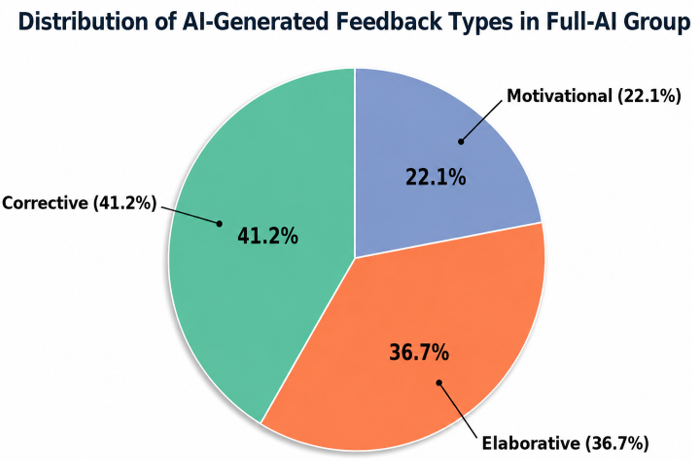
The results of the survey showed significant intergroup differences in the perceived usefulness of feedback. 88.6% of the full-AI group indicated that feedback would help them to detect and correct misconceptions in real time, agreeing or strongly agreeing. 62.4% of the learners in the semi-AI group and 41.3% in the control group were satisfied with the feedback. One-way ANOVA results were statistically significant (F (2, 279) = 36.7, p < 0.001) and indicated that there were differences in the perceived feedback utility between groups. Figure 3 illustrates the results of the AI system in terms of feedback types.
Figure 3. Types of feedback produced by the artificial intelligence (AI) system
The results of the AI system in terms of feedback types are shown in Figure 3. The 1,876 feedback messages that were sent to the full-AI group were divided into three categories: motivational (22.1%), elaborative (36.7%), and corrective (41.2%). This suggests that a balanced approach is being used for encouraging and supporting learners' performance.
The regression analysis also revealed that the use of AI-generated feedback was a key determinant of learning performance. Feedback interaction frequency alone accounted for 28.4% of the variance in post-test scores (R² = 0.284, F (1, 280) = 110.4, p < 0.001). Figure 3 shows the distribution of the types of feedback generated by the AI system.
4.5 Predictive pathways of learning performance
The general effect of engagement, feedback, and personalization on the learning outcomes was explored through the use of a hierarchical regression analysis. For the first model, there was a significant relationship between time-on-task and posttest (R2 = 0.31, p < 0.01). In model 2, there was an additional increase in explained variance with the addition of feedback interaction frequency (ΔR2 = 0.155, p < 0.001).
The contribution of perceived personalization was 7.4% additional explained variance (DEV, ΔR2 = 0.074, p < 0.01) in the third model. Figure 4 illustrates learners' perceptions of trust and allocation in different groups.
Figure 4. Perceptions of trust and personalization by learners in different groups
The findings shown in Figure 4 clearly validate that these variables (behavioral engagement, feedback responsiveness, and perceived allocation) statistically explain the differences in AI-assisted learning performance environments. The overall AI suite also had the highest allocation (90.8%) and AI decision confidence (85.3%) compared to the partial AI suites and control suites. Table 2 shows the results for each group.
Table 2. Results of each study group
|
Variable |
Control (Group A) |
Semi-AI (Group B) |
Full-AI (Group C) |
Statistical Significance |
|
Sample Size (n) |
94 |
94 |
94 |
N/A |
|
Pre-Test Mean (%) |
62.1 (SD = 11.2) |
62.9 (SD = 10.5) |
62.3 (SD = 10.7) |
F (2,279) = 1.28, p = 0.28 |
|
Post-Test Mean (%) |
70.2 (SD = 11.5) |
75.8 (SD = 10.1) |
80.3 (SD = 9.6) |
F (2,279) = 18.42, p < 0.001 |
|
Absolute Learning Gain (%) |
+7.8 |
+13.4 |
+17.2 |
— |
|
Normalized Learning Gain (g) |
0.21 |
0.36 |
0.47 |
χ²(2) = 29.1, p < 0.001 |
|
Time-on-Task (hours/week) |
4.1 (SD = 0.8) |
5.3 (SD = 0.9) |
6.8 (SD = 1.1) |
F (2,279) = 24.6, p < 0.001 |
|
Content Modules Visited |
14.8 (SD = 4.9) |
18.7 (SD = 5.5) |
24.3 (SD = 6.2) |
F (2,279) = 21.3, p < 0.001 |
|
Practice Questions Attempted |
68.3 |
86.7 |
114.5 |
F (2,279) = 19.4, p < 0.001 |
|
Feedback Satisfaction (% Agree) |
41.3% |
62.4% |
88.6% |
F (2,279) = 36.7, p < 0.001 |
|
Feedback Type Distribution |
— |
— |
41.2% corrective |
N/A |
|
Perceived Personalization (% Agree) |
42.1% |
68.2% |
90.8% |
— |
|
Trust in System Decisions (% Agree) |
38.3% |
59.1% |
85.3% |
— |
|
Qualitative Themes Noted (% Respondents) |
48.5% personalization |
61.3% personalization |
71.4% personalization |
— |
This study's findings support the notion that students in the Fully AI-Integrated Learning Environments demonstrate statistically significant gains in student performance, behavioral engagement, and perceived personalization when compared to the two other conditions (Traditional LMS and Semi-adaptive). The results revealed that the mean post-test score (M = 80.1%) and the mean normalized learning gain (g = 0.47) for students in the full-AI condition were the highest; in the hierarchical regression analysis, a model with AI-generated feedback and perceived personalization of the AI outperformed a model with only time-on-task, accounting for more than 41% of the variance in learning outcomes. Together, these findings suggest that the success of an AI-driven environment is not only due to exposure alone, but to the interactions between these three types of environmental adaptation—adaptive sequencing, real-time formative feedback, and learner-centered personalization mechanisms based on self-determination theory. However, the ethical management and oversight of fully integrated AI systems in educational environments are crucial. Higher levels of learner trust and perceived personalization were linked to positive learner results, and these results suggest that there are implied expectations placed on system designers and institutions to ensure that processes are transparent, data is shared appropriately, and that learners can and will provide feedback.
Privacy is a challenge to pedagogical authority. This finding is in line with the international ethics guidelines for the use of AI in education that focus on the ethical principles of responsibility, explainability, and students' well-being as essential factors for the design of AI's role.
There are a number of issues that need to be taken into account. Because of a lack of random assignment, complete causal inference is not possible in the quasi-experimental design. The study was carried out in one institution in one undergraduate course, making it difficult to generalize the findings either across disciplines or across educational contexts. Instructor impact and previous technology experiences cannot be completely ruled out. Further, the long-term retention of learning gains is not analyzed, and the AI feedback pipeline is tested with a single setting of the LLM and has not been established on other architectures. Figure 5 illustrates the results presented in the research.
Figure 5. Evaluating the impact of integrating artificial intelligence (AI) for enhancing participation in higher education
This study provides empirical evidence showing that fully integrated smart learning environments with AI contribute significantly to improving learning outcomes, engagement behaviors, and learner satisfaction in the context of education. AI-generated smart learning environments affect student performance, their interaction with behavioral factors, their use of feedback, and their perception of specialization in higher education. Research underscores the need to move from partial, rule-based AI applications to fully integrated ILEs. But this strategic shift should be accompanied by rigorous ethical guidelines and a focus on a learner-centred approach, ensuring that AI tools are utilized responsibly and sustainably to improve the education system and enhance the learning opportunities for its users. Longitudinal designs, more broadly in the international arena, and the use of sophisticated AI architectures that are able to predict emotions or dynamically change the difficulty level will be explored in future work. Moreover, the fusion of AI and metaverse-based interactive learning is a viable aspect to design an emotionally engaging learning environment.
[1] Dzogovic, S.A., Zdravkovska-Adamova, B., Serpil, H. (2024). From theory to practice: A holistic study of the application of artificial intelligence methods and techniques in higher education and science. Human Research in Rehabilitation, 14(2): 293-311. https://doi.org/10.21554/hrr.092406
[2] Kadhim, Q.K., Ahmed, S.T., Kadum, J., Turki, E.M., Kadhim, A.K. (2026). Detecting identity theft attacks in cloud security based on artificial intelligence techniques. In Proceedings of International Conference on Applied Innovation in IT, pp. 1093-1099. https://doi.org/10.25673/123682
[3] Alam, M.N., Islam, M.A., Babiker, M.O.A., Siddiqui, M.S., Amin, M.B., Oláh, J. (2026). AI-assisted learning tools and student learning outcomes: A cognitive load theory perspective. Computers in Human Behavior Reports, 21: 100986. https://doi.org/10.1016/j.chbr.2026.100986
[4] Holmes, W., Tuomi, I. (2022). State of the art and practice in AI in education. European Journal of Education, 57(4): 542-570. https://doi.org/10.1111/ejed.12533
[5] Sajja, R., Sermet, Y., Cikmaz, M., Cwiertny, D., Demir, I. (2024). Artificial intelligence-enabled intelligent assistant for personalized and adaptive learning in higher education. Information, 15(10): 596. https://doi.org/10.3390/info15100596
[6] Strielkowski, W., Grebennikova, V., Lisovskiy, A., Rakhimova, G., Vasileva, T. (2025). AI driven adaptive learning for sustainable educational transformation. Sustainable Development, 33(2): 1921-1947. https://doi.org/10.1002/sd.3221
[7] George, B., Wooden, O. (2023). Managing the strategic transformation of higher education through artificial intelligence. Administrative Sciences, 13(9): 196. https://doi.org/10.3390/admsci13090196
[8] Mallillin, L.L.D., Enriquez, B.B., Yee, C.C. (2025). Artificial intelligence (AI) in the higher education institutions (HEIS) practices: A transformation trends in teaching and learning. European Journal of Education Studies, 12(2): 97-116. https://doi.org/10.46827/ejes.v12i2.5811
[9] Aithal, P.S., Maiya, A.K. (2023). Innovations in higher education industry – Shaping the future. International Journal of Case Studies in Business, IT, and Education (IJCSBE), 7(4): 283-311. https://papers.ssrn.com/sol3/papers.cfm?abstract_id=4674658.
[10] Demartini, C.G., Sciascia, L., Bosso, A., Manuri, F. (2024). Artificial intelligence bringing improvements to adaptive learning in education: A case study. Sustainability, 16(3): 1347. https://doi.org/10.3390/su16031347
[11] Rahiman, H.U., Kodikal, R. (2024). Revolutionizing education: Artificial intelligence empowered learning in higher education. Cogent Education, 11(1): 2293431. https://doi.org/10.1080/2331186X.2023.2293431
[12] Wang, X.Y., Zainuddin, Z., Chin, H.L. (2025). Generative artificial intelligence in pedagogical practices: A systematic review of empirical studies (2022–2024). Cogent Education, 12(1): 2485499. https://doi.org/10.1080/2331186X.2025.2485499
[13] Kotsis, K.T. (2025). Integrating artificial intelligence into higher education curricula: Challenges and opportunities for science-based programs. International Journal of Artificial Intelligence Engineering and Transformation, 6(1): 4-12. https://doi.org/10.54660/IJAIET.2025.6.1.04-12
[14] Hariyanto, Kristianingsih, F.X.D., Maharani, R. (2025). Artificial intelligence in adaptive education: A systematic review of techniques for personalized learning. Discover Education, 4: 458. https://doi.org/10.1007/s44217-025-00908-6
[15] Wang, S., Wang, F., Zhu, Z., Wang, J.X., Tran, T., Du, Z. (2024). Artificial intelligence in education: A systematic literature review. Expert Systems with Applications, 252: 124167. https://doi.org/10.1016/j.eswa.2024.124167
[16] Alfredo, R., Echeverria, V., Jin, Y.Q., et al. (2024). Human-centred learning analytics and AI in education: A systematic literature review. Computers and Education: Artificial Intelligence, 6: 100215. https://doi.org/10.1016/j.caeai.2024.100215
[17] Ng, S.L., Ho, C.C. (2025). Generative AI in education: Mapping the research landscape through bibliometric analysis. Information, 16(8): 657. https://doi.org/10.3390/info16080657
[18] Villegas-Ch, W., Buenano-Fernandez, D., Navarro, A.M., Mera-Navarrete, A. (2025). Adaptive intelligent tutoring systems for STEM education: Analysis of the learning impact and effectiveness of personalized feedback. Smart Learning Environments, 12: 41. https://doi.org/10.1186/s40561-025-00389-y
[19] Ma, Y.J., Wang, L., Zhang, J.T., Liu, F.J., Jiang, Q.Y. (2023). A personalized learning path recommendation method incorporating multi-algorithm. Applied Sciences, 13(10): 5946. https://doi.org/10.3390/app13105946
[20] Lee, S.S., Moore, R.L. (2024). Harnessing generative AI (GenAI) for automated feedback in higher education: A systematic review. Online Learning, 28(3): 82-106. https://doi.org/10.24059/olj.v28i3.4593
[21] Panadero, E., Lipnevich, A.A. (2022). A review of feedback models and typologies: Towards an integrative model of feedback elements. Educational Research Review, 35: 100416. https://doi.org/10.1016/j.edurev.2021.100416
[22] Fulsher, A., Pagkratidou, M., Kendeou, P. (2026). GenAI and misinformation in education: A systematic scoping review of opportunities and challenges. AI & SOCIETY, 41: 1373-1385. https://doi.org/10.1007/s00146-025-02536-y
[23] Wiese, L.J., Patil, I., Schiff, D.S., Magana, A.J. (2025). AI ethics education: A systematic literature review. Computers and Education: Artificial Intelligence, 8: 100405. https://doi.org/10.1016/j.caeai.2025.100405
[24] Fortuna, A., Prasetya, F., Samala, A.D., et al. (2025). Artificial intelligence in personalized learning: A global systematic review of current advancements and shaping future opportunities. Social Sciences & Humanities Open, 12: 102114. https://doi.org/10.1016/j.ssaho.2025.102114
[25] Li, J. (2025). Enhancing learning through an adaptive web-based educational search framework integrating natural language processing and machine learning techniques. Discover Computing, 28: 213. https://doi.org/10.1007/s10791-025-09732-w
[26] Anasuri, S., Rusum, G.P., Pappula, K.K. (2023). AI-driven software design patterns: Automation in system architecture. International Journal of Artificial Intelligence, Data Science, and Machine Learning, 4(1): 78-88. https://doi.org/10.63282/3050-9262.IJAIDSML-V4I1P109
[27] Mahamad, S., Chin, Y.H., Zulmuksah, N.I.N., Haque, M.M., Shaheen, M., Nisar, K. (2025). Technical review: Architecting an AI-driven decision support system for enhanced online learning and assessment. Future Internet, 17(9): 383. https://doi.org/10.3390/fi17090383
[28] Donkor, A., Boakye, E., Atuanor, P., Wiafe, Y.A. (2025). Evaluation of a classroom-based medical imaging artificial intelligence educational intervention in Ghana: A pre-test/post-test study design. Radiography, 31(4): 102987. https://doi.org/10.1016/j.radi.2025.102987