Vijayatai Hukare | Vidya Kumbhar* | Gauravkumarsingh Gaharwar
© 2026 The authors. This article is published by IIETA and is licensed under the CC BY 4.0 license (http://creativecommons.org/licenses/by/4.0/).
OPEN ACCESS
Machine learning (ML) has become an important approach for improving crop yield prediction (CYP) by integrating heterogeneous agricultural data and supporting intelligent decision-making. However, the research development patterns, influential contributions, and emerging directions in this field have not been systematically investigated. This study presents a bibliometric analysis of ML-based CYP research using publications indexed in the Scopus database from 2014 to 2025. A total of 1161 documents were initially retrieved, and 637 eligible publications were selected after applying predefined screening criteria. Bibliometric analysis was conducted using network visualization and science mapping techniques to examine publication trends, international collaboration, keyword evolution, and research hotspots. The results indicate a rapid growth of ML applications in CYP, particularly after 2018. India, the United States, and China represent the leading contributors, while keywords related to CYP, ML, precision agriculture (PA), and deep learning (DL) dominate current research themes. The analysis further reveals a transition from traditional ML models toward hybrid intelligent systems integrating remote sensing, Internet of Things (IoT) data, and advanced learning algorithms. This study provides a comprehensive overview of the knowledge structure and future development directions of ML-based CYP. Future research should focus on multi-source data fusion, explainable artificial intelligence, and scalable decision-support systems for sustainable agricultural management.
machine learning, crop yield prediction, bibliometric analysis, science mapping, precision agriculture, deep learning, agricultural decision support systems
Agriculture is a vital sector of the Indian economy, contributing between 18.2% and 23% to the total GDP [1]. 54.6% of the total population is engaged in agriculture and allied activities directly [1]. With the increase in population, there is a strong need to improve the agricultural crop yield to cater to the increasing food demand. Crop yield improvement is one of the major activities of agricultural management. Soil, water, and Climate are very important parameters for crop yield [2, 3]. The amount of water and crop water requirement both have a high impact on the quality and quantity of yield. Reducing soil moisture, soil erosion, nutrient depletion, and other forms of land degradation lowers crop productivity due to water scarcity [3, 4]. Due to these highly dynamic factors, day by day, crop production and farmers are facing a lot of economic problems. So, the increase in crop yield improves the socio-economic status of the farmer. This leads to a need for early prediction of crop yield for improving crop productivity and enhanced decision-making. Indian farmers face several challenges, such as unpredictable climate, quality of soil, and water [4-6]. To improve yield further, information technologies (IT) play an important role. Through IT tools, crop yield data can be taken into the system and analyzed to facilitate better decision-making [6-8]. Modern frontier techniques, such as machine learning (ML), deep learning (DL), data mining (DM), etc., are playing an important role in agricultural management. Such technologies are used to overcome the drawbacks of traditional techniques, like agricultural decision support systems [9-11]. ML plays an essential role in the prediction of crops, including supporting decisions like identifying the crops that give maximum yield and what to do during the growing season of the crops by considering factors like soil and water quality, temperature, rainfall, area, etc. [5, 12-17].
This study aims to address the existing research gap by conducting a bibliometric analysis of ML algorithms used for crop yield prediction (CYP) from the research documents present in the Scopus database, with the increasing adoption of ML techniques in agriculture, publication trends, key contributors, collaboration networks, emerging research themes, and future research directions. The findings will provide valuable insights into the development of this field & support researchers and decision-makers in advancing ML-based CYP.
The research questions formulated to achieve this objective are shown below:
RQ1: What are the overall publication trends of research on ML algorithms for CYP?
RQ2: Which countries have made the most significant contributions to research on ML algorithms for CYP?
RQ3: What are the most frequently occurring keywords?
RQ4: Who are the authors actively contributed to researching ML algorithms for CYP?
RQ5: Which journals have the greatest scholarly impact on the ML algorithms for CYP?
RQ6: What are the emerging research directions and future opportunities for ML algorithms in CYP?
1.1 Literature review
This section discusses findings of the ten most highly cited research papers on CYP published in 2025. Review articles and other review-based publications have been excluded to focus exclusively on original research contributions.
El-Kenawy et al. [18] developed the potato CYP model using ML and DL techniques. The model used climate and soil parameters as input parameters to predict potato yield. The researchers compared several ML and DL models, including Support Vector Regression (SVR), XGBoost, Gradient Boosting, Graph Neural Networks (GNNs), Long-Short Term Memory (LSTM), and gated recurrent units (GRUs). GNN achieved the best performance (R2 of 51.7%) as compare the other models. Pei et al. [19] used climatic and phonological information for the corn yield prediction. XGBoost model reported the best performance with an R2 of 68.8%. Sharma et al. [20] developed a logistic regression model for predicting the crop yield using parameters such as P, K content, soil PH, rainfall, humidity, and temperature. The performance reported by the authors was 95%. Haseeb et al. [21] used remote sensing indices (NDVI, EVI, etc.) and climatic parameters rainfall, wind speed, soil moisture, and temperature) to predict wheat crop yield using the Random Forest (RF) and SVR ML algorithms. RF achieved the best performance with an R2 of 78% as compared to the SVR model. Zhou et al. [22] used UAV-based multispectral remote sensing imagery with ML and DL algorithms to develop the rice CYP model across multiple varieties. The study evaluated both feature-based and image-based CYP models. The feature-based models include RF, LSTM, and Deep Neural Network (DNN), while the image-based model comprises 2D and 3D Convolutional Neural Network (CNN). The multi-temporal 2D CNN model achieved the best prediction performance with an R² of 73% and an RRMSE of 8.13%.
The comprehensive literature review concludes that the existing research mainly focuses on using climatic parameters such as rainfall, temperature, humidity, etc., and soil chemical parameters (P, K, etc.) for building CYP models. However, the impact of water parameters on CYP has received limited attention. Also, soil physical properties such as water-holding capacity and soil texture are often overlooked, despite their significant role in crop growth and productivity. Therefore, incorporating both water quality indicators and soil physical properties represents a significant research gap and offers substantial potential for improving the accuracy, robustness, and reliability of CYP.
1.2 Trend analysis of machine learning and deep learning algorithms used for predicting crop yield
The study has also analyzed different ML and DL algorithms used for CYP (Figure 1). Here, it has been observed that ML algorithms such as RF, SVR, XGBoost, and LSTM have been used 2 times. Also, it is observed that algorithms such as Gradient Boosting, DNNs, Logistic Regression, GNNs, and CNNs have been used only once.

Figure 1. Analysis of the machine learning algorithms used in crop yield prediction (CYP)
1.3 Challenges
Despite significant advantages in CYP, several challenges remain:
•Limited dataset sizes reduce model reliability & capability.
•Dependency on historical datasets limits adaptability to changing environmental conditions.
•Traditional ML models may not effectively capture the nonlinear relationship among parameters.
•Prediction accuracy highly depends on feature selection and data quality.
•Lack of real-time IoT-based data integration limits adaptive decision-making.
The next part of the paper is organized as follows: Section 2 presents initial data on machine learning and crop yield prediction (MLCYP) publications. Section 3 presents a bibliometric analysis of MLCYP, and Section 4 provides a conclusion and limitations.
Open and paid access are the two categories of access to the research publications. Institutes or Individuals can register to access the paid publications. Preliminary data collected from different research papers have been cited in the references. University library portals can also be used to access these research publications. Scopus, Web of Science, Clarivate, ScienceDirect, SCImago, Mendeley, DBLP, Google Scholar, ResearchGate, etc., are popular publication databases. Scopus is the most extensive database of peer-reviewed research literature in the study area, such as science, engineering, technology, medicine, social sciences, arts, and humanities. The Scopus database is used in this paper. Important keywords are identified in the section. Table 1 shows the Scopus search query used for data collection.
Table 1. Scopus search query used for data collection
|
TITLE-ABS-KEY("Machine Learning " AND " Crop Yield Prediction") AND ( EXCLUDE ( DOCTYPE,"bk" ) OR EXCLUDE ( DOCTYPE,"tb" ) OR EXCLUDE ( DOCTYPE,"sh" ) OR EXCLUDE ( DOCTYPE,"ed" ) ) AND ( EXCLUDE ( LANGUAGE,"Persian" ) OR EXCLUDE ( LANGUAGE,"Korean" ) OR EXCLUDE ( LANGUAGE,"French" ) OR EXCLUDE ( LANGUAGE,"Turkish" ) OR EXCLUDE ( LANGUAGE,"Ukrainian" ) OR EXCLUDE ( LANGUAGE,"Chinese" ) ) AND ( EXCLUDE ( PREFNAMEAUID,"undefined" ) ) AND ( EXCLUDE ( PUBSTAGE,"aip" ) ) AND ( EXCLUDE ( EXACTSRCTITLE,"Aip Conference Proceedings" ) OR EXCLUDE ( EXACTSRCTITLE,"Plants" ) OR EXCLUDE ( EXACTSRCTITLE,"Methodsx" ) OR EXCLUDE ( EXACTSRCTITLE,"Heliyon" ) OR EXCLUDE ( EXACTSRCTITLE,"Sensors" ) OR EXCLUDE ( EXACTSRCTITLE,"Remote Sensing in Earth Systems Sciences" ) OR EXCLUDE ( EXACTSRCTITLE,"Remote Sensing" ) OR EXCLUDE ( EXACTSRCTITLE,"Acta Geophysica" ) OR EXCLUDE ( EXACTSRCTITLE,"E3s Web of Conferences" ) OR EXCLUDE ( EXACTSRCTITLE,"Agronomy" ) OR EXCLUDE ( EXACTSRCTITLE,"Journal of Food Quality" ) OR EXCLUDE ( EXACTSRCTITLE,"Physics and Chemistry of the Earth" ) OR EXCLUDE ( EXACTSRCTITLE,"Journal of Physics Conference Series" ) OR EXCLUDE ( EXACTSRCTITLE,"Lecture Notes in Mechanical Engineering" ) OR EXCLUDE ( EXACTSRCTITLE,"Journal of the Indian Society of Remote Sensing" ) OR EXCLUDE ( EXACTSRCTITLE,"Lecture Notes of the Institute for Computer Sciences Social Informatics and Telecommunications Engineering Lnicst" ) OR EXCLUDE ( EXACTSRCTITLE,"Materials Today Proceedings" ) OR EXCLUDE ( EXACTSRCTITLE,"Nature Environment and Pollution Technology" ) OR EXCLUDE ( EXACTSRCTITLE,"Lecture Notes in Networks and Systems" ) ) AND ( EXCLUDE ( PUBYEAR,"2026" ) ) AND ( EXCLUDE ( EXACTKEYWORD,"Food Supply" ) OR EXCLUDE ( EXACTKEYWORD,"Farms" ) OR EXCLUDE ( EXACTKEYWORD,"Iot" ) OR EXCLUDE ( EXACTKEYWORD,"Forestry" ) OR EXCLUDE ( EXACTKEYWORD,"Harvest" ) OR EXCLUDE ( EXACTKEYWORD,"Time Series" ) OR EXCLUDE ( EXACTKEYWORD,"Economics" ) OR EXCLUDE ( EXACTKEYWORD,"Classification" ) OR EXCLUDE ( EXACTKEYWORD,"Classification (of Information)" ) OR EXCLUDE ( EXACTKEYWORD,"Bangladesh" ) OR EXCLUDE ( EXACTKEYWORD,"Long Short-term Memory" ) OR EXCLUDE ( EXACTKEYWORD,"Errors" ) OR EXCLUDE ( EXACTKEYWORD,"Information Management" ) ) |
2.1 Data extraction
Figure 2 illustrates the systematic process used for selecting research papers related to ML-based CYP. In the identification stage, a total list of 1161 research papers was extracted from the Scopus database from the year 2014 to 2025 using the keywords “ML” and “CYP”. The screening stage mainly focused on the title, abstract, keywords, and conclusion. After this process, 317 papers were excluded.

Figure 2. Methodology flow of data collection
In the eligibility step, 832 research papers were assessed in detail. The eligibility criteria emphasized studies that used ML algorithms for CYP. After detailed evaluation,195 papers were excluded; finally, 637 research papers were selected. This entire process ensures that only the most relevant and high-quality studies were considered for the bibliometric analysis (Table 2).
Table 2. Inclusion and exclusion criteria for publication shortlisting
|
Inclusion |
Exclusion |
|
The study focuses on the use of machine learning (ML) algorithms for crop yield prediction (CYP); publication period: 2014 to 2025 |
Research papers not related to the use of ML algorithms for CYP outside the specified time frame (pre-2014 and post-2025) |
|
English language publication |
Non-English language publication |
|
The screening step mainly focused on the title, abstract, keywords, and conclusion |
Excluded non-related documents |
|
The eligibility criteria emphasized studies that used ML algorithms for CYP |
Publication not related to the research objective |
2.2 Initial investigation result
Table 3 shows published distributions considering all types of research papers from 2014 to 2025. The publication of a conference paper on MLCYP accounts for the height of the complete publication. A significantly smaller amount of research was published in a book chapter and a review.
Table 3. The document type of machine learning and crop yield prediction (MLCYP)
|
Sr. No. |
Document Type |
No. of Publication |
|
1 |
Conference paper |
281 |
|
2 |
Article |
280 |
|
3 |
Book chapter |
50 |
|
4 |
Review |
26 |
2.3 Basic work data inspection
Documents related to “MLCYP” are retrieved from conference papers, journal articles, reviews, and book chapters from 2014 to 2025. Figure 3 shows a graphical depiction of yearly publication trends. It is created with the SmartArt tool. It is observed that there has been an upsurge in research contributions in this field from 2018 onwards.

2.4 Exploration of data
The complete bibliometric analysis was conducted in Section 3 to know the nature of the literature, prominent research work in “MLCYP” through geographical attentiveness of the study, author contributions, journals where papers have been published, and their statistics, along with citation and network analysis.
The following methods are applied to perform a bibliometric study of “ML algorithms for CYP,” and they are:
•Inspection of research publications in the different geographic regions, citation papers, network analysis, etc.
•Insight into the subject area, the authors' statistics, and the keyword statistics.
3.1 Geographical analysis
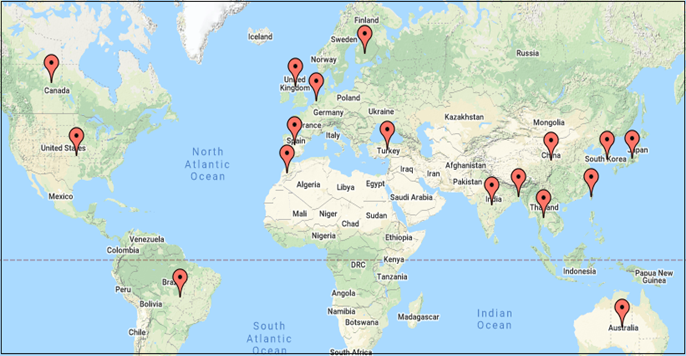
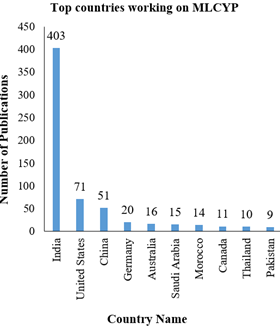
The iMapBuilder tool was used for geographical analysis, which depicts the country-wise regional distribution of published research papers on MLCYP (Figure 4). It is observed that research appears to be taking place all around the world. Figure 5 shows the top ten countries publishing research papers related to MLCYP. India leads with 403 papers, followed by the United States (US) with 71 and China with 51 publications. This shows that Asian and European countries have significantly contributed to this research problem (Figure 4).
3.2 Analysis of keywords
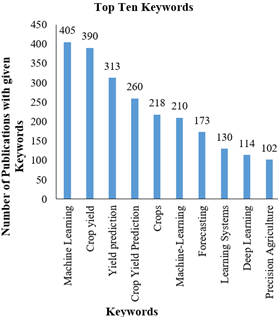
The analysis of the keywords used by the researchers while recommending solutions for CYP using shows that among all the keywords, “ML” has the highest occurrence with 405 publications, indicating that it is a widely used concept in the research area. This is followed by “Crop yield” with 390 occurrences, showing the strong focus on agricultural studies.
Figure 6 depicts the top ten most frequently used keywords in publications related to the research field obtained from an analysis of the Scopus database from the year 2014 to 2025.
3.3 Subject area
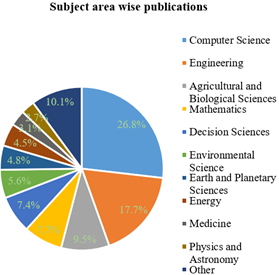
“MLCYP” publications by subject area are depicted in Figure 7. It is observed that the largest share of research is in the Computer Science domain, at 26.8%, and the second-largest is Engineering, at 17.7%. Agricultural and Biological Sciences have 9.5%. However, only 7.7% and 7.4% of research has been done in the fields of Mathematics and Decision Sciences. Also, Environmental Science has 5.6%, Earth and Planetary Sciences has 4.8%, Energy has 3.1%, Medicine has 3.1%, Physics and Astronomy has 4.1%, and Other has 10.1%.
3.4 Network analysis
Network analysis shows the graphical relationship between two or more statistical parameters. “ScienceScape and MiniVan” tools are used to perform network analysis, and distinct authors, author keywords, and source titles are shown using nodes and edges. Figures 8-11 show networks between different parametric combinations for MLCYP from data retrieved from the Scopus database.
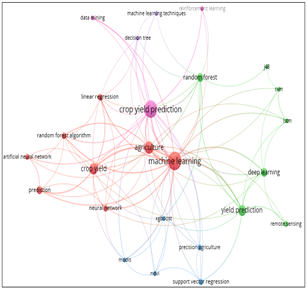
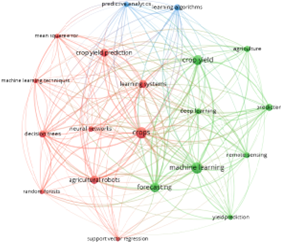
A data cluster of co-occurrences and author keywords with five clusters is shown in Figure 8, and three data clusters of co-occurrences and all keywords are shown in Figure 9.
The network of the author and author keywords that occur in the same papers is shown in Figure 10. The diagram shows 595 nodes and 1864 edges. It is observed that ML, CYP, crop yield, ML technique, and supervised learning are keywords used widely in the research of MLCYP.
Figure 11 shows a network with author and source title co-appearing in the same papers. The layout shows 430 nodes and 375 edges.
Figure 8. Cluster of co-occurrences and author keywords
Figure 9. Cluster of co-occurrences and all keywords

Figure 10. Network diagram

Figure 11. Network diagram of the source title and author keywords
3.5 Author statistics
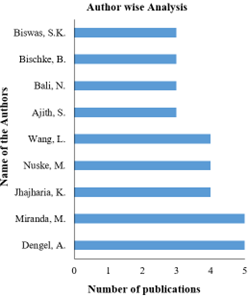
To comprehend the effect of a specific author contributing to “MLCYP,” the depiction of the top 10 authors is shown in Figure 12. It is observed that Dengel and Miranda have equally contributed to the research in the field of “MLCYP.”
3.6 Sponsored funding
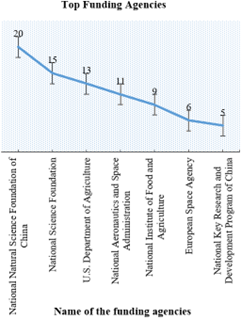
Figure 13 shows the association who have contributed more to the research of “MLCYP.” The National Science Foundation of China funding agencies have contributed more compared to the other funding agencies.
3.7 Future research direction of machine learning algorithms in crop yield prediction
The findings of this bibliometric analysis suggest several emerging research directions and future opportunities for the application of ML algorithms in CYP. The evolving research landscape can be broadly divided into four key dimensions: Advanced ML models, data integration and feature engineering, precision agriculture (PA), and sustainable artificial intelligence. Future researchers should focus on the development of a hybrid ensemble model to enhance prediction accuracy, robustness, and model generalization. The integration of multi-source data, such as remote sensing imagery and IoT sensor observations, with advanced feature selection techniques, to improve model accuracy. The PA dimension highlights the application of ML algorithms for crop and nutrient management, crop monitoring, and intelligent decision support systems.
Collectively, these emerging research directions provide a strategic roadmap for advancing accurate, reliable, scalable, and sustainable CYP systems, thereby promoting PA, efficient resource management, and global food security.
3.8 Analysis of citations
Every publication has a distinct number of citations. Table 4 shows the first ten publication titles and the number of times their titles were cited. It is observed that the paper with the source title “Computers and Electronics in Agriculture” leads with 1370 citations, followed by “Remote Sensing of Environment” with 917 and “Frontiers in Plant Science” with 796 citations.
Table 4. Highly cited research papers related to machine learning and crop yield prediction (MLCYP)
|
Sr. No. |
Title |
Year |
Source title |
Cited by |
|
1. |
“Machine Learning (ML) approaches for crop yield prediction (CYP) and nitrogen status estimation in precision agriculture (PA): A review.” [7] |
2018 |
Computers and Electronics in Agriculture |
1370 |
|
2. |
“Soybean yield prediction from UAV using multimodal data fusion and deep learning.” [23] |
2020 |
Remote Sensing of Environment |
917 |
|
3. |
“CYP using deep neural networks (DNNs).” [4] |
2019 |
Frontiers in Plant Science |
796 |
|
4. |
“Integrating satellite and climate data to predict wheat yield in Australia using ML approaches.” [6] |
2019 |
Agricultural and Forest Meteorology |
533 |
|
5. |
“ML methods for CYP and climate change impact assessment in agriculture.” [9] |
2018 |
Environmental Research Letters |
420 |
|
6. |
“Transfer learning in environmental remote sensing.” [24] |
2024 |
Remote Sensing of Environment |
395 |
|
7. |
“Satellite-based soybean yield forecast: Integrating ML and weather data for improving CYP in southern Brazil.” [25] |
2020 |
Agricultural and Forest Meteorology |
361 |
|
8. |
“ML for large-scale crop yield forecasting.” [11] |
2021 |
Agricultural System |
327 |
|
9. |
“A comprehensive review of CYP using ML approaches with Special emphasis on palm oil yield prediction.” [26] |
2021 |
IEEE Access |
326 |
|
10. |
“A novel approach for efficient CYP.” [10] |
2019 |
Computers and Electronics in Agriculture |
232 |
3.9 Research contribution
This very first kind of bibliometric study that focuses on ML for CYP. The study has provided an understanding of the publication growth and development trends of ML-based CYP. The study will help researchers to identify leading countries and understand the geographical distribution of research work done for this problem. It will provide researchers with an understanding of current and future research priorities in ML for CYP. In turn, the study will help researchers identify leading experts and establish research collaborations within the domain. It provides valuable insights into existing research gaps & future research opportunities.
This work presents a bibliometric analysis of research published in the field of “MLCYP” from 2014 to 2025. This study is one of the unique studies that focuses on a quantitative science mapping analysis for the research problem of building an ML model for CYP. The analysis shows an upsurge in CYP since the year 2018. The study concludes that ML algorithms are widely used by researchers for CYP in Asia and European countries, and it is observed that various ML techniques such as RF, SVR, LSTM, and XGBoost are widely used for CYP. The highest cited papers are from Computers and Electronics in Agriculture and Remote Sensing of Environment journals. Through the analysis of the studied documents, challenges such as limited dataset size, dependency on historical records, and choice of feature selection method are widely observed in existing work. Future work should focus on mitigating these challenges.
The study is limited to the research publications present in the Scopus database only, and future bibliometric studies could include multiple databases (e.g., Web of Science, IEEE, etc.) and add cross-regional or cross-disciplinary statistical comparisons to build on this research work.
The authors express their gratitude and acknowledgment towards Symbiosis Center for Research and Innovation (SCRI), Symbiosis International (Deemed University), Pune, Maharashtra, India, for the research opportunity.
[1] Ministry of Statistics and Programme Implementation. (2024). Statistical report on value of output from agriculture and allied sectors. https://mospi.gov.in/.
[2] Kale, S.S., Patil, P.S. (2019). A machine learning approach to predict crop yield and success rate. In 2019 IEEE Pune Section International Conference, Pune, India, pp. 1-5. https://doi.org/10.1109/PuneCon46936.2019.9105741
[3] Radhika, A., Masood, M. (2022). Crop yield prediction by integrating Et-DP dimensionality reduction and ABP-XGBOOST technique. Journal of Internet Services and Information Security, 12(4): 177-196. https://doi.org/10.58346/JISIS.2022.I4.013
[4] Khaki, S., Wang, L.Z. (2019). Crop yield prediction using deep neural networks. Frontiers in Plant Science, 10(5): 1-10. https://doi.org/10.3389/fpls.2019.00621
[5] Cairo, P.C., Armas, J.M., Artiles, P.T., Martin, B.D., Carrazana, R.J., Lopez, O.R. (2017). Effects of zeolite and organic fertilizers on soil quality and yield of sugarcane. Australian Journal of Crop Science, 11: 733-738. https://doi.org/10.21475/ajcs.17.11.06.p501
[6] Cai, Y.P., Guan, K.Y., Lobell, D., et al. (2019). Integrating satellite and climate data to predict wheat yield in Australia using machine learning approaches. Agricultural and Forest Meteorology, 274: 144-159. https://doi.org/10.1016/j.agrformet.2019.03.010
[7] Chlingaryan, A., Sukkarieh, S., Whelan, B. (2018). Machine learning approaches for crop yield prediction and nitrogen status estimation in precision agriculture: A review. Computers and Electronics in Agriculture: 61-69. https://doi.org/10.1016/j.compag.2018.05.012
[8] Zhou, Y.F., Pan, M.Z., Guan, W., Fu, C.C., Su, T.C. (2023). Predicting sugarcane yield via the use of an improved least squares support vector machine and water cycle optimization model. Agriculture, 13(11): 2115. https://doi.org/10.3390/agriculture13112115
[9] Crane-Droesch, A. (2018). Machine learning methods for crop yield prediction and climate change impact assessment in agriculture. Environmental Research Letters, 13: 114003. https://doi.org/10.1088/1748-9326/aae159
[10] Gopal, P.S., Bhargavi, R. (2019). A novel approach for efficient crop yield prediction. Computers and Electronics in Agriculture, 165: 104968. https://doi.org/10.1016/j.compag.2019.104968
[11] Paudel, D., Boogaard, H., Wit, A., Janssen, S., Osinga, S., Pylianidis, C., Athanasiadis, I.N. (2021). Machine learning for large-scale crop yield forecasting. Agricultural Systems, 187: 103016. https://doi.org/10.1016/j.agsy.2020.103016
[12] Gonzalez-Sanchez, A., Frausto-Solis, J., Ojeda-Bustamante, W. (2014). Predictive ability of machine learning methods for massive crop yield prediction. Spanish Journal of Agricultural Research, 12(2): 313-328. https://doi.org/10.5424/sjar/2014122-4439
[13] Saad, A., Benyamina, A.E.H., Gamatié, A. (2020). Water management in agriculture: A survey on current challenges and technological solutions. IEEE Access, 8: 38082-38097. https://doi.org/10.1109/ACCESS.2020.2974977
[14] Maya Gopal, P.S., Bhargavi, R. (2019). Performance evaluation of best feature subsets for crop yield prediction using machine learning algorithms. Applied Artificial Intelligence, 33(7): 621-642. https://doi.org/10.1080/08839514.2019.1592343
[15] Nigam, A., Garg, S., Agrawal, A., Agrawal, P. (2019). Crop yield prediction using machine learning algorithms. In 2019 Fifth International Conference on Image Information Processing (ICIIP), Shimla, India, pp. 125-130. https://doi.org/10.1109/ICIIP47207.2019.8985951
[16] Klompenburg, T., Kassahun, A., Catal, C. (2020). Crop yield prediction using machine learning: A systematic literature review. Computers and Electronics in Agriculture, 177(1): 105709. https://doi.org/10.1016/j.compag.2020.105709
[17] Qureshi, W.S., Payne, A., Walsh, K.B., Linker, R., Cohen, O., Dailey, M.N. (2017). Machine vision for counting fruit on mango tree canopies. Precision Agriculture, 18(2): 224-244. https://doi.org/10.1007/s11119-016-9458-5
[18] El-Kenawy, E.S.M., Alhussan, A.A., Khodadadi, N., Mirjalili, S., Eid, M.M. (2025). Potato crop yield with machine learning and deep learning for sustainable agriculture. Potato Research, 68: 759-792. https://doi.org/10.1007/s11540-024-09753-w
[19] Pei, J., Tan, S.F., Zou, Y.P., et al. (2025). The role of phenology in crop yield prediction: Comparison of ground-based phenology and remotely sensed phenology. Agricultural and Forest Meteorology, 361: 110340. https://doi.org/10.1016/j.agrformet.2024.110340
[20] Sharma, S., Jain, A., Sharma, S., Whig, P. (2025). Enhancing crop yield prediction through machine learning regression analysis. International Journal of Sustainable Agricultural Management and Informatics, 11: 29-47. https://doi.org/10.1504/IJSAMI.2025.143099
[21] Haseeb, M., Tahir, Z., Mahmood, S.A., Tariq, A. (2025). Winter wheat yield prediction using linear and nonlinear machine learning algorithms based on climatological and remote sensing data. Information Processing in Agriculture, 12: 431-444. https://doi.org/10.1016/j.inpa.2025.02.004
[22] Zhou, H.K., Huang, F.D., Lou, W.D., et al. (2025). Yield prediction through UAV-based multispectral imaging and deep learning in rice breeding trials. Agricultural Systems, 223: 104214. https://doi.org/10.1016/j.agsy.2024.104214
[23] Maimaitijiang, M., Sagan, V., Sidike, P., Hartling, S., Esposito, F., Fritschi, F.B. (2020). Soybean yield prediction from UAV using multimodal data fusion and deep learning. Remote Sensing of Environment, 237: 111599. https://doi.org/10.1016/j.rse.2019.111599
[24] Ma, Y.C., Chen, S., Ermon, S., Lobell, D.B. (2024). Transfer learning in environmental remote sensing. Remote Sensing of Environment, 301: 113924. https://doi.org/10.1016/j.rse.2023.113924
[25] Schwalbert, R.A., Amado, T., Corassa, G., Pott, L., Prasad, P.V.V., Ciampitti, I. (2020). Satellite-based soybean yield forecast: Integrating machine learning and weather data for improving crop yield prediction in southern Brazil. Agricultural and Forest Meteorology, 284(15): 107886. https://doi.org/10.1016/j.agrformet.2019.107886
[26] Rashid, M., Bari, B.S., Yusup, Y., Kamaruddin, M.A., Khan, N. (2021). A comprehensive review of crop yield prediction using machine learning approaches with special emphasis on palm oil yield prediction. IEEE Access, 9: 63406-63439. https://doi.org/10.1109/ACCESS.2021.3075159