Fairouz Khadraoui | Amel Behaz | Hamouma Moumen* | Ahmed-Sami Berkani
© 2026 The authors. This article is published by IIETA and is licensed under the CC BY 4.0 license (http://creativecommons.org/licenses/by/4.0/).
OPEN ACCESS
Learner annotation of educational materials is a common activity in technology-enhanced learning environments. However, existing annotation models mainly focus on learner-oriented purposes and provide limited support for interpreting annotations as indicators of course improvement needs. This study proposes an ontology-based framework that models learner annotation semantics to generate actionable recommendations for learning material adaptation. The proposed framework introduces a taxonomy containing ten instructor-oriented annotation goals and develops a Learner Annotation Ontology (LAO) based on the W3C Web Annotation Model to connect annotation information with potential update actions. A prototype system, AnnUpdate, is implemented as a browser plug-in to support semantic annotation and recommendation generation. The system enables learners to explicitly express learning material improvement needs through annotations and assists instructors in identifying possible areas for course revision. The proposed approach extends existing annotation models by incorporating instructor-oriented semantic information and provides a structured mechanism for transforming learner feedback into learning material adaptation strategies.
instructor recommendation, learner annotation semantics, learning material adaptation, technology-enhanced learning, Web Annotation Model
In e-learning environments, the learner performs different learning activities during which he manipulates various types of learning objects. These activities can be: reading a document, following a video lesson, participating in a forum, passing a test, etc. From all these activities, reading is the most ubiquitous activity in the learning process.
Opposed to passive reading, active reading allows the learner to engage with the document through practices such as taking notes, summarizing, and annotating the text. This active reading transforms the reader into an actor who enriches the document.
In this research work, we are mainly interested in the learners’ annotations. During active reading, the learner comments, highlights, circles, or even strikes a text to annotate the consulted resource. By annotating, the learner presents implicitly or explicitly specific needs for their learning. A learner can annotate a text passage to memorize its importance or incomprehension, report an error, add a related idea or a reference to another document, etc. Therefore, each annotation has semantics that represent the learner’s objective for the creation of this annotation.
In order that learners’ annotations can be manipulated by software agents and shared with other learners or teachers, the semantics of these annotations must be formally represented. In the field of e-learning, several annotation systems have been developed to transpose the practice of annotation to electronic documents. Several research groups are also interested in creating tools that facilitate the annotation activity for learners. Some studies focus on reviewing existing annotation tools [1-4], while others aim to classify them based on various criteria. Study [5] provides one of the most important classifications, categorizing 34 annotation tools into four primary groups: tools lacking classification mechanisms, tools employing controlled vocabularies, tools utilizing folksonomies, and tools leveraging ontologies. Study [6] classifies 18 annotation systems into 7 classes of functionalities. The defined classes are related to managing, storing, visualizing, sharing, searching, answering, and recommending data related to annotations.
Most annotation tools are based on models that formally conceptualize the properties of annotations. The models that emerged from annotation research suffer from an under-exploitation of the annotation’s semantics. They consider the annotation only as a simple track of reading made by the learner to memorize or share a note on a read passage. However, annotation is semantically richer than what is presented by these works. Our contribution introduces a new perspective on educational annotation systems. Existing systems (Hypothesis [7, 8], Perusall [9], Nota Bene (NB) [10]) treat annotations as student-to-self communication tools. Our framework instead introduces annotations as actionable signals for systematic course updates. Specifically, we present three interconnected innovations:
1. Pedagogical motivation taxonomy: a novel hierarchy of ten annotation goals has been created to address learner-identified content deficiencies (e.g., correcting, completing, reformulating) not found in any existing annotation model.
2. Ontological framework for course update: a formal semantic ontology (Learner Annotation Ontology (LAO)), which extends the W3C Web Annotation Model. LAO adds specific motivation concepts that link annotation semantics to course update actions, making those actions machine-actionable.
3. Instructor-recommendation system: a new system that transforms annotation data into course update recommendations for instructors. This system closes the gap between learners' needs and course improvement.
Our system does not just annotate content; it collects pedagogical gaps from learner annotations and suggests course improvements for teachers.
By assigning semantics to an annotation, the designer of the annotation tool defines a particular usage for that semantic. In this study, we start by defining three main types of usage—Personal, Classmate, and Instructor—for annotation semantics and outlining their primary purposes.
The personal usage category includes annotations that fulfill the learner's own needs, such as summarizing a passage or adding a personal remark. Annotation Studio [11] offers individual usage when the user defines his annotation as private. The classmate usage consists of annotations that learners share with other learners, such as adding a solution, a reference, or a discussion point. As examples of annotation tools, we find that the users of Annotation Studio can share their annotations with specific groups and with whole classes. The instructor usage category includes annotations that teacher can use, such as correcting an error or asking a question. However, we did not find annotation tools that could be classified in this last category (instructor usage).
In the context of the present work, we observed that many of the reviewed studies mainly focused on both personal and classmate use of annotations. They provide little support for instructor usage, which represents a significant gap in the annotation tools literature. Our observation aligns with the findings of Sun et al. [4], which state that “existing annotation tools enable students to engage with learning resources, but they have not yet been developed to provide distinct functions for instructors to manage these resources or communicate effectively with their students”. However, students’ annotations have a potential semantic that can facilitate instructors’ efficient manipulation of the annotated materials. In particular, this semantic information can be especially useful when teachers update course content, which is one of the most common forms of material management.
In face-to-face teaching sessions, teachers often have the habit of updating their courses continuously to meet the needs of learners, enrich the resources with new information or activities, refresh the information included therein, etc. In the e-learning systems literature, several approaches have been proposed to assist the teachers during the process of updating their educational resources. Through our studies of some of these approaches, we have found that despite the differences between the adopted technologies (ontologies, data mining, recommender systems, etc.), these approaches rely on student usage data. However, none of these systems has been based on annotations.
In this study, we have identified the following primary challenges:
The main aim of our work is to propose a formal modeling of the semantics of learners’ annotations. Modeling annotation semantics is in itself not novel. Much existing research work has been done in this area, and plenty of models have been designed. However, no model to date has presented the challenge of supporting semantics that will be used by the teacher to update his learning material. The majority of existing models are designed to support semantics that serve the learner’s purposes.
The remainder of this study is organized as follows: In Section 2, we review some related aspects of annotation as activity and object; then we examine existing models for learners’ annotation goals, and review prior research that, like our annotation model, aims to assist content authors in updating learning materials. In Section 3, we present the overall framework for our model. We list our new learner’s annotation goals. Then, we detail the ontological framework used for designing the LAO. Subsequently, we propose a scenario for using our approach and the implemented prototype that helps the learner to annotate online materials. In Section 4, we discuss some key observations about our annotation approach and its advantages compared with other approaches. Finally, we present our conclusions and future work.
2.1 Active reading, annotation and annotation goals
According to Robert [12], the concept of Active Reading was introduced by Van Doren and Adler [13] to distinguish all the activities associated with reading from the simple consultation of words on a page. Active reading combines reading with critical thinking, learning, and decision making, whereas passive reading is less careful and requires less effort [14]. Thus, this reading transforms the reader into an actor, which enriches the document and appropriates it. This ownership comes by adding marks to focus their attention on certain parts, to facilitate the assimilation of the notions encountered, etc. [13]. Reading a book should be a conversation between the reader and the author.
Opposed to passive reading, active reading allows the learner to engage with the document through practices such as taking notes, summarizing, and annotating the text. Thus, annotation is one of the activities of active reading, and therefore annotations are the product of this activity. These annotations are useful to readers, especially during a learning task. They help the reader to own the document and support its interpretation, comprehension, and memorization. They also facilitate its re-reading by the creation of markers on the document [15].
Several studies examined the practice of making annotations on paper as well as the use of annotations and their functionalities in the electronic context. These researches gave birth to several definitions in different application fields (Human Computer Interaction, cognitive science, the digital libraries and document retrieval field, etc.). Most of the proposed definitions agree that an annotation is both an object added to a document and the activity that produces this object.
On one hand, defining the annotation object often leads to describing its anchor on the document and its graphic form (possible visual marks). The graphic form, such as underlining, highlighting, circling, etc., must be placed on the document and perceptibly distinguishable from the annotated passage. The anchor of the annotation is the place where the annotation is placed on the document. It can concern different types of passages, a single word, a line, a paragraph, or the whole document.
On the other hand, defining the creation activity of the annotation object leads to describing the purpose of the annotator (implicit or explicit) during this annotation. It is the goal of the annotation that sets the semantics of the mark "posed" on the document. In the context of this article, we are particularly interested in the semantic aspect of learners’ annotations. Indeed, the readers annotate for a specific purpose, for a specific use, and for a targeted destination, if it is an annotation for others [15]. Thus, the annotation is not an end in itself, but it aims to achieve certain annotator goals.
2.2 Modeling semantics of learners’ annotations
Over the last few years, different communities have shown a great deal of research interest in learners' annotations. We have found in the literature much research aimed at identifying and classifying the different objectives of a learner to create a given annotation. This research has resulted in different models that, in most cases, depend on the purpose of active reading itself. Several studies [15-18] tried to identify the different objectives of an annotation. In the following, we present an overall view of the objectives’ hierarchy of each model.
2.2.1 Model of Marshall
Marshall [16] provided functions of the annotation, from an ecological study of the annotation paper by students. These functions (most of the consulted studies considered them as objectives) are:
•Procedural signaling for future attention: such as marking sections to reread.
•Placemarking and aiding memory: such as marking important sections to remember or recording bits of dialog for later use in an essay.
•Problem-working: such as adding personal marks in situ problem locations to register even complete resolution or just thoughts.
•Interpretation: such as marginal notes to interpret unfamiliar language.
•Visible trace of the reader's attention: such as extensive annotations through difficult narrative.
•Incidental reflection of the material circumstances of reading: such markings unrelated to the reading material itself but bound to the reading circumstances.
2.2.2 Model of Mille
Mille [15] proposed an annotation formalism to support learners in their electronic reading. The model aims to support both memorization / understanding process and for easy information retrieval. This model proposed the following objectives:
•To restructure: to title, synthesize or reformulate a passage.
•To assign new hierarchies to passages.
•To add a personal remark: It can be a critical note, a related idea, an external reference, or a passage development that expresses the learner's understanding.
•To categorize: the reader creates categories of passages for better retrieval of information.
•To create a relation between two passages.
•To plan an action: The reader records something to do.
•To support attention: by adding marks such as where to resume an interrupted reading.
2.2.3 Model of Mokeddem
This model [17] aimed at defining a semantic annotation ontology (OA) of the learner that was used in the pedagogical annotation tool “Easy Annotation”. All the annotations created by the learner with this tool constitute a self-pedagogical memory. This ontology defined the following annotation goals:
•To add a remark: the remarks are added to clarify, to criticize, to explain, or to develop different kinds of passages (e.g., exercise, idea, or concept).
•To add a reference: references can be bibliographical or point to a specific part of the same document or of an external document.
•To connect two passages: the connected passages can be questions, answers, concepts or ideas.
•To express a difficulty: difficulties are related either to understanding course parts (answer, question, concept …) or to other cognitive activities such as deduction and theorem application.
•To memorize an error in problem solving.
•To restructure: synthesize a course part or enumerate its components.
•To support attention: by adding specific marks that help to support the learner’s attention.
2.2.4 Model of Kalboussi
The work [18] differentiated between three concepts:
For the purpose of our present research, we have considered the annotative acts as learners’ annotation goals because they identify the learner needs through their annotation. The following are the main goals of their hierarchy:
•To judge positively or negatively a reading passage.
•To react by asking a question or by exclaiming.
•To annotate a passage by entitling it or by enumerating its components.
•To index a passage or to contextualize it.
•To program an action to do within the annotated passage
•To reformulate a passage by correcting it or by replacing its version.
•To comment on a passage to approve or disapprove its meaning. Comments can also be added for explaining, attracting attention, or for registering the reader’s thoughts.
•To document by searching other documents related to the annotated passage.
•To correlate two passages.
•To summarize the annotated content to facilitate its learning.
•To translate the annotated content into the native language of the annotator.
Table 1 establishes a systematic analysis comparison of studied models.
Table 1. Systematic comparison of learner annotation models
|
Capability |
User |
Purpose |
Instructor-Usage |
|
Marshall |
Learner |
Memory-aid |
None |
|
Mille |
Learner |
Understanding support |
None |
|
Mokeddem |
Learner |
Pedagogical memory |
None |
|
Kalboussi |
Learner |
Reading comprehension |
None |
|
Our model |
Learner + instructor |
Course update |
Systematic recommendation |
2.3 Assistance approaches for updating learning objects
The prior studies consulted in the context of this research concern author-assistance approaches for updating learning content. These approaches are based on learners’ usage data to suggest content updates. On the one hand, this data is derived from the learners' interactions with the consulted content, such as the number of page visits (downloads), the scores obtained in the evaluation activities, and the average time of an objective. On the other hand, they are extracted from interactions between learners or even between learners and educators, such as the messages exchanged in forums and chat rooms. We found that the proposed manipulations of this student’s data are different from one study to another.
The first study [19] designed the Learning Object Context Ontologies (LOCO)-analyst system. It imports interaction data from iHelp courses and transforms it into an ontological framework, where every user action is reformulated into Resource Description Framework (RDF) data. Subsequently, it processes this RDF data to generate meaningful feedback for educators responsible for updating course material.
Here, the feedback is considered as information about observed learners’ interactions either with learning content or with other participants in the learning process. At a coarse-grained level, feedback about possible learning design defaults is signaled for a course if the same students performed poorly on its quizzes compared with quizzes of the other courses (well performed). Another feedback about difficult domain topics is concluded if students performed poorly on the questions that cover this domain topic. Also, the exchanged messages in students’ online discussions (forums and chat rooms) are analyzed to identify the discussed domain topics. The feedback produced by these analyses could help teachers to find out difficult domain topics.
The second study [20] aimed to propose a system able to find, share, and suggest the most appropriate modifications to improve the effectiveness of a web-based course. The authors of this work applied the association rule mining (data mining technique) to discover interesting information through students’ usage data. They also used a collaborative recommender system to share and score the recommendation rules obtained by different teachers.
The developed client/server system is called Continuous Improvement of E-learning Course Framework (CIECoF). Using the client application, the teacher selects the students’ usage dataset (e.g., Moodle relational database) to be used. Then, he configures the numerical attributes: exercise time, exercise score, and course attempts. Each attribute is assigned a nominal value of Low, Medium, or High. Subsequently, he downloads the current rules repository (the knowledge database upon which the subjective analysis of the discovered rules is based) from the server. Finally, he executes the association rule algorithm. Consequently, the client application shows the set of discovered rules associated with possible detected problems and a set of suggested recommendations.
Here, two types of recommendations are possible. The Active recommendation implies a direct modification of the course content or structure, such as modifying the formulation of a question or eliminating a resource like a forum or a chat room. The passive recommendation detects a more general problem and points the teacher towards more specific recommendations. The authors did not specify more information about this second kind of recommendation.
The experts in the educational domain use the server application to manage the knowledge database (rules repository). An expert has permission to introduce new tuples into the rule repository and vote for existing ones. Initially, the knowledge base was empty, and experts proposed tuples. Afterward, both experts and teachers participated in voting for rules. Teachers’ votes are implicit: if the teacher applies one of the recommendations to his course, then he is automatically voting for its applicability to this tuple. Table 2 establishes a comparison between prior works on assisted update learning materials and our approach. Prior work relies on implicit student data, such as quiz scores or forum posts, while our approach leverages explicit learner intentions through annotation goals. The key distinction is that our annotation goals provide “contextual” and “specific” update suggestions (e.g., “add example to a specific LO”) vs. “generic pattern” (e.g., “students struggled with specific topic”).
Table 2. Systematic comparison of assisted update learning content approaches
|
Approach |
Data Source |
Learner Intentions |
Real-Time |
Suggestion Type |
|
LOCO-analyst |
Quiz scores, clicks |
implicit |
No |
Generic |
|
CIECoF |
Usage patterns |
implicit |
No |
Generic |
|
Our approach |
Annotations |
explicit |
Yes |
Contextual |
Our approach adopts the principles of the semantic web to annotate web learning resources [21, 22].
Figure 1 depicts the global ontological framework of our proposed model.
The annotating module is used by the learner to annotate learning objects of the consulted course. It uses our LAO and the Course Structure Ontology (CSO) to generate the learner’s annotations. Annotations are stored in the annotation repository.
The update-assistance module is used by the teacher to know about the updates suggested by learners, which may be applied to their course. It uses the annotation repository to access learners’ annotations and generate the appropriate type of update to suggest.

Figure 1. The overall framework
3.1 Annotation goals list
To build our learners’ annotation goals for updating learning content, we need to define new goals for learners’ annotations. Our new goals assign to learners’ annotations the accurate semantics of requesting or suggesting updates to be applied to the annotated resource. Students in face-to-face or e-learning classes usually ask for updating the learning content to enhance their comprehension, extend their knowledge, or to participate in the improvement of the learning content's quality and presentation.
Inspired by real learning experiences conducted in our university, and from annotation goals defined in previous research works, we have designed the following list of our proposed annotation goals (Table 3).
Table 3. Proposed annotation goals
|
Annotation Goal |
Description |
Suggested Update |
|
Correcting |
Suggesting a correction to a passage. The error corrected may be typographic or syntactic |
Replace the annotated passage with the suggested correction |
|
Completing |
Suggesting a completion to a learning object |
Add the suggested completion to the annotated learning object |
|
Reformulating |
Suggesting another formulation to a passage |
Replace the annotated passage with the suggested reformulation |
|
Adding example |
Suggesting to add a new example to a learning activity |
Add the suggested example to the concerned learning activity |
|
Adding solution |
Suggesting to add another solution to an exercise |
Add the suggested solution to the annotated exercise |
|
Actualizing |
Linking a learning object to an external resource that provides more recent information |
Access the external resource to find recent information to be added |
|
Detailing |
Linking a learning object to an external resource that provides more details. |
Access the external resource to find details that can be added to the annotated learning object |
|
Asking for explanation |
Asking a question to request more explanation for a learning object |
Add more explanation to the annotated learning object |
|
Asking for solution/answer |
Asking a question to request a solution to an exercise or an answer to a question |
Add a solution to the annotated exercise or an answer to the annotated question |
|
Restructuring |
Suggesting changing the place of a learning object |
Move the annotated learning object to the suggested place |
3.2 Proposed model
We obtained our annotation model by reusing the W3C Web Annotation Model [23]. This model provides an extensible, interoperable framework for expressing annotations such that they can easily be shared between platforms, with sufficient richness of expression. According to this model, an annotation is a set of connected resources, generally a body and a target. The annotation conveys that the body is related to the target [23]. The exact nature of this relationship changes depending on the intent of the annotation.
The intent behind the creation of an annotation or the inclusion of a particular body or target is an important property and is represented by a motivation resource.
This perspective leads to a basic model with four parts: Annotation, body, target, motivation.
The relationship between an annotation and a motivation describes the reason for the annotation creation. The Web Annotation Vocabulary [24] defines thirteen general values for the motivation resource: assessing, bookmarking, classifying, commenting, describing, editing, highlighting, identifying, linking, moderating, questioning, replying, and tagging.
We have defined our new ontology, LAO, that defines new learners’ annotation goals. Our ontology reuses the following RDF vocabularies:

Figure 2. The adapted Course Structure Ontology (CSO)
vv
Figure 3. Definition of an annotation for correcting a learning object
According to the Web Annotation specification, new motivations must be related to at least one existing motivation. Thus, all our learners’ annotation goals are connected to the oa motivations. Figure 3 defines the annotation goal “correcting”. Two new resources are defined:
• lao:LearnerMotivation: designed as a SKOS concept scheme that will contain all our new SKOS concepts expressing the learner’s annotation goals.
• lao:Correcting is a SKOS concept that represents an annotation goal. Each new goal must belong to the scheme lao:LearnerMotivation and must be connected to an oa motivation resource (oa:editing in this example).
To match our annotation goals to the appropriate oa motivation individual, we have considered the definitions of both. Hence, each annotation goal is connected to the oa motivation individual that has the closest meaning. The obtained hierarchy is the following:
• oa:editing
lao:Correcting
lao:Completing
lao:Reformulating
lao:AddingExample
lao:AddingSolution
lao:Restructuring
• oa:linking
lao:Actualizing
lao:Detailing
• oa:questioning
lao:AskingForExplanation
lao:AskingForSolution
We designed a learner’s annotation as an individual of oa:Annotation that is related to:
• an annotation goal using the oa:motivatedBy property
• a body resource using the oa:hasBody property
• a target resource using the oa:hasTarget property. Target resources are Learning Object (LO) or Learning Activity (LA) individuals (cso:LO, cso:LA)
• a learner resource using the dcterms:creator property.
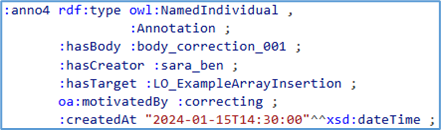
Figure 3 displays an example of an annotation individual (lao:annot4) created by lao:learner1, and that aims to indicate an error found in the LO cso:op_3_3_Exemple.
3.3 Learner Annotation Ontology formal description
We implemented the LAO as a formal Web Ontology Language (OWL) 2 ontology using Protégé 5.2.0. First, we imported the reused ontologies - OA, SKOS, and CSO- into the new LAO ontology. We then created our specific classes, properties, and individuals. Table 4 summarizes the LAO’s components. The formal descriptions of core LAO components are:
The root class LAO: Annotation carries four mandatory restrictions. Each annotation must have one creator, one pedagogical motivation, one learning content target, and at least one textual body.
•Ten specific motivation individuals; Figure 4 depicts the Turtle formal description of the correcting motivation. Each motivation individual includes formal property assertions linking it to: (1) A pedagogical impact level (high, medium, low) for prioritization; (2) A suggested update action for instructors (e.g., Replace Content, Add Content); (3) A Conceptual alignment with W3C OA motivations.
•The UpdateSuggestion class represents an instructor recommendation generated automatically from learner annotation patterns. Each suggestion links to its source annotation, specifies a recommended update action and identifies the target LO/LA requiring modification. It also includes a calculated priority level based on pedagogical impact and student consensus (Figure 5).
An example of LAO:Annotation individual is in Figure 6.
Table 4. Learner Annotation Ontology (LAO) components
|
LAO Component |
Number |
Names |
|
Classes |
4 |
Annotation, Learner, UpdateAction, UpdateSuggestion |
|
Object properties |
4 |
derivedFrom, suggestedUpdateAction, targets, enrolledIn |
|
Data properties |
5 |
Priority, createdAt, affectedStudentCount, annotationCount, pedagogicalImpact |
|
Individuals |
18 |
LearnerMotivationScheme, MoveContent, ReplaceContent, VerifyExternalResource, AddContent, AddExample, AddExplanation, AddSolution, actualizing, addingExample, addingSolution, askingForExplanation, askingForSolution, completing, correcting, detailing, reformulating, restructuring |

Figure 4. The LAO:correcting individual

Figure 5. The class UpdateSuggestion
Figure 6. An LAO:Annotation individual
3.4 Implementation and validation
The LAO is designed to be used (directly or indirectly) both by the annotating module and the update-assistance module (see Figure 1). We propose the following scenarios of use:
1. Learners annotate the learning content and specify the goal of each annotation.
2. The annotating module accesses the ontology LAO, creates annotation instances, and stores them in the Annotation Repository.
3. The teacher can start to use the system only after the end of the course session.
4. When the teacher selects a learning component (LA or LO) from his course, the update-assistance module picks out all students’ annotations that concern this component.
3.4.1 Annotating module
In recent years, numerous annotation tools and applications have been developed to improve educational practices in e-learning environments [10, 29]. Kalboussi et al. [18] classified web annotation tools in three categories: annotation application, annotation plug-in, and annotation website.
Our first implemented prototype, “AnnUpdate,” is an online annotation tool that takes the form of a plug-in for the browser. Thus, the learner must start by activating the plug-in, then logging into his annotation workspace.
AnnUpdate is designed to be intuitive: learners can annotate text using the same actions as with a traditional paper highlighter. To annotate a passage, the learner must first select the text. In situ-location popup, AnnUpdate provides three possible categories of annotation semantics: Editing, Linking, and Requesting. Each category gives access to a set of elementary annotation goals. Figure 7 depicts an annotation of an example of the course “C Array data structure” [30]. The pop-up box in this figure shows the goals included in the category “Editing”.
By this annotation, the learner needs to point out the typing error in the sorted data in the Array after the insertion of the element 8 at position 2.

Figure 7. An annotation realized by AnnUpdate
3.4.2 Update-assistance module
This module transforms annotations produced by the annotating module into actionable update recommendations. The input data of this module is the triple store of annotations generated by the annotating module. The process passes through 4 main steps:
1. Classification of annotations by running an OWL reasoner (HermiT, Pellet). Annotations can be classified along three dimensions: targeted content, time, and student consensus. Student consensus refers to cases where multiple, distinct students annotate the same content with the same motivation.
2. Detection of motivation patterns (e.g., error pattern, example gap pattern). Each pattern uses specific criteria of construction. For example, the error pattern requires the correcting motivation and a specific number of annotators (e.g., ≥3). This situation means that the annotated content contains a factual or syntactic error with a high urgency value. Pattern detection uses SPARQL queries that apply advanced filtering clauses and threshold conditions.
3. Generation of suggestions by transforming detected patterns into concrete update suggestion individuals. In this step, we implemented a SPARQL UPDATE query based on the INSERT clause (Figure 8). The running of the query on the Apache Fuseki-Jena server 6.0.0 generated all the UpdateSuggestion individuals corresponding to the Annotation individuals. Figure 9 depicts the Turtle description of an example of these instances.

Figure 8. SPARQL query for generation of update suggestions

Figure 9. A generated individual of LAO:UpdateSuggestion
4. Communication of update suggestions via the instructor dashboard. The dashboard displays recommendations within various types of views (priority, motivation-based, timeline). These views guide instructors in decision-making. For each suggestion, the instructor can choose between three decisions: “Mark as done”, “Dismiss”, or “Defer”. This step uses SELECT SPARQL queries.
3.4.3 Validation
For our prototype, we considered an ontology-based reasoning validation process. This type of validation considers only the utility side of our framework and aims to answer the research question “do derived update suggestions provide actionable insights for instructors?” To validate our AnnUpdate, we:
Previous studies on modeling learners’ annotation semantics only consider the annotation as a mechanism that reinforces the learner's personal memory. In the current study, we consider the learner’s annotation as a potential bridge between learners and content authors. Our modeling approach offers learners the necessary semantics for expressing their assimilation needs towards the consulted material. In order to respond to these needs, the content author can apply updates to the learning content. Our proposed annotation model gives the learner new opportunities compared to the previous models. First, the learner can notify a possible error detected in a specific passage by suggesting a correction. He can also suggest or request new content, such as complements, explanations, examples, or solutions, to be added to better understand the material. Another opportunity is when the student recommends reformulating a passage with the aim of achieving his/her assimilation.
Our modeling approach adopts the semantic web technologies to model all possible learners’ annotation goals that can help the teacher to know about learners’ needs and requirements. The applied ontological framework gives our model a wide range of interoperability. Thus, the resulting model is machine-readable so various applications across multiple platforms can used it.
Compared with the previous teacher-assistance approaches, our approach has well-aimed semantics in terms of learner goals. This is because the semantics are explicitly expressed by the learner himself, rather than detected or calculated from its interaction data.
Previous annotation models have mostly been used to implement annotation tools intended for students. Our model extends the scope of annotation use by exploiting learners’ annotations to implement tools intended for instructors.
The main goal of the research presented in this article is to extend previous learner annotation models by adding novel semantics to the annotation goals. Our new annotation goals are designed to be used in order to help the teacher during the process of updating the annotated content material.
Compared to the previous annotation models, our additional annotation semantics give the learner the opportunity to suggest their own corrections, complements, reformulations, and new content additions to the consulted material. Moreover, the learner can link the material to other external resources that refer to more details or even recent information. Learners can also apply their suggestions to the material’s structure proposing a new structuring of the learning content. Thus, a new structuration of the learning material may be suggested. Another variant of our annotation semantics takes along student’s asking questions. Here, the learner asks for more explanation or for solutions/answers.
For this work, we designed an ontological framework to represent our new annotation objectives. According to the Semantic Web, one best practice is “reusing existing vocabularies wherever possible,” and for “do not reinvent the wheel”, we have reused existing ontologies to develop our new ontology. Dubbed as “LAO”, we obtained our ontology by extending the W3C “Web OA” and the “CSO”. We have also reused other ontologies such as SKOS and FOAF.
We have designed the LAO with the aim of using it to implement teacher tools that can assist teachers during the process of updating the learning content.
In future work, we plan to enrich our semantic model by considering the learner’s profile (e.g., level of knowledge, preferences and objectives). Accordingly, we will be able to generate specific updates for a specific profile. Another perspective is to combine learning management system data about student interactions and student annotations for more accurate results about students’ needs and difficulties.
[1] Novak, E., Razzouk, R., Johnson, T.E. (2012). The educational use of social annotation tools in higher education: A literature review. The Internet and Higher Education, 15(1): 39-49. https://doi.org/10.1016/j.iheduc.2011.09.002
[2] Ghadirian, H., Salehi, K., Ayub, A.F.M. (2018). Social annotation tools in higher education: A preliminary systematic review. International Journal of Learning Technology, 13(2): 130-162. https://doi.org/10.1504/IJLT.2018.092096
[3] Krouska, A., Troussas, C., Virvou, M. (2018). Social annotation tools in digital learning: A literature review. In 2018 9th International Conference on Information, Intelligence, Systems and Applications (IISA), Zakynthos, Greece, pp. 1-4. https://doi.org/10.1109/IISA.2018.8633609
[4] Sun, C., Hwang, G.J., Yin, Z., Wang, Z., Wang, Z. (2023). Trends and issues of social annotation in education: A systematic review from 2000 to 2020. Journal of Computer Assisted Learning, 39(2): 329-350. https://doi.org/10.1111/jcal.12764
[5] Gayoso-Cabada, J., Sarasa-Cabezuelo, A., Sierra-Rodríguez, J.L. (2019). A review of annotation classification tools in the educational domain. Open Computer Science, 9(1): 299-307. https://doi.org/10.1515/comp-2019-0021
[6] Kalboussi, A., Mazhoud, O., Kacem, A. (2016). Functionalities provided by annotation systems for learners in educational context: An overview. International Journal of Emerging Technologies in Learning, 11(2): 4-11. https://doi.org/10.3991/ijet.v11i02.5166
[7] Rose-Wainstock, C. (2022). Hypothesis. CALICO Journal, 39(1): 118-128. https://doi.org/10.1558/cj.18560
[8] Tuiloma, S.H., Arnesen, K.T., Guo, Q., West, R.E., Graham, C.R. (2025). Promoting active learning through collaborative annotation tools. The Journal of Applied Instructional Design, 14(4). https://doi.org/10.59668/2224.22361
[9] Craig, C., Kay, R. (2024). A systematic review of the perusall application: Exploring the benefits and challenges of social annotation technology in higher education. INTED2024 Proceedings, 7566-7574. https://doi.org/10.21125/inted.2024.2000
[10] Yogev, E., Gal, K., Karger, D., Facciotti, M.T., Igo, M. (2018). Classifying and visualizing students' cognitive engagement in course readings. In Proceedings of the Fifth Annual ACM Conference on Learning at Scale, pp. 1-10. https://doi.org/10.1145/3231644.3231648
[11] Paradis, J., Fendt, K. (2016). Annotation studio: Digital annotation as an educational approach in the humanities and arts. MIT Technical Report 110.
[12] Robert, L. (2001). Annotation et visualisation interactives de documents hypermédias. Doctoral dissertation, Télécom ParisTech, Paris, France.
[13] Van Doren, C., Adler, M.J. (2012). How to Read a Book: The Classic Guide to Intelligent Reading. Blackstone Publishing.
[14] Yogev, E., Gal, K., Karger, D., Facciotti, M.T., Igo, M. (2018). Classifying and visualizing students' cognitive engagement in course readings. In Proceedings of the Fifth Annual ACM Conference on Learning at Scale, London, United Kingdom, pp. 1-10. https://doi.org/10.1145/3231644.3231648
[15] Mille, D. (2005). Modèles et outils logiciels pour l'annotation sémantique de documents pédagogiques. Doctoral dissertation, Université Joseph-Fourier-Grenoble I.
[16] Marshall, C.C. (1997). Annotation: From paper books to the digital library. In Proceedings of the Second ACM International Conference on Digital Libraries, Philadelphia, Pennsylvania, USA, pp. 131-140. https://doi.org/10.1145/263690.263806
[17] Mokeddem, H., Azouaou, F., Desmoulins, C. (2009). Ontology of the learner’s annotation objectives. In SWEL'09, Ontologies and Social Semantic Web for Intelligent Educational Systems, Brighton, pp. 76-80.
[18] Kalboussi, A., Mazhoud, O., Omheni, N., Kacem, A.H. (2014). A new annotation system based on a semantic analysis of a learner's annotative activity to invoke web services. International Journal of Metadata, Semantics and Ontologies, 9(4): 350-370. https://doi.org/10.1504/IJMSO.2014.065447
[19] Jovanovic, J., Gasevic, D., Brooks, C., Devedzic, V., Hatala, M., Eap, T., Richards, G. (2007). Using semantic web technologies to analyze learning content. IEEE Internet Computing, 11(5): 45-53. https://doi.org/10.1109/MIC.2007.116
[20] García, E., Romero, C., Ventura, S., Castro, C.D. (2009). An architecture for making recommendations to courseware authors using association rule mining and collaborative filtering. User Modeling and User-Adapted Interaction, 19(1): 99-132. https://doi.org/10.1007/s11257-008-9047-z
[21] Gayoso-Cabada, J., Goicoechea-de-Jorge, M., Gómez-Albarrán, M., Sanz-Cabrerizo, A., Sarasa-Cabezuelo, A., Sierra, J.L. (2019). Ontology-enhanced educational annotation activities. Sustainability, 11(16): 4455. https://doi.org/10.3390/su11164455
[22] Villegas-Ch, W., García-Ortiz, J. (2023). Enhancing learning personalization in educational environments through ontology-based knowledge representation. Computers, 12(10): 199. https://doi.org/10.3390/computers12100199
[23] World Wide Web Consortium (W3C). (2017). Web Annotation Data Model. https://www.w3.org/TR/annotation-model/.
[24] World Wide Web Consortium (W3C). (2017). Web Annotation Vocabulary. https://www.w3.org/TR/annotation-vocab/.
[25] World Wide Web Consortium (W3C). (2016). Web Annotation Ontology. http://www.w3.org/ns/oa#.
[26] Miles, A., Bechhofer, S. (2004). Simple Knowledge Organization System. http://www.w3.org/2004/02/skos/core
[27] Brickley, D., Miller, L. (2014). FOAF Vocabulary Specification 0.99. https://xmlns.com/foaf/spec/.
[28] Merzougui, G. (2012). Système auteur pour la création et la gestion de contenu pédagogique multimédia. Doctoral dissertation. Batna 2 University, Algeria. http://eprints.univ-batna2.dz/114/.
[29] Cui, T., Wang, J. (2024). Empowering active learning: A social annotation tool for improving student engagement. British Journal of Educational Technology, 55(2): 712-730. https://doi.org/10.1111/bjet.13403
[30] SiteBay.com. Array in Data Structure. https://www.sitesbay.com/data-structure/c-array-data-structure.