Hadjer Fellah* | Chaker Mezioud | Hichem Rahab | Youcef Bezza | Aridje Mebarki | Maissoun Mordjane
© 2026 The authors. This article is published by IIETA and is licensed under the CC BY 4.0 license (http://creativecommons.org/licenses/by/4.0/).
OPEN ACCESS
Mobile cloud computing (MCC) enables resource-constrained mobile devices to execute computation-intensive applications by transferring selected tasks to cloud servers. Effective computation offloading, however, requires a careful trade-off between device energy consumption and application response time, particularly under changing network and cloud conditions. Existing approaches often rely on fixed offloading costs or static graph partitioning, which limits their ability to adapt to heterogeneous execution environments. This study formulates task offloading as a bi-objective optimization problem and proposes an energy-aware Enhanced Rat Swarm Optimization (ERSO) algorithm for adaptive application partitioning. The method introduces a revised search strategy to improve the balance between exploration and exploitation while reducing premature convergence. ERSO was evaluated using 16-node and 50-node weighted call graphs across seven MCC scenarios, with cloud speedup factors ranging from 5 to 30 and network bandwidths ranging from 3 to 100 Mbps. Its performance was compared with local execution, full offloading, minimum-cut partitioning, the standard Rat Swarm Optimizer, binary Particle Swarm Optimization, and a binary-coded genetic algorithm. The results show that ERSO consistently identifies effective task allocations under different operating conditions. Under the most constrained setting, with a bandwidth of 3 Mbps and a cloud speedup factor of 5, ERSO reduced the composite fitness cost by 33% compared with local execution. Overall, the proposed method provides a robust mechanism for jointly reducing energy consumption and response time in dynamic MCC environments.
application partitioning, computation offloading, energy–latency optimization, mobile cloud computing, metaheuristic optimization, Rat Swarm Optimization
The rapid growth of mobile computing is primarily driven by the spectacular increase in the number of mobile devices such as smartphones, smartwatches, laptops, and more. In 2026, the number of smartphones worldwide is estimated at 7.58 billion, while the number of smartphone users will reach 5.65 billion [1]. Users of these devices typically expect a high quality of service, particularly in terms of response time, energy efficiency, and storage costs. Reducing the energy consumption of mobile devices has become both a major user requirement and an important objective in addressing the global energy crisis and promoting environmental sustainability. Current estimates indicate that mobile applications collectively consume approximately 20.3 terawatt-hours of electricity annually, slightly below the annual electricity consumption of Ireland [2]. Striking a balance between these non-functional requirements demands careful attention to ensure both a seamless user experience and the preservation of our planet. Several strategies have been adopted by both academia and industry to address energy efficiency and performance in mobile devices, covering multiple facets:
•At the hardware level, techniques like dynamic voltage and frequency scaling (DVFS) help adjust processor power based on workload. Newer approaches, such as MetaDVFS, have shown up to 17% improvement in performance-per-watt by using metadata to guide frequency scaling [3]. Modern mobile chips also integrate specialized hardware accelerators like neural processing units (NPUs) alongside graphics processing units (GPUs) and digital signal processors (DSPs). These allow tasks such as AI inference to run on the most energy-efficient unit available [4, 5]. Storage technology has also evolved: universal flash storage has largely replaced embedded MultiMediaCard (eMMC) by enabling full-duplex data transfer and command queuing, which translates to faster speeds and better power efficiency [6]. Meanwhile, smarter cache hierarchies help reduce the energy cost of memory operations [7].
•At the software level, energy-aware operating systems coordinate power management across different layers. Research shows that optimizing across hardware, operating system, network, and applications together yields better energy savings than tuning each layer separately [8]. Virtualization and containerization also help consolidate resources efficiently [7].
•User best practices, simple practices like lowering screen brightness, closing background apps, and following proper charging routines can extend battery life. A recent study [9] found that user awareness of these practices was a key factor in managing battery drain effectively.
•Finally, green energy harvesting offers a sustainable path forward. Systems that capture ambient energy from light, motion, or heat can power devices without relying solely on batteries. Light-based harvesters typically use solar cells, power management chips with Maximum Power Point Tracking, and small batteries or supercapacitors. The main challenges are dealing with inconsistent energy availability and ensuring that harvested power meets the device’s average needs [10].
In this study, we focus on computation offloading (CO). While hardware improvements, software optimization, user practices, and green energy each contribute to mobile device energy efficiency, CO offers a uniquely flexible solution that can dynamically adapt to varying workloads and environmental conditions. Rather than executing all computations locally on the device, offloading them to external resources, specifically the cloud, can be an effective way to meet user requirements. Mobile cloud computing (MCC) has emerged as a transformative paradigm, enabling mobile devices to offload intensive computations to the cloud and leverage its virtually unlimited resources. This practice has become a key approach for enhancing both performance and energy efficiency in mobile environments [11-13].
The CO is a complex process that involves a three-step workflow [14]:
•Application partitioning: This step divides a given mobile user application into offloadable and nonoffloadable components, i.e., determining which components are executed inside the device and which need to be externalized to the cloud. It is a prerequisite for efficient CO.
•Preparation: This step handles all tasks required for the offloadable components in mobile applications, including selecting a remote server, transferring, and installing the code, among others.
•Offloading decision: Before remote execution, a decision is made based on the current execution context to determine whether the remote component will be used in the user’s mobile application.
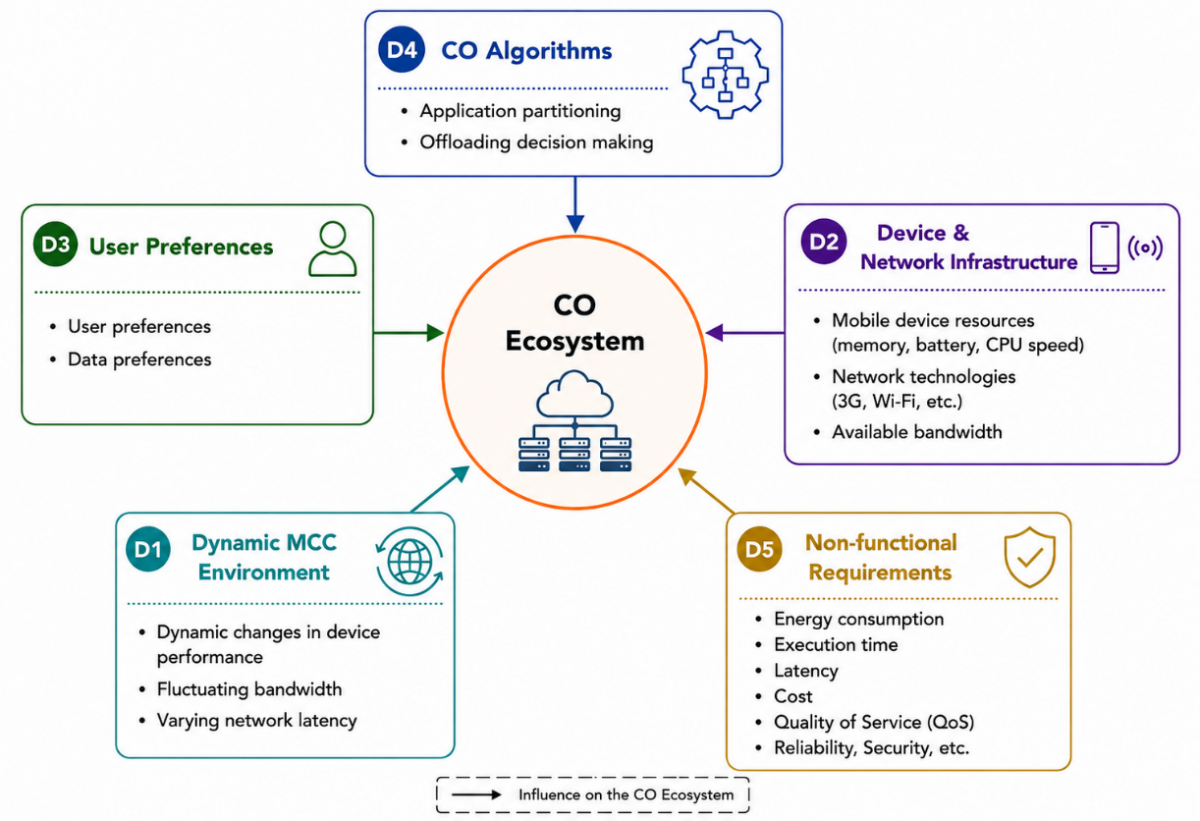
A thorough analysis of existing studies reveals the five key dimensions constituting the CO ecosystem (Figure 1): (D1) the highly dynamic nature of MCC, where device performance, bandwidth, and network latency fluctuate continuously, impacting the overall offloading cost; (D2) the underlying infrastructure of mobile devices including available memory, battery level, and CPU speed, as well as network specifications (such as 3G, Wi-Fi, and available bandwidth) that enable connectivity between devices and the cloud; (D3) user preferences, including data preferences; (D4) the CO algorithms responsible for application partitioning and decision-making; and (D5) the used non-functional requirements that CO algorithms have to satisfy. However, most existing CO algorithms do not incorporate the dynamic nature of the MCC environment. As a result, an effective offloading strategy should account for these fluctuations, optimizing energy consumption and resource usage in real time by adapting to changes in network conditions and service node capabilities, including the processing speed of both the mobile device and cloud servers. These challenges highlight the need for adaptive approaches that dynamically adjust offloading decisions based on current environmental conditions [15, 16].
Figure 1. Five dimensions of the computation offloading (CO) ecosystem
Due to its importance, let us focus on application partitioning. To perform this CO step, the mobile user application can be formally modeled as a graph, where vertices represent computational components (annotated with metrics such as execution time, memory usage, and input/output), and edges represent communication costs between these components [15, 17]. The goal of graph partitioning is to determine the optimal allocation of components between the mobile device and cloud servers, minimizing communication costs while maximizing performance and energy savings. Achieving this goal is challenging, as the graph partitioning problem is known to be nondeterministic polynomial-time complete (NP-complete) [18].
Several algorithms have been proposed for CO-oriented graph partitioning, including heuristic and metaheuristic approaches. Among these, swarm intelligence-based algorithms, such as Ant Colony Optimization (ACO), Particle Swarm Optimization (PSO), and Whale Optimization Algorithm (WOA), have demonstrated promising results in balancing trade-offs between energy efficiency, processing power, and communication costs. However, these algorithms are static and do not account for the dynamic MCC environment [19]. Recently, the Rat Swarm Optimizer (RSO) has emerged as a novel swarm intelligence-based algorithm for solving global optimization problems. Inspired by the behavior of rats chasing and fighting their prey, RSO has shown significant success in continuous optimization tasks [20]. This study focuses on enhancing the RSO algorithm to increase its effectiveness for MCC. The objective is to modify RSO to efficiently manage the allocation of tasks between mobile devices and cloud resources, prevent entrapment in local optima, and reduce both energy consumption and execution time.
The remainder of this study is organized as follows: Section II reviews existing research on CO and optimization methods in MCC. Section III presents the cost function formulation for energy optimization. We also introduce the proposed Enhanced Rat Swarm Optimization (ERSO) algorithm, detailing how it adapts traditional RSO concepts to reduce energy consumption while maintaining efficient task completion. Section IV outlines the simulation setup and performance metrics used to evaluate our approach, followed by an in-depth discussion of the experimental results. Finally, Section V provides concluding remarks and suggests potential directions for future research on applying intelligent swarm-based optimization to MCC offloading problems.
CO tackles limitations of mobile devices such as limited battery lifetime, processing capabilities, and storage capacity by partitioning the computation-intensive applications, such as augmented reality, face and voice recognition, into components that are offloaded to remote rich Cloud servers, with better performance and resources, for remote execution. [12, 13, 21]. The potential of mobile offloading mainly depends on mobile network technologies such as cellular networks and Wi-Fi. Cellular network data transmission requires a considerable amount of energy from the mobile device, contrary to Wi-Fi, which can provide high bandwidth connections. Therefore, CO should be performed only when the local execution consumes more time and energy than the remote execution. An offloading algorithm is designed to make decisions that minimize the overall cost of running an application. The decision depends on whether to improve performance or save battery life, though these two goals often align. Unless network transmission uses significantly more power than computation, offloading typically boosts performance (faster execution) while saving battery life. Several MCC proposal works have focused on CO due to its energy consumption and execution time benefits. Categorized by the granularity and partition algorithm being used, the current work follows two main approaches [16]:
(1) Full migration, also referred to as coarse granulation or Application-level offloading [12, 22-24], is a software-as-a-service model where the entire process, application, program, or entire Virtual Machine is offloaded for remote execution on remote servers. The application’s input data will be transmitted to the server when it is selected to be offloaded. The server will then execute the application and transmit its output data back to the mobile device [16, 25]. Every application is handled separately. The primary disadvantages of full migration are its rigidity and coarse granularity.
(2) Partial offloading, also referred to as fine-grained or task-level offloading [26, 27], involves dividing the application into inherited components [25]. With this approach, developers specify precisely how the application should be divided and which components should be offloaded. As well as how to modify the offloading plan in response to modifications in network conditions. By using this approach, applications can benefit from remote execution by offloading particular use-only subparts. Its main objective is enhancing mobile devices’ energy efficiency [25, 28].
Remote execution offers the ability to improve energy efficiency and enhance the performance of programs running on weak devices [29, 30]. As mentioned above, CO employs partitioning in its mechanism for remote execution, dividing the functionality of mobile applications into distinct components capable of independent operation within a distributed environment [31]. Since not every application task can be performed remotely, they must be divided into two categories: one will be executed on the mobile terminal, and the other will be executed on cloud servers [25].
While researchers have explored heuristic, metaheuristic, and machine-learning solutions to CO, the application of SI techniques in application partitioning within MCC specifically remains an underexplored area compared to its use in cloud and edge computing.
Before analyzing specific CO algorithms, it is essential to classify them according to the five key dimensions of the CO ecosystem introduced in the previous section. Table 1 presents this classification, which guides the critical analysis that follows.
Table 1. Classification of computation offloading (CO) algorithms by type
|
Algorithm Type |
Examples |
Key Mechanism |
Primary Limitation (CO Dimension) |
|
Heuristic |
GA [32, 33]; SA [34, 35] |
Iterative improvement, rule-based search |
Static assumption (D1) |
|
Hybrid heuristic |
GA-SA [36, 39] |
Global exploration (GA) + local exploitation (SA) |
High computational overhead (D2) |
|
Metaheuristic (swarm intelligence) |
PSO [40-43]; ACO [44-46] |
Collective behavior, information sharing |
Premature convergence; parameter sensitivity (D1) |
|
Metaheuristic (biology-inspired) |
WOA [47]; HHO [48]; GWO [49] |
Hunting/foraging behavior mimicry |
Parameter sensitivity; static hierarchy (D1) |
|
Hybrid multi-strategy |
GSP [50, 51] |
GA + SA + PSO + autoencoder |
Exceeds mobile CPU latency limits (D2, D5) |
Note: SA: Simulated Annealing; GA: Genetic Algorithm; PSO: Particle Swarm Optimization; ACO: Ant Colony Optimization; WOA: Whale Optimization Algorithm; HHO: Harris Hawks Optimization; GWO: Grey Wolf Optimization; GSP: Genetic Simulated-annealing-based Particle Swarm Optimization.
Existing research on CO has explored various optimization techniques to address mobile devices’ energy and resource constraints, such as heuristic approaches and metaheuristic algorithms. These techniques can be classified into three categories: heuristics (deterministic, rule-based), metaheuristics (stochastic, nature-inspired), and hybrid algorithms (combining multiple strategies). Traditional heuristic methods such as Genetic Algorithms (GA) [32, 33] and Simulated Annealing (SA) [34, 35] have been widely used to partition tasks and optimize resource allocation in MCC. These methods demonstrate robust performance in static environments but are less effective in dynamic settings. Specifically, GA fails to satisfy D1 (dynamic network conditions) as it assumes stationary environments, while SA’s slow convergence violates D5 (latency requirements) for real-time offloading decisions. For instance, studies have combined optimization approaches [36-39] to create hybrid algorithms that address the dual objectives of energy consumption and execution time. On the other hand, metaheuristic approaches, inspired by natural and biological phenomena, have gained prominence in MCC offloading. PSO has been applied to optimize offloading decisions by minimizing energy and computational costs [40-43]. However, PSO is prone to premature convergence, especially in complex, dynamic scenarios. This premature convergence limits the ability to satisfy D1, as particles collapse to suboptimal solutions when bandwidth or latency fluctuates unexpectedly. Furthermore, PSO lacks memory across consecutive offloading decisions, forcing it to re-explore from scratch for each new task arrival [40-43]. ACO has also been utilized for resource allocation, leveraging pheromone-based communication to optimize task partitioning [44-46]. While effective, the high computational overhead of ACO limits its scalability. ACO’s computational complexity scales quadratically with the number of tasks, failing to satisfy D2 (device resource constraints) and D5 (sub-second latency requirements). Additionally, the pheromone evaporation rate requires manual tuning: too fast loses memory of good solutions, too slow fails to adapt to D1 changes [42-44]. More recently, the WOA has shown promise in balancing performance and energy efficiency but requires careful parameter tuning for adaptability in dynamic environments [47]. WOA’s parameter sensitivity (specifically the ‘a’ parameter that decreases from 2 to 0) requires prior knowledge of environmental variability, which is unavailable in real MCC scenarios, thus violating D1. Recent advances have introduced more sophisticated metaheuristics to CO. The Harris Hawks Optimization (HHO) algorithm, inspired by cooperative hunting behavior, has been applied to MEC offloading by Behera et al. [48], achieving an improvement in energy consumption compared to existing methods. However, HHO’s performance degrades under D1 dynamics because its exploration-exploitation balance relies on a linearly decaying prey’s escape-energy factor that cannot track unpredictable bandwidth fluctuations [48]. Yuan et al. [49] proposed the L´evy Flights and SA-based Grey Wolf Optimizer (LSAG), an enhanced GWO algorithm that combines L´evy flight and SA strategies to improve exploration capability and avoid premature convergence in CO optimization. Nevertheless, GWO’s social hierarchy assumes static relationships among candidate solutions; when D1 conditions change, the algorithm cannot reassign its hierarchy without restarting the optimization process. Two hybrid metaheuristic approaches [50, 51], namely Genetic Simulated-annealing-based Particle Swarm Optimization (GSP) and its enhanced version Genetic Simulated-annealing-based Particle Swarm Optimization with Auto-Encoder (GSPAE), were proposed for CO in hybrid edge-cloud systems. By combining PSO, SA, and genetic operators, and further incorporating an Autoencoder in GSPAE, these methods achieve significant reductions in total system cost while satisfying latency and resource constraints. Nevertheless, the integration of multiple optimization mechanisms increases algorithmic complexity and computational requirements. Furthermore, both approaches rely on static optimization based on predefined system information and lack online adaptive learning capabilities, making them less suitable for highly dynamic mobile edge computing environments where network conditions, user mobility, and resource availability continuously evolve.
A critical synthesis of the literature indicates that existing methods, although insightful, frequently demonstrate limitations in the realm of MCC offloading, including premature convergence, sensitivity to parameter tuning, inadequate adaptability to dynamic network and device conditions, absence of memory-based learning from prior solutions, and insufficient mechanisms for balancing global exploration with local exploitation.
When mapped against the five CO dimensions, these limitations manifest as:
(1) Violation of D1 (dynamic adaptation): All existing algorithms assume static or slowly varying environments;
(2) Violation of D2 (device constraints): Hybrid algorithms like GSP exceed mobile CPU limitations;
(3) Violation of D3 (user preferences): No algorithm dynamically incorporates user-specified trade-offs between energy and latency;
(4) Violation of D5 (Non-Functional requirements satisfaction): Premature convergence leads to suboptimal energy consumption or unacceptable latency.
Given these limitations, an ideal CO algorithm for MCC should satisfy five requirements: (R1) adapt to D1 dynamics without restarting; (R2) maintain low computational overhead suitable for D2; (R3) optionally incorporate D3 user preferences; (R4) balance exploration and exploitation for D5; and (R5) include memory mechanisms to learn from past offloading decisions. Table 2 evaluates existing algorithms against these requirements.
Table 2. Comparison of existing algorithms against requirements for an ideal computation offloading (CO) algorithm
|
Algorithm |
R1 |
R2 |
R3 |
R4 |
R5 |
|
GA |
Assumes static; no adaptation to changing bandwidth |
Heavy; large population and generations |
No user preference mechanism |
Premature convergence; loses diversity |
No learning across runs; random start |
|
SA |
Assumes static; no real-time reaction |
Lightweight; single solution only |
No dynamic user input |
Poor temp control; too random or too greedy |
No memory; random start each run |
|
PSO |
Collapses to global best; cannot track changes |
Lightweight; few parameters |
No user input mechanism |
Premature convergence; loses diversity early |
Personal best only; no cross-run learning |
|
ACO |
Fixed evaporation; no adaptation to changes |
Heavy; O(n2) complexity |
Yes; weights encode preferences |
Too random or too greedy |
Pheromone decays; no long-term memory |
|
WOA |
Linear decay; assumes predictability |
Lightweight; simple updates |
No user input |
Good balance in static cases |
No memory; random Start |
|
HHO |
Linear escape energy; fails under change |
Lightweight; similar to PSO |
No user input |
Good balance in static cases |
No memory; independent Runs |
|
GWO |
Static hierarchy; cannot reassign |
Lightweight; simple updates |
No user input |
Good balance in static cases |
No memory; random Start |
|
GSP |
Offline only; no runtime adaptation |
Very heavy |
No dynamic user input |
Excellent balance |
Needs retraining; not real-time |
Note: SA: Simulated Annealing; GA: Genetic Algorithm; PSO: Particle Swarm Optimization; ACO: Ant Colony Optimization; WOA: Whale Optimization Algorithm; HHO: Harris Hawks Optimization; GWO: Grey Wolf Optimization; GSP: Genetic Simulated-annealing-based Particle Swarm Optimization.
As far as we know, no particular research examines the direct application of RSO to task partitioning in MCC offloading. Nonetheless, RSO has proven effectiveness in high-dimensional optimization problems. Unlike conventional SI algorithms, RSO addresses several of the limitations identified above. In contrast to conventional SI algorithms, RSO integrates adaptive mechanisms that equilibrate exploration (global search) and exploitation (local refinement). This equilibrium assists RSO in surmounting challenges such as premature convergence and suboptimal task allocation. Specifically, RSO satisfies R1 (adaptation to D1) through its dynamic parameter adjustment, R2 (low overhead for D2) through linear O(n*d) complexity, R4 (exploration-exploitation balance) through adaptive search ratios, and R5 (memory mechanism) through historical position retention [20]. Regarding R3 (user preferences), this remains an open gap that our proposed enhancement addresses. Applying the proposed ERSO algorithm to MCC offloading is expected to improve energy efficiency, computational efficiency, and convergence speed (Table 3). The aim is to alter RSO to proficiently navigate dynamic situations, avoid entrapment in local optima, and diminish both energy expenditure and execution duration. The RSO incorporates:
•A fitness function that considers both local energy costs and communication energy costs, emphasizing energy awareness.
•Adaptive exploration and exploitation strategies are essential for achieving robust optimization in dynamic MCC scenarios.
•Implementation of memory-guided search and mutation mechanisms to prevent stagnation in local optima.
Table 3. Standard Rat Swarm Optimizer (RSO) requirements analysis
|
Requirements |
Satisfied? |
Mechanism |
|
R1 |
√ |
Dynamic parameter adjustment |
|
R2 |
√ |
Linear O (n × d) complexity |
|
R3 |
× |
Not included (gap to address) |
|
R4 |
√ |
Adaptive search ratios |
|
R5 |
√ |
Historical position retention |
MCC presents several challenges, including variable network bandwidth, fluctuating server performance, and the limited resources of mobile devices, such as battery capacity, memory, and computational power [52]. These issues underscore the imperative for formulating efficient and flexible solutions for CO, which involves reallocating resource-intensive workloads from mobile devices to cloud servers [53]. A significant problem with existing approaches is their propensity to become trapped in local optima, resulting in unsatisfactory solutions. This issue occurs because numerous algorithms emphasize enhancing current solutions instead of sufficiently investigating fresh opportunities. Moreover, energy consumption continues to be a significant issue for mobile devices with limited battery life [19]. An efficient offloading approach must achieve a balance between performance and energy efficiency [54], including both processing and communication costs.
Before presenting the proposed approach, we formally define the system model and the optimization problem that our ERSO algorithm aims to solve.
3.1 System model
3.1.1 Application model
The mobile application is modeled as a directed graph G = (V, E), where V = {v1, v2, ..., vn} represents the set of computational components (methods or tasks), and E = {(vi, vj)} represents the communication dependencies between these components. Each vertex vi has associated costs: Li for local execution on the mobile device and Ri for remote execution on the cloud server. Each edge (vi, vj) has an associated communication cost Cij, which represents the data transfer overhead if methods viand vj are executed on different nodes. The goal of application partitioning is to divide the graph G into two disjoint subsets: VL (methods executed locally on the mobile device) and VR (methods offloaded to the cloud server), such that the total cost is minimized while satisfying system constraints.
3.1.2 Computation model
The execution time for methods executed locally on the mobile device is given by:
$T_{{Local }}=\sum_{i \in L} t_i^{ {Local }}$
where, L represents the set of methods executed locally, and $t_i^{{Local }}$ is the execution time for method i on the mobile device.
The execution time for methods offloaded to the cloud server is given by:
$T_{ {Remote }}=\sum_{i \in R} t_i^{ {local }} / F$
where, R represents the set of methods offloaded to the cloud, and F is the speedup factor representing the computational advantage of the cloud server over the mobile device. Typical values for F range from 5 to 50 depending on the cloud server type [14, 55, 56].
The energy consumption for local execution is calculated as:
$E_{{Local }}=\sum_{i \in L}\left(t_i^{ {Local }} * P_L\right)$
where, PL is the power consumption during local execution.
The energy consumption for remote execution is calculated as:
$E_{ {Remote }}=\sum_{i \in R}\left(t_i^{ {Remote }} * P_R\right)$
where, PR is the power consumption during remote execution.
3.1.3 Communication model
When methods are offloaded to the cloud, data must be transmitted between the mobile device and the cloud server. The communication time between methods i and j is determined by:
$C_{i j}=\frac{{ Data }_{i j}}{B}$
where, Dataij is the amount of data transmitted between methods i and j, and B is the network bandwidth.
The total communication time is given by:
$T_{ {Com }}=\sum_{(i, j) \in E} C_{i j}$
The energy consumption for communication is given by:
$E_{{Com }}=\sum_{(i, j) \in E}\left(C_{i j} * P_{ {Com }}\right)$
where, PCom is the power consumption for data transfer during communication.
3.2 Optimization problem formulation
The CO problem is formulated as a bi-objective optimization problem aiming to minimize both execution time and energy consumption.
3.2.1 Decision variables
Let xi $\in$ {0, 1} be the decision variable for each method vi $\in$ V, where:
$x_i=\left\{\begin{array}{c}0, \text { if method } v_i \text { is executed locally on the mobile device } \\ 1, \text { if method } v_i \text { is offloaded to the cloud server }\end{array}\right.$
The offloading strategy is represented by the binary vector x = [x1, x2, ..., xn].
3.2.2 Objective function
The total execution time is the sum of local execution time, remote execution time, and communication time:
$T_{ {Total }}=T_{{Local }}+T_{ {Remote }}+T_{{Com }}$
The total energy consumption is the sum of local energy, remote energy, and communication energy:
$E_{{Total }}=E_{ {Local }}+E_{ {Remote }}+E_{ {Com }}$
The objective is to minimize the weighted sum of execution time and energy consumption:
Minimize: Fitness $=W_t * T_{ {Total }}+W_e * E_{ {Total }}$
where, $W_t$ and $W_e$ are pre-defined weights such that $W_t$ $+W_e=1$. These weights allow for expressing preferences between execution time and energy consumption.
3.2.3 Constraints
The optimization problem is subject to the following constraints:
•Binary decision constraint:
$x_i \in\{0,1\}, \quad \forall_i \in V$
•Task dependency constraint:
If method $v_j$ depends on method $v_i$ (i.e., $v_j$ requires output from $v_i$), then the execution order must be preserved.
The problem is known to be NP-complete [18], which motivates the use of metaheuristic algorithms such as the proposed ERSO to find near-optimal solutions efficiently.
3.3 Proposed Enhanced Rat Swarm Optimization algorithm
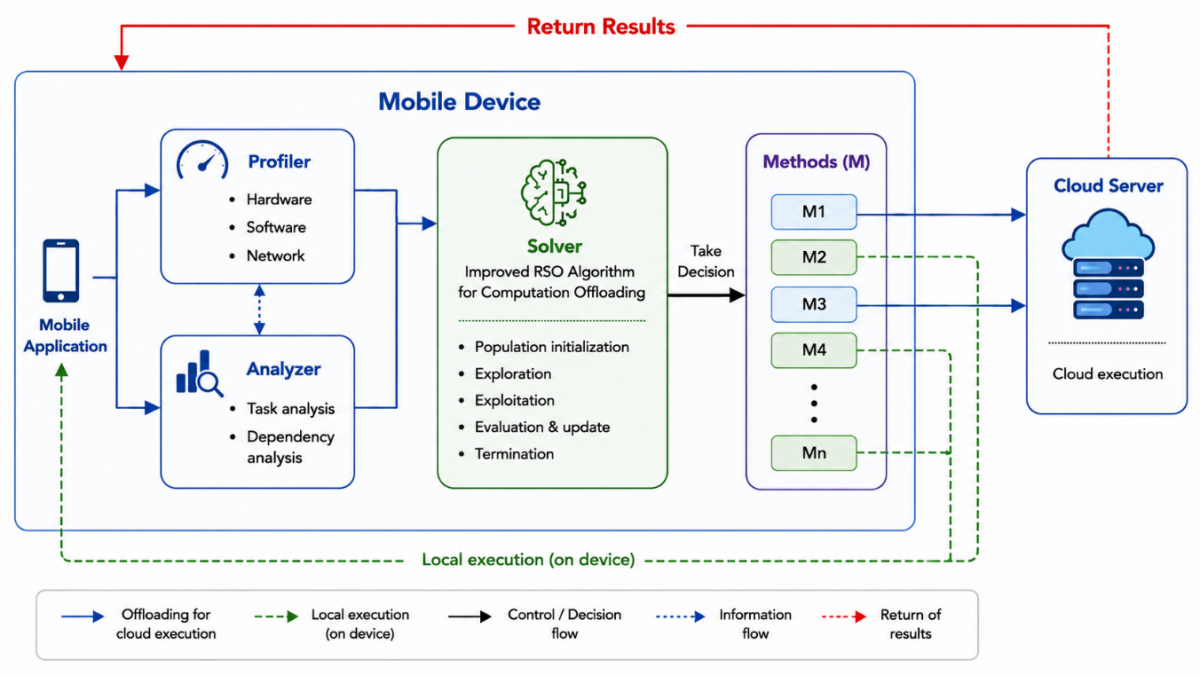
The proposed approach, ERSO for MCC offloading, depicted in Figure 2, utilizes hybrid algorithms that integrate the benefits of both linear programming and graph models to attain an optimal and dynamic solution by factoring in the previously stated costs: local, remote, and communication costs. This is achieved through the use of three modules, including profiler, analyzer, and solver, with the solver tasked with identifying the optimal partitioning outcome: which methods ought to remain on the mobile device and which should be offloaded. The application is partitioned during offloading to determine whether the process should be offloaded or executed locally. In our approach, application partitioning is a fundamental activity conducted before decision-making. It is assumed that the methods entering the decision engine are offloadable methods. In the context analysis and profiling phase, several metrics are gathered through the profiling tool for distinct factors to facilitate an optimal offloading decision, regarded as the final step of the CO process. A decision engine helps to decide when to offload to the remote or cloud using the enhanced ERSO algorithm, designed explicitly for CO in MCC environments. The suggested approach seeks to improve the allocation of tasks between mobile devices and cloud resources, including variable environmental factors, execution costs, and energy efficiency.
Figure 2. Schematic representation of application partitioning and offloading
Table 4. Characteristics of the proposed approach in mobile cloud computing (MCC) partitioning
|
Approach |
Granularity |
Language |
Model |
Profiler |
Allocation Decision |
Annotation |
|
Application Partitioning Algorithm (APA) proposed |
Method |
Single |
Hybrid |
Software Hardware Network |
online |
Automatic |
Our research contribution can be effectively visualized and compared using the thematic taxonomy of Application Partitioning Algorithm’s (APA) classification illustrated in [31]. Table 4 delineates the distinct attributes of our work, situating it clearly within the established taxonomy framework:
(1) Granularity: In our approach, partitioning is method-based, which allows for effective management and offloading of individual tasks. Besides, it provides flexibility and finer control over performance optimization [57]. Table 5 illustrates a comparison between the offloading-based methods, classes, and objects:
(2) Supported language: The approach was developed using a single programming language, Python. Python was chosen due to its widespread adoption and extensive libraries. Its simplicity, versatility, and comprehensive libraries suit complex tasks like application partitioning.
(3) Partitioning model: The hybrid model employed in this approach integrates a method call graph representation with linear programming for problem formulation. This method visually represents interactions among methods and facilitates mathematical optimization via linear programming.
(4) Profiling: Profiling is essential for acquiring data regarding software, hardware, and network characteristics. It aids in making informed decisions regarding offloading mechanisms, contingent upon the capabilities and status of both the cloud server and the mobile device.
(5) Allocation decision: Real-time online decision-making that improves adaptation to changes in the application context. It entails adapting to user behavior, network configurations, or device conditions for enhanced and dynamic offloading techniques.
(6) Techniques for analysis and annotation: Automating analysis and annotation enhances the efficiency and accuracy of identifying offloading strategies. This methodology guarantees the selection of methods with the highest profit potential from offloading, considering method dependencies, conditions, and constraints.
Table 5. Comparison between the offloading of methods, classes, and objects [57]
|
Strategy |
Difficulty of Dynamic Analysis |
|
Method |
* |
|
Class |
** |
|
Object |
*** |
These components jointly enhance performance and reduce energy consumption, rendering the technique adaptive, efficient, and responsive to variations in application context and system conditions.
In what follows, we give a description of each module illustrated in Figure 2:
(1) Profiling module: The profiling module actively monitors hardware, software, and network components, utilizing specific profiling techniques to gather detailed information. This ensures comprehensive tracking of system performance by concentrating on the underlying hardware infrastructure, software processes, and network activity.
•Hardware profiling: Its objective is to collect detailed information about the physical hardware resources of both mobile and cloud devices, such as the cloud server CPU, mobile device CPU, and mobile device battery capacity.
•Software profiling: It gathers data about the mobile application, including metrics such as code size, CPU usage, and other relevant software characteristics, which will be used later by the solver module to analyze the resource requirements and characteristics of the application, thereby enhancing overall performance and optimizing CPU utilization.
•Network profiling: Collects information on the network environment, including bandwidth and connectivity options (3G, 4G, 5G, Wi-Fi). This module enables informed decision-making regarding method allocation and offloading, ensuring efficient data transfer processes and optimal resource utilization.
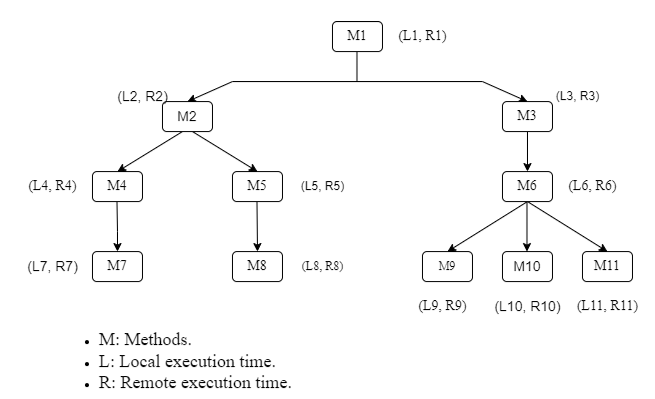
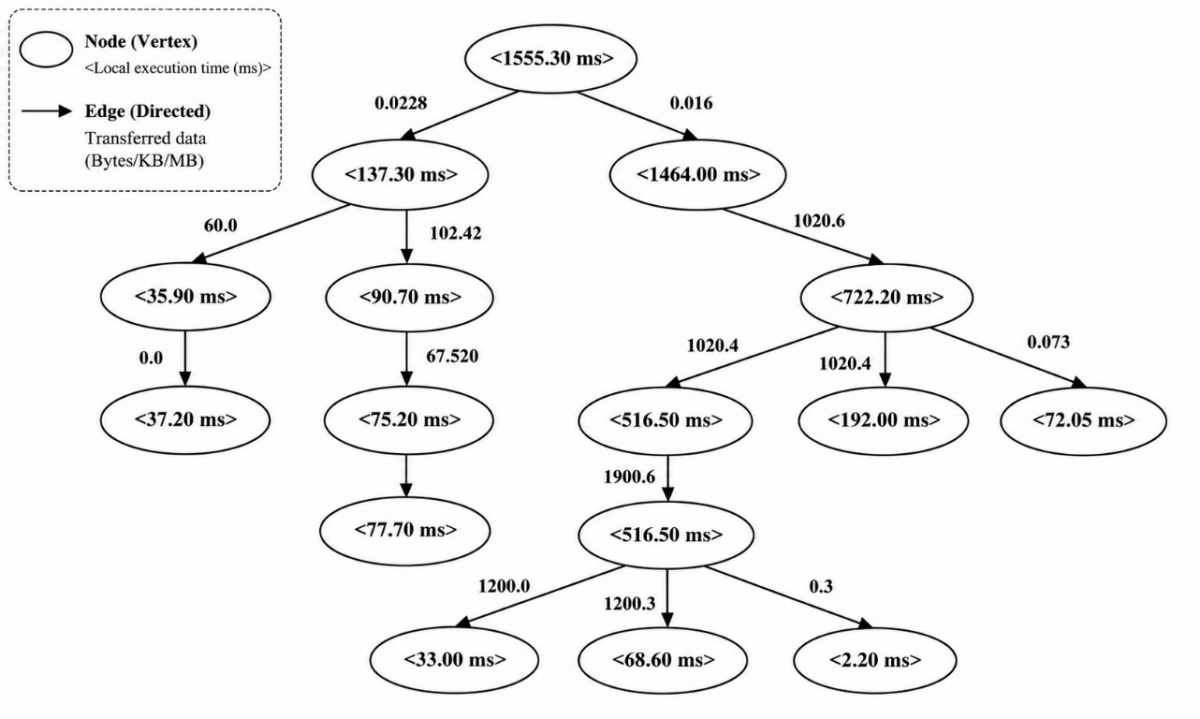
(2) Analyzer: The analyzer has two main functionalities. First, it partitions the mobile application into methods, and second, it follows the common practice in programming by representing the mobile application as a graph (Figure 3), where each vertex symbolizes a computational component (method). Each edge denotes the communication between these components. The weight on a vertex signifies the computational load required to execute that component on the mobile and cloud servers. In contrast, the weight on an edge indicates the relative communication demand between components. Communication costs between operations that are executed in the same location (either locally or remotely) are assumed to be negligible. Graph partitioning is a fundamental problem in many computer science domains. It involves dividing a graph into k equal sets while minimizing the edges between them. This problem is particularly relevant in the context of computation offloading to the network, where the goal is to partition the computational methods into groups and dispatch them to a single network node [56, 58]. The communications between methods within the same group essentially have no overhead because the methods will be executed in the same network node. Thus, it is desirable to group methods with high communication requirements; internal communication is maximized while minimizing external communication between different groups, effectively reducing overhead and optimizing performance. When k = 2, this problem is known as the min-cut bipartitioning problem. Employing this strategy tackles the NP-hard challenge of finding an optimal solution for graph partitioning [59].
(3) Solver: or decision engine, is a crucial element in the offloading framework, determining whether to offload tasks to a distant server based on the parameters available from the profiling process and the analyzer's output. The profiler and analyzer are two sources of information that the solver module gathers and utilizes to enhance the solution. This module employs the RSO algorithm to partition the application into groups, facilitating the equitable distribution of workloads between local (device) and remote (cloud) execution, hence minimizing overall execution time. The suggested RSO algorithm integrates a weighted fitness function that combines execution time and energy costs. This dual-objective optimization guarantees that the solution minimizes task execution delays while simultaneously decreasing energy consumption, which is essential for resource-constrained mobile devices. The weights for execution and energy costs can be adjusted dynamically according to the application's specifications.
Figure 3. Example of a weighted call graph generated by the analyzer module
Rats, in their natural environments, exhibit social intelligence. The primary inspiration of the RSO algorithm is the aggressive behavior of rats towards other animals, characterized by chasing and fighting [12, 20].
(1) Chasing the prey: The primary premise in this phase is that the most effective search rat is one that is aware of the prey's location. Consequently, the subsequent equations have been provided:
$\vec{P}=A * \overrightarrow{P_{\imath}}(x)+C\left(\overrightarrow{P_r}(x)-\overrightarrow{P_{\imath}}(x)\right)$
where, Pi(x) is the rats’ position in the space, and Pr(x) is the position of the best rat in the population. A and C are two calculated parameters.
$A=R-x\left(\frac{R}{ { Max }_{ {iteration }}}\right)$
where, x represents the current iteration from Maxiteration and R is a random number in the interval [1, 5].
C = 2 × rand()
where, C is a random number in the interval [0, 2].
(2) Fighting the prey: The following equation models mathematically the process of fighting the prey by rats:
$\vec{P}_l(x+1)=\left|\overrightarrow{P_r}(x)-\vec{P}\right|$
Algorithm 1 illustrates the pseudo-code of the RSO algorithm [13].
|
Algorithm 1: Rat Swarm Optimizer (RSO) |
|
Input: The rats population Pi (i = 1, 2, ..., n). Output: The optimal search agent. 1: Procedure RSO 2: Initialize parameters A, C, and R 3: Calculate the fitness value of each search agent 4: Pr ← the best search agent 5: While (x < Maxiteration) do 6: For each search agent do 7: Update the position of current search agent by Eq. (4) 8: End for 9: Update parameters A, C, and R 10: Check if there is any search agent which goes beyond the given search space and then adjust it 11: Calculate the fitness of each search agent 12: Update Prif this is a better solution than the previous optimal solution 13: x ← x + 1 14: End while 15: Return Pr 16: End procedure |
Table 6. Limitations of standard Rat Swarm Optimizer (RSO) and corresponding enhancements in Enhanced Rat Swarm Optimization (ERSO)
|
Limitation |
Impact on MCC Offloading |
Our Enhancement |
|
Premature convergence |
May get stuck in suboptimal partitions |
Diverse initial population |
|
No memory mechanism |
Cannot learn from past good solutions |
Memory component |
|
Fixed mutation |
Insufficient diversity in complex search spaces |
Guided mutation targeting worst agents |
|
No energy awareness |
Cannot balance execution time and energy |
Energy-aware fitness function |
Note: MCC = mobile cloud computing.
The RSO algorithm promises to solve optimization problems but needs some adjustments to work effectively in MCC environments (Table 6). The suggested enhancements include:
(1). Balancing exploration and exploitation
To enhance exploration, we replace standard random initialization with a diverse random matrix generation. Standard initialization often produces clustered solutions, limiting exploration. Our approach adds small controlled perturbations to the initial population, increasing diversity and reducing the risk of premature convergence to suboptimal solutions:
$M_{ {diverse }}={clip}\left(M_{ {random }}+U(-0.1,0.1), 0.1\right)$
where, $M_{{diverse }}$ is a random matrix in [0, 1], U(−0.1, 0.1) is a uniform perturbation in the range [−0.1, 0.1], and clip(0, 1) ensures values stay in [0, 1]. This provides a more robust foundation for optimization, particularly in high-dimensional problems.
(2). Energy-aware fitness function
A new fitness function will be introduced to evaluate solutions depending on:
• Energy consumption: This includes the energy required for the device's computational operations and communication with the cloud.
• Execution duration: This considers the time required for both local and remote execution.
The fitness function will incorporate these two components into a singular score, modified according to the user's preferences.
(3). Real-time method partitioning
The mobile application will be conceptualized as a graph, with tasks designated as nodes and dependencies represented as edges. This enables dynamic partitioning, allowing real-time decisions regarding which tasks should be executed locally and which should be delegated to the cloud.
(4). Memory component
To accelerate convergence and prevent the algorithm from revisiting suboptimal solutions, we introduce a memory mechanism that stores promising offloading strategies. The memory is defined as:
$M m=\left\{x_1, x_2, \ldots, x_k\right\}$
where, k is the memory size (set to 5). When a new solution xnew improves the global best, it is added to memory. If memory is full, the worst solution is replaced:
$M m=M m \backslash\left\{x_{{worst }}\right\} \cup\left\{x_{{new }}\right\}$
This mechanism has two key benefits: (1) it preserves high-quality solutions for future reference, and (2) it accelerates the search by guiding the algorithm toward promising regions of the search space
(5). Mutation mechanism
To further reduce the risk of entrapment in local optima, a guided mutation mechanism is incorporated. Instead of applying mutations randomly across all agents, the mechanism targets agents with the worst fitness values. The set of worst agents is identified as:
$W=\arg \min _i$ Fitness $\left(x_i\right)$
where, $W$ represents the set of agents with the worst fitness values, and $x_i$ is the position (offloading strategy) of agent $i$. For each selected agent $i \in W$, a mutation is applied to a randomly selected bit:
$x_i(j)= \begin{cases}1-x_i(j), & \text { if } j \in \text { selected bits for mutation } \\ & x_i(j), \quad \text { otherwise }\end{cases}$
where, $x_i(j)$ represents the j-th bit of agent i’s configuration. This operation flips a random bit of the worst agents, introducing meaningful diversity where it is most needed. The mutation probability is fixed:
$p_{m u t}=0.2$
where, $p_{m u t}$ is the probability that an agent undergoes mutation. Only the worst agents (typically the bottom 5) are selected for mutation, ensuring that the population retains stability while still encouraging exploration where it is most needed.
This guided mutation strategy has three key advantages:
• Targeted exploration: Mutations are applied only to the worst solutions, improving them without disrupting the better solutions.
• Population stability: The best solutions remain unchanged, preserving the algorithm’s convergence.
• Avoidance of local optima: By introducing diversity in the worst-performing agents, the algorithm can escape local optima.
The ERSO algorithm functions as outlined below:
1. Initialization: Construct an initial array of potential solutions (agents) and set parameters for exploration, exploitation, and mutation.
2. Evaluation of solutions: Employ the energy-aware fitness function to assess the quality of each solution.
3. Pursue optimal solutions: Transition between exploration and exploitation according to varying parameters. Subsequently, mutation will be implemented to preserve variation among solutions. Afterward, update the memory with the optimal solutions identified thus far.
4. Dynamic method partitioning: Utilize a graph-based approach to allocate tasks to the mobile device or the cloud based on prevailing conditions.
5. Repeat and converge: Persist in refining solutions until the algorithm satisfies a termination criterion, such as a predetermined number of iterations or negligible improvement in fitness.
6. Output results: Present the optimal work allocation strategy, along with data on energy consumption and execution time.
Algorithm 2 shows the detailed steps:
|
Algorithm 2. Enhanced Rat Swarm Optimizer |
|
Input: •nbagents: Number of agents (particles or solutions) •Maxiterations: Maximum number of iterations •MCC parameters: method graph, execution times (local and cloud), communication times Output: •Gbest: Optimal offloading strategy (method allocation) Step 1: Initialization During the initialization phase, a diverse random matrix is used to generate the initial population. By introducing controlled perturbations, this approach ensures that the population has sufficient diversity to explore a broader range of potential solutions. Each agent represents a potential offloading strategy, modeled as a binary vector. The fitness of each solution is calculated using an energy-aware fitness function that incorporates execution time, local computation energy, and communication energy: 1.1 An initial random population of agents is generated, P, where each agent represents a potential offloading strategy: P = {P1, P2, ..., Pnb agents} Each Pi is a binary vector representing task assignments (0 for local execution, 1 for cloud execution). 1.2 Calculates, afterwards, the fitness using the energy-aware fitness function for each agent: a. Determine the global best solution (Gbest), which represents the best solution among all agents in the population, and the personal best solutions (Pbest), denoting the best solution an individual agent has attained to date: Gbest = argmin Fitness(Pi) b. Initialize memory to store promising solutions with a maximum size of memorysize. Step 2: Adaptive parameter update 2.1 For the current iteration x, compute the adaptive parameter A: $A=R *\left(1-\frac{x}{Max_{iteration}}\right)^2$ where, R is a random value within the interval [1,5]; this guarantees that exploration dominates in early iterations and exploitation increases as x→Maxiterations. 2.2 Set the random coefficient C. C is a random coefficient that adds stochastic behavior, allowing agents to explore diverse solutions: C = 2 * rand() where, rand() is a random value in [0,1]. Step 3: Position update 3.1 For each agent i, update its position based on A, C, and the best solutions. Select a guiding solution from memory if available; otherwise, use Gbest. $P_i^{ {new }}=A * P_i+C *\left(\right. Guide \left.-P_i\right)$ where, Pi represents the agent’s current position, whereas the guide is defined by either the global best solution or a potentially effective solution stored in memory; this update enables agents to approach high-quality solutions while exploring new regions of the solution space. 3.2 A sigmoid function is utilized to represent method partitioning decisions as binary values based on the updated positions. $T(v)=\frac{1}{1+e^{-v}}$ Values approaching 1 signify remote offloading, whereas values approaching 0 signify local execution. Step 4: Mutation Mutation generates variation to prevent stagnation in local optima. The mutation system dynamically finds agents with the worst (lowest) fitness values and applies targeted mutations to them. This modification improves the weakest solutions by altering bit configurations, thereby promoting exploration while maintaining population stability. The mutation operation is defined as follows: $P_i^{ {mutated }}=\left\{\begin{array}{lr}1-P_{i j}, & \text { if } j \in \text { selected bits for mutation} \\ P_{i j}, & \text { otherwise }\end{array}\right.$ where, $P_{i j}$ represents the j-th bit of the configuration of agent i. The selected bits for mutation are chosen based on the agent's fitness ranking, ensuring that the weakest solutions are prioritized for improvement. This approach ensures that the algorithm explores new areas of the solution space effectively, mitigating the risk of getting trapped in local optima while maintaining meaningful diversity in the population. Step 5: Fitness evaluation 5.1 Compute the fitness of the updated positions (mentioned in the previous section) 5.2 Compare the updated fitness with the previous Gbest and Pbest: •Update Gbest if a better solution is found. •Update Pbest for each agent if the new position improves the fitness. Step 6: Memory update Store the best solutions in memory to guide future iterations. The algorithm maintains a memory component to store the best solutions identified during the search process. If a newly discovered solution improves upon the global best, it is stored in memory. This mechanism guarantees the preservation of high-quality solutions while the algorithm explores other regions of the solution space. Step 7: Convergence check The algorithm terminates when the maximum number of iterations is reached or if the improvement in Gbest stagnates over a predefined threshold. The final output includes the global best solution and its corresponding task allocation strategy. Repeat Steps 2–6 until one of the following criteria is met: • Maximum number of iterations is reached (x = maxiteration). • Improvement in Gbest stagnates for a predefined number of iterations. Output: The algorithm returns Gbest, the optimal method allocation strategy minimizing energy consumption and execution time. |
The pseudo-code of the enhanced algorithm is illustrated in Algorithm 3.
|
Algorithm 3. Enhanced Rat Swarm Optimization (ERSO) |
|
Input: Method graph (G = (V, E)), execution times, communication costs. Output: Optimal partitioning (Gbest). 1: Initialize population (P1, P2, ..., Pn) using diverse random initialization 2: Compute the initial fitness of each agent 3: Set Gbest = minimum fitness function and store initial memory 4: Repeat until convergence: 5: Compute adaptive parameter A and random coefficient 6: Update agent positions 7: Transform positions into binary form using a sigmoid function 8: Apply enhanced mutation to diversify solutions, targeting worst agents 9: Recalculate fitness for updated positions 10: Update Gbestand memory if a better solution is found 11: Return Gbest and corresponding task allocation |
3.4 Complexity analysis
The computational complexity of the proposed ERSO algorithm is analyzed as follows:
Let n be the number of methods/tasks in the application (size of the graph), and N be the number of agents (population size). The complexity of each step is:
• Initialization: $O(N \cdot n)$ to generate and evaluate the initial population.
• Position update: $O(N \cdot n)$ per iteration to update each agent’s position.
• Fitness Evaluation: $O(N \cdot n)$ per iteration to evaluate each agent.
• Mutation: $O(N \cdot n)$ per iteration to apply mutations.
• Memory Update: $O(N \cdot n)$ per iteration.
Overall, the time complexity of the ERSO algorithm is:
$O(T N n)$
where, T is the number of iterations. This complexity is linear with respect to the number of agents and tasks, making the algorithm suitable for resource-constrained mobile devices. The space complexity is $O(N \cdot n)$ for storing the population and memory. Compared to exact algorithms that have exponential complexity $O(2 n)$ for the graph partitioning problem, the ERSO algorithm provides a polynomial-time heuristic solution that is practical for real-time MCC offloading decisions.
4.1 Enhanced Rat Swarm Optimization vs. full-offloading and no-offloading strategies
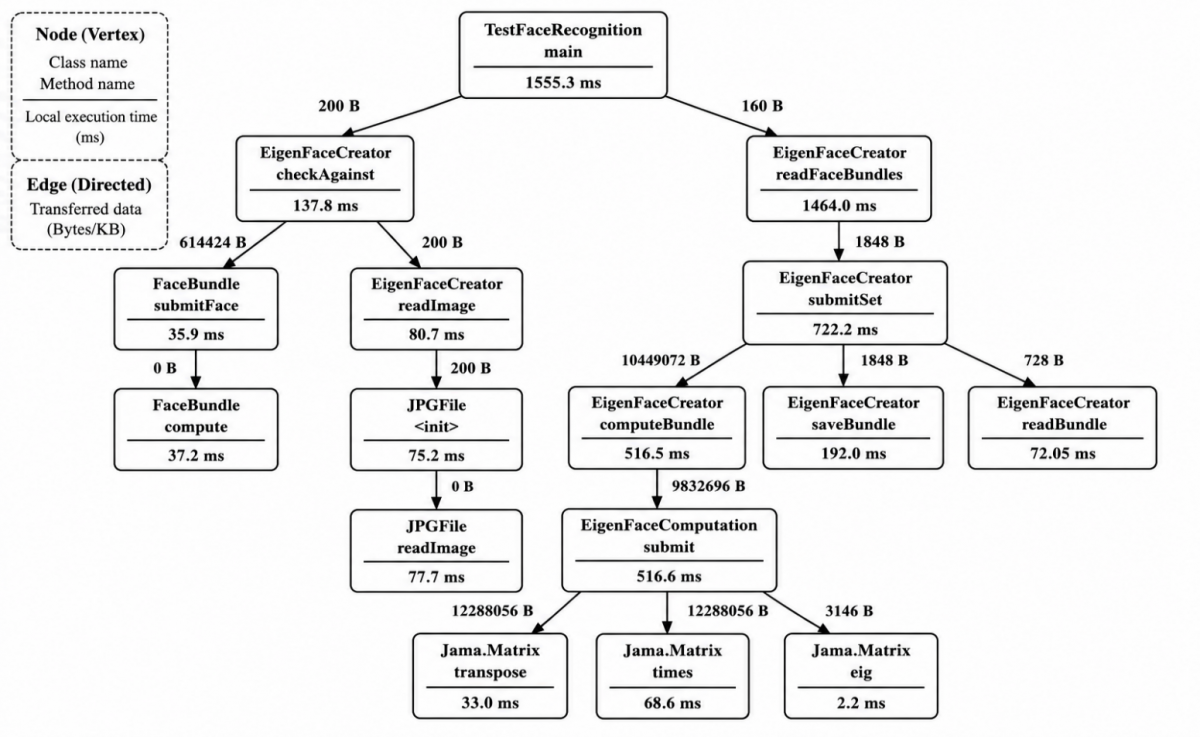
Static analysis and dynamic profiling can be integrated to create the weighted communication graph (WCG) of an application. We utilize a face recognition application used in studies [11, 14] represented as a call graph (Figure 4). By dividing the local estimated execution time by the speedup factor (F), we may derive the remote estimated execution time. The communication cost between the mobile device and the server is calculated by dividing the data transmission by the bandwidth (B) when a task is offloaded to the server. This provides all the information required to construct the WCG, including transmission and remote execution costs [11, 18]. We evaluated the ERSO algorithm’s performance through experiments conducted under seven different configurations of the speedup factor (F) and bandwidth (B). The values of PL, PR, and PCom are fixed to 0.9, 0.3, and 13 watts, respectively [11, 18].
Figure 4. A call graph for the face recognition application constructed [14]
The following configurations were considered (Table 7). These configurations make it possible to examine the ERSO algorithm’s flexibility in different computing and network environments.
Table 7. Configurations used for experimental analysis
|
S |
Parameters |
Description |
|
|
F |
B |
||
|
1 |
20 |
10 |
Simulates a mid-tier cloud server accessed over a moderate network connection |
|
2 |
30 |
3 |
Integrates high computational power accessed over a poor network connection |
|
3 |
30 |
10 |
Simulates a high-performance cloud server accessed over a moderate network connection |
|
4 |
30 |
100 |
Simulates a high-performance cloud server accessed over a fast network connection |
|
5 |
5 |
3 |
Low-performance cloud server with a poor network connection |
|
6 |
5 |
20 |
Low-performance cloud server with a decent network connection |
|
7 |
5 |
100 |
Low-performance cloud server with a high-speed network connection |
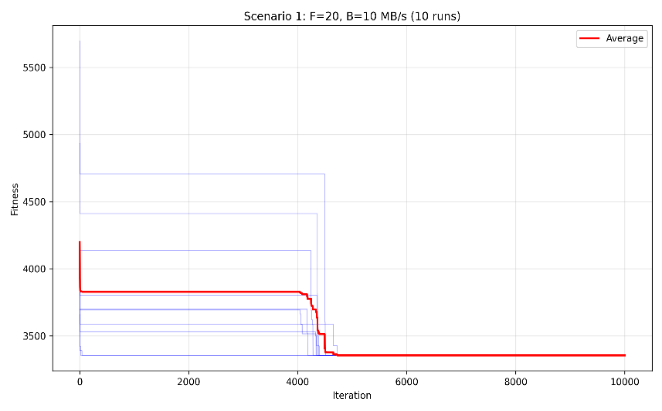
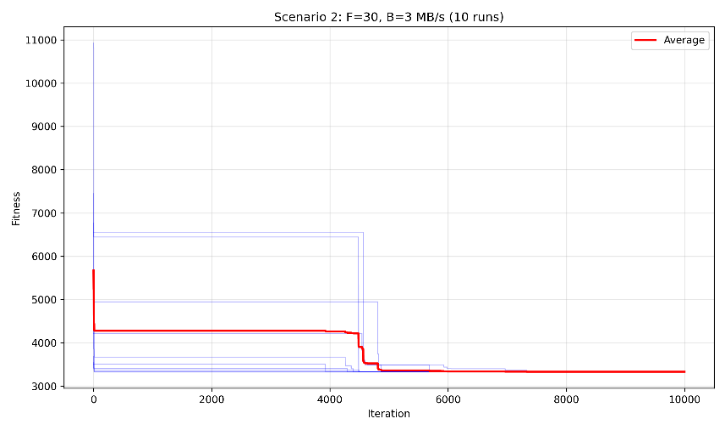
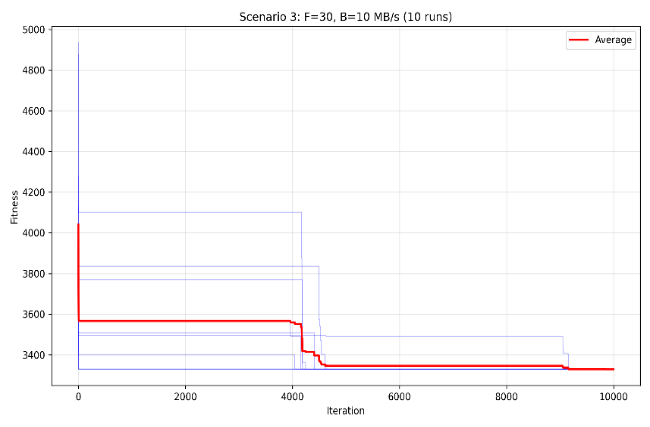
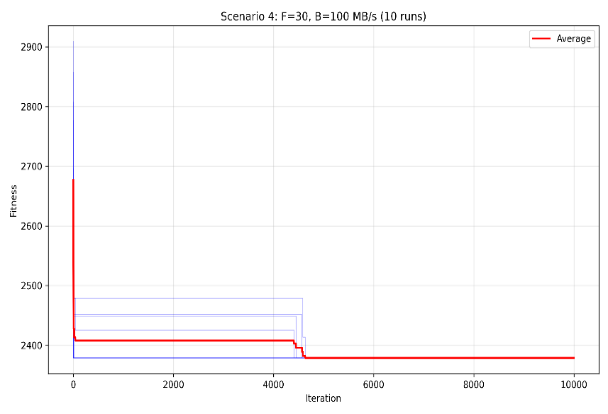
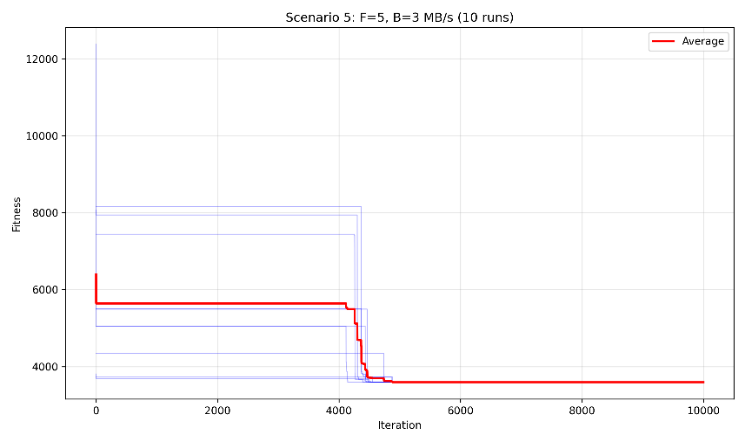
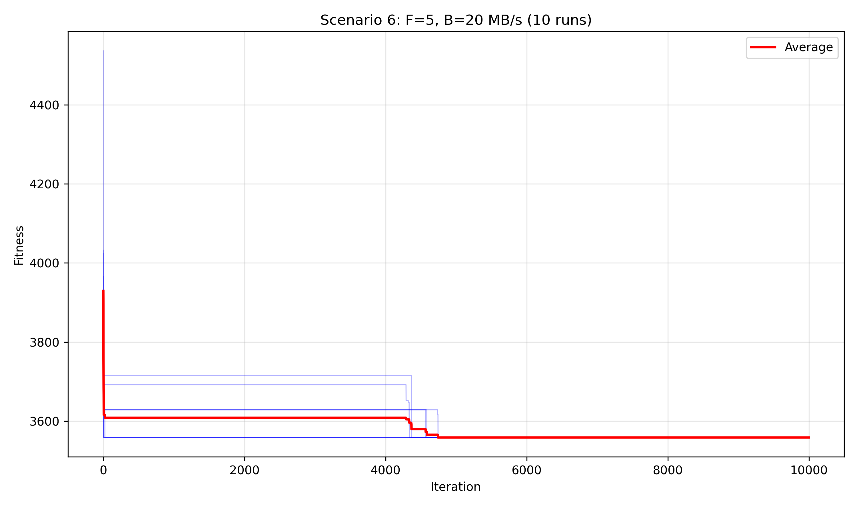
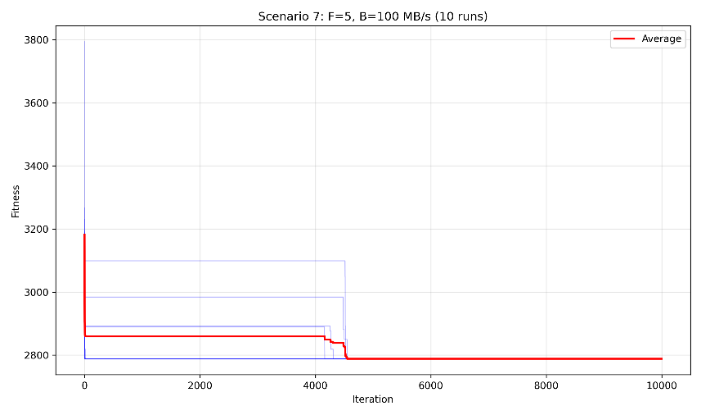
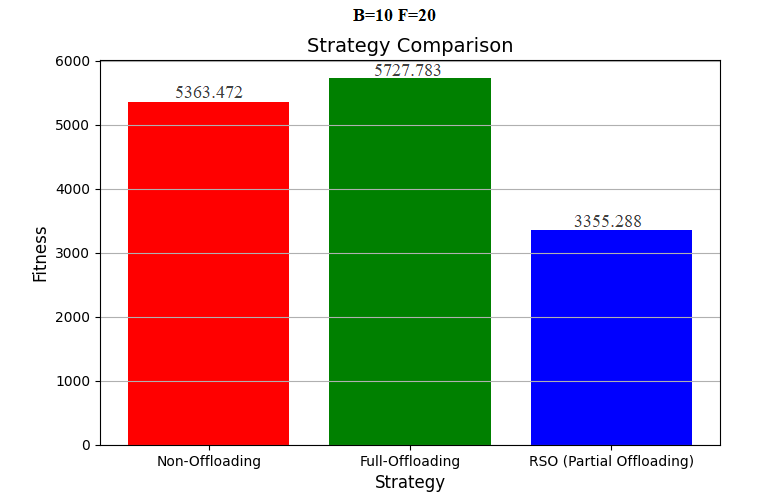
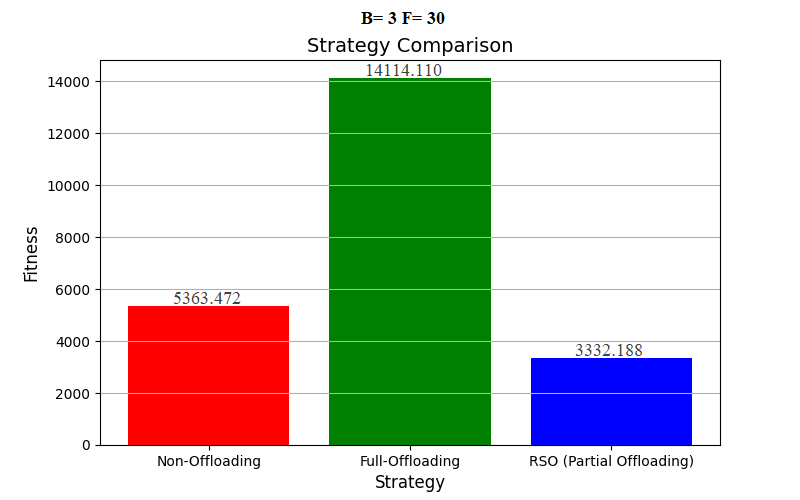
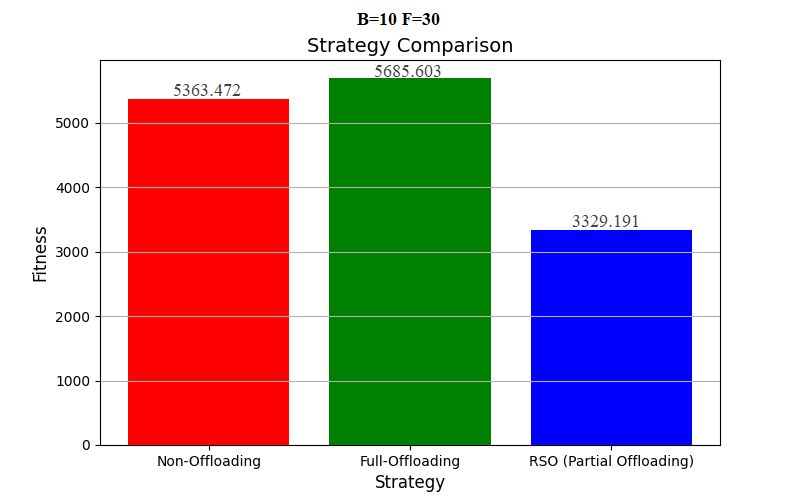
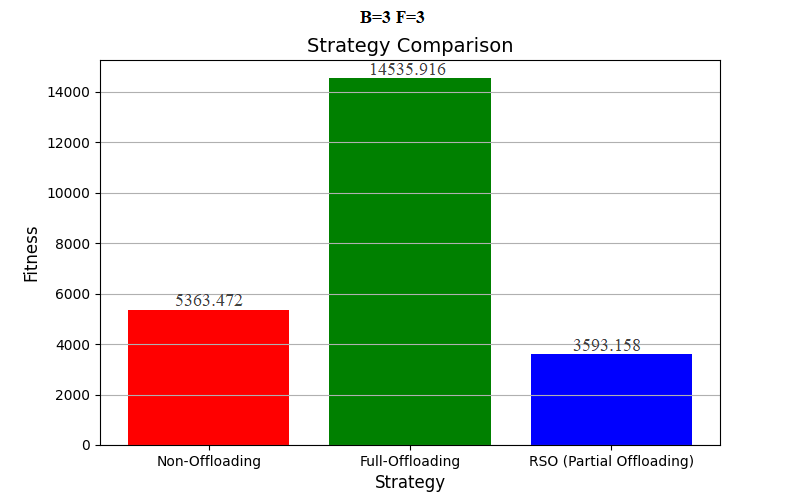
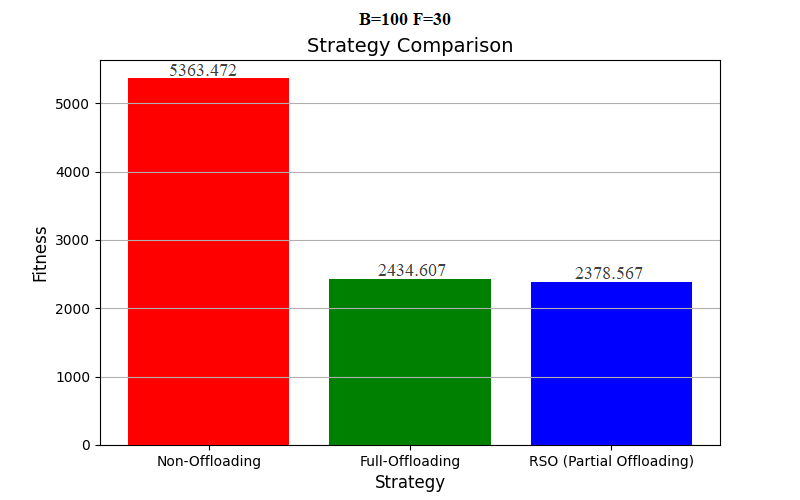
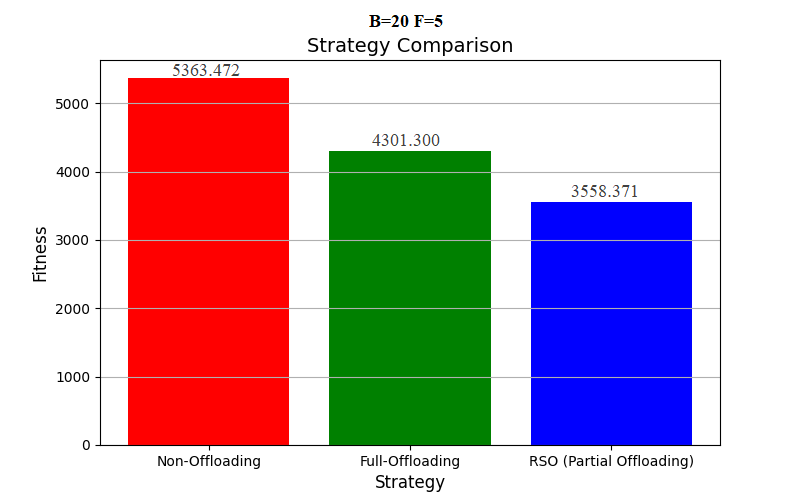
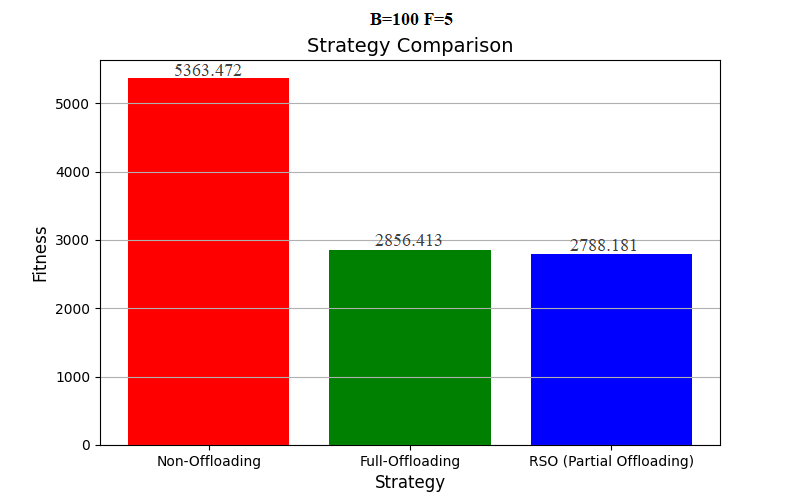
The experimental results were evaluated according to the fitness values, which include the execution time and energy consumption, with various weights (0.6 and 0.4, respectively) for the three offloading strategies: non-offloading, full offloading, and partial offloading using ERSO. These strategies serve as benchmarks to evaluate the algorithm's ability to achieve an optimal equilibrium between computational performance and resource utilization. A simulation was performed using the WCG (Figure 5) where twenty search rats (agents) were employed across 10000 search iterations. We have obtained different results under the different configurations (Table 8). The results of partitioning and fitness will change as B or F changes. The executions were repeated ten times (Figure 6) for each couple of parameters’ values (B and F) using the ERSO.
Table 8. Fitness results under different configurations
|
S |
Comparison |
Fitness Value |
Gain (%) |
Discussion |
|
1 |
ERSO vs. NO |
3355.288 vs. 5363.472 |
37.46 |
In this balanced scenario, ERSO outperforms both NO and FO. The moderate speedup and bandwidth allow the ERSO algorithm to effectively balance local and remote execution, minimizing energy consumption and execution time. FO struggles due to communication overhead, while NO suffers from the mobile device’s limited resources. |
|
ERSO vs. FO |
3355.288 vs. 5727.783 |
41.42 |
||
|
2 |
ERSO vs. NO |
3332.188 vs. 5363.472 |
37.86 |
Despite the high computational speedup, FO performs poorly due to the very low bandwidth, which significantly increases communication overhead. Partial Offloading excels by minimizing data transfer and leveraging local computation, demonstrating its adaptability to challenging network conditions. |
|
ERSO vs. FO |
3332.188 vs. 14114.110 |
76.39 |
||
|
3 |
ERSO vs. NO |
3329.191 vs. 5363.472 |
37.91 |
In this scenario, ERSO again outperforms both NO and FO. The high speed-up and moderate bandwidth allow FO to perform better than in Scenario 2, but it still underperforms compared to ERSO due to communication costs. |
|
ERSO vs. FO |
3329.191vs. 5685.603 |
41.43 |
||
|
4 |
ERSO vs. NO |
2378.567 vs. 5363.472 |
55.65 |
With high computational speedup and high bandwidth, FO performs nearly as well as ERSO. However, ERSO still achieves a slight improvement by optimizing task allocation and minimizing energy consumption. This scenario highlights the algorithm’s ability to leverage abundant resources effectively. |
|
ERSO vs. FO |
2378.567 vs. 2434.607 |
2.30 |
||
|
5 |
ERSO vs. NO |
3593.158 vs. 5363.472 |
33.00 |
In this challenging scenario, FO performs poorly due to both low speed-up and very low bandwidth. ERSO significantly outperforms both NO and FO by dynamically balancing local and remote execution, demonstrating its robustness in resource-constrained environments. |
|
ERSO vs. FO |
3593.158 vs. 14535.916 |
75.28 |
||
|
6 |
ERSO vs. NO |
3558.371 vs. 5363.472 |
33.66 |
With low computational speedup, FO struggles to achieve significant performance gains, even with moderate bandwidth. ERSO outperforms both strategies by optimizing task allocation and minimizing energy consumption. |
|
ERSO vs. FO |
3558.371 vs. 4301.300 |
17.27 |
||
|
7 |
ERSO vs. NO |
2788.181 vs. 5363.472 |
48.01 |
In this scenario, FO benefits from high bandwidth but is still limited by low computational speedup. ERSO achieves a slight improvement over FO and a significant improvement over NO, demonstrating its ability to adapt to varying resource conditions. |
|
ERSO vs. FO |
2788.181 vs. 2856.413 |
2.39 |
Note: ERSO: Enhanced Rat Swarm Optimization; NO: No offloading; FO: Full offloading.
Figure 5. Weighted communication graph (WCG) when F = 20 and B = 10 MB/s
As mentioned above, the partitioning fitness was tested with three strategies:
(1) Non-offloading: In this strategy, all methods are executed locally on the mobile device. While this approach reduces the communication overhead associated with data transfer to remote servers, it frequently results in longer execution times and higher energy consumption due to mobile devices' limited processing power and battery capacity. This strategy provides a baseline for determining the impact of no-task offloading on system performance.
(2) Full offloading: Here, all offloadable methods are executed on a remote server, utilizing the server's enhanced computational capabilities. This strategy substantially decreases local execution time and energy consumption by alleviating the computing load on the mobile device. The advantages of complete offloading depend on network conditions, as restricted bandwidth may negate the improvements in computational speed and efficiency
(3) Partial offloading: Partial offloading allocates methods across local and remote execution nodes according to the optimization results derived from the ERSO algorithm. This strategy dynamically identifies the appropriate partitioning of methods to reduce total execution time and energy costs, in contrast to the rigid strategies of non-offloading and full offloading. Partial offloading using the ERSO takes into account several considerations, such as the processing requirements of each method, communication overheads, and the unoffloadable nature of certain methods.
The effectiveness of the ERSO algorithm in achieving an optimal equilibrium between execution time and energy consumption is assessed through a comparison of different strategies. The gain for partial offloading (ERSO) is calculated compared to the non-offloading approach using the following formula:
$\begin{gathered}{Gain}(\%)= \frac{ { Fitness }( { Non.Offloading })- { Fitness }({ Partial\ Offloading })}{{ Fitness }( { Non-Offloading })} \times 100\end{gathered}$
The analysis for each configuration is summarized in Table 8. This gain underscores the effectiveness of the ERSO algorithm in balancing computational and communication costs, particularly in scenarios with moderate computational and network resources (Figure 7).
The comparison of all scenarios gives several important insights regarding the performance of the ERSO algorithm under a variety of different computational and network conditions. The insights presented here highlight the algorithm’s strengths and adaptability, as well as its ability to outperform the non-offloading and full offloading. The experimental results lead to several important observations regarding the performance of ERSO under different computational and network conditions:
(1) Partial offloading using ERSO outperforms non-offloading: The ERSO achieves considerable increases over non-offloading across all scenarios, with gains ranging from 33.00% to 55.65%. This illustrates the algorithm’s ability to effectively use the cloud resources while simultaneously decreasing the energy consumption and execution time.
(2) Partial offloading using ERSO outperforms full offloading in most scenarios: In scenarios with low to moderate bandwidth (B = 3, 10, 20 Mbps), the ERSO notably outperforms full offloading, with gains ranging from 17.27% to 76.39%. This highlights the algorithm’s ability to reduce communication costs and adjust to fluctuating network conditions.
(3) High bandwidth reduces the advantage of partial offloading: In high bandwidth scenarios (B = 100 Mbps), full offloading exhibits performance comparable to partial offloading, with gains of only 2.30% to 2.39%. Nonetheless, the ERSO still achieves slight enhancements through the optimization of method allocation.
(4) Low computational speedup limits full offloading: In scenarios with low computational speedup (F = 5), full offloading struggles to achieve significant performance gains, even with high bandwidth. The ERSO consistently outperforms full offloading in these scenarios.
(5) Robustness across diverse conditions: The ERSO algorithm demonstrates robustness and adaptability across a wide range of scenarios, from low-speedup, low-bandwidth conditions to high-speedup, high-bandwidth environments. This makes it a versatile solution for real-world MCC applications.
(6) Stability: Across all 10 executions, the algorithm consistently converges to similar fitness values, indicating its robustness and reliability.
The results across all scenarios demonstrate the ability of the ERSO algorithm in optimizing CO in MCC. By dynamically balancing local and remote execution, the algorithm achieves significant improvements in energy efficiency and execution time, even under challenging conditions. These findings validate the ERSO algorithm as a powerful tool for energy-efficient CO in MCC.
4.2 Enhanced Rat Swarm Optimization algorithm vs. min-cut algorithm
When the ERSO algorithm combines principles of swarm intelligence with specific enhancements such as diverse initial population generation, enhanced mutation targeting weaker solutions, and dynamic parameter tuning, the min-cut algorithm [14] is a graph-based optimization approach that partitions tasks based on WCG. Tasks are assigned to local or remote execution nodes by minimizing the “cut” cost, which considers execution and communication costs. Both approaches balance execution time and energy consumption to determine the optimal partitioning of tasks between local and remote execution. Table 9 demonstrates a simple comparison between the two approaches when B = 10, F = 20.
Table 9. Enhanced Rat Swarm Optimization (ERSO) approach vs. min-cut approach
|
Approach |
Fitness Value |
Gain over NO |
Gain over FO |
|
ERSO |
3355.288 |
37.46 |
41.42 |
|
Min-cut [14] |
3804.3102 |
29.07 |
33.59 |
Note: NO: No offloading; FO: Full offloading.
As shown in Table 9, ERSO achieves superior performance with the lowest fitness value (3355.288), indicating superior performance in optimizing the trade-off between execution time and energy consumption. It achieves a 37.46% improvement over non-offloading and a 41.42% improvement over full offloading, significantly outperforming the min-cut algorithm. min-cut performs well but lags behind ERSO.
The min-cut algorithm achieves a fitness value of 3804.310, with gains of 29.07% over non-offloading and 33.59% over full offloading. However, it is less effective than ERSO due to its reliance on static partitioning decisions and lack of adaptive mechanisms. ERSO’s dynamic method partitioning and adaptive mechanisms allow it to outperform both non-offloading and full offloading by a significant margin. Its ability to explore diverse solutions and avoid local optima contributes to its superior performance. The diverse initial population and targeted mutation ensure a comprehensive exploration of the solution space, reducing the likelihood of suboptimal convergence. The fitness of 3355.288 showcases its balanced approach to minimizing execution time and energy consumption. While the min-cut algorithm lacks the adaptive mechanisms of ERSO, it still performs well due to its effective task partitioning based on WCGs. The gains of 29.07% over non-offloading and 33.59% over full offloading indicate that min-cut can serve as a viable alternative when computational simplicity and speed are prioritized. However, it is less effective than ERSO in a complex and dynamic MCC environment.
4.3 Enhanced Rat Swarm Optimization algorithm vs. standard Rat Swarm Optimization, Particle Swarm Optimization and Genetic Algorithms
The min-cut approach offers a simpler and faster heuristic method for task offloading. To further validate the effectiveness of the proposed ERSO algorithm, its performance was compared with three widely used binary metaheuristic algorithms: Standard RSO, PSO, and GA.
All experiments were conducted 10 times for each scenario (F, B) to ensure statistical significance. For each algorithm and scenario, we report:
•Mean fitness: The average fitness value over 10 runs.
•Standard deviation: A measure of the algorithm’s stability. A low standard deviation indicates that the algorithm consistently finds similar solutions, while a high standard deviation indicates instability. It is calculated using the sample standard deviation formula:
$\sigma=\sqrt{\frac{\sum_{i=1}^n\left(x_i-\bar{x}\right)^2}{n-1}}$
where, $x_i$ is the result of the i-th run (e.g., fitness value), $\bar{x}$ is the mean of all results, n = 10 is the number of runs
Best Iteration (mean ± standard deviation): The average iteration at which the algorithm first found its best fitness, measuring convergence speed.
Table 10. Comparison of Enhanced Rat Swarm Optimization (ERSO), Rat Swarm Optimization (RSO), Particle Swarm Optimization (PSO), and Genetic Algorithms (GA) on the 16-node weighted communication graph (WCG)
|
S |
Algorithms |
Fitness Value |
Remote (Mean ± Standard Deviation) |
Best Iteration (Mean ± Standard Deviation) |
|
S1 |
GA |
3355.29 ± 0.00 |
10.00 ± 0.00 |
9 ± 3 |
|
PSO |
3355.29 ± 0.00 |
10.00 ± 0.00 |
10 ± 6 |
|
|
RSO |
3479.88 ± 143.58 |
8.30 ± 1.77 |
9 ± 4 |
|
|
ERSO |
3371.34 ± 50.75 |
9.80 ± 0.63 |
493 ± 339 |
|
|
S2 |
GA |
3332.19 ± 0.00 |
10.00 ± 0.00 |
17 ± 15 |
|
PSO |
3332.19 ± 0.00 |
10.00 ± 0.00 |
11 ± 3 |
|
|
RSO |
3765.32 ± 494.01 |
5.50 ± 1.43 |
7 ± 6 |
|
|
ERSO |
3403.94 ± 80.80 |
9.10 ± 0.99 |
339 ± 236 |
|
|
S3 |
GA |
3329.19 ± 0.00 |
10.00 ± 0.00 |
13 ± 12 |
|
PSO |
3329.19 ± 0.00 |
10.00 ± 0.00 |
11 ± 4 |
|
|
RSO |
3458.96 ± 169.21 |
8.30 ± 2.06 |
10 ± 6 |
|
|
ERSO |
3361.71 ± 68.55 |
9.60 ± 0.84 |
436 ± 413 |
|
|
S4 |
GA |
2378.57 ± 0.00 |
12.00 ± 0.00 |
8 ± 3 |
|
PSO |
2378.57 ± 0.00 |
12.00 ± 0.00 |
11 ± 4 |
|
|
RSO |
2419.97 ± 58.73 |
10.90 ± 1.10 |
7 ± 4 |
|
|
ERSO |
2378.97 ± 0.85 |
11.80 ± 0.42 |
304 ± 259 |
|
|
S5 |
GA |
3593.16 ± 0.00 |
10.00 ± 0.00 |
12 ± 5 |
|
PSO |
3593.16 ± 0.00 |
10.00 ± 0.00 |
12 ± 2 |
|
|
RSO |
3929.79 ± 449.36 |
6.50 ± 2.68 |
12 ± 9 |
|
|
ERSO |
3649.85 ± 73.19 |
9.20 ± 1.03 |
410 ± 238 |
|
|
S6 |
GA |
3558.37 ± 0.00 |
11.00 ± 0.00 |
7 ± 3 |
|
PSO |
3558.37 ± 0.00 |
11.00 ± 0.00 |
10 ± 3 |
|
|
RSO |
3682.40 ± 145.22 |
9.20 ± 2.10 |
7 ± 6 |
|
|
ERSO |
3558.37 ± 0.00 |
11.00 ± 0.00 |
199 ± 334 |
|
|
S7 |
GA |
2788.18 ± 0.00 |
12.00 ± 0.00 |
8 ± 4 |
|
PSO |
2788.18 ± 0.00 |
12.00 ± 0.00 |
9 ± 4 |
|
|
RSO |
2861.84 ± 78.76 |
10.70 ± 1.16 |
6 ± 3 |
|
|
ERSO |
2788.18 ± 0.00 |
12.00 ± 0.00 |
284 ± 240 |
Table 10 presents the results for all seven scenarios. From the table, we can observe that:
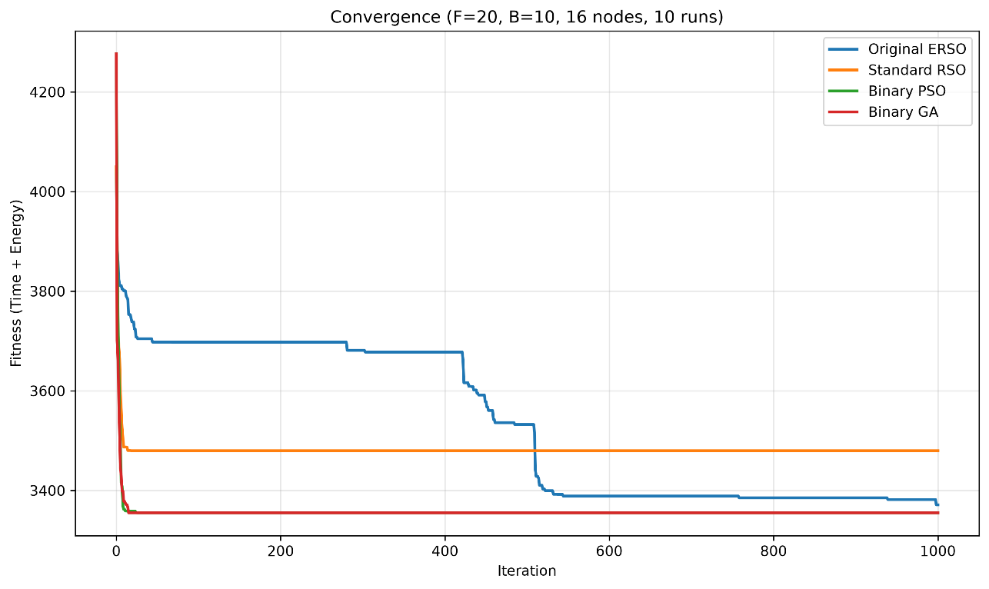
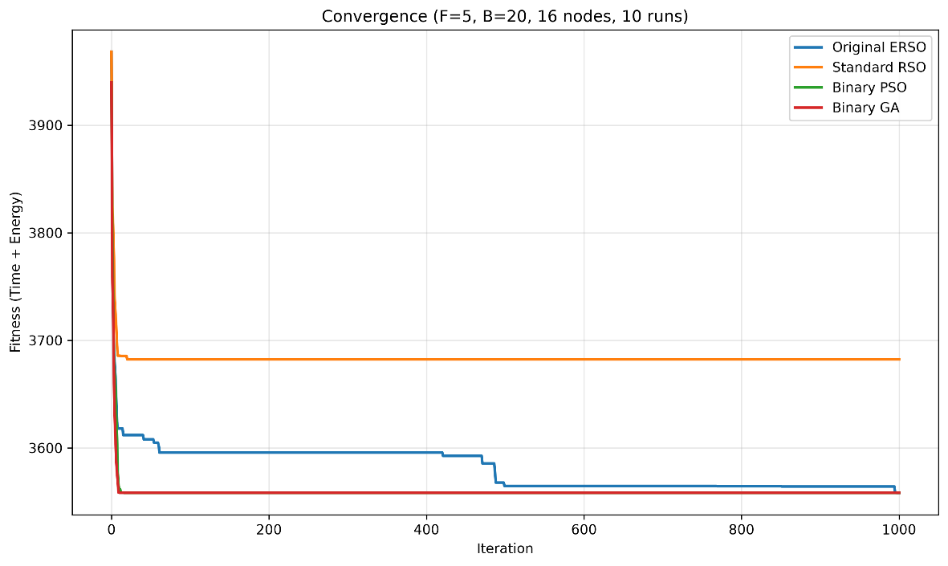
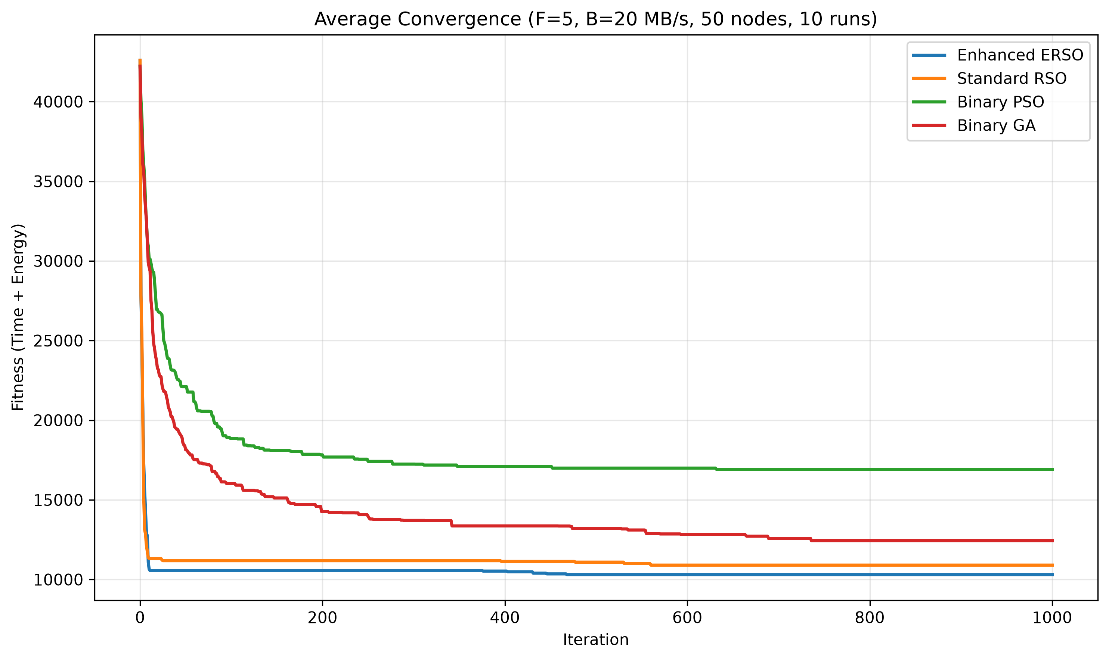
• GA and PSO consistently achieve the optimal fitness with zero standard deviation across all scenarios. This confirms that the 16-node problem is simple enough for these algorithms to reliably find the global optimum (Figure 8). On the other hand, ERSO achieves the same optimal fitness as GA and PSO in Scenarios 1, 3, 4, 6, and 7 (Figure 9). In Scenarios 2 and 5, ERSO achieves fitness values close to the optimal values. This demonstrates that ERSO is a reliable algorithm that consistently finds near-optimal solutions.
Figure 8. Convergence curves of Enhanced Rat Swarm Optimization (ERSO), Rat Swarm Optimization (RSO), Particle Swarm Optimization (PSO), and Genetic Algorithms (GA) on the 16-node weighted communication graph (WCG) under balanced conditions (F = 20, B = 10)
Figure 9. Convergence curves of Enhanced Rat Swarm Optimization (ERSO), Rat Swarm Optimization (RSO), Particle Swarm Optimization (PSO), and Genetic Algorithms (GA) on the 16-node weighted communication graph (WCG) under balanced conditions (F = 5, B = 20)
• Standard RSO shows high variability, with fitness standard deviations ranging from 58.73 (Scenario 4) to 494.01 (Scenario 2). In many runs, RSO gets stuck in suboptimal solutions, confirming that the standard algorithm lacks the robustness of ERSO. GA and PSO converge extremely fast (8–17 iterations on average), which is expected for simple problems. ERSO takes longer to converge (100–500 iterations) because it explores the search space more thoroughly. This is a trade-off between convergence speed and robustness.
• ERSO consistently offloads a similar number of methods as GA and PSO (9–12 remote methods), while Standard RSO often offloads fewer methods (5–8 remote methods), especially in challenging scenarios. This indicates that ERSO makes more informed offloading decisions.
• From the previous experiments, we can conclude that the 16-node WCG is a relatively simple problem where all algorithms can find the global optimum. To demonstrate the scalability and superiority of ERSO, we need a more complex problem. The 50-node problem has a search space of 250 $\approx$ 1.12 × 10¹⁵ possible partitions, making it impossible for simple algorithms to explore exhaustively. In our work, a 50-node WCG was generated synthetically using a realistic model:
• Execution times: Heavy-tailed distribution (scale parameter = 150 ms) with 15% of nodes designated as “heavy” (800–3500 ms) and 10% as “light” (2–15 ms), mimicking real mobile applications.
• Communication costs: A sparse directed graph with 6% edge density, where each edge has a data transfer size between 100 bytes and 50 MB.
• Structure: The graph follows a pipeline structure with additional branches, similar to real mobile application call graphs.
Table 11 presents the results for all the scenarios, where each scenario was run 10 times.
Table 11. Comparison of Enhanced Rat Swarm Optimization (ERSO), Rat Swarm Optimization (RSO), Particle Swarm Optimization (PSO), and Genetic Algorithms (GA) on the 50-node weighted communication graph (WCG)
|
S |
Algorithms |
Fitness Value |
Remote (Mean ± Standard Deviation) |
Best Iteration (Mean ± Standard Deviation) |
|
S1 |
GA |
17930.55 ± 4717.82 |
20.00 ± 16.17 |
451 ± 255 |
|
PSO |
28448.41 ± 4031.18 |
22.50 ± 10.61 |
211 ± 104 |
|
|
RSO |
11928.53 ± 1790.70 |
38.20 ± 19.61 |
278 ± 237 |
|
|
ERSO |
11928.53 ± 1790.70 |
38.20 ± 19.61 |
202 ± 227 |
|
|
S2 |
GA |
53202.43 ± 16568.71 |
22.40 ± 12.13 |
543 ± 302 |
|
PSO |
79257.70 ± 14595.21 |
22.30 ± 9.04 |
316 ± 180 |
|
|
RSO |
15029.95 ± 0.00 |
0.00 ± 0.00 |
271 ± 232 |
|
|
ERSO |
15029.95 ± 0.00 |
0.00 ± 0.00 |
280 ± 237 |
|
|
S3 |
GA |
19579.36 ± 5445.93 |
26.40 ± 13.87 |
614 ± 256 |
|
PSO |
25386.63 ± 6526.69 |
23.60 ± 13.25 |
178 ± 114 |
|
|
RSO |
11995.83 ± 2502.15 |
28.50 ± 23.89 |
216 ± 216 |
|
|
ERSO |
11776.79 ± 1854.56 |
38.20 ± 19.61 |
100 ± 194 |
|
|
S4 |
GA |
1455.01 ± 0.00 |
47.00 ± 0.00 |
299 ± 168 |
|
PSO |
2793.19 ± 590.73 |
42.00 ± 2.21 |
292 ± 213 |
|
|
RSO |
1538.11 ± 75.08 |
47.40 ± 0.70 |
108 ± 198 |
|
|
ERSO |
1560.71 ± 72.94 |
47.70 ± 0.48 |
56 ± 149 |
|
|
S5 |
GA |
46157.78 ± 22112.54 |
25.20 ± 17.14 |
274 ± 208 |
|
PSO |
69469.65 ± 19265.44 |
21.70 ± 13.72 |
316 ± 184 |
|
|
RSO |
15029.95 ± 0.00 |
0.00 ± 0.00 |
334 ± 225 |
|
|
ERSO |
15029.95 ± 0.00 |
0.00 ± 0.00 |
278 ± 202 |
|
|
S6 |
GA |
12443.78 ± 2928.95 |
31.90 ± 10.86 |
387 ± 237 |
|
PSO |
16913.93 ± 2870.55 |
28.80 ± 8.85 |
276 ± 166 |
|
|
RSO |
10906.31 ± 3970.71 |
24.20 ± 24.04 |
248 ± 253 |
|
|
ERSO |
10309.57 ± 3692.54 |
29.10 ± 23.33 |
227 ± 233 |
|
|
S7 |
GA |
3317.93 ± 0.00 |
47.00 ± 0.00 |
309 ± 232 |
|
PSO |
4710.79 ± 556.97 |
42.50 ± 2.95 |
311 ± 252 |
|
|
RSO |
3380.54 ± 80.82 |
47.40 ± 0.52 |
109 ± 208 |
|
|
ERSO |
3372.21 ± 71.43 |
47.00 ± 0.67 |
267 ± 258 |
On the 50-node graph, GA and PSO show very high fitness values and large standard deviations. In most Scenarios, GA and PSO achieve a fitness lower than the ERSO. This confirms that simple metaheuristics struggle with complex, high-dimensional problems. In Scenarios 1, 2, 5, and 6, ERSO achieves the same optimal fitness as RSO. However, in Scenario 3, ERSO achieves 11776.79 ± 1854.56 vs. RSO’s 11995.83 ± 2502.15. In Scenario 6 (F = 5, B = 20), ERSO achieves 10309.57 ± 3692.54 vs. RSO’s 10906.31 ± 3970.71. This shows ERSO’s ability to find better solutions to complex problems. Scenario 6 (Figure 10) represents a low- performance server (F = 5) and moderate bandwidth (20 MB/s). GA achieves 12443.78, PSO achieves 16913.93, RSO achieves 10906.31, while ERSO achieves the lowest fitness of 10309.57. This is a significant 5.5% improvement over RSO and 17% over GA. Scenario 4 is the one with high resources. With high speed-up and high bandwidth, all algorithms perform well. GA achieves the optimal fitness (1455.01 ± 0.00), while ERSO achieves 1560.71 ± 72.94. This is expected because high bandwidth and high speed-up make the offloading decision trivial. For the worst-case scenario (F = 5, B = 3) with low speed-up and low bandwidth, GA and PSO had the worst fitness (46157.78 and 69469.65) (Figure 11). ERSO and RSO both achieved 15029.95 ± 0.00 (keeping all methods local), which is the optimal decision under these conditions. A standard deviation of 0.00 means the algorithm is stable; it consistently finds the optimal solution. This result for ERSO demonstrates reliability.
Figure 10. Convergence curves of Enhanced Rat Swarm Optimization (ERSO), Rat Swarm Optimization (RSO), Particle Swarm Optimization (PSO), and Genetic Algorithms (GA) on the 50-node weighted communication graph (WCG) under challenging conditions (F = 5, B = 20)
Figure 11. Convergence curves of Enhanced Rat Swarm Optimization (ERSO), Rat Swarm Optimization (RSO), Particle Swarm Optimization (PSO), and Genetic Algorithms (GA) on the 50-node weighted communication graph (WCG) under challenging conditions (F = 5, B = 3)
The higher standard deviation of RSO shows that it is unreliable and may require more runs to achieve the optimum. The standard deviations on the 50-node graph are larger than on the 16-node graph for all algorithms, reflecting the increased complexity of the search space. However, ERSO consistently achieves lower fitness values than the other algorithms, demonstrating its superior scalability and robustness (Figure 12).
Figure 12. Fitness comparison of Enhanced Rat Swarm Optimization (ERSO), Rat Swarm Optimization (RSO), Particle Swarm Optimization (PSO), and Genetic Algorithms (GA) across all 7 scenarios on the 50-node weighted communication graph (WCG)
This study presented an ERSO algorithm for intelligent and dynamic task offloading in MCC environments. Unlike conventional approaches that depend on static heuristics or deterministic partitioning, ERSO introduces a swarm intelligence-based optimization framework that adapts to changing conditions such as bandwidth variability and server load. Our approach effectively identifies optimal execution points for mobile applications by balancing energy consumption and execution time through modeling the CO process as a bi-objective optimization problem and enhancing the standard RSO algorithm with adaptive learning strategies.
Experimental results demonstrated that ERSO significantly outperforms classical offloading methods in energy savings, particularly under highly dynamic network conditions. Extensive experiments conducted on both 16-node and 50-node application graphs, under network bandwidths ranging from 3 to 100 Mbps and cloud speedup factors ranging from 5 to 30, confirmed the robustness and effectiveness of the proposed approach. Compared with the non-offloading, full offloading, and min-cut approach, as well as GA, PSO, and the standard RSO, ERSO consistently achieved superior performance in terms of overall fitness, energy consumption, and response time. In particular, under the most challenging network conditions (3 Mbps bandwidth and a cloud speedup factor of 5), the proposed algorithm achieved up to a 33% improvement in fitness over the non-offloading baseline, demonstrating its ability to maintain efficient task allocation even in adverse MCC environments.
Furthermore, ERSO shows strong convergence performance and avoids the premature convergence and local minima limitations observed in earlier RSO-based algorithms. The proposed adaptive enhancements effectively balance exploration and exploitation throughout the optimization process, resulting in improved solution quality and greater robustness under dynamic execution conditions. These findings demonstrate that ERSO constitutes a reliable and scalable optimization framework for CO in MCC.
Several directions can further improve the ERSO approach:
•Task parallelism and multi-objective offloading: Future extensions may explore the simultaneous offloading of multiple interdependent tasks, considering parallel execution across edge/cloud nodes and multi-core mobile devices.
•Hybrid optimization models: Combining ERSO with other bio-inspired optimization techniques or deep learning methods could lead to hybrid frameworks capable of learning optimal offloading strategies in real time.
•Real-world deployment: Building a real MCC simulation platform or deploying ERSO in practical mobile and edge-cloud applications will enable a more comprehensive evaluation under realistic operating conditions.
•Scalability studies: Investigating ERSO's behavior in larger and more heterogeneous environments, involving numerous users, applications, and computational tasks, is essential to further validate its scalability and robustness.
•Security and privacy constraints: Since CO often involves transmitting sensitive data, integrating privacy-preserving mechanisms and incorporating security overhead into the fitness function would further enhance the algorithm's practical applicability. In addition, considering quality of service requirements, such as latency guarantees, reliability, resource availability, and user mobility, represents a promising direction for extending the proposed framework to next-generation mobile cloud and edge computing systems.
Overall, the proposed ERSO algorithm provides an effective, adaptive, and scalable solution for CO in MCC by achieving a balanced trade-off between energy efficiency, response time, and computational performance. The encouraging experimental results demonstrate its potential for deployment in dynamic real-world MCC environments and establish a solid foundation for future research on intelligent resource management and CO strategies.
|
G = (V, E) |
Application call graph |
|
V = {v1, ..., vn} |
Set of methods (Vertices) |
|
E = {(vi, vj)} |
Communication dependencies (Edges) |
|
Li |
Local execution cost of vi |
|
Ri |
Remote execution cost of vi |
|
Cij |
Communication cost between vi and vj |
|
B |
Network bandwidth |
|
F |
Cloud speedup factor |
|
PL |
Power consumption for local execution |
|
PR |
Power consumption during remote execution |
|
PCom |
Power consumption for data transfer during communication |
|
TLocal |
Total local execution time |
|
TRemote |
Total remote execution time |
|
TCom |
Total communication time |
|
TTotal |
Total execution time |
|
E |
Total energy consumption |
|
wt |
Weight for execution time |
|
we |
Weight for energy consumption |
|
U(−0.1, 0.1) |
A uniform perturbation in the range [−0.1, 0.1]. |
|
Mrandom |
Random matrix |
|
x |
Current iteration number |
|
maxiteration |
Maximum iterations |
|
nbagents |
Number of agents (Particles) |
|
Pi |
Position of agent i |
|
Gbest |
Global best solution |
|
Pbest |
Personal best for agent i |
|
A, C |
Adaptive parameters in RSO |
|
R |
Random value in [1, 5] |
|
rand() |
Random value in [0, 1] |
[1] BankMyCell. (2025). How many phones are in the world? https://www.bankmycell.com/blog/how-many-phones-are-in-the-world, accessed on 5 Jun. 2026.
[2] Greenspector. (2019). Energy consumption of the 30 most popular mobile apps in the world. https://greenspector.com/en/energy-consumption-of-the-30-most-popular-mobile-apps-in-the-world/, accessed on 5 Jun. 2026.
[3] Yan, J.Q., He, F., Sang, Q.L., et al. (2025). Metadata-guided adaptable frequency scaling across heterogeneous applications and devices. arXiv preprint, arXiv: 2509.22707. https://doi.org/10.48550/arXiv.2509.22707
[4] Qualcomm. (2024). Faster performance, longer battery life and new features: How the NPU will turbocharge your next laptop. https://www.qualcomm.com/news/onq/2024/09/faster-performance-longer-battery-life-how-the-npu-will-turbocharge-next-laptop.
[5] Embedded. (2025). AI accelerators in embedded systems. https://www.embedded.com/ai-accelerators-in-embedded-systems/.
[6] Flexxon. (2025). eMMC vs SSD vs UFS: Storage comparison guide. https://www.flexxon.com/emmc-vs-ssd-vs-ufs-storage-comparison-guide/.
[7] Tadesse, S.S., Chiasserini, C.F., Malandrino, F. (2018). Characterizing the power cost of virtualization environments. Transactions on Emerging Telecommunications Technologies, 29(8): e3462. https://doi.org/10.1002/ett.3462
[8] Mohapatra, S., Dutt, N., Nicolau, A., Venkatasubramanian, N. (2007). DYNAMO: A cross-layer framework for end-to-end QoS and energy optimization in mobile handheld devices. IEEE Journal on Selected Areas in Communications, 25(4): 722-737. https://doi.org/10.1109/JSAC.2007.070509
[9] Rumanyika, J., Ponera, J. (2026). Awareness and practices on smartphone battery drainage: A cross-sectional study in Dodoma city higher education institutions, Tanzania. Direct Research Journal of Engineering and Information Technology, 14(1): 27-37. https://www.ajol.info/index.php/drjeit/article/view/316291.
[10] Solar energy harvesting for scalable IoT: Practical guide from industry experts at the things conference. (2025). The Things Net Work. https://www.thethingsnetwork.org/article/solar-energy-harvesting-for-scalable-iot-practical-guide-from-industry-experts-at-the-things-conference.
[11] De, D. (2016). Mobile Cloud Computing: Architectures, Algorithms and Applications. CRC Press.
[12] Chun, B.G., Ihm, S., Maniatis, P., Naik, M., Patti, A. (2011). Clonecloud: Elastic execution between mobile device and cloud. In Proceedings of the sixth conference on Computer systems (EuroSys '11). Association for Computing Machinery, New York, NY, USA, pp. 301-314. https://doi.org/10.1145/1966445.1966473
[13] Kumar, K., Liu, J., Lu, Y. H., Bhargava, B. (2013). A survey of computation offloading for mobile systems. Mobile Networks and Applications, 18(1): 129-140. https://doi.org/10.1007/s11036-012-0368-0
[14] Wu, H.M., Knottenbelt, W.J., Wolter, K. (2019). An efficient application partitioning algorithm in mobile environments. IEEE Transactions on Parallel and Distributed Systems, 30(7): 1464-1480. https://doi.org/10.1109/TPDS.2019.2891695
[15] Ou, S., Yang, K., Liotta, A. (2006). An adaptive multi-constraint partitioning algorithm for offloading in pervasive systems. In Fourth Annual IEEE International Conference on Pervasive Computing and Communications (PERCOM’06), Pisa, Italy, pp. 125-134. https://doi.org/10.1109/PERCOM.2006.7
[16] Zhang, Y., Liu, H., Jiao, L., Fu, X.M. (2012). To offload or not to offload: An efficient code partition algorithm for mobile cloud computing. In 2012 IEEE 1st International Conference on Cloud Networking (CLOUDNET), Paris, pp. 80-86. https://doi.org/10.1109/CloudNet.2012.6483660
[17] Chen, J., Leng, Y.J., Huang, J.W. (2023). An intelligent approach of task offloading for dependent services in mobile edge computing. Journal of Cloud Computing, 12(1): 107. https://doi.org/10.1186/s13677-023-00477-9
[18] De Figueiredo, C.M.H. (2011). The P versus NP-complete dichotomy of some challenging problems in graph theory. Discrete Applied Mathematics, 160(18): 2681-2693. https://doi.org/10.1016/j.dam.2010.12.014
[19] Gu, F., Niu, J.W., Qi, Z.P., Atiquzzaman, M. (2018). Partitioning and offloading in smart mobile devices for mobile cloud computing: State of the art and future directions. Journal of Network and Computer Applications, 119: 83-96. https://doi.org/10.1016/j.jnca.2018.06.009
[20] Rahab, H., Haouassi, H., Souidi, M.E.H., Bakhouche, A., Mahdaoui, R., Bekhouche, M. (2023). A modified binary Rat Swarm Optimization algorithm for feature selection in Arabic sentiment analysis. Arabian Journal for Science and Engineering, 48: 10125-10152. https://doi.org/10.1007/s13369-022-07466-1
[21] Chandran, V., Mohapatra, P. (2024). A novel multi-strategy ameliorated quasioppositional chaotic tunicate swarm algorithm for global optimization and constrained engineering applications. Heliyon, 10(10): 30757. https://doi.org/10.1016/j.heliyon.2024.e30757
[22] Satyanarayanan, M., Bahl, P., Caceres, R., Davies, N. (2009). The case for vm-based cloudlets in mobile computing. IEEE Pervasive Computing, 8(4): 14-23. https://doi.org/10.1109/MPRV.2009.82
[23] Chun, B.G., Maniatis, P. (2009). Augmented smartphone applications through clone cloud execution. In Proceedings of the 12th Workshop on Hot Topics in Operating Systems (HotOS), pp. 8-11. https://www.usenix.org/legacy/events/hotos09/tech/full_papers/chun/chun.pdf.
[24] Zhao, B., Xu, Z., Chi, C.X., Zhu, S.C., Cao, G.H. (2011). Mirroring smartphones for good: A feasibility study. In Mobile and Ubiquitous Systems: Computing, Networking, and Services, pp. 26-38. https://doi.org/10.1007/978-3-642-29154-8_3
[25] Sharma, R., Gagandeep, D. (2017). Computation offloading in mobile cloud computing. International Journal of Current Trends in Science and Technology, 7(12): 20501-20510.
[26] Kemp, R., Palmer, N., Kielmann, T., Bal, H. (2010). Cuckoo: A computation offloading framework for smartphones. In Mobile Computing, Applications, and Services, pp. 59-79. https://doi.org/10.1007/978-3-642-29336-8_4
[27] Cuervo, E., Balasubramanian, A., Cho, D.K., et al. (2010). Maui: Making smartphones last longer with code offload. In Proceedings of the 8th International Conference on Mobile Systems, Applications, and Services (MobiSys), New York, NY, USA, pp. 49-62. https://doi.org/10.1145/1814433.181444
[28] Maray, M., Shuja, J. (2022). Computation offloading in mobile cloud computing and mobile edge computing: Survey, taxonomy, and open issues. Mobile Information Systems, 2022(1): 1121822. https://doi.org/10.1155/2022/1121822
[29] Seifaddini, O., Abdullah, A., Hussin, M., Muhammed, A. (2014). Performance assessment of mobile computation offloading. In 2014 4th World Congress on Information and Communication Technologies (WICT), Melaka, Malaysia, pp. 129-133. https://doi.org/10.1109/WICT.2014.7077316
[30] Rudenko, A., Reiher, P., Popek, G.J., Kuenning, G.H. (1998). Saving portable computer battery power through remote process execution. ACM SIGMOBILE Mobile Computing and Communications Review, 2(1): 19-26. https://doi.org/10.1145/584007.584008
[31] Liu, J., Ahmed, E., Shiraz, M., Gani, A., Buyya, R., Qureshi, A. (2015). Application partitioning algorithms in mobile cloud computing: Taxonomy, review and future directions. Journal of Network and Computer Applications, 48: 99-117. https://doi.org/10.1016/j.jnca.2014.09.009
[32] Rekha, P.M., Dakshayini, M. (2019). Efficient task allocation approach using genetic algorithm for cloud environment. Cluster Computing, 22(4): 1241-1251. https://doi.org/10.1007/s10586-019-02909-1
[33] Ramasubbareddy, S., Swetha, E., Luhach, A.K., Srinivas, T.A.S. (2021). A multi-objective genetic algorithm-based resource scheduling in mobile cloud computing. International Journal of Cognitive Informatics and Natural Intelligence, 15(3): 58-73. https://doi.org/10.4018/IJCINI.20210701.oa5
[34] Pandit, D., Chattopadhyay, S., Chattopadhyay, M., Chaki, N. (2014). Resource allocation in cloud using simulated annealing. In 2014 Applications and Innovations in Mobile Computing (AIMoC), Kolkata, India, pp. 21-27. https://doi.org/10.1109/AIMOC.2014.6785514
[35] Huang, T.T., Li, S.J., Gao, X.Y. (2020). Computing resource allocation and offloading method based on simulated annealing algorithm. In 2020 International Conference on Cyber-Enabled Distributed Computing and Knowledge Discovery (CyberC), Chongqing, China, pp. 276-282. https://doi.org/10.1109/CyberC49757.2020.00052
[36] Mahdi, M., YP, Z., Guoning, C.N. (2023). Resource allocation in cloud computing using genetic algorithm and neural network. In 2023 IEEE 8th International Conference on Smart Cloud (SmartCloud), Tokyo, Japan, pp. 25-32. https://doi.org/10.1109/SmartCloud58862.2023.00013
[37] Shao, K.L., Fu, H., Wang, B. (2023). An efficient combination of genetic algorithm and particle swarm optimization for scheduling data-intensive tasks in heterogeneous cloud computing. Electronics, 12(16): 3450. https://doi.org/10.3390/electronics12163450
[38] Gan, G.N., Huang, T.L., Gao, S. (2010). Genetic simulated annealing algorithm for task scheduling based on cloud computing environment. In 2010 International Conference on Intelligent Computing and Integrated Systems, Guilin, China, pp. 60-63. https://doi.org/10.1109/ICISS.2010.5655013
[39] Tanha, M., Hosseini Shirvani, M., Rahmani, A.M. (2021). A hybrid meta-heuristic task scheduling algorithm based on genetic and thermodynamic simulated annealing algorithms in cloud computing environments. Neural Computing and Applications, 33: 16951-16984. https://doi.org/10.1007/s00521-021-06289-9
[40] Zhou, W.Q., Chen, L.Y., Tang, S.P., et al. (2022). Offloading strategy with PSO for mobile edge computing based on cache mechanism. Cluster Computing, 25: 2389-2401. https://doi.org/10.1007/s10586-021-03414-0
[41] You, Q., Tang, B. (2021). Efficient task offloading using particle swarm optimization algorithm in edge computing for industrial Internet of Things. Journal of Cloud Computing, 10: 41. https://doi.org/10.1186/s13677-021-00256-4
[42] Peng, Q.X., Chen, X.D., Huang, Y.J., Ma, S.K., He, Z.L. (2023). Particle swarm optimization-based task migration in mobile-edge cloud computing. In 2023 IEEE International Conferences on Internet of Things (iThings), Green Computing & Communications (GreenCom), Cyber, Physical & Social Computing (CPSCom), Smart Data (SmartData), and Congress on Cybermatics (Cybermatics), Danzhou, China, pp. 616-623. https://doi.org/10.1109/iThings-GreenCom-CPSCom-SmartData-Cybermatics60724.2023.00113
[43] Dong, S., Xia, Y.J., Kamruzzaman, J. (2022). Quantum particle swarm optimization for task offloading in mobile edge computing. IEEE Transactions on Industrial Informatics, 19(8): 9113-9122. https://doi.org/10.1109/TII.2022.3225313
[44] Hemanth, S.V., Kirubha, D., Reddy, S.R., Chelladurai, T., Soundari, A.G., Amirthayogam, G. (2024). Multi-objective ant colony optimization technique for task scheduling in cloud computing. In 2024 3rd International Conference on Applied Artificial Intelligence and Computing (ICAAIC), Salem, India, pp. 830-835. https://doi.org/10.1109/ICAAIC60222.2024.10575423
[45] Singh, H., Bhasin, A., Kaveri, P.R. (2021). QRAS: Efficient resource allocation for task scheduling in cloud computing. SN Applied Sciences, 3: 474. https://doi.org/10.1007/s42452-021-04489-5
[46] Kniazhyk, T., Muliarevych, O. (2023). Ant colony optimization for resource allocation in cloud computing environments. In 2023 IEEE 12th International Conference on Intelligent Data Acquisition and Advanced Computing Systems: Technology and Applications (IDAACS), Dortmund, Germany, pp. 368-372. https://doi.org/10.1109/IDAACS58523.2023.10348763
[47] Huang, M.X., Zhai, Q.H., Chen, Y.J., Feng, S.L., Shu, F. (2021). Multi-objective whale optimization algorithm for computation offloading optimization in mobile edge computing. Sensors, 21: 2628. https://doi.org/10.3390/s21082628
[48] Behera, I., Sobhanayak, S., Almakayeel, N. (2025). Task offloading in heterogeneous mobile edge computing using meta heuristic approach for sustainable smart city applications. Physical Communication, 73: 102893. https://doi.org/10.1016/j.phycom.2025.102893
[49] Yuan, H.T., Hu, Q.L., Bi, J., Lü, J.H., Zhang, J., Zhou, M.C. (2023). Profit-optimized computation offloading with autoencoder-assisted evolution in large-scale mobile-edge computing. IEEE Internet of Things Journal, 10(3): 11896-11909. https://doi.org/10.1109/JIOT.2023.3244665
[50] Bi, J., Wang, Z.Q., Yuan, H.T., Zhang, J., Zhou, M.C. (2024). Cost-minimized computation offloading and user association in hybrid cloud and edge computing. IEEE Internet of Things Journal, 11(9): 16672-16683. https://doi.org/10.1109/JIOT.2024.3354348
[51] Yuan, H.T., Hu, Q.L., Wang, S., Bi, J., Buyya, R., Lü, J.H. (2024). Cost-optimized task offloading for dependent applications in collaborative edge and cloud computing. IEEE Internet of Things Journal, 12(9): 12975-12988. https://doi.org/10.1109/JIOT.2024.3522964
[52] Abolfazli, S., Sanaei, Z., Sanaei, M.H., Shojafar, M., Gani, A. (2015). Mobile cloud computing: The state-of-the-art, challenges, and future research. In Encyclopedia of Cloud Computing.
[53] Geng, Y.L., Yang, Y., Cao, G.H. (2018). Energy-efficient computation offloading for multicore-based mobile devices. In IEEE INFOCOM 2018-IEEE Conference on Computer Communications, Honolulu, HI, USA, pp. 46-54. https://doi.org/10.1109/INFOCOM.2018.8485875
[54] Ji, T.X., Luo, C.Q., Yu, L.X., Wang, Q.L., Chen, S.H., Thapa, A. (2022). Energy-efficient computation offloading in mobile edge computing systems with uncertainties. IEEE Transactions on Wireless Communications, 21(8): 5717-5729. https://doi.org/10.1109/TWC.2022.3142685
[55] Wu, H.M., Knottenbelt, W., Wolter, K., Sun, Y. (2016). An optimal offloading partitioning algorithm in mobile cloud computing. In Quantitative Evaluation of Systems, pp. 311-328. https://doi.org/10.1007/978-3-319-43425-4_21
[56] Li, G.S., Lin, Q.Y., Wu, J.H., Zhang, Y., Yan, J.H. (2019). Dynamic computation offloading based on graph partitioning in mobile edge computing. IEEE Access, 7: 185131-185139. https://doi.org/10.1109/ACCESS.2019.2960887
[57] Geoffray, N., Thomas, G., Folliot, B. (2006). Transparent and dynamic code offloading for java applications. In On the Move to Meaningful Internet Systems 2006: CoopIS, DOA, GADA, and ODBASE. pp. 1790-1806. https://doi.org/10.1007/11914952_51
[58] Seo, S.H., Straub, J. (2017). Comparative analysis of graph partitioning algorithms in context of computation offloading. In 2017 IEEE International Conference on Electro Information Technology (EIT), Lincoln, NE, USA, pp. 1-7. https://doi.org/10.1109/EIT.2017.8053425
[59] Verbelen, T., Stevens, T., De Turck, F., Dhoedt, B. (2013). Graph partitioning algorithms for optimizing software deployment in mobile cloud computing. Future Generation Computer Systems, 29: 451-459. https://doi.org/10.1016/j.future.2012.07.003