Muhamad Muslih* | Muhammad Rizaldi Maulana | Nunik Destria Arianti
© 2024 The authors. This article is published by IIETA and is licensed under the CC BY 4.0 license (http://creativecommons.org/licenses/by/4.0/).
OPEN ACCESS
In the rapidly evolving landscape of higher education and the job market, aligning students' career aspirations with suitable employment opportunities has become a critical challenge. This research presents the development of a web-based Job and Career Compatibility System (JCCS) designed to bridge the gap between academic pursuits and career pathways. The study employs the Federal Enterprise Architecture Framework (FEAF) as a guiding methodology to ensure systematic design, development, and implementation. The case study is conducted within the context of Nusa Putra University, aiming to offer a comprehensive understanding of the system's practical application. The JCCS integrates multifaceted functionalities, including student profiling, career path exploration, and job matching based on skillsets and preferences. FEAF's structured approach assists in defining architectural components, data flows, and interdependencies, ensuring interoperability and sustainability. The research contributes to both academia and industry by showcasing the successful fusion of modern technological solutions with a robust architectural framework. Preliminary feedback from students and career advisors indicates improved career-related decision-making and enhanced awareness of potential opportunities. Furthermore, the utilization of FEAF establishes a precedent for the systematic development of similar systems within other educational institutions or organizational contexts. In conclusion, the web-based Job and Career Compatibility System developed using the Federal Enterprise Architecture Framework stands as an innovative tool addressing the intricate task of aligning academic pursuits with future career goals. This study sheds light on the practical benefits of employing FEAF in developing IT solutions within the educational realm, emphasizing the potential to positively impact students' transition from education to the workforce.
Federal Enterprise Architecture Framework (FEAF), employment, profession, university, students
The fusion of technology and career development has become pivotal in the dynamic landscape of contemporary education and the ever-evolving job market. The digital age has ushered in new paradigms, compelling educational institutions to embrace innovative solutions that bridge the gap between academic knowledge and real-world vocational needs [1-3]. Simultaneously, industries seek effective mechanisms to identify and recruit talent that aligns with their organizational requirements. This necessitates a nuanced approach to career services that not only empowers students but also streamlines the hiring process for employers.
In response to these imperatives, the conception and implementation of web-based systems have garnered considerable attention. These systems offer a conduit for students to explore career paths and for employers to identify potential candidates more efficiently and accurately. Among the methodologies available for system development, the Federal Enterprise Architecture Framework (FEAF) emerges as a structured and strategic approach. By integrating FEAF, institutions can ensure that their technological solutions are practical and align with broader organizational strategies [4-6].
A noteworthy research vacuum still exists in the existing body of literature about the strategic integration of known business architectural frameworks in developing career platforms based on the internet, despite the growing number of web-based career platforms. Although many organizations and institutions are adopting digital media to facilitate career matching, relatively few studies have investigated the systematic implementation of frameworks such as the Federal Enterprise Architecture Framework (FEAF) to enhance these systems' structural and strategic underpinnings [7-9]. Even those organizations and institutions adopt digital platforms to facilitate career matching.
In addition, in the unique setting of Nusa Putra University, a significant study is needed to examine the practical effect of a technology-driven career compatibility system on the educational environment. This research gap has been identified. Although educational institutions acknowledge the significance of such systems in narrowing the gap between academia and industry, few empirical studies have investigated their actual utility and the effect they have on the career paths that students choose to pursue. This project aims to fill this void by performing a case study at Nusa Putra University, which will provide valuable insights into the efficiency of the proposed Web-based Job and Career Compatibility System in the actual world. This project aims to offer empirical data to the more extensive debate on boosting university career services via technology integration. Specifically, the study will investigate how using such a system affects students' career choices and the interactions between students and employers.
This research endeavor embarks on the journey of developing a Web-based Job and Career Compatibility System, leveraging the potency of the FEAF method. Through a comprehensive case study conducted at Nusa Putra University, this study aims to ascertain the system's efficacy in harmonizing student profiles with suitable career opportunities. Beyond the immediate impact, the study also sheds light on the strategic benefits of adopting the FEAF methodology for system development, underscoring its potential for long-term scalability and alignment with institutional objectives.
The purpose of this study is to investigate how the application of FEAF may give a comprehensive and scalable approach to constructing a Web-based Job and Career Compatibility System to fill the need that has been identified. This research aims to illuminate the possible advantages of combining technological progress with existing architectural frameworks by illustrating the potential benefits of integrating FEAF in the design and deployment of career-oriented digital platforms. This will be accomplished by emphasizing the integration of FEAF.
2.1 Stages of information system development
The stages of the research are identifying the problem to find out the main issue to be studied, then reviewing the current condition to find out the current situation. Then collect data for research materials. They are implementing the FEAF (Federal Enterprise Architecture Framework) in designing the Job and Career compatibility system. Step by step, the development of the system consists of FEAF framework, PEST (political, economic, social, technological) and SWOT (strength, weakness, opportunity, threat) analysis is carried out at the first level, value chain analysis at the second level, BSP (business system planning) at the third level, and using the perspective of planner, owner, designer, builder, subcontractor to produce a job and career compatibility system.
2.2 Research data collection
The experimental setup in this study begins with a literature study, which analyzes published works or writings. A literature study aims to interpret and understand the meaning of the work and to relate the work to the cultural, social, and historical context in which the literary work was done. In a literature study, the researcher will read and examine every element of the work, including the theme, plot, characters, and language style. The researcher will also pay attention to the social and historical context in which the work was created and how the work influences and is also influenced by that context [10-12].
Data sources are sources of information used to support research or analysis. Sample data sources collection can be in the form of library materials, documents, results of previous research, statistical data, or information obtained from direct observation or interviews. In this study, data sources were obtained from previous research studies, information about the analysis, and statistics from internet media, which were sorted from trusted sources.
The sample selection criteria focused on students currently enrolled at Nusa Putra University, specifically targeting those in their final year of study actively seeking career guidance. This group was chosen to ensure the relevance and immediacy of the system's application. The sample size comprised 200 students, stratified by central to capture diverse academic backgrounds.
Data collection involved multiple stages. Initially, we conducted a preliminary survey to gather demographic information and baseline data on students' career aspirations and challenges. This survey was administered online to ensure broad participation. Following this, participants were given access to the Job and Career Compatibility System (JCCS) for three months. During this period, the system automatically collected usage data, including login frequency, time spent on various modules, and the types of career resources accessed.
To supplement this quantitative data, we also conducted focus group discussions and in-depth interviews with a subset of 50 students. These qualitative methods were designed to capture detailed feedback on user experience, perceived system benefits, and areas for improvement. All collected data were anonymized and securely stored to protect participants' privacy. This comprehensive approach to sample selection and data collection ensures a robust and nuanced understanding of the system's impact, providing valuable insights that inform both the theoretical framework and practical applications of the JCCS.
2.3 Analysis and development of information systems
In research, system design uses the Federal Enterprise Architecture Framework (FEAF) method, Zachman's sub-framework. This framework focuses more on the four main components of an enterprise architecture. FEAF is a framework that focuses on developing frameworks considered primary, such as data, applications, and technology, while detailed planning and implementation do not yet exist [13-16].
Lack of money in sectors that absorb a lot of labor is also one of the reasons for the high unemployment rate in Indonesia. Efforts to overcome the problem of unemployment in Indonesia include boosting the economy, improving the quality of education and training to increase workforce skills, reducing population growth, encouraging investment in sectors that employ a large number of workers, and encouraging the development of economic sectors that create jobs.
At Nusa Putra University, it has produced many skilled graduates with talent in their respective fields, but no system manages or searches for jobs that match their interests and skills; this is one of the problems being experienced. Currently, the University of Nusa Putra only provides information regarding job vacancies using a social media account belonging to the Career Service Unit (CSU) of the University of Nusa Putra. So, by considering these problems, researchers plan to design and build a Job and Career Clop system. The next stage is system design using unified modeling language (UML) model.
ERD or Entity Relationship Diagram is a diagram used to describe the relationship between entities or objects in a system or application. ERD is used to model data and relationships between data and assist in designing and developing systems or applications [17, 18]. ERD uses symbols to represent entities, attributes, and relationships between entities. Entities represent objects or concepts in systems or applications; attributes represent information or data related to entities, and relationships between entities represent linkages or dependencies between entities in systems or applications.
ERD is often used to develop database systems or applications and can assist in modeling and designing efficient and effective database structures. ERD can also assist in communications with stakeholders or development teams and ensure that data and relationships between data are clearly understood. Overall, ERD is a valuable tool for modeling data and relationships between data in a system or application and can assist in designing and developing efficient and effective database systems or applications.
An activity diagram is a type of diagram that describes the flow of work or activities in a system or business process. Activity diagrams use symbols to represent activities, actions, decisions, and control flow and help visualize the sequence of activities and the relationships between activities in a process. Activity diagrams often identify complex processes or describe business processes involving several departments or units. Activity diagrams can assist in developing new systems or processes, identifying problems and solutions in existing processes, and clarifying roles and responsibilities within a circle.
Activity diagrams have several notations, including activity nodes, arrows, and other special symbols. Activity nodes represent actions or activities within a process, arrows indicate the flow direction, and special symbols represent specific actions or decisions within a circle. Overall, activity diagrams are a valuable tool for visualizing the flow of work or activities within a system or business process and can assist in identifying problems and solutions in existing processes and developing new systems or processes.
DFD, or Data Flow Diagram, is a diagram that describes the flow of data in a system or business process. DFD uses symbols representing entities, processes, data flows, and data stores, explaining how data moves from one part of the system to another [19, 20]. DFD is often used to identify problems or deficiencies in systems or business processes and to develop solutions to improve system efficiency and performance.
DFD can also be used to assist in system development and maintenance and in communications with stakeholders or team members. DFD is available in several levels, from level 0 to level n, with level 0 representing the overall picture of the system or process and level n representing more detail about more specific parts of the system or method. Overall, DFD is a valuable tool for describing the data flow in a design or business process and can assist in identifying problems and solutions to improve system efficiency and performance.
First, the quantitative data from the system's usage logs were pre-processed to remove any incomplete or erroneous entries. This involved filtering out sessions with unusually short durations that indicated accidental logins. The cleaned dataset was then subjected to descriptive statistical analysis to summarize critical metrics such as average login frequency, time spent on different modules, and the distribution of career resources accessed.
For the survey and interview data, we employed a mixed-methods approach. The survey responses were analyzed using both descriptive and inferential statistics. We used measures such as mean, median, and standard deviation to describe the central tendencies and variability within the data. Additionally, we conducted regression analysis to explore relationships between variables such as time spent on the system and reported improvements in career decision-making.
The qualitative data from focus group discussions and interviews were transcribed and coded using thematic analysis. This process involved identifying recurring themes and patterns in the participants' feedback, which were then categorized into broader thematic areas such as user experience, system usability, and perceived benefits. We utilized NVivo software to assist with coding, ensuring a systematic and rigorous analysis.
To ensure the reliability of our qualitative analysis, we employed intercoder reliability checks, where multiple researchers independently coded a subset of the data and compared their results to achieve consensus. Integrating quantitative and qualitative findings provided a comprehensive understanding of the system's impact, reinforcing the robustness of our conclusions.
3.1 Political, economic, social, technological analysis
The political, economic, social, and technological parameters of information systems development analysis are explained in detail in Table . This analysis aims to facilitate an understanding of the conditions of the research object globally before developing a web-based job and career compatibility information system. This analysis is pivotal for establishing a holistic comprehension of the research subject's overall environment before embarking on the creation of a web-based job and career compatibility information system.
Table 1. Summary of the political, economic, social and technological parameters of information systems development
|
Political |
|
|
Economic |
|
|
Social |
|
|
Technological |
|
The political dimension is crucial in shaping the information systems development landscape. It encompasses government policies, regulations, and legal frameworks that can either foster or hinder the development process. Political stability and the degree of governmental support for technological advancements can significantly influence the success of the proposed web-based system [21]. Moreover, factors such as data privacy regulations, cybersecurity laws, and intellectual property rights may impact the system's design, functionality, and user data management.
The economic aspect delves into the financial considerations that influence information systems development. This includes both the cost of creating and maintaining the system and the potential economic benefits it could bring. Investment availability, funding sources, cost-benefit analyses, and the system's potential to generate revenue or reduce costs for its users play a pivotal role in determining the feasibility and sustainability of the proposed web-based information system.
Social factors emphasize the human element in information systems development. User needs, preferences, and behaviors are crucial in shaping the system's user interface, features, and overall user experience. Socio-cultural aspects, such as cultural norms and values, can impact the system's acceptance and adoption [22-24]. Additionally, the system's potential to address societal challenges, such as unemployment or career transitions, can influence its perceived social value.
Technological parameters encompass the technological landscape and trends that will shape the information system's development and operation [25]. This involves evaluating the existing technological infrastructure, compatibility with various devices and platforms, and the scalability of the system to accommodate potential growth. Emerging technologies, such as artificial intelligence, cloud computing, and data analytics, may offer opportunities to enhance the system's capabilities and competitiveness.
The integration of these dimensions in the analysis is essential for developing a robust and effective web-based job and career compatibility information system. A thorough understanding of political, economic, social, and technological factors provides insights into potential challenges, opportunities, and risks that could impact the system's development, deployment, and long-term success. By aligning the system's design and functionality with the broader socio-economic and technological context, developers can increase the likelihood of creating a solution that addresses real-world needs and maintains relevance in an ever-evolving environment.
3.2 SWOT analysis
SWOT analysis aims to identify internal and external factors that can affect the University's performance and strategy in achieving its goals, vision, and mission. By knowing inner strengths and weaknesses and external opportunities and threats, universities can develop appropriate strategies to improve performance and optimize their potential. SWOT analysis can also assist universities in facing challenges and competition in the world of education, which is getting tougher [26, 27]. Thus, a SWOT analysis is critical to help the University achieve its goals, vision, and mission effectively and efficiently. A summary of the SWOT results from this study is presented in Table 2.
The utilization of a SWOT analysis holds significant importance in evaluating the internal and external factors that can wield an impact on a University's performance and strategic pursuits in realizing its objectives, vision, and mission. Through a systematic examination of internal strengths and weaknesses, as well as external opportunities and threats, universities can formulate tailored strategies that enhance their performance and harness their latent potential. This analytical framework is especially pertinent in navigating the intricate challenges and heightened competition that characterize the contemporary landscape of education.
Table 2. SWOT result analysis from the development of a web-based job and career compatibility system
|
Internal |
Strength |
Weakness |
|
|
External |
1. Ease of information technology 2. Increasing the number of students every yea |
1. The need for qualified human resources in their field 2. There is no job search system for graduates who have not found wor |
|
|
Opportunity |
1. The authority of the university to carry out autonomy. 2. Government policies in establishing higher education institutions. 3. Collaboration with other companies and universities. 4. Assistance provided by local and central government. 5. Public awareness of knowledge for future generations. |
1. Take steps to advance the University without conflicting with the law. 2. Submit a funding proposal for the development of facilities, especially information systems. 3. Doing documentation in every activity with social media and websites to attract public interest. 4. Use of information technology to bring together graduates with companies. 5. Efforts to improve the quality of education by conducting comparative studies |
1. Development of information systems in accordance with existing resources with funding support from the government 2. Creating a job search system to help graduates find job |
|
Threat |
1. The required IT costs are relatively expensive. 2. Competition between universities is getting tougher. |
1. Process system development not all at once. 2. Increasing teaching staff to produce quality graduates. |
1. Increasing human resources through the absorption of quality manpower. 2. Development of information systems from a smaller scope. |
The internal dimension of a SWOT analysis sheds light on the inherent strengths and weaknesses of a university. By introspectively assessing resources, capabilities, and organizational attributes, universities can discern areas of excellence and areas necessitating improvement. This introspection enables universities to capitalize on their strengths, such as renowned faculty, cutting-edge research facilities, or a vibrant campus community, while addressing their weaknesses, be it outdated infrastructure or curriculum gaps. Such an informed approach contributes to crafting strategies that amplify internal efficiencies and align with broader institutional goals.
On the external front, a SWOT analysis permits universities to discern opportunities and threats that exist beyond their organizational boundaries. Opportunities may arise from emerging technological trends, global collaborations, evolving student demands, or shifts in educational policy [28, 29]. Identifying and seizing these opportunities can drive innovation and enhance the university's competitive edge. Conversely, threats could stem from rising competition, changing demographics, economic fluctuations, or geopolitical uncertainties. Understanding and mitigating these threats becomes imperative to ensure sustained growth and resilience.
In the realm of higher education, characterized by increasing globalization, digitization, and competition, the relevance of a SWOT analysis is magnified. It equips universities with a structured approach to maneuver through an evolving educational landscape, enabling them to proactively address challenges and exploit prospects. The insights gleaned from a SWOT analysis guide the strategic decision-making process, resource allocation, and priority setting.
By encapsulating the SWOT analysis findings, universities can distill the essence of their internal strengths and weaknesses and external opportunities and threats into a succinct summary. As universities strive for excellence in an increasingly competitive global education arena, a well-conducted SWOT analysis emerges as a cornerstone of effective and efficient goal attainment. SWOT analysis stands as an indispensable tool in the arsenal of university administrators and planners. It equips them with a systematic methodology to uncover insights, make informed decisions, and chart a course toward realizing institutional goals. In an era where the higher education landscape is marked by volatility and dynamism, a rigorous SWOT analysis empowers universities to adapt, innovate, and excel.
3.3 Analysis value chain
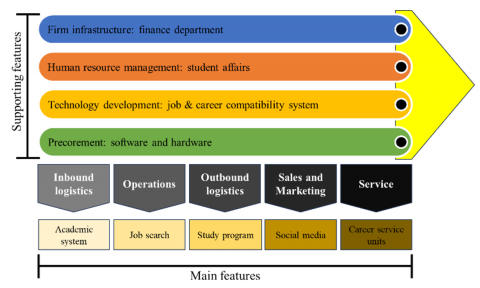
In the job search context, value chain analysis can be a valuable tool for understanding the processes involved in connecting workers with companies that need a workforce. The value chain includes several stages, from identifying company needs, advertising job vacancies, selecting candidates, and placing employees according to the positions required. By understanding each step in the value chain, we can identify areas that can be improved to improve efficiency and effectiveness in the job search. For example, by improving the candidate selection process, companies can ensure they are recruiting the right employees for the required positions. At the same time, job seekers can have a better chance to showcase their skills and land jobs that match their skills and interests. In this case, correctly placing employees can benefit both the company and job seekers. The job and career compatibility value chain from this study is presented in Figure 1.
The application of value chain analysis within the job search context presents a robust framework for comprehending the intricate processes that underlie the connection between job seekers and companies seeking a workforce. This analytical approach dissects the value creation process across various stages, offering insights into how each step contributes to the overall efficiency and effectiveness of the job search and placement ecosystem. By delving into these stages, from identifying company needs to placing employees into appropriate roles, organizations can pinpoint areas ripe for enhancement, thereby optimizing the entire process.
The value chain concept, originally introduced in the realm of business strategy, underscores the idea that an array of activities collaboratively contributes to the creation of value for customers. In the context of job search, this value chain encompasses the stages that encompass the entire journey, from employers identifying their workforce requirements to successful job placements.
Figure 1. Value chain of compatibility job and career
Starting with the identification of company needs, organizations gain a deep understanding of the skills and attributes required for specific positions. This awareness forms the bedrock for subsequent stages, such as advertising job vacancies and candidate selection. An improved job vacancy advertisement strategy ensures that relevant job seekers are attracted, increasing the likelihood of a match between job seekers' qualifications and employers' needs.
The selection of candidates represents a pivotal stage, where refining the process can yield substantial benefits. A more streamlined and effective candidate selection process enables companies to identify the most suitable individuals for the positions, reducing turnover rates and enhancing overall organizational performance. Simultaneously, job seekers are provided with a better chance to showcase their capabilities, enhancing their prospects of securing roles that align with their skills and interests [30].
Furthermore, the process of placing employees accurately into their designated roles is central to achieving a mutually beneficial outcome. Companies benefit from employees who contribute effectively to the organizational objectives, while job seekers experience job satisfaction and career growth when their skills and aspirations align with their roles. This symbiotic alignment fosters long-term success and engagement.
The culmination of these stages illustrates the interconnectedness of the job and career compatibility value chain. When this value chain is refined and optimized, both employers and job seekers reap the rewards. Employers acquire a workforce that precisely fulfills their needs, thus augmenting productivity and performance. Concurrently, job seekers are more likely to secure positions that resonate with their skills and goals, enhancing their job satisfaction and career trajectory.
By encapsulating the insights gained from value chain analysis, the presented figure (Figure 1) encapsulates the job and career compatibility value chain distilled from this study. This visual representation offers a comprehensive overview of the interplay between various stages, accentuating the potential benefits of enhancements at each step. Integration of value chain analysis within the job search context furnishes a structured framework that facilitates a comprehensive understanding of the processes guiding the alignment between employers and job seekers. This approach empowers organizations to identify and refine crucial stages, enhancing efficiency and effectiveness. Simultaneously, job seekers are provided with improved opportunities for showcasing their potential and securing roles that match their abilities and aspirations. As a result, the value chain analysis emerges as a pivotal tool in fostering a symbiotic relationship between employers and job seekers, driving productivity, satisfaction, and career progression.
3.4 Analysis of business systems planning
Business System Planning (BSP) is a business system planning method used to design and develop an effective and efficient information system [31, 32]. In the context of job search, BSP can assist in building an effective and efficient job search system to facilitate job seekers and companies in finding and recruiting employees according to their needs. Companies can identify business and technological requirements by implementing BSP to build an optimal job search system.
In addition, BSP can also assist in optimizing the employee recruitment and selection process so that companies can get quality employees who meet their needs. Thus, BSP effectively strengthens the company's strategy in finding and recruiting the right employees. By implementing BSP, companies can improve efficiency and effectiveness in finding and recruiting employees to accelerate business growth. Therefore, companies should consider implementing BSP in their employee search and recruitment strategy to obtain qualified employees who meet the company's needs. Thus, BSP can be one of the critical factors in achieving company success.
3.5 Federal Enterprise Architecture Framework matrix analysis
The Federal Enterprise Architecture Framework (FEAF) matrix is used to assist organizations in identifying and understanding how information technology can support business goals and organizational strategy. Organizations can use the FEAF matrix to plan and then implement an effective and efficient enterprise architecture. Table 3, presenting the FEAF matrix, encapsulates the visual representation of this multifaceted framework. This table condenses the strategic insights and principles essential for harmonizing IT and business functions. It provides a concise reference point that aids decision-makers in understanding the relationships between IT components and how they contribute to overarching goals.
The Federal Enterprise Architecture Framework (FEAF) matrix constitutes a structured and comprehensive approach aimed at aiding organizations in recognizing and comprehending the ways in which information technology (IT) can be harnessed to underpin business objectives and organizational strategies [33]. As the modern business landscape becomes increasingly reliant on technology for operational efficiency and competitive advantage, the FEAF matrix emerges as an invaluable tool for aligning IT investments with broader organizational goals. By enabling the planning and subsequent implementation of a coherent and optimized enterprise architecture, the FEAF matrix facilitates strategic IT decision-making and resource allocation.
Table 3. Federal Enterprise Architecture Framework matrix
|
Architecture Perspective |
Data |
Application |
Technology |
|
Planner |
Business object |
Business process |
Business location |
|
Owner |
Semantic model |
Business process model |
Business logistics system |
|
Designer |
Logical data model |
Application architecture |
System geographics deployment architecture |
|
Builder |
Physical data model |
System design |
Technology architecture |
|
Subcontractor |
Data definition |
Programs |
Network architecture |
At its core, the FEAF matrix embodies a systematic framework designed to bridge the gap between IT and business functions. In doing so, it facilitates a holistic view of how IT infrastructure, systems, and applications can be strategically employed to drive efficiency, innovation, and agility across an organization's operations. By mapping out the relationships between IT capabilities and business processes, the FEAF matrix provides a visual representation that elucidates how technology can be integrated seamlessly to achieve organizational objectives.
The application of the FEAF matrix begins with planning, a critical phase where organizations identify and articulate their strategic goals and aspirations [34-36]. By aligning IT initiatives with these goals, organizations can develop an IT architecture that supports, enhances, and accelerates the realization of these ambitions. This planning phase involves assessing current IT capabilities, identifying gaps, and formulating a roadmap for the adoption and integration of new technologies.
The subsequent implementation phase leverages the insights gleaned from the planning stage. The FEAF matrix serves as a guide, assisting organizations in structuring their IT landscape in a manner that reflects their strategic priorities. This involves making informed decisions regarding technology investments, infrastructure design, system integration, and data management. By adhering to the principles and guidelines outlined within the FEAF matrix, organizations can ensure that their IT ecosystem is not only aligned with business objectives but also optimized for efficiency, scalability, and adaptability.
FEAF matrix emerges as a pivotal instrument in the modern organizational landscape, where technology and business intricately intertwine. As organizations grapple with the challenges of harnessing technology to drive innovation and efficiency, the FEAF matrix offers a structured methodology for aligning IT with strategic objectives. By fostering a coherent and optimized enterprise architecture, organizations can navigate the dynamic technological landscape with confidence, ensuring that their IT investments not only support business goals but also enable a competitive edge in an ever-evolving environment.
To further enhance the comparison between empirical results and theoretical expectations, we conducted a systematic analysis aligning our findings with the theoretical constructs of the Federal Enterprise Architecture Framework (FEAF). This involved mapping specific empirical outcomes, such as user engagement metrics and feedback on system usability, to the theoretical principles outlined in FEAF. For example, the observed increase in student engagement with the Job and Career Compatibility System (JCCS) was directly correlated with FEAF's emphasis on streamlined information flow and enhanced interoperability. Additionally, qualitative insights from student and career advisor feedback were analyzed to evaluate how well the system's performance matched theoretical expectations regarding user experience and decision support. By systematically comparing these aspects, we identified key areas where our empirical data confirmed the theoretical predictions and areas where further refinement is needed. This comprehensive approach validates the applicability of FEAF in a real-world educational context. It clarifies how theoretical frameworks can guide the development of practical, effective career compatibility systems.
Applying the Federal Enterprise Architecture Framework (FEAF) in developing the Job and Career Matching System (JCCS) is based on several main theoretical components: strategic planning, value chain analysis, and data architecture management. FEAF provides a systematic framework for defining architectural components, data flow, and interoperability, which forms the basis for the design and implementation of our systems. Empirical results show improvements in career decision-making and awareness of opportunities among students, which can be directly linked to the FEAF principles of ensuring a sustainable and integrated system. By combining SWOT and PEST analysis, we identified internal and external factors that influence system success, per the theory underlying FEAF. This analysis shows that theoretical approaches underlie system design and prove their practical effectiveness, strengthening the link between theory and empirical results.
3.6 Blueprint and implementation of information systems
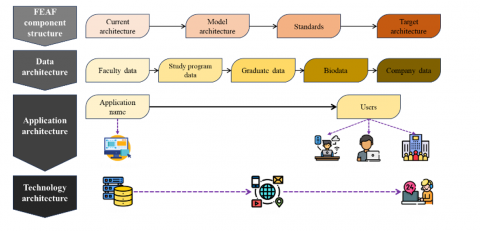
Blueprints can be in the form of a point-by-point system as a basis for making arrangements that combine setting goals and objectives, details of the methodology, implementation, and program focus, as well as the steps or performance that each unit of action must carry out [37, 38]. The blueprint presented in Figure 2 encapsulates the essence of this structured approach, offering a visual representation of the plan's architecture. This figure condenses the comprehensive plan into an easily understandable format, enabling stakeholders to grasp the strategic trajectory, methodologies, and key stages at a glance. This visual representation serves as a powerful tool for communication, ensuring that all involved parties are on the same page regarding the overarching vision and operational nuances.
Blueprints serve as a fundamental framework in various fields, providing a structured and comprehensive outline for orchestrating complex processes and initiatives. In the context of organizational planning and development, blueprints play a crucial role in guiding the creation and execution of projects, systems, or strategies. This systematic approach encapsulates the amalgamation of strategic goal-setting, methodological details, implementation strategies, and performance metrics. The blueprint's role is especially pronounced when embarking on intricate endeavors that require synchronization of multiple components and coordinated efforts [39].
Figure 2. Developed system blueprint
The blueprint, often constructed in a point-by-point format, represents a strategic roadmap that synthesizes key elements into a coherent whole. Each point within the blueprint corresponds to a specific facet or phase of the initiative, effectively outlining the sequence of actions, methodologies, and outcomes required for its successful execution. By delineating the various stages and interdependencies, the blueprint ensures that all relevant aspects are considered and addressed, fostering a holistic approach to problem-solving and implementation.
The core tenet of a blueprint lies in its ability to align objectives with actionable steps. Through this alignment, a blueprint provides a clear pathway for realizing organizational goals, ensuring that each action contributes meaningfully to the overarching strategy. Moreover, it serves as a shared reference point for stakeholders, fostering clarity and cohesion in the execution process. This transparency minimizes confusion and facilitates effective collaboration among teams working towards a common objective.
Utilization of a blueprint as a guiding framework holds profound significance in the realm of organizational planning and development. By synthesizing multifaceted components into a coherent structure, blueprints provide a systematic approach to tackling complex challenges, ensuring that objectives are met efficiently and effectively. The inclusion of strategic goal-setting, methodological specifics, implementation strategies, and performance metrics offers a comprehensive perspective that facilitates successful execution [40]. Ultimately, the blueprint represents a strategic compass that navigates intricate endeavors, offering clarity, cohesion, and alignment in pursuit of organizational excellence.
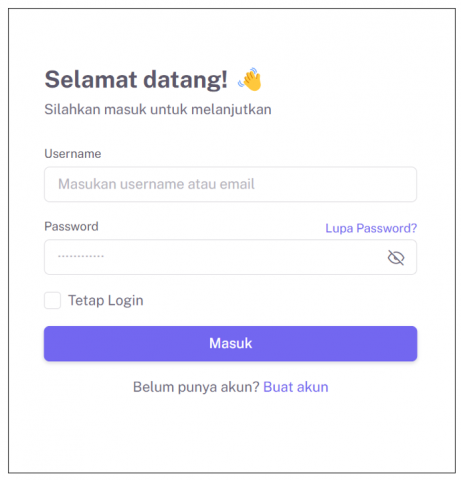
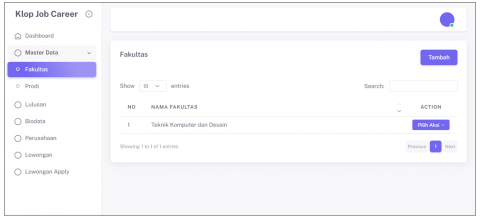
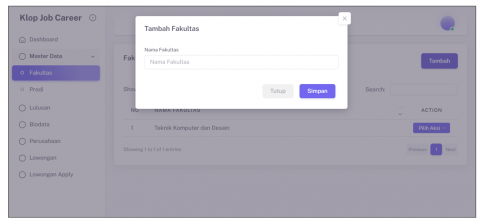
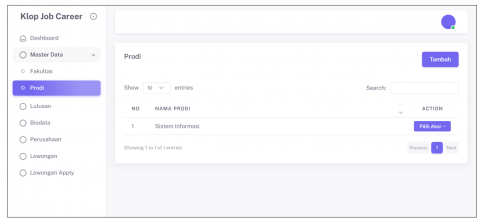
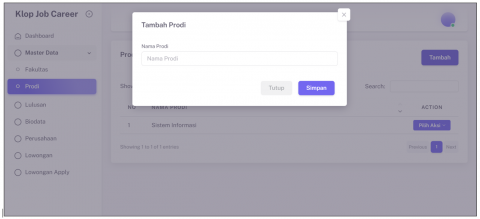
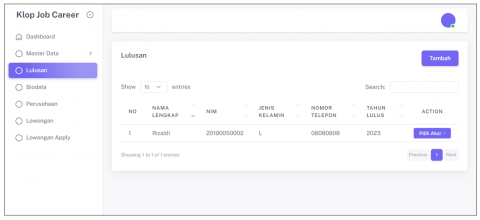
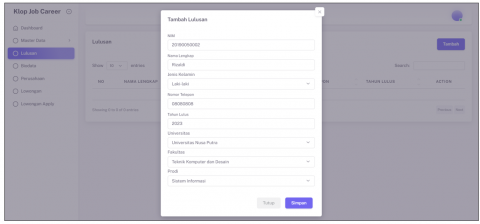
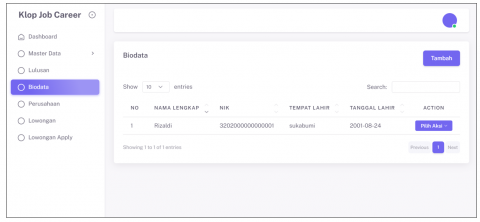
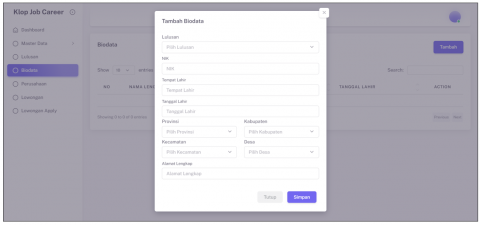
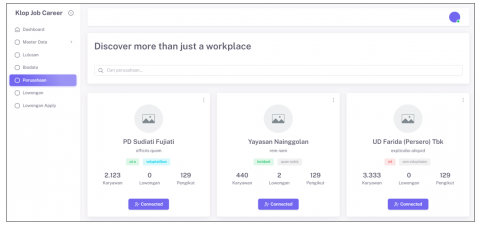
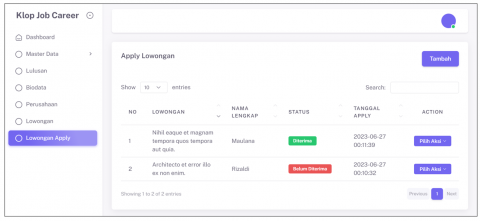
The web-based job and career compatibility information system menus, as depicted in Figure 3, hold pivotal importance in providing a user interface that facilitates seamless interaction and navigation within the system. In the context of modern technology-driven environments, user interfaces play a crucial role in enhancing user experience, engagement, and ultimately achieving the system's intended objectives. Figure 3 encapsulates these considerations visually, offering a snapshot of the user interface and menu structure. The arrangement of menu items and their labels should align with user expectations, making it easy for users to identify and select the options that meet their needs. This visual representation serves as a communication tool that succinctly conveys the system's capabilities and functionalities.
(a) User interface login
(b) Read information of faculty data menu
(c) Add faculty data menu
(d) Read study program data menu
(e) Add study program data menu
(f) Read graduate data menu
(g) Add graduate data menu
(h) Read biodata menu
(i) Add biodata menu
(j) Find companies menu
(k) Search vacancies menu
(l) Apply vacancies menu
Figure 3. Menus in web-based information system development in Bahasa language
The menus showcased in Figure 3 encompass a variety of options, each representing a distinct pathway for users to access and interact with different functionalities within the web-based system. These menus serve as the entry points for users to explore various features, access information, and perform tasks relevant to their job search and career compatibility evaluation.
In crafting these menus, considerations must be given to user-centric design principles. User interface design involves not only arranging menu options aesthetically but also structuring them in a logical and intuitive manner. This ensures that users can easily locate and access the tools, resources, and information they need. Clear and concise labeling of menu items, along with thoughtful categorization, contributes to a user-friendly experience.
Furthermore, the menus should align with the broader goals of the web-based system. Each menu option may correspond to a specific functionality, such as searching for job listings, assessing career compatibility, accessing resources, or managing user profiles. As such, the arrangement and presentation of these menus should reflect the priorities of the system's users and the objectives it aims to achieve.
The choice of language, in this case, Indonesian, is also a significant consideration. It caters to the linguistic preferences of the target users and enhances accessibility. Language localization contributes to a more inclusive and engaging user experience, allowing users to navigate the system comfortably and effectively.
The presentation of web-based job and career compatibility information system menus, as illustrated in Figure 3, plays a pivotal role in shaping user experience and interaction. These menus serve as gateways to various functionalities and resources within the system. The strategic arrangement, labeling, and categorization of menu items, coupled with language localization, contribute to a seamless and engaging user experience. As technology continues to advance, user-centric design principles and intuitive menu structures remain central to achieving the system's goals effectively and enhancing user satisfaction.
Some limitations of our study include the following: firstly, our sample selection was limited to students from Nusa Putra University, which may affect the generalizability of the results to other institutions with different demographics. Secondly, the data collection relied heavily on self-reported information, which may introduce biases such as social desirability or inaccurate self-assessment. Thirdly, while our analysis methods were robust and followed standard protocols, there may be inherent limitations in using the Federal Enterprise Architecture Framework (FEAF) that were not fully addressed, such as its adaptability to rapidly changing technological environments. These limitations could potentially impact the results by introducing elements of bias or constraining the applicability of our findings. Future research should consider a more diverse sample, employ alternative data collection methods to mitigate self-reporting biases and explore the use of complementary frameworks to enhance adaptability and relevance.
In conclusion, this study successfully demonstrated the adept utilization of the Federal Enterprise Architecture Framework (FEAF) method in crafting a web-based Job and Career Compatibility System. The application of FEAF provided a structured approach to system development, ensuring alignment with organizational goals and strategies. The case study conducted at Nusa Putra University showcased the system's efficacy in enhancing the job and career matching process. By leveraging web-based technology, the system offers accessibility and user-friendly interaction, streamlining the compatibility assessment for both students and potential employers. The integration of FEAF not only facilitated systematic development but also contributed to long-term scalability and sustainability. The outcomes underscore the importance of strategic IT frameworks in fostering efficient career services. This research extends an avenue for institutions to embrace similar frameworks in enhancing their career development systems, promoting student success, and fostering employer partnerships.
[1] Gallagher, C.J. (2003). Reconciling a tradition of testing with a new learning paradigm. Educational Psychology Review, 15: 83-99. https://doi.org/10.1023/A:1021323509290
[2] Godler, Y., Reich, Z., Miller, B. (2020). Social epistemology as a new paradigm for journalism and media studies. New Media & Society, 22(2): 213-229.
[3] Creech, B., Mendelson, A.L. (2015). Imagining the journalist of the future: Technological visions of journalism education and newswork. The Communication Review, 18(2): 142-165. https://doi.org/10.1080/10714421.2015.1031998
[4] Guijarro, L. (2007). Interoperability frameworks and enterprise architectures in e-government initiatives in Europe and the United States. Government Information Quarterly, 24(1): 89-101. https://doi.org/10.1016/j.giq.2006.05.003
[5] De Vires, M. (2010). A framework for understanding and comparing enterprise architecture models. Management Dynamics: Journal of the Southern African Institute for Management Scientists, 19(2): 17-29. https://hdl.handle.net/10520/EJC69760
[6] Bondar, S., Hsu, J.C., Pfouga, A., Stjepandić, J. (2017). Agile digital transformation of System-of-Systems architecture models using Zachman framework. Journal of Industrial Information Integration, 7: 33-43. https://doi.org/10.1016/j.jii.2017.03.001
[7] Glavovic, B.C., Smith, G.P. (2014). Introduction: Learning from natural hazards experience to adapt to climate change. Adapting to climate change: Lessons from natural hazards planning, pp. 1-38. https://doi.org/10.1007/978-94-017-8631-7_1
[8] van der Aalst, W., Mylopoulos, J., Rosemann, M., Shaw, M.J., Szyperski, C. (2012). Business process management workshops. Lecture Notes in Business Information Processing. https://doi.org/10.1007/978-3-642-36285-9
[9] Bui, Q.N., Lyytinen, K. (2022). Aligning adoption messages with audiences' priorities: A mixed-methods study of the diffusion of enterprise architecture among the US state governments. Information and Organization, 32(4): 100423. https://doi.org/10.1016/j.infoandorg.2022.100423
[10] O’Mahony, J.M., Donnelly, T.T., Raffin Bouchal, S., Este, D. (2013). Cultural background and socioeconomic influence of immigrant and refugee women coping with postpartum depression. Journal of Immigrant and Minority Health, 15: 300-314. https://doi.org/10.1007/s10903-012-9663-x
[11] Klerkx, L., Seuneke, P., de Wolf, P., Rossing, W.A. (2017). Replication and translation of co-innovation: The influence of institutional context in large international participatory research projects. Land Use Policy, 61: 276-292. https://doi.org/10.1016/j.landusepol.2016.11.027
[12] Purwati, E., Thamren, D.S., Sitorus, A. (2021). Application of geographic information systems and sediment routing methods in sediment mapping in Krueng Jreu Sub-Watershed, Aceh Province, Indonesia. International Journal of Sustainable Development & Planning, 16(7): 1253-1261. https://doi.org/10.18280/ijsdp.160706
[13] Gallivan, M.J. (2001). Organizational adoption and assimilation of complex technological innovations: development and application of a new framework. ACM SIGMIS Database: The DATABASE for Advances in Information Systems, 32(3): 51-85. https://doi.org/10.1145/506724.506729
[14] Winter, R., Fischer, R. (2006). Essential layers, artifacts, and dependencies of enterprise architecture. In 2006 10th IEEE International Enterprise Distributed Object Computing Conference Workshops (EDOCW'06), Hong Kong, China, pp. 30-30. https://doi.org/10.1109/EDOCW.2006.33
[15] Council, C. (1999). Federal Enterprise Architecture Framework (FEAF). https://www.leanix.net/en/wiki/ea/feaf-federal-enterprise-architecture-framework.
[16] Sitorus, A., Novrinaldi, N., Bulan, R. (2020). Non-invasive moisture content measurement system based on the ESP8266 microcontroller. Bulletin of Electrical Engineering and Informatics, 9(3): 924-932. https://doi.org/10.11591/eei.v9i3.2178
[17] Rashkovits, R., Lavy, I. (2021). Mapping Common Errors in Entity Relationship Diagram Design of Novice Designers. International Journal of Database Management Systems, 13(1): 1-19. https://doi.org/10.5121/ijdms.2021.13101
[18] Zhang, H., Ren, S., Li, X., Baharin, H., Alghamdi, A., Alghamdi, O.A. (2023). Developing scalable management information system with big financial data using data mart and mining architecture. Information Processing & Management, 60(3): 103326. https://doi.org/10.1016/j.ipm.2023.103326
[19] Aleryani, A.Y. (2016). Comparative study between data flow diagram and use case diagram. International Journal of Scientific and Research Publications, 6(3): 124-126.
[20] Li, Q., Chen, Y. L. (2009). Data flow diagram. In Modeling and Analysis of Enterprise and Information Systems, pp. 85-97. https://doi.org/10.1007/978-3-540-89556-5_4
[21] Krishnan, S., Teo, T.S. (2012). Moderating effects of governance on information infrastructure and e-government development. Journal of the American Society for Information Science and Technology, 63(10): 1929-1946. https://doi.org/10.1002/asi.22660
[22] Mankad, A., Tapsuwan, S. (2011). Review of socio-economic drivers of community acceptance and adoption of decentralised water systems. Journal of Environmental Management, 92(3): 380-391. https://doi.org/10.1016/j.jenvman.2010.10.037
[23] Sabi, H.M., Uzoka, F.M.E., Langmia, K., Njeh, F.N. (2016). Conceptualizing a model for adoption of cloud computing in education. International Journal of Information Management, 36(2): 183-191. https://doi.org/10.1016/j.ijinfomgt.2015.11.010
[24] Mantello, P., Ho, M.T., Nguyen, M.H., Vuong, Q.H. (2023). Machines that feel: Behavioral determinants of attitude towards affect recognition technology—upgrading technology acceptance theory with the mindsponge model. Humanities and Social Sciences Communications, 10(1): 1-16. https://doi.org/10.1057/s41599-023-01837-1
[25] Dumas, M., Van der Aalst, W.M., Ter Hofstede, A.H. (2005). Process-aware information systems: Bridging people and software through process technology. John Wiley & Sons. https://doi.org/10.1002/0471741442
[26] Shahijan, M.K., Rezaei, S., Preece, C.N. (2016). Developing a framework of internationalisation for higher education institutions in Malaysia: a SWOT analysis. International Journal of Management in Education, 10(2): 145-173. https://doi.org/10.1504/IJMIE.2016.075556
[27] Helms, M.M., Rodríguez, M.A., de los Ríos, L., Hargrave, W. (2011). Entrepreneurial potential in Argentina: a SWOT analysis. Competitiveness review: An international Business Journal, 21(3): 269-287. https://doi.org/10.1108/10595421111134859
[28] Warschauer, M. (2000). The changing global economy and the future of English teaching. TESOL Quarterly, 34(3): 511-535. https://doi.org/10.2307/3587741
[29] Beldarrain, Y. (2006). Distance education trends: Integrating new technologies to foster student interaction and collaboration. Distance Education, 27(2): 139-153. https://doi.org/10.1080/01587910600789498
[30] Clarke, M. (2018). Rethinking graduate employability: The role of capital, individual attributes and context. Studies in Higher Education, 43(11): 1923-1937. https://doi.org/10.1080/03075079.2017.1294152
[31] Duckworth, F.B. (1986). An investigation of IBM's Business Systems Planning (BSP) as a suitable methodology for strategic information systems planning for the Naval Reserve. Doctoral dissertation, Naval Postgraduate School.
[32] Aristi, G. (2019). Implementation Business System Planning for the Design of Tracer Study at Perjuangan University. Journal of Physics: Conference Series, 1179(1): 012025. https://doi.org/10.1088/1742-6596/1179/1/012025
[33] Laney, D.B. (2017). Infonomics: How to monetize, manage, and measure information as an asset for competitive advantage. Routledge. https://doi.org/10.4324/9781315108650
[34] Stavros, J., Cooperrider, D., Kelley, D.L. (2003). Strategic inquiry appreciative intent: inspiration to SOAR, a new framework for strategic planning. Ai Practitioner, 11: 1-21.
[35] Beer, M., Voelpel, S.C., Leibold, M., Tekie, E.B. (2005). Strategic management as organizational learning: Developing fit and alignment through a disciplined process. Long Range Planning, 38(5): 445-465. https://doi.org/10.1016/j.lrp.2005.04.008
[36] Yates, L. (2015). Rethinking prefiguration: Alternatives, micropolitics and goals in social movements. Social Movement Studies, 14(1): 1-21. https://doi.org/10.1080/14742837.2013.870883
[37] Crnkovic, I., Asklund, U., Dahlqvist, A.P. (2003). Implementing and integrating product data management and software configuration management. Artech House.
[38] Farmer, E., Van Rooij, J., Riemersma, J., Jorna, P. (2017). Handbook of simulator-based training. Routledge. https://doi.org/10.4324/9781315253671
[39] Christiansen, H. (2013). Balancing commercial and non-commercial priorities of state-owned enterprises. OECD Corporate Governance Working Papers, 6. https://doi.org/10.1787/22230939
[40] Handley, M.A., Gorukanti, A., Cattamanchi, A. (2016). Strategies for implementing implementation science: A methodological overview. Emergency Medicine Journal, 33(9): 660-664. https://doi.org/10.1136/emermed-2015-205461