
Andrei M. Bancovich-Erquínigo* | Jorge E. Ortiz-Porras | Rosiand Manrique-Alva | Harold S. Quintana-Saavedra | Flor M. Ortiz-Pinedo
© 2026 The authors. This article is published by IIETA and is licensed under the CC BY 4.0 license (http://creativecommons.org/licenses/by/4.0/).
OPEN ACCESS
Work absenteeism stemming from musculoskeletal disorders (MSDs) poses a severe threat to the productivity of textile small and medium-sized enterprises (SMEs) in emerging economies. Addressing this operational constraint, this study evaluated the effectiveness of a multi-component ergonomic model designed to reduce biomechanical risk and absenteeism in a small garment manufacturing firm. A pre-experimental design with pre- and post-intervention measurements was applied to operators within the T-shirt assembly process. The model integrated workplace redesign, lighting adjustments in compliance with standard EM.010, and structured active breaks. Biomechanical risk assessments using Rapid Entire Body Assessment (REBA) and Occupational Repetitive Actions (OCRA) methods were validated through video analysis and motion-tracking software, with statistical significance confirmed for all variables via the Wilcoxon signed-rank test (p < 0.01). Following the intervention, REBA scores decreased from 7.27 to 4.09 (both within the medium-risk band), a 43.8% reduction, while OCRA scores decreased from 7.68 (uncertain level) to 4.82 (optimal level), a 37.3% reduction. The mean cumulative absence time per operator fell by 71.3%, from 4,140.27 to 1,188.36 minutes per reporting period (a reduction in the group's combined total from 45,543 to 13,072 minutes), while illuminance levels successfully exceeded the 500 and 750 lux regulatory thresholds. This low-cost engineering framework demonstrates that combining physical redesign with organizational management offers a viable, sustainable strategy to mitigate occupational disability in resource-constrained industrial settings.
musculoskeletal disorders, absenteeism, ergonomic assessment, textile industry, small and medium-sized enterprise
Work absenteeism constitutes one of the main operational frictions in occupational health management within the textile sector, given its high labor intensity [1]. The resulting fluctuations in workflow directly impact operating costs, disrupting continuity along the production chain [2]. Among the most prevalent determinants are musculoskeletal disorders (MSDs), arising from continuous exposure to biomechanically unfavorable postures, cyclical repetitiveness, and physical overload [3]. This deterioration in worker health distorts the system's installed capacity, undermining overall efficiency and compromising the competitive positioning of manufacturing plants [4].
The Peruvian textile industry faces a sustained increase in exposure to ergonomic risks, which raises the prevalence of MSDs and the resulting absenteeism [5]. Approximately 40% of workers in the sector present some form of musculoskeletal complaint, with the greatest severity concentrated in the sewing and cutting areas due to forced postures [6]. This vulnerability calls for the formulation of ergonomically rigorous preventive strategies aimed at mitigating biomechanical risk and reconfiguring working conditions [4].
Although international literature validates the effectiveness of applied ergonomics in containing injuries and absences in manufacturing [7], most empirical frameworks originate from contexts unrelated to the textile industry. This gap limits their extrapolation to small and medium-sized enterprises (SMEs), whose operational dynamics demand tailored approaches [8]. It is therefore imperative to structure an ergonomic model adapted to the specificities of the sector, integrating the assessment of physical, environmental, and organizational factors [9].
This study evaluates the development and implementation of an ergonomic model designed to reduce work absenteeism in a textile SME in Lima, Peru. The intervention combines postural assessment of workstations, control of illuminance levels, and a structured active-break program to counter muscle fatigue. Through a quantitative pre-experimental design, the effectiveness of the proposal on biomechanical risk indices and absenteeism rates is determined.
This research contributes to the theoretical and industrial body of knowledge by providing a systemic framework for absenteeism management in textile SMEs, a segment historically characterized by low adoption of structured ergonomic methodologies [10]. The findings serve as empirical input for the formulation of occupational health policies adapted to manufacturing environments in emerging economies [11].
2.1 Ergonomic foundations and occupational health in biomechanical and environmental risk management
Ergonomics is the scientific discipline that studies the interactions between people and the components of a work system, with the purpose of optimizing worker well-being without compromising process performance [12, 13]. In the field of occupational health, its application goes beyond correcting unsafe conditions, as it guides workstation design toward matching the task's physical, cognitive, and environmental demands with operators' functional capacities, thereby reducing exposure to biomechanical risk factors [14].
Among the components of physical ergonomics, ambient illuminance, expressed in lux, directly influences visual comfort and the execution of tasks requiring precision [15]. This relationship is especially relevant in the textile industry, where activities such as cutting and sewing demand high visual acuity. When lighting levels are insufficient, ocular fatigue increases and the likelihood of errors during the production process rises; at the same time, workers adopt compensatory postures that increase muscular load and favor the onset of musculoskeletal discomfort [16-18].
Quantifying these risk factors requires standardized assessment procedures that allow for objective characterization of worker exposure [19]. Tools such as Rapid Entire Body Assessment (REBA) and Occupational Repetitive Actions (OCRA) estimate the level of risk associated with forced postures, repetitive movements, force application, and recovery times [20]. The incorporation of these methodologies, complemented by software for angular biomechanical analysis, strengthens ergonomic diagnosis and provides technical evidence to support workstation redesign, workflow reorganization, and the reduction of postural overload in manufacturing systems [21].
2.2 Musculoskeletal disorders, absenteeism, and the effectiveness of comprehensive ergonomic models in small and medium-sized enterprises
MSDs comprise a set of inflammatory and degenerative conditions affecting tendons, muscles, joints, and nerve structures, whose onset or aggravation is associated with prolonged exposure to repetitive movements, static postures, and high physical effort [22]. In the textile industry, the coexistence of workstations with limited adjustability, intensive production rates, and highly repetitive tasks increases the incidence of these conditions, limiting workers' functional capacity [23, 24]. Their consequences extend beyond the clinical domain, translating into higher levels of work absenteeism, disruptions to operational continuity, and increased costs stemming from replacements, unproductive time, and efficiency losses [2, 3].
Recent evidence supports the implementation of comprehensive ergonomic models grounded in a systemic approach, whose efficacy exceeds that achieved through isolated interventions [25]. These models combine actions on the biomechanical design of workstations with improvements in environmental conditions and organizational adjustments, incorporating measures such as lighting optimization, thermal comfort control, scheduled active breaks, and task rotation [26, 27]. Reported outcomes show reductions of between 40% and 70% in both ergonomic risk levels and sick days associated with MSDs, magnitudes that are seldom achieved through interventions focused on a single risk factor [4].
However, the transfer of these models to textile SMEs located in emerging economies faces constraints that the literature does not always address in sufficient depth. Budgetary limitations, infrastructure rigidity, and reduced investment capacity hinder the adoption of technologically complex solutions [28]. Consequently, the most viable proposals are those that integrate low-cost operational modifications with staff-participation mechanisms and occupational-health awareness programs, thereby improving ergonomic conditions without requiring structural transformations incompatible with these organizations' financial reality [11, 29].
3.1 Research design
The study adopted a quantitative approach, of applied type and causal-explanatory level, aimed at designing, formulating, and validating an ergonomic model to reduce work absenteeism in small textile enterprises. The model was developed on the basis of a systematic literature review, complemented by direct observation of production processes in a textile SME in Lima, Peru, used as an application case and practical validation setting.
3.2 Formulation of the ergonomic model
The formulation process followed three fundamental stages, based on the methodological proposal of Palella and Martins [30]:
a) Definition of the root problem: The ergonomic and organizational causes associated with work absenteeism in the textile industry were identified. To this end, recent scientific publications were analyzed and empirical data were gathered from the production environment, allowing the critical variables to be established: MSDs, ambient illuminance level, and workstation ergonomics.
b) Structuring of the model: The model consists of six sequential and interdependent phases that enable progression from the characterization of the work environment to the sustained control of implemented improvements.
c) Theoretical and practical validation: The content validity of the model was determined through expert judgment, applying Aiken's V coefficient to assess the coherence, pertinence, and relevance of each component.
Phase 1. Internal and external analysis and process mapping: This phase involves a documentary review of the organization's current status, considering both internal aspects (production processes, working conditions, absenteeism rates) and external factors (regulatory framework, ergonomic standards, and technical requirements).
Phase 2. Selection and implementation of ergonomic assessments: Based on the literature review and the requirements of the work activity, the most suitable assessment methodologies are selected for identifying and quantifying postural and repetitive-movement risks. The results obtained in this phase provide the technical inputs for formulating intervention strategies.
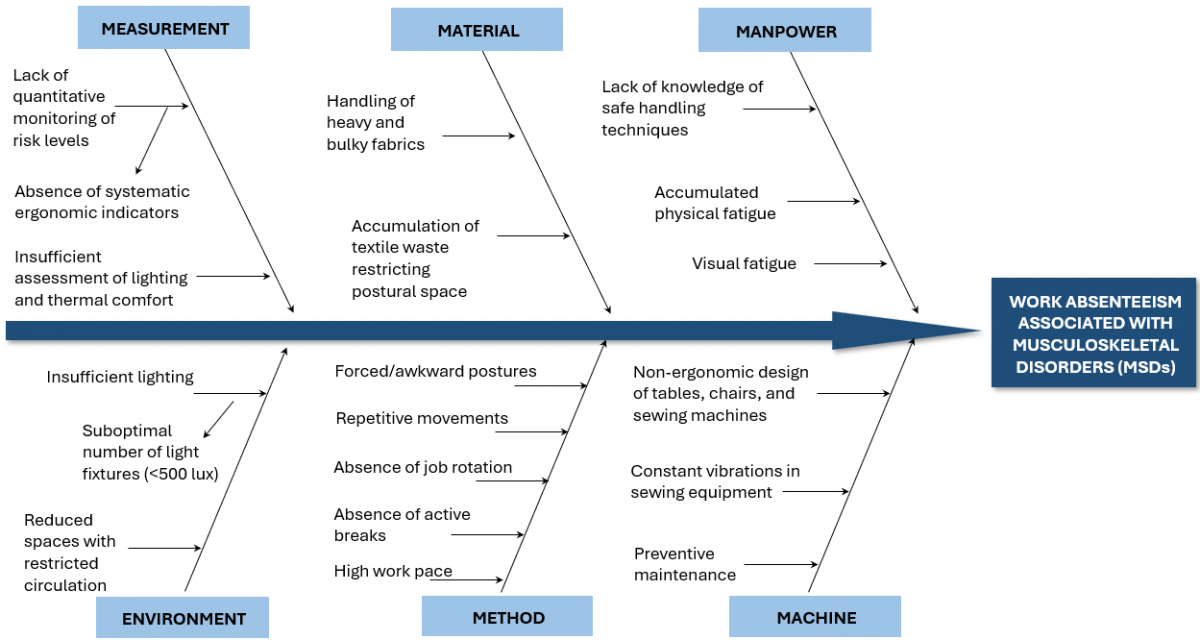
Phase 3. Root-cause analysis: The assessment results are analyzed using causal diagnostic tools, such as the Ishikawa diagram or the five-whys method, in order to determine the structural causes of work absenteeism, distinguishing among physical, environmental, organizational, and personal factors.
Phase 4. Proposal, implementation, and standardization of improvements: This stage involves designing the ergonomic strategies that form the operational core of the model. Such strategies may include workstation redesign, illuminance-level adjustment, task reorganization, and the incorporation of active breaks. These are documented and standardized through internal protocols, ensuring their replicability and sustainability across different production environments.
Phase 5. Post-improvement ergonomic assessments: The ergonomic assessments applied in Phase 2 are subsequently repeated in order to compare the new results against the initial baseline values. This comparison allows quantification of the reduction in risk levels and verification of the effectiveness of the implemented measures, constituting the model's technical validation mechanism.
Phase 6. Development of control mechanisms: Finally, monitoring and control mechanisms are established to ensure the continuity of the improvements and the early detection of deviations. These include periodic absenteeism records, ergonomic audits, performance indicators, and continuous training plans.
The model has three essential inputs: documentary review of the company or work environment, a literature review of ergonomic methodologies, and the use of technological tools for data processing and analysis. The system's main output is the reduction of work absenteeism through the integration of ergonomic solutions that balance human, technical, and organizational factors.
Subsequently, an empirical validation was carried out through a case study in a textile SME, in order to test the model's functionality and its effect on work absenteeism indicators.
The design of the ergonomic model and the consolidation of the intervention project took place during the first semester of 2023. Baseline (pre-intervention) absenteeism data were collected over the company's internal reporting period 2023-II (August–December 2023). Root-cause analysis was carried out between January and February 2024, and the formulation and implementation of the workstation, lighting, and organizational interventions took place between March and June 2024. Post-intervention absenteeism data were subsequently collected over the corresponding reporting period, 2024-II (August–December 2024). The same August-December data-collection window and the same group of 11 operators were used for both the pre- and post-intervention measurements, in order to minimize the influence of seasonal factors, such as production volume and order composition, on the comparison. No additional follow-up measurement was carried out beyond the post-intervention assessment; however, the company has continued to apply a control plan intended to sustain the improvements achieved over time.
The results obtained correspond to the empirical validation of the formulated ergonomic model and are presented according to the main intervention axes derived from its methodological phases. Accordingly, the findings are grouped around the assessment of ergonomic risks, the analysis of causes, the implementation of improvements, and the observed effects on work absenteeism indicators.
4.1 Initial ergonomic assessment
The initial ergonomic assessment aimed to identify the level of exposure to biomechanical and postural risks across the different processes of the production line. For this purpose, the REBA and OCRA methods were selected, as both allow a comprehensive assessment of ergonomic conditions in work environments where manual, repetitive tasks with frequent postural variations predominate.
To ensure the reliability and accuracy of the ergonomic assessments, a hybrid data-collection protocol was implemented. Tasks were recorded through direct on-site observation and complemented with video recordings to allow a detailed analysis of micro-movements and work cycles.
The subsequent analysis of postures and the precise measurement of the joint angles required by the REBA and OCRA methods were performed using the Ergoniza software, which eliminated subjectivity in angular estimation and ensured data consistency.
As shown in Table 1, the results of the initial assessments revealed high and very high-risk levels in the cutting and sewing processes, while embroidery and packaging activities showed medium levels. Considering the complete sample of 11 operators, the overall average score was 7.27 points on REBA and 7.68 points on OCRA, corresponding to medium-to-uncertain risk levels, evidencing significant exposure to forced postures, repetitive movements, and constant manual handling.
Table 1. Risk levels before the interventions
|
Operator |
Area |
REBA Score |
REBA Risk |
OCRA Score |
OCRA Risk |
|
1 |
Dyeing |
7 |
Medium |
6 |
Acceptable |
|
2 |
Cutting |
10 |
High |
8 |
Uncertain |
|
3 |
8 |
High |
9 |
Uncertain |
|
|
4 |
9 |
High |
10.5 |
Uncertain |
|
|
5 |
Sewing |
11 |
Very High |
12 |
Slightly Unacceptable |
|
6 |
9 |
High |
13 |
Slightly Unacceptable |
|
|
7 |
10 |
High |
11 |
Uncertain |
|
|
8 |
Embroidery and Printing |
5 |
Medium |
6 |
Acceptable |
|
9 |
6 |
Medium |
4 |
Optimal |
|
|
10 |
Packaging |
2 |
Low |
2 |
Optimal |
|
11 |
3 |
Low |
3 |
Optimal |
Note: Rapid Entire Body Assessment (REBA); Occupational Repetitive Actions (OCRA).
Likewise, the most frequently reported symptoms among workers corresponded to lower-back, upper-back, and neck pain, associated with prolonged static postures, repetitive tasks, and inadequate lighting in the work area, factors that contributed to the increase in absenteeism rates.
These results are consistent with the records obtained in the company's documentary review, which showed that during the 2023-II reporting period (August–December 2023) an average of 13 absences attributable to MSDs were recorded per operator, with an average duration of 230 minutes per absence, representing a mean cumulative absence time of 4,140.27 minutes per operator - equivalent to approximately 69 hours, or eight working days, per operator - and a combined total of 45,543 minutes across the 11 operators. However, these average values do not accurately reflect the organizational context, in which staff from critical areas, such as cutting and sewing, reported up to 20 absences during that period, with an average duration of 300 minutes per event, practically equivalent to a full working day.
For the purposes of this study, an absence event was operationally defined as any instance of lost working time attributed to musculoskeletal pain, whether corresponding to a full-shift absence, a partial-shift interruption, or time away for a medical consultation or company-granted permit related to musculoskeletal symptoms. Attribution to musculoskeletal causes was established through documentary review of the company's absence and permit registry, maintained by the person responsible for personnel management; each entry considered in this study explicitly recorded musculoskeletal pain as the stated reason for the absence or permit granted. The complete operator-level absenteeism data (frequency, duration, and cumulative time, before and after the intervention, for each of the 11 operators) are presented in Table A1 to allow full verification of the aggregate values reported in this study.
4.2 Root cause identification and intervention design
The root-cause analysis, carried out using the Ishikawa technique (Figure 1), made it possible to group the main risk factors into three dimensions:
(1) Physical, related to forced postures, repetitive movements, and lack of lumbar support.
(2) Environmental, mainly due to inadequate illuminance levels.
(3) Organizational, related to the absence of active breaks and limited task rotation.
Figure 1. Ishikawa diagram
The first line of action was the establishment of an active-break program designed to reduce muscle fatigue and prevent MSDs. This implementation was based on an analysis of the workday to identify critical moments involving static postures or repetitive movements. Based on this diagnosis, a specific break schedule was established for each process, varying in frequency and duration according to the physical demand of the task. The result is shown in Table 2.
Table 2. Breaks assigned by process
|
Process |
Assigned Breaks |
Justification |
|
Dyeing |
2 breaks every 2 hours, 10 minutes each. |
Exposure to prolonged static postures and poor lighting conditions requires regular breaks to prevent cumulative strain. |
|
Cutting |
3 breaks every 2 hours, 8 minutes each. |
High levels of repetitive movement and work bent over tables justify more frequent but shorter breaks to mitigate the risk of overuse injuries. |
|
Sewing |
2 breaks every 3 hours, 12 minutes each. |
Tasks involving mechanical vibration require more spaced-out but somewhat longer breaks to reduce the cumulative impact of the activity. |
|
Embroidery and printing |
1 break every 3 hours, 15 minutes. |
Lower physical intensity than other processes; a single longer break is sufficient to relieve fatigue and prevent strain. |
|
Packaging |
2 breaks every 2.5 hours, 10 minutes each. |
Load-handling activities and repetitive movements justify breaks of intermediate frequency and duration to prevent musculoskeletal disorders (MSDs). |
Simultaneously, the specific exercise protocol shown in Table 3 was developed, focused on the most affected body areas.
Table 3. Exercises for active breaks
|
Process |
Assigned Exercises |
|
Dyeing |
Wrist, elbow, and neck stretching; shoulder and trunk mobilization. |
|
Cutting |
Lumbar spine, shoulder, and wrist stretching; hip and ankle flexion exercises. |
|
Sewing |
Wrist and elbow mobilization; neck and shoulder stretching; trunk rotation exercises. |
|
Embroidery and printing |
Neck, upper-back, and arm stretching; shoulder and hip mobilization. |
|
Packaging |
Wrist flexion and extension exercises; lumbar spine and neck stretching. |
Notably, passive breaks (without activity) were ruled out, favoring muscle recovery through brief, controlled physical activation. The intervention was preceded by awareness-raising sessions and weekly follow-up.
In addition to the physical-activity intervention, work methods and workstations were redesigned to correct forced postures. In the cutting process, the intervention was twofold: first, the fabric-laying method was changed to a two-operator collaborative system to reduce the frequency and amplitude of trunk flexion; and second, the height mismatch between operators and work tables (which generated uncomfortable postures) was mitigated through the acquisition of modular platforms.
For the sewing process, an ergonomic chair design was developed based on the task requirements. Key design criteria included a pneumatic height-adjustment system, a backrest with lumbar support adapted to the curvature of the spine, and armrests designed to maintain a 90° elbow angle with a depth that does not interfere with the machinery. Footrests were not considered, given that the feet are in constant interaction with the pedals of the sewing machines.
Finally, the third intervention axis addressed the reported visual fatigue caused by inadequate lighting.
The objective was to bring the mean illuminance (Em) levels into compliance with the standards set by Technical Standard EM.010 of the National Building Regulations, which stipulates 500 lux for dyeing and cutting, and 750 lux for sewing.
MASTER TL-D Secura 58W/840 luminaires (luminous flux of 5,240 lm) were selected, and a lighting calculation was performed for each area (Eqs. (1) and (2)) to determine the number of luminaires and their distribution. The results are shown in Table 4.
$\Phi_T=\frac{E_m * S}{C_u * C_m}$ (1)
where,
ΦT = Total luminous flux
Em = Desired average illuminance
S = Work-plane surface area
Cu = Utilization coefficient
Cm = Maintenance coefficient
$N=\frac{\Phi_T}{\Phi_L * n}$ (2)
where,
N = Number of luminaires required
ΦL = Local luminous flux
n = Number of lamps per luminaire. In this installation, single-lamp luminaires were used (n = 1).
For all three areas, a uniform 4 × 4 luminaire grid (16 units) was installed rather than the strict photometric minimum calculated for each area. This was necessary because, in the dyeing area, the calculated minimum (13.52, rounded up to 14 luminaires) could not be arranged as a uniform grid: a 4 × 3 layout yields only 12 luminaires, below the required minimum, while an irregular 4 × 3-plus-2 arrangement would have produced non-uniform illumination across the work area. Adopting the same 4 × 4 grid in all three areas therefore ensured both compliance with the photometric minimum and consistent, uniform light distribution; for cutting and sewing, this grid already matches their respective calculated minimums (16 luminaires each).
Table 4. Calculation of the number of luminaires
|
Element |
Dyeing |
Cutting |
Sewing |
|
Width of work area |
5.41 m |
5.25 m |
4.25 m |
|
Length of work area |
4.86 m |
5.56 m |
4.88 m |
|
Height of work area |
5 m |
5.2 m |
5.5 m |
|
Height between work plane and luminaire plane |
3.32 m |
3.48 m |
3.48 m |
|
Desired average illuminance (Em) |
500 lux |
500 lux |
750 lux |
|
Room index (k) |
0.51 |
0.52 |
0.41 |
|
Ceiling reflectance |
0.5 |
0.5 |
0.5 |
|
Wall reflectance |
0.3 |
0.3 |
0.3 |
|
Floor reflectance |
0.1 |
0.1 |
0.1 |
|
Utilization factor |
0.32 |
0.32 |
0.32 |
|
Maintenance factor |
0.58 |
0.58 |
0.58 |
|
Work area |
26.29 m² |
29.19 m² |
20.74 m² |
|
Total luminous flux |
70,831.36 lm |
78,636.85 lm |
83,809.27 lm |
|
Local luminous flux |
5,240 lm |
5,240 lm |
5,240 lm |
|
Minimum calculated number of luminaires |
14 luminaires |
16 luminaires |
16 luminaires |
|
Installed number of luminaires (uniform 4 × 4 grid) |
16 luminaires |
16 luminaires |
16 luminaires |
|
Width-wise distribution |
4 luminaires |
4 luminaires |
4 luminaires |
|
Length-wise distribution |
4 luminaires |
4 luminaires |
4 luminaires |
After installation, it was verified that the resulting mean illuminance (Em) in each area met or exceeded the legal standard: Dyeing (591.82 lux > 500), Cutting (533.08 lux > 500), and Sewing (750.27 lux > 750). This intervention ensured regulatory compliance and mitigation of visual-fatigue risk.
4.3 Effect of the interventions on work absenteeism
Following the implementation of the interventions, risk scores showed a significant reduction.
Considering all 11 operators, the overall REBA average decreased from 7.27 (medium risk) to 4.09 (medium risk), a 43.8% reduction, while the OCRA average decreased from 7.68 (uncertain level) to 4.82 (optimal level), a 37.3% reduction, as shown in Table 5. Both reductions were confirmed as statistically significant through the Wilcoxon signed-rank test (REBA: W = 0, p = 0.001; OCRA: W = 0, p = 0.004), as detailed in Table 6, evidencing the effectiveness of the model in mitigating physical and postural factors.
Work absenteeism indicators also showed a substantial improvement. The average number of absences fell from 13.00 to 5.82 events per operator, the average duration per event fell from 230.00 to 147.82 minutes, and the mean cumulative absence time fell from 4,140.27 to 1,188.36 minutes per operator (a combined-group total of 45,543 to 13,072 minutes), a 71.3% reduction. This mean cumulative time was calculated as the product of frequency and duration recorded for each operator, averaged across the 11 operators; this differs from, and is not equivalent to, the product of the group's mean frequency and mean duration, since these two variables are correlated at the individual level.
To statistically validate these reductions, the Shapiro-Wilk test was first applied to the paired pre-post differences of each variable. Normality was rejected for two of the five variables (REBA, p(SW) = 0.010; cumulative absence time, p(SW) = 0.042), while the remaining three did not show a significant departure from normality (OCRA, p(SW) = 0.482; absence frequency, p(SW) = 0.326; absence duration, p(SW) = 0.081). Given this mixed result and the small sample size (n = 11), the non-parametric Wilcoxon signed-rank test (Minitab 2019) was applied uniformly to all five variables for methodological consistency. Table 6 presents the mean values before and after the intervention, the percentage reduction, and the Wilcoxon test statistics (W and p-value) for REBA, OCRA, absence frequency, duration, and cumulative time. All five variables showed statistically significant reductions (p < 0.01), confirming that the improvements are not the product of chance but consistent with the interventions implemented among the group of 11 operators comprising the T-shirt assembly process in the textile SME.
Effect sizes (matched-pairs rank-biserial correlation r, Table 6) ranged from 0.871 to 0.884, indicating a uniformly large effect across all variables.
Table 5. Risk levels after the interventions
|
Operator |
Area |
REBA Score |
REBA Risk |
OCRA Score |
OCRA Risk |
|
1 |
Dyeing |
4 |
Medium |
3 |
Optimal |
|
2 |
Cutting |
6 |
Medium |
6 |
Acceptable |
|
3 |
5 |
Medium |
6 |
Acceptable |
|
|
4 |
5 |
Medium |
6 |
Acceptable |
|
|
5 |
Sewing |
7 |
Medium |
6 |
Acceptable |
|
6 |
5 |
Medium |
8 |
Uncertain |
|
|
7 |
6 |
Medium |
6 |
Acceptable |
|
|
8 |
Embroidery and Printing |
2 |
Low |
4 |
Optimal |
|
9 |
3 |
Low |
4 |
Optimal |
|
|
10 |
Packaging |
1 |
Negligible |
2 |
Optimal |
|
11 |
1 |
Negligible |
2 |
Optimal |
Note: Rapid Entire Body Assessment (REBA); Occupational Repetitive Actions (OCRA).
Table 6. Statistical validation of results (Wilcoxon signed-rank test, n = 11)
|
Variable |
Pre |
Post |
Δ% |
Mdn Δ |
p(SW) |
W |
Z |
p |
r |
|
REBA |
7.27 |
4.09 |
43.8% |
-3.0 |
0.010 |
0 |
-2.93 |
0.001 |
0.884 |
|
OCRA |
7.68 |
4.82 |
37.3% |
-3.0 |
0.482 |
0 |
-2.61 |
0.004 |
0.871 |
|
Absence frequency |
13.00 |
5.82 |
55.2% |
-7.0 |
0.326 |
0 |
-2.61 |
0.004 |
0.871 |
|
Absence duration (min) |
230.00 |
147.82 |
35.7% |
-79.0 |
0.081 |
0 |
-2.89 |
0.001 |
0.872 |
|
Cumulative time per operator (min) |
4140.27 |
1188.36 |
71.3% |
-3293.0 |
0.042 |
0 |
-2.89 |
0.001 |
0.872 |
Note: Δ% = percentage reduction; Mdn Δ = median difference (post - pre); p(SW) = Shapiro-Wilk normality p-value on paired differences; W, Z, p = Wilcoxon signed-rank statistic, normal-approximation Z (continuity-corrected), and exact two-sided p-value; r = matched-pairs rank-biserial correlation (effect size).
The results obtained demonstrate that the implementation of the ergonomic model significantly reduced biomechanical risk and work absenteeism associated with MSDs. The intervention achieved reductions in ergonomic risk of 43.8% (REBA) and 37.3% (OCRA), and a 71.3% reduction in total time lost to absenteeism. These results are consistent with evidence reported in manufacturing settings, where ergonomic interventions combining workstation redesign with the optimization of operating methods generate sustained reductions in biomechanical load and sickness absence [31, 32].
The decrease in the scores obtained through the REBA and OCRA methods confirms that the modifications introduced in the workstations reduced exposure to biomechanical risk factors. The average REBA score dropped from 7.27 to 4.09; both values fall within the medium-risk band (4–7) of the REBA action-level scale, with the post-intervention score positioned toward its lower boundary. On the OCRA scale, the average fell from 7.68, considered an uncertain level, to 4.82, equivalent to an optimal level. These results are consistent with studies attributing ergonomic improvements to task reorganization and the physical redesign of the work environment-interventions that decrease trunk flexion, movement repetitiveness, and joint load [33, 34].
Lighting optimization also contributed to the reduction of postural load. Previous studies indicate that insufficient illuminance levels induce visual compensations that increase cervical inclination and muscular tension during the performance of precision tasks [18]. In the present study, the lighting adjustment eliminated these deficiencies and achieved values consistent with operational requirements, with 750.27 lux recorded in the sewing area, slightly above the 750-lux standard, as well as averages of 533.08 lux in cutting and 591.82 lux in dyeing, both above the 500-lux minimum established for these activities.
The incorporation of structured active breaks complemented the physical improvements to the workstation by reducing the cumulative fatigue arising from repetitive tasks. This finding is consistent with the available evidence, according to which scheduled micro-breaks favor muscle recovery without affecting operational performance [35]. The observed response supports the premise that multifactorial interventions produce effects superior to those obtained through isolated actions, by acting simultaneously on physical conditions and work organization [27].
The absenteeism indicators reinforce this interpretation. The number of absences decreased from 13.00 to 5.82 events per operator, the mean cumulative absence time fell from 4,140.27 to 1,188.36 minutes per operator, and the average duration of each episode was reduced from 230.00 to 147.82 minutes. These results are consistent with longitudinal studies that associate the reduction of musculoskeletal risk with improvements in attendance and organizational performance [36]. In this context, the incorporation of continuous-improvement principles favors the durability of ergonomic interventions, particularly in organizations where financial constraints limit the implementation of technologically more complex solutions [29].
One aspect that explains the model's performance was its adaptation to the operating conditions of a small Peruvian textile enterprise, characterized by limited financial resources and processes with a low level of formalization. Rather than incorporating high-investment technologies, the intervention relied on low-cost modifications aimed at workstation redesign, lighting improvement, and workstation conditioning through chairs and platforms. The evidence obtained indicates that this type of measure can generate substantial reductions in ergonomic risk without disrupting the continuity of the production process. Likewise, active breaks were incorporated into the regular production routine, avoiding significant interruptions while simultaneously contributing to workers' physiological recovery.
The implementation also revealed organizational barriers that condition the adoption of this type of intervention. Company management initially perceived active breaks as reducing effective production time, a view that changed once it was contrasted with the economic losses associated with absenteeism. Among workers, initial resistance was observed toward adopting new working postures and performing group exercises, a situation attributable to previously established habits and pressure to maintain production pace. These findings suggest that the sustainability of ergonomic programs depends not only on the technical effectiveness of the interventions but also on organizational acceptance and the commitment of the company's different levels.
It should be noted that the intervention combined several components, workstation redesign, lighting adjustment, and structured active breaks, that were implemented simultaneously rather than sequentially or under a controlled or phased design. Consequently, the specific contribution of each individual component to the observed reductions in ergonomic risk and absenteeism cannot be isolated from this case study alone; the results should be interpreted as evidence of the effectiveness of the integrated model as a whole. In addition, because no control group was available in the participating SME, which operates a single production line, history (concurrent changes in production volume, staffing, or client demand), instrumentation, and increased managerial and researcher attention (a Hawthorne-type effect) remain plausible alternative explanations for part of the observed improvement, consistent with the classical framework of internal-validity threats in quasi-experimental research [37]. Future studies employing phased implementation or a concurrent control group are recommended to disentangle the relative contribution of each intervention component.
The results obtained provide preliminary evidence that the proposed ergonomic model can serve as an effective alternative for reducing exposure to musculoskeletal risk factors and lowering work absenteeism in small textile-sector enterprises. The integration of interventions addressing the workstation, the physical environment, and task organization made it possible to act simultaneously on the main determinants of biomechanical load, generating quantifiable improvements in working conditions in this case study.
The post-intervention assessments showed significant reductions in the REBA and OCRA scores, confirming the effectiveness of workstation redesign, work-method optimization, and improved lighting conditions. Together, these actions decreased exposure to forced postures, repetitive movements, and muscular strain associated with an inadequate work environment.
The incorporation of structured active breaks and training activities strengthened the organizational dimension of the model, favoring the adoption of preventive practices and contributing to the reduction of absenteeism. The results show that ergonomic improvements produce effects that go beyond reducing physical risk, also being reflected in operational indicators linked to the continuity of the production process.
This study corresponds to a one-group pre-experimental case study conducted in a single small enterprise with 11 operators; consequently, its results should be interpreted as preliminary evidence rather than as generalizable proof of causal effectiveness, sustainability, or applicability to other SMEs. The design did not include a control group, a long-term follow-up beyond the immediate post-intervention measurement, a cost-effectiveness analysis, an assessment of potential adverse effects, or adherence data, all of which would be necessary before recommending the model as a validated occupational-health policy tool. Notwithstanding these limitations, the model developed offers favorable conditions for implementation in other SMEs with similar operational characteristics. Its structure, based on continuous-improvement principles and low-cost interventions, facilitates its adaptation to organizations with budgetary constraints, where the incorporation of technologically complex ergonomic solutions is typically limited.
The observations made during implementation also identify opportunities for future research. It would be pertinent to develop longitudinal studies assessing the influence of compensation systems on adherence to active breaks and the adoption of safe working postures. Likewise, it would be worthwhile to compare interventions focused exclusively on ergonomic improvements with others incorporating occupational safety and health awareness strategies, in order to determine the specific contribution of organizational culture to the sustainability of ergonomic improvements in small and medium-sized enterprises.
The authors would like to thank the management and operators of the textile SME for their active participation and support in the development of this study.
Table A1 presents the complete operator-level absenteeism data (frequency, duration, and cumulative time) before and after the intervention, for each of the 11 operators, supporting the aggregate values reported in Section 4.3 and Table 6.
Table A1. Operator-level absenteeism data before and after the intervention (n = 11)
|
Operator |
Freq. Before |
Freq. After |
Duration Before (min) |
Duration After (min) |
Cumulative Before (min) |
Cumulative After (min) |
|
1 |
6 |
2 |
95 |
45 |
570 |
90 |
|
2 |
22 |
9 |
366 |
275 |
8052 |
2475 |
|
3 |
19 |
6 |
380 |
250 |
7220 |
1500 |
|
4 |
24 |
8 |
390 |
230 |
9360 |
1840 |
|
5 |
23 |
11 |
352 |
215 |
8096 |
2365 |
|
6 |
19 |
12 |
335 |
256 |
6365 |
3072 |
|
7 |
16 |
9 |
296 |
150 |
4736 |
1350 |
|
8 |
5 |
2 |
84 |
55 |
420 |
110 |
|
9 |
7 |
3 |
82 |
60 |
574 |
180 |
|
10 |
1 |
1 |
60 |
30 |
60 |
30 |
|
11 |
1 |
1 |
90 |
60 |
90 |
60 |
[1] Hernández-Martínez, J.C., Varona-Uribe, M., Hernández, G. (2020). Prevalence of factors associated with cardiovascular disease and their relationship with work absenteeism in a government office. Revista Colombiana de Cardiología, 27(2): 109-116. https://doi.org/10.1016/j.rccar.2018.11.004
[2] Brouwer, W., Verbooy, K., Hoefman, R., van Exel, J. (2023). Production losses due to absenteeism and presenteeism: The influence of compensation mechanisms and multiplier effects. PharmacoEconomics, 41: 1103-1115. https://doi.org/10.1007/s40273-023-01253-y
[3] Mokhasi, V.R. (2022). Fore-warned is fore-armed: Effect of musculoskeletal disorders on sickness absenteeism. Cureus, 14(10): e30481. https://doi.org/10.7759/cureus.30481
[4] Quiroz, N., Mauricio, D., Inche Mitma, J., Sanga, C. (2025). Systematic literature review of Ergonomic evaluation methods in the mining sector (2015-2024). Journal of Safety Science and Resilience, 6: 100215. https://doi.org/10.1016/j.jnlssr.2025.100215
[5] Astete-Cornejo, J.M., Asencios-Hidalgo, J.R. (2023). Validation of the cornell musculoskeletal discomfort questionnaires in textile workers in Peru. Revista Brasileira de Medicina do Trabalho, 21(4): e20231029. https://doi.org/10.47626/1679-4435-2023-1029
[6] Abid Hasan, M., Kamal Hossain, M., Chandra Shil, R., Azmi, S., Jahangir, R.B., Sultana, N.J. (2023). Prevalence of musculoskeletal disorders among garment workers: A cross-sectional study in Bangladesh. Journal of Novel Physiotherapy and Rehabilitation, 7(2): 016-021. https://doi.org/10.29328/journal.jnpr.1001051
[7] Andreas, G.W.J., Johanssons, E. (2018). Observational methods for assessing ergonomic risks for work-related musculoskeletal disorders. A scoping review. Revista Ciencias de la Salud, 16(SPE): 8-38. https://doi.org/10.12804/revistas.urosario.edu.co/revsalud/a.6840
[8] Hermawati, S., Lawson, G., Sutarto, A.P. (2014). Mapping ergonomics application to improve SMEs working condition in industrially developing countries: A critical review. Ergonomics, 57(12): 1771-1794. https://doi.org/10.1080/00140139.2014.953213
[9] Mokhtarinia, H., Alimohammadi, B., Sadeghi-Yarandi, M., Torabi-Gudarzi, S., Soltanzadeh, A., Nikbakht, N. (2024). Investigating the relationship between physical, cognitive, and environmental factors of ergonomics with the prevalence of musculoskeletal disorders: A case study in a car-parts manufacturing industry. Work: A Journal of Prevention, Assessment & Rehabilitation, 79(1): 215-229. https://doi.org/10.3233/WOR-230155
[10] Aquino-Rojas, D.M., Rodriguez-Paz, E.A., Quiroz-Flores, J.C. (2022). Ergonomic redesign model to reduce musculoskeletal disorders in a cluster of SMEs in the clothing accessories sector. In Proceedings of the LACCEI International Multi-Conference for Engineering, Education and Technology, Boca Raton, Florida- USA. https://doi.org/10.18687/LACCEI2022.1.1.51
[11] Abdul Rahim, N., Juhari, J., Husin, N., et al. (2025). Occupational safety, health, and ergonomics in SMEs: A conceptual framework for sustainable work performance. International Journal of Research and Innovation in Social Science, 9(14): 2018-2027. https://doi.org/10.47772/IJRISS.2025.914MG00153
[12] Firescu, V., Filip, D. (2025). Human factors and ergonomics in sustainable manufacturing systems: A pathway to enhanced performance and wellbeing. Machines, 13(7): 595. https://doi.org/10.3390/machines13070595
[13] Dul, J., Bruder, R., Buckle, P., et al. (2012). A strategy for human factors/ergonomics: Developing the discipline and profession. Ergonomics, 55(4): 377-395. https://doi.org/10.1080/00140139.2012.661087
[14] Buckle, P. (2005). Ergonomics and musculoskeletal disorders: Overview. Occupational Medicine, 55(3): 164-167. https://doi.org/10.1093/occmed/kqi081
[15] Katabaro, J.M., Yan, Y.H. (2019). Effects of lighting quality on working efficiency of workers in office building in Tanzania. Journal of Environmental and Public Health, 2019(1): 3476490. https://doi.org/10.1155/2019/3476490
[16] Golmohammadi, R., Yousefi, H., Khotbesara, N.S., Nasrolahi, A., Kurd, N. (2021). Effects of light on attention and reaction time: A systematic review. Journal of Research in Health Sciences, 21(4): e00529. https://doi.org/10.34172/jrhs.2021.66
[17] Belany, P., Hrabovsky, P., Florkova, Z., Kantova, N.C. (2024). The impact of workplace lighting on employee well-being and productivity: A measurement study. System Safety: Human - Technical Facility - Environment, 6(1): 277-288. https://doi.org/10.2478/czoto-2024-0030
[18] Konstantzos, I., Sadeghi, S., Kim, M., Xiong, J., Tzempelikos, A. (2020). The effect of lighting environment on task performance in buildings – A review. Energy and Buildings, 226: 110394. https://doi.org/10.1016/j.enbuild.2020.110394
[19] Shang, L.T., Thiruchelvam, S., Rusli, M.E., Ghazali, A. (2020). A systematic approach of ergonomics assessment tool selection. In Driving Sustainability through Business-Technology Synergy, European Proceedings of Social and Behavioural Sciences, European Publisher, pp. 708-718. https://doi.org/10.15405/epsbs.2020.12.05.77
[20] Hita-Gutiérrez, M., Gómez-Galán, M., Díaz-Pérez, M., Callejón-Ferre, Á.J. (2020). An overview of REBA method applications in the world. International Journal of Environmental Research and Public Health, 17(8): 2635. https://doi.org/10.3390/ijerph17082635
[21] Deshpande, U.U., Das Chagas Silva Araujo, S., Deshpande, S., et al. (2025). A review of machine learning techniques for ergonomic risk assessment based on human pose estimation. Discover Artificial Intelligence, 5: 287. https://doi.org/10.1007/s44163-025-00566-5
[22] Demissie, B., Bayih, E.T., Demmelash, A.A. (2024). A systematic review of work-related musculoskeletal disorders and risk factors among computer users. Heliyon, 10(3): e25075. https://doi.org/10.1016/j.heliyon.2024.e25075
[23] Gebrye, T., Mbada, C., Apeagyei, P., Fatoye, F. (2025). Prevalence of musculoskeletal disorders among garment workers: A systematic review and meta-analysis. BMJ Open, 15(1): e085123. https://doi.org/10.1136/bmjopen-2024-085123
[24] Santos, W., Rojas, C., Isidoro, R., et al. (2025). Efficacy of ergonomic interventions on work-related musculoskeletal pain: A systematic review and meta-analysis. Journal of Clinical Medicine, 14(9): 3034. https://doi.org/10.3390/jcm14093034
[25] Trstenjak, M., Benešova, A., Opetuk, T., Cajner, H. (2025). Human factors and ergonomics in Industry 5.0—A systematic literature review. Applied Sciences, 15(4): 2123. https://doi.org/10.3390/app15042123
[26] Mares, A., Malega, P., Daneshjo, N., Yevtushenko, O. (2025). Sustainable efficiency through ergonomic design and optimization of assembly workstations. Sustainability, 17(21): 9545. https://doi.org/10.3390/su17219545
[27] Lee, C.L., Lu, S.Y., Wu, C.Y. (2022). Rest period and object load effects on upper limb muscle strength recovery for manual load transfer. International Journal of Industrial Ergonomics, 89: 103274. https://doi.org/10.1016/j.ergon.2022.103274
[28] Karuppiah, K., Sankaranarayanan, B., Ali, S.M., Kabir, G. (2020). Role of ergonomic factors affecting production of leather garment-based SMEs of India: Implications for social sustainability. Symmetry, 12(9): 1414. https://doi.org/10.3390/sym12091414
[29] Faber Hansen, A., Hasle, P., Caroly, S., et al. (2024). Participatory ergonomics: What works for whom and why? A realist review. Ergonomics, 67(1): 13-33. https://doi.org/10.1080/00140139.2023.2202842
[30] Palella Stracuzzi, S., Martins Pestana, F. (2012). Metodología de la investigación cuantitativa (3rd ed., 1st reprint). Fondo Editorial de la Universidad Pedagógica Experimental Libertador (FEDUPEL), Caracas, Venezuela.
[31] Driessen, M.T., Proper, K.I., van Tulder, M.W., Anema, J.R., Bongers, P.M., van der Beek, A.J. (2010). The effectiveness of physical and organisational ergonomic interventions on low back pain and neck pain: A systematic review. Occupational & Environmental Medicine, 67(4): 277-285. https://doi.org/10.1136/oem.2009.047548
[32] Brewer, S., Van Eerd, D., Amick, B.C., et al. (2006). Workplace interventions to prevent musculoskeletal and visual symptoms and disorders among computer users: A systematic review. Journal of Occupational Rehabilitation, 16: 317-350. https://doi.org/10.1007/s10926-006-9031-6
[33] Ogedengbe, T.S., Abiola, O.A., Ikumapayi, O.M., et al. (2023). Ergonomics postural risk assessment and observational techniques in the 21st century. Procedia Computer Science, 217: 1335-1344. https://doi.org/10.1016/j.procs.2022.12.331
[34] Li, G.Y., Buckle, P. (1999). Current techniques for assessing physical exposure to work-related musculoskeletal risks, with emphasis on posture-based methods. Ergonomics, 42(5): 674-695. https://doi.org/10.1080/001401399185388
[35] Loh, P.Y., Choi, J., Lin, Y. (2023). Impact of task variation and microbreaks on muscle fatigue at seated and standing postures. Work: A Journal of Prevention, Assessment & Rehabilitation, 76(3): 1039-1045. https://doi.org/10.3233/WOR-220528
[36] Bertrais, S., Pineau, E., Niedhammer, I. (2023). Prospective associations of psychosocial work factors with sickness absence spells and duration: Results from the French national working conditions survey. American Journal of Industrial Medicine, 66(11): 938-951. https://doi.org/10.1002/ajim.23526
[37] Campbell, D.T., Stanley, J.C. (1963). Experimental and Quasi-Experimental Designs for Research. Boston, MA, USA: Houghton Mifflin. https://www.sfu.ca/~palys/Campbell&Stanley-1959-Exptl&QuasiExptlDesignsForResearch.pdf.