Zikri Alhadi* | Fitri Eriyanti | Ory Riandini | Iip Permana | Rahmadani Yusran | Afriva Khaidir | Muhammad Ilham
© 2026 The authors. This article is published by IIETA and is licensed under the CC BY 4.0 license (http://creativecommons.org/licenses/by/4.0/).
OPEN ACCESS
Disaster contingency planning is a critical policy instrument for translating risk knowledge into operational preparedness, particularly in multi-hazard regions. However, contingency plans often remain administrative documents rather than adaptive, tested, and inclusive emergency governance systems. This study evaluates the existing design of disaster contingency planning and formulates a policy reconstruction model for strengthening disaster preparedness in West Sumatra, Indonesia. Using a qualitative policy study design, data were collected through policy document analysis, field observations, in-depth interviews, and focus group discussions (FGDs) involving disaster management agencies, sectoral government institutions, vertical agencies, humanitarian organizations, academics, community actors, and vulnerable groups. Data were analyzed using NVivo 12 Plus through open coding, axial coding, thematic coding, matrix coding, and triangulated interpretation based on six policy evaluation dimensions: effectiveness, efficiency, adequacy, appropriateness, equity, and responsiveness. The findings show that contingency planning in West Sumatra has a relatively strong normative and institutional basis but remains constrained by fragmented risk data, limited multi-hazard scenario development, unclear operational role allocation, insufficient resource gap analysis, uneven plan testing, weak updating mechanisms, and inadequate operational protection for vulnerable groups. This study proposes a policy reconstruction model consisting of six integrated components: dynamic risk data, multi-hazard and cascading-risk scenarios, operational governance, resource gap analysis, inclusive protection, and a continuous cycle of testing, evaluation, and updating. The study contributes to disaster risk governance by repositioning contingency planning as an adaptive and evidence-based policy instrument rather than a static compliance document.
disaster contingency planning, policy reconstruction, disaster risk governance, adaptive governance, multi-hazard risk, West Sumatra
Effective disaster-risk reduction requires the integration of government institutions across relevant policy sectors. In West Sumatra, policy design based on the Sendai Framework has been identified as an important foundation for strengthening disaster-risk reduction, while comparative evidence indicates that governance arrangements and policy design significantly shape post-disaster outcomes. Moreover, post-disaster landscapes may involve contested processes in which waste, value, and institutional responsibilities are redefined, demonstrating that disaster consequences extend beyond immediate physical damage [1-4]. Societal perceptions also influence how calamitous events are interpreted and addressed. Therefore, contingency management must anticipate uncertainty and low-probability “wild-card” events, translate risk knowledge into implementable policy arrangements, and account for interactions among multiple hazards that may produce compound impacts on exposed communities [5-8].
At the institutional level, local disaster-management performance depends on the policy capacity of responsible organizations. Disasters cannot be attributed to hazards or climatic conditions alone, as their consequences are also shaped by exposure, vulnerability, institutional arrangements, and policy choices. Strong institutional design, a multidimensional understanding of resilience, and integrated approaches to interdependent risks are therefore essential components of effective disaster-risk governance [9-13]. Research on the implementation of the Sendai Framework further highlights the importance of connecting disaster-risk reduction with governance and sustainable development, with its relevance also examined in satellite security, tsunami-evacuation infrastructure in Indonesia, and health-system preparedness [14-17]. At the local level, translating the complexity of disaster resilience into practical action additionally requires effective engagement and communication with community leaders [18]. Collectively, this literature supports a Sendai-oriented approach centred on risk knowledge, institutional governance, resilience investment, operational preparedness, and community participation.
This orientation is particularly relevant to Indonesia, where disaster resilience is shaped by local coping capacity, multi-hazard interactions, national risk profiles, and inter-sectoral preparedness for cascading risks [19-22]. In 2024, disasters caused 540 deaths, affected or displaced more than 8.1 million people, and damaged housing, educational facilities, health facilities, and critical transport infrastructure [23]. These impacts demonstrate the need for preparedness policies capable of translating risk information into coordinated and operational action.
Contingency planning is one such policy instrument. Under National Disaster Management Agency Regulation Number 2 of 2023, a contingency plan forms part of disaster emergency planning and may be converted into an emergency operations plan when an emergency occurs [24]. Its operational value depends on whether updated risk data are translated into realistic scenarios, actor responsibilities, command arrangements, resource requirements, evacuation procedures, protection measures, and mechanisms for testing and revision [7, 24-29]. A plan that merely lists hazards and institutions, without specifying activation procedures and measurable resource commitments, may satisfy administrative requirements but remain ineffective during an actual emergency.
West Sumatra provides a critical setting for evaluating this problem because its coastal, urban, river-basin, volcanic, and mountainous areas are exposed to interacting hazards, including earthquakes, tsunamis, floods, flash floods, landslides, eruptions, and cold-lava flows [30]. The province recorded a Disaster Risk Index score of 142.55 in 2024 [31]. However, the central policy concern is not simply the level of risk, but whether changing risk conditions are consistently incorporated into contingency-plan design. Multi-hazard events may simultaneously disrupt transportation, health services, communications, logistics, evacuation, and basic services across administrative boundaries [32-38]. Consequently, contingency planning requires an operational policy system that connects risk evidence, actor responsibilities, available resources, community knowledge, vulnerable-group protection, plan testing, and institutional learning.
Another weakness that needs to be emphasized is the lack of plan testing. Untested contingency plans do not provide assurance that the procedures in the document can be implemented. Without plan testing, weaknesses are only discovered after a disaster has occurred, when corrections become very costly due to the risk to life [39, 40].
Cross-actor coordination is equally crucial, and major disasters cannot be managed by a single institution [41, 42]. While the Regional Disaster Management Agency (RDMA) does have a coordinating function, saving lives, providing health services, providing social protection, transporting communications, providing logistics, providing security, providing evacuations, managing volunteers, and providing initial recovery involve numerous actors. Fragmented coordination will lead to duplication of assistance, delayed evacuations, overlapping authority, weak data collection, and wasted resources [43, 44].
Community empowerment is a crucial dimension in contingency planning, particularly for coastal communities and disaster-prone areas. Communities are the first to experience the impacts of disasters and are often the first responders before formal assistance arrives [45-47]. Accordingly, contingency plans must be developed with meaningful community participation, and communities need to be involved in risk mapping, identifying evacuation routes, determining assembly points, collecting data on vulnerable groups, testing procedures, and evaluating drills.
Table 1. Comparison with the authors’ related studies
|
Ref. |
Research Area and Object |
Analytical Focus |
Main Output |
Distinction from the Present Study |
|
[2] |
West Sumatra; provincial disaster-risk-reduction policy |
Sendai Framework, regulations, human-resource capacity, community empowerment, and budgeting |
Policy design for strengthening disaster-risk reduction |
The present study focuses specifically on the operational architecture of contingency planning rather than the broader implementation of the Sendai Framework. |
|
[7] |
West Sumatra; provincial tsunami contingency plan |
Effectiveness and efficiency |
Evaluation of plan readiness, resource management, testing, review, and updating |
This is the closest previous study. The present study expands the analysis from one tsunami-oriented plan and two evaluation dimensions to multi-hazard planning in four administrative areas, six evaluation dimensions, four evidence sources, and six reconstruction components. The relationship between the two datasets is explained explicitly below. |
|
[9] |
Rokan Hulu Regency |
Analytical, operational, and political policy capacity |
Institutional priorities for improving local disaster-management effectiveness |
It examines policy capacity in a different region and does not reconstruct the operational linkages among risk data, scenarios, roles, resources, inclusive protection, testing, and updating. |
|
[11] |
Padang City; institutional framework for disaster-risk governance |
Coordination, partnership, disaster knowledge, monitoring, communication, accountability, and equity |
Institutional policy design for disaster-risk governance |
Although Padang is geographically represented in the present study, the current unit of analysis is multi-area contingency planning, assessed through six policy-evaluation dimensions and a new multi-source dataset. |
From a public policy perspective, contingency planning can be understood as a policy instrument with objectives, targets, actors, resources, procedures, and evaluation mechanisms [48, 49]. Evaluative analysis is relevant because it can assess whether the contingency plan has fulfilled its policy function [50-52].
Table 1 demonstrates that the present study is related to, but analytically distinct from, the authors’ previous publications. The study [7] was the closest antecedent because it evaluated the effectiveness and efficiency of the West Sumatra tsunami contingency plan. However, the present study examines multi-hazard contingency planning across Padang City, Payakumbuh City, Sijunjung Regency, and Lima Puluh Kota Regency; applies six evaluation dimensions; and integrates documentary, interview, observational, and focus group discussion (FGD) evidence into six reconstructive components. The studies [2, 9, 11] addressed broader Sendai-based policy design, policy capacity, and institutional governance, respectively, rather than the operational reconstruction of contingency planning.
Existing studies often examine contingency planning through regulatory compliance, document completeness, or isolated aspects of preparedness. Limited attention has been given to how risk data, multi-hazard scenarios, actor roles, resource gaps, community participation, vulnerable-group protection, testing, and updating interact within a single operational policy system. This study addresses that gap by evaluating contingency planning through six policy dimensions and developing an integrated reconstruction model. Its contribution lies in repositioning contingency planning from a static administrative document into an adaptive, evidence-based, inclusive, and operational policy instrument for multi-hazard disaster governance.
The policy reconstruction referred to in this research goes beyond simply revising the wording of contingency plan documents. Reconstruction must be understood as an effort to redesign policy logic to better align with the nature of risks, regional capacities, community needs, and principles of disaster risk governance. Reconstruction includes updating risk databases, developing multi-hazard scenarios, analyzing resource gaps, refining command structures, integrating local actors, implementing plan testing mechanisms, establishing regular evaluation cycles, and strengthening responsiveness to vulnerable groups. In this way, contingency plans can move from being mere compliance documents to operational policy instruments.
Accordingly, this study addresses two research questions: (1) To what extent does the existing design of disaster contingency planning in West Sumatra satisfy the dimensions of effectiveness, efficiency, adequacy, appropriateness, equity, and responsiveness? (2) How can the identified policy-design weaknesses be reconstructed into an adaptive and operational contingency-planning model for multi-hazard governance?
This research uses a qualitative approach with a multi-data-source policy study design. A qualitative approach was chosen because contingency planning is a complex policy that involves many actors with authority, interests, resources, and perceptions. The issues relate not only to the completeness of the documents but also to the policy formulation process, coordination dynamics, institutional capacity, resource mapping, plan testing, community participation, and the gap between regulations and practice.
The unit of analysis is the contingency planning policy and the governance system that supports its implementation. The analysis includes document content, the formulation process, relationships between actors, resource capacity, coordination mechanisms, community involvement, testing systems, and document updates. Meanwhile, observation units include government agencies, vertical institutions, civil society organizations, communities, academics, and other actors involved in disaster management.
Empirical data were collected from November 2025 to May 2026 in four disaster-prone administrative areas of West Sumatra: Padang City, Payakumbuh City, Sijunjung Regency, and Lima Puluh Kota Regency. Document retrieval and screening were conducted from 3 November 2025 to 30 April 2026, interviews from 8 December 2025 to 8 May 2026, and field observations from 15 December 2025 to 23 April 2026. The two FGDs were conducted on 16 and 23 May 2026. The final dataset consisted of 24 policy and planning documents, 30 interview informants, 24 FGD participants, and 12 observation sites. The two FGDs involved 12 participants each. Sixteen of the 24 FGD participants had previously participated in individual interviews, while eight were additional participants recruited specifically for the validation stage. No participant attended both FGD sessions. Therefore, the interviews and FGDs involved 38 unique individuals.
The institutions that are the focus of the research include the RDMA, related regional apparatus organizations, Meteorology, Climatology, and Geophysics Agency, National Search and Rescue Agency, Indonesian National Armed Forces, Indonesian National Police, health services, social services, public works services, transportation services, sub-district governments, village governments, hospitals, Indonesian Red Cross, Non-Governmental Organizations, disaster risk reduction forums, the business world, universities, and local communities.
Informants were initially selected through purposive sampling based on their authority, experience, and direct involvement in contingency-plan formulation, implementation, testing, or evaluation. Snowball sampling was subsequently used to identify additional actors with relevant operational knowledge. Recruitment continued until thematic saturation was reached, resulting in 30 interview informants representing government, technical institutions, civil-society organizations, academics, business actors, and communities (Table 2). Each FGD involved 12 participants. Sixteen participants were involved in both interviews and FGDs, enabling the FGDs to validate earlier findings, while eight additional participants provided supplementary perspectives. Furthermore, the observation locations and verification focus are presented in Table 3.
Table 2. Composition and coding of research participants
|
Informant Group |
Interviews |
FGD 1 |
FGD 2 |
Interview–FGD Overlap |
|
Provincial Disaster Management Agency |
3 |
1 |
1 |
1 |
|
District/City-Regional Disaster Management Agency |
5 |
2 |
2 |
4 |
|
Relevant local-government agencies |
5 |
2 |
1 |
3 |
|
National institutions and security/rescue actors |
3 |
1 |
1 |
1 |
|
Sub-district and village governments |
3 |
1 |
1 |
1 |
|
Indonesian Red Cross, Non-Governmental Organizations, Disaster Risk Reduction Forum, and volunteers |
3 |
1 |
2 |
2 |
|
Academics or experts |
2 |
1 |
1 |
1 |
|
Business/infrastructure actors |
2 |
1 |
1 |
1 |
|
Community leaders and local institutions |
2 |
1 |
1 |
1 |
|
Hazard-prone communities and vulnerable groups |
2 |
1 |
1 |
1 |
|
Total |
30 |
12 |
12 |
16 |
Note: Focus group discussion (FGD)
Table 3. Observation sites and verification focus
|
Administrative Area |
Observation Site |
Main Focus |
|
Padang City |
Purus coastal evacuation route and assembly point |
Route visibility and accessibility |
|
Padang City |
Air Tawar vertical evacuation shelter |
Shelter capacity and accessibility |
|
Padang City |
Padang City emergency operations control centre |
Command and communication systems |
|
Payakumbuh City |
Urban evacuation route and assembly point |
Route condition and public information |
|
Payakumbuh City |
Emergency logistics warehouse |
Logistics and equipment readiness |
|
Payakumbuh City |
Emergency operations control centre |
Command and backup communication |
|
Sijunjung Regency |
River-basin evacuation route |
Flood evacuation and route safety |
|
Sijunjung Regency |
Temporary evacuation shelter |
Basic services and accessibility |
|
Sijunjung Regency |
Logistics and equipment storage facility |
Equipment condition and mobilisation |
|
Lima Puluh Kota Regency |
Harau evacuation route and assembly point |
Multi-hazard evacuation access |
|
Lima Puluh Kota Regency |
Temporary evacuation shelter |
Shelter services and inclusive access |
|
Lima Puluh Kota Regency |
Emergency operations control centre |
Monitoring and communication redundancy |
Data were collected through four main techniques: document study, field observation, in-depth interviews, and FGDs. The document study was conducted to identify the regulatory framework, formal structure, policy standards, and the content of contingency planning. Field observations were conducted to obtain a direct overview of the condition of facilities, evacuation routes, assembly points, shelters, equipment, control centers, information systems, and institutional readiness. In-depth interviews were conducted using semi-structured guidelines. FGDs were used to clarify findings, examine differences in perspectives among actors, and obtain input on the policy reconstruction design.
Data analysis was conducted in stages using NVivo 12 Plus to manage, code, compare, and visualize data from documents, interviews, observations, and FGDs. NVivo served as an analytical tool, while interpretation remained with the researcher based on the policy context and research objectives. The analysis process is summarized in Table 4.
Open coding generated initial nodes from documents, interviews, observations, and FGDs. Related nodes were consolidated through axial coding into seven categories: risk data, multi-hazard scenarios, actor roles, resource capacity, plan testing, community participation, and vulnerable-group protection. Thematic coding then mapped these categories onto six policy evaluation dimensions: effectiveness, efficiency, adequacy, appropriateness, equity, and responsiveness. Matrix coding and analytical memos were used to compare evidence across sources and to derive the six components of the reconstruction model (Table 5).
Table 4. Data analysis stages using NVivo
|
Stage |
Analytical Process |
NVivo Feature |
Expected Output |
|
Data preparation |
Transcribing interviews and FGDs, reviewing observation notes, and grouping documents by source and location. |
Import files, folders, classifications |
Structured research database |
|
Familiarisation |
Repeatedly reading the data and recording initial ideas, contexts, and key issues. |
Memos, annotations |
Initial understanding of policy patterns and problems |
|
Open coding |
Coding data segments based on emerging descriptors such as coordination, resources, simulation, vulnerable groups, and document updating. |
Nodes, coding stripes |
Initial codes derived from empirical data |
|
Axial coding |
Grouping related codes into broader categories. |
Parent nodes and child nodes |
Main categories such as institutional capacity, coordination, resources, and participation |
|
Thematic coding |
Linking categories to effectiveness, efficiency, adequacy, appropriateness, equity, and responsiveness. |
Hierarchical nodes |
Descriptor structure based on the policy evaluation framework |
|
Comparative analysis |
Comparing perspectives among RDMA, sectoral agencies, vertical institutions, Non-Governmental Organizations, academics, and communities. |
Matrix coding query |
Similarities, differences, and perspective gaps across informants |
|
Pattern tracing |
Identifying dominant terms, relationships among descriptors, and policy issue tendencies. |
Text search query, word frequency query |
Main patterns and dominant issues in contingency policy |
|
Visualisation |
Displaying relationships among problems, actors, capacities, and reconstruction needs. |
Project map, mind map, hierarchy chart |
Thematic schemes and conceptual relationships |
|
Synthesis |
Integrating findings from documents, interviews, FGDs, and observations into a gap matrix. |
Framework matrix, reports |
Empirical basis for policy reconstruction |
Note: Focus group discussions (FGDs), Regional Disaster Management Agency (RDMA).
Table 5. Coding structure and model development
|
Initial Coding Examples |
Axial Category |
Evaluation Dimension |
Reconstruction Component |
|
Outdated and fragmented data |
Risk-data quality |
Appropriateness, responsiveness |
Dynamic risk data |
|
Single-hazard assumptions |
Scenario development |
Appropriateness |
Multi-hazard scenarios |
|
Unclear roles and command lines |
Operational coordination |
Effectiveness, efficiency |
Operational governance |
|
Inventory not matched with needs |
Resource adequacy |
Adequacy |
Resource gap analysis |
|
Limited access for vulnerable groups |
Inclusive preparedness |
Equity |
Inclusive protection |
|
Exercises not followed by revision |
Institutional learning |
Responsiveness |
Testing, evaluation, and updating |
Data validity in this study was maintained through triangulation of sources, techniques, and perspectives. Source triangulation was conducted by comparing information from the government, vertical institutions, Non-Governmental Organizations, academics, and the community. Technical triangulation was conducted by comparing documentary data, interviews, observations, and FGDs. Perspective triangulation was conducted by assessing the problem through the framework of policies, institutions, and community experiences.
The NVivo analysis in this study was constructed through a coding structure that stemmed from the research objectives, namely analyzing the existing design of contingency planning and formulating a policy reconstruction based on evaluative analysis. The initial coding structure used six dimensions of policy evaluation: effectiveness, efficiency, adequacy, appropriateness, equity, and responsiveness. These six dimensions were then developed into empirical sub-descriptors relevant to contingency planning, such as risk databases, multi-hazard scenarios, actor clarity, command structures, resource mapping, plan testing, document updates, community participation, and protection of vulnerable groups.
In NVivo, each instrument is positioned as a data source with a distinct analytical function. Policy documents were used to assess the formal design, normative standards, and consistency of the plan's substance. In-depth interviews were used to capture actors' perceptions, experiences, obstacles, and assessments. Field observations were used to verify the condition of facilities, evacuation routes, assembly points, equipment, shelters, communications, and command centers. FGDs were used to validate findings, compare actors' perspectives, and test the feasibility of reconstruction alternatives.
The coding results indicate that contingency planning issues cannot be interpreted as a single issue. Each evaluation dimension is interconnected. Weaknesses in the risk database impact scenario quality. Weaknesses in scenario analysis impact resource requirements calculations. Weaknesses in resource analysis impact response adequacy. Weaknesses in coordination impact activation effectiveness. Weaknesses in updating impact policy responsiveness. Weaknesses in inclusiveness impact protection alignment. Consequently, NVivo results not only show a list of descriptors but also the relationships between them that shape the structure of the policy problem.
Frequency of coding references is used to help identify issue intensity but should not be treated as a sole measure. High-frequency descriptors indicate that the issue appears frequently in the data, while lower-frequency descriptors can still be considered strategic if they have significant consequences for public safety. For example, protecting vulnerable groups may not always be the most dominant descriptor in documents, but theoretically and practically, it is a crucial component of contingency planning. Accordingly, interpretation of results is conducted through a combination of coding references, matrix coding, analytical memos, and inter-source triangulation.
The final NVivo structure contained seven principal empirical nodes and six evaluative parent nodes. Coding frequencies were used to identify thematic prominence, while triangulation determined analytical significance. Documents mainly emphasized plan substance and risk data; interviews highlighted coordination and resources; observations verified facilities and operational capacity; and FGDs linked the identified weaknesses to reconstruction alternatives.
3.1 Results of policy document analysis
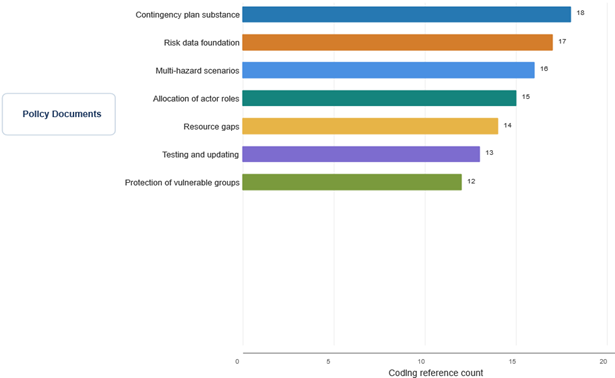
Document analysis indicates that contingency planning has a relatively clear regulatory basis and institutional format. Policy documents generally contain information on the type of threat, vulnerable areas, involved actors, coordination structures, and some resource requirements. The evidence suggests that administratively, contingency plans have been positioned as part of the regional preparedness system. However, coding results also indicate that administrative completeness has not been fully followed by operational depth. The coding generated 18 references to contingency-plan substance, 17 to risk-data foundations, 16 to multi-hazard scenarios, 15 to actor-role allocation, 14 to resource gaps, 13 to testing and updating, and 12 to vulnerable-group protection. Several documents identified hazards and responsible institutions but did not specify activation time, command channels, resource commitments, or reporting procedures. Other documents presented resource inventories without comparing available capacity with scenario-based requirements.
The most prominent descriptor in the document analysis is the substance of the contingency plan. This sub-descriptor includes clarity of objectives, completeness of components, consistency between risk analysis and action plans, and the document's alignment with policy guidelines. Documents tend to be strong in general descriptions, but not always strong in linking risks to measurable actions. Some documents mention the threat of earthquakes, tsunamis, floods, landslides, eruptions, or lahars, but operational scenarios still need clarification, particularly regarding the number of affected populations, shelter capacity, health service needs, and logistical requirements.
The second descriptor is the risk database. Risk data has been used as background, but has not always been the basis for calculating needs. Within an evidence-based policy framework, risk data should be used to prioritize areas, determine worst-case scenarios, calculate resources, and develop evacuation mechanisms. If data is used only as an initial narrative, risk plans lack sufficient precision. Document findings indicate that the use of risk data still needs to move from a descriptive to an operational function.
The third descriptor is the multi-hazard scenario. Documents generally list the main threats but do not fully integrate multiple and cascading risks. However, in the context of West Sumatra, threats can be interconnected. Eruptions can trigger cold lava flows during heavy rainfall. Earthquakes can trigger tsunamis, damage infrastructure, disrupt communications, and hinder evacuation. Floods can disrupt health services and logistics distribution. The limitations of these scenarios indicate the need for reconstruction to better align plans with actual risk dynamics.
The fourth descriptor is the division of actor roles. Documents list numerous institutions but do not always detail the division of tasks. Many formulations are general, such as coordinating, supporting, or implementing according to authority. Such formulations are difficult to use in an emergency because they do not answer the questions of who does what, when, with what resources, through which chain of command, and to whom to report. Thus, the division of roles needs to be translated into testable operational tasks.
The fifth descriptor is the resource gap. Documents generally contain an initial inventory, but it doesn't always compare available capacity with scenario requirements. A resource list is insufficient without information on condition, location, actual capacity, mobilization time, owner, and external support mechanisms. This finding suggests that the inventory needs to be developed into a resource gap analysis.
The sixth descriptor is testing and updating. Documents acknowledge the importance of simulations and regular updates, but follow-up mechanisms are not always clear. Plan testing schedules, success indicators, those responsible for evaluation, and revision procedures need to be strengthened. Without a learning cycle, contingency plans risk becoming static documents that no longer align with the latest risks and capacities. The seventh descriptor is the protection of vulnerable groups. Vulnerable groups are frequently mentioned in documents, but this is not always translated into operational data, specific evacuation procedures, shelter services, and accessible communications. This situation suggests that the equity dimension still needs to be strengthened in plan design.
Figure 1 shows that a contingency plan document cannot be judged solely by the presence of its components. The quality of the document must be seen in the relationships between the components. If risk data is not used to determine scenarios and resource requirements, the document has the potential to be administratively strong but operationally weak. The strongest document-based themes concerned plan substance, risk data, and scenario development. However, the relatively high references to role allocation, resource gaps, testing, and vulnerable-group protection indicate that formal completeness was not consistently supported by operational detail.
Figure 1. Coding matrix in policy document analysis
Document analysis showed that several contingency plans identified hazards, institutions, and resources but did not consistently translate them into measurable operational arrangements. For example, one document stated that relevant agencies should coordinate according to their respective responsibilities, without specifying activation time, command channels, resource commitments, or reporting procedures. This evidence supports the finding that documentary completeness has not yet ensured operational clarity.
3.2 In-depth interview results
In-depth interviews revealed a more complex dynamic than document analysis. Government informants generally considered contingency plans to be a crucial part of preparedness. However, informants from Non-Governmental Organizations, volunteers, communities, and vulnerable groups highlighted the gap between documents and practice. This difference in perspective is important because it demonstrates that preparedness cannot be assessed solely from the perspective of policy makers, but also from the perspective of implementing actors and the communities who will use the plan in an emergency.
The dominant descriptor in the interviews was cross-actor coordination. Informants stated that coordination is a determining factor in plan activation. Although coordination structures are in place, practice still relies heavily on personal relationships, field experience, and informal communication. Informal communication often helps expedite responses, but also poses sustainability risks if personnel change or communication networks are disrupted. These findings indicate that coordination needs to be institutionalized through clear procedures, proven communication channels, and a clear division of roles that all actors understand.
The second descriptor is resource capacity. Informants assessed that available capacity may be sufficient for specific incidents, but not necessarily for large-scale scenarios or trans-regional disasters. The issue is not simply the quantity of resources, but also their readiness, location, accessibility, and mobilization time. Registered equipment may not be ready for use. Registered shelters may not meet basic needs. Available vehicles may not be able to reach affected locations if roads are blocked. Thus, capacity needs to be assessed in actual terms, not nominally.
The third descriptor is planning testing. Informants acknowledged that simulations and exercises have been conducted on several occasions, but not all actors have consistently participated. Simulations have also not always been followed by evaluations that impact document revisions. In some cases, exercises have emphasized ceremonial aspects rather than critical testing of scenarios, commands, resources, and protection of vulnerable groups. These findings suggest that plan testing should be positioned as a policy evaluation mechanism, not simply a socialization activity.
The fourth descriptor is community participation. Communities are often positioned as recipients of information, rather than actors in plan development. Yet, they possess knowledge of local routes, safe points, vulnerable groups, and community resources. Community informants emphasized that limited outreach has left many residents unaware of the contents of contingency plans. Community engagement needs to be expanded beyond outreach to participatory mapping, community simulations, and evacuation route evaluations.
The fifth descriptor is the use of risk data. Several informants assessed that risk data is available, but its updating and use in decision-making are still suboptimal. Data on population, vulnerable groups, shelters, evacuation routes, and resources need to be synchronized across agencies. Data inconsistencies have the potential to cause confusion during emergency response.
The sixth descriptor is the inclusiveness of services. Informants from vulnerable groups assessed that evacuation and shelters do not fully address special needs. Physical accessibility, easy-to-understand information, the need for medication, assistance, and sanitation still need to be strengthened. This finding indicates that the dimensions of equity and responsiveness must be core components of policy reconstruction.
Figure 2 shows that the interviews yielded varying perspectives. These differences are not data weaknesses, but sources of triangulation. A good contingency policy must be able to answer the assessments of the government as the drafter, the Regional Apparatus Organizations as sectoral implementers, vertical institutions as technical support, and the community as end users. This indicates that cross-actor coordination and resource capacity were the most prominent concerns in the interviews. This pattern supports the finding that contingency plans are not always understood or activated consistently across institutions, especially when personnel, resources, or risk conditions change. Cross-actor coordination was the most frequent interview theme, with 19 coding references, followed by resource capacity with 18 references. Plan testing generated 16 references, community participation 15 references, the use of risk data 14 references, and service inclusiveness 13 references. These patterns show that operational coordination and actual resource readiness were the most prominent concerns, although participation and inclusive protection remained strategically important.
Figure 2. Coding matrix in in-depth interviews
3.3 Field observation results
Field observations were used to verify whether the components outlined in the document were actually available and usable. Observation findings revealed variations in preparedness between regions and facilities. Some locations had evacuation route signs, assembly points, shelters, equipment, and communication facilities, but their quality and actual use were uneven.
The first descriptor in the observation was evacuation routes and assembly points. In some areas, evacuation routes were present, but others were obscured by buildings, vegetation, billboards, or were not clearly visible at night. Some evacuation routes passed through narrow roads, busy intersections, or areas potentially disrupted during a disaster. The evidence suggests that evacuation routes need not only be specified in the document but also tested under various conditions, including rain, nighttime, heavy traffic, and public panic.
The second descriptor is shelter and basic facilities. Some locations designated as shelters have sufficient space, but not all are equipped with clean water, sanitation, lighting, accessibility, dedicated service areas, and refugee management mechanisms. Shelters that do not meet basic needs can create new problems during the emergency phase. Consequently, shelter assessments must include service capacity, quality, access, and adequacy.
The third descriptor is equipment readiness. Observations reveal discrepancies between inventory and actual conditions. Some equipment is available but requires maintenance, component replacement, or more strategic placement. This underscores the importance of periodic equipment readiness audits.
The fourth descriptor is command centers. Some command centers have communication and monitoring facilities, but system redundancy is not always robust. Reliance on electricity, internet networks, or specific devices can be a weak point when infrastructure is impacted. Alternative communication and backup procedures need to be incorporated into plans.
The fifth descriptor is emergency communication systems. Public information has been provided in the form of signs, boards, or outreach materials, but public understanding cannot be assumed. Risk communication should be tested through simulations and tailored to target groups. The sixth descriptor is accessibility for vulnerable groups. Observations show that not all routes, shelters, and facilities have adequate access for people with disabilities, the elderly, pregnant women, or residents with special needs. This situation reinforces the need to incorporate universal design and specific procedures into policy reconstruction.
Figure 3 distinguishes nominal capacity recorded in planning documents from actual capacity verified through facility condition, accessibility, maintenance, and operational usability. Field observations generated 18 references to evacuation routes and assembly points, 17 to shelters and basic facilities, 15 to equipment readiness, 14 to command centres, 13 to emergency communication systems, and 12 to accessibility for vulnerable groups. These records confirmed that the availability of facilities in planning documents did not always correspond to their condition, accessibility, maintenance, or operational usability.
Figure 3. Coding matrix in field observations
3.4 Focus group discussion results
The FGD served as a forum for validation and synthesis. FGD participants generally agreed that contingency plans remain necessary as a coordination framework, but their design needs to be made more operational, simple to use, testable, and easy to update. Participants noted that overly lengthy documents often make them difficult to use in emergency situations. Accordingly, contingency plans need to be supplemented with operational summaries, task cards, contact lists, resource maps, and clear activation procedures.
The first descriptor in the FGD was a dynamic risk baseline. Participants emphasized that plans should utilize the most recent risk data, including changes in settlements, infrastructure, population, vulnerable groups, and service capacity. Data should not be confined to appendices but should form the basis for determining scenarios and resource requirements. The second descriptor was a multi-hazard scenario. Participants assessed that plans need to account for interactions between hazards. In the context of West Sumatra, disasters can evolve from a single threat into a series of crises involving access to transportation, health, logistics, communications, and evacuation. Consequently, scenarios must include cascading impacts and cross-sector response strategies.
The third descriptor is operational governance. Participants emphasized the importance of clear and testable role allocations. Each actor needs to know their tasks, resources, activation times, and reporting mechanisms. The coordination structure must be implemented not only on paper but also in exercises. The fourth descriptor is resource gap analysis. Participants agreed that resource lists need to be updated and verified. Needs in specific scenarios should be compared with actual capacity. If there are gaps, plans should outline strategies for meeting them, whether through support from the province, other districts/cities, businesses, volunteers, or the community.
The fifth descriptor is inclusive protection. Participants stated that vulnerable groups need to be involved in planning and simulations. Disaggregated data, accessible routes, shelter services, dedicated communication, and mentoring should be part of the design. The sixth descriptor is testing and learning. Participants emphasized that simulations should produce evaluation records and document revisions. The FGD recommended after-action reviews as a routine mechanism following drills and disaster events. The seventh descriptor is regular updates. Participants assessed that plans should have a clear review cycle, designated person(s), indicators, and budget support. Updates should not be dependent on temporary projects but should be an ongoing institutional function.
Figure 4 shows how the FGD transformed the identified weaknesses into policy-design priorities. Dynamic risk data, multi-hazard scenarios, operational governance, resource-gap analysis, inclusive protection, testing, and periodic updating emerged as the main requirements for reconstruction. The FGDs indicated that policy reconstruction needs to be geared toward a practical system, not just a lengthy document. Participants emphasized the importance of operational summaries, task cards, resource maps, and user-friendly update mechanisms. FGD coding generated 18 references to dynamic risk data, 17 to multi-hazard scenarios, 17 to operational governance, 16 to resource-gap analysis, 15 to inclusive protection, 15 to testing and institutional learning, and 14 to periodic updating. The need for updated risk data was emphasized by provincial, local-government, and academic participants. Clear role allocation and resource-gap analysis were supported by disaster-management and technical-agency representatives. Inclusive protection was particularly emphasized by community and vulnerable-group representatives.
Figure 4. Coding matrix in focus group discussion (FGD)
3.5 Integration of contingency planning evaluation dimensions
The integration of data from documents, interviews, observations, and FGDs indicates that contingency planning has strengths in normative recognition and the existence of a basic framework, but still requires strengthening in operational aspects. In the effectiveness dimension, the plan has not yet fully become a working guideline used by all actors. Activation still relies on experience and informal communication. In the efficiency dimension, data and resources are still scattered, potentially leading to duplication and delays.
In the adequacy dimension, available capacity does not always match the needs of major scenarios. Inventories need to be developed into gap analyses. In the appropriateness dimension, plans still tend to be generic and not fully specific to regional variations and risk characteristics. In the equity dimension, protection of vulnerable groups still needs to be translated into operational procedures. In the responsiveness dimension, evaluation and learning have not yet fully resulted in document updates.
The integrated findings indicate that design weaknesses arise from weak relationships between components. Risk data doesn't always influence scenarios. Scenarios don't always form the basis for resource calculations. Resources aren't always linked to actors and commands. Simulations aren't always linked to revisions. Public participation isn't fully connected to formal structures. Thus, policy reconstruction needs to be carried out systematically.
Figure 5 indicates that adequacy, effectiveness, and responsiveness were the most prominent evaluative dimensions. Nevertheless, equity remained strategically important because failures in accessibility and protection directly increased risks for vulnerable groups.
Figure 5. Coding matrix on evaluation dimension integration
The integration matrix emphasizes that policy reconstruction must address the interrelationships between dimensions. Effectiveness requires scenario appropriateness, resource adequacy, coordination efficiency, protection equity, and responsiveness to reforms. Thus, no single dimension can be improved in isolation from the others.
Figure 6 presents the final analytical synthesis. The model links risk data with scenario development, scenarios with resource requirements, actor roles with command and coordination, and testing with evaluation and updating.
Figure 6. Coding matrix in policy reconstruction
Research findings confirm that contingency planning issues cannot be understood solely as a matter of completeness of policy documents. From a policy design perspective, a public instrument is assessed by its ability to connect problems, objectives, actors, resources, and implementation mechanisms [53, 54]. Contingency plans that merely comply with administrative formats are not necessarily capable of serving as operational guidelines when a disaster occurs. This is evident from document analysis and interviews, which indicate that the existence of plans is not always accompanied by a verifiable understanding of actors, activation mechanisms, and role allocation.
These findings strengthen the argument that contingency planning must be repositioned as a strategic policy instrument [55, 56]. As a policy instrument, contingency plans contain decisions about prioritized threats, areas considered most at risk, groups to be protected, responsible actors, and allocated resources [25, 57-59]. These decisions are not neutral because they impact the distribution of safety, speed of response, and public access to emergency services. Thus, plan development must go beyond the logic of administrative compliance.
In contingency planning, the primary problem is not only the threat of disaster, but also weak coordination, limited resources, outdated data, and untested procedures [13, 60]. If the plan only contains a threat narrative without addressing these institutional weaknesses, the instrument will be ineffective. Policy reconstruction must begin with an understanding that preparedness is a product of governance, not just documents.
Consequently, indicators of success should not be limited to the number of documents prepared. More meaningful indicators include the level of actor understanding, the availability of activation procedures, simulation results, the validity of resource data, community involvement, accessibility for vulnerable groups, and follow-up evaluations. Using these indicators, local governments can assess whether the contingency plan is truly functioning as a preparedness system.
4.1 Effectiveness and operational activation issues
The effectiveness of a contingency plan is related to its ability to direct a rapid, coordinated, and scenario-appropriate response [56, 61]. Research shows that effectiveness is still limited by the weak link between the document and activation practices. Policy documents may identify actors and tasks, but not all actors understand their roles in detail. Changes in officials, limited socialization, and infrequent training mean that knowledge of the plan is not always shared at the technical level.
In emergencies, effectiveness depends heavily on the clarity of initial actions. The first few days after a disaster are a critical phase. During this phase, actors must understand who activates the plan, how information is verified, who leads coordination, how resources are mobilized, and how the community is directed [62-64]. If activation procedures are unclear, the response tends to rely on improvisation. Improvisation can be helpful in certain circumstances, but it should not be the primary mechanism because it is difficult to replicate and prone to error [65, 66].
Effectiveness also relates to the relationship between contingency plans and early warning systems. Technical information from the Meteorology, Climatology, and Geophysics Agency, Center for Volcanology and Geological Hazard Mitigation, or other monitoring agencies must be translated into operational decisions. Disaster early warnings should not be understood simply as information messages, but as triggers for action [67]. Contingency plans need to clarify warning levels, actions to be taken at each level, responsible actors, and communication channels to the public [68].
The evidence suggests that effectiveness needs to be strengthened through concise and tested operational tools. Key policy documents can be supplemented with action cards, contact lists, command maps, activation flows, and initial action checklists. These tools should be simulated so that actors are not only aware of the plan but also able to implement it.
4.2 Efficiency, data fragmentation, and cross-actor coordination
The dimension of efficiency in this study is not understood solely as cost savings, but as the system's ability to optimally utilize time, information, actors, and resources [69]. The findings indicate that efficiency is still hampered by data fragmentation and coordination. Many actors possess their own data and resources, but these are not fully integrated into a shared system. This can lead to duplication, delays, and inconsistencies in information during emergencies.
From a collaborative governance perspective, effective coordination requires shared goals, role clarity, trust, communication, and institutional mechanisms [70, 71]. Research findings indicate that informal relationships often help expedite coordination, but reliance on personal relationships is insufficient to ensure sustainability. When personnel change, informal networks can weaken, so coordination needs to be institutionalized through agreed-upon procedures, not just interpersonal relationships.
Efficiency also necessitates the integration of resource data [72, 73]; therefore, local governments need to promptly gain an understanding of the resources available within the RDMA, regional government agencies, vertical agencies, hospitals, the business sector, humanitarian organizations, and the community. This information should include quantities, locations, conditions, responsible parties, mobilization times, and usage restrictions. Without integrated data, decision-making in disaster management is slow and tends to be reactive [74-76].
However, integration does not mean all data must be managed by a single agency; it requires data standards, update mechanisms, access rights, and interoperability [77, 78]. The RDMA can act as an orchestrator, ensuring cross-actor data is available, verified, and used as needed. This way, efficiency can be strengthened without diminishing the authority of each agency.
4.3 Adequate capacity and need for gap analysis
Adequacy is a crucial dimension because contingency plans are only meaningful if the planned resources are sufficient to address the scenario. Research shows that resource inventories have not always evolved into adequacy analyses. Policy documents may list equipment, shelters, vehicles, and personnel, but these do not always compare them to estimated needs.
In policy evaluation, adequacy asks whether the policy is capable of addressing the scale of the problem [79-81]. In contingency planning, this question must be answered through gap analysis. If the scenario anticipates thousands of evacuees, the capacity of shelters, clean water, sanitation, public kitchens, health workers, and logistics must be calculated. If the scenario anticipates road closures, the need for heavy equipment, alternative routes, and transportation support must be mapped. If the scenario involves vulnerable groups, the need for assistance, specialized vehicles, and health services must be provided. Adequacy must also take into account mobilization time. Resources available but arriving late cannot be considered sufficient for the initial response phase. The resource analysis must include location, accessibility, equipment condition, and potential damage from the disaster. Resources located in vulnerable zones may be affected, requiring alternatives [82].
Policy reconstruction needs to differentiate between nominal and actual capacity. Nominal capacity is the recorded resource, while actual capacity is the resource that can actually be used [83]. This distinction can only be determined through audits, observations, and exercises. The gap analysis should not be an add-on, but rather the core of contingency planning.
4.4 Policy appropriateness in the context of multi-hazard and cascading risks
Policy appropriateness relates to the alignment between plans and the characteristics of regional risks [84, 85]. Findings indicate that some plans remain generic. However, West Sumatra faces a complex variety of hazards, ranging from earthquakes and tsunamis in coastal areas, floods and landslides in river basins and hills, to eruptions and lava flows around volcanoes. Each hazard requires different scenarios, evacuation routes, resources, and communication patterns [86-88].
Plans for coastal areas need to account for short evacuation times, population density, vertical evacuation, and access for fishing communities. Plans for mountainous areas need to account for landslides, disrupted access, and the need for heavy equipment. Plans for urban areas need to account for congestion, high-rise buildings, and service density. Thus, the format of a contingency plan may have a general standard, but its operational content must vary according to regional characteristics [89].
This finding supports the need for dynamic risk data use and community verification. Technical data needs to be combined with local knowledge, and communities should be aware of commonly used routes, congestion points, the location of vulnerable residents, and community resources. By combining technical data and local knowledge, plans become more precise and more readily accepted.
4.5 Equity and protection of vulnerable groups
The equity dimension indicates that the success of a contingency plan cannot be measured solely by the overall response, but also by its ability to protect the most vulnerable groups [25, 90]. Research shows that vulnerable groups are recognized in documents, but not always incorporated into operational procedures. This is a serious problem because disasters have uneven impacts.
Children, the elderly, people with disabilities, pregnant women, the poor, and residents living in remote areas have different needs. They may require simpler information, evacuation assistance, specialized vehicles, medicines, health services, safe sanitation, and appropriate evacuation spaces. If these needs are not planned for from the outset, the response will rely on improvisation.
From a risk equity perspective, equity encompasses three aspects. First, distributive justice, which is the distribution of resources according to need. Second, procedural justice, which is the involvement of vulnerable groups in the development and evaluation of plans. Third, recognition justice, which is the recognition of specific experiences and needs as a legitimate part of the policy process [91, 92].
Policy reconstruction should incorporate disaggregated data, specific evacuation procedures, shelter accessibility, inclusive communication, and the involvement of organizations representing vulnerable groups. Protection of vulnerable groups should not be considered an afterthought, but a key indicator of plan quality. A plan that is fast but fails to reach vulnerable groups cannot be considered policy success [93, 94].
4.6 Responsiveness, learning, and adaptive governance
Policy responsiveness relates to the plan's ability to adapt to changing risks, exercise outcomes, incident experiences, and community needs [95-97]. Findings indicate that learning occurs in practice but has not yet been fully institutionalized. Simulations, disaster events, and field coordination often generate valuable lessons, but this is not always followed by revisions to policy documents.
Within the concept of adaptive governance, policies must be able to learn. Contingency plans cannot be developed once and then used continuously. Risks change due to population growth, spatial planning changes, infrastructure development, environmental degradation, climate change, and organizational changes. The contingency plans must have a cycle of development, dissemination, testing, evaluation, revision, and retesting [98-100].
After-action reviews need to be a routine mechanism. Every simulation and disaster event should produce a record of what was planned, what happened, why the differences occurred, what the impact was, and who was responsible for correcting them. Recommendations should have deadlines and follow-up indicators. Without such a mechanism, evaluations become merely administrative records [40, 101].
Responsiveness also demands institutional sustainability. Personnel changes must not eliminate knowledge of the plan. Accordingly, training, documentation, data systems, and regular audits are necessary to maintain organizational memory. Thus, responsiveness in disaster management policy is not only the ability to change, but the ability to change in a targeted manner based on learning [97, 102].
Based on the findings and discussion, this study formulated a policy reconstruction model consisting of six main components. The first component is dynamic risk data. Data on threats, exposure, vulnerability, capacity, vulnerable groups, and resources should be updated regularly and used to develop scenarios. The second component is multi-hazard scenarios. Scenarios should account for primary threats, secondary impacts, cascading risks, and disruptions to essential services.
The third component is operational governance. Plans should outline command structures, role allocations, communication channels, activation procedures, and accountability mechanisms. The fourth component is resource gap analysis. Requirements for each scenario should be compared with actual capacity, including external support. The fifth component is inclusive protection. Plans should include data on vulnerable groups, specific procedures, accessibility, and community participation. The sixth component is testing, evaluation, and updating. Every plan should be tested, evaluated, revised, and updated regularly.
This model positions contingency plans as a system, not just a policy document. The system connects data, scenarios, actors, resources, communities, exercises, and lessons learned. Reconstruction does not mean replacing existing policies entirely, but rather improving the policy architecture to make them more adaptive, operational, and evidence-based.
The strength of this model lies in the integration of policy evaluation and risk governance. Six evaluation dimensions are used to assess weaknesses, while six reconstruction components are used to design improvements. Thus, the research findings do not stop at criticism but offer design directions that local governments can use (Table 6).
Table 6. Policy reconstruction flow
|
Reconstruction Component |
Problem Addressed |
Mechanism |
Output |
|
Dynamic risk data |
Outdated data |
Data updating and local validation. |
Relevant and current scenarios |
|
Multi-hazard scenarios |
Single-hazard and generic assumptions |
Scenario design covering primary, secondary, and cascading impacts. |
Operationally realistic planning basis |
|
Operational governance |
Unclear roles and activation |
Command structure, task cards, communication flow, and accountability procedures. |
Clear activation and role allocation |
|
Resource gap analysis |
Resource lists without sufficiency assessment |
Comparison of scenario needs and actual capacity. |
Identified resource gaps and support mechanisms |
|
Inclusive protection |
Vulnerable groups insufficiently operationalised |
Disaggregated data, accessible shelter, special evacuation procedures, and inclusive communication. |
Equitable protection |
|
Testing, evaluation, and updating |
Static and untested documents |
Simulation, after-action review, revision, and annual review cycle. |
A living and adaptive contingency planning system |
Theoretically, this research contributes by positioning contingency planning as a policy design instrument. Contingency planning is often understood as a technical preparedness document. This research demonstrates that contingency plans are also policy instruments that contain decisions about issues, actors, resources, priorities, and distribution of protection. The second contribution is the use of multidimensional evaluation. Effectiveness alone is not sufficient to assess a plan. Plans also need to be efficient, sufficient, appropriate, equitable, and responsive. The integration of the six dimensions allows for a more comprehensive analysis and avoids narrow assessments based on the existence of documents. The third contribution is the link between evaluation and reconstruction. Many studies stop at problem identification. This research continues the analysis toward designing improvements that include risk data, scenarios, governance, resources, inclusiveness, and learning. Thus, evaluation is not only an assessment tool but also the foundation for new policy design.
Practically, this research has implications for local governments. The RDMA needs to act as a system coordinator, not a sole implementer. Regional Apparatus Organizations need to ensure sectoral readiness. Village governments and communities need to be involved in mapping and simulations. Businesses and humanitarian organizations need to be included in clear support mechanisms. Vulnerable groups must be part of success indicators. The most important policy implication is a shift in orientation from documents to systems. Local governments need to assess success based on the plan's function in training and response, not simply the existence of a document. With this approach, contingency planning can become a tangible instrument for strengthening regional disaster risk governance.
This finding indicates that the reconstruction of contingency planning cannot be separated from the broader regional policy cycle. Contingency plans are often developed within the disaster management framework, relatively separate from development documents, spatial planning, social protection, health, education, and infrastructure. Yet, disaster risk is shaped by cross-sectoral decisions. When the development of settlements, roads, public facilities, tourism areas, or economic zones fails to consider risk, the burden of contingency planning becomes even heavier. The research findings encourage the need to treat contingency plans not as sectoral documents, but as instruments that must be integrated with regional development planning.
This integration has practical consequences. Evacuation route data needs to be updated when new roads are built. Shelter data needs to change when public facilities are repaired, relocated, or repurposed. Data on vulnerable groups must be linked to social and health service systems. Logistics data needs to be linked to business capacity and distribution networks. Without integration, contingency plans will quickly lag behind regional changes. In other words, updating plans is not solely the responsibility of the RDMA, but a cross-sectoral task that requires institutional commitment.
From a policy perspective, these findings indicate the need to mainstream contingency planning into the planning and budgeting cycle. Local governments can establish an annual agenda for risk data reviews, resource validation, simulations, and document revisions. The results of the reviews should inform the following year's budget. This way, updates are not dependent on ad hoc projects or post-disaster momentum, but become a regular practice of local governance.
Modern disaster risk governance emphasizes that risk must be managed through an open, adaptive, and collaborative system. The research findings show that such a system is not fully established when contingency plans are still document-oriented. Risk governance requires the ability to connect scientific data, administrative decisions, cross-sectoral resources, and community capacity. If any of these elements are missing, the contingency plan loses its operational effectiveness.
The research findings also indicate that risk governance must acknowledge uncertainty. Plans cannot accurately predict all events. Therefore, the goal of a plan is not to eliminate uncertainty but rather to provide a framework for action when uncertainty arises. Scenarios, commands, communication channels, and gap analysis help actors act even when information is incomplete. This is where adaptive governance is crucial. Plans must be clear enough to guide action, yet flexible enough to adapt to actual circumstances.
In a multi-hazard context, risk governance also requires intersectoral linkages. Disasters can simultaneously damage roads, electricity, telecommunications, health facilities, markets, schools, and social networks. Response cannot be handled by a single agency. Accordingly, the division of roles in contingency plans must be more operational. Coordination should be seen as a collaborative work design, not just a general principle.
Findings regarding community participation indicate that contingency plans still need to expand the role of citizens from information recipients to policy partners. Communities possess knowledge about road conditions, the location of vulnerable residents, mobility habits, local resources, and patterns of solidarity. This knowledge is not always reflected in technical documents, but is crucial when a disaster strikes. If local knowledge is not utilized, plans can appear sound administratively but difficult to implement in the field.
In the context of West Sumatra, village institutions, traditional leaders, religious leaders, youth, women's groups, fishermen, and volunteers have the potential to act as liaisons between formal systems and communities. However, these roles need to be clearly defined. It is not enough to simply state that the community is involved; the document must explain the form of involvement, tasks, communication channels, and support provided. For example, who assists in data collection for vulnerable residents, who disseminates evacuation information, who manages assembly points, and how they coordinate with the command post.
Local wisdom also needs to be positioned critically. It can strengthen risk communication and solidarity, but it must be integrated with scientific data and safety standards. Integrating local wisdom does not mean replacing formal systems, but rather building a bridge between community knowledge and official procedures. A successful policy reconstruction is one that is acceptable to the community and meets operational disaster standards.
This finding indicates that disaster contingency planning should not be understood merely as a formal administrative document required by regulation, but as a strategic policy instrument that determines how risk knowledge is translated into collective action before and during emergencies. The case of West Sumatra shows that the existence of contingency planning documents does not automatically guarantee operational preparedness. Although the plans have a relatively clear normative basis and contain several essential components, their policy function remains limited when risk data are not fully transformed into realistic scenarios, actor roles are not translated into operational tasks, resource inventories are not developed into gap analyses, and simulations are not systematically used as learning mechanisms.
The integrated findings from document analysis, interviews, field observations, and FGD indicate that the main weakness of contingency planning lies in the disconnection among policy components. Risk data often function as descriptive background rather than as the basis for scenario formulation and resource calculation. Institutional coordination is formally recognized but is not always supported by clear activation procedures, communication flows, task cards, and accountability mechanisms. Resource capacity is frequently listed in documents, yet its actual readiness, location, accessibility, condition, and mobilization time are not consistently verified. Similarly, vulnerable groups are acknowledged in planning narratives, but their specific needs are not always translated into accessible evacuation routes, inclusive shelters, disaggregated data, tailored communication, and assisted evacuation procedures.
Theoretically, this study contributes to the literature on disaster risk governance by integrating policy evaluation, adaptive governance, and contingency planning into a single analytical framework. It shows that effectiveness alone is insufficient for assessing disaster preparedness policies; plans must also be efficient, adequate, appropriate, equitable, and responsive. Practically, the reconstruction model provides local governments with a usable framework for transforming contingency plans from static compliance documents into adaptive preparedness systems. By strengthening the linkage between evidence, actors, resources, community participation, and institutional learning, contingency planning can better support rapid response, reduce disaster losses, protect vulnerable groups, and enhance regional resilience in multi-hazard contexts.
The Research Team expresses its appreciation and gratitude to Ministry of Higher Education, Science, and Technology of the Republic of Indonesia and Universitas Negeri Padang for conducting this research (Decree Number: 181/KPA/C4/KPT/2026 and Contract Number: 1268/UN35.15/LT/2026).
[1] Nemakonde, L.D., van Niekerk, D. (2023). Enabling conditions for integrating government institutions for disaster risk reduction and climate change adaptation in the SADC region and beyond. Risk, Hazards & Crisis in Public Policy, 14(1): 6-26. https://doi.org/10.1002/rhc3.12246
[2] Alhadi, Z., Riandini, O., Yusran, R., Eriyanti, F., Putera, R.E. (2024). Policy design for strengthening disaster risk reduction based on sendai framework for action in West Sumatera Province, Indonesia. International Journal of Safety and Security Engineering, 14(6): 1895-1905. https://doi.org/10.18280/ijsse.140623
[3] Córdova, M.D., Menoscal, J., Moreno Flores, E. (2022). Governance and the design of post-disaster policies: A comparative analysis in Latin America and the Caribbean. Disasters, 47(3): 766-787. https://doi.org/10.1111/disa.12561
[4] Chhotray, V., Singh, D. (2025). Two regimes of waste and value: ‘Post‐Disaster’ landscapes in a New India. Development and Change, 57(1): 27-49. https://doi.org/10.1111/dech.70038
[5] Coates, R., Warner, J. (2023). Calamitous events? Exploring perceptions of disaster. International Journal of Disaster Risk Reduction, 91: 103700. https://doi.org/10.1016/j.ijdrr.2023.103700
[6] Walter, J. (2024). From worshipping Tyche to playing with wild cards. Journal of Contingencies and Crisis Management, 32: e12543. https://doi.org/10.1111/1468-5973.12543
[7] Alhadi, Z., Riandini, O., Eriyanti, F., Yusran, R., Permana, I. (2024). Analysis of the effectiveness and efficiency of tsunami disaster contingency planning policies in the Province of West Sumatra, Indonesia. International Journal of Safety and Security Engineering, 14(4): 1087-1098. https://doi.org/10.18280/ijsse.140407
[8] Lessy, M.R., Lassa, J., Zander, K.K. (2024). Understanding multi-hazard interactions and impacts on small-island communities: Insights from the active volcano island of ternate, Indonesia. Sustainability, 16(16): 6894. https://doi.org/10.3390/su16166894
[9] Alhadi, Z., Permana, I., Putera, R.E., et al. (2026). Policy capacity and local disaster management effectiveness: Assessing institutional performance in Rokan Hulu Regency, Indonesia. International Journal of Safety and Security Engineering, 16(1): 29-42. https://doi.org/10.18280/ijsse.160103
[10] Raju, E., Boyd, E., Otto, F. (2022). Stop blaming the climate for disasters. Communications Earth & Environment, 3: 1. https://doi.org/10.1038/s43247-021-00332-2
[11] Alhadi, Z., Riandini, O., Yusran, R., et al. (2025). Policy design for strengthening the institutional framework of disaster risk governance in Padang City, Indonesia. International Journal of Safety and Security Engineering, 15(8): 1541-1555. https://doi.org/10.18280/ijsse.150801
[12] Graveline, M.H., Germain, D. (2022). Disaster risk resilience: Conceptual evolution, key issues, and opportunities. International Journal of Disaster Risk Science, 13(3): 330-341. https://doi.org/10.1007/s13753-022-00419-0
[13] Safaeian, M., Moses, R., Ozguven, E.E., Dulebenets, M.A. (2024). An optimization-based risk management framework with risk interdependence for effective disaster risk reduction. Progress in Disaster Science, 21: 100313. https://doi.org/10.1016/j.pdisas.2024.100313
[14] Nekoei-Moghadam, M., Moradi, S.M., Tavan, A. (2024). How can the Sendai framework be implemented for disaster risk reduction and sustainable development? A qualitative study in Iran. Globalization and Health, 20: 23. https://doi.org/10.1186/s12992-024-01028-w
[15] Hamill-Stewart, J. (2025). The Sendai framework and satellite security. International Journal of Disaster Risk Science, 16: 117-127. https://doi.org/10.1007/s13753-025-00614-9
[16] Vivita, L., Husaini, Anggraini, R., Dewi, C.N. (2023). Enhancement of disaster preparedness: Approaches of place attachment and behavior to “build back better” mosque as tsunami evacuation building in Banda Aceh City, Indonesia. Progress in Disaster Science, 19: 100293. https://doi.org/10.1016/j.pdisas.2023.100293
[17] Khankeh, H.R. (2026). Advancing the Sendai framework in Iran’s health system. Health in Emergencies and Disasters Quarterly, 11(2): 93-94. https://doi.org/10.32598/hdq.2026.114.2
[18] Wowk, K., Adams, M.A., Martinez, E. (2023). Translating the complexity of disaster resilience with local leaders. Frontiers in Communication, 8: 1100265. https://doi.org/10.3389/fcomm.2023.1100265
[19] Alhadi, Z., Sasmita, S., Yulfa, A., et al. (2023). The coping strategies patterns based on local wisdom and resilience capital in facing natural disaster risk in Nagari Mandeh, Indonesia. International Journal of Sustainable Development and Planning, 18(1): 315-325. https://doi.org/10.18280/ijsdp.180133
[20] Triyanti, A., Surtiari, G.A.K., Lassa, J., et al. (2022). Governing systemic and cascading disaster risk in Indonesia: where do we stand and future outlook. Disaster Prevention and Management, 32(1): 27-48. https://doi.org/10.1108/dpm-07-2022-0156
[21] Inarisk. (2025). Indonesian Disaster Risk Index. https://inarisk.bnpb.go.id/irbi.
[22] Kachali, H., Storsjö, I., Haavisto, I., Kovács, G. (2018). Inter-sectoral preparedness and mitigation for networked risks and cascading effects. International Journal of Disaster Risk Reduction, 30: 281-291. https://doi.org/10.1016/J.IJDRR.2018.01.029
[23] NDMA. (2024). Indonesian Disaster Data for 2024. https://www.bnpb.go.id/buku/buku-data-bencana-indonesia-tahun-2024.
[24] NDMA. (2023). Development of a Disaster Contingency Plan. https://peraturan.bpk.go.id/Details/267983/peraturan-bnpb-no-2-tahun-2023.
[25] Orru, K., Hansson, S., Nero, K. (2025). Social vulnerability triage: A dynamic scenario-based system for disaster planning and response. Journal of Risk Research, 28(6): 549-570. https://doi.org/10.1080/13669877.2025.2522660
[26] Rivera, J. D., Quick, K., Herrera, E., Sung, H.E., Escobar Ortiz, K. (2024). Interorganisational emergency management coordination challenges in a resource-scarce environment: A case study of El Salvador post COVID-19. Disasters, 49(2): e12672. https://doi.org/10.1111/disa.12672
[27] Jovanović, A.S. (2025). Stress-testing the resilience of critical infrastructures exposed to polycrises triggered by emerging risks. International Journal of Disaster Risk Science, 16: 594-617. https://doi.org/10.1007/s13753-025-00663-0
[28] Hassel, H., Cedergren, A. (2024). A framework for business continuity management in a multiactor context. Journal of Contingencies and Crisis Management, 32(2): e12573. https://doi.org/10.1111/1468-5973.12573
[29] Qie, Z.J., Rong, L.L. (2022). A scenario modelling method for regional cascading disaster risk to support emergency decision making. International Journal of Disaster Risk Reduction, 77: 103102. https://doi.org/10.1016/j.ijdrr.2022.103102
[30] Central Bureau of Statistics. (2025). West Sumatra Province in Figures 2025. https://sumbar.bps.go.id/id/publication/2025/02/28/a757962d2ef9b6ce8943ed73/provinsi-sumatera-barat-dalam-angka-2025.html.
[31] Inarisk. (2024). West Sumatra Province Disaster Risk Index 2015–2024. https://inarisk.bnpb.go.id/IRBI-2024/mobile/index.html#p=66.
[32] Daddoust, L., Asgary, A., McBey, K.J., Elliott, S., Normand, A. (2021). Spontaneous volunteer coordination during disasters and emergencies: Opportunities, challenges, and risks. International Journal of Disaster Risk Reduction, 65: 102546. https://doi.org/10.1016/J.IJDRR.2021.102546
[33] Rahman, H.M.T., Ingram, S., Natcher, D. (2024). The cascading disaster risk of water, energy and food systems. Environmental Hazards, 23(5): 423-442. https://doi.org/10.1080/17477891.2024.2323105
[34] Col, J.M. (2007). Managing disasters: The role of local government. Public Administration Review, 67: 114-124. https://doi.org/10.1111/J.1540-6210.2007.00820.X
[35] Dunant, A., Robinson, T.R., Densmore, A.L., et al. (2025). Impacts from cascading multi-hazards using hypergraphs: A case study from the 2015 Gorkha earthquake in Nepal. Natural Hazards and Earth System Sciences, 25(1): 267-285. https://doi.org/10.5194/nhess-25-267-2025
[36] Phattharapornjaroen, P., Carlström, E., Khorram-Manesh, A. (2022). Developing a conceptual framework for flexible surge capacity based on complexity and collaborative theoretical frameworks. Public Health, 208: 46-51. https://doi.org/10.1016/j.puhe.2022.04.012
[37] Su, Q.M., Chen, K.D., Liao, L.Y. (2021). The impact of land use change on disaster risk from the perspective of efficiency. Sustainability, 13(6): 3151. https://doi.org/10.3390/SU13063151
[38] Papathoma-Köhle, M., Thaler, T., Fuchs, S. (2021). An institutional approach to vulnerability: Evidence from natural hazard management in Europe. Environmental Research Letters, 16(4): 044056. https://doi.org/10.1088/1748-9326/ABE88C
[39] Hsu, W.K., Tseng, C.P., Chiang, W.L., Chen, C.W. (2012). Risk and uncertainty analysis in the planning stages of a risk decision-making process. Natural Hazards, 61(3): 1355-1365. https://doi.org/10.1007/S11069-011-0032-1
[40] Waring, S., Moisi, I., Barrett, C., Gordts, S. (2024). Identifying what components of full-scale emergency exercises improve disaster response learning: A rapid evidence assessment. International Journal of Disaster Risk Reduction, 104: 104390. https://doi.org/10.1016/j.ijdrr.2024.104390
[41] Kapucu, N., Parkin, A., Lumb, M., Dippy, R. (2024). Crisis coordination in complex intergovernmental systems: The case of Australia. Public Administration Review, 84(3): 389-399. https://doi.org/10.1111/puar.13830
[42] Lü, Y., Zhang, Z.Y., Gan, Y.T. (2023). Joint disaster relief: The Chinese civilian rescue teams’ response to the 2021 Henan flood. Natural Hazards, 120: 1755-1783. https://doi.org/10.1007/s11069-023-06268-4
[43] Li, Y., Song, Y.S. (2023). Contingent coordination in crisis: Experiences of Qingdao control command in governing COVID-19 in China. Journal of Contingencies and Crisis Management, 31: 475-488. https://doi.org/10.1111/1468-5973.12453
[44] Kapucu, N., Hu, Q. (2022). An old puzzle and unprecedented challenges: Coordination in response to the COVID-19 pandemic in the US. Public Performance & Management Review, 45(4): 773-798. https://doi.org/10.1080/15309576.2022.2040039
[45] Ross, A.D., Atoba, K.O. (2022). The dimensions of individual support for coastal hazard mitigation: Analysis of a survey of upper texas coast residents. Natural Hazards Review, 23(2). https://doi.org/10.1061/(asce)nh.1527-6996.0000544
[46] Kaur, K. (2024). Role of community in disaster management. International Journal for Multidisciplinary Research, 6(1). https://doi.org/10.36948/ijfmr.2024.v06i01.14285
[47] Shmueli, D.F., Ozawa, C.P., Kaufman, S. (2021). Collaborative planning principles for disaster preparedness. International Journal of Disaster Risk Reduction, 52: 101981. https://doi.org/10.1016/J.IJDRR.2020.101981
[48] Hollis, S., Ekengren, M. (2025). The reality of contingency: Implications for crisis management. Risk, Hazards & Crisis in Public Policy, 16(3): e70020. https://doi.org/10.1002/rhc3.70020
[49] Head, B.W. (2025). Designing for complexity and uncertainty-policy instruments for complex environmental issues. Policy Design and Practice, 8(3): 291-304. https://doi.org/10.1080/25741292.2025.2474323
[50] Fernández-i-Marín, X., Hinterleitner, M., Knill, C., Steinebach, Y. (2023). Policy growth, implementation capacities, and the effect on policy performance. Governance, 37(3): 927-945. https://doi.org/10.1111/gove.12816
[51] Ramisch, M., Kirschke, S., Weber, N. (2025). Multi-level policy coherence analysis in wicked nexus problem settings: The case of nitrogen pollution in Germany. Environmental Policy and Governance, 35(6): 983-997. https://doi.org/10.1002/eet.70018
[52] Capano, G. (2025). Policy implementation and policy instruments: The underdeveloped dimensions of the four “political” American policy process theories. A Western European perspective. European Policy Analysis, 11: 230-253. https://doi.org/10.1002/epa2.1235
[53] Cejudo, G.M., Trein, P. (2023). Policy integration as a political process. Policy Sciences, 56(1): 3-8. https://doi.org/10.1007/s11077-023-09494-6
[54] Reeve, E., Venegas Hargous, C., Farrell, P., et al. (2025). Strategic design of public food procurement to leverage positive food systems outcomes: A framework of actions. Sustainable Development, 34(3): 3880-3898. https://doi.org/10.1002/sd.70508
[55] Olsson Gardell, E. (2024). Experts as crisis managers: The case of the Swedish response to the Covid-19 pandemic. Journal of Contingencies and Crisis Management, 32(1): e12540. https://doi.org/10.1111/1468-5973.12540
[56] Mattei, P., Vigevano, L. (2021). Contingency planning and early crisis management: Italy and the COVID-19 pandemic. Public Organization Review, 21: 647-663. https://doi.org/10.1007/S11115-021-00545-1
[57] Montibeller, G., Franco, L.A., Carreras, A. (2020). A risk analysis framework for prioritizing and managing biosecurity threats. Risk Analysis, 40(11): 2462-2477. https://doi.org/10.1111/RISA.13542
[58] Wood, N., Pennaz, A., Marineau, J. et al. (2022). Multi-hazard risk analysis for the U.S. department of the interior: An integration of expert elicitation, planning priorities, and geospatial analysis. International Journal of Disaster Risk Reduction, 82: 103385. https://doi.org/10.1016/j.ijdrr.2022.103385
[59] Taggart, G. (2023). Taking stock of systems for organizing existential and global catastrophic risks: Implications for policy. Global Policy, 14(3): 489-499. https://doi.org/10.1111/1758-5899.13230
[60] Oral, V. (2025). Factors affecting the success of disaster response management: The case of the 2023 Türkiye Earthquakes. Journal of Contingencies and Crisis Management, 33: e70070. https://doi.org/10.1111/1468-5973.70070
[61] Reykers, Y. (2024). Evaluating crisis response speed of international organisations: Why it matters and how to achieve it. Journal of European Public Policy, 32(11): 2768-2793. https://doi.org/10.1080/13501763.2024.2425380
[62] Yulianto, E., Yusanta, D.A., Utari, P., Satyawan, I.A. (2021). Community adaptation and action during the emergency response phase: Case study of natural disasters in Palu, Indonesia. International Journal of Disaster Risk Reduction, 65: 102557. https://doi.org/10.1016/J.IJDRR.2021.102557
[63] Tagarev, T., Ratchev, V. (2020). A taxonomy of crisis management functions. Sustainability, 12(12): 5147. https://doi.org/10.3390/SU12125147
[64] Nespeca, V., Comes, T., Meesters, K., Brazier, F.M.T. (2020). Towards coordinated self-organization: An actor-centered framework for the design of disaster management information systems. International Journal of Disaster Risk Reduction, 51: 101887. https://doi.org/10.1016/J.IJDRR.2020.101887
[65] Villar, E.B., Miralles, F. (2021). Purpose-driven improvisation during organisational shocks: Case narrative of three critical organisations and Typhoon Haiyan. Disasters, 45(2): 477-497. https://doi.org/10.1111/DISA.12428
[66] Mamédio, D.F., Pascuci, L., Meyer, V. (2024). Firefighters in action: How strategic improvisation enables agile and creative responsiveness in complex adaptive systems. Journal of Management Inquiry, 34(3): 286-300. https://doi.org/10.1177/10564926241253512
[67] Cooper, A.C., Cooke, M.L., Takayama, K., Sumy, D.F., McBride, S.K. (2024). From alert to action: Earthquake early warning and deaf communities. Natural Hazards, 120: 13573-13594. https://doi.org/10.1007/s11069-024-06719-6
[68] Sell, T.K., Watson, C.R., Mullen, L., Shearer, M., Toner, E. (2024). Pandemic exercises: Lessons for a New Era in pandemic preparedness. Health Security, 23(1): 62-69. https://doi.org/10.1089/hs.2023.0184
[69] Nsabimana, R., Perelman, S., Walheer, B., Mapapa, M. (2025). Effectiveness and efficiency in access to reliable electricity: The case of East African countries. Socio-Economic Planning Sciences, 93: 101898. https://doi.org/10.1016/j.seps.2024.101898
[70] Carr Kelman, C., Brady, U., Raschke, B.A., Schoon, M.L. (2023). A systematic review of key factors of effective collaborative governance of social-ecological systems. Society & Natural Resources, 1452-1470. https://doi.org/10.1080/08941920.2023.2228234
[71] Niu, L.Y., Wu, L.H. (2024). Study on key factors influencing coordination effectiveness of food safety coordinating body: Lessons from the Chinese context. Foods, 13(2): 289. https://doi.org/10.3390/foods13020289
[72] Huang, J.X., Li, S.M. (2024). Data-driven analysis of supply chain integration’s impact on procurement performance in international EPC projects. Sustainability, 16(23): 10729. https://doi.org/10.3390/su162310729
[73] Qiao, J.B., Shen, K.Y., Xiao, W.Z., Tang, J.R., Chen, Y.R., Xu, J. (2025). Integrating graph data models in advanced water resource management: A new paradigm for complex hydraulic systems. Water, 17(1): 3. https://doi.org/10.3390/w17010003
[74] Kim, S.D. (2026). Risk governance in complex disasters: Critical success factors for data-driven disaster management process. Journal of Homeland Security and Emergency Management, 23(1): 1-30. https://doi.org/10.1515/jhsem-2025-0037
[75] Abid, S.K., Sulaiman, N., Chan, S.W., et al. (2021). Toward an integrated disaster management approach: How artificial intelligence can boost disaster management. Sustainability, 13(22): 12560. https://doi.org/10.3390/SU132212560
[76] Vitoriano, B., Rodríguez, J.T., Tirado, G., Campo, F.J.M., Ortuño, M.T., Montero, J. (2015). Intelligent decision-making models for disaster management. Human and Ecological Risk Assessment, 21(5): 1341-1360. https://doi.org/10.1080/10807039.2014.957947
[77] Alruwaili, M., Alsayat, A., Idris, M., Alanazi, S., Aurangzeb, K. (2024). Integration and analysis of diverse healthcare data sources: A novel solution. Computers in Human Behavior, 157: 108221. https://doi.org/10.1016/j.chb.2024.108221
[78] Heacock, M.L., Lopez, A.R., Amolegbe, S.M., et al. (2022). Enhancing data integration, interoperability, and reuse to address complex and emerging environmental health problems. Environmental Science & Technology, 56(12): 7544-7552. https://doi.org/10.1021/acs.est.1c08383
[79] Guerrero, O., Guariso, D., Castañeda, G. (2024). Perceived adequacy of policy instruments reveals weak targets in the sustainable development goals. Sustainable Development, 32(6): 6836-6863. https://doi.org/10.1002/sd.3044
[80] Yu, D.L., Guo, S.Y., Yang, Y.Y., et al. (2024). Governance policy evaluation in the United States during the pandemic: Nonpharmaceutical interventions or else? Annals of the American Association of Geographers, 437-461. https://doi.org/10.1080/24694452.2023.2292807
[81] Ruggeri, K. (2025). Assessing evidence based on scale can be a useful predictor of policy outcomes. Policy Sciences, 58: 179-188. https://doi.org/10.1007/s11077-024-09564-3
[82] Wang, Y.Y., Sun, B.Q. (2022). Multiperiod equitable and efficient allocation strategy of emergency resources under uncertainty. International Journal of Disaster Risk Science, 13(5): 778-792. https://doi.org/10.1007/s13753-022-00437-y
[83] Brenton, S., Baekkeskov, E., Hannah, A. (2022). Policy capacity: Evolving theory and missing links. Policy Studies, 44(3): 297-315. https://doi.org/10.1080/01442872.2022.2043266
[84] Kalonga, C.H., van Niekerk, D., Nemakonde, L.D. (2025). Advancing policy coherence for disaster resilience in the SADC. Environmental Hazards, 1-19. https://doi.org/10.1080/17477891.2025.2546340
[85] Zhang, B.Q., Ma, D.H., Wang, W. (2024). Implementing a resistance-relief approach into evaluating urban disaster management capacity: A case study of Xuzhou. International Journal of Disaster Risk Reduction, 103: 104348. https://doi.org/10.1016/j.ijdrr.2024.104348
[86] Yusuf, J.E. (W.)., Whytlaw, J.L., Hutton, N., et al. (2023). Evacuation behavior of households facing compound hurricane-pandemic threats. Public Administration Review, 83(5): 1186-1201. https://doi.org/10.1111/puar.13634
[87] Fraser, T.W. (2022). The road more traveled: Evacuation networks in the US and Japan. Environment and Behavior, 54(4): 833-863. https://doi.org/10.1177/00139165221090159
[88] Wein, A., Ratliff, J.L., Baez, A., Sleeter, R. (2016). Regional analysis of social characteristics for evacuation resource planning: ARkStorm scenario. Natural Hazards Review, 17(4). https://doi.org/10.1061/(ASCE)NH.1527-6996.0000161
[89] Ferreira, M.A., Oliveira, C.S., Francisco, R. (2025). Tsunami risk mitigation: The role of evacuation routes, preparedness and urban planning. Natural Hazards, 121: 6719-6751. https://doi.org/10.1007/s11069-024-07061-7
[90] Raju, E., Morsut, C., Rubin, O., et al. (2024). Rethinking vulnerability in the Nordic countries: Lessons from the COVID-19 pandemic. International Journal of Disaster Risk Reduction, 107: 104474. https://doi.org/10.1016/j.ijdrr.2024.104474
[91] Joshi, B., Swarnakar, P. (2022). How fair is our air? The injustice of procedure, distribution, and recognition within the discourse of air pollution in Delhi, India. Environmental Sociology, 9(2): 176-189. https://doi.org/10.1080/23251042.2022.2151398
[92] de Goër de Herve, M., Schinko, T., Handmer, J. (2025). Risk justice: Boosting the contribution of risk management to sustainable development. Risk Analysis, 45(11): 3452-3466. https://doi.org/10.1111/risa.14157
[93] Christensen, T. (2021). The Social policy response to COVID-19-the failure to help vulnerable children and elderly people. Public Organization Review, 21: 707-722. https://doi.org/10.1007/S11115-021-00560-2
[94] Kempf, I., Dutta, P. (2021). Transformative social policies as an essential buffer during socio-economic crises. Sustainable Development, 29(3): 517-527. https://doi.org/10.1002/SD.2197
[95] Rangwala, T. (2024). Literature review: Adaptive planning practices. Water, 16(12): 1657. https://doi.org/10.3390/w16121657
[96] Robertson, T., Docherty, P.J., Millar, F., Ruck, A., Engstrom, S. (2021). Theory and practice of building community resilience to extreme events. International Journal of Disaster Risk Reduction, 59: 102253. https://doi.org/10.1016/J.IJDRR.2021.102253
[97] Albright, E.A., Crow, D.A. (2021). Capacity building toward resilience: How communities recover, learn, and change in the aftermath of extreme events. Policy Studies Journal, 49(1): 89-122. https://doi.org/10.1111/PSJ.12364
[98] Van Assche, K., Beunen, R., Verweij, S., Evans, J., Gruezmacher, M. (2022). Policy learning and adaptation in governance; A co-evolutionary perspective. Administration & Society, 54(7): 1226-1254. https://doi.org/10.1177/00953997211059165
[99] Gonzales-Iwanciw, J., Dewulf, A., Karlsson-Vinkhuyzen, S.I. (2020). Learning in multi-level governance of adaptation to climate change-a literature review. Journal of Environmental Planning and Management, 63(5): 779-797. https://doi.org/10.1080/09640568.2019.1594725
[100] Kochskämper, E., Koontz, T.M., Newig, J. (2021). Systematic learning in water governance: Insights from five local adaptive management projects for water quality innovation. Ecology and Society, 26(1): 22. https://doi.org/10.5751/ES-12080-260122
[101] Knox, C.C. (2021). Systematic analysis of after-action reports: A plan evaluation methodological approach. Natural Hazards Review, 22(4): 06021004. https://doi.org/10.1061/(ASCE)NH.1527-6996.0000519
[102] Anderson, D., DeLeo, R.A., Albright, E.A., et al. (2022). Policy learning and change during crisis: COVID-19 policy responses across six states. Review of Policy Research, 40(1): 10-35. https://doi.org/10.1111/ropr.12511