Hermansyah* | Agus Tamrin Reni | Ice Irawati
© 2026 The authors. This article is published by IIETA and is licensed under the CC BY 4.0 license (http://creativecommons.org/licenses/by/4.0/).
OPEN ACCESS
Coastal tourist destinations in earthquake- and tsunami-prone areas require safety arrangements that connect human factors, risk communication, early warning functions, and evacuation readiness. This study examines evacuation readiness reported by tourism actors in the Mentawai Islands, Indonesia, by testing the relationships among safety leadership, risk communication, perceived early warning system effectiveness, and safety awareness. Data were collected from 283 tourism actors operating in coastal tourist destinations and analysed using partial least squares structural equation modelling with 5,000 bootstrap subsamples. The measurement model met the recommended thresholds for reliability, convergent validity, and discriminant validity, while the structural model showed acceptable collinearity diagnostics, model fit, and predictive relevance. The results show that safety leadership, risk communication, and warning-system effectiveness are associated with higher safety awareness. Warning-system effectiveness and safety awareness are also associated with stronger reported evacuation readiness. Safety awareness carried significant indirect relationships linking the three antecedents to readiness. The model explains 64.8% of the variance in safety awareness and 58.9% of the variance in evacuation readiness. These findings contribute to Safety and Security Engineering by showing how human, communication, and warning-system dimensions are connected in tourism actors' readiness to respond to tsunami risk. Given the cross-sectional survey design and reliance on self-reports, the results should be interpreted as evidence of observed relationships rather than causal effects.
coastal tourism, early warning system, perceived evacuation readiness, human factors, Mentawai Islands, risk communication, safety awareness, tsunami preparedness
Coastal tourist destinations exposed to earthquakes and tsunamis cannot rely on ordinary service-based safety routines. In these settings, safety concerns extend to visitors, tourism workers and nearby communities who may have only a few minutes to interpret warning signs and move to safer areas. Destination safety therefore needs to be framed as a public-safety and risk-control issue, not merely as an internal management responsibility. This position is consistent with tourist-safety, risk-communication, and protective-action literature, which place emphasis on risk interpretation, emergency response, human factors, and actionable protective decisions in high-risk environments [1, 2].
The Mentawai Islands in West Sumatra, Indonesia, provide a relevant setting for this inquiry. The islands are known internationally for coastal tourism and surfing [3], while they are also located in a tectonically active zone associated with earthquake and tsunami hazards [4]. This combination of tourism appeal and disaster exposure creates a practical question for destination safety: whether local tourism actors are ready to receive warnings, interpret risk information and guide visitors during a tsunami emergency.
Tourism destinations become especially vulnerable when disaster governance, risk communication, local preparedness and visitor protection do not operate as a coordinated system. This problem is not unique to Mentawai, but the Mentawai case makes the issue more concrete because tourism activities are concentrated in coastal areas where evacuation time may be limited. In this study, Mentawai is therefore treated not simply as a tourism destination, but as a coastal public-safety case in which tourism operations, tsunami risk, warning dissemination and evacuation readiness intersect [5, 6].
Tsunami preparedness in Mentawai already has an institutional basis. Tua Pejat has been recognized under the UNESCO-IOC Tsunami Ready programme, with preparedness elements such as evacuation maps, signage and warning arrangements [7]. However, formal recognition does not automatically guarantee operational readiness at the destination level. Recent Indonesian evidence shows that tsunami-risk awareness, warning knowledge and intended evacuation behaviour among beach users remain uneven, which means preparedness remains a continuing safety challenge for coastal tourism areas [8].
Existing studies on workplace safety have often focused on safety culture, safety leadership, safety climate or safety performance [9, 10]. These concepts remain useful, but they are too broad if they are not linked to a concrete protective outcome in disaster-prone destinations. In the Mentawai context, the outcome that matters most is perceived tsunami evacuation readiness because evacuation is the immediate action required when a strong earthquake occurs or a tsunami warning is issued in coastal areas.
This study develops and tests a perception-based predictive model that links safety leadership, risk communication, perceived early warning system effectiveness, safety awareness, and perceived tsunami evacuation readiness. The model does not assume causal effects from cross-sectional data. Instead, it examines whether tourism actors who report clearer leadership, stronger risk communication, and more effective warning information also report higher awareness and readiness. This logic is supported by warning-system research and evidence showing that information provision is related to evacuation behaviour among residents and tourists [11, 12].
The contribution of this study lies in bringing leadership, communication, and warning-system functions into a single empirical model of perceived evacuation readiness among tourism actors. Rather than treating preparedness as a generic safety attitude, this study focuses on reported readiness in a tsunami-prone destination where visitors may depend on local actors for hazard interpretation, route guidance, and emergency assistance. This framing responds to the need for more context-specific research on tourist risk communication, tsunami evacuation behaviour, disaster preparedness, and tourism-disaster management in coastal destinations [13-18].
2.1 Safety leadership and safety awareness
Safety leadership refers to how leaders and influential actors make safety visible in daily operations through priorities, instructions, resource support, and reinforcement of safe practices. In disaster-prone tourism destinations, this role is rarely confined to formal managers. Destination managers, resort operators, guides, boat operators, tourism-community leaders, and preparedness groups may all shape how tsunami safety is understood and enacted in the field [9, 10]. This distributed form of leadership is important because safety awareness in coastal destinations is not simply a matter of knowing that a hazard exists. Tourism actors must be able to recognize warning cues, understand evacuation routes, identify safe areas, and assist visitors who may have no prior knowledge of local risks. Repeated safety messages, visible commitment, and support for preparedness activities can keep tsunami risk from being treated as a distant possibility and instead turn it into an operational concern. For this reason, safety leadership is expected to be positively associated with safety awareness among tourism actors.
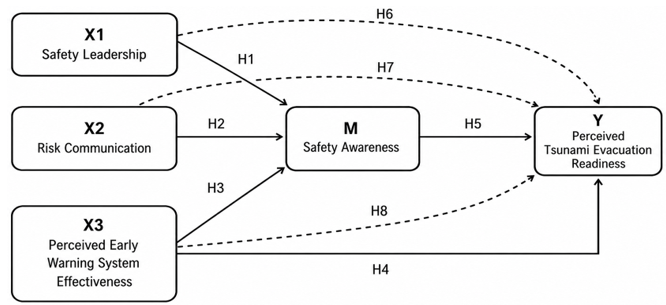
H1. Safety leadership is positively associated with safety awareness in coastal tourist destinations.
2.2 Risk communication and safety awareness
Risk communication concerns the way hazard information is made clear, reachable, consistent, and usable for action. In tsunami-prone tourist destinations, it does not operate only through official warnings; evacuation maps, coastal signage, safety briefings, guide instructions, local announcements, training sessions, and messages from authorities or destination managers all shape how tourism actors interpret risk on the ground [6, 13]. Its quality is crucial because tourism actors cannot respond effectively to a threat they only vaguely understand. Even when warning infrastructure is available, unclear messages, inconsistent instructions, or information that is poorly adapted to tourism operations can slow evacuation and weaken assistance for visitors. Practical risk communication turns tsunami risk from a general warning into operational knowledge: where to move, when to evacuate, which route to use, and how to help tourists during an emergency. For this reason, stronger risk communication is expected to be positively associated with safety awareness among tourism actors.
H2. Risk communication is positively associated with safety awareness in coastal tourist destinations.
2.3 Perceived early warning system effectiveness and safety awareness
Early warning systems are indispensable for tsunami risk reduction, but their usefulness cannot be judged only by the presence of sirens, alert devices, or official warning channels. In a coastal tourism setting, a warning has practical value only when it is received in time, understood by local actors, trusted as credible information, and transmitted quickly to visitors and other tourism workers. Warning-system research shows that technical infrastructure must be tied to community understanding, reliable communication channels, evacuation maps, drills, and local response capacity [11, 15]. For tourism actors, repeated exposure to warning procedures, alert channels, evacuation maps, and drills can build familiarity with what a warning means and what actions should follow. Evidence from tsunami-prone coastal areas also shows that warning knowledge and information provision are closely related to evacuation intentions among beach users, tourists, and coastal communities [8, 12]. Thus, perceived early warning system effectiveness is expected to be positively associated with safety awareness among tourism actors in coastal destinations.
H3. Perceived early warning system effectiveness is positively associated with safety awareness in coastal tourist destinations.
2.4 Perceived early warning system effectiveness and perceived tsunami evacuation readiness
Perceived tsunami evacuation readiness refers to the capacity of tourism actors to respond without delay, follow designated evacuation routes, guide visitors, and coordinate with relevant parties when a tsunami threat emerges. In coastal destinations, this readiness is shaped by two practical pressures: the limited time available after a strong earthquake or warning signal, and the need to assist visitors who may not understand local warning cues, evacuation routes, or emergency procedures. Previous evacuation studies show that timely warnings, clear route information, accessible shelters, and practical guidance can affect evacuation speed, route choice, and survival-related outcomes [12, 15]. When warning information is received quickly, communicated clearly, and translated into concrete instructions, tourism actors are more likely to make rapid decisions and begin evacuation before delays become dangerous. Thus, perceived early warning system effectiveness is expected to be positively associated with perceived tsunami evacuation readiness.
H4. Perceived early warning system effectiveness is positively associated with perceived tsunami evacuation readiness in coastal tourist destinations.
2.5 Safety awareness and perceived tsunami evacuation readiness
Safety awareness is not merely a general understanding of disaster risk; in tsunami-prone tourist destinations, it becomes a practical condition for timely evacuation. Tourism actors who know the warning cues, evacuation routes, safe areas, and basic emergency procedures are less likely to hesitate when a natural sign or formal warning appears [2, 16]. This awareness also has a visitor-protection dimension. Local tourism actors are often expected to do more than save themselves; they may need to explain the situation to tourists, direct them toward safe routes, and coordinate movement with guides, operators, or local authorities. When they understand what should be done after a strong earthquake, where people should move, and how instructions should be communicated, evacuation becomes less improvised and more actionable. Prior evidence also shows that risk awareness and warning knowledge are closely related to evacuation intentions and preparedness [8]. Therefore, safety awareness is expected to be positively associated with perceived tsunami evacuation readiness in coastal tourist destinations.
H5. Safety awareness is positively associated with perceived tsunami evacuation readiness in coastal tourist destinations.
2.6 Mediating role of safety awareness
Safety leadership, risk communication, and perceived early warning system effectiveness do not automatically correspond to evacuation readiness. They become meaningful when tourism actors absorb them as concrete safety awareness. Leadership may define priorities and make preparedness part of daily operations, risk communication may turn hazard information into instructions that can be followed, and warning information may support alertness and confidence in emergency response [2, 6]. In this study, safety awareness is therefore treated as the mechanism that links these external safety inputs with practical readiness. Destination-level leadership, risk messages, and warning-system functions need to be internalized as hazard recognition, procedural knowledge, route familiarity, and situational alertness before they are reflected in reported evacuation readiness. On this basis, safety awareness is expected to mediate the statistical relationships between safety leadership, risk communication, perceived early warning system effectiveness, and perceived tsunami evacuation readiness.
H6. Safety awareness mediates the statistical relationship between safety leadership and perceived tsunami evacuation readiness.
H7. Safety awareness mediates the statistical relationship between risk communication and perceived tsunami evacuation readiness.
H8. Safety awareness mediates the statistical relationship between perceived early warning system effectiveness and perceived tsunami evacuation readiness.
Figure 1 presents the proposed conceptual framework linking safety leadership, risk communication, perceived early warning system effectiveness, safety awareness, and perceived tsunami evacuation readiness.
Figure 1. Conceptual framework and hypotheses
3.1 Research design
This study used a quantitative cross-sectional survey design to examine perceived tsunami evacuation readiness among tourism actors in coastal destinations. This design was considered appropriate because the study focused on testing predictive associations among latent constructs and assessing direct and mediating relationships within a single empirical model. However, because all variables were measured at one point in time, the results should not be interpreted as causal evidence. Partial least squares structural equation modelling (PLS-SEM) was employed because the model is prediction-oriented, involves multiple reflective constructs, and requires simultaneous assessment of measurement quality and structural relationships [19, 20].
3.2 Research setting and sampling
The study was conducted in coastal tourist destinations across the Mentawai Islands, West Sumatra, Indonesia. Mentawai was selected because it combines two conditions central to this study: it is an active coastal and surf-tourism destination [3] and is also exposed to earthquake and tsunami hazards [4]. The accessible research sites included coastal and surf-tourism nodes in Sipora, North Pagai, South Pagai, and Siberut, where tourism activities, visitor movement, and evacuation-related preparedness are closely connected [3, 7]. The target population comprised tourism actors directly involved in tourism services, visitor interaction, or destination safety, including destination managers, resort and homestay operators, surf-camp operators, tour guides, boat operators, tourism workers, members of tourism awareness groups, and local tourism-community actors with knowledge of safety practices, warning information, or evacuation procedures. Because no complete sampling frame was available for tourism actors across the dispersed island destinations, purposive sampling was used, supported by referrals from local tourism-community contacts. Respondents were eligible if they were at least 18 years old, had been involved in tourism-related activities in Mentawai for at least six months, were connected to coastal tourism settings, and had some familiarity with destination safety practices, warning information, or evacuation procedures.
3.3 Data collection procedure
Data were collected from January to June 2025 through supervised on-site administration and assisted self-completion. Structured questionnaires were distributed to eligible tourism actors at coastal destinations, resorts, surf camps, boat-operator groups, and local tourism communities. Of the 320 questionnaires distributed, 300 were returned, yielding a response rate of 93.75%. After 17 responses were excluded because of incomplete answers, straight-lining patterns, or inconsistent responses to screening items, 283 valid responses were retained for analysis. Participation was voluntary, anonymous, and unpaid, and informed consent was obtained before respondents completed the questionnaire.
3.4 Questionnaire translation and contextual validation
The questionnaire was developed from previously validated English-language constructs and then translated into Indonesian, the language used during field administration. To reduce potential distortion of meaning, the Indonesian version was reviewed by two academics familiar with disaster-risk and tourism research and by local tourism actors who understood the operational context of coastal tourism in Mentawai. Several expressions were adjusted to improve local comprehension, particularly terms related to warning information, safe areas, evacuation routes, and visitor assistance.
The revised questionnaire was pilot-tested with approximately 30 respondents to assess item clarity, wording, and contextual relevance. Feedback from the pilot test was used to refine several statements, remove ambiguous expressions, and ensure that the items could be understood by respondents with different tourism roles. The construct sources and their contextual adaptations are summarized in Table 1, while the final measurement items are presented in Table 2.
Table 1. Item sources and contextual adaptation
|
Construct |
Sources and Contextual Adaptation |
Reference |
|
Safety Leadership |
Adapted to distributed destination leadership. |
[9, 10] |
|
Risk Communication |
Adapted to clarity, access, consistency, and actionability. |
[6, 13] |
|
Perceived Early Warning System Effectiveness |
Adapted to perceived access, timeliness, clarity, and information sharing. |
[11, 12, 15] |
|
Safety Awareness |
Adapted to hazard, route, safe-area, and procedure awareness. |
[2, 8, 16] |
|
Perceived Tsunami Evacuation Readiness |
Adapted to reported readiness to evacuate, assist visitors, and coordinate. |
[8, 16, 17] |
Table 2. Measurement items
|
Construct |
Code |
Item |
|
Safety Leadership |
SL1 |
Destination leaders place tsunami preparedness as an important priority in tourism operations. |
|
Safety Leadership |
SL2 |
Destination leaders provide clear instructions on what tourism actors should do during earthquake and tsunami emergencies. |
|
Safety Leadership |
SL3 |
Destination leaders support the availability of safety facilities, evacuation information, and preparedness activities. |
|
Safety Leadership |
SL4 |
Destination leaders encourage tourism actors to follow emergency procedures and evacuation instructions. |
|
Risk Communication |
RC1 |
Information about earthquake and tsunami risks in this destination is delivered clearly. |
|
Risk Communication |
RC2 |
Tourism actors can easily access information about evacuation routes, safe areas, and emergency procedures. |
|
Risk Communication |
RC3 |
Risk information from destination managers, local authorities, and community actors is consistent. |
|
Risk Communication |
RC4 |
The risk information provided helps tourism actors understand what actions should be taken during a tsunami threat. |
|
Perceived Early Warning System Effectiveness |
PEWS1 |
This destination has access to warning information when an earthquake or tsunami threat occurs. |
|
Perceived Early Warning System Effectiveness |
PEWS2 |
Warning information can be received quickly enough to support evacuation decisions. |
|
Perceived Early Warning System Effectiveness |
PEWS3 |
Warning messages are clear and easy for tourism actors to understand. |
|
Perceived Early Warning System Effectiveness |
PEWS4 |
Warning information can be quickly shared with visitors, workers, and local tourism actors. |
|
Safety Awareness |
SA1 |
I am aware that coastal tourism areas in Mentawai are exposed to earthquake and tsunami risks. |
|
Safety Awareness |
SA2 |
I know the evacuation routes that should be used during a tsunami threat. |
|
Safety Awareness |
SA3 |
I know the designated safe areas or gathering points for tsunami evacuation. |
|
Safety Awareness |
SA4 |
I understand the basic procedures that should be followed after a strong earthquake near the coast. |
|
Perceived Tsunami Evacuation Readiness |
PTER1 |
I am ready to evacuate immediately after receiving a tsunami warning or observing natural warning signs. |
|
Perceived Tsunami Evacuation Readiness |
PTER2 |
I am ready to use the designated evacuation route without delay during a tsunami threat. |
|
Perceived Tsunami Evacuation Readiness |
PTER3 |
I am ready to help visitors or tourists evacuate to safe areas during an emergency. |
|
Perceived Tsunami Evacuation Readiness |
PTER4 |
I am ready to coordinate with other tourism actors, local authorities, or community members during evacuation. |
3.5 Measures
All constructs were measured using multi-item indicators adapted to tsunami-prone coastal tourism. Safety leadership items were adapted from safety-leadership studies and revised to reflect distributed leadership among destination managers, operators, guides, and community actors [9, 10]. Risk communication items were adapted from tourism and disaster-risk communication research and focused on clarity, accessibility, consistency, and actionability of risk information [6, 13]. Perceived early warning system effectiveness items were adapted from warning-system and evacuation studies and emphasized respondents’ perceptions of access, timeliness, clarity, and information sharing [11, 12, 15]. Safety awareness and perceived tsunami evacuation readiness items were adapted from protective-action and evacuation-behaviour studies and reworded for the Mentawai context, especially in relation to recognizing tsunami risk, knowing evacuation routes, identifying safe areas, assisting visitors, and coordinating emergency response [8, 16, 17]. The term perceived is used for perceived early warning system effectiveness and evacuation readiness because the study measured respondents’ reported assessments rather than objective warning-system performance or observed evacuation behaviour. All items were assessed using a five-point Likert scale ranging from 1 = strongly disagree to 5 = strongly agree.
3.6 Common method bias control
Because the study relied on self-reported survey data, common method bias was addressed procedurally and statistically, but it could not be fully eliminated. During data collection, respondents were assured that their answers would remain anonymous, the items were written in simple and context-specific language, and predictor and outcome variables were placed in separate sections of the questionnaire to reduce patterned responses [21, 22]. After data collection, a full-collinearity variance inflation factor test was conducted for all latent variables. Since all values were below the 3.3 threshold, the diagnostic results did not indicate serious common method bias. However, this test was treated as one indicator rather than definitive proof that bias was absent. The possibility of shared-method variance remains because all variables were collected from the same respondents using the same questionnaire. For this reason, the results are interpreted with caution.
3.7 Data analysis
The data were analysed using PLS-SEM with 5,000 bootstrap subsamples. This approach was used to evaluate the quality of the measurement model and to test the model linking safety leadership, risk communication, perceived early warning system effectiveness, safety awareness, and tsunami evacuation readiness. The measurement model was assessed through indicator loadings, Cronbach's alpha, composite reliability, rho_A, average variance extracted, and discriminant validity using the heterotrait-monotrait ratio [19, 20, 23, 24]. The structural model was examined through inner collinearity diagnostics, path coefficients, bootstrapped t-values and p-values, R², f², Q², SRMR, and mediation testing. Q² was used to assess predictive relevance because the model was intended to evaluate how well the focal constructs predict evacuation readiness in tsunami-prone coastal tourism settings. As a supplementary check, gender, tourism role, education, and length of work were included as available profile controls in a mean-composite regression of evacuation readiness. This check was used only to assess whether the main pattern remained visible after including the available profile variables. It should not be read as a full control for respondent background differences because island location, prior tsunami experience, disaster training, and evacuation-drill participation were not available.
4.1 Respondent profile
A total of 283 valid responses were obtained from tourism actors in the Mentawai Islands. The demographic and occupational characteristics of the respondents are summarized in Table 3.
Table 3. Respondent profile
|
Variable |
Category |
Frequency |
Percentage |
|
Gender |
Male |
179 |
63.3% |
|
|
Female |
104 |
36.7% |
|
Role in tourism |
Homestay/resort operator |
75 |
26.5% |
|
|
Tour guide |
62 |
21.9% |
|
|
Destination manager |
54 |
19.1% |
|
|
Boat operator |
53 |
18.7% |
|
|
Tourism awareness group member |
39 |
13.8% |
|
Education |
Senior high school/vocational school |
105 |
37.1% |
|
|
Bachelor degree |
83 |
29.3% |
|
|
Diploma/D4 |
54 |
19.1% |
|
|
Elementary/junior high school |
21 |
7.4% |
|
|
Master/doctoral degree |
20 |
7.1% |
|
Length of work |
4–6 years |
95 |
33.6% |
|
|
1–3 years |
84 |
29.7% |
|
|
>6 years |
71 |
25.1% |
|
|
<1 year |
33 |
11.7% |
The sample reflects the operational structure of coastal tourism in the study area, involving actors who interact directly with visitors and are likely to play a role during emergency situations. Male respondents accounted for 63.3% of the sample, while female respondents represented 36.7%. In terms of tourism roles, the largest group consisted of homestay and resort operators (26.5%), followed by tour guides (21.9%), destination managers (19.1%), boat operators (18.7%), and members of tourism awareness groups (13.8%). This composition is relevant to the study because these groups are involved in accommodation services, visitor movement, guiding, marine transport, and local destination coordination. Most respondents had completed senior high school or vocational school (37.1%), followed by bachelor degree holders (29.3%) and diploma/D4 graduates (19.1%). The work-experience profile also shows that respondents were not mostly newcomers: 33.6% had worked for 4–6 years, 29.7% for 1–3 years, and 25.1% for more than six years. This profile indicates that the sample had sufficient practical exposure to coastal tourism operations and local safety arrangements.
4.2 Measurement model
The measurement model was examined to ensure that the indicators measured their intended constructs with sufficient precision before the structural relationships were tested. As reported in Table 4, all outer loadings were above the recommended minimum value of 0.70, ranging from 0.763 to 0.831. This result indicates that every item contributed adequately to its respective construct and that no indicator needed to be removed from the model [23, 24]. More importantly, the retained indicators were not merely statistically acceptable; they also reflected the operational context of tsunami-related safety in coastal tourism, including leadership practices, risk communication, warning-system effectiveness, safety awareness, and evacuation readiness. The reliability and convergent validity results in Table 5 further confirm the quality of the measurement model. Cronbach’s alpha values ranged from 0.818 to 0.838, rho_A values from 0.824 to 0.843, and composite reliability values from 0.881 to 0.893, indicating satisfactory internal consistency. The AVE values ranged from 0.649 to 0.676, exceeding the 0.50 threshold and showing that each construct captured more than half of the variance in its indicators [23, 24]. Discriminant validity was also supported because all HTMT values in Table 6 were below the conservative threshold of 0.85 [20]. The highest HTMT value was 0.748, found between safety awareness and perceived tsunami evacuation readiness, which is theoretically reasonable because knowledge of hazards, evacuation routes, and emergency procedures is closely related to readiness for evacuation [8, 16].
Table 4. Outer loading results
|
Construct |
Item |
Loading |
t-Statistic |
p-Value |
|
Safety Leadership |
SL1 |
0.821 |
18.420 |
<0.001 |
|
Safety Leadership |
SL2 |
0.793 |
3.300 |
0.001 |
|
Safety Leadership |
SL3 |
0.814 |
3.070 |
0.002 |
|
Safety Leadership |
SL4 |
0.782 |
2.970 |
0.003 |
|
Risk Communication |
RC1 |
0.803 |
3.300 |
0.001 |
|
Risk Communication |
RC2 |
0.831 |
19.050 |
<0.001 |
|
Risk Communication |
RC3 |
0.774 |
2.870 |
0.004 |
|
Risk Communication |
RC4 |
0.812 |
3.070 |
0.002 |
|
Perceived Early Warning System Effectiveness |
PEWS1 |
0.788 |
2.790 |
0.006 |
|
Perceived Early Warning System Effectiveness |
PEWS2 |
0.819 |
3.210 |
0.001 |
|
Perceived Early Warning System Effectiveness |
PEWS3 |
0.801 |
2.970 |
0.003 |
|
Perceived Early Warning System Effectiveness |
PEWS4 |
0.763 |
2.720 |
0.007 |
|
Safety Awareness |
SA1 |
0.812 |
3.140 |
0.002 |
|
Safety Awareness |
SA2 |
0.779 |
2.650 |
0.009 |
|
Safety Awareness |
SA3 |
0.803 |
2.870 |
0.004 |
|
Safety Awareness |
SA4 |
0.831 |
3.300 |
0.001 |
|
Perceived Tsunami Evacuation Readiness |
PTER1 |
0.829 |
3.070 |
0.002 |
|
Perceived Tsunami Evacuation Readiness |
PTER2 |
0.801 |
2.790 |
0.006 |
|
Perceived Tsunami Evacuation Readiness |
PTER3 |
0.818 |
2.970 |
0.003 |
|
Perceived Tsunami Evacuation Readiness |
PTER4 |
0.792 |
2.580 |
0.010 |
Table 5. Reliability and convergent validity
|
Construct |
Cronbach’s α |
rho_A |
Composite Reliability |
AVE |
|
Safety Leadership |
0.836 |
0.841 |
0.891 |
0.672 |
|
Risk Communication |
0.829 |
0.834 |
0.887 |
0.663 |
|
Perceived Early Warning System Effectiveness |
0.818 |
0.824 |
0.881 |
0.649 |
|
Safety Awareness |
0.832 |
0.837 |
0.889 |
0.668 |
|
Perceived Tsunami Evacuation Readiness |
0.838 |
0.843 |
0.893 |
0.676 |
Table 6. Discriminant validity (HTMT)
|
Construct |
SL |
RC |
PEWS |
SA |
PTER |
|
Safety Leadership (SL) |
- |
- |
- |
- |
- |
|
Risk Communication (RC) |
0.641 |
- |
- |
- |
- |
|
Perceived Early Warning System (PEWS) Effectiveness |
0.578 |
0.612 |
- |
- |
- |
|
Safety Awareness (SA) |
0.723 |
0.698 |
0.634 |
- |
- |
|
Perceived Tsunami Evacuation Readiness (PTER) |
0.589 |
0.613 |
0.701 |
0.748 |
- |
4.3 Collinearity, common method bias, effect sizes, and model fit
Before the hypotheses were tested, the structural model was checked for collinearity and full-collinearity VIF diagnostics. As shown in Table 7, all inner VIF values were very low, ranging from 1.000 to 1.097, and therefore far below the conservative threshold of 3.3. This indicates that the estimated paths were not distorted by multicollinearity among the predictors. The full-collinearity VIF values also remained below 3.3, ranging from 1.323 to 1.818. These values did not show a severe indication of common method bias based on the full-collinearity criterion, but they should not be read as definitive proof that shared-method variance was absent [21, 22]. The effect-size results in Table 8 provide a clearer picture of how each predictor contributed to the model. Safety leadership showed a medium-to-large statistical effect size on safety awareness (f² = 0.321), while risk communication also made a meaningful contribution (f² = 0.299). Perceived early warning system effectiveness showed medium effect sizes on both safety awareness (f² = 0.163) and perceived tsunami evacuation readiness (f² = 0.160), and safety awareness had a medium effect size on perceived tsunami evacuation readiness (f² = 0.162). These values suggest that reported evacuation readiness was associated with a combination of leadership, communication, perceived warning-system effectiveness, and awareness. The model also showed acceptable fit, with an SRMR value of 0.030, which is below the commonly used 0.08 threshold [19, 25].
Table 7. Structural VIF and full-collinearity diagnostics
|
Assessment |
Predictor / Construct |
Endogenous Construct |
VIF |
Interpretation |
|
Inner VIF |
Safety Leadership |
Safety Awareness |
1.010 |
No collinearity concern |
|
Inner VIF |
Risk Communication |
Safety Awareness |
1.010 |
No collinearity concern |
|
Inner VIF |
Perceived Early Warning System Effectiveness |
Safety Awareness |
1.000 |
No collinearity concern |
|
Inner VIF |
Perceived Early Warning System Effectiveness |
Perceived Tsunami Evacuation Readiness |
1.097 |
No collinearity concern |
|
Inner VIF |
Safety Awareness |
Perceived Tsunami Evacuation Readiness |
1.097 |
No collinearity concern |
|
Full-collinearity VIF |
Safety Leadership |
- |
1.358 |
No severe VIF indication; CMB still possible |
|
Full-collinearity VIF |
Risk Communication |
- |
1.323 |
No severe VIF indication; CMB still possible |
|
Full-collinearity VIF |
Perceived Early Warning System Effectiveness |
- |
1.373 |
No severe VIF indication; CMB still possible |
|
Full-collinearity VIF |
Safety Awareness |
- |
1.818 |
No severe VIF indication; CMB still possible |
|
Full-collinearity VIF |
Perceived Tsunami Evacuation Readiness |
- |
1.487 |
No severe VIF indication; CMB still possible |
Table 8. Effect sizes and model fit
|
Assessment |
Path / Index |
Value |
Interpretation |
|
Effect size (f²) |
Safety Leadership → Safety Awareness |
0.321 |
Medium-to-large effect |
|
Effect size (f²) |
Risk Communication → Safety Awareness |
0.299 |
Medium effect |
|
Effect size (f²) |
Perceived Early Warning System Effectiveness → Safety Awareness |
0.163 |
Medium effect |
|
Effect size (f²) |
Perceived Early Warning System Effectiveness → Perceived Tsunami Evacuation Readiness |
0.160 |
Medium effect |
|
Effect size (f²) |
Safety Awareness → Perceived Tsunami Evacuation Readiness |
0.162 |
Medium effect |
|
Model fit |
SRMR |
0.030 |
Acceptable fit |
4.4 Structural model and hypothesis testing
The structural model results and hypothesis-testing outcomes are summarized in Table 9. All direct hypotheses were statistically supported at the 5% significance level. Safety leadership was positively associated with safety awareness (β = 0.421, t = 7.259, p < 0.001), indicating that respondents who perceived clearer safety priorities and support from destination actors also reported greater awareness of tsunami-related risks and procedures. Risk communication also showed a positive statistical relationship with safety awareness (β = 0.387, t = 3.207, p = 0.001), suggesting that clear and actionable information was linked to better reported understanding of what should be done before and during a tsunami threat. Perceived early warning system effectiveness was positively associated with safety awareness (β = 0.312, t = 2.971, p = 0.003) and perceived tsunami evacuation readiness (β = 0.298, t = 2.865, p = 0.004). Warning information may therefore function as a practical preparedness cue when respondents perceive it as timely, understandable, and usable. Safety awareness showed the strongest direct statistical association with perceived tsunami evacuation readiness (β = 0.418, t = 7.085, p < 0.001), suggesting that reported knowledge of hazards, evacuation routes, safe areas, and emergency procedures is closely linked to reported readiness in coastal tourism settings. These findings are consistent with prior studies showing that awareness and warning information are related to preparedness and evacuation decisions [8, 12]. The coefficients of determination and predictive relevance statistics are reported in Table 10. Safety leadership, risk communication, and perceived early warning system effectiveness explained 64.8% of the variance in safety awareness (R² = 0.648), while perceived early warning system effectiveness and safety awareness explained 58.9% of the variance in perceived tsunami evacuation readiness (R² = 0.589). The Q² values for safety awareness (0.431) and perceived tsunami evacuation readiness (0.382) were both above zero, indicating predictive relevance for the perception-based model [19, 25].
Table 9. Structural model results
|
H |
Path |
β |
SE |
t |
p |
95% CI |
Decision |
|
H1 |
Safety Leadership → Safety Awareness |
0.421 |
0.058 |
7.259 |
<0.001 |
0.307; 0.535 |
Supported |
|
H2 |
Risk Communication → Safety Awareness |
0.387 |
0.121 |
3.207 |
0.001 |
0.149; 0.625 |
Supported |
|
H3 |
Perceived Early Warning System Effectiveness → Safety Awareness |
0.312 |
0.105 |
2.971 |
0.003 |
0.106; 0.518 |
Supported |
|
H4 |
Perceived Early Warning System Effectiveness → Perceived Tsunami Evacuation Readiness |
0.298 |
0.104 |
2.865 |
0.004 |
0.094; 0.502 |
Supported |
|
H5 |
Safety Awareness → Perceived Tsunami Evacuation Readiness |
0.418 |
0.059 |
7.085 |
<0.001 |
0.302; 0.534 |
Supported |
Table 10. Coefficient of determination and predictive relevance
|
Endogenous Construct |
R² |
Adjusted R² |
Q² |
Interpretation |
|
Safety Awareness |
0.648 |
0.644 |
0.431 |
Substantial |
|
Perceived Tsunami Evacuation Readiness |
0.589 |
0.586 |
0.382 |
Substantial |
A supplementary control-variable check was conducted using mean composite scores and the available profile variables. The results of this supplementary analysis are summarized in Table 11. After gender, tourism role, education, and length of work were included, perceived early warning system effectiveness (B = 0.310, p < 0.001) and safety awareness (B = 0.326, p < 0.001) remained positively related to evacuation readiness. This limited check indicates that the focal relationships remained visible after the available profile variables were entered. However, it should not be interpreted as a full control for respondent background differences. Other potentially relevant variables, including island location, prior tsunami experience, prior disaster training, and participation in evacuation drills, were not collected in sufficient detail and remain limitations of the study.
Table 11. Supplementary control-variable check for perceived tsunami evacuation readiness
|
Predictor/Control |
Result |
Interpretation |
|
Perceived Early Warning System Effectiveness |
B = 0.310; p < 0.001 |
Remained positive in the supplementary check. |
|
Safety Awareness |
B = 0.326; p < 0.001 |
Remained positive in the supplementary check. |
|
Profile controls |
Included |
Only gender, tourism role, education, and work length were available. |
4.5 Mediation analysis
The mediation analysis was conducted using the bootstrapping procedure, and the results are presented in Table 12. Direct, indirect, total effects, and VAF values are reported together to make the mediation pattern transparent. In this analysis, the direct effect refers to the relationship between the predictor and evacuation readiness after safety awareness is included in the mediation model. The indirect effect refers to the product of the predictor to safety awareness path and the safety awareness to evacuation readiness path. The total effect is the sum of the direct and indirect effects, while VAF is calculated by dividing the indirect effect by the total effect. Partial mediation is reported when both the direct and indirect effects remain present and part of the relationship is carried through safety awareness. Safety awareness carried a significant indirect effect between safety leadership and evacuation readiness (indirect effect = 0.176, t = 3.088, p = 0.002), supporting H6. It also carried a significant indirect effect between risk communication and evacuation readiness (indirect effect = 0.162, t = 2.860, p = 0.005), supporting H7. The indirect effect between perceived early warning system effectiveness and evacuation readiness through safety awareness was also significant (indirect effect = 0.130, t = 2.715, p = 0.007), supporting H8. The reported total effects are mathematically consistent with the direct and indirect effects: 0.245 + 0.176 = 0.421, 0.225 + 0.162 = 0.387, and 0.298 + 0.130 = 0.428. Based on these results, the three mediation paths are interpreted as partial mediation. Given the cross-sectional design, the mediation results should be read as a decomposition of observed relationships rather than evidence of temporal or causal ordering.
Table 12. Specific indirect effects and mediation results
|
Path |
Direct |
Indirect |
Total / VAF; Type |
|
SL → SA → PTER |
0.245 |
0.176; p = 0.002 |
0.421 / 41.81%; partial |
|
RC → SA → PTER |
0.225 |
0.162; p = 0.005 |
0.387 / 41.86%; partial |
|
PEWS → SA → PTER |
0.298 |
0.130; p = 0.007 |
0.428 / 30.37%; partial |
This study shows that evacuation readiness reported by tourism actors is linked to three operational conditions: safety leadership, usable risk communication, and warning information that can be accessed and understood. This pattern is consistent with protective-action decision making and tsunami-risk communication studies, which emphasize that warning information is more useful when it is credible, clear, and connected to actionable response steps [2, 6].
In Mentawai's tourism context, safety leadership is distributed across destination managers, resort and homestay operators, guides, boat operators, Pokdarwis members, and other local actors. Respondents who reported stronger safety priorities and clearer guidance from these actors also reported better awareness of tsunami hazards, evacuation routes, safe areas, and emergency procedures. This finding is relevant for tourism-disaster settings because preparedness depends on actors who work directly with visitors, not only on formal managers [9, 10]. It is also consistent with safety-leadership research showing that leadership and engagement are linked to safety-related performance in organizational settings [26].
Risk communication was linked to safety awareness because tourism actors need to translate tsunami risk into practical instructions. In coastal tourism areas, this means being able to explain where visitors should move, when evacuation should begin, and how assistance should be organized when tourists are unfamiliar with local warning signs or routes [6, 13]. Disaster-risk communication therefore has a specific public-safety role: it must support timely protective action, not merely provide general information.
Warning-system effectiveness was related to both safety awareness and evacuation readiness. This result concerns respondents' assessment of warning information, not an objective test of the physical warning system. The study did not evaluate siren performance, warning dissemination records, evacuation-route audits, or observed evacuation behaviour [11, 12].
Safety awareness remained central to evacuation readiness. Respondents who reported knowing the hazard, routes, safe areas, and basic emergency procedures also reported greater readiness to evacuate, assist visitors, and coordinate with others. In a coastal tourism setting, this matters because local actors may need to respond for themselves and for visitors who lack local knowledge during a fast-moving tsunami emergency [8, 14]. This interpretation is consistent with safety-behaviour research showing that knowledge, motivation, and situational understanding are linked to safety-related action [27, 28].
The mediation results indicate that safety awareness plays an intervening role in the model. Leadership, communication, and warning-system perceptions were examined as conditions linked to awareness, which was then linked to readiness. This interpretation fits the survey design better than a causal reading of the mediation paths.
Tourism-disaster studies show that destination vulnerability and resilience depend on local coordination, visitor protection, and preparedness arrangements, especially where hazards affect tourism communities directly [18, 29]. Similar work in tourism management also stresses the importance of institutional roles, community resilience, and planning for natural-disaster exposure in tourist destinations [30-32]. Several practical implications can be drawn from the model. Destination actors may formalize warning-relay procedures so that official warning information can move quickly from authorities to accommodation providers, guides, boat operators, and tourism-community groups. Evacuation information may also be improved through clear route maps, visible signs, and short safety briefings before coastal activities. For visitors who are unfamiliar with local language, signs, and warning cues, communication should be simple, visible, and easy to understand under stress [33, 34]. Periodic drills and after-action notes may help turn awareness into practiced response routines. These measures remain practical applications of the observed relationships and should be verified in future work through evacuation drills, route audits, warning-dissemination checks, and observed response evaluations [35]. From a Safety and Security Engineering perspective, these implications are consistent with systems thinking in safety management, where safety depends on the interaction between human, organizational, technical, and procedural components [36, 37]. The model did not directly test route audits, signage quality, evacuation drills, or bilingual communication. These elements should therefore be viewed as practical areas for applying the findings, not as additional empirical results.
This study examined tsunami evacuation readiness reported by tourism actors in Mentawai's coastal tourist destinations. The results show that safety leadership, risk communication, and warning-system effectiveness are associated with higher safety awareness, while warning effectiveness and safety awareness are associated with stronger readiness. Safety awareness also served as an intervening construct linking the three antecedents with readiness. Taken together, the findings indicate that readiness in tsunami-prone tourism settings depends not only on warning information but also on how local actors understand hazards, routes, procedures, and responsibilities for assisting visitors. The study remains limited by its cross-sectional design and self-reported data; therefore, the observed relationships should not be treated as causal effects. Future research should combine survey evidence with field-based indicators such as warning-system tests, evacuation-route audits, signage assessments, drill records, and observed response performance, and include controls for island location, prior tsunami experience, disaster training, and evacuation-drill participation. Comparative studies across several tsunami-prone tourist destinations would help assess whether the model applies beyond Mentawai.
The authors thank Universitas Negeri Padang for its academic support in this research. The authors also thank tourism actors and community members in the Mentawai Islands who participated in this study, as well as local authorities and tourism-awareness groups who supported access to respondents.
[1] Bird, D.K., Gísladóttir, G. (2020). Enhancing tourists' safety in volcanic areas: An investigation of risk communication initiatives in Iceland. International Journal of Disaster Risk Reduction, 50: 101896. https://doi.org/10.1016/j.ijdrr.2020.101896
[2] Lindell, M.K., Perry, R.W. (2012). The protective action decision model: Theoretical modifications and additional evidence. Risk Analysis, 32(4): 616-632. https://doi.org/10.1111/j.1539-6924.2011.01647.x
[3] Indonesia Travel. Mentawai Islands: Wild adventures in isolation. Ministry of Tourism and Creative Economy, Indonesia. https://www.indonesia.travel/my/en/destination/sumatra/west-sumatra/padang---mentawai-islands/.
[4] Badan Meteorologi, Klimatologi, dan Geofisika (BMKG). (2024). Tentang gempa di Selat Sunda dan Mentawai-Siberut yang “tinggal menunggu waktu”. https://www.bmkg.go.id/berita/utama/tentang-gempa-di-selat-sunda-dan-mentawai-siberut-yang-tinggal-menunggu-waktu.
[5] Rindrasih, E., Witte, P., Spit, T., Zoomers, A. (2019). Tourism and disasters: Impact of disaster events on tourism development in Indonesia 1998-2016 and structural approach policy responses. Journal of Service Science and Management, 12(2): 93-115. https://doi.org/10.4236/jssm.2019.122006
[6] Rafliana, I., Jalayer, F., Cerase, A., et al. (2022). Tsunami risk communication and management: Contemporary gaps and challenges. International Journal of Disaster Risk Reduction, 70: 102771. https://doi.org/10.1016/j.ijdrr.2021.102771
[7] UNESCO-IOC. Tua Pejat village, Indonesia: Tsunami ready. Tsunami programme. https://tsunami.ioc.unesco.org/en/tsunami-ready/tuapejat/id.
[8] Amri, I., Giyarsih, S.R., Ruslanjari, D. (2024). Tsunami risk awareness, hazard warning knowledge, and intended evacuation behavior among beach users in Bantul, Indonesia. International Journal of Disaster Risk Reduction, 109: 104594. https://doi.org/10.1016/j.ijdrr.2024.104594
[9] Clarke, S. (2013). Safety leadership: A meta-analytic review of transformational and transactional leadership styles as antecedents of safety behaviours. Journal of Occupational and Organizational Psychology, 86(1): 22-49. https://doi.org/10.1111/j.2044-8325.2012.02064.x
[10] Zhao, L.Y., Yang, D.J., Liu, S.X., Nkrumah, E.N.K. (2022). The effect of safety leadership on safety participation of employee: A meta-analysis. Frontiers in Psychology, 13: 827694. https://doi.org/10.3389/fpsyg.2022.827694
[11] Leonard, G.S., Johnston, D.M., Paton, D., Christianson, A., Becker, J., Keys, H. (2008). Developing effective warning systems: Ongoing research at Ruapehu volcano, New Zealand. Journal of Volcanology and Geothermal Research, 172(3-4): 199-215. https://doi.org/10.1016/j.jvolgeores.2007.12.008
[12] Choi, S., Maharjan, R., Hong, T.T.N., Hanaoka, S. (2024). Impact of information provision on tsunami evacuation behavior of residents and international tourists in Japan. Transport Policy, 155: 264-273. https://doi.org/10.1016/j.tranpol.2024.07.010
[13] Aliperti, G., Nagai, H., Cruz, A.M. (2020). Communicating risk to tourists: A mental models approach to identifying gaps and misperceptions. Tourism Management Perspectives, 33: 100615. https://doi.org/10.1016/j.tmp.2019.100615
[14] Arce, R.S.C., Onuki, M., Esteban, M., Shibayama, T. (2017). Risk awareness and intended tsunami evacuation behaviour of international tourists in Kamakura City, Japan. International Journal of Disaster Risk Reduction, 23: 178-192. https://doi.org/10.1016/j.ijdrr.2017.04.005
[15] Takabatake, T., Shibayama, T., Esteban, M., Ishii, H., Hamano, G. (2017). Simulated tsunami evacuation behavior of local residents and visitors in Kamakura, Japan. International Journal of Disaster Risk Reduction, 23: 1-14. https://doi.org/10.1016/j.ijdrr.2017.04.003
[16] Paton, D. (2003). Disaster preparedness: A social-cognitive perspective. Disaster Prevention and Management: An International Journal, 12(3): 210-216. https://doi.org/10.1108/09653560310480686
[17] Chan, C.S., Nozu, K., Cheung, T.O.L. (2020). Tourism and natural disaster management process: Perception of tourism stakeholders in the case of Kumamoto earthquake in Japan. Current Issues in Tourism, 23(15): 1864-1885. https://doi.org/10.1080/13683500.2019.1666809
[18] Chan, C.S., Nozu, K., Zhou, Q.R. (2022). Building destination resilience in the tourism disaster management process from the past experiences: The case of the 2018 Hokkaido Eastern Iburi earthquake in Japan. Tourism Recreation Research, 47(5-6): 527-543. https://doi.org/10.1080/02508281.2021.1881707
[19] Sarstedt, M., Hair, J.F., Pick, M., Liengaard, B.D., Radomir, L., Ringle, C.M. (2022). Progress in partial least squares structural equation modeling use in marketing research in the last decade. Psychology & Marketing, 39(5): 1035-1064. https://doi.org/10.1002/mar.21640
[20] Henseler, J., Ringle, C.M., Sarstedt, M. (2015). A new criterion for assessing discriminant validity in variance-based structural equation modeling. Journal of the Academy of Marketing Science, 43: 115-135. https://doi.org/10.1007/s11747-014-0403-8
[21] Kock, N. (2015). Common method bias in PLS-SEM: A full collinearity assessment approach. International Journal of e-Collaboration, 11(4): 1-10. https://doi.org/10.4018/ijec.2015100101
[22] Podsakoff, P.M., MacKenzie, S.B., Lee, J.Y., Podsakoff, N.P. (2003). Common method biases in behavioral research: A critical review of the literature and recommended remedies. Journal of Applied Psychology, 88(5): 879-903. https://doi.org/10.1037/0021-9010.88.5.879
[23] Fornell, C., Larcker, D.F. (1981). Evaluating structural equation models with unobservable variables and measurement error. Journal of Marketing Research, 18(1): 39-50. https://doi.org/10.2307/3151312
[24] Bagozzi, R.P., Yi, Y. (1988). On the evaluation of structural equation models. Journal of the Academy of Marketing Science, 16: 74-94. https://doi.org/10.1177/009207038801600107
[25] Hair, J.F., Sarstedt, M., Ringle, C.M. (2019). Rethinking some of the rethinking of partial least squares. European Journal of Marketing, 53(4): 566-584. https://doi.org/10.1108/EJM-10-2018-0665
[26] Quansah, P.E., Zhu, Y.Y., Guo, M.Y. (2023). Assessing the effects of safety leadership, employee engagement, and psychological safety on safety performance. Journal of Safety Research, 86: 226-244. https://doi.org/10.1016/j.jsr.2023.07.002
[27] Christian, M.S., Bradley, J.C., Wallace, J.C., Burke, M.J. (2009). Workplace safety: A meta-analysis of the roles of person and situation factors. Journal of Applied Psychology, 94(5): 1103-1127. https://doi.org/10.1037/a0016172
[28] Cooper, M.D., Phillips, R.A. (2004). Exploratory analysis of the safety climate and safety behavior relationship. Journal of Safety Research, 35(5): 497-512. https://doi.org/10.1016/j.jsr.2004.08.004
[29] Calgaro, E., Lloyd, K. (2008). Sun, sea, sand and tsunami: Examining disaster vulnerability in the tourism community of Khao Lak, Thailand. Singapore Journal of Tropical Geography, 29(3): 288-306. https://doi.org/10.1111/j.1467-9493.2008.00335.x
[30] Cioccio, L., Michael, E.J. (2007). Hazard or disaster: Tourism management for the inevitable in Northeast Victoria. Tourism Management, 28(1): 1-11. https://doi.org/10.1016/j.tourman.2005.07.015
[31] Rahmafitria, F., Sukmayadi, V., Suryadi, K., Rosyidie, A. (2021). Disaster management in Indonesian tourist destinations: How institutional roles and community resilience are mediated. Worldwide Hospitality and Tourism Themes, 13(3): 324-339. https://doi.org/10.1108/WHATT-01-2021-0014
[32] Bhaskara, G.I., Filimonau, V., Wijaya, N.M.S., Suryasih, I.A. (2021). The future of tourism in light of increasing natural disasters. Journal of Tourism Futures, 7(2): 174-178. https://doi.org/10.1108/JTF-10-2019-0107
[33] Cui, A., Fountain, J., Espiner, S. (2023). Communicating natural hazard risks to Chinese visitors: A case study from New Zealand. Frontiers in Sustainable Tourism, 2: 1192124. https://doi.org/10.3389/frsut.2023.1192124
[34] Nagai, H., Saito, H., Aliperti, G., Ritchie, B.W. (2023). Tourism disaster risk communication: Foreign employees’ preparedness and involvement in the Japanese accommodation industry. Tourism Planning & Development, 20(3): 489-498. https://doi.org/10.1080/21568316.2021.2001038
[35] Jong, W., Goossen, H. (2025). Enhancing tourists’ safety abroad. A literature review on best practices to support risk and crisis communication in tourism and hospitality. Tourism and Hospitality Research. https://doi.org/10.1177/14673584251330801
[36] Karanikas, N., Weber, D.E., Bruschi, K., Brown, S. (2022). Identification of systems thinking aspects in ISO 45001:2018 on occupational health and safety management. Safety Science, 148: 105671. https://doi.org/10.1016/j.ssci.2022.105671
[37] Šolc, M., Blaško, P., Girmanová, L., Kliment, J. (2022). The development trend of the occupational health and safety in the context of ISO 45001:2018. Standards, 2(3): 294-305. https://doi.org/10.3390/standards2030021