Javier Andrea's Moises Verme-Ochoa | Cristian Castro-Vargas*
© 2025 The authors. This article is published by IIETA and is licensed under the CC BY 4.0 license (http://creativecommons.org/licenses/by/4.0/).
OPEN ACCESS
Rapid and safe disinfection of frequently used objects is a critical requirement in hospitals, offices, and public transport, where chemical methods generate toxic residues, entail high costs, and require manual application. To overcome these limitations, this study presents the design and implementation of an automated UV-C disinfection capsule equipped with safety interlocks and microbiological validation. The system integrates an ESP32 microcontroller, proximity sensors, and a servo-based locking mechanism to prevent accidental exposure, ensuring a reliable and autonomous operation. Microbiological assays using Escherichia coli and Staphylococcus aureus on agar plates demonstrated a 90% reduction in bacterial load after only 10 s of exposure at 254 nm, and more than 99% inactivation after 60 s. Compared with commercial devices and chemical disinfection, the prototype achieved shorter disinfection times, lower fabrication cost (USD 120), and complete elimination of toxic residues. These findings confirm that the UV-C capsule is a viable and efficient biosecurity alternative for high-traffic environments, with potential for further improvement through optimized light distribution and intelligent monitoring in future iterations.
UV-C disinfection, automated capsule, ESP32 microcontroller, proximity sensors, UV intensity sensors, biosafety, safety interlocks, microbiological validation
The disinfection of frequently touched surfaces and objects remains a priority in high-risk environments such as hospitals, public transport, and offices, where microbial contamination contributes to pathogen transmission and healthcare-associated infections (HAIs) [1-3]. Conventional methods based on chemical agents such as hypochlorite solutions, alcohol-based disinfectants [4], and quaternary ammonium compounds are effective but have critical limitations [5]: The generation of chemical residues, the requirement for manual application, uneven coverage in shadowed or geometrically complex areas, and recurring operational costs associated with consumables [6, 7].
Ultraviolet-C (UV-C, ~200–280 nm) radiation has emerged as an efficient alternative for inactivating bacteria, viruses, and fungi by inducing nucleic acid damage [8]. At the molecular level, UV-C photons induce the formation of pyrimidine dimers, primarily thymine–thymine dimers in DNA and equivalent lesions in RNA [9, 10]. These photoproducts distort the nucleic acid structure, blocking replication and transcription processes and ultimately leading to cell death or viral inactivation [11]. Such mechanisms explain the broad-spectrum germicidal activity of UV-C radiation against both prokaryotic and eukaryotic microorganisms [12, 13]. Its application in environmental disinfection has gained momentum, with several studies confirming its potential to reduce microbial load on surfaces and within indoor spaces [14, 15].
However, the practical efficacy of UV-C systems is strongly influenced by design factors including delivered dose, source-to-surface distance, shadowing, internal reflectivity, and exposure time, as well as by operational safety [16, 17]. Accidental human exposure to UV-C can lead to ocular and skin damage, underscoring the need for rigorous safety mechanisms [18]. Accordingly, recent literature stresses that UV-C systems are promising but require careful engineering, robust experimental validation, and compliance with international safety standards [19].
Further evidence highlights unintended side effects, such as changes in indoor air quality when high-intensity UV-C sources are operated in closed environments, reinforcing the need for shielding and continuous monitoring of radiation leakage [20]. These findings are consistent with international regulations that establish exposure limits and safety requirements, such as ISO 15858:2016 and IEC 62471 [21, 22].
Recent advances have also explored the integration of automation and IoT in UV-C disinfection units, enabling remote monitoring, dose logging, and programmable operation [23]. Nonetheless, many prototypes reported in the literature remain costly, require extended exposure times, or lack rigorous microbiological validation. Recent studies have demonstrated the viability of compact UV-C systems for rapid microbial inactivation in clinical contexts. For example, Putra Wigianto et al. [24] showed that a portable UV-C box achieved a 91% reduction of C. albicans biofilm and virtually complete (99.99%) inactivation of SARS-CoV-2 under controlled exposure. Similarly, recent studies have validated the efficacy of UV-C 254 nm light for microbial inactivation on contaminated surfaces, reinforcing the potential for autonomous disinfection in healthcare settings [25].
In summary, there is still a practical gap in the development of portable, affordable solutions that combine (i) reliable automation, (ii) shielding and interlock mechanisms for safety, (iii) optimized light distribution, and (iv) reproducible microbiological validation.
This study addresses that gap by presenting the design and implementation of an automated UV-C disinfection capsule. The system integrates an ESP32 microcontroller for sequence control, proximity sensors, a mechanical-electronic interlock to prevent activation when the lid is open, and microbiological validation using Escherichia coli and Staphylococcus aureus. The proposed device aims to provide a safe, cost-effective, and efficient solution, capable of reducing disinfection times and minimizing reliance on chemical agents.
2.1 Experimental setup and microbiological assay
Two reference bacterial strains, Escherichia coli (ATCC 25922) and Staphylococcus aureus (ATCC 6538), were used to evaluate the germicidal performance of the proposed automated UV-C disinfection capsule. Strains were cultured on nutrient agar and incubated at 37℃ for 24 h to obtain fresh colonies. Sterile glass discs (2 cm diameter) were inoculated with standardized suspensions (~10⁶ CFU/mL) and then placed inside the irradiation chamber of the prototype [26].
Samples were positioned at a fixed distance of 10 cm from the 254 nm UV-C lamp. Each disc was exposed for 0, 5, 10, or 20 s under controlled conditions. Five independent replicates (n = 5) were performed per exposure group. After treatment, the discs were reincubated to quantify surviving colonies and calculate bacterial reduction (log-reduction).
The prototype capsule (Figure 1) integrates a closed chamber with a germicidal lamp and stainless-steel reflective lining to maximize irradiance uniformity.
Figure 1. General design of the UV-C disinfection capsule
2.2 UV-C dose calculation and measurement protocol
The UV-C radiation dose applied to each sample was calculated in the standard way as the product of irradiance and exposure time:
$D=\bar{E} \times t$ (1)
where, D is the dose in mJ/cm2, $\bar{E}$ is the mean irradiance in mW/cm2 measured at the exposure plane with a calibrated digital radiometer, and t is the exposure time in seconds. (Reminder: 1 mW/cm2 = 1 mJ/cm2 per second).
Practical procedure: irradiance was measured in a $3 \times 3$ grid (9 points) on the sample plane, and the mean irradiance $\bar{E}$ and coefficient of variation (CV $=\mathrm{SD} /$ mean) were reported. For the tests reported here, the measured mean irradiance was $\bar{E}=10.5 \mathrm{~mW} / \mathrm{cm}^2$ with $\mathrm{CV}<8 \%$, indicating good uniformity across the exposure plane. Example numeric application: for $\bar{E}=10.5 \mathrm{~mW} / \mathrm{cm}^2$ and $\mathrm{t}=60 \mathrm{~s}$, the applied dose is $\mathrm{D}=10.5 \times 60=630 \mathrm{~mJ} / \mathrm{cm}^2$. Reporting irradiance uniformity and dose is essential for reproducibility and comparison with other studies [19, 27, 28].
2.3 Bacterial reduction and log-reduction
Bacterial inactivation was expressed both as percent reduction and log-reduction. Percent reduction R is defined as:
$R(\%)=\left(\frac{C_0-C_t}{C_0}\right) \times 100$ (2)
where, C0 is the initial colony forming units (CFU) count and Ct is the CFU count after treatment.
Log-reduction (LR) is defined as:
$L R=\log _{10}\left(\frac{C_0}{C_t}\right)$ (3)
Interpretation: LR = 1⇒90% reduction; LR = 2⇒99%; LR = 3⇒99.9%. Both metrics are reported because percent and log-reductions are complementary for microbiological assessment and facilitate comparison with the literature [29].
2.4 Data analysis and statistical validation
All quantitative results are reported as mean ± standard deviation (SD) with sample size n = 5 per condition. The standard error of the mean (SE) was computed as $\mathrm{SE}=s / \sqrt{n}$, where s is the sample SD. Ninety-five percent confidence intervals (CI) were calculated as:
$\bar{x} \pm t_{n-1,0.975} \cdot S E$
A one-way analysis of variance (ANOVA) was applied to test differences between exposure-time groups (α = 0.05). When ANOVA indicated significant differences, pairwise comparisons were performed using Tukey’s honest-significant-difference (HSD) test. ANOVA results are reported as F(dfbetween, dfwithin) = F-value, p-value. Statistical analyses were carried out in R (version 4.3). This statistical approach provides a rigorous basis for claims of time-dependent efficacy and for selecting a practical operating point (e.g., 60 s) based on both biological effect and statistical evidence [30].
2.5 System architecture and safety
The control and safety architecture centers on an ESP32 microcontroller that coordinates the main operational modules:
Timed activation of the UV-C lamp.
Ultrasonic sensors for object detection and presence monitoring.
A servo-based mechanical interlock prevents operation when the lid is open.
A local HMI (LCD) for status display and error alerts.
Radiation leakage was measured using a calibrated external radiometer around all seams and openings. All readings were below the photobiological exposure limits recommended in IEC 62471, confirming safe operation. The chamber interior uses stainless-steel reflective lining to enhance irradiance uniformity, while power drivers and safety hardware incorporate redundancies to ensure fail-safe behavior.
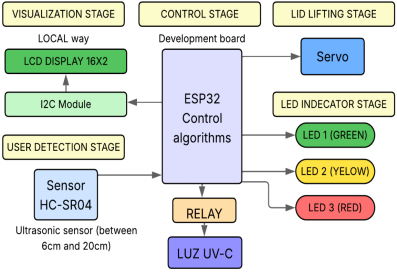
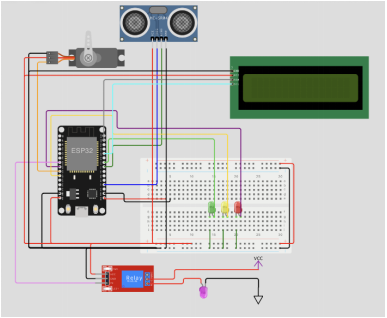
The overall system integration is illustrated in Figure 2, which presents the functional block diagram, and in Figure 3, which details the electronic circuit. This dual representation highlights both the logical architecture and its hardware implementation. The design follows best practices for enclosed UV-C devices and aligns with recent engineering and safety guidelines for portable germicidal systems [31].
Figure 2. Functional block diagram of the UV-C capsule
Figure 3. Electronic circuit of the UV-C disinfection capsule
2.6 Operating algorithm
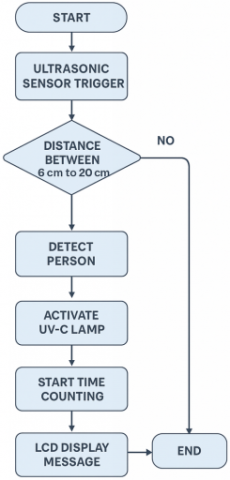
The disinfection cycle is fully automated on the ESP32 microcontroller. Its sequence is expressed in two complementary forms: Algorithm 1 provides the pseudocode structure, while Figure 4 presents the same logic in a standardized flowchart. The dual representation ensures clarity for both engineering-oriented readers and broader audiences by combining formal logic with an intuitive graphical overview.
|
Algorithm 1: Operating Pseudocode |
|
IF object_detected THEN close_lid() IF lid_closed THEN turn_on(UV_lamp, exposure_time) wait(exposure_time) turn_off(UV_lamp) open_lid() ENDIF ENDIF |
As illustrated in Figure 4, the process begins with object detection through an ultrasonic sensor. If an object is detected, the servo-driven interlock closes and confirms the lid position. Only under these safe conditions does the UV-C lamp activate for the predefined exposure time (5–60 s). After the cycle ends, the lamp switches off, the lid reopens automatically, and the LCD interface displays a completion message.
Figure 4. Operating algorithm (flowchart)
This automated control design reduces operator error, guarantees repeatability, and ensures that the UV-C lamp cannot be energized while the chamber is open. In addition, the firmware records cycle parameters, exposure duration, irradiance-derived dose, and sensor states for traceability and future remote monitoring integration. These safeguards confirm compliance with IEC 62471 and ISO 15858:2016, reinforcing both usability and user protection.
3.1 General description of the prototype
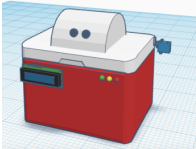
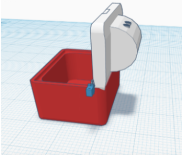
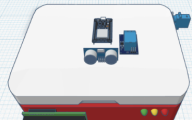
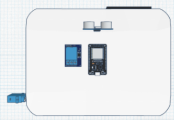
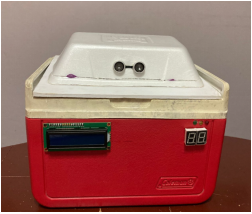
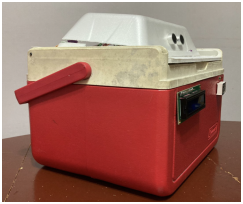
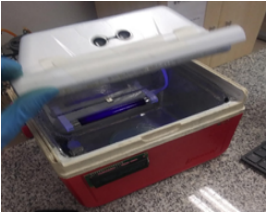
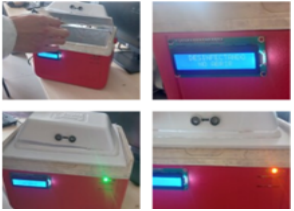
The UV-C disinfection capsule was designed as a portable, low-cost device for effective surface sterilization. The prototype integrates a germicidal low-pressure lamp (254 nm), a stainless-steel reflective inner lining to improve irradiance uniformity, and an ESP32-based control board for automated operation. Experimental validation focused on three aspects: (i) radiation safety, (ii) germicidal efficacy at different exposure times, and (iii) microbiological confirmation using agar cultures. Figure 5, Figure 6, Figure 7, and Figure 8 show the physical structure and user interface of the capsule. The front view (Figure 5) displays the LED status indicators and the LCD screen. The diagonal view (Figure 6) highlights the lid, hinges and outer housing. The internal irradiation chamber (Figure 7) presents the UV-C lamp, reflective lining and the sample holder designed for repeatable positioning. Figure 8 contains application and close-up images (lid operation, sample placement and LCD messages) illustrating typical use.
Figure 5. Front view of the prototype
Figure 6. Diagonal view of the prototype
Figure 7. Inside view of the irradiation chamber
Figure 8. Prototype in application
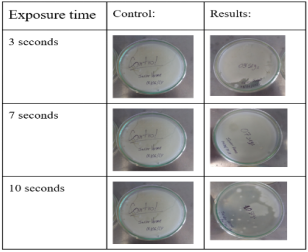
Microbiological tests with Escherichia coli and Staphylococcus aureus confirmed the device’s germicidal performance. Representative agar plates before and after 60 s of UV-C exposure are shown in Figure 9: Untreated controls exhibit confluent growth, while plates exposed to 60 s show near-complete inactivation.
Figure 9. Representative agar plates (control vs. 60 s UV-C)
3.2 Experimental results of UV-C dose measurement
The applied UV-C dose was calculated using Eq. (1), considering irradiance (E) and exposure time (t). Measurements across nine points of the exposure plane yielded an average irradiance of 10.5 mW/cm² (CV < 8%), confirming homogeneous distribution across the chamber.
3.3 Quantitative analysis and statistical validation
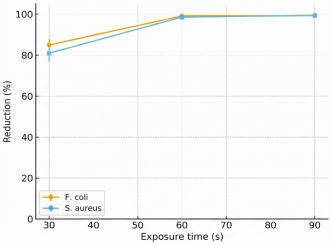
Bacterial inactivation was quantified as mean ± SD (n = 5). Results are summarized in Table 1, showing > 99% reduction after 60 s exposure.
Table 1. Bacterial reduction (%) at different exposure times (mean ± SD, n = 5)
|
Time (s) |
E. Coli (%) |
S. Aureus (%) |
|
30 |
85 ± 3.2 |
81 ± 4.1 |
|
60 |
99.2 ± 0.5 |
98.7 ± 0.6 |
|
90 |
99.5 ± 0.3 |
99.3 ± 0.4 |
A one-way ANOVA confirmed statistically significant differences between 30 s and 60 s (p = 0.01), while no significant difference was found between 60 s and 90 s (p = 0.28).
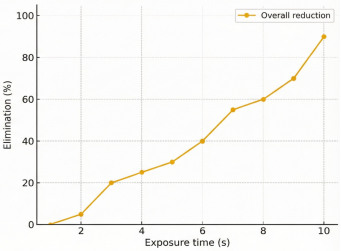
Figure 10. Microbial inactivation curves (ANOVA results)
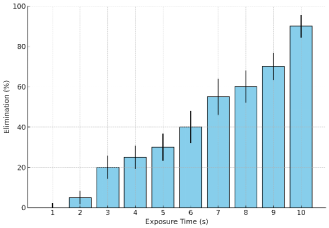
The reduction dynamics are illustrated in Figure 10(a) (microbial inactivation curves for E. coli and S. aureus) and Figure 10(b) (mean reduction with 95% CI), validating the statistical robustness of the results. A focused ANOVA comparison of selected short exposures (3 s, 5 s, and 10 s) confirms significant differences among groups (one-way ANOVA, p < 0.05). Post-hoc Tukey analysis shows that the 10-second exposure group achieves significantly higher reduction than 3 s and 5 s (p < 0.05). Figure 11 presents the group means and 95% confidence intervals, highlighting the rapid inactivation achievable with short UV-C pulses.
Figure 11. Comparison of microbial elimination
3.4 Comparative performance
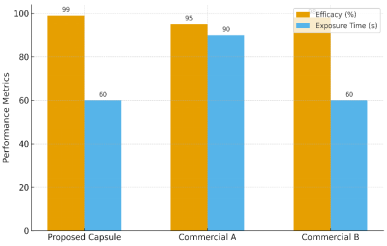
To assess feasibility, the prototype’s performance was compared with two commercial UV-C devices reported in the literature.
Table 2. Comparative performance of the proposed UV-C capsule and commercial devices
|
Parameter |
Proposed Capsule |
Commercial System A |
Commercial System B |
|
UV-C wavelength |
254 nm |
254 nm |
253.7 nm |
|
Lamp power |
30 W |
25 W |
35 W |
|
Exposure time |
60 s |
90 s |
60 s |
|
Bacterial reduction |
> 99% |
~95% |
~98% |
|
Portability |
High |
Medium |
Low |
|
Estimated cost (USD) |
120 |
220 |
250 |
Results in Table 2 and Figure 12 show that the proposed capsule achieved similar or superior inactivation (> 99% at 60 s) while maintaining a ~40% lower fabrication cost (USD 120 vs. USD 200–250).
Figure 12. Comparative performance of the UV-C capsule and commercial devices
3.5 Safety validation
Radiation leakage was measured at < 0.1 µW/cm², in full compliance with IEC 62471. In addition, the design fulfills ISO 15858:2016 requirements for UV-C disinfection devices, ensuring safe operation in public spaces and preventing accidental exposure.
3.6 Critical discussion
The present results demonstrate that the proposed UV-C capsule achieves rapid and repeatable microbial inactivation, with > 99% reduction after 60 s for both E. coli and S. aureus (Table 1; Figure 10(a) and Figure 10(b)). The one-way ANOVA confirmed that extending exposure beyond 60 s does not yield statistically meaningful improvements (30 vs 60 s, p = 0.01; 60 vs 90 s, p = 0.28), supporting 60 s as a practical operating threshold. From an engineering standpoint, this balances efficacy with throughput, energy consumption, and lamp longevity.
When benchmarked against representative commercial systems, the capsule delivers comparable or superior disinfection performance at approximately 40–50% lower upfront cost, while ensuring high portability (Table 2). These aspects are key for deployment in resource-restricted environments. Furthermore, the inclusion of automated interlocks and measured surface leakage below 0.1 µW/cm² confirms that enhanced affordability does not come at the expense of safety, meeting IEC 62471 standards.
Recent UV-C studies also recognize the practicality of rapid, portable systems. Prorok et al. [11] demonstrated that a handheld UV-C device eliminated more than 99% of C. difficile spores within clinically relevant exposure times. Similarly, Yemmireddy et al. [12] validated a portable UV-C coating activation device effective against Candida albicans biofilm and SARS-CoV-2, reinforcing the utility of compact sanitization tools. These findings are consistent with the capsule’s performance, further supporting its feasibility for real-world applications.
This work addresses two critical gaps in the existing literature: (i) the explicit measurement of UV-C dose and irradiance uniformity, and (ii) robust statistical validation across replicates. By combining quantified dose exposure, replicated assays, and ANOVA-based inference, the study strengthens both internal validity and comparability. Additionally, the capsule's low energy consumption and cost (Table 2) underscore its potential as a sustainable alternative to chemical disinfection.
Nonetheless, several limitations warrant future investigation. First, efficacy was demonstrated on glass substrates; complex geometries and low-reflectance materials may exhibit lower inactivation rates and should be examined. Second, while reflective lining minimized shadowing, multi-source configurations could further enhance coverage. Third, the current tests were conducted under controlled environmental conditions—real-world humidity, temperature fluctuations, or soiled surfaces may alter effectiveness. Lastly, long-term operational stability (lamp aging, sensor drift) requires periodic recalibration and maintenance tracking.
In summary, the capsule achieves a compelling balance of high germicidal effectiveness (≥ 99% at 60 s), safety compliance, portability, and cost-efficiency, positioning it as a scalable and practical solution for healthcare, educational, and public environments. The convergence of experimental evidence (Table 1; Figure 10(a) and Figure 10(b)) and comparative performance (Table 2), supported by recent literature [11, 12], underscores its relevance and applicability.
The developed UV-C disinfection capsule prototype demonstrated > 99% inactivation efficiency against Escherichia coli and Staphylococcus aureus after 60 s of exposure, confirming its potential as a biosafety tool in high-risk environments. The design integrates safety interlocks, proximity sensors, and structural shielding, ensuring safe operation in compliance with international standards IEC 62471 and ISO 1585.
From an economic perspective, the system positions itself as a cost-effective alternative to commercial devices, offering advantages in portability and ease of deployment in hospitals, public transportation, and office settings. Furthermore, its ESP32-based architecture provides a foundation for future IoT integration, enabling remote monitoring and cycle traceability, as well as the incorporation of artificial intelligence to optimize exposure times and radiation doses for different surfaces and microbial strains.
Overall, the UV-C capsule represents an innovative solution that combines germicidal efficacy, validated safety, and economic accessibility, distinguishing it from existing systems and contributing tangible value to biosafety in everyday environments. In conclusion, this development offers a safe, affordable, and portable alternative to commercial devices, with the potential to evolve into a scalable biosafety tool for high-risk applications.
This work was supported by Universidad Privada del Norte.
[1] Golfiroozi, S., Fashayi, F., Rajabi, A., Shahryar, A. (2024). Disinfectants efficacy in reducing pathogens related to health-care infection associated in universities hospitals of Gorgan, North of Iran. BMC Infectious Diseases, 24: 1113. https://doi.org/10.1186/s12879-024-09985-8
[2] Prasek, K., Kiersnowska, I., Wójkowska-Mach, J., Różańska, A., Romaniszyn, D., Foryciarz, E., Kwiećkowska, L.B., Krzych-Fałta, E. (2025). Microbial contamination on high-touch surfaces in outpatient clinics: Identification of bacterial strains from areas of patient and medical staff occupancy. Microorganisms, 13(3): 698. https://doi.org/10.3390/microorganisms13030698
[3] Hamed, N.M.H., Deif, O.A., El-Zoka, A.H., Abdel-Atty, M.M., Hussein, M.F. (2024). The impact of enhanced cleaning on bacterial contamination of the hospital environmental surfaces: A clinical trial in critical care unit in an Egyptian hospital. Antimicrobial Resistance & Infection Control, 13: 138. https://doi.org/10.1186/s13756-024-01489-z
[4] Oh, E., Shin, H., Han, S., Do, S.J., et al. (2025). Enhanced biocidal efficacy of alcohol based disinfectants with salt additives. Scientific Reports, 15: 3950. https://doi.org/10.1038/s41598-025-87811-0
[5] Pedreira, A., Fernandes, S., Simões, M., García, M.R., Vázquez, J.A. (2024). Synergistic bactericidal effects of quaternary ammonium compounds with essential oil constituents. Foods, 13(12): 1831. https://doi.org/10.3390/foods13121831
[6] Sun, Y.L., Wu, Q., Liu, J.Z., Wang, Q. (2023). Effectiveness of ultraviolet-C disinfection systems for reduction of multi-drug resistant organism infections in healthcare settings: A systematic review and meta-analysis. Epidemiology and Infection, 151: e149. https://doi.org/10.1017/S0950268823001371
[7] Demeersseman, N., Saegeman, V., Cossey, V., Devriese, H., Schuermans, A. (2023). Shedding a light on ultraviolet-C technologies in the hospital environment. The Journal of Hospital Infection, 132: 85-92. https://doi.org/10.1016/j.jhin.2022.12.009
[8] Tchonkouang, R.D., Lima, A.R., Quintino, A.C., Cristofoli, N.L., Vieira, M.C. (2023). UV-C light: A promising preservation technology for vegetable-based nonsolid food products. Foods, 12(17): 3227. https://doi.org/10.3390/foods12173227
[9] Plitta-Michalak, B., Kolobynina, K.G., Qin, Q., Jain, I., et al. (2025). Exposure of cells to near-infrared irradiation relaxes chromatin compaction and facilitates recognition of cyclo-butane pyrimidine dimers. Scientific Reports, 15: 22312. https://doi.org/10.1038/s41598-025-08763-z
[10] Banaś, A.K., Zgłobicki, P., Kowalska, E., Bażant, A., Dziga, D., Strzałka, W. (2020). All you need is light. Photorepair of UV-induced pyrimidine dimers. Genes, 11(11): 1304. https://doi.org/10.3390/genes11111304
[11] Prorok, P., Grin, I.R., Matkarimov, B.T., Ishchenko, A.A., Laval, J., Zharkov, D.O., Saparbaev, M. (2021). Evolutionary origins of DNA repair pathways: Role of oxygen catastrophe in the emergence of DNA glycosylases. Cells, 10(7): 1591. https://doi.org/10.3390/cells10071591
[12] Yemmireddy, V., Adhikari, A., Moreira, J. (2022). Effect of ultraviolet light treatment on microbiological safety and quality of fresh produce: An overview. Frontiers in Nutrition, 9: 871243. https://doi.org/10.3389/fnut.2022.871243
[13] Shrestha, P., Kim, B., Han, S.R., Lee, H., Oh, T.J. (2025). Unraveling the genetic mechanisms of UV radiation resistance in Bacillus through biofilm formation, sporulation, and carotenoid production. Genomics, 117(4): 111066. https://doi.org/10.1016/j.ygeno.2025.111066
[14] Täubel, M., Castagnoli, E., Salthammer, T., Morawska, L., Salonen, H. (2024). The impact of cleaning on the microbiomes of indoor surfaces. Indoor Environments, 1(3): 100021. https://doi.org/10.1016/j.indenv.2024.100021
[15] D'Accolti, M., Soffritti, I., Mazziga, E., Bini, F., Bisi, M., Volta, A., Mazzacane, S., Caselli, E. (2025). A sustainable combined approach to control the microbial bioburden in the school environment. Microorganisms, 13(4): 791. https://doi.org/10.3390/microorganisms13040791
[16] Suh, D., Sherlock, S.H., Dukes, K.C., Perencevich, E.N., Marra, A.R. (2025). Impact of UV-C on material degradation: A scoping literature review. Antimicrobial Stewardship & Healthcare Epidemiology, 5(1): e199. https://doi.org/10.1017/ash.2025.10114
[17] Cummings, B.E., Haas, C.N., James Lo, L., Sales, C.M., Waring, M.S. (2025). Inactivating airborne pathogens indoors with 222-nm far-UVC systems: Insights from a CFD-based analysis and a predictive performance model. Building and Environment, 283: 113336. https://doi.org/10.1016/j.buildenv.2025.113336
[18] Wiśniewski, A., Skarżyński, K., Pracki, P., Krupiński, R., Wolska, A., Wisełka, M., Pawlak, A. (2025). Surface disinfection systems with UV-C lamps–verification measurements and design procedure proposal. LEUKOS, 21(2): 125-140. https://doi.org/10.1080/15502724.2024.2392569
[19] Chen, H., Moraru, C.I., Protasenko, V.V. (2023). Maximizing the disinfection effectiveness of 254 nm UV-C light with a special design unit: Simulation and experimental approaches. Frontiers in Food Science and Technology, 3: 1223829. https://doi.org/10.3389/frfst.2023.1223829
[20] Graeffe, F., Luo, Y.Y., Guo, Y.S., Ehn, M. (2023). Unwanted indoor air quality effects from using Ultraviolet C lamps for disinfection. Environmental Science & Technology Letters, 10(2): 172-178. https://doi.org/10.1021/acs.estlett.2c00807
[21] ISO. (2016). ISO 15858:2016(en) UV-C Devices — Safety information — Permissible human exposure. https://www.iso.org/obp/ui/en/#iso:std:iso:15858:ed-1:v1:en.
[22] IEC. (2006). IEC 62471:2006 Photobiological safety of lamps and lamp systems. https://webstore.iec.ch/en/publication/7076.
[23] Chung, C.Y., Sung, W.T., Wang, L.C., Siami, L., Santos, J.P. (2024). Environmental disinfection based on mobile intelligent networking highly efficient ultraviolet light machines. Aerosol and Air Quality Research, 24(2): 230226. https://doi.org/10.4209/aaqr.230226
[24] Putra Wigianto, A.Y., Watanabe, M., Iwawaki, Y., Goto, T., Otsuki, T., Ichikawa, T. (2024). Antimicrobial efficacy of a portable UV-C-based coating activation device against Candida albicans biofilm and SARS-CoV-2 as an additional feature: An in vitro study. Hygiene, 4(1): 93-102. https://doi.org/10.3390/hygiene4010006
[25] Blau, K., Gallert, C. (2024). Efficacy of UV-C 254 nm light and a sporicidal surface disinfectant in inactivating spores from Clostridioides difficile ribotypes in vitro. Pathogens, 13(11): 965. https://doi.org/10.3390/pathogens13110965
[26] Ferraz, M.P. (2024). Antimicrobial resistance: The impact from and on society according to one health approach. Societies, 14(9): 187. https://doi.org/10.3390/soc14090187
[27] Rufyikiri, A.S., Martinez, R., Addo, P.W., Wu, B.S., et al. (2024). Germicidal efficacy of continuous and pulsed ultraviolet-C radiation on pathogen models and SARS-CoV-2. Photochemical & Photobiological Sciences, 23: 339-354. https://doi.org/10.1007/s43630-023-00521-2
[28] Gelir, A., Asicioglu, F., Yilmaz, A.S., Kuskucu, M., et al. (2023). UVC-LED-based face mask design and efficacy against common germs. Archives of Industrial Hygiene and Toxicology, 74(4): 282-287. https://doi.org/10.2478/aiht-2023-74-3766
[29] Vareschi, A., Gaglio, S.C., Dervishi, K., Minoia, A., et al. (2025). Evaluation of biocontrol measures to reduce bacterial load and healthcare-associated infections. Microorganisms, 13(8): 1923. https://doi.org/10.3390/microorganisms13081923
[30] Vincent, R., Rapoport, D., Balchandani, P., Borrello, J., et al. (2024). Portable UV-C device to treat high flow of infectious aerosols generated during clinical respiratory care. Scientific Reports, 14: 31799. https://doi.org/10.1038/s41598-024-82901-x
[31] Link, M.F., Shore, A., Robertson, R., Hamadani, B.H., Poppendieck, D. (2024). Spectral characteristics and indoor air quality effects of germicidal 254 nm and 222 nm ultraviolet light. NIST Interagency/Internal Report (NISTIR), National Institute of Standards and Technology, Gaithersburg, MD. https://doi.org/10.6028/NIST.IR.8550