Gulzhan Nuruldaeva* | Asel Isakhanova | Dauren Kumar | Bakdaulet Kumar
© 2025 The authors. This article is published by IIETA and is licensed under the CC BY 4.0 license (http://creativecommons.org/licenses/by/4.0/).
OPEN ACCESS
This article considers the problem of occupational health and safety in crushing and grinding mineral ore at the processing plants of mining enterprises. Occupational risks at workplaces are dust of complex composition (aerosol of fibrogenic action), industrial noise (80-105 dB) and vibration (up to 43-56% of working time), unfavorable microclimate. In the structure of occupational injuries, injuries of musculoskeletal system, concussions of the brain and contusions prevail. The aim of the study is to review the literature to identify occupational hazards of workers employed in ore crushing and grinding areas in order to compile a body of knowledge to investigate safety in the workplace. The study synthesizes theoretical statements and results of 38 scientific papers published between 2000 and 2023 in PubMed, Core Collection in Web of Science, ScienceDirect, and RINC databases to display the existing body of knowledge on occupational hazards in ore preparation for further processing in mining companies; PubMed database data were processed by VOS Viewer 1.16.18; descriptive analysis and textual narrative syntheses were compiled through a systematic literature review. Data on occupational risks of occupations such as plate feeder and conveyor (transporter, elevator) operators, crusher operators (jaw, cone, roller, hammer), screen and mill operators were obtained. The results of this study can provide useful information for making proposals for organizational and technical improvement to reduce occupational morbidity during ore preparation at concentrators and reduce the limitations of socio-economic consequences of occupational diseases and accidents.
dust, mineral ore crushing, noise, occupational hazards, vibration, occupational health management, mining safety
Due to the rapid development of technology, accompanied by a constant increase in the power and productivity of machines, the speed of their working bodies, labor conditions at workplaces of industrial enterprises are changing. Therefore, ensuring safe and hygienic working conditions in production is a serious scientific problem that engineers of literally all specialties have to face, especially at mining enterprises. In mining and processing of minerals, one of the subsectors with the highest rate of occupational diseases and accidents is mining enterprises [1], which are also one of the subsectors in which workers are exposed to the worst and most dangerous working conditions [2].
Mining enterprises can be singled out as an industry with high occupational risk indicators, many works [3, 4] have singled them out as the most dangerous production environments due to the large number of injuries that occur in them.
In study [5] an analysis of health and safety reports in the mining industry was carried out in order to identify historical prerequisites for the formation of safety culture in the mining industry. The results show that identifying and changing cultural factors can influence the likelihood of accident recurrence. Many processes in the mining industry are characterized by peculiarities of technological processes, specific working conditions, and high occupational health risks for workers. The industries involved in mining have the highest levels of occupational morbidity - up to 24.3 per 10 thousand workers [6]. Increased occupational risk has a negative impact on the health of workers, worsens the indicators of general and occupational morbidity, increases mortality from chronic non-infectious diseases [7-10].
Operations of preparation of raw materials for beneficiation are practically identical for factories and are associated with crushing, stage grinding of rock mass to certain particle sizes. Technological processes of mineral processing can be conditionally divided into three main stages: operations of preparation for enrichment - crushing, screening and transportation of raw materials, enrichment processes and operations to obtain concentrates (drying, packaging, loading).
The occupational risk mechanisms of workers are associated with ore preparation processes such as crushing, screening and grinding. The ore extracted from the mine is coarse to be useful for metallurgy. The coarse particles must be reduced to a certain size to release minerals; therefore, the ore from the mine is crushed and pulverized to process the minerals. Crushing technology is concerned with breaking the lumpy material into small pieces [11, 12]. Ore crushing is performed in two, three and four stages depending on the size of the incoming material and enrichment methods. Coarse and medium crushing is carried out in jaw, cone, gear and hammer crushers. Fine crushing is carried out in cone, roller and hammer crushers. Mechanisms of dust entry into the working area at this stage depend on the state of the equipment and organization of aspiration systems. Outdated crushing plants are sources of dust 36-48mg/m3. Ore is fed to the crushers by feeders of various designs and belt conveyors. Ore is screened on grates, drums, oscillating, vibrating and other types of screens. Ore grinding is carried out in ball or rod mills in one or several stages. The number of installed equipment and its type correspond to the number of grinding stages and the adopted technology [13].
When performing this literature review, the most commonly considered processes for crushing and grinding in ore processing are jaw crushers, cone crushers, and ball mills. Cone crushers utilize compression mechanism and are the most common type of crushers used in mineral processing schemes for secondary and tertiary crushing [14]. Due to the severe loading conditions during crusher operation, various failure problems may occur in its internal plain bearings, including surface wear, frictional failure, chemical corrosion and overload failure [15]. Ball mill is a typical and common grinding equipment and it is widely used in non-ferrous metal beneficiation [16]. It is a type of heavy mechanical equipment that uses its own rotation to drive steel balls internally to impact and grind material loads with high reliability. The study [17] performed mechanism characterization analysis and soft measurement method of mill load parameter based on mechanical vibration and acoustic signals in mineral grinding process.
The key occupational hazards associated with ore crushing and grinding processes are dust, noise, vibration and mechanical injuries.
Dust. The crushing plant is one of the significant sources of dust generation that affect the health of workers as well as the environment. The main raw materials falling on crushing are ores of non-ferrous and ferrous metals. The production duties of a mill driver include controlling the processes of crushing and grinding ore, regulating the supply of materials or liquid components, reagents and air to the ore crushing mills. Also during the day the specialists check the grinding and classification processes on automatic control. If necessary, foreign objects are removed, samples are taken and output is monitored. Silicon dioxide and lead dust are hazardous in ore crushing. APFD at the workplaces of crushers is determined by high maximum single and average daily concentrations of crystalline silicon dioxide from 10% to 70%. The condition contributing to air pollution of working premises with harmful substances, dust can also be insufficient sealing of equipment. At the workplace of the conveyor and mill driver the leading harmful factor is aerosol mainly fibrogenic action.
Noise. All processes of ore crushing at crushing plants of various types, screening and their step-by-step transportation are associated with the generation of noise and vibration. Crushing plants in mining and processing plants and crushing and screening plants in mines are equipped with vibrating screens, which generate high levels of noise during operation. In the manufacturing industry, at least 45% of workers are constantly exposed to noise at work [18, 19]. This condition can be harmful to hearing, with a greater hazard occurring with systematic 8-hour exposure above 85 dB (A) [20] and it is exacerbated if it is associated with other environmental hazards such as chemicals [21] and vibration [22]. The results of the conducted hygienic studies [23-25] allowed us to assess the working conditions of conveyor operator, mill driver by the intensity of noise exposure as harmful - 3 class 2 degree of harmfulness. Average terms of development of occupational hearing loss in factory workers are as follows: crushers - 23.9 ± 2.1 years; mill operators and pumping plant operators - 26.3 ± 1.9 years; conveyor operators - 32.5 ± 1.8 years [6].
Industrial vibration. Concentrator workers often suffer from musculoskeletal pain and have diagnosed musculoskeletal disorders. During the operation of cone crushers, vibration problems cannot be ignored, as they directly correlate with the stability and service life of the equipment. Industrial practice shows that structural damage within the crusher [26], weakened connections between the foundation and crushers, and variation in the structural designs of the foundation are key factors affecting vibration characteristics. In the field of engineering technology, vibration problems pose a potential threat to the safety of screen and mill operators [27]. Prolonged exposure to vibration (both local and general) can cause back pain, poor circulation and dystrophic changes in joints.
Mechanical injuries. Shortcomings in the organization of work, most often the lack of protection of equipment or improper use of tools, are the causes of injuries associated with mechanical equipment. Conveyor driver's work is connected with significant movements horizontally and vertically of galleries, the height of which reaches 35-40 meters. It was found that accidents occur in greater numbers in the evening and night shifts, and during the shift the increase in cases is observed in the second half of the working shift [13, 28].
The purpose of this study is to review the literature to identify the occupational risks of workers employed in the crushing and grinding areas of ore processing plants of mining enterprises to compile a body of knowledge on safety research in the workplace. An attempt has been made to conduct a holistic and systematic analysis of the working conditions of workers in ore preparation shops of mining enterprises. The study synthesizes previous findings and seeks avenues for future research in the field of improving the working conditions of workers.
The identification of occupational risk mechanisms is important for the development of effective occupational health and safety management measures in mining operations. The methodological approach based on the goals and objectives of the study is outlined in the next section of the paper.
Literature review is aimed at finding scientific papers on the selected topic. To ensure the completeness of the study, all relevant publications on the topic under review were identified, the representativeness of the work is ensured by selecting such publications that most accurately reflect the current state of research in the field. In compiling the literature review, it is important to utilize various sources of information and search strategies to achieve these objectives.
Since the work of mining companies includes a large number of technological processes, there are relatively few scientific papers devoted to workers involved in ore preparation for further metallurgical processing. The literature review is conducted to analyze past and present data in order to present the prevailing state of the issue in the literature and to propose management solutions applied in the workplace. Figure 1 shows the sequence of work steps in the study.
Figure 1. Sequence of research steps
The research methodology includes 4 steps: 1) defining the aims, objectives and research questions; 2) searching for studies; 3) selecting studies; and 4) conducting textual narrative synthesis through literature review.
Relevant studies were selected by systematic searches of scientific databases such as PubMed (search for health and safety studies), Core Collection in Web of Sience (access to peer-reviewed articles and reports), Sience Direct (search for publications on technical aspects of ore processing), RINC (search for publications by CIS scientists) and a number of smaller databases using a title and keyword search strategy (see Figure 2).
Figure 2. Visualization of the keyword network
The selection of databases was based on their reputation and relevance in the research environment, as well as the availability of the required bibliography.
The following keywords occupational health and safety and mining; occupational hazards, ore crushing, occupational hazards in mining, occupational health and safety in mining, risk management in extractive industries were used for the literature search. Both general and specialized terms were used to cover all aspects of the topic (see Figure 3).
Figure 3. Keywords associated with the term occupational risks
Publication selection was made based on the following criteria as: date of publication (2000 to 2023); type of publication (peer-reviewed articles, reports, scientific reviews); and relevance of the topic (studies that directly address labor conditions during ore crushing and grinding). Preliminary searches were conducted to identify key papers to guarantee the completeness of the research conducted. In preparing the research paper, a systematic literature review was used to analyze the publications.
This multifaceted and extended search strategy ensures a comprehensive and systematic approach to identifying occupational hazards in the process of ore crushing and grinding, which in turn contributes to the successful outcome of the study.
2.1 Question wording
To perform a literature review, it is necessary to perform a research assessment and identify the most influential authors, journals or publications in the chosen field. Bibliometric analysis involves collecting data on the number of publications, citations in a particular field, and the use of statistical methods to analyze and interpret the data [29, 30]. A systematic literature review allows us to analyze the risks and consequences faced by workers in these occupations and identify measures to improve occupational health and safety management systems at workplaces.
Considering the context, the following research question was formulated.
RQ1: What occupational risk factors are crushing and screening machine operators exposed to in the workplace?
To further explore the systematic literature review, three additional secondary research questions were identified.
RQ1a: What occupational hazards cause workers to become ill?
RQ1b: What occupational hazards are present in ore crushing and grinding processes?
RQ3c: What controls can be implemented to effectively manage occupational hazards?
2.2 Search for scientific studies
This study collected literature review data sources from Core Collection in Web of Science, Sience Direct, PubMed, and RINC. The literature search includes the period from 2000-2024. The following keywords were used: occupational health and safety and mining; occupational hazards, ore crushing. Titles and abstracts of papers, articles listed in the search results were examined. In scientific bases there are many research works which are devoted to the issues of labor protection and industrial safety of mining enterprises, conditions of mining workers engaged in underground mining, a large number of works devoted to metallurgical processing for obtaining clean raw materials. The problems of ore processing are considered in the context of raw material processing in open pit mining, preparation of coal for further combustion in boiler units. Therefore, theses devoted to crushing and grinding plants used in other branches of production were excluded, since the purpose of the work is to study the working conditions of workers of processing plants of mining enterprises. Given the criteria for inclusion of studies, the full texts of all potentially relevant studies were examined and included in the paper.
The reason for choosing these databases is the large number of journals containing articles on prevention and control of occupational risks.
2.3 Study selection
This section describes the database selection, search strategies, inclusion criteria and analysis procedures. The area of current research is the determination of occupational hazards in the preparation of ore for further metallurgical processing. The selection of articles for inclusion in the literature review was conducted according to the questions formulated in Section 2.1 The article selection process, was conducted in 3 stages. At stage 1, all articles dealing with occupational hazards in mining enterprises were selected. For example, the following keywords were used to identify occupational diseases of mining workers in the PubMed database: occupational health and safety and mining. The document type was articles with a time range of 2000 to 2023. This process generated 990 papers as data for analysis. Using the VOS Viewer 1.16.18 program, keywords in scientific papers in the PubMed database for the period under review and the association of co-occurrence of these indicators (working conditions, occupational diseases, hazardous factors) in different work sites of mining companies were selected. The search identified 198 keywords in 10 clusters.
Since the purpose of the research work was chosen the workplace of crushing and screening machine operators, the articles devoted to the work of miners, workers of transport and cargo machines, working conditions of workers specializing in ore dressing processes, in particular metal extraction were not considered. It should be noted that there are very few individual works devoted to the study of working conditions of workers engaged in processing and preparation of raw materials for ore dressing, so for the research was used also sources of databases Core Collection in Web of Science, Science Direct, PubMed, RINC.
Ore crushing technology, ore quality, working conditions and workloads vary from country to country. According to the formulated questions in the study, in order to identify harmful and hazardous factors at workplaces, the literature search included data from other scientific databases published in the same time period from 2000 to 2023. At the second stage, articles that are directly related to the statistics of labor conditions and measures to protect workers in the crushing and grinding shops, articles related to accidents and injuries in the operation of crushers and mills were selected. At the third stage, the scientific papers that were included in the final database were analyzed. These papers were ranked in terms of journal citations and reviewed the current status of working conditions at these facilities.
This section presents a selection of selected scientific papers. As shown in Table 1, after applying the search criteria, 15 scientific papers were found.
Table 1. Number of articles reviewed at each stage of the study
|
A Selection of Studies |
Articles |
|
Stage 1 |
990 |
|
Stage 2 |
38 |
|
Stage 3 |
15 |
The detailed description of the characteristics of the 15 selected articles is divided according to the following aspects (see Table 2):
1 Authors
2 Research topic (production factor addressed in the paper)
3 Research methods
Table 2. Review of literature used
|
No. |
Ref. |
Type of Production Factor |
The Research Period Covered in the Paper |
Research Methods |
|
1 |
[31] |
Accident |
2009-2019 |
Statistical analysis |
|
2 |
[20] |
Production noise |
2013-2018 |
Mathematical model of the regression |
|
3 |
[25] |
Accident |
2000-2004 |
Survey |
|
4 |
[32] |
Dust, noise, general vibration, heavy work |
- |
Instrumental measurements, medical indicators of employees |
|
5 |
[4] |
Risk management |
2023-2024 |
Literature review, questionnaire survey |
|
6 |
[5] |
Occupational health and safety reports |
|
Review of the literature |
|
7 |
[33] |
dust |
- |
Statistical analysis |
|
8 |
[34] |
Dust and aerosols |
- |
Literature review |
|
9 |
[6] |
Noise, vibration, microclimate, hard work |
2004-2014 |
Instrumental measurements, medical indicators of employees |
|
10 |
[35] |
Noise, vibration, dust, microclimate, hard work |
2004-2015 |
Hygienic research |
|
11 |
[36] |
Noise, vibration, dust, microclimate, hard work |
|
Instrumental measurements, working environment parameters |
|
12 |
[37] |
microclimate |
2020 |
Instrumental measurements, working environment parameters |
|
13 |
[38] |
Noise and dust |
|
Hygienic research |
|
14 |
[39] |
Noise, vibration, dust, chemicals |
|
Hygienic research |
|
15 |
[40] |
Accidents |
2013-2018 |
Statistical analysis |
The selected articles were systematized by the type of production factor and research methods (instrumental measurement of working conditions, interviewing of workers, conclusion of correlation of indicators by mathematical methods).
The number of peer-reviewed journals is 9 (see Table 3), articles are distributed in 15 journals, this fact shows the area of interest of the scientific community to the issues of working conditions at mining enterprises. Different technologies and methods used in mining ore processing in the world, leads to the narrowing of the field of study of this article and consequently the field of research.
Table 3. Review of literature used
|
No. |
Journal |
Articles |
|
1 |
Safety Science |
2 |
|
2 |
Safety and Health at Work |
2 |
|
3 |
Indian Journal of Occupational and Environmental Medicine |
1 |
|
4 |
Russian Journal of Occupational Health and Industrial Ecology |
1 |
|
5 |
Ecotoxicology and Environmental Safety |
1 |
|
6 |
Science of The Total Environment |
1 |
|
7 |
Health care of the Russian Federation |
1 |
|
8 |
Hygiene and Sanitation, Russian Journal |
1 |
|
9 |
Journal of Safety Research |
1 |
According to the journals used to conduct this systematic review, it can be emphasized that journals covering topics related to occupational hazards, safety, rehabilitation, quality and occupational health predominate, while it can be proved that there is a close relationship between the topics of the journals and the formulated research questions.
The study of the relationship between occupational risk factors and the health of workers allows to identify the mechanisms of impact and develop more effective measures for occupational safety. This section of the scientific work is grouped according to the key risk factors such as noise, vibration, dust in the air of the working area, microclimate, accidents and injuries at workplaces and also includes, methods of risk management and measures to prevent occupational diseases of mill drivers and crushers.
4.1 Industrial noise
Production noise is of primary importance in the complex of harmful factors of the working environment in factories. The processing plant's technological equipment is a source of intense industrial noise. The working conditions for noise and general vibration correspond to class 3.2 [32, 41]. A variety of types and types of technological equipment for ore preparation, driven by powerful electric motors, a variety of centrifugal pumps for pumping liquids installed at different levels, vibrations of protective fences are sources of intense noise. Its levels are especially high at the workplaces of ball mill machinists, at the sites of the main flotation, at the time of filling the bunkers, where the noise level exceeds values of 100 dB or more. In the drying and finished product workshops, in the room of craftsmen and operators monitoring the technological process, the noise level is lower than acceptable and ranges from 60 to 65 dBA. Excess noise levels are noted during the operation of all types of equipment that ensure ore reception, crushing, crushing, transportation along the technological chain, enrichment, tailings separation, and product delivery. During the shift, the screen drivers are exposed to noise levels of 100-105 dB, and in the immediate vicinity during inspection and maintenance of units - up to 112 dB. The noise levels in the work areas depend on the degree of loading, the size of the pieces and the strength of the screening, etc. The main sources of noise of vibrating screens are leak surfaces, sides, stiffness elements and guide rails of sieves. The highest noise levels (90-97 dBA, class 3.3) are observed in the areas of crushing, screening and crushing of ore in the work area of crushers and machinists of ball mills. The noise has a broadband spectrum with a maximum sound energy in the mid-frequency range (500-2000 Hz) exceeding spectral levels by 12-18 dBA [6]. Equivalent noise levels at locksmiths' and repairmen's workplaces depend on the type of equipment being serviced and on average exceed the remote control by 7-11 dBA (class 3.2) [42].
The most common hearing symptoms for workers in crushing plants are tinnitus 13%, difficulty understanding speech 12%, dizziness 12%. hearing loss 7%, feeling of fullness of the auricles 4%. There is a link between hearing loss detected by audiometry and the most common auditory symptoms: difficulty understanding speech, tinnitus, stuffy ears, and dizziness [43].
The time spent by workers in conditions of acoustic vibrations, characterized by an increased level of noise and general vibration, is 43-53%. The crusher's reaction rate to a sound stimulus increases after a shift [44], which indicates the predominance of inhibitory processes in the auditory cortex due to the monotony of work and constant noise from the working crushing complex.
The relative risk of developing sensorineural hearing disorders is estimated to be high in the majority of factory workers (crushers, pumping plant machinists, mill machinists, repair workers).
The average time frame for the development of occupational hearing loss in factory workers is (average values are shown): crushers – 24 years old; locksmiths – 29 years old; mill machinists and pumping plant machinists – 27 years old; conveyor machinists – 34 years old [35, 44].
In a number of factories processing high-strength ores at crushing and crushing sites, sound pressure levels are significant and at frequencies of 125, 250 and 500 Hz exceed the permissible crushing stages 2 and 3 for millers, respectively, by 34 and 39 dB. The noise dose loads received by workers at processing plants can vary very widely and often exceed the permissible values for workers operating crushing and milling equipment. In the works [38], it was noted that in enrichment plants, in addition to noise, vibration and physical factors, increased levels of infrasound are recorded in workplaces. The constant presence of infrasound, which has a pronounced harmonic character, is noted, and according to the degree of severity relative to noise, it can be characterized as "pronounced infrasound".
4.2 Production vibration
Vibration, regardless of whether it is local, general, or combined, negatively affects the nervous system, gastrointestinal tract, muscles, musculoskeletal system, vision, hearing, etc. Prolonged exposure to vibration can lead to a difficult-to-treat vibration disease - a persistent violation of the physiological functions of the body. Industrial production practice shows that structural damage inside the crusher, loosening of the joints between the foundation and the crushers, and diversity in the structural structures of the foundation are key factors affecting vibration characteristics.
Occupational vibration of the whole body has negative effects on the body and in the long run can lead to chronic problems such as lower back pain, autonomic nervous system dysfunction and spinal degeneration, among other problems [45]. Studies are being conducted to identify the links between the physical values of vibrational stimuli applied to the entire body and the perceived degree of comfort [10, 46].
A large amount of evidence confirms the importance of physical factors in the development of lower back diseases [47]. The difficulty lies in the fact that in professions where workers are exposed to general vibration, there are other physical risk factors such as uncomfortable postures, prolonged sitting, as well as loading and unloading materials from the vehicle.
According to the study [32], the equivalent adjusted vibration acceleration levels exceed an average of 7.9 dB along the Z axis. With prolonged exposure to general vibration, workers may experience pain in the lower back, limbs, and joints. 32% of the surveyed crushers complain of joint pain. At the main workplaces in the coarse crushing housing, the vibration level reached 71 dB, which was 21 dB higher than the maximum permissible level (remote control). In the case of medium and fine crushing, it exceeded the remote control by 30 dB, in the case of crushing – by 28 dB. Vibration levels exceeding the limit by 24 dB were recorded at workplaces in the filter drying, reagent, crushing and flotation departments [39].
In study [48], the vibration parameters of workplaces and functional shifts during the shift of mill operators, their assistants and separator operators were studied. The research involved individuals aged 20 to 45 years with work experience from 3 months to 11 years. There are 33 people in total during 90 working shifts. According to the vibration intensity, the equipment was distributed as follows. The highest levels of vibration velocity were observed in classifiers (up to 4.6 cm/sec), slightly lower levels in mills (up to 1.9 cm/sec), deslamators (up to 1.5 cm/sec), conveyors (up to 0.75 cm/sec), separators (up to 0.24 cm/sec). The authors revealed an increase in blood pressure among mill drivers, an increased pulse rate, and a decrease in auditory sensitivity at the end of a work shift. The authors also noted a decrease in manual strength and endurance after 6 hours from the start of work.
In study [49], it was revealed that the indicators of carbohydrate metabolism change most intensively with vibration pathology and in combination with sensorineural hearing loss.
4.3 Dustiness of workplaces
Despite the introduction of new technological processes and modern equipment, air pollution in the working area with aerosols of predominantly fibrogenic action remains a leading role in enrichment plants. Workers in processing plants are characterized by a high degree of industrial conditionality of diseases of the circulatory system, respiratory system. The structure of occupational diseases is formed by dust lung diseases.
The degree of dustiness in the workplace is determined by the nature of the processed raw materials, their humidity, the stage of grinding, and also largely depends on the effectiveness of dedusting agents. Studies on measuring dust concentrations in working areas at a number of ore processing plants have shown that the dust content at different crushing and crushing sites can vary very widely. At the same time, at the stages of grinding raw materials, mineral dust with different contents of free silicon dioxide is present in the air of the working areas, and concentrate dust is present at the final stages of enrichment. The initial stages of crushing are performed on jaw crushing plants of different capacities, followed by its transportation by conveyors to subsequent processing plants. Conveyor transportation of raw materials in factories is the main one, it has a significant length (up to several kilometers) with many transshipment points and a large number of workers servicing the conveyors. Up to 30-35% of the working time, conveyor machinists control the operation of equipment in isolated cabins located on different levels, in which the air is low in dust. At workplaces closer to the sources of dust emission, where workers stay most of the time, dust concentrations are on average 1.5-4 times higher than the maximum permissible concentration. Against this background, dust concentrations increase sharply during the elimination of spills, during visual inspection of the filling of bunkers at the inspection grilles and during dry cleaning. At the final stage of ore crushing and the fine grinding stage, the dust intake into the working areas depends on the technical condition of the crushing and grinding equipment, the degree of its deterioration, the use and effectiveness of sanitary and technical means of dust control. The lowest dust concentrations are found in factories where the most modern shredding equipment equipped with efficient ventilation systems was used. At the same time, factories using outdated designs of jaw and cone crushers have high levels of workplace dust at all stages of crushing raw materials, reaching 36-48 mg/m3 [4].
The working conditions of crushers, locksmiths, repair workers, conveyor machinists, pumping plant machinists are harmful to the first degree (class 3.1) due to the dustiness of the air in the working area, and ball mill machinists [50]. The smaller the size of the dust particles, the deeper they penetrate into the respiratory tract. In PM10, larger particles will accumulate in the human respiratory tract; smaller particles will enter the bronchioles and alveoli of the human body, causing serious damage to lung tissue. Pneumoconiosis develops slowly, over the course of 5-15 years of operation, but with high dust levels, the process can develop in the shortest possible time.
Dust concentrations in the air of the working area during crushing and screening processes exceed the maximum permissible concentration by more than 3-5 times, at the enrichment site during crushing of ferruginous quartzites, magnetic separation, filtration are at the maximum concentration level. The working conditions of crushers, locksmiths, conveyor machinists, pumping unit machinists are classified as harmful to the first degree (class 3.1) due to the dustiness of the working area, while ball mill machinists, separators, and filter workers are permissible (class 2) [32].
At the stages of crushing and crushing, dust containing crystalline silicon dioxide from 2 to 10% is released into the air of the working area, while the maximum concentrations of which ranged from 3.2 to 9 mg/m3 at the workplace of the conveyor operator and mills, the leading harmful factor was an aerosol of predominantly fibrogenic action. The calculated dust load for the machinists was 4.5 – 4.8 mg/m3 (class 3.1) [36].
The most common occupational disease in GOK factories is chronic dust bronchitis (47%), pneumoconiosis (silicosis) (15.6%), and occupational bronchial asthma (6.25%) is diagnosed in isolated cases [44].
According to study [51], dust from mining operations is one of the most significant occupational risks, especially in the production of fine materials, which has consequences for the environment, health and safety. As noted in study [52], several reviews have addressed various aspects of mineral dust, such as sources, control measures, and monitoring methods.
Dust containment systems use troughs, barriers, and covers that physically limit the area of the dust source. However, these methods have disadvantages because they mainly affect performance in a certain area, for example, in a restricted access area where dust movement is intense. The most common suppression system is water spraying.
The authors [51] revealed that the workers of the enrichment plant, under the influence of harmful factors of the working environment and the labor process, have a risk of thyroid pathology, expressed in its hypofunction and autoimmune damage. the impact of toxic environmental and industrial factors on this system. The development of thyroid pathology may be associated with an excess or deficiency of trace elements such as copper, zinc, lead, and cadmium, which not only affect the absorption of iodine in the body, but also can affect the functioning of the thyroid gland to varying degrees.
4.4 Workplace microclimate
The microclimatic conditions of workplaces should be attributed to a significant unfavorable factor in processing plants. The composition of the atmosphere in the workplace is monitored based on the results of air sample analyses. Sampling locations and their frequency are set by a schedule approved by the technical director of the organization. Depending on the technological purpose of the premises, the parameters of the microclimate in the work areas can vary significantly and are determined by architectural and planning solutions, the supply of cold air to the ore preparation sites, moisture from open water surfaces, and the state of the heating and ventilation systems on duty. The microclimate parameters in factories have seasonal fluctuations [52].
The lowest temperatures, especially in winter, are observed at the stages of storage and preparation of raw materials for crushing, since significant amounts of cold air from open areas enter through doorways, hatchways and transport openings. An analysis of the microclimatic parameters in the rooms of processing plants during the transitional periods of the year (autumn-winter) showed that the air temperature in the workshops ranged from 14.2℃ to 25°C, and the relative humidity was 60-79% [28].
Consequently, in processing plants located in different climatic zones, the parameters of the microclimate in the workplace can vary widely and often do not comply with current sanitary standards, which can lead to stress on the thermoregulation mechanisms, a decrease in the level of efficiency and a violation of the health of workers.
Hygienic studies conducted in [37, 38] at the sites of the main workshops and the mining and processing plant showed that the air temperature during the warm period fluctuated at the level of 19-27℃. The levels of relative humidity and air velocity in the main workshops and sections of the processing plant were kept at a level from 45 to 65% and did not exceed 0.2–0.09 m/s, respectively.
4.5 Mechanical hazard
Addressing occupational health and safety issues is one of the most important challenges in the mining industry [53]. It can be identified as a particularly risky industry, even as one of the most dangerous production environments due to the large number of injuries that occur in it [54, 55]. As a result, workers, especially mining equipment operators, face high occupational health risks, including environmental and psychosocial factors, and the industry continues to experience high levels of accidents and occupational diseases that can seriously affect their productivity, competitiveness, and overall efficiency [56].
The work of the machinists of the enrichment plants is accompanied by significant physical exertion, which is associated with long-distance crossings, both horizontally and vertically, with a large number of slopes (more than 100). During repair and adjustment work, the machinists of enrichment plants perform more than 40,000 movements involving the muscles of the hands and fingers [24].
Most of the crusher's working time is associated with observing the technological process in a standing position. The workplace of the operator overseeing the ore supply to the crusher and its operation should have metal lattice fences to protect against the possible release of ore pieces from the crushers onto the site. Protective devices should be provided on screens and crushers to protect people from accidental release of pieces of ore. There is a large component of monotony in this profession, which affects the indicators of the cardiovascular system. Insufficient physical activity leads to a decrease in the body's reserve capabilities, if there are rare heavy shifts in work. Such work does not have a training effect on the human muscular and ligamentous apparatus, and the main load falls on the spine. This labor operation for a crusher corresponds to very hard work. Hypokinesia, which is now widespread not only among knowledge workers, but also among physical workers, contributes to an increase in the severity and intensity of work. According to physiological indicators, the crusher's work is classified as work of moderate severity [32].
The results of hygienic studies on the assessment of the intensity of the labor process have shown that for all professional groups, nervous and emotional stress is caused by a high degree of responsibility for the result of activity and the significance of errors, as well as three-shift work, including night shift work, for the operator, in addition, the duration of concentrated observation. The final class of working conditions in terms of the intensity of the labor process is assessed by us as harmful with the class of working conditions 3.1 [41, 53].
In study [48], a significant relationship was found between occupational injuries and stress at work, night shifts, the use of PPE, and the level of education of employees (see Figure 4).
Figure 4. Relationship between production factors and occupational diseases
Electrical equipment of various capacities is installed in the crushing building of the factory, and fuel and lubricants warehouses are located in the buildings. This creates a risk of fire and electric shock. In the workshops of the factory, there are also such dangers as people falling from a height, an involuntary fall.
The metallurgical sector covers manual activities and other activities related to the constant use of machinery, which leads to accidents caused by loss of control over machinery (26.8%), involuntary body movements (25.6%) and voluntary body movements (19.3%).
The results of hygienic studies assessing the intensity of the labor process have shown that for all professional groups, nervous and emotional stress is caused by a high degree of responsibility for the result of activity and the significance of errors, as well as three-shift work, including night shift work, for the operator, in addition, the duration of focused observation [54]. The final class of working conditions in terms of the intensity of the labor process is assessed as acceptable with a class of working conditions 2 [36].
The structure of established occupational injuries is dominated by injuries to the musculoskeletal system, brain concussions and bruises. This is due to the prolonged impact on the body of the worker of such industrial factors as vibration, heavy physical labor, often performed stereotypical movements, which inevitably leads to overstrain of individual organs and systems and the development of occupational and production-related diseases. Research has established [55] that the causes of accidents at the enterprise are: lack of briefings, insufficient labor protection control, unsatisfactory organization and maintenance of workplaces, violation of safety regulations, non-compliance with safety standards of technological equipment, tools and accessories, violation of labor and technological discipline, unsatisfactory sanitary and hygienic working conditions [56].
A detailed understanding of the interrelationships between risk factors allows not only to assess the health status of workers, but is also the basis for the development of practical recommendations to reduce occupational risks. Further research in this area is needed to clarify these relationships, create more effective preventive measures and improve working conditions [57-60].
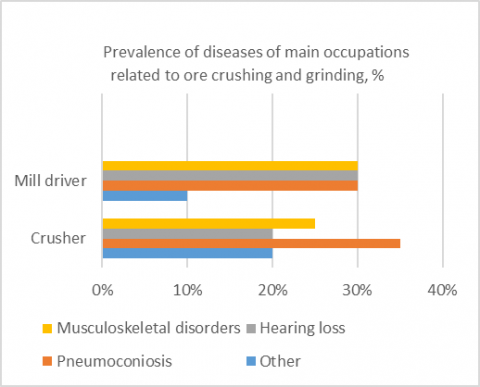
For example, chronic exposure to noise combined with vibration significantly increases the risk of sensorineural hearing loss and musculoskeletal disorders. In addition, exposure to airborne fibrogenic dust under conditions of extreme temperatures and humidity contributes to the progression of pneumoconiosis and chronic bronchitis (see Figure 5). Complex analysis shows that health disorders of workers at mining and processing plants are the result of combined exposure to a variety of occupational risk factors. Therefore, prevention strategies should be multidimensional, taking into account the combined impact of noise, vibration, dust and microclimatic conditions [61-63].
Figure 5. Prevalence of diseases of main occupations related to ore crushing and grinding, %
4.6 Risk management
Management of the prevention of occupational risks arising at ore crushing and crushing sites includes methods of collective and individual protection of workers.
The methods of dust control during the operation of crushing units are related to their design features: a receiving hopper, a grate screen, a crusher, plate and belt conveyors. The main sources of dust release during the operation of these units are: the loading site, reloading sites, screens and crushers. In this case, aspiration, purification of technological emissions from dust, general exchange ventilation and hydraulic spraying are used to control dust. During dust collection, the dusting units are separated from the external environment by shelters, the design of which depends on the sources of dust emission. The most universal way to control dust here is dust extraction, which involves the aspiration of dusty air from the shelters of dust sources and its subsequent purification in dust collectors. If dust suppression measures cannot ensure that dust levels are reduced to sanitary standards, respiratory protection equipment is used [64, 65].
To combat industrial noise and vibration that occurs on the surfaces, protective elements from the conveyor belt are used, mounted on the side and frontal surfaces of the heat source. Reducing the noise of vibrating screens is achieved through the use of soundproof barriers. For these purposes, a 2-3 mm thick sheet steel fence is used. Coating the inner surfaces of the fence with sound-absorbing materials can lead to effective sound insulation (20-26 dB). External soundproof fences mounted on the mill drum, rubber linings, and overbolt vibration-insulating linings serve as means of reducing noise from impacts by grinding bodies [27]. The designs of special soundproof bunkers are provided, which additionally have means of reducing the impact energy of falling pieces of ore, sound absorption and isolation of structural vibrations.
A number of factories use virtual reality training for employees. To reduce the severity of work, exoskeletons are provided that take on heavy weight, thereby reducing the load on the human body during movement. There are locking devices that automatically stop the mechanisms when an employee dangerously approaches them. Complexes of preventive measures and ways of their implementation are being developed aimed at preserving the health of workers at processing plants and preventing the development of occupational and professionally related diseases. Age and length of service restrictions are appropriate when combined with the effects of various adverse industrial environments.
As a result of the conducted research, it has been established that the complex of harmful factors of the working environment and labor process acting on mill drivers and crushers includes, industrial noise and vibration, unfavorable microclimate, dustiness of the air of the working zone with aerosols of mainly fibrogenic action, increased severity and tension of labor. For clarity and relevance, the results were grouped into thematic categories based on the research questions. Only data directly related to occupational risk factors and their impact on worker health were retained in this section. Additional or contextualized findings carried over discussion. In addition, key findings have been summarized using charts and tables for better visualization and interpretation.
Occupational exposure levels show that noise levels at the crushing, grinding and ore transportation workplaces range from 85-100 dB, exceeding the maximum permissible levels at the workplaces in almost 85-90% of the literature reviewed. (exceeding the MPL in 100% of cases). Dust load at workplaces depends on the type of mineral raw materials and organization of ventilation installations and makes 3.5-5.2 mg/m³, including the content of free silicon dioxide >10%. The next factor constantly present at workplaces is general vibration. Literature review has shown that in coarse and fine crushing hulls the vibration level exceeds sanitary norms by more than 20 dB.
Thus, different levels of production factors determine different degree of risk of occupational pathology in workers. Occupational diseases occur in workers who are exposed to several factors simultaneously. Literature review has shown that among crushers such dust-related diseases as pneumoconiosis occur. Prolonged exposure to general vibration is the cause of pain in the lower back, limbs and joints, noise exceeding the maximum permissible exposure limit is the cause of hearing loss.
The summarized findings indicate a high prevalence of occupational hazards in ore crushing and grinding environments, with a significant correlation between multi-factor exposures and chronic health conditions. These insights underline the necessity of integrated protective measures and further targeted studies.
Despite the conducted research, there are still many unresolved issues and challenges related to occupational health and safety of workers of enrichment plants engaged in ore crushing and grinding workplaces. Changing working conditions and introduction of new technologies require continuous monitoring and adaptation of occupational health and safety management systems.
The results of future research in this area can be used to improve existing occupational health and safety practices. This may include recommendations for policy changes, the introduction of new technologies, or the development of risk assessment tools.
It is only through continuous updating of knowledge and adaptation of occupational health and safety management systems that safe and healthy working conditions for workers can be ensured.
[1] Parker, A.W., Tones, M.J., Ritchie, G.E. (2017). Development of a multilevel health and safety climate survey tool within a mining setting. Journal of Safety Research, 62: 173-180. https://doi.org/10.1016/j.jsr.2017.06.007
[2] Marimuthu, R., Sankaranarayanan, B., Karuppia, K. (2023). Prioritizing the factors affecting the occupational health and safety of workers in the mining industry using the SWARA Technique. Journal of Current Science and Technology, 13(1): 59-73. https://doi.org/10.14456/jcst.2023.6
[3] Gyekye, S.A. (2003). Causal attributions of Ghanaian industrial workers for accident occurrence: Miners and non-miners perspective. Journal of Safety Research, 34(5): 533-538. https://doi.org/10.1016/j.jsr.2003.03.002
[4] Milošević, I., Stojanović, A., Nikolić, Đ., Mihajlović, I., Brkić, A., Perišić, M., Spasojević-Brkić, V. (2025). Occupational health and safety performance in a changing mining environment: Identification of critical factors. Safety Science, 184: 106745. https://doi.org/10.1016/j.ssci.2024.106745
[5] Tetzlaff, E.J., Goggins, K.A., Pegoraro, A.L., Dorman, S.C., Pakalnis, V., Eger, T.R. (2021). Safety culture: A retrospective analysis of occupational health and safety mining reports. Safety and Health at Work, 12(2): 201-208. https://doi.org/10.1016/j.shaw.2020.12.001
[6] Preobrazhenskaya, E.A., Sukhova, A.V., Zorkina, L.A., Bondareva, M.V. (2016). Hygienic assessment of working conditions and health of the workers of mining and processing enterprises. Hygiene and Sanitation, Russian Journal, 95(11): 1065-1070. https://doi.org/10.18821/0016-9900-2016-95-11-1065-1070
[7] Mandal, B.B., Bhattacharya, S., Munawar, V.D., Hussain, S.A. (2022). Health risk of exposure to noise in coal preparation and mineral processing plants. In: Moitra, A.K., Kayal, J.R., Mukherjee, B., Bhattacharya, J., Das, A.K. (eds) Innovative Exploration Methods for Minerals, Oil, Gas, and Groundwater for Sustainable Development. Elsevier, pp. 139-157. https://doi.org/10.1016/B978-0-12-823998-8.00062-4
[8] Freeh, E.J., Iles, C.D. (1985). Experience with operating and controlling an in-pit portable crushing and conveying system. IFAC Proceedings, 18(6): 153-158. https://doi.org/10.1016/S1474-6670(17)60502-0
[9] Chebotarev, A.G., Sementsova, D.D. (2021). Comprehensive assessment of working conditions and occupational disease rates at mining and metallurgical enterprises. Russian Mining Industry, (1): 114-119. https://doi.org/10.30686/1609-9192-2021-1-114-119
[10] Kiryakov V.A., Sukhova A.V. (2015). Professional risk of diseases of the musculoskeletal system in workers mining and processing enterprises. Russian Journal of Occupational Health and Industrial Ecology, (9): 68-69.
[11] Neikov, O.D. (2009). Mechanical crushing and grinding. In: Neikov, O.D., Naboychenko, S.S., Murashova, I.V., Gopienko, V.G, Frishberg, I.V., Lotsko, D.V. (eds) Handbook of Non-Ferrous Metal Powders. Elsevier, pp. 47-62. https://doi.org/10.1016/B978-1-85617-422-0.00002-1
[12] Yamashita, A.S., Thivierge, A., Euzébio, A.M. (2021). A review of modeling and control strategies for cone crushers in the mineral processing and quarrying industries. Minerals Engineering, 170: 107036. https://doi.org/10.1016/j.mineng.2021.107036
[13] Bengtsson, M., Asbjörnsson, G., Hulthén, E., Evertsson, M. (2017). Towards dynamical profit optimization of comminution circuits. Minerals Engineering, 103-104: 14-24. https://doi.org/10.1016/j.mineng.2016.07.013
[14] Nematollahi, E., Zare, S., Maleki-Moghaddam, M., Ghasemi, A., Ghorbani, F., Banisi, S. (2021). DEM-based design of feed chute to improve performance of cone crushers. Minerals Engineering, 168: 106927. https://doi.org/10.1016/j.mineng.2021.106927
[15] Liu, Z., Bi, Q., Guo, J., Liu, G., Zhou, M., Huang, Q. (2023). Failure analysis of eccentric bushings in large gyratory crusher. Engineering Failure Analysis, 153: 107630. https://doi.org/10.1016/j.engfailanal.2023.107630
[16] Xie, C., Zhao, Y., Song, T., Zhao, Y. (2022). Investigation of the effect of filling level on the wear and vibration of a SAG mill by DEM. Particuology, 63: 24-34. https://doi.org/10.1016/j.partic.2021.04.009
[17] Tang, J., Qiao, J., Liu, Z., Zhou, X., Yu, G., Zhao, J. (2018). Mechanism characteristic analysis and soft measuring method review for ball mill load based on mechanical vibration and acoustic signals in the grinding process. Minerals Engineering, 128: 294-311. https://doi.org/10.1016/j.mineng.2018.09.006
[18] Cavalcante, F., Ferrite, S., Meira, T.C. (2013). Exposure to noise in the manufacturing industry in Brazil. Revista CEFAC, 15: 1364-1370. https://doi.org/10.1590/S1516-18462013005000021
[19] World Health Organization. (2021). World report on hearing. World Health Organization.
[20] Lopes, A.V.C., Teixeira, C.F., Vilela, M.B., de Lima, M.L. (2024). Time trend of occupational noise-induced hearing loss in a metallurgical plant with a hearing conservation program. Safety and Health at Work, 15(2): 181-186. https://doi.org/10.1016/j.shaw.2024.04.001
[21] Hormozi, M., Ansari-Moghaddam, A., Haghighi, J., Eftekharian, F. (2017). The risk of hearing loss associated with occupational exposure to organic solvents mixture with and without concurrent noise exposure: A systematic review and meta-analysis. International Journal of Occupational Medicine and Environmental Health, 30(4): 521-535. https://doi.org/10.13075/ijomeh.1896.01024
[22] Pettersson, H., Burström, L., Hagberg, M., Lundström, R., Nilsson, T. (2012). Lundström Noise and hand-arm vibration exposure in relation to the risk of hearing loss. Noise and Health, 14(59): 159-165. https://doi.org/10.4103/1463-1741.99887
[23] Chaulya, S.K., Chowdhury, A., Kumar, S., Singh, R.S., Singh, S.K., Singh, R.K., Prasad, G., Mandal, S., Banerjee, G. (2021). Fugitive dust emission control study for a developed smart dry fog system. Journal of Environmental Management, 285: 112116. https://doi.org/10.1016/j.jenvman.2021.112116
[24] Donoghue, A.M. (2004). Occupational health hazards in mining: an overview. Occupational Medicine, 54(5): 283-289. https://doi.org/10.1093/occmed/kqh072
[25] Saha, A., Kumar, S., Vasudevan, D. (2007). Occupational injury surveillance: A study in a metal smelting industry. Indian Journal of Occupational and Environmental Medicine, 11(3): 103-107. https://doi.org/10.4103/0019-5278.38458
[26] Liu, Z., Wang, S., Guo, J., Chen, Z., Guan, W., Bi, Q., Mao, Y., Wang, H., Huang, Q. (2024). Analysis and optimization of vibration characteristics of gyratory crusher based on DEM-MBD and PSO. Computers and Geotechnics, 174: 106665. https://doi.org/10.1016/j.compgeo.2024.106665
[27] Nuruldaeva, G., Zhumadilova, Z., Kumar, D., Kaldybayeva, S. (2019). Dissipative properties of the highly alloyed aluminum cast iron ЧЮ22Ш. Industry of Kazakhstan, 2(106): 59-63.
[28] Zhalimbetov, M., Zharylkasyn, J., Sraubaev, E. (2008). Hygienic assessment of labor activity of workers engaged in open-pit mining and concentration of chrome ore. Russian Journal of Occupational Health and Industrial Ecology, (2): 11-14.
[29] Abdullah, K.H. (2022). Bibliometric analysis of safety behavior research. Asian Journal of Behavioral Sciences, 4(2): 19-33.
[30] Agarwal, A., Durairajanayagam, D., Tatagari, S., Esteves, S.C., Harlev, A., Henkel, R., Roychoudhury, S., Homa, S., Puchalt, N., Ramasamy, R., Majzoub, A., Ly, K., Tvrda, E., Assidi, M., Kesari, K., Sharma, R., Banihani, S., Ko, E., Abu-Elmagd, M., Gosalvez, J., Bashiri, A. (2016). Bibliometrics: Tracking research impact by selecting the appropriate metrics. Asian Journal of Andrology, 18(2): 296-309. https://doi.org/10.4103/1008-682X.171582
[31] Fuentes-Bargues, J.L., Sánchez-Lite, A., González-Gaya, C., Rosales-Prieto, V.F., Reniers, G.L.L.M.E. (2022). A study of situational circumstances related to Spain’s occupational accident rates in the metal sector from 2009 to 2019. Safety Science, 150: 105700. https://doi.org/10.1016/j.ssci.2022.105700
[32] Mishina, E.A., Kudryashov, I., Belometsnova, O.V. (2019). Occupational risk assessment in crusher operators in polymetals production. Russian Journal of Occupational Health and Industrial Ecology, 59(9): 700-700. https://doi.org/10.31089/1026-9428-2019-59-9-700-701
[33] Soltani, N., Keshavarzi, B., Moore, F., Cave, M., Sorooshian, A., Mahmoudi, M.R., Ahmadi, M.R., Golshani, R. (2021). In vitro bioaccessibility, phase partitioning, and health risk of potentially toxic elements in dust of an iron mining and industrial complex. Ecotoxicology and Environmental Safety, 212: 111972. https://doi.org/10.1016/j.ecoenv.2021.111972
[34] Kasongo, J., Alleman, L.Y., Kanda, J., Kaniki, A., Riffault, V. (2024). Metal-bearing airborne particles from mining activities: A review on their characteristics, impacts and research perspectives. Science of The Total Environment, 951: 175426. https://doi.org/10.1016/j.scitotenv.2024.175426
[35] Sukhova, A.V., Preobrazhenskaya, E.A., Il’Nitskaya, A.V., Kir’Yakov, V.A. (2017). The health of workers of concentrating mills by modern technologies of concentration of minerals and prevention measures. Health care of the Russian Federation, 61(4): 196-201. https://doi.org/10.18821/0044-197Х-2017-61-4-196-201
[36] Karimova, L., Gainullina, M., Grebneva, O., Shaikhlislamova, E., Mavrina, L., Sembayev, Z., Beigul, N. (2017). On the state of working conditions of the workers of the mining and processing plant. Occupational Hygiene and Medical Ecology, 1(54): 22-29.
[37] Каrаbаlin, S.К., Niyazbekova, L.S., Saylybekova, A.K., Terlikbaeva, G.A., Seyduanova, L.B., Myrzagulova, S.E. (2020). Hygienic evolution of microclimatic parameters in the mining and processing industries. International Journal of Applied and Fundamental Research, 9: 18-22.
[38] Chebotarev, A.G., Golovkova, N.P. (2013). Hygienic problems of improving working conditions in the enrichment of minerals. Mining, (3): 104-110.
[39] Tarmaeva, I.Y., Odontsetseg, B., Pankov, V.A., Kuleshova, M.V. (2018). Sanitary audit of working conditions in the concentrating mill of ore mining and processing enterprise Erdenet (Mongolia). Pacific Medical Journal, (4): 84-88. https://doi.org/10.17238/PmJ1609-1175.2018.4.84-88
[40] Baraza, X., Cugueró-Escofet, N., Rodríguez-Elizalde, R. (2023). Statistical analysis of the severity of occupational accidents in the mining sector. Journal of Safety Research, 86: 364-375. https://doi.org/10.1016/j.jsr.2023.07.015
[41] Kopytenkova, O.I., Tursunov, Z.S., Levanchuk, A.V., Mironenko, O.V., Frolova, N.M., Sazonova, A.M. (2018). The hygienic assessment of the working environment in individual occupations in building organizations. Hygiene and Sanitation, 97(12): 1203-1209. https://doi.org/10.47470/0016-9900-2018-97-12-1203-1209
[42] Sundback, U., Tingwall, B. (1982). Impact noise control within ironworks. In INTER-NOISE and NOISE-CON Congress and Conference Proceedings, 1982(2): 265-268.
[43] Almaayeh, M., Al-Musa, A., Khader, Y.S. (2018). Prevalence of noise induced hearing loss among Jordanian industrial workers and its associated factors. Work, 61(2): 267-271.
[44] Marth, E., Reinthaler, F.F., Schaffler, K., Jelovcan, S., Haselbacher, S., Eibel, U., Kleinhappl, B. (1997). Occupational health risks to employees of waste treatment facilities. Annals of Agricultural and Environmental Medicine, 4(1): 143-147.
[45] Santos, B., Larivière, C., Delisle, A., Plamondon, A., Boileau, P., Imbeau, D. (2008). A laboratory study to quantify the biomechanical responses to whole-body vibration: The influence on balance, reflex response, muscular activity and fatigue. International Journal of Industrial Ergonomics, 38(7-8): 626-639. https://doi.org/10.1016/j.ergon.2008.01.015
[46] Maeda, S., Mansfield, N., Shibata, N. (2008). Evaluation of subjective responses to whole-body vibration exposure: Effect of frequency content. International Journal of Industrial Ergonomics, 38(5-6): 509-515. https://doi.org/10.1016/j.ergon.2007.08.013
[47] Burdorf, A., Sorock, G. (1997). Positive and negative evidence of risk factors for back disorders. Scandinavian Journal of Work, Environment & Health, 23(4): 243-256. https://doi.org/10.5271/sjweh.217
[48] Kifle, M., Engdaw, D., Alemu, K., Sharma, H., Amsalu, S., Feleke, A., Worku, W. (2014). Work related injuries and associated risk factors among iron and steel industries workers in Addis Ababa, Ethiopia, Safety Science, 63: 211-216. https://doi.org/10.1016/j.ssci.2013.11.020
[49] Lapko, I., Kiryakov, A., Antoshina, L. (2014). Effect of vibration, noise, physical stress and unfavorable microclimate on carbohydrate metabolism in workers of mining enterprises and mechanical engineering. Russian Journal of Occupational Health and Industrial Ecology, (7): 32-36.
[50] Shur, P.Z., Redko, S.V., Fadeev, A.G., Goryaev, D.V., Fokin, V.A. (2023). Assessment of working conditions and health conditions of employees of non-ferrous metallurgy enterprises. Russian Journal of Occupational Health and Industrial Ecology, 63(8): 537-544. https://doi.org/10.31089/1026-9428-2023-63-8-537-544
[51] Lozovaya, Е., Gainullina, М., Masyagutova, L., Karimova, L. (2013). Laboratory evaluation of the thyroid system in female workers of the enrichment plant. Saratov Scientific Medical Journal, 9(2): 201-203.
[52] Abitayev, D., Yerdesov, N., Zhumaliyev, B., Mashina, T., Serik, B., Kalishev, M., Shintayeva, N., Zhakenova, S. (2020). Occupational risks and health status of persons working in the mining industry of the Central Kazakhstan. Medicine and Ecology, (2): 41-45.
[53] Bukhtiyarov, I., Sivochalova, O., Khoruzhaya, O., Kontorovich, E. (2016). Reproductive health disorders in night shift workers (review of literature). Russian Journal of Occupational Health and Industrial Ecology, (9): 10-14.
[54] Semenova, I.N., Rafikova, Y.S. (2011). Hygienic characteristic of conditions of Sibay branch of Uchaly oredressing plant. Fundamental Research, (9): 509-512.
[55] Yusupova, S.M. (2016). Analysis of industrial injuries and safety improvement at Zhezkazgan concentrator No. 1 LLP “Corporation Kazakhmys” Automation. Informatics, 1(38): 49-51.
[56] Selin, H., Selin, N.E. (2023). The human–technical–environmental systems framework for sustainability analysis. Sustainability Science, 18(2): 791-808. https://doi.org/10.1007/s11625-022-01177-0
[57] Duarte, J., Castelo Branco, J., Rodrigues, F., Vaz, M., Santos Baptista, J. (2022). Occupational exposure to mineral dust in mining and earthmoving works: A scoping review. Safety, 8(1): 9. https://doi.org/10.3390/safety8010009
[58] Boranova, N.A. (2009). Occupational health in factory workers engaged into iron quartzite enrichment, prophylactic measures. Russian Journal of Occupational Health and Industrial Ecology, (8): 34-37.
[59] Teregulova, Z., Tairova, E., Karimova, L., Iskhakova, D., Abdrakhmanova, D. (2006). Features of occupational diseases among workers of the mining enterprises. Byulleten’ Vostochno-Sibirskogo nauchnogo tsentra Sibirskogo otdeleniya RAMN, (3): 109-110.
[60] Wikström, B., Kjellberg, A., Landström, U. (1994). Health effects of long-term occupational exposure to whole-body vibration: A review. International Journal of Industrial Ergonomics, 14(4): 273-292. https://doi.org/10.1016/0169-8141(94)90017-5
[61] Noble, T.L., Parbhakar-Fox, A., Berry, R., Lottermoser, B. (2017). Mineral dust emissions at metalliferous mine sites. In Environmental Indicators in Metal Mining. Springer, Cham, рр. 281-306. https://doi.org/10.1007/978-3-319-42731-7_16
[62] Liu, В., Ai, S., Zhang, W., Huang, D., Zhang, Y. (2017). Assessment of the bioavailability, bioaccessibility and transfer of heavy metals in the soil-grain-human systems near a mining and smelting. Science of the Total Environment, 609: 822-829. https://doi.org/10.1016/j.scitotenv.2017.07.215
[63] Haas, E., Patrick, L. (2021). Exploring the differences in safety climate among mining sectors. Mining, Metallurgy & Exploration, 38(1): 655-668. https://doi.org/10.1007/s42461-020-00364-w
[64] Servet, G., Surer, E., Erkayaoğlu, M. (2023). Mining-virtual: A comprehensive virtual reality-based serious game for occupational health and safety training in underground mines. Safety Science, 166: 106226. https://doi.org/10.1016/j.ssci.2023.106226
[65] Muhammet, G., Fatih, A.M. (2018). A comparative outline for quantifying risk ratings in occupational health and safety risk assessment. Journal of Cleaner Production, 196: 653-664. https://doi.org/10.1016/j.jclepro.2018.06.106