Retno Widjajanti* | Mirza Irwansyah | Agung Sugiri | Wakhidah Kurniawati | Atika Aditya | Khansa Saffana | Aulia Ayu Kartika | Wardatut Toyyibah | Sabita Thifal Amani
© 2025 The authors. This article is published by IIETA and is licensed under the CC BY 4.0 license (http://creativecommons.org/licenses/by/4.0/).
OPEN ACCESS
Street vendors (SVs) play a vital social and economic role in urban life, particularly in cities of the Global South. During the COVID-19 pandemic, their role in sustaining community economies became more evident. However, SVs are often overlooked in urban planning, especially in the design of inclusive public spaces. This study aims to formulate inclusive open space design strategies that support informal sector activities as part of a broader commitment to social inclusion. Jetayu Park in Pekalongan, Indonesia, is used as a case study to explore the spatial integration of SVs in a multifunctional public park. A mixed-methods approach was employed, combining quantitative data from questionnaires (n=54) with qualitative spatial analysis. The findings indicate that SVs require spaces that are responsive to operational time, thermal and visual comfort, physical and visual accessibility, safety, spatial flexibility, and adequate supporting infrastructure. Based on inclusive design principles, the study proposes five key strategy categories: (1) Enhancing Temporal and Operational Adaptability, (2) Providing Environmental Comfort, (3) Allocating Strategically Accessible Locations, (4) Ensuring Mobility and Safety, and (5) Implementing Technical Considerations for Inclusive Design. These strategies are contextualized to Jetayu Park but offer adaptable guidance for other cities in the Global South. By integrating SVs into the urban design process, this study contributes to strengthening the framework for inclusive public space—where formal and informal users can coexist and thrive. The proposed framework demonstrates how inclusive design can support equity, flexibility, and multifunctionality in public space development.
design strategies, inclusive design principles, street vendors (SVs), vending activity patterns, spatial requirements
1.1 The importance of designing inclusive public space
In urban settings, parks are crucial public spaces that contribute to the sustainability, well-being, and general health of local communities, supporting the achievement of SDG-3 and SDG-11 [1]. In addition, parks attract individuals from diverse backgrounds, creating positive social interactions [2-5]. Various park-related studies emphasize the importance of assisting users in finding comfortable public spaces as a means to enhance community engagement and promote inclusivity [5, 6].
According to El Khateeb and Shawket [7], some groups of people are unable to access public spaces due to limited mobility, financial constraints, and dependence on others, such as children, older adults, and people with low income. In fact, public spaces should be accessible to all group including the informal economy sectors, which is in line with the opinion of Landman [8] with the conclusion that inclusive public spaces must be able to accommodate various groups of people both physically and socially. According to Hanson [9], an inclusive environment means that all users could carry out various activities comfortably, effectively, and safely without being restricted by poor design, maintenance, and management. There are seven principles that are formed to accommodate the broadest range of bodily shapes, dimensions, and movements, achieving a more social equity and justice measurement. The principles consist of equitable, flexible, intuitive, effective, tolerant, efficient, and appropriate. The characteristics of inclusive spaces are the freedom of the community in activities and communal life without requiring permission [8, 10, 11]. Inclusive public spaces will create a sense of belonging for users regardless of age, gender, ability, sexuality, race, ethnicity, culture, socioeconomic status, religion, and profession [12].
Despite the need for inclusivity, many studies on inclusive design do not specifically address Street vendors (SVs) as a vulnerable group in urban areas [5, 13-16], which contradicts the principle of inclusivity in open spaces, whereas the informal economy particularly for street food is considered as part of supporting activity attracting diverse communities [17]. Policies in Indonesia have also not specifically regulated the design of open spaces that involve SVs as actors, considering that open spaces are often designated as areas where these sectors are prohibited from selling even though they often occupy formal public spaces [18-22]. Similarly, Bangkok, Singapore, Malaysia, Manila, Hanoi, and Cambodia tend to treat policies as restrictions on the space and activities of urban SVs [23, 24], while policies for SVs exist, they often ignore how SVs perceive, manage, and coexist with formal spaces [25].
1.2 The role of vendor in socio-economic perspective
SVs in the Global South often find themselves caught between their vital contributions to urban life and the persistent challenges posed by public perception and policy. The occupation of SVs in public space is often seen as an indication of disorder and deprivation of collective rights [23, 26]. They have been subject to regulations in several Asian cities such as Indonesia to control spatial chaos that is thought to negatively affect the city's reputation, so they are typically viewed as a source of spatial conflict [23]. SVs’ regulation remains limited to the scope of their placements and licensing that must be followed to maintain city order [18-22].
SVs are also considered as an "out of place" area that disrupts the city's order [27, 28] characterized as disorder and underdeveloped [29], and a threat to the city's image, which is inextricably linked to its order [25, 30]. Conflicts between the government, SVs, and local communities are sometimes caused by the overcrowding that takes place in parks, sidewalks, and along roadsides [24, 27, 30, 31]. Due to the lack of efforts to accommodate informal activities, SVs are often at risk of being relocated. Yet, such policies have not effectively succeeded in resolving the existing spatial disorder of the city [32]. This spatial disorder likewise contributes to environmental quality, such as the accumulation of waste along the roadsides, disrupting the SDG-11 accomplishment [33]. Other negative aspects that have stigmatized citizen perceptions include the disruption of pedestrian activity, traffic congestion, and the potential of establishing slums [34, 35].
Despite the negative impact, these informal activities are also able to improve the urban economy [27, 36] and spatial vitality affecting its role as a pillar of urban economic growth [25, 37]. Global agendas such as the Sustainable Development Goals (SDGs) emphasize inclusive, equitable, and sustainable strategies, recognizing SVs aligns with several SDGs—including poverty reduction (SDG-1), gender equality (SDG-5), micro-and small-enterprise development (SDG-8), reducing inequality (SDG-10), and inclusive urban development (SDG-11) [1, 26, 38]. While in Indonesia, areas where SVs have been operating for many years have grown to be popular tourist attractions that significantly affect nearby operations and impacting as social identity in cities. Additionally, social interaction between economic actors that exhibit many traits of Asian society can be enhanced by the short distribution chain of items from the informal sector [39]. As proved in Lagos, 80% of the population works in the informal sector, contributing to a GDP index of up to 70%, highlighting the impact of unregulated metropolitan networks [25]. SVs also play a role in the new types of livelihoods and incomes for community [40] due to the fact that they provide an easy money exchange and goods as well as a wider range of audience, making it one of the sectors that survived the crisis [39]. One example is during the COVID-19 pandemic, informal sectors have their own role with their characteristics [41] as happened in India where they have succeeded in improving the economic conditions during COVID-19 [42]. However, these unique characteristics do not make the informal sector sustainable when faced with difficult conditions such as COVID-19 as one of the vulnerable groups [37, 40-42].
Accordingly, the notion of urban spatial disorder has often positioned informal actors such as SVs as contributors to the issue. This perspective tends to overlook structural factors such as regulatory limitations and the absence of inclusive planning process. In many cases, SVs are simply adapting to restrictive market systems and spatial conditions, which limit their access to formal spaces. Contrary to negative perceptions, informal practices have shown potential in supporting local social and economic dynamics. Hence this study advocates a paradigm shift towards recognizing the social and economic roles of the informal sector, acknowledging SVs as a complex interplay of social, environmental, and institutional barriers, rather than merely being viewed as a public space disorder.
1.3 Research objectives
While previous discussions have noted that current policies primarily address the spatial placement of SVs, this narrow regulatory focus continues to overlook their actual needs. As a result, the concept of inclusive public space for SVs remains underexplored. This reinforces the need for a deeper understanding of SV’s perspectives in designing more inclusive urban space. While existing research seldom addresses the provision of inclusive open spaces that position SVs as central actors in shaping spatial strategies, this study brings attention to their roles and spatial preferences. In doing so, it offers a fresh perspective on advancing social inclusion for vulnerable urban populations, particularly through the design of public spaces. Building on this foundation, the study aims to provide an inclusive design strategy for urban public spaces which are potentially used by all segments of society, including SVs, without exception. The result of the research serves as a reference for policymakers in terms of the spatial layout of SVs in urban public spaces, as well as the maintenance of SV spaces in Indonesia and other Global South cities.
2.1 Method
The purpose of this research is to formulate design strategy for inclusive open space, such as parks, that consider SV’s need, making it critical to investigate SV activities and their trading areas in public spaces. Using quantitative methods, this study forms design strategy by considering the activity characteristics, including main activity area; type of merchandise; trading facilities; activity time; the nature of service and its spatial characteristics: including the space's nature, safety, shape, and character. Cross-tabulation was employed to examine the relationship between trading location and the two categories of variables previously discussed. The specific trading locations are distributed both within the park area and around it particularly in front of the former Governance Building. To find out more details regarding the relationship pattern, the Chi Square Test was also applied by interpreting the total Pearson Chi-Square value generated from the questionnaire data processing tabulation.
Furthermore, this study also applied qualitative methods using a case study approach to achieve a more context-sensitive understanding of the study area. This method involves learning of a case within a real-life and contemporary setting [43, 44], particularly focusing on a single case study of Jetayu Park which acts as an instrument to explore the context of SVs’ needs accommodated in public space. It matters to enhance a deeper insight into the social, environmental, and institutional barriers faced by SVs and their integration into inclusive public space design. This case study also serves as an effort to understand inclusive design from a social perspective, providing insights that go beyond the physical conditions of public space by emphasizing the principles of inclusive design. The results of both quantitative and qualitative then serve as the basis for formulating design strategies through comparison with previous literature review on inclusive design.
2.2 Case study
As previously discussed, it is essential to gain a better understanding of SVs’ activities within public space to explore their spatial needs. Thus, this study provides context-specific recommendations relevant to areas with similar characteristics, particularly within the context of the Global South. The selected site, Jetayu Park in Pekalongan Indonesia serves as the case study location due to its status as one of the densest SV areas in the city. Contextually, the location features various cultural heritage sites in the form of historical buildings from the Dutch colonial period, which lies within the scope of the Jetayu Old City area. Thus, this area is designated as a protected zone, promoted as a tourist destination by the Pekalongan City Government, as the city is recognized by UNESCO as part of a cultural heritage site [42]. Therefore, Jetayu Park possesses an attractive character due to its strong historical significance, enabling it to effectively attract both visitors and SVs.
Jetayu Park also functions as a meeting point for several street networks or urban nodes of Pekalongan City, resulting a high volume of visitors that attracts SVs to conduct trading activities, bringing many consumer opportunities [41]. Furthermore, the wide range of activities offered in the park, both active, such as sports and play, and passive, such as recreation and entertainment, makes the place appeal to SVs to operate [23]. In addition, the park's pedestrian pathways function as communal spaces that support various forms of social interaction. These characteristics contribute to Jetayu Park being a preferred location for SVs, ultimately making it one of the most densely occupied public spaces by SVs in Pekalongan (Figure 1).
Figure 1. Location of Jetayu Park, Pekalongan City
Data collection involved questionnaires distributed to 54 SVs in Jetayu Park. The population comprised 67 SVs; given the small population size, all were considered for inclusion. The sample size of 54 was selected through disproportionate stratified random sampling selection that is appropriate as it represents approximately 80% of the total population. As Mitani et al. [45] stated that this sampling method is suitable for surveying a small yet significant subgroups such as SVs hence it could ensure adequate representation of them, facilitating a more thorough understanding of the spatial and activity needs of SVs in the park. In this study, several SVs, located in front of the Ex-Governance Office, include food sellers (snacks, meatballs, fried rice, soto, Korean street food), beverage vendors (iced tea, fruit juice, sachet drinks), and toy rental businesses (balloon houses, toy cars, painting, drawing), as shown in Table 1.
Table 1. Stratified and purposive sampling in Jetayu Park by types of trading
|
1a. Stratified Sampling in Jetayu Park by Types of Trading |
|||||
|
Sample Merchandise |
|
$n l=\frac{n}{N}$ |
x N1 |
|
Sample |
|
n |
N |
N1 |
nl |
||
|
(sample) |
(population) |
(population in every stratus) |
(sample in every stratus) |
||
|
Food & Beverages |
54 |
67 |
57 |
45.94 |
46 |
|
Toys |
54 |
67 |
10 |
8.06 |
8 |
|
Amount of Classification regarding to Merchandise in every SV at Jetayu Park |
67 |
- |
54 |
||
|
1b. Purposive Sampling in Jetayu Park by Types of Trading |
|||||
|
Sample Merchandise |
$\sum$ Sample $=\frac{\sum Merchandise}{\sum Classification \, of \, Population} \times \sum Classification \, of \, Sample$ |
Research Sampling |
|||
|
$\sum$ Merchandise |
$\sum$ Classification of Population |
$\sum$ Classification of Sample |
$\sum$ Sample |
||
|
Jetayu Park |
|||||
|
Food & Beverages |
40 |
67 |
46 |
27.46 |
34 |
|
Toys |
10 |
67 |
8 |
1.19 |
4 |
|
Ex-Governance Office |
|||||
|
Food & Beverages |
17 |
67 |
46 |
11.67 |
16 |
|
Total Samples |
|
|
|
|
54 |
3.1 Activities and spatial characteristics of street vendor in Jetayu Park
In this study, the activity and spatial characteristics of SVs is elaborated locally specific in Jetayu Park context and descriptive review from previous studies, as well as quantitative method in the form of cross-tabulation and Chi Square test, specifically will be explain in the following paragraph.
According to the questionnaire result, most SVs in Jetayu Park are active from afternoon to evening, particularly between 03.00 p.m. and 12.00 a.m., with 93.5% operating during this period. In terms of activity duration, 90.3% of SVs focus on these hours, coinciding with leisure and entertainment activities. Additionally, 15% of SVs who operate on weekends from 06:00 to 09:00 a.m. support community sports activities. The SVs’ trading hours align with the main times when the local community engages in activities. This is evidenced by the Chi-Square test which shows a significant relationship between the point of trade location and the length of activity at that location where the Pearson value (p-value) is 0.003. These activities—including sports, playground use, leisure, and entertainment—influence vending periods. Most visitors come to the park in the afternoon and evening for relaxation and entertainment. As a result, SVs’ afternoon and evening operating hours comply with government regulations. Thus, the SVs’ trading period aligns with the community’s peak activity [46, 47].
Natural elements, such as shade and adequate lighting, also influence the spatial preferences of SVs. Even though the P value does not indicate a significant link, most SVs, which include 75% in the parking area, 90% on the sidewalk, and 92% on the roadside near the former Government Office, reported choosing shaded and well-lit areas to ensure comfort for both them and their customers. These areas benefit from natural daylight due to their openness, and are illuminated at night by streetlamps or portable lighting provided by the traders themselves [48]. This indicates that SVs prioritize locations that are both shaded and adequately lit.
SVs in Jetayu Park and around the former Pekalongan City Government Office commonly operate in public open spaces, including roadsides, sidewalks, and parks. At Jetayu Park, some SVs also rent out children’s games and play equipment. To support toy rental activities, vendors utilize pushcarts and mats to create flexible play areas that are easy to set up and manage for visitors. The questionnaire results indicate that 62% of SVs engage in these play-related activities, with 30% operating on sidewalks within Jetayu Park and 8% located deeper inside the park. These locations are favored by SVs because of their high foot traffic and greater potential to attract customers [46, 47].
SVs tend to choose public spaces for trading because they are open and accessible, rather than private [8, 10]. This choice reflects the importance of spatial accessibility in public areas [49], as illustrated in Figure 2. This result shows there are 54 SVs indicating that the majority (95%) of those operating around the sidewalk and roadside by the former Government Office.
These areas should remain physically and visually unobstructed by other activities or buildings, allowing consumers to easily locate SVs [34, 48, 50]. In addition, 87.5% of vendors stated that the presence of worship activities, offices, recreational or entertainment facilities influenced their decision to trade in the area. This highlights the variety of activities taking place in Jetayu Park, which in turn attract many visitors and significantly influence vendors’ location choices [46, 47].
The questionnaire also highlighted that SVs in Jetayu Park operate in designated safe zones approved by local authorities, who issue licenses for vending activities. These spaces are regulated and require vendors to keep the area clean and pay government-imposed fees [11]. This arrangement gives vendors greater confidence in the security of their locations, reducing concerns about potential disciplinary actions. These findings suggest that vendors prefer officially authorized and secure spaces for their operations.
Figure 2. Space characteristics of SV commodities and their main activities
In Jetayu Park, 100% of vendors selling packaged food and beverages use trading facilities such as tent carts, carts, and mats. Additionally, 93.5% of toy rental vendors use the park to set up game facilities and play areas. These activities create demand for spaces of varying sizes. However, most vendors feel that the size of their current trading space is adequate, as it is not their primary concern. Instead, they prioritize customer potential and flexibility to operate in various locations [35, 48, 50]. Consumer loyalty is one of the reasons many SVs continue to trade permanently in Jetayu Park, allowing them to establish dedicated vending areas that are often maintained for years and passed down through generations. In addition, the relationship analysis between vending types and trading locations also reveals a significant trend on Pearson value which means SVs tend to adapt their vending setups to the spatial characteristics of the site reflecting their flexibility traits. These findings align with Rahayu et al. [46], who indicated that SV operations can be permanent, semi-permanent, or mobile. Therefore, space flexibility is considered more important than the physical size of the trading area.
Spatially, vending areas in Jetayu Park often feature open boundaries without rigid physical barriers. This openness enhances accessibility, allowing customers to approach stalls with ease and navigate the space freely. SVs—whether located on roadsides, sidewalks, or within the park—perceive their trading spaces as flexible and borderless, which improves visibility and encourages social interaction between vendors and customers (see Figure 2). Such spatial configurations also foster collaboration among different vendor types, such as toy rentals and food stalls, thereby enhancing the multifunctional and inclusive character of the public space [49]. In addition to openness, vendors prioritize safety from vehicular hazards when selecting locations. Parks, sidewalks, and roadsides that offer adaptable and protected environments are preferred, as they can accommodate a variety of merchandise and trading practices. These findings suggest that the success of vending activities is closely tied to the spatial qualities of the environment—particularly accessibility, flexibility, safety, and compatibility with vendor need.
According to the Chi-Square analysis, there is a significant relationship between trading locations and access to basic utilities, including lighting (p=0.002) and wastewater disposal systems (p=0.025) across the study sites, as well as waste disposal facilities at the Ex-Governance building (p=0.014). The data indicate that SVs tend to adapt their practices based on the availability of infrastructure. In areas where utility systems are collectively provided—such as through vendor associations—vendors are more likely to utilize shared services. This demonstrates the adaptability of SVs in navigating existing systems and underscores the importance of ensuring shared access to basic utilities. Moreover, this adaptive behavior highlights the need for participatory planning approaches that actively involve vendors, enabling infrastructure design to better respond to their practical needs and on-the-ground realities.
3.2 Design strategies for street vendor accommodation in Jetayu Park
The inclusive design approach is primarily employed to create spaces that are not only aesthetically pleasing and functional but also accessible to all users, regardless of age, gender, or physical ability [11, 51, 52]. The specific challenges faced by various global cities influence the criteria used to implement universal design. At its core, universal design is guided by the seven principles of inclusive design [9]: (1) equitable, (2) flexible, (3) intuitive, (4) effective, (5) tolerant, (6) efficient, and (7) appropriate. These principles serve as the foundational framework for assessing inclusive design in Jetayu Park, particularly with the inclusion of SVs.
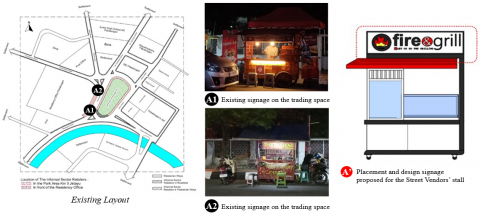
Clear and well-placed signage plays a crucial role in communicating directions, safety information, and vendor regulations in public spaces [52]. In Jetayu Park, signage mainly provides general information such as food and beverage menus and vendor names, which are displayed at the front of each stall (Figure 3). This setup allows customers to easily identify the type of merchandise offered and locate desired items [51]. For signage to be truly inclusive, it must be simple, essential, and easy to read, particularly for elderly users. Text should be large, shapes should be easily recognizable, and colors should enhance visibility [53]. To improve visibility further, it is recommended that signage be positioned on top of vendor carts and on adjacent street furniture (Figure 3, point A’).
The physical setup of vending facilities also influences the ease with which users can navigate the space. In Jetayu Park, most vendors use carts, tent carts, and mats to organize their stalls. Around 85% of traders near the former Government Office report that their current space is sufficient for both displaying goods and conducting business activities. However, 15% experience constraints due to crowding. Notably, 92% of vendors supplement their setup with additional furniture. This contributes to better merchandise presentation and helps attract customers, especially as these stalls remain visible from adjacent roads and walkways. The integration of signage and spatial arrangement reflects the application of the “size and space for approach and use” principle in inclusive design.
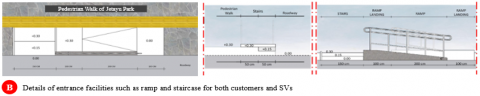
Ease of access is a crucial feature that connects SVs with other actors in public spaces. Jetayu Park has particular spaace characteristics which supports this feature, as vendors operate along sidewalks and roadside areas where they are easily visible and accessible to consumers. This level of accessibility illustrates a well-integrated relationship between SVs and the public environment. Widjajanti observes that the activities of SVs often intersect with visitors’ paths to main destinations, thereby enhancing the spatial feature of the area [34, 49]. According to the research findings, since vertical access is urgently required by both visitors and vendors to create an equitable space, Jetayu Park should be equipped with ramps alongside staircases. This strategy is emphasized by Burgstahler [54], who notes that when SV spaces cannot be located on the ground floor, accessible routes and vertical circulation must be provided. Although Jetayu Park includes access points and vertical circulation facilities, its reliance on stairs presents challenges for vendors transporting goods and for users accessing the area [55]. The inclusion of ramps in Jetayu Park responds to the intersecting circulation between visitors and buyers, as illustrated in Figure 4 point A.
The circulation path is strategically placed between vending areas and dining spaces to facilitate smooth movement and interaction between vendors and customers. This is supported by the dedicated alignment of ramps and staircases, which helps maintain pedestrian flow and enhances the intuitiveness of movement. Clear spatial segmentation between SVs, pedestrians, and other park users further reinforces this organization and accessibility (see Figure 4, point A’).
Figure 3. Design proposal for signage of SV stall in Jetayu Park
Figure 4. Design proposal of Jetayu Park circulation and accessibility
To improve accessibility for visually impaired users, guiding blocks should be installed at all park entrances, supporting the “intuitive” principle of inclusive design [52]. This approach is reinforced by the clear layout of SV zones, seating areas, greenery, and walkways, creating a safe and interactive space for both vendors and buyers during transactions (see Figure 4, point A’).
The circulation dimensions play an important role in creating a clear separation between standing and seated users [56]. The proposed design follows ergonomic principles, including proper stairs and ramps, adequate circulation widths, and the use of guiding blocks for visually impaired users [57]. At Jetayu Park, stairs and ramps are built according to these standards: stair risers measure 15-18cm in height with a minimum tread width of 30 cm, while ramps have a minimum width of 95cm and a maximum incline of 6 degrees (Figure 4 point B). Meanwhile, parking space availability is a key criterion for SVs in choosing space for their activities [48]. A statistically significant link (p=0.003) between parking availability and trading locations further strengthen the argument. Jetayu Park currently lacks officially licensed parking facilities for motorbikes and cars; instead, on-street parking is used along the surrounding streets. This is particularly significant given that most visitors and traders (90%) use motorbikes as their primary means of transportation to the area. The absence of legalized parking facilities may reduce convenience and accessibility for users, highlighting the need for inclusive infrastructure planning that supports both vendors and visitors.
Although general parking is available, there are no designated spaces for people with disabilities near Jetayu Park. Oktavia and Kusumadewi [51] stated that the principle of fair use in inclusive design should be applied to parking for disabled. This aligns with the Universal Design Guide for Public Places [53] that parking must be provided for vehicles driven by people with disabilities and for families needing more space for children in strollers or older people with mobility equipment. Almost all traders (90%) stated that no parking is available for people with disabilities around Jetayu Park and that only public parking is available for consumers and traders. Providing parking spaces for all types of vehicles, types of users, and types of activities is necessary (See Figure 5). Therefore, it is proposed that parking areas be located to the south of the former Government Office Building and to the north of Jetayu Park, along with a designated loading and unloading area for SVs using a lay-by concept, with the aim of minimizing disruption to traffic on the main road (See Figure 5, point A’ and B’). By implementing the Effective Principle in inclusive design enables users to perform activities more efficiently and sustainably, with minimal fatigue.
Figure 5. Vending facilities and the proposed parking allocation in Jetayu Park
According to the findings, various elements of Jetayu Park have a significant impact on SV operations. These findings at Jetayu Park specifically demonstrate how SVs select sites and facilities as supporting activities of recreational activities, in a specific context of Jetayu Park. Factors that must be considered when determining the quality of SV space include temporal and operational adaptability (A), Environmental Comfort (B), Strategic Location and Accessibility, Mobility and Safety (D), and Technical Consideration of Inclusive Design (E).
Both street vending and inclusive design are significant features of cities in the Global South. Therefore, developing design strategies for inclusive public spaces is essential, as the case of Jetayu Park may serve as a model for other countries with similar urban contexts. While inclusive design has gained attention in recent years, several studies still overlook the integration of SVs as part of inclusive user groups. For instance, French [5] discusses the creation of an inclusive playground that accommodates people from various socioeconomic backgrounds. Selanon et al. [13] focused on improving accessibility in outdoor spaces for people with disabilities. Shi et al. [14] highlighted the importance of community engagement to address diverse user needs, while Wu and Song [15] examined variations in park usage across different demographic groups, including vulnerable populations. However, none of these studies explicitly consider the spatial needs and inclusion of SVs in public space design.
In contrast, the literature on SVs has primarily focused on non-design aspects, such as policy innovations and relocation strategies aimed at integrating the informal sector [32]. Although these approaches may improve working conditions, they also risk reducing vendor income [58]. Other studies have examined how vendors and local communities independently manage their environments with relative effectiveness [32, 59, 60]. Some research has addressed the spatial needs of SVs, though such studies are mostly situated within informal settlement context rather than public open spaces [61]. Thorn et al. [59] emphasized the urgency of studying the optimal placement of SVs in urban green spaces to improve accessibility for both vendors and visitors. Their study also notes that vendors frequently choose parks to be near potential customers—such as children—while Rahayu et al. [46] found that roadsides and sidewalks remain the most selected vending locations. These findings suggest that SVs tend to occupy open spaces with few physical barriers, enabling easier physical and visual access for consumers [62, 63].
Jetayu Park, as the case study, has served as a center for community activities such as recreation, sports, and entertainment—even during the COVID-19 pandemic. The park accommodates both physical activities, like sports, and passive activities, including recreation, relaxation, and children's play. The analysis reveals that SV activity patterns tend to align with the timing and diversity of these community activities. In particular, vendors are drawn to areas with high pedestrian flow and diverse user groups, which they perceive as advantageous for attracting customers. These vending spaces often feature adaptable spatial arrangements that support both user mobility and flexible trade setups.
Table 2. Design strategies of inclusive public space for the context of Jetayu Park
|
Design Principles and Strategies |
Relation to Inclusive Design Principles |
|||||||
|
Equ. |
Fle. |
Int. |
Eff. |
Tol. |
Effi. |
App. |
||
|
A. |
Enhancing Temporal and Operational Adaptability |
|
|
|
|
|
|
|
|
|
|
$\sqrt{ }$ |
$\sqrt{ }$ |
|
|
|
|
|
|
|
|
|
$\sqrt{ }$ |
|
|
|
|
$\sqrt{ }$ |
|
B. |
Providing Environmental Comfort |
|
|
|
|
|
|
|
|
|
|
$\sqrt{ }$ |
|
|
|
$\sqrt{ }$ |
|
|
|
|
|
$\sqrt{ }$ |
$\sqrt{ }$ |
|
|
|
$\sqrt{ }$ |
|
|
C. |
Allocating Strategically Accessible Locations |
|
|
|
|
|
|
|
|
|
|
|
|
|
|
|
$\sqrt{ }$ |
|
|
|
|
$\sqrt{ }$ |
|
|
|
|
|
|
|
|
|
|
|
|
|
$\sqrt{ }$ |
|
|
|
D. |
Ensuring Mobility and Safety |
|
|
|
|
|
|
|
|
|
|
|
$\sqrt{ }$ |
|
|
|
|
$\sqrt{ }$ |
|
|
|
|
|
|
|
$\sqrt{ }$ |
$\sqrt{ }$ |
|
|
|
|
$\sqrt{ }$ |
$\sqrt{ }$ |
$\sqrt{ }$ |
|
|
$\sqrt{ }$ |
$\sqrt{ }$ |
|
E. |
Implementing Technical Consideration for Inclusive Design |
|
|
|
|
|
|
|
|
|
|
$\sqrt{ }$ |
|
|
|
|
$\sqrt{ }$ |
|
|
|
|
|
|
$\sqrt{ }$ |
$\sqrt{ }$ |
$\sqrt{ }$ |
|
|
|
|
|
$\sqrt{ }$ |
|
|
|
|
$\sqrt{ }$ |
|
|
|
|
$\sqrt{ }$ |
|
|
|
|
$\sqrt{ }$ |
|
|
|
|
|
|
|
$\sqrt{ }$ |
|
$\sqrt{ }$ |
|
Equ. = Equitable; Fle. = Flexible; Int. = Intuitive; Eff. = Effective; Tol. = Tolerant; Effi. = Efficient; App. = Appropriate
The SV activity spaces in Jetayu Park were found to be both shaded and well-lit, creating a comfortable environment for users. One aspect of this spatial character is the availability of vegetation, which not only supports environmental goals—such as moderating urban temperatures [59]—but also provides significant social benefits through ecosystem services [63]. The findings also indicate that for SVs to safely and comfortably operate in public spaces, these areas must be formally licensed and protected from vehicular hazards. This contributes to a broader sense of freedom and safety for all users [64]. The permanent nature of certain SV locations implies that vendors often operate from long-established sites, sometimes passed down through generations, resulting in a stable base of regular customers. These findings support the views of Rahayu et al. [46] and Riani et al. [47] who classify SV services into permanent, semi-permanent, and mobile categories. Recognizing these classifications is essential for incorporating SVs into placemaking strategies that promote flexible and inclusive park spaces.
This study proposes several key strategies for designing inclusive parks that accommodate street vendor (SV) activities as a means of promoting social inclusion. These strategies are outlined in Table 2, with specific design recommendations that can be applied in cities with contexts similar to Jetayu Park. The approach is grounded in inclusive design principles [9], which emphasize the following: (1) equitability, (2) flexibility, (3) intuitiveness, (4) effectiveness, (5) tolerance, (6) efficiency, and (7) appropriateness. The proposed strategies integrate SV transactions with recreational park activities, thereby reinforcing the inclusive function of public space. Overall, these findings contribute to strengthening the inclusive public space framework, particularly in Global South contexts. By addressing the spatial integration of SVs—an often-overlooked user group—this study underscores the need for inclusive design strategies that reflect the complexity and informality of everyday urban life.
In Global South cities, urban informality presents both challenges and opportunities for inclusive public space design. SVs, as integral yet often marginalized actors in urban life, are frequently excluded from formal planning frameworks. This study, through a case study of Jetayu Park in Pekalongan, Indonesia, demonstrates how inclusive design can spatially integrate SVs while enhancing multifunctionality and accessibility in public parks.
Using a mixed-method approach—comprising site observation, spatial analysis, and a structured questionnaire involving 54 SVs—this research identified the vendors’ spatial preferences and operational patterns. The findings highlight the significance of shaded, accessible, and flexible spaces near high pedestrian flows and diverse community activities. SVs also emphasized the importance of safety from vehicular hazards, clear spatial segmentation, and formal recognition through designated vending zones.
Based on these insights, the study proposes key strategies for designing inclusive parks that accommodate SV activities, grouped under five themes: (1) Enhancing Temporal and Operational Adaptability, (2) Providing Environmental Comfort, (3) Allocating Strategically Accessible Locations, (4) Ensuring Mobility and Safety, and (5) Implementing Technical Considerations for Inclusive Design. These strategies are grounded in inclusive design principles such as equity, flexibility, intuitiveness, and accessibility.
Given the focus of this study on the spatial integration of SVs and inclusive design principles within a specific case study, it is acknowledged that the review of existing literature remains limited in scope. Future research is encouraged to undertake a more comprehensive literature review that systematically explores the theoretical underpinnings and interdisciplinary dimensions of inclusive and universal design, particularly in the context of informal economies, accessibility in public spaces, and urban equity. This includes examining global best practices, regulatory frameworks, design evaluation methods, and participatory planning approaches that influence the spatial inclusion of marginalized subgroups, including SVs. Integrating insights from urban studies, sociology studies, and socio-spatial justice can enrich the conceptual framework and provide a stronger foundation for inclusive spatial planning. A more extensive review would also allow for critical comparisons across different urban typologies and cultural settings, thereby contributing to a more generalizable understanding of inclusive public space design.
We appreciate the work of Parandita, M. Ghozi Al-Ghifari, Pratamaningtyas, Hariditia, Firda Puspa Yustika, Alfian Sayyid Haqqi A, and Danu Wisundoro for their assistance in conducting the survey and compiling data.
This work was supported by the International Publication Research under Grant 225-28/UN7.D2/PP/IV/2023 Diponegoro University, Indonesia.
Retno Widjajanti: Writing-original draft, conceptualization, methodology, data curation, validation, formal analysis, investigation. Mirza Irwansyah: Supervision, formal analysis, conceptualization, methodology. Agung Sugiri: Writing and review. Wakhidah Kurniawati: Writing, review and editing, conceptualization, methodology, data curation, formal analysis. Atika Aditya: Writing, review and editing. Khansa Saffana: Software, visualization, resources. Aulia Ayu Kartika: Funding acquisition, investigation, project administration. Wardatut Toyyibah: Writing, review, and editing. Sabita Thifal Amani: Writing, review, and editing.
[1] Report of the Inter-Agency and Expert Group on Sustainable Development Goal Indicators (No. (E/CN.3/2016/2/Rev.1)). (2016). United Nation.
[2] Rahman, B., Noviani, A., Rosyadea, R. (2020). The effect of street vendors’ activities in city park on the functions of park as a public space. Journal of Physics: Conference Series, 1655(1): 012114. https://doi.org/10.1088/1742-6596/1655/1/012114
[3] Reyes-Riveros, R., Altamirano, A., De La Barrera, F., Rozas-Vásquez, D., Vieli, L., Meli, P. (2021). Linking public urban green spaces and human well-being: A systematic review. Urban Forestry & Urban Greening, 61: 127105. https://doi.org/10.1016/j.ufug.2021.127105
[4] Nordh, H., Østby, K. (2013). Pocket parks for people-A study of park design and use. Urban Forestry & Urban Greening, 12(1): 12-17. https://doi.org/10.1016/j.ufug.2012.11.003
[5] French, M. (2023). Inclusive park design for people of all housing statuses: Tools for restoring unhoused individuals’ rights in Public Parks. The Ralph and Goldy Lewis Center for Regional Policy Studies. https://escholarship.org/uc/item/1f1619sk.
[6] Goličnik, B., Ward Thompson, C. (2010). Emerging relationships between design and use of urban park spaces. Landscape and Urban Planning, 94(1): 38-53. https://doi.org/10.1016/j.landurbplan.2009.07.016
[7] El Khateeb, S., Shawket, I.M. (2022). A new perception; Generating well-being urban public spaces after the era of pandemics. Developments in the Built Environment, 9: 100065. https://doi.org/10.1016/j.dibe.2021.100065
[8] Landman, K. (2020). Inclusive public space: Rethinking practices of mitigation, adaptation and transformation. URBAN DESIGN International, 25(3): 211-214. https://doi.org/10.1057/s41289-020-00136-4
[9] Hanson, P.J. (2004). The inclusive city: Delivering a more accessible urban environment through inclusive design. OAI.
[10] Li, J., Sun, S., Li, J. (2021). The dawn of vulnerable groups: The inclusive reconstruction mode and strategies for urban villages in China. Habitat International, 110: 102347. https://doi.org/10.1016/j.habitatint.2021.102347
[11] Mazhambe, A. (2017). Assessment of the contribution of street vending to the Zimbabwe economy. A case of street vendors in Harare CBD. IOSR Journal of Business and Management (IOSR-JBM), 19(9): 91-100. https://doi.org/10.9790/487X-19090191100
[12] Liang, D., De Jong, M., Schraven, D., Wang, L. (2022). Mapping key features and dimensions of the inclusive city: A systematic bibliometric analysis and literature study. International Journal of Sustainable Development & World Ecology, 29(1): 60-79. https://doi.org/10.1080/13504509.2021.1911873
[13] Selanon, P., Puggioni, F., Dejnirattisai, S. (2024). An inclusive park design based on a research process: A case study of Thammasat Water Sport Center, Pathum Thani, Thailand. Buildings, 14(6): 1669. https://doi.org/10.3390/buildings14061669
[14] Shi, W., Mahdzar, S.S.S., Li, W. (2023). Park inclusive design index as a systematic evaluation framework to improve inclusive urban park uses: The case of Hangzhou urban parks. Applied Sciences, 13(23): 12954. https://doi.org/10.3390/app132312954
[15] Wu, K.C., Song, L.Y. (2017). A case for inclusive design: Analyzing the needs of those who frequent Taiwan’s urban parks. Applied Ergonomics, 58: 254-264. https://doi.org/10.1016/j.apergo.2016.06.015
[16] Chu, C. (2022). Planning for gender inclusion: Gender-inclusive planning and design recommendations for Los Angeles parks. The Ralph and Goldy Lewis Center for Regional Policy Studies. https://escholarship.org/uc/item/4ht60519.
[17] Saragih, V., Toyyibah, W., Kurniawan, A., Kusuma, H. (2024). Exploring the inclusivity of Jakarta’s child-friendly integrated public spaces (RPTRA) through qualitative analysis of Google map reviews. In IOP Conference Series: Earth and Environmental Science. IOP Publishing, 1394(1): 012025. https://doi.org/10.1088/1755-1315/1394/1/012025
[18] Governor Regulation of Provincial DKI Jakarta No. 10. (2015). The Governor of DKI Jakarta Province. https://jdih.jakarta.go.id/dokumen/detail/9188/peraturan-gubernur-nomor-10-tahun-2015-tentang-penataan-dan-pemberdayaan-pedagang-kaki-lima.
[19] Regulation of the Provincial DKI Jakarta No. 8. (2007). The Governor of DKI Jakarta Province. https://jdih.jakarta.go.id/dokumen/detail/13441.
[20] Surabaya City Regulation No. 17. (2003). The government of Surabaya City. https://jdih.surabaya.go.id/peraturan/260.
[21] Bogor City Regional Regulation no. 11. (2019). The Regional Government of Bogor. https://peraturan.bpk.go.id/Details/135504/perda-kota-bogor-no-11-tahun-2019.
[22] Surabaya City Regulation No. 9. (2014). The government of Surabaya City. https://peraturan.bpk.go.id/Details/23621.
[23] Bhowmik, S.K. (2005). Street vendors in Asia: A review. Economic and Political Weekly, 40(22/23): 2256-2264.
[24] Boonjubun, C. (2017). Conflicts over streets: The eviction of Bangkok street vendors. Cities, 70: 22-31. https://doi.org/10.1016/j.cities.2017.06.007
[25] Dovey, K. (2016). Urban design Thinking: A Conceptual Toolkit (First edition). Bloomsbury Academic, an Imprint of Bloomsbury Publishing Plc. https://doi.org/10.5040/9781474228503
[26] Peimani, N., Kamalipour, H. (2022). Informal street vending: A systematic review. Land, 11(6): 829. https://doi.org/10.3390/land11060829
[27] Yatmo, Y.A. (2008). Street vendors as ‘Out of Place’ urban elements. Journal of Urban Design, 13(3): 387-402. https://doi.org/10.1080/13574800802320889
[28] Xue, D., Huang, G. (2015). Informality and the state’s ambivalence in the regulation of street vending in transforming Guangzhou, China. Geoforum, 62: 156-165. https://doi.org/10.1016/j.geoforum.2015.04.012
[29] Hunt, S. (2009). Citizenship’s place: The state’s creation of public space and street vendors’ culture of informality in Bogotá, Colombia. Environment and Planning D: Society and Space, 27(2): 331-351. https://doi.org/10.1068/d1806
[30] Tran, H.A., Yip, N.M. (2020). Rhythm of endurance and contestation: Everyday practices of roaming vendors in Hanoi. Geoforum, 117: 259-267. https://doi.org/10.1016/j.geoforum.2020.10.011
[31] Tan ’G’-Ling, A., Aminuddin, A. (2019). How does street trading activities keep Chinatown in Kuala Lumpur a living cultural enclave? Journal of Design and Built Environment, 19(3): 42-52. https://doi.org/10.22452/jdbe.vol19no3.5
[32] Wijaya, A.F., Muhammad, F., Patriot, M.T., Novita, A.A. (2021). The implementation of street vendor relocation policy in the Pro-Environmental era in Mojokerto City Square. The Journal of Indonesia Sustainable Development Planning, 2(2): 145-159.
[33] Liu, X., Xie, Y., Sheng, H. (2023). Green waste characteristics and sustainable recycling options. Resources, Environment and Sustainability, 11: 100098. https://doi.org/10.1016/j.resenv.2022.100098
[34] Widjajanti, R. (2016). The space utilization by street vendors based on the location characteristics in the Education Area of Tembalang, Semarang. Procedia-Social and Behavioral Sciences, 227: 186-193. https://doi.org/10.1016/j.sbspro.2016.06.061
[35] Hermawati, R. (2017). The strategy of street vendors in facing local government policy. A case of street vendor in Bandung. Journal of Business and Economics Review (JBER), 2(1): 42-48. https://doi.org/10.35609/jber.2017.2.1(5)
[36] Saha, D. (2016). Informal Markets, Livelihood and Politics: Street Vendors in Urban India (1st ed.). Routledge India. https://doi.org/10.4324/9781315543086
[37] Nyabeze, K., Chikoko, W. (2021). Socio-economic impact of COVID-19 lockdown measures on the informal sector livelihoods in Zimbabwe. African Journal of Social Work, 11(4): 231-239. https://www.ajol.info/index.php/ajsw/article/view/215263.
[38] Tucker, J.L., Anantharaman, M. (2020). Informal work and sustainable cities: From formalization to reparation. One Earth, 3(3): 290-299. https://doi.org/10.1016/j.oneear.2020.08.012
[39] Ruzek, W. (2014). The informal economy as a catalyst for sustainability. Sustainability, 7(1): 23-34. https://doi.org/10.3390/su7010023
[40] Thanh, P.T., Duong, P.B. (2022). The COVID-19 pandemic and the livelihood of a vulnerable population: Evidence from women street vendors in urban Vietnam. Cities, 130: 103879. https://doi.org/10.1016/j.cities.2022.103879
[41] Chikazhe, L., Mashapure, R., Chavhunduka, D., Hamunakwadi, P. (2020). Socio-Economic implications of Covid19 pandemic to women entrepreneurs: A case of the informal sector in Zimbabwe. Business Management and Strategy, 12(1): 1. https://doi.org/10.5296/bms.v12i1.17911
[42] Unni, J. (2020). Impact of COVID-19 on Informal Economy: The revival. The Indian Journal of Labour Economics, 63(S1): 113-118. https://doi.org/10.1007/s41027-020-00265-y
[43] Yin, R.K. (2009). Case Study Research: Design and Method (4th ed.). SAGE Publications Ltd.
[44] Creswell, J.C. (2013). Qualitative Inquiry & Research Design: Choosing among Five Approaches (3rd ed.). SAGE Publications Ltd.
[45] Mitani, A.A., Mercaldo, N.D., Haneuse, S., Schildcrout, J.S. (2021). Survey design and analysis considerations when utilizing misclassified sampling strata. BMC Medical Research Methodology, 21: 1-13. https://doi.org/10.1186/s12874-021-01332-8
[46] Rahayu, M.J., Andini, I., Putri, R.A. (2016). Typology of urban hawker’s location preferences. Procedia-Social and Behavioral Sciences, 227: 239-246. https://doi.org/10.1016/j.sbspro.2016.06.067
[47] Riani, R.D., Situmorang, R., Supriatna, Y. (2021). Activity characteristics of street vendor in Royal Market area, Serang City. In IOP Conference Series: Earth and Environmental Science. IOP Publishing, 737(1): 012032. https://doi.org/10.1088/1755-1315/737/1/012032
[48] Widjajanti, R., Wahyono, H. (2018). Space livability of street vendors in Simpang Lima public space, Semarang. In IOP Conference Series: Earth and Environmental Science. IOP Publishing, 123(1): 012045. https://doi.org/10.1088/1755-1315/123/1/012045
[49] Widjajanti, R., Ristianti, N.S., Ardiati, H.H., Nooringsih, K. (2022). Spatial adaptive arrangement of street vendors to the COVID-19 pandemic in Simpang Lima, Semarang, Indonesia. International Journal of Built Environment and Sustainability, 9(2-2): 15-27. https://doi.org/10.11113/ijbes.v9.n2-2.1018
[50] Faruk, M., Ashraf, S.A., Ferdaus, M. (2018). An analysis of inclusiveness and accessibility of Cyclone Shelters, Bangladesh. Procedia Engineering, 212: 1099-1106. https://doi.org/10.1016/j.proeng.2018.01.142
[51] Oktavia, R.C., Kusumadewi, T. (2021). An integrated design concept of Lamongan inclusive street vendor community center. In Proceedings of the International Conference on Engineering, Technology and Social Science (ICONETOS 2020). Atlantis Press, Malang, East Java, Indonesia, pp. 332-344. https://doi.org/10.2991/assehr.k.210421.048
[52] Calori, C., Vanden-Eynden, D. (2015). Signage and Wayfinding Design: A Complete Guide to Creating Environmental Graphic Design Systems. John Wiley & Sons, Inc. https://doi.org/10.1002/9781119174615
[53] Universal Design Guide for Public Places. (2016). Building and construction authority of singapore. https://www1.bca.gov.sg/about-us/about-bca.
[54] Burgstahler, S. (2021). Universal design. https://www.researchgate.net/publication/349737141.
[55] Honiball, J., Burger, E., Burger, Y. (2024). Pedestrian connectivity: A focus on residential neighbourhood sidewalks to promote accessibility to public parks. Spatium, 51: 1-10. https://doi.org/10.2298/SPAT240401007H
[56] Smith, K.H., Preiser, W.F.E. (2011). Universal Design Handbook (2nd ed). McGraw-Hill.
[57] Neufert, E., Neufert, P. (2012). Architects’ Data (4th ed). Wiley-Blackwell.
[58] Donovan, M.G. (2008). Informal cities and the contestation of public space: The case of bogotá’s street vendors, 1988-2003. Urban Studies, 45(1): 29-51. https://doi.org/10.1177/0042098007085100
[59] Thorn, J.P.R., Maruza, T.C.G., Stoffberg, M. (2025). Climate justice and informal trader’s access to urban green spaces. Cities, 159: 105725. https://doi.org/10.1016/j.cities.2025.105725
[60] Dwijayanti, I., Nugroho, A.D. (2018). The image of manahan region. Journal of Architectural Research and Design Studies, 2(1): 26-36. https://doi.org/10.20885/jars.vol2.iss1.art4
[61] Thinh, N.K., Peimani, N., Kamalipour, H. (2025). Forms and spatiality of street vending in informal settlements: The case of in-between spaces in Hanoi. Cities, 161: 105870. https://doi.org/10.1016/j.cities.2025.105870
[62] Raubaba, H.S., Octavia, S., Simorangkir, Y.V. (2019). Timor street study as a center for sales of crocodile leather crafts in the City of Merauke based on the city design elements criteria. In IOP Conference Series: Earth and Environmental Science, 343(1): 012232. https://doi.org/10.1088/1755-1315/343/1/012232
[63] Rambhia, M., Volk, R., Rismanchi, B., Winter, S., Schultmann, F. (2024). Prioritizing urban green spaces in resource constrained scenarios. Resources, Environment and Sustainability, 16: 100150. https://doi.org/10.1016/j.resenv.2024.100150
[64] Mehta, V. (2014). Evaluating public space. Journal of Urban Design, 19(1): 53-88. https://doi.org/10.1080/13574809.2013.854698