Zaid Ibrahim Yousef Gharaibeh
© 2024 The author. This article is published by IIETA and is licensed under the CC BY 4.0 license (http://creativecommons.org/licenses/by/4.0/).
OPEN ACCESS
The study is aimed at better understanding modern aspects of criminal law ensuring sustainable development in the Middle East in the context of combating financial fraud. The process of combating financial fraud has been proven to be key to achieving sustainable development in the Middle East. Combating financial fraud is a key element of ensuring the region's sustainable development, as financial crime can seriously undermine economic sustainability and confidence in the financial system. An effective criminal law response to financial fraud helps protect investments, consumers and businesses, which is vital to maintaining a healthy economic climate. In addition, the fight against financial crime enhances law and order in society, which is the basis for sustainable social and economic development. In addition, the main manifestations of financial fraud in the Middle East were identified. The object of the study is the system of criminal legal support for sustainable development in the Middle East. The research methodology involves the use of modern analysis methods, in particular, Multi-Criteria Decision-Making (MCDM) Method methodology. Based on the results of the study, key types of financial fraud affecting the criminal legal system for sustainable development in the Middle East were identified. The study is limited by the fact that a limited number of types of financial fraud were selected during the analysis process. In future studies, it is planned to expand the number of types of monetary fraud to analyze their effects for ensuring sustainable development.
sustainable development, law, legislative norms, Middle East, sustainability, criminal law
The modern criminal law system plays a key role in ensuring sustainable, uninterrupted sustainable development. Primarily we are talking about monitoring compliance with laws and punishing violations of laws related to environmental protection, rational use of resources, protection of human rights, social and economic justice. With a high level of efficiency of this system, an environment with a low crime rate is formed in the region, and the fairness of this system contributes to economic and social growth, which are fundamental elements of the modern paradigm of sustainable development. The criminal law system is aimed at ensuring the protection of the most vulnerable groups of the population, guaranteeing through its activities the observance of parity rights in the distribution of social, economic and other benefits. At the same time, if the criminal legal system is ineffective, corrupt or unfair, its implementation can become a significant impediment, causing environmental and environmental conditions to deteriorate and social and economic inequality to prevail in society. Such a system will not only be damaging in the present, but will also undermine the prospects for a sustainable and prosperous future.
At the present stage of development of world economic and social processes, ensuring sustainable development in Middle East is of particular importance. One of the key aspects of this is the effectiveness of criminal law mechanisms, in particular in the context of combating financial fraud. The importance of criminal law regulation lies not only in protecting the economic interests of citizens and businesses, but also in stabilizing the overall financial system. The lack of effective legislative and law enforcement mechanisms can lead to an increase in financial fraud, which in turn undermines confidence in the financial system and threatens the economic security of the region.
Financial fraud poses a serious threat to sustainable development. It not only harms individual investors and companies, but also has a profound impact on the economy as a whole. This creates barriers to investment, reduces trust in financial institutions, leads to a loss of public resources and generally harms economic growth.
Therefore, the relevance of the topic of criminal law ensuring sustainable development in the context of combating financial fraud is undeniable. The problem of financial fraud includes a wide range of issues - from the imperfection of legislative norms to problems in their implementation and application. This requires a comprehensive analysis and development of comprehensive approaches to improving the criminal legal system in order to strengthen law and order.
An important aspect is also international experience in this field, which can provide valuable ideas and solutions to the local context. Analysis of successful practices of other countries, their legislation and enforcement activities in the field of combating financial crimes can become a key element in the formation of effective strategies to combat financial fraud.
The Middle East is a region of significant geopolitical importance and complexity, which often impacts its economic policies and legal structures. Legal support for sustainable development can help stabilize the region by reducing the vulnerability of its financial systems to misuse and corruption, which in turn can alleviate some of the tensions that arise from economic disparities and the misallocation of resources. Effective criminal law enforcement against financial fraud strengthens governance and the rule of law by demonstrating a commitment to justice and ethical economic practices. This, in turn, fosters a more stable legal and regulatory environment, encouraging further investment and development. For sustainable development, strong governance is essential as it ensures that development gains are not eroded by corruption or malfeasance.
The importance of this issue at the regional level cannot be overestimated, because regions often have unique economic conditions and specific challenges in the field of financial security. Effective criminal legal regulation in the field of combating financial fraud at the regional level can significantly enhance economic stability, create a favorable environment for business and attract investment. In addition, a regional approach allows for greater sensitivity to local characteristics and needs, resulting in more effective solutions to financial crime problems. This approach may include the development of specific regulations, the formation of local law enforcement agencies with specialization in the field of financial crimes, and the creation of effective mechanisms for interdepartmental interaction. Such an integrated approach provides greater efficiency in the fight against financial crimes, taking into account the specifics and needs of a particular region.
Thus, the study of this topic has not only academic, but also practical weight, since it can contribute to the development of recommendations for improving the legislative framework and the practice of its application, which is extremely important for ensuring stability and progress in the Middle East.
The study is aimed at better understanding modern aspects of criminal law ensuring sustainable development in the Middle East in the context of combating financial fraud. The process of combating financial fraud has been proven to be key to achieving sustainable development in the Middle East.
Developing the issue of criminal legal support for sustainable development in the Middle East in the context of combating financial fraud is impossible without researching modern sources, which is key to understanding and improving methods of combating financial crimes. Due to the constantly evolving nature of financial fraud, especially in the context of globalization and digitalization, contemporary research provides important insights into the effectiveness of existing criminal legal mechanisms and reveals new opportunities for their improvement. Analysis of current literature allows not only to identify new challenges and trends in the field of financial fraud, but also to develop comprehensive approaches to counter them, which ultimately contributes to the sustainable development in Middle East.
Kryshtanovych et al [1]. delve into the methodical approaches to countering threats to economic security, particularly in the protection of national interests. Their work provides a comprehensive framework for understanding how systemic economic threats can be addressed through targeted legal mechanisms, which is crucial for crafting effective legal strategies against financial fraud. The authors emphasize the integration of national security concerns with economic policies, which offers valuable insights for structuring criminal law to support sustainable development through stability in financial systems.
In the work of Rushchyshyn et al. [2] the focus is on the regulatory and legal components essential for ensuring a state’s financial security. Their research underlines the importance of robust legal frameworks in safeguarding against economic crises and financial crimes, including fraud. This article is particularly relevant as it explores the effectiveness of current legislative measures and highlights areas where additional legal provisions could fortify defenses against financial misconduct. Their findings suggest that a dynamic regulatory approach, capable of adapting to evolving financial fraud tactics, is crucial for maintaining economic integrity and by extension, sustainable development. Hammouri [3] addresses the socio-economic aspects of criminal law security in Jordan, offering a regional perspective on how justice systems can influence economic stability and development. By analyzing the effectiveness of criminal law in mitigating financial crimes, Hammouri’s study sheds light on the broader socio-economic impacts that such legal frameworks can have. His findings suggest that a well-calibrated criminal law system not only deters financial fraud but also strengthens societal trust in the legal and economic systems, thereby promoting a stable environment conducive to sustainable development.
Thus, a study by Anderson et al. [4] focuses on developing a systemic model of the impact of sustainable development goals. This is important for understanding the relationships between different sustainable development goals and their impact on economic security. Similar is the study of Rosati and Faria [5], exploring the contribution of business to sustainability strategy, in particular the early adoption of reporting on the Sustainable Development Goals. This study highlights the role of the private sector in combating financial fraud [4, 5].
Zager et al. [6] analyze the role and responsibility of auditors in preventing and detecting financial fraud. This study highlights the importance of auditing within the criminal justice framework for sustainable development. In turn, Baesu and Bejinaru [7] focus on knowledge management strategies for leadership in the digital business environment. The importance of this research is that it points to the need to adapt criminal legal systems to the new challenges of the digital economy [6, 7].
Ching-Chiang et al. [8] propose a hybrid model for detecting financial fraud using fuzzy set theory and machine learning techniques. This research is important for developing effective methods for detecting financial fraud. Vian et al. [9] examined multistakeholder initiatives that promote transparency, accountability, and access, particularly in the context of physician transparency. This study is important for understanding the role of different stakeholders in combating financial fraud [8, 9].
An interesting study by Sylkin et al. [10]. It focuses on analyzing the financial stability and safety of engineering enterprises, which is a key aspect in the context of crisis management. This research provides important guidance on how financial security can be assessed and improved across different sectors, which has a direct impact on the effectiveness of criminal enforcement measures against financial fraud. A similar study by Saha and Sen [11]. This study examines the relationship between corruption and economic growth and the influence of political regimes on this relationship [10, 11].
In his work, Goncharenko and Sybachin [12], consider the digitalization of the national economy. This research is important and relevant as digitalization can impact financial fraud management practices, including the use of emerging technologies to detect and prevent fraud.
A number of authors resort to modeling when it comes to combating financial fraud. Yes, Jan [13] presented a model for detecting financial fraud in financial statements that is important for the sustainable development of financial markets using Taiwan as a case study. This model can be used to complement the criminal law mechanisms discussed in your study to improve the effectiveness of combating financial fraud. While Bracci et al. [14] examined risk management and control systems in the public sector.
Despite significant modern research, the issue of combating financial fraud in the context of criminal law ensuring sustainable development in the Middle East remains insufficiently studied and requires further improvement. Although existing research provides a valuable overview of tools and approaches to combat this phenomenon, it also reveals gaps in knowledge and practical application. This is especially important given the constant evolution of financial fraud techniques and the dynamic nature of the global economic environment. Thus, there is an urgent need for further research and development of more effective and adaptive criminal legal mechanisms to ensure sustainable development in Middle East.
Multi-Criteria Decision-Making hierarchical (MCDM) methodology is a powerful tool for decision making in complex situations where multiple criteria and alternatives must be considered. This methodology involves breaking down a problem into a hierarchy consisting of objectives, criteria, sub-criteria and alternatives. It allows you to systematize and quantify the influence of various factors on the final decision, ensuring objectivity and clarity of the decision-making process.
To analyze the current criminal justice system in the Middle East, in particular in the fight against financial fraud, we will use MCDM, which will be used to evaluate different strategies and approaches. The implementation of this methodology will allow us to evaluate various types of legislative changes, technical tools and methods of the executive branch and their degree of effectiveness in combating financial crime.
A key aspect of MCDM is the ability to perform aggregation and parallel analysis of expert opinions. In the criminal law system, this is especially important, since it makes it possible to analyze different points of view, highlight their essence and differences among specialists in various fields. In our case, these will be specialists from law enforcement agencies, financial services, justice and scientists in this field. Such a significant advantage allows us to form a comprehensive understanding of the problem and, based on this, determine the most effective ways to solve it.
However, MCDM has a number of disadvantages that will not have a significant impact on the research, but listing them is an important element in the argumentation of the chosen methodology. Yes, this process is lengthy in terms of time. In addition, the quality of the final results largely depends on the accuracy and impartiality of the expert opinion, which leads to the careful selection of experts or specialists, as well as a sufficient level of their professionalism and experience.
But, despite these shortcomings, MCDM has significant advantages in the context of the issue of analysis and planning of criminal law, in particular in the fight against financial fraud. It makes it possible to carry out detailed structuring and quantify the complex relationships between various aspects of the problem being studied, which will become a factor in the formation of effective strategies and action plans. The practical use of MCDM can be useful for the activities of law enforcement agencies and legislators, in the context of developing a coordinated action plan that will take into account all aspects and problem areas, ensuring a prompt and effective response to the facts of financial crimes in the system of sustainable development.
As part of our research, we used the expert survey method, which is a key tool for collecting qualified opinions and assessments of specialists in the field of financial law and economic security. This approach allowed us to gain a deeper understanding of the different aspects of the impact of financial fraud on the sustainable development of the region. The expert survey helped identify key types of financial fraud, assess their impact and identify priorities for further legal and policy action. This provides a more objective and comprehensive approach to analyzing the complex phenomenon of financial fraud and its implications for regional development.
The criteria for the MCDM were defined through a combination of literature review and preliminary expert consultations. This ensured that the criteria are both comprehensive and relevant to the specific context of the Middle East. These criteria encompass various dimensions of the legal system, including legislative robustness, enforcement capabilities, coordination among financial regulatory bodies, and public awareness and trust in the legal measures. For the selection of experts, the Delphi method was employed to enhance the robustness and credibility of the MCDM analysis. The Delphi method is particularly effective in achieving a reliable consensus on complex issues through a series of structured interactions.
The Multi-Criteria Decision-Making hierarchical method may suffer from subjective evaluations, especially when the importance of criteria is determined based on expert opinions, which can lead to heterogeneity in evaluations. It can also be labor intensive and require a significant amount of data to accurately analyze. Expert analysis also faces problems of subjectivity, as well as the risk of excessive expert bias. In addition, involving a large number of experts may lead to difficulties in achieving consensus and require additional resources to coordinate their interaction.
In addition, to better objectify the research process, we chose a specific region – Middle East. The reason for choosing this region is that the authors have already formed research communications with scientists and specialists in the field of combating financial fraud.
The criminal law system has a direct and significant impact on the processes and pace of sustainable development, in the context of the formation of a system of law enforcement aimed at ensuring social equality, the protection of environmental norms and standards, and economic development. At the same time, the implementation of a robust and effective criminal justice system will constrain activity, which may negatively impact the pace of sustainable development. This concerns the issue of corruption, which can take away key resources for sustainable development projects, as well as environmental crimes, which will have a direct destructive impact on the state of ecosystems and natural resources. In this regard, an important task of the criminal law system is the formation of mechanisms of transparency and publicity. In addition, this legal system plays an important role in protecting human rights, ensuring economic development and social guarantees. In general, the existence of an effective, transparent and accountable criminal justice system plays a key role for all processes in society, especially in the context of sustainable development, since its progress directly depends on the transparency of government institutions, as well as the economic and social development of society.
Due to the importance of ensuring sustainable development in the Middle East, improving criminal protection against financial crimes becomes a key task. Financial fraud, which often leads to serious economic and social losses, is one of the main threats in this context. To effectively combat this phenomenon and improve the effectiveness of legal mechanisms, it is necessary to deeply understand its key aspects. In this direction, using the expert survey method, we identified five main types of financial fraud that have the greatest impact on the sustainable development of the Middle East.
Next, we use Multi-Criteria Decision-Making hierarchical method and paire directical matrix to determine the impact of each of these types of fraud. This approach allows us to objectively assess and rank types of fraud with their potential impact on sustainable development. Through a systematic and structured analysis, using criteria defined on the basis of expert opinions, we seek to identify the most significant areas for improving the region's legal and regulatory framework in the context of combating financial fraud.
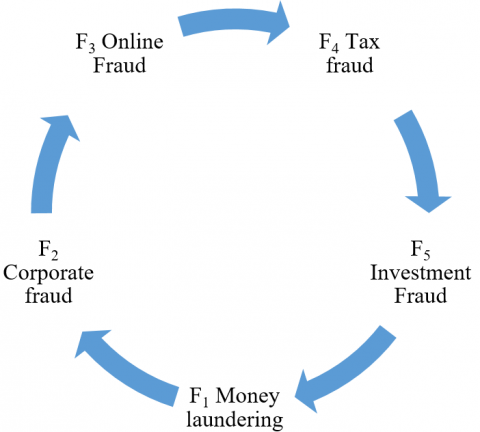
Thus, through the method of expert analysis, we identified five key types of financial fraud that have the greatest impact on the sustainable development of the Middle East under study. For convenience, each type of financial fraud has been designated with a symbolic meaning (Figure 1).
So, having defined the key criteria of our methodology, the first step is to conduct an even comparison of the criteria according to their importance by purpose. Each criterion is compared with each others and based on these comparisons a paire directical matrix formed.
So, we have this scale for assessment, where:
- 1 means that both elements have equal importance;
- 10 means that one element is much more important than the other.
The even comparison matrix in the hierarchical analysis method is constructed based on scores representing the relative importance of one element compared to another. The formula for each element $F_{i j}$ of the even comparison matrix is as follows:
$F_{i j}$ = how many times element $i$ is more important than element $j$
where:
•$F_{i j}$ – matrix element in row i and column j,
•$i$ and $j$ are indices representing the elements being compared.
This formula is used to populate the entire matrix, creating a square symmetrical matrix where each element represents the relative importance of one criterion compared to another (Figure 2).
Figure 1. The main types of financial fraud that have the greatest impact on the sustainable development of the Middle East
Figure 2. Paire directical matrix
The next step will be the formation of a unitized matrix and calculation of the eigenvector.
Thus, the formation of the matrix will occur according to the formula, where each element of the matrix $F_{i j}$ is divided by the sum of its column (1):
$S E_{i j}=F i j / \sum_{k-1}^n F_{k j}$ (1)
where, $S E_{i j}$ is a unitized indicator for normalizing values. In accordance with this formula, we created a unitized matrix (Table 1).
Table 1. Unitized matrix for F1
|
|
F1 |
F2 |
F3 |
F4 |
F5 |
|
F1 |
0.438 |
0.490 |
0.439 |
0.381 |
0.333 |
Now the same for others types of financial fraud that have the greatest impact on the sustainable development of the Middle East (Tables 2-5).
Table 2. Unitized matrix for F2
|
|
F1 |
F2 |
F3 |
F4 |
F5 |
|
F2 |
0.219 |
0.245 |
0.293 |
0.286 |
0.267 |
Table 3. Unitized matrix for F3
|
|
F1 |
F2 |
F3 |
F4 |
F5 |
|
F3 |
0.146 |
0.122 |
0.146 |
0.190 |
0.200 |
Table 4. Unitized matrix for F4
|
|
F1 |
F2 |
F3 |
F4 |
F5 |
|
F4 |
0.109 |
0.082 |
0.073 |
0.095 |
0.133 |
Table 5. Unitized matrix for F5
|
|
F1 |
F2 |
F3 |
F4 |
F5 |
|
F5 |
0.088 |
0.061 |
0.049 |
0.048 |
0.067 |
Based on the data in the unitized matrix, we define an eigenvector (priority vector), which is a direct result of standardization of the paire directical matrix, and plays a key role in determining the relative importance of criteria in the MCDM method. Below is the formula for determining the eigen(priority vector) (2):
$\vartheta_i=1 / n * \sum_j^n S E_{i j}$ (2)
$\vartheta_i$ - is direct of the $i$-th criterion.
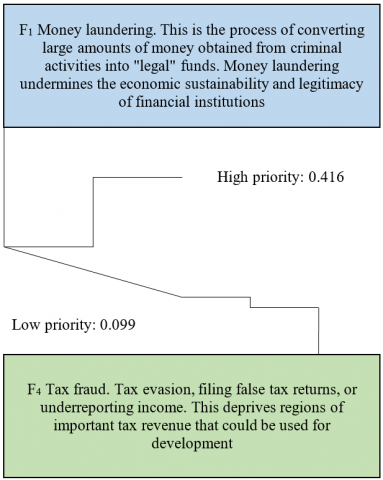
The results of the calculation of the priority vector are shown in Figure 3.
The next step in this methodology is to check consistency. Consistency testing in the analysis hierarchical (MCDM) method is important to ensure the reliability and objectivity of the estimates made in the even comparison process. The first element of this step will be the calculation of the maximum eigenvalue ($\lambda$max). This is done by multiplying the even comparison matrix by the eigenvector and then dividing the resulting values by the eigenvector. The arithmetic mean of these values is $\lambda$max (3).
$\lambda_{\max }=1 / n \sum_{i-1}^n \frac{(F \times \text { Priority vector })}{\text { Priority vector }}$ (3)
As a result of the calculations, the maximum eigenvalue ($\lambda]$max) for each criterion is the same and equal to 5.068. This value will be used to calculate the Coherence Index (HI) and Coherence Ratio (HR). Since λmax is the same for all criteria, this confirms consistency in our estimates in the paire directical matrix (Table 6).
Figure 3. Priority weights results
Table 6. Completing the coherence task
|
HI |
HR |
|
λmax-n/(n-1) |
HI/RI |
|
0.017 |
0.015 |
With these results, we can confidently use the resulting eigenvectors to assess the importance of different types of financial fraud in the context of our study.
As a result of the study, using the Multi-Criteria Decision-Making hierarchical method, we established a specific ranking of types of financial fraud according to their impact on the sustainable development of the region. Based on the analysis and calculation of weighting coefficients for each criterion, it was determined that money laundering is the most significant and influential – 0.416. This type of fraud received the highest weight in our analysis, indicating its critical impact on the economic stability and development of the region. Further rankings include corporate fraud, internet fraud, tax fraud and investment fraud according to their specific weightings. These results provide valuable information for the development of targeted strategies and policies in the fight against financial crime to support sustainable development in the Middle East.
By identifying the impacts of different types of financial fraud, sustainability authorities in the Middle East are able to significantly better organize their activities and effectively counter these threats. Understanding that money laundering has the greatest impact allows resources and attention to be focused on the most critical aspects of the problem. It also encourages more targeted strategies and policies that can target specific aspects and mechanisms of money laundering. This approach not only improves the effectiveness of the fight against financial crime, but also ensures more efficient use of resources, helping to strengthen economic resilience and sustainable development in the Middle East.
Beyond money laundering, policy should also address other prevalent types of financial fraud identified in the study, such as embezzlement, identity theft, and fraudulent investment schemes. Strengthening digital security measures is vital, given the increasing reliance on digital platforms for financial transactions. Policies should promote the adoption of advanced cybersecurity technologies, rigorous audits, and fraud detection systems by financial institutions. Moreover, creating public awareness campaigns to educate citizens and businesses about the risks of financial fraud and the best practices to avoid them can further mitigate the prevalence of these crimes. A comprehensive approach involving legislative actions, technological upgrades, and public education will provide a multi-faceted defense against financial fraud, thereby supporting sustainable economic development in the Middle East.
Thus, our research makes a significant contribution to understanding and combating financial fraud, which is key to the sustainable development of the region. The use of the hierarchical alignment method to identify key types of financial fraud allows the study to focus on the most critical aspects of this problem, which differs from the general approaches in similar works. This method provides a deeper dive into the specifics of financial crimes, and also provides a more detailed picture of the impact of these crimes on sustainable development. To confirm the effectiveness of the results obtained, we compare our study with existing ones.
Ruggiero [15] examines the relationship between sustainability and financial crime, analyzing how financial crime can impact sustainable development. While our study complements this by offering specific analysis of the types of financial fraud that most impact sustainable development in a regional context.
Curti and Mihov [16] and Bardal et al. [17] examine recovery from financial fraud and the quality of national governance. Our study extends this perspective by using a top-down approach to identify how specific types of financial fraud may impact sustainable development.
In studies by Sun et al. [18] and Fatimah et al. [19] focus on improving municipal economic security management systems. While our work adds insight into how criminal enforcement can enhance economic security by addressing financial fraud.
In a study by Gupta and Kumar [20] and Berrone et al. [21] examines the issue of personal identity theft as a gateway to greater financial crime. It highlights the need to focus on this aspect as a key component in the fight against financial fraud. Our study makes a valuable contribution by providing a systematic analysis of different types of financial fraud, including identity theft, and their impact on regional sustainable development.
While Dolynska [22] discusses the evolution of legal regulation concerning digitalization in notarial activities, and Alazzam et al. [23] explored information models for e-commerce platforms, the focus on legal responses to financial fraud in the Middle East offers a more specialized investigation into criminal law as a tool for sustainable economic stability. Unlike these studies that look at digitalization broadly, the article in question zeroes in on criminal justice responses to specific illegal activities undermining economic structures.
Kronivets et al. [24] and Yesimov and Borovikova [25] address legal frameworks in educational processes and business rights, respectively. These areas, while crucial, differ from the direct impact of criminal law on economic sustainability as explored in the primary article. The Middle East-focused study directly links criminal legal structures with the broader economic and social stability of the region, which is less emphasized in the comparative references.
Shakhatreh et al. [26] and Kopytko and Sylkin [27] examined corruption and homeland security within legal frameworks, but their focus on administrative corruption and land relations security does not delve into the specific challenges of financial fraud as a barrier to sustainable development. The primary article's examination of financial fraud, particularly money laundering, provides a focused insight into a key area that is both a symptom and a facilitator of broader systemic issues. Alazzam and Alshunnaq [28] discuss the development of creative thinking among lawyers, which, while important for evolving legal practices, does not address the practical application of legal principles in combating economic crimes as the primary article does.
A study by Pradhan et al. [29] focuses on the relationship between ICT infrastructure and economic growth. Our research extends this perspective by demonstrating how ICT can be used not only to promote economic growth, but also to improve the effectiveness of criminal law enforcement against financial fraud. Similar is Hanna [30]'s study exploring the role of the state in the digital age. This study focuses on the need for active government participation in policy formation and regulation in the digital sphere. Our research makes an important contribution to understanding how criminal law mechanisms can be adapted and used to protect financial stability and support sustainable development in a rapidly changing digital world.
Thus, our study has significant relevance and importance in the scientific context. It opens up new perspectives in understanding the role of criminal law in ensuring sustainable development in Middle East, in particular, in the context of combating financial fraud. In today's world, where financial crimes are becoming more complex and varied, your research highlights the need for criminal legal systems to adapt to these challenges. This makes our work an important contribution to the scientific debate, as well as a practical tool for improving criminal law policies in this area.
Modern interaction between the criminal law system and sustainable development processes is multi-vector and complex. This is explained by the fact that the system of ensuring compliance with laws, including in areas that relate to and determine the pace of sustainable development, largely determines this complex process and acts as an enabling factor. Implementing an effective criminal justice system can minimize crime rates, resulting in increased levels of environmental sustainability and natural resource management. In addition, the effective implementation of the criminal law system will stimulate the development of economic and social equality, as well as increase the level of trust in justice, law enforcement and public authorities. Such a transparent and democratic environment will stimulate new investments and innovations in the field of sustainable development. But at the same time, ensuring a high level of efficiency of the criminal justice system requires cooperation between law enforcement agencies and the legislative branch, as well as the use of modern methods for developing strategies and measures in this area.
The relevance of research and improvement of criminal legal support for sustainable development in the Middle East, especially in the context of combating financial fraud, is extremely important in modern conditions. This is due to several key factors. First, the growing integration of world economies and the expansion of international trade are increasing the opportunities for transnational financial crime, requiring each region to be especially vigilant and prepared for such challenges. Secondly, the rapid development of technology, in particular in the financial sector, although it contributes to the increased efficiency and convenience of financial transactions, it also opens up new avenues for fraudsters and attackers.
Given these challenges, the need to improve criminal law in the Middle East takes on special weight. Effective legislation and reliable law enforcement mechanisms are the foundation for protecting the economic interests of both individuals and businesses. They help create an environment in which financial fraudsters cannot easily operate, thereby reducing the risk of economic loss and increasing everyone's confidence in the Middle East's financial system.
Increasing public awareness and education regarding financial security is also important. Informed citizens who can recognize and respond to potential threats are an important element in the financial fraud response chain. In addition, cooperation between government agencies, the private sector and international institutions is important in exchanging information and developing common strategies to combat financial crime.
In the context of these challenges, research and improvement of criminal law enforcement of sustainable development in the Middle East is not only relevant, but also necessary to ensure economic stability and security at the local and global levels. It allows you to identify weaknesses in the legal system, develop and implement the necessary measures to eliminate them, thereby creating a solid foundation for the sustainable development of the region.
Based on the results of the study, key types of financial fraud affecting the criminal legal system for sustainable development in the Middle East were identified. The study is limited by the fact that a limited number of types of financial fraud were selected during the analysis process. In future studies, it is planned to expand the number of types of monetary fraud to analyze their effects.
[1] Kryshtanovych, M., Ortynskyi, V., Krasivskyу O., Maziy, N., Pasichnyk, V. (2021). Methodical approach to countering threats of economic security in the context of ensuring the protection of national interests. Financial and Credit Activity: Problems of Theory and Practice, 4(39): 202-208. https://doi.org/10.18371/.v4i39.241309
[2] Rushchyshyn, N., Medynska, T., Nikonenko, U., Kostak, Z., Ivanova, R. (2021). Regulatory and legal component in ensuring state’s financial security. Business: Theory and Practice, 22(2): 232-240. https://doi.org/10.3846/btp.2021.13580
[3] Hammouri, J.A.A. (2023). Socio-economic aspects of measuring the security of criminal law in the context of ensuring justice in Jordan. Financial and Credit Activity Problems of Theory and Practice, 3(50): 419-431. https://doi.org/10.55643/fcaptp.3.50.2023.4077
[4] Anderson, C.C., Denich, M., Warchold, A., Kropp, J.P., Pradhan, P. (2022). A systems model of SDG target influence on the 2030 Agenda for Sustainable Development. Sustainability Science, 17(4): 1459-1472. https://doi.org/10.1007/s11625-021-01040-8
[5] Rosati, F., Faria, L.G.D. (2019). Business contribution to the Sustainable Development Agenda: Organizational factors related to early adoption of SDG reporting. Corporate Social Responsibility and Environmental Management, 26(3): 588-597. https://doi.org/https://doi.org/10.1002/csr.1705
[6] Zager, L., Malis, S.S., Novak, A. (2016). The role and responsibility of auditors in prevention and detection of fraudulent financial reporting. Procedia Economics and Finance, 39: 693-700. https://doi.org/10.1016/S2212-5671(16)30291-X
[7] Baesu, C., Bejinaru, R. (2020). Knowledge management strategies for leadership in the digital business environment. In Proceedings of the International Conference on Business Excellence, 14: 646-656. https://doi.org/10.2478/picbe-2020-0061
[8] Ching-Chiang, Y., Der-Jang, C., Tzu-Yu, L., Sheng-Hsiung, C. (2016). A hybrid detecting fraudulent financial statements model using rough set theory and support vector machines. Cybernetics and Systems, 47(4): 261-276. https://doi.org/10.1080/01969722.2016.1158553
[9] Vian, T., Kohler, J.C., Forte, G. et al. (2017). Promoting transparency, accountability, and access through a multi-stakeholder initiative: Lessons from the medicines transparency alliance. Journal of Pharmaceutical Policy and Practice, 10: 18. https://doi.org/10.1186/s40545-017-0106-x
[10] Sylkin, O., Shtangret, A., Ogirko, O., Melnikov, A. (2018). Assessing the financial security of the engineering enterprises as preconditions of application of anti-crisis management: Practical aspect. Business and Economic Horizons, 14(4): 926-940. https://doi.org/10.15208/beh.2018.63
[11] Saha, S., Sen, K. (2021). The corruption-growth relationship: does the political regime matter? Journal of Institutional Economics, 17(2): 243-266. https://doi.org/10.1017/S1744137420000375
[12] Goncharenko L., Sybachin S. (2019). Digitalization of national economy. Vestnik Universiteta, 8: 32-38. https://doi.org/10.26425/1816-4277-2019-8-32-38
[13] Jan, C. (2018). An effective financial statements fraud detection model for the sustainable development of financial markets: Evidence from Taiwan. Sustainability, 10(2): 513. https://doi.org/10.3390/su10020513
[14] Bracci, E., Mouhcine, T., Rana, T., Wickramasinghe, D. (2022). Risk management and management accounting control systems in public sector organizations: A systematic literature review, Public Money & Management, 42(6): 395-402. https://doi.org/10.1080/09540962.2021.1963071
[15] Ruggiero, V. (2022) Sustainability and financial crime. International Criminology, 2: 143-151. https://doi.org/10.1007/s43576-022-00052-3
[16] Curti, F., Mihov, A. (2018). Fraud recovery and the quality of country governance. Journal of Banking & Finance, 87: 446-461. https://doi.org/10.1016/j.jbankfin.2017.11.009
[17] Bardal, K.G., Reinar, M.B., Lundberg, A.K., Bjørkan, M. (2021). Factors facilitating the implementation of the sustainable development goals in regional and local planning—Experiences from Norway. Sustainability, 13: 4282. https://doi.org/10.3390/su13084282
[18] Sun, P., Vorona-Slivinskaya, L., Voskresenskaya, E. (2017). Improvement of economic security management system of municipalities with account of transportation system development: Methods of assessment. IOP Conference Series: Earth and Environmental Science, 90: 012073. https://doi.org/10.1088/1755-1315/90/1/012073
[19] Fatimah, Y.A., Govindan, K., Murniningsih, R., Setiawan, A. (2020). Industry 4.0 based sustainable circular economy approach for smart waste management system to achieve sustainable development goals: A case study of Indonesia. Journal of Cleaner Production, 269: 122263. http://doi.org/10.1016/j.jclepro.2020.122263
[20] Gupta, C.M., Kumar, D. (2020). Identity theft: A small step towards big financial crimes. Journal of Financial Crime, 27(3): 897-910. https://doi.org/10.1108/JFC-01-2020-0014
[21] Berrone, P., Rousseau, H.E., Ricart, J.E., Brito, E., Giuliodori, A. (2023). How can research contribute to the implementation of sustainable development goals? An interpretive review of SDG literature in management. International Journal of Management Reviews, 25(2): 318-339. https://doi.org/https://doi.org/10.1111/ijmr.12331
[22] Dolynska, M. (2023). Evolution of legal regulation of digitalization of notarial activity. Social and Legal Studios, 6(4): 58-68. https://doi.org/10.32518/sals4.2023.58
[23] Alazzam, F.A.F., Shakhatreh, H.J.M., Gharaibeh, Z.I.Y., Didiuk, I., Sylkin, O. (2023). Developing an information model for E-Commerce platforms: A study on modern socio-economic systems in the context of global digitalization and legal compliance. Ingénierie des Systèmes d’Information, 28(4): 969-974. https://doi.org/10.18280/isi.280417
[24] Kronivets, T., Yakovenko, O., Tymoshenko, Y., Ilnytskyi, M., Lasechko, S., Lasechko, M. (2023). The legal foundations for the utilization of artificial intelligence in educational processes. Relocoes Internacionais no Mundo Atual, 4(42): 686-702.
[25] Yesimov, S., Borovikova, V. (2022). Administrative and legal implementation of the rights of business entities. Social and Legal Studios, 5(3): 16-22. https://doi.org/10.32518/2617-4162-2022-5-3-16-22
[26] Shakhatreh, H.J.M., Alazzam, F.A.F., Vashchyshyn, M., Shparyk, N., Gontar, Z. (2023). Methodological approach for developing legal frameworks to protect land relations in homeland security. International Journal of Safety and Security Engineering, 13(3): 501-507. https://doi.org/10.18280/ijsse.130312
[27] Kopytko, M., Sylkin, O. (2023). Modelling information support for combating corruption in the economic security management system of the state. Social and Legal Studios, 6(3): 60-66. https://doi.org/10.32518/sals3.2023.60
[28] Alazzam, F.A.F., Alshunnaq, M.F.N. (2023). Formation of creative thinking of a lawyer in modern conditions of development including the influence of COVID-19 pandemic. Creativity Studies, 16(1): 315-327. https://doi.org/10.3846/cs.2023.16117
[29] Pradhan, Rudra, P., Mallik, G., Bagchi, T.P. (2018). Information communication technology (ICT) infrastructure and economic growth: A causality evinced by cross-country panel dana. IIMB Management Review. 30: 91-103. https://doi.org/10.1016/j.iimb.2018.01.001
[30] Hanna, N. (2018) A role for the state in the digital age. Journal of Innovation and Entrepreneurship, 7(5). https://doi.org/10.1186/s13731-018-0086-3