Hasanain A. Abdul Wahhab | Yasamin Hameed Abed | Mohammed A. Fayad | Louay A. Mahdi | Miqdam T. Chaichan*
© 2025 The authors. This article is published by IIETA and is licensed under the CC BY 4.0 license (http://creativecommons.org/licenses/by/4.0/).
OPEN ACCESS
Flames of combustion mixture of Ammonia/Methane fuels are receiving great attention in the industry towards providing a sustainable and carbon-neutral economy. Therefore, four flames produced by the combustion of four different mixing Ammonia/Methane ratios were experimentally investigated in a counter burner. The four different compositions of fuels consisting of 0, 5, 10, and 20% NH3 with 100, 95, 90, and 80% of CH4 by volume have been prepared and premixed with air for combustion in a counter burner. Experiments included recording images of counter flames; the images for all premixed NH3/CH4/air flames with a high contrast have been obtained by changing the air flow rates for a wide range of equivalence ratios of 0.64 < ϕ < 1.28. The results revealed that the burning velocity decreased with an increased portion of NH3 in the mixtures. The rates of decrease in the burning velocity were 4.3%, 8.4%, and 13.6% with added NH3 at 5%, 10%, and 20%, respectively, compared to the pure CH4. While, addition of the same percentages of NH3 gas is leading to a decrease in flame temperature by 7.8%, 9.3%, and 12.9%, respectively, compared to the pure CH4. As future work, all the cases are recommended to be investigated from the point of view of environmental impact by characterizing the emissions analysis for all tested cases.
ammonia combustion, counter combustor, combustion operations, premixed combustion stability
Enhancing the merits of the combustion process, including both the diffusion and premixed, within flame generators or the combustion chambers of different engines, aircraft turbines, and power generation units, is always essential in the case of energy and fuel optimization. Through increasing the efficiency of combustion, one can maximize the amount of energy that is harnessed from familiar fuels and, in so doing, increase resource utility. In addition, enhancement of the combustion process with a view to establishing a better homogeneity of the fuel and air, as well as striving to achieve a stable flame temperature, also has a great impact on minimizing the emission of pollutants, especially NOx [1]. It is crucial to reduce emissions to decrease the extent of environmental pollution, its impact on air quality, and on the health of the population, in general compliance with the efforts to implement clean energy and find a solution to the environmental problems of the future [2].
The low calorific value of biogas, hydrogen, and synthesis gas, and the high-aromatic composition of natural gas impose technological challenges for gas turbines while avoiding the risks associated with combustion [3]. The advances of experimental methods and the joint developments with modelling lead to new diagnostics, thermochemical models, numerical tools to assess stability, and new combustor concepts. This knowledge is important to extend the operational limit of gases like hydrogen in current combustors and to propose new combustor architectures for alternative gases and applications [4, 5]. While ammonia has relatively high laminar flame speeds, another important issue is flame stabilization, the use of counterflow flames on counter combustors in this case, and weakly backward-facing step (sudden expansion) flames in practical applications. Entrained non-premixed flames are a common type of flame used in technical flames. With high-temperature requirements for NOx reduction, the utilization of ammonia for engine and gas turbine applications is suggested [6, 7].
Xiao et al. [8] studied an oxidizing ammonia-methane-air counterflow flame on a split flame counter combustor that was stabilized on a central bluff body at atmospheric pressure, 400 K preheat temperature, with air purge slots, 200 mm length, 50 mm width, and a nitrogen-surrounded annular premixed pilot flame for improved stabilization characteristics. Zhang et al. [9] used a pilot flame, which was necessary for the ignition of ammonia-methane mixtures as well as ammonia mixtures, which were first studied before the ignitability limits were determined for ammonia-methane mixtures. The ignition delay time of an ammonia-methane-air mixture (φ = 3.3) was found to be too long to be measured in this investigation [10]. The explanation for this difference is that the fluctuations decay on a diffusive time scale and, for a strongly exothermic reaction, faster compared to the time scale of the pressure waves associated with the reaction, which are responsible for raising the flame front. Therefore, the physical flame stabilization mechanism is relaxed, which leads to a decrease in the combustion speed in the flame, as shown by Duan et al. [11], Wawrzak et al. [12], and Mishra et al. [13].
In literature, a much higher combustion speed, circumferentially averaged, for ammonia-methane-air premixed flames is suggested compared to pure methane premixed flames due to the higher reaction rate of NH3 than that of CH4 [14]. With this background, the combustion speed of ammonia-methane-air mixtures was determined experimentally in homogeneous reactors by torching these mixtures and by shadowgraph. The results were compared with simulations using the detailed chemistry mechanism USC-Mech-II.1-USM-II by Shu et al. [15]. Similar trends to the measurements were shown, but the chemical kinetic calculations agreed an order of magnitude better with the measurements than the average value from the optical diagnostics [16]. Considerable work has been done on alternative low-heating-value main fuels. Methane is known for being highly flammable, as well as for the pollutants that may be generated when burned. Ammonia is one of the 10 most manufactured compounds worldwide and is considered a promising primary fuel for combustion [17]. In addition to its high visibility and considerable flammability, ammonia has zero carbon content, which causes interest in the combustion of ammonia-air mixes [18]. The combustion of methane and ammonia in a doubly fed flow in burners with submerged aerodynamic flows, in a pilot-scale combustor, non-reactive flow studies in conditions similar to real conditions of the equipment being fired, and studies of combustion stability. Other fuels and mixtures require additional studies regarding flammability and combustion characteristics, mainly for those with no flammability [19].
The emergence of unknown fuel alternatives such as biofuels, hydrogen, synthetic fuels, natural gas, and aluminium-based requirements for adjustable combustion systems [20]. These systems should be able to meet the requirements of different fuel types, and their operation should be improved by increasing their sustainability and reducing environmental impact [21]. Previous studies have been mostly devoted to individual fuel types, whereas in practice, there is a common need to burn different fuels at the same time or sequentially to meet energy and emission standards [22, 23].
This research proposes a solution:
Design multi-fuel combustion systems: To enable the seamless capture of different fuel sources, whether diesel, gas, or alternative fuels, without loss of efficiency and fluctuations. Installed in many industrial machines such as gas turbines and heaters including heaters, they not only improve the longevity of these facilities but also add to energy stability and environmental protection. The research presents several innovative aspects, most notably, fuel adaptation, creating combustion systems that can efficiently use alternative fuels in their various forms. Some vital features, such as fuel injection, combustion chamber configuration, and control algorithms, are essential.
Combustion stability and regulation: Further development of diagnostic and control modules aimed at predicting and regulating combustion stability during mixture ratio changes in multi-fuel settings will be important from the point of view of reliability in diverse scenarios.
Emissions mitigation: Pollutants produced during each of them are controlled through emission control technologies used for different types of fuel, with the aim of reducing environmental damage.
Thermochemical modelling and simulation: Using supercomputer models combined with highly accurate simulation of fuel mixture behavior and optimized combustion chamber designs to improve combustion efficiency.
Experimental validation and demonstration: A comprehensive study on the practical application of multi-fuel combustion systems, as well as tests to evaluate the effectiveness of these systems. By solving these problems, multi-fuel combustion systems become a very viable option for the industrial sector facing the increasing demand for alternative fuels. This entails creating patterns for a cleaner and greener energy system with less risk of uncertainty in future energy fuel markets and industry regulations.
The comprehension and regulation of the stability and configuration of premixed flames are pivotal in enhancing efficiency and minimizing emissions in combustion systems. Nevertheless, the impact of the addition of NH3 gas on these flames remains to be researched. This study examines the impact of adding NH3 gas to methane premixed flames on the burning velocity and stability of these flames, conducted by a counter burner.
2.1 Test rig
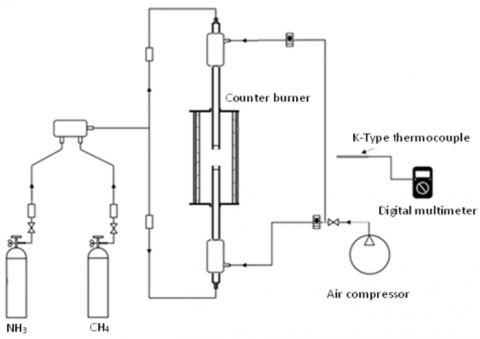
The experiments were conducted by an apparatus consisting of a double tube burner system (counter burner) and a visualization system (image recording system). Via this double tube burner, the premixed disc flame was prepared; Ammonia gas (NH3), Methane (CH4), and air flow rates were measured. Recording the stability limits for premixed flame front images needed for this study was carried out via the optical system. The components of the apparatus are demonstrated in Figure 1. The system of a counter burner includes two counter tubes at 24 mm diameter, reduced at the end to an outlet of 16 mm diameter and at 780 mm length. These tubes were fixed by a structure made of steel, and four screws were used to control the distance between the burner edges. This type of combustion process is a premixing combustion; CH4 and NH3 were premixed with air before reaching the edge burner, and to prevent the interference of the ambient air near the burner edge in the combustion process, the combustion region was surrounded with a transparent polycarbonate container. Compressed cylinders were used for gas fuel supply, one for CH4 and another for NH3. At the exit of the compressed cylinders, there is a pressure regulator to control and set the desired pressure. After the fuels pass through the flow meters, they are conducted through Teflon pipes into the main mixing chamber to reunite with air before arriving at the burner edge. The important parameters of the experimental setup are demonstrated in Table 1.
Figure 1. Schematic of the combustor setup
Table 1. Important parameters of the experimental setup
|
Parameter |
Value |
|
Buner tube diameter Burner edge diameter Burner tube height |
24 mm 16 mm 780 mm |
|
Ring electrode diameter Distance between burner edges |
90 mm 30 mm |
|
Properties |
Value |
|
Density, CH4 NH3 Air |
0.657 kg/m3 0.73 kg/m3 1.184 kg/m3 |
2.2 Flame front recording and image treatment
In this work, the optical system has been a light source with a low power of 0.11 mW fixed behind tracing paper, and a set of lenses. A digital camera setup “Phantom VEO 440” with 100 ~ 180 fps speed was used in the experiments. Images were recorded with a resolution of 1280 × 720 dpi. The camera was located on a stationary base, in the test rig front, at a horizontal line for the camera path. Also, optical diffraction with the flame front at the burner edge was checked and confirmed. Through the premixed flame experiments, the disc and double disc of the flame front were recorded at different mixing conditions. The images of flame front for the premixed flame with a high contrast have been obtained by changing the NH3/CH4-air flow rates for a wide range of equivalence ratios of 0.64 < ϕ < 1.28.
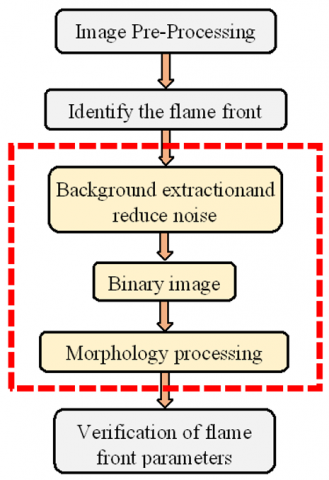
Figure 2. Schematic of a digital image processing algorithm
An image processing technique was used to analyze of flame front, and a MATLAB code was developed to determine flame front dimensions from image frames to measure the flame parameters, diameter, area, and spatial location. A low contrast ratio is an important property that must be considered during the analysis of flame boundaries. Therefore, treatment techniques must be applied with high evaluation. For the image to be processed effectively, a software program was developed and used to extract information from the flame image data recorded. The software program is divided into two basic stages: flame identification and flame front verification of parameters. Figure 2 shows a schematic of the image processing routine used in this work.
2.3 Data acquisition
A counter-flow burner system was used to conduct the first set of experiments to record premixed flame images of different air and CH4 flow rates with varied equivalence ratios, as in Table 1. In the following sets of experiments, the premixed flames images of (CH4 + 5 vol.% NH3)/Air equivalence ratios (0.64 < φ < 1.28), the third and fourth sets of experiments, (CH4 + 10 vol.% and 20 vol.% NH3)/Air, were recorded, as mentioned in Table 2. Where (SLPM), the standard litter per.
Table 2. Selected conditions for air flow rates, CH4, and NH3 flow rates during experiments
|
1st Set |
Premixed Flames |
|
Air flow rate (SLPM) |
8–12 |
|
CH4 flow rate (SLPM) |
0.4–0.9 |
|
2nd, 3rd, And 4th Set |
5%, 10%, 20% NH3 Premixed Flames |
|
Air flow rate (SLPM) |
8–12 |
|
CH4 flow rate (SLPM) |
0.4–0.9 |
|
NH3 flow rate (SLPM) |
0.08–0.26 |
2.4 Uncertainty analysis
Uncertainty analysis was employed to conduct a thorough comparison of the statistical precision of the research and the empirical findings. By means of this analysis, potential deviations identified in the calibration procedures of instruments can be detected, thus facilitating the anticipation of data inaccuracies. The assessment of uncertainty for the present investigation was grounded on the Klein and McClintock technique. The subsequent formula was utilized to ascertain the different experimental measurement inaccuracies [24]:
$W_R=\left[\left(\frac{\partial R}{\partial x_1} w_1\right)^2+\left(\frac{\partial R}{\partial x_2} w_2\right)^2+\cdots+\left(\frac{\partial R}{\partial x_n} w_n\right)^2\right]^{0.5}$ (1)
The uncertainty in test reg is listed in Table 3. The experimental total uncertainty was 3.23%, which represents a high accuracy and low uncertainty value.
Table 3. Uncertainties in the experiment
|
Instrument |
Parameters |
Accuracy |
Uncertainty (%) |
|
Flow meter |
Air flowrate |
±8 |
±0.29% |
|
Flow meter |
CH4 flow rate |
±1.5% |
±1.2% |
|
Flow meter |
NH3 flow rate |
±1.17 s |
±0.64% |
|
Digital camera setup |
Flame speed m/s |
±0.8 |
±0.73% |
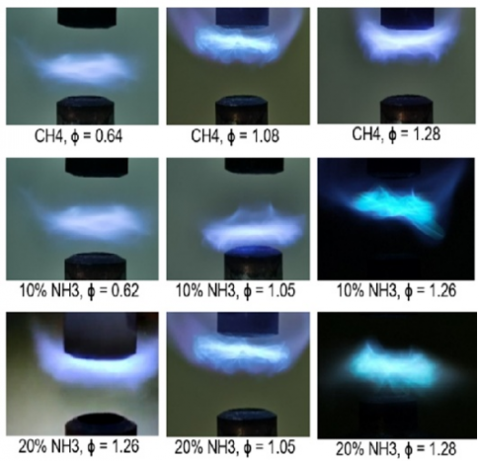
Influence of NH3 addition to CH4/air mixtures on a laminar premixed flame front was analysed, in a first case, the CH4 and air flow rates were applied to get on lean and rich sides mixing at equivalent ratio from 0.64 to 1.28, without NH3 addition to record flame disc behaviour at this condition, to determine the characteristics of the flame disc in counter burner: The flame disc diameters, and the location of flame disc from the edges of the burner. In the subsequent tests, the NH3 gas addition to CH4/air was recorded at different percentages at 5%, 10%, and 20%, respectively, at the same mixing conditions for the flame disc. Figure 3 demonstrates images of flame disc with the addition of different percentages of NH3 gas to CH4/air mixtures. As shown in the figure, the behaviour of the flame disc is mainly affected by the NH3 addition by changing the brightness of the flame as well as the dimensions of the flame front represented by the diameter of the disk. These results are consistent with many experimental studies that confirmed the changes of premixed flames under the influence of the NH3 addition [8, 9].
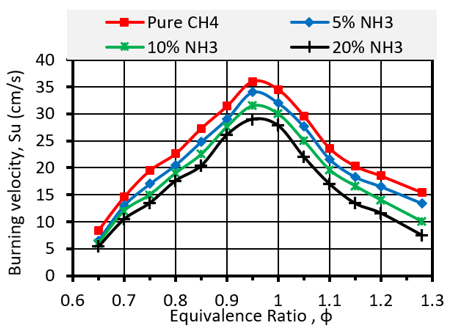
Figure 4 displays the variation of burning velocity, in cm/s, with equivalence ratio for the four types of premixed flames. The burning velocity has a maximum value of 36.8 cm/sec near an equivalence ratio of 1.0, while the combustion velocity range values for lean and rich sides were low. This behaviour is due to a difference in the diameter of the flame front formed through the counter burner, as the mixture continuity in the premixed flame helps to form the flame front with a smaller diameter. The results indicate that the burning velocity decreased with the increasing addition of NH3 in the mixtures. The rates of decrease in the burning velocity were 4.3%, 8.4%, and 13.6% with added NH3 at 5%, 10%, and 20%, respectively.
Figure 3. Images of the flame disc for lean and rich mixtures at the addition of NH3 as 5%, 10%, and 20%
Figure 4. Variation of burning velocity with the equivalence ratio for premixed CH4/air flame at addition different percentages of NH3 as 5%, 10%, and 20%
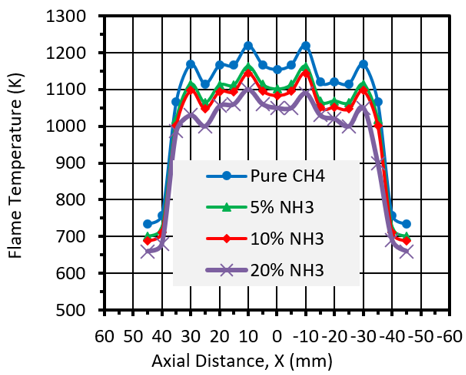
To study the effect of adding different percentages of NH3 gas to CH4/air mixture on the flame temperature, a laminar flame under an equivalent ratio of 1.0 was selected to be analysed. Figure 5 shows the distribution of flame temperature with radial distance above the burner edge under different additions of NH3 percentages at values of 5%, 10%, and 20%. Generally, the temperature of a laminar premixed flame changes depending on three regions in the flame disc: The preheating region, the first reaction region, and the second reaction region. The higher values of temperature in the laminar premixed flame appear in the first reaction region. While the flame temperature decreased with the increasing NH3 percentage. Addition of 5%, 10%, and 20% of NH3 gas is leading to a decrease in flame temperature of 7.8%, 9.3% and 12.9%, respectively. These results are in agreement with experimental results for Zhang et al. [9].
Figure 5. Flame temperature distribution at equivalent ratio 1.0 under the addition of NH3 at 5%, 10%, and 20%
This work presents the influence of the addition of NH3 gas to CH4/air mixture on the combustion characteristics of the laminar premixed flames. The available literature appears to need necessary to more analyze in NH3 combustion applications in combustion operations. The main identified objectives of the current study have been achieved, and the conclusions drawn from the results are summarized as follows: Results showed that increasing the NH3 content in the CH4-air mixture has significantly decreased the flame temperature and burning velocities. Mixing of 5%, 10%, and 20 % of NH3 gas leads to a decrease in flame temperature by 7.8%, 9.3% and 12.9%, respectively.
|
CH4 |
methane |
|
NH3 |
ammonia |
|
R |
A given function of the independent variable (x1, x2, …, xn) |
|
WR |
uncertainty in the results |
|
w1, w2, ..., wn |
uncertainties in the independent variables |
|
Greek symbols |
|
|
Φ |
Equivalence ratio |
[1] Yao, N., Pan, W., Zhang, J., Wei, L. (2024). The advancement on carbon-free ammonia fuels for gas turbine: A review. Energy Conversion and Management, 315: 118745. https://doi.org/10.1016/j.enconman.2024.118745
[2] Ekaab, N.S., Hamza, N.H., Chaichan, M.T. (2019). Performance and emitted pollutants assessment of diesel engine fuelled with biokerosene. Case Studies in Thermal Engineering, 13: 100381. https://doi.org/10.1016/j.csite.2018.100381
[3] Mola, A.H., Abdul Wahhab, H.A., Naji, Z.H. (2022). Effects of nozzle diameter and number of carbon atoms in fuel on flame quenching in counter burner. In ICPER 2020: Proceedings of the 7th International Conference on Production, Energy and Reliability, pp. 123-131. https://doi.org/10.1007/978-981-19-1939-8_11
[4] Erdemir, D., Dincer, I. (2021). A perspective on the use of ammonia as a clean fuel: Challenges and solutions. International Journal of Energy Research, 45(4): 4827-4834. https://doi.org/10.1002/er.6232
[5] Muter Khlaif, A., Abdul Wahhab, H.A., Aliehyaei Ehyaei, M. (2023). Impact of magnetic field on the stability of laminar flame in a counter burner. International Journal of Energy Production and Management, 8(4): 229-234. https://doi.org/10.18280/ijepm.080404
[6] Chiong, M.C., Chong, C.T., Ng, J.H., Mashruk, S., Chong, W.W.F., Samiran, N.A., Mong, G.R., Valera-Medina, A. (2021). Advancements of combustion technologies in the ammonia-fuelled engines. Energy Conversion and Management, 244: 114460. https://doi.org/10.1016/j.enconman.2021.114460
[7] Rocha, R.C., Costa, M., Bai, X.S. (2021). Combustion and emission characteristics of ammonia under conditions relevant to modern gas turbines. Combustion Science and Technology, 193(14): 2514-2533. https://doi.org/10.1080/00102202.2020.1748018
[8] Xiao, H., Chen, A., Guo, Y., Zhang, L., Zhang, M., Deng, X., Li, J., Ying, W. (2022). Auto-ignition delay characteristics of ammonia substitution on methane. Processes, 10(11): 2214. https://doi.org/10.3390/pr10112214
[9] Zhang, X., Tian, J., Cui, Z., Xiong, S., Yin, S., Wang, Q., Long, W. (2023). Visualization study on the effects of pre-chamber jet ignition and methane addition on the combustion characteristics of ammonia/air mixtures. Fuel, 338: 127204. https://doi.org/10.1016/j.fuel.2022.127204
[10] Chen, L., Zhang, R., Wei, H. (2023). Auto-ignition and flame characteristics of ammonia reactivity-controlled compression ignition combustion in comparison with methane. Energy and Fuels, 37(16): 12503-12513. https://doi.org/10.1021/acs.energyfuels.3c02236
[11] Duan, X., Li, Y., Liu, Y., Zhang, S., Guan, J., Lai, M.C., Liu, J. (2020). Dilution gas and hydrogen enrichment on the laminar flame speed and flame structure of the methane/air mixture. Fuel, 281: 118794. https://doi.org/10.1016/j.fuel.2020.118794
[12] Wawrzak, A., Wawrzak, K., Boguslawski, A., Tyliszczak, A., Geurts, B.J. (2023). Global instability phenomenon as a physical mechanism controlling dynamics of a nitrogen-diluted hydrogen flame. International Journal of Heat and Mass Transfer, 213: 124260. https://doi.org/10.1016/j.ijheatmasstransfer.2023.124260
[13] Mishra, A., Sharma, P., Kumar, M., Ray, A. (2023). Flame structure and stability for oxygen enhanced non-premixed combustion of highly diluted methane with helium and nitrogen. Fuel, 347: 128469. https://doi.org/10.1016/j.fuel.2023.128469
[14] Rocha, R.C., Zhong, S., Xu, L., Bai, X.S., Costa, M., Cai, X., Kim, H., Brackmann, C., Li, Z. Alden, M. (2021). Structure and laminar flame speed of an ammonia/methane/air premixed flame under varying pressure and equivalence ratio. Energy and Fuels, 35(9): 7179-7192. https://doi.org/10.1021/acs.energyfuels.0c03520
[15] Shu, T., Xue, Y., Zhou, Z., Ren, Z. (2021). An experimental study of laminar ammonia/methane/air premixed flames using expanding spherical flames. Fuel, 290: 120003. https://doi.org/10.1016/j.fuel.2020.120003
[16] Tang, G., Jin, P., Bao, Y., Chai, W.S., Zhou, L. (2021). Experimental investigation of premixed combustion limits of hydrogen and methane additives in ammonia. International Journal of Hydrogen Energy, 46(39): 20765-20776. https://doi.org/10.1016/j.ijhydene.2021.03.154
[17] MacFarlane, D.R., Cherepanov, P.V., Choi, J., Suryanto, B.H., Hodgetts, R.Y., Bakker, J.M., Vallana, F.M.F., Simonov, A.N. (2020). A roadmap to the ammonia economy. Joule, 4(6): 1186-1205.
[18] Chehade, G., Dincer, I. (2021). Progress in green ammonia production as potential carbon-free fuel. Fuel, 299: 120845. https://doi.org/10.1016/j.fuel.2021.120845
[19] Sprouse, C.E., III. (2024). Review of organic rankine cycles for internal combustion engine waste heat recovery: Latest decade in review. Sustainability, 16(5):1924. https://doi.org/10.3390/su16051924
[20] Obaid, L.T., Abdul Wahhab, H.A., Chaichan, M.T., Fayad, M.A., Al-Sumaily, G.F. (2023). Influence of burner diameter on premixed flame shape and quenching. International Journal of Computational Methods and Experimental Measurements, 11(4): 245-250. https://doi.org/10.18280/ijcmem.110406
[21] Khlaf, A.M., Ehyaei, M.A., Abdul Wahhab, H.A. (2023). CFD simulation of premixed flame in counter burner under the influence of a magnetic field. International Journal of Computational Methods and Experimental Measurements, 11(4): 233-238. https://doi.org/10.18280/ijcmem.110404
[22] Abdul Wahhab, H.A., (2021). Investigation of stability limits of a premixed counter flame. International Journal of Automotive and Mechanical Engineering, 18(1): 8540-8549. https://doi.org/10.15282/ijame.18.1.2021.13.0648
[23] Abdul wahhab, H.A. (2022). Influence of swirl flow pattern in single tube burner on turbulent flame blow-off limit. In ICPER 2020: Proceedings of the 7th International Conference on Production, Energy and Reliability, pp. 17-34. https://doi.org/10.1007/978-981-19-1939-8_2
[24] Al-Kayiem, H.H., Tukkee, A.M., See, Y.K. (2024). Experimental assessment of a solar vortex engine integrated with sensible TES at different collector configurations. Renewable Energy, 227: 120539. https://doi.org/10.1016/j.renene.2024.120539