Nadjat Boudouaour* | Ouassila Bahloul | Rafik Boufarh | Laid Lekouara
© 2025 The authors. This article is published by IIETA and is licensed under the CC BY 4.0 license (http://creativecommons.org/licenses/by/4.0/).
OPEN ACCESS
Recycled asphalt pavement (RAP) is a type of waste generated during the renovation of damaged roadways. It is often irresponsibly discarded in developing countries, such as Algeria, thereby causing environmental harm. Recycling RAP is an environmentally friendly technology that conserves significant natural resources and provides ecological benefits in geotechnical engineering, particularly in applications involving collapsible soils. These soils, characterized by their unsaturated nature, can undergo significant deformations when wet, whether they are subjected to a load or not. The objective of this study is to demonstrate the potential for reducing settlement risks in reconstituted soils exhibiting collapsibility. This was investigated by varying water contents (W0 = 2%, 4%, and 6%) and compaction energies (Ec = 30, 50, and 70 blows), while incorporating RAP at different contents (2%, 4%, 6%, 8%, and 10%). Suction and collapse potential (Cp) were measured to evaluate the performance of these modified soils. The results revealed improved geotechnical properties, with the collapse potential (Cp) decreasing from 14.4% to 0.4%, and suction (s) reducing from 9.89 MPa to 1.12 MPa. These improvements were associated with the development of a compacted microstructure and reduced porosity.
collapsible soils, collapse potential, recycled asphalt pavement, suction, microstructure, waste
The global production of construction, demolition, and road debris has experienced a remarkable surge due to swift urbanization and industrialization. According to estimates by the World Bank, construction and demolition waste accounts for up to 40% of solid waste produced in many countries [1, 2]. At the same time, road waste also significantly contributes to this issue. The global road infrastructure extends over 21 million kilometers [3]. With the increase in road reconstruction projects, many asphalt pavement layers have been milled [4]. Recycled Asphalt Pavement (RAP) is a waste material generated during the refurbishment of degraded pavement sections and roadways that have reached the end of their expected lifespan [5, 6]. Reclaimed asphalt pavement (RAP) comprises aggregates and aged bituminous additives [7]. Worldwide, a relatively large amount of unused RAP is stored without resorting to sustainable reuse methods [8]. The recycling of RAP has gained popularity since the mid-1970s, despite its practice beginning in 1915.
Soils with good physico-mechanical characteristics are becoming increasingly rare. This justifies using soil improvement operations to make the land suitable for hosting large-scale constructions. Over 10% of the global land area comprises collapsible soils [9]. These soils are mainly found in arid and semi-arid regions [10]. Collapsible soils are generally classified among alluvial, aeolian, and loess formations. Most soils show a porous and loose structure, typically comprising grains varying from silt to fine sand [11, 12]. Collapsible soils are unsaturated soils that are likely to undergo significant deformations and a substantial rearrangement of their particles when exposed to moisture, whether or not a load is applied. When these soils are dry, a cementitious bond forms between the particles, generating an internal connection force sufficient to support heavy loads. Upon saturation, the soil structure fails due to the dissipation of bonding forces between particles, resulting in the rearrangement of particles and the formation of a new soil structure [13, 14].
Significant damage to structures caused by soil collapse and triggered by moisture has been observed in many regions around the world. Recently, incidents in southeastern Algeria illustrate the extent of the problem. Following these disasters, geotechnical engineers must improve their comprehension of the mechanical behavior of problematic soils to reduce the adverse effects of soil collapses. Various researchers have examined the collapse behavior of these soils over the past several decades [15-17]. Indeed, there are numerous methods for stabilizing these soils, including stabilization with cement [18], polymers [19], fly ash [20], inorganic salts [21], sodium chloride, and potassium chloride [11], bituminous materials [22], slag [23] and eggshell [24].
However, most of these methods are costly to deploy in the field and are not always available locally. Furthermore, while efficacious, chemical additions can negatively impact the ecosystem, especially the groundwater. Similarly, mechanical improvements (static and dynamic) necessitate heavy machinery, which is sometimes inaccessible in rural or remote locations [25, 26].
Previous research has demonstrated the efficacy of RAP in treating clayey and lateritic soils [27-30]. Road rehabilitation has notably utilized this material, incorporating it into bituminous mixtures to produce new asphalt layers. Numerous studies have focused on its excellent mechanical characteristics, particularly its wear resistance, durability, and capacity to enhance the load-bearing capability of buildings. More recent research has investigated its application as a foundational material in road layers or in combination with other recycled substances [7, 31, 32].
The excellent performance of this material in these applications suggests its potential for effectively stabilizing collapsible soils. In this context, seeking sustainable, economical, and environmentally friendly alternatives is essential. This research examines the stabilization of collapsible soil using different proportions of reclaimed asphalt pavement. The main objective is to present a novel approach to valorize road waste while enhancing the mechanical properties of problematic soils. The application of RAP in this context offers significant economic and environmental benefits, aiding in the reduction of the stabilization costs of problematic soil, the preservation of natural resources, and the protection of the environm
The experimental program was designed to evaluate the impact of varying percentages of RAP on the behaviour of collapsible soil reconstituted at varied water contents (W0 = 2%, 4%, and 6%) and compaction energies (Ec = 30, 50, and 70 blows) by adding RAP.
The laboratory performed two types of tests: oedometer tests following the Jennings and Knight [33] methodology and suction tests following the ASTM D5298-10 standard. We prepared soil-RAP mixtures by incorporating RAP at content levels of 2%, 4%, 6%, 8%, and 10%. Each sample was dry-mixed in a closed container for 10 minutes to ensure optimal homogeneity. The experiments were performed at ambient temperature (about 22 ± 2℃) and under stable laboratory relative humidity.
2.1 Description and origin of materials
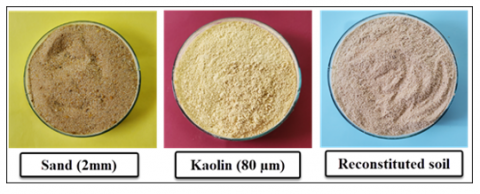
The study employs two primary materials for soil reconstitution (Figure 1).
The sand originates from the Liwa River, situated in the Biskra region of Algeria. It was sieved through a 2 mm sieve.
The Kaolin employed in this research is obtained from the Tamazert-Jijel area in eastern Algeria. It was dried, crushed, and sieved to 80 µm.
The reconstituted soil sample consists of 80% sand and 20% kaolin. This material is classified as collapsible according to the collapse criteria defined by many authors, including study [34] and other researchers such as study [15].
Figure 1. The main materials for preparing soil samples
The geotechnical characteristics of the reconstituted soil are in Table 1.
Table 1. Geotechnical characteristics of sand, kaolin and untreated soil
|
Materials |
Characteristics |
|
Sand (2 mm) |
Sand equivalent ES =64.02% Coefficient of uniformity Cu = 2.77% Coefficient of curvature Cc = 0.64% VBS =0.05 Specific density Gs=2.65 |
|
Kaolin(80 µm) |
Liquid limit LL= 47.67% Plastic limit PL= 25.4% Specific Gravity Gs = 2.39 |
|
Reconstituted soil (80% sand + 20% kaolin) |
Liquid limit LL=20.65% Plastic limit PL=11.83% Specific gravity Gs = 2.71 Coefficient of uniformity Cu = 28% Coefficient of curvature Cc = 3.57% Maximum dry density $\gamma \mathrm{d}$ = 2.00 g/cm3 Optimal water content Wopt = 9.62% |
2.2 Stabilizer additions
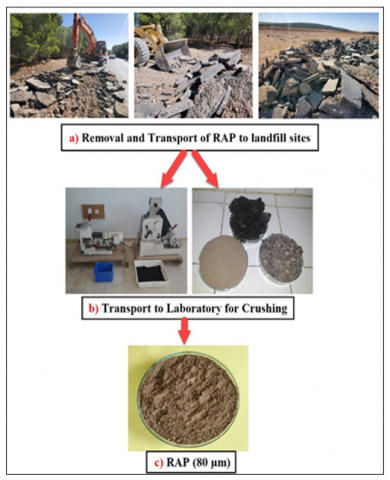
Reclaimed asphalt pavement is a waste material derived from removing deteriorated pavements that have reached the end of their service life. These waste products are deposited in landfills, specifically the technical landfill center in Batna city in Algeria (Figure 2).
Figure 2. Schematic diagram of RAP preparation for experimental tests
After collection, the waste materials were transported to the laboratory, crushed with a suitable crusher, and sieved to yield discrete granular fractions. The main objective was to separate fine particles, specifically those less than 80 µm, for incorporation in soil treatment tests.
2.3 Scanning electron microscope (SEM) of materials
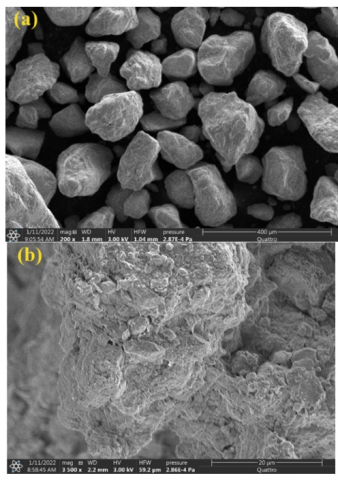
SEM image shows that the sand particles have a relatively smooth surface without any adhering material (Figure 3(a)). This characteristic is crucial in stabilizing, as it promotes cohesion and reduces voids between particles. The grain sizes appear similar to angular shapes, and they are separated from each other; this morphology is favourable for mechanical interconnection. The SEM picture of kaolin is characterized by a white tone and low porosity, indicating a reduction in plasticity (Figure 3(b)).
Figure 3. Scanning electron micrographs of materials: (a) Sand, (b) Kaolin
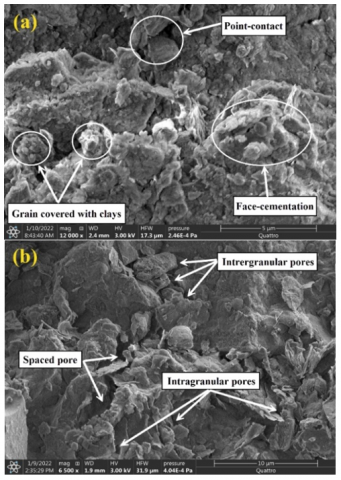
Figure 4. SEM observation of untreated reconstituted soil
SEM pictures of untreated soil (S) demonstrated an open fabric and a structure marked by weak cohesion among the various soil components, mainly sand and kaolin. The pictures also indicate a loose connection between the kaolinite crystallites and the quartz crystals. The sand grains consisted of quartz in diverse sizes and sub-rounded to sub-angular forms, coated with a minimal quantity of clay Figure 4(a).
The SEM study indicates the existence of holes of diverse shapes and spaces linked to regions of low density where substantial grains are interconnected by clay bridges (kaolin). Consequently, the contact relationship in the soil is a crucial indicator in determining how easily particles can slide over one another. In collapsible soils, particles usually have two primary types of contact relationships based on the number of contact bonds: point-contact and face-cementation connections, as shown in Figure 4(a). Particles in point-contact connections are predominantly uncoated, with just a limited number of contact bonds.
On the other hand, particles in face-cementation relations are typically completely covered and have numerous contact connections, creating the appearance of a face-to-face contact relationship [35].
The pores of collapsible soils are categorized into spaced, intergranular, and intragranular pores according to their size compared to the adjacent particles (Figure 4(b)). The spaced pores are larger than the adjacent particles, which are inadequately cemented and more susceptible to point contact. The spaced pores facilitate the creation of spatial conditions favorable to collapse [35].
Experimental evidence indicates that intergranular pores marginally contribute to the failure of collapsible soils [17]. The intragranular pores, which are the pores inside the aggregates, are often holes; these pores minimally influence the overall collapse or rearrangement of particles due to their limited percentage [35].
Figure 5. EDAX analysis of untreated soil
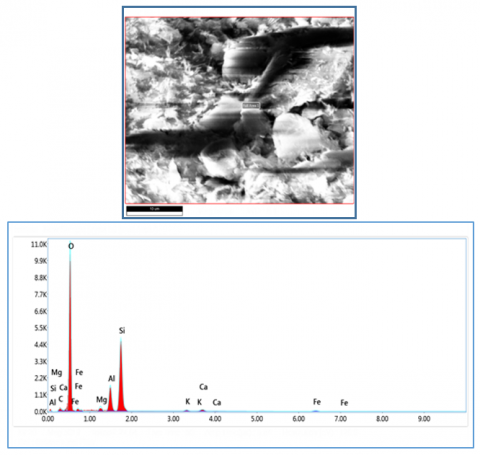
EDAX analysis in Figure 5 indicates that the sample presents a concentration of Si compared to Al, attributable to quartz and kaolin, with a dense matrix including millimeter-sized clusters of the material's elements. Traces of specific elements like Iron (Fe), Magnesium (Mg), Calcium (Ca), and Potassium (K) in the soil (S) [12, 36].
2.4 Oedometric test
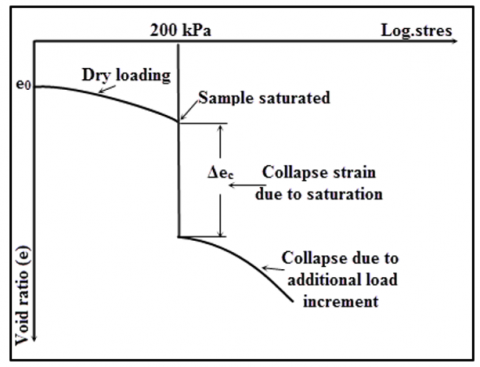
Jennings and Knight [33] proposed an experimental technique to evaluate the collapse potential of soils through oedometer testing. This approach entails performing an oedometer test at a specified stress level of 200 KPa, adhering to ASTM standards, on an unmodified soil sample at its natural moisture content. Figure 6 demonstrates that the collapse potential is immediately determined from the deformation of the soil sample.
Figure 6. Simple oedometer curve
The experimental setup created by studies [22, 37] has a piston that weighs 152 g, with a diameter slightly less than that of the oedometer ring. The piston falls from a height of 15 cm into a soil sample within the ring; the total compaction energy is calculated as follows:
$E_c=\frac{n \cdot m \cdot g \cdot h}{v}$ (1)
where, $E_c$ is the compaction energy, $n$ is the number of drops, $m$ is the mass of the hammer disc, $h$ is the drop height, $g$ is the acceleration of gravity, and $v$ is the volume of material before compaction.
The samples were prepared with varying water contents (2%, 4%, and 6%) and compaction energies (30, 50, and 70 blows) in a standard oedometer mold, employing a single layer due to the limited ring height (20 mm). Subsequently, an identical test will be conducted on soil samples treated with different dosages of RAP.
Table 2. Identification of collapse-associated structural problems [33]
|
Cp (%) |
Severity of Disorders |
|
0-1 |
No problem |
|
1-5 |
Moderate trouble |
|
5-10 |
trouble |
|
10-20 |
Severe trouble |
|
> 20 |
Very severe disorders |
The RAP content will be varied to determine the limit at which the collapse potential (Cp) becomes safe for the structure, eliminating any risk of damage, according to the classification of study [33] (Table 2).
Oedometer tests are performed following the approach established by study [33]. This method involves applying loads of 25, 50, 100, and up to 200 kPa, then saturating the sample with water and evaluating the resulting settlement. Settlements are documented at intervals of 15 seconds, 30 seconds, 1 minute, 2 minutes, 5 minutes, 10 minutes, and 24 hours during the test. The potential for collapse (Cp) is defined as follows:
$\mathrm{Cp}(\%)=\left[\frac{\Delta_e}{1+e_0}\right] \times 100$ (2)
with, $\Delta e=e_1-e_2, e_1$: void ratio before flooding, $e_2$: void ratio after flooding, e0: initial void ratio.
2.5 Suction test
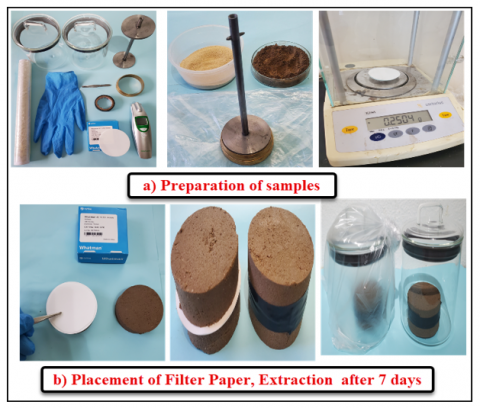
This study explores the use of the filter paper method, particularly Whatman 42 dry filter paper, for measuring suction, as outlined in the study [38]. This indirect method involves placing three sheets of filter paper into a soil sample, as seen in Figure 7, which has been moistened and compacted according to the specifications outlined in Table 3.
Figure 7. Suction measurement test by filter paper (Whatman ashless grade 42)
Table 3. Mix composition of untreated and treated soils for diverse laboratory tests
|
Tests Type |
Water Content |
Number of Blows |
Additions Dosage |
Designation |
|
Oedometric tests |
2% 4% 6% |
30 50 70 |
S+0% RAP S+2% RAP S+4% RAP S+6% RAP S+8% RAP S+10% RAP |
S S2RAP S4RAP S6RAP S8RAP S10RAP |
|
Suction tests |
The sample is contained in an isothermal plastic bag and kept in a controlled environment at 20℃ ± 2℃ for 7 days to achieve water equilibrium between the soil and the filter paper. After that, the filter papers are extracted, and the moisture content of the middle sheet, indicative of the soil's moisture, is determined. The soil suction is subsequently measured utilizing the appropriate retention curve corresponding to the water content.
3.1 Oedometric tests
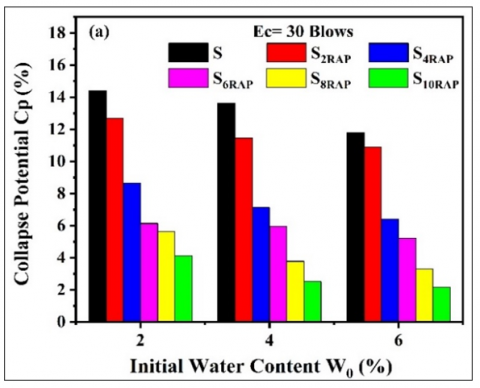
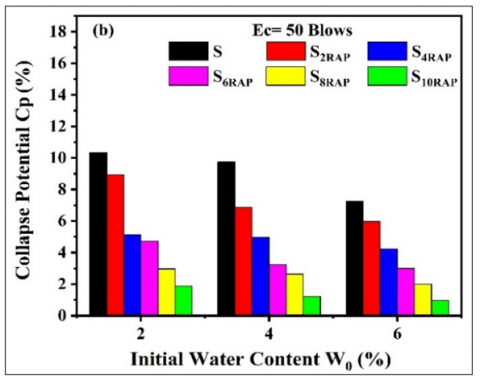
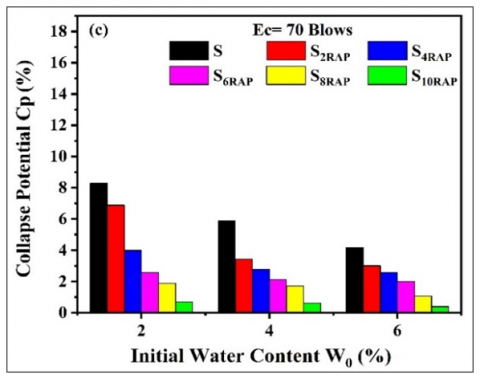
The results shown in Figure 8 indicate that untreated soil collapses conform to the classification established by study [33]. For vertical stress σ of 200 KPa at varying compaction energies (Ec = 30, 50, 70 blows), the settlement potentials of the soils (S) range from 14.4% to 8.28% at an initial water content of W0=2%, from 13.64% to 5.9% at W0=4%, and from 11.79% to 4.18% at W0=6%. The settlement potential values we obtained fall within the range of soils that show moderate to severe disturbance.
Figure 8. Effect of the addition of RAP on the collapse potential of soil at different Ec (a) 30 blows, (b) 50 blows, (c) 70 blows
The incorporation of RAP diminishes the collapse potential (Cp) of the soil (S), with this reduction becoming more pronounced as factors such as water content (W0), degree of compaction (Ec), and RAP dosage increase Figure 8. The variation in the RAP treatment rate from 0% to 10% in the soil (S) results in a substantial decrease in the collapse potential, irrespective of water content and compaction level. This is explained by a pronounced downward slope, signifying a decrease in deformations within the granular matrix of the treated soils and, subsequently, a modification of their physical and mechanical properties.
Adding 2% to 6% of RAP results in a substantial decrease in settling potential (Cp). Within this range, the Cp diminishes from 12.7% in the S2RAP sample, which was moistened to 2% and compacted with 30 blows, to 2% in the S6RAP sample, which was moistened to 6% and compacted with 70 blows. Despite this enhancement, the Cp persists over 1%, indicating that the soil (S) continues to exhibit a propensity for settlement and does not achieve total stability.
However, the incorporation of 8 to 10% RAP persistently diminishes Cp until it attains levels near 1 to 0.4% in samples moistened to 6% and compacted with 70 blows. Incorporating RAP in this range results in a regression of Cp from 78.16% to 90.45%, depending on the variance in compaction degree. These results convert our soil (S) from a collapsible behavior to a non-collapsible behavior, characterized by significantly low values of Cp (Cp < 1).
The risk for collapse is then regarded without issue based on the classification by study [33], resulting in minor intergranular deformations and signifying nearly complete soil stability. Similarly, additional research on treated collapsible soils aligns with our current findings. Overall, our results surpass those of the study [39], which recorded a minimum Cp of 1.62%. Study [23] achieved a minimum Cp of 0.84%, while this study reports a Cpmin of 0.40%.
The reduction in Cp demonstrates an enhancement in the physical and chemical properties of the treated soil matrix. The results align well with those reported by the study [40], which recommends enhancing the strength of clayey and silty connections and cementitious components to establish a stable soil structure and minimize the risk of collapse (Cp).
3.2 Suction tests
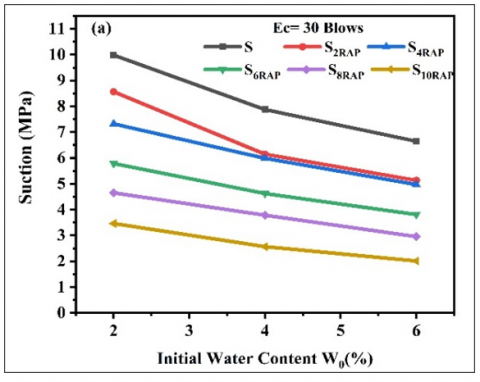
Figure 9 illustrates the results obtained after treatment with RAP. It clearly shows the evolution of suction as a function of the treatment rate.
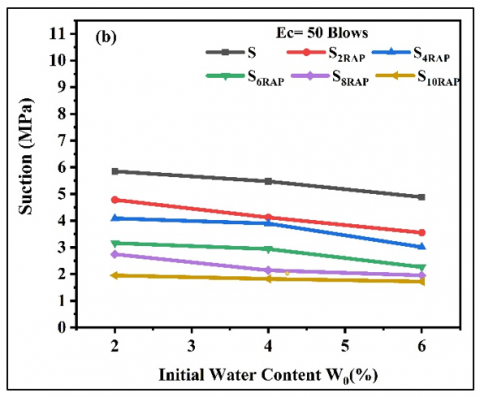
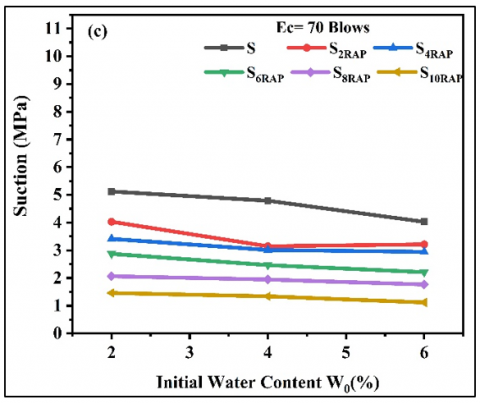
Figure 9(a) indicates that at compaction energy of 30 blows, representing a loose soil condition, the application of a 2% additive reduces suction from 9.98 MPa at a water content of 2% to 2.01 MPa at a water content of 6% and a treatment rate of 10%. A similar result can be noted in Figure 9(b), where soil subjected to compaction energy of 50 blows exhibits a decrease in suction from 5.84 MPa at a water content of 2% to 1.72 MPa at a treatment rate of 10% and a water content of 6%.
Figure 9. Effect of initial water content on suction at different Ec (a) 30 blows, (b) 50 blows, (c) 70 blows
This validates the efficacy of the chosen treatment. Figure 9(c) presents the results of the RAP treatment with a compaction energy of 70 blows. The suction decreases as the treatment rate varies by 2% with a water content of 2%, decreasing from 4.03 MPa to 1.12 MPa as the treatment rate increases to 10% and the water content rises to 6%.
The rise in initial water content is defined by two gradients, independent of compaction energy. Previous studies agree well with the obtained values [23]. They indicate that solidification happened by humidification within the range of (2-4%), marked by substantial decreases in suction. Samples with initial water concentrations between 4% and 6% exhibited reduced suction values, indicating intergranular adjustment of the treated soils.
An increase in initial water content (W0) and degree of compaction (Ec) decreases the collapse potential (Cp) of untreated soil samples (S). Incorporating RAP into the soil (S) at rates between 8% and 10% significantly decreases suction and the collapse potential (Cp), indicating the stabilization of the treated samples.
Many physical factors contribute to the significant suction decrease in the samples treated with RAP. RAP's amorphous and hydrophobic characteristics limit the interactions between soil particles and water. Furthermore, the RAP particles rich in bituminous fractions, which do not have much chemical attraction for water, allow a partial filling of the spaces between the normal soil grains.
This results in decreased porosity, modifying its microstructure, restricting water circulation within the soil's capillary network, increasing impermeability, and reducing water absorption [41], subsequently reducing matric suction [22]. The augmentation of compaction energy also promotes the densification of the structure, making it more difficult for internal capillary forces to develop. Reduced suction helps soil stability by minimizing volume variations and subsidence potential.
From a practical standpoint, this stabilization approach offers an economically viable alternative by utilizing locally available recycled materials. It is also part of a sustainable development approach, reducing the volumes of road waste sent to landfills and limiting the use of more expensive traditional binders. Thus, the results obtained in this study show a strong potential for application in public works, particularly for the stabilization of road platforms in areas prone to subsidence.
3.3 Influence of RAP on compaction
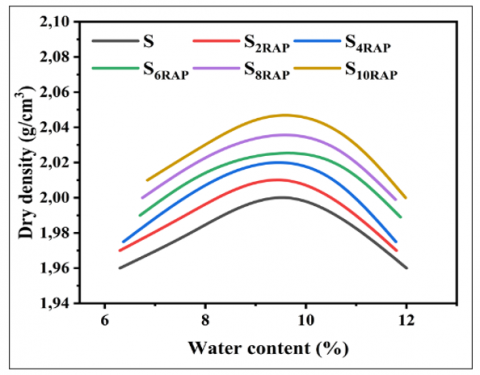
Standard proctor tests were performed by the study [42] on untreated soil samples (S) and soil treated with RAP material at varying concentrations to assess the influence of the stabilizer on maximum dry density and optimal water content. Figure 10 illustrates the dry density results as a function of water content derived from compaction tests on (S) soil stabilized with RAP at various percentages. Indeed, the observed rise in initial density can be attributed to minimal amounts of high-density aggregates and low-density bitumen in the RAP [27-29]. At an RAP content of 10%, the density of the soil-RAP mixture attains its peak value of 2.045 g/cm³, resulting from the elevated fraction of crushed aggregates in the RAP. Study [43] has demonstrated that variations in maximum dry density result from particle size, specific soil densities, and additives. A decrease in optimal water content is observed. This phenomenon can be attributed to the aggregates covered with bitumen exhibiting a lower affinity for water than soil (S), decreasing the water required to achieve appropriate moisture levels. Incorporating RAP enhances soil density, making it more compact and resilient to water effects, diminishing the possibility of subsidence.
Figure 10. Effect of RAP on soil compaction
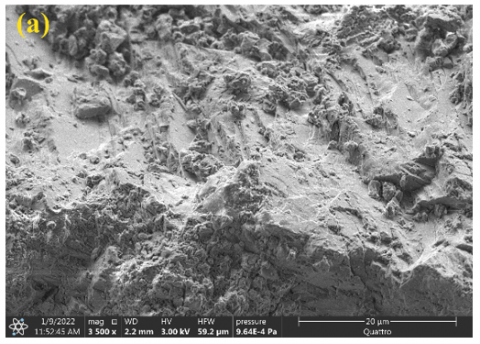
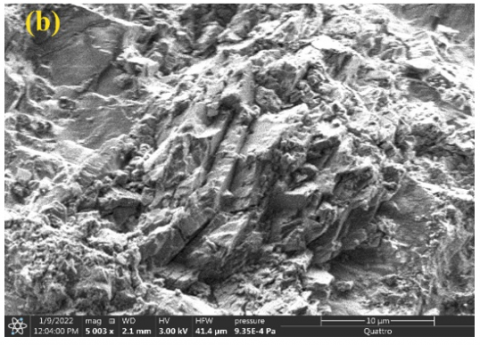
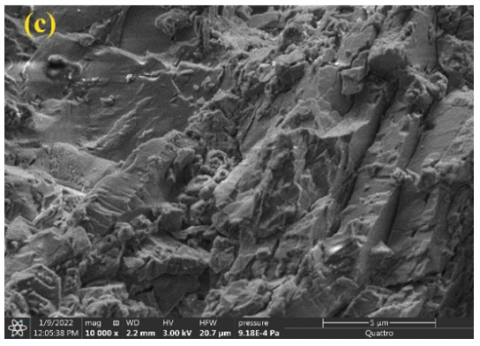
SEM pictures of the soil treated with RAP show a reduced volume of dark spaces, confirming a cemented matrix compared to untreated soil (S) (Figure 11). The aged bitumen adhering to the fine particles imparts a coarse, roughness to the surface, characterized by a dense entanglement of particles. This microstructure was documented by a study [29]. Clusters of small particles aggregated by bitumen, which may contribute to decreased porosity and better bonding, have also been identified. This clarifies the maximum recorded dry density. The RAP particles show a novel structure resulting from the adhesion process. We find interactions between the two elements, RAP and soil, resulting in a novel structure that differs from untreated soil [12].
Figure 11. SEM pictures of treated soil with RAP (a) 3500x, (b) 5003x, (c) 10000x
The treatment with RAP, partially or fully covered with bitumen, results in diminished soil permeability; as impermeability increases, water movement through the voids slows, reducing suction and the collapse potential to minimal levels (Cp<1) [22]. We notice that the precipitation of RAP particles covered with binder inside the quartz grains, forming compact zones. We observe the beneficial impact of treating the soil reconstructed utilizing RAP.
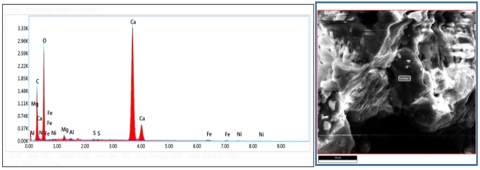
Figure 12. EDAX analysis of treated soil by RAP
The EDAX analysis indicates a higher concentration of 51.95% O (Oxygen) and 17.93% C (Carbon). These indicate the presence of bitumen and mineral oxides, and 26.97% of Ca (Calcium) indicates the presence of calcium carbonates (CaCO₃) or other binders such as Fe, Mg, Al, and Ni (Figure 12).
The results obtained in this experimental study demonstrate the effectiveness of stabilizing collapsed soils by adding RAP.
The addition of RAP at different percentages increases the specific dry density and decreases the optimal water content of the soil, improving compaction characteristics by making the soil resistant to water's harmful effects.
The incorporation of RAP at a dosage of 10% of the soil weight for samples with a water content of 6% and compacted to 70 blows results in a significant decrease in suction, followed by a reduction in the collapse potential amplitude to a value below 1 (Cp = 0.40%), below the critical instability threshold.
The significant reduction in suction of RAP-treated samples may result from the amorphous and hydrophobic characteristics of RAP; these particles have a bitumen-rich composition that has no chemical affinity with water, consequently reducing the capillary attraction between soil particles and water, thus resulting in a decrease in matric suction.
The SEM of the RAP-treated soil shows a dense, slightly porous, and partially cemented structure. The distribution of RAP in the area gives the soil a specific strength, thereby reducing the risk of collapse by providing a compact structure.
Using RAP allows for an efficient valorization of road waste, reducing the need to extract virgin materials and limiting the ecological impact. Moreover, using these waste materials is less costly than traditional soil improvement techniques, making construction projects more economical.
|
RAP |
Reclaimed asphalt pavement |
|
CP |
Collapse potential |
|
s |
Suction |
|
S |
Untreated soil |
|
W0 |
Water content |
|
Ec |
Compaction energy |
|
ES |
Sand equivalent |
|
Cu |
Coefficient of uniformity |
|
Cc |
Coefficient of curvature |
|
VBS |
Methylene blue value |
|
SEM |
Scanning electron microscope |
|
Gs |
Specific density |
|
Ll |
Liquid limit |
|
Lp |
Plastic limit |
|
Wopt |
Optimal water content |
|
Greek symbols |
|
|
$\gamma \mathrm{d}$ |
Maximum dry density |
[1] Alsheyab, M. (2022). Recycling of construction and demolition waste and its impact on climate change and sustainable development. International Journal of Environmental Science and Technology, 19(3): 2129-2138. https://doi.org/10.1007/s13762-021-03217-1
[2] Akhtar, A., Sarmah, A.K. (2018). Construction and demolition waste generation and properties of recycled aggregate concrete: A global perspective. Journal of cleaner production, 186: 262-281. https://doi.org/10.1016/j.jclepro.2018.03.085
[3] Costa, J.O., Borges, P.H., dos Santos, F.A., Bezerra, A.C.S., Blom, J. (2020). Cementitious binders and reclaimed asphalt aggregates for sustainable pavement base layers: Potential, challenges and research needs. Construction and Building Materials, 265: 120325. https://doi.org/10.1016/j.conbuildmat.2020.120325
[4] Ren, J., Wang, S., Zang, G. (2020). Effects of recycled aggregate composition on the mechanical characteristics and material design of cement stabilized cold recycling mixtures using road milling materials. Construction and Building Materials, 244: 118329. https://doi.org/10.1016/j.conbuildmat.2020.118329
[5] Singh, S., Ransinchung, G., Kumar, P. (2017). An economical processing technique to improve RAP inclusive concrete properties. Construction and Building Materials, 148: 734-747. https://doi.org/10.1016/j.conbuildmat.2017.05.030
[6] Huang, B., Shu, X., Burdette, E. (2006). Mechanical properties of concrete containing recycled asphalt pavements. Magazine of Concrete Research, 58(5): 313-320. https://doi.org/10.1680/macr.2006.58.5.313
[7] Hoy, M., Horpibulsuk, S., Arulrajah, A. (2016). Strength development of recycled asphalt pavement–fly ash geopolymer as a road construction material. Construction and Building Materials, 117: 209-219. https://doi.org/10.1016/j.conbuildmat.2016.04.136
[8] Rahman, M.A., Imteaz, M., Arulrajah, A., Disfani, M.M. (2014). Suitability of recycled construction and demolition aggregates as alternative pipe backfilling materials. Journal of Cleaner Production, 66: 75-84. https://doi.org/10.1016/j.jclepro.2013.11.005
[9] Jefferson, I., Evstatiev, D., Karastanev, D. (2008). The treatment of collapsible loess soils using cement materials. In GeoCongress 2008, pp. 662-669. https://doi.org/10.1061/40971(310)82
[10] Gaaver, K.E. (2012). Geotechnical properties of Egyptian collapsible soils. Alexandria Engineering Journal, 51(3): 205-210. https://doi.org/10.1016/j.aej.2012.05.002
[11] Bahloul, O., Abbeche, K., Bahloul, A. (2016). Study of the microstructure of collapsible soil treated with the potassium chloride. Journal of Applied Engineering Science & Technology, 2(1): 39-42. http://dx.doi.org/10.69717/jaest.v2.i1.30
[12] Bahloul, O., Abbeche, K., Bahloul, A. (2016). Study of the microstructure of a collapsible soil flooded with NaCl saline. E3S Web of Conferences. https://doi.org/10.1051/e3sconf/20160914001
[13] Abbeche, K., Hammoud, F., Ayadat, T. (2007). Influence of relative density and clay fraction on soils collapse. In Experimental Unsaturated Soil Mechanics. Springer. https://doi.org/10.1007/3-540-69873-6_1
[14] Abbeche, K., Ayadat, T., Lahmadi, A. (2009). Traitement d'un sol á effondrement brusque par la chaux lime stabilisation of a collapsible soil. Séminaire International Innovation et Valorisation dans le Génie Civil, Hammamet, Tunisia, 161-168.
[15] Ayadat, T., Gherabli, A. (1995). Traitement des sols affaissables par du ciment CPA. Annales de l'Institut Technique du Bâtiment et des Travaux Publics.
[16] Karol, R.H. (2003). Chemical Grouting and Soil Stabilization, Revised and Expanded. CRC Press. https://doi.org/10.1201/9780203911815
[17] Reznik, Y.M. (2007). Influence of physical properties on deformation characteristics of collapsible soils. Engineering geology, 92(1-2): 27-37. https://doi.org/10.1016/j.enggeo.2007.03.001
[18] Mohamed, A.M., El Gamal, M. (2012). Treatment of collapsible soils using sulfur cement. International Journal of Geotechnical Engineering, 6(1): 65-77. https://doi.org/10.3328/IJGE.2012.06.01.65-77
[19] Khodabandeh, M.A., Nagy, G., Török, Á. (2023). Stabilization of collapsible soils with nanomaterials, fibers, polymers, industrial waste, and microbes: Current trends. Construction and Building Materials, 368: 130463. https://doi.org/10.1016/j.conbuildmat.2023.130463
[20] Phetchuay, C., Horpibulsuk, S., Arulrajah, A., Suksiripattanapong, C., Udomchai, A. (2016). Strength development in soft marine clay stabilized by fly ash and calcium carbide residue based geopolymer. Applied Clay Science, 127: 134-142. https://doi.org/10.1016/j.clay.2016.04.005
[21] Abbeche, K., Bahloul, O., Ayadat, T., Bahloul, A. (2010). Treatment of collapsible soils by salts using the double consolidation method. In Experimental and Applied Modeling of Unsaturated Soils, 69-78. https://doi.org/10.1061/41103(376)10
[22] Ayadat, T., Dahili, M., Ahmed, K.M.H. (1998). Traitement d'un sol effondrable par un liant hydrocarboné (bitume). Revue Française de Géotechnique, 85: 57-64. https://doi.org/10.1051/geotech/1998085057
[23] Ziani, H., Abbèche, K., Messaoudene, I., Andrade Pais, L. (2019). Treatment of collapsible soils by additions of granulated slag and natural pozzolan. KSCE Journal of Civil Engineering, 23: 1028-1042. https://doi.org/10.1007/s12205-019-0051-0
[24] Bekhouche, H., Bahloul, O., Tebbi, F.Z., Aidoud, A. (2024). Modification of the geotechnical properties of loess using eggshell waste (El'Mghair region). International Journal of Design & Nature and Ecodynamics, 19(2): 489-496. https://doi.org/10.18280/ijdne.190214
[25] Holtz, W.G., Hilf, J.W. (1961). Settlement of soil foundations due to saturation. In Proceedings of the 5th International Conference on Soil Mechanics and Foundation Engineering, pp. 673-679. https://www.issmge.org/publications/publication/settlement-of-soil-foundations-due-to-saturation.
[26] Lutenegger, A.J., Saber, R.T. (1988). Determination of collapse potential of soils (Détermination du potentiel d'effondrement des sols). Geotechnical Testing Journal, 11(3): 173-178.
[27] Mustapha, A.M., Jibrin, R., Etsuworo, N.M., Alhassan, M. (2014). Stabilization of A-6 lateritic soil using cold reclaimed asphalt pavement. International Journal of Engineering and Technology, 4(1): 52-57.
[28] Kumar, C.R., Gadekari, R.S., Vani, G., Mini, K.M. (2020). Stabilization of black cotton soil and loam soil using reclaimed asphalt pavement and waste crushed glass. Materials Today: Proceedings, 24: 379-387. https://doi.org/10.1016/j.matpr.2020.04.289
[29] Alhaji, M.M., Musa, A. (2018). Effect of reclaimed asphalt pavement stabilization on the microstructure and strength of black cotton soil. International Journal of Technology, 9(4): 435. https://doi.org/10.14716/ijtech.v9i4.435
[30] Hoyos, L.R., Puppala, A.J., Ordonez, C.A. (2011). Characterization of cement-fiber-treated reclaimed asphalt pavement aggregates: Preliminary investigation. Journal of Materials in Civil Engineering, 23(7): 977-989. https://doi.org/10.1061/(ASCE)MT.1943-5533.0000267
[31] Hajj, E.Y., Sebaaly, P.E., Kandiah, P. (2010). Evaluation of the use of reclaimed asphalt pavement in airfield HMA pavements. Journal of Transportation Engineering, 136(3): 181-189. https://doi.org/10.1061/(ASCE)TE.1943-5436.0000090
[32] Suebsuk, J., Suksan, A., Horpibulsuk, S. (2014). Strength assessment of cement treated soil-reclaimed asphalt pavement (RAP) mixture. GEOMATE Journal, 6(12): 878-884. https://doi.org/10.21660/2014.12.3262
[33] Jennings, J., Knight, K. (1975). A guide to construction on or with materials exhibiting additional settlement due to collapse of grain structure.
[34] Abbeche, K., Mokrani, L., Boumekik, A. (2005). Contribution à l'identification des sols effondrables. Revue Française de Géotechnique, 110: 85-90. https://doi.org/10.1051/geotech/2005110085
[35] Li, P., Vanapalli, S., Li, T. (2016). Review of collapse triggering mechanism of collapsible soils due to wetting. Journal of Rock Mechanics and Geotechnical Engineering, 8(2): 256-274. https://doi.org/10.1016/j.jrmge.2015.12.002
[36] Bahloul, O., Ziani, H., Benmoussa, S. (2022). Impact of calcium chloride on the microstructure of a collapsible soil. Annales de Chimie. Science des Materiaux, 46(4): 405. https://doi.org/10.18280/acsm.460405
[37] Bahloul, O., Abbeche, A., Bahloul, A., Halitim, A. (2014). Effect of sodium chloride on the wetting induced collapse strain of soils. Malaysian Journal of Civil Engineering, 26(2): 1-17. https://doi.org/10.11113/mjce.v26.15881
[38] ASTM. (2010). Standard test method for measurement of soil potential (suction) using filter paper (D5298). ASTM International. https://doi.org/10.1520/D5298-10
[39] Bakir, N., Abbeche, K., Panczer, G. (2017). Experimental study of the effect of the glass fibers on reducing collapse of a collapsible soil. Geomechanics and Engineering, 12(1): 71-83. https://doi.org/10.12989/gae.2017.12.1.071
[40] Iranpour, B. (2016). The influence of nanomaterials on collapsible soil treatment. Engineering Geology, 205: 40-53. https://doi.org/10.1016/j.enggeo.2016.02.015
[41] US Army. (1994). Soil stabilization for pavements (Technical Manual TM 5-822-14). Department of the Army, the Navy, and the Air Force.
[42] ASTM. (2012). Standard test methods for laboratory compaction characteristics of soil using standard effort (D698). ASTM International. https://doi.org/10.1520/D0698-12E02
[43] Basha, E., Hashim, R., Mahmud, H.B., Muntohar, A.S. (2005). Stabilization of residual soil with rice husk ash and cement. Construction and Building Materials, 19(6): 448-453. https://doi.org/10.1016/j.conbuildmat.2004.08.001