
Taha A. Taha | Rafal Azzam Abed | Saad Ahmed Ayoob*
© 2026 The authors. This article is published by IIETA and is licensed under the CC BY 4.0 license (http://creativecommons.org/licenses/by/4.0/).
OPEN ACCESS
The performance of non-return-to-zero (NRZ) and return-to-zero (RZ) digital modulation formats was evaluated and compared in hybrid wavelength division multiplexing and time division multiplexing passive optical network (WDM–TDM PON) systems. This study addresses the growing demand for broadband capacity by evaluating system efficiency through the measurement of two key parameters. System performance is evaluated in terms of signal quality factor (Q-factor) and the bit error rate (BER) under different operating conditions (laser power and transmission distances of up to 40 km). OptiSystem 7 simulations reveal the superiority of the RZ modulation format over its NRZ counterpart in the different test scenarios. At a distance of 10 km and a laser power of 5 dBm, the RZ format achieved a high Q-factor ranging from 6.84 to 7.48 and BER of 3.5 × 10⁻14. The NRZ format under the same conditions exhibited a BER of 6.16 × 10⁻¹⁰ and a low Q-factor. With an increase in transmission distance to 40 km and laser power to 10 dBm, a significant performance difference emerged in favor of the RZ format which maintained exceptional signal quality. The best Q-factor reached 8.65, with the lowest BER recorded 2.24 × 10⁻¹⁸, while the NRZ format achieved a Q-factor of 6.23. The study also tested the effect of increasing the number of channels: RZ format maintained its superiority, achieving a Q-factor of 6.44 with BER of 5.73 × 10⁻¹¹. It is concluded that the RZ format provides better simulated performance under the specific transmission conditions for developing hybrid PON systems, due to its good ability to improve transmission efficiency over long distances, and thus ensure high reliability in modern optical access networks (OANs). Finally, it should be noted that the Q-factor and BER of the received signal, measured under identical simulation conditions, vary from one channel to another while remaining within the established acceptable thresholds.
wavelength division multiplexing, Q-factor, passive optical networks, non-return-to-zero, chromatic dispersion
Recent decades have witnessed a massive expansion in the use and transmission of data across telecommunication networks, driven by the widespread adoption of cloud computing services, high-definition (4 K/8 K) video streaming, and Internet of Things (IoT) applications [1]. This increased demand has placed significant strain on existing access network infrastructure, making the transition to fiber optic technologies essential, as they offer high capacity and reliability [2]. While this study addresses optical signal integrity within the fiber domain, the growing convergence of passive optical network (PON) infrastructure with millimeter-wave wireless access motivates consideration of radio-layer impairments. In this context, recent work on reconfigurable intelligent surfaces (RISs) has shown measurable reductions in inter-user interference (IUI) at the wireless edge [3], suggesting that future hybrid optical-wireless PON extensions could benefit from such adaptive reflecting surfaces to maintain end-to-end quality of service. PONs are the cornerstone of this transformation, given their cost-effectiveness, low power consumption and ability to serve a large number of users using a shared infrastructure [4].
Traditional PON systems often rely on either time division multiplexing passive optical network (TDM–PON) or wavelength division multiplexing passive optical network (WDM–PON). However, TDM systems face limitations in bandwidth per user, while WDM systems remain relatively expensive for widespread deployment [5]. This has led to the need for hybrid WDM–TDM PON systems, which combine the advantages of both technologies. They allow for increased overall capacity through the allocation of WDM channels while simultaneously enabling multiple users to share each wavelength via TDM [6]. This combination provides high network management flexibility and scalability to meet future needs while reducing the number of fibers required [7].
While hybrid WDM–TDM PON networks offer scalable bandwidth, signal integrity suffers severe degradation due to chromatic dispersion (CD). CD causes significant pulse broadening and subsequent inter-symbol interference when distance exceeds 20 km. Thus, analyzing the performance of WDM–TDM PON becomes important. In this optical technology, we select the optimal digital modulation format, specifically non-return-to-zero (NRZ) vs. return-to-zero (RZ), to improve Q values and minimize bit error rate (BER) across the integrated network, such as achieving a maximum Q value of 8.65 and a minimum BER of 2.24 × 10⁻¹⁸ over a transmission distance of 40 km.
The choice of Modulation format determines the efficiency and quality of long-distance data transmission in optical systems. NRZ and RZ formats are among the most common technologies [8]. NRZ is characterized by its simple design and low bandwidth requirements, but it suffers when distance increases or the data transmission rate is raised. The wide bandwidth nature of NRZ pulses leads to severe inter symbol interference (ISI) under the influence of cumulative CD. The cost-effective PON design lacks any dispersion compensation, and the NRZ format fails to maintain signal integrity compared to the RZ format [9].
The RZ format is more resilient to signal distortion because its shorter pulse widths allow for clearer differentiation between transmitted bits. RZ requires higher bandwidth and more complex equipment designs to achieve a higher signal quality factor (Q-factor) and lower BER, especially over long transmission distances and with high transmission power [10, 11].
A research gap remains regarding the implementation of a specific modulation format in a complex WDM–TDM PON environment, particularly when multiple optical channels are combined or laser power is increased to compensate for loss over distances of 40 km and beyond.
This study aims to conduct a detailed comparative analysis of NRZ and RZ performance using OptiSystem 7 simulation software to assess how signal quality is affected by variations in laser power and optical cable length. These results will provide network engineers with a clear understanding of the optimal choice for designing next-generation optical access networks (OANs) to ensure the highest transmission efficiency with the lowest possible error rate.
Despite the potential advantages of hybrid PON networks in increasing bandwidth capacity through the integration of TDM and WDM technologies, this integration poses significant technical challenges at the physical layer.
The integration between WDM and the high speeds of TDM promotes the emergence of nonlinear effects, which, along with CD, degrade signal quality; besides, the optical components required for the projection process (Mux/De-Mux) impose strict power budget constraints, limiting the ability to expand the network or increase the number of users. This research focuses on studying and analyzing the strategies to mitigate them.
Hamadouche et al. [12] compared the performance of hybrid WDM–TDM and WDM and TDM single systems for 128 users using OptiSystem 7. The research focused on the effect of laser power, fiber length and data rate on the Q-factor and BER with an EDFA amplifier. This research shares with our study the use of the OptiSystem 7 simulation environment to analyze hybrid systems, but it mainly focused on the NRZ modulation format only, while the effect of the RZ modulation format was overlooked.
Kherici and Kandouci [13] focused on a comparative study between WDM PON and CWDM PON (coarse wavelength division multiplexing) systems in OANs, testing system performance at a data rate of 10 Gbps over a distance of up to 60 km. The researchers evaluated performance by measuring the Q-factor, optical signal-to-noise ratio (OSNR), and BER using different fiber lengths and transmission capacities. However, they did not take into account the effect of the modulation type and the role of changing the power of the laser source.
Azmi et al. [14] presented a design for a hybrid passive optical network (WDM–TDM PON) system aimed at providing high capacity while minimizing losses. It integrates existing TDM technology with a proposed WDM technology using OptiSystem 7 software. The study focused on analyzing the network's upstream and downstream performance using specific wavelengths in the 1500 nm range, evaluating signal Q-factor and eye diagram measurements, but this study primarily focused on using the NRZ modulation format only, while the effect of the RZ modulation format was overlooked. The study also did not take into account the significant effects of passive elements on network configuration and performance.
Pagare et al. [15] presented a model for next-generation networks (NG-PON2) based on time and wavelength division multiplexing (TWDM) technology, focusing on supporting 5G services, the IoT, and Fiber to the X (FTTX) applications. The study focused on analyzing nonlinear effects such as the Kerr effect, CD, and four-wavelength interference (FWI), while testing channel performance at data rates from 2.5 to 10 Gbps.
This research shares with our study the analysis of the performance of systems combining WDM and TDM technologies to address capacity challenges. However, that study did not consider the type of modulation, the effect of changing the laser source power, and the type of optical signal amplifier [16].
Published studies have addressed the performance of optical links under limited conditions using a single modulation scheme, fixed transmission power, and fixed transmission distances. They have also isolated the Q-factor from the BER without considering the combined effect of channel bandwidth expansion, multiplexing techniques, and passive component defects. The diagnostic value of eye-diagram dynamics, their effects, and their causes remain unaddressed. To tackle these gaps, this work presents a performance evaluation comparing RZ and NRZ modulations under dynamic operating conditions. We also evaluate the Q-factor and BER together at varying laser power levels, fiber lengths, and channel numbers, while considering passive network loss and eye-diagram characteristics at reception.
4.1 Operating principle and transmission mechanism
The operating mechanism of the hybrid WDM–TDM PON system is based on a layered approach:
Downstream Transmission: Data is transmitted from the optical line terminal (OLT) using a wavelength allocated to each group of users (WDM Layer). Within each wavelength, data frames are broadcast at sequential time intervals (TDM Layer), where the optical network unit (ONU) extracts only the data addressed to it based on its time and frequency address.
Upstream Transmission: To avoid data interference between users, a Dynamic Bandwidth Allocation (DBA) algorithm is implemented. Each ONU transmits its data within a precisely defined time window on its allocated wavelength, using Burst-Mode transmission to ensure synchronization at the receiver [17].
4.2 Mathematical modeling and power budgeting
To ensure system reliability, an optical power budget is calculated to determine the maximum transmission distance and possible split ratio. The power received (Prec) at the user can be expressed by the following equation [18]:
$P_{r e c}=P_{t r}-\left(L_f \cdot \alpha+L_{A W G}+10 \log _{10}(N)+L_c+M_s\right)$ (1)
Standard parameters are Ptr = 5 dBm or 10dBm; fiber attenuation $\alpha$ = 0.2 dB/km; AWG Mux/De-Mux insertion loss LAWG = 6 dB; 1 × 4 splitter loss 10 log10 (4) ≈ 6 dB; connector losses Lc = 2dB; and system margin Ms =3 dB.
At 10 km (Ptr = 5 dBm): Prec ≈ 5 - (10 × 0.2 + 6 + 6 + 2 + 3) = −14 dBm, which is above the typical receiver sensitivity of −22 dBm, thus ensuring reliable reception.
At 25 km (Ptr = 5 dBm): Prec ≈ 5 - (25 × 0.2 + 6 + 6 + 2 + 3) = −17 dBm, which is still above the typical receiver sensitivity (−22 dBm). Therefore, performance degradation is mainly attributed to CD-induced ISI under the assumed dispersion-uncompensated design.
At 40 km (Ptr = 10 dBm): Prec ≈ 10 - (40 × 0.2 + 6 + 6 + 2 + 3) = −15 dBm, then ensuring reliable operation.
4.3 Resource allocation and scalability
One of the key advantages of this hybrid model is its ability to perform Dynamic Wavelength Allocation (DWA). This feature improves spectrum efficiency by distributing wavelengths between branches to avoid congestion [19, 20]. This flexibility enables the network to scale to up to M × N users (where M is the number of WDM channels and N is the number of TDM subdivisions), thereby reducing the total cost per subscriber while maintaining high transmission speeds [21].
Table 1 shows some of the simulation parameters for OptiSystem 7 were set as follows: the rise and fall times of the RZ and NRZ signals were 0.05 bit; the laser source linewidth was 10 MHz with an initial phase of 0°; the Mach-Zehnder modulator (MZM) had an extinction ratio of 30 dB and a symmetry factor of −1; the single-mode fiber had an attenuation of 0.2 dB/km; the WDM Mux and De-Mux had a bandwidth of 10 GHz, a depth of 100 dB, and used a Bessel filter; and the photodetectors and regenerators were left at their default settings (auto-set BER analyzer).
Table 1. The simulation parameters for hybrid WDM–TDM PON
|
Parameter |
Specification |
|
Fiber Type |
Single Mode |
|
Data Rate for Each Channel |
10 Gbps |
|
Number of Channels |
2–16 |
|
Laser Source |
DFB Laser (CW) |
|
Modulation Format |
RZ and NRZ |
|
Transmission Reach |
10, 25, 30, 40 km |
5.1 Hybrid transmitter design
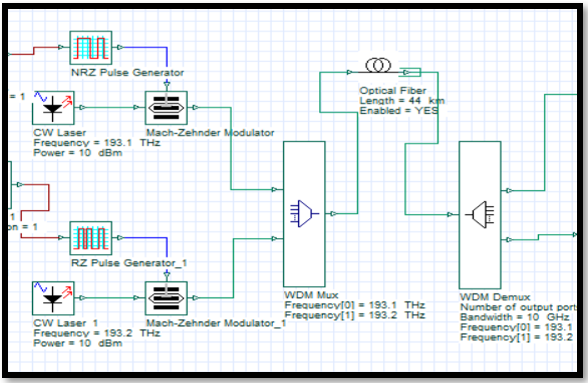
Figure 1 shows two transmitters operating at different wavelengths that were built to represent WDM technology.
Figure 1. Wavelength division multiplexing (WDM) technology simulation
5.1.1 Data generation and encoding
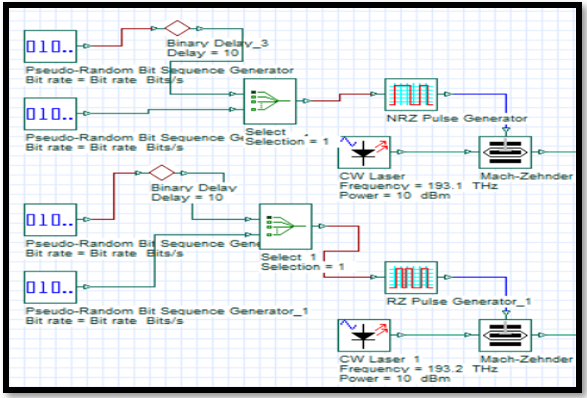
A pseudo-random bit sequence generator was used to generate random data, followed by a binary delay to ensure data was not duplicated between channels. External Modulation: The electrical signals were combined with a continuous wave (CW) laser signal via an MZM to ensure signal stability and minimize chirp.
Pulse Generation: Two modulation methods were applied for comparison; the first used NRZ, while the second used RZ. Each simulation scenario was run five times with different pseudo-random bit sequences and the average Q-factor and BER values were reported to verify the reproducibility of results. After execution, slight numerical differences in the Q-factor and BER were observed between runs due to the random data patterns. These differences did not affect the ranking and performance between the NRZ and RZ modulation formats. The values mentioned represent typical results obtained under identical simulation settings.
5.1.2 Multiplexing and transmission over optical fiber
After signal generation, the WDM channels were multiplexed using a WDM Mux at frequencies starting from 193.1 THz and with a defined frequency spacing. The multiplexed signals were transmitted over the single-mode optical fiber (SMF). The fiber parameters were tuned to simulate the actual attenuation and dispersion experienced by the signal in long-distance PON networks.
5.1.3 Signal distribution and reception (De-Mux and time division multiplexing splitting)
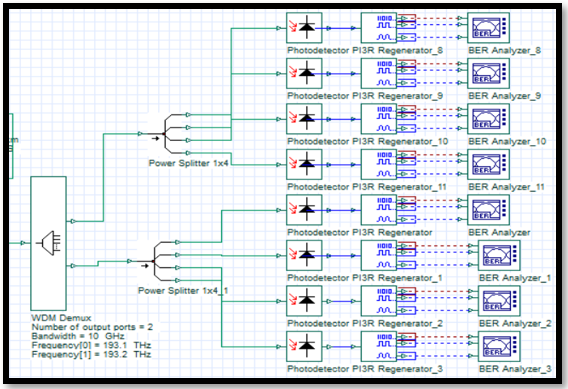
At the end of the link, the signal is divided to reach the end users and the De-Mux separates the wavelengths and sends each wavelength to a specific branch. Figure 2 shows that the power splitter in each branch is used to represent TDM technology, where each wavelength is distributed among the users (ONUs), thus increasing the network's total capacity to serve a large number of subscribers.
Figure 2. Time division multiplexing (TDM) technology simulation
5.1.4 Receiver and performance analysis unit
Figure 3 shows a receiver unit for each user (ONU) that was designed, consisting of a PIN photodetector to convert the returning optical signal into an electrical signal. 3R regenerator was used to restore the shape of the electrical pulse and reduce noise. Each user was connected to a BER analyzer to obtain accurate values for the Q-factor and BER, which are the primary parameters upon which the research will rely to compare the performance of the NRZ and RZ over the specified distance.
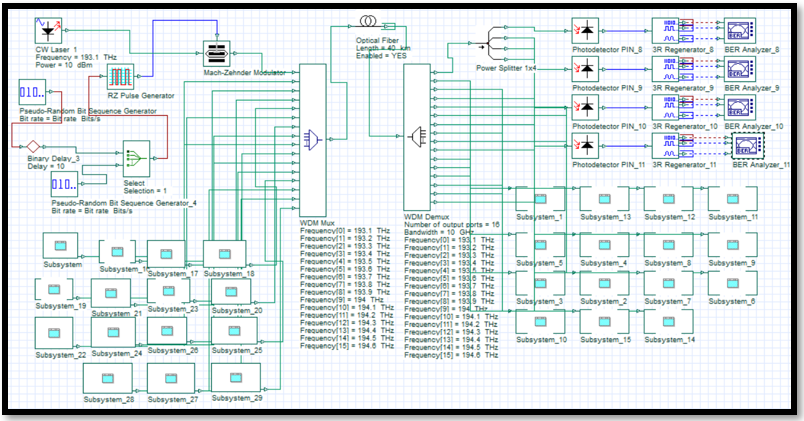
Figure 4 shows the possibility of using 16 channels simultaneously and studying the characteristics of the transmitted optical signal in terms of signal Q-factor and BER, and comparing the behavior of the two modulation formats.
Figure 3. Power splitter and receiver part simulation
Tables 2 and 3 present the simulation results for the NRZ and RZ formats, respectively, providing the basis for comparing their transmission performance.
Table 2. The simulation results for hybrid WDM–TDM PON with NRZ modulation format
|
Laser Power |
Fiber Length |
Q-Factor |
BER |
Received Signal Status |
|
5 dBm |
10 km |
6.04 |
5.75 × 10⁻¹⁰ |
Accepted |
|
5 dBm |
10 km |
6.12 |
3.57 × 10⁻¹⁰ |
Accepted |
|
5 dBm |
10 km |
6.04 |
6.16 × 10⁻¹⁰ |
Accepted |
|
5 dBm |
10 km |
6.09 |
4.58 × 10⁻¹⁰ |
Accepted |
|
5 dBm |
25 km |
4.85 |
5.17 × 10⁻⁷ |
Not Accepted |
|
5 dBm |
25 km |
5.47 |
1.83 × 10⁻⁸ |
Not Accepted |
|
5 dBm |
25 km |
5.07 |
1.67 × 10⁻⁷ |
Not Accepted |
|
5 dBm |
25 km |
4.71 |
1.11 × 10⁻⁶ |
Not Accepted |
|
10 dBm |
40 km |
5.95 |
9.6 × 10⁻⁸ |
Critical |
|
10 dBm |
40 km |
6.23 |
1.6 × 10⁻¹⁰ |
Accepted |
|
10 dBm |
40 km |
6.07 |
4.74 × 10⁻¹⁰ |
Accepted |
|
10 dBm |
40 km |
5.86 |
1.75 × 10⁻⁹ |
Critical |
Table 3. The simulation results for hybrid WDM–TDM PON with RZ modulation format
|
Laser Power |
Fiber Length |
Q-Factor |
BER |
Received Signal Status |
|
5 dBm |
10 km |
6.84 |
3.6 × 10⁻¹² |
Accepted |
|
5 dBm |
10 km |
7.14 |
4.2 × 10⁻¹³ |
Accepted |
|
5 dBm |
10 km |
7.48 |
3.5 × 10⁻¹⁴ |
Accepted |
|
5 dBm |
10 km |
7.13 |
4.8 × 10⁻¹³ |
Accepted |
|
5 dBm |
25 km |
4.48 |
3.57 × 10⁻⁶ |
Not Accepted |
|
5 dBm |
25 km |
4.52 |
2.9 × 10⁻⁶ |
Not Accepted |
|
5 dBm |
25 km |
4.59 |
2.15 × 10⁻⁶ |
Not Accepted |
|
5 dBm |
25 km |
4.5 |
3 × 10⁻⁶ |
Not Accepted |
|
10 dBm |
40 km |
8.3 |
2.37 × 10⁻¹⁷ |
Best Result |
|
10 dBm |
40 km |
8.43 |
1.5 × 10⁻¹⁷ |
Best Result |
|
10 dBm |
40 km |
8.65 |
2.24 × 10⁻¹⁸ |
Best Result |
|
10 dBm |
40 km |
8.43 |
1.46 × 10⁻¹⁷ |
Best Result |
6.1 Simulation results analysis
6.1.1 Signal quality factor analysis
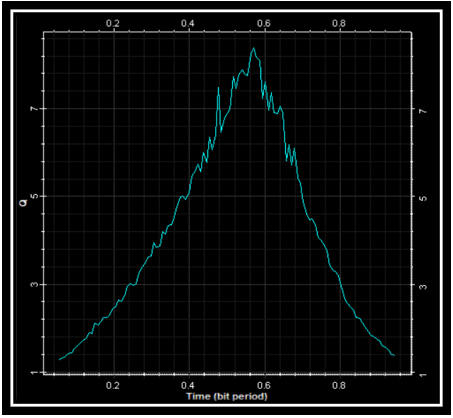
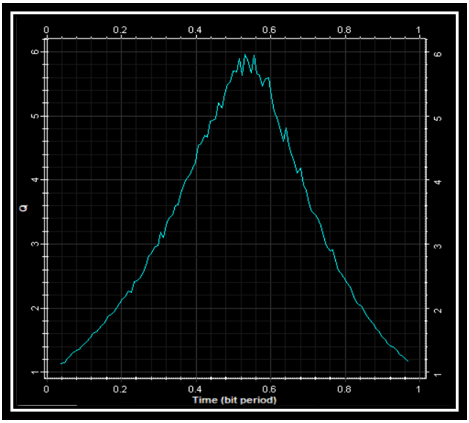
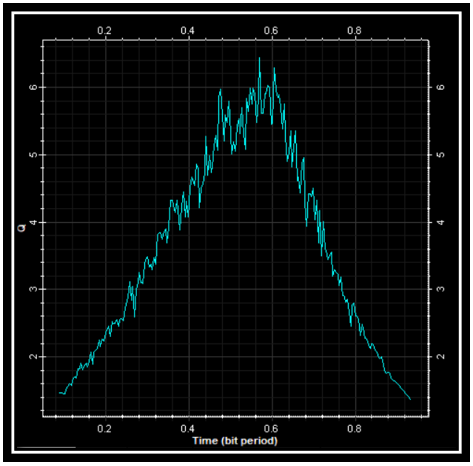
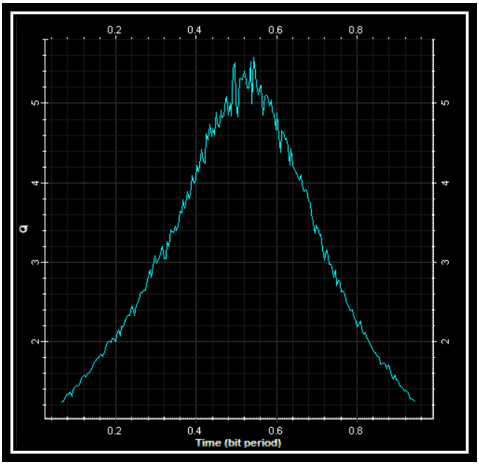
The Q-factor is a key indicator of signal performance; a higher value means higher quality of the detected signal. At a distance of 10 km (5 dBm), RZ significantly outperforms NRZ, with values ranging from 6.84 to 7.48, compared to NRZ, which ranged from 6.04 to 6.12.
At a distance of 40 km (10 dBm), the difference is even more pronounced in favor of RZ, with very high values ranging from 8.3 to 8.65, while NRZ remained in the range of 5.86 to 6.23 as shown in Figure 5.
The high value of the Q-factor for the optical signal at the receiver using the RZ modulation format is shown in Figure 5(a). The significant decrease in the signal Q-factor when we use the NRZ format is shown in Figure 5(b).
(a) Q-factor for RZ format (40 km, 10 dBm)
(b) Q-factor for NRZ format (40 km, 10 dBm)
6.1.2 Bit error rate analysis
BER represents the accuracy of data transmission and lower values indicate better performance.
Overall, the RZ format reveals significantly higher stability and efficiency in reducing errors. For example, at a distance of 10 km, RZ achieved a low error rate of 3.5 × 10⁻¹⁴, while NRZ recorded very high values (technically unacceptable in real-world systems), reaching 6.16 × 10⁻¹⁰. At a longer distance of 40 km, the RZ format maintained exceptional quality with an error rate of 2.24 × 10⁻¹⁸, while NRZ exhibited significant fluctuations and reading failures with high error rates.
6.1.3 Eye diagram analysis
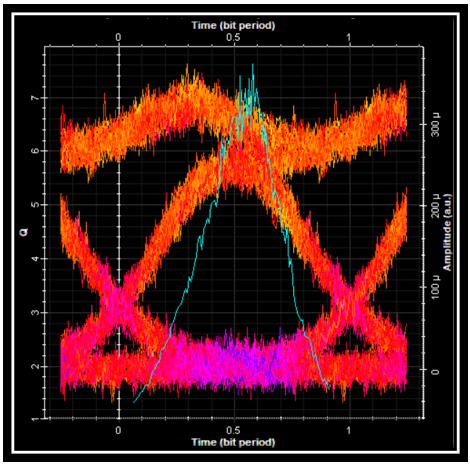
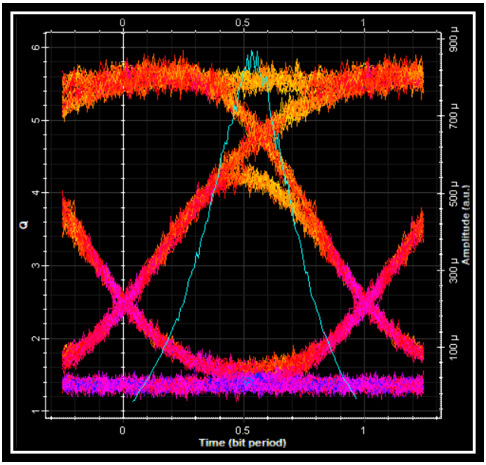
An analysis of the eye diagram for each modulation format, as shown in Figure 6, reveals the following:
The eye diagram for the RZ format displays a very clear eye opening that is wide both horizontally and vertically, with a relatively low and concentrated noise level. The pulses are sharp and well separated in the time domain. This wide eye opening signifies a high capability to distinguish the signal from noise, resulting in a significantly low BER and a very high Q-factor, as indicated in the research findings. RZ scheme creates a temporal safety margin between successive pulses, effectively mitigating the ISI caused by fiber dispersion over a 40 km distance.
However, this format has drawbacks such as high bandwidth; narrow RZ pulses necessitate a wider bandwidth, double that required by NRZ, to transmit the same amount of data. So, there is the issue of equipment complexity, as the design of RZ modulators and demodulators is more complex and costly.
In the NRZ format, the eye diagram yields a much narrower eye opening compared to RZ overlap, filling part of the opening, and the transition slopes between levels appear thicker and noisier.
Drawbacks of this format are poor long-distance performance; the narrow eye opening and significant distortion lead to a high BER and a drastic reduction in Q-factor, rendering it a marginal or unacceptable choice. Also, the close proximity of pulses makes it highly susceptible to ISI caused by CD in optical fibers, the primary cause of eye quality degradation.
In summary, eye diagram analysis validates that the RZ format vastly outperforms NRZ in a hybrid WDM–TDM PON environment over a 40 km span, delivering exceptional signal quality at the cost of increased bandwidth requirements and equipment complexity.
(a) Eye diagram for RZ format (40 km, 10 dBm)
(b) Eye diagram for NRZ format (40 km, 10 dBm)
6.2 Hybrid WDM–TDM PON with 16 channels
Within the 16-channel hybrid WDM–TDM PON scenario, Table 4 presents the simulation results for the NRZ and RZ modulation formats, while Figure 7 provides a comparative analysis of the Q-factor.
(a) Q-factor for the RZ format (30 km, 10 dBm, 16 channels)
(b) Q-factor for the NRZ format (30 km, 10 dBm, 16 channels)
Table 4. Simulation results for hybrid WDM–TDM PON with 16 channels
|
Modulation |
Laser Power |
Fiber Length |
Q-Factor |
BER |
Received Signal Status |
|
NRZ |
10 dBm |
30 km |
5.58 |
1.07 × 10⁻⁸ |
Not Accepted |
|
RZ |
10 dBm |
30 km |
6.44 |
5.73 × 10⁻¹¹ |
Accepted |
Compensating for attenuation by increasing the transmission power (5–10 dBm) allows for network reach extension. At the input power of 5 dBm, the inverse relationship between distance and quality was confirmed, and signal quality decreased with increasing distance (10–25 km). For RZ modulation efficiency and under the investigated operating conditions, our results reveal that the RZ mode effectively resists dispersion over long distances (40 km) provided a sufficient transmission power of 10 dBm, achieving an optimal Q-factor above 8.6 and negligible BER. The BER value is extremely low and it is a simulation-derived value, so it may not be achievable in real systems.
This study encountered some challenges due to the use of OptiSystem 7 software, including practical physical layer defects such as nonlinear optical effects. Component defects, laser phase noise, receiver imperfections, and manufacturing tolerances were neglected. To replicate the results reported in the proposed simulation model, the same study hypotheses must be adopted. In future work, we can explore the use of optical signal amplifiers as an alternative to reduce the transmitted power while maintaining the same simulation setup. Finally, we acknowledge that the practical selection of NRZ or RZ also depends on bandwidth, transceiver complexity, cost, nonlinear effects, hardware limitations, and other system-level considerations that are not fully represented in the present model. For future experiments, a physical optical testbed is essential to confirm these simulation-based findings and to assess the real-world feasibility of RZ-based hybrid PON systems under practical hardware imperfections.
|
NRZ |
Non-return-to-zero |
|
RZ |
Return-to-zero |
|
WDM |
Wavelength division multiplexing |
|
TDM |
Time division multiplexing |
|
PON |
Passive optical network |
|
Q |
Quality |
|
BER |
Bit error rate |
|
IoT |
Internet of Things |
|
IUI |
Inter-user interference |
|
RISs |
Reconfigurable intelligent surfaces |
|
ISI |
Inter symbol interference |
|
OANs |
Optical access networks |
|
CWDM |
Coarse wavelength division multiplexing |
|
OSNR |
Optical signal-to-noise ratio |
|
FTTX |
Fiber to the X |
|
CD |
Chromatic dispersion |
|
DFB |
Distributed feedback |
|
CW |
Continuous wave |
|
OLT |
Optical line terminal |
|
DBA |
Dynamic bandwidth allocation |
|
ONU |
Optical network unit |
|
MZM |
Mach-Zehnder modulator |
[1] Ali, S.H., Jalal, S.K., Sadeq, J.M., Yousif, R.Z. (2026). High-speed spectrally efficient duobinary-precoded NRZ free-space optical links with adaptive optical gain control under extreme atmospheric attenuation. Journal of Optical Communications. https://doi.org/10.1515/joc-2026-0026
[2] Awad, S. (2026). Pulse generator applications in optical communication systems. AURUM Journal of Engineering Systems and Architecture, 10(1): 21-35. https://doi.org/10.53600/ajesa.1683167
[3] Qeryaqos, B.J., Ayoob, S.A. (2025). Improving SINR with smart RIS solutions: Exploring optimal dimensions and sizes. International Journal of Microwave and Wireless Technologies, 17(1): 1-10. https://doi.org/10.1017/S1759078725000169
[4] Nyachionjeka, K., Makondo, W. (2014). Effects of modulation techniques (Manchester code, NRZ or RZ) on the operation of hybrid WDM/TDM passive optical networks. International Scholarly Research Notices, 2014(1): 984157. https://doi.org/10.1155/2014/984157
[5] Garg, A.K. (2022). Fully flexible remote node based energy-efficient and scalable hybrid WDM-TDM optical access network with broadcasting capability. Optical and Quantum Electronics, 54: 296. https://doi.org/10.1007/s11082-022-03689-6
[6] Kavitha, T., Arulmary, A., Nagarajan, P. (2020). Radio over fiber on gigabit passive optical network using QPSK modulation scheme. Journal of Optical Communications, 44(s1): s1023-s1027. https://doi.org/10.1515/joc-2020-0232
[7] Amer, A.A., Abdulelah, A., Mashkor, A.A., Sabbar, A. (2022). Enhancement of traveling wave semiconductor optical amplifier approach for DWDM communication system. Indonesian Journal of Electrical Engineering and Computer Science, 28(3): 1541-1547. https://doi.org/10.11591/ijeecs.v28.i3.pp1541-1547
[8] Ali, M. (2025). Mitigation of Rayleigh backscattering in WDM passive optical access networks. International Journal of Advanced Engineering, Management and Science, 11(2): 157-170. https://doi.org/10.22161/ijaems.112.14
[9] Sachdeva, S., Sindhwani, M., Kaur, S., Kumar, A., Adhikari, M.S. (2022). Hybrid OCSS/RF system employing wavelength division multiplexing and modulation transmitter diversity. Journal of Optical Communications, 45(s1): s1113-s1120. https://doi.org/10.1515/joc-2022-0314
[10] Garg, R., Kaur, G., Kumar, N. (2022). Reach enhanced Is-OWC system using double sideband suppressed (DSS) DP-QPSK. International Journal of Engineering and Manufacturing, 12(5): 48-55. https://doi.org/10.5815/ijem.2022.05.04
[11] Singhal, A., Gupta, A., Bakshi, S. (2020). Optimized dynamic bandwidth allocation algorithm for optical access networks. Journal of Optical Communications, 44(s1): s847-s851. https://doi.org/10.1515/joc-2019-0286
[12] Hamadouche, H., Merabet, B., Bouregaa, M. (2020). The performance comparison of hybrid WDM/TDM, TDM and WDM PONs with 128 ONUs. Journal of Optical Communications, 44(s1): s1241-s1252. https://doi.org/10.1515/joc-2020-0046
[13] Kherici, C., Kandouci, M. (2020). A comparative study of performances between the WDM PON system and the CWDM PON system in an optical access network. Journal of Optical Communications, 44(s1): s815-s821. https://doi.org/10.1515/joc-2019-0248
[14] Azmi, F.H., Naim, N.F., Ya’acob, N., Sarnin, S.S., Supian, L.S. (2023). Design of time division multiplexing/wavelength division multiplexing passive optical network system for high-capacity network. International Journal of Electrical and Computer Engineering, 13(4): 4152-4158. https://doi.org/10.11591/ijece.v13i4.pp4152-4158
[15] Pagare, R.A., Kumar, S., Mishra, A. (2021). Modeling and comparative analysis of all-class converged-coexistence NG-PON2 network for 5G-IoT-FTTX-services and application. Journal of Optical Communications, 45(2): 257-277. https://doi.org/10.1515/joc-2021-0116
[16] Sonia, M.K., Goel, A. (2026). Design and performance evaluation of DWDM systems for high-capacity long-haul optical networks. In Sixth International Conference on Optical and Wireless Technologies (OWT 2025), Goa, India, pp. 115-122. https://doi.org/10.1117/12.3108215
[17] Singhal, A., Gupta, A., Goyal, R., Singh, H., Singhal, T. (2022). Bidirectional TWDM Optical access network with novel dynamic bandwidth allocation and scheduling algorithm. Optical and Quantum Electronics, 54: 422. https://doi.org/10.1007/s11082-022-03818-1
[18] Kumar, D., Garg, A.K., Janyani, V. (2025). A fault-protected SMF/FSO ring-based pay as you grow hybrid wavelength division multiplexing and time division multiplexing optical network. Optical and Quantum Electronics, 57: 604. https://doi.org/10.1007/s11082-025-08518-0
[19] Taha, T.A., Ayoob, S.A., Yaseen, M.T. (2025). The effect of the magnetic-field on the transmission of the optical signal in the optical fiber. Mathematical Modelling of Engineering Problems, 12(2): 669-675. https://doi.org/10.18280/mmep.120230
[20] Dhaini, A.R., Assi, C.M., Maier, M., Shami, A. (2007). Dynamic wavelength and bandwidth allocation in Hybrid TDM/WDM EPON networks. Journal of Lightwave Technology, 25(1): 277-286. https://doi.org/10.1109/JLT.2006.886683
[21] Taha, T.A., Ayoob, S.A., Yaseen, M.T. (2023). Raman/EDFA hybrid system to enhance the optical signal in the optical network. Journal of Communications, 18(10): 621-628. https://doi.org/10.12720/jcm.18.10.621-628