Chafai Bechtella* | Ouassila Bahloul | Samir Benmoussa | Assia Aidoud
© 2026 The authors. This article is published by IIETA and is licensed under the CC BY 4.0 license (http://creativecommons.org/licenses/by/4.0/).
OPEN ACCESS
Salt-rich sabkha soils (SSs) present a persistent challenge for infrastructure development in arid and semi-arid regions due to their high soluble salt content, elevated electrical conductivity (EC), and weak mechanical strength. This study investigates enhancing the geotechnical performance of Djendli SS, Batna (Algeria), through stabilization with a cement (C) ceramic waste (CW) blend. Physicochemical characterization included pH measurement, EC analysis, and mechanical properties by standard Proctor compaction and unconfined compressive strength (UCS) testing. In this framework, soil samples were stabilized with 2% cement and varying CW contents ranging from 5% to 20%. The experimental data reveal that the SS + 2% C + 20% CW formulation yielded the most substantial improvements in soil densification, as evidenced by a marked increase in maximum dry density (MDD) from 15.50 kN/m³ to 15.81 kN/m³. The UCS values reached 1200 kPa after 28 days of curing. These gains result from a synergy between the immediate hydraulic action of cement and the delayed pozzolanic reactivity of CW, which may promote the formation of calcium silicate hydrate (C-S-H), calcium aluminate hydrate (C-A-H), and calcium aluminosilicate hydrate (C-A-S-H) gels. These findings demonstrate that CW acts as an effective supplementary binder in saline soils, enhancing strength while promoting CW valorization and providing a sustainable, cost-effective solution for improving SSs for engineering applications.
sabkha soil, stabilization, cement, ceramic waste, unconfined compressive strength, mechanical enhancement, valorization
In the ever-evolving field of civil engineering, construction activities in arid and semi-arid regions frequently face significant geotechnical difficulties arising from the presence of sabkha soils (SSs), which represent a critical challenge characterized by extreme salinity and problematic settlement behavior [1]. Widely recognized as one of the most complex and hazardous soil types, these deposits are classified as unpredictable and high-risk due to their inherent salt content and extreme sensitivity to moisture. Consequently, they are considered a primary hazard to the longevity of built environments, necessitating specialized stabilization and design strategies to ensure structural stability in these territories [2, 3]. These soils, commonly encountered in both coastal and inland environments, exhibit specific physicochemical and structural features that are responsible for their weak geotechnical behavior and marked vulnerability to saturation, thereby restricting their suitability for engineering applications and typically necessitating prior treatment to ensure adequate engineering performance. Their low shear strength, high compressibility, and limited bearing capacity render them highly susceptible to collapse when exposed to water [2, 4-6]. The instability is primarily attributed to the dissolution of cementing agents, along with corrosive effects on reinforced concrete and volumetric changes caused by salt crystallization and recrystallization, which may induce heaving [2]. For these reasons, SSs pose serious risks to infrastructure such as roads, buildings, bridges, and dams, and therefore require careful geotechnical assessment and appropriate treatment before construction activities can be safely undertaken [7].
Algeria hosts numerous sabkha areas, particularly in the High Plateaus and the North-East. However, the expansion of the country’s road and highway network frequently requires crossing these sabkha zones, where SSs pose major challenges to the construction, durability, and serviceability of transport infrastructure [8]. These saline depressions present a critical geotechnical hazard due to their low bearing capacity, high compressibility, and chemical instability. According to Al-Amoudi [9], the inherent collapse potential of these saline deposits poses an unacceptable risk to infrastructure, necessitating specialized stabilization or soil improvement to ensure long-term structural durability. Their behavior is further aggravated by drying-wetting cycles, which can induce collapse and significantly modify shear strength, thereby compromising the durability and structural integrity of road embankments and other infrastructure [10, 11]. Consequently, the presence of SSs remains a major constraint on infrastructure development in Algeria and calls for detailed geotechnical assessment together with suitable stabilization measures to ensure long-term performance and safety [12]. These soils, composed of quartz sand and gypsum-rich silt with high salt content, are highly sensitive to moisture and require pre-treatment before construction. Recently, a project involves upgrading the road by duplicating (widening to dual carriageway) the road corridor passing through Chemora and Boumia. The road occupies a strategically important geographic position and carries substantial daily traffic, making capacity enhancement essential to prevent congestion. Algeria's road network development aims not only to meet current demand but also to anticipate future needs, ensuring that infrastructure supports the region's economic and social growth. To render this road fully operational, a rehabilitation program has been proposed for this main route. However, as part of the upgrade project, the road must pass beside the sabkha area of Djendli. Therefore, to identify the causes of these road deteriorations and to develop a solution to ensure road stability and extend the service life of this section of the route, it was considered necessary to investigate the mechanical behavior of SS.
To address these limitations, several researchers have investigated stabilization techniques, revealing two dominant research directions. The first focuses on conventional binder solutions, including cement alone, cement partially replaced by cement kiln dust (CKD), and cement–lime combinations. The second explores newer, lower-carbon alternatives based on geopolymer and alkali-activated binders [13-15]. Furthermore, recent studies have emphasized the need to address these challenges through the assessment of foundation performance on SSs [7] and the characterization of coastal and inland sabkhas.
Previous research has demonstrated that reducing conventional cement content by supplementing it with industrial by-products or waste materials provides an efficient and sustainable solution. No prior research has examined the combination of cement and waste ceramic proposed in this study. The primary novelty of our approach lies in integrating reduced cement with ceramic waste (CW) to address the extreme geotechnical challenges specific to SSs. Moreover, this method is cost-effective, offering a sustainable solution while maintaining or improving the geotechnical properties of the soil. Finally, this approach provides a dual opportunity by valorizing industrial waste and stabilizing problematic soils in an effective and environmentally friendly manner.
2.1 Study area and sabkha soil sampling
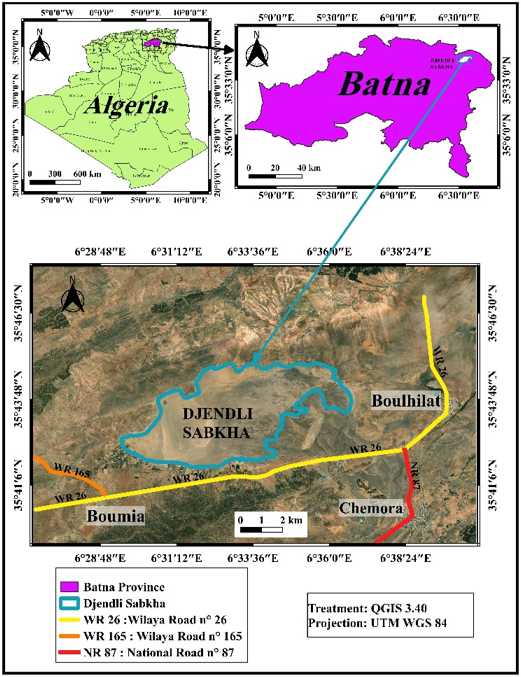
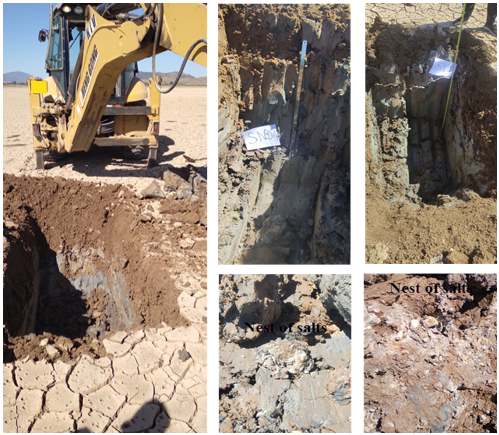
The Sabkha of Djendli is a natural salt lake (latitude: 35°41′N to 35°45′N, longitude: 06°29′E to 06°36′E) located in the municipality of Boumia, with a portion in the municipality of Boulhilet, 46 km northeast of the capital of Batna province in northeastern Algeria. It covers 37 km2 and is bordered by three mountain ranges, Djebel Bou Arif to the south, Djebel Toumbait to the north, and Djebel Tafraout to the west, and opens onto the plains of Boulhilet and Chemora to the east (Figure 1). Given the inherent spatial variability of sabkha deposits, which makes obtaining truly representative samples difficult, sampling was carried out at easily accessible locations considered as the study area for investigation. Two boreholes (S1 and S2) were carried out in open pits using a hydraulic excavator, and from each borehole, soil samples were collected to a depth of 1.70 m in plastic bags (Figure 2). In order to acquire representative soil samples for the various tests, once the pit was dug, samples of each layer were collected, based on the description method of Aiban et al. [16].
Figure 1. Location of the Djendli sabkha
Figure 2. Sabkha soil (SS) collection
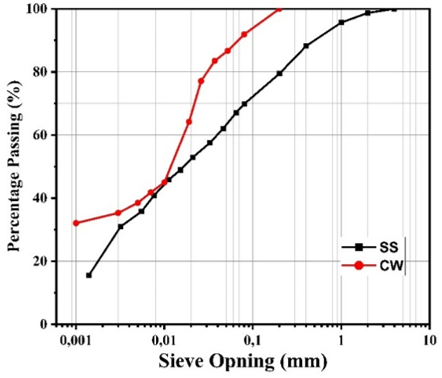
The particle size distribution of the Djendli SS is illustrated in Figure 3. This curve reveals a composition of 1.3% gravel, 28.85% sand, 47.61% silt, and 22.24% clay, with 69.85% of the material passing the 80 μm sieve. According to the classification of the Technical Guide for the Construction of Embankments and Capping Layers (GTR) [17], this soil is categorized as fine clayey sand or silt (class A2), and under the unified soil classification system (USCS) [18], it is classified as medium plasticity sandy lean clay (CL).
Figure 3. Grain size distribution of the Djendli sabkha soil (SS) and ceramic waste (CW)
The Atterberg limits and the compaction characteristics are presented in Table 1. The chemical composition analysis from X-ray fluorescence (XRF) revealed that silica (SiO2), calcium oxide (CaO), and alumina (Al2O3) were the main elements of the Djendli SS (Table 1).
Table 1. Geotechnical properties of Djendli sabkha soil (SS) and ceramic waste (CW)
|
Properties |
Sabkha Soil |
Ceramic Waste |
|
Specific gravity |
2.53 |
2.63 |
|
Maximum dry density (MDD) (kN/m3) |
15.5 |
/ |
|
Optimum moisture content (%) |
24.4 |
/ |
|
Liquid limit (LL) (%) |
48.94 |
/ |
|
Plastic limit (PL) (%) |
27.31 |
/ |
|
Plasticity index (PI) (%) |
21.63 |
/ |
|
Passing < 2 mm (%) |
98.7 |
100 |
|
Passing < 80 µm (%) |
69.85 |
91.9 |
|
Passing < 2 µm (%) |
22.24 |
34.13 |
|
Methylene blue value (MBV) |
1.83 |
0.33 |
|
pH |
8.5 |
9.38 |
|
EC (mS/cm) |
8.22 |
0.14 |
2.2 Ceramic waste and cement
CW mainly comes from manufacturing rejects, construction off-cuts, and demolition debris. It is commonly recycled in geotechnical applications by crushing it into aggregates or grinding it into fine powder, which can then be used for soil stabilization because of its pozzolanic potential [19-21].
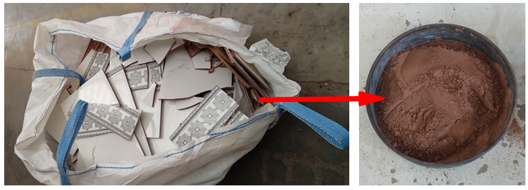
Ceramic tile waste (Figure 4) was converted into ceramic powder through a systematic processing sequence. The process began with the collection of ceramic tile waste, which was subsequently cleaned to remove surface impurities and dried to eliminate residual moisture. The tiles were then crushed into smaller fragments and ground to produce a fine powder. Finally, the ground material was sieved in order to obtain the required particle size distribution. The CW specimen's granulometric analysis, presented in Figure 3, indicates a composition of 8.1% sand, 57.77% silt, and 34.13% clay, with 91.9% of the material passing the 80 μm sieve. On the other hand, Table 2 shows the chemical composition; SiO2 and Al2O3 are the dominant constituents of the CW.
Figure 4. Collection of ceramic waste (CW)
Table 2. Chemical composition of sabkha soil (SS), ceramic waste (CW) and cement
|
Components |
Sabkha Soil |
Ceramic Waste |
Cement |
|
SiO2 |
33.681 |
54.849 |
18.095 |
|
CaO |
13.422 |
4.914 |
61.318 |
|
Al2O3 |
12.165 |
14.764 |
4.452 |
|
SO3 |
5.84 |
0.006 |
2.309 |
|
Fe2O3 |
3.557 |
3.489 |
2.995 |
|
Na2O |
3.516 |
1.079 |
0.08 |
|
MgO |
2.282 |
0.802 |
1.418 |
|
K2O |
1.54 |
3.336 |
0.701 |
|
Cl |
0.453 |
0.01 |
0 |
|
Loss on ignition |
16.32 |
0.58 |
6.28 |
Cement is widely used to stabilize SSs because hydration and pozzolanic reactions form calcium silicate hydrate (C-S-H) and calcium aluminate hydrate (C-A-H) products that improve strength, stiffness, bearing capacity, and moisture resistance [22, 23]. In this study, a locally manufactured Portland composite cement (CIMII/ A-L 42,5 N) was produced at the Aïn Touta plant in Batna, Algeria. As illustrated by the compositional data in Table 2, CaO and SiO2 serve as the major components of this cement, while the high sulfate content still indicates potential durability risks in saline environments; for sustainability, recent research also explores partial replacement of cement with other additives [8, 24].
2.3 Sample preparation
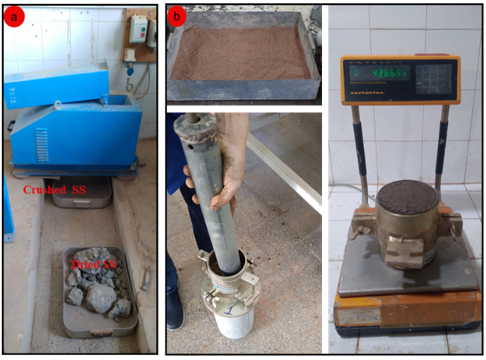
To ensure the reliability of the experimental procedures, the soil samples were homogenized in strict accordance with the process established by Aiban et al. [16]. This systematic approach was employed to obtain a representative material matrix suitable for the various laboratory tests. The samples were air-dried or oven-dried at 105 ℃, and the dried soil was then crushed to break the bonds between particles cemented by salts (Figure 5(a)). The soil was therefore passed through a 5 mm sieve, stored in plastic bags, and subsequently subjected to a detailed experimental program aimed at characterizing its geotechnical and chemical properties.
Figure 5. (a) Crush machine and (b) Proctor test apparatus
2.4 Chemical characterization tests
The chemical composition of the materials studied was determined by XRF spectrometry. Before analysis, the samples were dried, ground, and homogenized to obtain a representative powder suitable for reliable multi-element characterization. The prepared samples were then analyzed to identify the major elemental constituents of the materials [25, 26]. To complement the elemental analysis and provide a broader assessment of soil chemical characteristics, pH and electrical conductivity (EC) were also determined. Soil pH, commonly classified as acidic, neutral, or alkaline, is a key indicator of soil chemical evolution and reflects the concentration of hydrogen ions (H⁺). It includes effective acidity in the soil solution and reserve acidity associated with exchangeable H⁺ ions on soil colloids [27]. The pH of the materials and mixtures was measured under defined conditions using a sample mass (g) to solution volume (mL) ratio of 1:2.5 [28, 29]. In addition, EC was measured as an indicator of the degree of soil salinity because it reflects the concentration of water-soluble ionizable species present in the sample. Accordingly, the EC of the materials and mixtures was determined with a conductivity meter on a sample–water extract prepared at a 1:5 ratio [30, 31].
2.5 Standard Proctor test
The maximum dry density (MDD) and its corresponding optimum moisture content (OMC) of the stabilized SS were determined using a standard Proctor compaction test, conducted in accordance with the NF P94-093 standard [32]. Using a 2.49 kg rammer dropped from a height of 305 mm, air-dried soil that had passed through a 5 mm sieve was combined with predetermined water contents and compacted in a standard mold using 25 blows per layer across three layers. After compaction, the mold was weighed, and samples of the mold's moisture content were taken from layers and oven-dried (Figure 5(b)). To create numerous data points, this process was repeated with incrementally increased water content in order to establish the dry density versus moisture content curve, identifying the peak values.
2.6 Unconfined compressive strength test
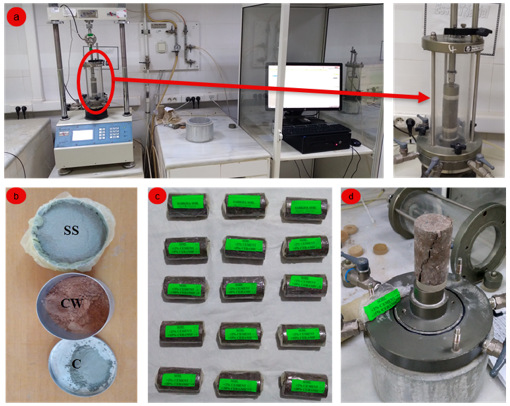
To evaluate the mechanical performance of the treated SS, an unconfined compressive strength (UCS) test was performed following ASTM D2166 [33] and the specimen preparation protocol proposed by Kafodya and Okonta [34]. Soil samples were prepared by mixing dry material with water at the OMC established from compaction testing, followed by static compaction into cylindrical molds (37.5 mm in diameter and 75 mm in height) in four equal layers, while the interface of each layer was scarified to enhance inter-layer bonding. After extraction using a hydraulic device, the specimens were sealed in plastic film to mitigate moisture loss and cured under controlled laboratory conditions for 7, 14, and 28 days. Testing was performed using an axial loading machine at a strain rate of 1 mm/min, with force-strain data logged via a computerized acquisition system (Figure 6).
Figure 6. Unconfined compressive strength (UCS) test apparatus: (a) axial loading machine, (b) materials, (c) samples before testing, and (d) sample after testing
3.1 Effect of ceramic waste and cement on pH and electrical conductivity
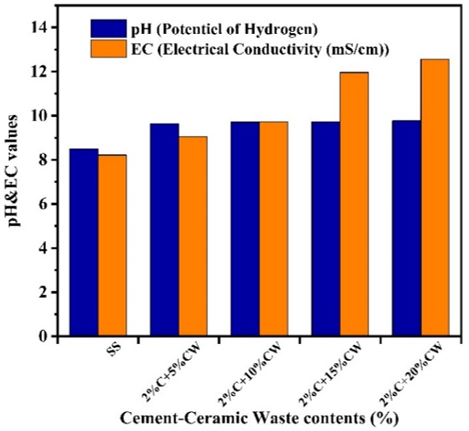
The evolution of pH and EC of the untreated and treated SS mixtures is presented in Figure 7. The untreated SS exhibited a pH of 8.5 and an EC of 8.22 mS/cm, reflecting its naturally alkaline and highly saline character, consistent with the physicochemical properties typically reported for sulfate- and carbonate-rich sabkha deposits.
Figure 7. pH and electrical conductivity (EC) of different sabkha-cement-ceramic waste (CW) mixtures
Upon addition of 2% C + 5% CW, the pH increased markedly to 9.63, and continued to rise progressively with increasing CW content, reaching 9.77 for the mixture containing SS + 2% C + 20% CW (a variation of only +0.14 pH units). The liberation of hydroxyl ions (OH⁻) and calcium ions (Ca²⁺) raises the pH of the pore solution, creating a strongly alkaline environment conducive to both cationic exchange reactions with clay minerals and the activation of pozzolanic reactions in the CW. This systematic alkalinisation of the pore environment is primarily driven by the hydration of cement clinker phases, which releases calcium hydroxide, Ca(OH)₂, into the interstitial solution according to the following reaction:
$\mathrm{C}_3 \mathrm{S}+\mathrm{H}_2 \mathrm{O} \rightarrow \mathrm{C}-\mathrm{S}-\mathrm{H}+\mathrm{Ca}(\mathrm{OH})_2$ (1)
Rather than reflecting a simple dilution effect, this plateau behavior indicates that the reactive SiO₂ and Al₂O₃ phases of the CW are actively consuming the portlandite released by cement hydration through the following pozzolanic reaction:
$\begin{gathered}\mathrm{SiO}_2+\mathrm{Al}_2 \mathrm{O}_3(\mathrm{CW})+\mathrm{Ca}(\mathrm{OH})_2+\mathrm{H}_2 \mathrm{O}\rightarrow \mathrm{C}-\mathrm{A}-\mathrm{S}-\mathrm{H}\end{gathered}$ (2)
The EC increased progressively from 8.22 mS/cm for the untreated soil to 12.55 mS/cm for the mixture containing SS + 2% C + 20% CW, representing an overall increase of 53%. This monotonic rise in EC reflects the continuous enrichment of the pore solution with ionic species originating from three concurrent sources, the hydration of cement clinker, which releases Ca²⁺, OH⁻, K⁺, Na⁺, and SO₄²⁻ ions into solution, the partial dissolution of the native soluble salts of the SS (NaCl, Na₂SO₄, MgSO₄, CaSO₄) facilitated by mixing with water [35, 36], and the liberation of alkali ions (K⁺, Na⁺) adsorbed on the vitreous surface phases of the finely ground CW particles [37]. The quasi-linear relationship between EC and CW content suggests that, at early curing ages, the release of soluble ionic species from cement hydration and the partial dissolution of CW may exceed their incorporation into insoluble hydration products. This interpretation is consistent with Chen et al. [37], who showed that pH and Ca²⁺ concentration strongly influence early cement hydration and C-S-H precipitation, and with Barreto et al. [38] and Li et al. [39], who reported the pozzolanic contribution of CW in cementitious systems. As curing progresses, continued hydration and pozzolanic reactions may promote the formation of secondary C-S-H, C-A-H, and calcium aluminosilicate hydrate (C-A-S-H) gels, progressively binding or consuming free ions in the pore solution. Overall, the simultaneous increases in pH and EC indicate that the cement-CW treatment substantially modifies the chemical environment of the SS, promoting the development of a denser and more chemically stable cementitious matrix.
3.2 Effect of ceramic waste and cement on compaction characteristics
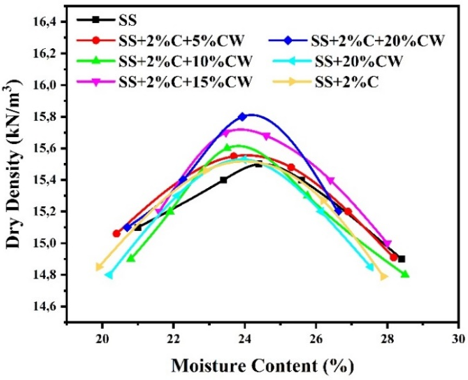
The compaction characteristics of the untreated and treated SS mixtures, determined from standard Proctor tests, are shown in Figure 8. The untreated SS exhibited a MDD of 15.50 kN/m³ and an OMC of 24.4%. The progressive addition of CW from 5% to 20% at a fixed cement content of 2% slightly improved the compaction characteristics of the SS, as evidenced by the increase in MDD from 15.50 kN/m3 to 15.81 kN/m3 while the OMC followed a non-monotonic trend, decreasing from 24.40% to a minimum of 23.83% at the mixture SS + 2% C + 10% CW before slightly recovering to 24.18% at 20% CW. A reasonable explanation is the higher specific gravities of cement (3.15) and CW (2.63) compared with the natural SS (2.53), which increased the average unit weight of the solid phase and favored a denser soil skeleton. In addition, CW likely acted as a filler material, improving particle-size distribution, reducing void ratio, and lowering the water-holding capacity of the mixture; similar trends, namely decreasing OMC and increasing MDD with CW incorporation, have been reported in stabilized soils by Md Isa et al. [40]. The non-monotonic variation in OMC can be attributed to the interaction of two competing mechanisms. The initial decrease in OMC from 24.40% to 23.83% between 0% and 10% CW is consistent with the cement-induced reduction in water demand; hydration reactions and clay-particle flocculation reduce the amount of free water needed, thereby lowering the water demand for optimum compaction. The slight increase in OMC from 23.83% to 24.18% between 10% and 20% CW is caused by the high specific surface area of the fine CW. As more CW is added, these particles adsorb more water, which offsets the water-reducing properties typically provided by the cement. Overall, the improvement in compaction characteristics confirms that the combined cement-CW system enhances the densification potential of the SS, establishing a more compact and structurally favorable initial state for subsequent strength development.
Figure 8. Compaction characteristics of untreated and treated sabkha soil (SS) with cement and ceramic waste (CW)
3.3 Effect of ceramic waste and cement on unconfined compressive strength test
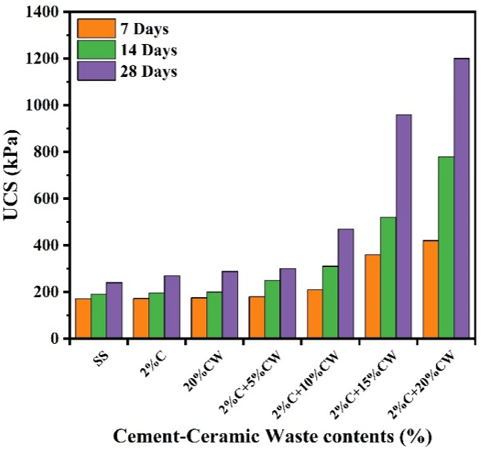
Figure 9 illustrates the UCS results at 7, 14, and 28 days of curing. All treated mixtures demonstrated substantially higher UCS values than the untreated soil at every curing age, with strength increasing progressively with both CW content and curing time. It is noted that the individual application of either 20% CW or 2% cement yielded only marginal improvements. The most significant enhancement was observed for the SS + 2% C + 20% CW mixture, which achieved UCS values of 420, 780, and 1200 kPa at 7, 14, and 28 days, respectively, corresponding to an overall 28-day improvement of 605% over the untreated soil baseline (240 kPa). The increase in UCS is typical of cement-treated soils and is generally attributed to the continuation of hydration and secondary pozzolanic reactions, which progressively generate cementitious products such as C-S-H, reduce porosity, and strengthen interparticle bonding within the soil matrix [40]. The current results therefore confirm that 20% CW combined with 2% cement represents the ideal formulation for the stabilization of Djendli SS, delivering both maximum mechanical performance and the most efficient utilization of the pozzolanic potential of the CW. Overall, the present trend is consistent with previous studies on sabkha and other problematic soils, where cement-based stabilization combined with waste-derived additives led to substantial UCS gains and a marked improvement in structural integrity under unconfined compression [13].
Figure 9. Unconfined compressive strength (UCS) of untreated and treated sabkha soil (SS) at 7, 14, and 28 days of curing
This study demonstrates that the combined use of recycled CW and moderate cement content provides an effective and sustainable solution for stabilizing saline SSs from the Djendli region in Batna province, Algeria. The most effective binder formulation (SS + 2% C + 20% CW) significantly enhanced compaction and mechanical performance, increasing the MDD and producing a fivefold increase in UCS. Beyond the marked mechanical gains, the incorporation of CW promotes waste valorization and reduces reliance on conventional binders. Overall, this approach offers a scalable, cost-effective, and environmentally responsible method for upgrading salt-affected SSs into durable engineering materials suitable for infrastructure development in arid and semi-arid regions. However, the elevated sulfate content of SSs raises concerns regarding delayed ettringite formation, warranting further durability investigation. Further studies should investigate durability aspects, including delayed ettringite formation and the physical filler effect responsible for reducing interparticle voids.
[1] Moon, J.S., Jung, H.S., Lee, S., Kang, S.T. (2019). Ground improvement using dynamic compaction in Sabkha deposit. Applied Sciences, 9(12): 2506. https://doi.org/10.3390/app9122506
[2] Abduljauwad, S.N., Al-Amoudi, O.S.B. (1995). Geotechnical behaviour of saline sabkha soils. Geotechnique, 45(3): 425-445. https://doi.org/10.1680/geot.1995.45.3.425
[3] Abdullah, G.M.S. (2023). Performance of enhanced problematic soils in roads pavement structure: Numerical simulation and laboratory study. Sustainability, 15(3): 2595. https://doi.org/10.3390/su15032595
[4] Amin, A. (2004). Comparative study of the geotechnical properties of the coastal Sabkhas of Saudi Arabia and their hazardous effects. Bulletin of Engineering Geology and the Environment, 63(4): 309-314. https://doi.org/10.1007/s10064-004-0254-5
[5] Alshenawy, A.O., Hamid, W.M., Alnuaim, A.M. (2021). A review on the characteristics of sabkha soils in the Arabian Gulf Region. Arabian Journal of Geosciences, 14(19): 2018. https://doi.org/10.1007/s12517-021-08275-w
[6] Al-Amoudi, O.S.B., Abduljauwad, S.N., El-Naggar, Z.R. (1992). Response of sabkha to laboratory tests: A case study. Engineering Geology, 33(2): 111-125. https://doi.org/10.1016/0013-7952(92)90003-H
[7] Elsawy, M., Lakhouit, A., Alahmari, T.S., Abdelmeguid, H., Shaban, M. (2025). Performance assessment of a foundation resting on reinforced collapsible Sabkha soil by deep soil mixing columns using machine learning analyses. Alexandria Engineering Journal, 118: 591-605. https://doi.org/10.1016/j.aej.2025.01.047
[8] Kitchah, M., Bahloul, O., Aidoud, A., Bencheikh, M. (2025). Synergistic influence of cement–lime stabilization on the mechanical properties and mineralogical changes of Sabkha soils from Aïn M'lila. Annales de Chimie. Science des Materiaux, 49(5): 505-514. https://doi.org/10.18280/acsm.490506
[9] Al-Amoudi, O.S.B. (2002). Characterization and chemical stabilization of Al-Qurayyah sabkha soil. Journal of Materials in Civil Engineering, 14(6): 478-484. https://doi.org/10.1061/(ASCE)0899-1561(2002)14:6(478)
[10] Hafhouf, I., Bahloul, O., Abbeche, K. (2022). Effects of drying-wetting cycles on the salinity and the mechanical behavior of sebkha soils. A case study from Ain M'Lila, Algeria. Catena, 212: 106099. https://doi.org/10.1016/j.catena.2022.106099
[11] Hafhouf, I., Abbeche, K. (2023). Impact of drying-wetting cycles on shear properties, suction, and collapse of Sebkha soils. Heliyon, 9(2): e13594. https://doi.org/10.1016/j.heliyon.2023.e13594
[12] Messad, A., Yahia Debbab, O., Moussai, B. (2019). Effect of water salinity on the compaction of Sabkha soils. In IOP Conference Series: Materials Science and Engineering, Kuala Lumpur, Malaysia, 527: 012008. https://doi.org/10.1088/1757-899X/527/1/012008
[13] Al-Homidy, A.A., Dahim, M.H., Abd El Aal, A.K. (2017). Improvement of geotechnical properties of sabkha soil utilizing cement kiln dust. Journal of Rock Mechanics and Geotechnical Engineering, 9(4): 749-760. https://doi.org/10.1016/j.jrmge.2016.11.012
[14] Hamid, W., Alnuaim, A. (2023). Evaluation of the durability and strength of stabilized sabkha soil with geopolymer. Case Studies in Construction Materials, 18: e02051. https://doi.org/10.1016/j.cscm.2023.e02051
[15] Hamid, W.M., Alnuaim, A.M., Alshenawy, A.O. (2023). Effect of alkali activated materials in stabilizing sabkha soil. In Smart Geotechnics for Smart Societies, pp. 551-556.
[16] Aiban, S.A., Al-Ahmadi, H.M., Asi, I.M., Siddique, Z.U., Al-Amoudi, O.S.B. (2006). Effect of geotextile and cement on the performance of sabkha subgrade. Building and Environment, 41(6): 807-820. https://doi.org/10.1016/j.buildenv.2005.03.006
[17] GTR. (1992). Technical guide for the creation of embankments and subgrade layers. France: Laboratoire Central des Ponts et Chaussées. https://www.scirp.org/reference/referencespapers?referenceid=3638792.
[18] ASTM D2487-17. (2025). Standard practice for classification of soils for engineering purposes (unified soil classification system). ASTM International, West Conshohocken. https://doi.org/10.1520/D2487-17R25
[19] Cabalar, A.F., Hassan, D.I., Abdulnafaa, M.D. (2017). Use of waste ceramic tiles for road pavement subgrade. Road Materials and Pavement Design, 18(4): 882-896. https://doi.org/10.1080/14680629.2016.1194884
[20] Chen, J.A., Idusuyi, F.O. (2015). Effect of waste ceramic dust (WCD) on index and engineering properties of shrink-swell soils. International Journal of Engineering and Modern Technology, 1(7): 1-11.
[21] Pelisser, F., Steiner, L.R., Bernardin, A.M. (2012). Recycling of porcelain tile polishing residue in Portland cement: Hydration efficiency. Environmental Science & Technology, 46(4): 2368-2374. https://doi.org/10.1021/es203118w
[22] ASTM C150/C150M-24. (2022). Standard specification for portland cement. ASTM International, West Conshohocken, PA, USA. https://doi.org/10.1520/C0150_C0150M-24
[23] Nasr, A.M.A. (2015). Geotechnical characteristics of stabilized Sabkha soils from the Egyptian–Libyan coast. Geotechnical and Geological Engineering, 33(4): 893-911. https://doi.org/10.1007/s10706-015-9872-x
[24] Kitchah, M., Bahloul, O., Bencheikh, M., Aidoud, A., Lekouara, L. (2026). Enhancing the geotechnical properties of sabkha soil using cement and lime through experimental approach and optimization. Indian Geotechnical Journal, 1-22. https://doi.org/10.1007/s40098-025-01454-6
[25] Croffie, M.E.T., Williams, P.N., Fenton, O., Fenelon, A., Metzger, K., Daly, K. (2020). Optimising sample preparation and calibrations in EDXRF for quantitative soil analysis. Agronomy, 10(9): 1309. https://doi.org/10.3390/agronomy10091309
[26] Fedeli, R., Di Lella, L.A.D., Loppi, S. (2024). Suitability of XRF for routine analysis of multi-elemental composition: A multi-standard verification. Methods and Protocols, 7(4): 53. https://doi.org/10.3390/mps7040053
[27] Mathieu, C., Pieltain, F., Jeanroy, E. (2003). Chemical Analysis of Soils: Selected Methods. Tec & Doc Paris.
[28] Centre d'Expertise en analyse environnementale du Québec. (2023). Ministry of the Environment, the Fight Against Climate Change, Wildlife and Parks. https://www.ceaeq.gouv.qc.ca/index.asp.
[29] Williams, I.I. (2001). Environmental Chemistry: A Modular Approach. John Wiley & Sons.
[30] He, Y.B., DeSutter, T., Prunty, L., Hopkins, D., Jia, X.H., Wysocki, D.A. (2012). Evaluation of 1:5 soil to water extract electrical conductivity methods. Geoderma, 185-186: 12-17. https://doi.org/10.1016/j.geoderma.2012.03.022
[31] Nilo, G., Bernaldo, B., Boukbida, H.A., Espinosa, J., Mooketsi-Selepe, L. (2021). Standard Operating Procedure for Soil Electrical Conductivity, Soil/Water, 1:5. FAO, Rome, Italy, pp. 1-15. http://www.fao.org/3/cb3354en/cb3354en.pdf.
[32] NF P94-093. (1999). Soils: Investigation and testing-determination of the compaction reference values of a soil type-standard proctor test-modified proctor test. AFNOR. https://www.boutique.afnor.org/en-gb/standard/nf-p94093/soils-investigation-and-testing-determination-of-the-compaction-reference-v/fa185491/43924.
[33] ASTM D2166. (2016). Standard test method for unconfined compressive strength of cohesive soil. ASTM International, West Conshohocken, PA, USA. https://doi.org/10.1520/D2166-06
[34] Kafodya, I., Okonta, F. (2018). Density control method for compression test of compacted lime-flyash stabilised fiber-soil mixtures. MethodsX, 5: 848-856. https://doi.org/10.1016/j.mex.2018.04.010
[35] Liu, K.Q., Cheng, X.W., Li, J.X., et al. (2019). Effects of microstructure and pore water on electrical conductivity of cement slurry during early hydration. Composites Part B: Engineering, 177: 107435. https://doi.org/10.1016/j.compositesb.2019.107435
[36] Sang, Y., Yang, Y.Z., Zhao, Q. (2022). Electrical resistivity of plain cement-based materials based on ionic conductivity: A review of applications and conductive models. Journal of Building Engineering, 46: 103642. https://doi.org/10.1016/j.jobe.2021.103642
[37] Chen, H., Feng, P., Ye, S.X., Sun, W. (2018). The coupling effect of calcium concentration and pH on early hydration of cement. Construction and Building Materials, 185: 391-401. https://doi.org/10.1016/j.conbuildmat.2018.07.067
[38] Barreto, E.D.S., Stafanato, K.V., Marvila, M.T., et al. (2021). Clay ceramic waste as pozzolan constituent in cement for structural concrete. Materials, 14(11): 2917. https://doi.org/10.3390/ma14112917
[39] Li, L., Liu, W.F., You, Q.X., Chen, M.C., Zeng, Q. (2020). Waste ceramic powder as a pozzolanic supplementary filler of cement for developing sustainable building materials. Journal of Cleaner Production, 259: 120853. https://doi.org/10.1016/j.jclepro.2020.120853
[40] Md Isa, M.H., Koting, S., Hashim, H., Aziz, S.A., Mohammed, S.A. (2023). Structural characteristics and microstructure analysis of soft soil stabilised with fine ground tile waste. Materials, 16(15): 5261. https://doi.org/10.3390/ma16155261