Husain Khalaf Jarallah | Muataz I. Ali* | Hiba A. Abu-Alsaad
© 2025 The authors. This article is published by IIETA and is licensed under the CC BY 4.0 license (http://creativecommons.org/licenses/by/4.0/).
OPEN ACCESS
This study delivers a study to assess the performance of Mansur's nonlinear constitutive model to predict the load-deflection relationship of encased composite concrete beam experiencing monotonic flexural loading. The model is equipped with post-peak softening and fibre-induced ductility effect. The model was implemented in a hybrid modelling approach of ACI 318-19, considering a full plastic factor of 0.90 and AISC 360-16 provisions. Two full-scale experimental beams from previous literature studies were selected as sample beams for which the Mansur model described their behaviours. The obtained results were benchmarked by using statistical indicators of RMSE, NRMSE, MAPE, R², and Pearson’s R to the experimental data and the code-predicted results. The Mansur model could capture the nonlinear stiffness degradation more accurately compared to other code-predicted results, and it is more significantly accurate beyond the cracking stage. The most significant outcome from the study is the accurate prediction of the post-cracking behaviour of Beam Cb. 2 using the Mansur model, yielding RMSE = 6.41 kN and R² = 0.9812.
composite concrete beams, load–deflection response, Mansur nonlinear model, flexural analysis, stress–strain behavior, post-cracking simulation
The load-deflection relationship is a pivotal measure of performance of moment-resisting reinforced and compacted fiber-reinforced cement composites (CFRCCs) beams that takes into account the influence of stiffness degradation, cracking performance, and ultimate strength. It provides valuable information on the influences of flexural rigidity, ductility, and failure modes and is of great significance with regard to the design of serviceability and ultimate limit states. Correct modeling of this relationship is not only crucial for the sake of safety in calculations, but also enables optimization of material usage and long-term service under different service loads [1, 2]. In practical design codes such as American Concrete Institute (ACI) 318-19 and American Institute of Steel Construction (AISC) 360-16, the stress-strain relationship of the concrete is often represented by simplified parabolic or bilinear form, which might ignore the nonlinear behaviors that exist in the vicinity of peak and post-peak concrete zones. More advanced constitutive models that can effectively reproduce the stress-strain behavior of both the ascending and descending branches of the curve are necessary in refined analysis, especially in modern composite systems [3, 4].
There are many concepts of nonlinear constitutive models that were created to capture how concrete behaves under flexural loads. Each of these models does relatively well when they are applied to the behavior of concrete. However, the amount of confinement on concrete after it has peaked will make the models behave differently from one another. The most common nonlinear constitutive models include those developed by Hognestad, Saenz, and Sargin [5-7]. On the other hand, Carreira and Chu in 1985 [8] developed a model, which is commonly used, consisting of a general rational function well known for its broad range of applicability to the data in experiments. However, there is still a slight lack of confidence in the confinement in enclosed composite structure, where steel and concrete are working together in a confined shape using the above-mentioned model, which gives the reason that essential calibration and verification based on full-scale applications are vital for concrete columns subjected to uniaxial and biaxial flexure [9-11].
Providing a crucial refinement in modelling the nonlinear behavior of concrete under high amplitude monotonic load, Mansur in 1999 introduced the Mansur nonlinear constitutive model, which exhibits a) smooth transition between the elastic and plastic ranges (unlike the aforementioned models) and b) a smooth descending branch reflecting experimental failure patterns observed in reinforced concrete elements [12]. Although the Mansur model has been used successfully in reinforced concrete frame analyses and prestressed beam evaluations, there has been limited use in assessing load–deflection response of composite enclosed beams. While some studies, e.g., Nicolaides 's study in 2015 [13], have shown the Mansur model’s ability in simulating the propagation of cracks and energy absorption characteristics in beams, there is a lack of comprehensive studies within the realm of steel–concrete composite beams [14, 15].
As the usage of composite constructions increases, and in need of more realistic simulation tools, evaluating the behaviour of the Mansur model within enclosed composite concrete beams becomes an interesting investigation. In confined composite sections, the interaction between the steel flanges and the surrounding concrete leads to adopting the proper stress redistribution behaviour, which needs an appropriate constitutive model that could adjust to these complications [16, 17].
The purpose of the present study is to assess the capability of the Mansur Nonlinear Constitutive Model to predict the overall load-deflection behaviour of encased composite concrete beams under monotonic flexure. To do this, the predicted behaviour of encased composite beams (full-scale testing), as reported by Ibrahim et al. [18] and Li et al. [19], is used as a benchmark. Additionally, these predicted behaviours will be compared with typical design approaches as per (ACI 318-19, AISC 360-16) [20, 21]. While ACI and AISC essentially provide design bases that assume that concrete exhibits a predictable pattern of behaviour in relation to the strength of concrete and its corresponding stress–strain relationship that is based upon a simplistically idealised Hognestad model ascending branch shape with a defined ultimate strain limit, the Mansur model provides an overall constitutive representation of encased composite concrete beams, including nonlinear behaviour pre-peak and softening behaviour post-peak, including residual strength effects. This allows for the prediction of the response of encased composite concrete beams through the cracking stage and into the ultimate condition where the degradation of stiffness and softening behaviour determines the form of the load-deflection curve. Finally, the present work demonstrates that the Mannur-based sectional analysis most effectively predicts the nonlinear response of encased composite concrete beams, while still allowing the support of typical design code databases. Further, the results of this investigation serve as a basis for extending the Mansur model to additional structural configurations and for supporting more accurate nonlinear finite-element simulations in advanced engineering applications.
The Mansur nonlinear constitutive model was created to analytically work out how high-strength fiber-reinforced concrete (HSFC) reacts under stress in compression. This model was based on the Carreira and Chu equation [8], which was first used on plain concrete, and the model used by Mansur et al. [12], which makes his tests more like HSFC in the presence of steel fibers. What makes the Mansur model innovative is that he introduces two individual correction factors, k1 and k2, on the descending branch of the Carreira-Chu equation to make models that accurately model the post-peak softening volume of his fiber-concrete and the residual strength of fiber-concrete in compression.
Previously, subsequent to maximum strain in compression, specific models exhibit a sort of cutoff in the response, or in several models, various (and sometimes unphysical) assumptions are made. Mansur’s model, however, provides expressions for initial tangent modulus, peak strain, and compressive strength, all of which are functions of specimen type (cylindrical or prismatic) and casting direction, and they are experimentally derived. Moreover, other advantages of the Mansur model are its flexibility with respect to different fiber contents and aspect ratios, making it appropriate for practical, structural applications where anisotropy and fiber alignment often have significant effects on behavior. Also, predictions of vertically cast elements and horizontally cast elements do not deviate as previous models do, and make Mansur’s model more meaningful in practical, structural design. By including fiber effects while remaining consistent with the original Carreira and Chu model, Mansur’s model remains robust and computationally feasible.
The Mansur model leads to several hypotheses as regards the mechanical behavior of HSFC under compression. First, it is hypothesized that incorporating steel fibers into the matrix increases ductility and peak strain, primarily when fibers are aligned in a favorable configuration within the matrix, as in the case of vertically cast specimens, since fibers encounter primary crack paths. Second, it is thought that the initial tangent modulus (Eit) with fiber addition drops slightly in vertically cast specimens due to an increase in heterogeneity and localized deformation zones [12]. A third hypothesis states that the combination of fiber shape and specimen casting configuration affects the stress–strain behavior. For example, it is anticipated that post-peak toughness may be higher for vertically cast prisms when compared to either cylinders or horizontally cast prisms, especially because fiber bridging is more efficient in these prisms. Thirdly, without fibers, the post-peak portion of the stress–strain curve of a plain concrete specimen starts to soften rapidly, while it is postulated that with the addition of fibers, the Stress–strain curve softens much more gradually. Correction factors k1 and k2 account for the residual stress contribution of activated fibers. The confirmation of these hypotheses is backed up by an experimental validation and regression-based equations, enabling the Mansur model to predict full-range behavior using measurable input parameters, such as compressive strength and fiber geometry.
The Constitutive Framework of Mansur lends itself to the formulation of Response Level Hypotheses with potential application to Structural Prediction. The use of a complete Concrete Stress Strain Relationship that includes both the ascending branch up to peak stress and the descending or Softening Branch will cover more accurately the factors contributing to Load Deflection Curves of Encased Composite Beams subjected to constant bending loads after initial cracking and nearing failure than do any of the Code Based ACI318 Idealizations using the Hognestad type ascending curves plus the prescribed ultimate Strain Limits for analysis, as well as that developed within AISC360 for Steel Members only (when compared to continuously obtained Nonlinear Beam responses).
Conventional ACI-based sectional analyses use a Hognestad model idealization of concrete. This idealization targets the pre-peak or ascending compressive response. Additionally, it provides an ultimate strain limit but does not include an explicit model for the descending softening branch of the concrete's post-peak compressive strength behaviour. However, the Mansur constitutive model provides a complete nonlinear stress-strain relationship for concrete, including both ascending and descending stress-strain curves. Only with the Mansur model can stiffness degradation and post-cracking behaviour be realistically modeled.
Performing an accurate prediction of deflection in steel-concrete composite beams, this study adopted a dual-framework analytical methodology based on well-established provisions in both concrete and steel design codes. Specifically, reinforced concrete section analyses were conducted to determine the governing deflection mode in accordance with the ACI 318-19 Code [20] and to investigate stress distribution in concrete and steel reinforcement under service-level loads via both uncracked and cracked transformed section approaches. These calculations allowed the identification of the most significant mode of deflections and, most importantly, provided an in-depth understanding of stiffness degradation by taking into account the role of cracking, which is vital to capturing the beam’s actual flexural response in service.
The elastic stress distribution of the concrete is used to find the flexural behavior of the composite section. The elastic stress distribution of the concrete is then pushed against the load capacities made by AISC 360-16 [21], which is a set of guidelines used for designing structures and composite systems that contain steel. The POWM model, which is a nonlinear constitutive model [12], is then used to make the stress-strain in the concrete portion of the composite system more accurate. As the load increases, the model takes it into account by reducing the concrete load and is able to capture the overall change in the whole composite.
A validation study was performed to validate the predictive capability of the proposed model incorporating the Mansur constitutive formulation using steel-concrete composite beams, which were previously tested. Two sets of experimental data by the studies of Ibrahim et al. [18] and Li et al. [19] on load-deflection under three-point bending and simply-supported conditions, respectively, were employed as a benchmark. These tests effectively captured the full behavioral range from elastic response through cracking to ultimate failure. Geometrical and material inputs for each specimen were directly adopted from the original studies to maintain consistency and ensure methodological transparency. Utilizing the Mansur Model allowed for the account of both fibre-induced ductility and strain softening effects on concrete in numerical simulations and has shown that these numerical simulations compare favourably with the experimental data, especially in the post-cracking region.
Ibrahim et al. [18] and Li et al. [19]’s studies provide two experimental data sets as shown in Table 1, for evaluating the performance of the Mansur model [12]. The two sets consist of a composite beam tested under a three-point bending test (Figure 1). The test configurations used in these experiments represent a typical flexural behavior of composite materials. In order to assess how well the Mansur model represents the nonlinear load-deflection relationship for composite systems, these two sets of experimental data were compared to the Mansur model prediction.
Table 1. Geometrical and material properties of the composite beam
|
No. |
Property |
Unit |
Beam |
|
|
Cb.1 Li et al. [19] |
Cb.2 Ibrahim et al. [18] |
|||
|
1 |
Concrete beam width, bc |
mm |
160 |
200 |
|
2 |
Concrete beam thickness, hc |
mm |
250 |
300 |
|
3 |
Steel section height, hs |
mm |
140 |
150 |
|
4 |
Steel section web thickness, tw |
mm |
5.5 |
10 |
|
5 |
Steel flange width, bs |
mm |
80 |
100 |
|
6 |
Steel flange thickness, tw |
mm |
9.1 |
10 |
|
7 |
Reinforcement cover |
mm |
40 |
40 |
|
8 |
Tension steel area, A |
mm2 |
85 |
157 |
|
9 |
Compression steel area, A′s |
mm2 |
57 |
402 |
|
10 |
Beam span length, L |
mm |
2000 |
2750 |
|
11 |
Shear span, a |
mm |
120 |
150 |
|
12 |
Concrete strength, f′c |
Mpa |
48.4 |
25.75 |
|
13 |
Concrete ultimate strain, εcu |
- |
0.002 |
0.002 |
|
14 |
Concrete elastic modulus, Ec |
Gpa |
33.23 |
23.98 |
|
15 |
Concrete cracking strain, εt |
- |
0.0004 |
0.004 |
|
16 |
Concrete tensile strength, ft |
Mpa |
4.8 |
2.78 |
|
17 |
Steel elastic modulus, Es |
Gpa |
200 |
200 |
|
18 |
Steel yield stress, fy |
Mpa |
276 |
315 |
|
19 |
Steel yield strain, εy |
- |
0.02 |
0.02 |
|
20 |
Steel strain corresponding to its ultimate strength, εsu |
- |
0.03 |
0.03 |
|
21 |
Steel profile yield strength, fsy |
Mpa |
315 |
520.7 |
|
22 |
Steel profile ultimate strength, fsu |
Mpa |
410 |
600 |

Figure 1. Details of the loading on the composite beam
This investigation utilises a statistical approach to determine the ability of the Mansur model to predict flexural performance of reinforced concrete (RC) beams, comparing its predictions to those obtained from standard design codes (ACI 318-19; AISC 360-16) using experimental results as a basis for evaluation. Statistical performance indicators calculated include: RMSE; NRMSE; MAPE; R²; and Pearson Correlation Coefficient (R), as outlined in Eqs. (1)-(5). These statistical performance indicators provide a valid statistical method for determining if the Mansur model can accurately predict the load-deflection response of RC beams subjected to moment loading conditions.
$R M S E=\sqrt{\frac{1}{N} \sum_{n=1}^N\left(A_n-P_n\right)^2}$ (1)
$N R M S E=\frac{R M S E}{S}$ (2)
$R^2=1-\frac{\sum\left(A_n-P_n\right)^2}{\sum\left(A_n-S_n\right)^2}$ (3)
$MAPE =\frac{\left(\sum \frac{\mid A-E\mid}{A}\right) * 100}{N}$ (4)
$A A \%=100 \%-M A P E$ (5)
where, (An) actual and predicted (Pn) values and the estimated (N) number of points within the dataset (S) are normalized against the mean of the actual values.
The analytical model proposed by Mansur [12] is a modified mathematical framework to predict the complete range compressive behavior of high-strength strain-hardening fiber-reinforced concrete (HSFRC). The equation modified by Carreira and Chu [8] is modified by inserting additional terms for correction factors k1 and k2 to account for post-peak softening and the residual strength due to fiber bridging effects [12]. The model takes the general form of the standard stress–strain relationships:
$\frac{f_{c}}{f_c^{\prime}} = \frac{\beta_1 \cdot(x)}{1+\left(\beta_2-2\right) \cdot x+x^2}$ (6)
where, $f_c$ is the compressive stress at a given strain, $f_c^{\prime}$ is the peak compressive strength, $\mathrm{x}=\frac{\varepsilon}{\varepsilon_0}$ and $\varepsilon_0$ is the strain at peak stress. The empirical coefficients $\beta_1$ and $\beta_2$ vary with casting direction and fiber alignment, reflecting the anisotropic nature of fiber distribution. This enhanced formulation allows the model to capture the ductile behavior and gradual decay of strength observed in fiber-reinforced concrete, particularly after the peak stress point.
To facilitate the use of the Mansur model for benchmarking purposes, deflection values were also determined from existing design codes. In assessing the elastic response of the Mansur model, ACI 318-19 [20] was used for gross section properties of the uncracked (i.e., all portions that are still in elastic behaviour) and modified stiffness properties for the cracked regions. To determine the ultimate capacity of the structure for bending, AISC 360-16 [21] was used; incremental calculations of deflection were performed across the entire loading spectrum.
$y_{\max}=\frac{p \cdot(\text {span})^3}{48 \cdot E_c I_g} for\,uncracked\,section$ (7)
$y_{\max}=\frac{p \cdot(s p a n)^3}{48 \cdot E_c \cdot\left\{\left[\left(\frac{M_{c r}}{M_a}\right)^3 I_g\right]+\left[1-\left(\frac{M_{c r}}{M_a}\right)^3\right] I_{c r}\right\}}$ for cracked section (8)
The applied moment is denoted as Ma, and the cracking moment as Mcr. Uncracked and cracked moment of inertia are represented by Ig and Icr, respectively.
Through its development, the Mansur nonlinear constitutive model, as applied to modelling the behaviour of steel-concrete composite beams in terms of their load-deflection response, provides a structured way to account for how the structural response develops progressively as loads are applied to a structure; initially, as loads begin, the beam will behave elastically. The elastic behaviour of a composite beam can be described by the properties of each uncracked section and its respective elastic moduli, which will be defined by the elastic properties of the individual elements making up the composite. As loading advances, tensile cracking initiates in the concrete, leading to a reduction in stiffness, which is modeled through an effective moment of inertia approach. As it is cycled further, it is able to capture the post-yield response, including strain-softening and stiffness degradation, enabled by the nonlinear stress–strain model with back stress that was calibrated to the monotonic test data [12]. For all load increments, the response is determined using the provisions for both ACI 318-19 and AISC 360-16 [20, 21], such as Eqs. (7) and (8) to estimate service and ultimate deflection, thus combining the best of both worlds with analytical accuracy and computational efficiency for flexural performance.
In order to evaluate the effectiveness of the suggested analytical approach, a real reinforced concrete beam, Beam Cb.1, was carefully selected for a case study. For the selected beam, the nonlinear constitutive model of Mansur was used to perform a simulation of the load-deflection response for elastic, cracked, and post-yield stages of the beam. The code provisions of ACI 318-19 [20] and AISC 360-16 [21] were embedded in the strength predictions of Mansur’s model to produce the deflection predictions. Figure 2 and Table 2 compare the experimental measurements with the deflection predictions, using Mansur’s model and the code.
Table 2. Values of the uncracked load, cracked load, and failure load for beam Cb.1 for different analysis methods
|
Case |
Uncracked Load |
Cracked Load |
Failure Load |
|||
|
Load (kN) |
Deflection (mm) |
Load (kN) |
Deflection (mm) |
Load (kN) |
Deflection (mm) |
|
|
Experimental |
16.1 |
1.01 |
27.6 |
2.00 |
159.79 |
24.02 |
|
By ACI 318-19 & AISC 2017 Codes |
16.6 |
1.09 |
30.5 |
2.12 |
168.18 |
24.62 |
|
By the Mansur model |
17.0 |
1.05 |
29.1 |
2.08 |
162.86 |
23.87 |

Figure 2. Load deflection curve for beam Cb.1
As shown in Figure 2, the response predicted by ACI 318-19 and AISC 360-16 [20, 21] closely follows the experimental trend in the elastic range but gradually diverges beyond cracking. The design codes tend to predict ultimate capacity over, as reflected by a failure load of 168.18 kN compared to the experimental value of 159.79 kN. This deviation can be attributed to the built-in safety factors within code-based formulations [20, 21].
As opposed to the previous model, the Mansur Model provides significantly better agreement with actual experimental data at all stages. It predicts a failure load of 162.86 kN at 23.87 mm of deflection, which closely matches what was found during testing. In addition, because it captures both the post-cracking stiffness degradation and strain-softening effects, the Mansur model provides a better approximation of nonlinear structural response behavior, therefore improving the reliability of flexural analysis of composite sections, compared to previous models.
The experimental evidence presented illustrates that following the peak load, there was an overall strength decrease in the specimen as a result of factors such as micro-cracking, stress redistribution, and bond-slip behaviors. Although the Mansur model captured the initial softening behavior displayed by the experimental results, it was unable to predict the subsequent plateau or residual strength achieved at the conclusion of the test.
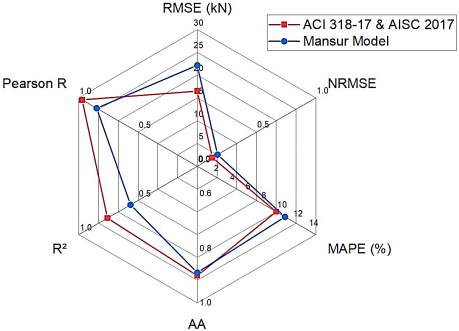
The application or predictions from the conventional code-based approach such as ACI 318-19 and AISC 360-16 [20, 21] show better correlation with the experimental values compared to the predictions from Mansur nonlinear concrete constitutive model for both initial cracking and failure load cases, with root mean square error (RMSE) of 16.50 kN, mean average percentage errors (MAPEs) of 9.98%, higher coefficients of determinations, R2 = 0.7580, and high Pearson’s correlation, R = 0.9719. The code-based approach is conservative of calibration as it over-predicted the capacity reasonably within design tolerances.
Contrarily, the Mansur model produces a MAPE of 11.10% and a 12.80kN RMSE, with lower R² (0.5638) and Pearson R (0.8496) when compared to the Marie model. The quantitative disparity notwithstanding, the Mansur model appreciates important nonlinear problems such as, for example, strain-softening or post-cracking stiffness degradation that linear code models commonly omit. Indeed, this virtuous behavior allows a more realistic simulation of the structural performance after the elastic phase under load all statistical performance indicators for beam Cb.1 shown in Figure 3. Furthermore, Golafshani's study in 2020 supports the idea that the use of constitutive models gives a more accurate and improved prediction of the inelastic mechanisms impacting the performance of the material in the future, even though their statistical accuracy is less than that of other types of models [22].
Figure 3. Statistical performance evaluation for beam Cb.1
Beam Cb.2 is an important benchmarking element for further assessment of how well the analytical model represents localized nonlinear behavior with the Mansur constitutive framework. The same methodology was previously used in evaluating Beam Cb.1; however, this new evaluation uses a more thorough approach to exploring the entire load-deflection curve and not only to provide the value of maximum stiffness. Figure 4 and Table 3 present the experimental data from Ibrahim's study [18] to serve as the basis for determining how closely the model predicts actual behavior.

Figure 4. Load deflection curve for beam Cb.2
Table 3. Values of the uncracked load, cracked load, and failure load for beam Cb. 2 for different analysis methods
|
Case |
Uncracked Load |
Cracked Load |
Failure Load |
|||
|
Load (kN) |
Deflection (mm) |
Load (kN) |
Deflection (mm) |
Load (kN) |
Deflection (mm) |
|
|
Experimental |
19.57 |
1.14 |
30.3 |
2.67 |
187.17 |
39.94 |
|
By ACI 318-19 & AISC 2017 Codes |
17.77 |
1.21 |
32.7 |
3.10 |
191.98 |
40.20 |
|
By the Mansur model |
17.60 |
1.18 |
31.6 |
2.92 |
183.17 |
40.05 |
During the first phase of an elastic curve, the deflection is < 10 mm, all methods of predicting deflection, i.e., experimental/testing and design codes, and Mansur show nearly the same stiffness. This is due to all having the same assumptions of an elastic modulus. Beyond this point, at the deflections of 10–35 mm, the data sets show increased differences. For example, ACI 318-19 and AISC 360-16 codes predict a greater load capacity than experimental results, particularly for maximum load near failure - ACI 318-19 calculated the maximum load to be 191.98 kN. In contrast, experimental results were only 187.17 kN. This means both codes use conservative methods of calculating load capacities based on factors of safety as defined in the respective ACI and AISC codes [20, 21].
On the contrary, the Mansur Model is a better approximation of an accurate nonlinear response compared to the design codes. Through its application of the Mansur Model, it was possible to simulate a failure at 183.17 kN, accompanied by a deflection of 40.05 mm. Additionally, it was able to address both the degradation of stiffness after cracking as well as the transition to peak load. In comparison to the level of plateau that was achieved on the experimental curve post-peak as a result of micro-cracking and the redistribution of internal stresses, the Mansur Model was the only model that was somewhat able to replicate this behavior. In contrast, the design codes produced a false result of continued improvement in the level of strength after the peak.

Figure 5. Statistical performance evaluation for beam Cb.2
Data from the comparative statistical analysis performed on Beam Cb.2 are presented in Figure 5. In this analysis, data from the ACI318-19 & AISC360-16 prediction methods and the nonlinear Methods by Mansur and Associates have been provided with a similar layout [20, 21], showing good agreement with experimental test results regarding predictive accuracy (R2 0.97 and higher) and a high level (> 99%) of Pearson correlation coefficients. The Mansur method did provide superior nondeterministic results to the code-based, with RMSE = 6.41 kN for the Mansur model and RMSE = 0.0470 for the NRMSE, showing superior accuracy in predicting load-deflection behavior. In addition, the MAPE for the Mansur model (6.27%) and AA% of 93.73% indicate that the Mansur model is more accurate than the codes' predicted values (MAPE = 7.13% and AA% = 92.87%). Thus, the results of the analyses demonstrate that the Mansur model does a better job than the ACI/AISC codes in capturing the complete nonlinear response (NCRP), especially in the post-cracking region. In contrast, the codes remain conservative on early-to-mid-range predictions. Therefore, from the results of this study, the authors finalized that the Mansur model is an ideal approach for performing detailed nonlinear analysis of composite elements subjected to bending.
The authors would like to thank the University of Samarra (https://uosamarra.edu.iq/) in Salah Al-Deen, Iraq, and Mustansiriyah University (www.uomustansiriyah.edu.iq) in Baghdad, Iraq, for their support in the present work.
[1] Imjai, T., Aosai, P., Garcia, R., Raman, S.N., Chaudhary, S. (2024). Deflections of high-content recycled aggregate concrete beams reinforced with GFRP bars and steel fibres. Engineering Structures, 312: 118247. https://doi.org/10.1016/j.engstruct.2024.118247
[2] Romanazzi, V., Leone, M. (2025). Analysis of flexural behaviour of steel reinforced cement-less concrete beam. Engineering Structures, 330: 119859. https://doi.org/10.1016/j.engstruct.2025.119859
[3] Gao, D. Y., Gu, Z. Q., Wu, C. (2020). Bending behavior and deflection prediction of high-strength SFRC beams under fatigue loading. Journal of Materials Research and Technology, 9(3): 6143-6159. https://doi.org/10.1016/j.jmrt.2020.04.017
[4] Gong, F., Yang, Y., Li, P., Wang, Z., Zeng, B., Jin, W., Maekawa, K. (2024). Multi-physical analysis of saturation-dependent creep behavior for RC beam under sustained load and wet-dry cycles. Engineering Structures, 309: 117976. https://doi.org/10.1016/j.engstruct.2024.117976
[5] Sargin, M. (1971). Stress-strain relationships for concrete and the analysis of structural concrete sections. University of Waterloo, Ontario, Canada.
[6] Hognestad, E. (1951). Study of combined bending and axial load in reinforced concrete members. University of Illinois. Engineering Experiment Station. Bulletin; No. 399.
[7] Popvics, S. (1970). A review of stress strain relationships of concrete. Journal Proceedings, 67(3): 243-248. https://doi.org/10.14359/7266
[8] Carreira, D.J., Chu, K.H. (1985). Stress-strain relationship for plain concrete in compression. Journal Proceedings, 82(6): 797-804. https://doi.org/10.14359/10390
[9] Mao, M., Yin, C.L., Shen, S.Y., Wan, Y. (2024). Experimental and numerical study on flexural behaviors of steel-UHPC composite beams under hogging moment. KSCE Journal of Civil Engineering, 28(6): 2344-2354. https://doi.org/10.1007/s12205-024-1945-z
[10] Ahmed, A.M., Ali, S.I., Ali, M.I., Jamel, A.A.J. (2023). Analyzing self-compacted mortar improved by carbon fiber using artificial neural networks. Annales de Chimie. Science des Materiaux, 47(6): 363-369. https://doi.org/10.18280/acsm.470602
[11] Ali, M.I., Jamel, A.A.J., Ali, S.I. (2020). The hardened characteristics of self-compacting mortar including carbon fibers and estimation results by artificial neural networks. AIP Conference Proceedings, 2213(1): 020159. https://doi.org/10.1063/5.0000177
[12] Mansur, M.A., Chin, M.S., Wee, T.H. (1999). Stress-Strain Relationship of High-Strength Fiber Concrete in Compression. Journal of Materials in Civil Engineering, 11(1): 21-29. https://doi.org/10.1061/(ASCE)0899-1561(1999)11:1(21)
[13] Nicolaides, D., Markou, G. (2015). Modelling the flexural behaviour of fibre reinforced concrete beams with FEM. Engineering Structures, 99: 653-665. https://doi.org/10.1016/j.engstruct.2015.05.028
[14] Ali, M.I., Allawi, A.A. (2024). An artificial neural network prediction model of GFRP residual tensile strength. Engineering, Technology & Applied Science Research, 14(6): 18277-18282. https://doi.org/10.48084/etasr.9107
[15] Abu-Alsaad, H.A., Al-Taie, R.R.K. (2021). NLP analysis in social media using big data technologies. TELKOMNIKA (Telecommunication Computing Electronics and Control), 19(6): 1840-1846. http://doi.org/10.12928/telkomnika.v19i6.19339
[16] Abushanab, A., Ebead, U., Genedy, M., Ayash, N.M., Fawzy, S.A. (2025). Flexural behavior and durability of reinforced concrete beams with seawater, sulfate-resistant cement, and glass fiber-reinforced polymer reinforcement. Engineering Structures, 333: 120204. https://doi.org/10.1016/j.engstruct.2025.120204
[17] Fasan, M., Bedon, C., Pecce, M.R. (2024). Optimised rotational-spring component-based modelling strategy for seismic resistant steel-concrete composite joints and frames with continuous or isolated slab. Structures, 70: 107689. https://doi.org/10.1016/j.istruc.2024.107689
[18] Ibrahim, T.H., Allawi, A.A., El-Zohairy, A. (2023). Experimental and FE analysis of composite RC beams with encased pultruded GFRP I-beam under static loads. Advances in Structural Engineering, 26(3): 516-532. https://doi.org/10.1177/13694332221130795
[19] Li, X., Lv, H., Zhou, S. (2012). Flexural behavior of GFRP-reinforced concrete encased steel composite beams. Construction and Building Materials, 28(1): 255-262. https://doi.org/10.1016/j.conbuildmat.2011.08.058
[20] ACI Committee. (2019). ACI CODE-318-19 (22): Building code requirements for structural concrete and commentary. Farmington Hills, MI, 48331. https://www.concrete.org/store/productdetail.aspx?ItemID=318U19&Language=English&Units=US_Units.
[21] American Institute of Steel Construction. (2016). Specification for Structural Steel Buildings (AISC 360-16). https://www.aisc.org/news/2016-specification-for-structural-steel-buildings-draft-available-for-public-review/.
[22] Belmouden, Y., Lestuzzi, P. (2007). Analytical model for predicting nonlinear reversed cyclic behaviour of reinforced concrete structural walls. Engineering Structures, 29(7): 1263-1276. https://doi.org/10.1016/j.engstruct.2006.08.014