
Rina Afiani Rebia | Dwi Adi Purnama* | Sayyidah Maulidatul Afraah | Zahwa Putri Aghniya
© 2026 The authors. This article is published by IIETA and is licensed under the CC BY 4.0 license (http://creativecommons.org/licenses/by/4.0/).
OPEN ACCESS
Sustainable skincare design requires an automated way to transform unstructured consumer opinions into product requirements that are technically feasible, market-responsive, and environmentally responsible. This study proposes an automated soft computing decision-support framework for biodegradable and nanofiber-based sheet mask development. The framework integrates data preprocessing, Latent Dirichlet Allocation (LDA) topic modeling, term frequency (TF)-inverse document frequency (IDF) feature weighting, lexicon-based sentiment analysis, Importance-Performance Analysis (IPA), and a newly proposed Sustainability-Aware Automated Design Priority Index (SADPI). SADPI combines normalized topic importance and sentiment-based performance gaps to rank design priorities and translate them into people-planet-profit requirements. An analysis of 7,918 review sentences identified 14 topics. Environmental effect, skin-type-based product development, and clay sheet mask were the most important themes. Positive reviews accounted for 46.91%, neutral reviews for 38.57%, and negative reviews for 14.52%. Sustainable packaging showed the highest satisfaction weight (0.1001), whereas BPOM labeling, clinical testing, and supervision showed high importance but low satisfaction. The SADPI results ranked clay sheet mask development, regulatory assurance, ingredient and vitamin transparency, skin-type personalization, and environmental impact as the main automated design priorities. The framework contributes to automated systems research by linking system learning, text-based identification, and optimization-oriented prioritization into a reproducible human-machine decision-support process for sustainable product design. It also shows how consumer-generated data can guide material selection, regulatory communication, and sustainable skincare innovation.
automated decision support, biodegradable skincare, Importance-Performance Analysis, sentiment analysis, soft computing, topic modeling
In today's dynamic market environment, companies are increasingly expected to be able to better identify consumer expectations and create sustainable and marketable products accordingly. Product development requires not only technical capabilities but also the ability to capture and use consumer-generated information in the form of decisions. Traditional ways of exploring consumers' expectations via surveys, interviews, and focus group discussions are valuable but limited in terms of sample size and structure. By contrast, online user reviews, social networks, and social media platforms generate massive amounts of continuously updated data on consumers' preferences, opinions about product quality and safety, as well as sustainability claims. Modern advancements in machine learning and soft computing allow for the use of automated systems for processing unstructured textual data and deriving design recommendations from consumers' opinions on sustainability.
The issue of sustainability has become crucial for skincare and cosmetic product development. Currently, consumers focus on product ingredient safety, recyclability, environmental impacts, compatibility with skin, and waste generation. This is especially true for skincare products because of their close connection with personal well-being, product safety, and usage behavior. Prior studies have shown that consumer behaviors that target sustainability depend on environmental consciousness, product transparency, and product responsibility [1, 2]. However, the conventional product development process follows a linear stage-gate approach where consumer requirements are determined from limited manually collected data. This leads to a delayed reaction on changing market conditions, subjectivity in interpreting consumers' needs, and incomplete identification of sustainability-related product attributes. There is a demand for an intelligent, automated framework that will allow for extraction of requirements for sustainable product design.
Big data analytics, machine learning, and soft computing have increasingly become important components of automated and intelligent decision-support systems. Recent developments in human–AI decision systems demonstrate how computational models can support the transformation of complex data into structured and actionable decisions [3]. These technologies enable latent-pattern identification, opinion classification, preference estimation, and optimization-oriented decision support. In public policy, transportation, and product innovation, internet-based data mining has been used to construct models of public sentiment, identify barriers to adoption, and develop decision frameworks based on priorities [4, 5]. When it comes to cosmetics and personal care product innovation, data-driven analysis allows for exploring customers' discussions of such product attributes as texture, ingredients, effectiveness, packaging, price, product safety, and sustainability issues [6, 7]. Despite this, most of the studies stop at the level of descriptive text mining or opinion classification without moving further and creating an automated design-support system that would take into consideration consumer voice, sustainability dimensions, and priorities for product development in one computational framework.
One of the examples of sustainability-driven innovation in the field of cosmetics is the sheet mask. It can be defined as a thin layer with active compounds used for applying them directly to the face for skincare purposes. Although being very popular, many commercial sheet masks are currently produced from biodegradability synthetic polymers such as polypropylene (PP) [8]. While PP is cheap, easily accessible, and relatively easy to produce, it is environmentally problematic because of its limited biodegradability and the generation of post-consumer waste. Recently, research in innovative materials has focused on biodegradable, biopolymer-based, and nanofiber-based materials that allow for improving environmental properties, skin comfort, hydration capability, and skin compatibility [9, 10]. However, in addition to their properties, the successful usage of such materials also depends on consumer expectations. Thus, the problem is how to link material innovation with consumer-driven sustainability requirements in automated systems.
To solve this problem, this study proposes a framework for automated decision support for sustainable skincare product design. The framework uses big data text mining, machine learning, sentiment analysis, and priority-based evaluation to derive design requirements for biodegradable and nanofiber-based skincare products. Customers' voices are extracted from online reviews through the use of Latent Dirichlet Allocation (LDA) for topic modeling. Then, sentiment analysis is used to estimate consumer satisfaction with the product attributes. The results are integrated in Importance-Performance Analysis (IPA) framework to construct the relationship between attribute importance and performance. Moreover, this study extends the contribution of the automated decision support approach by introducing the Sustainability-Aware Automated Design Priority Index (SADPI) for transforming the results of analysis into priority scores for product design improvement.
The novelty of this study is the creation of an automated soft-computing framework that allows bridging between consumer-generated big data, innovative materials for skincare products, and product design priorities. Unlike other researches, which focus only on the application of text mining for description of consumer opinions, this study goes a step further and creates an intelligent design-support system that will help to identify, evaluate, and rank the product attributes based on consumer importance, performance, and sustainability dimension. This contribution is valuable for automated-systems research because it shows how machine learning and soft computing can be applied for sustainable new product development. Practically, the framework will help product designers determine which attributes should be improved, maintained or prioritized regarding biodegradable materials, nanofiber innovation, sustainable packaging, product safety, and transparency in regulations.
Thus, this study makes three main contributions to automated decision-support research. First, it develops an automated learning mechanism that transforms unstructured consumer-generated text into structured product attributes through topic modeling, term frequency (TF)-inverse document frequency (IDF) weighting, and sentiment-based performance evaluation. Second, it introduces an integrated identification and decision-prioritization mechanism in which consumer-derived importance and performance information are processed through IPA and the proposed SADPI to automatically generate ranked design priorities. Third, it establishes a human–machine decision-support framework that links consumer-generated data, sustainability considerations, and biodegradable nanofiber product development within a repeatable computational process. Unlike conventional consumer research that primarily describes market preferences, the proposed framework converts continuously generated textual data into actionable and updateable design decisions. Therefore, the principal contribution of this study lies not only in analyzing consumer opinions, but also in demonstrating how computational learning, attribute identification, and automated prioritization can support adaptive decision-making in sustainable product development.
2.1 Sustainable material innovation for biodegradable and nanofiber-based products
The increasing awareness of environmental issues and consumer demands for more eco-friendly solutions have become the main drivers in the development of sustainable products across various industrial sectors [11]. Sustainable products are generally understood as products that consider their impacts on public health and the environment throughout their life cycle [11]. Innovations in sustainable products are typically developed through a systematic approach based on the Sustainable Product Development and Services (SPDS) framework, which integrates environmental, social, and economic dimensions from the early stages of product design [12].
The sustainable material development approach was applied by Deif et al. [12] through the design of biodegradable zinc (Zn) alloys for bone implant applications. By prioritizing material efficiency and waste reduction from conventional experimental processes, this research provides a tangible contribution to the development of eco-friendly medical products and supports circular economy principles in healthcare. Research by Adak et al. Demonstrates the potential use of wheat-based thermoplastic starch (TPS) and biodegradable polyesters such as PBAT as main materials in sustainable product development. also examines the development of sustainable paper-based food packaging through biopolymer and nanocomposite coatings. Li et al. [13] investigated strategies to enhance the performance of biodegradable polymer foams with a focus on product sustainability by utilizing materials from renewable sources such as PLA, PBS, and PCL. Through this approach, the research contributes to the development of foam materials that are not only functional but also aligned with circular economy and sustainability principles. In the context of sustainable products, research by Dawoud et al. [14] significantly contributes to the development of eco-friendly natural skincare formulations through technological innovation.
Although various studies have developed sustainable products based on biodegradable materials and nanotechnology, most remain limited to technical aspects and have not yet included comprehensive life cycle assessments or integration of socio-economic dimensions. Furthermore, the connection between material innovation and market needs has been insufficiently addressed. Therefore, this study emphasizes the importance of a holistic approach in formulating design requirements for sustainable skincare products, especially those based on biodegradable materials and nanofiber technology.
2.2 Customer-driven for product design and machine learning
The traditional approach to exploring customer needs and consumer preferences is generally conducted through structured surveys and interviews [15, 16]. For example, Panichakarn et al. [17] distributed questionnaires to 389 respondents and used Structural Equation Modeling or Partial Least Squares Structural Equation Modeling (PLS-SEM) to analyze factors influencing the intention to adopt electric vehicles (EV). A similar method was used by Ma et al. [18] in the context of Online Food Delivery (OFD) services. This research compared results from the machine learning model BERTopic with existing service quality frameworks developed using traditional methods such as OFD-SERV and DEQUAL. This comparison effectively showed that data-driven approaches can reveal new service dimensions overlooked by traditional frameworks, such as corporate social responsibility, payment methods, and pricing levels, thereby providing a more comprehensive understanding based on authentic consumer experiences.
In addition to large-scale surveys, traditional data collection methods from experts are also commonly used, especially for policy formulation or standardization. Fahma et al. [19] involved 20 expert respondents representing various stakeholders to determine interoperability requirements for electric motorcycle batteries. This approach was also reinforced in the study by Sutopo et al. [20], which used traditional methods.
Although these methods are still widely used and provide deep qualitative insights, their limitations lie in restricted reach, differences in perception, and inability to capture real-time consumer opinion dynamics. Therefore, data-driven machine learning approaches are increasingly adopted. Today, the availability of open big data and machine learning’s capability to perform data mining offer significant opportunities to support more adaptive and market-needs-based product design and innovation processes. Several recent studies have adopted machine learning to support data-driven decision-making insights. Recent studies have further demonstrated that machine-learning models can extract consumer preferences and design-relevant information directly from large-scale online reviews, allowing consumer-generated data to function as an input to intelligent decision-support processes [21].
One example is the study by Purnama et al. [22], which developed a Three-Dimensional Concurrent Engineering (3DCE) approach based on big data and machine learning to identify consumer needs and opinions through social media in the smartphone industry context. Adopted a data-driven machine learning approach to evaluate public opinion dynamics regarding the adoption of EV by analyzing Twitter social media data over a decade (2012–2022). In line with the findings of Ren et al. [23], who developed a battery electric vehicle (BEV) selection strategy using LDA to extract topics from user reviews and Support Vector Machine (SVM) to classify consumer preferences, this study successfully identified key factors in BEV purchase decisions such as price, battery, and comfort. The results showed that this approach more accurately reflects user intention compared to traditional methods, making it relevant for product development and data-based market strategies.
These studies demonstrate that the integration of machine learning and data-driven approaches from social media has evolved as a more responsive and adaptive alternative compared to traditional methods. This approach can explore real-time public opinion [21], map consumer preferences more broadly and dynamically [24] and accurately identify product innovation opportunities. These studies prove the effectiveness of machine learning in supporting decision-making processes based on actual market needs. Therefore, this research adopts a similar approach by utilizing machine learning and data-driven methods to obtain data-based insights in formulating strategies that are more relevant and based on real-time user experiences.
2.3 Product design method
In recent years, machine learning approaches for capturing the voice of the customer (VoC) through social media data have become an effective strategy in supporting the product design process. This approach enables the identification of customer needs and innovation opportunities more efficiently than traditional methods. Consequently, there is a growing need for data-driven methods that can extract user needs more comprehensively, particularly from social media data [25]. The approaches that can be used are extensions of machine learning and data-driven methods, including LDA [26], topic modeling, and sentiment analysis [27].
Several previous studies related to product design methods include those of Zhang et al. [28]. After mining consumer needs from online reviews using machine learning and sentiment analysis, this method also applies the Kano Model to classify each need attribute. Thus, this method not only answers what consumers want but also how meeting those needs will impact their satisfaction, ultimately providing a more strategic foundation for formulating technical product specifications. Another approach that focuses more on the quantitative potential of opportunities from data was explored by Jeong et al. [24], who used the opportunity mining method to extract product improvement opportunities from online reviews. This framework integrates topic modeling to extract and measure the importance level of product attributes, as well as sentiment analysis to measure satisfaction levels. The results from both analyses are then combined in an opportunity algorithm to calculate an opportunity score, which effectively highlights priority areas for product improvement. Furthermore, Purnama et al. [5] add a dynamic dimension to its analysis. More recent studies have extended this direction toward intelligent and optimization-oriented product decision support. Machine-learning and text-mining approaches have been integrated with decision models to transform online consumer opinions into product-improvement priorities and design guidance [29]. Other studies have combined text analytics with preference-ranking and soft-computing mechanisms to support product evaluation under multiple criteria [21]. Furthermore, machine learning has increasingly been integrated with optimization techniques in new product development to generate more systematic and robust design decisions [30].
This method combines LDA for attribute identification and sentiment analysis for measuring satisfaction. However, its novelty lies in integrating these results into a hybrid model called the Dynamic-Product Improvability Index–Importance Performance Analysis (D-PII-IPA). This model not only identifies priorities at a single point in time but also tracks how consumer preferences and satisfaction evolve over time, offering a more advanced and adaptive approach to product or service improvement.
Compared with the Opportunity Algorithm and Kano-based requirement classification, SADPI is designed for a different input-output setting. The Opportunity Algorithm combines importance and satisfaction information to identify improvement opportunities, whereas Kano-based approaches classify requirements according to satisfaction-response categories obtained from structured customer elicitation [ 24 , 28]. SADPI instead starts from attributes learned automatically from unstructured consumer text. It normalizes machine-derived topic importance $\left(I_i^*\right)$ and sentiment-derived performance $\left(P_i^*\right)$, converts performance into a dissatisfaction gap $\left(G_i=1-P_i^*\right)$, and applies a binary sustainability-relevance gate $\left(R_i\right)$ before producing a continuous redesign priority score $\left(\right.$SADPI $\left._i=I_i^* \times G_i \times R_i\right)$. In the present sustainable-product case, each retained priority maps to at least one People, Planet, or Profit dimension, so $R_i=1$ and the reported numerical ranking is determined by importance and dissatisfaction rather than by subjective sustainability weights. Thus, the original design intent of SADPI is not to replace Kano or the Opportunity Algorithm as general customer-needs theories, but to provide an updateable computational bridge from online consumer discourse to prescriptive sustainable-design decisions.
Although these methods have proven effective, there remains an opportunity to implement a combination of well-established and robust fundamentals to produce clear and actionable design priorities. Therefore, this study will develop a framework that integrates three core methods, LDA topic modeling to identify product attributes discussed by consumers and measure their importance, Sentiment analysis to evaluate satisfaction levels for each attribute, and IPA to visually map the results and determine the most critical priorities for developing sustainable skincare products.
2.4 Sustainability approach
The sustainability approach in product development is no longer seen merely as an ethical commitment but has become a crucial business strategy to meet consumer behavior and market expectations that are increasingly aware of environmental and social issues [31]. The concept of sustainability in the context of product design is based on the Triple Bottom Line principle, which consists of people, planet, and profit [32]. These three dimensions emphasize the importance of creating value not only economically, but also in terms of environmental sustainability and social well-being. In the skincare industry, sustainability has become a strategic and essential dimension in product design, given the high consumption of skincare products and growing consumer concern about the impact of chemical ingredients and packaging waste on society and the environment [33].
Several previous studies still emphasize selected sustainability dimensions rather than an integrated product design perspective. Some studies focus on economic feasibility through incentives, cost reduction, and market adoption, while others focus on environmental performance through biodegradable materials, polymer substitution, or waste reduction. These contributions are important, but they often do not fully connect consumer well-being, environmental outcomes, and commercial viability in a single design model.
A more integrated sustainability approach is needed for skincare products because the design decision affects consumers, firms, regulators, and the environment at the same time. For example, biodegradable sheet mask substrates address the planet dimension, regulatory assurance and pricing address the profit dimension, while skin compatibility, ingredients, and consumer safety address the people dimension. Therefore, this study uses the people-planet-profit logic as a sustainability interpretation layer for the automated design priorities generated from online consumer data.
Although various studies have applied sustainability approaches in different sectors, the literature review reveals a lack of research that integrates all three pillars of the Triple Bottom Line (People, Planet, Profit) simultaneously, especially in the context of a single product design. Moreover, there is a significant research gap regarding the application of a holistic sustainability approach in skincare product design. Therefore, this study proposes an integrated framework that combines all three pillars to derive comprehensive and truly sustainable product design requirements for skincare products.
2.5 State of the art
Recent research demonstrates a growing integration of machine learning, soft computing, and intelligent decision-support methods for transforming large-scale online information into structured decision variables. Studies have shown that online reviews can support preference identification, product ranking, improvement prioritization, and design guidance through machine-learning and decision-analytic mechanisms [34]. Other studies have further integrated machine learning with optimization models for new product development, indicating a shift from descriptive consumer analytics toward prescriptive and intelligent decision support [35].
To improve domain relevance, the literature positioning emphasizes recent work on intelligent product decision support, review-driven product improvement, and machine-learning/optimization integration [21, 29, 30, 34, 35], together with biodegradable/nanofiber and skincare-specific studies [10, 14, 25]. In addition, related studies have examined biodegradable starch–copolyester systems [36], biopolymer-coated paper packaging [37], and text-based product ranking [38]. Electric-mobility studies provide methodological examples involving policy evaluation [39], conceptual policy modeling [40], aspect-based sentiment analysis [41], and adoption-intention modeling [42]. Studies from electric mobility and public policy are retained only as methodological examples of large-scale consumer-data analytics, rather than as direct evidence for skincare product design.
In sustainable material research, biodegradable polymers, biopolymers, and nanofiber-based products have been developed to reduce environmental impacts. Yet, the connection between material innovation and consumer-derived product requirements remains limited. In product design research, topic modeling and sentiment analysis have been used for attribute discovery and satisfaction evaluation, but their integration with sustainability dimensions and automated decision rules is still underdeveloped.
Based on these gaps, this study advances the state of the art through the following contributions:
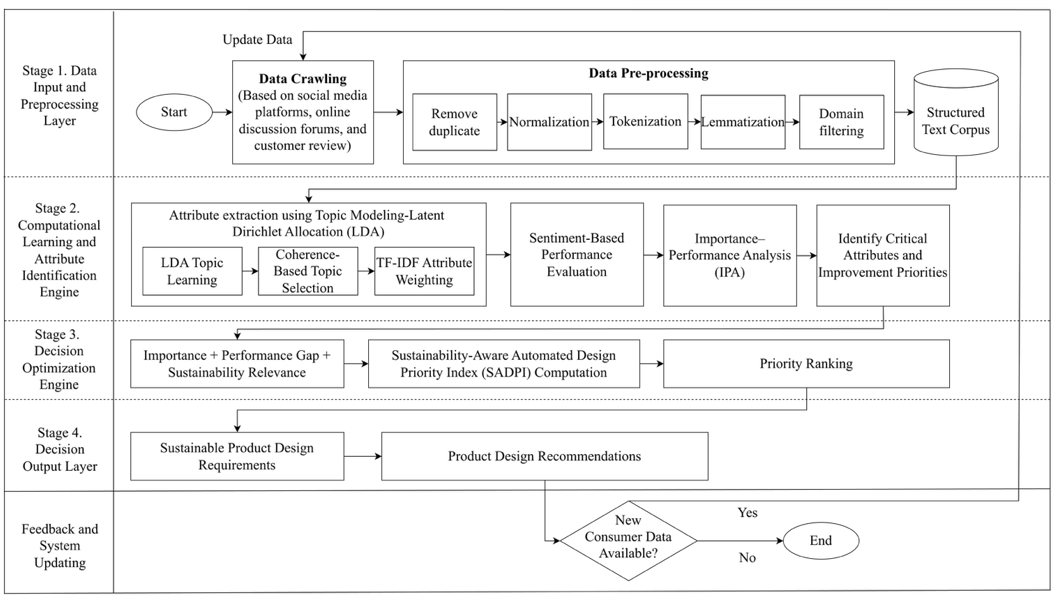
The methodology is designed as an automated soft computing system that transforms consumer-generated text into sustainable design requirements. The system contains five modules: data acquisition and preprocessing, attribute extraction, sentiment-based performance evaluation, sustainability-aware automated prioritization, and design requirement generation. This sequence allows the framework to move from unstructured data to prescriptive design recommendations.
The proposed framework supports automated decision-making because each analytical output is converted into an explicit decision variable. LDA and TF-IDF generate attribute importance, sentiment analysis generates performance, IPA identifies the quadrant position, and SADPI ranks redesign priorities. The final output is a set of sustainability-oriented requirements for biodegradable and nanofiber-based skincare products.
As shown in Figure 1, the proposed framework consists of four main modules. The first module performs online data mining and consumer review acquisition. The second module prepares the textual corpus through cleaning, tokenization, stopword removal, lemmatization, and domain-specific filtering. The third module applies automated learning through LDA topic modeling, sentiment analysis, and IPA to identify attribute importance and perceived performance. The fourth module introduces the SADPI, which combines normalized importance and the sentiment-derived performance gap with a binary sustainability-relevance gate to create a continuous redesign ranking. The resulting priorities are then labeled by the people-planet-profit dimension(s) they address. This formulation preserves sustainability relevance without introducing unsupported author-defined sustainability weights.
Figure 1. Research methodology
3.1 Cleaning and pre-processing data
Data crawling was conducted on social media platforms, online discussion forums, and customer review sources related to skincare, sheet masks, sustainable cosmetics, biodegradable materials, nanofiber products, skin-type suitability, packaging, price, ingredients, and regulatory assurance. The collected corpus was filtered to retain consumer statements related to skincare product experience, sustainability perception, material preference, and product safety. The final dataset contained 7,918 review sentences.
The preprocessing stage consisted of duplicate removal, irrelevant-text filtering, case normalization, punctuation removal, tokenization, stopword removal, and lemmatization. A domain dictionary was developed to retain skincare-specific and sustainability-related terms such as sheet mask, clay mask, biodegradable, nanofiber, BPOM, ingredient, vitamin, acne, brightening, packaging, and skin type. A synonym dictionary was also used to reduce semantic fragmentation among equivalent terms.
The unit of analysis was a review sentence. Only statements addressing skincare product experience, sustainability perception, material preference, or product safety were retained, and duplicate or irrelevant entries were removed before text processing. Because platform-level demographic profiles were not available in the analytical corpus, the 7,918 sentences are treated as a purposive digital-discourse corpus rather than as a statistically representative sample of all skincare consumers. Accordingly, the findings are interpreted as patterns within the collected online discourse and are not presented as population estimates.
3.2 Attribute extraction using topic modeling-Latent Dirichlet Allocation
Topic modelling is a machine learning technique that is designed to identify the thematic structures that are frequently concealed within extensive text data sets. Utilizing statistical methodologies, it extracts and identifies these themes throughout a dataset. This method is extensively employed in the disciplines of text mining and information retrieval, including text categorization, keyword extraction, and similarity searching.
Blei et al. [43] made a substantial contribution to the field of topic modelling by introducing LDA. LDA is a sophisticated probabilistic model that reveals concealed thematic patterns in extensive text corpora. It functions by organizing words that frequently occur together into distinct topics. Using clustering concepts, the LDA process effectively analyses the frequency of word occurrences within each document and the co-occurrence patterns between words.
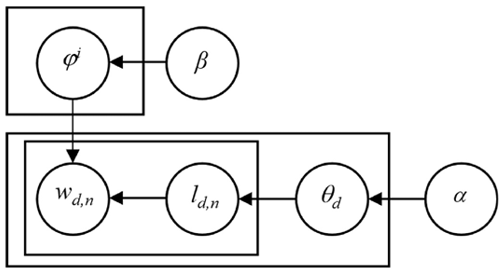
Within the LDA model (Figure 2), the initial step involves sampling the topic distribution for each document, denoted as $\theta \mathrm{d}$, from a Dirichlet distribution that is defined by the parameter $\alpha$. Subsequently, a topic ($\mathrm{z} d n$) is selected from a multinomial distribution that is defined by the topic mixture $(\theta \mathrm{d})$ of the document for each word $(w d n)$ within it. Consequently, the actual word $w d n$ is selected from a distinct multinomial distribution that is associated with the designated topic $\mathrm{z} d n . \beta$ is the parameterization of this word-topic probability distribution.
Figure 2. Graphical model for Latent Dirichlet Allocation (LDA)
The primary computational difficulty in LDA lies in ascertaining the posterior distribution of the latent variables (the topic mixtures $\theta$ and topic assignments z) based on the observed documents (words w) and the model's hyperparameters ($\alpha, \beta$). This is theoretically articulated as determining $\mathrm{p}(\theta, \mathrm{z} \mid \mathrm{w}, \alpha, \beta)$. Blei et al. [43] state that the joint probability distribution, which includes the topic mixtures $\theta$, topic assignments z, and words w, is defined by Eq. (1) utilizing the parameters $\alpha$ and $\beta$, along with the set of topic assignments z and the set of words w.
$p(\theta, z, w \mid \alpha, \beta)=p(\theta \mid \alpha) \prod_{n=1}^N \mathrm{p}(\mathrm{zn} \mid \theta) \mathrm{p}(\mathrm{wn} \mid \mathrm{zn}, \beta)$ (1)
3.2.1 Optimal number of topics
The optimal number of topics is subsequently determined. This entails calculating the coherence score for each potential number of subjects to determine the most appropriate value. The coherence computation is conducted as follows:
Coherence(${{\mathrm{t}} ; \mathrm{V}}(\mathrm{t}))=\sum_{m=2}^M \cdot \sum_{t=1}^{m-1} \log \frac{D\left(v_m^{(t)}, v_l^{(t)}\right)+1}{D\left(v_{m l}^{(t)}\right)}$ (2)
In this computation (Eq. (2)), D(v) denotes the document frequency of word v (the number of documents containing it), whereas $\mathrm{D}\left(\mathrm{v}, \mathrm{v}^{\prime}\right)$ represents the document frequency of both terms v and v' co-occurring in the same document. $\mathrm{V}(\mathrm{t})=$ $\left(v_l^{(t)}, \ldots, v_m^{(t)}\right)$ is the collection of the M most representative words for a specific topic t. The computed score derived from these components acts as a quality metric: a greater value indicates that the subjects recognized by the model are more coherent and significant.
The optimal number of topics was determined by evaluating candidate topic solutions from K = 1 to K = 30. For each candidate K, the coherence score was calculated using the coherence criterion described above. The model with the highest coherence score was selected as the optimal topic solution. Based on this evaluation, K = 14 produced the highest coherence score and was therefore retained for the final LDA model. The resulting 14-topic structure and its corresponding topic weights and representative keywords are presented in Table 1.
3.2.2 Importance calculation
Employing LDA, we derive two principal outputs based on the work of Purnama et al. and Jeong et al. [22, 24]: thematic classifications and their significance (computed using Eq. (1)). This information assists product developers in prioritizing critical consumer needs.
Table 1. System component mapping
|
System Component |
Automation Level |
Human Involvement |
|
Review acquisition |
Automated after query definition |
Search terms defined initially |
|
Text preprocessing |
Automated |
Domain dictionary configured initially |
|
Topic extraction |
Automated |
- |
|
Optimal topic selection |
Automated |
- |
|
Topic interpretation |
Semi-automated |
Human assigns semantic labels |
|
TF-IDF importance |
Automated |
- |
|
Sentiment scoring |
Automated |
Lexicon/model predefined |
|
IPA positioning |
Automated |
- |
|
Sustainability mapping |
Semi-automated |
Human-defined sustainability relevance |
|
SADPI computation |
Automated |
Binary relevance gate; no author-defined PPP weights |
|
Priority ranking |
Automated |
— |
|
Design recommendation
|
Semi-automated
|
Designer validates technical feasibility
|
The TF-IDF algorithm extracts significant feature words and computes the TF-IDF value from textual input. TF-IDF is a widely utilized technique for keyword analysis [44]. The key premise is that a word that frequently occurs in a specific text but infrequently in others is deemed highly significant to that document [45, 46]. The technique comprises two components: TF and IDF. TF-IDF is mathematically defined as follows:
$T F I D F=T F_{(t, d)} \cdot I D F_{(t, D)}$ (3)
$T F_{(t, d)}=\frac{f t}{\sum_{i \in d} f i}$ (4)
$I D F_{(t, D)}=\log \frac{D}{D F(t)}$ (5)
where,
T = term
f = frequency
d = the individual document
D = the total number of documents
DF(t) = the total count of documents within the corpus that include at least one term.
We utilized the TF-IDF technique to extract feature words and their corresponding TF-IDF values from online reviews. Subsequently, the feature words were aligned with terms in the attribute lexicon. We aggregated the TF-IDF values to determine the significance of the attribute Eq. (6), and we normalized the value based on Eq. (7).
$W I_t=\sum_{i=0}^{\text {#ofkeywords }} T F I D F_i$ (6)
$Importance \,\,Score$ $=\frac{ {WIt}- {WItmin}}{ {WIt max}- {WItmin}}$ (7)
We utilize $W I_t$ to represent the importance weight allocated to topic $i$. This particularly specifies the topic cluster or 'keyword topic'.
3.3 Attribute performance evaluation using sentiment analysis
Sentiment analysis is a mechanism for categorizing opinions and facts into positive, negative, and neutral classifications. This study employed sentiment analysis to categorize attribute performance and attitudes as positive, negative, or neutral, and to determine preference scores for each significant topic. This procedure frequently uses a lexicon-based approach to classify sentiment according to the utilised vocabulary. Utilising a dictionary-based methodology, it allocates polarity scores, with positive sentiment exceeding 0 up to 1, negative sentiment ranging from -1 to less than 0, and a score of 0 indicating neutral emotion.
Sentiment analysis was used to estimate consumer evaluation of each identified product attribute and to operationalize attribute performance in the subsequent prioritization stage. The analysis employed a lexicon-based, dictionary-driven polarity scoring procedure following the analytical approach adopted in previous consumer-review studies [22]. Each review sentence was assigned a polarity score on a continuous scale ranging from negative to positive values. Sentences with polarity scores greater than 0 were classified as positive, scores lower than 0 as negative, and scores equal to 0 as neutral.
For each topic, sentences containing the representative topic keywords were identified, and their polarity scores were aggregated to derive a topic-level satisfaction measure. The resulting satisfaction weight therefore represents the relative sentiment-based performance of each topic rather than a direct measure of product quality. These topic-level performance values were subsequently normalized and combined with topic importance in the IPA and SADPI stages.
The sentiment model was used as an operational lexicon-based scoring mechanism rather than as a supervised classification model trained on a manually labelled dataset. Accordingly, this study did not construct an independent hand-labelled gold-standard dataset for estimating classification metrics such as Precision, Recall, F1-score, or accuracy. The reported positive, neutral, and negative distributions therefore represent outputs of the lexicon-based polarity procedure. This methodological choice is considered when interpreting the findings, particularly because lexicon-based approaches may be less sensitive to sarcasm, implicit sentiment, contextual expressions, and domain-specific meanings.
Eqs. (8)–(12) are revised to represent the quantitative process as outlined by Purnama et al. [22]. The sentiment score for each sentence is ascertained by the sentiment analysis polarity score ($Polarity \,Score$$_i$). The satisfaction level of each product subject is ascertained by the proportion of sentiment-weighted values of the keywords that comprise their particular product topic compared to the total keywords in the documents (WSt). At this stage, the satisfaction level of product themes is normalised (Norm) to enable the use of the opportunity algorithm in the following step. The positive value is calculated using the satisfaction score positive formula (Satisfaction Scorepositive), whereas the negative value is determined through the satisfaction score negative formula (Satisfaction Scorenegative).
Polarity Score$_i=\frac{\sum_{i=0}^{\# \text { of sentences }} S C i}{\text { num of SCi }}$ (8)
WSt = $\frac{\sum_{i=0}^{\# \text {of keywords}} \text { Polarity Score}_i}{\text { Total documents related keywords }} \times 100 \%$ (9)
Norm $=\frac{\text {WSt}- \text {WStmin}}{\text {WSt} \max -\text {WStmin}}$ (10)
$Satisfaction \,\,Score$$_{{positive}}=0.5+$ $Normalization$ × $(1-0.5)$ (11)
$Satisfaction \,\,Score$$_{{negative }}=0.5-($$Normalization$$\times(1-0.5)+0)$ (12)
where,
$W S_t$ = Weight of Satisfaction,
i = Keyword topic#,
SCi = Sentiment score from sentences that include each keyword of topics.
3.4 Sustainability-Aware Automated Design Priority Index
To strengthen the prescriptive capability of the proposed framework, this study introduces the SADPI. SADPI is developed as an automated prioritization layer that converts normalized importance and sentiment-derived dissatisfaction into a continuous redesign order. Let $I_i$ denote the importance weight of attribute or topic i obtained from LDA and TF-IDF, and let $P_i$ denote the sentiment-based performance score of the same attribute. Because importance and performance are measured on different scales, both values are normalized using min-max normalization, as shown in Eqs. (13) and (14).
$I_i^*=\frac{I_i-\min (I)}{\max (I)-\min (I)}$ (13)
$P_i^*=\frac{P_i-\min (P)}{\max (P)-\min (P)}$ (14)
where, $I_i^*$ represents the normalized importance value of attribute $i$, while $P_i^*$ represents the normalized performance value. The dissatisfaction gap is then calculated by subtracting normalized performance from the maximum performance value, as shown in Eq. (15).
$G_i=1-P_i^*$ (15)
where, $G_i$ represents the dissatisfaction gap of attribute $i$. A higher value of $G_i$ indicates that the attribute has lower perceived performance or satisfaction.
Sustainability is incorporated as a non-compensatory eligibility layer rather than as a set of numerical people-planet-profit weights. Each attribute is mapped to one or more sustainability dimensions according to its substantive design implication. Let $D_{i, d}$ denote the binary relevance of attribute i to sustainability dimension $d$:
$D_{i, d} \in\{0,1\}, d \in\{$$People, Planet, Profit$$\}$ (16)
The sustainability-relevance gate $R_i$ is then defined as whether the attribute maps to at least one of the three dimensions:
$R_i=\max _d\left(D_{i, d}\right) \in\{0,1\}$ (17)
SADPI is calculated by multiplying normalized importance, the dissatisfaction gap, and the binary sustainability-relevance gate:
$\mathrm{SADPI}_i=I_i^* \times G_i \times R_i$ (18)
where, $\mathrm{SADPI}_i$ represents the automated design priority score of attribute $i$. A higher SADPI value indicates that a sustainability-relevant attribute combines high consumer importance with a large dissatisfaction gap and should therefore receive earlier redesign attention. In the present case, every retained design attribute is mapped to at least one People, Planet, or Profit dimension, so $R_i=1$. Consequently, the numerical values reported in Section 4.5 are driven by $I_i{ }^*$ $\times G_i$, while sustainability acts as an explicit eligibility and interpretation rule rather than an author-assigned weight. This avoids arbitrary weighting that could change the priority order without empirical justification.
The attributes are then classified into automated decision rules based on their normalized importance and performance values, as shown in Eq. (19).
Decision$_i=\left\{\begin{array}{cl}\text { Urgent Redesign, } & I_i^* \geq \bar{I}^*, P_i^*<\bar{P}^* \\ \text { Maintain and Communicate, } & I_i^* \geq \bar{I}^*, P_i^* \geq \bar{P}^* \\ \text { Supportive Attribute, } & I_i^*<\bar{I}^*, P_i^* \geq \bar{P}^* \\ \text { Monitor, } & I_i^*<\bar{I}^*, P_i^*<\bar{P}^*\end{array}\right.$ (19)
where, $\bar{I}^*$ and $\bar{P}^*$ represent the average normalized importance and average normalized performance, respectively. Attributes categorized as Urgent Redesign are considered the highest priority because they are important to consumers but have not yet achieved satisfactory performance. Attributes categorized as Maintain and Communicate should be preserved as competitive strengths. Attributes categorized as supportive can complement the product value proposition, while attributes categorized as Monitor require periodic observation but are not immediate redesign priorities.
The final stage attaches the corresponding People, Planet, and/or Profit interpretation to each sustainability-eligible ranked attribute. The binary relevance gate ensures that the redesign queue remains sustainability-focused, while the dimensional label explains whether the resulting action primarily concerns user well-being, environmental impact, regulatory/commercial feasibility, or more than one of these areas. This separation preserves the data-derived priority order and avoids subjective numerical weighting among the three sustainability pillars.
3.5 Automation boundary and human-in-the-loop mechanism
The proposed framework should therefore be interpreted as a human-in-the-loop automated decision-support system rather than a fully autonomous design system. Once the analytical configuration has been established, data preprocessing, topic extraction, importance calculation, sentiment evaluation, performance-gap calculation, SADPI computation, and priority ranking can be executed computationally without repeated manual calculation. Human intervention remains necessary primarily at the semantic and strategic levels, including domain-dictionary development, interpretation of latent topics, sustainability relevance mapping, and validation of the final design recommendations.
3.6 Automation capability and computational execution
Once the query, domain dictionary, sentiment lexicon/model, and semantic mapping rules are configured, the core analytical path-text preprocessing, topic extraction, coherence-based topic selection, TF-IDF weighting, sentiment scoring, IPA positioning, SADPI computation, and priority ranking - can be re-executed programmatically when new data become available. Relative to a fully manual review-coding workflow, this architecture removes repeated sentence-by-sentence coding and manual priority calculations for the 7,918-sentence corpus while retaining human judgment for topic naming, sustainability mapping, and technical feasibility. The present study did not record wall-clock runtime or analyst person-hours for a controlled manual benchmark, so no quantitative speed-up is claimed; the demonstrated automation advantage is repeatability and reduction of repetitive analytical operations.
Results obtained via the suggested soft computing approach offer a detailed understanding of consumers' views and sustainability preferences revealed from large-scale social media datasets. By combining such methods as topic modeling (LDA), sentiment analysis, and IPA, it is possible to demonstrate how informal information may be transformed into structured knowledge and used for making sustainable product design decisions. Thanks to the hybrid computational process, it is possible to identify not only main consumer topics but also to assess their sentiment polarity and to prioritize product characteristics in situations of uncertainty. Such results prove the ability of data-driven and machine learning-based approaches to establish a link between consumer sentiment and product design decision-a goal of soft computing data mining techniques and decision-making models.
In this section, the interpretation of computational outputs focuses on revealing key sustainability-related insights for biodegradable and nanofiber skincare products. The computational analysis reveals such issues as those related to sustainability-related packaging, product performance, regulation, and overall customer experience. Beyond the descriptive results, interpretation is provided connecting computational metrics like topic relevancy, sentiment intensity, and IPA quadrant positioning to more general aspects of sustainable design, innovation management, and product market compatibility.
4.1 Analysis of Latent Dirichlet Allocation model
Topic modeling is performed using the LDA approach to identify the optimal number of dominant topics in product reviews [47], including sustainable skincare products containing biodegradable and nanofiber materials. These topics are then grouped based on reviews that contain similar sentences or terms. The determination of the best topics is calculated using coherence scores. Table 2 presents the results of the best topic analysis, showing the weight distribution from topics 1 to 14. This topic distribution illustrates the diversity of consumer perceptions and expectations toward quality products, such as sustainable skincare, ranging from environmental issues, regulations, technology, to product usage results [25].
From the results shown in Table 2, Topic 5: Environment Effect is the most important topic (0.655) because it shows a high level of concern among consumers about the effect of using skincare products on the environment. The findings are supported by past studies, which have revealed that environmental factors play a critical role in influencing cosmetic purchase behavior, skincare included [48]. Other highly weighted topics are Topic 13: product development based on skin type (0.635) and Topic 14: clay sheet mask (0.615). From these results, one can deduce that in addition to environmental issues, customer reviews focus on product development according to different skin types and also innovative product formulations such as clay sheet masks, seen in Topic 14: Clay Sheet Mask. Similarly, like previous research studies that showed that through the use of LDA, one can find out topics on the suitability of products for different skin types [25], the set of keywords in Topics 1 to 14 are still a collection of keywords that require classification.
Table 2. Distribution of topic features in sustainable skincare product reviews
|
Topic |
Weight |
Keyword |
|
Topic 1: Technology development for sheet mask |
0.453 |
mask, sheet, energy, technology, support, sector, sheetmask, friend, development, innovation |
|
Topic 2: Swept Clean |
0.165 |
clean, swept, resident, nder, cat, try, pad, mikecatbriena, broom, porch, lover |
|
Topic 3: Energy security and related to government program |
0.6 |
program, government, trip, business, energy security, fun, join, sleep, level |
|
Topic 4: Label BPOM/Food and Drug Supervisory Agency, Clinical Trials, and Supervision |
0.533 |
water, day, acne, wash, campus, BPOM, head, fact, clinic, number |
|
Topic 5: Environment Effect |
0.655 |
environment, time, team, beauty, effect, job, minute, point, clean, clinic |
|
Topic 6: Skincare brightening |
0.444 |
amp, toner, brightening, morning, moist, tip, originote, yesterday, wonder, exfoliation |
|
Topic 7: Benefit and Result |
0.587 |
year, help, oil, step, holiday, benefit, tomorrow, thing, result, control |
|
Topic 8: Toner Kit |
0.17 |
hair, field, recommendation, wife, loss, creambath, tonic, handicraft, tradition, kit |
|
Topic 9: Price and promotion |
0.548 |
price, guy, need, order, today, shipping, promo, brother, item, cleansing |
|
Topic 10: People, work |
0.6 |
people, work, effort, way, woman, man, office, video, game, turn |
|
Topic 11: Sustainable packaging |
0.481 |
plastic, care, bag, tissue, cream, boyfriend, hope, cotton, question, pc |
|
Topic 12: Ingredient and vitamin |
0.412 |
food, change, problem, treatment, milk, vitamin, condition, vitamin, benefit, medicine |
|
Topic 13: Product development considering skin type |
0.635 |
skin, product, solution, lot, addition, body, person, production, type, example |
|
Topic 14: Clay Sheetmask |
0.615 |
face, skincare, clay, child, village, activity, month, night, hand, suit |
4.2 Sentiment analysis
A sentiment analysis was done for the set of 7,918 user review sentences. Based on the results of the sentiment analysis found in Table 3, 46.91%, 38.57%, and 14.52% of the total number of reviews were found to be positive, neutral, and negative, respectively. The relatively high percentage of positive reviews implies that a majority of users have a positive view towards sustainable skin care products, which confirms the objective of the analysis. This result has been proved by literature showing that green skin care is currently the fastest-growing industry around the world, especially among young women because of its environmentally friendly nature [49].
Table 3. Sentiment analysis of the sustainable skincare product reviews
|
Total Number of Sentiment Analysis Sentences |
Positive Reviews (%) |
Neutral Reviews (%) |
Negative Reviews (%) |
|
7918 |
46.91 |
38.57 |
14.52 |
On the whole, the consumers' perception of sustainable skincare products is largely positive. To conduct further analysis of the consumer perceptions concerning the aspects of the product, additional calculations of the satisfaction weights based on the topics acquired in LDA results are conducted. Each topic is defined by the set of key terms that can be traced throughout the reviews. Sentences with the use of these key terms are singled out, and then the sentiment polarity of those sentences is calculated and averaged. Each topic includes the sentences that can be considered positive and negative; however, the final perception of the topic is considered to be positive, since the average polarity of the sentences tends to be positive. For example, Topic 1: Technology development for sheet masks has a satisfaction weight of 0.0974, meaning that it is the mean polarity of the positive reviews. It is evident from the sentiment polarity analysis of the identified topics that the consumers have a positive attitude toward sustainable skincare products. The use of LDA allows identifying not only the specific topics, but also the sentiment polarity associated with them.
4.2.1 Analysis of topics
Analysis of keywords assigned to each topic in relation to the sentiment polarity demonstrates that some areas, like product innovation (e.g., technological innovation related to sheet masks), are more positively rated based on greater satisfaction weights. This observation implies that consumers appreciate the progress made in the technology of skin care products, especially with regard to sustainable ones.
4.2.2 Dominance of positive sentiment
Given that the general sentiment is positive for the topics analyzed, one can conclude that, in general, consumers are satisfied with the sustainability features of the product. This can be explained by the growing awareness and preference towards eco-friendly and innovative products.
4.2.3 Insights for product improvement
Positive attitude towards product innovations (e.g., material or technological innovations in the sphere of skin care) offers insights into how brands can improve their sustainable products. Highlighting the latest achievements in technology and the quality of the formulations can help foster consumer confidence and increase their satisfaction. The analysis of the satisfaction weights from LDA-generated topics highlights the importance of product innovation and the specific sustainable features of the product most important for consumers.
Table 4. Satisfaction weight
|
Topic |
Polarity |
Satisfaction Weight |
|
Topic 1: Technology development for sheet mask |
Positive |
0.0974 |
|
Topic 2: Swept Clean |
Positive |
0.0974 |
|
Topic 3: Energy security and related to government program |
Positive |
0.0986 |
|
Topic 4: Label BPOM/Food and Drug Supervisory Agency, Clinical Trials, and Supervision |
Positive |
0.0819 |
|
Topic 5: Environment Effect |
Positive |
0.0973 |
|
Topic 6: Skincare brightening |
Positive |
0.0971 |
|
Topic 7: Benefit and Result |
Positive |
0.0971 |
|
Topic 8: Toner Kit |
Positive |
0.0825 |
|
Topic 9: Price and promotion |
Positive |
0.0964 |
|
Topic 10: People, work |
Positive |
0.0968 |
|
Topic 11: Sustainable packaging |
Positive |
0.1001 |
|
Topic 12: Ingredients and vitamins |
Positive |
0.0832 |
|
Topic 13: Product development considering skin type |
Positive |
0.0936 |
|
Topic 14: Clay sheet mask |
Positive |
0.0826 |
High customer satisfaction from sustainable packaging in skincare is an indicator of the strong preference for environmental-friendly material among customers. On average, polarity of 0.1001 (Table 4) shows that sustainable packaging is the most valuable issue for customers since packaging is viewed as one of the key issues of the sustainable product. Indeed, in the industry where environmental considerations are becoming increasingly important, there is no denying the importance of packaging.
According to Perret et al. [50], materials like glass, bio-based plastics, and recycled plastics have a more significant effect on the perception of sustainability from consumers compared to any other product characteristic, even labeling and refilling systems. The materials mentioned above are considered more sustainable because of being recyclable or using renewable resources. For example, glass is viewed as sustainable because of the ability of the material to be recycled infinitely without deterioration of quality, whereas bio-based plastic decreases the dependency on fossil fuel. Recycled plastic supports the idea of circular economy and reduces the amount of waste.
Therefore, in the context of the current research, packaging plays a vital role in forming the perception of sustainability. High visibility and tangibility of packaging make it one of the channels of communication between customers and brands concerning environmental sustainability issues. Customers are expected to feel more affinity towards those brands that use eco-friendly packaging since it corresponds to their interests in environmental issues and products that do not harm the environment. Furthermore, the positive perception of the package improves the overall value of the product. The correlation of the product and its packaging with consumer sustainability values affects the willingness of people to pay more.
Thereby, brands that use sustainable packaging are likely to enjoy their benefits regarding the development of consumer loyalty and positioning of the company on the market. Since sustainability gains more and more weight in the decision-making process of customers, the availability of products with eco-friendly packaging becomes a competitive advantage for companies. There is not only high satisfaction among the customers using sustainable packaging but also more willingness to support the brand corresponding to the values of customers.
4.3 Importance performance analysis weighted performance evaluation
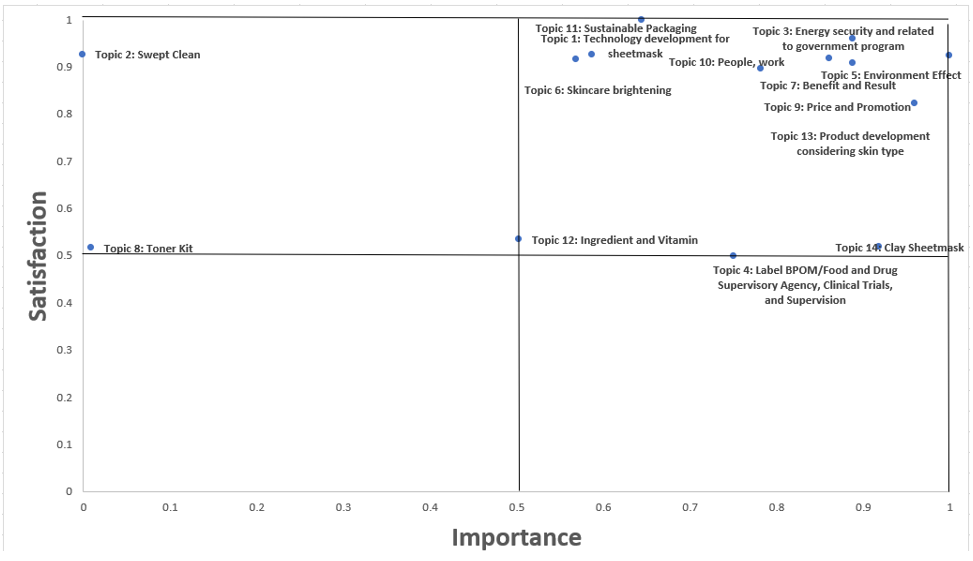
Figure 3 shows the mapping of attributes or topics within the IPA framework, carried out in order to determine the priority of developing sustainable skincare products, taking into account the consumer ratings of topics in terms of importance and satisfaction. As a result of mapping, Quadrant I was determined to contain attributes with the highest ratings concerning both importance and actual performance. The attributes that fall into Quadrant I are as follows: Technology development for sheet masks, energy security and government program, environmental effect, skincare brightening, Benefit and Result, price and promotion, people work, sustainable packaging, ingredient and vitamin, product development according to skin type, and clay sheet mask. From these results, one can conclude that these attributes satisfy user expectations and are crucial to creating positive experiences with sustainable skincare products. Thus, the focus on environmental effect and sustainable packaging, which are among the main consumer concerns, corresponds to the results proving that packaging material is crucial to assessing sustainability and is able to make consumers willing to pay extra money for products. Moreover, the technology development for sheet masks implies the consumer concern about technological innovations, which is proved by scientific evidence that consumer care about innovation. Moreover, the topics Energy security and Government program indicate the consumer interest in governmental initiatives aimed at sustainability in cosmetics industry, which is proved by research demonstrating the influence of favourable perception of governmental policy on consumers' pro-environmental behaviour and trust in eco-compliant products. Overall, all attributes in Quadrant I can be viewed as strategic elements that need to be preserved during the development of sustainable skincare products.
In turn, Quadrant II contains attributes that are perceived as relatively less important but bring a high level of user satisfaction. The topics Swept Clean and Toner Kit belong to Quadrant II. While they are not the key drivers of strategic satisfaction, they add to user satisfaction and positively influence the consumer perception of product. Therefore, although these attributes may not be a focus in product development, they need to be preserved as additional elements that add to the product value. This idea is confirmed by the previous studies, which prove that Quadrant II also contributes to the creation of the positive image of product and the increased holistic consumer experience (Anggraeni, 2021).
Quadrant III contains attributes with both low importance and low satisfaction, which do not receive much attention in the design of the product. In this case, none of topics falls into Quadrant III, which means that all topics have some degree of consumer relevance and none of attributes is fully ignored.
Quadrant IV contains attributes with high importance but low satisfaction, which implies unmet user expectations. In this case, the only attribute that falls into Quadrant IV is Label BPOM, clinical testing, and supervision. The mismatch between user expectations and actual performance indicates the consumers' concerns about the legality, transparency, and assurance of product safety. It needs special attention from the stakeholders of the industry as negative perceptions of legal issues directly influence consumers' trust. Without prompt action in this area via improving transparency, market trust will decrease.
Thus, the IPA analysis of 14 consumer review topics has proven that most aspects of sustainable skincare products satisfy consumer expectations and positively influence the user experience. Using this analysis, it is possible to develop strategies for the development of sustainable skincare products focused on consumer expectations, trust, and competitive advantages in the market.
Figure 3. Priority analysis of the sustainable skincare product reviews using Importance-Performance Analysis (IPA) model evaluation
4.4 Sustainability-Aware Automated Design Priority analysis
The IPA result was further transformed into an automated priority ranking using SADPI. This additional layer is important because IPA provides quadrant interpretation, whereas SADPI provides a computable redesign order. The index highlights attributes that combine high consumer importance with low sentiment-based performance, thus identifying issues that should receive earlier design attention.
SADPI Ranking Changes the Meaning of the Results of IPA Analysis. Sustainable packaging has the highest level of customer satisfaction and needs to be kept, although it is not the most urgent aspect to focus on from the perspective of redesign because of a relatively narrow gap between the importance and performance measures. In contrast, the creation of clay sheet masks and the issues concerning BPOM need to be paid more attention to, since they are characterized by high levels of importance and lower performance measured through sentiment analysis.
Baseline comparison with IPA and Kano-based approaches
Using the same importance and performance inputs, IPA serves as the direct baseline (Table 5). IPA assigns attributes to quadrants and, in the present case, identifies BPOM labeling, clinical testing, and supervision as the only high-importance/low-performance item, but it does not provide a continuous order among attributes within or across quadrants. SADPI adds this ordering: clay sheet mask (0.883), BPOM assurance (0.751), ingredient and vitamin transparency (0.468), skin-type-based development (0.343), people and work (0.161), and environmental effect (0.154). Thus, the decision output changes from categorical diagnosis to a ranked redesign queue while retaining the same underlying consumer signals. A Kano baseline was not estimated from this corpus because Kano classification requires structured satisfaction-response elicitation that is not available in the unstructured review data [28]; forcing the review corpus into Kano categories would introduce unsupported assumptions.
Table 5. Sustainability-Aware Automated Design Priority Index (SADPI)-based automated priority ranking for sustainable skincare design
|
Rank |
Priority Attribute |
SADPI |
Automated Design Action |
|
1 |
Clay sheet mask (Profit: product innovation) |
0.883 |
Optimize biodegradable nanofiber-clay formulation, usability, and perceived efficacy. |
|
2 |
BPOM labeling, clinical trials, and supervision (Profit: trust assurance) |
0.751 |
Improve regulatory visibility, clinical-test evidence, and safety assurance. |
|
3 |
Ingredient and vitamin transparency (People: user well-being) |
0.468 |
Clarify active ingredients, vitamin function, and potential skin compatibility. |
|
4 |
Skin-type-based product development (People: personalization) |
0.343 |
Segment formulations for oily, dry, acne-prone, and sensitive skin. |
|
5 |
People and work (People: ethical production) |
0.161 |
Communicate fair production practices and responsible labor conditions. |
|
6 |
Environmental effect (Planet: environmental impact) |
0.154 |
Evidence of biodegradability, waste reduction, and lower environmental impact. |
4.5 Sustainable product design requirements
Combining the topic modeling via LDA approach, satisfaction assessment via sentiment analysis and priority mapping via IPA results in a set of design requirements for sustainable products. Requirements for sustainable product design are obtained based on attributes that belong to Quadrant I and are classified into three categories: environment, economy and social. This multidimensional approach reflects the literature findings related to sustainable product design, which highlights the necessity of integrating all three aspects at the very beginning of the product development [51]. Also, according to Rocha et al. [52], modern sustainable design has developed an eco-design framework that can incorporate environmental, economic and social aspects simultaneously. Additional studies also emphasize that consumer needs cannot be interpreted separately but emerge due to the interaction between several dimensions in the complex ecosystem [53]. Thus, considering all three dimensions will improve the adequacy and relevance of decision-making in the sustainable skincare market.
Table 6 presents the sustainable product design requirements for sheet masks and specifies different topics that affect product design from the perspective of the environmental, economic and social dimensions. First of all, the topic "Technology Development for Sheet Mask" is associated with innovations that will make sheet masks more sustainable, implying that there should be a reduction in the environmental impact of the product and placing it into the environment category. Second, the topic "Energy Security and Related to Government Program" is also classified into the environment category because it is associated with the optimization of energy consumption in the production process according to governmental programs that promote resource efficiency.
The topic "Label BPOM/Food and Drug Supervisory Agency, Clinical Trials, and Supervision" relates to the economy, as it implies that product should comply with some standards necessary to enter the market and ensure its safety and accordance with legal requirements. "Environmental Effect" is also associated with the environment, as it analyzes the environmental consequences of the sheet mask product, including pollution caused by its production and disposal.
From the social perspective, the topic "Skincare Brightening" demonstrates the benefit of the product for consumers. Also, the topic "Benefit and Result" is related to the social aspect, as it reflects the satisfaction of customers from the product. In addition, the topic "People, Work" is associated with the labor conditions in sheet mask production, requiring the presence of ethically correct labor practices.
"Sustainable Packaging" is the topic associated with the application of environmentally friendly materials for packaging and is classified into the environment category because it helps to reduce waste and ecological footprint. The topic "Ingredient and Vitamin" is relevant to the social aspect because of its relation to the health benefits of consumers. Moreover, the topic "Product Development Considering Skin Type" is relevant to the social aspect, as it highlights the need to develop designs that are suitable for people with different skin types and needs.
Finally, "Clay Sheet Mask" is a topic related to innovation in the sheet mask market and its ability to provide a possibility of expanding the market, placing it into the economy category.
Table 6. Sustainable product design requirements
|
Topic |
Sustainable Product Design |
|
Topic 1: Technology development for sheet mask |
Environment |
|
Topic 3: Energy security and related to government program |
Environment |
|
Topic 4: Label BPOM/Food and Drug Supervisory Agency, Clinical Trials, and Supervision |
Economy |
|
Topic 5: Environmental effect |
Environment |
|
Topic 6: Skincare brightening |
Social |
|
Topic 7: Benefits and results |
Social |
|
Topic 9: Price and promotion |
Economy |
|
Topic 10: People, work |
Social |
|
Topic 11: Sustainable packaging |
Environment |
|
Topic 12: Ingredients and vitamins |
Social |
|
Topic 13: Product development considering skin type |
Social |
|
Topic 14: Clay sheet mask |
Economy |
Overall, it is possible to conclude that sustainable sheet mask design has to balance its environmental, economic and social impacts through technological innovation, responsible packaging, benefits for the health of the consumers and ethically correct labor practices.
In conclusion, the conducted research showed that sustainable sheet mask design should balance environmental impact, economic viability and social well-being.
Although the present case study focuses on biodegradable and nanofiber-based skincare products, the proposed architecture is product-independent at the computational level. The input layer can process consumer-generated text from other sustainable product domains, while the learning and identification layers can extract domain-specific attributes without changing the fundamental LDA, sentiment, IPA, and SADPI mechanisms. Adaptation to another product category mainly requires modification of the domain dictionary, sustainability mappings, and design-action knowledge base. The framework could therefore be extended to sustainable packaging, textile products, personal-care products, household products, biomedical consumables, and other product-development problems in which consumer requirements must be balanced with environmental, social, and economic considerations.
Illustrative R&D application of the decision output
A product-development team can use the ranked output as a design gate for a biodegradable nanofiber sheet-mask project: first, prioritize clay-nanofiber formulation, usability, and perceived efficacy; second, strengthen BPOM/regulatory visibility and clinical-test evidence; third, improve ingredient and vitamin transparency and develop skin-type variants; and, in parallel, maintain sustainable packaging as an existing strength. This sequence translates the computational ranking into formulation, assurance, communication, and portfolio actions. It is an illustrative application derived from the case results rather than external industry validation; evaluation by skincare product managers and R&D specialists is therefore recommended as the next validation step.
4.6 Limitations
Several limitations should be acknowledged. First, online reviews may contain fake, promotional, or biased content, which can affect the reliability of consumer-derived insights [54, 55]. Second, lexicon-based sentiment analysis may not fully capture sarcasm, implicit emotions, and context-dependent expressions [56]. Third, several stages, including topic interpretation and sustainability mapping, still require human judgment. Finally, the framework has only been tested on biodegradable and nanofiber-based skincare products; therefore, future studies should validate it across other sustainable product categories.
In addition, exact source-platform/timeframe metadata, some LDA run-level settings, and the sentiment lexicon implementation are not fully documented in the supplied analytical archive. The sentiment outputs have also not been verified against a manually labelled gold-standard sample, and the design priorities have not yet been evaluated by an external product-manager/R&D panel. Future work should preserve complete provenance and run metadata, report Precision/Recall/F1 against manual labels, benchmark computational workload, and conduct industry validation of the resulting design priorities.
This study developed a human-in-the-loop automated decision-support framework that transforms unstructured consumer-generated data into prioritized sustainable product-design actions. Rather than treating topic modeling and sentiment analysis as independent market-analysis tools, the proposed architecture links data acquisition, automated learning, attribute identification, performance evaluation, sustainability-aware prioritization, and decision output in an integrated computational process. SADPI constitutes the principal decision layer by converting learned attribute importance and sentiment-derived performance gaps into ranked redesign priorities.
The biodegradable and nanofiber-based skincare case demonstrates the ability of the framework to generate actionable priorities from 7,918 review sentences. Clay sheet mask innovation, regulatory assurance, ingredient transparency, skin-type personalization, and environmental impact emerged as major redesign priorities, while sustainable packaging represented an attribute that should primarily be maintained and communicated.
From an automated-systems perspective, the main contribution of this study is therefore not the identification of individual skincare attributes, but the development of a reproducible architecture that connects system learning, attribute identification, and optimization-oriented decision support. The framework can be periodically re-executed when new consumer data become available, enabling design priorities to be updated without repeating conventional large-scale consumer studies.
The current implementation remains a human-in-the-loop system because semantic topic interpretation, sustainability mapping, and final technical validation require expert involvement. Future development should focus on automated topic labeling, transformer-based contextual sentiment learning, fake-review detection, automated sustainability classification, adaptive weight learning, and integration with technical design and life-cycle assessment modules. Such extensions may enable the framework to evolve from an analytical decision-support model toward a more autonomous intelligent design-support system applicable across multiple sustainable product domains.
This research was funded by the Research Grant (Skema Penelitian Kolaboratif Antar Jurusan) from the Faculty of Industrial Technology, Universitas Islam Indonesia, under Grant Number 628/WDSD-FTI/70/FTI/XII/2024.
Appendix 1. Summary of related works from pre-existing literature and the proposed research
|
Author |
Sustainable Product |
Other Product |
Data Driven |
Product Design Method |
Sustainability Approach |
||||||||||
|
Biodegradable |
Nanofiber |
Specific |
Traditional |
Big Data & Machine Learning' |
Social Media |
Topic Modeling |
Sentiment Analysis |
Importance Performance Analysis |
Opportunity Algorithm |
Statistic Analysis |
People |
Profit |
Planet |
||
|
Deif et al. [12] |
✓ |
biodegradable zinc alloy for bone implants |
✓ |
✓ |
✓ |
||||||||||
|
Morinval et al. [36] |
✓ |
biodegradable polyester |
✓ |
✓ |
|||||||||||
|
Adak et al. [37] |
✓ |
food packaging materials |
✓ |
✓ |
|||||||||||
|
Li et al. [13] |
✓ |
biodegradable polymer foams |
✓ |
✓ |
|||||||||||
|
Dawoud et al. [14] |
✓ |
✓ |
natural anti-aging nanofiber facial mats |
✓ |
✓ |
✓ |
|||||||||
|
Purnama et al. [22] |
Smartphone |
✓ |
✓ |
✓ |
✓ |
✓ |
|||||||||
|
Chen et al. [38] |
Smatphone |
✓ |
✓ |
✓ |
✓ |
✓ |
|||||||||
|
Jeong et al. [24] |
Smartphone |
✓ |
✓ |
✓ |
✓ |
✓ |
|||||||||
|
Zhang [28] |
Mobile Phone |
✓ |
✓ |
✓ |
✓ |
✓ |
|||||||||
|
Setiawan et al. [39] |
Electric vehicle |
✓ |
✓ |
||||||||||||
|
Natalia et al. [40] |
Electric vehicle |
✓ |
✓ |
||||||||||||
|
Balla et al. [4] |
Electric vehicle |
✓ |
✓ |
✓ |
✓ |
✓ |
✓ |
||||||||
|
Nugroho and Widianto [41] |
Electric Vehicle |
✓ |
✓ |
✓ |
✓ |
✓ |
|||||||||
|
Panichakarn et al. [17] |
Electric vehicle |
✓ |
✓ |
||||||||||||
|
Suresha and Tiwari [27] |
Electric Vehicle |
✓ |
✓ |
✓ |
✓ |
✓ |
|||||||||
|
Purnama et al. [5] |
Electric Vehicle |
✓ |
✓ |
✓ |
✓ |
✓ |
✓ |
✓ |
|||||||
|
Ma et al. [18] |
Online Food |
✓ |
✓ |
✓ |
|||||||||||
|
Fahma et al. [19] |
Battery electric vehicle |
✓ |
✓ |
||||||||||||
|
Saputra and Andajani [42] |
Battery electric vehicle |
✓ |
✓ |
||||||||||||
|
Ren et al. [23] |
Battery electric vehicle |
✓ |
✓ |
✓ |
✓ |
||||||||||
|
Sutopo et al. [20] |
Electric Motorcycle |
✓ |
✓ |
||||||||||||
|
This study |
✓ |
✓ |
skincare product using biodegradable and nanofiber materials |
✓ |
✓ |
✓ |
✓ |
✓ |
✓ |
✓ |
✓ |
||||
[1] Chang, T.W., Chen, Y.S., Yeh, Y.L., Li, H.X. (2021). Sustainable consumption models for customers: Investigating the significant antecedents of green purchase behavior from the perspective of information asymmetry. Journal of Environmental Planning and Management, 64(9): 1668-1688. https://doi.org/10.1080/09640568.2020.1837087
[2] You, X.Z., Zhou, Y.T., Sun, R.J., et al. (2025). Biodegradable microbeads for personal care products and cosmetics. Green Chemistry, 27(11): 2823-2845. https://pubs.rsc.org/en/content/articlehtml/2025/gc/d4gc05852f.
[3] Storey, V.C., Hevner, A.R., Yoon, V.Y. (2024). The design of human-artificial intelligence systems in decision sciences: A look back and directions forward. Decision Support Systems, 182: 114230. https://doi.org/10.1016/j.dss.2024.114230
[4] Balla, S.N., Pani, A., Sahu, P.K., González-Feliu, J. (2023). Examining shifts in public discourse on electric mobility adoption through Twitter data. Transportation Research Part D: Transport and Environment, 121: 103843. https://doi.org/10.1016/j.trd.2023.103843
[5] Purnama, D.A., Lumi, D.P., Febriani, A., et al. (2025). Data-driven public policy for electric vehicles (EV) through open innovation and dynamic consumer preferences: A time-series social media analysis using integrated IPA-product improvability model. Journal of Open Innovation: Technology, Market, and Complexity, 11(3): 100583. https://doi.org/10.1016/j.joitmc.2025.100583
[6] Marlina, D., Tri Basuki, K., Mohd Zaki, Z., Siti Farahnasihah, A. (2022). Sentiment analysis on natural skincare products. Journal of Data Science, 2022(12): 1-17. http://eprints.intimal.edu.my/1667/.
[7] Park, J. (2020). Framework for sentiment-driven evaluation of customer satisfaction with cosmetics brands. IEEE Access, 8: 98526-98538. https://doi.org/10.1109/ACCESS.2020.2997522
[8] Rebia, R.A., Budiman, A.S., Hidayah, F.N., Septyani, D.W., Isla, S.A. (2022). Preparasi dan karakteristik lembaran plastik limbah masker berdasarkan variasi lapisan luar, tengah, dan dalam. Jurnal Serambi Engineering, 7(4): 4151-4158.
[9] Faheed, N.K. (2024). Advantages of natural fiber composites for biomedical applications: A review of recent advances. Emergent Materials, 7(1): 63-75. https://doi.org/10.1007/s42247-023-00620-x
[10] Yahya, E.B., Ali, S.R., Lalung, J., Zain, M.S.C., Danish, M., John, A. (2025). Exploring the potential of biopolymers in cosmetic applications: Sustainable, biocompatible, and high-performance materials for future innovations. Polymer Engineering & Science, 65(6): 2789-2802. https://doi.org/10.1002/pen.27186
[11] Bollinger, B., Kronthal-Sacco, R., Zhu, L. (2025). Sustainable product profit potential and availability. SSRN. https://papers.ssrn.com/sol3/papers.cfm?abstract_id=4546321.
[12] Deif, M., Attar, H., Aljaidi, M., Alsarhan, A., Al-Fraihat, D., Solyman, A. (2025). Machine learning alloying design of biodegradable zinc alloy for bone implants using XGBoost and bayesian optimization. Intelligent Systems with Applications, 27: 200549. https://doi.org/10.1016/j.iswa.2025.200549
[13] Li, S.S., Zhou, D.F., Yu, Z.R., et al. (2025). Research progress on the improvement strategy of foaming behavior for biodegradable polymer foams and their functional applications. Sustainable Materials and Technologies, 44: e01354. https://doi.org/10.1016/j.susmat.2025.e01354
[14] Dawoud, M.H.S., Gharieb, A.E., Hassan, A.H.M., Hendawy, O.M.B., Awad, H.H. (2025). Innovative natural anti-aging nanofiber facial mats: Harnessing quality by design and artificial intelligence for sustainable skincare solutions. Journal of Drug Delivery Science and Technology, 11: 107130. https://doi.org/10.1016/j.jddst.2025.107130
[15] Prastiyo, R.H., Lahindah, L. (2024). Customer requirements on digital application in energy sectors for B2B customers (a part of quality function deployment analysis on my pertamina for business). INJURITY: Journal of Interdisciplinary Studies, 3(1): 31-48.
[16] Karell, E., Niinimäki, K. (2020). A mixed-method study of design practices and designers’ roles in sustainable-minded clothing companies. Sustainability, 12(11): 4680. https://doi.org/10.3390/su12114680
[17] Panichakarn, B., Pochan, J., Shafiq, M., Saleem, I., Wang, Y.Q., Nazeer, S. (2024). The interplay of digital transformation, agility, environmental volatility, and innovation to spur enterprise performance: Evidence from Chinese electric vehicle firms. Journal of Open Innovation: Technology, Market, and Complexity, 10(4): 100408. https://doi.org/10.1016/j.joitmc.2024.100408
[18] Ma, B.H., Wong, Y.D., Teo, C.C., Wang, Z.Y. (2024). Enhance understandings of Online Food Delivery’s service quality with online reviews. Journal of Retailing and Consumer Services, 76: 103588. https://doi.org/10.1016/j.jretconser.2023.103588
[19] Fahma, F., Sutopo, W., Pujiyanto, E., Nizam, M. (2024). Dynamic open innovation to determine technology-based interoperability requirement for electric motorcycle swappable battery. Journal of Open Innovation: Technology, Market, and Complexity, 10(2): 100259. https://doi.org/10.1016/j.joitmc.2024.100259
[20] Sutopo, W., Prianjani, D., Fahma, F., Pujiyanto, E., Rasli, A., Kowang, T.O. (2022). Open innovation in developing an early standardization of battery swapping according to the Indonesian national standard for electric motorcycle applications. Journal of Open Innovation: Technology, Market, and Complexity, 8(4): 219. https://doi.org/10.3390/joitmc8040219
[21] Wu, P., Tang, T.J., Zhou, L.G., Martínez, L. (2024). A decision-support model through online reviews: Consumer preference analysis and product ranking. Information Processing & Management, 61(4): 103728. https://doi.org/10.1016/j.ipm.2024.103728
[22] Purnama, D.A., Subagyo, Masruroh, N.A. (2023). Online data-driven concurrent product-process-supply chain design in the early stage of new product development. Journal of Open Innovation: Technology, Market, and Complexity, 9(3): 100093. https://doi.org/10.1016/j.joitmc.2023.100093
[23] Ren, X.S., Sun, S., Yuan, R. (2021). A study on selection strategies for battery electric vehicles based on sentiments, analysis, and the MCDM model. Mathematical Problems in Engineering, 2021: 1-23. https://doi.org/10.1155/2021/9984343
[24] Jeong, B., Yoon, J., Lee, J.M. (2019). Social media mining for product planning: A product opportunity mining approach based on topic modeling and sentiment analysis. International Journal of Information Management, 48: 280-290. https://doi.org/10.1016/j.ijinfomgt.2017.09.009
[25] Huzaifah, A.S., Nurhasanah, R., Adriansyah, R.A.F. (2025). Topic modelling on beauty product reviews using latent dirichlet allocation. Jurnal Ilmu Komputer dan Agri-Informatika, 12(1): 119-131. https://doi.org/10.29244/jika.12.1.119-131
[26] Lee, J.H., Wood, J., Kim, J. (2021). Tracing the trends in sustainability and social media research using topic modeling. Sustainability, 13(3): 1269. https://doi.org/10.3390/su13031269
[27] Suresha, H.P., Tiwari, K.K. (2021). Topic modeling and sentiment analysis of electric vehicles of twitter data. Asian Journal of Research in Computer Science, 12(2): 13-29.
[28] Zhang, L., Xuan, Y., Li, Z.Q., Gao, P.F., Zheng, Y. (2024). How to obtain customer requirements for each stage of the product life cycle from online reviews: Using mobile phones as an example. Journal of Retailing and Consumer Services, 80: 103928. https://doi.org/10.1016/j.jretconser.2024.103928
[29] Zhang, F., Song, W.Y. (2024). Product improvement in a big data environment: A novel method based on text mining and large group decision making. Expert Systems with Applications, 245: 123015. https://doi.org/10.1016/j.eswa.2023.123015
[30] Wang, Z., Liu, H.R., Fan, X.J., Zhang, T. (2024). Integrating machine learning and robust optimization for new product development: A consumer and expert preference-based approach. Computers & Industrial Engineering, 197: 110520. https://doi.org/10.1016/j.cie.2024.110520
[31] Sharma, R., Singh, A. (2025). Integrating AI, green marketing, and influencer strategies: Shaping sustainable consumer behavior in the digital age. In Strategic Brand Management in the Age of AI and Disruption, IGI Global Scientific Publishing: 325-342. https://doi.org/10.4018/979-8-3693-9461-8.ch013
[32] Elkington, J. (1998). Accounting for the triple bottom line. Measuring Business Excellence, 2(3): 18-22. https://doi.org/10.1108/eb025539
[33] Al Mamun, A., Shawon, M.L., Hamid, M.K. (2025). Purchase intention and buying behaviour of green skincare products: A study on bangladeshi consumers. FASS INQUEST, 4(2): 117-141.
[34] Su, Z.J., Yang, M., Zhai, Q.B., Guo, K.Y., Huang, Y.X., Cong, Y.F. (2025). A multigrained preference analysis method for product iterative design incorporating AI-generated review detection. Scientific Reports, 15(1): 2528. https://doi.org/10.1038/s41598-025-86551-5
[35] Ribeiro, R., Pilastri, A., Moura, C., Morgado, J., Cortez, P. (2023). A data-driven intelligent decision support system that combines predictive and prescriptive analytics for the design of new textile fabrics. Neural Computing & Applications, 35(23): 17375-17395. https://doi.org/10.1007/s00521-023-08596-9
[36] Morinval, A., Follain, N., Avérous, L. (2024). Design and analysis of biodegradable and potentially biobased multiphase systems from starch and co-polyesters. European Polymer Journal, 215: 113231. https://doi.org/10.1016/j.eurpolymj.2024.113231
[37] Adak, B., Baidya, S., Teramoto, Y. (2025). Biopolymers and their nanocomposites coated paper-based high barrier and sustainable food packaging materials. Carbohydrate Polymers, 367: 123966. https://doi.org/10.1016/j.carbpol.2025.123966
[38] Chen, K.J., Zheng, J.J., Jin, J. (2024). Ranking products through online opinions: A text analysis and regret theory-based approach. Applied Soft Computing, 158: 111571. https://doi.org/10.1016/j.asoc.2024.111571
[39] Setiawan, A.D., Zahari, T.N., Purba, F.J., Moeis, A.O., Hidayatno, A. (2022). Investigating policies on increasing the adoption of electric vehicles in Indonesia. Journal of Cleaner Production, 380: 135097. https://doi.org/10.1016/j.jclepro.2022.135097
[40] Natalia, Y., Rahman, I., Hidayatno, A. (2020). Conceptual model for understanding the policy challenges of electric vehicle adoption in Indonesia. In Proceedings of the 6th International Conference on Industrial and Business Engineering (ICIBE '20). Association for Computing Machinery, New York, NY, USA, pp. 113-117. https://doi.org/10.1145/3429551.3429557
[41] Nugroho, S.A., Widianto, S. (2024). Exploring electric vehicle adoption in Indonesia using zero-shot aspect-based sentiment analysis. Sustainable Operations and Computers, 5: 191-205. https://doi.org/10.1016/j.susoc.2024.08.002
[42] Saputra, M.C., Andajani, E. (2023). Analysis of factors influencing intention to adopt battery electric vehicle in Indonesia. ADI Journal on Recent Innovation, 5(2): 100-109. https://doi.org/10.34306/ajri.v5i2.993
[43] Blei, D.M., Ng, A.Y., Jordan, M.I. (2003). Latent dirichlet allocation. Journal of Machine Learning Research, 3: 993-1022. https://www.jmlr.org/papers/volume3/blei03a/blei03a.pdf.
[44] Wu, J., Zhao, N., Yang, T. (2024). Wisdom of crowds: SWOT analysis based on hybrid text mining methods using online reviews. Journal of Business Research, 171: 114378. https://doi.org/10.1016/j.jbusres.2023.114378
[45] Wu, J., Zhao, N. (2023). What consumer complaints should hoteliers prioritize? Analysis of online reviews under different market segments. Journal of Hospitality Marketing & Management, 32(1): 1-28. https://doi.org/10.1080/19368623.2022.2119187
[46] Yang, T., Dang, Y.Z., Wu, J.N. (2023). Dynamic perceived quality analysis using social media data at macro- and micro-levels. Industrial Management & Data Systems, 123(5): 1465-1495. https://doi.org/10.1108/IMDS-08-2022-0478
[47] Subagyo, Purnama, D.A., Masruroh, N.A., Pratama, R.R. (2024). Modeling dynamic consumer preferences in product attributes for social media-based product improvement planning. MAJCAFE, 32(1): 104-140. https://doi.org/10.60016/majcafe.v32.05
[48] Amberg, N., Fogarassy, C. (2019). Green consumer behavior in the cosmetics market. Resources, 8(3): 137. https://doi.org/10.3390/resources8030137
[49] Chin, J., Jiang, B.C., Mufidah, I., Persada, S.F., Noer, B.A. (2018). The investigation of consumers’ behavior intention in using green skincare products: A pro-environmental behavior model approach. Sustainability, 10(11): 3922. https://doi.org/10.3390/su10113922
[50] Perret, J.K., Gómez Velázquez, A., Mehn, A. (2025). Green cosmetics—The effects of package design on consumers’ willingness-to-pay and sustainability perceptions. Sustainability, 17(6): 2581. https://doi.org/10.3390/su17062581
[51] Chen, C.W. (2018). Guidance on the conceptual design of sustainable product-service systems. Sustainability, 10(7): 2452. https://doi.org/10.3390/su10072452
[52] Rocha, C.S., Antunes, P., Partidário, P. (2019). Design for sustainability models: A multiperspective review. Journal of Cleaner Production, 234: 1428-1445. https://doi.org/10.1016/j.jclepro.2019.06.108
[53] Phan-Le, N.T., Brennan, L., Parker, L. (2024). An integrated model of the sustainable consumer. Sustainability, 16(7): 3023. https://doi.org/10.3390/su16073023
[54] Luo, J.W., Luo, J., Nan, G.F., Li, D.H. (2023). Fake review detection system for online E-commerce platforms: A supervised general mixed probability approach. Decision Support Systems, 175: 114045. https://doi.org/10.1016/j.dss.2023.114045
[55] Xie, Y.C., Yeoh, W., Wang, J.G. (2024). How self-selection Bias in online reviews affects buyer satisfaction: A product type perspective. Decision Support Systems, 181: 114199. https://doi.org/10.1016/j.dss.2024.114199
[56] Mao, Y.Y., Liu, Q., Zhang, Y. (2024). Sentiment analysis methods, applications, and challenges: A systematic literature review. Journal of King Saud University - Computer and Information Sciences, 36(4): 102048. https://doi.org/10.1016/j.jksuci.2024.102048