
Nazar J. Abdulridha | Sinan S. Hamdi | Shaymaa J. Ahmed | Anwer J. Al-Obaidi*
© 2026 The authors. This article is published by IIETA and is licensed under the CC BY 4.0 license (http://creativecommons.org/licenses/by/4.0/).
OPEN ACCESS
The growing accumulation of aluminium waste poses serious environmental and industrial challenges and calls for new sustainable recycling methods. This study investigates the development of hybrid aluminium matrix composites reinforced with varying proportions of carbon fibres and silica particles and evaluates their mechanical properties and wear behaviour. The composites were fabricated using stir casting and tested to determine their mechanical properties and wear response. The results showed that the addition of the reinforcing materials significantly improved the mechanical and wear properties compared to unreinforced recycled aluminium. The optimal sample (containing 6.75% carbon fibres and 11.25% silica) exhibited the highest mechanical performance and wear resistance, with yield strength, tensile strength, and hardness jumping to 190 MPa, 290 MPa, and 143 HV, respectively, accompanied by the lowest wear rate. These improvements are attributed to the combined effect of load transfer mechanisms. Conversely, the study revealed a critical limit at which the reinforcement increases. Sample (9.00% carbon fibre and 15.00% silica) exhibited a sharp decline in yield strength (80 MPa) and a significant increase in wear rate to 30.1 at 15 minutes. This was attributed to particle agglomeration and the formation of micropores, which acted as stress concentrators, despite maintaining high stiffness (139 HV). This study highlights the importance of selecting a "safe fabrication window" to balance strengthening mechanisms and prevent brittle failure of the hybrid composite in advanced engineering applications.
recycled aluminium, silica particles, carbon fibre, mechanical properties, wear behaviour
Due to the rapid expansion of industrial and structural applications, the demand for lightweight, high-performance materials has been dramatically heightened by intensifying global environmental pressures. Composite materials have emerged as the basis for these requirements, with various matrices such as epoxy [1, 2], thermoplastic polymers [3], and various reinforcements, such as fibres [4] and particles [5-7], or even the type of structure, such as auxetic [8]. There is an environmentally oriented trend towards relying on the recycling of materials, such as natural materials [9], or recycling metals [10]. Among recyclable alloys, aluminium recycled from post-consumer waste—such as beverage cans—stands out as a highly sustainable and cost-effective alternative, requiring only a fraction of the energy consumed in the primary extraction process [11]. However, unreinforced recycled aluminium inherently suffers from reduced mechanical strength and surface hardness, in addition to increased friction and wear, due to the accumulation of impurities, entrapped oxides, and microporosity. To address these limitations, aluminium matrix hybrid composites (AMCs) have gained significant attention. The importance of aluminium recycling is also justified by its excellent recyclability: it retains 100% of the end product’s characteristic mechanical and metallurgical properties in each recycling cycle, making it well-suited to a circular economy [12-15].
AlShamari et al. [16] used stir casting to produce aluminium alloy (AA6061) reinforced by aluminium oxide (Al2O3)/boron carbide (B4C) at various weight ratios (2.5–10 wt.%). The findings show that wear resistance and hardness properties have been improved at the optimum filler content of 7.5 wt.%. However, after 7.5 wt.%, agglomeration appeared with increasing porosity. Gürbüz et al. [17] used the stir casting method under vacuum to improve the mechanical properties of recycled cans using Silicon Carbide (SiC) (1-12 wt.%). The results showed that the best tensile strength was achieved at 1 wt.% of SiC, while the optimal compressive strength was at 5 wt.%. After that, the properties decreased at higher SiC content due to clustering. The ultrasonically assisted stir casting was adopted by Sharma et al. [18] to improve the mechanical and wear properties of aluminium. The research showed that ultrasonic casting leads to a reduction in porosity, and the properties improved with a small particle size. However, excess fillers reduce the ductility, and the agglomeration challenge remains. Abolusoro et al. [19] used rice husk ash (RHA) (0-15 wt.%) to improve the properties of recycled aluminium. The findings show that corrosion resistance increases to achieve the best at 5% RHA; after that, the performance decreases with increasing the percentage content of RHA. RHA (3-12 wt.%) was used with Graphite (3 wt.%) to improve the mechanical properties of AA7075 by Sulayman et al. [20]. The findings showed that impact strength increased significantly, while the hardness and tensile strength decreased at higher contents of RHA due to weak load transfer and clustering. Recycled aluminium has been improved using melon shell ash (5-20 wt.%) by Abolusoro et al. [21]. The results showed that the wear resistance and coefficient of friction improved significantly with the increase in fillers. However, agglomeration appears at 15 wt.%, which caused corrosion susceptibility. The importance of adding silicon dioxide (SiO2) to improve the mechanical and fracture behaviour of the polymer matrix was investigated by Dileep et al. [22]. The findings showed a significant increase in the mechanical properties of composites, reaching 53% and 22% for tensile and flexural strengths due to stronger interfacial bonding, which leads to less brittleness.
Although extensive work has been conducted on aluminium matrix composites, very little has been done to upgrade recycled aluminium waste into high-performance microcomposites for use in harsh industrial environments. While aluminium recycling provides substantial environmental benefits and energy savings, recycled aluminium typically has lower mechanical and tribological properties than primary aluminium alloys. This deterioration is primarily due to impurity enrichment, oxide entrapment, pore formation, and microstructural changes during recasting.
Although recycled aluminium suffers from reduced strength, stiffness, and corrosion resistance due to impurities and porosity, the literature has not yet explored a hybrid reinforcement system combining short carbon fibres (SCF) and SiO2 for multi-scale hybrid reinforcement mechanics. Therefore, this research aims to alleviate the handicaps associated with recycled aluminium, particularly its reduced strength, hardness, and wear resistance, by using SCF and SiO2 at various weight ratios, and optimising the composite production and casting processes.
2.1 Recycled aluminium
Post-consumer aluminium beverage cans were used to obtain recycled aluminium. They were collected and processed through a cleaning procedure to remove unwanted impurities such as dirt, coatings, and liquids. The cans were cleaned and dried, and then cut into small pieces to ensure even melting. Recycled aluminium helps ensure sustainability because it uses less energy and has a lower environmental impact than primary aluminium production. The commercial beverage cans typically consist of aluminium alloys AA3104/AA3004 with nominal alloying additions, as shown in Table 1.
Table 1. Chemical composition (wt.%) of the recycled aluminium matrix
|
Element |
Mn |
Mg |
Fe |
Si |
Cu |
Zn |
Cr |
Al |
|
wt.% |
0.85–1.35 |
0.80–1.30 |
≤0.70 |
≤0.30 |
≤0.25 |
≤0.25 |
≤0.10 |
Balance |
2.2 Reinforcement materials
In the current study, two types of reinforcement materials have been used: SCF and SiO2. Carbon fibre (150 µm length, 7 µm diameter (aspect ratio L/D ≈ 21.4), and supplied by SGL Carbon) is reputed to be very strong and stiff, thus suitable for enhancing the mechanical performance of composites and providing an efficient aspect ratio for interfacial load transfer. Silica particles (50 µm in size, supplied by Sigma-Aldrich), however, are commonly used to impart hardness and wear resistance. These particles have an irregular geometry that enhances the mechanical interlocking with the matrix. The hybrid-reinforced system formed by SCF and silica enhances the composite's strength and durability.
Table 2. Weight percentage composition of recycled aluminium composites reinforced with short carbon fibres (SCF) and silica
|
Sample |
Al (%) |
SCF (%) |
Silica (%) |
|
S1 |
94.0 |
2.25 |
3.75 |
|
S2 |
100.0 |
0.00 |
0.00 |
|
S3 |
82.0 |
6.75 |
11.25 |
|
S4 |
89.5 |
6.75 |
3.75 |
|
S5 |
86.5 |
2.25 |
11.25 |
|
S6 |
91.0 |
9.00 |
0.00 |
|
S7 |
88.0 |
4.50 |
7.50 |
|
S8 |
76.0 |
9.00 |
15.00 |
|
S9 |
85.0 |
0.00 |
15.00 |
To investigate the impact of reinforcement content, a design of experiments (DOE) approach is used to manage compositions with different weight percentages of aluminium, carbon fibre, and silica, as shown in Table 2. These compositions were well chosen to study the effect of progressive reinforcement on the mechanical characteristics of the composite. The difference in composition enables a complete comparison between reinforced and unreinforced samples. Minitab 18 software was used to create the experimental sets.
The composites were fabricated using vortex stir-casting, a technique commonly used in the manufacturing of aluminium matrix composites because of its simplicity and cost-effectiveness. It started with the recycled aluminium being melted in a furnace at 650–700 ℃. Once fully molten, all of the ash and slag were skimmed off to be cleaned.
The reinforcement materials (SCF and silica) were slowly added after preheating at 250 ℃ to prevent thermal shock. To create a stable vortex, the speed of mechanical stirring was 400–500 rpm. The preheated reinforcement materials were added incrementally into the vortex for 3–5 minutes to minimise particle agglomeration.
Solidification and cooling of the molten mixture were then carried out in moulds (preheated at 180-200 ℃), and the mixture was left to cool under ambient conditions with an estimated cooling rate of 0.5-1 ℃/s.
The composites were removed from the moulds after solidification, and cutting instruments were used to cut the samples to the standard dimensions. Each test specimen was machined to obtain the desired shape and size. Lastly, the specimens were polished to remove surface irregularities and ensure the accuracy of the test results.
The composites were mechanically tested to assess strength, wear resistance, and hardness. The tensile test assessed the material's strength in resisting applied forces. American Society for Testing and Materials (ASTM) E8/E8M standard [23] was adopted to evaluate the tensile strength of the samples. A Vickers hardness test was conducted to assess the material's resistance to deformation; the standard ASTM E384 [24] was adopted to determine the micro-indentation hardness of the composites.
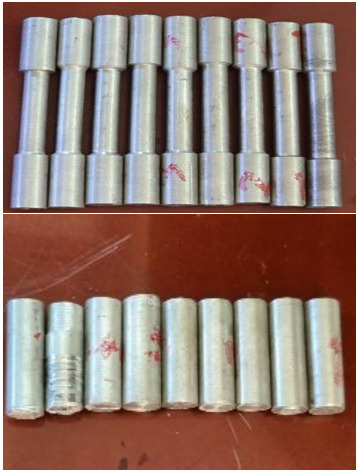
A wear test was conducted to assess its resistance to friction and surface degradation. Following the standard ASTM G99 [25], a pin-on-disc device was used, where the sample slides against a rotating disc (hardened EN31 tool steel) along a fixed track diameter (70 mm) at a defined load (10 N), constant sliding speed 1.5 m/s, and time (5, 10, and 15 minutes). These tests were performed on cylindrical specimens based on the standard dimensions and repeated three times to ensure reliability, as shown in Figure 1.
All mechanical and wear tests were conducted at an ambient room temperature of 25 ± 2 ℃ and a relative humidity of 50 ± 5%.
Figure 1. Cylindrical composite specimens used in mechanical testing
The mechanical and tribological behaviours of Recycled Aluminum reinforced with SCF and micro silica were evaluated, as shown in Table 3.
Table 3. The mechanical and tribological results
|
No. |
Yield Strength (MPa) ± 4 |
Ultimate Strength (MPa) ± 5 |
Strain at Break % ± 0.13 |
Hardness (HV) ± 3 |
Wear Rate (*10-8) |
||
|
5 min ± 0.5 |
10 min ± 0.7 |
15 min ± 1 |
|||||
|
S1 |
130 |
190 |
2.65 |
110 |
15.0 |
19.5 |
22.2 |
|
S2 |
90 |
150 |
5.90 |
78 |
16.0 |
21.0 |
27.0 |
|
S3 |
190 |
290 |
4.60 |
143 |
12.0 |
16.0 |
19.7 |
|
S4 |
132 |
200 |
4.34 |
119 |
14.9 |
19.7 |
23.7 |
|
S5 |
130 |
207 |
3.76 |
132 |
15.3 |
20.3 |
24.1 |
|
S6 |
134 |
196 |
4.64 |
98 |
14.7 |
19.4 |
23.6 |
|
S7 |
135 |
199 |
2.80 |
128 |
14.0 |
17.8 |
20.5 |
|
S8 |
80 |
163 |
2.30 |
139 |
20.4 |
25.6 |
30.1 |
|
S9 |
129 |
211 |
3.46 |
135 |
15.4 |
20.5 |
24.3 |
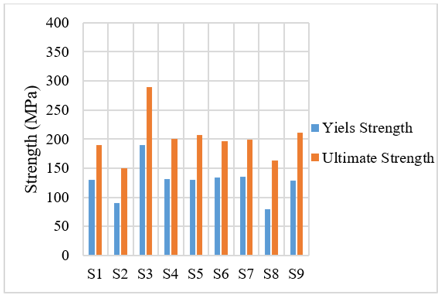
Figure 2. The relationship between strengths and composite sets
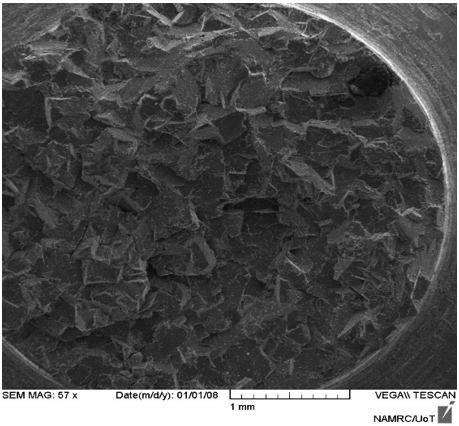
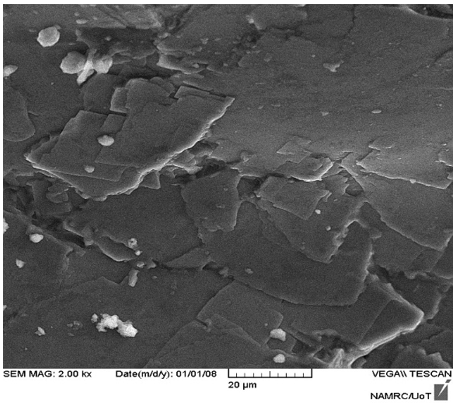
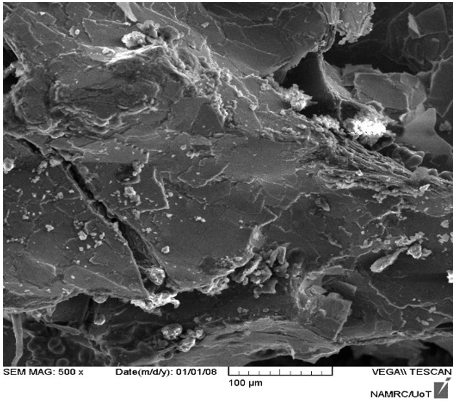
As shown in Table 3 and Figure 2, the findings showed a significant variation dependent on the percentage of fillers. S2 represents the recycled aluminium without any fillers, with minimum values of ultimate and yield strengths, which are 150 and 90 MPa, respectively, and the highest strain at break (5.9%). This attitude is related to the mechanical behaviour of pure aluminium, which provides a large number of continuous slip systems, facilitating the movement of dislocations under low stress, as shown in Figure 3.
Conversely, S3 provides a significant increase in the mechanical properties, achieving ultimate and yield strengths of 290 and 190 MPa, respectively. This behaviour is due to the efficiency of load transfer by carbon fibres, which absorb and transfer high stresses. Moreover, the presence of microsilica acts to prevent dislocations from moving freely and forces them to bend around it.
Figure 3. Scanning electron microscopy (SEM) image of the fracture surface of the S2 sample
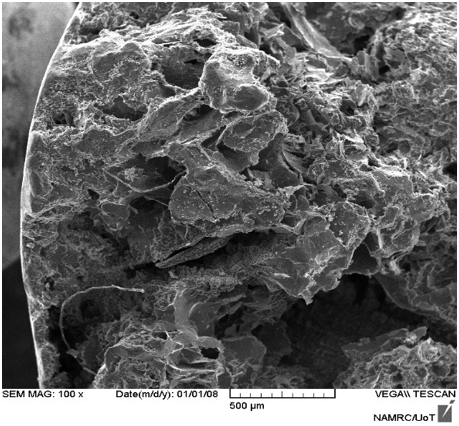
Figure 4. Scanning electron microscopy (SEM) image of the fracture surface of the S8 sample
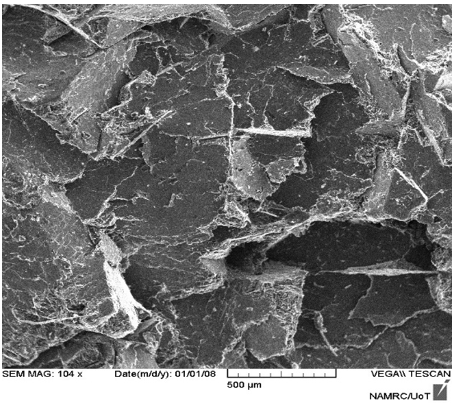
However, the S8 composite (9 wt.% SCF and 15 wt.% Silica) shows a sharp deterioration in stress, where the yield strength dropped to 80 MPa, which is lower than that of the recycled aluminium with the lowest strain at break, 2.3%. This collapse is due to filler ratios, which become a critical limit that leads to particle agglomeration of SCF and microsilica and thus creates micropores, which are transformed into stress concentrations, as shown in Figure 4.
The remaining samples observed remarkable stability and convergence with yield strength values around 130 MPa, and ultimate strength around 200 MPa. This indicates a dynamic balance between the strengthening mechanisms and the restriction of matrix ductility.
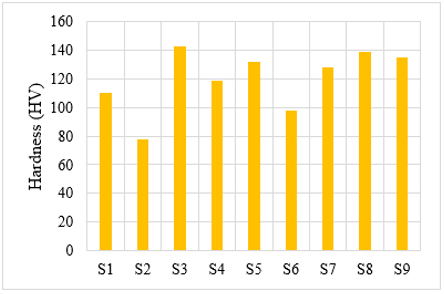
Figure 5 shows the relationship between hardness and the composite sets. The results illustrate that the recycled aluminium (S2) exhibits the lowest value of hardness (78 HV) because of the elastic nature of the matrix and the absence of reinforcing phases.
The hardness values gradually increase after adding the reinforcements to reach the peak value of 143 HV in S3 due to the uniform distribution of microsilica particles, which effectively resists penetration, while the SCF play a role in restricting plastic deformation.
Figure 5. The relationship between hardness and composite sets
Figure 6. The relationship between the wear rate and composite sets
Despite the dramatic drop previously in tensile stress, the S8 sample maintains a very high hardness value, which is 139 HV. This is due to the fact that the hardness test depends on measuring the localised resistance to penetration and scratching on the surface, which is directly related to the high volumetric fracture of microsilica particles (15 wt.%).
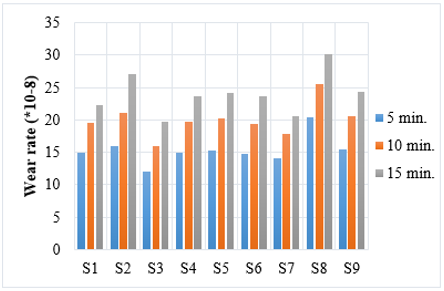
Figure 6 shows the behaviour of the wear rate for nine composites (S1-S9) at three different times, which are 5, 10, and 15 minutes. Generally, the wear rate gradually increased as the time increased for all composites. This is due to the gradual increase in the localised frictional heating at the contact surfaces, which leads to thermal softening of materials and decreases the mechanical resistance to shear, thus facilitating the removal of the material and the generation of wear debris over time.
The results show that the S3 sample shows the best wear resistance (lowest wear rate) across all periods because of its high hardness value. The uniform distribution of reinforcement fillers can contribute to producing a surface shield, which resists penetration of the counterface protrusions and prevents micro-ploughing.
However, the wear rate of the S8 sample is the most striking and significant phenomenon because of its sharp increase, reaching the highest wear rate value despite its very high hardness value. This critical behaviour is due to particle agglomeration, and when frictional shear forces are applied, the weak matrix fails to retain them, which leads to the removal and crushing (particle pull-out) of these agglomerations.
The fracture surfaces of the composites were systematically investigated using scanning electron microscopy (SEM) to observe the material failure and the structural transition under tensile testing. Depending on the fractographic observations, the failure mode shifted from quasi-ductile (recycled aluminium) to a brittle fracture mode with the addition of the reinforcements.
As illustrated previously in Table 3, the S2 sample shows relatively higher ductility with a strain at break of 5.9%. However, the localized plastic deformations were restricted with the addition of hard particulate reinforcements due to pinning of dislocation movement.
The optimum composite S3 showed a fairly homogeneous distribution of reinforcing phases on its fracture surface, featuring robust interfacial adhesion between the recycled Al matrix, SCF, and SiO2 particles, as shown in Figure 7. This effective load transfer was facilitated by a strong interfacial bond (matrix-reinforcement interface), which led to a delay in crack formation, thereby achieving maximum yield and ultimate strengths of 190 and 290 MPa, respectively.
Figure 7. Scanning electron microscopy (SEM) image of sample S3
Conversely, when the concentrations of fillers increased excessively, a dramatic degradation in yield strength (80 MPa) and ultimate tensile strength (163 MPa) occurred, with the lowest strain at break (2.3%), as observed in sample S8 (see Figure 8).
Stress concentration zones occurred due to clustering of hard particles SiO2 and SCF, which led to mechanical constraints and prominent microstructural defects under tensile loading. Therefore, a brittle fracture surface was created due to particle pull-out and catastrophic transgranular shear cleavage, as shown in Figure 9.
Figure 8. Scanning electron microscopy (SEM) image of sample S8
Figure 9. Scanning electron microscopy (SEM) image of clustering of hard particles: Silicon dioxide (SiO2) and short carbon fibres (SCF)
These observations confirm that the excessive addition of fillers leads to degradation of structural integrity by promoting brittle fracture. However, the controlled hybrid fillers optimise crack growth resistance.
This research provides a deep understanding of the synergistic effect of SCF and silica particles as hybrid reinforcement elements in an aluminium matrix. The key findings can be summarised as follows: Hybrid reinforcement at carefully considered ratios resulted in a significant improvement in mechanical performance and wear resistance compared to unreinforced recycled aluminium. The optimal combination (sample S3) achieved the highest yield strength and tensile strength (190 MPa and 290 MPa, respectively) and the highest hardness (143 HV) with the lowest wear rate across all test times. This improvement was suggested to be due to the load transfer mechanism through the short fibre and silica particles. Furthermore, a general positive relationship was observed between increased friction time and wear rate for all samples due to localised thermal smoothing of the matrix caused by continuous friction. The results also demonstrated the existence of a critical absorbent limit for the matrix. Excessive reinforcement ratios (in sample S8) resulted in severe mechanical deterioration and record-high wear rates. This was due to particle agglomeration and dislodging during friction, transforming into third-party abrasive particles. Furthermore, structural pores formed, acting as stress centres that accelerated crack growth and premature fracture, despite the surface maintaining high localised hardness. Ultimately, this study provides an engineering roadmap for determining optimal reinforcement ratios and avoiding critical limits, thereby enabling the design of hybrid aluminium composites with superior mechanical efficiency and excellent wear resistance for advanced industrial applications.
[1] Hammadi, A.F., Oleiwi, A.H., Abbas, A.T., Al-Obaidi, A.J. (2023). Effect of alumina particles on the mechanical and physical properties of polypropylene whisker reinforced lamination 80:20 resin composite. Revue des Composites et des Matériaux Avancés-Journal of Composite and Advanced Materials, 33(1): 7-12. https://doi.org/10.18280/rcma.330102
[2] Cellai, A., Pezzana, L., Casalegno, V., Salvo, M., Sangermano, M. (2025). Bio-based epoxy adhesives reinforced with recycled fillers. Polymers, 17(22): 2975. https://doi.org/10.3390/polym17222975
[3] Abbas, A.T., Al-Obaidi, A.J., Ahmed, S.J. (2021). Synthesis and study of the mechanical properties of biodegradable polyvinyl alcohol/eggshell composites. Journal of Engineering Science and Technology, 16(4): 3084-3093.
[4] Al-Obaidi, A.J., Ahmed, S.J., Sukar, H.M. (2020). The effect of factors on the flexural of the composite leaf spring. Materials Today: Proceedings, 20: 566-571. https://doi.org/10.1016/j.matpr.2019.09.190
[5] Abdulridha, N.J., Al-Ghaban, A.M., Al-Obaidi, A.J. (2024). Physical and structural properties of biphasic calcium phosphate BCP reinforced with silicene fillers. AIP Conference Proceedings, 3091(1): 030003. https://doi.org/10.1063/5.0204640
[6] Al-Obaidi, A.J., Tariq, A., Dalfi, H. (2022). Influence of nanoparticles reinforcements on the mechanical performance and tribological properties of aluminum 6082 alloys. Engineering Transactions, 70(4): 391-405. https://doi.org/10.24423/EngTrans.2239.20221012
[7] Santos Junior, A.J., Herradon, M.P., de Souza, M.V., et al. (2025). Epoxy as an alternative resin in particleboard production with pine wood residues: Physical, mechanical, and microscopical analyses of panels at three resin proportions. Forests, 16(2): 196. https://doi.org/10.3390/f16020196
[8] Mirante, L. (2015). Auxetic structures: Towards bending-active architectural applications. Master's thesis. School of Architecture and Society, Politecnico di Milano, Milan, Italy.
[9] Al-Bayati, S.I.A., Aydoğmuş, E. (2026). Sustainable epoxy composites filled with natural mineral rocks: Comparative evaluation of mechanical, thermal, and dielectric performance. Polymers, 18(5): 571. https://doi.org/10.3390/polym18050571
[10] Suzuki, T., Daigo, I. (2024). Recycled content for metals with refined classification of metal scrap: Micro-level circularity indicator in accordance with macro-level system. Sustainability, 16(16): 6933. https://doi.org/10.3390/su16166933
[11] Wędrychowicz, P., Kustra, P., Milenin, A. (2023). A numerical and experimental analysis of the mechanical behavior of the aluminum beverage can with internal varnish layers during axial load force testing. Materials, 16(19): 6603. https://doi.org/10.3390/ma16196603
[12] Hajar, H.A.A., Tweissi, A., Hajar, Y.A.A., et al. (2020). Assessment of the municipal solid waste management sector development in Jordan towards green growth by sustainability window analysis. Journal of Cleaner Production, 258: 120539. https://doi.org/10.1016/j.jclepro.2020.120539
[13] Al-Alimi, S., Yusuf, N.K., Ghaleb, A.M., et al. (2024). Recycling aluminium for sustainable development: A review of different processing technologies in green manufacturing. Results in Engineering, 23: 102566. https://doi.org/10.1016/j.rineng.2024.102566
[14] Ashwin Kumar, S., Chaganty, S., Rajesh, V., Sunil Kumar Reddy, K., Babu, N., Shnain, A.H. (2024). Review on development, nanoparticle reinforcement and sustainable materials for enhancement of mechanical properties in aluminium hybrid metal matrix composites. E3S Web of Conferences, 552: 01068. https://doi.org/10.1051/e3sconf/202455201068
[15] Harmaji, A., Jafari, R., Simard, G. (2024). Valorization of residue from aluminum industries: A review. Materials, 17(21): 5152. https://doi.org/10.3390/ma17215152
[16] AlShamari, K.D., AlNaimi, I.K., Majid, R.H. (2018). Experimental study on tribological characteristics of AA 6061 alloy reinforced with Al2O3 and B4C particles. Journal of Engineering, 24(6): 1-10. https://doi.org/10.31026/j.eng.2018.06.01
[17] Gürbüz, M., Turan, B.C., Yılmaz, Ö. (2019). Stir casting of SiC reinforced aluminum composites from waste aluminum. International Journal of Multidisciplinary Studies and Innovative Technologies, 3(1): 31-33. https://izlik.org/JA82JM73SK.
[18] Sharma, S.K., Gajević, S., Sharma, L.K., et al. (2024). Progress in aluminum-based composites prepared by stir casting: Mechanical and tribological properties for automotive, aerospace, and military applications. Lubricants, 12(12): 421. https://doi.org/10.3390/lubricants12120421
[19] Abolusoro, O.P., Khoathane, M.C. (2026). Corrosion and wear behavior of recycled aluminum alloy reinforced with rice husk ash. Research on Engineering Structures and Materials, 12: 391-406. https://doi.org/10.17515/resm2025-995ma0701rs
[20] Sulayman, F.A., Saraki, Y.A., Sulaiman, I. (2025). Characterization and experimental analysis of AA7075 aluminium alloy and rice husk ash reinforced hybrid composite. ARID Zone Journal of Engineering, Technology and Environment, 21(1): 87-100. https://azojete.com.ng/index.php/azojete/article/view/1013.
[21] Abolusoro, O.P., Khoathane, M.C., Mhike, W. (2024). Influence of melon shell ash reinforcement on the mechanical and microstructural characteristics of recycled aluminium matrix composites. Research on Engineering Structures and Materials, 11(2): 783-798. https://doi.org/10.17515/resm2024.320me0614rs
[22] Dileep, K., Srinath, A., Banapurmath, N.R., Umarfarooq, M.A., Sajjan, A.M. (2026). Mechanical and fracture response of epoxy nanocomposites reinforced with low concentration graphene and graphene–SiO₂ hybrids. Fracture and Structural Integrity, 20(78): 31-43. https://doi.org/10.3221/IGF-ESIS.78.03
[23] ASTM International. (2021). Standard test methods for tension testing of metallic materials (ASTM E8/E8M-21). ASTM International. https://doi.org/10.1520/E0008_E0008M-21
[24] ASTM International. (2022). Standard test method for microindentation hardness of materials (ASTM E384-22). ASTM International. https://doi.org/10.1520/E0384-22
[25] ASTM International. (2023). Standard test method for wear testing with a pin-on-disk apparatus (ASTM G99-23). ASTM International. https://doi.org/10.1520/G0099-23