
Omer Saleem | Mohd Zulham Affandi Mohd Zahid* | B. H. Abu Bakar | Dianah Mazlan | Siwar Khasawneh | Bassam S. A. Dabbour | Tamilselvan Thangayah | Ooi Khai Yaw
© 2026 The authors. This article is published by IIETA and is licensed under the CC BY 4.0 license (http://creativecommons.org/licenses/by/4.0/).
OPEN ACCESS
Structural lightweight aggregate concrete (SLWAC) offers reduced self-weight and adequate load-bearing capacity, making it attractive for sustainable structural applications. However, its structural use is constrained by the porous, comparatively weak nature of lightweight aggregates, which reduces stiffness and tensile capacity and promotes brittle failure through the aggregate. Steel-fibre reinforcement mitigates these limitations by bridging cracks, redistributing tensile stresses and delaying failure. This paper reviews over 100 studies (2010-2026) on the mechanical performance and crack behaviour of steel-fibre-reinforced SLWAC, covering conventional and green/recycled aggregates. Particular attention is given to crack-bridging mechanisms, fibre-matrix bonding, and the influence of fibre geometry and dosage on strength, modulus and toughness. Steel fibres provide their greatest benefits for tensile-governed properties and post-cracking behaviour, promoting a more ductile, energy-absorbing response without necessarily changing the overall failure mode, whereas their effect on elastic modulus remains limited. Reported gains are typically 10-21% in compressive strength, 68-104% in splitting tensile strength and 17-31% in flexural strength at fibre volume fractions up to 0.75%, with hooked-end fibres generally outperforming straight fibres. Green aggregates such as LiGrA may support sustainability, but their fibre-reinforced behaviour remains insufficiently characterised, and standardised crack-bridging models linking fibre-matrix bonding with aggregate pore structure are lacking.
structural lightweight aggregate concrete, lightweight aggregates, steel fibres, crack bridging, mechanical performance, failure mode, toughness
Structural lightweight aggregate concrete (SLWAC) is a specialised class of concrete developed to reduce its unit weight while retaining adequate load-bearing capacity for structural applications. According to the American Concrete Institute (ACI) 213R-14 [1], concrete is classified as structural lightweight when its oven-dry density lies between 1120 and 1920 kg/m³ and its 28-day compressive strength is not less than 17 MPa. These limits should be viewed as engineering criteria rather than absolute physical boundaries. However, the classification provides a practical basis for distinguishing SLWAC from other lightweight concrete systems in terms of density and strength.
The reduced density of SLWAC is achieved primarily by replacing normal-weight coarse aggregate, wholly or partly, with lightweight aggregate (LWA), whose highly porous internal structure lowers concrete density while still providing sufficient strength for structural applications. This porous structure is fundamental to the behaviour of SLWAC, as it enables substantial weight reduction while simultaneously influencing its mechanical and durability performance. The application of SLWAC dates back more than a century, emerging in shipbuilding during the First World War before spreading to high-rise construction in the United States and Europe [2]. Today, it is used in long-span bridges, offshore structures, precast elements and tall buildings, where reduced self-weight can provide structural and economic advantages [3]. Its long history indicates that SLWAC has established applications in structural construction, while current research continues to focus on improving its performance and sustainability.
Interest in SLWAC has been renewed by the growing demand for sustainable construction. Concrete is the second most consumed material after water, and its production accounts for roughly 8-9% of global anthropogenic greenhouse-gas emissions, mainly through cement manufacture [4]. By reducing structural dead load, SLWAC can enable smaller foundations, slimmer columns and lighter beams, potentially reducing the consumption of concrete and reinforcing steel and their associated embodied energy and carbon. Its lower mass can also reduce earthquake-induced inertial forces and decrease the demand on lateral-load-resisting systems [5]. These environmental benefits may be further enhanced when LWAs are produced from recycled or industrial waste, as this can reduce the consumption of virgin resources and divert waste from landfill [6].
Despite these advantages, the porous nature of LWAs remains a major challenge for the wider application of SLWAC. It can reduce stiffness and tensile performance, resulting in a lower modulus of elasticity, higher water absorption and a more brittle failure mode than normal-weight concrete [7, 8]. Since these limitations are closely associated with the characteristics of the aggregate phase, improving SLWAC performance requires approaches that enhance stress transfer and control crack propagation. Among the available approaches, steel fibre reinforcement has been widely investigated as an effective method for mitigating the brittle behaviour of SLWAC. Steel fibres bridge developing cracks, transfer tensile stresses across cracked sections, and can improve toughness, post-cracking capacity and energy absorption [9].
Accordingly, this review focuses on steel-fibre-reinforced SLWAC, with particular emphasis on green and recycled lightweight aggregates, including engineered plastic-glass aggregates. Although steel fibres and lightweight aggregates have each been extensively investigated, studies examining their combined behaviour remain comparatively limited, particularly for engineered recycled plastic-glass aggregates. This review therefore critically evaluates the current literature on lightweight aggregates, fibre-matrix interaction, the influence of steel fibres on the mechanical performance of SLWAC, and the resulting crack behaviour and failure mechanisms, while identifying key research gaps that require further investigation.
The scope of this review is limited to steel-fibre reinforcement because steel fibres have been among the most extensively investigated fibre types for SLWAC. Although other fibre types, including polypropylene, basalt, glass and carbon fibres, have also been investigated, they are beyond the scope of the present review.
2.1 Definition and classification
SLWAC is generally defined as concrete in which normal-weight coarse aggregate is replaced, fully or partly, by aggregates of lower particle density while retaining the mechanical capacity needed for load-bearing service. ACI 213R-14 [1] defines SLWAC as having an oven-dry density of 1120-1920 kg/m³ together with a minimum 28-day compressive strength of 17 MPa. European Standard (EN) 206 [10] adopts a broader framework, classifying lightweight concrete into six density classes (D1.0-D2.0) with corresponding strength grades ranging from LC8/9 to LC80/88. Unlike ACI, which establishes a general threshold for SLWAC, EN 206 explicitly relates density classes to strength grades, recognising a wider range of structural applications. This indicates that SLWAC is defined by the combined achievement of reduced density and adequate mechanical performance rather than by density alone [11] (Table 1).
Classification is also closely related to the type of LWA used. Lightweight aggregates are generally divided into three categories: natural aggregates of volcanic origin (pumice, scoria and volcanic tuff), manufactured aggregates produced by thermal expansion of clay, shale or slate, and aggregates derived from industrial by-products or recycled waste, including sintered fly ash, expanded slag, recycled plastic and recycled glass [12-14]. Although this classification is based on aggregate origin, the engineering performance of SLWAC is governed primarily by the internal structure of the aggregate rather than its source. Consequently, selecting an appropriate LWA is a key aspect of SLWAC mix design because it largely determines the balance between reduced density and structural performance.
Table 1. Classification criteria for structural lightweight aggregate concrete (SLWAC) [1, 10]
|
Category |
Criterion / Density Class |
Density Range (kg/m³) |
Value / Nominal Design Density-Plain Concrete (kg/m³) |
Nominal Design Density-Reinforced Concrete (kg/m³) |
|
General criteria (ACI 213R-14) [1] |
Oven-dry density |
— |
1120-1920 |
|
|
Minimum 28-day compressive strength |
— |
17 MPa |
||
|
Classification system |
— |
Single general threshold (no density sub-classes) |
||
|
EN 206:2013 density classes [10] |
D1.0 |
801-1000 |
1050 |
1150 |
|
D1.2 |
1001-1200 |
1250 |
1350 |
|
|
D1.4 |
1201-1400 |
1450 |
1550 |
|
|
D1.6 |
1401-1600 |
1650 |
1750 |
|
|
D1.8 |
1601-1800 |
1850 |
1950 |
|
|
D2.0 |
1801-2000 |
2050 |
2150 |
|
|
EN 206:2013 strength grades [10] |
Strength grade range |
— |
LC8/9 to LC80/88 MPa |
|
|
Minimum grade permitted by material standard |
— |
LC8/9 [10] |
||
|
Minimum grade required by structural design code |
— |
LC12/13 (EN 1992-1-1) |
||
2.2 Density and mechanical characteristics
The fresh density of SLWAC typically ranges from 1400 to 2000 kg/m³ depending on the type, volume and moisture condition of the LWA [15-17], compared with approximately 2400 kg/m³ for conventional concrete. This variability means that reported density values should always be interpreted alongside the specific aggregate and mix design used. Since lightweight aggregates occupy approximately 35-45% of the concrete volume, their particle density has the greatest influence on the final concrete density. Aggregates with particle densities between 1.0 and 1.8 g/cm³ generally provide an effective balance between reduced self-weight and adequate structural capacity [18-20]. This density range therefore serves as a practical reference point for mix design decisions.
Mechanically, SLWAC differs from normal-weight concrete in three principal aspects. First, its compressive strength is often governed by the intrinsic strength of the lightweight aggregate, making the aggregate itself the preferred fracture path during failure rather than the surrounding cement matrix [21]. Second, the elastic modulus is typically lower, ranging from about 10-25 GPa compared with 25-35 GPa for normal-weight concrete of similar compressive strength, owing to the lower stiffness of lightweight aggregates. This has important implications for structural deflection and serviceability [18, 22]. Third, the tensile strength is generally 10-30% lower, and the post-cracking response is considerably more brittle than that of conventional concrete [23]. These characteristics explain why improving the tensile behaviour and crack resistance of SLWAC has become a major research priority. Addressing these three aspects together is therefore essential for the reliable structural application of SLWAC.
2.3 Advantages and limitations
The primary advantage of SLWAC is its reduced dead load. Concrete with a density of approximately 1800 kg/m³ is around 25% lighter than conventional concrete of comparable strength, allowing smaller structural members and foundations while reducing the quantities of concrete and reinforcing steel required [24]. The porous structure of lightweight aggregates also lowers thermal conductivity to approximately 0.5-1.2 W/m·K compared with 1.6-2.2 W/m·K for conventional concrete, making SLWAC particularly attractive in regions with hot climates [5, 25-27]. These benefits have contributed to the increasing use of SLWAC in structural engineering.
However, the same porous aggregate structure also introduces several important limitations. Lightweight aggregates may absorb between 5% and 25% of their own mass in water, making control of the effective water-to-binder ratio more difficult and increasing the risk of fluid ingress unless a dense cementitious matrix is achieved [28-30]. Another important aspect is the interfacial transition zone (ITZ). Although the rough and absorptive surface of many lightweight aggregates can produce a denser and better interlocked interface than that found in normal-weight concrete [31, 32], the ITZ generally remains the preferred location for crack initiation under tensile and shear loading. These limitations have encouraged extensive research into steel fibre reinforcement, which has proven effective in improving crack resistance, tensile performance and the post-cracking behaviour of SLWAC. The mechanisms by which steel fibres enhance these properties are discussed in the following sections.
Lightweight aggregates are the primary constituent responsible for reducing concrete density while maintaining acceptable structural performance. Their porous internal structure lowers unit weight and thermal conductivity but also influences mechanical properties, water absorption, permeability, durability, and the quality of the ITZ. Lightweight aggregate should therefore not be treated as one variable among several in SLWAC mix design, because many of the benefits and limitations of the concrete originate directly from its pore structure and physical characteristics [33].
Table 2. Comparison of common conventional and green lightweight aggregates used in structural lightweight aggregate concrete (SLWAC)
|
Agg |
Density (kg/m³) |
Water Absorption |
Mechanical Performance |
Key Characteristics |
Potential Application |
|
Expanded clay |
800-1,300 [27] |
Relatively high [27] |
Can exceed 30 MPa [34] |
✓ Mature, well-established LWA; good interlock/ITZ. X High absorption → lower E, more shrinkage [27] |
Structural/precast elements [3, 5] |
|
Pumice |
1,200-1,450 [35] |
High, interconnected [36] |
Lower crushing strength [36] |
✓ Very low density, good insulation; aids internal curing X Weakest conventional LWA; needs moisture control [37] |
Non-structural / insulation uses |
|
Expanded shale |
1,700-1,900 [38] |
Lower than pumice/clay |
Higher strength, lower permeability [31] |
✓ Best strength-durability-density balance [22] X Cross-study comparisons not always identical |
Precast beams, bridge elements |
|
Green/recycled (e.g. LiGrA) |
1,900-1,995 [39] |
Low, ≈1.2-1.6% [39] |
Bound by aggregate ceiling [39] |
✓ Diverts waste; low absorption; supports sustainability [13] X Hydrophobic → weaker ITZ; fibre behaviour [40] |
Emerging sustainable/insulation uses |
Lightweight aggregates are commonly classified as natural or artificial. Natural LWAs are formed through geological processes, whereas artificial LWAs are produced through thermal expansion or industrial processing. Although this classification is convenient, aggregate origin alone is not a reliable predictor of concrete performance. Aggregates from the same general category may differ considerably in pore connectivity, particle strength, surface texture, absorption, and outer-shell structure. These characteristics are more directly related to SLWAC behaviour than the source of the aggregate itself (Table 2).
A recent development within the artificial LWA category is the emergence of waste-derived green aggregates. LiGrA® is a manufactured lightweight green aggregate produced by Gramoler Pte Ltd (Singapore) through the valorisation of waste materials, including recycled glass, recycled plastics, fly ash, and other industrial by-products, into a stable and safe aggregate form suitable for structural and non-structural applications. This zero-waste manufacturing approach aims to reduce material costs, improve thermal insulation performance, and support sustainable construction practices by diverting waste from landfill.
The porous structure of LWA provides reduced dead load, improved thermal insulation, and enhanced fire resistance [41]. However, the same structure may cause high water absorption, low stiffness, reduced workability, and poor crack resistance when the mixture is not properly optimised [41, 42]. This dual effect is central to understanding lightweight aggregates: every reduction in density may be accompanied by a mechanical or durability penalty. Consequently, reported benefits should not be evaluated separately from the limitations associated with achieving them.
Table 2 summarises the origin, density, water absorption, mechanical performance, advantages, limitations, and potential applications of the four aggregate types discussed in this section, providing a basis for the comparative discussion that follows.
3.1 Conventional lightweight aggregates
3.1.1 Expanded clay
Expanded clay is one of the most widely used artificial LWAs. It is manufactured by heating selected clays in rotary kilns above approximately 1100 ℃, causing gas expansion and producing a cellular internal structure, typically consisting of a hard outer shell surrounding a porous core [43, 44]. Expanded-clay concretes can achieve compressive strengths above 30 MPa at densities considerably below those of normal-weight concrete [34, 45]. Its rough surface can also improve mechanical interlock and the aggregate-paste interface.
Nevertheless, compressive-strength values reported for expanded-clay concrete should be interpreted cautiously because they depend not only on the aggregate but also on the mixture proportions and matrix characteristics adopted in each investigation. Therefore, reporting structural strength without considering the conditions under which it was achieved limits meaningful comparison between studies. Expanded clay also exhibits relatively high water absorption and lower stiffness, which can reduce elastic modulus and increase drying shrinkage [27]. It should thus be regarded as a well-established LWA rather than a material free from the typical limitations of lightweight aggregates.
3.1.2 Pumice
Pumice is a natural volcanic aggregate characterised by a highly vesicular structure that provides very low density and good thermal insulation [36]. Compared with expanded clay and shale, pumice generally has lower crushing strength and higher absorption because of its interconnected pores. These characteristics can increase permeability and weaken the aggregate-paste interface unless the mixture and aggregate moisture condition are carefully controlled [37].
Water stored within pumice pores can contribute to internal curing [46], but this benefit should not be treated as automatic. It depends on the capacity of the aggregate to absorb and later release water, as well as on appropriate pre-soaking. Without moisture control, pumice may instead absorb mixing water and disturb the intended mixture proportions. Its low baseline strength should also be considered when evaluating reported percentage improvements, because a large relative increase does not necessarily indicate superior absolute performance.
3.1.3 Expanded shale
Expanded shale is produced by thermally expanding shale rock to form a porous but mechanically stable aggregate [13]. Compared with pumice, it generally provides higher compressive strength and lower permeability because of its denser outer shell and finer pore distribution. Its angular morphology may further improve aggregate-paste bonding and stress transfer [31].
Shale-based lightweight concretes commonly exhibit densities of approximately 1700-1900 kg/m³, making expanded shale suitable where a balance between strength, durability, and density is required [22]. However, comparisons suggesting that shale performs better than clay or pumice should be treated as indicative rather than conclusive. Such conclusions are often drawn from separate studies that used different concrete matrices, curing conditions, and testing procedures rather than from direct comparisons under identical conditions.
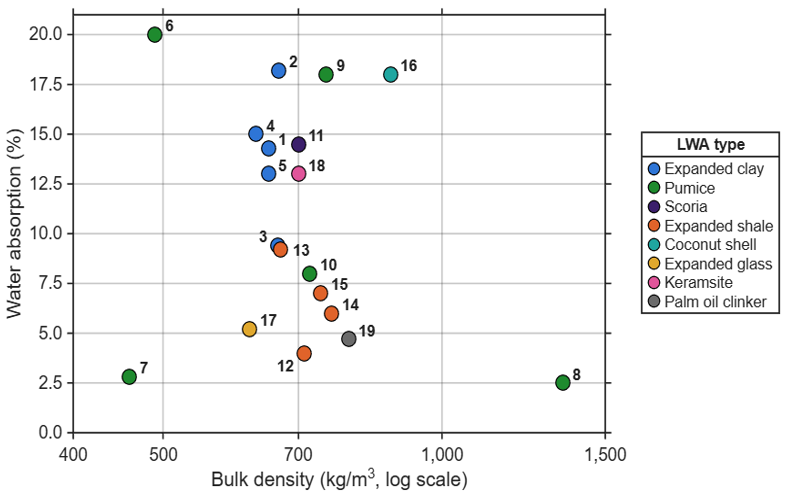
Figure 1 compares the reported bulk density and water absorption of the principal lightweight aggregate types. Two observations are relevant here. First, absorption does not decrease systematically with increasing bulk density; aggregates of comparable density differ by more than an order of magnitude in water uptake, indicating that pore connectivity and outer-shell continuity govern absorption more strongly than total porosity alone. Second, the scatter within a single aggregate type is comparable to, or larger than, the scatter between types: reported absorption for pumice alone spans approximately 3-20%. This supports the position adopted in this review that aggregate origin is a weak predictor of engineering behaviour. The comparison should nonetheless be interpreted cautiously, because absorption is strongly dependent on the immersion period adopted and the source studies do not follow a common test duration (see Table 3 for the individual data sources).
Figure 1. Bulk density and water absorption of representative lightweight aggregates
Table 3. Sources for the lightweight aggregate density and water absorption data shown in Figure 1
|
# |
LWA Type |
Reference |
|
1 |
Expanded clay |
[47] |
|
2 |
Expanded clay |
[48] |
|
3 |
Expanded clay |
[49] |
|
4 |
Expanded clay |
[50] |
|
5 |
Expanded clay |
[51] |
|
6 |
Pumice |
[52] |
|
7 |
Pumice |
[53] |
|
8 |
Pumice |
[54] |
|
9 |
Pumice |
[55] |
|
10 |
Pumice |
[56] |
|
11 |
Scoria |
[51] |
|
12 |
Expanded shale |
[57] |
|
13 |
Expanded shale |
[58] |
|
14 |
Expanded shale |
[30] |
|
15 |
Expanded shale |
[38] |
|
16 |
Coconut shell |
[59] |
|
17 |
Expanded glass |
[60] |
|
18 |
Keramsite |
[61] |
|
19 |
Palm oil clinker |
[62] |
Overall, conventional lightweight aggregates have a relatively mature and predictable evidence base. However, their performance remains governed by the same fundamental trade-off: increased porosity reduces density but may compromise stiffness, absorption resistance, and crack behaviour. This limitation has encouraged the development of engineered aggregates produced from recycled and waste-derived materials.
3.2 Green and recycled lightweight aggregates
Environmental concerns and carbon-reduction targets have increased interest in engineered green lightweight aggregates produced from recycled and waste-derived materials. These aggregates aim to reduce the consumption of virgin resources and divert waste from landfill while retaining acceptable structural and durability performance [13, 63]. Recycled glass and post-consumer plastics are among the most frequently investigated feedstocks. Glass-based aggregates are attractive because of their low density and silica-rich composition, which may assist particle packing and matrix densification [64], whereas plastic-based aggregates can reduce concrete density while providing a route for plastic-waste utilisation [40].
Plastic-based aggregates have been reported to reduce unit weight by approximately 21-29% compared with conventional coarse aggregates while maintaining acceptable structural performance in the reported studies. Their hydrophobic surfaces may also result in relatively low water absorption values of approximately 1.2-1.6% [39]. However, although the environmental rationale for these aggregates is well established, the engineering evidence supporting their long-term structural application remains comparatively limited. Available studies are fewer and less consistent than those concerning conventional LWAs, particularly with respect to durability, interfacial behaviour, and performance under prolonged loading or environmental exposure.
The main engineering challenge is the variability of recycled feedstocks. Differences in their physical and chemical characteristics can affect particle stability, absorption, interfacial bonding, and long-term behaviour. In particular, the hydrophobic and relatively low-energy surfaces of waste plastics can reduce adhesion to cement paste and weaken the ITZ [40, 65, 66]. Hydrophobicity therefore presents a potential trade-off: it may reduce water absorption and alter moisture transport, but it may also reduce the aggregate–paste bond responsible for stress transfer and influence crack initiation.
This behaviour distinguishes plastic-based aggregates from conventional porous LWAs. Conclusions developed from rough and absorptive ceramic aggregates cannot necessarily be transferred directly to hydrophobic recycled aggregates because the governing interfacial and moisture-related mechanisms differ. In particular, the internal-curing and moisture-exchange effects associated with conventional porous aggregates may be less pronounced when the recycled aggregate exhibits low water absorption.
Pelletisation, surface treatment, and thermal treatment have been investigated to improve particle stability, bonding, and pore characteristics [67]. However, these approaches are mainly supported by individual experimental investigations rather than widely established design procedures. Their effectiveness may also depend strongly on the characteristics of the original waste material and the processing conditions, making direct comparison between different engineered aggregates difficult.
Among engineered green LWAs, aggregates combining recycled plastic and recycled glass, such as LiGrA, have been investigated at high replacement levels, of the order of 80%, with substantial density reduction reported in the corresponding studies. Their low absorption may address one of the principal limitations of conventional porous aggregates; however, the hydrophobic plastic component may also... contribute to weaker interfacial bonding and influence crack initiation at the aggregate-paste boundary. These competing characteristics make crack control and stress transfer particularly relevant when assessing concrete containing such aggregates.
Comprehensive evidence on the combined behaviour of recycled plastic-glass lightweight aggregates and steel fibres remains limited. Existing studies often examine density reduction, mechanical performance, or durability separately, while fewer studies evaluate how fibre reinforcement interacts with the distinctive interfacial characteristics of hydrophobic recycled aggregates. The research gap is therefore not simply the limited use of recycled LWAs, but the insufficient understanding of how steel fibres interact with, and potentially mitigate the consequences of, their weaker aggregate-paste bond and associated crack development.
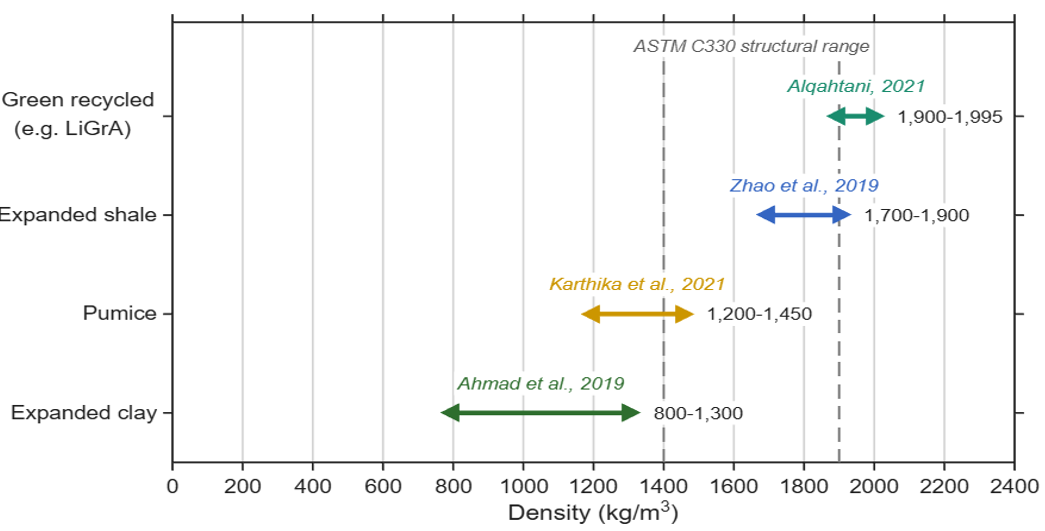
Figure 2 compares the typical density ranges reported for structural lightweight concrete produced with expanded clay, pumice, expanded shale, and recycled plastic-based green lightweight aggregates. The ranges were compiled from representative experimental studies reported by Chung et al., Ahmad et al., Zhao et al. and Alqahtani [7, 27, 38, 39]. Rather than establishing a fixed ranking between aggregate types, the figure illustrates the variation in reported concrete density and the broader range associated with engineered recycled aggregates. The density values are presented in kg/m³ for consistency; no unit conversions were required, as all four cited sources report density directly in kg/m³. Such comparisons should be interpreted cautiously because the reported densities were obtained using different mixture proportions, replacement levels, and moisture conditions. The figure should therefore be regarded as a literature-based contextual comparison rather than a direct experimental comparison between aggregate types. Table 4 summarises the origin, density, strength, and key characteristics of the four aggregate types discussed in this section, to support direct comparison alongside the density data presented in Figure 2.
Figure 2. Typical density ranges of structural lightweight concrete produced with expanded clay, pumice, expanded shale, and green recycled lightweight aggregates
Table 4. Comparison of common conventional and green lightweight aggregates used in structural lightweight aggregate concrete (SLWAC)
|
Aggregate |
Origin / Production |
Density (kg/m³) |
Strength |
|
Expanded clay |
Artificial; clay expanded in a rotary kiln above ~1100 °C |
800-1,300 [27] |
Concrete can exceed 30 MPa |
|
Pumice |
Natural; volcanic vesicular rock |
1,200-1,450 [35] |
Lower crushing strength than clay/shale |
|
Expanded shale |
Artificial; thermal expansion of shale |
1,700-1,900 [38] |
Higher strength, lower permeability |
|
Green / recycled (plastic-glass, e.g. LiGrA) |
Engineered from recycled/waste plastic and glass |
1,900-1,995 [39] |
Strength governed by aggregate ceiling |
Steel-fibre-reinforced SLWAC combines the reduced density of structural lightweight concrete with the improved crack control and post-cracking behaviour provided by steel fibres. Although SLWAC offers lower dead load, improved thermal insulation, and reduced seismic forces, its structural performance can be constrained by brittleness, low tensile strength, and limited crack resistance associated with porous lightweight aggregates and interfacial weaknesses [22, 33, 68]. Steel fibres are therefore commonly incorporated to improve crack resistance, ductility, toughness, residual load capacity, and energy absorption under static and dynamic loading [69-71].
The importance of fibres in lightweight concrete should not, however, be interpreted as evidence that they improve all properties equally. Their principal contribution becomes more evident after cracking, when they provide an alternative mechanism for stress transfer across cracked sections. Their effects are therefore generally more pronounced for tensile, flexural, and post-cracking behaviour than for properties governed primarily by aggregate stiffness or crushing strength. This distinction is important because some studies report the benefits of fibre reinforcement in general terms without clearly differentiating between pre-cracking properties and post-cracking performance.
Fibre effectiveness depends on geometry, aspect ratio, dosage, distribution, and fibre–matrix bond. Hooked-end steel fibres generally provide better performance than straight fibres because their mechanical anchorage can increase pull-out resistance and help maintain stress transfer during crack opening [72, 73]. Nevertheless, fibre geometry cannot be evaluated independently of bond quality. A mechanically anchored fibre may not provide its full reinforcing benefit when the surrounding matrix is weak, highly porous, or poorly bonded.
Volume fractions in the range of approximately 0.5-0.75% have been reported in several studies to provide a practical balance between mechanical improvement and workability. Higher dosages may increase the number of fibres crossing a crack, but they can also cause fibre balling, poor dispersion, reduced workability, and increased superplasticiser demand [69, 74, 75]. The frequently reported range should therefore not be regarded as universally optimal. Rather, it represents a practical compromise that depends on fibre geometry, aggregate characteristics, mixture proportions, and mixing procedures.
4.1 Crack-bridging mechanism
The primary strengthening mechanism of steel fibres is crack bridging. When microcracks initiate in the matrix, fibres intersecting the crack plane transfer tensile stress between the two crack surfaces and resist further opening. This action delays crack propagation, limits crack width, and preserves the integrity of the composite after the cementitious matrix has begun to crack [34].
This mechanism is particularly important in lightweight concrete because fracture may pass through the porous and relatively weak aggregate rather than being redirected around it. Plain SLWAC may therefore lose load-carrying capacity rapidly after the first major crack forms. Steel fibres provide an additional load-transfer path, restrain lateral deformation under compression, delay crack localisation, and sustain capacity beyond the first-crack load [5, 76].
However, fibre bridging does not prevent crack initiation. Rather, it modifies the development of cracks after they form. The improvement should therefore be understood as a change from rapid localised cracking towards more controlled and distributed cracking, rather than as the complete elimination of fracture. This distinction is sometimes obscured when increases in strength are reported without corresponding observations of crack width, crack distribution, or residual capacity.
The effectiveness of crack bridging is governed strongly by fibre geometry and interfacial bond. Hooked-end fibres maintain stress transfer more effectively than straight or crimped fibres because mechanical anchorage increases resistance to pull-out [73, 77]. Their advantage may become more pronounced when bond conditions deteriorate, as the fibres continue to provide mechanical resistance even after part of the adhesive bond has been lost.
The role of fibres may become more important when hydrophobic recycled lightweight aggregates are used at high replacement levels. Altered aggregate-paste bonding can increase the likelihood of localised crack initiation near the aggregate boundary, thereby increasing the demand on fibres to redistribute stress and control crack growth [32]. At the same time, weak interfacial conditions may also reduce fibre effectiveness. Fibres in such systems may therefore be more necessary while operating under less favourable bond conditions, an interaction that remains insufficiently understood.
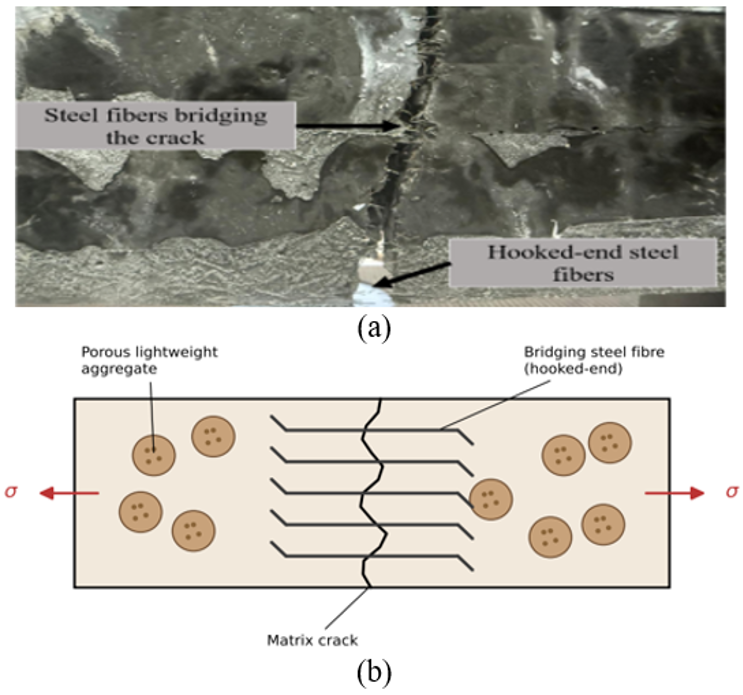
Figure 3 illustrates the crack-bridging mechanism using experimental evidence and a schematic representation. The figure should be interpreted as showing the post-cracking role of fibres in transferring stress and controlling crack opening, rather than suggesting that fibres eliminate the formation of cracks.
Figure 3. (a) Experimental observation from the authors’ laboratory testing, (b) schematic illustration prepared by the authors
4.2 Fibre-matrix bond and interfacial transition zone
The fibre-matrix bond controls stress transfer, pull-out resistance, crack bridging, and residual capacity, and therefore determines whether the expected benefits of steel fibres are fully realised [78]. Fibre performance cannot be assessed from fibre content or geometry alone because the same fibre may behave differently in matrices with different pore structures and interfacial qualities.
In lightweight concrete, the fibre-matrix interaction differs from that in normal-weight concrete because porous and low-stiffness aggregates introduce greater microstructural heterogeneity. Voids and weak regions may form around both the lightweight aggregate and the embedded fibres, reduce the efficiency of stress transfer and increase the likelihood of premature interfacial debonding [5]. Conversely, water stored in absorptive lightweight aggregates may support internal curing, reduce autogenous shrinkage and microcracking, and contribute to more stable interfacial behaviour [79].
These two effects should not be treated as universally applicable to all lightweight aggregates. Their relative importance depends on aggregate absorption, pore connectivity, surface texture, and moisture condition. Conventional porous aggregates may provide internal-curing benefits, whereas hydrophobic recycled aggregates may absorb and release much less water. Conclusions obtained from absorptive ceramic aggregates therefore cannot automatically be transferred to recycled plastic-based or plastic-glass aggregates.
Fibre geometry remains an important part of the bond mechanism. Hooked-end fibres provide greater anchorage and pull-out resistance than straight fibres, resulting in more effective crack bridging and higher residual strength [72, 73]. However, improved anchorage does not remove the need for a sound surrounding interface. Excessive interfacial porosity or local weakness may still cause debonding, matrix splitting, or premature pull-out before the full tensile capacity of the fibre is mobilised.
Microstructural observations indicate that a denser and less defective interface improves stress transfer between fibre and matrix and supports better tensile, flexural, and toughness performance [32]. Nevertheless, much of the available evidence is based on conventional lightweight aggregates. The fibre-matrix interaction in concrete containing hydrophobic recycled lightweight aggregates remains less established, particularly because low water absorption may be beneficial for moisture transport while simultaneously weakening chemical and mechanical interaction with the paste.
The key research gap is therefore not simply whether steel fibres improve lightweight concrete. Their general crack-bridging benefit is already well established. The more relevant uncertainty is whether fibres can provide the same level of crack control and post-cracking capacity when used with recycled lightweight aggregates that possess different surface and bonding characteristics from conventional LWAs.
The mechanisms discussed in this section explain why steel fibres mainly influence tensile behaviour, flexural response, toughness, and residual capacity. The following section examines how these mechanisms are reflected in the principal mechanical properties of steel-fibre-reinforced SLWAC.
4.3 Segregation resistance
Low-density lightweight aggregates may migrate upward in the fresh mixture because their density is lower than that of the surrounding paste. This tendency becomes more pronounced in highly flowable mixtures and can produce a non-uniform aggregate distribution. Hydrophobic recycled aggregates may be particularly susceptible to this behaviour because their low surface energy can reduce adhesion to the surrounding paste [66, 80, 81].
Steel fibres can partly counteract this problem by forming a three-dimensional network that restricts aggregate movement and improves particle stability [82]. This represents an important but less frequently emphasised fresh-state benefit of fibre reinforcement. Although fibres reduce slump, they may simultaneously reduce segregation and upward aggregate migration.
The influence of fibres on fresh behaviour is therefore double-edged. Insufficient fibre content may provide limited control of aggregate movement, whereas excessive fibre content may reduce flow and hinder compaction. In mixtures containing buoyant recycled aggregates, the optimum fibre content should not be defined only by maximum strength, but by the balance between flowability, dispersion, compaction, and segregation resistance.
4.4 Fresh density
Fresh density is governed primarily by aggregate particle density, aggregate volume fraction, and moisture condition [1], as noted earlier for SLWAC generally. Recycled plastic-based lightweight aggregates can further reduce unit weight by approximately 21-29% relative to conventional coarse aggregates [39].
Steel fibres may slightly increase fresh density because of their high specific gravity [34], partially offsetting the reduction achieved by lightweight aggregates. However, this increase is generally secondary to the effect of aggregate density and replacement level. Fresh density should therefore be interpreted as the net result of two opposing influences: the lightweight aggregate lowers unit weight, whereas steel fibres add a small amount of high-density material.
The available literature commonly reports slump and density as separate outcomes, but their interaction is important. A mixture may satisfy the required density range while still exhibiting poor workability, fibre clustering, or aggregate segregation. Fresh-state suitability should therefore be assessed through a combination of density, slump, visual stability, and fibre dispersion rather than through a single parameter.
Overall, the fresh performance of steel-fibre-reinforced lightweight concrete is controlled by competing mechanisms. Porous aggregates may reduce workability through water absorption, hydrophobic aggregates may reduce absorption but increase segregation risk, and fibres may restrict flow while improving mixture stability. These effects demonstrate that fresh behaviour cannot be generalised across all lightweight aggregates. In particular, conclusions derived from conventional absorptive LWAs should not be transferred directly to hydrophobic recycled aggregates without experimental verification.
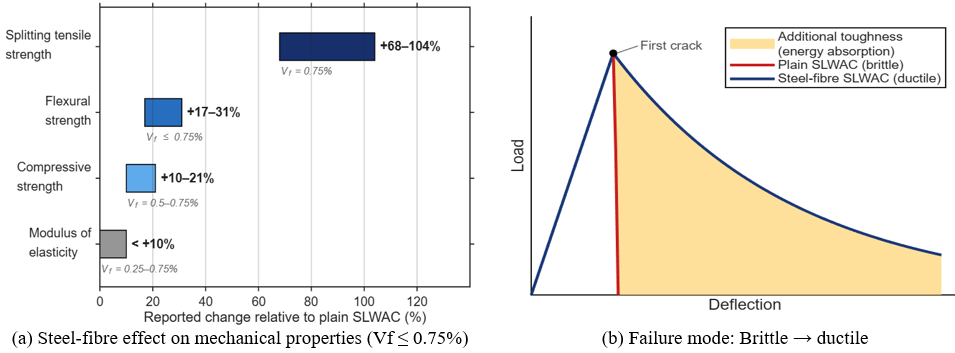
The mechanical performance of SLWAC includes compressive strength, splitting tensile strength, flexural strength, modulus of elasticity, toughness, and post-cracking behaviour. These properties are governed by the combined effects of aggregate strength and stiffness, matrix quality, ITZ characteristics, and fibre reinforcement [5, 83]. However, these factors do not contribute equally to every property. The lightweight aggregate largely controls compressive strength and stiffness, whereas steel fibres are most effective in properties governed by cracking and post-cracking stress transfer. This distinction is essential because reporting all mechanical improvements together can overstate the overall influence of fibres. The principal quantitative trends are consolidated in Figure 4.
Figure 4. Effect of steel fibres on structural lightweight aggregate concrete (SLWAC)
5.1 Compressive strength
Compressive strength is the main property used in structural design. In SLWAC, it is strongly influenced by the lightweight aggregate, which is generally weaker and more porous than normal-weight aggregate. Whereas failure in normal-weight concrete often develops around the aggregate-paste interface, fracture in SLWAC frequently passes through the lightweight aggregate because of its lower crushing strength [22, 34].
This behaviour creates a strength ceiling. Once the matrix becomes stronger than the lightweight aggregate, further improvement in matrix quality does not produce a proportional increase in concrete strength because the aggregate becomes the controlling phase [84-86]. This concept is important when interpreting high-strength claims in lightweight concrete. A stronger matrix cannot increase compressive strength indefinitely, and the achievable performance remains bounded by the strength of the aggregate.
The strength-ceiling effect becomes particularly relevant when recycled green aggregates such as LiGrA are used at high replacement levels. Under these conditions, the properties of the recycled aggregate increasingly govern the failure mode and final load capacity [39]. Accordingly, compressive strength should not be interpreted only as a reflection of matrix quality, especially in mixtures containing large volumes of low-density aggregate.
Lower density does not correspond to a fixed loss in strength. Concrete mixtures of similar density may achieve different strengths because aggregate crushing resistance, pore structure, bonding, and matrix characteristics also influence performance. The density-strength relationship should therefore be regarded as a general trade-off rather than a fixed or universal correlation between the two properties.
Steel fibres improve compressive strength mainly through lateral confinement rather than through direct strengthening of the matrix. As concrete expands laterally under compression, fibres crossing internal cracks restrain deformation, delay crack development, and improve stress redistribution. Reported gains are commonly around 10-21% at fibre contents of 0.5-0.75% by volume, while increases of up to approximately 76% have been reported in pumice-based systems at higher dosages [5, 34, 87].
The wide difference between these reported gains indicates that there is no single fibre effect applicable to all lightweight concretes. Large percentage increases may partly reflect a weak reference mixture rather than an exceptionally strong fibre contribution. Therefore, improvements should be interpreted together with baseline strength, aggregate type, fibre dosage, and absolute strength values. Comparing percentage gains alone may give a misleading impression of fibre effectiveness.
Fibres at 0.75% have been reported to increase load capacity by approximately 20% and reduce brittle crushing through improved internal crack resistance and stress redistribution [88, 89]. Nevertheless, the compressive contribution of fibres remains limited by aggregate crushing. This explains why compressive-strength gains are generally smaller than improvements in tensile, flexural, and post-cracking properties.
5.2 Splitting tensile strength
Splitting tensile strength is associated with crack initiation, shear resistance, and structural integrity under service loading. Plain SLWAC generally has lower tensile strength than normal-weight concrete of similar compressive strength because the porous aggregate has limited tensile capacity. This weakness may be more pronounced when hydrophobic recycled aggregates are used at high replacement levels, as reduced aggregate-paste adhesion can encourage crack initiation near the interface [32, 34, 39].
Porous conventional lightweight aggregates may partly improve the ITZ through the micro-pump effect. During mixing, they absorb water from the surrounding paste, locally reducing the water-to-binder ratio and contributing to a denser interface [22, 32]. However, this mechanism depends on the aggregate's ability to absorb water. It should not be assumed to occur to the same extent in hydrophobic recycled aggregates with low water affinity.
Steel fibres are especially effective in splitting tension because they directly resist the mechanism governing failure. Fibres crossing developing cracks transfer tensile stress, delay crack coalescence, and reduce the rapid loss of capacity after crack initiation [90, 91]. This direct correspondence between fibre action and tensile failure explains why improvements in splitting tensile strength are commonly greater than those in compressive strength.
A fibre volume fraction of 0.75% has been reported to increase splitting tensile strength by approximately 68-104% relative to non-fibrous lightweight concrete [92, 93], while Mohamed et al. [34] reported improved tensile resistance and reduced brittle behaviour across several fibre dosages. These large percentage gains should nonetheless be interpreted cautiously because they depend strongly on the initial tensile strength of the control mixture. A large relative improvement does not necessarily indicate a high absolute tensile capacity.
The range of 0.25-0.75% therefore provides a practical band for evaluating tensile enhancement in lightweight concrete containing recycled green aggregates [94]. The value of this range lies not in guaranteeing a universal optimum, but in allowing the relationship between dosage, crack control, and workability to be assessed without automatically assuming that the highest fibre content will provide the best overall performance.
5.3 Flexural strength
Flexural strength is governed by tensile resistance in the tension zone and by the ability of the material to sustain load after cracking. Plain SLWAC generally exhibits lower flexural strength than normal-weight concrete because of the weaker tensile capacity of the lightweight aggregate and its tendency to fracture under bending. The response becomes more sensitive to aggregate-paste bonding when hydrophobic recycled aggregates are used at high replacement levels [34, 39].
Steel fibres improve flexural behaviour by bridging cracks in the tension zone and maintaining stress transfer after matrix cracking. Fibre-reinforced lightweight beams therefore show higher residual flexural strength and a more gradual post-cracking response than plain beams [95]. Improvements of approximately 17-31% have been reported at fibre contents up to 0.75%, with larger gains generally associated with increased crack-bridging capacity [34, 96].
The flexural evidence supports the tensile-strength findings because both properties are controlled by crack formation and propagation. This agreement provides stronger mechanistic support for fibre reinforcement than compressive-strength results alone. Nevertheless, peak flexural strength should not be used as the only indicator of improvement. Residual strength, crack distribution, and the ability to maintain load after the first crack are equally important when evaluating fibre performance.
These improvements are particularly relevant for members subjected to repeated loading, vibration, and dynamic actions, where the retention of capacity after cracking contributes to safety and serviceability [97]. The main benefit of fibres in bending is therefore not merely a higher peak strength, but a less abrupt transition from uncracked to cracked behaviour.
5.4 Modulus of elasticity
The modulus of elasticity of SLWAC is lower than that of normal-weight concrete of comparable strength because composite stiffness is strongly governed by the relatively low stiffness of the lightweight aggregate. Typical values range from approximately 10 to 25 GPa, compared with 25-35 GPa for normal-weight concrete [22]. At high replacement levels of recycled lightweight aggregate such as LiGrA, particle stiffness becomes an increasingly dominant influence on the modulus of the composite [39].
Steel fibres have only a limited influence on elastic modulus because the modulus is measured within the pre-cracking linear-elastic range, whereas fibres contribute mainly after cracking begins. Reported increases are generally below 10% at fibre dosages of 0.25-0.75% [34, 68, 98].
This limited effect is analytically important because it defines what fibre reinforcement cannot achieve. Fibres may improve crack resistance, residual strength, and toughness, but they cannot substantially correct the low stiffness caused by lightweight aggregates. Consequently, reductions in modulus and the resulting serviceability implications should be treated as inherent characteristics of high-replacement SLWAC rather than as weaknesses that fibre reinforcement can fully remove.
The comparatively low modulus may increase deformation under service loads, although it can also contribute to energy dissipation under dynamic and seismic loading [99]. This characteristic should therefore be evaluated according to the structural application rather than described only as a disadvantage.
5.5 Toughness and post-cracking behaviour
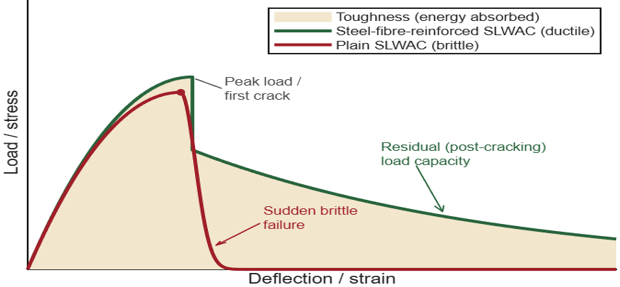
Toughness represents the energy absorbed up to and beyond the peak load and is the property in which steel fibres most clearly transform lightweight concrete behaviour. Plain SLWAC typically fails with limited deformation and loses load capacity rapidly after cracking because of its low tensile resistance and brittle aggregate fracture. Steel fibres maintain stress transfer across cracked regions, enlarge the area under the load-deformation curve, and produce a more gradual failure response [56].
The principal contribution of fibres is therefore not simply an increase in peak load. Their greater value lies in preserving residual capacity after the matrix has cracked. Through crack bridging, fibres improve toughness index, residual flexural strength, ductility, and energy absorption while maintaining structural continuity after first cracking [71, 100, 101].
Figure 5 illustrates this distinction. Plain lightweight concrete loses capacity abruptly after reaching its peak load, whereas fibre-reinforced concrete sustains a longer descending branch. The additional area under this branch represents the greater energy absorbed during post-cracking deformation. The figure should therefore be interpreted as demonstrating a change in failure mode rather than only an increase in strength.
Schematic load-deflection response of plain versus steel-fibre-reinforced SLWAC, prepared by the authors. Plain concrete fails abruptly at peak load (brittle), whereas steel fibres provide residual post-cracking capacity; the shaded area denotes the additional toughness (energy absorption).
Increasing fibre dosage has been associated with improved ductility and delayed brittle failure [9]. Material-scale toughness and member-scale ductility should, however, not be treated as interchangeable. A larger area under a specimen load-deflection curve demonstrates improved material energy absorption, whereas a change in beam failure mode depends additionally on member geometry, reinforcement arrangement, and structural loading. Both forms of evidence support fibre use, but they describe different levels of performance.
Overall, the literature shows a consistent division in the role of steel fibres. Their influence on compressive strength and elastic modulus is comparatively limited because these properties remain controlled mainly by aggregate crushing strength and stiffness. Their greatest contribution occurs in splitting tension, flexure, toughness, and residual behaviour, where crack bridging directly changes the failure process. Table 5 and Table 6 summarise the reported quantitative and qualitative effects of steel fibres across the studies cited in this section, grouped by compressive/splitting-tensile strength (Table 5) and flexural strength/other performance aspects (Table 6).
Table 5. Reported effects of steel fibres on the compressive and splitting tensile strength of Structural lightweight aggregate concrete (SLWAC)
|
Reference |
Vf (%) |
Δfc |
Δft |
|
[34] |
0.5–0.75 |
+10–21% |
enhanced (qual.) |
|
[5] |
higher contents |
up to +76% |
— |
|
[87] |
0.5–0.75 / higher |
+10–21% |
— |
|
[88] |
0.75 |
≈ +20% |
— |
|
[89] |
— |
improved (qual.) |
— |
|
[92] |
0.75 |
— |
+68–104% |
|
[93] |
0.75 |
— |
+68–104% |
|
[90, 91] |
increasing Vf |
— |
↑ progressively (qual.) |
|
[96] |
≤ 0.75 |
— |
— |
|
[95] |
— |
— |
— |
|
[9] |
0.5 → 1.0 |
— |
— |
Table 6. Reported effects of steel fibres on flexural strength and other mechanical performance aspects of structural lightweight aggregate concrete (SLWAC)
|
Reference |
ΔFlexural |
Other Reported Effect |
|
[34] |
+17–31% |
reduced brittle failure; E modulus < +10% |
|
[5] |
— |
gain strongly depends on LWA type & matrix |
|
[87] |
— |
lateral confinement of matrix |
|
[88] |
— |
↑ load capacity; reduced brittle crushing |
|
[89] |
— |
better crack resistance & stress redistribution |
|
[92] |
— |
bridges microcracks; delays coalescence |
|
[93] |
— |
confirms strong tensile contribution |
|
[90, 91] |
— |
improved stress transfer |
|
[96] |
+17–31% |
larger gains at higher Vf |
|
[95] |
↑ residual (qual.) |
improved post-cracking response |
|
[9] |
— |
↑ ductility; delayed brittle failure (crack arrest) |
The magnitude of these improvements is not governed by fibre content alone but results from the combined influence of lightweight aggregate characteristics, fibre geometry, fibre volume fraction, matrix composition, and the quality of the fibre–matrix interface. Consequently, direct comparison of reported mechanical improvements across different studies should be undertaken with caution, since variations in mixture proportions, curing conditions, specimen geometry, and testing procedures can significantly influence the measured performance. This highlights the importance of interpreting published results within their specific experimental context rather than relying solely on percentage improvements. Such critical interpretation provides a more reliable basis for evaluating the effectiveness of steel fibres in SLWAC and for identifying realistic directions for future research.
6.1 Crack control through bridging
The crack behaviour of SLWAC is governed by the interaction between the porous lightweight aggregate, the aggregate-paste interface, and the steel fibres. In plain SLWAC, fracture often propagates through the aggregate itself because the particles may be weaker than the surrounding matrix. Once cracking begins, the damage can therefore localise rapidly into a dominant fracture, leading to a sudden and brittle loss of load-carrying capacity.
Steel fibres modify this process by crossing developing cracks and transferring tensile stress between the crack faces. This bridging action limits crack opening, delays crack propagation, and promotes a larger number of finer cracks rather than a single dominant crack [34, 76]. The principal benefit is therefore not that fibres prevent cracking, but that they control how cracks develop after initiation.
This distinction is important because crack initiation and crack propagation are not governed by exactly the same mechanisms. The lightweight aggregate and the ITZ strongly influence where cracks begin, whereas fibre geometry, distribution, and bond determine whether these cracks remain controlled or develop into unstable fractures. A higher peak strength alone does not demonstrate effective crack control unless it is accompanied by reduced crack localisation, smaller crack widths, or improved residual load capacity.
The effectiveness of crack bridging also depends on the position and orientation of fibres relative to the crack plane. Fibres that do not intersect the developing crack contribute little to stress transfer, while poorly dispersed or clustered fibres may leave weak regions unreinforced. Consequently, fibre dosage should not be interpreted independently of fibre distribution and bond quality.
For engineered green aggregates used at high replacement levels, crack development may be more sensitive to aggregate-paste bonding. Hydrophobic aggregate surfaces can reduce adhesion and encourage crack initiation near the interface. In such systems, fibres may be required to carry a greater share of post-cracking stress transfer. However, the same weak interfacial environment may also reduce the effectiveness of fibre anchorage. Fibres may therefore be more necessary in hydrophobic recycled-aggregate systems while simultaneously operating under less favourable bonding conditions.
6.2 From brittle to ductile failure
The most important effect of steel-fibre reinforcement is the modification of failure mode. Plain lightweight concrete commonly exhibits brittle failure with limited deformation and little warning. Once a major crack forms, the material rapidly loses capacity because the porous aggregate and weak tensile resistance provide limited post-cracking stress transfer.
In fibre-reinforced SLWAC, progressive fibre pull-out and crack bridging allow stress to continue transferring after matrix cracking. This produces a more gradual, energy-absorbing response and delays the sudden loss of capacity [77]. The material does not become fully ductile in the same sense as reinforcing steel, but its failure becomes less abrupt and more controlled.
At the structural-member level, this behaviour may appear as a shift from brittle shear failure towards ductile flexural failure, accompanied by higher deformation capacity and greater warning before collapse. However, material-scale toughness and member-scale ductility should not be treated as interchangeable. Improved fibre pull-out behaviour in a specimen does not automatically guarantee a change in structural failure mode, because beam geometry, reinforcement, loading conditions, and crack location also contribute.
Hooked-end fibres generally sustain bridging action longer than straight fibres because mechanical anchorage improves pull-out resistance and allows higher stress transfer during crack opening [73, 77]. Nevertheless, their superiority should not be considered independent of the surrounding matrix. Stronger anchorage may be offset by premature matrix splitting or interfacial failure when the concrete around the fibre is weak or highly porous.
The transition from brittle to more ductile failure is especially important under dynamic and seismic actions, where energy absorption and visible deformation before failure contribute to structural safety. The critical contribution of fibres in such applications is therefore not only an increase in load capacity, but the provision of a more stable and progressive failure process.
The three-dimensional fibre network may also improve the final hardened uniformity of mixtures containing low-density recycled aggregates by limiting upward aggregate migration during placement [80-82, 102]. This effect is indirect: fibres do not strengthen the aggregate-paste bond itself, but improved particle distribution may reduce local weak zones that would otherwise promote crack concentration. However, excessive fibre contents may reduce compaction and introduce new defects, so this stabilising effect should not be assumed to increase continuously with dosage.
Despite substantial progress in steel-fibre-reinforced lightweight concrete, the existing evidence remains concentrated on conventional lightweight aggregates such as expanded clay, shale, pumice, and ceramsite. Green and recycled aggregates derived from waste have received comparatively less attention, and engineered plastic-glass aggregates such as LiGrA remain particularly underexplored in structural fibre-reinforced systems [33, 35, 103].
The main limitation is not simply the smaller number of studies. Conclusions developed from conventional porous and absorptive aggregates are frequently transferred to recycled hydrophobic aggregates without sufficient verification. This transfer is questionable because hydrophobic aggregates differ in water absorption, surface energy, aggregate-paste adhesion, segregation behaviour, and crack initiation. Mechanisms established for conventional LWAs, including improved interlocking and internal moisture exchange, may therefore operate differently or may be substantially reduced.
A second gap concerns the way mechanical performance is commonly evaluated. Many studies report changes in compressive, tensile, or flexural strength without examining whether these changes are accompanied by improved crack distribution, residual capacity, or failure mode. Strength gains alone do not explain how fibres alter structural behaviour. This is particularly important because the most valuable contribution of fibres lies in post-cracking stress transfer rather than in peak strength.
The available literature also frequently combines material-scale and structural-scale evidence without clearly distinguishing them. Improvements in specimen toughness, beam ductility, shear capacity, and failure mode are often presented as equivalent indicators, although they represent different levels of behaviour. Future investigations should link material responses to member responses instead of assuming that one necessarily predicts the other.
A further limitation is the weak integration of mechanical, crack, and microstructural analyses. Improvements are often reported without directly relating them to fibre distribution, pull-out behaviour, aggregate fracture, fibre-matrix bond, or ITZ characteristics [32, 104]. As a result, many mechanistic explanations remain inferred rather than demonstrated.
The fibre-matrix interaction is especially underexplored in concrete containing recycled lightweight aggregates. Hydrophobic surfaces may increase crack initiation near the aggregate boundary while weak interfacial conditions may reduce fibre anchorage. This creates a critical and unresolved interaction: fibres may be more urgently needed in these systems, yet their effectiveness may be reduced by the same interfacial weakness they are intended to compensate for.
Future research should therefore examine different fibre geometries and practically relevant dosages, particularly within the 0.25-0.75% range, in SLWAC containing high proportions of green lightweight aggregates. These studies should not define optimum fibre content from peak strength alone. Workability, fibre dispersion, crack width, crack distribution, residual strength, toughness, pull-out behaviour, and failure mode should be evaluated together.
Research should also distinguish between aggregate fracture, ITZ cracking, fibre pull-out, fibre rupture, and matrix splitting. Without this distinction, it is difficult to determine whether performance is limited by the aggregate, the interface, or the reinforcement mechanism. Establishing these relationships is essential before findings from conventional lightweight concrete can be reliably transferred to recycled plastic-glass systems.
This review critically examined the mechanical performance and crack behaviour of SLWAC reinforced with steel fibres. The main conclusions are as follows.
SLWAC reduces self-weight and offers structural and environmental advantages, but its porous and relatively low-stiffness aggregates reduce tensile capacity, elastic modulus, and crack resistance while promoting brittle fracture through the aggregate.
Lightweight aggregate selection is the main factor governing performance. Conventional aggregates such as expanded clay, pumice, and shale have a comparatively mature evidence base, whereas engineered green aggregates, including recycled plastic-glass aggregates such as LiGrA, remain insufficiently characterised in fibre-reinforced structural applications.
The environmental benefit of recycled lightweight aggregates does not guarantee equivalent engineering performance. Hydrophobicity may lower absorption but may also reduce aggregate-paste adhesion, promote segregation, and alter crack initiation. These competing effects must be evaluated together rather than individually.
Steel fibres act primarily through crack bridging and post-cracking stress transfer. They reduce crack localisation, limit crack width, redistribute tensile stresses, and sustain residual load after matrix cracking. Their main contribution is therefore the modification of crack development and failure mode rather than uniform improvement of all mechanical properties.
Fibre benefits are greatest in tensile-governed properties. Reported increases in splitting tensile strength and flexural strength are generally larger than those in compressive strength because fibres directly bridge tensile cracks, whereas compressive strength remains limited by aggregate crushing.
The effect of fibres on the modulus of elasticity is minor because modulus is governed mainly by aggregate stiffness and is measured before significant cracking. Steel fibres should therefore not be expected to correct the serviceability limitations caused by the low stiffness of lightweight aggregates.
Reported percentage gains should be interpreted together with the baseline performance of the control mixture. Very large increases may reflect a weak reference concrete rather than a universally superior fibre response, and percentage improvements alone are insufficient for comparing different lightweight systems.
Hooked-end fibres generally provide better pull-out resistance and longer-lasting stress transfer than straight fibres. However, their effectiveness still depends on matrix quality, fibre dispersion, and the condition of the fibre-matrix interface.
Fibre contents around 0.5-0.75% frequently provide a practical balance between mechanical improvement and workability. This range should not be treated as a universal optimum, because the most suitable dosage depends on fibre geometry, aggregate characteristics, bond quality, workability, and mixing conditions.
The decisive contribution of steel fibres lies in toughness, residual strength, and failure-mode control. Fibres transform the response from sudden and localised cracking towards a more gradual and energy-absorbing process, although material-level toughness should not be assumed to guarantee structural-level ductility without member testing.
Existing literature remains fragmented. Mechanical properties, crack patterns, failure modes, and microstructural characteristics are commonly examined separately, preventing a complete understanding of how fibre reinforcement operates in recycled lightweight systems.
Realising the full potential of steel-fibre-reinforced SLWAC requires integrated studies that connect peak strength with crack width, crack distribution, residual capacity, fibre pull-out, aggregate fracture, ITZ condition, and structural failure mode. This need is especially important for hydrophobic recycled lightweight aggregates, where conventional mechanisms cannot be assumed to remain valid.
Overall, the available evidence confirms that steel fibres are an important enabling component for extending the structural application of sustainable lightweight concrete. Their value lies not in eliminating the inherent limitations of lightweight aggregates, but in controlling the brittle cracking and rapid loss of capacity that would otherwise restrict their structural use.
This work was supported by Universiti Sains Malaysia through the USM-Industry Matching Research Grant with Project No: R502-KR-ARU003-000002238-134.
[1] ACI Committee 213. (2014). ACI 213R-14 guide for structural lightweight-aggregate concrete. American Concrete Institute: Farmington Hills, MI, USA, pp. 1-4. https://www.concrete.org/Portals/0/Files/PDF/Previews/213-14(23)_preview.pdf.
[2] Zareef, M.E. (2010). Conceptual and structural design of buildings made of lightweight and infra-lightweight concrete. Doctoral Dissertation, Berlin, pp. 1-101.
[3] Lu, J.X. (2022). High-performance lightweight concrete with ultra high-performance binder. Doctoral dissertation, The Hong Kong Polytechnic University, p. 341. https://theses.lib.polyu.edu.hk/handle/200/12079.
[4] Miller, S.A., Horvath, A., Monteiro, P.J.M. (2018). Impacts of booming concrete production on water resources worldwide. Nature Sustainability, 1(1): 69-76. https://doi.org/10.1038/s41893-017-0009-5
[5] Behera, D., Liu, K.Y., Rachman, F., Worku, A.M. (2025). Innovations and applications in lightweight concrete: Review of current practices and future directions. Buildings, 15(12): 2113. https://doi.org/10.3390/buildings15122113
[6] Kwek, S.Y., Awang, H. (2021). Utilization of industrial waste materials for the production of lightweight aggregates: A review. Journal of Sustainable Cement-Based Materials, 10(6): 353-381. https://doi.org/10.1080/21650373.2021.1891583
[7] Chung, S.Y., Sikora, P., Kim, D.J., El Madawy, M.E., Abd Elrahman, M. (2021). Effect of different expanded aggregates on durability-related characteristics of lightweight aggregate concrete. Materials Characterization, 173: 110907. https://doi.org/10.1016/j.matchar.2021.110907
[8] Bogas, J.A., Gomes, A. (2013). Compressive behavior and failure modes of structural lightweight aggregate concrete-Characterization and strength prediction. Materials & Design (1980-2015), 46: 832-841. https://doi.org/10.1016/j.matdes.2012.11.004
[9] Soltanzadeh, F., Behbahani, A.E., Hosseinmostofi, K., Teixeira, C.A. (2022). Assessment of the sustainability of fibre-reinforced concrete by considering both environmental and mechanical properties. Sustainability, 14(10): 6347. https://doi.org/10.3390/su14106347
[10] EN 206, B.S. (2013). Concrete-specification, performance, production and conformity. British Standards Institution, Her Majesty Stationery Office, London, United Kingdom.
[11] Farina, I., Moccia, I., Salzano, C., Singh, N., Sadrolodabaee, P., Colangelo, F. (2022). Compressive and thermal properties of non-structural lightweight concrete containing industrial byproduct aggregates. Materials, 15(11): 4029. https://doi.org/10.3390/ma15114029
[12] Abdelfattah, M.M., Géber, R., Kocserha, I. (2023). Enhancing the properties of lightweight aggregates using volcanic rock additive materials. Journal of Building Engineering, 63: 105426. https://doi.org/10.1016/j.jobe.2022.105426
[13] Singh, N., Raza, J., Colangelo, F., Farina, I. (2024). Advancements in lightweight artificial aggregates: Typologies, compositions, applications, and prospects for the future. Sustainability, 16(21): 9329. https://doi.org/10.3390/su16219329
[14] Umar, U.M., Muthusamy, K. (2023). Potential of waste material as coarse aggregates for lightweight concrete production: A sustainable approach. Construction, 3(1): 87-114. https://doi.org/10.15282/construction.v3i1.9217
[15] Sampaio, Z.L.M. (2017). Low cement structural lightweight concrete with optimized multiple waste mix design. Doctoral dissertation, Universidade Federal do Rio Grande do Norte. https://repositorio.ufrn.br/server/api/core/bitstreams/18eda464-c2fe-4d0e-a096-d23c2605805c/content.
[16] Al-Obaidey, S.J. (2020). The effects of maximum attapulgite aggregate size and steel fibers content on fresh and some mechanical properties of lightweight self compacting concrete. Journal of Engineering (17264073), 26(5): 172-190. https://doi.org/10.31026/j.eng.2020.05.12
[17] Uche, C.K.A., Abubakar, S.A., Nnamchi, S.N., Eze, V.H.U. (2026). Design and evaluation of sustainable structural lightweight concrete using recycled pet as aggregates. F1000Research, 14: 922. https://doi.org/10.12688/f1000research.168557.2
[18] Bogas, J.A., Real, S. (2019). A review on the carbonation and chloride penetration resistance of structural lightweight aggregate concrete. Materials, 12(20): 3456. https://doi.org/10.3390/ma12203456
[19] Hedjazi, S. (2020). Compressive strength of lightweight concrete. Compressive Strength of Concrete, 11. https://doi.org/10.5772/intechopen.88057
[20] Wasmi, M.H., Abbod, E.A., Anber, M.A. (2026). Lightweight concrete: Types, properties, and applications, a comprehensive analytical review. Al-Rafidain Journal of Engineering Sciences, 4(1): 784-798. https://doi.org/10.61268/y8t8hh14
[21] Huang, H., Yuan, Y.J., Zhang, W., Liu, B.Q., Viani, A., Mácová, P. (2019). Microstructure investigation of the interface between lightweight concrete and normal-weight concrete. Materials Today Communications, 21: 100640. https://doi.org/10.1016/j.mtcomm.2019.100640
[22] Thienel, K.C., Haller, T., Beuntner, N. (2020). Lightweight concrete-From basics to innovations. Materials, 13(5): 1120. https://doi.org/10.3390/ma13051120
[23] Mehany, S., Mohamed, H.M., Benmokrane, B. (2021). Contribution of lightweight self-consolidated concrete (LWSCC) to shear strength of beams reinforced with basalt FRP bars. Engineering Structures, 231: 111758. https://doi.org/10.1016/j.engstruct.2020.111758
[24] Bahij, S., Omary, S., Feugeas, F., Faqiri, A. (2020). Fresh and hardened properties of concrete containing different forms of plastic waste-A review. Waste Management, 113: 157-175. https://doi.org/10.1016/j.wasman.2020.05.048
[25] Al-Safar, D. (2012). Some properties of fiber reinforced foamed concrete. Master's thesis, University of Technology. https://www.researchgate.net/profile/Doha-Al-Saffar/publication/333634106_Some_Properties_of_Fiber_Reinforced_Foamed_Concrete_of_Science_in_Building_Materials_Engineering/links/5cf80a5da6fdcc8475089931/Some-Properties-of-Fiber-Reinforced-Foamed-Concrete-of-Science-in-Building-Materials-Engineering.pdf.
[26] Alengaram, U.J., Al Muhit, B.A., bin Jumaat, M.Z. (2013). Utilization of oil palm kernel shell as lightweight aggregate in concrete-A review. Construction and Building Materials, 38: 161-172. https://doi.org/10.1016/j.conbuildmat.2012.08.026
[27] Ahmad, M.R., Chen, B., Shah, S.F.A. (2019). Investigate the influence of expanded clay aggregate and silica fume on the properties of lightweight concrete. Construction and Building Materials, 220: 253-266. https://doi.org/10.1016/j.conbuildmat.2019.05.171
[28] Wei, Y., Chen, Z.W., Yio, M., Cheeseman, C., Wang, H.L., Poon, C.S. (2025). Advanced moisture control in porous aggregates for improved lightweight high-performance concrete. Cement and Concrete Composites, 155: 105826. https://doi.org/10.1016/j.cemconcomp.2024.105826
[29] Al-Shmaisani, S. (2021). Assessing supplementary cementitious materials for use in concrete: Long-term and rapid testing. Doctoral Dissertation.
[30] Hao, R.Q. (2025). Effect of internal curing on shrinkage and self-healing of cementitious materials. Doctoral dissertation, INSA de Rennes. https://theses.hal.science/tel-05599825/.
[31] Liu, X., Wu, T., Liu, Y. (2019). Stress-strain relationship for plain and fibre-reinforced lightweight aggregate concrete. Construction and Building Materials, 225: 256-272. https://doi.org/10.1016/j.conbuildmat.2019.07.135
[32] Zhou, J., Dong, Y.D., Qiu, T., Lv, J.J., Guo, P., Liu, X. (2025). The microstructure and modification of the interfacial transition zone in lightweight aggregate concrete: A review. Buildings, 15(15): 2784. https://doi.org/10.3390/buildings15152784
[33] Agrawal, Y., Gupta, T., Sharma, R., Panwar, N.L., Siddique, S. (2021). A comprehensive review on the performance of structural lightweight aggregate concrete for sustainable construction. Construction Materials, 1(1): 39-62. https://doi.org/10.3390/constrmater1010003
[34] Mohamed, A.M., Tayeh, B.A., Aisheh, Y.I.A., Salih, M.N.A. (2023). Exploring the performance of steel fiber reinforced lightweight concrete: A case study review. Case Studies in Construction Materials, 18: e01968. https://doi.org/10.1016/j.cscm.2023.e01968
[35] Karthika, R.B., Vidyapriya, V., Nandhini Sri, K.V., Merlin Grace Beaula, K., Harini, R., Sriram, M. (2021). Experimental study on lightweight concrete using pumice aggregate. Materials Today: Proceedings, 43: 1606-1613. https://doi.org/10.1016/j.matpr.2020.09.762
[36] Shafiq, M.S., Khan, F.A., Badrashi, Y.I., et al. (2021). Evaluation of mechanical properties of lightweight concrete with pumice aggregate. Advances in Science and Technology. Research Journal, 15(2): 30-38. https://doi.org/10.12913/22998624/135198
[37] Bodur, B., Benli, A., Bayraktar, O.Y., Alcan, H.G., Kaplan, G., Aydın, A.C. (2025). Impact of attapulgite and basalt fiber additions on the performance of pumice-based foam concrete: Mechanical, thermal, and durability properties. Archives of Civil and Mechanical Engineering, 25(2): 74. https://doi.org/10.1007/s43452-025-01128-3
[38] Zhao, M.S., Zhang, B.X., Shang, P.R., Fu, Y., Zhang, X.Y., Zhao, S.B. (2019). Complete stress-strain curves of self-compacting steel fiber reinforced expanded-shale lightweight concrete under uniaxial compression. Materials, 12(18): 2979. https://doi.org/10.3390/ma12182979
[39] Alqahtani, F.K. (2021). Sustainable green lightweight concrete containing plastic-based green lightweight aggregate. Materials, 14(12): 3304. https://doi.org/10.3390/ma14123304
[40] Sau, D., Shiuly, A., Hazra, T. (2024). Utilization of plastic waste as replacement of natural aggregates in sustainable concrete: Effects on mechanical and durability properties. International Journal of Environmental Science and Technology, 21(2): 2085-2120. https://doi.org/10.1007/s13762-023-04946-1
[41] Wu, F., Yu, Q.L., Liu, C.W. (2021). Durability of thermal insulating bio-based lightweight concrete: Understanding of heat treatment on bio-aggregates. Construction and Building Materials, 269: 121800. https://doi.org/10.1016/j.conbuildmat.2020.121800
[42] Domagała, L., Bryła, E. (2021). The properties of lightweight aggregates pre-coated with cement pastes and their suitability for concrete. Materials, 14(21): 6417. https://doi.org/10.3390/ma14216417
[43] Kaminskas, R., Savickaite, B. (2023). Expanded clay production waste as supplementary cementitious material. Sustainability, 15(15): 11850. https://doi.org/10.3390/su151511850
[44] Achaw, O.W., Danso-Boateng, E. (2021). Cement and clay products technology. In Chemical and Process Industries, Cham: Springer International Publishing, pp. 135-170. https://doi.org/10.1007/978-3-030-79139-1_5
[45] Issa, A.S., Al-Asadi, A.K. (2022). Mechanical properties of lightweight expanded clay aggregate (LECA) concrete. Scientific Review Engineering and Environmental Sciences, 31(3): 161-175. https://doi.org/10.22630/srees.3150
[46] Balun, B., Karataş, M. (2021). Influence of curing conditions on pumice-based alkali activated composites incorporating Portland cement. Journal of Building Engineering, 43: 102605. https://doi.org/10.1016/j.jobe.2021.102605
[47] Nepomuceno, M.C.S., Pereira-de-Oliveira, L.A., Pereira, S.F. (2018). Mix design of structural lightweight self-compacting concrete incorporating coarse lightweight expanded clay aggregates. Construction and Building Materials, 166: 373-385. https://doi.org/10.1016/j.conbuildmat.2018.01.161
[48] Heiza, K., Eid, F., Masoud, T. (2018). Lightweight self-compacting concrete with light expanded clay aggregate (LECA). MATEC Web of Conferences, 162: 02031. https://doi.org/10.1051/matecconf/201816202031
[49] Abdelaziz, G.E. (2010). A study on the performance of lightweight self-consolidated concrete. Magazine of Concrete Research, 62(1): 39-49. https://doi.org/10.1680/macr.2008.62.1.39
[50] Altalabani, D., Linsel, S., Bzeni, D.K.H. (2020). Rheological properties and strength of polypropylene fiber-reinforced self-compacting lightweight concrete produced with ground limestone. Arabian Journal for Science and Engineering, 45: 4171-4185. https://doi.org/10.1007/s13369-020-04410-z
[51] Vahabi, M.Y., Tahmouresi, B., Mosavi, H., Fakhretaha Aval, S. (2021). Effect of pre-coating lightweight aggregates on the self-compacting concrete. Structural Concrete. 23: 2120-2131. https://doi.org/10.1002/suco.202000744
[52] Andiç-Çakır, Ö., Yoğurtcu, E., Yazıcı, Ş., Ramyar, K. (2009). Self-compacting lightweight aggregate concrete: Design and experimental study. Magazine of Concrete Research, 61(7): 519-527. https://doi.org/10.1680/macr.2008.00024
[53] Karthika, V., Awoyera, P.O., Akinwumi, I.I., Gobinath, R., Gunasekaran, R., Lokesh, N. (2018). Structural properties of lightweight self-compacting concrete made with pumice stone and mineral admixtures. Revista Română de Materiale / Romanian Journal of Materials, 48(2): 208-213. https://solacolu.chim.upb.ro/p208-213.pdf.
[54] Awoyera, P.O., Akinwumi, I.I., Karthika, V., et al. (2020). Lightweight self-compacting concrete incorporating industrial rejects and mineral admixtures: Strength and durability assessment. Silicon 12: 1779-1785. https://doi.org/10.1007/s12633-019-00279-2
[55] Gonen, T., Yazicioglu, S. (2018). The effect of curing conditions on permeation of self-compacting lightweight concrete with basaltic pumice aggregate. Arabian Journal for Science and Engineering, 43: 5157-5164. https://doi.org/10.1007/s13369-017-2990-4
[56] Gonen, T. (2015). Mechanical and fresh properties of fiber reinforced self-compacting lightweight concrete. Scientia Iranica, 22(2): 313-318. https://www.sid.ir/paper/290355/en.
[57] Yu, Z.P., Tang, R., Liu, G.Q., Guo, Z.Y., Huang, Q. (2021). Experimental study on dynamic performance of plain concrete and lightweight aggregate concrete under uniaxial loading. Journal of Materials in Civil Engineering, 33(9): 04021217. https://doi.org/10.1061/(ASCE)MT.1943-5533.0003846
[58] Zhu, Y.Y., Cui, H.Z., Tang, W.C. (2016). Experimental investigation of the effect of manufactured sand and lightweight sand on the properties of fresh and hardened self-compacting lightweight concretes. Materials, 9: 735. https://doi.org/10.3390/ma9090735
[59] Poongodi, K., Murthi, P. (2021). Correlation between compressive strength and elastic modulus of lightweight self-compacting concrete using coconut shell as coarse aggregate. Australian Journal of Structural Engineering, 22(2): 85-95. https://doi.org/10.1080/13287982.2021.1926061
[60] Yu, Q.L., Spiesz, P., Brouwers, H.J.H. (2013). Development of cement-based lightweight composites-Part 1: Mix design methodology and hardened properties. Cement and Concrete Composites, 44: 17-29. https://doi.org/10.1016/j.cemconcomp.2013.03.030
[61] Nguyen, H.D., Truong, K.X.T., Nguyen, N.M., Do, T.T. (2018). Self-compacting lightweight aggregate concrete in Vietnam. IOP Conference Series: Materials Science and Engineering, 365: 032030. https://doi.org/10.1088/1757-899X/365/3/032030
[62] Feen, O.S., Mohamed, R.N., Mohamed, A., Khalid, N.H.A. (2017). Effects of coarse palm oil clinker on properties of self-compacting lightweight concrete. Jurnal Teknologi, 79: 111-120. https://doi.org/10.11113/jt.v79.10593
[63] Alqahtani, F.K., Abotaleb, I.S., Harb, S. (2021). LEED study of green lightweight aggregates in construction. Sustainability, 13(3): 1395. https://doi.org/10.3390/su13031395
[64] Lu, J.X., Ali, H.A., Jiang, Y., et al. (2022). A novel high-performance lightweight concrete prepared with glass-UHPC and lightweight microspheres: Towards energy conservation in buildings. Composites Part B: Engineering, 247: 110295. https://doi.org/10.1016/j.compositesb.2022.110295
[65] Barnat-Hunek, D., Góra, J., Widomski, M.K. (2020). Durability of hydrophobic/icephobic coatings in protection of lightweight concrete with waste aggregate. Materials, 14(1): 101. https://doi.org/10.3390/ma14010101
[66] Petrella, A., Di Mundo, R., Notarnicola, M. (2020). Recycled expanded polystyrene as lightweight aggregate for environmentally sustainable cement conglomerates. Materials, 13(4): 988. https://doi.org/10.3390/ma13040988
[67] Schumacher, K., Saßmannshausen, N., Pritzel, C., Trettin, R. (2020). Lightweight aggregate concrete with an open structure and a porous matrix with an improved ratio of compressive strength to dry density. Construction and Building Materials, 264: 120167. https://doi.org/10.1016/j.conbuildmat.2020.120167
[68] Liu, X., Sun, Y.J., Wu, T., Liu, Y. (2020). Flexural cracks in steel fiber-reinforced lightweight aggregate concrete beams reinforced with FRP bars. Composite Structures, 253: 112752. https://doi.org/10.1016/j.compstruct.2020.112752
[69] Esmaeili, J., Ghaffarinia, M., Nodehi, M., Gencel, O., Shi, J., Ozbakkaloglu, T. (2023). Mechanical and fractural characteristics of structural lightweight fiber reinforced concrete. Structural Concrete, 24(2): 2420-2439. https://doi.org/10.1002/suco.202200107
[70] Bakhshi, M., Soheili, H., Dalalbashi, A. (2023). Optimization of a structural lightweight fiber-reinforced concrete for best performance under impact loading. Cement and Concrete Composites, 136: 104875. https://doi.org/10.1016/j.cemconcomp.2022.104875
[71] Lee, H.J., Yang, K.H. (2023). Compressive and flexural toughness indices of lightweight aggregate concrete reinforced with micro-steel fibers. Construction and Building Materials, 401: 132965. https://doi.org/10.1016/j.conbuildmat.2023.132965
[72] Ding, X.X., Zhao, M.L., Li, C.Y., Li, J., Zhao, X.S. (2021). A multi-index synthetical evaluation of pull-out behaviors of hooked-end steel fiber embedded in mortars. Construction and Building Materials, 276: 122219. https://doi.org/10.1016/j.conbuildmat.2020.122219
[73] Poveda, E., Yu, R.C., Tarifa, M., Ruiz, G., Cunha, V.M.C.F., Barros, J.A.O. (2020). Rate effect in inclined fibre pull-out for smooth and hooked-end fibres: A numerical study. International Journal of Fracture, 223(1): 135-149. https://doi.org/10.1007/s10704-019-00404-7
[74] Iqbal Khan, M., Abbass, W., Alrubaidi, M., Alqahtani, F.K. (2020). Optimization of the fine to coarse aggregate ratio for the workability and mechanical properties of high strength steel fiber reinforced concretes. Materials, 13(22): 5202. https://doi.org/10.3390/ma13225202
[75] Kong, X.Q., Yao, Y.B., Wu, B.J., Zhang, W.J., He, W.C., Fu, Y. (2022). The impact resistance and mechanical properties of recycled aggregate concrete with hooked-end and crimped steel fiber. Materials, 15(19): 7029. https://doi.org/10.3390/ma15197029
[76] Yang, J.C., Zhang, Y.H., Huang, J. (2024). The strengthening theory of steel fiber reinforced concrete and its application in tunnel engineering: A review. Journal of Engineered Fibers and Fabrics, 19: 15589250241239242. https://doi.org/10.1177/15589250241239242
[77] Yang, K.H., Kim, H.Y., Lee, H.J. (2022). Mechanical properties of lightweight aggregate concrete reinforced with various steel fibers. International Journal of Concrete Structures and Materials, 16(1): 48. https://doi.org/10.1186/s40069-022-00538-4
[78] Mujalli, M.A., Dirar, S., Mushtaha, E., Hussien, A., Maksoud, A. (2022). Evaluation of the tensile characteristics and bond behaviour of steel fibre-reinforced concrete: An overview. Fibers, 10(12): 104. https://doi.org/10.3390/fib10120104
[79] Alaskar, A., Alshannag, M., Higazey, M. (2021). Mechanical properties and durability of high-performance concrete internally cured using lightweight aggregates. Construction and Building Materials, 288: 122998. https://doi.org/10.1016/j.conbuildmat.2021.122998
[80] Ting, T.Z.H., Rahman, M.E., Lau, H.H., Ting, M.Z.Y. (2019). Recent development and perspective of lightweight aggregates based self-compacting concrete. Construction and Building Materials, 201: 763-777. https://doi.org/10.1016/j.conbuildmat.2018.12.128
[81] Solak, A.M., Tenza-Abril, A.J., García-Vera, V.E. (2020). Influence of the segregation phenomenon on structural efficiency of lightweight aggregate concretes. Materials, 13(24): 5754. https://doi.org/10.3390/ma13245754
[82] Xiong, G.Q., Wang, C., Zhou, S., Zheng, Y.L. (2022). Study on dispersion uniformity and performance improvement of steel fibre reinforced lightweight aggregate concrete by vibrational mixing. Case Studies in Construction Materials, 16: e01093. https://doi.org/10.1016/j.cscm.2022.e01093
[83] Zhang, B.F., Feng, Y., Xie, J.H., et al. (2022). Compressive behaviours, splitting properties, and workability of lightweight cement concrete: The role of fibres. Construction and Building Materials, 320: 126237. https://doi.org/10.1016/j.conbuildmat.2021.126237
[84] Rehman, M.U., Rashid, K., Zafar, I., Alqahtani, F.K., Khan, M.I. (2020). Formulation and characterization of geopolymer and conventional lightweight green concrete by incorporating synthetic lightweight aggregate. Journal of Building Engineering, 31: 101363. https://doi.org/10.1016/j.jobe.2020.101363
[85] Kumar, R., Srivastava, A., Lakhani, R. (2022). Industrial wastes-cum-strength enhancing additives incorporated lightweight aggregate concrete (LWAC) for energy efficient building: A comprehensive review. Sustainability, 14(1): 331. https://doi.org/10.3390/su14010331
[86] Han, Z., Zhang, X.H., Liu, Y.C., Hou, D.S., Xiao, J.Z., Miao, J. J.(2025). Uncovering the compensatory effect of aggregate size on the mechanical performance of lightweight aggregate concrete (LWAC): An experiment and simulation study. Case Studies in Construction Materials, 22: e04220. https://doi.org/10.1016/j.cscm.2025.e04220
[87] Hong, S.H., Choi, J.S., Yuan, T.F., Yoon, Y.S. (2021). Mechanical and electrical characteristics of lightweight aggregate concrete reinforced with steel fibers. Materials, 14(21): 6505. https://doi.org/10.3390/ma14216505
[88] Saba, A.M., Khan, A.H., Akhtar, M.N., et al. (2021). Strength and flexural behavior of steel fiber and silica fume incorporated self-compacting concrete. Journal of Materials Research and Technology, 12: 1380-1390. https://doi.org/10.1016/j.jmrt.2021.03.066
[89] Zhao, Y., Bi, J.H., Sun, Y.T., Wang, Z.Y., Huo, L.Y., Duan, Y.C. (2022). Synergetic effect of ground granulated blast-furnace slag and hooked-end steel fibers on various properties of steel fiber reinforced self-compacting concrete. Structural Concrete, 23(1): 268-284. https://doi.org/10.1002/suco.202000722
[90] Ye, Y.X., Liu, J.L., Zhang, Z.Y., Wang, Z.B., Peng, Q.W. (2020). Experimental study of high-strength steel fiber lightweight aggregate concrete on mechanical properties and toughness index. Advances in Materials Science and Engineering, 2020(1): 5915034. https://doi.org/10.1155/2020/5915034
[91] Peng, S., Wu, B., Du, X.Q., Zhao, Y.F., Yu, Z.P. (2023). Study on dynamic splitting tensile mechanical properties and microscopic mechanism analysis of steel fiber reinforced concrete. Structures, 58: 105502. https://doi.org/10.1016/j.istruc.2023.105502
[92] Motloq, R.F., Khalil, W.I., Dawood, E.T., Ahmed, H.K. (2024). Possibility of production high strength lightweight concrete containing organic waste aggregate and recycled steel fibers. Open Engineering, 14(1): 20220584. https://doi.org/10.1515/eng-2022-0584
[93] Abd Elmoaty, A.E.M., Morsy, A.M., Harraz, A.B. (2022). Effect of fiber type and volume fraction on fiber reinforced concrete and engineered cementitious composite mechanical properties. Buildings, 12(12): 2108. https://doi.org/10.3390/buildings12122108
[94] Guo, Y.J., Gao, D.Y., Ding, C., Pi, H.J. (2025). Effect of high steel fiber volume fraction on the mechanical properties of ultrahigh-performance concrete incorporating entirely recycled fine aggregates. Journal of Materials in Civil Engineering, 37(8): 04025255. https://doi.org/10.1061/JMCEE7.MTENG-20250
[95] Hossain, K.M.A., Hossain, M.A., Manzur, T. (2020). Structural performance of fiber reinforced lightweight self-compacting concrete beams subjected to accelerated corrosion. Journal of Building Engineering, 30: 101291. https://doi.org/10.1016/j.jobe.2020.101291
[96] Cho, S., Bordelon, A.C., Kim, M.O. (2024). Effects of macro fibers on crack opening reduction in fiber reinforced concrete overlays. Polymers, 16(16): 2282. https://doi.org/10.3390/polym16162282
[97] Li, J.J., Chen, J., Wan, C.J., Niu, J.G. (2021). Flexural toughness and evaluation method of steel fiber reinforced self-compacting lightweight aggregate concrete. Construction and Building Materials, 277: 122297. https://doi.org/10.1016/j.conbuildmat.2021.122297
[98] Hosen, M.A., Shammas, M.I., Shill, S.K., Al-Deen, S., Jumaat, M.Z., Hashim, H. (2022). Ductility enhancement of sustainable fibrous-reinforced high-strength lightweight concrete. Polymers, 14(4): 727. https://doi.org/10.3390/polym14040727
[99] Dabbaghi, F., Yang, T.Y., Tanhadoust, A., Emadi, S.B., Dehestani, M., Yousefpour, H. (2022). Experimental and numerical investigation on post-fire seismic performance of light weight aggregate reinforced concrete beams. Engineering Structures, 268: 114791. https://doi.org/10.1016/j.engstruct.2022.114791
[100] Chandramouli, P., Muthukrishnan, D., Sridhar, V., Sathish Kumar, V., Murali, G., Vatin, N.I. (2022). Flexural behaviour of lightweight reinforced concrete beams internally reinforced with welded wire mesh. Buildings, 12(9): 1374. https://doi.org/10.3390/buildings12091374
[101] Turk, K., Bassurucu, M., Bitkin, R.E. (2021). Workability, strength and flexural toughness properties of hybrid steel fiber reinforced SCC with high-volume fiber. Construction and Building Materials, 266: 120944. https://doi.org/10.1016/j.conbuildmat.2020.120944
[102] Solak, A.M., Tenza-Abril, A.J., García-Vera, V.E. (2022). Adopting an image analysis method to study the influence of segregation on the compressive strength of lightweight aggregate concretes. Construction and Building Materials, 323: 126594. https://doi.org/10.1016/j.conbuildmat.2022.126594
[103] Selman, S.M., Abbas, Z.K. (2022). The use of lightweight aggregate in concrete: A review. Journal of Engineering, 28(11): 1-13. https://doi.org/10.31026/j.eng.2022.11.01
[104] Mermerdaş, K., İpek, S., Algın, Z., Ekmen, Ş., Güneş, İ. (2020). Combined effects of microsilica, steel fibre and artificial lightweight aggregate on the shrinkage and mechanical performance of high strength cementitious composite. Construction and Building Materials, 262: 120048. https://doi.org/10.1016/j.conbuildmat.2020.120048