
Janan Saadie | Furqan Wahhab Abdulsada | Muthana H Al-Saidi*
© 2026 The authors. This article is published by IIETA and is licensed under the CC BY 4.0 license (http://creativecommons.org/licenses/by/4.0/).
OPEN ACCESS
The effect of Arabic gum (AG) on the physical, mechanical, microstructural, and optical properties of gypsum composite is investigated in this study. Different concentrations of AG were used to modify the Iraqi gypsum, and the resulting materials were systematically analyzed. The compressive strength was enhanced at lower contents and peaked at 0.25 wt.% for all of the tested samples. Furthermore, AG was found to be a retarder that increases initial and final setting times. Density measurements showed that bulk density increased with AG content. Water swelling tests demonstrated improved dimensional stability, particularly at higher AG levels. Microstructural analysis showed that the pure gypsum had a porous and heterogeneous structure, whereas the AG-modified gypsum samples had a more compact structure. The X-ray diffraction (XRD) patterns showed that the peaks corresponding to the characteristic gypsum dihydrate structure remained, and the intensities of the peaks indicated that the arrangement of crystallites might have changed. Changes in optical response with increasing AG content were observed using ultraviolet-visible (UV-Vis) spectroscopy. Overall, AG was shown to be a promising natural additive that alters the physical and mechanical characteristics of gypsum, especially within the range of dosages investigated, with the best performance being obtained at low AG content.
gypsum, Arabic gum, mechanical properties, compressive strength, setting time, density, eco-friendly materials
Recently, green building materials have become quite popular; the circular economy and carbon neutrality have come into fashion. Gypsum, which is an industrial by-product of chemical fertilizer production, desulfurization of power plants, the metallurgical industry, and the salt-alkali chemical industry, is mainly used as building gypsum, a cement additive, in road construction, as a filling material, and for manufacturing gypsum boards and blocks. This material has a number of positive properties, including lightweight, great heat and thermal insulating properties, and soundproofing capabilities [1].
Gypsum has been a popular construction material for thousands of years due to its unique features. It deals well with humidity fluctuations and dries and hardens quickly. But gypsum has certain disadvantages: low toughness (the material is fragile), low strength, and high moisture sensitivity [2]. So, the main disadvantages of gypsum include low compressive strength, brittleness, and a narrow application sphere. That is why many researchers have been working on improving the properties of this material recently [3].
According to archaeological data, gypsum started being used about 7000 BC. Nevertheless, the science and industrial application of gypsum became more developed in the 18th century, which was an era of considerable industrial transformation.
During this era, there were regulated manufacturing processes, product standardization, and the first use of additives, mainly setting retarders [4]. The research on the impact of various additives on the properties of gypsum, along with the investigation of the use of phosphor production or flue gas desulfurization gypsum, became relevant only in the late 20th century. Moreover, research on other specialized gypsum plasters (lightweight, projection, and insulating) became significant since World War II [5].
Although the processing of gypsum is less energy-intensive than processing other common construction materials (such as cement or ceramics), nowadays scientists pay growing attention to new methods of improving gypsum sustainability [6]. Mainly, the efforts are targeted at minimizing the negative influence on the environment through replacement of some of the raw materials with waste from the construction industry or other industries [7]. Natural gypsum from Iraq has been used extensively; however, its naturally weak strength and durability usually restrict the range of applications [8].
In order to solve these problems, many studies have been carried out in this field on different treatments [9]. Different materials have been investigated for their treatment and improvement. Though it is abundant in nature, its weakness is its strength and durability [10]. Many additives can be incorporated into it to improve its performance, such as polyvinyl alcohol (PVA), polypropylene fibers, acrylic polymers, metakaolin, etc. [11, 12].
The benefits of using Arabic gum (AG) include:
•Mechanical properties: This would result in improved compressive strength, tensile strength, flexural strength, and impact strength [13, 14].
•Workability: This would result in improved workability by facilitating easier molding and shaping of the paste. Additionally, the amount of water required would also be minimized [15-17].
•Extended setting time: This would result in a longer setting time.
•Enhanced durability: This would also result in improved durability by reducing the effects of water [18].
•Environmental benefits: As a natural and biodegradable polysaccharide, AG is an environmentally friendly alternative to synthetic additives [19-21].
In addition to these individual benefits, AG may also exhibit synergistic effects when combined with other additives, and its optimal dosage depends on the specific application.
In this paper, we investigate the use of AG as a modifier for Iraqi gypsum. AG is a natural polysaccharide that has been used for centuries in food and medicine. It has recently shown promise in improving the mechanical properties and setting behavior of construction materials.
2.1 Materials
In the present study, Iraqi gypsum was used as a main binder. The gypsum used was CaSO₄·0.5H₂O (calcium sulfate hemihydrate) from the local market without purification. AG was purchased commercially and used as received in powdered form. Table 1 shows the specifications of raw materials used in this study.
Table 1. Specifications of raw materials used in this study
|
Material |
Source |
Chemical Nature/Phase |
Form |
Remarks |
|
Iraqi gypsum |
Local market |
Calcium sulfate hemihydrate (CaSO₄·0.5H₂O) |
Powder |
Used as received |
|
Arabic gum (AG) |
Local commercial market |
Natural polysaccharide (amorphous biopolymer) |
Powder |
Used as received |
2.2 Preparation of gypsum-Arabic gum composites
The preparation of gypsum-AG composites was carried out using the following steps:
1. Gypsum-AG composites were prepared by adding different concentrations of AG powder (0.25–1.5 wt.% of gypsum mass). The materials were dry-mixed to ensure initial homogeneity.
2. Then distilled water was added at a ratio of 0.60 (water/(gypsum + AG)). This ratio was chosen after some preliminary testing to make a workable paste of suitable consistency for molding and handling.
3. Following the addition of water, the mixture was mechanically stirred for 30–60 seconds to produce a homogeneous and lump-free paste. The specimens were then placed in cubic moulds (50 × 50 × 50 mm) for compressive strength tests and into suitable moulds for setting time tests. Entrapped air bubbles were removed by gently compacting the specimens. The test samples were cured for 7 days at 25 ± 2 ℃, with a relative humidity of about 60%, before testing.
The samples were designated as AG0, AG1, AG2, AG3, and AG4 corresponding to 0, 0.25, 0.5, 1.0, and 1.5 wt.% of AG, respectively.
2.3 Mechanical tests
2.3.1 Compressive strength
The compressive strength test was carried out after 7 days of curing in the universal testing machine (UTM) according to ASTM C472/C472M-19. The load was applied at a constant rate up to failure. The setting time was determined for three specimens of each composition, and the average value was reported.
2.3.2 Setting time
Setting time was determined using a Vicat apparatus in accordance with ASTM C191, with minor modifications adapted for gypsum-based materials. The gypsum paste was prepared using a fixed water-to-powder ratio and mixed until a homogeneous consistency was achieved. All measurements were performed at a controlled temperature of 25 ± 2 ℃. The Vicat apparatus was equipped with a standard Vicat needle, and penetration tests were conducted at regular time intervals of 1 minute immediately after mixing. The initial setting time was defined as the time at which the Vicat needle no longer completely penetrated the paste, whereas the final setting time was defined as the time at which no visible indentation was observed on the surface of the sample. All experiments were performed under identical laboratory conditions to ensure reproducibility, and each measurement was repeated three times (n = 3).
2.3.3 Density
The bulk density of the hardened samples was found after 7 days of curing by weighing and measuring their volume. The masses were measured on a precision balance and the dimensions were measured with a digital caliper. The density was found by dividing mass by volume.
2.3.4 Water swelling test
The water swelling characteristics of the gypsum specimens were determined by measuring the changes in size after water immersion. Specimens were prepared with dimensions before testing. The first set of dimensions (L₀, W₀, H₀) was measured with a digital caliper. These samples were then placed in distilled water at room temperature (25 ± 2 ℃). The variation in dimensions was measured at different time intervals (10 min, 30 min, 60 min, and 120 min). The swelling was calculated by the equation below:
Swelling (%) = [(Dₜ−D₀)/D₀] × 100
where, D₀ represents the initial dimension and Dₜ represents the dimension after the immersion time t. Each measurement was done in triplicate (n = 3) and the data are presented as means ± standard deviation (SD).
2.3.5 Mechanism of action
The addition of AG to gypsum significantly influences the hydration process, exhibiting a clear retarding effect on setting characteristics. This effect is reflected in the obtained results, where setting times were markedly increased. This behavior can be attributed to the adsorption of gum macromolecules onto the surface of gypsum particles, creating a physical barrier that restricts water molecules from interacting with the active sites on the gypsum surface, thereby reducing the rates of nucleation and crystal growth of the hydration products.
Furthermore, this mechanism is indirectly supported by the obtained results, such as compressive strength, density, and swelling properties, which indicate a modification in the microstructural development of the gypsum matrix. Consequently, this mechanism represents the most plausible physicochemical interaction rather than a definitive hydration pathway.
2.4 Microstructural analysis
Microstructure analysis was performed with the aid of an optical microscope having a magnification of 400 times. Smaller pieces of pure gypsum and AG-treated gypsum samples were examined. Images were captured to study the morphology, porosity, and homogeneity of crystals.
2.5 X-ray diffraction
With the incorporation of AG, crystalline phases were characterized using X-ray diffraction (XRD), and structural changes in the gypsum crystal structure were evaluated. The analysis was done based on phase determination and the relative changes in peak intensity.
2.6 Ultraviolet-visible spectroscopy
The powdered AG was dissolved in distilled water to prepare solutions. Ultraviolet-visible (UV-Vis) absorption spectra were measured in the range of 200–800 nm for the purpose of studying the optical properties of AG solution.
The spectral features observed are explained as a result of the molecular structure of the AG and its components. All variations in optical response are assumed to be caused by molecular interactions and dispersion effects and not due to the nanoparticles or plasmonic effects.
3.1 Compressive strength of gypsum composites
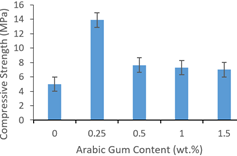
Figure 1 illustrates the effect of AG on the compressive strength of Iraqi gypsum composites. The compressive strength of the control (0 wt.%) was 5.0 ± 1.0 MPa. The compressive strength increased to 13.9 ± 1.0 MPa when 0.25 wt.% of AG was used. However, the compressive strength decreased progressively at higher concentrations to 7.7 ± 1.0 MPa, 7.3 ± 1.0 MPa and 7.0 ± 1.0 MPa when 0.5, 1.0 and 1.5 wt.% were used, respectively. Results are given as mean ± SD (n = 3). The increased compressive strength at lower amounts of AG could be attributed to the filling of pores and better cementation of gypsum particles with a more rigid microstructure due to such addition. On the contrary, higher amounts can cause a less rigid organic-rich phase to form, disrupting the matrix's continuity.
In the present study, 7-day compressive strength is the main performance criterion; extended curing times (1 day and 28 days) were not studied herein. An investigation of these hydration and early-age behaviors will be conducted in future studies to better understand the mechanical performance over the long term. It should be noted that no statistical optimization was performed in this study, and the reported trends are based on experimental comparisons (n = 3).
3.2 Effect of Arabic gum on setting time
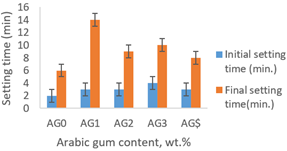
The effect of AG on initial and final setting times of the gypsum composites is demonstrated in Figure 2. The investigated samples were designated as AG0 (0 wt.%), AG1 (0.25 wt.%), AG2 (0.5 wt.%), AG3 (1.0 wt.%), and AG4 (1.5 wt.%). Initial and final setting times were always extended with the introduction of AG. The initial setting time of the control sample (AG0) was 2.0 ± 1.0 min, whereas the modified samples (AG1, AG2, AG3, and AG4) exhibited extended initial setting times of 3.0 ± 1.0 min, 3.0 ± 1.0 min, 4.0 ± 1.0 min, and 3.0 ± 1.0 min, respectively. Similarly, the final setting time rose significantly from 6.0 ± 1.0 min for AG0 to its highest value of 14.0 ± 1.0 min for AG1 (0.25 wt.% AG), followed by a gradual decrease to 9.0 ± 1.0 min, 10.0 ± 1.0 min, and 8.0 ± 1.0 min for AG2, AG3, and AG4, respectively. The data are shown as a mean ± SD (n = 3). These results suggest that AG can act as an effective retarder for the setting behaviour of gypsum, especially at low concentrations. The behavior may be associated with the adsorption of AG macromolecules on the surface of the gypsum particles, which is retarding the calcium sulfate dihydrate nucleation and crystal growth during hydration. This means that the setting process will take longer. Note that the proposed mechanism is drawn from the observed experimental trends; in the present study, no direct investigations of the hydration kinetics (e.g., isothermal calorimetry or pore-solution analysis) were undertaken, but this is a topic for future research.
3.3 Bulk density of gypsum composites
The bulk density of the gypsum composites increases with the increasing content of AG, as shown in Figure 3. The bulk densities were found to increase from 1.119 ± 0.007 g/cm³ for the control sample AG0 (0 wt.%) to 1.130 ± 0.007 g/cm³ for AG1 (0.25 wt.%), 1.141 ± 0.007 g/cm³ for AG2 (0.5 wt.%), 1.149 ± 0.007 g/cm³ for AG3 (1.0 wt.%), and reached a maximum of 1.160 ± 0.007 g/cm³ for AG4 (1.5 wt.%). Quantitative data are presented as mean ± SD ($n = 3$). The difference in density means that the presence of AG makes the inner structure of the matrix more dense. Such behavior could be caused by improved efficiency of binding of the particles, accompanied by a lower volume of pores inside the structure. This tendency can be associated with the results obtained during investigation of the microstructure and could be partially explained by the higher compressive strength of the investigated samples. It should be noted that the porosity was not measured in the course of this research; therefore, the assumed correlation of the change in density and porosity is considered the most probable one.
3.4 Water swelling behavior
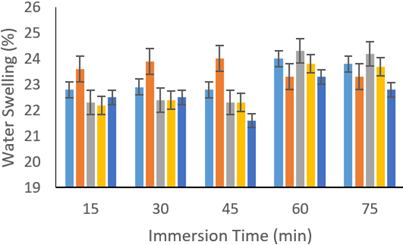
The swelling behavior of the gypsum composites in varying amounts of AG was analyzed for a duration of immersion time of 75 min, as compared to the control sample (AG0), which is shown in Figure 4. All quantitative data for the intervals used during the test are represented as the mean ± SD (n = 3). In the initial stage of immersion (15-45 min), the swelling behavior of the samples containing AG was lower than that of the control sample. For example, after 15 min of immersion, the percentage swelling of the control sample was 22.8% ± 0.3%, whereas that of AG2 and AG3 were 22.3% ± 0.5% and 22.2% ± 0.4%, respectively. In the early stages of testing, the least degree of swelling was seen for the specimen with the highest amount of AG (AG4) at 45 min with a minimum value of 21.6% ± 0.3%. This pattern suggests that there is some improvement in the dimensional stability of the composite owing to the presence of AG in the early stages. As the period of immersion increases from 60-75 min, there is a marginal increase in the degree of swelling for all specimens due to the process of hydration. Nonetheless, the specimens with AG showed less or similar degrees of swelling in comparison to the control specimen. At the final stage of 75 min, the degree of swelling of the control specimen (AG0) was 23.8% ± 0.3%, while the AG4 specimen limited it to 22.8% ± 0.3%. The pore-filling effect of the AG macromolecules and the consequently more compacted microstructure are the primary factors mitigating water expansion, as the denser matrix restricts the physical displacement and expansion of the gypsum crystals during secondary hydration.
3.5 Microscopic examination
The microstructural changes of gypsum samples containing different amounts of AG are shown in Figure 5. The surface of the control sample (AG0) is heterogeneous, showing the presence of micro-pores which could allow increased water penetration. The addition of AG (AG1 to AG3) resulted in a relatively more compact and less porous surface appearance, with a decrease in the visible pore size and an increase in structural continuity. This suggests a possible modification of the gypsum matrix due to the presence of the additive.
The most uniform surface morphology occurs at the highest concentration (AG4), suggesting a denser microstructural appearance than the control sample. It is noted, however, that the observations were made by qualitative optical microscopy (80×), and advanced techniques such as scanning electron microscopy (SEM) would be needed to establish the pore refinement or the changes in crystal structure. The morphological changes observed are consistent with the improvement in the water swelling resistance and bulk density reported in the experimental results.
3.6 X-ray diffraction crystallite size and crystallinity analysis
The crystalline changes of the synthesized samples were characterized by X-ray diffraction, as illustrated in Figure 6. The quantitative crystalline behavior of pure gypsum (AG0) and AG-modified samples (AG1-AG4) has been determined by applying the Scherrer equation and the results are presented in Table 2. The size of the crystallites in the pristine gypsum sample (AG0) is 17.8 nm. A very small amount of AG (AG1) is added and the crystallite size slightly increases to 20.5 nm. This behavior could be explained by the initial interaction between the hydrophilic functional groups of AG and the gypsum matrix, which are able to temporarily modify the crystal growth kinetics. With an increase in AG content (AG2 and AG3), it seems that the reduction of crystallite size is noticeable, which is 13.5 nm for AG2 and 10.7 nm for AG3.
Table 2. X-ray diffraction (XRD) parameters and crystallite size analysis
|
Sample Code |
Selected Peak (2θ, °) |
FWHM (β, °) |
Crystallite Size (D nm) |
Relative Crystallinity Change (a.u.) |
|
AG0 |
29.68 |
0.462 |
17.8 |
85.3 |
|
AG1 |
29.72 |
0.401 |
20.5 |
82.1 |
|
AG2 |
29.60 |
0.607 |
13.5 |
76.4 |
|
AG3 |
29.62 |
0.680 |
12.1 |
71.8 |
|
AG4 |
32.19 |
0.441 |
18.8 |
68.5 |
Figure 6. X-ray diffraction (XRD) patterns of pure Arabic gum (AG) and gypsum composites with varying weight fractions of AG (AG0–AG4(
The decrease in this reduction indicates there may be a barrier to crystal growth, either in the form of reduced ion mobility in the presence of the biopolymer, or it could be a physical barrier to the crystal formation process. The crystallite size is slightly increased to 18.8 nm and the relative crystallinity is decreased to 68.5% at the highest concentration (AG4). This is characteristic of a more complex interaction at the higher polymer loadings, which may be due to the presence of an organic-rich phase that affects crystal packing. In general, the changes in crystallite size and crystallinity observed were consistent with the changes in microstructural properties observed in optical microscopy and the macroscopic properties in terms of bulk densities and water swelling resistance. Table 2 shows the XRD parameters and crystallite size analysis.
The XRD analysis was done with Cu Kα radiation (λ = 1.5406 Å). The size of crystallites was calculated by employing the Scherrer formula
D = Kλ/(βcosθ)
where, D stands for the crystallite size, K = 0.9 is a shape factor, λ refers to the X-ray wavelength, β is the full width at half maximum (FWHM) of the chosen diffraction line, and θ denotes Bragg’s angle. Prior to the fitting process of diffraction lines, background correction was carried out and then FWHM was obtained from the fitted diffraction lines. Broadening due to the instrument was not taken into account in this calculation; consequently, the resulting crystallite sizes were only approximate ones.
Relative crystallinity changes were obtained by calculating the normalized integrated intensities of the crystalline diffraction peaks of each sample compared to those of the reference gypsum sample (AG0).
3.7 Ultraviolet-visible spectroscopy analysis
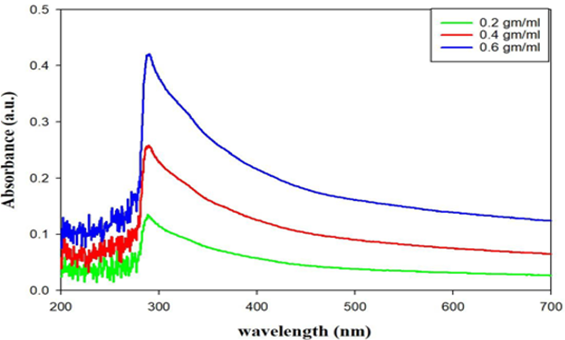
The optical behavior of the modified system was studied by UV-Vis analysis in this study. Measurements were performed at various concentrations (0.2%, 0.4%, 0.6%) of aqueous AG solutions in the optical range 200–700 nm. Absorbance spectra of the AG solutions, as shown in Figure 7, show a characteristic absorbance band in the UV-Vis range with the maximum (λmax) occurring at about 280–300 nm. The absorption feature is believed to be due to electronic transitions (π → π* and n → π*) due to functional groups and aromatic amino acid residues in the glycoprotein structure of AG. As the concentration is raised, the absorbance intensity also increases, which means the absorbance intensity is dependent on the concentration and is in accordance with the Beer-Lambert law.
Figure 7. Ultraviolet-visible (UV-Vis) absorbance spectra of aqueous Arabic gum (AG) solutions at different concentrations
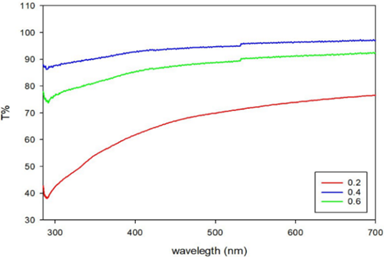
The transmittance (T%) is low and gradually increases with wavelength, as shown in Figure 8; however, it is higher in the visible region (400–700 nm), suggesting that the solution has a high optical transparency at longer wavelengths.
Figure 8. Ultraviolet-visible (UV-Vis) transmittance (T%) spectra of aqueous Arabic gum (AG) solutions at different concentrations
Figure 9. Ultraviolet-visible (UV-Vis) reflectance-like signal of aqueous Arabic gum (AG) solutions at different concentrations
Figure 9 shows that the reflectance-like signal exhibits complementary behaviour to the transmittance, being related to the changing light attenuation in solution, not to the reflection behaviour of the surface. It is important to note that the following UV-Vis measurements were made only on the aqueous solutions of AG and not on solid gypsum composites. Thus, the derived optical parameters are only for the modifier phase, and not for the bulk optical properties of gypsum.
3.8 Sustainability and environmental perspective
The use of AG as a natural biopolymer modifier is from a sustainability standpoint, the introduction of a renewable bio-based additive into gypsum systems. AG is obtained naturally from a plant source and is biodegradable, unlike synthetic chemical additives, and can help to lower the need for petroleum-based modifiers. A quantitative life-cycle assessment (LCA), carbon footprint and recycling pathway evaluation were not carried out in this study, but the choice of a natural biopolymer is in line with the general principles of sustainable material design. Based on the developed gypsum-biopolymer system, further studies are recommended to assess the environmental performance, energy efficiency and end-of-life performance in a more comprehensive circular economy context.
3.9 Engineering relevance and limitations
In the present study, the effect of AG on the physical and mechanical properties of gypsum is investigated primarily with respect to compressive strength, setting time, bulk density, and swelling properties. These parameters give a basic idea of the material's initial performance in construction applications. It is recognized that other mechanical and durability properties like flexural strength, water absorbency, and wet-dry cycling resistance were not examined in this work. These tests usually need to be conducted when a full-scale evaluation of long-term structural performance is needed in real building environments. Thus, the present study can be regarded as a baseline experimental study that proves the possibility of using AG as a natural modifying agent for gypsum systems and further detailed structural durability testing is still left to be performed.
In this work, the effect of AG used as a retarder on the physical, mechanical, microstructural and optical properties of Iraqi gypsum was studied. From the obtained experimental results under the investigated conditions, the following conclusions can be drawn:
The compressive strength of gypsum was enhanced at low concentrations of AG, and maximum compressive strength was achieved at 0.25 wt.% AG.
The use of AG resulted in an increase in the initial and final setting time of gypsum, which is a retarding effect and gave a longer working time to gypsum.
The bulk density of gypsum was found to be higher whenthe AG content was greater.
Water swelling tests confirmed that the modified gypsum samples had better dimensional properties, especially for higher concentrations of AG. The microstructure of the samples was observed, and pure gypsum showed a porous and heterogeneous texture compared to the samples modified with AG, so the optimal dosage was determined to be 0.25% by weight of the AG additive, which yields the maximum enhancement in compressive strength. This improvement is attributed to the filling of micro-voids, resulting in a more compact and homogeneous microstructure as observed via SEM without altering the fundamental crystalline phase of the gypsum dehydrate.
[1] Wu, P.F., Liu, X.Y., Liu, X.M., Zhang, Z.Q., Wei, C. (2024). Effect of industrial byproduct gypsum on the mechanical properties and stabilization of hazardous elements of cementitious materials: A review. Materials, 17(17): 4183. https://doi.org/10.3390/ma17174183
[2] Singh, M. (2023). Gypsum & Gypsum Products: Their Science & Technology. CRC Press, New York.
[3] Songkhla, W.N., Chaikaew, C., Chatveera, B., Sua-Iam, G. (2025). Experimental investigation of recycled HDPE waste fiber-reinforced gypsum with emphasis on durability and mechanical performance. Results in Engineering, 26: 105330. https://doi.org/10.1016/j.rineng.2025.105330
[4] Dudgeon, K. (2023). Insights into resource management and technological development through microbotanical and geoarchaeological characterisation of floor plasters from Neolithic Abu Hureyra, Syria, 8600-6000 cal. BC. Quaternary International, 655: 55-68. https://doi.org/10.1016/j.quaint.2023.02.007
[5] Li, M.J., Huang, G.D., Wang, B., et al. (2022). Mechanical properties and coagulation characteristics of flue gas desulfurization gypsum-based polymer materials. Polymers, 14(21): 4761. https://doi.org/10.3390/polym14214761
[6] Mustafa, M. (2024). Use of ceramic and rock wool fiber waste as raw materials for the production of new eco-efficient gypsum plasters. Master’s thesis, Universidad Politécnica de Madrid. https://doi.org/10.13140/RG.2.2.28037.26080
[7] Almusaed, A., Yitmen, I., Myhren, J.A., Almssad, A. (2024). Assessing the impact of recycled building materials on environmental sustainability and energy efficiency: A comprehensive framework for reducing greenhouse gas emissions. Buildings, 14(6): 1566. https://doi.org/10.3390/buildings14061566
[8] Al-Saoudi, N.K.S., Al-Khafaji, A.N., Al-Mosawi, M.J. (2013). Challenging problems of gypseous soils in Iraq. In Proceedings of the 18th International Conference on Soil Mechanics and Geotechnical Engineering, Paris, pp. 479-482. https://www.issmge.org/publications/publication/challenging-problems-of-gypseous-soils-in-iraq.
[9] Vignesh, J., Ramesh, B., Xavier, J.R. (2025). Recent advances in multifunctional nanocomposites for high-performance and durable concrete in harsh environments. Results in Engineering, 29: 108840. https://doi.org/10.1016/j.rineng.2025.108840
[10] Ali, A., Andriyana, A. (2020). Properties of multifunctional composite materials based on nanomaterials: A review. RSC Advances, 10(28): 16390-16403. https://doi.org/10.1039/C9RA10594H
[11] Wang, X.G., Li, Y.C., Meng, D., et al. (2023). A review on flame-retardant polyvinyl alcohol: Additives and technologies. Polymer Reviews, 63(2): 324-364. https://doi.org/10.1080/15583724.2022.2076694
[12] Abbas, M.M., Muntean, R. (2025). The effectiveness of different additives on concrete’s freeze-thaw durability: A review. Materials, 18(5): 978. https://doi.org/10.3390/ma18050978
[13] Nasir, M., Islam, A.B.M.S., Alotaibi, K.S., Al-Kutti, W. (2023). Evolution of Arabic gum-based green mortar towards enhancing the engineering properties: Fresh, mechanical, and microstructural investigation. Construction and Building Materials, 365: 130025. https://doi.org/10.1016/j.conbuildmat.2022.130025
[14] Rustum, M.K., Oweed, K.M. (2020). Investigation the effect of Arabic gum on the physical and mechanical properties of ordinary cement mortar. Journal of Engineering and Sustainable Development, 24: 417-424. https://doi.org/10.31272/jeasd.conf.1.46
[15] Huang, W., Wang, H. (2024). Formulation development of metakaolin geopolymer with good workability for strength improvement and shrinkage reduction. Journal of Cleaner Production, 434: 140431. https://doi.org/10.1016/j.jclepro.2023.140431
[16] Zhang, M.H., Sisomphon, K., Ng, T.S., Sun, D.J. (2010). Effect of superplasticizers on workability retention and initial setting time of cement pastes. Construction and Building Materials, 24(9): 1700-1707. https://doi.org/10.1016/j.conbuildmat.2010.02.021
[17] Aslan, İ., Can, A. (2025). Investigation of the mechanical properties of water-soluble salt cores produced by binder jetting additive manufacturing. International Journal of Metalcasting, 19(6): 3705-3716. https://doi.org/10.1007/s40962-025-01602-x
[18] Hooton, R.D., Bickley, J.A. (2014). Design for durability: The key to improving concrete sustainability. Construction and Building Materials, 67: 422-430. https://doi.org/10.1016/j.conbuildmat.2013.12.016
[19] Brzyski, P. (2024). Influence of gum arabic admixture on selected properties of clay mortar. Construction and Building Materials, 451: 138865. https://doi.org/10.1016/j.conbuildmat.2024.138865
[20] Luanda, A., Anjar, R., K.J., D., Badalamoole, V. (2026). Recent trend in biomedical and environmental applications of gum arabic-based hydrogels: Benefits, challenges and opportunities. Polymer Reviews, 66(1): 214-258. https://doi.org/10.1080/15583724.2025.2592546
[21] Patel, S., Goyal, A. (2015). Applications of natural polymer gum arabic: A review. International Journal of Food Properties, 18(5): 986-998. https://doi.org/10.1080/10942912.2013.809541