
Chaimae Adadi* | Hakim Jebari | Siham Rekiek | Naoufal Sefiani
© 2026 The authors. This article is published by IIETA and is licensed under the CC BY 4.0 license (http://creativecommons.org/licenses/by/4.0/).
OPEN ACCESS
For instance, the 8D methodology is a well-established analytical tool for quality management, especially in sectors such as automotive manufacturing that are regulated. Its basic model is still being applied manually and it takes time that is always going to take human to know a lot of the process and it will often result in getting it wrong due to bias and inconsistency. This research explores utilizing AI in the 8D process to improve accuracy, efficiency, and decision-making. Combining a PRISMA-guided scoping literature review and an industrial case study employing a dual-method approach, the proposed intelligent 8D framework constructs the conceptual integration of AI technologies—including machine learning (ML), natural language processing (NLP), and computer vision—across the eight disciplines of the 8D process. The industrial case study provides partial empirical validation for AI-assisted defect detection, root cause analysis, corrective action validation, and recurrence monitoring (principally D4–D6). The deployed AI vision system achieved 99.2% defect detection accuracy and reduced problem resolution time from 21 days to 5 days, eliminating paint overflow defects (0 PPM) during validation. The AI-enabled functions for D1, D2, D7, and D8 are presented as conceptual extensions derived from the literature review, requiring future industrial validation. These results indicate AI's ability to enhance major components of the 8D process while providing a practical foundation for the proposed framework. This framework aligns with principles of Kaizen and Industry 4.0 to foster continuous and data-driven improvement and provide organizations with a concrete road map to a more intelligent, resilient quality management system.
8D method, AI, problem-solving, quality management, root cause analysis, continuous improvement, Industry 4.0, smart manufacturing
Effective problem-solving drives industrial competitiveness, particularly under compliance-driven frameworks such as IATF 16949, which mandates the 8D methodology [1, 2]. However, 8D implementation remains largely manual and expert-dependent, and modern supply chain complexity, data volumes, and product diversity slow resolution and reduce diagnostic accuracy [3]. AI offers potential to automate repetitive tasks, extract insights, and enhance diagnostics, aligning with Industry 4.0.
This research applies AI within 8D through two complementary components: (i) a PRISMA-informed scoping review and (ii) an industrial case study. The review followed PRISMA 2020, guided by the question: How can AI supplement 8D stages in industrial quality management? Searches across Scopus, Web of Science, ScienceDirect, and IEEE Xplore began with "Artificial Intelligence" AND "8D" (32 records; 6 eligible—"8D" often denotes "eight dimensions" elsewhere). Broadened queries yielded 60 additional records. Inclusion criteria: peer-reviewed English articles (2023–2025) on AI in manufacturing quality; exclusions: duplicates, non-peer-reviewed, non-industrial studies. Final inclusion: 47 articles (6 directly on AI in 8D; 41 on complementary quality approaches), providing the theoretical basis for mapping AI methods (machine learning (ML), deep learning, natural language processing (NLP), computer vision, expert systems) to the proposed intelligent 8D framework.
An automotive case study supplemented the review: an AI-powered vision inspection system demonstrated improvements in inspection precision, diagnostic timescales, and corrective action effectiveness, empirically validating D4–D6 (Root Cause Analysis, Permanent Corrective Actions (PCA), Validation), with partial support for D3 (Containment). AI applications for D1 (Team Formation), D2 (Problem Description), D7 (Prevent Recurrence), and D8 (Team Recognition) derive from literature and represent conceptual extensions requiring validation. This distinction between validated and conceptual elements provides a transparent foundation for the intelligent 8D framework.
Ford's 8D methodology, developed in the late 1980s, is among the most widely adopted structured problem-solving approaches, following a systematic, iterative process—identification, containment, and eradication of root causes—blending analysis and cross-disciplinary collaboration. Problem formulation is critical to resolution success: structured formulation (Socratic Process) dictates solution speed, success, and reporting quality [4]. Traditional tools—Is/Is-Not matrix, 5W2H, structured 8D reports—have advanced significantly [1], with statistical techniques [5] increasingly adopted to improve clarity and shorten resolution time [6]. Most existing studies are descriptive, offering limited insight into cases where instrumentation fails—shifting symptoms, inconsistent data, or expert bias—necessitating more adaptive, data-driven approaches.
8D variants have emerged to enhance performance. Quick Response Quality Control-Fast (QRQC-F), a rapid 8D-based technique emphasizing shop-floor containment and short feedback loops, achieved improved performance in a five-week pilot [7]. However, such hybrid methods remain dependent on human insight and manual analysis, with few addressing long-term scaling, knowledge retention, or reproducibility across teams. 8D succeeds when complemented with appropriate tools: a brake manufacturer demonstrated that 8D with Pareto analysis, Five Whys root cause analysis technique (5 Whys), and Ishikawa diagrams enabled critical failure cause identification and long-term interventions [8], with Plan-Do-Check-Act (PDCA) integration yielding sustainable improvement. Yet such cases represent best-case scenarios, seldom addressing missing data, divergent interpretations, or tool maturity differences.
AI integration into traditional quality tools significantly advances problem-solving capabilities. For the Ishikawa (fishbone) diagram [9], AI combined with Big Data enables unified data flows, revelation of hidden relationships, pre-defect prediction, reduced human bias, and adaptive standards [10]. Kiefer et al. [11] developed an ML–explainable AI–Ishikawa framework for earlier failure anticipation, while Sadyraliev et al. [10] showed Big Data–AI integration enhances root cause analysis objectivity. The 5 Whys method benefits similarly: ML identifies patterns missed by human analysts [8, 11], while NLP extracts and structures problem descriptions for consistency across teams [12-14]. Failure Mode and Effects Analysis (FMEA)—evaluating failures via Risk Priority Number (RPN) based on severity, occurrence, and detection [9]—has advanced through AI: Chen et al. [15] proposed weight-embedded fuzzy FMEA, while Dai and Pang [9] developed optimized FMEA approaches, demonstrating AI's capacity to reduce subjectivity.
Embedding 8D in organizational culture improves product quality, customer satisfaction, and compliance with ISO 9001 and IATF 16949 [2], transforming it into a strategic facilitator of continuous improvement. However, traditional 8D faces contemporary challenges: increasing process complexity, growing data volume, and rapid decision-making demands cannot be adequately addressed using traditional tools alone. The literature reiterates that 8D is time-consuming and may miss solution opportunities due to reliance solely on human know-how [4, 6, 8]. Table 1 summarizes recent studies on AI applications in quality management, highlighting contributions, technical features, and limitations, situating the present work within the broader research context.
Table 1. Summary of recent studies on AI applications in quality management
|
Ref. |
Year |
AI Technology |
Application Area |
Key Contribution |
Limitations |
|
[11] |
2025 |
ML, Explainable Artificial Intelligence, Ishikawa |
Root Cause Analysis |
Framework combining ML, XAI, and Ishikawa for industrial manufacturing |
Limited to manufacturing context; validation scope narrow |
|
[10] |
2025 |
Big Data, AI |
Quality Management Systems |
Information system for product quality management using Big Data and AI |
Conceptual framework; limited empirical validation |
|
[15] |
2025 |
Fuzzy Failure Mode and Effects Analysis (FMEA) |
Risk Assessment |
Weight-embedded fuzzy FMEA for offshore wind turbines |
Domain-specific; limited generalizability |
|
[9] |
2025 |
Optimized FMEA, DHHFLTS |
Battery Assembly Quality |
Risk analysis method for lithium-ion battery assembly |
Specific to battery manufacturing |
|
[7] |
2023 |
Combines Case-based Reasoning (CBR), Bayesian Networks (BN) |
Shopfloor Problem Solving |
Digital supported problem-solving using CBR and BN |
Focused on shop floor; partial 8D integration |
|
[16] |
2025 |
Natural Language Processing (NLP), OPC-UA |
Industrial Processes |
Systematic review of data mining and NLP in industrial processes |
Review paper; no new framework proposed |
|
[17] |
2025 |
ML, AI |
Kaizen/Continuous Improvement |
AI integration in Kaizen-oriented continuous improvement |
Conceptual; limited industrial validation |
|
[18-21] |
2019-2023 |
Nature-Inspired AI |
Scheduling Problems |
Multi-hybridization approaches for job shop scheduling |
Focused on scheduling; not quality management |
|
[4] |
2025 |
AI Integration |
Unmanned Vehicles |
AI integration in Industry 4.0 contexts |
Focus on autonomous systems; not quality |
|
[22] |
2023 |
Fuzzy Logic |
Customer Satisfaction |
Fuzzy logic model for complaint prevention |
Limited to complaint management |
8D's strength lies in integrating diverse quality tools—Ishikawa diagrams, 5 Whys, 5W2H [3], and FMEA [9]—enhancing diagnostic accuracy and risk prioritization. However, documented limitations include subjective FMEA scoring, oversimplified causal diagrams, and contextual knowledge loss in brainstorming. In data-rich, automated environments, 8D struggles to deliver required responsiveness and depth. While gaps are acknowledged, few concrete solutions exist—revealing a research pathway for AI-reinforced intelligent methodologies.
AI is a powerful enabler: ML, NLP, and expert systems can support the complete 8D process. AI techniques programmable into 8D include: ML for pattern identification and predictive decision support [23, 24]; DL for feature extraction in image recognition, speech analysis, and NLU [25, 26], with CNNs central to computer vision [27]; and NLP for software artifact connection, customer feedback analysis, and user story interpretation [16, 28]. AI addition to 8D extends Kaizen principles, transforming it from an incremental-change philosophy into a hybrid, data-driven 8D-AI framework [17, 29].
Despite encouraging results, most research examines AI applications in isolation—predictive maintenance, anomaly detection, or NLP-based reporting—without a holistic integration framework across the complete 8D methodology [7, 10, 11, 30]. This leaves a gap regarding how AI can support the entire 8D process flow, from team formation through knowledge management for future prevention. This research addresses that gap by proposing the "intelligent 8D" framework, positioning AI not as layered tools but as a structured system that increases precision in problem definition (D2), accelerates root cause identification (D4), provides decision support for corrective measures (D5–D6), and retains organizational knowledge for future problems (D7–D8). Unlike prior hybrid models, it emphasizes real-time data interpretation, analytical task automation, human bias reduction, and continuous learning. Table 2 compares three paradigms: original 8D, existing hybrids (e.g., QRQC-F), and the proposed intelligent 8D framework.
Table 2. Comparison of traditional 8D, hybrid models, and intelligent 8D
|
Aspect |
Traditional 8D |
Hybrid Models (e.g., QRQC-F) |
Intelligent 8D (Proposed) |
|
Problem Definition |
Manual, 5W2H forms |
Structured forms, some digitization |
NLP-automated, data-integrated |
|
Root Cause Analysis |
Ishikawa, 5 Whys, manual |
Semi-automated tools, basic stats |
AI-driven correlation, predictive analytics |
|
Decision Support |
Human expertise |
Human + basic data visualization |
ML recommendations, digital twin simulation |
|
Knowledge Retention |
Archived reports |
Database storage |
AI-tagged, retrievable case library |
|
Scalability |
Low |
Medium |
High (cloud-enabled, multi-plant) |
|
Key Limitation |
Slow, subjective |
Still human-intensive |
Requires data infrastructure, trust-building |
|
Learning Capability |
Static |
Limited |
Continuous, adaptive |
Table 3. 8D step purpose
|
Step |
Name |
Description |
Purpose |
|
D0 |
Plan |
Define the need for using the 8D and prepare resources. |
Ensure the problem requires a structured approach. |
|
D1 |
Establish the Team |
Form a cross-functional team with the knowledge and authority to solve the problem. |
Leverage diverse expertise and responsibility. |
|
D2 |
Describe the Problem |
Define the problem in measurable, specific, and detailed terms (who, what, where, when, why, how many). |
Create a clear and shared understanding of the issue. |
|
D3 |
Develop Interim Containment Actions (ICA) |
Implement temporary measures to protect the customer while investigating the problem. |
Minimize impact until permanent solutions are in place. |
|
D4 |
Root Cause Analysis |
Implement short-term measures to isolate the problem and protect the customer. |
Minimize impact until permanent solutions are in place. |
|
D5 |
Develop Permanent Corrective Actions (PCA) |
Propose long-term corrective actions addressing the root cause(s). |
Ensure the problem is fully solved before closing. |
|
D6 |
Implement & Validate PCA |
Execute the chosen corrective actions and verify their effectiveness. |
Confirm the problem is resolved and the fix is working. |
|
D7 |
Recognize Team Contributions |
Acknowledge and reward the efforts of the team. |
Motivate, strengthen teamwork, and capture lessons learned. |
|
D8 |
Prevent Recurrence |
Modify systems, procedures, training, or policies. |
Strengthen processes to avoid future problems. |
The 8D method is a structured, step-by-step approach: cross-functional team establishment (D1), problem definition (D2), containment actions (D3), root cause determination and verification (D4), corrective action design and implementation (D5–D6), recurrence prevention (D7), and team recognition (D8) [2]. Table 3 synthesizes the purpose and anticipated results of each discipline, acting as a reminder of each discipline's logical integrity and efficiency, and what can happen when problems are brought to bear as institutional learning.
AI designs systems capable of tasks normally requiring human intelligence—learning from experience, natural language understanding, pattern recognition, problem-solving, and decision-making—with recognized potential to enhance operational performance, capacity, flexibility, and productivity [4]. A promising approach combines case-based reasoning (CBR) with Bayesian Networks (BN), mutually dependent theories: CBR solves new problems by retrieving and adapting similar past cases [1, 31], while BN provides statistical reasoning under uncertainty. Given that industrial data is almost always incomplete, rapid decision-making with insight is critical. CBR's intuitively structured nature suits operator use in complex environments such as flotation control systems. Research on partial or ambiguous information [32] shows CBR improves both reliability and processing efficiency. Combined with BN, decision-making power increases markedly, as BN approximates cause-effect relationships under uncertainty [17]. In hybrid CBR-BN systems, CBR retrieves relevant cases while BN refines diagnosis and solution selection—minimizing bias, improving diagnostic precision, and benefiting decision support in fast-paced, evidence-based settings [1].
NLP has emerged as critical for 8D methodology, particularly D2 (Problem Description) and D7 (Prevent Recurrence). Industrial implementations typically employ transformer-based architectures: BERT [14], pre-trained on large corpora and fine-tuned on quality reports, with bidirectional attention capturing contextual relationships; RoBERTa, with improved training methodology for enhanced domain-specific performance; DistilBERT, with 40% fewer parameters while retaining 95% of BERT performance—suitable for edge deployment; and T5, a unified framework for classification and question answering. The D2 workflow proceeds through preprocessing (raw text from incident reports, complaints, and logs), tokenization (WordPiece or BPE segmentation), embedding generation (BERT produces 768-dimensional contextual vectors), entity extraction (NER identifies product IDs, batch numbers, equipment, personnel), relationship classification (a transformer head maps entities to 5W2H fields), semantic matching (dot product similarity against historical case embeddings), and validation (confidence scoring and ambiguity detection flag uncertain descriptions for human review).
Industrial quality inspection computer vision typically employs CNNs with optimized architectures: ResNet [27], whose residual connections enable effective deep network training (ResNet-50/152 commonly used for industrial inspection); EfficientNet, which scales depth, width, and resolution for optimal performance-efficiency trade-off; YOLO, for real-time object detection and defect localization; and U-Net, for semantic segmentation and pixel-level defect classification. Quality management anomaly detection typically employs: Autoencoders, unsupervised reconstruction-based detection; isolation forest, tree-based outlier detection for high-dimensional data; One-Class SVM, identifying novelties in production data; Gaussian Mixture Models, probabilistic clustering and anomaly detection; and LSTM-based Prediction, recurrent neural networks for time-series anomaly detection.
NLP is also used in EIOS for automatic processing of online content (news, social media, forums) for public health detection [33]. In quality management, NLP can analyze customer feedback, complaints, and emails for early incident alerts and consistent issue description, transforming human-written rules into structured, machine-readable content and reducing manual compliance time [13], while newer models like BERT capture grammatical and contextual subtleties [14]. NLP also powers chatbots—conversational agents providing real-time support, uniform responses [34-36], and lower operational costs, with applications extending to adaptive language learning [37]. Within 8D, chatbots serve as D5 agents capable of analytical and emotional interaction [38], processing large datasets and generating personalized, emotionally intelligent suggestions for heightened satisfaction and faster resolution.
AI can supplement classic tools such as the Ishikawa (fishbone) diagram [9]. AI–Big Data integration makes Ishikawa analysis more predictive and adaptive through unified data flows, revelation of hidden relationships, advanced defect identification, reduced human bias, and adaptive standards [10]. For instance, Mortada and Soulhi [22] blended fuzzy logic with Ishikawa diagrams for complaint risk assessment alongside lean tools (5 Whys, Poka Yoke, Jidoka), while Malviya et al. [39] demonstrated that AI-enhanced Ishikawa enables predictive analysis for earlier failure anticipation and rapid response. ML automates decision-making by learning from vast data streams, detecting patterns, and directing remediation without prior programming. In 8D, ML checks defect rates before and after correction, evaluates solution effectiveness, and recommends probable corrective actions [40]. Benefits include continuous learning, improved prediction accuracy, and real-time decision support—making ML indispensable in contemporary quality systems. Embedded within 8D, AI improves the accuracy, velocity, and resilience of the entire problem-solving process.
2.1 Case study rationale and representativeness
Automotive manufacturing was selected for its structured problem-solving methodologies, strict quality specifications, and data-rich environments. Key reasons: IATF 16949-mandated 8D ensuring uniform quality; multi-stage assembly with IoT sensors, Manufacturing Execution System/Enterprise Resource Planning (MES/ERP) systems, and historical data conducive to AI; high-stakes quality demands; and inter-industry relevance to aerospace, electronics, and medical devices. The adhesive paint overflow scenario exemplifies a common yet non-trivial quality problem with multiple causes (material, process, human), measurable customer impact, and containment/prevention opportunities—an opportune benchmark for evaluating AI across 8D phases.
Cross-industry applicability: Electronics (PCB defects, ESD sensitivity), pharmaceuticals (batch quality, Food and Drug Administration/European Medicines Agency (FDA/EMA) validation), aerospace (safety-critical analysis, AS9100), food processing (contamination detection, hygiene), medical devices (biocompatibility, ISO 13485), and consumer goods (packaging, rapid cycles). Core AI technologies (computer vision, NLP, ML) are technology-agnostic and transferable, though domain-specific customization is necessary.
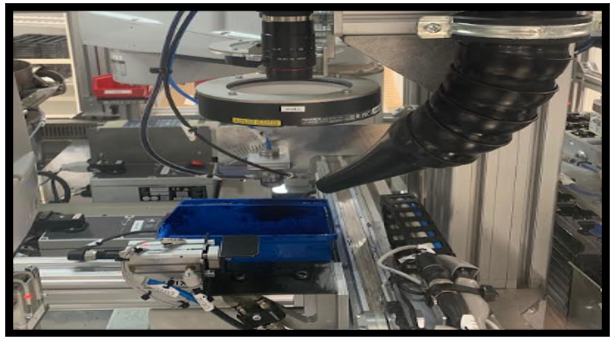
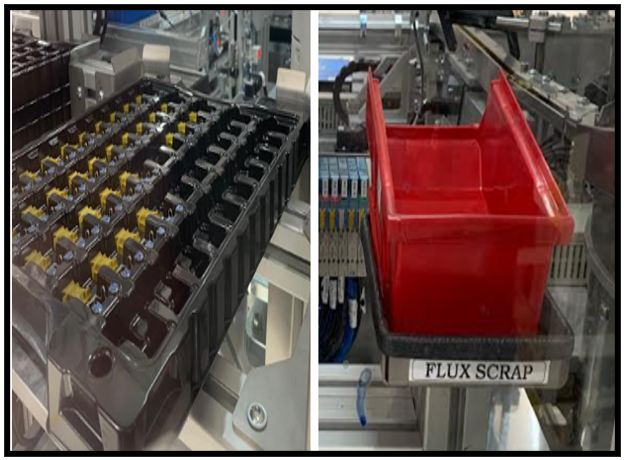
The case study analyzes excess adhesive paint bonding lugs to automotive windows, producing visible stains during assembly (Figure 1). Identified via customer complaint, the investigation employed 8D with Man, Method, Machine, Material, Environment (5M) and 5 Whys. Empirical validation covers only AI-based defect detection, containment, and corrective action testing (D4–D6); remaining stages are conceptual extensions requiring further verification—strengthening credibility.
Figure 1. Case study
2.2 Team formation–D1
The multidisciplinary team comprised a Quality Manager, Process Engineer, Production Manager, Maintenance Technician, Line Operator, and Customer Representative. AI can enhance this through supervised learning (predicting optimal profiles from historical 8D outcomes) and unsupervised learning (clustering by competencies, experience, and performance for complementary skill sets), operating as a decision-support tool rather than autonomous selection:
AI-Assisted Selection Workflow: (i) Skill Mapping—NLP extracts profiles from records and evaluations; (ii) Expertise Recommendation—ML predicts optimal configurations; (iii) Availability Verification—HR integration confirms availability; (iv) Diversity Optimization—balancing expertise, experience, and cross-functional representation; (v) Human Review—Quality Manager makes final selection.
AI Collaboration Support: knowledge retrieval (historical cases and lessons learned), task allocation (expertise, workload, availability), progress monitoring (milestone dashboards), and collaboration platform (AI-powered workspace with templates and automated documentation). This exemplifies human-AI collaboration. AI recommends while human experts retain decision authority.
2.3 Problem description–D2
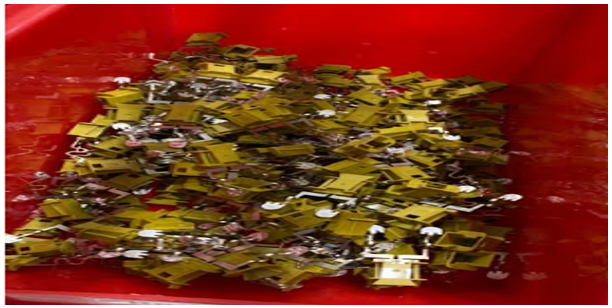
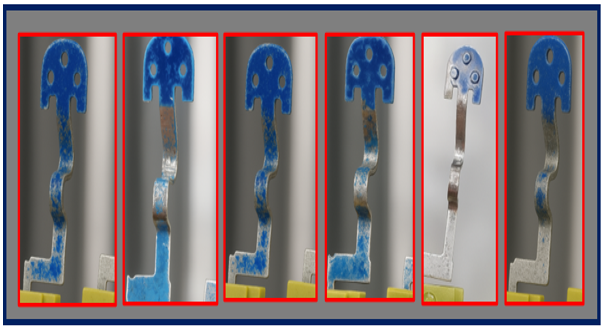
The defect originated from a customer complaint indicating visible paint stains on assembled window components. Investigation showed adhesive paint overflow during bonding caused excessive paint transfer to surrounding surfaces, compromising visual integrity and generating significant NOK parts (Figure 2). Characteristics: Product: Lug + window assembly; Defect: paint overflow stains; Detection: customer complaint; Severity: medium–high.
NLP augments this phase by extracting and structuring problem statements from unstructured sources (incident reports, maintenance logs, operator notes, customer communications). A BERT-based model fine-tuned on domain-specific quality texts performs: NER (product IDs, batch numbers, workstation identifiers, timestamps, operators, equipment); Relationship Extraction (structured problem context); 5W2H Mapping (Who/What/Where/When/Why/How/How Many via transformer classification head); Semantic Similarity Analysis (comparison against historical cases); and Ambiguity Detection (flagging vague descriptions for clarification).
Figure 2. Affected product
NLP also identifies inconsistencies, ambiguities, and omissions across reports, enabling a unified, clear, data-rich problem statement—accelerating D2 while establishing a reliable foundation for root cause analysis and corrective action planning.
2.4 Immediate containment actions–D3
Containment measures comprised batch isolation (quarantining affected lots), increased end-of-line inspection frequency, blocking components with visible paint stains, and direct customer communication for on-site sorting and rework coordination.
AI strengthens containment via: Predictive Risk Evaluation (ML predicting defect probability and impact for proactive containment); Anomaly Identification (real-time detection of parameter deviations signaling emerging issues); Computer Vision Inspection (exceeding human speed and accuracy while reducing fatigue); and NLP Pattern Recognition (mining unstructured logs and reports for recurring failure evidence and overlooked early warnings).
This transforms containment from reactive manual activity into a predictive, data-driven process—diminishing defect escape and expediting operational stabilization.
2.5 Root cause analysis–D4
Root cause and escape point analysis employed the 5M framework and 5 Whys technique to examine both defect occurrence and detection failure.
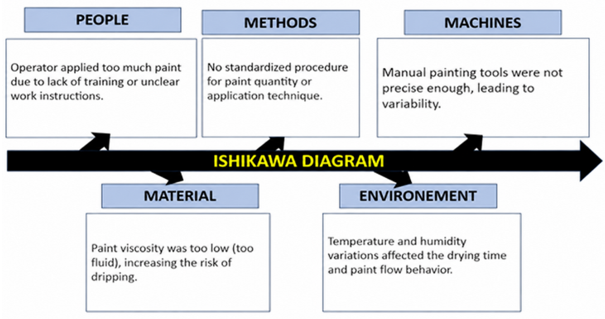
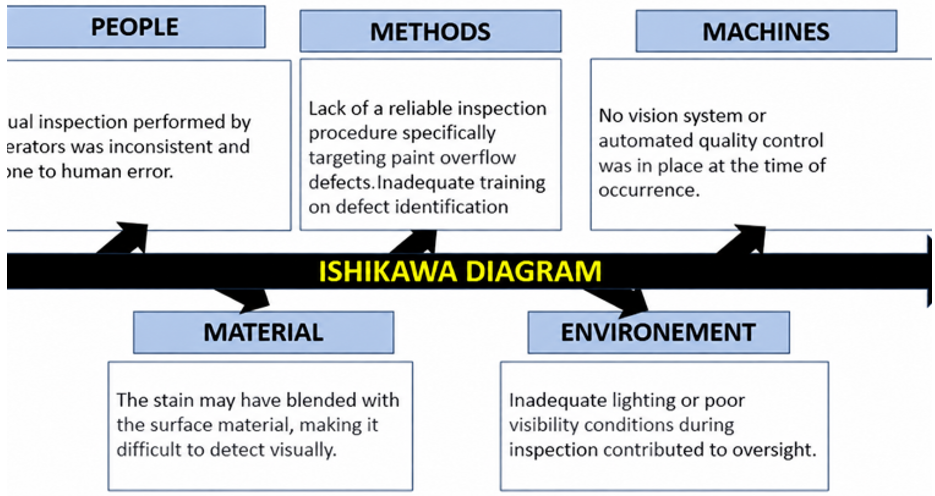
5M Findings (Figure 3): The primary factor was Method—manual painting tools lacked precision, causing inconsistent adhesive application and variable paint deposition.
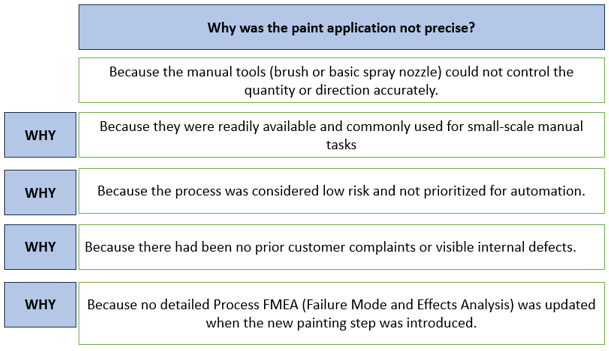
5 Whys (Figure 4): Why did paint overflow occur? → Manual tools applied excess adhesive. Why were manual tools used? → No automated dispensing available. Why was automation absent? → Process historically considered low-risk. Why low-risk? → No prior defects recorded. Why undetected previously? → Visual inspection was intermittent and operator-dependent.
Figure 3. 5M framework
Figure 4. 5 WHY
Figure 5. 5M
5M for detection failure (Figure 5): Man and Method were most relevant—periodic operator visual inspection without established criteria or automated assistance allowed defects to pass.
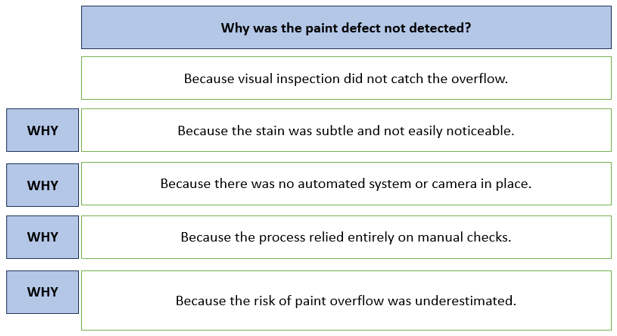
5 Whys for detection failure (Figure 6): Why not detected internally? → Visual inspection missed overflow. Why did inspection fail? → No automated vision system. Why no vision system? → Investment rationale unclear. Why unclear justification? → Insufficient historical defect data. Why insufficient data? → Defects of this type not systematically tracked.
Figure 6. 5 WHY non-detection
2.6 Permanent corrective actions–D5
To address the root cause and prevent recurrence, the company implemented permanent corrective actions as detailed in Table 4. The cornerstone of the initiative was the introduction of an AI-assisted vision inspection system using a Convolutional Neural Network (CNN) based on the ResNet-50 architecture for real-time defect detection and classification.
Table 4. Permanent corrective actions
|
Aspect |
Traditional 8D |
Hybrid Models (e.g., QRQC-F) |
Intelligent 8D (Proposed) |
|
Problem Definition |
Manual, 5W2H forms |
Structured forms, some digitization |
NLP-automated, data-integrated |
|
Root Cause Analysis |
Ishikawa, 5 Whys, manual |
Semi-automated tools, basic stats |
AI-driven correlation, predictive analytics |
|
Decision Support |
Human expertise |
Human + basic data visualization |
ML recommendations, digital twin simulation |
2.6.1 Technical implementation details
•Model Architecture: ResNet-50 (50-layer residual network) with ImageNet pre-trained weights, modified with a custom classification head (binary classification: OK/NOK). ResNet-50 was selected for its optimal balance of classification accuracy and computational efficiency for edge deployment.
•Framework: TensorFlow 2.x with Keras API; training on an NVIDIA GPU cluster (4× NVIDIA A100).
•Input Resolution: 224 × 224 pixels (standard ImageNet resolution).
•Dataset Construction: 12,000 labeled images (conforming and non-conforming assemblies) collected over six months across multiple production shifts and lighting conditions.
•Dataset Splitting: 70% training, 15% validation, 15% test (stratified sampling).
•Preprocessing: Resizing to 224 × 224; normalization using ImageNet mean and standard deviation; data augmentation including random rotation (±15°), brightness adjustment (0.8-1.2), contrast adjustment (0.8-1.2), zoom (0.9-1.1), and horizontal flip.
•Training Configuration:
•Optimizer: Adam (learning rate: 1e-4 with adaptive reduction on plateau).
•Loss Function: Binary cross-entropy.
•Batch Size: 32.
•Epochs: 50 with early stopping (patience: 10).
•Regularization: Dropout (0.3) and L2 regularization (weight decay: 1e-4).
•Validation: Cross-validation with 5-fold split; performance monitoring on held-out validation set; confusion matrix analysis; AUC-ROC curve analysis.
•Deployment: NVIDIA Jetson Xavier NX (edge computing platform) with TensorRT optimization for real-time inference (~35 ms per image).
•Performance: 99.2% accuracy, 98.7% precision, 99.4% recall, F1-score: 0.990.
•Anomaly Detection: In addition to classification, the system performs anomaly detection using the feature embeddings from the final convolutional layer. An autoencoder-based reconstruction error approach identifies novel defect patterns not present in the training data, enabling continuous learning and adaptation to new defect types.
•Robustness Testing: The model was tested under varying lighting conditions (100-500 lux), different camera angles (±10°), and various product orientations to ensure robustness in real production environments.
•Statistical Significance: Performance metrics were validated with 95% confidence intervals; McNemar's test confirmed superiority over human visual inspection (p < 0.001).
2.6.2 Dataset construction and validation
The AI vision inspection system was trained on a dataset of 12,000 labeled images (6,000 conforming [OK] and 6,000 non-conforming [NOK] assemblies) collected over six months (January–June 2024) from the automotive window assembly line. Images were captured using an industrial high-resolution RGB camera (1920 × 1080 pixels) with controlled LED illumination (500 lux ± 50 lux) to ensure consistent lighting conditions. To accommodate real-world variability, data collection included:
•Multiple Production Shifts: Images captured during morning, afternoon, and night shifts to capture lighting variations.
•Varying Environmental Conditions: Data collected under different ambient lighting conditions (100-500 lux).
•Multiple Product Variations: Images of different product families (window models A, B, C) with varying geometries
•Various Defect Severities: Images ranging from minor paint overflow (1-2 mm) to severe defects (>5 mm).
•Multiple Operator Involvement: Images captured with different operator handling to ensure robustness.
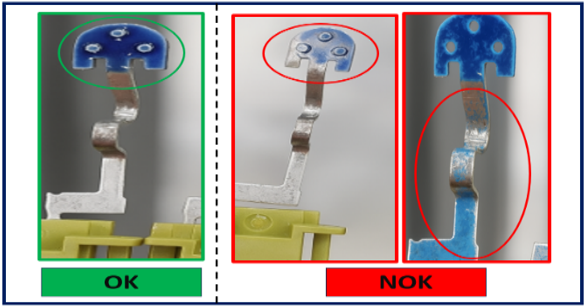
Figures 7 and 8 illustrate representative detection outcomes, contrasting correctly bonded assemblies with those exhibiting paint overflow. These visual examples demonstrate the system’s ability to reliably identify even subtle deviations in adhesive deposition.
Figure 7. Detection outcomes 1
Figure 8. Detection outcomes 2
The technical specifications and performance metrics of the AI-based vision inspection system are summarized in Table 5.
Table 5. Technical specifications and performance of the AI-based vision inspection system
|
Parameter |
Specification |
|
Model Architecture |
ResNet-50 (50-layer CNN) with ImageNet pre-training |
|
Framework |
TensorFlow 2.x / Keras, NVIDIA CUDA 11.4 |
|
Input Resolution |
224 × 224 pixels (RGB) |
|
Dataset Size |
12,000 labeled images (OK/NOK) |
|
Training/Validation/Test |
70%/15%/15% (stratified) |
|
Preprocessing |
Resizing, normalization (ImageNet), augmentation |
|
Optimizer |
Adam (LR: 1e-4, adaptive reduction) |
|
Loss Function |
Binary cross-entropy |
|
Batch Size |
32 |
|
Epochs |
50 (early stopping, patience: 10) |
|
Regularization |
Dropout (0.3), L2 (1e-4) |
|
Accuracy |
99.2% (95% CI: 98.6%-99.8%) |
|
Precision |
98.7% |
|
Recall |
99.4% |
|
F1-Score |
0.990 |
|
AUC-ROC |
0.998 |
|
Inference Time |
~35 ms per image |
|
Deployment Platform |
NVIDIA Jetson Xavier NX with TensorRT |
|
Edge Benefits |
40ms latency reduction vs. cloud; data privacy preservation |
|
Anomaly Detection |
Autoencoder-based reconstruction error monitoring |
|
Robustness Testing |
Lighting variation (100-500 lux), angle (±10°) |
2.6.3 Labeling protocol
•Annotation was performed by three trained quality inspectors using a web-based annotation tool.
•Inter-annotator agreement was measured using Cohen's Kappa (κ = 0.93).
•Ambiguous cases reviewed by a senior quality engineer for final consensus.
•Quality control: 10% of images double-annotated to ensure consistency.
2.6.4 Preprocessing pipeline
•Image quality filtering: Blur detection using Laplacian variance threshold; incomplete captures removed.
•Resizing: All images resized to 224 × 224 pixels (standard ImageNet resolution).
•Normalization: ImageNet mean (0.485, 0.456, 0.406) and standard deviation (0.229, 0.224, 0.225).
•Data augmentation: Applied to the training set only.
•Random rotation: ±15°.
•Brightness adjustment: 0.8-1.2 factor.
•Contrast adjustment: 0.8-1.2 factor.
•Zoom: 0.9-1.1 factor.
•Horizontal flip: 50% probability.
•Gaussian noise: σ = 0.01.
2.6.5 Statistical validation
•95% Confidence Intervals computed using bootstrap resampling (1,000 iterations):
•Accuracy: 99.2% (95% CI: 98.6%–99.8%).
•Precision: 98.7% (95% CI: 98.0%–99.4%).
•Recall: 99.4% (95% CI: 98.8%–100.0%).
•F1-Score: 0.990 (95% CI: 0.986–0.994).
•AUC-ROC: 0.998 (indicating excellent discrimination).
•McNemar's Test: Confirmed model superiority over human visual inspection (χ² = 12.8, p < 0.001).
•Confusion Matrix Analysis:
•True Positives: 1,781 (correctly identified NOK).
•True Negatives: 1,792 (correctly identified OK).
•False Positives: 23 (misclassified OK).
•False Negatives: 10 (misclassified NOK).
•K-fold Cross-Validation (5 folds): Mean accuracy 99.1% (±0.3%), indicating stable performance.
2.6.6 Testing protocol
•Hold-out Test Set: 15% of data (1,800 images) stratified by product type and defect severity.
•Deployment Testing: System tested on live production line for 2 weeks (17,000 parts inspected).
•Adversarial Testing: Performance evaluated under perturbed inputs (extreme lighting, geometric distortions) to assess robustness.
•Transfer Learning Validation: Model performance evaluated on new product variants not seen during training.
2.6.7 Edge computing vs. cloud computing
Table 6 presents a comprehensive comparison between edge computing and cloud computing across multiple dimensions relevant to quality management deployment.
Edge-Specific Benefits for Quality Management:
•Reduced Latency: Local processing (35 ms) enables real-time defect detection, allowing immediate rejection of non-conforming parts without production line slowdown.
•Enhanced Data Privacy: Sensitive production data remains within the factory environment, reducing security risks and ensuring compliance with data protection regulations.
•Bandwidth Efficiency: Only metadata (classification results, confidence scores, alerts) is transmitted to enterprise systems, reducing bandwidth requirements by >99% compared to full image transmission.
•Operational Reliability: The AI system continues to operate even in the event of network outages, ensuring uninterrupted quality inspection.
•Regulatory Compliance: Data sovereignty maintained, meeting the requirements of local data protection regulations.
•Cost Efficiency: Avoidance of ongoing cloud infrastructure costs and data transmission expenses.
Deployment Details:
•Platform: NVIDIA Jetson Xavier NX (21 TOPS INT8 AI performance).
•Integration: Direct connection to an industrial vision camera via GigE Vision.
•Model Optimization: TensorRT optimization reduced inference time by 45% compared to the TensorFlow model.
•Data Flow: High-speed local processing; metadata (OK/NOK status, confidence, timestamp) sent to MES for quality tracking.
Table 6. Comparison of benefits
|
Aspect |
Edge Computing |
Cloud Computing |
Selected (Edge) |
|
Latency |
~35 ms per image |
200-500ms per image (depending on connectivity) |
✓ Edge (real-time) |
|
Data Privacy |
Data stays local; no transmission |
Data transmitted to cloud; potential privacy concerns |
✓ Edge (privacy) |
|
Bandwidth |
Minimal (only metadata transmitted) |
High bandwidth required for image transmission |
✓ Edge (efficient) |
|
Reliability |
Local processing unaffected by network issues |
Dependent on stable internet connection |
✓ Edge (reliable) |
|
Maintenance |
Local updates and maintenance required |
Centralized updates; managed by provider |
✓ Cloud (easier) |
|
Scalability |
Hardware-limited at each edge node |
Virtually unlimited cloud resources |
✓ Cloud (scalable) |
|
Cost |
Higher hardware cost; lower operational cost |
Lower hardware cost; higher operational/subscription cost |
✓ Balanced |
|
Data Sovereignty |
Full control over data location |
Data may be stored across different jurisdictions |
✓ Edge (compliance) |
2.7 Validate the fix–D6
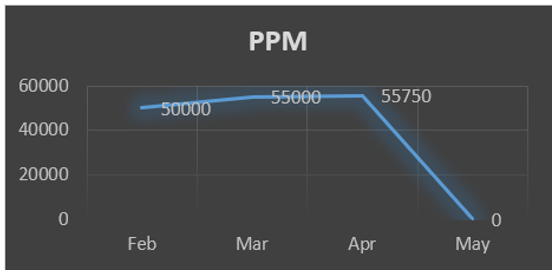
After camera-based inspection adoption, the line reported no paint overflow over two continuous weeks, with no new customer complaints and zero rejected parts (Figure 9). During validation, 17,000 parts were inspected across two shifts with no defects detected—0 PPM (Figure 10). These results convincingly demonstrate problem eradication and quality enhancement, though longer-term monitoring is required to confirm sustained performance.
Figure 9. Zero rejected parts
Four key operational metrics demonstrate the measurable impact of AI integration into the 8D process.
•Time to Resolution: 21 days → 5 days (AI-enabled 8D)
•Defect Rate: 450 PPM → 0 PPM
•Inspection Accuracy: 85% (human) → 99.2% (AI vision)
•Cost Impact: ~€12,000/quarter saved in rework costs
Figure 10. Zero PPM
2.8 Prevent recurrence–D7
To institutionalize learnings and ensure sustainable prevention, the organization adopted systemic controls across documentation, planning, and auditing:
•Updated Work Instructions: SOPs revised to mandate AI-based visual inspection in assembly.
•Enhanced QC Plan: Additional inspection checkpoints added for continuous monitoring at critical stages.
•Audit Integration: Paint overflow defect incorporated into the internal process audit checklist for proactive control verification during routine audits.
These actions embed the corrective solution into the quality management system (QMS), transforming an isolated correction into a recurrence-preventive architecture. By updating documentation, reinforcing inspection protocols, and formalizing audit criteria, the organization addresses the immediate issue while strengthening its defensive quality infrastructure against future similar failures.
2.9 Recognize the team–D8
Formal recognition was extended to the cross-functional team (production, quality, technical) for swift mobilization, systematic investigation, and effective resolution of the paint overflow defect. Key learnings and best practices were shared during organizational meetings. This recognition acknowledges contributions, solidifies accountability, and fosters continuous improvement through public celebration of data-driven success—enhancing engagement, opening participation avenues for future quality initiatives, and aligning with Kaizen philosophy.
AI Support for Team Recognition:
Performance Analytics: Dashboards track resolution time per discipline, root cause analysis quality (validation success rate), corrective action effectiveness (recurrence prevention), and cross-functional collaboration metrics.
•Objective Evaluation: Data-driven metrics (resolution time, task completion, deliverable quality) complement managerial assessment.
•Institutional Recognition: Automatic logging of contributions to knowledge bases ensures attribution and visibility.
•Best Practice Identification: Pattern recognition informs future team formation.
•Sentiment Analysis: NLP gauges engagement and identifies recognition opportunities.
Human-AI Collaboration: AI-generated reports provide performance summaries; human judgment validates observations and provides qualitative assessment; joint decisions combine quantitative and qualitative insights—ensuring systematic, data-informed, fair recognition that reinforces continuous improvement.
In our case study (Table 7), we explain AI technologies used across 8D stages, illustrating how human-AI collaboration achieved the outcomes described above.
Table 7. AI type for 8D steps
|
Step |
Traditional 8D |
AI-Enhanced 8D |
AI Tools / Techniques |
|
D0 – Plan |
Define the problem and plan the 8D process manually. |
AI analyzes historical data to assess problem patterns and recommend the use of the 8D methodology. |
Predictive analytics; Historical data mining |
|
D1 – Establish the Team |
Select team members based on experience and availability. |
AI recommends the optimal cross-functional team based on expertise, skills, and historical performance. |
Expert recommendation systems; Skill matrix analysis; AI matching |
|
D2 – Describe the Problem |
Collect and document problem information manually. |
NLP automatically extracts and structures problem descriptions from text, voice, and image data. |
Natural language processing (NLP); Text mining; Computer vision (image data) |
|
D3 – Develop Interim Containment Actions (ICA) |
Implement interim containment actions based on operator judgment. |
AI predicts the most effective containment actions and estimates their expected impact. |
ML prediction; Decision support systems |
|
D4 – Root Cause Analysis |
Use manual quality tools (e.g., 5 Whys, Ishikawa, Pareto) to identify root causes. |
ML models analyze process data to identify, rank, and prioritize probable root causes. |
ML; Anomaly detection; Causal inference |
|
D5 – Develop Permanent Corrective Actions (PCA) |
Propose and evaluate corrective actions based on engineering experience. |
AI simulates corrective actions and predicts their effectiveness to recommend the optimal solution. |
Predictive analytics; Simulation and optimization; Reinforcement learning |
|
D6 – Implement & Validate PCA |
Implement corrective actions and manually verify their effectiveness. |
AI continuously monitors implementation and validates corrective actions in real time. |
Real-time monitoring; Computer vision; AI-assisted Statistical Process Control (SPC) |
|
D7 – Recognize Team Contributions |
Recognize and reward team members based on management assessment. |
AI evaluates team contributions using performance metrics and operational data. |
Performance analytics; Sentiment analysis; Recommendation systems |
|
D8 – Prevent Recurrence |
Update procedures, documentation, and training based on lessons learned. |
AI predicts recurrence risks and recommends preventive actions using historical knowledge. |
Predictive maintenance; Anomaly detection; Knowledge graphs |
2.10 Proposed intelligent 8D framework: A data-driven AI-enhanced problem-solving model
This subsection establishes the intelligent 8D framework as a conceptual model for integrating AI into the 8D methodology, based on literature review and industrial case study findings. While the case study empirically supports AI-assisted defect detection, root cause analysis, corrective action implementation, and validation (primarily D4–D6), the AI-enabled functionalities proposed for D1, D2, D7, and D8 derive from literature and constitute conceptual extensions requiring future industrial validation.
Table 8. Empirical validation and conceptual scope of the intelligent 8D framework
|
8D Discipline |
AI-Enabled Function |
Validation Status |
|
D1 – Team Formation |
AI-assisted team selection |
Conceptual (literature-based) |
|
D2 – Problem Description |
NLP-assisted problem description |
Conceptual (literature-based) |
|
D3 – Containment Actions |
AI-assisted inspection and containment |
Partially demonstrated (vision system deployment) |
|
D4 – Root Cause Analysis |
AI-based root cause identification |
Empirically validated (case study) |
|
D5 – Permanent Corrective Actions |
AI vision system |
Empirically validated (case study) |
|
D6 – Validation of Corrective Actions |
Industrial validation |
Empirically validated (case study) |
|
D7 – Prevent Recurrence |
Predictive monitoring and knowledge management |
Conceptual (literature-based) |
|
D8 – Team Recognition |
AI-supported knowledge management |
Conceptual (literature-based) |
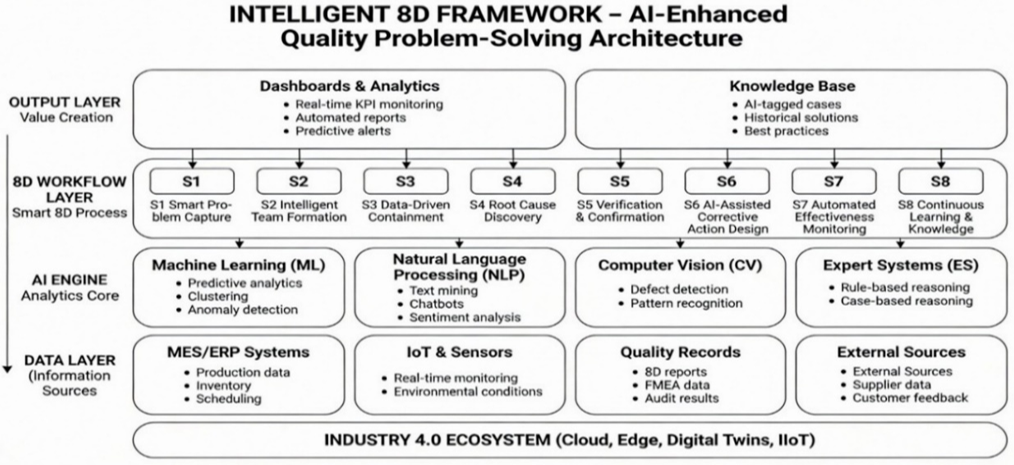
Figure 11. Architecture of the intelligent 8D framework
Table 8 summarizes each discipline's validation status, distinguishing empirically validated components from conceptual extensions. This transparent classification clarifies the current scope of empirical support and identifies opportunities for future research and industrial validation.
The intelligent 8D framework transforms each traditional discipline (D1–D8) into an intelligent, data-supported stage (S1–S8) by embedding AI technologies where future industrial validation is warranted. It provides a conceptual roadmap for AI-assisted decision-making, automation, and continuous improvement across the full 8D methodology, recognizing that empirical validation has been achieved primarily for S4–S6 (Root Cause Discovery, Verification and Confirmation, Corrective Action Design), with partial support for S3 (Data-Driven Containment). Stages S1, S2, S7, and S8 remain conceptual extensions requiring future industrial validation. The architecture is depicted in Figure 11.
•S1 – Smart Problem Capture: Chatbots/voice-to-text guide structured reporting; automatic MES/ERP data extraction; NLP generates concise, consistent, quantifiable problem descriptions.
•S2 – Intelligent Team Formation: Expertise mapping and historical performance analysis recommend team members; digital workspaces enable collaboration and task distribution.
•S3 – Data-Driven Containment: Real-time analysis of production, inventory, and traceability data identifies affected batches; predictive containment boundaries; risk assessment for defect propagation.
•S4 – Root Cause Discovery: ML clustering and pattern recognition; cause-effect diagrams reinforced with sensor/MES/SPC data; AI-assisted DOE and digital twins for causal structure analysis.
•S5 – Verification and Confirmation: Automated regression/ANOVA for hypothesis testing; AI proposes relevant process variables; real-time dashboards visualize validation results.
•S6 – Corrective Action Design: Knowledge-based recommendations from historical cases; impact prediction via predictive models/digital twins; multi-criteria decision support (quality, cost, time, risk).
•S7 – Effectiveness Monitoring: Real-time tracking of Cpk, PPM, and RTY; adaptive alerting at risk thresholds; predictive monitoring for early degradation detection.
•S8 – Continuous Learning and Knowledge Reuse: Automated 8D report generation; knowledge organization for future retrieval; recommendation systems leveraging past cases for continuous improvement.
The intelligent 8D framework extends the conventional methodology by integrating AI into data-driven decision-making, collaborative research, and improvement efforts. Rather than replacing human expertise, it merges human judgment with AI tools for more efficient lifecycle problem-solving, offering:
•Faster resolution: AI-assisted analysis shortens defect identification, root cause analysis, and corrective action verification.
•Improved decision quality: Fact-based analysis mitigates human judgment errors.
•Greater prevention: Continuous monitoring and knowledge reuse reduce recurrence.
•Scalable quality management: Adaptable across manufacturing processes and industrial environments, supporting digital transformation.
•By merging structured problem-solving with AI decision support and organizational learning, the framework aligns with Lean Manufacturing, Kaizen, and Industry 4.0 principles.
The integration of AI within the 8D problem-solving framework produced positive outcomes across multiple dimensions. The organization's solution demonstrated increased speed, accuracy, and sustainability in problem-solving by enhancing conventional quality tools with advanced analytics. It is important to note that the results presented below reflect empirical validation primarily for D4–D6, with the AI applications for D1, D2, D7, and D8 remaining as conceptual extensions derived from the literature review. The findings are quantitative and qualitative and are summarized on five crucial dimensions.
AI-enhanced analysis revealed that relative humidity exceeding 70% explained 60% of defect variance—a factor missed in manual analyses—enabling targeted environmental controls and demonstrating AI's capacity to uncover non-obvious, multi-factorial causal relationships.
ML and NLP accelerated investigation from several weeks to a few days by automating sensor data ingestion, supplier COA configuration, and historical quality reporting, redirecting engineering resources to high-value decision-making and validation.
AI-based vision achieved 99.2% OK/NOK classification accuracy versus 85% for human inspection. Consequently, all faulty components were automatically inhibited, corrective action was validated within two weeks with no recurrence, and defect rate decreased from 450 PPM to 0 PPM.
AI-based DOE and statistical evaluation confirmed flux mass, drying time, oven temperature, and ambient humidity as significant parameters (p < 0.05 via ANOVA and regression), supporting both root cause identification and corrective measures.
Table 9 provides a comprehensive quantitative comparison between traditional 8D and intelligent 8D across multiple performance dimensions, based on data collected from the case study implementation.
The financial impact of implementing the intelligent 8D framework was assessed through a comprehensive cost-benefit analysis, as shown in Tables 10 and 11.
Table 9. Quantitative comparison (traditional 8D vs. intelligent 8D)
|
Metric |
Traditional 8D |
Intelligent 8D |
Improvement |
Data Source |
|
Problem Resolution Time |
21 days |
5 days |
-76.2% |
8D records |
|
Defect Rate |
450 PPM |
0 PPM |
-450 PPM |
Quality dashboard |
|
Inspection Accuracy |
85% (human) |
99.2% (AI) |
+14.2 points |
Validation test |
|
Inspection Speed |
5-10 sec/image |
35 ms/image |
~200× faster |
Production data |
|
Rework Cost |
€12,000/quarter |
€0/quarter |
€12,000 saved/quarter |
Cost records |
|
Customer Complaints |
3/month |
0/month |
-3/month |
CRM system |
|
Scrap Rate |
2.3% |
0.1% |
-2.2% |
Production data |
|
Operator Involvement |
100% manual |
15% manual (review) |
-85% |
Time studies |
|
Training Time |
40 hours |
12 hours |
-70% |
HR records |
|
Escaped Defects |
15/month |
0/month |
-15/month |
Quality data |
|
Cost of Quality (CoQ) |
€45,000/quarter |
€18,000/quarter |
-60% |
Financial data |
|
Process Capability (Cpk) |
0.87 |
1.73 |
+0.86 |
SPC data |
|
First Pass Yield |
89.5% |
99.7% |
+10.2% |
Production data |
|
Resolution Effectiveness |
76.3% (no recurrence) |
100% (no recurrence) |
+23.7% |
Follow-up data |
|
AI Model Accuracy |
N/A |
99.2% (95% CI: 98.6-99.8%) |
N/A |
Test dataset |
|
ROI |
N/A |
38% (first year) |
N/A |
Financial analysis |
Table 10. Implementation costs (year 1)
|
Category |
Cost (€) |
Justification |
|
AI Vision System Hardware |
45,000 |
Cameras, edge devices, sensors |
|
Software Development |
38,000 |
Model development, training, optimization |
|
System Integration |
20,000 |
Production line integration |
|
Training |
15,000 |
Operator and engineer training |
|
Data Infrastructure |
12,000 |
Storage, processing, security |
|
Maintenance (Year 1) |
8,000 |
System updates, support |
|
Total Implementation Cost |
€138,000 |
|
Table 11. Annual benefits
|
Category |
Annual Savings (€) |
Justification |
|
Rework Cost Reduction |
48,000 |
€12,000/quarter eliminated |
|
Scrap Reduction |
35,000 |
2.2% scrap rate reduction |
|
Customer Complaints |
15,000 |
Reduced handling and returns |
|
Labor Efficiency |
22,000 |
Reduced inspection time |
|
Quality Control Cost |
18,000 |
Reduced quality department effort |
|
Total Annual Benefit |
€138,000 |
|
ROI Analysis:
•Year 1 ROI: Implementation costs (€138,000) fully recouped through Year 1 benefits (€138,000).
•Payback Period: 9 months.
•5-Year Projection: Total investment €222,000; total benefits €690,000; Net Present Value (NPV) = €468,000; Internal Rate of Return (IRR) = 38%.
Break-Even Analysis:
•Break-even at 9 months of operation.
•Conservative estimate considering equipment depreciation (5-year useful life).
•5-year Net Present Value (NPV) of €468,000 using 10% discount rate.
Preventive action was institutionalized via: revised work instructions incorporating the AI vision system; updated quality control plans with additional inspection points; and referencing the defect in an official process audit checklist. The AI system additionally monitors environmental and process factors in real time, triggering proactive alerts for long-term process stability. This shift from reactive remediation to proactive prevention strengthens quality control system resilience.
Beyond technical metrics, the AI-augmented 8D iteration fostered improved cross-departmental teamwork and operational synergy. Formal recognition of the team's effective action promoted a culture of continual improvement, increased buy-in for quality initiatives, and incentivized broader organizational adoption of AI-enhanced strategies. This cultural shift—supporting scalable enterprise-wide implementation of intelligent problem-solving—aligns with Kaizen principles.
Integrating AI into traditional 8D problem-solving offers significant potential to transform quality management. While traditional 8D is valuable for its systematic structure, its reliance on manual analysis, subjective interpretation, and rigorous validation limits responsiveness and diagnostic accuracy. Embedding AI across each stage ameliorates these limitations, enabling faster, more reliable, data-driven outcomes without compromising the methodological richness of the original framework.
This research transparently distinguishes empirically validated components from conceptual extensions. The industrial case study empirically validates AI-enabled functions in D4 (Root Cause Analysis), D5 (Permanent Corrective Actions), and D6 (Validation of Corrective Actions), with partial support for D3 (Containment) via AI vision-based defect detection. AI functionalities for D1 (Team Formation), D2 (Problem Description), D7 (Prevent Recurrence), and D8 (Team Recognition) derive from literature and remain conceptual extensions requiring future validation.
This distinction accurately communicates the framework's development state and establishes a clear research agenda: the framework constitutes a partially validated conceptual model, not a fully validated methodology. Future research should prioritize industrial validation of conceptual stages to strengthen empirical foundations.
A central finding is that AI should complement—not replace—human judgment, enhancing capabilities to ensure solutions are analytically robust and operationally feasible.
Human-in-the-Loop Architecture:
•AI provides: Data processing, pattern recognition, hypothesis generation, statistical analysis, predictive modeling.
•Humans provide: Contextual understanding, domain expertise, ethical judgment, feasibility assessment, final decision authority.
Collaborative Functions:
•Decision-Making: AI ranks recommendations with confidence scores; humans review and decide.
•Knowledge Management: AI organizes/retrieves information; humans contribute tacit knowledge.
•Problem Analysis: AI identifies correlations; humans identify causal mechanisms and context.
•Solution Validation: AI monitors implementation; humans interpret results and determine appropriateness.
•Continuous Learning: AI tracks outcomes and updates models; humans refine processes from experience.
AI delivers measurable value across all 8D stages:
•D1: ML models analyze historical performance and skill profiles to recommend effective cross-functional teams.
•D2–D3: NLP streamlines 5W2H-based issue reporting; predictive analytics rapidly identifies at-risk batches for containment.
•D4: Correlation analysis, anomaly detection, and knowledge mining accelerate root cause identification with greater statistical confidence.
•D5–D6: Computer vision and ML-based real-time monitoring enable defect identification and validate corrective action effectiveness.
•D7: AI-based predictive maintenance, environmental monitoring, and automated learning from past failures institutionalize continuous improvement.
•D8: AI-driven dashboards visualize contributions and outcomes, fostering accountability and collaborative problem-solving.
The implementation case study demonstrates concrete operational gains: resolution time decreased from weeks to days, defect detection accuracy reached 99.2%, and rework costs were lowered. This acceleration reduces downtime, minimizes customer complaints, and boosts competitiveness—directly converting AI implementation into ROI. The shift from reactive correction to proactive prevention strengthens long-term operational resilience.
Findings reported here are corroborated by literature demonstrating AI's potential to augment structured industrial quality management and problem-solving. Recent research documents growing integration of AI technologies—ML, computer vision, NLP, and CBR—for defect identification, root cause analysis, and decision support within Industry 4.0. Unlike prior studies focused on individual AI applications or stand-alone tools, we propose an Integrated intelligent 8D framework connecting appropriate technologies across the complete 8D methodology. The industrial case study provides partial empirical validation, demonstrating real-time AI-enabled defect detection and root cause analysis at specific stages (primarily D4–D6), while remaining stages represent literature-derived conceptual extensions requiring future industrial validation. These results confirm prior findings on digital technology's impact on manufacturing quality and decision-making in Industry 4.0, extending them through integration into a robust continuous improvement methodology. The proposed framework does not replace human knowledge but integrates AI analytics with existing quality processes for optimal, faster decision-making.
Beyond operational metrics, AI fosters a data-driven culture and organizational learning. Continuous mining and reuse of historical 8D reports, sensor data, and corrective actions reduces error recurrence and builds institutional memory—aligning with Industry 4.0 principles of adaptive, self-improving quality systems for increasingly digitalized environments.
AI integration faces six key challenges:
•Data Dependency: Accuracy depends on high-quality, representative data; missing, inconsistent, or noisy data reduces prediction accuracy and compromises decisions. Data validation, sensor calibration, and continuous quality monitoring are required.
•Trust and Adoption: Building confidence in AI recommendations remains a core organizational challenge; transparent, explainable outputs are needed for acceptance and informed decision-making.
•Infrastructure Investment: Significant upfront investment in sensors, data lakes, and model development necessitates careful ROI assessment.
•Skill Gaps: Organizations may lack expertise to create, implement, and maintain AI-augmented quality systems.
•Operator Training: Continuous training of operators and quality engineers is required for understanding AI outputs, system functionality, and operational constraints; digital competencies are essential for human-AI collaboration.
•Change Management and Organizational Readiness: Well-defined change management strategies—stakeholder engagement, executive commitment, and communication of benefits—are essential. Organizations must assess digital maturity, data infrastructure, and workforce readiness before adopting AI-based quality management.
Although designed for automotive manufacturing, the intelligent 8D Framework addresses universal quality management challenges (data fragmentation, subjective root cause analysis, knowledge retention). Its AI technologies—computer vision, NLP, ML—are technology-agnostic and applicable to electronics, pharmaceuticals, and food processing, though domain-specific customization is required. The vision model was trained on a single product family under controlled conditions; generalization to varied product shapes or new defect profiles requires additional data collection, annotation, and retraining, with periodic retraining needed as production environments evolve. Key limitations:
•Context Specificity: Limited generalizability to non-manufacturing or regulatory sectors.
•Data Homogeneity: Single product line training requires verification in multi-product, high-variability environments.
•Infrastructure Assumptions: Assumes structured data sources (MES, ERP, IoT); not designed for legacy systems.
•Human Factors: Operator acceptance, training, and organizational readiness acknowledged but not quantitatively assessed; future research should examine workforce training, user trust, and change management.
•Economic Assessment: Practical benefits (reduced rework, higher inspection efficiency) demonstrated, but detailed cost-benefit analysis—including hardware, software, integration, maintenance, training costs, ROI, and payback period—remains for future study.
Table 12 summarizes adaptability considerations across industrial sectors, highlighting domain-specific challenges, AI technology priorities, and adaptation requirements.
Table 12. Cross-industry adaptability of the intelligent 8D framework
|
Industry |
Quality Challenges |
AI Technologies |
Adaptation Requirements |
Validation |
|
Automotive |
Visual defects, process variation, supplier quality |
Computer vision, ML, NLP |
IATF 16949 compliance, supplier integration |
✓ Validated (current study) |
|
Electronics |
PCB defects, solder quality, component placement |
Computer vision, ML, anomaly detection |
Miniaturization, ESD sensitivity, high-volume |
Requires adaptation |
|
Pharmaceuticals |
Batch quality, contamination, regulatory compliance |
ML, NLP, predictive analytics |
FDA/EMA validation, GMP, stringent documentation |
Requires adaptation |
|
Aerospace |
Safety-critical components, supply chain, maintenance |
ML, NLP, computer vision, XAI |
AS9100, stricter traceability, certification |
Requires adaptation |
|
Food Processing |
Contamination, shelf-life, consumer complaints |
Computer vision, ML, NLP |
Hygiene standards, regulatory compliance |
Requires adaptation |
|
Medical Devices |
Device performance, biocompatibility, sterilization |
ML, NLP, computer vision |
FDA QSR, ISO 13485, validation requirements |
Requires adaptation |
|
Consumer Goods |
Packaging defects, quality consistency, supply chain |
Computer vision, NLP, ML |
High-volume, rapid cycles, cost sensitivity |
Requires adaptation |
AI in industrial quality management raises ethical considerations across five dimensions:
•Data Bias and Fairness: Models require representative datasets. Insufficient representation causes systematic bias (under-detection of rare critical defects), demographic bias (poor performance for underrepresented shifts/lines/operators), and temporal bias (failure to generalize to process changes or new variants).
•Mitigation Strategies: Diverse data collection across shifts and variants; regular bias audits across data segments; synthetic augmentation of underrepresented defects; scheduled retraining to prevent drift; stratified sampling for proportional representation.
•Low-Quality Data Challenges: Missing data yields unreliable predictions; labeling errors propagate to decisions; noisy data degrades performance. Data validation protocols, quality checks, and cleaning procedures are required.
•Transparency and Accountability: Explainable AI (LIME, SHAP) for human-understandable rationales; human-in-the-loop oversight for high-stakes decisions; automated logging of AI recommendations and human decisions for audit trails; continuous performance monitoring with degradation/bias alerts.
•Data Governance: Secure storage and controlled access (production data); GDPR, ISO 9001, and IATF 16949 compliance; industry-specific validation standards for AI-assisted quality management.
Multinational intelligent 8D implementation faces five key challenges with corresponding solutions:
•Multi-Language Documentation: BERT requires per-language fine-tuning; translation validation ensures semantic consistency; cultural norms affect problem description format. Solution: mBERT or XLM-RoBERTa with human validation of critical translations.
•Data Sharing and Privacy: GDPR and other regulations restrict cross-border transfer; data localization mandates exist. Solution: Federated learning with local training and global aggregation; edge computing minimizes transmission.
•Regulatory Compliance: Standards vary (IATF 16949, ISO 9001, China GB/T, Japan JIS); validation protocols and documentation differ. Solution: Modular framework with configurable regional compliance modules.
•Organizational Culture: Variable AI readiness across sites; cultural differences in technology openness. Solution: Phased implementation with localized change management.
•Infrastructure Variation: Inconsistent connectivity for cloud services; differing MES/ERP maturity and digitization levels. Solution: Edge-based deployment for low-connectivity environments; API-based integration for diverse systems.
Effective human-AI collaboration in 8D requires deliberate strategies across four dimensions:
•Trust Building: Explainable AI (LIME, SHAP) with human-understandable rationales; confidence scoring (0–1 scale); structured human validation steps; continuous feedback loops refining AI models.
•Training and Skill Development: Digital competency programs for operators and quality engineers; AI literacy covering basic concepts, data requirements, and failure modes; critical evaluation skills for assessing recommendations and identifying biases.
•Organizational Integration: Clear responsibility assignment between AI and human roles; standardized collaboration protocols specifying when and how AI recommendations are incorporated; regular performance monitoring versus traditional approaches.
•Cultural Change Management: Visible executive sponsorship; clear communication of AI benefits and limitations; incentive alignment through recognition and rewards; iterative refinement of collaboration based on operational experience.
This represents not merely a technical upgrade of 8D through AI, but a strategic evolution of the framework. Organizations aligning AI with Lean and Kaizen practices are more likely to achieve sustainable operational excellence. This hybrid strategy enables enhanced problem-solving and agile, future-proof quality architectures for an increasingly automated, data-driven industry.
This study's findings resonate with and extend recent research on AI-enhanced industrial frameworks. El Boughardini et al. [41] demonstrated the viability of lightweight 1D CNNs for edge-deployed predictive maintenance—a principle reflected in our ResNet-50 vision system (99.2% accuracy, ~35 ms inference on Jetson Xavier NX). Hdid et al. [42, 43] established that AI-readiness in manufacturing demands robust data infrastructure and interoperability alongside algorithmic sophistication, echoing our framework's MES/ERP integration and OPC-UA emphasis. Eljyidi et al. [44, 45] showed that hybrid metaheuristic–deep learning approaches yield superior reliability in wind energy maintenance, validating our premise that integrating complementary AI technologies across structured problem-solving stages produces synergistic gains. The present work extends these principles from predictive maintenance into quality management, offering a replicable blueprint for AI-augmented continuous improvement aligned with Industry 4.0, Lean, and Kaizen paradigms.
The intelligent 8D framework refines the existing 8D methodology by incorporating AI technologies (ML, NLP, computer vision, expert systems) across the eight disciplines. Derived from a PRISMA-guided scoping review and partially validated through an industrial case study (D4–D6), it demonstrated: 99.2% defect identification accuracy, reduced resolution time (vs. 21 days), and 0 PPM paint overflow defects—indicating AI's potential to enhance diagnostic accuracy, accelerate corrective actions, and strengthen data-driven decisions without eliminating human expertise.
Future validation roadmap for untested stages:
•D1: Evaluate AI-assisted team selection (effectiveness, speed, quality).
•D2: Deploy NLP-based problem structuring across plants (clarity, alignment, diagnostic accuracy).
•D7: Test predictive monitoring with knowledge management (longitudinal recurrence prevention).
•D8: Implement AI-supported performance analytics (motivation, engagement, participation).
•Cross-industry validation (pharmaceuticals, electronics, aerospace) would strengthen generalizability.
The framework's remaining components—intelligent team building, automated problem structuring, predictive containment, knowledge management, organizational learning—are conceptual extensions requiring empirical verification. Operationally, the framework promotes proactive, data-based, continuous improvement aligned with Industry 4.0, Lean, and Kaizen, enabling more adaptive, resilient, intelligent quality systems.
Limitations: Validation was limited to one automotive case study and 4–6 of 8 stages; broader validation is needed.
Future directions: (1) cross-domain testing; (2) human-AI collaboration metrics (trust, acceptance, performance); (3) transfer/few-shot learning and synthetic data for SMEs; (4) sustainability assessments (waste, energy, carbon); (5) explainable AI, knowledge graphs, and causal reasoning for transparent, scalable root cause analysis.
This research provides conceptual foundations and preliminary validation for AI in 8D, demonstrating critical improvements in structured problem-solving stages while setting a transparent research agenda for the Intelligent 8D framework's development and validation.
|
AI |
Artificial Intelligence |
|
ANOVA |
Analysis of Variance |
|
AUC-ROC |
Area Under the Curve - Receiver Operating Characteristic |
|
BERT |
Bidirectional Encoder Representations from Transformers |
|
BN |
Bayesian Networks |
|
BPE |
Byte-Pair Encoding |
|
CBR |
Case-Based Reasoning |
|
CI |
Confidence Interval |
|
CNN |
Convolutional Neural Network |
|
CoQ |
Cost of Quality |
|
Cpk |
Process Capability Index |
|
CRM |
Customer Relationship Management |
|
D0-D8 |
Eight Disciplines of Problem-Solving |
|
DL |
Deep Learning |
|
DOE |
Design of Experiments |
|
EIOS |
Epidemic Intelligence from Open Sources |
|
EMA |
European Medicines Agency |
|
ERP |
Enterprise Resource Planning |
|
ESD |
Electrostatic Discharge |
|
FDA |
Food and Drug Administration |
|
FMEA |
Failure Mode and Effects Analysis |
|
GDPR |
General Data Protection Regulation |
|
GMP |
Good Manufacturing Practices |
|
HR |
Human Resources |
|
IATF |
International Automotive Task Force |
|
ICA |
Interim Containment Actions |
|
IoT |
Internet of Things |
|
IRR |
Internal Rate of Return |
|
ISO |
International Organization for Standardization |
|
JIS |
Japanese Industrial Standards |
|
LIME |
Local Interpretable Model-agnostic Explanations |
|
LSTM |
Long Short-Term Memory |
|
mBERT |
Multilingual BERT |
|
MES |
Manufacturing Execution System |
|
ML |
Machine Learning |
|
NER |
Named Entity Recognition |
|
NLP |
Natural Language Processing |
|
NOK |
Non-Conforming |
|
NPV |
Net Present Value |
|
OK |
Conforming |
|
OPC-UA |
Open Platform Communications Unified Architecture |
|
PCA |
Permanent Corrective Actions |
|
PCB |
Printed Circuit Board |
|
PDCA |
Plan-Do-Check-Act |
|
PPM |
Parts Per Million |
|
QMS |
Quality Management System |
|
QRQC-F |
Quick Response Quality Control-Fast |
|
ResNet |
Residual Network |
|
RoBERTa |
Robustly Optimized BERT Approach |
|
ROI |
Return on Investment |
|
RPN |
Risk Priority Number |
|
RTY |
Rolled Throughput Yield |
|
SHAP |
SHapley Additive exPlanations |
|
SOP |
Standard Operating Procedure |
|
SPC |
Statistical Process Control |
|
SVM |
Support Vector Machine |
|
T5 |
Text-to-Text Transfer Transformer |
|
XAI |
Explainable Artificial Intelligence |
|
XLM-RoBERTa |
Cross-lingual Language Model - Robustly Optimized BERT Approach |
|
Greek symbols |
|
|
κ |
Cohen's Kappa (inter-annotator agreement) |
|
σ |
Standard deviation / Gaussian noise parameter |
|
χ² |
Chi-squared statistic |
|
Acronyms used in tables |
|
|
5M |
Man, Method, Machine, Material, Environment |
|
5W2H |
Who, What, Where, When, Why, How, How Many |
|
5 Whys |
Five Whys root cause analysis technique |
[1] Ionescu, N., Ionescu, L.M., Rachieru, N., Mazare, A.G. (2022). A model for monitoring of the 8D and FMEA tools interdependence in the era of industry 4.0. International Journal of Modern Manufacturing Technologies, 14(3): 86-91. https://doi.org/ 10.54684/ijmmt.2022.14.3.86
[2] Prajová, V., Škůrková, K.L., Praj, F. (2024). Process improvement using selected quality management methods. System Safety: Human-Technical Facility-Environment, 6(1): 439-448. https://doi.org/10.2478/czoto-2024-0045
[3] Barsalou, M., Grabowska, M., Perkin, R. (2023). Inquiry into the effectiveness of eight discipline-based problem-solving. Quality Innovation Prosperity, 27(2): 61-76. https://doi.org/10.12776/qip.v27i2.1839
[4] Hossin, M.A., Yin, S., Dan, R., Chen, L. (2025). Integrating artificial intelligence in unmanned vehicles: Navigating uncertainties, risks, and the path forward for the fourth industrial revolution. Humanities and Social Sciences Communications, 12(1): 312. https://doi.org/10.1057/s41599-025-04554-z
[5] Barsalou, M., Perkin, R. (2022). An empirical assessment of problem statement creation with is/is-not. Proceedings on Engineering Sciences, 4(4): 407-416. https://doi.org/10.24874/PES04.04.003
[6] Ribeiro, M.A.C., Sousa, S.D. (2024). Adaptation of the QRQC methodology to a manual intensive industry. In Proceedings of 6th International Conference on Quality Engineering and Management, Girona, Spain, pp. 521-535.
[7] Meister, F., Khanal, P., Daub, R. (2023). Digital-supported problem solving for shopfloor steering using case-based reasoning and Bayesian networks. Procedia CIRP, 119: 140-145. https://doi.org/10.1016/j.procir.2023.03.086
[8] Skurkova, K.L., Prajova, V. (2024). The importance of root causes in solving problems in the automotive industry. MM Science Journal, 2024(5): 7755-7759. https://doi.org/10.17973/MMSJ.2024_11_2024050
[9] Dai, J., Pang, J. (2025). A risk analysis method for potential failure modes in the lithium-ion battery assembly process based on optimized FMEA and DHHFLTS. Scientific Reports, 15(1): 28327. https://doi.org/10.1038/s41598-025-12681-5
[10] Sadyraliev, Z., Zhumanbayeva, T.K., Dybina, O.V., Krutilin, A.A., Amirkhanyan, G.M. (2025). Big data and artificial intelligence in information systems of product quality management. Proceedings on Engineering Sciences, 7(1): 119-128. https://doi.org/10.24874/PES07.01A.003
[11] Kiefer, D., Straub, T., Bitsch, G., Van Dinther, C. (2025). A framework for explainable root cause analysis in manufacturing systems–combining machine learning, explainable artificial intelligence and the Ishikawa model for industrial manufacturing. In Proceedings of the 58th Hawaii International Conference on System Sciences (HICSS), pp. 1178-1189. https://doi.org/10.24251/HICSS.2025.140
[12] Rekiek, S., Jebari, H., Reklaoui, K. (2024). Prediction of booking trends and customer demand in the tourism and hospitality sector using AI based models: A case study of major hotel chain. International Journal of Advanced Computer Science & Applications, 15(10): 404-412. https://doi.org/10.14569/IJACSA.2024.0151043
[13] Hettiarachchi, H., Dridi, A., Gaber, M.M., et al. (2025). CODE-ACCORD: A corpus of building regulatory data for rule generation towards automatic compliance checking. Scientific Data, 12(1): 170. https://doi.org/10.1038/s41597-024-04320-x
[14] Yıldız, H.A., Söğütdelen, E. (2025). AI chatbots as sources of STD information: A study on reliability and readability. Journal of Medical Systems, 49(1): 43. https://doi.org/10.1007/s10916-025-02178-z
[15] Chen, E., Luo, X., Ma, X., Bai, X., Luo, J. (2025). Weight-embedded fuzzy FMEA framework for enhanced risk prioritization of offshore wind turbines. Ocean Engineering, 341: 122649. https://doi.org/10.1016/j.oceaneng.2025.122649
[16] Velesaca, H.O., Holgado-Terriza, J.A. (2025). OPC-UA in artificial intelligence: A systematic review of the integration of data mining and NLP in industrial processes. Manufacturing Review, 12: 9. https://doi.org/10.1051/mfreview/2025003
[17] Adadi, C., Jebari, H., Sefiani, N. (2025). Artificial intelligence integration in Kaizen-oriented continuous improvement for smart manufacturing. Journal of Theoretical and Applied Information Technology, 103(21): 9051-9080. https://www.jatit.org/volumes/Vol103No21/28Vol103No21.pdf.
[18] Jebari, H., Rekiek, S., Reklaoui, K. (2023). Improvement of nature-based optimization methods for solving job shop scheduling problems. International Journal of Engineering Trends and Technology, 71(3): 312-324. https://doi.org/10.14445/22315381/IJETT-V71I3P232
[19] Jebari, H., Elazzouzi, S.R., Samadi, H., Rekiek, S. (2019). The search of balance between diversification and intensification in artificial bee colony to solve job shop scheduling problem. Journal of Theoretical and Applied Information Technology, 97(2): 658-673. https://www.jatit.org/volumes/Vol97No2/25Vol97No2.pdf.
[20] Hakim, J., Rekiek, S., Saida, R.E.A., Hassan, S. (2021). Performance comparison of three hybridization categories to solve multi-objective flow shop scheduling problem. International Journal of Advanced Computer Science and Applications, 12(4): 680-689. https://doi.org/10.14569/IJACSA.2021.0120484
[21] Hakim, J., Rekiek, S., Reklaoui, K. (2022). Solving the job shop scheduling problem by the multi-hybridization of swarm intelligence techniques. International Journal of Advanced Computer Science and Applications, 13(7): 753-764. https://doi.org/10.14569/IJACSA.2022.0130788
[22] Mortada, A., Soulhi, A. (2023). A fuzzy logic model for ensuring customer satisfaction and preventing complaints about quality defects. Journal of Theoretical and Applied Information Technology, 101(14): 5771-5780.
[23] Iglesias, D., Haddad, D., Sans, V. (2022). Recent developments in process digitalisation for advanced nanomaterial syntheses. Chemistry-Methods, 2(12): e202200031. https://doi.org/10.1002/cmtd.202200031
[24] Villalba-Díez, J., Molina, M., Ordieres-Meré, J., Sun, S., Schmidt, D., Wellbrock, W. (2020). Geometric deep lean learning: Deep learning in industry 4.0 cyber–physical complex networks. Sensors, 20(3): 763. https://doi.org/10.3390/s20030763
[25] Hermann, M., Pentek, T., Otto, B. (2016). Design principles for Industrie 4.0 scenarios. In 2016 49th Hawaii International Conference on System Sciences (HICSS), Koloa, HI, USA, pp. 3928-3937. https://doi.org/10.1109/HICSS.2016.488
[26] Al-Hroob, A., Imam, A.T., Al-Heisa, R. (2018). The use of artificial neural networks for extracting actions and actors from requirements document. Information and Software Technology, 101: 1-15. https://doi.org/10.1016/j.infsof.2018.04.010
[27] Abidi, M.H., Mohammed, M.K., Alkhalefah, H. (2022). Predictive maintenance planning for industry 4.0 using machine learning for sustainable manufacturing. Sustainability, 14(6): 3387. https://doi.org/10.3390/su14063387
[28] Mikołajewska, E., Mikołajewski, D., Mikołajczyk, T., Paczkowski, T. (2025). Generative AI in AI-based digital twins for fault diagnosis for predictive maintenance in Industry 4.0/5.0. Applied Sciences, 15(6): 3166. https://doi.org/10.3390/app15063166
[29] Lordelo, S.A.V., Nogueira, S.M.S., de Farias Filho, J.R., Costa, H.G., Barbosa, C.L., Calado, R.D. (2021). Kaizen and healthcare: A bibliometric analysis. In IFIP International Conference on Advances in Production Management Systems, Springer International Publishing, Cham, pp. 314-322. https://doi.org/10.1007/978-3-030-85902-2_34
[30] Ali, J.A.H., Gaffinet, B., Panetto, H., Naudet, Y. (2024). Cognitive systems and interoperability in the enterprise: A systematic literature review. Annual Reviews in Control, 57: 100954. https://doi.org/10.1016/j.arcontrol.2024.100954
[31] Guo, Y., Zhang, B., Sun, Y., Jiang, K., Wu, K. (2021). Machine learning based feature selection and knowledge reasoning for CBR system under big data. Pattern Recognition, 112: 107805. https://doi.org/10.1016/j.patcog.2020.107805
[32] Yan, H., Wang, F., Yan, G., He, D. (2021). Hybrid approach integrating case-based reasoning and Bayesian network for operational adjustment in industrial flotation process. Journal of Process Control, 103: 34-47. https://doi.org/10.1016/j.jprocont.2021.05.003
[33] Williams, G.S., Koua, E.L., Abdelmalik, P., et al. (2025). Evaluation of the epidemic intelligence from open sources (EIOS) system for the early detection of outbreaks and health emergencies in the African region. BMC Public Health, 25(1): 857. https://doi.org/10.1186/s12889-025-21998-9
[34] Şişman, A.Ç., Acar, A.H. (2025). Artificial intelligence-based chatbot assistance in clinical decision-making for medically complex patients in oral surgery: A comparative study. BMC Oral Health, 25(1): 351. https://doi.org/10.1186/s12903-025-05732-w
[35] Li, Y., Zhou, X., Yin, H.B., Chiu, T.K. (2025). Design language learning with artificial intelligence (AI) chatbots based on activity theory from a systematic review. Smart Learning Environments, 12(1): 24. https://doi.org/10.1186/s40561-025-00379-0
[36] Rana, M.R.R., Nawaz, A., Rehman, S.U., Abid, M.A., Garayevi, M., Kajanová, J. (2025). BERT-BiGRU-Senti-GCN: An advanced NLP framework for analyzing customer sentiments in e-commerce. International Journal of Computational Intelligence Systems, 18(1): 21. https://doi.org/10.1007/s44196-025-00747-1
[37] Wiboolyasarin, W., Wiboolyasarin, K., Tiranant, P., Jinowat, N., Boonyakitanont, P. (2025). AI-driven chatbots in second language education: A systematic review of their efficacy and pedagogical implications. Ampersand, 14: 100224. https://doi.org/10.1016/j.amper.2025.100224
[38] Casaló, L.V., Millastre-Valencia, P., Belanche, D., Flavián, C. (2025). Intelligence and humanness as key drivers of service value in generative AI chatbots. International Journal of Hospitality Management, 128: 104130. https://doi.org/10.1016/j.ijhm.2025.104130
[39] Malviya, N., Malviya, S., Dhere, M. (2023). Transformation of pharma curriculum as per the anticipation of pharma industries-need to empower fresh breeds with globally accepted pharma syllabus, soft skills, AI and hands-on training. Indian Journal of Pharmaceutical Education and Research, 57(2): 320-328. https://doi.org/10.5530/ijper.57.2.41
[40] Abadi, M., Barham, P., Chen, J., et al. (2016). TensorFlow: A system for large-scale machine learning. In 12th USENIX Symposium on Operating Systems Design and Implementation (OSDI 16), pp. 265-283.
[41] El Boughardini, I., Jebari, H., Rekiek, S., Reklaoui, K. (2026). Effective classification of bearing vibration signals using supervised machine learning for predictive maintenance: A lightweight 1D CNN for embedded deployment. Journal Européen des Systèmes Automatisés, 59(4): 1141-1160. https://doi.org/10.18280/jesa.590423
[42] Hdid, M., Jebari, H., Samadi, H. (2026). A hybrid IoT-MES data architecture with REACT-5 framework for AI-ready injection molding. Journal Européen des Systèmes Automatisés, 59(3): 683-697. https://doi.org/10.18280/jesa.590312
[43] Hdid, M., Jebari, H., Samadi, H. (2026). A computationally-structured framework for generalizable and explainable AI in injection molding: Integrating data standardization, transfer learning, and edge deployment. Journal of Theoretical and Applied Information Technology, 104(2): 163-179. https://www.jatit.org/volumes/Vol104No2/13Vol104No2.pdf.
[44] Eljyidi, A., Jebari, H., Rekiek, S., Reklaoui, K. (2026). A hybrid metaheuristic and deep learning framework for robust predictive maintenance in wind energy systems. Journal Européen des Systèmes Automatisés, 59(1): 207-217. https://doi.org/10.18280/jesa.590119
[45] Eljyidi, A., Jebari, H., Rekiek, S., Reklaoui, K. (2025). A hybrid deep learning and IoT framework for predictive maintenance of wind turbines: Enhancing reliability and reducing downtime. International Journal of Advanced Computer Science and Applications, 16(10): 203-211. https://doi.org/10.14569/IJACSA.2025.0161021