Doan Thi Hong Hai | Nguyen Thi Tam Thanh | Nguyen Minh Phu*
© 2026 The authors. This article is published by IIETA and is licensed under the CC BY 4.0 license (http://creativecommons.org/licenses/by/4.0/).
OPEN ACCESS
Understanding the underlying heat and mass transfer mechanisms during multi-mode drying is critical for optimizing industrial fruit dehydration. However, existing numerical models often focus on single drying modes without providing a direct, comparative physics-based analysis across different heating configurations. This study develops a 2D transient mathematical model using explicit finite difference approximations to simulate coupled heat and mass transfer in pineapple slices under three distinct modes: Infrared (IR) at room temperature, Hot Air (HA) at 50 ℃, and Hybrid IR-HA drying. Experimental validations demonstrate high predictive accuracy with less than 2% discrepancy in total drying time. The model reveals that while IR radiation alone enhances moisture removal over hot air via direct surface energy absorption, the Hybrid IR-HA mode achieves a synergistic performance, reducing drying time by over 50% (to 3.95–4.12 hours). Physically, the model demonstrates that the hybrid energy input elevates the product’s steady-state temperature to ~65 ℃, significantly accelerating internal moisture migration by increasing effective mass diffusivity via the Arrhenius relationship. This work provides a clarified computational framework and physical insights into energy-transport interactions to guide the design of hybrid fruit dryers.
pineapple drying, infrared radiation, coupled heat and mass transfer, computational fluid dynamics, hybrid drying, finite difference method
Infrared (IR) drying is an advanced dehydration technology that utilizes electromagnetic radiation to transfer thermal energy directly to the surface of a product. Unlike traditional hot air (HA) drying, which relies on convective heat transfer from the surrounding air, IR radiation penetrates the material's surface, where it is absorbed and converted into heat. This mechanism provides a direct heat flux that accelerates the evaporation of moisture by enhancing internal diffusion. In industrial applications, the technology is often favored for its ability to reduce drying times and improve energy efficiency. The process is typically modeled by balancing the energy conducted into the material against the combined inputs of surface convection and IR radiation [1-3].
Pineapple (Ananas comosus L.) is a major tropical fruit that ranks third in global production and is widely valued for its high content of minerals, nutrients, fibers, and bioactive substances. In Hau Giang Province, Vietnam, pineapple cultivation covers an area of 2,000 hectares with a total production of 40,000 tons [4]. To extend the shelf life and add value to this highly produced fruit, drying technologies such as IR, HA, and hybrid methods are employed to remove moisture from fresh slices.
To establish a foundation for modeling fruit dehydration, numerous studies have investigated transport phenomena and drying kinetics across various materials and equipment configurations [5-15]. Onwude et al. [5] developed a 3D model for sweet potato slices to simulate coupled heat and mass transfer under combined IR and hot-air conditions, utilizing the Chilton-Colburn analogy for convective coefficients. Restrepo Román et al. [6] examined the influence of IR radiation on convective drying systems for kaolin clay, emphasizing the thermal advantages of radiative supplementation. Focusing on chamber design, Aktaş et al. [7] performed a computational fluid dynamics (CFD) simulation of an IR dryer for apricots with heat recovery to optimize internal airflow and thermal distribution. Specifically for pineapple geometry, Ponkham et al. [8] evaluated far-IR drying of ring-shaped slices, demonstrating the importance of accounting for material deformation. Further investigations [9-11] focused on fundamental moisture migration and kinetic behavior during convective and heat pump-assisted pineapple drying, establishing baselines for effective diffusivity and variable transport properties. Additionally, CFD-based investigations [12-15] have evaluated macro-scale system performance in solar and convective dryers, focusing on airflow patterns and thermal collection efficiency.
Although these studies have advanced the understanding of drying dynamics, existing research on pineapple drying remains largely divided between macro-scale CFD chamber optimizations [7, 12-15] and single-mode kinetic models [8-11]. Most available literature fails to provide a direct, physics-based comparative analysis of coupled heat and mass transfer across distinct heating configurations—namely IR, HA, and Hybrid modes—within the same computational framework. Consequently, the transient internal temperature elevation, effective diffusivity variations via the Arrhenius relation, and moisture migration interactions under combined radiative-convective heating remain insufficiently articulated for pineapple slices.
To address this gap, this study develops a two-dimensional (2D) transient mathematical model using an explicit finite difference scheme to simulate coupled heat and mass transfer in pineapple slices under IR, HA, and Hybrid IR-HA drying modes. By integrating experimental validation from a multi-mode setup, this work provides a clarified computational framework and physical insights into energy-transport interactions to guide the optimization of fruit dryers.
Figures 1 and 2 define the physical and mathematical basis for the drying simulation. Figure 1 displays a fresh pineapple slice, which serves as the physical specimen for both the numerical and experimental portions of the study. Figure 2 provides the corresponding computational domain, representing the pineapple slice as a cylindrical geometry within a cylindrical coordinate system. In this domain, $\delta / 2$ represents the half-thickness of the slice along the z-axis, while $\phi / 2$ denotes the radius along the r-axis, establishing the spatial boundaries used to solve the coupled heat and mass transfer equations.

Figure 1. Fresh pineapple slice for drying in numerical and experimental works of this study

Figure 2. Computational domain
In the IR drying process, thermal energy is supplied to the pineapple slice via simultaneous surface convection and IR radiation. Given the product's opacity, these heat transfer mechanisms act primarily on the surface. The material is modeled as a homogeneous medium with constant thermophysical properties. Concurrently, moisture migrates from the internal core to the surface through molecular diffusion, where it is subsequently evaporated into the surrounding environment. Based on these phenomena, the coupled heat and mass transfer governing equations for this investigation are formulated as Eqs. (1) and (2).
Heat transfer equation
$\frac{1}{\alpha} \frac{\partial T}{\partial t}=\frac{\partial^2 T}{\partial r^2}+\frac{1}{r} \frac{\partial T}{\partial r}+\frac{\partial^2 T}{\partial z^2}$ (1)
where, T is temperature, a is thermal diffusivity, and t is time.
Mass transfer equation
$\frac{1}{D} \frac{\partial M}{\partial t}=\frac{\partial^2 M}{\partial r^2}+\frac{1}{r} \frac{\partial M}{\partial r}+\frac{\partial^2 M}{\partial z^2}$ (2)
where, M is moisture content (dry basis – db), and D is effective mass diffusivity.
To formulate a tractable coupled heat and mass transfer model, several standard engineering simplifications are adopted. The pineapple slice is assumed to be isotropic and homogeneous, with constant thermophysical properties ($k, ~\alpha, ~\rho$). These assumptions are reasonable and widely accepted for thin agricultural slices subjected to moderate drying temperatures (below 65 ℃), where global transport dynamics are governed primarily by bulk surface evaporation and internal moisture diffusion rather than local structural variations.
Nevertheless, these simplifications introduce potential physical limitations. In reality, pineapple tissue exhibits cellular heterogeneity, and moisture loss during drying induces volumetric shrinkage as well as localized changes in thermal conductivity and porosity. Neglecting structural deformation and property variation may lead to minor local inaccuracies, particularly near the outer boundaries where moisture gradients are steepest. Nonetheless, as confirmed by our experimental validation, these assumptions provide a computationally efficient framework that accurately predicts average drying kinetics and overall thermal behavior within an acceptable engineering error margin.
The effective mass diffusivity can be estimated by Arrhenius equation as [10]:
$D=1.823 \times 10^4 \exp \left(-\frac{9050.5}{T+275.15}\right)$ (3)
The boundary conditions for the coupled heat and mass transfer are defined as follows. At the axes of symmetry, there is no gradient for temperature or moisture, meaning no heat or mass flux crosses these lines (Eqs. (4) and (5)) [13].
At r = 0:
$\frac{\partial M}{\partial r}=\frac{\partial T}{\partial r}=0$ (4)
At z = $\delta / 2$:
$\frac{\partial M}{\partial z}=\frac{\partial T}{\partial z}=0$ (5)
At r = $\phi / 2$, the thermal energy entering the surface through convection and IR radiation is balanced by the energy conducted into the material (Eq. (6)). The moisture reaching the surface via internal diffusion is equal to the amount of water vapor removed by the surrounding air through convective mass transfer (Eq. (7)) [16, 17].
$-k \frac{\partial T}{\partial r}=h_t\left(T_d-T\right)+q_{I R}$ (6)
where, $k$ is the thermal conductivity of the material, $h_t$ is the heat transfer coefficient, $q_{I R}$ is the IR radiation absorbed by the pineapple slice surface, and $T_d$ is the drying air temperature. The effective absorbed heat flux $q_{I R}$ is challenging to determine purely theoretically due to radiative view factors, wall reflections, and radiation losses to the surroundings. To calibrate this parameter, an initial theoretical maximum value was estimated by dividing the total lamp capacity by the total surface area of the loaded pineapple slices. Because a portion of this energy is dissipated to the chamber walls and internal components, this initial estimate represents an upper theoretical limit. Starting from this value, $q_{I R}$ was systematically reduced in the numerical model using a trialand-error procedure until the simulated drying time matched the experimental results. Through this iterative process, an effective absorbed heat flux was identified for the present experimental setup.
$-D \frac{\partial M}{\partial r}=h_m\left(M-M_e\right)$ (7)
where, hm is the mass transfer coefficient, and Me is the equilibrium moisture content.
Similarly, At z = 0:
$-k \frac{\partial T}{\partial z}=h_t\left(T_d-T\right)+q_{I R}$ (8)
$-D \frac{\partial M}{\partial z}=h_m\left(M-M_e\right)$ (9)
The governing equations and boundary conditions are solved using an explicit finite difference method. The study utilizes a central difference approach and a forward difference approach to approximate spatial derivatives and unsteady terms, respectively [18, 19].
$\frac{1}{\alpha} \frac{T_{i, j}^{n+1}-T_{i, j}^n}{\Delta t}=\frac{T_{i+1, j}^n-2 T_{i, j}^n+T_{i-1, j}^n}{\Delta r^2}+\frac{1}{i \Delta r} \frac{T_{i+1, j}^n-T_{i-1, j}^n}{2 \Delta r}+\frac{T_{i, j+1}^n-2 T_{i, j}^n+T_{i, j-1}^n}{\Delta z^2}$ (10)
$\frac{1}{D} \frac{M_{i, j}^{n+1}-M_{i, j}^n}{\Delta t}=\frac{M_{i+1, j}^n-2 M_{i, j}^n+M_{i-1, j}^n}{\Delta r^2}+\frac{1}{i \Delta r} \frac{M_{i+1, j}^n-M_{i-1, j}^n}{2 \Delta r}+\frac{M_{i, j+1}^n-2 M_{i, j}^n+M_{i, j-1}^n}{\Delta z^2}$ (11)
where, n is the time level, i is the index in the radial direction, and j is the index in the axial direction.
The thermophysical and transport properties of the pineapple samples used in the numerical simulations are summarized in Table 1. The convective mass transfer coefficient is determined through the Chilton-Colburn analogy of the heat transfer coefficient, relating the transport phenomena at the product surface. The IR heat flux $\left(q_{I R}\right)$ absorbed by the pineapple surface is empirically determined based on the experimental data obtained from the drying tests in Section 3. The time step ($\Delta \mathrm{t}$) and spatial steps ($\Delta \mathrm{z}, \Delta \mathrm{r}$) listed in Table 1 were carefully selected to ensure the stability of the explicit finite difference method and to achieve grid independence for the numerical solution. The computational program described in the study was developed and implemented using the MATLAB environment.
Table 1. Input parameters
|
Parameter |
Value |
Reference |
|
Pineapple slice thickness $\delta$, m |
0.01 |
Current study |
|
Pineapple slice diameter $\phi$, m |
0.08 |
Current study |
|
Heat transfer coefficient ht, W/m2 K |
14.51 |
[20] |
|
Air drying temperature Td, ℃ |
50 |
Current study |
|
Equilibrium moisture content Me, kg/kg (db) |
0.1255 |
Current study |
|
Initial moisture content M0, kg/kg (db) |
12.15 |
Current study |
|
Initial temperature T0, ℃ |
24 |
Current study |
|
Pineapple conductivity k, W/m K |
0.549 |
[21] |
|
Thermal diffusivity of pineapple $\alpha$, m2/s |
1.7 × 10⁻⁷ |
[12, 22] |
|
Mass transfer coefficient hm, m/s |
8.844 × 10⁻⁷ |
[5] |
|
Infrared radiation absorbed by pineapple slice surface $q_{I R}$, W/m2 |
228.6 |
Current study |
|
Time step $\Delta \mathrm{t}$, s |
0.1 |
Current study |
|
Axial space step $\Delta \mathrm{z}$, m |
2 × 10⁻⁴ |
Current study |
|
Radial space step $\Delta \mathrm{r}$, m |
8 × 10⁻⁴ |
Current study |
|
Final desired moisture content, kg/kg (db) |
0.22 |
Current study |
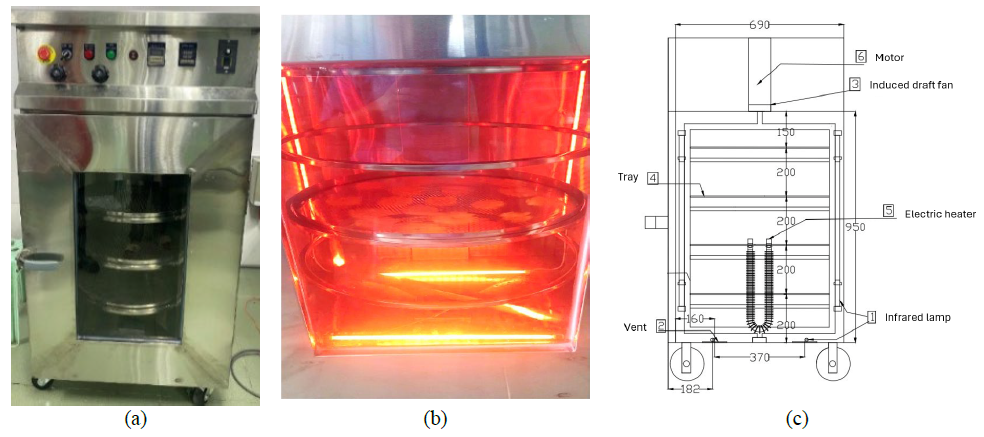
For the pineapple drying process, the raw material consists of pineapple slices (Queen group) with an initial moisture content of 12.15 kg water/kg dry matter and a diameter of 8 cm, as shown in Figure 1. The moisture content of the pineapple samples is precisely measured using a DAB 100-3 moisture analyzer. Each slice is prepared with a thickness of 1 cm, and the total capacity for each drying batch is 6 kg. To accommodate this capacity, the system features a drying chamber measuring 690 × 690 × 1050 mm, which houses four circular trays, each with a diameter of 0.57 m. The drying operation is conducted at a fixed air temperature by adjusting the electric heater and an airflow velocity of 2 m/s by a fan, as shown in Figure 3. The selection of these specific operating conditions is grounded in tropical fruit processing engineering standards. For hot-air drying, an air temperature of 50 ℃ was selected as it represents a standard commercial trade-off for heat-sensitive fruits like pineapple. Drying at temperatures above 60–65 ℃ frequently triggers quality degradation, such as loss of heat-labile vitamins (e.g., ascorbic acid), enzymatic browning, and sugar caramelization, whereas temperatures below 45 ℃ unacceptably prolong the process. For the pure IR mode, operating at ambient air temperature (36 ℃) allows the study to isolate the sole impact of radiative heat flux on transport phenomena without preheated convective assistance.
Figure 3. (a) Exterior of the infrared (IR) dryer, (b) the dryer under operation, (c) schematic and dimensions (in mm) of the dryer
Finally, the hybrid mode combines preheated air (50 ℃) with direct IR radiation to evaluate the synergistic potential for industrial applications seeking reduced processing times and higher throughput. The machine is equipped with six 350 W infrared lamps and two 300 W U-shaped resistors, delivering a total heating capacity of 2700 W. The drying system is designed for high flexibility, offering three distinct operational modes to optimize the dehydration process:
•IR Drying Mode: In this configuration, the heating resistors are deactivated while the IR lamps are switched on, utilizing radiative heat transfer to remove moisture.
•HA Drying Mode: The IR lamps are turned off, and only the heating resistors are energized to generate a convective HA stream for drying the product.
•Hybrid IR-Convective Drying Mode: Both the IR lamps and the heating resistors operate simultaneously, providing a synergistic effect that combines radiation and convection to enhance drying efficiency and reduce overall processing time.
To evaluate repeatability and ensure data reliability, all drying tests under each of the three operating modes (IR, HA, and Hybrid IR-convective) were performed in triplicate under identical conditions. Moisture loss was monitored continuously during each run, and the experimental data points, including the validation drying times reported in Table 2, represent the arithmetic mean values of the three runs. The maximum relative standard deviation across runs was found to be less than ±3.5%, demonstrating high experimental repeatability and confirming that the observed kinetic trends provide a reliable foundation for numerical validation.
Table 2. Comparison of drying time between modeling and experiment to obtain final desired moisture content
|
Drying type |
Modeling |
Experiment |
|
Infrared |
8.13 h |
8.26 h |
|
Hot air |
8.37 h |
8.43 h |
|
Infrared + hot air |
3.95 h |
4.12 h |
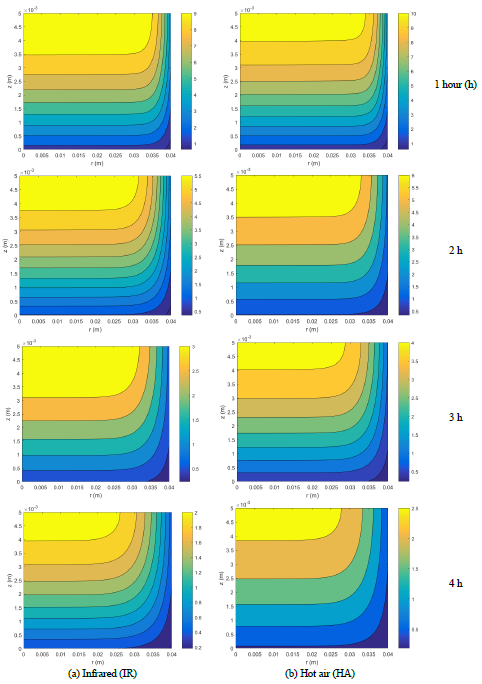
Figure 4 presents the numerical simulation results for the moisture distribution within the pineapple slice under two different drying conditions. Specifically, Figure 4(a) illustrates the drying process using only IR radiation, where the ambient air temperature (Td) is maintained at room temperature (36 ℃). In contrast, Figure 4(b) shows the results for HA drying alone, using a resistance heater to maintain Td at 50 ℃ with no IR heat flux applied (qIR = 0). The figure illustrates the spatial distribution of moisture within the pineapple slice over a 4-hour period for both IR and HA drying modes. The contour plots show that moisture content decreases more rapidly at the surface and corners of the slice, where the material is in direct contact with the drying medium. The moisture gradients are steeper in the IR mode compared to HA drying, as evidenced by the tighter contour lines near the boundaries. This distribution lies in the internal molecular diffusion process, where moisture migrates from the high-concentration core toward the surface to replace the water evaporated by convective mass transfer and radiative heat.
Figure 4. Comparison of moisture distribution of IR and HA drying with time
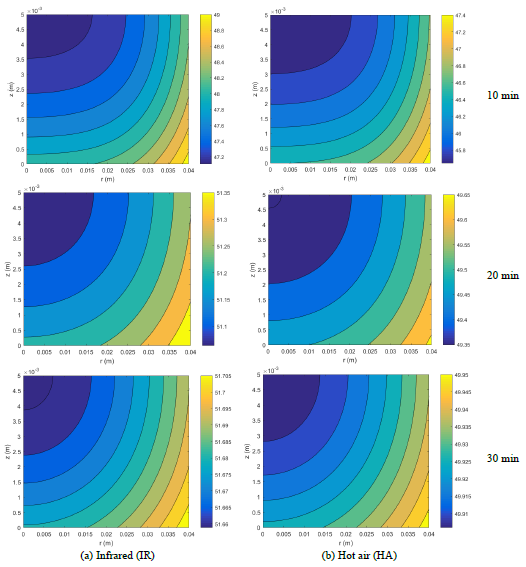
Figure 5 displays the temperature profiles across the computational domain during the first 30 minutes of drying. The surface temperatures rise rapidly while the core temperature lags, illustrating the conduction of heat from the exterior to the interior. The IR drying mode achieves higher surface temperatures (51.7 ℃) more quickly than the HA mode (49.9 ℃), even though both utilize an air temperature of 50 ℃. The IR radiation provides a direct heat flux that is absorbed at the surface, accelerating the heating process beyond what convection alone can achieve. Figure 6 provides a quantitative comparison of the drying kinetics for the three operational modes over time. All curves follow a typical falling-rate drying period, where the drying rate slows as the material becomes drier. The combination of radiation and convection enhances moisture removal efficiency and significantly reduces overall processing time. In addition, despite the IR-only mode operating at a lower ambient temperature (room temperature, 36 ℃) compared to the 50 ℃ used in the HA mode, the moisture content in the IR process decreases at a faster rate. This is evident in the steeper gradient of the IR curve relative to the HA curve throughout the drying period.
Figure 5. Comparison of temperature distribution of IR and HA drying with time

Figure 6. Average simulated moisture content profile of pineapple drying
Figure 7 tracks the average product temperature throughout the drying process. The hybrid (IR+HA) mode reaches a steady-state temperature of approximately 65 ℃, which is significantly higher than the IR-only (»52 ℃) or HA-only (»50 ℃) modes. The temperature rises sharply in the initial stages before leveling off once a thermal equilibrium is reached between the energy supplied and the energy used for water evaporation. The physical meaning of the higher hybrid temperature is that the additional energy from the 2100 W IR lamps combined with the resistors drives the material to a higher energy state, which in turn increases the effective mass diffusivity (D) according to the Arrhenius equation.

Figure 7. Average simulated temperature profile of pineapple drying
To understand the distinct kinetics among the three drying modes, it is essential to analyze the underlying coupled heat and mass transfer interactions. In HA drying, thermal energy is transferred solely through surface convection from the heated air stream (Td = 50 ℃). Because heat conduction into the wet tissue is constrained by the thermal conductivity of the material (k = 0.549 W/m‧K), the internal product temperature rises slowly and stabilizes at approximately 50 ℃. Internal moisture migration relies purely on liquid diffusion toward the surface under concentration gradients. At this thermal level, the effective mass diffusivity (D) remains relatively low, causing the drying rate to be governed by slow internal diffusion. In IR drying, energy transfer does not rely on convective air heating. Instead, radiative heat flux (qIR) is directly absorbed by the surface layer of the opaque pineapple slice. This direct energy absorption creates an immediate thermal input at the surface, establishing a sharp surface-to-core thermal gradient. This rapid surface heating accelerates moisture vaporization at the boundary, which in turn enhances the internal moisture concentration gradient and drives faster outward capillary diffusion compared to convective drying, even under ambient air conditions (36 ℃). In Hybrid IR-Convective drying, a strong synergistic coupling between radiative and convective energy transport is established. Convective HA reduces thermal losses from the product surface to the surrounding air, while simultaneous IR radiation continuously deposits high energy flux onto the surface. This dual-energy input drives the average product temperature to a significantly higher steady state of ~65 ℃. Exponentially governed by the Arrhenius relationship (Eq. (3)), this elevated core-to-surface temperature field exponentially boosts the effective moisture diffusivity (D). Consequently, internal moisture diffusion is dramatically accelerated to continuously supply water to the surface, matching the high convective-radiative evaporation capacity and preventing localized surface hardening.
Table 2 validates the numerical model against experimental data across all three drying modes. The predicted drying times show excellent agreement with experimental results (<2% discrepancy), confirming that the explicit finite difference formulation accurately captures the coupled transport physics. Notably, single-mode IR drying achieves a slightly shorter drying time (8.13–8.26 h) than hot-air drying at 50 ℃ (8.37–8.43 h), as direct surface radiation eliminates convective thermal resistance. Most prominently, the hybrid IR-convective mode demonstrates the fastest kinetics (3.95–4.12 h), achieving over 50% time reduction. This performance stems from the synergistic energy input that elevates product temperature to ~65 ℃, thereby boosting effective mass diffusivity (D) via the Arrhenius relationship.
From an engineering and industrial processing perspective, the reduction in drying time achieved by the hybrid IR-convective mode carries significant practical implications. First, equipment throughput and operational capacity are substantially enhanced. Reducing the processing cycle from over 8.2 hours (for single-mode IR or HA) to approximately 4 hours allows commercial processing facilities to double their daily production capacity using the same dryer volume, thereby lowering capital expenditure per unit mass of dried fruit. Second, in terms of energy performance, although the hybrid mode engages both IR lamps and electrical heaters simultaneously, the drastic reduction in total processing duration reduces cumulative parasitic energy losses. Shortening the cycle by half minimizes continuous fan power consumption and thermal heat dissipation through the chamber walls over time, leading to overall lower specific energy consumption per kilogram of evaporated water. Third, regarding product quality, long exposure to elevated temperatures during extended single-mode drying typically leads to thermal degradation of heat-sensitive nutrients (e.g., Vitamin C and bromelain) and adverse color changes due to non-enzymatic browning. The rapid dehydration kinetics in hybrid drying shorten thermal exposure while preventing surface case hardening, yielding dried pineapple slices with superior nutritional and visual quality.
To provide a realistic picture of model applicability, its scope and limitations should be noted. The 2D finite-difference framework accurately captures transient internal transport and drying kinetics for thin cylindrical slices with high computational efficiency (<2% error). However, key simplifications (including constant thermophysical properties, neglected volumetric shrinkage, and an experimentally calibrated qIR) limit direct extension to complex 3D shapes, bulk bed drying, or industrial continuous systems without re-evaluating radiative view factors and property variations.
This study successfully developed and validated a numerical model based on the explicit finite difference method to simulate the coupled heat and mass transfer in IR-assisted pineapple drying. The following conclusions are drawn:
The numerical solution remained stable and achieved grid independence by utilizing carefully selected spatial and temporal steps. The model demonstrated high predictive accuracy, with a low discrepancy between simulated drying times and experimental data for all three drying configurations.
The results indicate that IR drying is significantly more efficient than conventional HA drying. Despite being conducted at room temperature, IR drying reached the target moisture content faster than HA drying conducted at a higher air temperature.
The hybrid IR-convective mode was found to be the most effective, reducing the total drying time to approximately 3.95–4.12 hours. This represents a reduction of over 50% in processing time compared to single-mode methods, confirming a powerful synergy that enhances moisture removal through simultaneous radiative and convective heat transfer.
The hybrid system maintained a steady-state product temperature of approximately 65 ℃, which is notably higher than the 50 ℃ achieved in HA drying. This higher thermal state significantly enhances the effective mass diffusivity according to the Arrhenius relationship, facilitating more rapid internal moisture migration from the core to the surface.
Overall, the findings of this research provide a valuable physics-based computational framework for understanding coupled heat and mass transfer in hybrid IR-convective fruit drying. However, it is important to emphasize that the model was developed and experimentally validated for a specific pineapple slice geometry (10 mm thickness, 80 mm diameter) and particular laboratory dryer operating conditions. The model assumes a 2D axisymmetric domain with constant thermophysical properties and a calibrated constant heat flux. Consequently, applying this framework to other agricultural products, complex non-cylindrical geometries, or larger industrial-scale drying equipment will require further adaptation. Future work should focus on incorporating variable material shrinkage, temperature-dependent properties, 3D CFD airflow modeling, and economic/energy consumption evaluations to facilitate scaling up to industrial processing lines.
This research is supported by Industrial University of Ho Chi Minh City (IUH) under grant number 25BNL02.
[1] Sakare, P., Prasad, N., Thombare, N., Singh, R., Sharma, S.C. (2020). Infrared drying of food materials: Recent advances. Food Engineering Reviews, 12(3): 381-398. https://doi.org/10.1007/s12393-020-09237-w
[2] Nguyen, M.H., Thanh, L.N. (2025). The drying kinetics of Arctium lappa roots in a combined infrared–vacuum dryer: An experiment. International Journal of Heat and Technology, 43(4): 1383-1388. https://doi.org/10.18280/ijht.430416
[3] Ha Nguyen, M., Luan Nguyen, T. (2023). The influence of drying mode on the drying time of anchovy fish in a hybrid infrared-convective dryer: Drying time correlation and Taguchi analysis. Applied Engineering Letters, 8(4): 167-174. https://doi.org/10.18485/aeletters.2023.8.4.4
[4] Anh, N.H.M., Hiep, P.C., Ngan, N.T., et al. (2025). Assessment of nutrition status of pineapple plants during ratoon season using diagnosis and recommendation integrated system. Open Agriculture, 10(1): 20250414. https://doi.org/10.1515/opag-2025-0414
[5] Onwude, D.I., Hashim, N., Abdan, K., Janius, R., Chen, G., Kumar, C. (2018). Modelling of coupled heat and mass transfer for combined infrared and hot-air drying of sweet potato. Journal of Food Engineering, 228: 12-24. https://doi.org/10.1016/j.jfoodeng.2018.02.006
[6] Restrepo Román, A., Bedoya, I.D., Amell, A.A. (2023). Comparative, numerical, and experimental study of the influence of infrared radiation on a radiative-convective drying system for kaolin clay. Case Studies in Thermal Engineering, 49: 103329. https://doi.org/10.1016/j.csite.2023.103329
[7] Aktaş, M., Sözen, A., Amini, A., Khanlari, A. (2017). Experimental analysis and CFD simulation of infrared apricot dryer with heat recovery. Drying Technology, 35(6): 766-783. https://doi.org/10.1080/07373937.2016.1212871
[8] Ponkham, K., Meeso, N., Soponronnarit, S., Siriamornpun, S. (2012). Modeling of combined far-infrared radiation and air drying of a ring shaped-pineapple with/without shrinkage. Food and Bioproducts Processing, 90(2): 155-164. https://doi.org/10.1016/j.fbp.2011.02.008
[9] Rani, P., Tripathy, P.P. (2020). Modelling of moisture migration during convective drying of pineapple slice considering non-isotropic shrinkage and variable transport properties. Journal of Food Science and Technology, 57(10): 3748-3761. https://doi.org/10.1007/s13197-020-04407-4
[10] Tunçkal, C., Coşkun, S., Doymaz, İ., Ergun, E. (2018). Determination of sliced pineapple drying characteristics in a closed loop heat pump assisted drying system. International Journal of Renewable Energy Development, 7(1): 35-41. https://doi.org/10.14710/ijred.7.1.35-41
[11] Malaikritsanachalee, P., Choosri, W., Choosri, T. (2018). Study on kinetics of flow characteristics in hot air drying of pineapple. Food Science and Biotechnology, 27(4): 1047-1055. https://doi.org/10.1007/s10068-018-0357-6
[12] Rani, P., Tripathy, P.P. (2023). CFD coupled heat and mass transfer simulation of pineapple drying process using mixed-mode solar dryers integrated with flat plate and finned collector. Renewable Energy, 217: 119210. https://doi.org/10.1016/j.renene.2023.119210
[13] Nguyen, T.T.D., Nguyen, V.T., Le, K.H. (2025). Effect of ultrasound on effective moisture diffusivity: An assessment by numerical method. Journal of Advanced Research in Numerical Heat Transfer, 39(1): 51-62. https://doi.org/10.37934/arnht.39.1.5162
[14] Thao, P.B., Truyen, D.C., Phu, N.M. (2025). Performance evaluation of green peas drying by using a solar air heater with baffles inserted on the back plate: A numerical and experimental approach. Journal of Thermal Analysis and Calorimetry, 150(12): 9327-9339. https://doi.org/10.1007/s10973-025-14206-8
[15] Thanh, L.N. (2024). The mass transfer coefficient of Pseudapocryptes elongatus fish dried in a hot air dryer. International Journal of Heat and Technology, 42(6): 2001-2007. https://doi.org/10.18280/ijht.420617
[16] Niamnuy, C., Devahastin, S., Soponronnarit, S., Vijaya Raghavan, G.S. (2008). Modeling coupled transport phenomena and mechanical deformation of shrimp during drying in a jet spouted bed dryer. Chemical Engineering Science, 63(22): 5503-5512. https://doi.org/10.1016/j.ces.2008.07.031
[17] Nguyen, M.P., Ngo, T.T., Le, T.D. (2019). Experimental and numerical investigation of transport phenomena and kinetics for convective shrimp drying. Case Studies in Thermal Engineering, 14: 100465. https://doi.org/10.1016/j.csite.2019.100465
[18] Phu, N.M., Nam, L.H., Son, N.L.H. (2023). Unsteady analysis of a solar air heater with sensible heat storage using 2D finite difference approximation. Journal of Mechanical Science and Technology, 37(11): 6019-6028. https://doi.org/10.1007/s12206-023-1038-9
[19] Thao, P.B., Truyen, D.C., Phu, N.M. (2024). A general mathematical model to determine temperature and moisture distributions in drying of spherical products: Case studies of green peas, barley, and cranberry. Science & Technology Development Journal – Engineering and Technology, 7(3): 2379-2384. https://doi.org/10.32508/stdjet.v7i4.1361
[20] Kumar, S., Mullick, S.C. (2010). Wind heat transfer coefficient in solar collectors in outdoor conditions. Solar Energy, 84(6): 956-963. https://doi.org/10.1016/j.solener.2010.03.003
[21] Mukama, M., Ambaw, A., Opara, U.L. (2020). Thermophysical properties of fruit—A review with reference to postharvest handling. Food Measure, 14(5): 2917-2937. https://doi.org/10.1007/s11694-020-00536-8
[22] Chokngamvong, S., Suvanjumrat, C. (2024). Development of conjugate heat- and moisture-transfer model for pineapple drying using OpenFOAM. Case Studies in Thermal Engineering, 60: 104770. https://doi.org/10.1016/j.csite.2024.104770