Tien Dat Huynh | Gia Han Ly | Trung Nhan Dao | Ngoc-Trung Nguyen | Ngoc-Hong Duong*
© 2026 The authors. This article is published by IIETA and is licensed under the CC BY 4.0 license (http://creativecommons.org/licenses/by/4.0/).
OPEN ACCESS
Food waste remains a major sustainability challenge, generating economic losses and environmental impacts. Although influencer sustainability messaging has become increasingly visible in digital campaigns, the psychological mechanisms through which such messages encourage food waste reduction remain insufficiently examined. Drawing on the Stimulus–Organism–Response (S-O-R) framework, this study investigates how expertise (EPT), trustworthiness (TWO), and influencer attractiveness (IAT) shape consumers’ perceived functional (FUN), economic (ECO), and emotional values (EMO), which subsequently influence food waste reduction intention (FWI) and food waste reduction behavior (FWB). Eco-guilt (EG) is further examined as a moderator in the value–intention (FUN, ECO, EMO → FWI) and FWI → FWB relationships. Data were collected from 456 consumers in Vietnam and analyzed using partial least squares structural equation modeling (PLS-SEM). The results show that influencer attributes significantly enhance specific perceived value dimensions, which in turn promote FWI and FWB. EG strengthens the relationship between FUN and FWI, as well as the relationship between FWI and FWB, whereas its moderating effects on ECO and EMO pathways are insignificant. The findings extend the S-O-R framework to digital sustainability communication and offer practical implications for designing influencer-based campaigns that support responsible food consumption and food waste reduction.
eco-guilt, food waste reduction, influencer sustainability messaging, perceived value, sustainable consumption
Whilst millions of people face food insecurity [1], the lack of green food consumption globally makes approximately one-third of food wasted annually, leading to an estimated economic loss of US$1 trillion [2]. Even worse, the problem triggers remarkable and multifaceted impacts across environmental, social, and economic fields [3, 4]. As a result, fostering green consumption to reduce food waste is integral in securing the future of the planet [5].
Whereas some retailers try to adjust the packaging, price formation and price discounts of sustainable food [6], others link these products to environmental messages [7] and transparent authenticity [8]. However, the general impact of these approaches is not remarkable [7]. As an innovative approach, Nekmahmud et al. [9] and Wu et al. [10] have highlighted the role of social influencers as endorsers in green content, particularly those who express profound environmental concerns and advocate for disciplined consumption, in influencing consumers’ intentions and behaviors to buy sustainable food, supported by the social-media environment [11, 12]. However, Kapoor et al. [13] have pinpointed that not many green messages from influencers materialize into fruitful results, as the qualifications and mechanisms regarding this process have not been comprehensively explored. Consequently, building on this literature, the present study examines the qualities of an impactful “green” influencer in sustainable promotion and the mechanism through which green messages from influencers translate into actual food waste reduction behaviors (FWB).
Furthermore, the effectiveness of the messages does not solely lie in the influencers themselves, but also in the inner state of the customers. One of the factors needing to be illuminated is eco-guilt (EG), which is closely associated with pro-environmental behaviors [14]. As highlighted by Shipley and van Riper [15], EG is a key factor stimulating and leveraging green intentions to actual green behaviors. As a result, this study will closely examine the impact of these two factors in green message conveying.
This study aims to investigate how influencers can strengthen and consolidate their green messages, effectively promoting sustainable food consumption intentions that eventually drive FWB. Based on the above objectives, the study aims to answer the following research questions:
RQ1: How do influencer endorsers’ content impact customers’ food waste reduction intentions (FWI) and FWB?
RQ2: Does EG amplify the impact of influencer endorsers’ content on customers’ FWI and FWB?
Addressing these questions would provide actionable insights for marketers and policymakers to promote sustainable food consumption and policy planning for urban sustainability, significantly contributing to SDG 12.
2.1 Influencer endorsers and consumers’ perception of food waste reduction
Influencers are individuals who leverage their social media presence to shape followers’ beliefs, attitudes, and behaviors [16], including sustainable consumption. This paper focuses on three popular determinants of their persuasive impact: trustworthiness (TWO), expertise (EPT), and influencer attractiveness (IAT) [17]. In the context of food waste, unreasonable food consumption is primarily attributed to consumers’ misconceptions about freshness and related risks of food [18]. Influencers who communicate credible, accurate, and emotionally resonant information can encourage or even reshape these perceptions [19].
While the role of influencers has been extensively studied in commercial contexts [20], their effectiveness in promoting sustainable behaviors, particularly food waste reduction, remains underexplored. Therefore, this study focuses on understanding how influencer endorsers’ content dimensions influence consumers’ perceived functional (FUN), economic (ECO), and emotional values (EMO), which subsequently shape their intention to reduce food waste.
2.2 Eco-guilt and its role in the context of food waste reduction
EG is a cognitive moral emotion that arises when individuals experience a disparity between their green values and their actual behavior [21, 22]. It is a negative emotion linked to individual guilt for harm brought to the environment and typically drives corrective action [23]. In the domain of sustainability, EG functions as a tool of control to close the intention-behavior gap and ensure that an individual’s actions match their beliefs [24].
In the context of food waste, EG arises when individuals feel uncomfortable after they have wasted food or realized they were among the contributing causes of decreasing resources [25]. These guilt states heighten moral sensitivity and provoke compensatory behavior, such as saving food items, frugal shopping, or sharing surplus food, to restore balance and achieve a good self-concept. Although EG has been examined as a driver of pro-environmental behavior in other domains [14, 15], its moderating role in the relationship between influencer-driven value perceptions and food waste reduction has received limited empirical attention. This study therefore incorporates EG as a moderator to clarify whether it amplifies these relationships in the context of food waste reduction.
2.3 Theoretical framework
To address our research questions, this study adopts the Stimulus–Organism–Response (S-O-R) model by Mehrabian and Russell [26], which explains how influencer endorsers (Stimuli) impact perceived FUN, EMO and ECO (Organism), resulting in specific intentions and behaviors (Response). Specifically, we focus on three influencers’ traits as stimuli: TWO, EPT and IAT. TWO of influencers, as Li et al. [27] suggested, impacts the reliability of the content conveyed, whereas EPT and IAT represent credibility [28]. Perceived values (FUN, ECO, and EMO) act as organisms, mediating the impacts of stimuli on intentions and behaviors. While FUN refers to customers’ perceptions of product usefulness [29], EMO and ECO refer to positive sentiments [30] and cost utility [31], respectively. As perceived values about sustainable food consumption increase, people are more likely to respond and take action. Lastly, responses refer to the willingness to act on the intentions and behaviors related to the reduction of food waste.
2.4 Hypotheses development
EPT is defined as the degree to which the influencer is viewed as having specific expertise, competence, and skills in a specific domain [32]. In the context of sustainable consumption, EPT is one of the sources of credibility because consumers tend to turn to individuals who are knowledgeable about specific issues to gain better insight into environmentally-related behaviors [33]. As indicated by empirical research, EPT is critical in enhancing the persuasiveness of influencers, thereby enhancing consumer engagement [34]. EPT could also influence consumers’ perceptions of the ECO of products [35, 36]. Therefore, influencers who provide clear knowledge and practical strategies can help consumers recognize both the functional effectiveness and the financial benefits of reducing food waste.
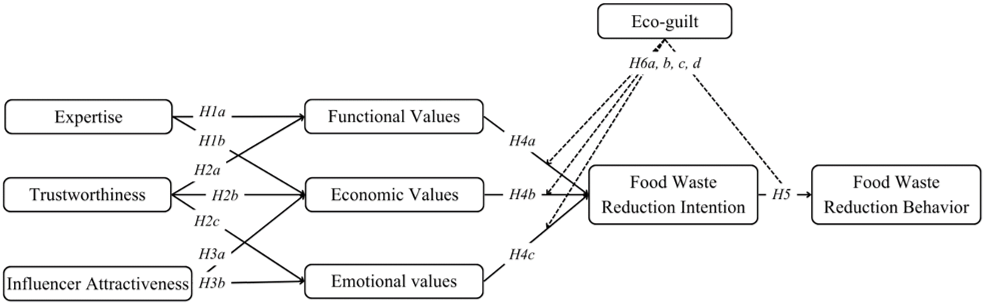
H1a,b: EPT positively influences consumers’ FUN and ECO.
TWO is the measure of how much consumers see an influencer as honest and sincere in their communication and endorsements [37]. TWO is essential in sustainability communication because consumers seek authentic sources of information on sustainable practices [38]. When an influencer is seen as trustworthy, consumers are more likely to accept their recommendations as authentic [39]. In addition, trustworthy influencers may help consumers identify the FUN of reducing food waste and the ECO linked to better food management [40]. Moreover, trust may lower perceived risks in economic decisions and build confidence in the economic claims made by influencers [41]. Consumers may also experience feelings of reassurance and satisfaction when they depend on trustworthy influencers, thus enhancing their commitment to sustainable behaviors [30].
H2a,b,c: TWO positively influences consumers’ FUN, ECO and EMO.
IAT refers to the degree to which an influencer is perceived as physically attractive, glamorous, charming, and sophisticated to the target audience [17]. Consumers develop a more intimate relationship with the influencer if the influencer presents a lifestyle that is consistent and genuine, which resonates with environmental idealism [28, 42]. Therefore, if the influencer presents content on food sustainability, consumers will view the influencer as a role model whose behavior can be emulated, leading to the development of FUN [43, 44]. Additionally, parasocial relationships suggest that the influencer’s attractiveness makes consumers more emotionally connected to the influencer [45, 46]. When consumers feel emotionally connected to such influencers, they are more likely to experience positive emotions such as pride, inspiration, and moral satisfaction, which encourages them to translate these feelings into consistent pro-environmental actions [47].
H3a,b: IAT positively influences consumers’ eco and EMO.
FUN, ECO, and EMO play an important mediating role between influencer characteristics and consumers’ behavioral intentions [48]. When individuals perceive that such behaviors improve efficiency, optimize resources, and bring practical outcomes, they are more likely to develop intentions to adopt them [49]. In particular, FUN helps consumers recognize the practical effectiveness of reducing food waste [17]. ECO provides financial motivation by highlighting potential cost savings and more efficient household food management [9]. EMO strengthens consumers’ internal motivation to engage in sustainable behaviors through feelings of joy, pride or moral satisfaction [50, 9]. Interactions with credible influencers who communicate sustainability messages with empathy can further strengthen these feelings [51, 52].
H4a,b,c: FUN, ECO and EMO positively influence FWI.
The link between behavioral intention and actual behavior is a fundamental proposition of behavioral psychology. According to the Theory of Planned Behavior, individuals are more likely to engage in a behavior as they form positive evaluations and intentions towards the behavior [53]. Past research on green consumption indicates that intentions towards sustainable behaviors are a significant predictor of actual behavior [54]. Research on influencer-driven sustainability campaigns also finds that strong intentions can lead to consistent sustainable behavior, especially when supported by emotional engagement and perceived self-efficacy [15]. Individuals with stronger waste reduction intentions tend to produce lower levels of food waste over time [55].
H5: FWI positively influences FWB.
EG refers to the negative emotional state that arises when individuals realize that their actions or inactions may harm the environment or do not meet their internal environmental standards [56]. It involves feelings of regret, remorse and moral discomfort, which often motivate individuals to correct their behavior and restore moral balance [24]. EG may reinforce the effect of value-based beliefs on behavioral intention. If people feel EG about food waste, they would be more concerned about the consequences of preventing waste, which would amplify the effect of FUN-based beliefs on intention [57]. EG would also potentially amplify the effect of ECO-based beliefs [21, 24, 58, 59] and interact with EMO-based beliefs [23, 60].
H6a,b,c: EG moderates the relationships between FUN, ECO and EMO and FWI.
Moreover, EG could also enhance the connection between intention and action. People who feel EG are more likely to behave in a manner consistent with their intentions in order to alleviate moral discomfort or dissonance [21]. This could motivate individuals to engage in actual behaviors, such as meal planning, portion control, or using leftover food [57].
H6d: EG moderates the relationship between FWI and FWB.
The overall research framework depicting these hypothesized relationships is presented in Figure 1.
Figure 1. Research framework
3.1 Sample and procedures
The study was conducted in Vietnam between August and October 2025, an emerging market with rapid socio-economic growth, high urbanization rates, and an expanding market size [60, 61]. The sampling method focused on adults with experience using social media and familiarity with influencer-generated green content. A stratified purposive sampling technique was used to ensure representation of different ages and income groups. This study used an organized survey disseminated via the internet using university networks and social media. The study used a scale to measure the perception of influencer credibility, EG, and sustainable food consumption behavior. To make sure the concept was clearly demonstrated, participants were first exposed to short fabricated social media posts by the green lifestyle influencer about ways to minimize food wastage at home and only then asked to evaluate her competence, credibility, and attractiveness. In order to ensure the concept was understood, the study used a short influencer post on the topic of going green, assisting respondents in visualizing the research context. In order to ensure a valid sample size, the inverse square root method was used to calculate the minimum sample size for SEM [62], resulting in a minimum sample size of 177. The total sample collected was 456 respondents.
Table 1 presents the demographic profile of respondents. The majority were female (58.3%), aged 25 to 34 years (48.7%), with undergraduate education (58.8%). Regarding income, the largest group earned between \$400 and \$800 monthly (47.8%), followed by those earning below \$400 (39.5%), reflecting a young, well-educated urban consumer profile with moderate income levels.
Table 1. Respondent’s characteristics
|
Demographics |
Categories |
Frequency |
% |
|
Gender |
Male |
190 |
41.7 |
|
Female |
266 |
58.3 |
|
|
Age |
18–24 years old |
180 |
39.5 |
|
25–34 years old |
222 |
48.7 |
|
|
35–44 years old |
34 |
7.5 |
|
|
45–54 years old |
14 |
3.1 |
|
|
> 55 years old |
6 |
1.3 |
|
|
Education |
High school |
86 |
18.9 |
|
Undergraduate |
268 |
58.8 |
|
|
Postgraduate |
102 |
22.4 |
|
|
Monthly Income |
< $400 |
180 |
39.5 |
|
\$400–\$800 |
218 |
47.8 |
|
|
\$800–\$1200 |
40 |
8.8 |
|
|
\$1200–\$1600 |
10 |
2.2 |
|
|
> $1600 |
8 |
1.8 |
3.2 Measures
The scales for the constructs of the study were created through the use of prior validated research studies with slight modifications to suit the Vietnamese research context. The constructs of TWO, EPT, and IAT were borrowed from Al Mamun et al. [28] to represent the concept of consumers’ perceived attributes of green influencers. The constructs of FUN, EMO, and ECO were modified from Carlson et al. [35] to measure consumers’ perceived value formation of green food consumption. FWI scale was borrowed from Chi [63]. FWB was measured through the scale developed by Nekmahmud et al. [9]. Finally, EG was measured as the general climate-change EG scale developed by Ágoston et al. [14]. This general scale was adopted because, at the time of instrument design, limited validated food-waste-specific EG scale was available; general environmental guilt is theorized to spill over into and shape behavior in specific pro-environmental domains. Full scale items for all constructs are presented in Table A1.
3.3 Data analysis
The suggested model was evaluated partial least squares structural equation modeling (PLS-SEM). PLS-SEM enables prediction and theory development and is appropriate for assessing complex models with a number of mediators and moderators. In social sciences, PLS-SEM is used in various forms of study, especially in consumer behavior and marketing [64].
The analysis process involved two major steps. First, the measurement model was checked to ensure that all constructs were dependable and met the requirements for discriminant and convergent validity. Second, in order to test the hypotheses, identify collinearity problems, and check path coefficients and R², the structural model was subjected to testing.
4.1 Common method bias
Given the use of a self-reported questionnaire, common method bias (CMB) may pose a threat to the validity of the findings; therefore, it was assessed through both procedural and statistical approaches following MacKenzie and Podsakoff [65]. Procedurally, the survey instrument was designed to be well-structured, concise, and written in Vietnamese, and respondent confidentiality was assured throughout data collection. Statistically, Harman's single-factor test was conducted, and the largest component accounted for 31.315% of the total variance. While this value remained below the conventional 50% cutoff, it is relatively close to the threshold, so this result alone should not be interpreted as conclusive evidence that CMB is not present. A marker variable technique was therefore also employed, in which two items theoretically unrelated to the focal constructs "I am using Microsoft Word", "I am using Microsoft PowerPoint" were included as a marker variable and linked to all substantive constructs in the model. The average absolute path coefficient between the marker variable and the constructs was small (rm = 0.031), with most coefficients being non-significant (p > 0.05); only the path to FWB reached marginal significance (β = 0.076, p = 0.024). Comparing the adjusted R² values of the model with and without the marker variable showed only a modest maximum increase of 0.5 percentage points, well below the commonly cited 10% threshold. Additionally, all VIF values ranged from 1.420 to 3.197, below the conservative threshold of 3.3 recommended for full collinearity assessment [64]. Taken together, while no single test can fully rule out CMB in cross-sectional, self-reported data, the convergence of these three approaches suggests that CMB is unlikely to substantially distort the study's conclusions.
4.2 Measurement model
To assess the measurement model, factor loadings, reliability, convergent validity, and discriminant validity were thoroughly examined. As presented in Table 2, all standardized loadings ranged from 0.779 to 0.899, surpassing the minimum acceptable threshold of 0.70 [64]. Internal consistency was well-established, with Cronbach's alpha values between 0.735 and 0.931 and composite reliability values between 0.850 and 0.948, both exceeding the recommended benchmark of 0.70. AVE values ranged from 0.653 to 0.785, well above 0.50, confirming convergent validity [64]. For discriminant validity, all Heterotrait-Monotrait ratio values were between 0.158 and 0.813, within the conservative limit of 0.90 (Table 3) [66]. All constructs of the measurement model thus have satisfactory levels of reliability and validity.
Model fit was subsequently assessed to evaluate the overall adequacy of the structural model. As shown in Table 4, the standardized root mean square residual (SRMR) of the estimated model was 0.072, below the commonly accepted cutoff of 0.08, while the normed fit index (NFI) reached 0.871. Predictive relevance was further examined through the cross-validated predictive ability test (CVPAT, Table 5). The PLS-SEM model produced significantly lower prediction error than the indicator-average (IA) benchmark across all constructs (p < 0.001), and lower error than the linear-model (LM) benchmark for FWB (p = 0.045), while showing statistically equivalent performance to the LM benchmark for the remaining constructs and at the overall level (p > 0.05). These results indicate that the model possesses meaningful predictive power beyond naïve and linear benchmarks.
Table 2. Reliability and validity of constructs
|
Construct |
Item |
Loading |
α |
rho_A |
CR |
AVE |
|
Economic Values (ECO) |
ECO1 |
0.884 |
0.896 |
0.897 |
0.928 |
0.762 |
|
ECO2 |
0.867 |
|
|
|
|
|
|
ECO3 |
0.841 |
|
|
|
|
|
|
ECO4 |
0.899 |
|
|
|
|
|
|
Eco-guilt (EG) |
EG1 |
0.839 |
0.903 |
0.905 |
0.925 |
0.673 |
|
EG2 |
0.830 |
|
|
|
|
|
|
EG3 |
0.803 |
|
|
|
|
|
|
EG4 |
0.825 |
|
|
|
|
|
|
EG5 |
0.779 |
|
|
|
|
|
|
EG6 |
0.843 |
|
|
|
|
|
|
Emotional Values (EMO) |
EMO1 |
0.821 |
0.735 |
0.739 |
0.850 |
0.653 |
|
EMO2 |
0.784 |
|
|
|
|
|
|
EMO3 |
0.820 |
|
|
|
|
|
|
Expertise (EPT) |
EPT1 |
0.846 |
0.901 |
0.901 |
0.926 |
0.716 |
|
EPT2 |
0.856 |
|
|
|
|
|
|
EPT3 |
0.839 |
|
|
|
|
|
|
EPT4 |
0.837 |
|
|
|
|
|
|
EPT5 |
0.851 |
|
|
|
|
|
|
Influencer Attractiveness (IAT) |
IAT1 |
0.868 |
0.890 |
0.890 |
0.924 |
0.752 |
|
IAT2 |
0.879 |
|
|
|
|
|
|
IAT3 |
0.862 |
|
|
|
|
|
|
IAT4 |
0.859 |
|
|
|
|
|
|
Functional Values (FUN) |
FUN1 |
0.847 |
0.833 |
0.833 |
0.900 |
0.750 |
|
FUN2 |
0.868 |
|
|
|
|
|
|
FUN3 |
0.882 |
|
|
|
|
|
|
Food Waste Reduction Behavior (FWB) |
FWB1 |
0.859 |
0.880 |
0.882 |
0.918 |
0.736 |
|
FWB2 |
0.854 |
|
|
|
|
|
|
FWB3 |
0.867 |
|
|
|
|
|
|
FWB4 |
0.852 |
|
|
|
|
|
|
Food Waste Reduction Intention (FWI) |
FWI1 |
0.878 |
0.909 |
0.909 |
0.936 |
0.785 |
|
FWI2 |
0.886 |
|
|
|
|
|
|
FWI3 |
0.893 |
|
|
|
|
|
|
FWI4 |
0.886 |
|
|
|
|
|
|
Trustworthiness (TWO) |
TWO1 |
0.894 |
0.931 |
0.932 |
0.948 |
0.785 |
|
TWO2 |
0.887 |
|
|
|
|
|
|
TWO3 |
0.886 |
|
|
|
|
|
|
TWO4 |
0.889 |
|
|
|
|
|
|
TWO5 |
0.874 |
|
|
|
|
Table 3. Assessment of discriminant validity
|
|
ECO |
EG |
EMO |
EPT |
IAT |
FUN |
FWB |
FWI |
TWO |
|
EG |
0.378 |
|
|
|
|
|
|
|
|
|
EMO |
0.813 |
0.260 |
|
|
|
|
|
|
|
|
EPT |
0.625 |
0.231 |
0.449 |
|
|
|
|
|
|
|
IAT |
0.684 |
0.252 |
0.533 |
0.331 |
|
|
|
|
|
|
FUN |
0.566 |
0.158 |
0.390 |
0.545 |
0.318 |
|
|
|
|
|
FWB |
0.482 |
0.550 |
0.400 |
0.253 |
0.303 |
0.192 |
|
|
|
|
FWI |
0.780 |
0.449 |
0.702 |
0.441 |
0.499 |
0.521 |
0.638 |
|
|
|
TWO |
0.529 |
0.180 |
0.424 |
0.317 |
0.317 |
0.631 |
0.247 |
0.377 |
|
Table 4. Model fit
|
|
Saturated Model |
Estimated Model |
|
SRMR |
0.038 |
0.072 |
|
d_ULS |
1.055 |
3.868 |
|
d_G |
0.486 |
0.626 |
|
Chi-square |
1314.095 |
1559.798 |
|
NFI |
0.892 |
0.871 |
Table 5. Cross-validated predictive ability test
|
Construct |
PLS Loss |
IA Loss |
p-Value |
LM Loss |
p-Value |
|
ECO |
0.588 |
1.057 |
0.000 |
0.600 |
0.222 |
|
EMO |
0.454 |
0.535 |
0.000 |
0.463 |
0.276 |
|
FUN |
0.185 |
0.266 |
0.000 |
0.177 |
0.294 |
|
FWB |
0.341 |
0.429 |
0.000 |
0.354 |
0.045 |
|
FWI |
0.381 |
0.518 |
0.000 |
0.389 |
0.381 |
|
Overall |
0.398 |
0.579 |
0.000 |
0.405 |
0.134 |
4.3 Hypothesis testing results
In order to check whether multicollinearity was a problem, the variance inflation factor was checked. The maximum VIF value was 4.394, below the required value of 5 [64]. The R² adjusted values of the five endogenous variables ranged from 0.242 to 0.621, and all Q²predict values were positive, ranging from 0.235 to 0.582, indicating the model's robustness and predictive relevance [64].
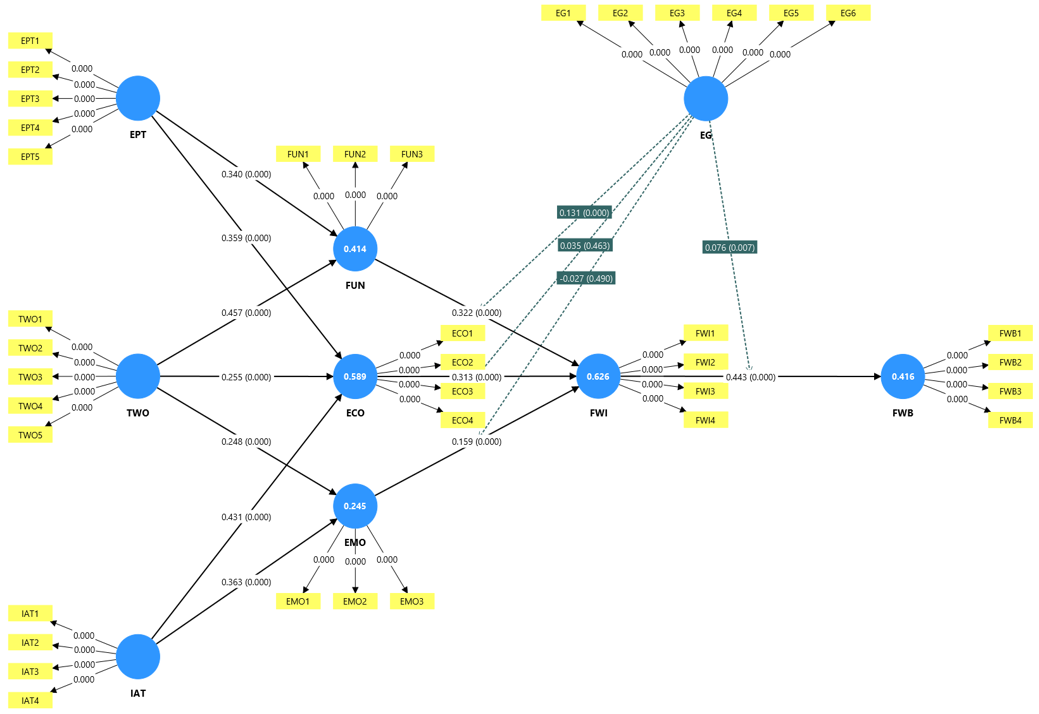
Hypothesis testing was performed using a bootstrapping approach of 5,000 resamples with effect size (f²) calculation. Results provided empirical support for most proposed hypotheses, with the exception of H6b and H6c (Table 6). Specifically, EPT positively influenced FUN (β = 0.340, p < 0.001) and ECO (β = 0.359, p < 0.001), supporting H1a and H1b. TWO significantly affected FUN (β = 0.457, p < 0.001), ECO (β = 0.255, p < 0.001), and EMO (β = 0.248, p < 0.001), confirming H2a–H2c. IAT demonstrated positive effects on ECO (β = 0.431, p < 0.001) and EMO (β = 0.363, p < 0.001), supporting H3a and H3b. Among the value constructs, FUN (β = 0.322, p < 0.001), ECO (β = 0.313, p < 0.001), and EMO (β = 0.159, p < 0.001) all significantly enhanced FWI, confirming H4a–H4c. FWI strongly predicted FWB (β = 0.443, p < 0.001), supporting H5. In addition, EG exerted significant direct effects on both FWI (β = 0.209, p < 0.001) and FWB (β = 0.423, p < 0.001), consistent with the hierarchical principle of moderated regression.
Specific indirect effects (Table 7) further confirmed that perceived values mediate the influence of influencer attributes on FWI: EPT (via ECO, β = 0.112; via FUN, β = 0.109), TWO (via ECO, β = 0.080; via EMO, β = 0.039; via FUN, β = 0.147), and IAT (via ECO, β = 0.135; via EMO, β = 0.058) all showed significant, non-zero bootstrap confidence intervals (p ≤ 0.001). The standardized path coefficients for the structural model are illustrated in Figure 2.
Table 6. Evaluation of hypotheses testing
|
Construct |
Q²predict |
R2 |
R2 Adjusted |
RMSE |
MAE |
|
|
Economic value (ECO) |
0.582 |
0.589 |
0.586 |
0.651 |
0.508 |
|
|
Emotional value (EMO) |
0.235 |
0.245 |
0.242 |
0.881 |
0.634 |
|
|
Functional value (FUN) |
0.408 |
0.414 |
0.412 |
0.774 |
0.567 |
|
|
Food Waste Reduction Behavior (FWB) |
0.280 |
0.416 |
0.412 |
0.853 |
0.692 |
|
|
Food Waste Reduction Intention (FWI) |
0.339 |
0.626 |
0.621 |
0.818 |
0.631 |
|
|
Hypotheses |
Path |
β Coefficient |
t-Value |
p-Value |
95% CI |
f² |
|
H1a: Supported |
EPT → FUN |
0.340 |
8.255 |
0.000 |
[0.259-0.420] |
0.180 |
|
H1b: Supported |
EPT → ECO |
0.359 |
12.065 |
0.000 |
[0.300-0.417] |
0.272 |
|
H2a: Supported |
TWO → FUN |
0.457 |
11.818 |
0.000 |
[0.377-0.532] |
0.326 |
|
H2b: Supported |
TWO → ECO |
0.255 |
7.652 |
0.000 |
[0.190-0.322] |
0.137 |
|
H2c: Supported |
TWO → EMO |
0.248 |
5.935 |
0.000 |
[0.167-0.329] |
0.075 |
|
H3a: Supported |
IAT → ECO |
0.431 |
12.897 |
0.000 |
[0.363-0.495] |
0.393 |
|
H3b: Supported |
IAT → EMO |
0.363 |
7.997 |
0.000 |
[0.271-0.450] |
0.160 |
|
H4a: Supported |
FUN → FWI |
0.322 |
7.939 |
0.000 |
[0.242-0.402] |
0.157 |
|
H4b: Supported |
ECO → FWI |
0.313 |
7.088 |
0.000 |
[0.223-0.400] |
0.102 |
|
H4c: Supported |
EMO → FWI |
0.159 |
3.807 |
0.000 |
[0.077-0.239] |
0.036 |
|
H5: Supported |
FWI → FWB |
0.443 |
11.253 |
0.000 |
[0.365-0.518] |
0.280 |
|
|
EG → FWI |
0.209 |
4.145 |
0.000 |
[0.113-0.315] |
0.043 |
|
|
EG → FWB |
0.423 |
6.501 |
0.000 |
[0.297-0.550] |
0.117 |
|
H6a: Supported |
EG × FUN → FWI |
0.131 |
3.836 |
0.000 |
[0.054-0.192] |
0.069 |
|
H6b: Not Supported |
EG × ECO → FWI |
0.035 |
0.734 |
0.463 |
[-0.054-0.134] |
0.002 |
|
H6c: Not Supported |
EG × EMO → FWI |
-0.027 |
0.690 |
0.490 |
[-0.112-0.050] |
0.002 |
|
H6d: Supported |
EG × FWI → FWB |
0.076 |
2.721 |
0.007 |
[0.015-0.125] |
0.015 |
Table 7. Specific indirect effects
|
Path |
β Coefficient |
t-Value |
p-Value |
95% CI |
|
EPT → ECO → FWI |
0.112 |
6.270 |
0.000 |
[0.078, 0.148] |
|
EPT → FUN → FWI |
0.109 |
5.877 |
0.000 |
[0.075, 0.149] |
|
TWO → ECO → FWI |
0.080 |
5.504 |
0.000 |
[0.053, 0.110] |
|
TWO → EMO → FWI |
0.039 |
3.384 |
0.001 |
[0.018, 0.064] |
|
TWO → FUN → FWI |
0.147 |
6.107 |
0.000 |
[0.103, 0.197] |
|
IAT → ECO → FWI |
0.135 |
5.948 |
0.000 |
[0.091, 0.181] |
|
IAT → EMO → FWI |
0.058 |
3.424 |
0.001 |
[0.027, 0.093] |
4.4 Moderating effects
EG significantly strengthened the relationship between FUN and FWI (β = 0.131, p < 0.001), as well as between FWI and FWB (β = 0.076, p = 0.007), supporting H6a and H6d. However, the moderating effects of EG on the relationships between ECO and intention (β = 0.035, p = 0.463) and between EMO and FWI (β = −0.027, p = 0.490) were non-significant, resulting in the rejection of H6b and H6c.
4.5 Discussion
The findings indicate that influencer endorsement attributes, including EPT, TWO, and IAT, enhance consumers’ perceived values toward sustainable consumption. This supports prior studies suggesting that influencers enhance green behavior through credibility and persuasive communication [38, 67-69]. EPT improves consumers’ perceptions of food-related claims [70], while TWO strengthens FUN, ECO, and EMO by creating openness and reliability [71]. In addition, IAT contributes to consumers’ ECO and EMO through emotional attachment and perceived enjoyment [72].
The study also confirms that FUN, ECO, and EMO significantly influence FWI. FUN increases perceptions of usefulness and practical effectiveness [73], ECO highlights saving potential and efficiency [74], while EMO fosters pride, satisfaction, and moral warmth associated with sustainable behavior [9, 49]. These findings suggest that influencer-driven value perceptions can effectively encourage sustainable FWI. Consistent with prior research, FWI strongly predicts actual FWB [73-75].
Finally, EG acts as an important psychological mechanism that strengthens the relationship between FUN and FWI, as well as between FWI and FWB. Authentic and emotionally engaging influencer content may evoke EG, encouraging consumers to align their actions with environmental norms [21, 76, 77]. However, EG does not significantly moderate the effects of ECO and EMO on FWI, possibly because economic motivations are primarily utilitarian, while positive emotions may already sufficiently motivate sustainable behavior [78].
5.1 Theoretical implications
This study advances theoretical understanding by extending the S-O-R framework to the context of influencer endorsement and sustainable consumption, specifically food waste reduction. By conceptualizing influencer attributes as stimuli (S), perceived values as organisms (O), and FWI as responses (R), the study provides new insights into how influencer-related content can promote sustainable consumer behavior in the digital era.
The findings enrich current literature by demonstrating that influencer attributes, specifically TWO and IAT, could manifest significant effects on perceived value, which in turn foster FWI. This also indicates that the role of influencers is not only seen as a marketing figure but also as a sustainability communicator [79]. Additionally, through the incorporation of EG as a moderator, this study expands the understanding of how moral affect interacts with persuasive communication and eventually influences consumers’ pro-environmental behaviors, contributing to the extension of the S-O-R model to moral consumption and digital social influence [80, 81].
5.2 Practical implications
The study provides profound insights and guidance for marketers and policymakers wishing to harness the power of social media advocacy for reducing food waste and promoting sustainable consumption. First, TWO plays a pivotal role in shaping value perceptions in food waste reduction messages. Brands and organizations should therefore collaborate with influencers who possess credible backgrounds in sustainability, nutrition, or environmental education [35]. Training programs and co-created content emphasizing EPT, transparency, and authenticity can also strengthen perceived trust [8]. A certification for “green influencers”, supported by governmental or non-governmental organization partnerships, could also enhance message reliability and public trust.
Second, the emotional appeal of influencers’ content, particularly through empathy and storytelling (ethical consumption stories, regret appeals), can effectively evoke and resonate with consumers’ inner EG, motivating behavioral change [24, 82]. Influencers can use relatable narratives, visual contrasts like before-and-after waste imagery, or testimonials to make the consequences of food waste personally salient.
Finally, this study suggests that policymakers and sustainability organizations should consider the growing influence of digital ecosystems in shaping pro-environmental behavior [70]. For example, integrating influencer-related campaigns to disseminate widespread evidence-based content about the advantages of “ugly food” [83, 84], thereby reducing consumer bias and facilitating widespread attitude change.
5.3 Limitations and future research
Although the research makes a significant contribution to the emerging body of research on the promotion of sustainability, it is important to note the study’s limitations. First, the study was limited to consumers in Vietnam. Future research may replicate the study in different cultures to test the generalizability of findings. Second, the study relied on self-reported measures to capture both FWB and the constructs assessed following exposure to the influencer stimulus. It is important to acknowledge that participant awareness of being assessed could have influenced their responses, leading to socially desirable answers, and that a gap between reported intention and actual behavior may persist; examining the impact of influencer-based messaging on actual food waste behavior would therefore be an interesting direction for future research. Relatedly, although multiple statistical checks confirmed that CMB is unlikely to be a concern in the present data, future studies could further strengthen causal inference by pairing self-reported intention with observed behavior data or adopting a time-lagged research design. Additionally, individual variables like age, income, and environmental involvement may affect the emotional response to influencer content. Also, because influencer attributes were assessed as general dispositional perceptions anchored to a single illustrative post rather than manipulated across multiple message or platform conditions, causal claims about specific message features should be interpreted with caution. Moreover, the EG scale employed in the present study measures guilt associated with climate change in general, and not guilt associated with food waste specifically. This, although in line with the conceptualization of spillover of general EG into eco-friendliness in domain-specific situations, may fail to measure the contextual nature of the guilt associated with food waste specifically. Further research needs to focus on developing a food-waste-specific EG scale, based on the emotion measures from the food waste literature.
This research is funded by the University of Economics Ho Chi Minh City, Vietnam.
Table A1. Survey scales
|
Items |
Measures |
|
TWO1 |
Influencers who promote green consumption are trustworthy. |
|
TWO2 |
Influencers who promote green consumption are reliable. |
|
TWO3 |
Influencers who promote green consumption are knowledgeable. |
|
TWO4 |
Influencers who promote green consumption provide confidence. |
|
TWO5 |
Influencers who promote green consumption are ethical. |
|
EPT1 |
Influencers know a lot about green consumption. |
|
EPT2 |
Influencers are competent to make assertions about green consumption. |
|
EPT3 |
Influencers are experts on green consumption. |
|
EPT4 |
Influencers are aware of the effects of green consumption. |
|
EPT5 |
Influencers’ expertise motivates green consumption. |
|
IAT1 |
Influencers promoting green consumption are physically attractive. |
|
IAT2 |
Influencers promoting green consumption are glamorous. |
|
IAT3 |
Influencers promoting green consumption are charming. |
|
IAT4 |
Influencers promoting green consumption are sophisticated. |
|
FUN1 |
I think following green consumption practices is helpful for me. |
|
FUN2 |
I believe engaging in green consumption practices is useful for me. |
|
FUN3 |
I think green consumption is functional for me. |
|
EMO1 |
I think green consumption is fun. |
|
EMO2 |
I believe green consumption is exciting. |
|
EMO3 |
I think green consumption is entertaining. |
|
ECO1 |
Green consumption is good for the money I spend. |
|
ECO2 |
Green consumption is economical for the attributes it offers. |
|
ECO3 |
Green consumption helps maintain a reasonable quality of living. |
|
ECO4 |
Green consumption is safe and responsible for daily lives. |
|
FWI1 |
I am willing to consider changing my food consumption habits to reduce food waste. |
|
FWI2 |
I am willing to pay more for products that help minimize food waste. |
|
FWI3 |
I am willing to pay more for food options that support waste reduction efforts. |
|
FWI4 |
I will consider buying products that help prevent food waste because they are environmentally friendly. |
|
FWB1 |
I typically buy food products in ways that help reduce food waste. |
|
FWB2 |
I typically apply practices that save food and prevent waste. |
|
FWB3 |
I typically reuse or repurpose leftover food whenever possible. |
|
FWB4 |
I typically make food waste reduction part of my daily lifestyle. |
|
EG1 |
The more I know about the human causes of climate change, the more things I feel guilty about. |
|
EG2 |
It makes me feel uneasy that I am a part of a system that is amplifying climate change. |
|
EG3 |
I feel guilty for not paying enough attention to the issue of climate change. |
|
EG4 |
At times I feel some personal responsibility for the problems and unfolding impacts of climate change. |
|
EG5 |
I blame myself for often behaving in an environmentally destructive way in situations where it could have been avoided. |
|
EG6 |
I very often feel that what I do for the environment is not enough, because it cannot balance other negative behaviors. |
|
AVE |
Average Variance Extracted |
|
CA |
Cronbach's Alpha |
|
CMB |
Common Method Bias |
|
CR |
Composite Reliability |
|
ECO |
Economic Values |
|
EG |
Eco-guilt |
|
EMO |
Emotional Values |
|
EPT |
Expertise |
|
IAT |
Influencer Attractiveness |
|
FUN |
Functional Values |
|
FWB |
Food Waste Reduction Behaviors |
|
FWI |
Food Waste Reduction Intention |
|
PLS- SEM |
Partial Least Squares Structural Equation Modeling |
|
RQ |
Research Question |
|
S-O-R |
Stimulus–Organism–Response |
|
TWO |
Trustworthiness |
|
VIF |
Variance Inflation Factor |
[1] Iannotti, L., Kleban, E., Fracassi, P., Oenema, S., Lutter, C. (2024). Evidence for policies and practices to address global food insecurity. Annual Review of Public Health, 45: 375-400. https://doi.org/10.1146/annurev-publhealth-060922-041451
[2] UNEP. (2024). Food waste index report 2024. https://www.unep.org/resources/publication/food-waste-index-report-2024.
[3] Crippa, M., Solazzo, E., Guizzardi, D., Monforti-Ferrario, F., Tubiello, F.N., Leip, A. (2021). Food systems are responsible for a third of global anthropogenic GHG emissions. Nature Food, 2: 198-209. https://doi.org/10.1038/s43016-021-00225-9
[4] Attiq, S., Habib, M.D., Kaur, P., Hasni, M.J.S., Dhir, A. (2021). Drivers of food waste reduction behaviour in the household context. Food Quality and Preference, 94: 104300. https://doi.org/10.1016/j.foodqual.2021.104300
[5] Kautish, P., Khare, A. (2022). Antecedents of sustainable fashion apparel purchase behavior. Journal of Consumer Marketing, 39(5): 475-487. https://doi.org/10.1108/JCM-04-2020-3733
[6] Hartmann, T., Jahnke, B., Hamm, U. (2021). Making ugly food beautiful: Consumer barriers to purchase and marketing options for suboptimal food at retail level – A systematic review. Food Quality and Preference, 90: 104179. https://doi.org/10.1016/j.foodqual.2021.104179
[7] Yang, X.K., Huang, Y.H., Chen, Q. (2023). Less delicious but more natural: The effect of the natural label in promoting ugly food consumption. International Journal of Hospitality Management, 115: 103601. https://doi.org/10.1016/j.ijhm.2023.103601
[8] Qi, D., Penn, J., Li, R., Roe, B.E. (2022). Winning ugly: Profit maximizing marketing strategies for ugly foods. Journal of Retailing and Consumer Services, 64: 102834. https://doi.org/10.1016/j.jretconser.2021.102834
[9] Nekmahmud, M., Naz, F., Ramkissoon, H., Fekete-Farkas, M. (2022). Transforming consumers' intention to purchase green products: Role of social media. Technological Forecasting and Social Change, 185: 122067. https://doi.org/10.1016/j.techfore.2022.122067
[10] Wu, Y.H., Yang, S.H., Liu, D.P. (2023). The effect of social media influencer marketing on sustainable food purchase: Perspectives from multi-group SEM and ANN analysis. Journal of Cleaner Production, 416: 137890. https://doi.org/10.1016/j.jclepro.2023.137890
[11] Alam, M.N., Ogiemwonyi, O., Alshareef, R., Alsolamy, M., Mat, N., Azizan, N.A. (2023). Do social media influence altruistic and egoistic motivation and green purchase intention towards green products? An experimental investigation. Cleaner Engineering and Technology, 15: 100669. https://doi.org/10.1016/j.clet.2023.100669
[12] Verma, S., Kapoor, D. (2025). Sustainability on the plate: How influencers and social norms transform food choices. British Food Journal, 127(6): 1942-1958. https://doi.org/10.1108/bfj-11-2024-1202
[13] Kapoor, P.S., Balaji, M.S., Jiang, Y. (2023). Greenfluencers as agents of social change: The effectiveness of sponsored messages in driving sustainable consumption. European Journal of Marketing, 57(2): 533-561. https://doi.org/10.1108/EJM-10-2021-0776
[14] Ágoston, C., Urbán, R., Nagy, B., et al. (2022). The psychological consequences of the ecological crisis: Three new questionnaires to assess eco-anxiety, eco-guilt, and ecological grief. Climate Risk Management, 37: 100441. https://doi.org/10.1016/j.crm.2022.100441
[15] Shipley, N.J., van Riper, C.J. (2022). Pride and guilt predict pro-environmental behavior: A meta-analysis of correlational and experimental evidence. Journal of Environmental Psychology, 79: 101753. https://doi.org/10.1016/j.jenvp.2021.101753
[16] Pop, R.A., Săplăcan, Z., Dabija, D.C., Alt, M.A. (2022). The impact of social media influencers on travel decisions: The role of trust in consumer decision journey. Current Issues in Tourism, 25(5): 823-843. https://doi.org/10.1080/13683500.2021.1895729
[17] Kalam, A., Mollah, M. (2026). The efficacy of the use of social media networks and celebrity endorsers on green consumption: An integrated model of attitude, intention, and actual behavior. Journal of Retailing and Consumer Services, 88: 104472. https://doi.org/10.1016/j.jretconser.2025.104472
[18] Shamim, K., Ahmad, S., Alam, M.A. (2022). Consumer understanding of food date labels: Preventing food wastage. British Food Journal, 124(10): 3116-3132. https://doi.org/10.1108/BFJ-06-2021-0672
[19] Raj, S., Singh, A., Lascu, D.N. (2023). Green smartphone purchase intentions: A conceptual framework and empirical investigation of Indian consumers. Journal of Cleaner Production, 403: 136658. https://doi.org/10.1016/j.jclepro.2023.136658
[20] Ampornklinkaew, C. (2025). The role of social media influencers in influencing consumers' imitation intentions. Digital Business, 5(2): 100143. https://doi.org/10.1016/j.digbus.2025.100143
[21] Bissing-Olson, M.J., Fielding, K.S., Iyer, A. (2016). Experiences of pride, not guilt, predict pro-environmental behavior when pro-environmental descriptive norms are more positive. Journal of Environmental Psychology, 45: 145-153. https://doi.org/10.1016/j.jenvp.2016.01.001
[22] Hurst, K.F., Sintov, N.D. (2022). Guilt consistently motivates pro-environmental outcomes while pride depends on context. Journal of Environmental Psychology, 80: 101776. https://doi.org/10.1016/j.jenvp.2022.101776
[23] Nielsen, R.S., Gamborg, C. (2024). The moral potential of eco-guilt and eco-shame: Emotions that hinder or facilitate pro-environmental change? Journal of Agricultural and Environmental Ethics, 37: 17. https://doi.org/10.1007/s10806-024-09938-w
[24] Bahja, F., Hancer, M. (2021). Eco-guilt in tourism: Do tourists intend to behave environmentally friendly and still revisit? Journal of Destination Marketing & Management, 20: 100602. https://doi.org/10.1016/j.jdmm.2021.100602
[25] Liang, D.P., Hou, C.X., Jo, M.S., Sarigöllü, E. (2019). Pollution avoidance and green purchase: The role of moral emotions. Journal of Cleaner Production, 210: 1301-1310. https://doi.org/10.1016/j.jclepro.2018.11.103
[26] Mehrabian, A., Russell, J.A. (1974). An Approach to Environmental Psychology. The MIT Press. https://psycnet.apa.org/record/1974-22049-000.
[27] Li, M.Y., Li, J.L., Yasin, M.A.I., Hashim, N.B., Ang, L.H., Bidin, R. (2022). Impact of celebrity-endorsed environmental advertisements on green economy development. Technological Forecasting and Social Change, 184: 121979. https://doi.org/10.1016/j.techfore.2022.121979
[28] Al Mamun, A., Naznen, F., Yang, Q., Ali, M.H., Hashim, N.M.H.N. (2023). Modelling the significance of celebrity endorsement and consumer interest on attitude, purchase intention, and willingness to pay a premium price for green skincare products. Heliyon, 9(6): e16765. https://doi.org/10.1016/j.heliyon.2023.e16765
[29] Jang, S., Farajallah, M., So, K.K.F. (2021). The effect of quality cues on travelers' demand for peer-to-peer ridesharing: A neglected area of the sharing economy. Journal of Travel Research, 60(2): 446-461. https://doi.org/10.1177/0047287519897998
[30] Loureiro, S.M.C., Bilro, R.G., Japutra, A. (2020). The effect of consumer-generated media stimuli on emotions and consumer brand engagement. Journal of Product & Brand Management, 29(3): 387-408. https://doi.org/10.1108/jpbm-11-2018-2120
[31] Akram, U., Junaid, M., Zafar, A.U., Li, Z.W., Fan, M.Y. (2021). Online purchase intention in Chinese social commerce platforms: Being emotional or rational? Journal of Retailing and Consumer Services, 63: 102669. https://doi.org/10.1016/j.jretconser.2021.102669
[32] Ki, C.W., Cuevas, L.M., Chong, S.M., Lim, H. (2020). Influencer marketing: Social media influencers as human brands attaching to followers and yielding positive marketing results by fulfilling needs. Journal of Retailing and Consumer Services, 55: 102133. https://doi.org/10.1016/j.jretconser.2020.102133
[33] Kumar, S., Mehrotra, A., Yaqub, M.Z., Gupta, B., Agarwal, V. (2025). The role of values and attitude in food waste reduction: Exploring ideal sustainable business strategies. Business Strategy and the Environment, 34(2): 2341-2360. https://doi.org/10.1002/bse.4087
[34] Barari, M.M., Eisend, M., Jain, S.P. (2026). A meta-analysis of the effectiveness of social media influencers: Mechanisms and moderation. Journal of the Academy of Marketing Science, 54: 28-48. https://doi.org/10.1007/s11747-025-01107-3
[35] Carlson, J., Wyllie, J., Rahman, M.M., Voola, R. (2019). Enhancing brand relationship performance through customer participation and value creation in social media brand communities. Journal of Retailing and Consumer Services, 50: 333-341. https://doi.org/10.1016/j.jretconser.2018.07.008
[36] Schouten, A.P., Janssen, L., Verspaget, M. (2020). Celebrity vs. Influencer endorsements in advertising: The role of identification, credibility, and product-endorser fit. International Journal of Advertising, 39(2): 258-281. https://doi.org/10.1080/02650487.2019.1634898
[37] Nguyen, P.V., Le, H.T.P.M. (2026). Green influencers’ source credibility in driving customers’ green behaviors: Role of trust, engagement, and knowledge in a cross-country study. Journal of Retailing and Consumer Services, 88: 104505. https://doi.org/10.1016/j.jretconser.2025.104505
[38] Sokolova, K., Kefi, H. (2020). Instagram and YouTube bloggers promote it, why should I buy? How credibility and parasocial interaction influence purchase intentions. Journal of Retailing and Consumer Services, 53: 101742. https://doi.org/10.1016/j.jretconser.2019.01.011
[39] Ajina, A.S., Ali, S., Zamil, A.M.A., Khalid, N., Sulaiman, M.A.B.A. (2024). Unleashing the potential of social media celebrities to promote food waste reduction in educational institutions: Developing an extended model based on the value-belief-norm theory. British Food Journal, 126(7): 2787-2808. https://doi.org/10.1108/bfj-04-2023-0279
[40] Thøgersen, J. (2025). Sustainable consumer behaviour. In The Routledge Companion to Marketing and Sustainability, pp. 185-199. https://doi.org/10.4324/9781003412397-16
[41] Anderson, L.M., Chapman, M., Muraca, B., Chan, K.M.A. (2025). Transformative influence? The hedonic and eudaimonic sustainabilities of social media influencers. Environmental Communication, 19(7): 1257-1275. https://doi.org/10.1080/17524032.2025.2458227
[42] Dekoninck, H., Schmuck, D. (2024). The “greenfluence”: Following environmental influencers, parasocial relationships, and youth’s participation behavior. New Media & Society, 26(11): 6615-6635. https://doi.org/10.1177/14614448231156131
[43] Breves, P., Liebers, N. (2022). #Greenfluencing. The impact of parasocial relationships with social media influencers on advertising effectiveness and followers’ pro-environmental intentions. Environmental Communication, 16(6): 773-787. https://doi.org/10.1080/17524032.2022.2109708
[44] Balaban, D.C., Szambolics, J., Chirică, M. (2022). Parasocial relations and social media influencers' persuasive power. Exploring the moderating role of product involvement. Acta Psychologica, 230: 103731. https://doi.org/10.1016/j.actpsy.2022.103731
[45] Park, S., Hoffner, C.A. (2024). Roles of parasocial relationship with eco-celebrities, motivation attribution, and message framing in virality of climate information on social media. Computers in Human Behavior, 160: 108380. https://doi.org/10.1016/j.chb.2024.108380
[46] Le, H.T.P.M., Nguyen, P.V., Stokes, P. (2025). Green influencers and consumers’ decoupling behaviors for parasocial relationships and sustainability. A comparative study between Korea and Vietnam. Journal of Retailing and Consumer Services, 84: 104256. https://doi.org/10.1016/j.jretconser.2025.104256
[47] Ding, L. (2022). The effects of self-efficacy and collective efficacy on customer food waste reduction intention: The mediating role of ethical judgment. Journal of Hospitality and Tourism Insights, 5(4): 752-770. https://doi.org/10.1108/jhti-07-2021-0168
[48] Han, L., Wang, S.Y., Zhao, D.T., Li, J. (2017). The intention to adopt electric vehicles: Driven by functional and non-functional values. Transportation Research Part A: Policy and Practice, 103: 185-197. https://doi.org/10.1016/j.tra.2017.05.033
[49] Kim, J., Rana, M.R.I. (2025). Exploring socio-psychological drivers and pathways of sustainable fashion consumption. Journal of Community & Applied Social Psychology, 35(5): e70158. https://doi.org/10.1002/casp.70158
[50] König, S., Maier, E. (2024). Preaching to the choir: Do green influencers make a difference? Journal of Cleaner Production, 447: 141449. https://doi.org/10.1016/j.jclepro.2024.141449
[51] Wang, J., Ma, Y.D., Min, L., Geng, J.N., Xiao, Y.J. (2025). The impact of social media fashion influencers’ relatability on purchase intention: The mediating role of perceived emotional value and moderating role of consumer expertise. Acta Psychologica, 258: 105174. https://doi.org/10.1016/j.actpsy.2025.105174
[52] Ajzen, I., Fishbein, M., Lohmann, S., Albarracín, D. (2018). The influence of attitudes on behavior. In The Handbook of Attitudes, Volume 1: Basic Principles, pp. 197-255. https://doi.org/10.4324/9781315178103-5
[53] Singh, G., Sharma, S., Sharma, R., Dwivedi, Y.K. (2021). Investigating environmental sustainability in small family-owned businesses: Integration of religiosity, ethical judgment, and theory of planned behavior. Technological Forecasting and Social Change, 173: 121094. https://doi.org/10.1016/j.techfore.2021.121094
[54] Aydin, A.E., Yildirim, P. (2021). Understanding food waste behavior: The role of morals, habits and knowledge. Journal of Cleaner Production, 280: 124250. https://doi.org/10.1016/j.jclepro.2020.124250
[55] Mkono, M., Hughes, K. (2020). Eco-guilt and eco-shame in tourism consumption contexts: Understanding the triggers and responses. Journal of Sustainable Tourism, 28(8): 1223-1244. https://doi.org/10.1080/09669582.2020.1730388
[56] Chakraborty, D., Mattila, A.S. (2025). The effect of self-conscious emotions of guilt and regret on consumers’ intentions to reduce food waste. Journal of Sustainable Tourism, 33(9): 1871-1889. https://doi.org/10.1080/09669582.2024.2406532
[57] Aydin, H., Aydin, C. (2022). Investigating consumers’ food waste behaviors: An extended theory of planned behavior of Turkey sample. Cleaner Waste Systems, 3: 100036. https://doi.org/10.1016/j.clwas.2022.100036
[58] McCarthy, B. (2024). Green, guilty, and frugal: Facilitators of energy saving and the choice of energy-efficient appliances in the Australian energy market. Energy Strategy Reviews, 53: 101400. https://doi.org/10.1016/j.esr.2024.101400
[59] Ullah, S., Lyu, B., Ahmad, T., Sami, A., Kukreti, M. (2024). A mediated moderation model of eco-guilt, personal and social norms and religiosity triggering pro-environmental behavior in tourists. Current Psychology, 43: 6830-6839. https://doi.org/10.1007/s12144-023-04894-6
[60] Liu, C., Nguyen, T.T. (2020). Evaluation of household food waste generation in Hanoi and policy implications towards SDGs Target 12.3. Sustainability, 12(16): 6565. https://doi.org/10.3390/su12166565
[61] Nguyen, D.H., Hoang, L.C. (2026). Customers’ engagement with virtual influencers: The roles of parasocial relationship, emotional attachment. Young Consumers: Insight and Ideas for Responsible Marketers, 27(1): 109-129. https://doi.org/10.1108/YC-04-2025-2510
[62] Kock, N., Hadaya, P. (2018). Minimum sample size estimation in PLS-SEM: The inverse square root and gamma-exponential methods. Information Systems Journal, 28(1): 227-261. https://doi.org/10.1111/isj.12131
[63] Chi, N.T.K. (2021). Understanding the effects of eco-label, eco-brand, and social media on green consumption intention in ecotourism destinations. Journal of Cleaner Production, 321: 128995. https://doi.org/10.1016/j.jclepro.2021.128995
[64] Hair, J.F., Hult, G.T.M., Ringle, C.M., Sarstedt, M. (2022). A Primer on Partial Least Squares Structural Equation Modeling (PLS-SEM) (3rd ed.). Sage Publishing.
[65] MacKenzie, S.B., Podsakoff, P.M. (2012). Common method bias in marketing: Causes, mechanisms, and procedural remedies. Journal of Retailing, 88(4): 542-555. https://doi.org/10.1016/j.jretai.2012.08.001
[66] Henseler, J., Ringle, C.M., Sarstedt, M. (2015). A new criterion for assessing discriminant validity in variance-based structural equation modeling. Journal of the Academy of Marketing Science, 43: 115-135. https://doi.org/10.1007/s11747-014-0403-8
[67] Casaló, L.V., Flavián, C., Ibáñez-Sánchez, S. (2020). Influencers on Instagram: Antecedents and consequences of opinion leadership. Journal of Business Research, 117: 510-519. https://doi.org/10.1016/j.jbusres.2018.07.005
[68] Chung, S., Cho, H. (2017). Fostering parasocial relationships with celebrities on social media: Implications for celebrity endorsement. Psychology & Marketing, 34(4): 481-495. https://doi.org/10.1002/mar.21001
[69] van Bussel, L.M., Kuijsten, A., Mars, M., van’t Veer, P. (2022). Consumers’ perceptions on food-related sustainability: A systematic review. Journal of Cleaner Production, 341: 130904. https://doi.org/10.1016/j.jclepro.2022.130904
[70] Filimonau, V., Matute, J., Kubal-Czerwińska, M., Krzesiwo, K., Mika, M. (2020). The determinants of consumer engagement in restaurant food waste mitigation in Poland: An exploratory study. Journal of Cleaner Production, 247: 119105. https://doi.org/10.1016/j.jclepro.2019.119105
[71] Venhoeven, L.A., Bolderdijk, J.W., Steg, L. (2020). Why going green feels good. Journal of Environmental Psychology, 71: 101492. https://doi.org/10.1016/j.jenvp.2020.101492
[72] Joshi, Y., Uniyal, D.P., Sangroya, D. (2021). Investigating consumers’ green purchase intention: Examining the role of economic value, emotional value and perceived marketplace influence. Journal of Cleaner Production, 328: 129638. https://doi.org/10.1016/j.jclepro.2021.129638
[73] Tawde, S., Kamath, R., ShabbirHusain, R.V. (2023). ‘Mind will not mind’ – Decoding consumers’ green intention-green purchase behavior gap via moderated mediation effects of implementation intentions and self-efficacy. Journal of Cleaner Production, 383: 135506. https://doi.org/10.1016/j.jclepro.2022.135506
[74] Nguyen, H.V., Nguyen, C.H., Hoang, T.T.B. (2018). Green consumption: Closing the intention-behavior gap. Sustainable Development, 27(1): 118-129. https://doi.org/10.1002/sd.1875
[75] Al Mamun, A., Mohamad, M.R., Yaacob, M.R.B., Mohiuddin, M. (2018). Intention and behavior towards green consumption among low-income households. Journal of Environmental Management, 227: 73-86. https://doi.org/10.1016/j.jenvman.2018.08.061
[76] Ketelsen, M., Janssen, M., Hamm, U. (2020). Consumers’ response to environmentally-friendly food packaging–A systematic review. Journal of Cleaner Production, 254: 120123. https://doi.org/10.1016/j.jclepro.2020.120123
[77] Wang, J.M., Wu, L.C. (2016). The impact of emotions on the intention of sustainable consumption choices: Evidence from a big city in an emerging country. Journal of Cleaner Production, 126: 325-336. https://doi.org/10.1016/j.jclepro.2016.03.119
[78] Yang, H.B., Tang, C.W., Wang, D.L. (2023). Is it true that negative emotions cause more utilitarian judgements? From the influence of emotion and cognition. Cognition and Emotion, 37(7): 1248-1260. https://doi.org/10.1080/02699931.2023.2258572
[79] Jacobson, J., Harrison, B. (2022). Sustainable fashion social media influencers and content creation calibration. International Journal of Advertising, 41(1): 150-177. https://doi.org/10.1080/02650487.2021.2000125
[80] Arora, S., Parida, R.R., Sahney, S. (2020). Understanding consumers’ showrooming behaviour: A stimulus-organism-response (S-O-R) perspective. International Journal of Retail & Distribution Management, 48(11): 1157-1176. https://doi.org/10.1108/IJRDM-01-2020-0033
[81] Rivas, A.A., Liao, Y.K., Vu, M.Q., Hung, C.S. (2022). Toward a comprehensive model of green marketing and innovative green adoption: Application of a stimulus-organism-response model. Sustainability, 14(6): 3288. https://doi.org/10.3390/su14063288
[82] Huyen, N.N.T., Hong, H.D., Thi, L.H. (2025). Green practices: Building green image and green trust for green revisit intentions in the hospitality industry. Journal of Open Innovation: Technology, Market, and Complexity, 11(1): 100481. https://doi.org/10.1016/j.joitmc.2025.100481
[83] Hingston, S.T., Noseworthy, T.J. (2020). On the epidemic of food waste: Idealized prototypes and the aversion to misshapen fruits and vegetables. Food Quality and Preference, 86: 103999. https://doi.org/10.1016/j.foodqual.2020.103999
[84] de Hooge, I.E., Oostindjer, M., Aschemann-Witzel, J., Normann, A., Loose, S.M., Almli, V.L. (2017). This apple is too ugly for me!: Consumer preferences for suboptimal food products in the supermarket and at home. Food Quality and Preference, 56: 80-92. https://doi.org/10.1016/j.foodqual.2016.09.012