Sami Ahmed Alhuzaili* | Ahmad Irdha Bin Mokhtar | Razaleigh Bin Muhamat
© 2026 The authors. This article is published by IIETA and is licensed under the CC BY 4.0 license (http://creativecommons.org/licenses/by/4.0/).
OPEN ACCESS
This study contributes to the understanding of reverse logistics (RL) by proposing a triadic value concept, which merges sustainability, organisational performance, and competitive advantage, expanding the understanding of returns management, recovery operations, and end-of-life management. This study analysed 218 studies using a hybrid deductive–inductive framework synthesis. The evidence extracted from each study was coded according to RL mechanisms, sustainability contributions, organisational outcomes, competitive outcomes, enabling conditions, and contextual contingencies. Value pathways and comparative-advantage regimes were identified via pattern coding. The findings indicate that RL has evolved from a waste-oriented operational role into a resilient digital and circular system integrating network design, closed-loop coordination, eco-efficiency, social inclusion, traceability, and governance. When turning sustainability benefits into cost reductions, resource utilisation, recovery of services, resilience, legitimacy, and orchestration of digital processes, strategic value is added. The six comparative advantage regimes that emerged were cost recapture, carbon compliance, service differentiation, resilience, digital orchestration, and ecosystem legitimacy. The proposed framework identifies RL as strategic circular infrastructure for theory development, managerial decision-making, and circular-economic policy.
reverse logistics, triadic value creation, sustainability, organizational performance, competitive advantage, circular economy, closed-loop supply chains
The definition of reverse logistics (RL) was traditionally given as the management of returned, damaged, obsolete, and post-consumption waste, with a strong focus on the economic aspects of take-back, recycling, disposal, and recovery [1]. Recently, this view has become obsolete as reverse flows have become part of global production networks that seek a ‘circular economy’, ‘carbon constraints’, ‘resource insecurity’, ‘digitalisation’, and ‘regulatory pressure’. RL applications across the globe (Africa, Asia, Europe, North America, Australia, and the Gulf) show that, besides contributing to environmental protection, they are also beneficial for resource security, operational efficiency, service recovery, traceability, resilience, and industrial competitiveness [2, 3]. Based on these considerations, this review builds RL as a value-creation system comprising three entities: sustainability, organisation, and competitive advantage. There are three phases in the evolution of RL from 2007 to 2025. The three evolutionary stages of RL from 2007 to 2025 can broadly be termed as follows. In the period from 2007–2012, studies focused mainly on the remedial approach dealing with waste reduction, recovery routes, responsible environmental disposal, and remanufacturing [4, 5]. The perceived value was mostly derived from the forward value chain, and RL prevented environmental and economic losses after use. From 2013–2019, the field was oriented towards closed-loop systems, circularity, carbon-sensitive optimisation, the coordination of remanufacturing, recycling facilities for packaging, and life-cycle value recovery [6]. Further research showed that effective RL could lead to additional improvements in environmental outcomes, process efficiency, resource utilisation, and organisational performance. As a result, implications for implementation capability, institutional conditions, managerial alignment, network optimisation, and recovery quality were studied. Between 2020 and 2025, strategic competitiveness, sustainability, circularity, resilience, and digitalisation merged. Modern research shows that RL is becoming increasingly relevant in the fields of electric-vehicle batteries, photovoltaic waste, e-commerce, healthcare, electronics, plastics, etc., which have high resource demands [7, 8]. The advent of technologies such as big data analytics, machine learning, blockchain, and Radio-Frequency Identification (RFID) is bringing RL from “post-consumption transport” to “data-driven, circular orchestration” [9]. RL therefore creates more value through resource recovery, eco-efficiency, service recovery, governance alignment, digital traceability, capability development, and resilience. This review has three main contributions based on the 218-study corpus. First, it summarises and extends the traditional research bias on sustainability-forward reasoning for RL towards a triadic logic involving the mediating aspects of organisational performance and competitive advantage. First, it takes the sustainability-forward reasoning approach of RL towards the triadic paradigm of environmental benefits, organisational performance, and competitive advantage. Second, it is built to weave together the discrete elements within the current literature in a way that establishes a coherent analytical framework to address the knowledge domains, value pathways, sectoral ecosystems, comparative-advantage mechanisms, and enabling conditions. Third, it works to connect circular recovery activities with measurable organisational and strategic outcomes through the mediation of RL.
Therefore, the review considers five research questions. The first question is how to conceptualise and operationally execute RL as an integrated value-creation system that develops sustainability, organisational performance, and competitive advantage. The second question is what RL knowledge domains and value pathways are best suited to converting sustainability improvements into real tangible outcomes for organisations and competition across industries and geographical areas. The third question is how RL has transformed from waste management and recovery into a wise, agile, and digitally connected circular orchestration. The fourth question is what advantages RL provides under sectoral, geographic, institutional, and capability conditions. The fifth question is what governance and capability mechanisms, as well as possible traces and performance measurement mechanisms, are necessary to strategically transform fragmented RL practices into circular infrastructure. The review then analyses the research activities and methodological development of the corpus from 2007 to 2025, followed by the development of the triadic value creation framework. It brings together the key areas and pathways of RL knowledge, examines mechanisms—sectoral and comparative—as well as enablers and barriers that transcend different contexts. Lastly, the synthesis is presented as managerial and policy implications: how relevant it is to Oman Vision 2040 and what future research is needed, with a focus on creating intelligent circular ecosystems, measuring performance causally, strengthening circularity and resilience, and addressing circularity, justice, and digital orchestration.
Table 1 illustrates a database-specific search strategy that breaks down the three-fold framework of sustainability, organisational performance, and competitive advantage represented by the study into a replicable evidence-retrieval approach for the period of 2007–2025. Scopus and Web of Science were used as primary bibliographic databases; Google Scholar features snowball and interdisciplinary searches; and ScienceDirect, Taylor & Francis Online, and SpringerLink offer improved thematic searches. The strategy provides structured filtering, deduplication, screening, and eligibility assessment that provide a balance between retrieval breadth, precision, and transparency.
Table 1. Database-specific search queries and justifications
|
Database |
Database-Specific Search Query |
Filters to Apply |
Justification |
|
Scopus |
TITLE-ABS-KEY(("reverse logistics" OR "reverse supply chain*" OR "closed-loop supply chain*" OR remanufactur* OR recycl* OR refurbish* OR "product return*" OR "end-of-life management") AND (sustainab* OR "circular economy" OR "green supply chain*" OR "resource recovery" OR ESG OR resilien*) AND ("organizational performance" OR "operational performance" OR "firm performance" OR productivity OR efficiency OR "service quality") AND ("competitive advantage" OR competitiv* OR differentiation OR "cost leadership" OR "strategic advantage")) AND PUBYEAR > 2006 AND PUBYEAR < 2026 |
Language: English; document type: Article, Review; source type: Journals; final manual relevance screening |
This is the strongest primary-retrieval string for the study because Scopus Advanced Search supports TITLE-ABS-KEY(), which closely matches the study’s title/abstract/keyword qualification logic, while the query captures the paper’s triadic lens through sustainability, organizational performance, and competitive advantage. |
|
Web of Science Core Collection |
TS=(("reverse logistics" OR "reverse supply chain*" OR "closed-loop supply chain*" OR remanufactur* OR recycl* OR refurbish* OR "product return*" OR "end-of-life management") AND (sustainab* OR "circular economy" OR "green supply chain*" OR "resource recovery" OR Environmental, Social, and Governance (ESG) OR resilien*) AND ("organizational performance" OR "operational performance" OR "firm performance" OR productivity OR efficiency OR "service quality") AND ("competitive advantage" OR competitiv* OR differentiation OR "cost leadership" OR "strategic advantage")) |
Refine results to Publication Years: 2007–2025; English; Article, Review; then screen titles/abstracts |
TS= is well suited here because Web of Science defines Topic as title, abstract, author keywords, and Keywords Plus, which helps recover both direct reverse-logistics papers and adjacent conceptual studies framed through circularity, performance, and strategy. Because WoS advises care with long year spans in PY, it is cleaner to apply the 2007–2025 year filter in results refinement. |
|
Google Scholar |
Primary query: ("reverse logistics" OR "closed-loop supply chain" OR "reverse supply chain") sustainability "organizational performance" "competitive advantage" Calibration query: intitle:"reverse logistics" sustainability "competitive advantage" |
Custom range: 2007–2025; sort first by relevance, then by date for update checking; retain only peer-reviewed journal/review items during screening |
Google Scholar is best used here as a supplementary capture and snowballing tool rather than the main evidence set, because it supports quoted title searching and advanced author/title/publication/date limits, but it also indexes theses, books, preprints, reports, and other web-visible scholarly material, with only 1,000 visible results per query. That makes a broad primary query plus a narrower calibration query methodologically safer. |
|
ScienceDirect |
("reverse logistics" OR "reverse supply chain" OR "closed-loop supply chain" OR remanufactur* OR recycl* OR refurbish* OR "product return*") AND (sustainab* OR "circular economy" OR "resource recovery" OR ESG OR resilien*) AND ("organizational performance" OR "operational performance" OR "firm performance" OR productivity OR efficiency) AND ("competitive advantage" OR competitiv* OR differentiation OR "cost leadership") |
Use Advanced Search; Years field: 2007–2025; article/review content; subject refinement where needed |
ScienceDirect’s Advanced Search supports explicit Boolean and nested clauses and lets the user set a year range directly in the search form. A slightly broader publisher-platform string is preferable here because ScienceDirect is excellent for recovering full-text Elsevier content in operations, sustainability, waste, and circular-economy journals that are central to this study’s domain. |
|
Taylor & Francis Online |
("reverse logistics" OR "closed-loop supply chain" OR "reverse supply chain" OR remanufactur* OR recycl* OR refurbish*) AND (sustainab* OR "circular economy" OR ESG OR resilien*) AND ("organizational performance" OR "firm performance") AND ("competitive advantage" OR competitiv*) |
Advanced Search; publication years: 2007–2025; content type: Article/Review; subject narrowing to supply chain, management, sustainability, operations |
Taylor & Francis Online should be used as a publisher-platform enrichment search. A phrase-heavy Boolean string improves precision on this platform, while year and content-type filters reduce noise. This is especially useful for management, logistics, and sustainability journals that may contribute conceptual and sectoral pieces missed in citation-database ranking. |
|
SpringerLink |
("reverse logistics" OR "closed-loop supply chain" OR "reverse supply chain" OR remanufactur* OR recycl* OR refurbish* OR "product returns") AND (sustainab* OR "circular economy" OR "resource recovery" OR ESG OR resilien*) AND ("organizational performance" OR "operational performance" OR "firm performance") AND ("competitive advantage" OR competitiv* OR "strategic advantage") |
Advanced Search; Date Published: 2007–2025; content type: Article, Chapter; optionally search within Title for validation runs |
Springer Nature Link supports Boolean operators, exact-phrase searching with quotation marks, keyword/title targeting, and date-range filtering in Advanced Search. That makes it well suited for identifying both journal articles and high-value book chapters around circular economy, remanufacturing, sustainability strategy, and reverse-logistics governance. |
Table 2. Eligibility criteria summary: inclusion approaches (IA1–IA5) and exclusion approaches (EA1–EA6)
|
Code |
Type |
Study-Aligned Criterion |
Operational Meaning for Screening and Eligibility |
Strategic Justification for This Review |
|
IA1 |
Inclusion |
Direct reverse-logistics relevance |
Include studies whose core focus is reverse logistics (RL), reverse supply chains, closed-loop supply chains, remanufacturing, recycling, refurbishment, product returns, take-back systems, or end-of-life recovery. |
Ensures that the corpus is anchored in the reverse-logistics field rather than in generic sustainability or waste literature. |
|
IA2 |
Inclusion |
Triadic-value relevance |
Include studies that address at least one of the study’s three core value dimensions: sustainability contribution, organizational-performance improvement, or competitive-advantage formation. |
Prevents the evidence base from collapsing into sustainability-only interpretation and preserves the study’s triadic proposition. |
|
IA3 |
Inclusion |
Conceptual or empirical analytical depth |
Include studies that provide substantive conceptual framing, modeling, empirical evidence, sectoral cases, or review-based synthesis capable of informing higher-order interpretation. |
Supports the study’s goal of building theory, domains, pathways, and comparative regimes rather than merely listing examples. |
|
IA4 |
Inclusion |
Quality-controlled scholarly source |
Include English-language, peer-reviewed journal articles and reviews retrieved from the selected scholarly databases and publisher platforms. |
Preserves methodological rigor, reproducibility, and comparability across the final analytical corpus. |
|
IA5 |
Inclusion |
Time-bounded and synthesis-fit relevance |
Include studies published within 2007–2025 that remain sufficiently aligned with the study’s final synthesis on reverse logistics (RL) beyond waste. |
Matches the study window and ensures that retained papers are usable for the final integrative and critical discussion. |
|
EA1 |
Exclusion |
Duplicate record exclusion |
Exclude records duplicated across Scopus, Web of Science, Google Scholar, ScienceDirect, Taylor & Francis Online, and SpringerLink. |
Avoids artificial inflation of the evidence base and preserves an accurate screening denominator. |
|
EA2 |
Exclusion |
Title/abstract/keyword irrelevance |
Exclude studies whose title, abstract, or keywords do not genuinely address reverse logistics (RL) or closely related reverse-flow concepts. |
Removes false positives produced by broad database capture and improves thematic precision early in screening. |
|
EA3 |
Exclusion |
Sustainability-only or waste-only narrowness |
Exclude studies that discuss waste management, recycling, or environmental sustainability in general terms but do not meaningfully engage reverse-logistics structure, performance, or strategic implications. |
Keeps the review centered on reverse logistics (RL) as a value-creation system rather than on generic environmental management. |
|
EA4 |
Exclusion |
Insufficient triadic analytical fit |
Exclude studies that mention reverse logistics (RL) only peripherally and do not provide usable evidence on sustainability, organizational performance, competitive advantage, or their interaction. |
Ensures that included studies contribute directly to the study’s integrative framework and not just to background context. |
|
EA5 |
Exclusion |
Full-text conceptual insufficiency |
Exclude full-text papers that, after detailed reading, lack adequate theoretical substance, analytical clarity, or transferable insight for the comprehensive triadic synthesis. |
Enables the transition from a broad eligible set to a sharper critical-review corpus. |
|
EA6 |
Exclusion |
Final synthesis redundancy or weak strategic contribution |
Exclude papers that are repetitive, weakly informative, overly narrow, or not sufficiently useful for the final critical discussion of reverse logistics (RL) as a strategic triadic framework. |
Supports the final distillation from included studies to the most analytically powerful critical set used in the study’s final synthesis. |
Table 2 is methodologically significant as it demonstrates that the research approach considers evidence selection not only as a basic relevance assessment but also as a complex analytical framework that systematically transforms an extensive literature landscape into a justifiable triadic-value corpus over the period of 2007–2025. The study's workflow progresses from broad database identification to title–abstract–keyword qualification, software-assisted duplicate elimination, structured screening, full-text eligibility assessment, and final critical study distillation, all governed by five inclusion criteria and six exclusion criteria rather than solely by arbitrary judgement. In this framework, IA1–IA5 serve as effective boundary-setting mechanisms: they guarantee that the selected studies are authentically rooted in RL or related reverse-flow systems, analytically linked to the study's triadic perspective of sustainability, organisational performance, and competitive advantage, sufficiently robust to facilitate conceptual or empirical synthesis, rigorously vetted through English-language peer-reviewed literature, and temporally consistent with the review period. The paired EA1–EA6 criteria refine the corpus by eliminating duplication, superficial keyword matches, publications focused only on sustainability or waste that lack depth in RL, studies with weak triadic connections, and full-text papers that do not significantly enhance the final synthesis. This makes the table much more than a mere administrative checklist. It serves as a conceptual protection against diluting the review into general literature on circular economy or environmental management. Table 2 is particularly robust, as it reflects the study's central thesis that RL should be understood beyond only environmental results. The inclusion–exclusion methodology structurally integrates the triadic concept into the review design by necessitating performance and strategic relevance alongside sustainability compatibility. This enhances the study's repeatability and theoretical coherence and provides a more compelling trajectory from initial data collection to the conclusive analytical framework of 218 studies.
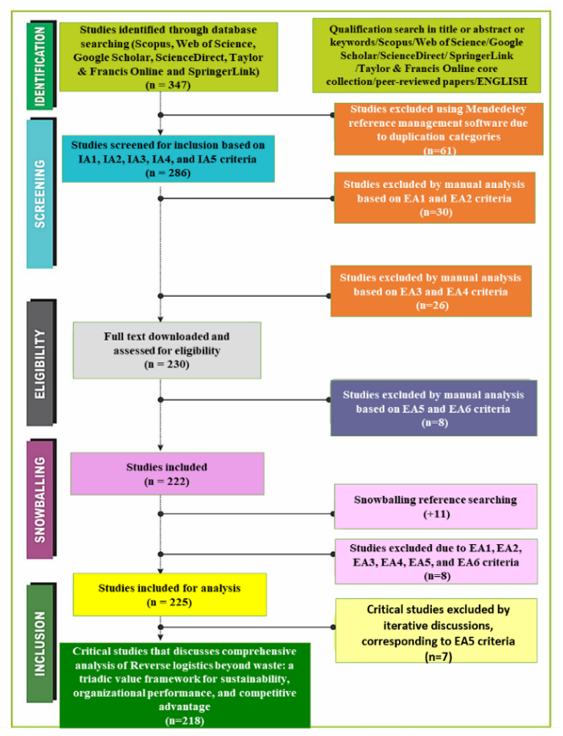
The initial background research resulted in the identification of 347 studies, of which 218 were identified as pivotal ones and used in the final synthesis (see Figure 1 for details). The records from the six data sources and platforms were filtered for language and peer-review status, deduplicated with the help of Mendeley, filtered for structured data using the IA1–IA5 criteria, and finally screened for full-text eligibility using EA1–EA6. The iterative refinement process and subsequent snowballing further refined the corpus. It is a systematic process that blends broad retrieval, rule-based screening, eligibility assessment, and interpretative enhancement, all of which ensure a formal analytical underpinning for the study's triadic methodology of RL.
Figure 1. Study refinement and integration workflow
2.1 Qualitative evidence synthesis and framework derivation
Studies were analysed using an abductive thematic framework synthesis based on the deductive and inductive coding (DIC) approach, through which all 218 retained studies were analysed. The three value dimensions (VCs) in the deductive coding were related to sustainability contribution, organisational-performance improvement, and competitive-advantage formation, whereas the mechanisms, outcomes, enablers, barriers, and contextual conditions were identified through the inductive coding of the studies. Geographical and sectoral contexts were noted in a study-level evidence matrix, as were the RL activities, sustainability outcomes, organisational performance effects, strategic outcomes, enabling and inhibiting conditions, and the methodologies applied. Individual studies contributed evidence to multiple themes by being broken down into mechanism–outcome statements as the analytical unit. Descriptive codes, process codes, and outcome codes were used to explain aspects of the mechanisms developed for material recovery, waste and emission reduction, optimisation of energy and transport usage, customer retention, capability development, traceability, regulatory conformity, stakeholder legitimacy, secondary sourcing, and disruption continuity. In the first cycle of coding, codes with similar concepts were combined, while individual codes were not merged. Second-cycle pattern coding was used to group codes into mechanism–outcome chains, and these were further grouped into mechanism–outcome patterns, sustainability-contribution patterns, organisational-performance patterns, and strategic-implication patterns. Pathways (themes) were selected for retention based on sufficient corpus support, conceptual agreement, thematic differentiation, and explanatory relevance for at least two dimensions in the triadic framework. This process resulted in the following potential value pathways: resource recovery; efforts to become 'eco-efficient'; service recovery; capability development; digital tracking; establishing legitimacy and governance; and resilience. Strategic outcomes were then clustered through one or more steps to yield six regimes of comparative advantage: cost-recapture, carbon-compliance, service-differentiation, resilience, digital-orchestration, and ecosystem-legitimacy advantages. The seven pathways and six regimes are deliberately non-one-to-one. The pathways are mechanisms that generate value for RL, whereas the advantage regimes are higher-order strategic outcomes developed through one or more interacting pathways. Eco-efficiency, for instance, could contribute to cost recovery and carbon benefits; legitimacy and governance may help build preparedness and ecosystem legitimacy. The preliminary framework was then reviewed to determine coverage, exclusion of negative cases, the degree of sectoral dependence, and the degree of conceptual overlap across the 218-study evidence matrix. The framework is non-quantitative and non-causal in nature, representing qualitative convergence not across quantitative evidence but across heterogeneous evidence.
2.2 Current research status
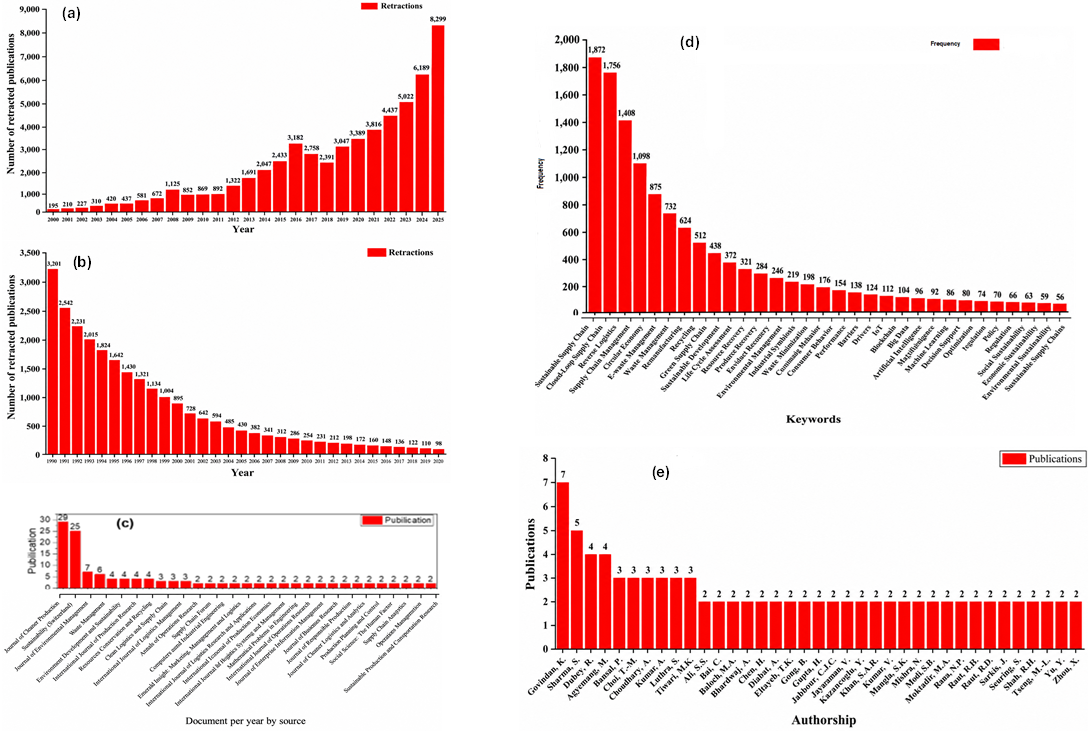
As shown in Figure 2, there was significant growth in the number of RL research articles between 2007 and 2025. Regarding annual publications, they slowly increased from a few studies in the early years to the rapid growth observed in recent years, with 2025 showing the highest level of output. This indicates that RL has moved from a specialised waste management research area to become a more strategic research field involving the circular economy, sustainable operations, recovery systems, and competitiveness. The literature is distributed globally, and a significant amount of information comes from several leading national research systems, including China, India, Brazil, the United States, Europe, Africa, and others. The same trend is reflected in publication outlets, with interdisciplinarity not only increasing across logistics journals but also emerging in journals focusing on sustainability, environmental management, operations, circular production, and industrial strategy. Keyword patterns suggest a well-developed conceptual foundation focusing prominently on RL, sustainability, sustainability transitions, circular economy, closed-loop supply chains, recycling, and remanufacturing, while other increasingly emerging themes include digital product lifecycles, resilience, ESG, product returns, and innovative recovery systems. The observable trends also show that the field is largely dominated by specialised research groups, with a growing presence of multidisciplinary collaboration not only within operations, environmental assessment, data analytics, and governance but also in sector-specific expertise.
Figure 2. Current research status of the revealed reverse logistics (RL) beyond waste: a triadic value framework for sustainability, organizational performance, and competitive advantage, (a) number of annual publications, (b) document by country, (c) document per year by source, (d) keywords, (e) authorship distribution
3.1 Reframing reverse logistics: The triadic value creation lens
3.1.1 Defining reverse logistics in contemporary supply and circular systems
RL is the intentional design and planning of reverse supply chain activities to retrieve a product, its components, materials, packaging, embedded energy, and information after use or after the loss of value. It goes beyond disposal to cover collection, sorting, refabrication, refurbishing, reuse, recycling, redistribution, compliance, and digital visibility. With the concept recently being widely adopted in closed-loop and network studies, the use of RL as a circular operations architecture that incorporates facility location, recovery routing, remanufacturing, and disposition decisions is gaining popularity [10, 11]. Evidence based on international experience also shows the link between the use of circular resource management and increased operational efficiency, organisational capacity, and value recovery [12, 13]. RL continues to base its work on sustainability principles that include waste reduction, pollution reduction, landfill prevention, and decreased virgin resource consumption. These benefits are not, however, explained by sustainability alone but rather by how they are implemented, scaled, and sustained. The effects of RL on costs, asset utilisation and operation, customer service, resource security, regulatory liabilities, and competitiveness are evident in product returns, packaging, batteries, manufacturing, pharmaceuticals, and mining products [14-16]. It also has an impact on social inclusion, institutional legitimacy, public health, and stakeholder engagement [17-19]. Sustainability-focused interpretations are thus valuable but incomplete, as RL generates environmental, organisational, and strategic value.
3.1.2 The triadic proposition
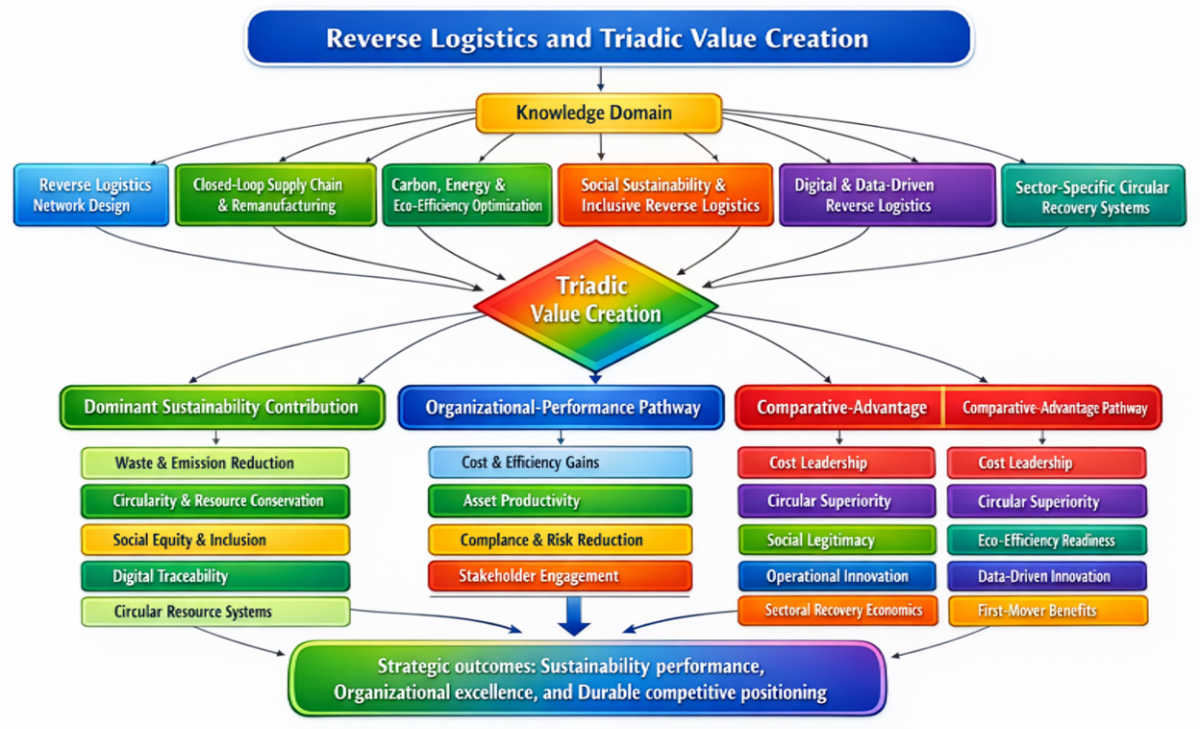
The proposed framework consists of three dimensions of RL that are connected to each other: sustainability contribution, organisational performance, and comparative advantage. The concept of sustainability involves minimising waste, reusing materials, reducing emissions, responsible consumption, and the inclusion of people [20-22]. Organisational effectiveness is measured in terms of cost efficiency, asset utilisation, inventory productivity, service responsiveness, implementation capability, and managerial coordination [23-25]. These capabilities give rise to "cost recapture," "service differentiation," "digital orchestration," "resilience," and "ecosystem legitimacy," which can establish comparative advantage [10, 26]. The three dimensions interact with one another in various ways. When one dimension is assigned to another dimension, it follows a value conversion chain. These enhancements, when multiplied and scaled, lead to strategic gains such as cost leadership, customer loyalty, resilience, regulatory readiness, and data-oriented coordination [7, 16, 27]. RL is thus conceptualised as a self-reinforcing value creation system within the framework of three components: sustainability as an environmental directive, organisation-based performance as a lever for implementation, and competitive advantage as a tool for sustainability action and scalability, shifting the paradigm of RL from a waste management system to a tool for circular transformation, as shown in Figure 3.
Figure 3. The proposed integrative framework of reverse logistics (RL) and triadic value creation
3.2 Knowledge domains of reverse logistics: Network design and configuration
Ten knowledge areas of RL are interconnected to describe the value to sustainability, organisation, and strategy that stems from reverse flows. Network design and configuration influence four factors: waste, emissions, virgin-material dependency, and cost efficiency/recovery (virtuosity) in terms of facility locations, collection channels, routing, and recovery capacity, etc. [10, 23]. Closed-loop supply chains and remanufacturing coordination bring recovered products and materials back into the system via repair, remanufacturing, recycling, or reuse, enhancing asset productivity and inventory efficiency, as well as lifecycle value and cost recovery [28-31]. Green routing and carbon-sensitive network design minimise emissions, energy use, transportation pressure, and regulatory risk by optimising the network in terms of carbon, energy, and eco-efficiency [17, 32-34]. Social sustainability is a component of inclusive RL that encompasses a number of elements, including employment, participation in the informal sector, provision of stakeholder rights, health, and community involvement. There is evidence documenting the positive association between waste-picker integration and increased recovery efficiency, more successful livelihoods, social legitimacy, and stakeholder acceptance [35-37]. RL is digital, data-driven, and intelligent, enabling greater traceability, forecasting, monitoring, responsiveness, and simpler and better ecosystem organisation with the help of machine learning, blockchain, RFID, big data, and real-time analytics [38, 39]. RL is customised to industry features, with the development of sector-specific circular recovery systems. While batteries present risk management and state-of-health issues, e-waste involves extensive disassembly and contamination, and plastics suffer from disassembly and safety challenges. Traceability is particularly important in healthcare [40, 41]. Consumer returns and service recovery involve understanding how return intentions, ease of returns, return costs, trust, and service design affect returns and service experiences. Optimal systems can minimise unnecessary returns and enhance customer satisfaction, retention, and after-sales differentiation [42, 43]. Adoption is influenced by governance, policies, and institutions. Appropriate institutional alignment enables the institutionalisation of recovery systems [44-46]. Implementation readiness and capabilities include managerial support, resources, skills, infrastructure, coordination among stakeholders, and technological readiness. There is evidence that poor organisational capacity and poor coordination are often limiting factors for implementation [47-49]. Lastly, performance measurement and assessment include lifecycle assessment, sustainability metrics, reference models, and multi-criteria approaches to evaluate environmental, organisational, and strategic results [50]. These ten domains are integrated together to form the knowledge base of the study's integrated RL architecture.
3.3 Reverse logistics as a triadic value engine: Integrated pathways and amplification mechanisms
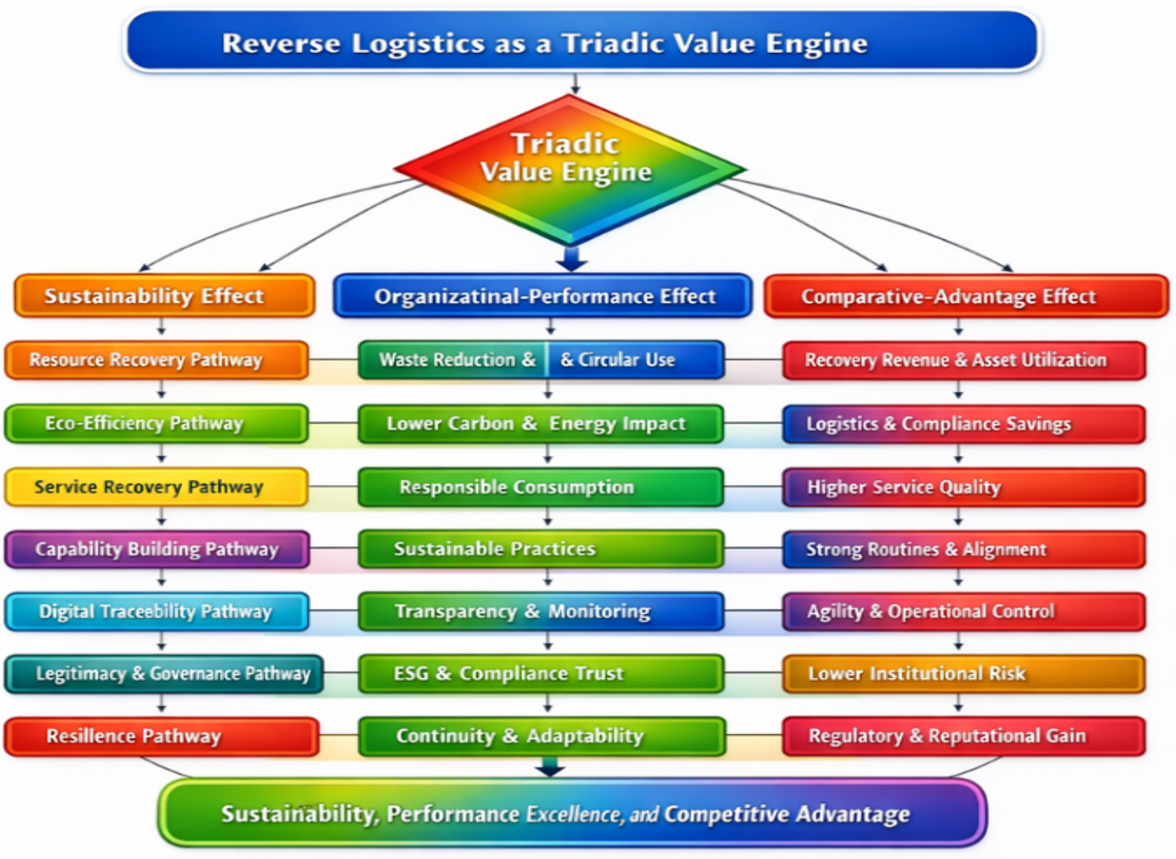
Figure 4 and Table 3 show a conceptualisation of RL as a "value engine" with three parts. It is a value-generating engine for sustainability outcomes, improving organisational performance, and gaining competitive advantages. These lead to seven value pathways: resource recovery, eco-efficiency, service recovery, capability development, digital traceability, legitimacy and governance, and resilience. Resource recovery can transform waste into usable resources. However, it can also help alleviate reliance on virgin materials, enhance resource security, and improve asset utilisation [7]. Eco-efficiency minimises environmental impacts and operating costs, and aids carbon compliance and green cost leadership [51]. Service recovery converts returns into opportunities for customer retention and differentiation [1]. Capability development integrates skills, routines, and implementation readiness, whereas digital traceability enhances visibility, coordination, and differentiation via data [26, 39]. Governance builds trust in Environmental, Social, and Governance (ESG), alignment with regulation, and stakeholder legitimacy [16], while resilience ensures recovery and service continuity in times of disruption [9]. These pathways can have different significance depending on each sector and institutional landscape. The pathways collectively illustrate how environmental and social improvements are translated into organisational capabilities and strategic outcomes, and how the RL process can be a strategic circular capability that co-produces sustainability, organisational performance, and enduring competitive value.
Figure 4. Reverse logistics (RL) as a triadic value engine
Table 3. Reverse logistics (RL) as a triadic value engine
|
Reverse-Logistics Value Pathway |
Sustainability Effect |
Organizational-Performance Effect |
Comparative-Advantage Effect |
References |
|
Resource recovery pathway |
Waste reduction, circular material use, lower extraction pressure |
Recovery revenue, lower raw-material cost, higher asset utilization |
Cost and resource-security advantage |
[16, 52] |
|
Eco-efficiency pathway |
Lower carbon, energy, packaging, and transport impacts |
Lower logistics and compliance costs |
Green cost leadership |
[34] |
|
Service-recovery pathway |
Lower return waste and improved responsible consumption |
Higher service quality and customer satisfaction |
Return-experience differentiation |
[16, 52] |
|
Capability-building pathway |
Better implementation of sustainable practices |
Stronger routines, readiness, and managerial alignment |
Difficult-to-imitate organizational capabilities |
[53] |
|
Digital-traceability pathway |
Better transparency and sustainability monitoring |
Improved forecasting, control, and operational agility |
Data-driven differentiation and ecosystem lock-in |
[54] |
|
Legitimacy and governance pathway |
Stronger ESG, policy compliance, and societal trust |
Lower institutional risk and stronger stakeholder support |
Regulatory and reputational advantage |
[55] |
|
Resilience pathway |
Better continuity under disruption and uncertainty |
Agility, robustness, and service continuity |
Competitive endurance under shocks |
[56] |
Resource recovery turns waste products into useful resources, with benefits including reduced waste, reduced reliance on virgin materials, and lower input costs for raw materials; lower waste costs, greater revenue, and greater resource security. Studies on steel, mining waste, and battery recovery have highlighted the benefits of reintegrating recovered resources into the productive value chain, in terms of both environmental and economic aspects. Studies conducted in the fields of steel, mining waste, and batteries have shown various environmental and economic advantages of the reintegration of resources into the productive value chain.
Eco-efficiency reduces the amount of emissions produced, energy used, packaging waste, transportation impacts, and environmental effects per recovered product value. Concurrently, routing and recovery networks can reduce environmental impacts and logistics expenses while reducing related compliance exposure [51, 57]. At scale, these improvements enable carbon compliance and green cost leadership. Effective return systems facilitate waste avoidance and increase responsiveness, customer satisfaction, retention, and after-purchase experiences [1, 52]. Participation can be influenced by convenience, cost, or trust and can lead to service recovery that brings sustainability benefits and differentiates the firm competitively [58]. Capacity development improves managerial buy-in, skills, practices, infrastructure, and organisational preparedness to institutionalise RL. Training, coordination, and sequencing of implementation are found to be important factors in successful adoption, as shown by findings from India, Ghana, and other emerging economies [13, 25]. These capabilities can facilitate enterprise growth and are potentially hard-to-replicate strategic capabilities.
Machine learning and other technologies are applied to gain visibility, predict, coordinate, and control reverse flows through blockchain, analytics, and real-time monitoring. Cross-sector and cross-domain applications in steel, agri-food, pharmaceuticals, and logistics show improved recovery decisions, compliance, product integrity, and stakeholder coordination [26, 39, 40, 54]. Digital traceability consolidates sustainability verification, agility, and data-driven differentiation. Governance adds value by aligning with ESG principles, fulfilling regulatory requirements, enhancing transparency, establishing stakeholder trust and credibility, and building institutional trust. Studies have shown that regulations and institutions can have a substantial impact on reverse-system performance [45, 46]. Good governance structures codify sustainability practices, diminish uncertainty, and provide regulatory and reputational benefits. Resilience provides flexibility, secondary sourcing, and alternative material streams for RL systems to maintain recovery activities and service continuity during disruptions. Automotive, healthcare, and vaccine networks provide evidence of the need for resilient systems under uncertainty [29, 56]. Resilience automatically helps safeguard sustainability commitments, organisational performance, and competitive position. The seven pathways are interconnected and not independent. Effective implementation is essential for resource recovery, while digital optimisation improves data quality, traceability, and the requirements of eco-efficiency. Service recovery depends on organisational capabilities and stakeholder trust, whereas resilience is strengthened through information visibility, adaptive coordination, and institutional support. Examples from battery systems, pharmaceutical supply chains, and e-commerce demonstrate how these pathways interact to enhance RL performance [37, 59]. The complementary pathways can therefore have not only additive but also multiplicative impacts on sustainability, organisational performance, and competitive advantage. In their general form, the mechanisms of RL are created through resource recovery, capability building, and legitimacy/governance, and these serve as the core pillars of resource recovery.
Generally, the mechanisms underlying RL are established through resource recovery, capability building, and legitimacy/governance, which include establishing material circularity, implementation capacity, and legitimacy/institutional credibility, respectively. The main enhancers, differentiators, and protectors of this value are eco-efficiency, service recovery, digital history traceability, and resilience. This is, however, not a hierarchical architecture but a context-dependent one. In the future, the recovery element may prevail in the context of mining and heavy industry, the service element in retail and e-commerce, and governance in healthcare and pharmaceuticals. Therefore, the structure is a flexible architecture, with pathway importance depending on the conditions in different contexts.
3.4 Reverse logistics–driven comparative-advantage regimes
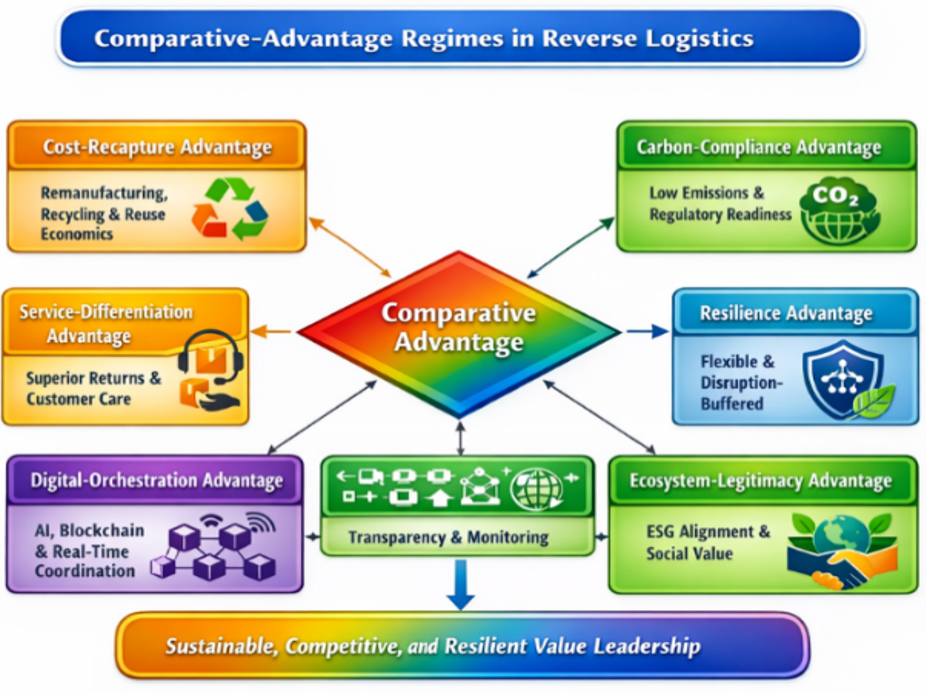
These pathways are combined to create six comparative-advantage regimes: cost recapture, carbon compliance, service differentiation, digital orchestration, and ecosystem legitimacy (see Figure 5). Cost recapture is based on reuse, remanufacturing, and resource recovery; carbon compliance is based on emission reduction and regulatory preparedness; service differentiation is based on improved returns and after-sales service. Resilience is derived from alternative recovery and sourcing paths, while digital orchestration relies on cutting-edge technologies to advance forecasting, visibility, and coordination. Ecosystem legitimacy is derived from alignment with ESG criteria, stakeholder engagement, regulatory trust, and social value. Importantly, the seven pathways and six regimes are not identified as one-to-one categories. Figure 5 is thus intended to illustrate how RL transforms the concept of circular recovery into operational capability, digital visibility, resilience, institutional credibility, and ultimately sustainable competitive advantage, turning RL into a strategic approach in the process of creating value from the circular economy rather than just a function of waste management.
Figure 5. Comparative-advantage regimes emerging from the corpus
Through the application of remanufacturing, recycling, reuse, and the economics of cost recovery, cost-recapture advantage transforms RL from a cost centre into a value-recovery system. It occurs when there is the economic reintegration of recovered materials, components, and products into productive systems, thereby lowering raw material costs and enhancing asset utilisation. Examples of using secondary resources in Kazakhstan mining, steel recovery in Brazil, the end-of-life battery network in China, and battery-material recovery in the U.S. illustrate how to decrease reliance on virgin materials and improve the economics of material recovery [12, 52]. Cost recapture thus signifies the strategic transformation of sustainability-based recovery into tangible strategies for cost and resource security.
The carbon-compliance advantage lies in the ability to achieve emission reductions and prepare for environmental mandates, decarbonization restrictions, and disclosure obligations. Environmental impacts, logistics, and compliance costs are reduced through eco-efficient collection, reverse routing, energy management, and recovery networks. These are illustrated by studies on plastics, last-mile delivery, cold chains, Australian PV waste, EU carbon-constrained systems, and green supply chains in Southeast Asia [32, 57, 60]. Thus, low-carbon reverse systems offer environmental advantages as well as lower exposure to regulation, greater compliance preparedness, and green cost leadership. The service-differentiation advantage refers to the service characteristics that make it more convenient for customers to use RL, provide rewards for their experiences, build their confidence, or respond to their needs after the product is purchased. Good returns management can not only minimise waste but also help improve customer satisfaction and loyalty [1, 52]. Other examples include customer-to-customer returns, return-pricing strategies, and reusable packaging; all are indications of the value of convenience, fairness, and service quality [58]. Well-designed RL therefore converts something that is an operational burden into something that is a brand differentiator for customers. RL can help alleviate reliance on fragile linear supply chains by providing alternative material streams and decentralised recovery channels. Several service cases, such as end-of-life vehicle networks, healthcare and vaccine supply chains, and responsive forward-reverse systems, illustrate how reverse networks can ensure the continuity of material flows and services in the face of uncertainty [56, 61]. This is particularly relevant for sectors that rely extensively on imported inputs or sectors that are affected by geopolitical, climatic, health, or transportation challenges and uncertainties. Thus, RL essentially represents a form of circular resilience that allows organisations to better cope with shocks than their competitors. The digital-orchestration factor comes into play when blockchain, machine learning, analytics, and real-time information enable more effective prediction, monitoring, coordination, and control of reverse flows. The need to digitalise is especially critical as the magnitude, timing, quality, and location of returns are all subject to uncertainty. Forecasting, traceability, compliance, and decision-making improvements in steel and agri-food systems, blockchain-based logistics, and last-mile recovery of pharmaceuticals exemplify machine learning and blockchain applications [39, 40]. Digital orchestration thus bolsters operational agility and sustainability monitoring and also provides data-driven differentiation by enhancing coordination across the entire ecosystem. ESG credibility, stakeholder engagement, added social value, transparency, and regulatory trust contribute to the ecosystem-legitimacy advantage. RL systems are evaluated not only by technical recovery rates but may also be assessed by their fairness, inclusiveness, accountability, and alignment with societal expectations. The various institutions involved in establishing and legitimising the scalability of reverse systems in Ethiopian industrial parks, ESG-oriented logistics organisations, Bottom-of-the-Pyramid (BOP) reverse systems, and Brazilian waste-picker integration are found in the literature and practice to influence institutional credibility and stakeholder inclusion in reverse recovery systems [17, 18]. RL can thus create competitive advantage through reputational capital, social licence, regulatory credibility, and stakeholder trust. Ongoing sustainability practices are no guarantee of successful sustainable positioning in the long term. The six regimes show an approach to sustainability practices that can move towards sustainable positioning. Defensible advantages through sustainability are almost invariably based on sustainable processes, capacities, technologies, and informal institutional arrangements that can only be copied with significant difficulty by competitors. Different mechanisms exist across different sectors. Heavy industry and mining combine resource recovery with cost stability, battery and electric-vehicle systems combine material security and compliance with recovery technologies, logistics systems introduce reverse flows with visibility and service continuity, while healthcare and pharmaceuticals integrate recovery with safety, traceability, trust, and resilience. As such, the concepts of cost recapture, carbon compliance, service differentiation, resilience, digital orchestration, and ecosystem legitimacy represent strategic connections within the circular value creation process. The creation of so-called durable advantage depends on the integration of sustainability contributions, organisational performance improvements, and competition into an integrated, coordinated, cross-functional system that encompasses RL. For RL, strategic durability is not the promise of going beyond sustainability, but rather of laying the groundwork for sustainability to become an actual means of operational discipline, ecosystem coordination, and the creation of defensible competitive value.
3.5 Sectoral applications of reverse logistics: Contextual heterogeneity and cross-sector comparison
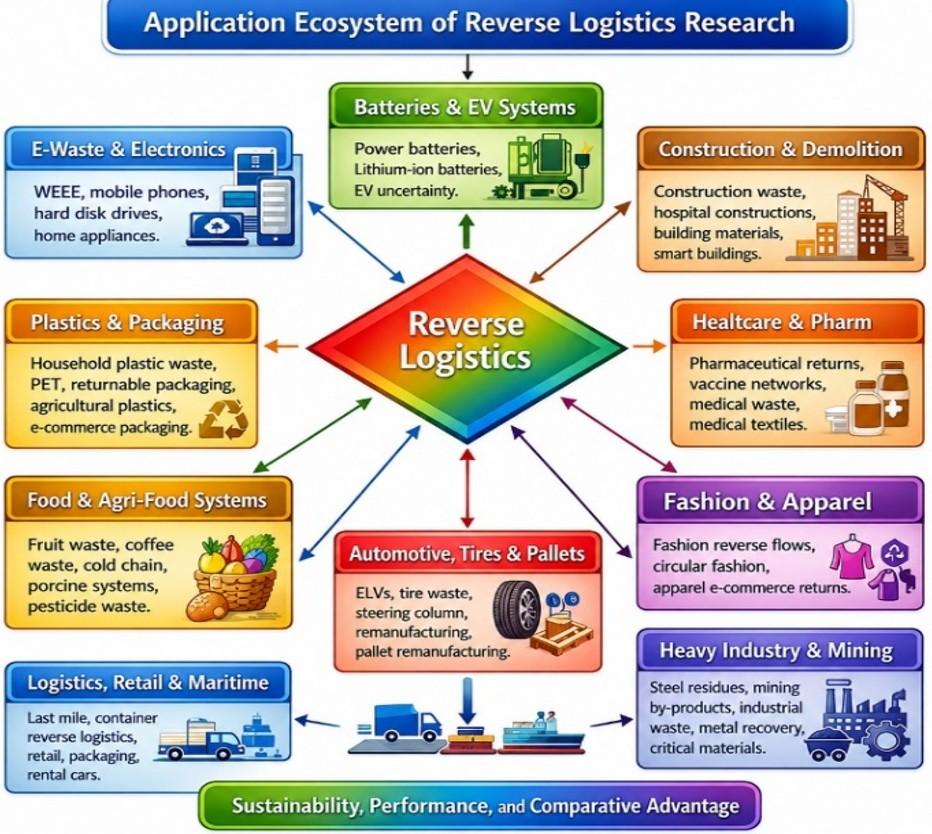
The aim of the strategy was to enable a shift towards neutral logic—with the strategic relevance of this logic remaining broadly transferable, although its relevance is fully sector-specific in implementation. The value of e-waste and electronics is based on safe disassembly and sorting components into their appropriate materials [62]. Uncertain battery conditions, hazardous materials, and the recirculation of strategically important materials are all aspects that must be managed in battery and EV systems. Collection density and contamination, consumer participation, and the economics of high-volume, relatively low-value flows shape the form of plastics and packaging [20]. There are several critical challenges for construction and demolition systems, including volumetric production, fragmented projects, multi-temporalities, and fragmented stakeholders. Safety, traceability, regulatory needs, and public confidence are as significant as the economic aspects of recovery in healthcare and pharmaceuticals [37]. Consumer-return behaviour, opportunities for resale, service design, and the positioning of circular brands prevail in the field of fashion and apparel, while perishability, contamination risks, and time-dependent recovery are limiting circumstances in food and agri-food systems [63]. Moreover, there is a focus on remanufacturing, reuse, and making secondary supplies resilient for automotive, tyre, and pallet systems, as well as on backhauls, asset cycles, container repositioning, and service continuity for logistics, retail, and maritime systems [19]. Figure 6 thus shows that there is no universal technical configuration for RL. Instead, all industries share a common goal of transforming reverse flows into sustainability, competitiveness, and organisational-performance outcomes, and the means to achieve these outcomes vary with material properties, regulation, technology, customer actions, market organisation, and institutional context. Consequently, the framework is not restricted by the term contextual heterogeneity; rather, contextual heterogeneity is a given condition that defines the creation of circular competitive advantage across sectors.
Figure 6. Sectoral application ecosystems and contextual heterogeneity
RL is able to tackle the problems of hazardous materials, short product lifecycles, the variety of components, and significant recovery opportunities through collection, sorting, disassembly, refurbishment, remanufacturing, recycling, and reuse. These activities help eliminate harmful releases and landfill waste and recover valuable materials [62]. Organisations benefit from asset recovery and have specific diagnostic and disassembly skills that give them a circular competitive edge. Recovering batteries or EVs is a complex process involving hazardous materials, unknown battery conditions, limited resources, and specialised recovery equipment. RL can reduce hazardous waste, primary resource extraction, and boost recovery economics and compliance. Research findings from China and the United States clearly show how collection systems, facility configurations, and critical-material recovery affect industrial resilience and competitiveness. The benefit is better access to secondary materials, as well as protection from raw material fluctuations and the availability of specialised infrastructure [64]. Plastics and packaging are high in volume, low in unit value, and show great reliance on collection efficiency and consumer participation. Effective RL minimises landfill leakage and virgin polymer usage and enhances packaging reuse, routing, and sourcing efficiency [20]. Scale and standardisation, participation, and efficient closed-loop packaging systems are key elements of competitive advantage, particularly when considering scale. The reuse of materials and the diversion of materials away from landfill provide environmental benefits, and additional benefits include better site logistics, cost control, and staff coordination [65]. This circular-building expertise and these recovery competencies can then provide a competitive edge [49].
Safety, traceability, regulatory compliance, and public trust are paramount in the healthcare and pharmaceutical realm of RL prioritisation. Pharmaceutical returns, medical waste utilisation, vaccine, and textile management are effective in avoiding environmental and health hazards. They also enhance inventory management, compliance, service, and resilience [37, 61]. The reliability of recovery infrastructure thus becomes a key condition for achieving competitive advantage, which is based on the concepts of safety, traceability, economic, and institutional credibility [66]. Short return cycles, seasonality, short lifecycles, and consumer behaviour are all factors impacting RL. Efficient return processing maximises inventory recovery, while textile reuse, resale, and efficient repair minimise textile waste [63]. Then, the circular economy and secondary markets help differentiate services and brands, but the recovered value is subject to style, condition, hygiene, and seasonality [67]. The concept of these systems involves remanufacturing, component recovery, reuse, and after-market circulation. RL helps extend product life, reduce virgin material demand, and improve parts availability, as well as parts recovery economics [28]. Stable vehicle networks offer alternative supply lines, and tyre and pallet systems illustrate the value of specific recovery systems and multi-time asset utilisation [44].
Agri-food RL is subjected to time sensitivity, biological variability, product contamination, and perishability. Better coordination of the cold chain and implementation of forward–reverse integration can boost performance; reducing food waste and utilising organic resources more effectively will mean that further recoveries can be made [22]. Competitive value occurs when residues are sold as additional products, feed, or energy [68]. The importance of real-time coordination cannot be overstated, especially when it comes to recovered value, which can rapidly decrease. Heavy-industry and mining RL regenerate heavy-industry and mining residues into productive resources. Steel and mining recovery lower landfill disposal and virgin resource extraction, along with reducing material costs and improving integration and asset utilisation in the process [20, 39]. The competitive advantage is thus based on resource security, lower commodity exposure, and connecting recovered resources with circular industrial systems. These are often sectors that focus on the flow of assets, containers, vehicles, information, and customer services. RL minimises unnecessary transportation, maximises backhaul utilisation, and facilitates package reuse and asset reuse [57]. Costs, visibility, responsiveness, and asset utilisation are enhanced through route optimisation and digital coordination, thus generating advantages in terms of avoiding resource losses and ensuring reliable supply chain processes [26]. The analysis of the cross-sections reveals a parallel triadic value logic across different layers with different implementation mechanisms. In mining and steel, temporal sensitivity is ubiquitous, as are material hazards in batteries and pharmaceuticals, consumer behaviour influences in fashion, and time sensitivity in e-commerce. There are also widely varying infrastructure maturity levels and regulatory, technological, and institutional conditions. The principle of best practice, as such, should therefore not be applied at the national level in the context of RL. The most portable of its principles is the three-pronged process of creating sustainability, organisational-performance, and competitive-advantage results; however, the implementation process must remain sector-specific.
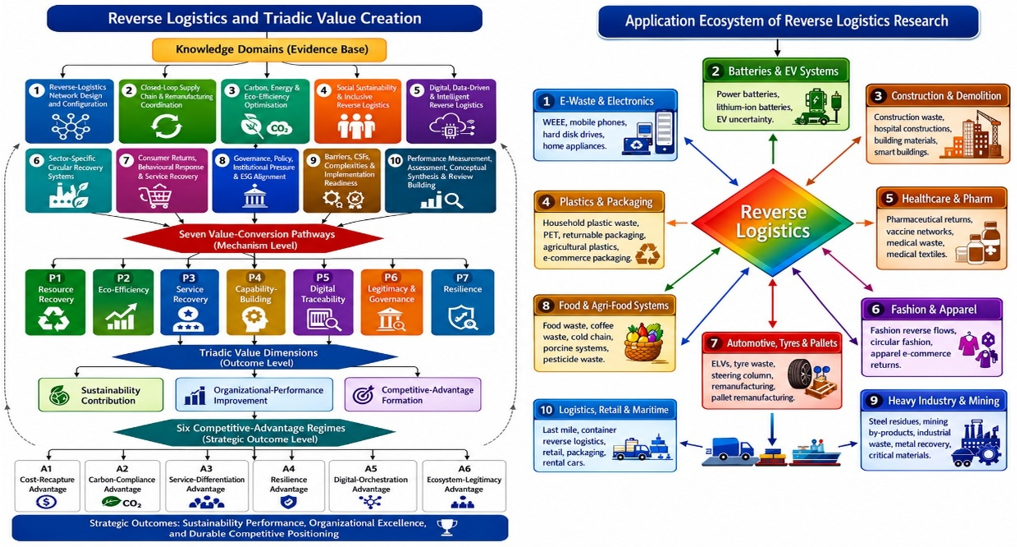
Figure 7 presents an evidence-to-application architecture and integrates all 218 studies in the corpus. These include 10 knowledge domains and 7 value pathways, including resource recovery, eco-efficiency, service recovery, capability building, digital traceability, legitimacy and governance, and resilience. These pathways offer three value dimensions: sustainability contributions (such as waste reduction, emission reduction, and resource use/cycling), organisational-performance improvement (such as asset productivity, service quality, asset visibility, compliance, service continuity, and cost efficiency), and competitive advantage. Figure 7 thus links the evidence base to the impact of value mechanisms on sectoral applications and adds feedback loops bringing insights from applications to digital infrastructure and governance, and from digital infrastructure and governance back to applications. RL is thus not a waste endpoint but a modular system that can be configured and made self-reinforcing for creating circular value.
Figure 7. Integrated evidence-to-application framework of reverse logistics (RL)
Ten corpus-derived knowledge domains converge through seven value-conversion pathways and three triadic value dimensions to generate six competitive-advantage regimes. The right panel demonstrates how this shared architecture is configured across ten distinct sectoral ecosystems, revealing both transferable value principles and context-specific recovery conditions.
3.6 Cross-cutting enablers and conditions for scaling reverse logistics: Institutional alignment, digital traceability, and stakeholder engagement
When the institutional regulatory environment is aligned, RL processes are formalised and scaled up from fragmented processes. Compliance, accountability, risk management, and legitimacy can be enhanced through regulation, subsidies, carbon policies, ESG requirements, and producer responsibilities. For industrial parks in Ethiopia, institutional pressure has been shown to improve environmental performance, and in the pharmaceutical industry, similar mechanisms improve the economic feasibility of safe recovery [37]. In addition, carbon-sensitive models and recovery studies show the impact of regulatory signals on recovery economics and technology decisions [46]. Therefore, the scaling-up of RL becomes more efficient when roles are clarified by regulation, incentives exist, and recovery is economically and institutionally viable. Digital infrastructure eliminates return uncertainty regarding quality, quantity, location, ownership, and timing. Machine learning, distribution networks (DNs), blockchain, big data, and real-time analytics add value in terms of traceability, forecasting, control, and coordination. Applications in steel, agri-food, last-mile logistics, and pharmaceuticals showcase recovery decision support, dynamic monitoring, trusted data sharing, and chain-of-custody management [20, 26, 39, 40]. Digitalisation allows RL to scale in terms of information clarity in addition to physical infrastructure. Without data and traceability, reverse systems are reactive and cannot be easily optimised [38]. This involves assessing and mapping the steps needed for the organisation to be ready to create new capabilities and innovate within its existing ones. RL will either be an integrated capability or an individual sustainability initiative depending on organisational readiness. It is especially instrumental that proper infrastructure, cross-functional coordination, training, management commitment, implementation routines, and professional competence are in place [25]. The experience from India and Ghana shows that a lack of capability can result in circular objectives not becoming practices [69]. Additionally, understanding continuous improvement and dynamic capabilities helps organisations institutionalise learning from recovery processes [70]. Organisational readiness, as a prerequisite and competitive advantage, requires the capacity for reverse innovation to be developed as ideas that are difficult for competitors to replicate. Therefore, stakeholder acceptance has a direct influence on the scalability of RL. Enhanced environmental performance, employment, trust, and social legitimacy can be achieved in a single recovery system that is inclusive of the project. Experience with base-of-the-pyramid systems in Australia and the inclusion of waste-picker cooperatives in recovery show that including stakeholders benefits recovery without the need for unfair distribution of value [17, 18]. Pharmaceutical and e-commerce research show that stakeholder trust and sensemaking are vital to research [59, 60]. Reverse flows have different amounts, qualities, timings, and locations, and networks must be designed to react to uncertainty. Continuity and resilience are reinforced by flexible capacity, redundancy, responsive routing, resource sharing, and designing for uncertainty. Distributed end-of-life vehicles, vaccination systems, forward-reverse networks, and agri-food recovery show how flexible architectures, in both disruptions and routine variability, are important [22, 56, 61]. The adaptability of recovery infrastructure, information flows, and partnerships to changing conditions is therefore an important part of scalability that goes beyond network size.
In the electronics industry, potential hazards include safety issues and the handling of hazardous materials [62]; batteries include uncertainty about state of health and requirements for specialised technology; plastics include contamination, unit valuation of the product range, and location restrictions on collection [20]; construction includes the challenges of high bulk material volumes and achieving service levels with split actors involved in the process [38]; healthcare is all about safety, traceability, and compliance [39]; fashion refers to consumer behaviour and aesthetic obsolescence; mining involves process integration and commodity economics; logistics includes efficient asset circulation and service coordination [19]. RL is thus impossible to scale using a universal model, and these constraints in different sectors should guide the design of a system considering material, environmental, technological, regulatory, behavioural, and organisational factors. The approaches outlined in that paragraph were found to work in some contexts and be less successful in others. The corpus is used to illustrate the use of configurational alignment to achieve the success of RL as opposed to relying on a single factor. Effective systems involve a mixture of institutional support, digital visibility, organisational capacity, stakeholder legitimacy, network adaptability, and sector-specific design. If there is weakness in one or more dimensions, informality and fragility in recovery systems may result, and the transition from waste management to intelligent orchestration is an example of this. Mature systems operate recovery as part of strategic, digitised, resilient, circular infrastructure, while less mature systems focus on compliance or are operationally disjointed. The overall conclusion drawn from the 218-study body of work is thus that scaling is context-specific but systematic.
4.1 Discussion structured by research questions
Guidelines for the assessment and development of RL in printed circuit board manufacturing companies conceptualizing RL as a triadic value-conversion architecture, rather than as a downstream disposal function, are addressed in research question one. Resources, information, customer value, and material security are recovered resources that include returned products and residual materials [1]. It depends on network design and closed-loop coordination whether this residual value can be collected, processed, remanufactured, and re-integrated [10]. What is important to highlight here is the potential for the generation of sustainability, organisational performance, and competitive advantage all at once. Steel-residue recovery, for example, can decrease waste and dependence on the use of virgin materials, reduce production costs, and at the same time achieve environmental protection; battery recovery, on the other hand, can achieve environmental protection, critical-material security, and industrial competitiveness [12, 71]. These benefits are then embedded in routines that are difficult to imitate through dynamic capabilities and organisational learning. RL is thus strategic when governance, data, capabilities, and network design allow the benefits of sustainability to be transformed into measurable organisational and competitive value.
Knowledge domains and pathways as configurational mechanisms in research question two specify the knowledge domains and value pathways. Network design sets up structural conditions for recovery, and closed-loop coordination provides appropriate reuse, remanufacturing, recycling, and disposal strategies [10]. In terms of capability building, institutionalisation enables implementation [25]. Pathway complementarity, contextual fit, and measurable conversion are therefore key to competitive advantage, even though there may not be a universal best practice. Four evolutions are shown for research question three. Early RL was centred on issues of waste disposal and pollution control [4]. Thereafter, closed-loop systems, remanufacturing, carbon limits, and optimisation were added in further studies [16]. In a shift from its predecessor, research question three redefined RL as a management capability influenced by management, stakeholders, and implementation readiness [25]. Research question four takes the field one step further and makes it more intelligent, resilient, and platform-enabled to orchestrate and manage an ecosystem. The upswing starts with technological developments but also changes how things are analysed and how value is created. The methods have shifted from description to optimisation, structural modelling, machine learning, blockchain, and networks with uncertainty [39]. These digital technologies have been used to improve visibility, prediction, coordination, and verification [26, 40]. However, digital technologies create value only when accompanied by appropriate governance, processes, incentives, and organisational capabilities [38]. In research question four, we showed that industry competitive advantage relies on the alignment between materials, consumer behaviours, regulation, time sensitivity, information, and capabilities. Cost-recapture advantage is greater if end-of-life materials have received significant added value, particularly in industry sectors such as mining, steel manufacturing, and batteries [52]. Where emissions and regulations significantly affect reverse-network economics, carbon-compliance advantage becomes a relevant factor. In customer-facing systems, the service differentiation approach prevails, while digital orchestration is useful in information-intensive and fragmented networks [38, 59]. Resilience is significant when disruptions occur, and ecosystem legitimacy is important when ESG credibility and stakeholder acceptance affect system viability [61]. Pathways and advantage regimes are strategically relevant depending on sectoral and geographic settings. A common feature among the scaling infrastructures described in research question five is how they are connected by inter-reinforcing governance, capability, traceability, and measurement. Governance creates and defines responsibilities, motivations, expectations, and accountability. Capability delivers these requirements in terms of routines and coordination, including continuous improvement. Traceability provides continuity of information, identification of products, ensures the integrity of the chain of custody, and coordinates product recovery [38]. Symbolic activities differ from environmental, organisational, and strategic improvements because they can be measured. RL should thus be operated as infrastructure, built as organisational competence, managed through information, and evaluated based on triple sustainability–performance–advantage considerations.
4.2 Future research agenda based on the synthesis, five gaps are found
First, there is a need for increased focus on RL resilience in the face of climate change, geopolitical disruptions, and critical-material scarcity, including batteries, healthcare, food, and mining. Second, technological ecosystems, in this case AI, blockchain, RFID, Internet of Things (IoT), digital twins, and analytics, should be explored as a whole. Third, the study of consumer return behaviour, pricing, convenience, trust, and after-sales services should undergo further behavioural research. Fourth, socially inclusive RL, especially informal collectors, workplace safety, value sharing, and community-based recovery, is needed in developing economies. Fifth, there needs to be more convincing causal evidence. Time-series, quasi-experimental, mixed-methods, and multilevel studies should examine the development of sustainability, organisational performance, and competitive advantage resulting from RL practices as a function of time.
5.1 Limitations of the study
The main drawback is the diversity across the 218 studies included in the corpus, ranging from conceptual studies and reviews, bibliometric analyses, optimisation models, and case studies to empirical research across a wide range of business areas and regions. This breadth provides a better theoretical synthesis but lacks the capacity for direct comparative comparisons and causal inference processes. Geographical evidence is also found in varying quantities, with more prominent voices from Brazil, China, India, the United States, the United Arab Emirates, Ethiopia, Malaysia, Indonesia, and some areas in Europe compared with a number of other regions. Moreover, features of comparative advantage, such as cost outcomes, resilience, and traceability, are often assumed or examined over shorter terms rather than longitudinally. The triadic model is drawn from interactions between pathways, and there is little longitudinal evidence to draw conclusions about how sustainability improvements become embedded as sustainable competitive positions. A study of this sort should be considered primarily as a conceptual synthesis and a theory-building study, rather than as a causal model.
5.2 Future research directions
The next step should go beyond the optimisation of individual company recovery towards the design and organisation of smart circular ecosystems for resource security, industrial resilience, and competitiveness. Cross-sectoral research should involve complex, interrelated systems involving batteries and opportunities in electric mobility, construction waste and secondary-material markets, agricultural residues and bioresources, maritime logistics sectors, and circular distribution. Technologies including AI, digital twins, blockchain, robotics, advanced analytics, and real-time sensing should be explored not only as efficiency tools but also as approaches to adaptive governance, prediction, decentralised coordination, and resilient circular operational models. Research must also contribute to the development of justice-related RL, which involves formal/informal sector players, livelihood protection, working conditions, and value distribution rules. Lastly, RL needs to be better connected to national roadmaps on carbon neutrality, resource independence, digitalisation, circular economy development, and sustainable industrial competitiveness.
5.3 Concluding remarks
From an afterthought waste-recovery process, RL is now being embraced as a strategic tool that combines sustainability, organisational efficiency, and competitiveness. Moving from disposal correction to closed-loop optimisation and then to a digitally connected resilient ecosystem orchestration, its value creation through reverse flows is becoming more robust than ever before. The novel contribution of the study therefore lies in the following proposition: sustainability-oriented interpretations alone are insufficient. Sustainability contribution, organisational performance improvement, and competitive advantage are elements advanced in an integrated circular system, which makes RL transformational. In the analysis of e-waste, batteries, plastics, construction, healthcare, fashion, automotive systems, agri-food, mining, and logistics, effective RL depends on context-specific networks and combinations of network design, network governance, capabilities, digital intelligence, and measurement. This will require more robust theories, causal evidence, integrated digital systems, inclusive governance, and sector-sensitive implementation for continued progress. Ultimately, RL should be made purposive, managed, and measured as part of an organisation's strategic circular logistics processes and capabilities that can ensure sustainable value, resilience, and longevity.
All authors have participated in (a) conception and design, or analysis and interpretation of the data; (b) drafting the article or revising it critically for important intellectual content; and (c) approval of the final version. This manuscript has not been submitted to, nor is under review at, another journal or other publishing venue.
[1] Frei, R., Jack, L., Brown, S. (2020). Product returns: A growing problem for business, society and environment. International Journal of Operations & Production Management, 40(10): 1613-1621. https://doi.org/10.1108/IJOPM-02-2020-0083
[2] Dutta, P., Talaulikar, S., Xavier, V., Kapoor, S. (2021). Fostering reverse logistics in India by prominent barrier identification and strategy implementation to promote circular economy. Journal of Cleaner Production, 294: 126241. https://doi.org/10.1016/j.jclepro.2021.126241
[3] Uriarte-Miranda, M.L., Caballero-Morales, S.O., Martinez-Flores, J.L., Cano-Olivos, P., Akulova, A.A. (2018). Reverse logistic strategy for the management of tire waste in Mexico and Russia: Review and conceptual model. Sustainability, 10(10): 3398. https://doi.org/10.3390/su10103398
[4] Lu, L.Y., Wu, C.H., Kuo, T.C. (2007). Environmental principles applicable to green supplier evaluation by using multi-objective decision analysis. International Journal of Production Research, 45(18-19): 4317-4331. https://doi.org/10.1080/00207540701472694
[5] Chaabane, A., Ramudhin, A., Paquet, M. (2012). Design of sustainable supply chains under the emission trading scheme. International Journal of Production Economics, 135(1): 37-49. https://doi.org/10.1016/j.ijpe.2010.10.025
[6] Bing, X., Groot, J.J., Bloemhof-Ruwaard, J.M., van der Vorst, J.G.A.J. (2013). Multimodal network design for sustainable household plastic recycling. International Journal of Physical Distribution & Logistics Management, 43(5-6): 452-477. https://doi.org/10.1108/IJPDLM-04-2012-01134
[7] Lin, J., Li, X., Zhao, Y., Chen, W., Wang, M. (2023). Design a reverse logistics network for end-of-life power batteries: A case study of Chengdu in China. Sustainable Cities and Society, 98: 104807. https://doi.org/10.1016/j.scs.2023.104807
[8] Dutta, P., Mishra, A., Khandelwal, S., Katthawala, I. (2020). A multiobjective optimization model for sustainable reverse logistics in Indian e-commerce market. Journal of Cleaner Production, 249: 119348. https://doi.org/10.1016/j.jclepro.2019.119348
[9] Govindan, K., Gholizadeh, H. (2021). Robust network design for sustainable-resilient reverse logistics network using big data: A case study of end-of-life vehicles. Transportation Research Part E: Logistics and Transportation Review, 149: 102279. https://doi.org/10.1016/j.tre.2021.102279
[10] Kannan, D., Solanki, R., Darbari, J.D., Govindan, K., Jha, P.C. (2023). A novel bi-objective optimization model for an eco-efficient reverse logistics network design configuration. Journal of Cleaner Production, 394: 136357. https://doi.org/10.1016/j.jclepro.2023.136357
[11] Alamri, A.A. (2023). A sustainable closed-loop supply chains inventory model considering optimal number of remanufacturing times. Sustainability, 15(12): 9517. https://doi.org/10.3390/su15129517
[12] Dabees, A., Lisec, A., Elbarky, S., Barakat, M. (2024). The role of organizational performance in sustaining competitive advantage through reverse logistics activities. Business Process Management Journal, 30(6): 2025-2046. https://doi.org/10.1108/BPMJ-03-2023-0235
[13] Agyekum, K., Sackey, K.N.Y.S., Addoh, F.E., Pittri, H., Sosu, J., Danso, F.O. (2025). Key competencies of built environment professionals for achieving net-zero carbon emissions in the Ghanaian construction industry. Buildings, 15(10): 1750. https://doi.org/10.3390/buildings15101750
[14] Olivo, F., Junqueira, M.C., Furlan, M.B., Justi, P.A., de Morais Lima, P. (2020). Monetary losses caused by the absence of packaging reverse logistics: Environmental and economic impacts. Journal of Material Cycles and Waste Management, 22(6): 1801-1817. https://doi.org/10.1007/s10163-020-01070-x
[15] Ahmed, M.S., Hasan, M.F., Kabir, S.M.S., Khan, A.S., Khan, S.A. (2024). Sustainable management of spent lithium-ion batteries: The role of reverse logistics in the automotive sector. In Presented at the 1st International Conference on Industrial, Manufacturing, and Process Engineering (ICIMP-2024), Regina, Canada. https://doi.org/10.3390/engproc2024076061
[16] Li, X., Jiang, B., Meng, X., Bai, Y. (2025). Refining waste and elevating customer service: Assessing the efficacy of reverse logistics strategies for product returns management. Journal of Combinatorial Optimization, 49(5): 87. https://doi.org/10.1007/s10878-025-01320-4
[17] Brix-Asala, C., Hahn, R., Seuring, S. (2016). Reverse logistics and informal valorisation at the base of the pyramid: A case study on sustainability synergies and trade-offs. European Management Journal, 34(4): 414-423. https://doi.org/10.1016/j.emj.2016.01.004
[18] Ghisolfi, V., Chaves, G.D.L.D., Siman, R.R., Xavier, L.H. (2017). System dynamics applied to closed loop supply chains of desktops and laptops in Brazil: A perspective for social inclusion of waste pickers. Waste Management, 60: 14-31. https://doi.org/10.1016/j.wasman.2016.12.018
[19] Vicente, J.J., Neves, L., Marques, C. (2025). Impact of container reverse logistics on the maritime sector: Economic and environmental factors. Logistics, 9(3): 131. https://doi.org/10.3390/logistics9030131
[20] Bing, X., Bloemhof-Ruwaard, J.M., Chaabane, A., van der Vorst, J.G.A.J. (2015). Global reverse supply chain redesign for household plastic waste under the emission trading scheme. Journal of Cleaner Production, 103: 28-39. https://doi.org/10.1016/j.jclepro.2015.02.019
[21] Li, Z., Huang, J. (2018). How to effectively improve pesticide waste governance: A perspective of reverse logistics. Sustainability, 10(10): 3622. https://doi.org/10.3390/su10103622
[22] Geraeli, M., Roghanian, E. (2026). Integrated fruit waste management through a dynamic reverse logistics network using real-time data and machine learning. Journal of Environmental Management, 398: 128501. https://doi.org/10.1016/j.jenvman.2025.128501
[23] Beiler, B.C., de Arruda Ignácio, P.S., Júnior, A.C.P., Anholon, R., Rampasso, I.S. (2020). Reverse logistics system analysis of a Brazilian beverage company: An exploratory study. Journal of Cleaner Production, 274: 122624. https://doi.org/10.1016/j.jclepro.2020.122624
[24] Yusuf, Y.Y., Olaberinjo, A.E., Papadopoulos, T., Gunasekaran, A., Subramanian, N., Sharifi, H. (2017). Returnable transport packaging in developing countries: Drivers, barriers and business performance. Production Planning & Control, 28(6-8): 629-658. https://doi.org/10.1080/09537287.2017.1294271
[25] Mangla, S.K., Govindan, K., Luthra, S. (2016). Critical success factors for reverse logistics in Indian industries: A structural model. Journal of Cleaner Production, 129: 608-621. https://doi.org/10.1016/j.jclepro.2016.03.124
[26] Mofatteh, M.Y., Valilai, O.F. (2025). A blockchain ecosystem model for a sustainable last-mile delivery operation management. Transportation Engineering, 21: 100379. https://doi.org/10.1016/j.treng.2025.100379
[27] Farahani, S., Otieno, W., Barah, M. (2019). Environmentally friendly disposition decisions for end-of-life electrical and electronic products: The case of computer remanufacture. Journal of Cleaner Production, 224: 25-39. https://doi.org/10.1016/j.jclepro.2019.03.182
[28] Rajak, S., Vimal, K.E.K., Arumugam, S., et al. (2022). Multi-objective mixed-integer linear optimization model for sustainable closed-loop supply chain network: A case study on remanufacturing steering column. Environment, Development and Sustainability, 24(5): 6481-6507. https://doi.org/10.1007/s10668-021-01713-5
[29] Vasudevan, M.K., Prakash, G. (2016). Linking grave to cradle: The next big reverse logistics business. International Journal of Logistics Systems and Management, 23(4): 419-444. https://doi.org/10.1504/IJLSM.2016.075208
[30] Spadafora, M., Rapaccini, M. (2025). Exploring the linkages between servitization and circular economy: Remanufacturing as a product or as a service? Sustainable Technology and Entrepreneurship, 4(3): 100116. https://doi.org/10.1016/j.stae.2025.100116
[31] de Souza Junior, H.R.A., Dantas, T.E.T., Zanghelini, G.M., Cherubini, E., Soares, S.R. (2020). Measuring the environmental performance of a circular system: Emergy and LCA approach on a recycle polystyrene system. Science of the Total Environment, 726: 138111. https://doi.org/10.1016/j.scitotenv.2020.138111
[32] Bottani, E., Casella, G., Nobili, M., Tebaldi, L. (2022). An analytic model for estimating the economic and environmental impact of food cold supply chain. Sustainability, 14(8): 4771. https://doi.org/10.3390/su14084771
[33] Hidayat, Y.A., Kiranamahsa, S., Zamal, M.A. (2019). A study of plastic waste management effectiveness in Indonesia industries. AIMS Energy, 7(3): 350-370. https://doi.org/10.3934/energy.2019.3.350
[34] Reddy, K.N., Kumar, A., Ballantyne, E.E. (2019). A three-phase heuristic approach for reverse logistics network design incorporating carbon footprint. International Journal of Production Research, 57(19): 6090-6114. https://doi.org/10.1080/00207543.2018.1526422
[35] Viegas, C.V., Bond, A., Pontes, A.T., et al. (2023). Sustainability assessment of medicines reverse logistics in Brazil: Outcomes from the national and local systems. Sustainability, 15(20): 14675. https://doi.org/10.3390/su152014675
[36] Hervani, A.A., Sarkis, J., Helms, M.M. (2017). Environmental goods valuations for social sustainability: A conceptual framework. Technological Forecasting and Social Change, 125: 137-153. https://doi.org/10.1016/j.techfore.2017.07.015
[37] Liu, W., Wan, Z., Wan, Z., Gong, B. (2020). Sustainable recycle network of heterogeneous pharmaceuticals with governmental subsidies and service-levels of third-party logistics by bi-level programming approach. Journal of Cleaner Production, 249: 119324. https://doi.org/10.1016/j.jclepro.2019.119324
[38] Rodrigues, S.P., Gomes, L.D.C., Peres, F.A.P., Correa, R.G.D.F., Baierle, I.C. (2025). A framework for leveraging digital technologies in reverse logistics actions: A systematic literature review. Logistics, 9(2): 54. https://doi.org/10.3390/logistics9020054
[39] Dosti, A., Hajikarimi, A., Abedi, S. (2025). A machine learning-based framework to configure a sustainable reverse logistics in the steel industry. Journal of Optimization in Industrial Engineering, 18(2): 93-106. https://doi.org/10.71720/joie.2025.1211390
[40] Crooks, K., Haddud, A. (2025). Using radio frequency identification (RFID) technology in the pharmaceutical supply chain: The impact on competitive advantage. Sustainability, 17(4): 1378. https://doi.org/10.3390/su17041378
[41] Karimi, H., Wassan, N., Ehsani, B., Tavakkoli-Moghaddam, R., Ghodratnama, A. (2024). Optimizing COVID-19 medical waste management using goal and robust possibilistic programming. Engineering Applications of Artificial Intelligence, 131: 107838. https://doi.org/10.1016/j.engappai.2023.107838
[42] Dixit, S., Badgaiyan, A.J. (2016). Towards improved understanding of reverse logistics–examining mediating role of return intention. Resources, Conservation and Recycling, 107: 115-128. https://doi.org/10.1016/j.resconrec.2015.11.021
[43] Mayr, K., Amsl, S., Schwendtner, T., Kotzab, H., Teller, C. (2026). Return fees in online retailing-psychological mechanisms across fee designs and product categories. Journal of Retailing and Consumer Services, 89: 104652. https://doi.org/10.1016/j.jretconser.2025.104652
[44] Castañeda-Rodríguez, I., Pérez, A.T.E. (2025). Multi-objective model for end-of-life tires reverse logistics: Enhancing sustainability through a techno-political framework. Expert Systems with Applications, 291: 128203. https://doi.org/10.1016/j.eswa.2025.128203
[45] Aghaei, A., Cai, F., Wu, T. (2025). Game-theoretic analysis of policy impacts in competition between reverse supply chains involving traditional and e-channels. Smart Cities, 8(1): 36. https://doi.org/10.3390/smartcities8010036
[46] Liao, H., Wu, D., Wang, Y., et al. (2022). Impacts of carbon trading mechanism on closed-loop supply chain: A case study of stringer pallet remanufacturing. Socio-Economic Planning Sciences, 81: 101209. https://doi.org/10.1016/j.seps.2021.101209
[47] Pimentel, M., Arantes, A., Cruz, C.O. (2022). Barriers to the adoption of reverse logistics in the construction industry: A combined ISM and MICMAC approach. Sustainability, 14(23): 15786. https://doi.org/10.3390/su142315786
[48] Korku, A.G., Gaffar, V., Adib, S.M., Andriana, D. (2025). The impact of green logistics management practices on manufacturing firms' sustainability performance in Ghana and Indonesia. International Journal of Supply and Operations Management, 12(2): 215-235. https://doi.org/10.22034/ijsom.2024.110506.3185
[49] Kadaei, S., Nezam, Z., González-Lezcano, R.A., et al. (2023). A new approach to determine the reverse logistics-related issues of smart buildings focusing on sustainable architecture. Frontiers in Environmental Science, 10: 1079522. https://doi.org/10.3389/fenvs.2022.1079522
[50] Shahidzadeh, M.H., Shokouhyar, S. (2023). Toward the closed-loop sustainability development model: A reverse logistics multi-criteria decision-making analysis. Environment, Development and Sustainability, 25(5): 4597-4689. https://doi.org/10.1007/s10668-022-02216-7
[51] Bing, X., Bloemhof-Ruwaard, J.M., van der Vorst, J.G.A.J. (2014). Sustainable reverse logistics network design for household plastic waste. Flexible Services and Manufacturing Journal, 26(1-2): 119-142. https://doi.org/10.1007/s10696-012-9149-0
[52] Li, M., Maffei, A., Mukhanova, G., Kuldeyev, E., Amralinova, B., Tymbayeva, Z. (2025). Reverse supply chain optimization in Kazakhstan’s mining industry: Unlocking value from waste. Sustainability, 17(23): 10589. https://doi.org/10.3390/su172310589
[53] Kumar, P., Yadav, V., Sharma, M.K. (2025). Exploring challenges to sustainable practices in India's metal sector using DEMATEL approach. Discover Sustainability, 6(1): 777. https://doi.org/10.1007/s43621-025-01686-9
[54] Zeynali, F.R., Parvin, M., ForouzeshNejad, A.A., Jeyzanibrahimzade, E., Ghanavati-Nejad, M., Tajally, A. (2025). A heuristic-based multi-stage machine learning-based model to design a sustainable, resilient, and agile reverse corn supply chain by considering third-party recycling. Applied Soft Computing, 174: 113042. https://doi.org/10.1016/j.asoc.2025.113042
[55] Tsang, Y.P., Fan, Y., Feng, Z.P. (2023). Bridging the gap: Building environmental, social and governance capabilities in small and medium logistics companies. Journal of Environmental Management, 338: 117758. https://doi.org/10.1016/j.jenvman.2023.117758
[56] Saffari, H., Abbasi, M., Gheidar-Kheljani, J. (2025). A robust, sustainable, resilient, and responsive model for forward/reverse logistics network design with a new approach based on horizontal collaboration. Environment, Development and Sustainability, 27(10): 23439-23482. https://doi.org/10.1007/s10668-023-02954-2
[57] Akkad, M.Z., Rabee, R., Banyai, T. (2022). Energy efficiency optimization of last mile supply system with reverse logistics consideration. Acta Logistica, 9(3): 315-323. https://doi.org/10.22306/al.v9i3.315
[58] Eruguz, A.S., Karabağ, O., Tetteroo, E., van Heijst, C., van den Heuvel, W., Dekker, R. (2024). Customer-to-customer returns logistics: Can it mitigate the negative impact of online returns? Omega, 128: 103127. https://doi.org/10.1016/j.omega.2024.103127
[59] González Romero, I., Ortiz Bas, Á., Prado Prado, J.C. (2025). The perspective of key stakeholders on the sustainable design of reverse logistics in e-commerce: An interpretive sensemaking review. International Journal of Production Management and Engineering, 13(1): 122-136. https://doi.org/10.4995/ijpme.2025.22508
[60] Oteng, D., Zuo, J., Sharifi, E. (2022). Environmental emissions influencing solar photovoltaic waste management in Australia: An optimised system network of waste collection facilities. Journal of Environmental Management, 314: 115007. https://doi.org/10.1016/j.jenvman.2022.115007
[61] Torshizi, E., Bozorgi-Amiri, A., Sabouhi, F. (2024). Resilient and sustainable global COVID-19 vaccine supply chain design considering reverse logistics. Applied Soft Computing, 151: 111041. https://doi.org/10.1016/j.asoc.2023.111041
[62] Jin, H., Frost, K., Sousa, I., et al. (2020). Life cycle assessment of emerging technologies on value recovery from hard disk drives. Resources, Conservation and Recycling, 157: 104781. https://doi.org/10.1016/j.resconrec.2020.104781
[63] Fani, V., Bucci, I., Bandinelli, R., da Silva, E.R. (2025). Sustainable reverse logistics network design using simulation: Insights from the fashion industry. Cleaner Logistics and Supply Chain, 14: 100201. https://doi.org/10.1016/j.clscn.2024.100201
[64] Mahboubi, A., Keivanpour, S., Lamghari, A. (2026). Promoting circular systems in electric vehicle batteries: A use-oriented business model with sharing economy and reverse logistics integration. International Journal of Green Energy, 23(2): 298-315. https://doi.org/10.1080/15435075.2025.2553177
[65] da Silva, I.G., Martins, V.W.B., Junior, A.E., et al. (2025). Stakeholders and activities in reverse supply chains for construction and demolition waste: A literature review. Revista Brasileira de Ciências Ambientais, 60: e2653. https://doi.org/10.5327/Z2176-94782653
[66] Kharat, M.G., Kapoor, S., Parhi, S., Kharat, M.G., Pandey, S. (2025). Operationalizing sustainability in pharmaceuticals: Green supply chain metrics for circular economy. Sustainable Futures, 9: 100413. https://doi.org/10.1016/j.sftr.2024.100413
[67] Czrnhak, T., Schreiber, D., Mazzotti, K.G. (2025). Uma análise compreensiva sobre moda circular em pequenas empresas. Revista de Administração Contemporânea, 29: e240239. https://doi.org/10.1590/1982-7849rac2025240239.por
[68] Zohourfazeli, H., Sabaghpourfard, A., Chaabane, A., Jabbarzadeh, A. (2025). Optimization-based model of a circular supply chain for coffee waste. Supply Chain Analytics, 10: 100126. https://doi.org/10.1016/j.sca.2025.100126
[69] Prajapati, H., Kant, R., Shankar, R. (2019). Prioritizing the solutions of reverse logistics implementation to mitigate its barriers: A hybrid modified SWARA and WASPAS approach. Journal of Cleaner Production, 240: 118219. https://doi.org/10.1016/j.jclepro.2019.118219
[70] Moroni, I.T., Seles, B.M.R.P., Lizarelli, F.L., Guzzo, D., da Costa, J.M.H. (2022). Remanufacturing and its impact on dynamic capabilities, stakeholder engagement, eco-innovation and business performance. Journal of Cleaner Production, 371: 133274. https://doi.org/10.1016/j.jclepro.2022.133274
[71] Iloeje, C.O., Xavier, A.S., Graziano, D., et al. (2022). A systematic analysis of the costs and environmental impacts of critical materials recovery from hybrid electric vehicle batteries in the US. iScience, 25(9): 104830. https://doi.org/10.1016/j.isci.2022.104830