Irina Oshergina* | Evgeniy Ten | Timur Savin
© 2026 The authors. This article is published by IIETA and is licensed under the CC BY 4.0 license (http://creativecommons.org/licenses/by/4.0/).
OPEN ACCESS
The research aimed to study the dynamics of photosynthetic pigments (chlorophylls a, b, and carotenoids) in the leaves of different pea morphotypes under contrasting climatic conditions of the Akmola region in 2022-2024. The methodology included field research, spectrophotometric determination of pigments, statistical data processing, and correlation analysis. The study found that the climate of the Akmola region had a significant impact on the photosynthetic pigments in pea plants: in the dry years of 2022-2023, a sharp decrease in chlorophyll a content was observed, ranging from 41% to 49%, while carotenoid levels increased by 67% in the wet year of 2024. Tendril morphotypes exhibited higher stress adaptability, as indicated by an increased chlorophyll b content (0.51 mg/g) and a more stable pigment system. In contrast, leaf forms displayed higher photosynthetic activity under favourable conditions. Correlation analysis revealed a strong positive relationship between chlorophyll a content and yield in tendril genotypes under drought stress (r = 0.840). Tendril morphotypes showed higher adaptability to stress through the optimisation of pigment composition, while carotenoids were key biomarkers of hydrothermal stress. The practical significance of this research lies in the possibility of using the results for breeding resistant pea varieties and developing adaptive agrotechnologies for regions with unstable moisture.
photosynthetic pigments, vegetation period, flowering phase, abiotic factors, Pisum sativum, drought stress
Global climate changes, manifested in the form of increased average annual temperatures and disturbances in precipitation patterns, significantly affect agroecosystems, especially in regions with a sharply continental climate, such as the Akmola region of Kazakhstan. The increase in frequency and duration of abiotic stresses, in particular droughts and periods of excessive moisture, raises risks for the stable cultivation of sensitive agricultural crops. Pea (Pisum sativum L.), as one of the key leguminous crops of the region, demonstrates a high dependence of productivity on environmental conditions, with potential yield reduction in case of disturbance of the water-temperature regime.
Special attention in 2020-2024 was paid to studying changes in the pigment profile of leaves under the influence of unfavourable environmental factors. Photosynthetic pigments, in particular chlorophyll a and b (Chl a, Chl b) and carotenoids, serve as important bioindicators of stress resistance, since the content rapidly responds to changes in the external environment. For instance, in the work of Tafesse et al. [1], a significant correlation was established between chlorophyll content, wax layer, and spectral vegetation indices, which makes it possible to forecast heat resistance in pea varieties. Chl b increases under shade or stress to enhance light capture, broadening the absorption spectrum and improving photosynthetic efficiency in low-light or stress conditions. This adaptation allows the plant to optimise light harvesting when light is limited. Carotenoids, via the xanthophyll cycle, provide photoprotection by dissipating excess light energy as heat, preventing damage to the photosynthetic machinery [2-6]. Under high light stress, the cycle converts violaxanthin to zeaxanthin, safeguarding the plant from photooxidative damage and maintaining photosynthetic stability.
Against the backdrop of growing interest in the biological regulation of adaptive crop responses to drought, Sultan et al. [7] proved the effectiveness of using biostimulants such as benzylaminopurine, moringa extract, and ascorbic acid to mitigate the impact of water deficit on peas. The results confirm the enhancement of plant resistance through the stimulation of photosynthesis and the maintenance of pigment balance. In the context of temperature stress, the study of Rath et al. [8] indicates reversible changes in photosynthetic efficiency and in the structure of pea thylakoid membranes under high temperatures. This study demonstrates the ability of plants to functionally reorganise chloroplasts to preserve photosynthetic activity under heat load conditions.
Li et al. [9] reviewed biochemical pathways of pigment breakdown and synthesis in response to environmental factors to assess the effects of abiotic stresses on chlorophyll metabolism. Most research is done on model crops and lab conditions, limiting its applicability to field systems. Tomaškinová et al. [10] confirmed this trend by evaluating the effects of environmental stressors on chlorophyll fluorescence and Glycine max content in a controlled environment. Muhammad et al. [11] systematically studied photosynthetic control under drought, salt, and severe temperatures. The involvement of photosynthetic pigments, antioxidant systems, and plant adaptive responses was highlighted, confirming the importance of pigment composition monitoring for agricultural crop stress resistance. Uzakbay et al. [12] described the dynamics of absolute and relative pigment content in Glycyrrhiza uralensis under flooding, which partially models Akmola's natural conditions. Water stress changes the pigment system, affecting plant adaptation. Another regional field study was Atabayeva et al. [13], which examined rice resistance to cadmium stress under iron deficiency. The authors underline the need of analysing stress variables and pigment status together to assess plant physiological response. Sharma et al. [14]'s review on photosynthetic stress responses emphasised the need for adaptable methods for varied climates and crops, shaping present scientific discourse. Field studies for agricultural application are needed due to the scarcity of data from harsh climate locations. Talebzadeh and Valeo [15] examined how environmental stress affects chlorophyll concentration in tree leaves, a sign of plant health. The researchers stressed the need of non-invasive leaf pigment composition monitoring to measure urban and natural tree health.
Tendril (afila) and leafed morphotypes in peas differ significantly in canopy architecture and stress adaptation [16-20]. Tendril morphotypes have smaller leaves and tendrils, resulting in a more compact canopy. This structure reduces water loss through transpiration, enhancing drought resistance and improving lodging resistance in adverse weather. The open canopy allows better light penetration to lower plant parts [21-25]. In contrast, leafed morphotypes have larger leaves, increasing photosynthetic capacity under favourable conditions but also making them more susceptible to lodging and higher transpiration rates. Their denser canopy can limit light distribution, reducing photosynthesis in lower leaves. These differences make tendril morphotypes more resilient to stress, while leafed morphotypes thrive in optimal conditions, highlighting the importance of canopy structure in breeding for stress tolerance, especially in regions like Akmola with extreme climatic conditions.
The research gap specific to the Akmola region lies in the limited understanding of how abiotic stresses, particularly fluctuations in moisture availability and temperature extremes, impact the photosynthetic pigment composition in peas under field conditions. While previous studies have investigated the effects of environmental stressors on photosynthetic efficiency in model crops or controlled environments, there is a lack of comprehensive field-based research in the Akmola region, which has a sharply continental climate with frequent droughts and excessive moisture. The current study fills this gap by examining the dynamic responses of Chl a, Chl b, and carotenoids in pea plants of different morphotypes under real agroclimatic conditions in this region. The aim of this work was a comprehensive assessment of the impact of contrasting abiotic conditions on the content of Chl a, b, and carotenoids in the leaves of pea plants of different morphotypes in the conditions of the Akmola region (Kazakhstan). We hypothesise that tendril morphotypes maintain higher Chl b and carotenoid levels under drought, leading to better yield stability.
Field studies took place in the Shortandinsky district of Akmola region, the village of Naukove, Republic of Kazakhstan, at the base of the Limited Liability Partnership “A.I. Baraev research and production centre for grain farming” [26] during 2022-2024. Field experiments were laid out on clean fallow. The soils of the experimental plot were represented by ordinary low-humus chernozems with fertility indicators (layer 0-20 cm): humus 4.2%, easily available nitrogen (N-NH₄⁺+N-NO₃⁻) 32.1 mg/100 g of soil, mobile phosphorus (P₂O₅) 24.5 mg/100 g, exchangeable potassium (K₂O) 35.7 mg/100 g, pH 6.8.
A total of 21 pea samples were studied, each having different ecological-geographical origins, of which 7 genotypes belonged to the tendrilled morphological leaf type and 14 to the leafed type. The selection included pea samples with clearly expressed morphotypes of leaf (tendrilled and leafed), different ecological-geographical origins, and stable agronomic characteristics, which ensured genetic diversity and adaptability to stress. Samples with an insufficient number of seeds, signs of diseases or damage, as well as those that did not correspond to the conditions of standardised cultivation, were excluded in order to avoid the influence of external factors on the research results.
Sowing was carried out at the optimal times for the region: the end of the second, the beginning of the third ten-day period of May. The sowing depth of seeds was 3-4 cm, row spacing was 15 cm. The experiment was duplicated (2 replications). The seed material was sown with a breeding, fractional, cone precision seeder with 7 sowing units (SSFK-7, Kazakhstan) on plots of 4 m². During the growing season, phenological monitoring was conducted to record the duration of interphase intervals and the total vegetation period. At the ripening stage, before harvesting, structural sheaves were collected from control plots. For harvesting from experimental plots, a breeding combine Wintersteiger Classic (Austria) was used.
The assessment of agroclimatic conditions during the research (2022-2024) was carried out based on daily meteorological observations obtained from the state meteorological station of Shortandy (Shortandinsky district, Akmola region, Kazakhstan). The data included: total precipitation (mm), average daily air temperature (℃), relative air humidity (%). The hydrothermal coefficient (HTC) was calculated according to Selyaninov’s Eq. (1):
$H T C=\frac{\sum P}{0.1 \times \sum T_{a c t}}$ (1)
where, ΣP – total precipitation (mm) for the vegetation season, ΣTact – sum of average daily air temperatures >+10 ℃ for the same period, coefficient 0.1 – normalising multiplier according to Selyaninov’s method.
Threshold values for different drought categories are as follows: extreme drought occurs when the HTC is below 0.4, indicating severe moisture stress relative to temperature and evapotranspiration demands; moderate drought is defined by an HTC between 0.4 and 0.6, where water availability remains a limiting factor but not as severe as in extreme drought conditions; mild drought is characterised by an HTC between 0.6 and 0.8, signifying a moderate imbalance between precipitation and temperature, though crops can still survive with proper moisture management; and normal conditions are indicated by an HTC greater than 0.8, suggesting adequate moisture for optimal crop growth [27]. These thresholds are widely used to categorise drought intensity and guide agricultural management strategies.
The determination of chlorophyll a, b, and carotenoids was carried out by spectrophotometry, based on the ability of pigments to absorb light of a certain wavelength using a spectrophotometer Venta Lab T6 (Biogenetix, China). The quantitative assessment of chlorophyll content was carried out by the traditional method, which included extraction with acetone or ethanol followed by spectrophotometry or high-performance liquid chromatography, using the average sample method [28].
The spectrophotometric analysis was performed using 5 mL of 96% ethanol for each sample, with pigment extraction carried out at room temperature (25 ℃) for 30 minutes, ensuring periodic shaking to enhance extraction efficiency. The extraction was conducted in the dark to prevent light-induced degradation of the pigments. After extraction, the samples were centrifuged at 3000 rpm for 10 minutes to remove solid debris, and the supernatant was filtered through a 0.45 µm nylon filter to obtain a clear solution for analysis. The spectrophotometric measurements were conducted using a 1 cm cuvette, with 96% ethanol serving as the blank solvent. The instrument (Venta Lab T6) was calibrated using the blank solvent, and wavelength accuracy was verified using calibration standards for 470 nm (carotenoids), 646 nm (Chl b), and 663 nm (Chl a) to ensure precise readings. This protocol ensures accurate and reproducible measurements of photosynthetic pigments under controlled conditions.
For each sample at each growth phase, three independent measurements were carried out, which allowed the variability to be assessed and the reliability of the results to be improved. Leaf samples for the determination of photosynthetic pigments were taken at the phases: “seedlings”, “flowering”, and “ripening”.
The experimental layout was designed as a Randomised Complete Block Design (RCBD), with two replications per plot, where each replication represents a separate block. The plots were randomly assigned within each block to ensure randomisation of the experimental conditions. Each plot consisted of three randomly selected plants per genotype, and the leaves from these plants were pooled to account for plant-to-plant variability. Pigment sampling was averaged per plot to ensure consistency across experimental conditions, and the data from two replications were used for statistical analysis. Border rows were included to mitigate edge effects and maintain plot integrity. The two replications per plot helped in ensuring robust and reliable statistical analysis, allowing for accurate assessment of pigment content under the different experimental conditions.
A portion of plant material (0.2 g) was ground in a mortar to a homogeneous mass. Extraction and determination of chlorophyll and carotenoid contents were carried out in 96% ethyl alcohol in accordance with established recommendations [29]. The following calculation formulas were used.
Eq. (2) for the concentration of Chl a:
$\mathrm{C}_{\mathrm{Chl} \, \mathrm{a}}=12.21 \mathrm{D}_{663}-2.81 \mathrm{D}_{646}$ (2)
where, CChl a – concentration of Chl a in extract (mg/L); D663 – optical density of extract at wavelength 663 nm; D646 – optical density of extract at wavelength 646 nm.
Eq. (3) for the concentration of Chl b:
$\mathrm{C}_{\mathrm{Chl} \mathrm{~b}}=20.13 \mathrm{D}_{646}-5.03 \mathrm{D}_{663}$ (3)
where, CChl b – concentration of Chl b in extract (mg/L); D646 – optical density of extract at wavelength 646 nm; D663 – optical density of extract at wavelength 663 nm.
Eq. (4) for the concentration of carotenoids [14]:
$\mathrm{C}_{\mathrm{car}}=\frac{\mathrm{D}_{470}-\left(\mathrm{C}_{\mathrm{Chl} \, \mathrm{a}} \times k_{\mathrm{Chl} \, \mathrm{a}}\right)-\left(\mathrm{C}_{\mathrm{Chl} \mathrm{~b}} \times k_{\mathrm{Chl} \mathrm{~b}}\right)}{k_{c a r}}$ (4)
where, Ccar – concentration of carotenoids in extract (mg/L); D470 – optical density of extract at wavelength 470 nm; CChl a – concentration of chlorophyll a (mg/L), calculated by Eq. (1); CChl b – concentration of chlorophyll b (mg/L), calculated by Eq. (3); $k_{\mathrm{Chl} \, \mathrm{a}}$, $k_{\mathrm{Chl} \mathrm{~b}}$, and $k_{\mathrm{car}}$ – specific coefficients for Chl a (11.64), Chl b (22.25), and carotenoids (4.69), respectively, derived for the 96% ethanol solvent system.
After determining the concentration of pigment in the extract, its content in the studied tissue was calculated taking into account the extract volume and the sample mass according to Eq. (5):
$\mathrm{F}=(\mathrm{V} \times \mathrm{C}) / \mathrm{P}$ (5)
where, F – pigment content in plant material (mg/g fresh mass); V – extract volume (L); C – pigment concentration (mg/L); P – mass of plant material portion (g). Additionally, the ratios of pigments Chl a/Chl b and (Chl a + b)/car were calculated.
In addition to the analysis of photosynthetic pigments, the yield of each genotype (g/m²) was measured after full ripening. To assess the relationship between pigment composition and productivity, Pearson’s correlation analysis was used (at p < 0.05). Sampling for pigment analysis and determination of yield was carried out on the same experimental plots, which allowed the influence of microclimatic differences to be avoided. The statistical processing of experimental data was carried out in the Statistica 6.0 software environment. The analysis of results included methods of descriptive statistics and Pearson’s correlation analysis (significance level p < 0.05). The strength of correlations was evaluated according to the standard scale: coefficient values r < 0.3 indicated a weak correlation, r = 0.3-0.7 indicated a moderate correlation, and r > 0.7 indicated a strong statistical relationship.
3.1 Climatic conditions of the study and the dynamics over the years
The relief of the Akmola region (Kazakhstan) was characterised by diversity: steppe landscapes predominated, with small-hill massifs, weakly dissected plains, river valleys, and forested mountains. The region was distinguished by a sharply continental climate with a short hot summer and a long severe winter, accompanied by strong winds and snowstorms. Temperature indicators ranged from – 40 ℃ in winter to +44 ℃ in summer. The year 2022 proved to be relatively drier. Pea sowing was carried out against the background of a deficit of precipitation (during the Sowing-Seedling stage, only 16.9 mm, which was 15.5 mm below the norm) and elevated temperatures (+3.2 ℃ above the long-term average). The HTC, calculated by Eq. (1), in May was 0.30, which indicated an extreme drought. Soil moisture content in the 0-100 cm layer at the time of sowing (15 May) was 51.42 mm. During May-August, the total amount of precipitation (117.2 mm) was 51.5 mm lower than the norm, and the average daily temperature (+18.5 ℃) exceeded the norm by 1.5 ℃ (Table 1). Such conditions created stressful situations for leguminous crops.
The year 2023 was marked by an even more pronounced drought. During the Sowing-Seedling stage, only 2.5 mm of precipitation fell (29.9 mm below the norm) at a temperature of 15.3 ℃ (+2.8 ℃ above the norm); the HTC was a critically low 0.03. During the growing season, total precipitation (35.2 mm) was 133.5 mm lower than the long-term average, and the temperature (19.6 ℃) exceeded the norm by 2.6 ℃. The growing-season HTC was 0.12. Conditions remained severe in June: precipitation totalled 13.2 mm (vs. a norm of 39.5 mm), with a mean temperature of 21.1 ℃ and an HTC of 0.12. The most extreme period occurred during the Flowering–Ripening stage, when precipitation was very low (19.5 mm; norm 57 mm), and the mean temperature reached 21.3 ℃ (4.5 ℃ above the norm), with an HTC of 0.16. Overall, these conditions reflect a pronounced moisture deficit and were associated with reduced pea productivity, including a shortened growing season, decreased leaf photosynthetic activity, and smaller seed size.
In 2024, a significant contrast in conditions was observed due to excessive moisture. During the growing season, 309.1 mm of precipitation fell, which exceeded the norm by 140.4 mm, and the HTC value (1.22) indicated sufficient moisture availability. The temperature regime was moderate (18.0 ℃; 1.0 ℃ above the norm), but heavy rainfall slowed down maturation. A characteristic feature of the season was stable soil moisture and the presence of heat stress only at the beginning of the growing season (during the Sowing-Seedling stage). In the Akmola region, a high yield of agricultural crops was formed, but the maturation process was significantly delayed compared to previous years due to excessive moisture availability during the growing season. Excess moisture in 2024 may increase disease pressure, such as Botrytis cinerea, impairing leaf function and reducing photosynthetic efficiency, which could lower chlorophyll and pigment levels. Additionally, waterlogged conditions may reduce solar radiation penetration, limiting photosynthesis and affecting Chl a and carotenoid content. Changes in nitrogen dynamics due to waterlogging can also hinder nitrogen uptake, essential for chlorophyll synthesis, potentially reducing both pigment concentration and yield. A characteristic feature of the growing season was the formation and maturation of seeds under stable temperature conditions. The maximum temperature increase was observed in April (2.2 times higher than the norm), but during the active growth of crops, a sufficient level of soil moisture was noted.
Table 1. Precipitation, air temperature, and hydrothermal coefficient (HTC) during pea growing seasons (2022-2024)
|
Year |
Indicator |
Sowing-Seedling |
Seedling-Flowering |
Flowering-Ripening |
Total |
Deviation from the Norm |
|
2022 |
Precipitation, mm |
16.9 |
25.5 |
74.8 |
117.2 |
-51.5 |
|
Air temperature, ℃ |
15.7 |
21.1 |
19.3 |
18.5 |
+1.5 |
|
|
HTC |
0.30 |
0.30 |
0.70 |
0.40 |
-0.40 |
|
|
2023 |
Precipitation, mm |
2.5 |
13.2 |
19.5 |
35.2 |
-133.5 |
|
Air temperature, ℃ |
15.3 |
21.1 |
21.3 |
19.6 |
+2.6 |
|
|
HTC |
0.03 |
0.12 |
0.16 |
0.12 |
-0.68 |
|
|
2024 |
Precipitation, mm |
111.8 |
66.5 |
130.8 |
309.1 |
+140.4 |
|
Air temperature, ℃ |
15.8 |
22.7 |
19.3 |
18.0 |
+1.0 |
|
|
HTC |
2.00 |
1.02 |
0.90 |
1.22 |
+0.42 |
Over three years of observations (2022-2024), significant climatic fluctuations were recorded: from severe droughts to excessive precipitation. Such variability of conditions made it possible to assess how different types of abiotic stress affected the formation of photosynthetic pigments in peas.
3.2 Growing conditions and dynamics of photosynthetic pigments in peas
The growing conditions during the study differed significantly, which had a strong effect on the development of pea plants, especially at the vegetative stage of growth. Weather conditions caused noticeable changes in the formation of the assimilation apparatus and, as a consequence, in the amount of pigments in the studied samples. It was confirmed that the pigment content depended on environmental conditions, intensity, and quality of light, structural features of the leaf blade, anthropogenic and other factors; therefore, the absolute pigment content and the ratio in plants were unstable. The results of the study showed that leaf morphotypes of peas had a higher content of Chl a than tendril ones, but only at the flowering stage. The difference in Chl a concentration averaged +0.04 mg/g of fresh weight, which may indicate activation of photosynthetic processes in these samples, since it is Chl a that plays a leading role in light absorption. The genotype values in Table 2 represent pooled data from all three years of the study.
Table 2. Content of photosynthetic pigments in pea plants of different leaf morphological types, 2022-2024
|
Genotype |
Chl a (mg/g Fresh Weight ± SD) |
Chl b (mg/g Fresh Weight ± SD) |
Carotenoids (mg/g Fresh Weight ± SD) |
||||||
|
Seedling |
Flowering |
Ripening |
Seedling |
Flowering |
Ripening |
Seedling |
Flowering |
Ripening |
|
|
Tendril Morphological Type |
|||||||||
|
KASIB |
0.81 ± 0.03c |
0.82 ± 0.03b |
0.87 ± 0.03a |
0.34 ± 0.05c |
0.43 ± 0.05a |
0.37 ± 0.05b |
0.21 ± 0.02b |
0.21 ± 0.02b |
0.25 ± 0.02a |
|
Vu 24/90 |
0.89 ± 0.02a |
0.85 ± 0.02c |
0.87 ± 0.02b |
0.47 ± 0.13b |
0.48 ± 0.13a |
0.25 ± 0.13c |
0.18 ± 0.09b |
0.15 ± 0.09c |
0.31 ± 0.09a |
|
Aksay tendril k8921 |
0.82 ± 0.03c |
0.88 ± 0.03a |
0.86 ± 0.03b |
0.38 ± 0.12b |
0.53 ± 0.12a |
0.30 ± 0.12c |
0.20 ± 0.03b |
0.16 ± 0.03c |
0.21 ± 0.03a |
|
Kombainovy 2 |
0.87 ± 0.13b |
0.89 ± 0.13a |
0.66 ± 0.13c |
0.38 ± 0.11b |
0.49 ± 0.11a |
0.27 ± 0.11c |
0.21 ± 0.02a |
0.18 ± 0.02b |
0.17 ± 0.02c |
|
L-38-98 |
0.89 ± 0.03a |
0.86 ± 0.03b |
0.84 ± 0.03c |
0.49 ± 0.20b |
0.63 ± 0.20a |
0.24 ± 0.20c |
0.17 ± 0.07b |
0.11 ± 0.07c |
0.24 ± 0.07a |
|
Aksay tendril 15 |
0.84 ± 0.07b |
0.85 ± 0.07a |
0.72 ± 0.07c |
0.35 ± 0.07b |
0.40 ± 0.07a |
0.26 ± 0.07c |
0.22 ± 0.02b |
0.22 ± 0.02b |
0.26 ± 0.02a |
|
L-46-08 |
0.84 ± 0.10b |
0.93 ± 0.10a |
0.73 ± 0.10c |
0.55 ± 0.19b |
0.62 ± 0.19a |
0.26 ± 0.19c |
0.12 ± 0.04c |
0.14 ± 0.04b |
0.19 ± 0.04a |
|
Mean for tendril type |
0.85 ± 0.07b |
0.87 ± 0.07a |
0.79 ± 0.07c |
0.42 ± 0.08b |
0.51 ± 0.08a |
0.28 ± 0.08c |
0.19 ± 0.03b |
0.17 ± 0.03c |
0.23 ± 0.03a |
|
Leafed Morphological Type |
|||||||||
|
UG 95-8882 |
0.85 ± 0.08b |
0.98 ± 0.08a |
0.61 ± 0.08c |
0.43 ± 0.12b |
0.59 ± 0.12a |
0.21 ± 0.12c |
0.16 ± 0.02c |
0.17 ± 0.02b |
0.18 ± 0.02a |
|
Chelyabinsk 24 |
0.77 ± 0.09c |
0.94 ± 0.09a |
0.81 ± 0.09b |
0.40 ± 0.09b |
0.43 ± 0.09a |
0.25 ± 0.09c |
0.17 ± 0.04c |
0.23 ± 0.04b |
0.28 ± 0.04a |
|
Alexandrite |
0.87 ± 0.09b |
0.92 ± 0.09a |
0.67 ± 0.09c |
0.41 ± 0.10b |
0.49 ± 0.10a |
0.27 ± 0.10c |
0.14 ± 0.05c |
0.18 ± 0.05b |
0.24 ± 0.05a |
|
Omsk 10 |
0.79 ± 0.08b |
0.89 ± 0.08a |
0.64 ± 0.08c |
0.32 ± 0.10b |
0.43 ± 0.10a |
0.20 ± 0.10c |
0.18 ± 0.02c |
0.21 ± 0.02b |
0.22 ± 0.02a |
|
28/01 |
0.85 ± 0.06b |
0.87 ± 0.06a |
0.65 ± 0.06c |
0.48 ± 0.08b |
0.49 ± 0.08a |
0.25 ± 0.08c |
0.11 ± 0.03b |
0.18 ± 0.03a |
0.18 ± 0.03a |
|
45/02 |
0.82 ± 0.07a |
0.77 ± 0.07b |
0.66 ± 0.07c |
0.43 ± 0.07b |
0.46 ± 0.07a |
0.23 ± 0.07c |
0.10 ± 0.04c |
0.14 ± 0.04b |
0.21 ± 0.04a |
|
Vyatich |
0.82 ± 0.06c |
0.90 ± 0.06a |
0.85 ± 0.06b |
0.43 ± 0.07b |
0.54 ± 0.07a |
0.20 ± 0.07c |
0.18 ± 0.06b |
0.14 ± 0.06c |
0.29 ± 0.06a |
|
Talovets (Zorya) |
0.84 ± 0.07b |
0.91 ± 0.07a |
0.74 ± 0.07c |
0.35 ± 0.09b |
0.38 ± 0.09a |
0.23 ± 0.09c |
0.21 ± 0.04c |
0.22 ± 0.04b |
0.25 ± 0.04a |
|
Kamerton |
0.73 ± 0.11b |
0.95 ± 0.11a |
0.56 ± 0.11c |
0.43 ± 0.10b |
0.60 ± 0.10a |
0.23 ± 0.10c |
0.13 ± 0.03c |
0.15 ± 0.03b |
0.19 ± 0.03a |
|
Kharkiv Amber |
0.85 ± 0.06b |
0.97 ± 0.06a |
0.66 ± 0.06c |
0.41 ± 0.07b |
0.54 ± 0.07a |
0.19 ± 0.07c |
0.18 ± 0.03b |
0.18 ± 0.03b |
0.22 ± 0.03a |
|
Svitozar |
0.87 ± 0.05b |
0.95 ± 0.05a |
0.81 ± 0.05c |
0.36 ± 0.09b |
0.41 ± 0.09a |
0.26 ± 0.09c |
0.20 ± 0.04c |
0.24 ± 0.04b |
0.27 ± 0.04a |
|
Novosibirets |
0.91 ± 0.07b |
0.94 ± 0.07a |
0.82 ± 0.07c |
0.39 ± 0.07b |
0.43 ± 0.07a |
0.19 ± 0.07c |
0.21 ± 0.04c |
0.23 ± 0.04b |
0.26 ± 0.04a |
|
Cristall |
0.80 ± 0.05c |
0.87 ± 0.05a |
0.82 ± 0.05b |
0.37 ± 0.11b |
0.58 ± 0.11a |
0.36 ± 0.11c |
0.14 ± 0.03b |
0.14 ± 0.03b |
0.19 ± 0.03a |
|
Nitouche |
0.81 ± 0.06b |
0.83 ± 0.06a |
0.73 ± 0.06c |
0.42 ± 0.04a |
0.41 ± 0.04b |
0.28 ± 0.04c |
0.17 ± 0.02c |
0.18 ± 0.02b |
0.19 ± 0.02a |
|
Mean for leaf type |
0.83 ± 0.06b |
0.91 ± 0.06a |
0.72 ± 0.06c |
0.40 ± 0.07b |
0.48 ± 0.07a |
0.24 ± 0.07c |
0.16 ± 0.03c |
0.18 ± 0.03b |
0.23 ± 0.03a |
According to the results of the study, at the flowering stage, the leafed variety UG 95-8882 demonstrated peak Chl a values – 0.98 mg/g fresh mass, while the other studied leafed samples had Chl a values in the range 0.77-0.97 mg/g. The data on Chl b are of significant scientific value, since this pigment determines the ability of plants to adapt to changing environmental conditions. On average, the Chl b content in pea samples of tendril morphotype exceeded that of leafed forms by 0.03 mg/g fresh plant mass, confirming the role of Chl b in plant adaptive mechanisms. It helped plants to effectively absorb light under low illumination and protected the plants from potentially harmful effects of bright light. Samples L-38-98 and L-46-08 showed the best average Chl b content across the studied growth stages – 0.45 and 0.48 mg/g fresh plant mass, respectively. This may indicate increased resistance and efficiency under different lighting conditions, making these samples promising for further research and breeding.
Carotenoids perform a dual function in plants: light-harvesting and light-protecting, activating mechanisms for the dissipation of excess excitation energy [30-35]. A detailed analysis of the content of these pigments in pea samples revealed a clear seasonal dynamic – there was progressive growth of the concentration from the seedling stage to ripening. The maximum carotenoid content was recorded in both morphotypes (tendril and leafed) at the ripening stage, with an average of 0.23 mg/g fresh mass. This confirmed the key role of carotenoids in plant functioning, especially at the final stages of ontogenesis.
3.3 Dynamics of photosynthetic pigments in different phases of pea ontogenesis
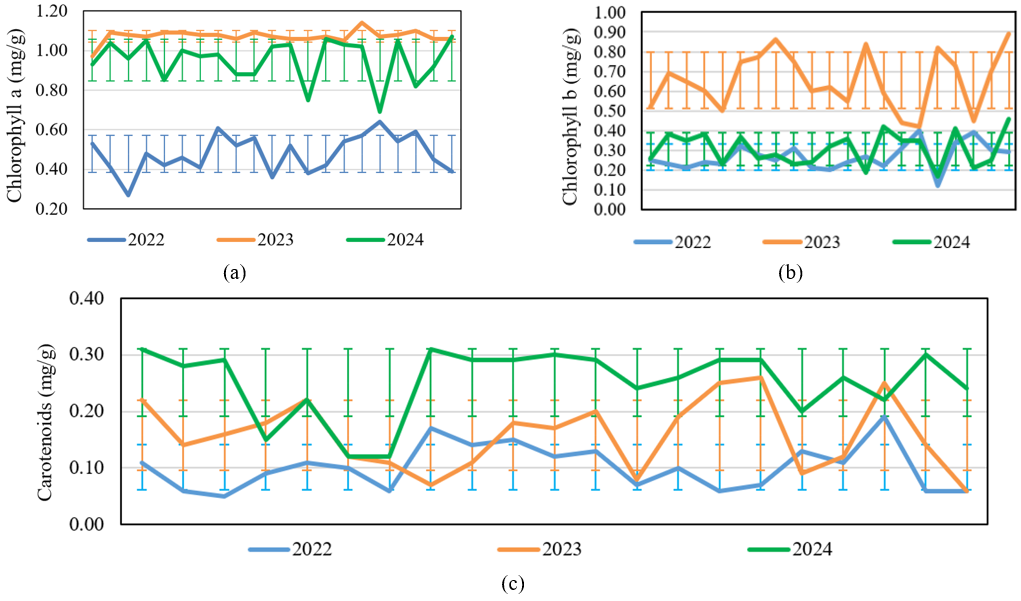
Figure 1 presents the pigment content in pea leaves at the seedling stage across the three years. The study revealed significant fluctuations in Chl a content at the seedling stage: the minimum value of 0.27 mg/g was recorded in Chelyabinsk 24 (2022), while the maximum of 1.14 mg/g was observed in Novosibirets (2023). Chl b content ranged from 0.12 mg/g (Cristall, 2022) to 0.89 mg/g (L 46-08). Carotenoids, as key elements of the pigment complex, reached peak values of 0.3 mg/g in 2024, which was 67% and 34% higher than the levels of 2023 and 2022, respectively, with individual variations from 0.05 mg/g (Chelyabinsk 24) to 0.31 mg/g (Vu 24/90).
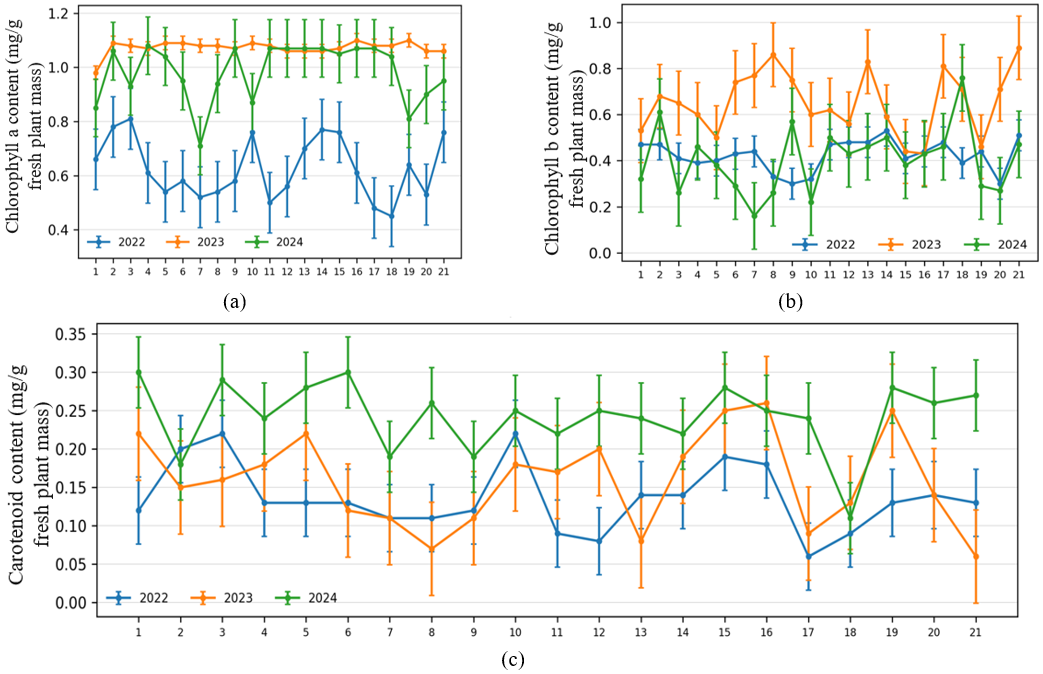
At the flowering stage (Figure 2), the maximum Chl a content was recorded in 2023 in the genotype Novosibirets (sample 19; 1.10 mg/g). Chl b content in this period varied: in 2022 from 0.28 mg/g in Nitouche (sample 20) to 0.53 mg/g in Kharkiv Amber (sample 17); in 2023 from 0.42 mg/g in Novosibirets (sample 19) to 0.89 mg/g in L-46-08 (sample 21); in 2024 from 0.47 mg/g in 45/02 (sample 13) to 0.78 mg/g in L-38-98 (sample 5). Carotenoids in the flowering stage of 2024 reached an average of 0.3 mg/g, showing an increase of 27% and 14% compared with 2023 and 2022, respectively, indicating activation of antioxidant mechanisms under conditions of thermal stress. Considering the dual function of carotenoids as photoprotectors and light-harvesting complexes, the increased content in wet years can be regarded as an adaptive response to unfavourable environmental conditions. In wet years, increased cloud cover and periodic sun breaks can lead to light fluctuations that stress the photosynthetic machinery, prompting the plant to enhance its carotenoid content for photoprotection, ensuring efficient photosynthesis and safeguarding against oxidative damage.
At the ripening stage (Figure 3), the accumulation of Chl a varied widely across the three years, reflecting the different environmental conditions experienced in each growing season. The genotypes Vyatich (sample 14) and Kharkiv Amber (sample 17) stood out with maximum Chl a in 2022 (1.40 mg/g), with Kharkiv Amber also leading in 2023 (0.86 mg/g), while in 2024 the leader was the standard variety KASIB (sample 1; 1.05 mg/g). Chl b content at ripening ranged from minimal values around 0.06 mg/g (2023-2024) to 0.60 mg/g in Kharkiv Amber (sample 11) in 2022, with the lowest overall mean values occurring in the drought year 2023. Carotenoids at this period showed average values from 0.19 mg/g (2023) to 0.29 mg/g (2022), with an absolute maximum in genotype UG 95-8882 (sample 8) at 0.43 mg/g in 2022.
3.4 Correlation analysis of relationships between pigments and yield
Application of Pearson’s correlation analysis revealed the relationship between photosynthetic pigment concentration in leaves and productivity of different pea morphotypes (2022-2024). The analysis showed a clear dependence of results on climatic conditions and plant type (Table 3).
Under the drought conditions of 2022, a strong positive correlation between Chl a content and yield was observed in tendril morphotypes, indicating that increased Chl a levels were strongly linked to better productivity. It likely reflects Chl a as a marker of plant health rather than a direct cause of higher yield. Higher Chl a content suggests better photosynthetic efficiency and stress adaptation, enabling the plant to maintain growth despite drought, but it is more an indicator of overall plant vitality than a direct driver of yield.
In contrast, the correlation between carotenoids and yield was moderate, suggesting a lesser but still notable role of carotenoids in stress adaptation. No significant correlations were found in leafed genotypes in 2022, although a high correlation between carotenoids and Chl a was evident, highlighting the interdependence of these pigments in maintaining photosynthetic function. During the extreme drought of 2023, tendril morphotypes still showed a significant positive correlation between Chl a and yield, whereas carotenoids-yield and all leafed pigment–yield correlations were not significant. However, in leafed morphotypes, a moderate correlation between carotenoids and Chl a was recorded, suggesting some degree of pigment stability despite the stress. In 2024, under wetter conditions, tendril genotypes showed a strong positive correlation between carotenoids and yield, indicating the importance of carotenoids in promoting productivity when moisture was more abundant. Notably, the relationship between Chl a and Chl b was moderate in tendril morphotypes, while leafed forms exhibited a high correlation between these two chlorophylls, reflecting their synergistic role in photosynthesis. However, no significant relationship between pigments and yield was found in leafed genotypes in 2024, suggesting that under more favourable moisture conditions, other factors may have influenced yield more than pigment composition alone.
Table 3. Correlations between photosynthetic pigments and yield for tendril and leafed morphotypes (2022-2024)
|
Correlation |
Morphotype |
Year |
r |
p |
|
Chl a vs Yield |
Tendril |
2022 |
0.840 |
<0.05 |
|
2023 |
0.750 |
<0.05 |
||
|
2024 |
0.790 |
<0.05 |
||
|
Leafed |
2022 |
0.430 |
0.15 |
|
|
2023 |
0.380 |
0.20 |
||
|
2024 |
0.360 |
0.25 |
||
|
Carotenoids vs Yield |
Tendril |
2022 |
0.487 |
0.15 |
|
2023 |
0.500 |
0.12 |
||
|
2024 |
0.710 |
<0.05 |
||
|
Leafed |
2022 |
0.420 |
0.18 |
|
|
2023 |
0.420 |
0.18 |
||
|
2024 |
0.380 |
0.22 |
||
|
Carotenoids vs Chl a |
Tendril |
2022 |
0.720 |
<0.05 |
|
2023 |
0.680 |
0.06 |
||
|
2024 |
0.750 |
<0.05 |
||
|
Leafed |
2022 |
0.848 |
<0.01 |
|
|
2023 |
0.422 |
0.16 |
||
|
2024 |
0.490 |
0.12 |
||
|
Chl a vs Chl b |
Tendril |
2022 |
0.650 |
0.05 |
|
2023 |
0.600 |
0.07 |
||
|
2024 |
0.421 |
0.22 |
||
|
Leafed |
2022 |
0.710 |
0.02 |
|
|
2023 |
0.750 |
0.03 |
||
|
2024 |
0.840 |
<0.01 |
The obtained data on the dynamics of photosynthetic pigments in pea (Pisum sativum L.) under contrasting climatic scenarios of the Akmola region represented significant scientific interest in the context of plant adaptation to abiotic stress factors. These results demonstrated the complex interaction between the plant morphotype, vegetation phase, and external conditions, which found numerous parallels in modern research. A sharp decrease in Chl a content by 41-49% in the drought years 2022-2023 (0.51-0.68 mg/g compared to 1.03 mg/g in the 2022, which was relatively drier but slightly better than 2023) fully corresponded to the data of Farooq et al. [36], who described a similar decrease in Chl a concentration in pea under combined heat and water stress. Particularly noteworthy was the correlation revealed between Chl a content and yield in tendril morphotypes in 2022 (r = 0.840), which agreed with the study of Pandey et al. [37], who proved the relationship between the stability of the photosynthetic apparatus and pea productivity under drought conditions.
An increased content of Chl b in tendril morphotypes (0.51 mg/g at the flowering stage) during the drought of 2023 confirmed the data of Wiśniewska et al. [38] on the adaptive role of this pigment under stress conditions. The authors established that Chl b contributed to optimising light absorption under reduced insolation, which fully corresponded to the conducted observations. However, the degree of Chl b decrease at the ripening stage in 2023 (to 0.15 mg/g) turned out to be more pronounced than in the studies of Jahan et al. [39] on tomato, which may indicate species-specific reactions. The 67% increase in carotenoids at the seedling stage in the wet 2024 year (0.3 mg/g) found confirmation in the works of Dhami and Cazzonelli [40], who described the activation of the synthesis of these pigments as a response to oxidative stress. This effect was especially pronounced in the early phases of ontogenesis, which fully confirmed the data obtained in this study. The role of carotenoids in reflecting oxidative stress is better understood when considering the carotenoids/chlorophyll ratio, as this index accounts for the balance between protective pigments and chlorophyll, offering accurate assessment of stress levels than absolute carotenoid content alone.
At the same time, the peak accumulation of carotenoids at the ripening stage (0.29 mg/g in 2022) agreed with the studies of Sarker et al. [41] on amaranth, but significantly differed from the results of Doğru and Çakirlar [42], who recorded maximum concentration already at the seedling stage. However, the absence of correlation between pigments and yield in these forms in 2024 contradicted the data of Balde et al. [43], who revealed a stable relationship between chlorophyll fluorescence and productivity in forest ecosystems.
The 27% increase in carotenoids at the flowering stage in the wet 2024 year fully matched expectations based on the work of Sun et al. [44], who described the antioxidant function of these pigments. However, the absence of a similar reaction in Al-Huqail et al. [45] on basil indicated a genus–species specificity of responses. A strong correlation between Chl a and Chl b in leafed forms in 2024 (r = 0.840) found theoretical confirmation in the study of Quian-Ulloa and Stange [46], where the coordination of chlorophyll biosynthesis under external factors was described in detail. This effect was less pronounced in tendril forms (r = 0.421), which may indicate different adaptive strategies of morphotypes.
The obtained data on the dynamics of pigments at different stages of ontogenesis found confirmation in modern literature. The increase in carotenoids from seedling to ripening, recorded in this study, fully agreed with the concept of Kolašinac et al. [47] on the ontogenetic dynamics of these pigments. At the same time, the revealed decrease in Chl b content at the ripening stage during the drought of 2023 found confirmation in the works of Sachdev et al. [48], who described the enhanced degradation of this pigment under oxidative stress. The obtained data on the role of chlorophyll b as an adaptive pigment in tendril morphotypes during drought found confirmation in the works of Moustakas et al. [49], where it was proven that changes in chlorophyll fluorescence were a sensitive indicator of early stress. Particularly noteworthy was the coincidence of results on the decrease of Chl a by 41-49% in drought years with the data of Moustaka and Moustakas [50], who revealed similar changes in fluorescence parameters in plants under abiotic stress.
The revealed increase in carotenoid content by 67% at the seedling stage under excess moisture fully corresponded to the studies of Hossain et al. [51] on amaranth, where salt stress caused a similar activation of the synthesis of these pigments. However, the degree of increase was higher in the studied case, which may indicate species-specificity of reactions.
At the same time, the current data on the protective role of carotenoids was confirmed by the works of Hamani et al. [52], who described the antioxidant function in cotton under salt stress. The decrease in Chl b content to 0.15 mg/g in the dry 2023 year found a partial analogue in the studies of Kalisz et al. [53] on lettuce, where metal nanoparticles caused similar changes in chlorophyll fluorescence. However, in this case, the effect was more pronounced, highlighting the intensity of climatic stress. The higher Chl a content in leafed forms (by 0.04 mg/g) agreed with the data of Trejo-Téllez et al. [54] on the positive effect of silicon on chlorophyll concentration in pepper, confirming the general patterns of photosynthetic apparatus formation under favourable conditions.
A comparative analysis revealed significant consistency of the main trends with the results of other researchers, confirming the universality of photosynthetic apparatus reactions to stress. At the same time, specific features such as morphotype-dependent Chl b dynamics and carotenoid synthesis intensity indicated the necessity of considering regional climatic conditions and genotypic characteristics. These observations formed the scientific basis for further conclusions regarding the adaptive potential of pea under climate change conditions.
Three-year comprehensive studies (2022-2024) of photosynthetic pigments in pea under the conditions of the Akmola region revealed a significant dependence of plant productivity on climatic factors. The extreme weather conditions of the studied period, which ranged from drought to excessive moisture, demonstrated a clear impact on the formation of the pigment complex and crop productivity.
The most critical conditions were observed in 2023, when the HTC dropped to 0.03 during the Sowing-Seedling stage (with a total HTC of 0.12 for the growing season), and the total amount of precipitation during the growing season was only 35.2 mm (133.5 mm below normal). Under such conditions, a sharp decrease in chlorophyll a content to a range of 0.51–0.68 mg/g was observed, which was up to 51% less compared to 2022. Particularly notable was the strong correlation (r = 0.840) between Chl a content and yield in tendril morphotypes, confirming the potential for cultivation under drought conditions.
The contrasting conditions of 2024, with excessive precipitation (309.1 mm, +140.4 mm above normal) and HTC 1.22, contributed to the activation of carotenoid synthesis, the content of which at the seedling stage reached 0.3 mg/g (67% higher than in 2023). This indicated the activation of plant protective mechanisms in response to stress conditions. Leafed forms, despite the absence of a direct correlation between pigment content and yield, demonstrated consistently high Chl a content (up to 1.14 mg/g in Novosibirets), indicating the potential effectiveness under various climatic conditions. For farmers and breeders in drought-prone areas, it is advised to focus on tendril morphotypes such as L‑38‑98 and L‑46‑08, as they exhibit a strong correlation between chlorophyll a content and yield under water stress. In regions with more consistent moisture, leafed morphotypes may be more suitable, though their productivity is less predictable during dry spells.
The limitations of the study lay in the fact that the analysis was conducted for only three years (2022-2024), which did not allow for a full assessment of long-term trends in changes of photosynthetic pigments in pea under climate fluctuations. Further research should be directed towards studying the adaptation mechanisms of different pea morphotypes to climate change, particularly at the molecular level, which will make it possible to develop more effective breeding strategies and cultivation technologies for this important leguminous crop.
The work was carried out within the framework of the Program-targeted financing of the Ministry of Agriculture of the Republic of Kazakhstan under the budget program 267, BR – 22885414 “Creation and introduction into production of highly productive varieties of leguminous crops based on modern biology methods, development of their varietal technology and primary seed production”.
|
Chl a |
Chlorophyll a |
|
Chl b |
Chlorophyll b |
|
Car |
Carotenoids |
|
HTC |
Hydrothermal coefficient |
|
mg/g |
Milligrams per gram of fresh weight |
|
℃ |
Degrees Celsius |
|
r |
Pearson’s correlation coefficient |
|
p |
Statistical significance (probability) |
|
D663 |
Optical density at 663 nm (chlorophyll a) |
|
D646 |
Optical density at 646 nm (chlorophyll b) |
|
D470 |
Optical density at 470 nm (carotenoids) |
|
CChl a |
Concentration of chlorophyll a in extract (mg/L) |
|
CChl b |
Concentration of chlorophyll b in extract (mg/L) |
|
CCar |
Concentration of carotenoids in extract (mg/L) |
|
F |
Pigment content in plant material (mg/g fresh mass) |
|
V |
Extract volume (L) |
|
P |
Mass of plant material portion (g) |
|
k |
Coefficient for the 96% ethanol solvent system |
[1] Tafesse, E.G., Warkentin, T.D., Shirtliffe, S., Noble, S., Bueckert, R. (2022). Leaf pigments, surface wax and spectral vegetation indices for heat stress resistance in pea. Agronomy, 12(3): 739. https://doi.org/10.3390/agronomy12030739
[2] Rahimova, S.A., Novruzova, E.S. (2023). Anthosians of Morus Nigra L. fruit growing in the territory of Nakhchivan Autonomous Republic. International Journal of Bioscience and Biochemistry, 5(2): 17-19. https://doi.org/10.33545/26646536.2023.v5.i2a.45
[3] Safarova, F., Novruzova, E. (2021). Self-defense Mechanisms of Plants in Nature. Bulletin of Science and Practice, 7(8): 73-77. https://doi.org/10.33619/2414-2948/69/09
[4] Coutinho, M.L., Miller, A.Z., Rogerio-Candelera, M.A., et al. (2016). An integrated approach for assessing the bioreceptivity of glazed tiles to phototrophic microorganisms. Biofouling, 32(3): 243-259. https://doi.org/10.1080/08927014.2015.1135242
[5] Bogoyavlenskiy, A., Alexyuk, M., Alexyuk, P., et al. (2023). Computer analysis of the inhibition of ACE2 by flavonoids and identification of their potential antiviral pharmacophore site. Molecules, 28(9): 3766. https://doi.org/10.3390/molecules28093766
[6] Novruzova, E. (2025). Biochemical composition and pharmacological potential of species of the genus Arenaria L. Scientific Horizons, 28(1): 85-99. https://doi.org/10.48077/scihor1.2025.85
[7] Sultan, K., Perveen, S., Parveen, A., Atif, M., Zafar, S. (2023). Benzyl amino purine (BAP), moringa leaf extract and ascorbic acid induced drought stress tolerance in pea (Pisum sativum L.). Gesunde Pflanzen, 75(6): 2423-2436. https://doi.org/10.1007/s10343-023-00890-9
[8] Rath, J.R., Pandey, J., Yadav, R.M., et al. (2022). Temperature-induced reversible changes in photosynthesis efficiency and organization of thylakoid membranes from pea (Pisum sativum). Plant Physiology and Biochemistry, 185: 144-154. https://doi.org/10.1016/j.plaphy.2022.05.036
[9] Li, X., Zhang, W., Niu, D., Liu, X. (2024). Effects of abiotic stress on chlorophyll metabolism. Plant Science, 342: 112030. https://doi.org/10.1016/j.plantsci.2024.112030
[10] Tomaškinová, J., Tomaškin, J., Drimal, M., Bellido, J. (2025). The impact of abiotic environmental stressors on fluorescence and chlorophyll content in glycine max (L.) Merrill. Agronomy, 15(2): 263. https://doi.org/10.3390/agronomy15020263
[11] Muhammad, I., Shalmani, A., Ali, M., Yang, Q., Ahmad, H., Li, F.B. (2021). Mechanisms regulating the dynamics of photosynthesis under abiotic stresses. Frontiers in Plant Science, 11: 615942. https://doi.org/10.3389/fpls.2020.615942
[12] Uzakbay, G.B., Isagat, R.I., Mendigaliyev, E.E., Maksotova, A.E., Akatiev, N.V. (2025). Study of the influence of flood on the absolute and relative content of plant pigments in ural glycory. Bulletin WKU, 97(1): 549-560. https://doi.org/10.37238/2960-1371.2960-138X.2025.97(1).44
[13] Atabayeva, S.D., Rakhymgozhina, A.B., Nurmahanova, A.S., et al. (2022). Rice plants (Oryza sativa L.) under Cd stress in Fe deficiency conditions. BioMed Research International, 2022(1): 7425085. https://doi.org/10.1155/2022/7425085
[14] Sharma, A., Kumar, V., Shahzad, B., et al. (2020). Photosynthetic response of plants under different abiotic stresses: A review. Journal of Plant Growth Regulation, 39(2): 509-531. https://doi.org/10.1007/s00344-019-10018-x
[15] Talebzadeh, F., Valeo, C. (2022). Evaluating the effects of environmental stress on leaf chlorophyll content as an index for tree health. IOP Conference Series Earth and Environmental Science, 1006(1): 012007. https://doi.org/10.1088/1755-1315/1006/1/012007
[16] Novruzova, E. (2016). The features of ferns for their moisture demand and life form including in the flora of Nakhchivan Autonomous Republic Azerbaijan. International Journal of Multidisciplinary Research and Development, 3(11): 65-67. https://www.allsubjectjournal.com/assets/archives/2016/vol3issue11/3-11-12-823.pdf.
[17] Bardule, A., Grinfelde, I., Lazdina, D., Bardulis, A., Sarkanabols, T. (2018). Macronutrient leaching in a fertilized juvenile hybrid aspen (Populus tremula L. × P. tremuloides Michx.) plantation cultivated in an agroforestry system in Latvia. Hydrology Research, 49(2): 407-420. https://doi.org/10.2166/nh.2017.054
[18] Guliyeva, Z., Maxsudov, S., Garibova, S., et al. (2025). Effects of vermicompost application rates and irrigation regimes on tomato yield, nutrient uptake and soil properties under greenhouse conditions. Eurasian Journal of Soil Science, 14(3): 270-279. https://doi.org/10.18393/ejss.1703816
[19] Aliyeva, M., Tanriverdiyeva, G., Faradjova, D., Ahmadova, E., Baranovska, O. (2024). The impact of state policy on the development of organic agriculture in Azerbaijan. Scientific Horizons, 27(12): 128-141. https://doi.org/10.48077/scihor12.2024.128
[20] Turmukhambetov, A.Z., Buketova, G.K., Gafurov, N.M., Adekenov, S.M. (1999). Chrysartemin A and canin from Achillea nobilis. Chemistry of Natural Compounds, 35(1): 102. https://doi.org/10.1007/BF02238225
[21] Peruzzo, P., de Serio, F., Defina, A., Mossa, M. (2018). Wave height attenuation and flow resistance due to emergent or near-emergent vegetation. Water, 10(4): 402. https://doi.org/10.3390/w10040402
[22] Meftah, M.B., De Serio, F., Malcangio, D., Mossa, M., Petrillo, A.F. (2015). Experimental study of a vertical jet in a vegetated crossflow. Journal of Environmental Management, 164: 19-31. https://doi.org/10.1016/j.jenvman.2015.08.035
[23] Roni, N.G.K., Suarna, I.W., Suryani, N.N., Budiasa, I.K.M. (2025). Improving soil fertility and forage productivity through bioorganic fertilizer substitution for urea in pennisetum purpureum-macroptilium atropurpureum association. Organic Farming, 11(2): 102-115. https://doi.org/10.56578/of110203
[24] Lyubchik, S.B., Galushko, L.Y., Rego, A.M., Tamarkina, Y.V., Galushko, O.L., Fonseca, I. M. (2004). Intercalation as an approach to the activated carbon preparation from Ukrainian anthracites. Journal of Physics and Chemistry of Solids, 65(2-3): 127-132. https://doi.org/10.1016/j.jpcs.2003.10.006
[25] Valujeva, K., Pilecka, J., Frolova, O., Berzina, L., Grinfelde, I. (2017). Measurement time estimation of CO2, CH4, N2O and NH3 in closed chambers and recirculation system with picarro g2508 analyser. International Multidisciplinary Scientific GeoConference Surveying Geology and Mining Ecology Management, 17: 519-526. https://doi.org/10.5593/sgem2017/41/S19.066
[26] A.I. Barayev research and production centre for grain farming. (2025). https://baraev.kz/en/.
[27] Baisholanov, S.S., Polevoy, A.N. (2017). Agroclimatic zoning of the northern grain-producing territory of Kazakhstan. Ukrainian Hydrometeorological Journal, (19): 82-89. https://doi.org/10.31481/uhmj.19.2017.10
[28] Gholizadeh, A., Saberioon, M., Borůvka, L., Wayayok, A., Soom, M.A.M. (2017). Leaf chlorophyll and nitrogen dynamics and their relationship to lowland rice yield for site-specific paddy management. Information Processing in Agriculture, 4(4): 259-268. https://doi.org/10.1016/j.inpa.2017.08.002
[29] Lichtenthaler, H.K. (1987). Chlorophylls and carotenoids: Pigments of photosynthetic biomembranes. Methods in Enzymology, 148: 350-382. https://doi.org/10.1016/0076-6879(87)48036-1
[30] Demmig-Adams, B., Gilmore, A.M., Iii, W.W.A. (1996). In vivo functions of carotenoids in higher plants. The FASEB Journal, 10(4): 403-412. https://doi.org/10.1096/fasebj.10.4.8647339
[31] Garibli, A.S., Suleymanov, T.A., Ollivier, E., Herbette, G. (2021). Flavonoids from Medicago falcata from the Flora of Azerbaijan. Chemistry of Natural Compounds, 57(1): 150-151. https://doi.org/10.1007/s10600-021-03302-4
[32] Kokojka, F., Bacu, A., Shahini, S., Medha, G. (2023). Tribenuron-methyl treatment affects glutathione metabolization and other physiological processes in bread wheat. International Journal of Pest Management, 69(3): 248-254. https://doi.org/10.1080/09670874.2021.1916123
[33] Movsumov, I.S., Garayev, E.A., Baghdikian, B., et al. (2018). Flavonoids from Stachys annua Growing in Azerbaijan. Chemistry of Natural Compounds, 54(2): 261-262. https://doi.org/10.1007/s10600-018-2318-y
[34] Zaccone, R., Caroppo, C., La Ferla, R., Zampino, D., et al. (2004). Deep-chlorophyll maximum time series in the Augusta Gulf (Ionian Sea): Microbial community structures and functions. Chemistry and Ecology, 20(sup1): 267-284. https://doi.org/10.1080/02757540410001689812
[35] Adenekov, S.M., Kupriyanov, A.N., Turmukhambetov, A.Z., Gafurov, N.M., Dzhazin, K.A. (1992). Austricin from artemisia juncea. Chemistry of Natural Compounds, 28(6): 633-634. https://doi.org/10.1007/BF00630453
[36] Farooq, M., Ahmad, R., Shahzad, M., et al. (2024). Evaluation of morphological and biochemical variations in peas under two widespread abiotic stresses. Acta Physiologiae Plantarum, 46(12): 109. https://doi.org/10.1007/s11738-024-03740-x
[37] Pandey, J., Devadasu, E., Saini, D., et al. (2022). Reversible changes in structure and function of photosynthetic apparatus of pea (Pisum sativum) leaves under drought stress. The Plant Journal, 113(1): 60-74. https://doi.org/10.1111/tpj.16034
[38] Wiśniewska, K., Śliwińska-Wilczewska, S., Lewandowska, A., Konik, M. (2021). The effect of abiotic factors on abundance and photosynthetic performance of airborne cyanobacteria and microalgae isolated from the Southern Baltic Sea Region. Cells, 10(1): 103. https://doi.org/10.3390/cells10010103
[39] Jahan, M.S., Hasan, M.M., Alotaibi, F.S., et al. (2022). Exogenous putrescine increases heat tolerance in tomato seedlings by regulating chlorophyll metabolism and enhancing antioxidant defense efficiency. Plants, 11(8): 1038. https://doi.org/10.3390/plants11081038
[40] Dhami, N., Cazzonelli, C.I. (2020). Environmental impacts on carotenoid metabolism in leaves. Plant Growth Regulation, 92(3): 455-477. https://doi.org/10.1007/s10725-020-00661-w
[41] Sarker, U., Oba, S., Ercisli, S., Assouguem, A., Alotaibi, A., Ullah, R. (2022). Bioactive phytochemicals and quenching activity of radicals in selected drought-resistant amaranthus tricolor vegetable amaranth. Antioxidants, 11(3): 578. https://doi.org/10.3390/antiox11030578
[42] Doğru, A., Çakirlar, H. (2020). Effects of leaf age on chlorophyll fluorescence and antioxidant enzymes activity in winter rapeseed leaves under cold acclimation conditions. Brazilian Botany Magazine, 43(1): 11-20. https://doi.org/10.1007/s40415-020-00577-9
[43] Balde, H., Hmimina, G., Goulas, Y., et al. (2024). Investigating the responses of sun-induced chlorophyll fluorescence, gross primary production and their inter-relationship to abiotic factors changes in a temperate deciduous forest. EGUsphere. https://doi.org/10.5194/egusphere-2024-657
[44] Sun, T., Rao, S., Zhou, X., Li, L. (2022). Plant carotenoids: Recent advances and future perspectives. Molecular Horticulture, 2(1): 3. https://doi.org/10.1186/s43897-022-00023-2
[45] Al-Huqail, A., El-Dakak, R.M., Sanad, M.N., et al. (2020). Effects of climate temperature and water stress on plant growth and accumulation of antioxidant compounds in sweet basil (Ocimum basilicum L.) leafy vegetable. Scientifica, 2020(1): 3808909. https://doi.org/10.1155/2020/3808909
[46] Quian-Ulloa, R., Stange, C. (2021). Carotenoid biosynthesis and plastid development in plants: The role of light. International Journal of Molecular Sciences, 22(3): 1184. https://doi.org/10.3390/ijms22031184
[47] Kolašinac, S.M., Stevanović, Z.P.D., Kilibarda, S.N., Kostić, A.Ž. (2021). Carotenoids: New applications of “old” pigments. Phyton, 90(4): 1041-1062. https://doi.org/10.32604/phyton.2021.015996
[48] Sachdev, S., Ansari, S.A., Ansari, M.I., Fujita, M., Hasanuzzaman, M. (2021). Abiotic stress and reactive oxygen species: Generation, signaling, and defense mechanisms. Antioxidants, 10(2): 277. https://doi.org/10.3390/antiox10020277
[49] Moustakas, M., Calatayud, Á., Guidi, L. (2021). Editorial: Chlorophyll fluorescence imaging analysis in biotic and abiotic stress. Frontiers in Plant Science, 12: 658500. https://doi.org/10.3389/fpls.2021.658500
[50] Moustaka, J., Moustakas, M. (2023). Early-stage detection of biotic and abiotic stress on plants by chlorophyll fluorescence imaging analysis. Biosensors, 13(8): 796. https://doi.org/10.3390/bios13080796
[51] Hossain, M.N., Sarker, U., Raihan, M.S., Al-Huqail, A.A., Siddiqui, M.H., Oba, S. (2022). Influence of salinity stress on color parameters, leaf pigmentation, polyphenol and flavonoid contents, and antioxidant activity of amaranthus lividus leafy vegetables. Molecules, 27(6): 1821. https://doi.org/10.3390/molecules27061821
[52] Hamani, A.K.M., Wang, G., Soothar, M.K., et al. (2020). Responses of leaf gas exchange attributes, photosynthetic pigments and antioxidant enzymes in NaCl-stressed cotton (Gossypium hirsutum L.) seedlings to exogenous glycine betaine and salicylic acid. BMC Plant Biology, 20(1): 434. https://doi.org/10.1186/s12870-020-02624-9
[53] Kalisz, A., Kornaś, A., Skoczowski, A., et al. (2023). Leaf chlorophyll fluorescence and reflectance of oakleaf lettuce exposed to metal and metal (oid) oxide nanoparticles. BMC Plant Biology, 23(1): 329. https://doi.org/10.1186/s12870-023-04305-9
[54] Trejo-Téllez, L.I., García-Jiménez, A., Escobar-Sepúlveda, H.F., et al. (2020). Silicon induces hormetic dose-response effects on growth and concentrations of chlorophylls, amino acids and sugars in pepper plants during the early developmental stage. PeerJ, 8: e9224. https://doi.org/10.7717/peerj.9224