Effect of Seaweed Extract and Silicon on the Growth, Yield, Activity of Catalase and Peroxidase Enzymes, and the Level of Phytohormones of the Broad Bean Plant, Vicia Faba L.

Qasim Jasim Athfua | Mahmood Shakir Hashim | Kadhim Fadhil Kadhim*
© 2026 The authors. This article is published by IIETA and is licensed under the CC BY 4.0 license (http://creativecommons.org/licenses/by/4.0/).
OPEN ACCESS
The study was conducted on a private farm in Qurna district, north of Basra province, Iraq. To examine the impact of applying seaweed extract (agrosign) and silicon on the vegetative, blooming, and yield development of broad bean plants, alongside the activity of catalase (CAT) and peroxidase (POD), and the concentrations of auxin, gibberellin (GA), and abscisic acid (ABA). The factorial experiment had three repetitions and involved nine treatments, representing the interaction of three concentrations of agrosign (0, 2, and 4 mL/L) with three concentrations of silicon (0, 200, and 400 mg/L). The design was a completely randomized block. The probability level was set at 0.05 to compare the averages with the least significant difference. The findings demonstrated that plants subjected to agrosign at a concentration of 4 mL/L showed marked enhancement in the following metrics: plant height, leaf count, node percentage, pod count, pod weight, plant yield, CAT enzyme activity, POD activity, and concentrations of auxin hormone and GAs. The plants treated with silicon at a concentration of 400 mg/L exhibited the highest values for the characteristics in comparison to the control plants. In contrast, the concentration of ABA (μg/g) decreased in the two treatments relative to the control treatment. Most previously indicated qualities were substantially affected by the interaction between the two study parameters (p < 0.05). The highest values obtained were 99.03 cm for plant height, 194.51 for leaf count, 80.67% for node percentage, 34.14 for pod count, and 121.89 g for pod weight when the plants were treated with 4 mL/L of agrosign and sprayed with 400 mg/L of silicon, respectively and 45.00 for inflorescence count at 2 mL/L of agrosign and 400 mg/L of silicon.
acrosine seaweed extract, broad bean plant, silicon element
Vicia faba L., a member of the Fabaceae family, is a cheap source of protein when compared to animal protein; its seeds contain a high proportion of protein, reaching 29% of dry weight [1]. This makes it a strategic crop with great nutritional worth. Vicia faba seeds contain a high percentage of carbohydrates, in addition to minerals, fiber, and vitamins such as vitamin C [2]. Due to their ability to improve plant tolerance and stimulate development, seaweed extracts have recently found extensive usage in horticultural crops. Auxins, cytokinins, gibberellins (GAs), and amino acids are abundant in environmental conditions, which have a role in enhancing plant development [3, 4]. Since these compounds have little impact on the environment, Al-Zubaidy [5] found that spraying crystal bean cultivars with seaweed extract (Super) at a concentration of 2 g/L improved vegetative growth and yield. Sulieman et al. [6] found that yield attributes and their constituents rose when plants were sprayed with seaweed extract (Algaren) at a concentration of 6 and 8 cm3/L. When compared to the control treatment, the spraying treatment showed a substantial improvement in terms of the overall plant yield, the percentage of protein, and the number of pods produced. Furthermore, studies have shown that the element silicon has many substantial impacts. It contributes to augmenting plant resilience against various stressors, promoting development and production [7], and elevating the plant's water content [8, 9]. Furthermore, it improves enzyme performance and increases proline content, lipid peroxidation, and phenol content [10].
The effectiveness of photosynthesis is enhanced, roots can absorb more nutrients, and plant cell walls are strengthened [11, 12]. Ali and Bijay-Singh [13] examined the effects of treating broad bean seeds with silicon at concentrations of 0, 1, and 2 mmol/L. They found that, in comparison to the control treatment, the treated plants exhibited an increase in plant height, leaf number, and area, and fresh and dry weight.
While previous studies have documented the individual benefits of seaweed extracts or silicon on legume growth, their combined synergistic effect remains insufficiently understood, particularly for broad beans (Vicia faba L.). Furthermore, there is a lack of information on how the combined use of these two bio-stimulants affects the regulation of endogenous plant hormones and antioxidant enzyme activity under environmental stress conditions. Therefore, our study aimed to investigate the effect of using agrosign and silicon on vegetative growth, flowering, and yield in broad bean plants, as well as on catalase (CAT) and peroxidase (POD) activity, and auxin, GA, and abscisic acid (ABA) concentrations. This experiment was conducted to examine the positive effects of agrosign and silicon on growth, yield, physiological characteristics, and biochemical components.
2.1 Field preparation and experimental layout
The experiment was conducted in an agricultural region of the Qurna district, located north of Basra governorate, during the winter. An examination of the field soil was performed prior to planting. The physical and chemical properties of the field soil are shown in Table 1.
Table 1. Some physical and chemical traits of field soil
|
No. |
Traits (Soil Properties) |
Unit |
Values |
|
1 |
Electrical conductivity (EC) |
ds m-1 |
4.12 |
|
2 |
Soil pH |
- |
7.13 |
|
3 |
Total nitrogen |
g kg-1 |
1.37 |
|
4 |
Available phosphorus |
mg kg-1 |
20.20 |
|
5 |
Available potassium |
mg kg-1 |
67.74 |
|
6 |
Organic matter |
% |
1.30 |
|
Soil Texture |
|||
|
1 |
Sand |
% |
18.9 |
|
2 |
Silt |
% |
41.2 |
|
3 |
Clay |
% |
39.9 |
|
4 |
Soil texture class |
- |
Silty clay |
The land was plowed deeply twice, perpendicular to the grain, using a moldboard plow. Afterward, it was smoothed, and decomposed cow manure was added at a rate of 10 m³ per dunam. It was then leveled and divided into furrows 75 cm wide. The land was further divided into experimental units (27) measuring 2.10 m in length, each containing 3 furrows and 21 beds, spaced 30 cm apart. Diammonium Phosphate (DAP) was added to the bottom of each bed to a depth of 10 cm before planting, using the feed method, at a rate of 35 kg per dunam (equivalent to 3.6 g per bed). Dithane fungicide was used at a concentration of 2.5 mL per 100 liters for fungal protection, and Avaunt fungicide at a concentration of 2 g per liter.
2.2 Experimental treatments and factors
In the experiment, the broad bean variety “Luz de otono” of Turkish origin, supplied by the Spanish company Semillas Fito, was used. The seeds were sown on 10/1/2022, and the experiment included two factors: spraying with three concentrations of seaweed extract (Agrosign): 0, 2, and 4 mL/L and three concentrations of silicon are 0, 200 and 400 mg/L (using potassium silicate (K₂SiO₃) as a source of silicon in the experiment), and the number of treatments was nine treatments and three replicates, so the number of experimental units is 27 units. All the agricultural operations followed in the production of this crop were conducted through irrigation and weeding. To serve as a dispersant, a few drops of Tween 20 were added to the spraying procedures. With a 2-liter hand sprayer, the plants were sprayed on the early morning shoots till total wetness. The shoots were treated twice: first, 45 days after planting, and again, 15 days later.
2.3 Data collection and measurements
At the conclusion of the experiment, the following indicators were analyzed: Plant height (cm), leaf count, inflorescence count, fruit set %, pod count, fruit weight (g), yield per plant (kg), leaf concentrations of CAT and POD (unit/g), and plant hormones. Auxin, GA, and ABA were measured in micrograms per gram (µg/g).
CAT activity was estimated by taking 300 mg of fresh-weight protein, washing it with deionized distilled water, crushing it in a ceramic mortar, and adding 6 mL of phosphate solution consisting of 50 mM potassium phosphate, 0.1% EDTA, 4% PVP, and 0.2 mM ascorbic acid. The extract was then centrifuged at 12,000 rpm at 4 ℃ for 20 minutes. The enzymatic activity was then estimated using a spectrophotometer at 240 nm. Based on the change in the absorption of the reaction mixture, which reduces H₂O₂, the activity was estimated as one unit of enzyme absorption per gram of fresh weight, as described by Góth [14].
Conversely, to estimate the POD enzyme, the enzyme was extracted by mixing 0.5 g of leaf tissue with 8 mL of potassium phosphate buffer solution in a ceramic mortar. Centrifugation was then performed, and the filtrate was used to estimate the activity. The activity was then estimated according to the method of Kim and Yoo [15]. The absorbance was measured at a wavelength of 470 nm.
For the extraction and quantification of the hormones auxin, GA, and ABA, the method described in Abbas et al. [16] was adopted. The following was done: The samples were extracted using a methanol solvent with a concentration of 80% (v/v). 5 g of the plant sample was taken with 50 mL of 80% methanol for 24 hours at a temperature of 4 ℃ in the dark (inside the refrigerator). This process was repeated twice to complete the extraction process. After that, the extracts (final volume 100 mL) were collected and evaporated using a rotary evaporator at a temperature of 40 ℃ until the aqueous phase was reached. The volume was then completed to 50 mL with distilled water. The extracts were then cleared using basic lead acetate with a concentration of 45% and potassium oxalate with a concentration of 22%. The pH of the filtrate was then adjusted to pH = 2.5 using HCl. The separation (or partitioning) process was then carried out to transfer the organic phase (containing acidic hormones) using a separating funnel and 50 mL of diethyl ether solvent. This process was repeated three times. Following this, the organic phase, which had undergone the aforementioned evaporation process, was collected using a rotary evaporator until a suitable sample volume of 5 mL was reached, which was used in paper chromatography.
The method for determining auxin was based on Reeve and Crozier [17] using a UV spectrophotometer at a wavelength of 280 nm. Concentrations were calculated on a standard curve using natural auxin. GAs were determined at a wavelength of 205 nm, and concentrations were calculated on a standard curve. ABA was determined at a wavelength of 254 nm, and concentrations were calculated using a standard curve.
2.4 Statistical analysis
The statistical analysis of all collected data was performed using two-way Analysis of Variance (ANOVA). Differences were compared at a significance level of 5%. All statistical operations, analyses, and calculations of means were performed using the GenStat statistical software (version 10, GenStat 10).
3.1 Vegetative and flowering traits and yield components
Table 2 demonstrates that the plants treated with algae extract exceeded the agrosign at a concentration of 4 mL/L in the following categories: plant height (cm), number of leaves, node ratio, number of pods, weight of one pod (g), and total plant yield (kg). The values were 90.54, 182.45, 79.20, 28.49, 114.78, and 3.26, respectively. While the plants treated with agrosign at a concentration of 0 mL/L gave the lowest values of 77.22, 167.79, 30.52, 70.64, 21.68, 111.90, and 2.39, respectively.
This may be due to the ability of the algae extract to increase CAT, POD, auxin, and GAs, which activate several physiological processes and lead to increased cell division and elongation. As a result, the plant grows more vigorously, increasing its height and the number of leaves, as evidenced by the characteristics of its flowering.
The table also showed that plants that were given 400 mg/L of silicon did better in terms of plant height (cm), number of leaves, number of inflorescences, node %, pod weight (g), and total plant yield (kg). These values were 93.30, 183.58, 40.11, 77.58, 120.86, and 3.41 from the control group. The next steps were 71.87, 167.98, 29.95, 71.88, 101.18, and 1.89 compared to the measurement treatment of spraying with pure water.
The treatment of spraying with silicon at a concentration of 200 mg /L showed superiority of the plants in the number of pods, as it reached 27.14 pods, relative to the control which amounted to 19.23 pods. The reason behind the outstanding performance of plants treated with silicon may be due to the role of this element in increasing the efficiency of roots in absorbing nutrients, which may be reflected positively in an increase in the vital activities of the plant.
Numerous studies have proven that silicon plays a role in increasing the division and elongation of cells, which in turn leads to an increase in growth [11], and its role in increasing the vital activities of plant cells [18], which is reflected in the compounds that result from the process of photosynthesis, and consequently an improvement in the characteristics of vegetative growth, which leads to an increase in yield [19].
In our study, higher values were shown by plants treated with agrosign at a concentration of 4 mL/L and silicon at a concentration of 400 mg/L compared to plants treated with distilled water (control treatment), therefore suggesting that the interaction greatly influenced all research markers (Table 3).
Table 2. Effect of the absence of silicon and agrosign on vegetative growth and yield traits
|
Alone Effects |
Plant Height (cm) |
Number of Leaves |
The Number of Inflorescences |
Node Percentage )%( |
Number of Pods |
Pod Weight (g) |
Plant Yield (kg) |
|
|
Agrosign (mL/L) |
0 |
77.22 |
167.79 |
30.52 |
70.64 |
21.68 |
111.90 |
2.39 |
|
2 |
87.24 |
178.61 |
39.44 |
75.31 |
24.86 |
113.68 |
2.78 |
|
|
4 |
90.54 |
182.45 |
37.39 |
79.20 |
28.49 |
114.78 |
3.26 |
|
|
ANOVA Results |
F = 226500 Sig =< 0.001 |
F = 1393.46 Sig =< 0.001 |
F = 195.53 Sig =< 0.001 |
F = 173.60 Sig =< 0.001 |
F = 104.50 Sig =< 0.001 |
F = 19.99 Sig =< 0.001 |
F = 14.79 Sig =< 0.001 |
|
|
Silicon (mg/L) |
0 |
71.87 |
167.98 |
29.95 |
71.88 |
19.23 |
101.18 |
1.89 |
|
200 |
89.83 |
177.58 |
37.29 |
75.68 |
27.14 |
118.36 |
3.13 |
|
|
400 |
93.30 |
183.58 |
40.11 |
77.58 |
28.66 |
120.86 |
3.41 |
|
|
ANOVA Results |
F = 622600 Sig =< 0.001 |
F = 1515.74 Sig =< 0.001 |
F = 243.88 Sig =< 0.001 |
F = 82.36 Sig =< 0.001 |
F = 230.88 Sig =< 0.001 |
F = 1061.21 Sig =< 0.001 |
F = 51.70 Sig =< 0.001 |
|
Table 3. Effect of synergistic action of silicon and agrosign spraying on vegetative growth and yield traits
|
Synergistic Effects |
Plant Height (cm) |
Number of Leaves |
The Number of Inflorescences |
Node (%) |
Number of Pods |
Pod Weight (g) |
Plant Yield (kg) |
|||
|
Agrosign (mL /L) |
0 |
Silicon (mg/L) |
0 |
62.34g |
159.18e |
26.32f |
67.69f |
17.81g |
97.90d |
1.74b |
|
200 |
81.88f |
171.52d |
32.19de |
70.88e |
22.81de |
117.8b |
2.57ab |
|||
|
400 |
87.45c |
173.22d |
33.05d |
73.35d |
24.43d |
120.16a |
2.88ba |
|||
|
2 |
0 |
78.17d |
173.05d |
33.33d |
70.11e |
19.36f |
100.16d |
1.90b |
||
|
200 |
90.12b |
179.44c |
40.01bc |
77.09c |
27.80c |
119.73a |
3.21ab |
|||
|
400 |
93.43a |
183.36b |
45.00a |
78.73abc |
27.42c |
120.53a |
3.24ab |
|||
|
4 |
0 |
75.10e |
171.73d |
30.22ef |
77.85bc |
20.52ef |
104.88c |
2.04b |
||
|
200 |
97.50a |
181.73b |
39.67c |
79.08ab |
30.82b |
117.57b |
3.63a |
|||
|
400 |
99.03a |
194.51a |
42.30b |
80.67a |
34.14a |
121.89a |
4.11a |
|||
|
ANOVA Results |
F = 16381.74 |
F = 113.75 |
F = 8.13 |
F = 8.64 |
F = 12.16 |
F = 13.73 |
F = 1.93 |
|||
|
Sig =< 0.001 |
Sig =< 0.001
|
Sig =< 0.001
|
Sig =< 0.001
|
Sig =< 0.001
|
Sig =< 0.001
|
Sig =0.149
|
||||
3.2 Leaf content of enzymes and hormones
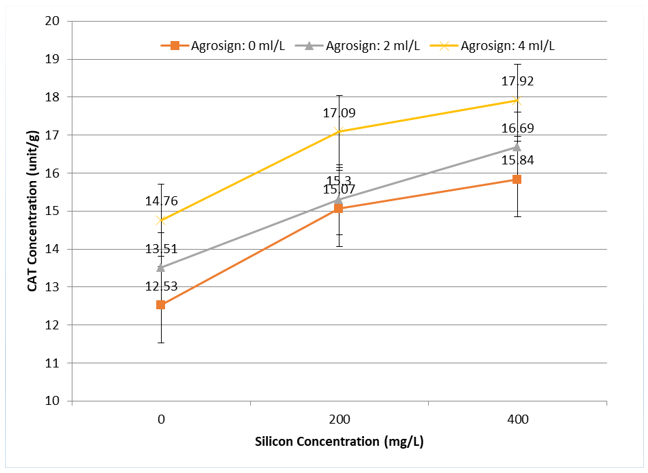
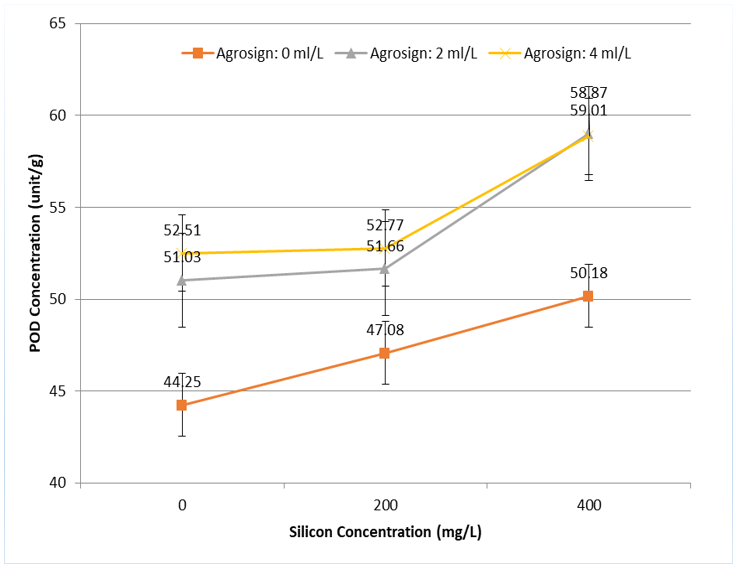
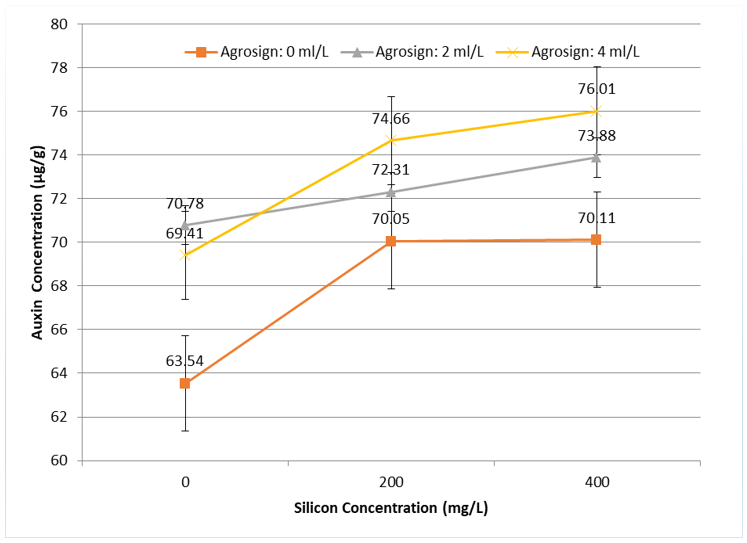
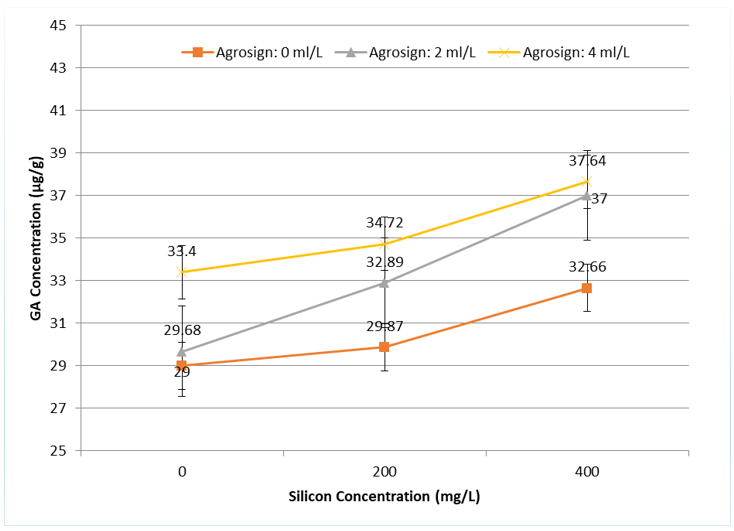
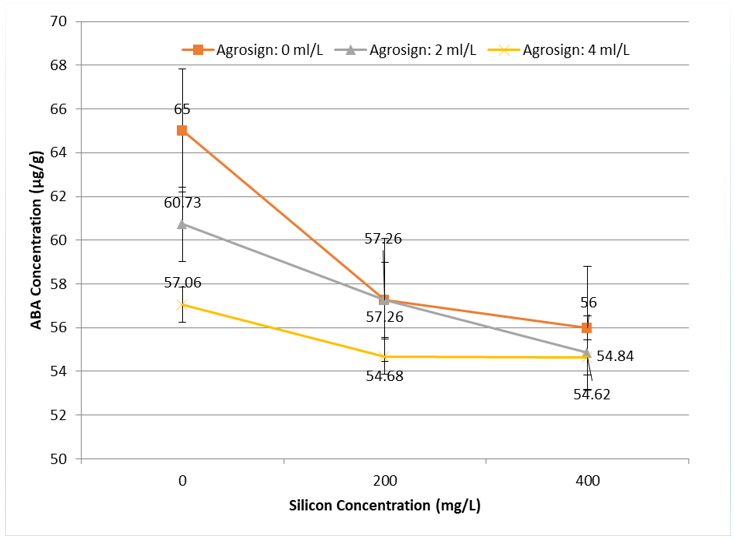
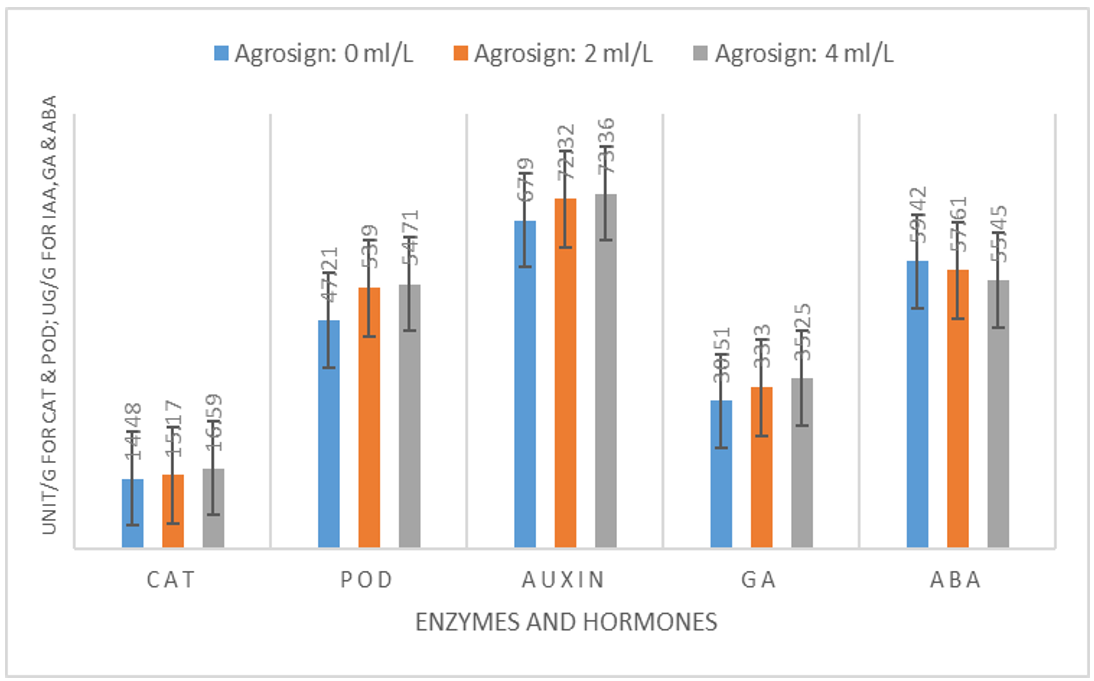
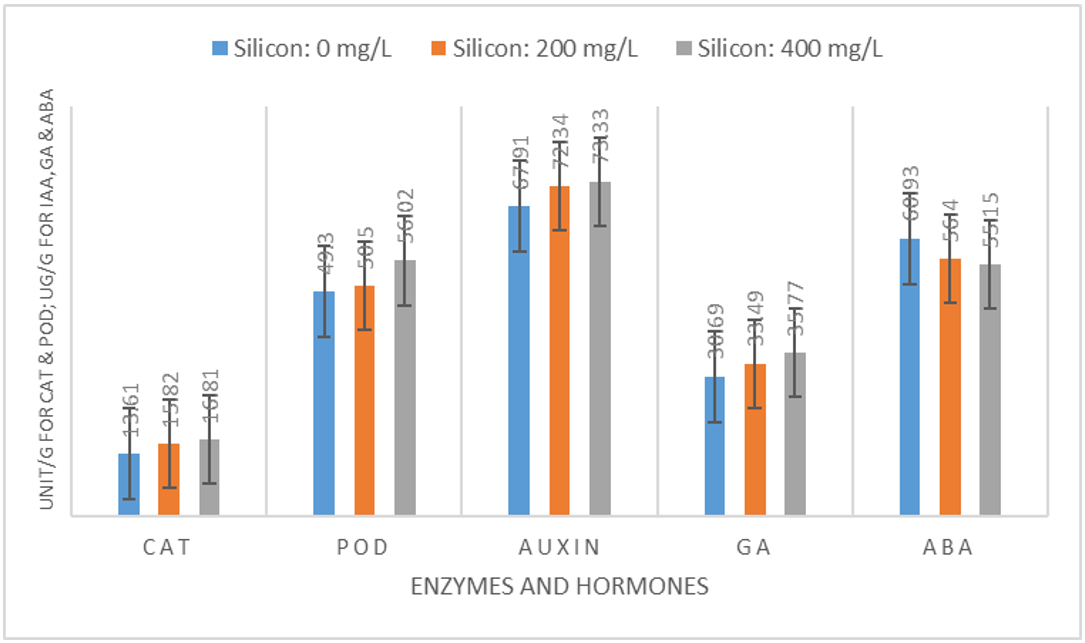
Figures 1-4 indicate that the plants treated with agrosign and silicon exhibited a significant increase in the efficacy of the enzymes CAT, POD, auxin hormone, and GA in comparison to the plants treated with distilled water. Additionally, the same treatments resulted in a substantial reduction in the concentration of ABA in the plants compared to the control treatment (Figure 5). The results demonstrated that the maximum values for the characteristics were obtained through the foliar application of agrosign at a concentration of 4 mL/L, with values of 16.59 unit/g for CAT, 54.71 unit/g for POD, 73.36 μg/g for auxin, and 35.25 μg/g for GA (Figure 6).
In comparison to the lowest values observed in plants treated with agrosign at a concentration of 0 mL/L, the highest values were 14.48 unit/g for CAT, 47.21 unit/g for POD, 67.9 µg/g for auxin, and 30.51 µg/g for GA.
Maybe the reason for this is that seaweed contains plant hormones and substances that promote growth, resulting in an increase in plant tissues. The findings showed that the treatment of plants with agrosign at a concentration of 4 mL/L led to a decrease in the concentration of ABA in the leaves, reaching 55.45 μg/g, compared to the control group, which recorded the highest concentration of 59.42 μg/g. The reason for this may be the presence of phytohormones in the extract, which mitigated the impact of stress on plants.
The results showed that spraying plants with silicon at a dose of 400 mg/L resulted in the highest activity of CAT and POD. Hormone concentrations were also highest compared to the control treatment, which recorded the lowest values. Furthermore, auxin and GAs reached 73.33 µg/g and 35.77 µg/g, respectively, in Figure 7, at this concentration. This is because silicon may affect several vital plant functions, including nutrient uptake. The control treatment resulted in the highest concentration for ABA (60.93 µg/g), while the concentration in plants treated with 400 mg/L silicon was 55.15 µg/g.
The findings showed that the interaction between the two study factors had a significant effect on the traits under study. The highest values for the activity of the enzyme CAT and POD and the concentration of the hormone auxin and GA were recorded when plants were treated with agrosign at a concentration of 4 mL/L and silicon element 400 mg/L, reaching 58.87 unit/g for POD, 17.92 unit/g for CAT, 76.01 μg/g for auxin, and 37.64 μg/g for GA, compared to the lowest values in the control treatment, while the plants marked with agrosign at a concentration of 4 mL/L and silicon element 400 mg/L gave the lowest concentration of ABA, which amounted to 54.62 μg/gm, compared to the highest concentration in control plants, which was 65.00 μg/gm.
Regarding the interaction effect, our study demonstrated that the combined application of agrosign and silicon produced a highly significant synergistic response that outperformed the individual effects of each agent alone. Maybe this strong synergistic effect is attributed to the complementary mechanisms of action of both agents. Some studies have shown that silicon is beneficial to plants under stress. This element mitigates the toxic effects of abiotic stresses such as drought, salinity, and heavy metals, in addition to its positive impact on endogenous plant hormones [20]. Furthermore, algal extracts have been used to enhance plant productivity thanks to their numerous benefits. Analytical techniques and molecular genetics tools have demonstrated the ability of agrosign to modify plant responses and significantly improve their biological efficiency [21].
The combination of 4 mL/L agrosign and 400 mg/L silicon proved to be the optimal ratio for achieving physiological balance in the current study.
Some studies indicate that the presence of silicon increases the efficiency of photosynthesis [22] and nutrient absorption while providing maximum cell protection [23]. Furthermore, the synergistic interaction of the agrosign in our study successfully directed the plant's metabolic energy towards growth and dry matter production, resulting in a significantly higher yield compared to individual treatments.
The current experience has led to the conclusion that the treatment of broad bean plants with agrosign extracts and silicon enhanced the effectiveness of enzymes and activated plant hormones. This improvement was evident in the enhanced characteristics of vegetative and flowering growth and increased productivity. Our current experiment demonstrated that the agrosign extract concentration (4 mL/L) and the silicon concentration (400 mg/L) had a positive effect on improving the properties. The study also recommends further experiments on other vegetable crops to determine the extent of this treatment's impact.
We would like to express our gratitude and appreciation to all those who contributed to the completion of this project.
[1] Warsame, A.O., O’Sullivan, D.M., Tosi, P. (2018). Seed storage proteins of faba bean (Vicia faba L): Current status and prospects for genetic improvement. Journal of Agricultural and Food Chemistry, 66(48): 12617-12626. https://doi.org/10.1021/acs.jafc.8b04992
[2] Poonia, A., Vikranta, U., Chaudhary, N., Dangi, P. (2022). Current and potential health claims of faba beans (Vicia Faba, L.) and its components. In Faba Bean: Chemistry, Properties and Functionality, pp. 331-355. https://doi.org/10.1007/978-3-031-14587-2_13
[3] Battacharyya, D., Babgohari, M.Z., Rathor, P., Prithiviraj, B. (2015). Seaweed extracts as biostimulants in horticulture. Scientia Horticulturae, 196: 39-48. https://doi.org/10.1016/j.scienta.2015.09.012
[4] Hilles, A.R., Waly, M.I., Mahmood, S. (2026). Role of natural biostimulants (seaweed extracts, humic acids, beneficial bacteria, and fungi) in leguminous crops. In Agricultural Biostimulants for Mitigation of Salt, Drought, and Heat Stress, pp. 261-288. https://doi.org/10.1016/B978-0-443-33457-3.00008-2
[5] Al-Zubaidy, N.W.Q. (2023). Effect of organic fertilizer and seaweed extract in growth and yield broad bean Vicia Faba L. IOP Conference Series: Earth and Environmental Science, 1262: 042022. https://doi.org/10.1088/1755-1315/1262/4/042022
[6] Sulieman, M.S., Al-Abadee, A.I.Y., Al-Khashab, S.M.H. (2023). Effect of foliar application of algaren and ALG6000 on growth and chemical characteristics in two cultivars of broad bean (Vicia faba L.). IOP Conference Series: Earth and Environmental Science, 1158: 062006. https://doi.org/10.1088/1755-1315/1158/6/062006
[7] Yang, X., Wen, E., Ge, C., et al. (2023). Iron-modified phosphorus-and silicon-based biochars exhibited various influences on arsenic, cadmium, and lead accumulation in rice and enzyme activities in a paddy soil. Journal of Hazardous Materials, 443: 130203. https://doi.org/10.1016/j.jhazmat.2022.130203
[8] Irfan, M., Maqsood, M.A., Rehman, H.U., et al. (2023). Silicon nutrition in plants under water-deficit conditions: Overview and prospects. Water, 15(4): 739. https://doi.org/10.3390/w15040739
[9] Teixeira, G.C.M., de Prado, R.M., Rocha, A.M.S. (2022). Action of silicon on the activity of antioxidant enzymes and on physiological mechanisms mitigates water deficit in sugarcane and energy cane plants. Scientific Reports, 12: 17487. https://doi.org/10.1038/s41598-022-21680-9
[10] Abd-El-Aty, M.S., Kamara, M.M., Elgamal, W.H., et al. (2024). Exogenous application of nano-silicon, potassium sulfate, or proline enhances physiological parameters, antioxidant enzyme activities, and agronomic traits of diverse rice genotypes under water deficit conditions. Heliyon, 10(5): e26077. https://doi.org/10.1016/j.heliyon.2024.e26077
[11] Adrees, M., Ali, S., Rizwan, M., et al. (2015). Mechanisms of silicon-mediated alleviation of heavy metal toxicity in plants: A review. Ecotoxicology and Environmental Safety, 119: 186-197. https://doi.org/10.1016/j.ecoenv.2015.05.011
[12] Guerriero, G., Hausman, J., Legay, S. (2016). Silicon and the plant extracellular matrix. Frontiers in Plant Science, 7: 463. https://doi.org/10.3389/fpls.2016.00463
[13] Ali, A.M., Bijay-Singh. (2025). Silicon: A crucial element for enhancing plant resilience in challenging environments. Journal of Plant Nutrition, 48(3): 486-521. https://doi.org/10.1080/01904167.2024.2406479
[14] Góth, L. (1991). A simple method for determination of serum catalase activity and revision of reference range. Clinica Chimica Acta, 196(2-3): 143-151. https://doi.org/10.1016/0009-8981(91)90067-M
[15] Kim, Y.H., Yoo, Y.J. (1996). Peroxidase production from carrot hairy root cell culture. Enzyme and Microbial Technology, 18(7): 531-535. https://doi.org/10.1016/0141-0229(95)00168-9
[16] Abbas, M.F., Jasim, A.M., Ibrahim, A.O. (1995). Effect of pollen endogenous hormones on the fruit of the date palm (Phoenix dactylifera L.) cv. Hillawi. Basrah Journal of Agricultural Sciences, 8: 33-41.
[17] Reeve, D.R., Crozier, A. (1980). Quantitative analysis of plant hormones. In Hormonal Regulation of Development I: Molecular Aspects of Plant Hormones, Berlin, pp. 203-280. https://doi.org/10.1007/978-3-642-67704-5_4
[18] Ma, J.F., Yamaji, N. (2008). Functions and transport of silicon in plants. Cellular and Molecular Life Sciences, 65(19): 3049-3057. https://doi.org/10.1007/s00018-008-7580-x
[19] Souri, Z., Khanna, K., Karimi, N., Ahmad, P. (2020). Silicon and plants: Current knowledge and future prospects. Journal of Plant Growth Regulation, 40(3): 906-925. https://doi.org/10.1007/s00344-020-10172-7
[20] Luyckx, M., Hausman, J.F., Lutts, S., Guerriero, G. (2017). Silicon and plants: Current knowledge and technological perspectives. Frontiers in Plant Science, 8: 411. https://doi.org/10.3389/fpls.2017.00411
[21] Craigie, J.S. (2011). Seaweed extract stimuli in plant science and agriculture. Journal of Applied Phycology, 23(3): 371-393. https://doi.org/10.1007/s10811-010-9560-4
[22] Rastogi, A., Yadav, S., Hussain, S., et al. (2021). Does silicon really matter for the photosynthetic machinery in plants…? Plant Physiology and Biochemistry, 169: 40-48. https://doi.org/10.1016/j.plaphy.2021.11.004
[23] Greger, M., Landberg, T., Vaculík, M. (2018). Silicon influences soil availability and accumulation of mineral nutrients in various plant species. Plants, 7(2): 41. https://doi.org/10.3390/plants7020041