Hasil Fataliyev | Umida Majnunlu* | Gunay Hajiyeva | Vugar Mikayilov | Konul Baloghlanova
© 2026 The authors. This article is published by IIETA and is licensed under the CC BY 4.0 license (http://creativecommons.org/licenses/by/4.0/).
OPEN ACCESS
The object of the study was grape bunches, berries, pomace, grape marc, grape marc flour, wood flour, as well as the technology for obtaining oil from grape seeds and the technological means used for this purpose. The aim of the study was to evaluate the effects of cultivation conditions, pulsed electric field (PEF) pretreatment, cold pressing method, and adsorption-alkaline refining on the yield and quality indicators of grape seed oil. It was determined that the seeds of grape varieties cultivated under irrigated conditions had a larger mass and higher grape seed oil content (11.2-18.6) compared to seeds grown under rainfed conditions. In the oil extraction process, cold pressing was applied after PEF pretreatment. The developed improved technology demonstrated a relative increase of 3.3% in oil yield compared to the existing conventional cold pressing technology. The improved technology confirmed its effectiveness in industrial-scale trials. The application of local bentonite in adsorption-alkaline refining ensured a more effective reduction of residual pigments, oxidation products, phospholipid residues, and metal ions, resulting in improved oil purification degree and food safety indicators.
grape, grape marc, seed, oil, oil yield, refining
In the wine industry, by-products generated during grape processing, such as seeds, skins, and stems, were long considered waste; however, in recent years, they have been recognized as high-value bioresources. In particular, grape seeds are rich in lipids, proteins, carbohydrates, polyphenols, tocopherols, phytosterols, and unsaturated fatty acids, and possess considerable potential for use in the food, pharmaceutical, and cosmetic industries. Various studies have shown that the major fatty acids of grape seed oil consist of linoleic, oleic, palmitic, and stearic acids, and that the high antioxidant potential of the oil is mainly associated with tocopherols, phytosterols, and lipophilic phenolic compounds. These characteristics define grape seed oil as both a functional food ingredient and a natural product with high biological activity [1-7].
Although the literature confirms the high nutritional and functional value of grape seed oil, insufficient research has been conducted on the optimization of processing and refining technologies that ensure the maximum preservation of these bioactive components.
The yield and chemical composition of grape seed oil depend on numerous factors, including grape variety, cultivation conditions, soil and climatic characteristics, seed maturity, and post-processing storage and drying methods. It has been established that oil yield, phenolic compound content, and the proportions of fatty acids may differ significantly among different grape varieties. Furthermore, seed moisture content and drying temperature have a significant effect on the viscosity, oxidative stability, and fatty acid composition of the oil. Studies conducted on grape varieties grown in different countries have also demonstrated that, in addition to genetic characteristics, environmental factors play an important role in determining the quality characteristics of the oil [8-14].
Although existing studies have identified the main factors affecting oil quality, the comprehensive evaluation of different grape varieties and processing conditions, particularly comparative studies on locally produced raw materials, remains limited.
The most widely used methods for obtaining grape seed oil are cold pressing, solvent extraction, and supercritical CO₂ extraction. Although cold pressing is characterized by a relatively lower oil yield, it enables better preservation of bioactive compounds, particularly tocopherols, phytosterols, and the major fatty acids. While solvent extraction and supercritical CO₂ technologies provide higher oil yields, the application of pulsed electric field (PEF) pretreatment has recently been shown to further improve extraction efficiency, thereby enriching the oil with phenolic compounds, sterols, and antioxidants. At the same time, different extraction methods exert varying effects on the chemical composition and antioxidant properties of the oil [15-20].
Although modern extraction technologies make it possible to obtain high-quality oil, their economic efficiency, industrial-scale applicability, and interaction with subsequent refining stages have not yet been sufficiently investigated in a comparative manner.
Although crude grape seed oil obtained after extraction possesses high biological value, it contains various undesirable components, including chlorophylls, carotenoids, phospholipids, waxes, free fatty acids, proteins, and mechanical impurities, as well as primary oxidation products formed during oxidative processes. These substances may adversely affect the color, clarity, taste, aroma, and oxidative stability of the oil, thereby shortening its storage life. In addition, depending on the cultivation, transportation, and storage conditions of the raw material, the presence of potential contaminants such as pesticide residues, heavy metals, polycyclic aromatic hydrocarbons (PAHs), and mycotoxins in the oil cannot be excluded. In this regard, the quality and safety of the oil are evaluated based on key indicators such as peroxide value, acid value, anisidine value, oxidative stability, and free fatty acid content.
To improve the quality of crude oil, enhance its oxidative stability, and obtain a product that is safe for consumption, the refining process is applied. During refining, free fatty acids, phospholipids, pigments, oxidation products, and other undesirable components are removed, thereby improving the color, clarity, taste, aroma, and storage stability of the oil. However, excessively intensive refining may result in the loss of certain bioactive compounds, particularly tocopherols and phenolic compounds; therefore, optimization of the technological parameters is of considerable importance.
One of the main stages of the refining process is purification by adsorption. For this purpose, adsorbents such as activated clay minerals, silica, activated carbon, and bentonite are widely used. Owing to its high specific surface area, well-developed porous structure, and ion-exchange properties, bentonite provides effective adsorption of pigments, oxidation products, phospholipids, and other impurities. These characteristics have made bentonite one of the most widely used natural adsorbents in the refining of vegetable oils.
In particular, the use of local bentonite deposits offers significant economic and environmental advantages. The utilization of local mineral resources reduces dependence on imports, lowers production costs, and enables more efficient use of available natural resources. At the same time, since the mineralogical and adsorption properties of different bentonite deposits vary, evaluating their effects on the quality and safety characteristics of the oil is of particular scientific interest. Although the existing literature has extensively investigated grape seed oil production technologies and its bioactive composition, the comprehensive effects of adsorption-alkaline refining, particularly the purification process using local bentonite, on the physicochemical, oxidative, and safety characteristics of the oil have not been sufficiently studied. Therefore, evaluating the application of local bentonite is of both scientific novelty and practical industrial significance and constitutes the main scientific focus of the present study.
The aim of this study is to compare the oil content characteristics of grape seeds cultivated under different growing conditions, to evaluate the effect of PEF pretreatment on oil yield during cold pressing, and to determine the effect of adsorption-alkaline refining carried out using local bentonite on the quality and safety indicators of the oil. To achieve this aim, the following objectives were established:
•To investigate the effect of cultivation conditions and grape variety on the oil content of grape seeds;
•To determine the effect of different processing methods on oil extraction from seeds and on the quality of the obtained oil;
•To evaluate oil samples in terms of purification from impurities, refining, and safety.
The objects of the study were grape bunches, berries, mash, pomace, pomace flour, wood flour, as well as the extraction technology and related equipment.
The experiments were carried out in irrigated and rainfed vineyards belonging to Az-Granata LLC, located in the Agsu region. Twelve grape varieties cultivated under irrigated conditions and five varieties cultivated under rainfed conditions were investigated. Comparative evaluation was performed for the varieties common to both cultivation conditions (Bayan Shira, Madrasa, Khindogni, Cabernet Sauvignon, and Moldova).
Samples were collected from three randomly selected vines for each grape variety. Each analysis was performed in three analytical replicates, and the results were presented as mean ± standard deviation (mean ± SD). Considering the different numbers of varieties evaluated under different cultivation conditions, comparisons between irrigated and rainfed conditions were descriptive and used only to determine general trends.
Statistical analyses were performed using IBM SPSS Statistics 21.0 software. Results were presented as mean ± standard deviation (mean ± SD). Analysis of variance (ANOVA) and Student’s t-test were applied to evaluate differences between groups, and Tukey’s post-hoc test was used when significant differences were detected. Statistical significance was accepted at p < 0.05. Analyses for each indicator were conducted based on three biological samples (3 vines) and three analytical replicates.
The mean ± standard deviation values are presented in the descriptive statistics of the variables included in the study. To compare the measurement values obtained at different time points for the control and experimental samples, ANOVA and t-tests were used. The Tukey method was applied for pairwise comparisons of variables that showed significant differences between groups. To compare the measurement values of the control and experimental samples obtained at different measurement times, repeated measures ANOVA and paired t-tests were also used [21, 22].
After crushing the grape berries and pressing the juice, the seeds were separated from the pomace and cleaned of skins, stems, and other mechanical impurities. The seeds were washed with potable water to remove soil, stones, and other foreign materials. The cleaned seeds were initially pre-dried under natural conditions and subsequently dried in a laboratory hot-air dryer at 50-60 ℃ until the moisture content reached the range of 5-10%. The average moisture content of the seeds used in the study was 6.6% (Table 1). The drying temperature was maintained below 60 ℃ to preserve heat-sensitive oil components [23, 24].
The dried seeds were ground in a laboratory mill into a homogeneous powder and stored until oil extraction in light-proof, hermetically sealed glass containers at room temperature under dry conditions for no longer than 7 days [25, 26].
Pressing was carried out using a laboratory-scale screw-type cold press. The pressing temperature was maintained within the range of 40-50 ℃. The screw rotation speed was 35 rpm, the feed rate was 4 kg/h, and the pressing duration was 25-30 minutes, depending on the batch. The obtained oil was allowed to settle for 24 hours and then filtered through a 5 μm paper filter. Conventional and PEF-treated samples were prepared from the same batch of grape seeds; the only difference was that Variant II was subjected to PEF treatment before pressing.
The oil samples were filtered and stored in glass containers under dark conditions at 4 ℃. The physicochemical properties of the oil were determined using standard methods. The fatty acid composition was analyzed using a Shimadzu GC-2010 Plus gas chromatograph equipped with a Flame Ionization Detector (FID) (Shimadzu Corporation, Japan).
Heavy metal concentrations (Pb, Cd, As, and Hg) were determined using an Agilent 5110 Inductively Coupled Plasma Optical Emission Spectrometer (ICP-OES) (Agilent Technologies, USA). The limits of detection (LOD) and limits of quantification (LOQ) were determined according to the analytical method. The LOD values were 0.005 mg/kg for Pb, Cd, and As, and 0.001 mg/kg for Hg, while the LOQ values were 0.015 mg/kg and 0.003 mg/kg, respectively.
Pesticide residues were determined using an Agilent 7890B gas chromatograph coupled with an Agilent 7000D Triple Quadrupole Mass Spectrometer (Agilent Technologies, USA). For pesticide analysis, the LOD and LOQ values were 0.005 and 0.01 mg/kg, respectively. The analyzed pesticide groups included organophosphates, pyrethroids, and triazoles.
The total oil content of grape seeds was determined using the Soxhlet extraction method with petroleum ether as the solvent. After completion of the extraction, the solvent was evaporated, and the remaining oil was dried to constant weight. The oil mass fraction was calculated as a percentage. Results were expressed on a dry basis. Oil yield during cold pressing was calculated based on the dry weight of the seeds before pressing.
Two different technologies were compared.
Variant I (control): Conventional cold pressing
Conventional cold mechanical pressing. The temperature during pressing was maintained between 40 and 50 ℃.
Variant II: Pulsed electric field pretreatment followed by cold pressing
Pretreatment with PEF followed by mechanical pressing.
To increase the permeability of grape seed cell membranes and improve oil release during subsequent cold pressing, the raw material was subjected to pretreatment using a PEF.
PEF pretreatment was performed using a laboratory-scale high-voltage pulse generator (BTX ECM 830, Harvard Apparatus, USA). The device generated square monopolar pulses and formed a homogeneous electric field between parallel plate electrodes.
The pretreatment chamber was equipped with parallel plate electrodes made of AISI 316L stainless steel. The distance between electrodes was 10 mm (1.0 cm), and the effective chamber volume was 150 mL. The electric field intensity was set at 2.0 kV/cm, and a voltage of 2.0 kV was applied to the electrodes.
PEF pretreatment was carried out under the following fixed parameters:
•Electric field intensity - 2.0 kV/cm
•Pulse shape - square monopolar
•Pulse duration - 15 μs
•Number of pulses – 30
•Pulse frequency - 5 Hz
•Total pulse duration - 450 μs
•Specific energy input - 0.1-0.2 kJ/kg
•Seed: treatment medium ratio - 1:3 (g)
•Treatment medium - distilled water
•Initial temperature - 30 ± 1 ℃
•Final temperature - 34 ± 1 ℃
•Temperature increase (ΔT) - 4 ± 1 ℃
During pretreatment, the seeds were maintained in distilled water to ensure the formation of a homogeneous electric field. The selection of a pulse frequency of 5 Hz allowed heat dissipation between pulses and prevented excessive heating of the product. At the end of treatment, the temperature increase did not exceed 4 ± 1 ℃, which preserved the non-thermal character of the process.
Equipment (BTX ECM-830) and calculation of its energy consumption:
Electric field intensity:
$E=2 \mathrm{kV} / \mathrm{cm}$
Distance between electrodes:
$d=1 \mathrm{~cm}$
Voltage:
$U=E \cdot d=2 \cdot 1=2 \mathrm{kV}=2000 \mathrm{~V}$
Pulse duration:
$\tau=15 ~\mu \mathrm{s}=15 \cdot 10^{-6} \mathrm{~s}$
Number of pulses:
$n=30$
Sample mass:
$m=0.150 \mathrm{~kg}$
For BTX ECM-830, the current during pulse treatment in such chambers is typically in the range of 15-25 A. An average value of I = 20 A was assumed.
1. Energy of a single pulse
$W_p=U \cdot I \cdot \tau=2000 \cdot 20 \cdot 15 \cdot 10^{-6}=0.60 \mathrm{~J}$
2. Total energy of thirty pulses
$W_{\text {total }}=0.60 \cdot 30=18 \mathrm{~J}$
3. Specific energy
$W_{s p}=\frac{18}{0.150}=120 \mathrm{~J} / \mathrm{kg}=0.12 \mathrm{~kJ} / \mathrm{kg}$
Approximately 0.1-0.2 kJ/kg may be assumed.
Immediately after PEF pretreatment, the seeds were filtered, surface water was removed using filter paper, and the seeds were pressed in the same laboratory-scale screw-type cold press (pressing temperature 40-50 ℃, screw rotation speed 35 rpm, feed rate 4 kg/h). All conventional and PEF-pretreated samples were prepared from the same batch of grape seeds, with the only difference being that Variant II was subjected to PEF pretreatment prior to pressing.
The selected PEF pretreatment regime was applied unchanged in all subsequent experiments because, based on the results of preliminary trials, it provided an optimal balance between oil yield and quality indicators.
Such selected technological parameters ensure effective permeabilization of grape seed cell membranes without causing irreversible electroporation, thereby facilitating the release of the intracellular oil phase during pressing or subsequent extraction processes. At the same time, the low-temperature regime prevents oil oxidation and contributes to preserving its quality indicators. Therefore, the presented PEF pretreatment regime can be considered an optimal technological regime for laboratory- and pilot-scale studies aimed at increasing oil yield from grape seeds.
The obtained oil samples were collected, filtered to remove solid residues, and stored in dark glass containers at 4 ℃ until further analyses.
The operating conditions for adsorption-alkaline refining were as follows. Unrefined grape seed oil was first maintained at a temperature of 90-95 ℃ under vacuum at 0.2 kPa (0.002 bar; approximately 0.2 × 10⁻³ MPa absolute pressure) for 40 minutes. Then, a calculated amount of 25% ethanolic NaOH solution was added to the oil to neutralize free fatty acids. The oil ratio was selected as 100:1.2 (by mass), and mixing was continued for 15 minutes. Subsequently, activated bentonite bleaching clay at 2.0% of the oil mass was added, and adsorption was carried out at 90 ℃ for 25 minutes. After drying the sorbent under vacuum, the mixture was filtered through a filter press. The obtained oil was additionally passed through a 5 μm filter.
The effect of the hydration stage on oil yield was excluded by subjecting the control samples (Variant I) to the same hydration conditions as the PEF-pretreatment samples. Specifically, before oil extraction, the control samples were soaked in distilled water at a seed-to-water ratio of 1:3 for the same duration, but without the application of PEF pretreatment. Thus, the only experimental difference between the two variants was the application of PEF pretreatment, and the observed increase in oil yield was primarily attributed to the electroporation effect.
3.1 Investigation of the effect of cultivation conditions and variety on the oil content of grape seeds
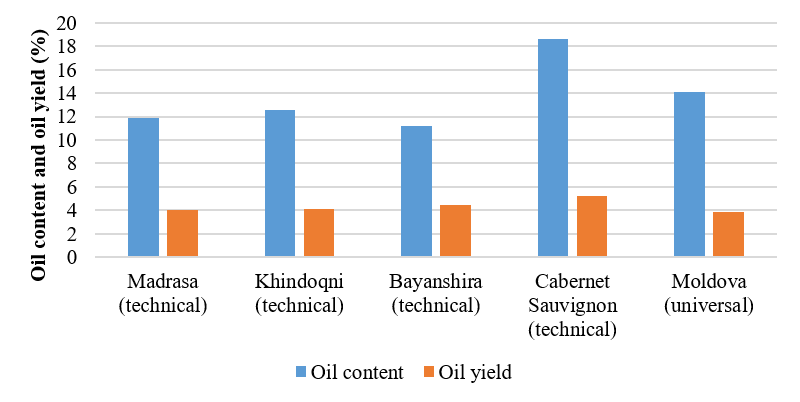
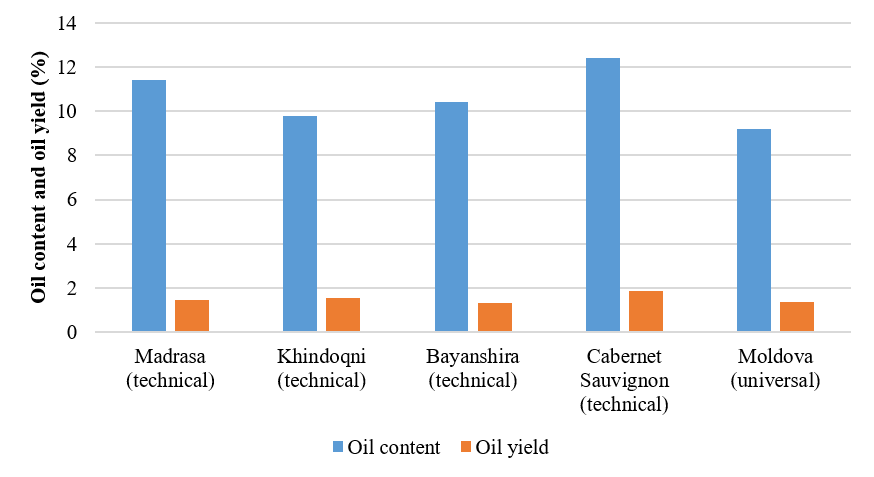
One of the main factors increasing the agricultural and economic importance of grape seeds is the amount of oil contained in them [27]. The crude oil content of grape seeds was determined, and certain differences were observed depending on the cultivation conditions. The oil content and oil yield values presented in Figures 1-3 are expressed on a dry matter basis (dry basis) (Figures 1 and 2).
In irrigated conditions, the oil content of grape seed varieties ranged from 11.2% to 18.6%, whereas in rainfed conditions it varied between 9.2% and 12.4%. However, since the number of varieties evaluated under irrigated and rainfed conditions was not the same, the obtained results are of a comparative nature only, and the observed differences should not be interpreted as a direct effect of irrigation. Comparisons were mainly performed for the common varieties studied under both cultivation conditions.
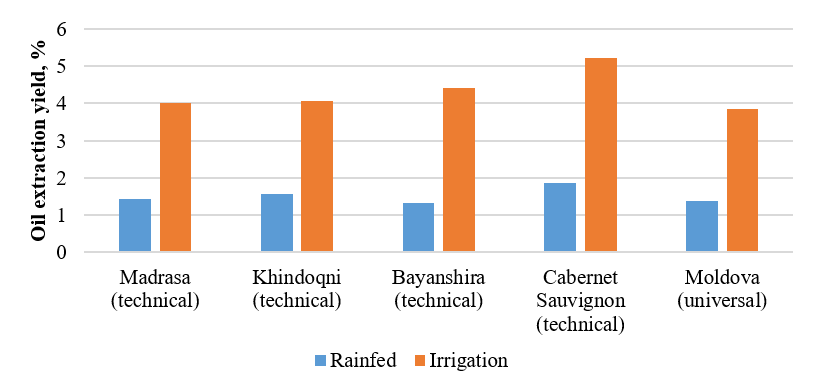
In addition to the biochemical analysis of grape seeds from different varieties grown under both conditions, the percentage of oil obtained during cold pressing was also determined (Figure 3).
Under irrigated conditions, the oil yield obtained by cold pressing from grape seeds ranged between 3.86% and 5.22%, with the following values recorded by variety: Cabernet Sauvignon (technical) – 5.22%, Madrasa (technical) - 4.00%, Khindogni (technical) - 4.08%, Bayanshira (technical) - 4.42%, and Moldova (universal) – 3.86%.
The oil extraction yield (%) was calculated as the ratio of the mass of extracted oil to the initial mass of grape seeds, as presented in Eq. (1):
Oil yield $(\%)=\frac{\text { Mass of extracted oil}}{\text { Initial mass of grape seeds}} \times 100$ (1)
Under rainfed conditions, the oil yield obtained from five grape seed varieties during cold pressing ranged between 1.32% and 1.86%. Specifically, the oil yield by variety was: Bayan Shira (technical) - 1.32%, Cabernet Sauvignon (technical) - 1.86%, Madrasa (technical) - 1.43%, Khindogni (technical) - 1.56%, and Moldova (universal) - 1.38%.
3.2 Determination of the effect of different processing methods on oil extraction from seeds and on the quality of the obtained oil
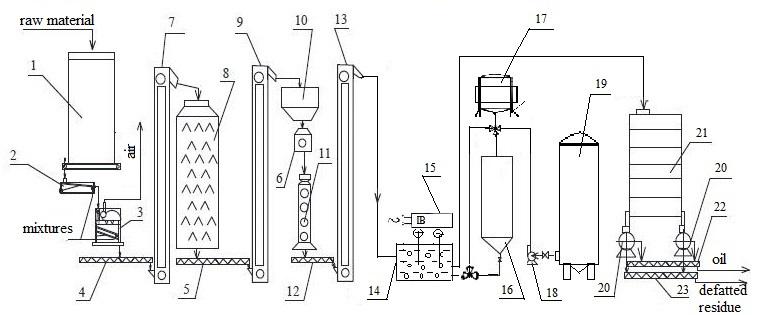
Based on the conducted research, an improved process-flow diagram for grape seed oil production was developed (Figure 4).
As shown, the seed raw material enters the discharge reservoir (1). From there, it passes through a magnetic separator (2) and is transferred to a separator (3). In the magnetic separator, the seeds are cleaned of metal particles and then passed through an aspirator, where light husk and dust particles are removed by air flow.
If necessary, the seeds are washed with water and dried again. Subsequently, the seed mass is transported via a conveying screw (4) to the first elevator (7). From there, the material is sent to the dryer (8). For drying, chamber-type, belt (conveyor), or drum dryers are used. The seeds are dried with hot air at 40-60 ℃, with the main objective of reducing moisture content to 5-10%.
This process increases oil yield and inhibits the growth of microorganisms. The dried seeds are transferred by a conveying belt (5) to the next elevator (9), and from there to the bunker (10). After passing through the double-roll mill (6) and the roller mill (11), the seeds are conveyed via screw conveyor (12) to the next elevator (13). From here, the seeds are transferred to the PEF treatment chamber (electrode treatment chamber) (14). This chamber is controlled by a control unit (15) consisting of a temperature system and a high-voltage generator.
In the liquid medium, the seeds are subjected to 30 pulses with a duration of 15 μs, resulting in the formation of “micro-pores” in the cell membranes. As a result, the extraction of oils and phenolic compounds from the seeds becomes easier. During this process, the temperature is maintained between 30 and 35 ℃. The electric field intensity is 2 kV/cm, and the total energy input is 7 kJ/kg. The formation of the liquid medium in the electrode treatment chamber is carried out in the reactor (16).
Alcohol is supplied from the dosing unit (17), and water is supplied via pump (18) from the potable water tank (19), resulting in a homogeneous solution in the reactor. The alcohol concentration in the hydroalcoholic solution is 30% (v/v). The seed mass subjected to PEF treatment is then transferred to the cold pressing units (20), where mechanical cold pressing is performed. Here, the mass is mechanically pressed in the press. During pressing, the temperature is maintained between 40 and 50 ℃. Since no chemical solvents are used, biologically active compounds are preserved, and a higher-quality oil is obtained. Compared to other methods, the lower oil yield of mechanical pressing is compensated for by the preliminary PEF treatment. Although pressure and speed vary during pressing, maintaining a stable temperature is considered essential.
The pressed mass is then thermally treated in the heating unit (21), and the obtained oil as well as the defatted residue are transferred via conveying containers (22 and 23) to the next stage.
The main physicochemical characteristics of the grape seed raw material used for oil production were investigated, and the obtained results are presented below (Table 1).
As shown, the grape seed raw material was whole and undamaged, with a brownish-brown color. The moisture content of the raw material was 6.60%, the mass fraction of foreign matter was 0.27%, and the oil content was 18.23%. The acid value determined for the oil to be obtained was 1.14 mg KOH/g, which indicates that the raw material is slightly subjected to hydrolytic degradation and is suitable for further processing.
Table 1. Physicochemical properties of grape seed raw material
|
Indicators |
Value |
|
External appearance |
Whole, undamaged seeds |
|
Color |
Brownish-brown color |
|
Moisture, % |
6.60 |
|
Mass fraction of impurities, % |
0.27 |
|
Oil content, % |
18.23 |
|
Acid value of extracted oil, mg KOH/g oil |
1.14 |
The grape seed raw material with the above-mentioned characteristics was divided into two parts and used for oil production according to the following variants:
Variant I - conventional technology: cold mechanical pressing method.
Variant II - new technology: mechanical pressing combined with preliminary treatment by electric pulses, using alcoholized water up to 30% (h%) and keeping the seeds in this medium. Afterwards, current was applied via electrodes placed in the medium. The selected average regime was: electric field intensity - 2 kV/cm; pulse duration - 15 μs; number of pulses - 30; total energy ~ 7 kJ/kg; temperature - 30-35 ℃; medium - water or 30% ethyl alcohol-water mixture.
The results of oil yield and quality indicators obtained by the improved technology are presented below (Table 2).
The obtained results showed that the application of PEF pretreatment increased the oil yield from 11.4% to 14.7% compared with conventional cold-pressing, corresponding to a relative increase of approximately 29%. Since both the control and experimental samples underwent the same hydration stage, the observed increase in oil yield can be attributed primarily to the electroporation effect induced by the PEF pretreatment.
Table 2. Yield and main quality indicators of grape seed oil obtained by conventional technology and technology with preliminary electric pulse (PEF) pretreatment
|
Indicators |
Variant I (Conventional Cold Pressing) |
Variant II (PEF Pretreatment + Cold Pressing) |
|
Oil yield, % |
11.4 |
14.7 |
|
Moisture and volatile substances, % |
0.34 |
0.19 |
|
Acid value, mg KOH/g |
1.21 |
1.74 |
|
Saponification value, mg KOH/g |
239.4 |
243.1 |
|
Iodine value, g I₂/100 g |
136.6 |
139.2 |
|
Peroxide value, meq O₂/kg |
4.2 |
9.7 |
|
Anisidine value |
3.40 |
8.40 |
Notes: The increase in peroxide and anisidine values in the PEF-treated sample is associated with the fact that electroporation of cell structures leads to a more intensive transfer of oxidation-sensitive components into the oil phase.
Table 2 presents a comparative overview of the yield and main quality indicators of grape seed oil obtained by conventional cold pressing and by cold pressing after preliminary treatment with electric pulses (PEF). The results show that the application of PEF technology significantly increased oil yield. Thus, while oil yield during conventional pressing was 11.4%, this value increased to 14.7% when PEF was applied. The approximately 29% increase in oil yield is explained by electroporation induced in cell membranes by electric pulses, which facilitates the release of intracellular lipids and ensures a more complete extraction of oil during mechanical pressing.
As a result of PEF treatment, the moisture and volatile matter content of the oil decreased from 0.34% to 0.19%. This change may be related to the easier separation of free water during pressing and the lower moisture content of the obtained oil, which is considered a positive factor in terms of storage stability.
In the PEF-pretreated sample, the acid value increased from 1.21 mg KOH/g to 1.74 mg KOH/g. This increase is associated with the more intensive transfer of intracellular lipases and free fatty acids into the oil phase. In addition, slight increases were observed in the saponification value (from 239.4 to 243.1 mg KOH/g) and iodine value (from 136.6 to 139.2 g I₂/100 g), indicating that there are no significant changes in the overall chemical composition of the oil.
Regarding oxidation indicators, higher values were determined in the PEF-pretreated sample. The peroxide value increased from 4.2 to 9.7 meq O₂/kg, and the anisidine value increased from 3.40 to 8.40. These results can be explained by the formation of higher amounts of primary and secondary oxidation products due to increased contact with oxygen and pro-oxidant intracellular components during electroporation. Nevertheless, the obtained values remained within the acceptable range for crude, unrefined vegetable oils and confirmed the feasibility of subsequent refining.
Overall, the results show that preliminary treatment with electric pulses enhances the efficiency of the cold pressing process by increasing oil yield and improving the extraction of bioactive components, while also causing a moderate decrease in phosphorus compounds and an increase in oxidation indicators. Therefore, PEF pretreatment technology can be considered a promising method for obtaining high-yield crude oil; however, further refining is necessary to achieve high-quality oil.
3.3 Purification, refining, and safety evaluation of oil samples
Table 3 compares the main quality characteristics of unrefined grape seed oil obtained by PEF pretreatment followed by cold pressing with those of oil obtained by the conventional cold-pressing method. The comparison showed that PEF pretreatment affected both the extraction of biologically active components and the oxidation-related quality parameters of the oil.
Table 3. Main quality indicators of unrefined grape seed oil
|
Indicators |
Variant I (Conventional Cold Pressing) |
Variant II (PEF Pretreatment + Cold Pressing) |
|
Mass fraction of phospholipids, % |
0.60 |
0.40 |
|
Chlorophyll, mg/kg |
1.9 |
2.5 |
|
Tocopherols, mg/100 g |
2.65 |
3.05 |
|
Carotenoids, mg/100 g |
4.01 |
4.12 |
When PEF pretreatment was applied, the phospholipid content decreased from 0.60% to 0.40%. This reduction may be attributed to structural changes in the cell membranes caused by electroporation, resulting in a portion of the phospholipids remaining in the press cake after pressing. A lower phospholipid content is considered one of the factors contributing to improved efficiency of the subsequent refining stages.
PEF pretreatment also improved the extraction of bioactive compounds. The tocopherol content increased from 2.65 to 3.05 mg/100 g, while the carotenoid content increased from 4.01 to 4.12 mg/100 g. These results may be attributed to the more efficient extraction of intracellular antioxidant components.
The chlorophyll content increased from 1.90 to 2.50 mg/kg. Although the enhanced extraction of chloroplast-derived pigments increased the color intensity of the oil, chlorophyll acts as a photosensitizer; therefore, its removal during the subsequent refining stage is considered necessary.
Overall, PEF pretreatment increased both the oil yield and the extraction of bioactive components, while also causing a moderate increase in oxidation-related quality parameters. Therefore, the application of an effective refining process was considered necessary to obtain a high-quality final product.
Table 4 compares the main quality characteristics of crude grape seed oil obtained by PEF pretreatment followed by cold pressing after processing by conventional water-alkali refining and adsorption-alkaline refining.
Table 4. Main quality characteristics of crude grape seed oil obtained by preliminary electric pulse (PEF)-assisted cold pressing before and after conventional and adsorption-alkaline refining
|
Indicators |
Unrefined Oil- Variant II (PEF-Assisted Cold Pressing) |
Water-Alkaline Neutralization and Subsequent Bleaching |
Adsorption--Alkaline Refining |
|
Phospholipids, % |
0.60 |
0.34 |
0.21 |
|
Acid value, mg KOH/g |
1.25 |
0.30 |
0.20 |
|
Chlorophyll, mg/kg |
1.99 |
0.43 |
0.19 |
|
Tocopherols, mg/100 g |
2.30 |
2.14 |
2.08 |
|
Carotenoids, mg/100 g |
0.37 |
0.28 |
0.25 |
|
Anisidine value |
6.28 |
2.70 |
1.21 |
|
Total oxidation value, meq O₂/kg |
27.41 |
6.70 |
3.21 |
Notes: The "unrefined oil" sample presented in Table 4 refers to a separate batch of PEF-pretreated crude grape seed oil prepared specifically for the evaluation of the refining process. Therefore, the parameters presented in this table should not be directly compared with the technological comparison results reported in Table 2.
Both refining methods improved the quality characteristics of the oil. The phospholipid content decreased from 0.60% to 0.34% after conventional refining and to 0.21% after adsorption-alkaline refining. Similarly, the acid value decreased from 1.25 mg KOH/g to 0.30 and 0.20 mg KOH/g, respectively.
The chlorophyll content was reduced from 1.99 mg/kg to 0.43 mg/kg after conventional refining and to 0.19 mg/kg following adsorption-alkaline refining. These results demonstrate the high efficiency of activated bentonite in the adsorption of pigments.
Although a certain reduction in the contents of tocopherols and carotenoids was observed during refining, the majority of these bioactive compounds were retained, indicating that the biological value of the oil was largely preserved.
The anisidine value decreased from 6.28 to 2.70 after conventional refining and to 1.21 following adsorption-alkaline refining. Likewise, the total oxidation value decreased from 27.41 meq O₂/kg to 6.70 and 3.21 meq O₂/kg, respectively. These results indicate a more efficient removal of oxidation products and demonstrate that adsorption-alkaline refining provides higher purification efficiency than conventional refining.
Adsorptive refining is an important stage of oil purification, where, in addition to decolorization (removal of pigments), other essential processes also occur, such as the breakdown and removal of oxidation products, elimination of residual phospholipids and soaps, and reduction of metal traces. The efficiency of adsorption refining is largely determined by the activity and technological properties of the adsorbent.
In unrefined and refined experimental oil samples, the total content of heavy metals, pesticides, and fatty acids was investigated (Table 5).
Table 5 presents a comparative overview of the safety indicators and the main fatty acid composition of unrefined and refined grape seed oil.
Table 5. Safety and compositional indicators of unrefined and refined grape seed oil
|
Indicators |
Unrefined Oil |
Adsorption-Alkali Refining Oil |
|
Heavy metals, mg/kg |
||
|
Lead (Pb) |
0.08 |
0.03 |
|
Cadmium (Cd) |
0.04 |
0.01 |
|
Arsenic (As) |
0.07 |
0.03 |
|
Mercury (Hg) |
0.008 |
0.003 |
|
Iron (Fe) |
3.50 |
1.00 |
|
Copper (Cu) |
0.30 |
0.08 |
|
Fatty acid composition, % |
||
|
Linoleic acid (C18:2) |
70.0 |
70.0 |
|
Oleic acid (C18:1) |
17.0 |
17.0 |
|
Palmitic acid (C16:0) |
7.0 |
7.0 |
|
Stearic acid (C18:0) |
4.0 |
4.0 |
|
Pesticide residues, mg/kg |
||
|
Total pesticide residues |
0.05 |
0.01 |
The results show that the refining process had a positive effect on the reduction of heavy metal content. The levels of lead, cadmium, arsenic, mercury, iron, and copper decreased after refining. These changes can be explained by the removal of a significant portion of metal ions during adsorption, neutralization, and filtration stages of refining.
The comparison of fatty acid composition showed that the refining process did not noticeably affect the relative proportions of the main fatty acids. In both unrefined and refined samples, linoleic acid (C18:2) remained the dominant component at approximately 70.0%, followed by oleic acid (C18:1) at 17.0%, palmitic acid (C16:0) at 7.0%, and stearic acid (C18:0) at 4.0%. These results indicate that refining does not alter the fatty acid profile of triacylglycerols.
The total pesticide residue content was 0.05 mg/kg in unrefined oil and 0.01 mg/kg in refined oil. This indicates that the refining process also contributes to the reduction of pesticide residues. Refining removed a significant portion of phospholipids, pigments, oxidation products, and metal ions. At the same time, a certain fraction of tocopherols and carotenoids was lost during adsorption. However, the retention of approximately 90% of tocopherols shows that sorption-alkaline refining not only improves oxidative stability but also largely preserves the biological value of the oil.
Overall, the detected levels of heavy metals and pesticide residues were below the permissible limits established in relevant regulatory standards. These results indicate that the obtained grape seed oil complies with food safety requirements and is suitable for human consumption.
The obtained results were compared with the permissible limits defined by Codex Alimentarius and relevant European Union food safety regulations, and all parameters were found to be within acceptable ranges.
1. Along with the genetic characteristics of grape varieties, cultivation conditions also influenced the oil content of seeds. In the studied samples, higher oil content was observed in varieties grown under irrigation conditions. However, since the number of irrigated and rain-fed varieties evaluated was different, these results are comparative in nature and should not be interpreted as a direct effect of irrigation.
2. The improved technology, combining preliminary electric pulse treatment with subsequent cold mechanical pressing, increased oil yield by 3.3 percentage points compared to the conventional method. The industrial application of this technology appears promising. However, for a complete evaluation of economic efficiency, additional techno-economic assessments are required, taking into account energy consumption, equipment costs, and production scale.
Sorption-alkaline refining ensured a reduction in the content of phospholipids, pigments, oxidation products, and heavy metals. The measured safety indicators complied with the permissible limits defined in relevant regulatory documents, confirming that the refining process contributes to improving oil quality.
[1] Ćurko, N., Perić, K., Vukušić Pavičić, T., et al. (2024). Effect of pulsed electric field pretreatment on the concentration of lipophilic and hydrophilic compounds in cold-pressed grape seed oil produced from wine waste. Foods, 13(14): 2299. https://doi.org/10.3390/foods13142299
[2] Ćurko, N., Lukić, K., Jurinjak Tušek, A., et al. (2023). Effect of cold pressing and supercritical CO₂ extraction assisted with pulsed electric fields pretreatment on grape seed oil yield, composition and antioxidant characteristics. LWT - Food Science and Technology, 84: 114974. https://doi.org/10.1016/j.lwt.2023.114974
[3] Rombaut, N., Savoire, R., Thomasset, B., Castello, J., Van Hecke, E., Lanoisellé, J.L. (2015). Optimization of oil yield and oil total phenolic content during grape seed cold screw pressing. Industrial Crops and Products, 63: 26-33. https://doi.org/10.1016/j.indcrop.2014.10.001
[4] Sinyavskaya, L.V., Kalmanovich, S.A., Martovshchuk, V.I., Babushkin, A.F., Kravchuk, N.S. (2003). Grape seeds are an important raw material for the oil and fat industry. News of Universities. Food Technology, 2-3: 26-27.
[5] Shi, J., Yu, J., Pohorly, J.E., Kakuda, Y. (2003). Polyphenolics in grape seeds—Biochemistry and functionality. Journal of Medicinal Food, 6: 291-299. https://doi.org/10.1089/109662003773193692
[6] Saykova, I., Tylkowski, B., Popovici, C., Peev, G. (2018). Extraction of phenolic and flavonoid compounds from solid wastes of grape seed oil production by cold pressing. Journal of Chemical Technology and Metallurgy, 53: 177-190.
[7] Chew, S.C. (2020). Cold-pressed rapeseed (Brassica napus) oil: Chemistry and functionality. Food Research International, 131: 1-13. https://doi.org/10.1016/j.foodres.2020.108997
[8] Lachman, J., Hejtmánková, A., Táborský, J., et al. (2015). Evaluation of oil content and fatty acid composition in the seed of grapevine varieties. LWT Food Science and Technology, 63: 620-625. https://doi.org/10.1016/j.lwt.2015.04.030
[9] Al Juhaimi, F., Özcan, M.M. (2018). Effect of cold press and Soxhlet extraction systems on fatty acid, tocopherol contents, and phenolic compounds of various grape seed oils. Journal of Food Processing and Preservation, 42(1): e13417. https://doi.org/10.1111/jfpp.13417
[10] Carmona-Jiménez, Y., Igartuburu, J.M., Guillén-Sánchez, D.A., García-Moreno, M.V. (2022). Fatty acid and tocopherol composition of pomace and seed oil from five grape varieties Southern Spain. Molecules, 27(20): 6980. https://doi.org/10.3390/molecules27206980
[11] Özcan, M.M., Unver, A., Gümüş, T., Akın, A. (2012). Characteristics of grape seed and oil from nine Turkish cultivars. Natural Product Research, 26(21): 2024-2029. https://doi.org/10.1080/14786419.2011.631133
[12] de Menezes, M.L., Johann, G., Diório, A., et al. (2023). Comparison of the chemical composition of grape seed oil extracted by different methods and conditions. Journal of Chemical Technology and Biotechnology, 98: 1103-1113. https://doi.org/10.1002/jctb.7336
[13] Özcan, M.M., Al Juhaimi, F., Gülcü, M., Ulsu, N., Gecgel, Ü. (2017). Determination of bioactive compounds and mineral contents of seedless parts and seeds of grapes. South African Journal for Enology and Viticulture, 38: 212-220. https://doi.org/10.21548/3188
[14] Karaman, S., Karasu, S., Tornuk, F., et al. (2015). Recovery potential of cold press by-products obtained from the edible oil industry: Physicochemical, bioactive, and antimicrobial properties. Journal of Agricultural and Food Chemistry, 63: 2305-2313. https://doi.org/10.1021/jf505948k
[15] Bhise, S., Kaur, A., Gandhi, N., Gupta, R. (2014). Antioxidant property and health benefits of grape byproducts. Journal of Postharvest Technology, 02(01): 001-011.
[16] Shinagawa, F.B., de Santana, F.C., Araujo, E., Purgatto, E., Mancini-Filho, J. (2018). Chemical composition of cold pressed Brazilian grape seed oil. Food Science and Technology, 38: 164-171. https://doi.org/10.1590/1678-457X.16617
[17] Mohamed, H.B., Duba, K.S., Fiori, L., et al. (2016). Bioactive compounds and antioxidant activities of different grape (Vitis vinifera L.) Seed oils extracted by supercritical CO₂ and organic solvent. LWT Food Science and Technology, 74: 557-562. https://doi.org/10.1016/j.lwt.2016.08.061
[18] Kapcsándi, V., Hanczné Lakatos, E., Sik, B., Linka, L.Á., Székelyhidi, R. (2021). Characterization of fatty acid, antioxidant, and polyphenol content of grape seed oil from different Vitis vinifera L. varieties. Acta Alimentaria, 28: 1.
[19] Lucarini, M., Durazzo, A., Kiefer, J., et al. (2020). Grape seeds: Chromatographic profile of fatty acids and phenolic compounds and qualitative analysis by FTIR-ATR spectroscopy. Foods, 9(1): 10. https://doi.org/10.3390/foods9010010
[20] Bozdogan Konuskan, D., Kamiloglu, O., Demirkeser, O. (2019). Fatty acid composition, total phenolic content and antioxidant activity of grape seed oils obtained by cold-pressed and solvent extraction. Indian Journal of Pharmaceutical Education and Research, 53(1): 144-150. https://doi.org/10.5530/ijper.53.1.19
[21] Fataliyev, H.K., Mammadova, S.M., Gadimova, N.S., Aliyeva, G.R., Tagıyev, A.T., Baloglanova, K.V. (2020). Production of functional products using grape processing residuals. Food Science and Technology (Campinas), 40(suppl 2): 1-7. https://doi.org/10.1590/fst.30419
[22] Fataliyev, H., Hajiyeva, G., Isgandarova, S., Gadimova, N., Baloghlanova, K. (2025). Study of the production of functional food products through the application of resource-conserving technologies. International Journal of Innovative Research in Social Sciences, 8(6): 9593. https://doi.org/10.53894/ijirss.v8i6.9593
[23] Fataliyev, H., Hajiyeva, G., Majnunlu, U., Mammadova, N., Mikayilov, V. (2026). Grape pomace as a functional ingredient in bread production: Effects on quality and nutritional properties. International Journal of Design & Nature and Ecodynamics, 21(3): 881-892. https://doi.org/10.18280/ijdne.210326
[24] Fataliyev, H.K., Qadimova, N.S., Allahverdiyeva, Z.C., Musayev, T.M., Akhundova, N., Babashli, A. (2022). Obtaining and investigation of the chemical composition of powdered malt and polymalt extracts for application in the production of nonalcoholic functional beverages. Eastern-European Journal of Enterprise Technologies, 5/11(119): 66-74. https://doi.org/10.15587/1729-4061.2022.265762
[25] Fataliyev, H., Gadimova, N., Huseynova, S., Isgandarova, S., Heydarov, E., Mammadova, S. (2024). Enrichment of functional drinks using grape pomace extracts, analysis of physicochemical indicators. Eastern-European Journal of Enterprise Technologies, 3/11(129): 37-45. https://doi.org/10.15587/1729-4061.2024.307039
[26] Sheskin, D.J. (2020). Handbook of Parametric and Nonparametric Statistical Procedures. Chapman and Hall/CRC. https://doi.org/10.1201/9780429186196
[27] Majnunlu, U.Kh., Shukurova, V.N., Salimov, V.S. (2024). Mechanical properties of several local and introduced grape varieties: Research and evaluation of their technological suitability. Research in Agricultural & Veterinary Sciences, 8(2): 74-83. https://doi.org/10.62476/ravs8274