Harini Sosiati* | Muhammad Faqih Dwi Putro | Ammar Azhar | Aris Widyo Nugroho | Totok Suwanda
© 2026 The authors. This article is published by IIETA and is licensed under the CC BY 4.0 license (http://creativecommons.org/licenses/by/4.0/).
OPEN ACCESS
Glass/nylon hybrid laminates are promising for external medical support components because they offer a useful combination of flexural stiffness and impact energy absorption. However, their performance is strongly affected by the quality of fiber–matrix adhesion and the type of polymer matrix used. This study evaluated TiO₂-modified glass/nylon GGNNGG hybrid laminates using a two-stage experimental approach. In the first stage, treated and untreated glass-woven roving and nylon mesh were combined in an epoxy–TiO₂ matrix to identify the most effective fiber surface-treatment condition. The laminate made with treated glass and treated nylon (TG–TN) showed the best performance among the epoxy-based systems, with the highest flexural strength of 212.19 MPa and the lowest water absorption of 0.63% after 120 h immersion. Post-test damage-zone observations were consistent with improved interfacial bonding when both reinforcements were treated. In the second stage, the optimized TG–TN reinforcement was combined with three TiO₂-modified matrices: polymethyl methacrylate (PMMA), epoxy, and polyester. The polyester-based TG–TN laminate showed the highest mean flexural and impact performance, with flexural strength, flexural modulus, strain at break, impact strength, and impact energy of 228.45 MPa, 8.15 GPa, 3.53%, 114.33 kJ/m², and 4.79 J, respectively. Overall, the results show that both fiber surface treatment and matrix selection play important roles in controlling the mechanical properties and water absorption behavior of TiO₂-modified glass/nylon hybrid laminates. Since TiO₂ content was kept constant in all systems, the results are interpreted under a fixed TiO₂-modified condition rather than as an independent evaluation of TiO₂ loading.
glass fiber, nylon fiber, TiO₂, hybrid laminates, mechanical properties, water absorption
Fiber-reinforced polymer (FRP) composites are increasingly used in external medical devices such as braces, prosthetic components, joint protectors, and non-implant support plates. Their increasing use is mainly attributed to their high specific strength and stiffness, good corrosion resistance, and the possibility of tailoring properties through appropriate fiber, matrix, and interfacial design [1, 2]. In biomedical applications, this flexibility is particularly important because a single device is expected to meet several functional demands at once. The material must be stiff and strong enough to keep the structure stable, yet tough enough to tolerate handling and occasional impacts, while also maintaining performance in the presence of moisture and sweat during everyday use [3, 4]. The ability of these materials to meet such requirements depends strongly on the quality of the fiber–matrix interface, which governs stress transfer between the reinforcement and matrix and influences damage initiation through interfacial debonding and fiber pull-out under mechanical loading [5]. For that reason, improving and stabilizing interfacial bonding remains a central task in designing FRP laminates for durable external medical devices.
Hybridization has attracted increasing attention because combining fibers with different characteristics can produce a more balanced set of laminate properties. In glass/nylon systems, glass (G) fiber mainly contributes to laminate stiffness and flexural load-bearing capacity, whereas nylon (N) fiber mesh provides a more deformable reinforcement phase that can improve energy absorption and damage tolerance. Previous work reported that the GGNNGG stacking sequence provides a favorable combination of flexural strength, impact strength, and water absorption behavior in G/N hybrid polyester laminates [2]. This finding indicates that combining stiff glass layers with nylon layers in a controlled architecture is important for balancing bending and impact performance.
At the same time, such hybrid systems introduce a significant challenge: achieving reliable adhesion on dissimilar reinforcement surfaces and across different matrix types. Glass and nylon exhibit different surface energies and chemical functionalities, so their bonding to a given matrix can be either promoted or hindered depending on the processing route and surface preparation that are used [6].
Selecting an appropriate matrix is another important step in designing G/N hybrid laminates. In many FRP systems, epoxy is often favored because of its good interfacial adhesion and flexural performance, whereas polyester remains attractive because it is easier to process and more economical [2, 7, 8]. Polymethyl methacrylate (PMMA) is also widely used in dental, orthotic, and protective applications because it is easy to fabricate and has long been accepted for biomedical applications [9]. Therefore, comparing epoxy, polyester, and PMMA within the same GGNNGG laminate architecture is useful for understanding how matrix type affects the mechanical response of TiO₂-modified glass/nylon hybrid laminates.
TiO₂ was used in this study as a matrix modifier because it has been reported to improve several properties of polymer systems, particularly when it is homogeneously dispersed and used at a suitable content. In previous studies, low TiO₂ contents, commonly around 1–3 wt.%, have been associated with improved surface hardness, wear resistance, and, in some cases, antimicrobial performance [10-12]. However, excessive TiO₂ loading can promote particle agglomeration and reduce mechanical performance [11, 13]. For example, Choi et al. [13] reported that adding 1 wt.% TiO₂ increased the tensile strength of an epoxy matrix, whereas contents above 3 wt.% reduced the strength regardless of particle size. These findings indicate that the benefit of TiO₂ depends strongly on dispersion quality, matrix–filler interaction, and the ability of the matrix to wet and bond with the treated reinforcements.
In G/N hybrid composites, interfacial quality plays a central role in determining laminate performance. For glass fibers, silane coupling agents are commonly used in industry because they help form stronger chemical bonds with the polymer matrix; as a result, tensile and flexural strengths usually increase, and the laminate becomes less prone to delamination. In practice, even simple pretreatments can make a difference, since they change the surface condition and remove contaminants that interfere with bonding [6, 14]. Cadore-Rodrigues et al. [6] showed, for example, that cleaning glass fibers with alcohol improved their adhesion to the matrix. Separate studies have reported that heat treatment can modify fiber surface characteristics and influence the mechanical properties of the corresponding polymer composites [15, 16]. Nylon fibers present a slightly different interfacial challenge: pristine polyamide surfaces can exhibit limited wettability and adhesion toward polymer matrices, so surface activation methods such as mechanical roughening, oxidative/plasma treatment, or mild chemical modification are often used to increase surface energy, improve wetting, and strengthen interfacial adhesion, especially when nylon is combined with thermoset matrices such as epoxy [17, 18].
Recent primary research has demonstrated that the laminate architecture, the arrangement of the fibers, and the ratio of stiff to tolerant reinforcement phases greatly impact the mechanical performance of hybrid composite laminates. The variation of fiber orientation, hybridization technique, and stacking order on flexural response, impact resistance, and damage progression has been shown for glass/Kevlar and carbon/aramid hybrid laminates [19]. The results show that hybridization influences both the average mechanical properties and the way damage initiates and propagates in the laminate [20]. For the G/N hybrid laminates, the GGNNGG stacking sequence and the relative positions of G and N layers are expected to be important for balancing bending stiffness, impact energy absorption, and damage tolerance.
The other important factor is the interfacial quality, as it determines the transfer of stress between the matrix and reinforcement and affects the formation of interfacial voids, which can act as pathways for moisture ingress. Previous investigations on glass-FRP composites indicate that surface cleaning, chemical activation, and silane-based treatments can alter the surfaces of glass fibers and hence influence the adhesion to polymer matrices [6, 14]. In addition, fiber packing, laminate shape, and interfacial areas have a significant effect on the moisture diffusion in fiber-reinforced composites. These parameters can either enhance or decrease the tortuosity of the water transport channels [21]. Therefore, the combined influence of surface treatment, matrix type, damage morphology, and water absorption should be considered when evaluating TiO₂-modified G/N hybrid laminates.
For external support components exposed to humid or sweaty environments, moisture resistance is also important because water uptake in fiber-reinforced composites is influenced by laminate structure, fiber arrangement, matrix type, and transport pathways in the matrix and interfacial regions [21, 22]. Interfacial quality, which governs stress transfer and influences damage initiation under mechanical loading, closely relates to these variables [5]. For these reasons, water absorption needs to be evaluated together with flexural and impact behavior when assessing the potential suitability of hybrid composites for external medical support applications.
Previous studies have shown that stacking sequence and filler selection strongly affect the performance of glass/nylon hybrid systems. Sosiati et al. [2] investigated polyester-matrix laminates with different nylon/glass configurations and found that the GGNNGG sequence exhibited the highest flexural strength (125.12 MPa) and impact strength (84.20 kJ/m²) among the samples examined. This finding indicates that placing glass layers on the outer sides in a symmetrical configuration improves bending performance, while the nylon layers contribute to impact energy absorption [2]. The study also added ceramic nanoparticles (ZnO, TiO₂, ZrO₂, Al₂O₃) to the polyester matrix. The polyester–TiO₂ combination absorbed the least water (0.52%), which suggests that TiO₂ could be a good filler for making these laminates more resistant to moisture [2]. A significant constraint in this and analogous studies is the dependence on untreated glass fibers within the hybrid laminates and TiO₂-modified systems. Furthermore, the optimization of fiber treatments has yet to be incorporated into systematic comparisons of matrix types, such as epoxy, polyester, and PMMA, within a cohesive framework [2, 13]. While basic treatments for glass fiber surfaces, like cleaning with alcohol, have been shown to improve adhesion [6], and more complicated chemical and silane treatments can greatly improve glass/PMMA performance [14], more research is needed to figure out how optimized surface treatments, TiO₂ incorporation, and matrix chemistry work together to affect mechanical response and water absorption.
However, most studies on G/N hybrid laminates and TiO₂-modified systems still share several limitations. They often rely on untreated glass fibers, do not systematically optimize surface treatments for both glass and nylon reinforcements, and rarely compare different matrix types (PMMA, epoxy, and polyester) within a single laminate architecture while evaluating flexural, impact, and moisture-related properties at the same time. In response to these gaps, the current study adopts a two-stage experimental framework to evaluate TiO₂-modified glass/nylon GGNNGG hybrid laminates. In the first stage, various combinations of treated and untreated glass-woven roving and nylon mesh are compared within an epoxy–TiO₂ matrix to determine the most effective surface treatment condition. In the second stage, the selected reinforcement condition is applied to three TiO₂-modified matrix systems, i.e., PMMA, epoxy, and polyester, to investigate the influence of the matrix types on the flexural and impact behaviors. With the TiO₂ content held constant throughout the study, this work focuses on the effects of fiber surface treatment and matrix selection under a fixed TiO₂-modified condition, rather than examining the independent effect of TiO₂ content. By organizing the work into these two stages, the study first identifies the most effective surface-treatment condition and then evaluates how the selected reinforcement system responds to different TiO₂-modified matrices.
2.1 Materials
This study used nylon fiber mesh (N, nylon 6), E-glass woven roving (G, WR200) mat, and TiO₂ particles supplied by local chemical suppliers. The matrix materials were epoxy, polymethyl methacrylate (PMMA, ISO 1567 type II class I), and unsaturated polyester (UP, 157 BTQN). The epoxy system consisted of bisphenol A, epichlorohydrin, and polyaminoamide hardener with a 1:1 mixing ratio. The unsaturated polyester was cured using methyl ethyl ketone peroxide at 1 wt.%.
2.2 Composite manufacturing and mechanical-physical tests
Before laminate fabrication, the surfaces of the glass fiber and nylon fiber mesh were treated to improve fiber–matrix adhesion. The glass fibers were immersed in 70% ethanol for 48 h and then dried in an oven at 200 ℃ for 30 min. This treatment was applied to remove weakly bonded contaminants and improve surface cleanliness before matrix impregnation. The nylon fiber mesh was mechanically roughened using 400-grit emery paper in both vertical and horizontal directions to increase surface roughness and promote mechanical interlocking with the polymer matrix.
TiO₂ particles were added to the matrix at a fixed content of 1 vol.%. Prior to mixing, TiO₂ particles were dried in an oven at 100 ℃ for 30 min to reduce absorbed moisture and minimize moisture-related agglomeration. The dried TiO₂ was then gradually added to the liquid matrix and dispersed using a conventional mechanical mixer at 70 rpm for 5 min. The TiO₂ content was kept constant for all composite systems. TiO₂ was thus regarded as a fixed matrix modifier rather than as an independent variable in this work.
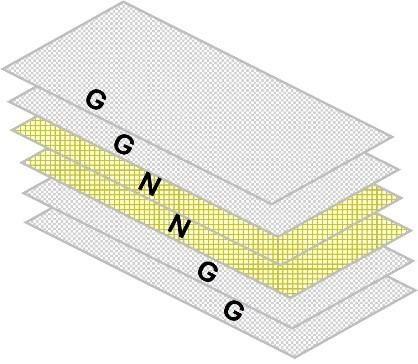
All laminates were fabricated using the same mold geometry, GGNNGG stacking sequence (Figure 1), and nominal constituent composition. The composition ratio of G:N:TiO₂:polymer was fixed at 16:8:1:75 vol.%. The required matrix volume for each laminate was calculated from the mold cavity volume and the fixed reinforcement volume fraction. This procedure was used to control the resin content and to minimize variation in laminate architecture among the different matrix systems.
Figure 1. Schematic of the GGNNGG stacking sequence of glass woven roving (G) and nylon fiber mesh (N) used in the hybrid laminates
After TiO₂ incorporation, the matrix was applied uniformly to each fiber layer by hand lay-up. The impregnated laminate was then placed in a matched metal mold with a target thickness of 3.2 mm. Epoxy- and polyester-based laminates were processed by hot-press molding at 100 ℃ for 30 min under a pressure of 500 psi (3.45 MPa). The laminates were then cooled to room temperature for 30 min before specimen preparation.
Because PMMA hardens rapidly during processing, the PMMA-based laminates required a different molding route. PMMA and TiO₂ were mixed for 1 min at 70 rpm, and the laminate was then formed by cold pressing for approximately 1 h. Although the molding route differed for PMMA, the mold geometry, stacking sequence, and nominal constituent composition were kept the same to maintain comparability among the matrix systems.
The current study was conducted in two experimental steps. The first experiment involved making composites with various ratios of treated and untreated glass and nylon (see Table 1) to evaluate the influence of their treatment combinations on the flexural and water absorption properties of epoxy-based composites. The tests were conducted according to ASTM D790-10 (specimens measuring 127 × 12.7 × 3.2 mm³) and ASTM D570-10 (specimens measuring 76.2 × 25.4 × 3.2 mm³) to assess the bending performance and water absorption of each composite type, respectively. The water absorption test included weighing each sample every 12 hours over a total period of 120 h. Five specimens were prepared for each composite combination for water absorption testing, while three valid specimens were included for flexural testing and statistical analysis. The goal of the first step was to optimize the composite based on its flexural and water absorption properties to identify the best composite specimen for use in the second experiment.
Table 1. Composite types in Experiment 1
|
Treatment Combination of G and N |
G (vol.%) |
N (vol.%) |
TiO2 (vol.%) |
Matrix Polymer (E) (vol.%) |
|
UG–UN |
16 |
8 |
1 |
75 |
|
UG–TN |
16 |
8 |
1 |
75 |
|
TG–UN |
16 |
8 |
1 |
75 |
|
TG–TN |
16 |
8 |
1 |
75 |
Note: G = glass, N = nylon, T = treated, U = untreated, E = epoxy.
In the second experiment, the optimized reinforcement condition selected from Experiment 1 was combined with three different matrices, namely PMMA, epoxy, and polyester, to evaluate the effect of matrix type on flexural and impact properties (see Table 2). Three-point bending and unnotched Charpy impact tests were then performed according to ASTM D790-10 and ASTM D6110, respectively. The number of valid specimens used in the mechanical tests for each composite condition ranged from three to seven, depending on the availability of acceptable specimens that met the testing criteria. Statistical analysis was performed only for flexural strength using the valid specimens; therefore, the number of analyzed specimens varied among the matrix groups.
Table 2. Composite types in Experiment 2
|
G and N |
G (vol.%) |
N (vol.%) |
TiO2 (vol.%) |
Matrix Polymer (vol.%) |
||
|
E |
P |
PMMA |
||||
|
XG–XN |
16 |
8 |
1 |
75 |
|
|
|
XG–XN |
16 |
8 |
1 |
|
75 |
|
|
XG– XN |
16 |
8 |
1 |
|
|
75 |
Note: XG–XN denotes the optimized glass/nylon surface-treatment condition selected from Experiment 1 and used for the matrix-type comparison in Experiment 2. G = glass, N = nylon, E = epoxy, P = polyester, PMMA = polymethyl methacrylate.
2.3 Microstructural characterization
The treated glass and nylon surfaces and TiO2 particle distribution in the composite were observed by scanning electron microscopy-energy dispersive X-ray spectroscopy (SEM–EDS, JSM IT200LA). SEM–EDS was used to examine the surface features of treated fibers and to confirm the presence and distribution of TiO₂ in the matrix phase. An optical microscope (Olympus SZ61) was used to observe post-test damage regions after flexural and impact testing. These observations were used to support the interpretation of the mechanical behavior.
2.4 Statistical analysis
Statistical analysis was carried out using one-way analysis of variance (ANOVA) in Minitab 14. The analysis was applied to compare the mean flexural strength among the surface-treatment groups and matrix-type groups. The surface-treatment comparison included UG–UN, TG–UN, UG–TN, and TG–TN laminates. The matrix-type comparison included PMMA-, epoxy-, and polyester-based laminates.
3.1 Scanning electron microscopy observation
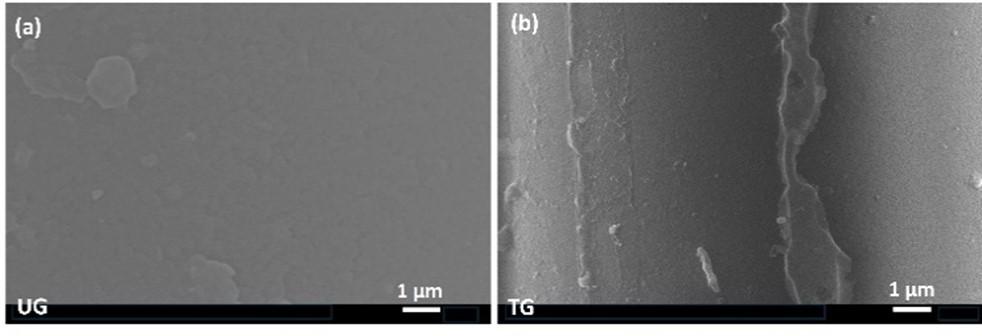
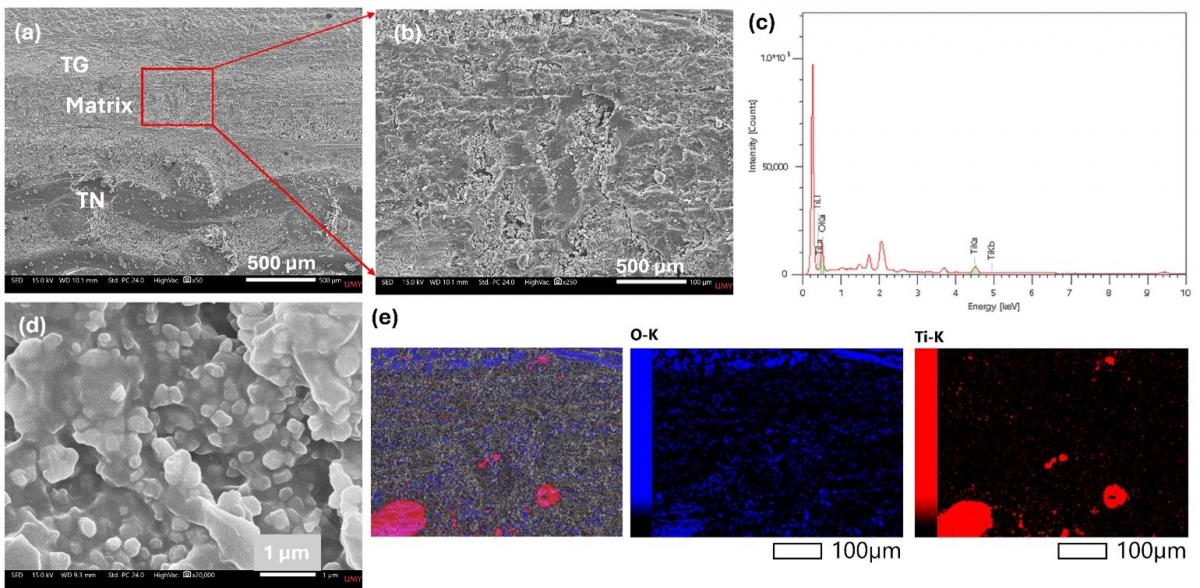
SEM–EDS analysis of the TiO₂ particles used as matrix fillers showed an inhomogeneous particle-size distribution ranging from 200 to 500 nm (Figure 2). The particles also tended to agglomerate after oven heating. Figure 3 shows the SEM images of the glass fiber surface before and after ethanol treatment. The treated glass fiber surface showed a more irregular structure, indicating increased surface roughness. Similarly, the treated nylon mesh surface showed a flower-like structure, indicating a substantial increase in surface roughness (Figure 4). These SEM observations confirm that the treatments produced rougher and more irregular surface features than those of the untreated fibers. These changes support the intended role of the treatments in improving surface condition and mechanical interlocking.
Figure 2. Scanning electron microscopy-energy dispersive X-ray spectroscopy (SEM–EDS) characterization of TiO₂ particles: (a) SEM micrograph showing particle/agglomerate morphology and (b) EDS spectrum confirming Ti and O signals associated with TiO₂
Figure 3. Scanning electron microscopy (SEM) images of glass fiber surfaces: (a) untreated and (b) after ethanol treatment, showing increased surface roughness on the treated fibers
Figure 4. Scanning electron microscopy (SEM) images of nylon mesh surfaces: (a) untreated and (b) after mechanical polishing with emery paper, showing removal of contaminants and a rougher surface texture
Figure 5. Scanning electron microscopy-energy dispersive X-ray spectroscopy (SEM–EDS) mapping of the polyester-based treated glass and treated nylon (TG–TN) laminate: (a) cross-sectional SEM image showing the TG fiber, matrix region, and TN mesh; (b) enlarged matrix region marked by the red rectangle in (a); (c) EDS spectrum showing Ti and O signals; (d) high-magnification SEM image showing TiO₂ particles/agglomerates embedded in the matrix; and (e) elemental maps of O and Ti, indicating Ti-containing regions distributed within the matrix with local Ti-rich agglomerates
Additional SEM–EDS mapping was performed on both epoxy-based and polyester-based composites to evaluate the distribution of TiO₂ within the matrix phase. A representative SEM–EDS mapping result of the polyester-based TG–TN laminate is presented in Figure 5. The EDS spectrum confirmed the presence of Ti and O signals, indicating that TiO₂ was incorporated into the matrix. The elemental mapping showed that Ti-containing regions were distributed within the matrix phase at the composite scale. However, local Ti-rich regions were also observed, indicating the presence of TiO₂ agglomerates. This result is consistent with the SEM observation of the original TiO₂ filler, which showed particle/agglomerate sizes of approximately 200–500 nm (Figure 2).
Therefore, TiO₂ in the present composites can be described as distributed within the matrix phase but locally agglomerated at the microstructural scale.
3.2 Selection of fiber surface treatment (epoxy matrix)
3.2.1 Flexural properties
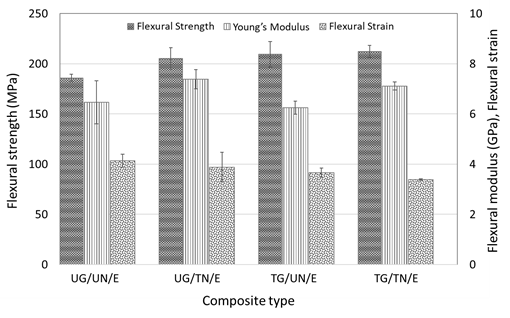
Figure 6 shows that treating nylon and/or glass improved the flexural strength of the composite compared with the untreated condition (UG–UN). When only one type of reinforcement was treated (UG–TN or TG–UN), the flexural strength already increased relative to UG–UN, indicating that enhancing the interface at either the glass–matrix or nylon–matrix boundary improves stress transfer in bending. The highest flexural strength was obtained when both reinforcements were treated (TG–TN), suggesting that simultaneous improvement of the glass–epoxy and nylon–epoxy interfaces is necessary to fully exploit the load-carrying capacity of the GGNNGG architecture.
These results are consistent with the SEM observations of the glass and nylon surfaces (Figures 3 and 4). As described earlier, ethanol treatment of the glass fibers produced a more irregular and rougher surface, while mechanical polishing of the nylon mesh generated a flower-like texture; both treatments clearly increased surface roughness. A rougher surface is expected to improve mechanical interlocking and to facilitate wetting by the epoxy–TiO₂ matrix, so that the interface can transfer load more effectively and local stress concentrations are reduced. Laminates in which only one reinforcement was treated showed higher flexural strength than the fully untreated system, most likely because strengthening a single interface already hinders early damage at that location [6, 14]. However, the remaining untreated interface is still relatively weak and can act as a preferential path for crack initiation and growth.
In contrast, when both reinforcements were treated (TG–TN), both interfaces were reinforced. This leads to a more uniform stress distribution through the laminate thickness and delays the onset of interfacial debonding during bending.
The effect of fiber surface-treatment combination on flexural strength was evaluated using one-way ANOVA in Minitab 14. Four treatment combinations were analyzed: UG–UN, UG–TN, TG–UN, and TG–TN. Three valid replications were included for each condition. The ANOVA gave an F-value of F₀ = 26.39. At α = 0.05, the critical F-value was F(0.05; 3; 8) = 4.07, with DF₁ = 3 and DF₂ = 8. Because F₀ was higher than F(0.05; 3; 8), the null hypothesis was rejected. This result indicates that the surface-treatment combination had a statistically significant effect on flexural strength.
Tukey’s multiple comparison test was then performed to identify which treatment combinations were significantly different. The results showed significant differences between TG–UN and UG–TN, TG–UN and UG–UN, UG–TN and TG–TN, and TG–TN and UG–UN. In contrast, no statistically significant differences were observed between TG–UN and TG–TN, or between UG–TN and UG–UN. These results confirm that the surface-treatment combination influenced the flexural strength of the epoxy-based G/N laminates, although not all pairwise comparisons were statistically different.
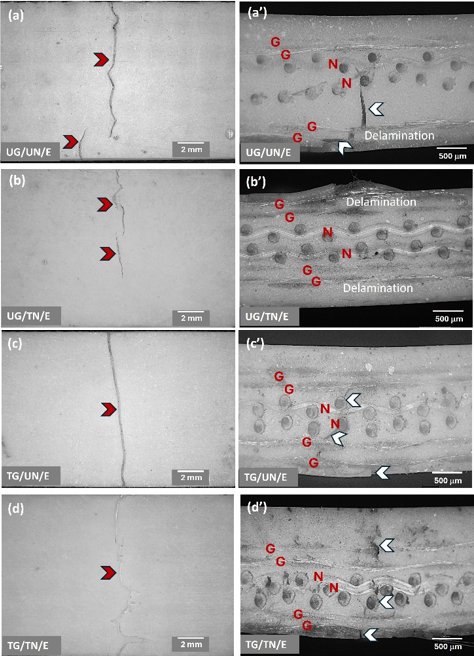
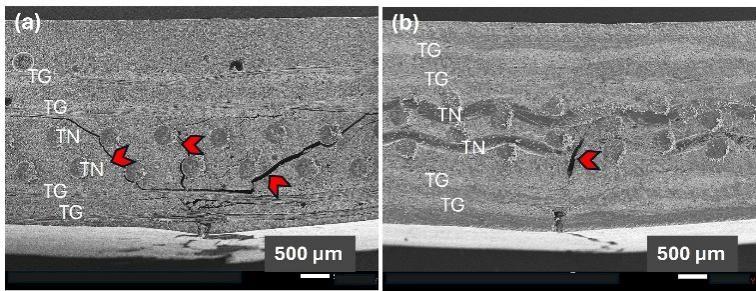
The optical micrographs in Figure 7 support the interpretation of the flexural results. The UG–UN laminate showed clear interfacial cracks and delamination along the glass/nylon and fiber-matrix interfaces. Relatively smooth fiber pull-out regions were also observed, indicating weak adhesion and limited mechanical interlocking. In the UG–TN and TG–UN laminates, the damage pattern became more mixed. Interfacial cracks were still visible, but matrix cracking across the plies and shorter fiber pull-out regions were more apparent. These features indicate that improving one interface already changed the damage development during bending. In the TG–TN laminate, the post-bending damage region showed less severe interfacial separation and more distributed local matrix damage than the untreated laminate. This behavior suggests that the combined treatment helped preserve the fiber-matrix interface and reduced the tendency of damage to follow weak interfacial paths.
Figure 7. Optical micrographs of damage regions after three-point bending of epoxy-based GGNNGG laminates with different surface-treatment combinations: (a–d) top-view images highlighting crack paths (red arrows) and (a′–d′) corresponding cross-sectional views highlighting matrix cracking (white arrows)
Overall, the flexural data and post-test damage region observations suggest that the combination of ethanol-treated glass and mechanically roughened nylon creates the most effective interface tailoring in the epoxy–TiO₂ system. These treatments enhance both interfaces in the hybrid laminate, minimize early interfacial debonding, and induce cracks to propagate through more energy-dissipating modes. This behavior is consistent with the superior bending performance of the TG–TN composite.
Compared with our previous nylon/glass/unsaturated polyester–2TiO₂ laminate, which reached a flexural strength of 107.5 MPa [2], the treated epoxy-based GGNNGG laminate in the present work achieved a higher value of 212.19 MPa. This represents an approximately twofold increase in flexural strength. The improvement can be attributed to the combined effects of the GGNNGG stacking sequence, the epoxy–TiO₂ matrix, and the surface treatments applied to both glass and nylon reinforcements. These factors likely improved stress transfer through the laminate thickness and reduced early interfacial separation, as supported by the post-bending damage observations.
3.2.2 Water absorption
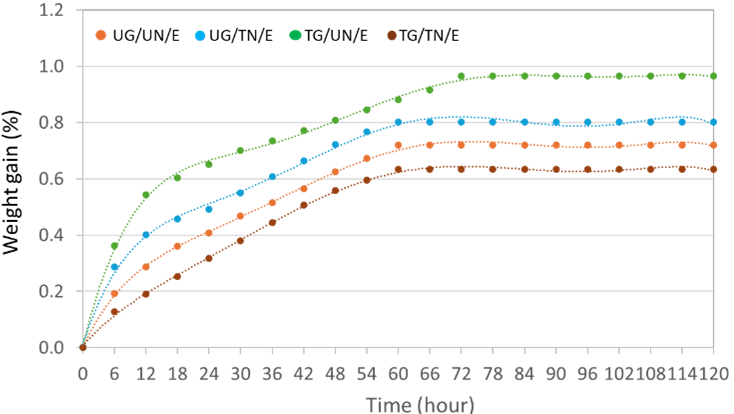
The water absorption behavior of epoxy-based GGNNGG laminates with different fiber surface treatment combinations after 120 h in distilled water is depicted in Figure 8. During the early immersion stage, all laminates showed a sharp rise in water uptake, particularly during the first 12 to 24 hours. Water diffusion into the polymer matrix and the quick filling of accessible interfacial gaps or microvoids are responsible for this initial stage. Following this phase, the absorption rate steadily dropped, suggesting that the uptake process slowed down and the available diffusion pathways became increasingly limited.
Figure 8. Water absorption curve of epoxy-based GGNNGG laminates with different surface-treatment combinations (UG–UN, UG–TN, TG–UN, TG–TN) during 120 h immersion in distilled water
The highest water absorption during the whole immersion time was observed for the untreated UG–UN laminate. Such behavior indicates that weaker fiber-matrix interfaces and larger interfacial pathways facilitated moisture ingress. Water uptake was lower than that of UG–UN when either glass or nylon was treated. This behavior suggests that improvement of one interface already helped restrict capillary transport. The TG–TN laminate showed the lowest water absorption throughout the immersion period, reaching 0.63% after 120 h. This result indicates that the combined treatment of glass and nylon produced a more compact interfacial structure with fewer moisture pathways [21].
The curves approached nearly constant values during the final immersion period, suggesting a near-saturation tendency. Nevertheless, the test's 120-hour duration prevented a conclusive confirmation of saturation. Because it exhibited the best combination of highest flexural strength (212.19 MPa) and lowest water absorption (0.63%) among the epoxy-based laminates, the TG–TN laminate was chosen as the ideal condition.
It is instructive to compare these values with our previous nylon/glass/unsaturated polyester–2TiO₂ laminate, which showed a flexural strength of 107.5 MPa and water absorption of 0.52% [2]. In the present work, the flexural strength has almost doubled (from 107.5 to 212.19 MPa), while water uptake increases only slightly from 0.52% to 0.63%. This modest increase is reasonable because epoxy is intrinsically more polar and more prone to moisture uptake than unsaturated polyester, and the current GGNNGG architecture also contains a higher volume fraction of hygroscopic nylon mesh [3]. The fact that the water absorption remains at a relatively low level despite these less favorable conditions suggests that the combined glass/nylon surface treatments and the presence of TiO₂ effectively reduce interfacial voids and diffusion paths so that moisture ingress is mainly governed by diffusion into the epoxy–nylon phases rather than extensive capillary transport along poorly bonded interfaces.
After the TG–TN condition was selected based on flexural strength and water absorption behavior, the next analysis focused on the influence of matrix type on the mechanical response of the optimized laminate.
3.3 Matrix-type effects on flexural behavior
Following the selection of TG–TN as the optimized reinforcement condition, the effect of matrix type was evaluated using PMMA-, epoxy-, and polyester-based laminates. This comparison was intended to clarify whether the selected surface-treatment condition remained effective across different TiO₂-modified matrix systems.
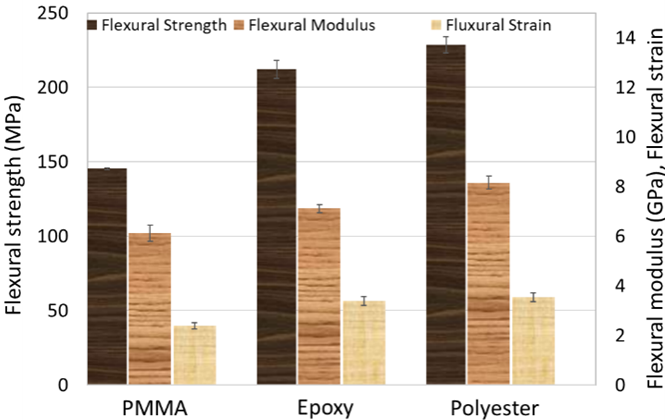
Figure 9 depicts flexural properties as a function of matrix type. Among the three TiO₂-modified matrices, the polyester system shows the highest flexural strength, followed by epoxy and then PMMA. The polyester laminate achieved 228.45 MPa, which was about 57% higher than the PMMA-based composite (145.27 MPa) and around 8% higher than the epoxy-based composite (212.19 MPa). Notably, the flexural strength of the PMMA-based laminate is already substantially higher than typical values reported for glass- or nylon-reinforced PMMA denture base resins, which commonly remain below ~100 MPa [23, 24].
A similar order was observed for the flexural modulus: polyester (8.15 GPa) > epoxy (7.11 GPa) > PMMA (6.11 GPa). Interestingly, the flexural strain at break also increased with matrix stiffness, from 2.39% for PMMA to 3.39% for epoxy and 3.53% for polyester. This result indicates that the polyester matrix provided a favorable combination of stiffness, strength, and deformation capacity before severe damage developed. The combination of high flexural strength, modulus, and strain at break agrees with previous reports that unsaturated polyester and epoxy matrices can provide higher structural efficiency than PMMA in fiber-reinforced laminates when the interface is well designed [7, 8, 25].
These trends can be interpreted in terms of both matrix properties and fiber-matrix interactions. Polyester and epoxy generally possess higher intrinsic stiffness and strength than PMMA and can form stronger covalent or hydrogen-bond interactions with siliceous glass surfaces, whereas PMMA often relies more on mechanical interlocking. Previous studies on glass- and natural-fiber laminates have shown that epoxy and polyester usually achieve higher flexural strength and modulus than PMMA for a given fiber architecture, provided that wetting and cure are adequate [7, 8]. In the present laminates, polyester and epoxy also appear to wet the treated glass and nylon reinforcements more effectively, so that stress transfer from the matrix to the hybrid fiber skeleton in bending is more efficient, leading to higher apparent composite modulus and strength. The relatively low strength and modulus of the PMMA-based laminate suggest that, despite using the same GGNNGG stacking sequence and surface treatments, interfacial adhesion and/or fiber wet-out are less effective, so debonding and interfacial shear deformation occur earlier under bending. The larger strain at break observed for the polyester composite, together with its high strength, is consistent with a damage process dominated by progressive matrix cracking and fiber breakage in a well-bonded interface, rather than extensive early debonding and fiber pull-out as would be expected in a weakly bonded PMMA system [2, 4].
The influence of matrix type on flexural strength was further examined using one-way ANOVA. The analysis compared three matrix systems: PMMA, epoxy, and polyester. The number of valid specimens differed among the groups, with seven specimens for the PMMA-based laminate, four specimens for the epoxy-based laminate, and five specimens for the polyester-based laminate. The calculated F-value was 5.74. At a significance level of α = 0.05, the critical F-value for DF₁ = 2 and DF₂ = 13 was 3.81. Since the calculated F-value exceeded the critical value, the null hypothesis was rejected. This result indicates that matrix type had a statistically significant effect on flexural strength.
Further comparison using Tukey’s test showed that the PMMA-based laminate was significantly different from the epoxy- and polyester-based laminates. In contrast, the epoxy- and polyester-based laminates were not significantly different from each other. This means that the polyester-based laminate had the highest mean flexural strength, but its difference from the epoxy-based laminate was not statistically significant. For this reason, the matrix-type effect is interpreted together with the SEM results, where the polyester-based laminate showed fewer visible matrix cracks after flexural testing.
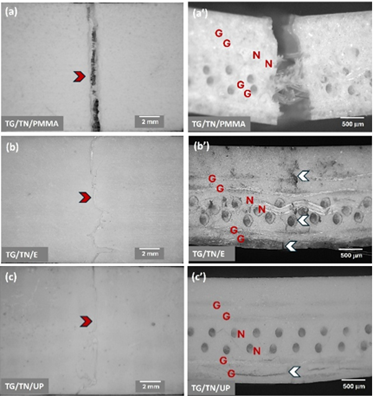
The differences in flexural properties, as shown in Figure 9, are reflected in the post-flexural damage morphologies shown in Figure 10. In the PMMA system, the top-view and cross-section micrographs reveal long, relatively straight cracks and significant delamination along the G/N interfaces, along with longer fiber pull-out zones, all indicating premature interface failure. The epoxy- and polyester-based TG–TN laminates showed more stable post-flexural damage regions with better preservation of the fiber–matrix interface compared with the PMMA-based laminate. The epoxy-based TG–TN laminate still exhibited visible matrix cracking around the reinforced region, whereas the polyester-based TG–TN laminate showed a more continuous matrix phase with limited localized cracking. This observation supports the higher mean flexural performance of the polyester-based laminate, indicating that the polyester matrix helped maintain interfacial integrity and reduced premature matrix damage during bending. Therefore, the lower damage severity observed in the polyester-based TG–TN laminate helps explain its higher mean flexural strength compared with the epoxy- and PMMA-based systems.
Figure 10. Optical micrographs of damage regions after three-point bending of GGNNGG laminates with different matrices (PMMA, epoxy, polyester): (a–c) top-view images highlighting crack paths (red arrows) and (a′–c′) corresponding cross-sectional views highlighting matrix cracking (white arrows). Images (b, b′) correspond to the same epoxy-based treated glass and treated nylon (TG–TN) condition presented in Figure 7(d, d′) and are included here for comparison
Additionally, SEM observations of the interfacial regions further support the flexural behavior of the optimized TG–TN laminates. Both the epoxy-based (Figure 11(a)) and polyester-based (Figure 11(b)) TG–TN composites showed good fiber-matrix contact, indicating that the combined glass and nylon surface treatments were effective in improving interfacial bonding [19]. However, the epoxy-based laminate exhibited more visible matrix cracking around the reinforced region, suggesting that although the interface was strong, the matrix experienced more localized damage under bending. In contrast, the polyester-based TG–TN laminate showed a more continuous matrix phase with minimal matrix cracking and no obvious interfacial separation in the observed regions.
3.4 Matrix-type effects on impact behavior
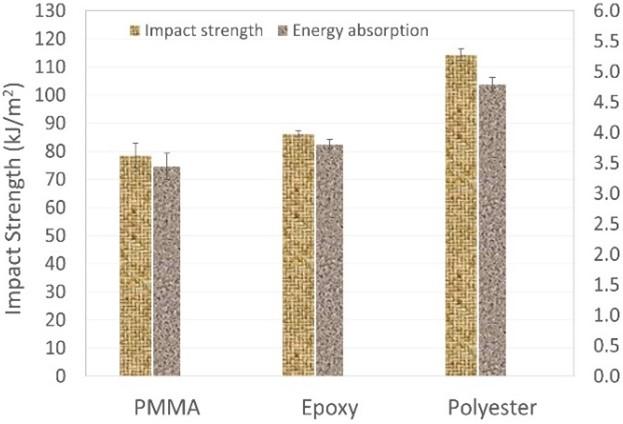
After evaluating the flexural response, the matrix-type comparison was extended to impact behavior. Figure 12 summarizes the impact properties of the three matrix systems. The impact strength followed the same trend as the flexural properties, with the polyester-based laminate showing the highest value. The impact strengths of the PMMA, epoxy, and polyester-based laminates were 78.42 kJ/m², 86.09 kJ/m², and 114.33 kJ/m², respectively. Thus, the polyester system showed an improvement of about 46% over PMMA and 33% over epoxy. A similar trend was observed for the total impact energy absorption: 3.44 J for PMMA, 3.80 J for epoxy, and 4.79 J for polyester. Compared with PMMA and epoxy, the polyester laminate showed increases of approximately 39% and 26%, respectively. These magnitudes are comparable to those reported for other glass-fiber laminates modified with nanoparticles or hybrid reinforcements, in which matrix type and interface quality strongly influence impact performance [1, 2].
In this study, laminates with a polyester matrix absorbed more impact energy and achieved higher impact strength compared to those based on epoxy and PMMA. This behavior reflects their flexural response and suggests that, for this hybrid layup, polyester offers a better balance between stiffness, strength, and toughness. Under impact loading, the outer glass plies initially resisted bending deformation, so effective load transfer from the matrix to these layers became important. At the same time, the nylon plies contributed to energy dissipation through local deformation, fiber bridging, and pull-out.
This observation agrees with previous studies on glass/nylon and other hybrid composite laminates, demonstrating that laminate architecture, matrix-fiber interaction, and damage distribution greatly influence impact strength and energy absorption [2, 26]. In systems where the matrix can maintain good contact with the reinforcement, the impact damage is generally more distributed, and delamination is delayed. This allows more of the impact energy to be absorbed by local matrix damage, fiber deformation, and small interlaminar separation rather than one major crack.
Similar hybrid mechanisms have been reported in laminates that combine glass with high-toughness fibers, such as aramid/Kevlar, where a rigid glass layer provides bending resistance while a more ductile fiber phase enhances damage tolerance and impact performance. In these systems, the design of the hybrid and the stacking sequence significantly influence impact strength and delamination behavior [19, 27]. In the laminates evaluated here, it is likely that the polyester matrix wets the hybrid reinforcement more effectively and forms stronger interfaces with both glass and nylon. As a result, a larger portion of the impact energy is dissipated through controlled matrix cracking, fiber fracture, and relatively short pull-out, rather than through early delamination and prolonged interfacial sliding. In contrast, the lower impact values observed for the PMMA-based system suggest earlier interface decohesion and insufficient mobilization of the hybrid reinforcement network, which aligns with its reduced flexural stiffness and strength.
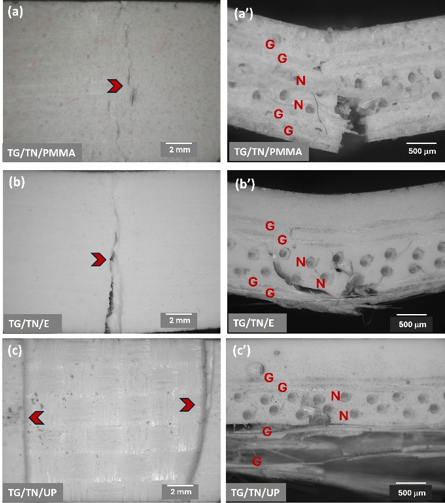
Figure 13. Optical micrographs of post-impact damage regions of GGNNGG laminates with different matrices: (a–c) top-view images of the impacted surface and (a′–c′) corresponding cross-sectional views through the impact zone
The optical micrographs in Figure 13 further support this interpretation. The PMMA-based laminate showed obvious ply separation and large through-thickness fissures after impact testing, indicating that delamination was the dominant visible damage mode. In contrast, the epoxy- and polyester-based TG–TN laminates, and particularly the polyester system, showed more distributed local matrix damage and restricted delamination around the impact zone. This difference indicates that the epoxy- and polyester-based laminates distributed the impact-induced damage more effectively and reduced early ply debonding. In polymer composites, the fiber–matrix interface is critical for stress transfer and damage initiation [5]. Better preservation of the interfacial region can help delay premature delamination. In impact-loaded composite laminates, the measured impact response and absorbed energy are also strongly related to distributed damage and controlled energy dissipation [26]. Thus, the more stable post-impact damage features observed in the polyester-based laminate agree with its higher impact strength and energy absorption capability.
This study investigated the influence of fiber surface treatment and matrix type on the flexural, impact, and water absorption behavior of TiO₂-modified glass/nylon GGNNGG hybrid laminates. In the first stage, the TG–TN laminate provided the most favorable balance among the epoxy-based laminates, with high flexural strength and the lowest water absorption of 0.63% after 120 h immersion. This result indicates that treating both reinforcements improved the fiber–matrix interface and helped reduce moisture pathways within the laminate.
In the second stage, the optimized TG–TN reinforcement was combined with PMMA, epoxy, and polyester matrices. Among the matrix systems evaluated, the polyester-based TG–TN laminate showed the highest mean flexural and impact performance. SEM observations showed good fiber–matrix contact in both epoxy- and polyester-based TG–TN laminates, while the polyester-based laminate exhibited fewer visible matrix cracks after flexural testing. These observations support the role of matrix type in controlling damage development and mechanical response under the present fixed TiO₂-modified condition.
SEM–EDS mapping confirmed that TiO₂ was incorporated into the matrix phase and distributed at the composite scale, although local Ti-rich agglomerates were still observed. Therefore, TiO₂ should be considered as a fixed matrix modifier in this study, and its independent contribution could not be isolated. Overall, the results indicate that combining treated glass/nylon reinforcements with a suitable matrix, particularly polyester in the present system, can improve flexural and impact responses while maintaining relatively low water absorption. Future work should include TiO₂-free controls, varied TiO₂ contents, more detailed interfacial characterization, quantitative damage analysis, and flexural–impact testing after moisture conditioning to clarify the role of TiO₂ and evaluate the long-term durability of these laminates for external medical support applications.
The authors gratefully acknowledge the financial support provided by the Directorate of Research and Community Engagement, Universitas Muhammadiyah Yogyakarta, Indonesia, through the Kerjasama Dalam Negeri research scheme 2026. This research was supported under Decree No. 4/DRP-Riset/I/2026.
[1] Oleiwi, J.K., Hamad, Q.A., Abdulrahman, S.A. (2022). Flexural, impact and max. shear stress properties of fibers composite for prosthetic socket. Materials Today: Proceedings, 56: 3121-3128. https://doi.org/10.1016/j.matpr.2021.12.368
[2] Sosiati, H., Fahrezy, R.A., Fahrudin, Pamasti, A., Hata, S., Gao, H. (2024). Improvement of the nylon (N)-glass fiber (G) reinforced polyester composite properties by varying oxide ceramic particles and stacking sequences of N and G. Materials Research Express, 11(12): 125301. https://doi.org/10.1088/2053-1591/ad95df
[3] Alhotan, A., Yates, J., Zidan, S., Haider, J., Jurado, C.A., Silikas, N. (2021). Behavior of PMMA resin composites incorporated with nanoparticles or fiber following prolonged water storage. Nanomaterials, 11(12): 3453. https://doi.org/10.3390/nano11123453
[4] Thomason, J., Xypolias, G. (2023). Hydrothermal ageing of glass fiber reinforced vinyl ester composites: A review. Polymers, 15(4): 835-856. https://doi.org/10.3390/polym15040835
[5] Singh, D.K., Vaidya, A., Thomas, V., Theodore, M., Kore, S., Vaidya, U. (2020). Finite element modeling of fiber-matrix interface in polymer composite. Journal of Composites Science, 4(2): 58. https://doi.org/10.3390/jcs4020058
[6] Cadore-Rodrigues, A.C., Guilardi, L.F., Wandscher, V.F., Pereira, G.K.R., Valandro, L.F., Rippe, M.P. (2020). Surface treatments of a glass-fiber reinforced composite: Effect on the adhesion to a composite resin. Journal of Prosthodontic Research, 64(3): 301-306. https://doi.org/10.1016/j.jpor.2019.09.001
[7] Oleiwi, J.K., Hamad, Q.A. (2018). Studying the mechanical properties of denture base materials fabricated from polymer composite materials. Al-Khwarizmi Engineering Journal, 14(3): 100-111. https://doi.org/10.22153/kej.2018.01.006
[8] Shettar, M., Bhat, A., Katagi, N.N., Gowrishankar, M.C. (2025). Experimental investigation on mechanical properties of glass fiber–nanoclay–epoxy composites under water-soaking: A comparative study using RSM and ANN. Journal of Composites Science, 9(4): 195-214. https://doi.org/10.3390/jcs9040195
[9] Sosiati, H., Rizky, A.M., Latief, A.L.M., Adi, R.K., Hamdan, S. (2023). The mechanical and physical properties of microcrystalline cellulose (MCC)/sisal/PMMA hybrid composites for dental applications. Materials Research Express, 10(3): 035301. https://doi.org/10.1088/2053-1591/acbb57
[10] Shakir, W.A., Mohammed, M.R., Hilal, I.H. (2019). Mechanical characteristics of (TiO2-ZnO)/PMMA nanocomposites for dentures. International Journal of Medical Research & Health Sciences, 8(3): 59-72.
[11] Kaurani, P., Hindocha, A.D., Jayasinghe, R.M., Pai, U.Y., Batra, K., Price, C. (2023). Effect of addition of titanium dioxide nanoparticles on the antimicrobial properties, surface roughness and surface hardness of polymethyl methacrylate: A systematic review. F1000Research, 12: 577. https://doi.org/10.12688/f1000research.130028.1
[12] Purnomo, Arti, D.W.K., Mukaromah, A.H., Muhammad, S. (2023). An overview of titanium dioxide effect on mechanical properties of PMMA-TiO2 nanocomposites. Journal of International Dental and Medical Research, 16(4): 1797-1803.
[13] Choi, Y.M., Hwangbo, S.A., Lee, T.G., Ham, Y.B. (2021). Effect of particle size on the mechanical properties of TiO2-Epoxy nanocomposites. Materials, 14: 2866-2878. https://doi.org/10.3390/ma14112866
[14] Schauperl, Z., Ivanković, L., Bauer, L., Šolić, S., Ivanković, M. (2023). Effects of different surface treatments of woven glass fibers on mechanical properties of an acrylic denture base material. International Journal of Molecular Sciences, 24(2): 909-920. https://doi.org/10.3390/ijms24020909
[15] Sherif, G., Chukov, D.I., Tcherdyntsev, V.V., Torokhov, V.G., Zherebtsov, D.D. (2020). Effect of glass fibers thermal treatment on the mechanical and thermal behavior of polysulfone based composites. Polymers, 12(4): 902-914. https://doi.org/10.3390/polym12040902
[16] Faria, D.L., Pereira, T.G.T., Silva, D.W., Scatolino, M.V., et al. (2026). Recycled lignocellulosic resources for circular bioeconomy applications: Heat-treated eucalyptus fibers in polyester composites. Recycling, 11(2): 34-59. https://doi.org/10.3390/recycling11020034
[17] Wu, C.C., Demaree, J.D., Weerasooriya, A., Bujanda, A., Robinette, J. (2022). Enhanced interfacial adhesion on nylon 66 to epoxy resin EPON 825 by non-thermal atmospheric pressure dielectric barrier discharge plasmas. Coatings, 12: 919-936. https://doi.org/10.3390/coatings12070919
[18] Rodríguez, M.D.P., Vélez, E.V., Hernández, A.G., Martinez, H., Torres, A. (2023). Surface modification of the Nylon 6,6 and wasted glass fiber-Nylon 6.6 coating using atmospheric plasma treatment. Journal of Applied Polymer Science, 140(16): e53763. https://doi.org/10.1002/app.53763
[19] Alagumalai, V., Shanmugam, V., Balasubramanian, N.K., Krishnamoorthy, Y., et al. (2021). Impact response and damage tolerance of hybrid glass/kevlar-fiber epoxy structural composites. Polymers, 13(16): 2591-2606. https://doi.org/10.3390/polym13162591
[20] Rout, S., Nayak, R.K., Patnaik, S.C., Nezhad, H.Y. (2022). Development of improved flexural and impact performance of kevlar/carbon/glass fibers reinforced polymer hybrid composites. Journal of Composites Science, 6: 245-259. https://doi.org/10.3390/jcs6090245
[21] Subramaniyan, S.P., Imam, M.A., Prabhakar, P. (2021). Fiber packing and morphology driven moisture diffusion mechanics in reinforced composites. Composites Part B: Engineering, 226: 109259. https://doi.org/10.1016/j.compositesb.2021.109259
[22] Aranha, R., Filho, M.A.A., Santos, C.D.L., de Andrade, T.H., et al. (2024). Effect of water absorption and stacking sequences on the tensile properties and damage mechanisms of hybrid polyester/glass/jute composites. Polymers, 16(7): 925. https://doi.org/10.3390/polym16070925
[23] Yerliyurt, K., Taşdelen, T.B., Eğri, Ö., Eğri, S. (2023). Flexural properties of heat-polymerized PMMA denture base resins reinforced with fibers with different characteristics. Polymers, 15(15): 3211. https://doi.org/10.3390/polym15153211
[24] Singh, K., Sharma, S., Negi, P., Kumar, M., Rajpurohit, D., Khobre, P. (2016). Comparative evaluation of flexural strength of heat polymerised denture base resins after reinforcement with glass fibers and nylon fibers: An in vitro study. Advances in Human Biology, 6(2): 91-94. https://doi.org/10.4103/2321-8568.190315
[25] Sosiati, H., Guntur Ma’arif, M., Firmansyah, W.A., Hamdan, S. (2023). Characterization of the properties of bio-CaCO3 waste eggshell and abaca fiber reinforced hybrid composites. Materials Science Forum, 1087: 13-20. https://doi.org/10.4028/p-n61z06
[26] Ding, Y., Liu, J., Hall, Z.E.C., Brooks, R.A., Liu, H., Kinloch, A.J., Dear, J.P. (2023). Damage and energy absorption behaviour of composite laminates under impact loading using different impactor geometries. Composite Structures, 321: 117259. https://doi.org/10.1016/j.compstruct.2023.117259
[27] Safri, S.N.A., Sultan, M.T.H., Jawaid, M., Jayakrishna, K. (2018). Impact behavior of hybrid composites for structural applications: A review. Composites Part B: Engineering, 133: 112-121. https://doi.org/10.1016/j.compositesb.2017.09.008