Huda Sarhan* | Amal Hamza | Nisren Jasim
© 2026 The authors. This article is published by IIETA and is licensed under the CC BY 4.0 license (http://creativecommons.org/licenses/by/4.0/).
OPEN ACCESS
In this study, the lemon residue was utilized as a bio-leaching solution for the removal of copper ions from the artificially contaminated soil and to assess its effects on the soil physicochemical properties via the soil washing technique. Under constant operation conditions, three Batch experiments were conducted, consisting of a soil-to-solution ratio of 1:20, 4 h washing time, 150 rpm agitation, and pH 5, with different concentrations of the lemon residue bio-leaching solution (LRBLS). The results indicated significant differences between the particle-size distribution of the washed soil and the untreated soil at the 20, 40, and 70 g/L concentrations. The soil pH levels have changed from 8.01 to 7.01, 6.87, and 6.79, which shows a decrease in soil alkalinity. The increase in Electrical conductivity with increasing LRBLS concentration was 1910, 4020, and 4280 µS/cm. Chloride content increased by 14–20%, while nitrate (NO₃⁻) levels decreased after treatment. The amount of copper that was determined in the samples of soil after washing with LRBLS at 20, 40, and 70 g/L decreased from the initial value of the contaminated soil of 433.552 mg/kg to 206.495, 147.526, and 139.13 mg/kg, respectively, which corresponded to the extraction efficiency of 52.4%, 65.9%, and 68%. Overall, LRBLS demonstrates strong potential as an eco-friendly approach for copper removal, although it induces measurable changes in soil properties.
soil, washing, heavy metal, copper, citric acid, chelation, lemon residue, lemon residue bio-leaching solution
The availability of heavy metal ions (HMs) in soil is now a significant environmental issue, with far-reaching consequences for public health, agriculture, and ecosystem stability. Unlike organic contaminants, heavy metals do not decompose easily by microbial or chemical means. Rather, their persistence in the environment results in continued accumulation in soil systems. This longevity, combined with potential bioaccumulation and biomagnification, makes them significantly more dangerous to ecosystems and public health. Industrialization and urbanization are the primary sources of heavy metal contamination in soil. The anthropogenic activities, such as industrial effluents, intensive agriculture (pesticide and fertilizer use), and poor waste disposal, further aggravate the situation [1, 2].
Some HMs, such as copper (Cu+2) and zinc (Zn+2), are known as essential micronutrients required in trace amounts for various metabolic functions. They are poisonous at high concentrations, though, and can have harmful health impacts. Moreover, the accumulating metals can also disrupt the soil structure, reduce the soil fertility, and slow plant growth and development [3].
Soil pollution not only seriously affects the ability of the soil to circulate and destroys sustainable agricultural development, but also poses a threat to public health and food security. Incidents, such as Acute poisoning involving cadmium, excess blood lead levels, and arsenic poisoning, are common. The soil-heavy metal pollution issue has emerged as a major issue that cannot be avoided [4].
Many treatment methods have been proposed to extract contaminants (e.g., heavy metals) from polluted soils, and they include phytoremediation, thermal treatment, soil washing, and electrokinetic. Soil washing is considered one of the most effective methods for extracting heavy metals. In practice, the efficiency of this process can be significantly enhanced by adding washing agents, such as dispersing agents, strong acids, or organic acids. Examples of strong acids used in this process include hydrochloric acid (HCl) and nitric acid (HNO3). They may be able to extract more contaminants from polluted soil than weak acids, but they may also acidify the soil after the treatment, and additional processes ought to be conducted to neutralize the acidified soil [5].
In order to address these weaknesses, the use of low-molecular-weight organic acids (LMWOAs), like citric and tartaric acids, is proposed as a substitute for synthetic chelating agents. Even though such organic acids are biodegradable and cause less damage in the treatment of soils, their use can still result in significant losses of the nutrients of the soils. As a result, there is an acceptable necessity to look for highly efficient, environmentally friendly, low-cost leaching reagents capable of effectively extracting the metals without damaging the quality of soils, because they contain a variety of functional groups that can bind with metal cations [6].
Investigated the capability of Na2-EDTA solution to extract Cu+2 from the contaminated soil. The findings revealed the highest level of extraction efficiency in Na2-EDTA, as the leaching solution had a pH of 5.5 compared to a pH of 8 in the contaminated soil [7].
Materials derived from fruits and vegetables have attracted attention as effective and low-cost adsorbents. Their availability, renewability, and environmentally friendly nature make them particularly suitable for applications in resource-limited settings. These materials are commonly sourced from non-edible agricultural residues produced in large quantities during food processing operations, such as peeling by abrasion, steam, or chemical methods. Utilizing these by-products for pollutant removal not only enhances waste management practices but also contributes to reducing environmental contamination. Various fruit and vegetable wastes have been explored for this purpose, including residues from sugar beet, watermelon, potato, carrot, mango, apple, garlic, lemon, cucumber, eggplant, and corn [8].
These materials can be used as environmentally friendly leaching that will provide an efficient and viable technique for the remediation of copper-contaminated soils. According to a study conducted in research [9], lemon peel has the potential to be used in large-scale production of citric acid that can be used in numerous industries. The study [10] documented that different fruit residue extracts are efficient in heavy metal remediation from contaminated soils. The concentration of cadmium (Cd+2) that was extracted from the contaminated soil was different among the various fruit residues, with a value of between 3.72 and 35.60 mg/kg. The 11 fruits were pineapple (Ananas comosus), grapefruit (Citrus maxima), orange (Citrus sinensis), grape (Vitis vinifera L.), lemon (Citrus limon), kiwi (Actinidia chinensis), tangerine (Citrus reticulata), apple (Malus pumila), kumquat (Fortunella margarita), tomato (Lycopersicon esculentum), and carambola (Averrhoa carambola). Lemon residue was found to extract the highest amount of cadmium (35.60 mg/kg), and carambola extracted the least (3.72 mg/kg), with a 9.6-fold difference in extracting capability between lemon and carambola residues. Overall, the results indicate the potential of lemon residues as vegetable-based resources in the elimination of heavy metals. This justifies the use of lemon residue, environmentally friendly leaching solutions in the copper-contaminated soils, which offer a viable and sustainable solution to soil remediation. The present study focuses on evaluating the ability of lemon residue bio-leaching solution (LRBLS) for the removal of copper and explores the effects of this solution on selected physicochemical properties of the treated soil, such as electrical conductivity (EC), soil pH, particle size distribution, calcium carbonate (CaCO₃), nitrate ions (NO₃⁻), and chloride content (Cl-). In addition, the study employs Scanning Electron Microscopy (SEM) and Fourier Transform Infrared Spectroscopy (FTIR) to describe the characterized soil samples.
2.1 Soil properties
In this study, the collected soil samples were taken from depths of 0-20 cm below the ground surface in Hilla, Iraq, following the procedure described by the study [11]. The sampled soil was sieved through a 2 mm mesh to remove stones and coarse debris, and then air-dried under laboratory conditions, in accordance with research [12]. The examination of the size of particles in the soil revealed that it was sand (30%), silt (27%), and clay (43%) (ASTM D 422). Also, the Atterberg limits of soil were measured as Liquid limit (18%), Plastic limit (27%), and Plasticity index (7%) (ASTM D 4318). Table 1 shows the physicochemical properties of the soil sample. Soil samples contaminated with a copper concentration equal to 433.552 mg/kg and an initial moisture content equal to 40% by weight were prepared by dissolving 3.8 g of Cu(NO3)2∙3H₂O in 400 ml of distilled water. The solution was then added to 1 kg of dry soil, and the contaminated soil was aged for 6 weeks at room temperature. The soil-to-water ratio for pH measurements was 1:2.5 (w/v); 5 g of air-dried soil was added to 12.5 mL of distilled water. The suspension was shaken thoroughly by hand for several minutes, left to stand for 1 h, and then the pH was determined using a calibrated pH meter (EZDO type, PL-700), according to the methods of research [13]. Chemical analyses were performed following procedures consistent with BS 1377/1990 (British Standards /methods of testing soil for civil engineering purposes) for organic matter, chloride, and sulfate content.
Table 1. Summarized the properties of the physical and chemical native soil samples used in the current study
|
Characteristic |
Value |
|
pH |
8.29 ± 0.06 |
|
Organic content (%) |
0.0530 ± 0.0026 |
|
Nitrate ions (NO3-) (mg/kg) |
93.88 ± 2.24 |
|
Electrical conductivity EC (µS/cm) |
152.0 ± 4.0 |
|
Chloride content (Cl-) (%) |
0.0088 ± 0.0004 |
|
Sulfate content (%) |
0.0120 ± 0.0005 |
2.2 Preparation of soil washing solutions
As reported by Luo et al. [10], lemon residue showed the highest efficiency in extracting Cd from soil among 11 kinds of fruit wastes. Accordingly, this study employed an LRBLS, which was then applied for the extraction of copper ions from artificially contaminated soil. Lemons were obtained from local markets, and their peels were separated and thoroughly washed before being air-dried, ground, and sieved. A measured quantity of the resulting powder was then combined with water in suitable containers and agitated using a shaker (140 rpm for 12 h) at 25 ℃. Afterward, the mixtures were filtered to collect the supernatant, which was used to prepare solutions of varying concentrations for soil washing tests. This procedure was carried out in accordance with research [6]. The characteristics of LRBSL at different concentrations were determined in terms of pH, electrical conductivity (EC, µS/cm), and total acidity (Meq/L). For LRBSL concentrations of 20, 40, and 70 g/L, the corresponding pH values were 3.24, 3.00, and 3.11; EC values were 918, 1490, and 1619 µS/cm; and total acidity values were 10.3, 35.2, and 20.8 Meq/L, respectively.
2.3 Batch experiment
A batch test was performed to assess how effective the LRBLS is in removing copper ions from polluted soil. The batch tests were conducted following the same procedure adopted from research [14]. In each experiment, 10 g of Cu-contaminated soil was placed into a 250 mL Erlenmeyer flask. Subsequently, 200 mL of LRBLS at different concentrations (20, 40, and 70 g/L) at soil/solution =1/20 was added to each flask. The initial pH of the LRBLS was adjusted to 5 before the washing experiment, and no further pH control was applied during the washing process. The flasks were then shaken at 150 rpm for 4 h. using a flask shaker, as shown in Table 2. Finally, to filter the resulting soil-solution suspension, a Whatman No. 42 filter paper was used. Air-drying of treated soil samples. The physicochemical characteristics of the soil were measured after drying, and included particle size distribution, electrical conductivity (EC), soil pH, calcium carbonate (CaCO3), nitrate ions (NO₃-), and chloride content (Cl-). Moreover, SEM and FTIR were used to characterize the soil sample.
Table 2. Details of soil washing experiments for contaminated soil
|
Experiment Designation |
Operation Conditions Used for Batch Experiments |
|||
|
LRBSL Concentration (g/L) |
Solution pH |
Time of Shaking (h) |
Shaking Speed (rpm( |
|
|
E1 |
20 |
5 |
4 |
150 |
|
E2 |
40 |
5 |
4 |
150 |
|
E3 |
70
|
5
|
4
|
150
|
3.1 Influence of lemon residue bio-leaching solution washing on the physicochemical properties of soil
Soil pH is a critical factor influencing the metal concentrations in the soil pore solution, as well as their mobility and bioavailability to plants. In alkaline soils, heavy metals tend to bind to the solid matrix, reducing their release into the environment. In contrast, under acidic conditions, more mobile metal species predominate [3].
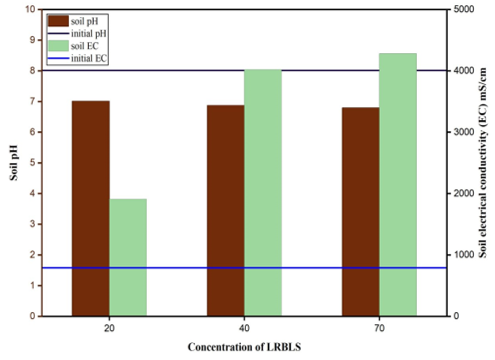
The present study evaluated the effectiveness of the bio-leaching solution, which was derived from lemon residue, for copper mobilization and removal from contaminated soils and its impact on soil physicochemical properties. To explain the effect of the concentration LRBLS under the following controlled conditions: Soil/Liquid ratio (S/L) 1:20, washing time 4 hrs., continuous shaking at 150 rpm, and pH of the leaching solution 5. As shown in Figure 1, the solution concentrations of LRBLS (20, 40, and 70 g/L) reduced the pH of the soil as compared to the pH of the contaminated soil (8.01). The pH values were 7.01, 6.87, and 6.79, showing a general decreasing trend in acidity.
The soil pH after washing with LRBLS drops, due to lemon residues containing high concentrations of organic acids. According to Nour et al. [15], who concluded that through HPLC analysis, the quantitative determination of organic acids in fruit juices indicated that citric acid is the major acid present in citrus fruits, followed by malic and lactic acids.
In lemon, the major organic acids identified were citric acid (73.936 g/L), tartaric acid (0.073 g/L), malic acid (1.465 g/L), lactic acid (1.545 g/L), oxalic acid (0.094 g/L), and ascorbic acid (0.718 g/L), as reported by research [15]. Furthermore, ionization of citric acid leads to the release of hydrogen ions (H⁺), which facilitates metal desorption through proton competition, modifications in surface potential, and changes in surface charge density [14]. Hence, the observed decrease in soil pH following the treatment with the increasing concentrations of LRBLS is primarily connected with the proton release and complexation reactions of the soil matrix.
In addition to pH changes, electrical conductivity (EC) increased with increasing LRBLS concentration. The EC values after washing at 20, 40, and 70 g/L were 1910, 4020, and 4280 µS/cm, respectively. The EC was rising in direct relationship to the falling pH, indicating more soluble ionic species in the soil solution. As mentioned by research [16], EC is an indicator of the content of base ions in the soil. Likewise, EC's subsequent increase in soil washing has been explained by the remaining ionic nature of the washing agents, which could lead to high salt levels in the treated soil.
A prior study [17] also reported that the contents of HMs in soil are higher with the smallest particle size, and the maximum concentration was found in the fraction of <0.053 mm. Figure 2(a) indicates that the cumulative particle-size distribution of the polluted soil (pre-washing) represents the indication of a well-graded soil that contains clay, silt, and sand fractions. The findings also indicate that a considerable percentage of the particles are found to be in the silt-size range since the D50 is 38.83 µm, which is the median size of the particles. It is worth mentioning that over 50% of the soil particles were less than 45 µm, which validates the primacy of the silt fraction. Based on this, the high level of initial copper in the artificially contaminated soil (433.552 mg/kg), this can be attributed to the high percentage of fine particles. that offer a greater specific surface area (SSA = 2.333 m2/kg) to the adsorption process of copper. Figure 2(b-d) also reveals that the cumulative distribution of particle size of soils washed with LRBLS at 20, 40, and 70 g/L, respectively, was significantly changed. The median particle size (D50) was raised to 58.43 µm, 52.76 µm, and 67.71 µm, corresponding to a decrease in specific surface area of 2.333 m2/kg to 1.063, 1.379, and 0.64 m2/kg, respectively, and shown in Table 3. This variation in particle size and specific surface area is explained by the fact that the copper ions are extracted from the soil matrix during the experiments of batch washing, which was conducted at a soil pH of 5, shaking at 150 rpm, and an S/L ratio of 1: 20.
The initial contents of copper in the artificially polluted soil were 433.552 mg/kg. The amount of copper that was determined in the samples of soil after washing with LRBLS at 20, 40, and 70 g/L decreased from the initial value of the contaminated soil of 433.552 mg/kg to 206.495, 147.526, and 139.13 mg/kg, respectively, which corresponded to the extraction efficiency of 52.4%, 65.9%, and 68%. The elimination of copper helped in the disaggregation of fine particles during washing, which was followed by flocculation and conversion of these fine particles into larger particles. These findings are consistent with the report by research [18], which indicated that soil washing disrupts natural particle aggregation. Similarly, study [16] reported that when soil was washed with [Met][NO3], the clay content decreased to at 15%, while the sand content recorded a significant increase of 38%. Nonetheless, these changes were not substantial. This reflects the lack of a significant change in the overall soil texture. This suggests that the general classification of the soil remained stable. This minor fluctuation in sand and clay proportions aligns with the macro-scale stability, further confirming that [Met][NO3] leaching does not induce significant shifts in the soil texture classification. The slight decrease in clay content may be attributed to the detachment of fine clay particles weakly bound to larger aggregates during leaching, yet these changes are insufficient to alter the loamy soil category. Conversely, research [19] found that soil washing using various regents reduced silt and increased clay content, irrespective of initial soil types. This could be connected with the disaggregation of silts particles under the strict conditions in the process of soil washing. In the present study, to investigate the possibility of using the LBRSL washing solution to remove copper from the contaminated soil, a control experiment was run with distilled water at the same experimental conditions (S/L ratio = 1:20, shaking speed = 150 rpm, and contact time = 4 h). The concentration of residual copper in the washed soil was around 399 mg/kg, which indicates that the extraction efficiency is around 8%. This is quite minimal when compared with the removal efficiency gained by LBRSL as a leaching solution.

Figure 2. Distribution of soil particle sizes
Table 3. The distribution of soil particle sizes (D10, D50, D90, D[4,3], D[3,2], and specific surface area (SSA)) of contaminated soil before and after washing with lemon residue bio-leaching solution (LRBLS), measured using a laser particle size analyzer
|
Experiment |
D50 (µm) |
D10 (µm) |
D90 (µm) |
D[4,3] (µm) |
D[3,2] (µm) |
SSA (m2/kg) |
Concentration of Residual Copper (mg/kg) |
Removal Efficiency (%) |
|
Contaminated soil (before washing) |
38.83 |
6.606 |
84.739 |
47.42 |
5.033 |
2.333 |
433.552 ± 24.15 |
— |
|
washed with LRBLS at 20 g/L |
58.43 |
5.075 |
152.5 |
70.24 |
11.23 |
1.063 |
206.495 ± 35.1 a |
52.4 |
|
washed with LRBLS at 40 g/L |
52.76 |
5.365 |
123.2 |
59.13 |
8.7 |
1.379 |
147.526 ± 19.72 b |
65.9 |
|
washed with LRBLS at 70 g/L
|
67.71
|
16.63
|
166.3
|
81.47
|
18.72
|
0.64
|
139.13 ± 9.11b
|
68
|
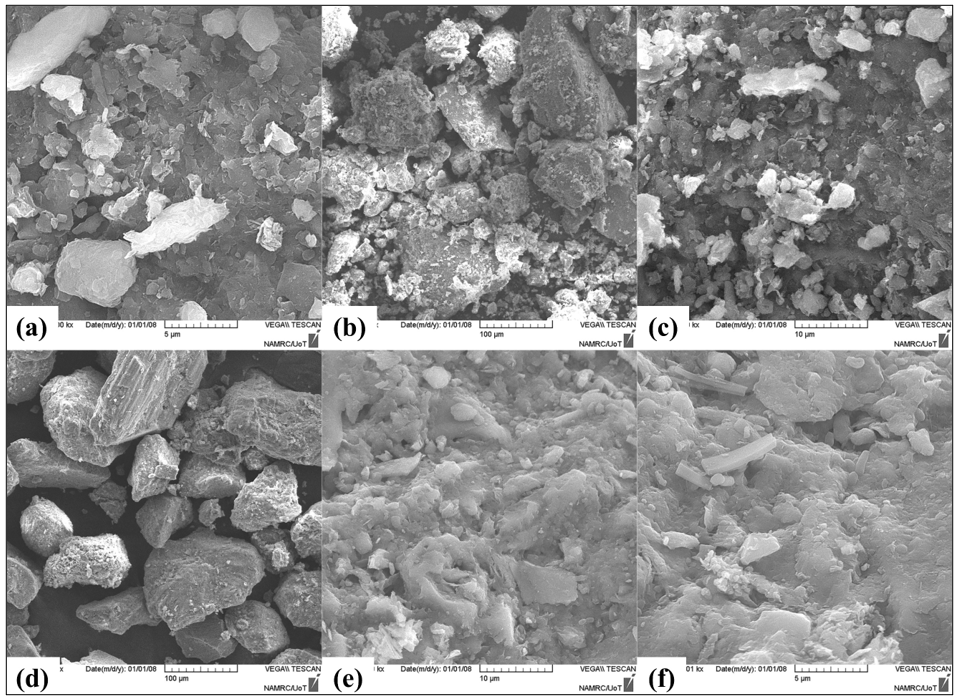
Figure 3 provides SEM of pre- and post-washing of soil samples by LRBLS at magnifications of 100, 10, and 5 µm. In Panels (a)–(c), the samples are presented before washing, with the surfaces of the particles being quite smooth (Figure 3(a)). Some particles in Figure 3(b) and 3(c) also exhibit the surface brightness of the particles, which has been caused by the adsorption of copper ions onto the surfaces of the particles by the contaminated soil (artificial contamination). In contrast, Figure 3(d–f) depicts the samples after washing with LRBLS, revealing irregular surfaces where the particles are aggregated and interconnected, with noticeable spacing between them (Figure 3(f)). The surfaces are rough and consist of particles of varying sizes, indicating a heterogeneous granular distribution, which is consistent with Figures 2(b–d), showing the cumulative particle-size distribution of soils washed with LRBLS at 20, 40, and 70 g/L. Some platy layers are also observed, suggesting aggregation of fine particles, in agreement with the data in Table 3, which show a reduction in specific surface area due to the clustering of small particles.
The present results are in agreement with those of research [14], in which SEM revealed that the observed changes in soil structure pre- and post-washing with citric acid (CA) and water-soluble chitosan (WSCS) were attributed to the dissolution of soluble salts. Moreover, research [20] reported that, in SEM observations, the polluted soil after washing with citric acid, sulfuric acid, and ethylenediamine tetraacetic acid disodium exhibited a greater number of pores and bubbles, and the soil structure became looser compared with the unwashed soil.
Figure 3. Scanning Electron Microscopy (SEM) images (a–c) unwashed soil (contaminated soil), (d–f) soil washed with LRBSL at a concentration of 40 g/L
Table 4 shows the effect of different LRBLS concentrations used as leaching solutions on the elimination of copper ions from polluted soil under the same operating conditions, with respect to the calcium carbonate content. It was observed that the calcium carbonate content decreased from the initial value of 20.9% in the original contaminated soil to 16.5%, 11%, and 9.8% as the LRBLS concentration soared from 20 to 70 g/L. This reduction in calcium carbonate content is attributed to the acidic nature of LRBLS, which lowers soil pH during washing, leading to partial dissolution of calcium carbonate. According to a study [21], a calcium carbonate content of 5.5% classifies the soil as calcareous, influencing soil pH and nutrient availability. The decrease in pH not only affects carbonate dissolution but also plays a key role in heavy metal mobility. Depending on research [22], pore fluid pH significantly governs metal behavior, where increasing H⁺ concentration enhances the desorption of cationic metals, depending on soil characteristics. Similarly, research [23] indicated that lowering pH facilitates the dissolution of heavy metals bound to mineral surfaces through protonation and cation exchange mechanisms, thereby increasing their release into the solution.
Table 4. The impact of lemon residue bio-leaching solution (LRBLS) concentration as a leaching solution on the soil calcium carbonate content
|
Experiment |
pH |
CaCO3 (%) |
|
Contaminated soil (before washing) |
8.01 |
20.9 |
|
Washed with LRBLS at 20 g/L |
7.01 |
16.5 |
|
Washed with LRBLS at 40 g/L |
6.87 |
11 |
|
Washed with LRBLS at 70 g/L |
6.79 |
9.8 |
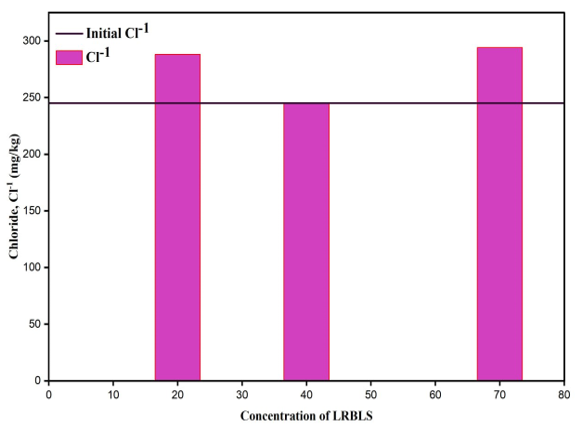
Figure 4, together with Table 5, presents the residual concentration of chloride ions in soil after washing the contaminated soil with LRBSL at varying concentrations (20–70 g/L). The residual chloride concentrations were 288, 245, and 294 mg/kg, respectively. All experiments were carried out under controlled conditions comprising a ratio of solid to liquid (S/L) of 1:20, washing duration of 4 hrs., constant shaking of 150 rpm, and a pH of the washing solution of 5.
Figure 4. Effect of lemon residue bio-leaching solution (LRBLS) concentration on the chloride ions (Cl-) of contaminated soils
The findings show that the chloride concentration increased by about 14-20% as compared to the original polluted soil. This rise may be explained by the action of organic acids found in the lemon peel extract, as they decreased the pH level of the soil, which was 8.01 before the washing to 6.79 after treatment. The fall in pH is likely to have increased the dissolution of soluble salts. It promoted the release of chloride ions that were previously occluded within soil aggregates or weakly associated with mineral surfaces, making them more extractable and detectable in the final analysis.
As reported by Delil and Köleli [24], the solubility of heavy metal ions in soil is governed by their structural form, chemical compounds, soil pH, and redox potential (Eh). Among these factors, pH is a key parameter controlling the desorption and mobility of metals in contaminated soil. Similarly, Kaurin et al. [18] found that leachate production and nutrient loss in washed soils were higher than in the original soil, presumably due to intensive leaching, highlighting the ability of soil washing to simultaneously mobilize multiple ionic species. Omar et al. [25] reported that the electrical conductivity is contributed by both cations (e.g., Na⁺) and anions (e.g., Cl⁻) because of their high mobility and complete dissociation in soil solution, as compared with less mobile ions (e.g., Ca²⁺ and Mg²⁺). Rengasamy [26] also found that the type of dissolved cations and anions affects ion exchange reactions, which in turn affects the distribution of ions between the soil solution and the exchange phase at the equilibria.
Table 5. Effect of lemon residue bio-leaching solution (LRBLS) concentration as a leaching solution on chloride ion content in soil
|
Experiment |
pH |
Chloride Ions (Cl-, mg/kg) |
Chloride Ions Increment (%) |
Electrical Conductivity (EC, µS/cm) |
|
Contaminated soil (before washing) |
8.01 |
245 |
|
790 |
|
washed with LRBLS at 20 g/L |
7.01 |
288 |
14 |
1910 |
|
washed with LRBLS at 40 g/L |
6.87 |
245 |
0 |
4020 |
|
washed with LRBLS at 70 g/L |
6.79 |
294 |
20 |
4280 |
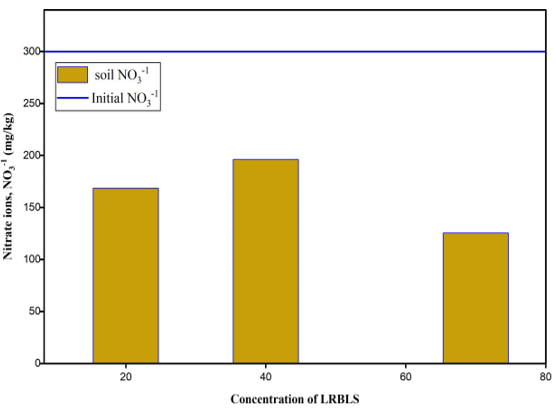
Figure 5. Effect of lemon residue bio-leaching solution (LRBLS) concentration on the nitrate ions (NO3-) of contaminated soils
The simultaneous release of various soluble ions may be further reflected in the increase in soil electrical conductivity (EC), which rose from 790 µS/cm before washing to 4280 µS/cm after treatment, as shown in Table 5.
Figure 5 shows the concentration of nitrate ions (NO₃⁻) in mg/kg at different concentrations of the leaching solution to evaluate their effects on the treated soil. The concentration of nitrate ions in the contaminated soil (299.88 mg/kg) was higher than that in the native soil (before artificial contamination) (93.88 mg/kg). The highest concentration occurred when the native soil was amended with Cu(NO₃)₂·3H₂O, which can be interpolated from the data. According to a study [16], the N–O spectral band near 1381 cm⁻¹, the findings in the FTIR test were due to the addition of nitrates to lead-contaminated soil during preparation.
The residual concentration of nitrate ions in the soil after washing the contaminated soil with LRBSL at different concentrations (20, 40, and 70 g/L) was 168.38, 196.07, and 125.24 mg/kg, respectively. All experiments were conducted under controlled conditions, including a solid-to-liquid (S/L) ratio of 1:20, a washing time of 4 h, continuous shaking at 150 rpm, and a washing solution pH of 5. Finally, it was observed that the concentration of nitrate ions decreased after treatment with LRBSL at all tested concentrations compared to the initial levels.
All experiments were conducted in triplicate (n = 3). One-way ANOVA was carried out to analyze the data statistically. Analysis of the data, done using Tukey's multiple comparison test at p < 0.05 in OriginPro 2026 software (Windows), showed significant differences between treatments as explained in Table 6.
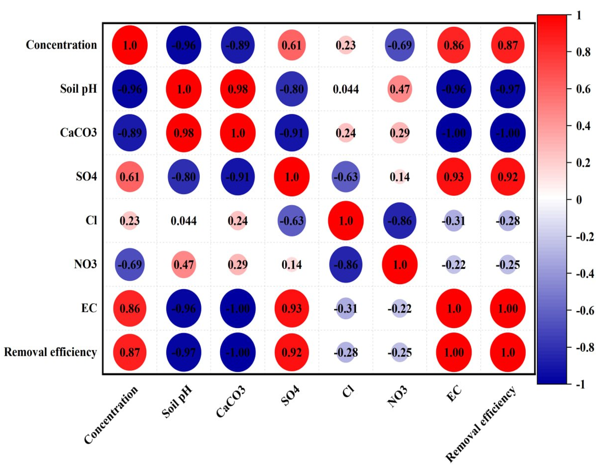
According to the Pearson correlation analysis, which was performed using OriginPro-2026, as shown in Figure 6, pH exhibited a strong negative correlation with both contaminant concentration and EC values, indicating that acidic conditions enhanced the dissolution and mobility of ions in the solution. This finding is consistent with Hu et al. [14], who reported that lowering soil pH improved removal efficiency due to the dissolution of Zn ions. In contrast, CaCO₃ showed a positive relationship with pH, which may be attributed to the buffering capacity of carbonate minerals and their role in reducing acidity. Ouhadia et al. [22] reported that the presence of carbonates reduced the removal rate of heavy metals from contaminated soil by decreasing soil acidity, which consequently increased the buffering capacity of the soil. Furthermore, contaminant concentration was positively correlated with EC, confirming that increasing dissolved ionic species resulted in higher electrical conductivity values. Meanwhile, chloride exhibited relatively weak correlations with the studied variables, suggesting a limited influence within the investigated system.
Table 6. The physical and chemical properties of treated soil
|
Experiment |
Soil pH |
Cl (mg/kg) |
CaCO3 (%) |
SO4 (mg/kg) |
NO3 (mg/kg) |
EC (µS/cm) |
Removal Efficiency (%) |
|
E1 |
7.01 ± 0.02a |
288 ± 4.35a |
16.5 ± 0.26a |
418.62 ± 7.4b |
168.38 ± 3.83b |
1910 ± 21.65c |
52.4 ± 8.09b |
|
E2 |
6.87 ± 0.01b |
245 ± 3.78b |
11 ± 0.15b |
488.94 ± 6.74a |
196.07 ± 2.5a |
4020 ± 42.03b |
65.9 ± 4.55b |
|
E3 |
6.79 ± 0.02c |
294 ± 7.93a
|
9.8 ± 0.17c
|
469.59 ± 8.96a
|
125.24 ± 0.98c
|
4280 ± 58.5a
|
68 ± 2.10a
|
Figure 6. Pearson correlation analysis of the measured variables after soil washing using lemon residue bio-leaching solution (LRBLS)
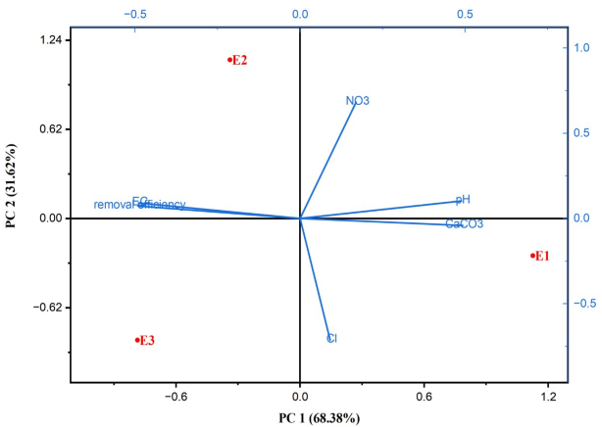
Figure 7. Principal component analysis (PCA) of selected soil properties after soil washing using lemon residue bio-leaching solution (LRBLS)
The principal component analysis (PCA) was conducted using using OriginPro-2026 software to evaluate some soil properties, including electrical conductivity (EC), soil pH, calcium carbonate (CaCO₃), nitrate ions (NO₃⁻), and chloride content (Cl⁻), after soil washing using LRBLS at different concentrations of 20, 40, and 70 g/L, denoted as E1, E2, and E3, respectively, as shown in Figure 7. The first principal component (PC1) and the second principal component (PC2) explained 68.38% and 31.62% of the total variance, respectively. The PCA biplot demonstrated that PC1 and PC2 together accounted for 100% of the total variance. Due to the limited number of experimental conditions (n = 3), the PCA and correlation results should be interpreted as exploratory and not as definitive evidence of causal relationships. The 100% variance explained by PC1 and PC2 is an artifact of the small sample size relative to the number of variables.
Removal efficiency showed a strong negative correlation with pH and CaCO₃, suggesting that acidic conditions enhanced soil washing performance. Conversely, pH and CaCO₃ exhibited a strong positive correlation due to the alkaline nature of calcium carbonate. Sample E3 was closely associated with high removal efficiency, whereas E1 was associated with elevated pH and CaCO₃ levels.
3.2 Fourier Transform Infrared Spectroscopy of the contaminated soil and washed soil with lemon residue–derived bio-leaching solution
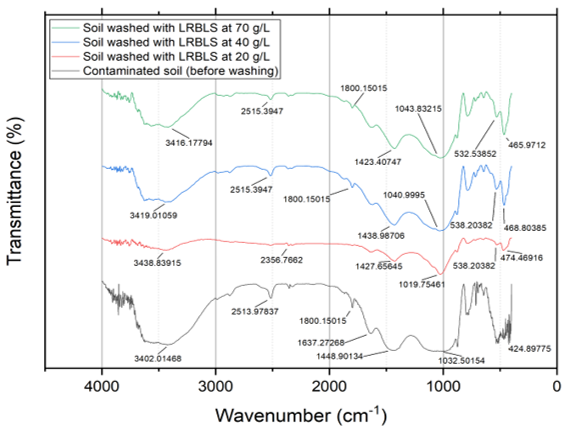
The spectrum of FTIR observed for the contaminated soil (before washing), and the soil that was treated with LRBLS at 20, 40, and 70 g/L, is shown in Figure 8, together with Table 7, which describes the FTIR spectral band position after treating the soil with LRBLS, identifications of the functional group of the sample of soil before and after washing by LRBLS.
Figure 8. Fourier Transform Infrared Spectroscopy (FTIR) spectra of the contaminated soil (before washing) and washed soil with lemon residue bio-leaching solution (LRBLS) at 20, 40, and 70 g/L
Table 7. Description of Fourier Transform Infrared Spectroscopy (FTIR) spectral band of contaminated soil (before washing) and after washing by lemon residue–derived bio-leaching solution (LRBLS) at 20, 40, and 70 g/L
|
Wavelength (cm-1) |
Characteristic Bands Groups |
||||||
|
Contaminated Soil |
E1 |
E2 |
E3 |
Difference after E1 |
Difference after E2 |
Difference after E3 |
|
|
424.8 |
474.4 |
468.8 |
465.9 |
-49.6 |
-44 |
-41.1 |
Attributed to C–H, C–C, according to the assignments reported in study [6]. |
|
543.86 |
538.2 |
538.2 |
532.5 |
5.66 |
5.66 |
11.36 |
Considered as Si–O–Si and Si–O deformation vibrational features in inorganic materials such as quartz and albite, according to the assignments reported in research [20]. |
|
1032.3 |
1019.7 |
1040.9 |
1043.8 |
12.6 |
-8.6 |
-11.5 |
Attributed to in-plane bending vibrations of Si/Fe–O bonds and are indicative of inter-tetrahedral bridging Si–O–Si linkages, along with contributions from Si–O–Al deformation and mixed Si–O/Si–O–Fe bending modes, based on the assignments reported in research [27], where bands observed within the ranges of 1030–1028, 800–780, 729, 694, 648, 529–523, and 471–470 cm⁻¹ in this spectral region |
|
1448.9 |
1427.6 |
1438.9 |
1423.4 |
21.3 |
10 |
25.5 |
Attributed to vibrations of CO3 in calcite and minerals of the calcite and dolomite groups; C/H bending vibrations of CH and CH2 groups. According to a report [28], the spectral bands are located between 1453 and 1416 cm-1. |
|
2513.978 |
2356.7 |
2515.3 |
2515.3 |
157.278 |
-1.322 |
-1.322 |
Attributed to CO3 vibrations in calcite and minerals, as well as in the calcite and dolomite groups [28]. |
|
3402.01 |
3438 |
3419 |
3416.17 |
-35.99 |
-16.99 |
-14.16 |
Assigned to the O–H stretching vibrations of water molecules, as well as hydroxyl and carboxylic groups, as described by study [28]. |
According to Al-Alam et al. [29], explained that Pb ions can interact with the functional groups of Opuntia ficus-indica through different mechanisms. Specifically, the C=O groups pertaining to both carbonyl and carboxyl functionalities can form complexes with cationic metals, whereas hydroxyl groups can interact with cations via ion exchange.
Finally, it was observed that the spectral bands of the soil treated with LRBLS at 20, 40, and 70 g/L were shifted compared to those of the contaminated soil (before washing). As reported in the study [30], the soil absorption peak shifted after the leaching process, indicating that soil metal ions reacted with wood vinegar (WV) during washing.
Based on the obtained results from batch experiments, the LRBLS showed a good ability to remove copper from the contaminated soil, especially when the concentration increased. This indicates that the solution can be useful for improving the washing efficiency. The washing process also caused some changes in soil properties. The pH values decreased after treatment, while electrical conductivity increased, which may be related to the presence of more dissolved ions. In addition, slight changes in chloride and nitrate concentrations were observed. Although there were some differences in particle size after washing, these changes were not large enough to affect the overall soil structure.
Yet, the present study did not consider the management of washing effluent, recovery of soils over the long-term, copper bioavailability, and plant-growth response. Therefore, further investigations are needed to assess these aspects before large-scale or field applications can be considered.
The authors would like to thank the College of Engineering, University of Babylon, Department of Environmental Engineering, Iraq, for providing the necessary resources to conduct this study. The authors used AI-assisted tools solely for language editing and text refinement. No AI tools were used to generate scientific content, data, analysis, or conclusions.
|
LRBLS |
lemon residue bio-leaching solution |
|
|
HMs |
heavy metal ions |
|
|
HCl |
hydrochloric acid |
|
|
HNO3 |
nitric acid |
|
|
LMWOAs |
low-molecular-weight organic acids |
|
|
CaCO₃ |
calcium carbonate |
|
|
NO₃⁻ |
nitrate ions |
|
|
-1 |
chloride ions |
|
|
SEM |
Scanning Electron Microscopy |
|
|
FTIR |
Fourier Transform Infrared Spectroscopy |
|
|
EC |
electrical conductivity |
|
|
H⁺ |
hydrogen ions |
|
|
SSA |
specific surface area |
|
|
CA |
citric acid |
|
|
WSCS |
water-soluble chitosan |
|
|
S/L |
ratio of solid to liquid |
|
|
PCA |
principal component analysis |
|
|
PC1 |
the first principal component |
|
|
PC2 |
the second principal component |
|
|
WV |
wood vinegar |
|
[1] Kumar, V., Rout, C., Singh, J., Malik, S., Umar, A., Ibrahim, A.A., Baskoutas, S. (2025). Enhanced heavy metal removal from contaminated soils using chelation and adsorption synergy. International Journal of Environmental Science and Technology, 22: 15409-15424. https://doi.org/10.1007/s13762-025-06592-1
[2] Zhou, Z., Liu, J., Zeng, H., Zhang, T., Chen, X. (2020). How does soil pollution risk perception affect farmers' pro-environmental behavior? The role of income level. Journal of Environmental Management, 270: 110806. https://doi.org/10.1016/j.jenvman.2020.110806
[3] Krzysztof, B., Beata, K., Ewa, N. (2025). Citric acid extraction impact on chemical and bioavailable forms of metals in soil. Molecules, 30(22): 4480. https://doi.org/10.3390/molecules30224480
[4] Xu, S., Zhou, Z., Liu, K. (2020). Multi-evolutionary game research on heavy metal pollution control in soil: Based on a third-party perspective. Sustainability, 12(13): 5306. https://doi.org/10.3390/su12135306
[5] Park, H., Jung, K., Alorro, R.D., Yoo, K. (2013). Leaching behavior of copper, zinc and lead from contaminated soil with citric acid. Materials Transactions, 54(7): 1220-1223. https://doi.org/10.2320/matertrans.M2013038
[6] Feng, C., Zhang, S.R., Li, L.X., Wang, G.Y., Xu, X.X., Li, T., Zhong, Q.M. (2018). Feasibility of four wastes to remove heavy metals from contaminated soils. Journal of Environmental Management, 212: 258-265. https://doi.org/10.1016/j.jenvman.2018.01.030
[7] Luma, M.F., Amal, H.K. (2022). Removal of copper ions from contaminated soil by soil washing technique. Materials Today: Proceedings, 60(3): 1219-1222. https://doi.org/10.1016/j.matpr.2021.08.074
[8] Afifa, T., Noorfatimah, Y., Muhammad, S. (2024). Low-cost adsorbents derived from vegetables and fruits: Synthesis, properties, and applications in removal of heavy metals from water. Desalination and Water Treatment, 320: 100626. https://doi.org/10.1016/j.dwt.2024.100626
[9] Mohammed, S.S.D., Aliyu, A.D., Wartu, J.R., Ninyo, N.N. (2020). Citric acid produced from lemon peel using Aspergillus niger isolated from cereal gruel. Journal of Microbial Cell and Biotechnology, 1(1): 1-7.
[10] Luo, J.P., Liang, J.B., Song, Y.C., Guo, X.Y., Ning, Y.Z., Liu, N.L., Zhao, H.P., Li, T.Q. (2021). Compounded chelating agent derived from fruit residue extracts effectively enhances Cd phytoextraction by Sedum alfredii. Soil Ecology Letters, 3: 253-265. https://doi.org/10.1007/s42832-021-0097-z
[11] Li, Y.Q., Wang, Y.J., Khan, M.A., Luo, W.X., et al. (2021). Effect of plant extracts and citric acid on phytoremediation of metal-contaminated soil. Ecotoxicology and Environmental Safety, 211: 11190. https://doi.org/10.1016/j.ecoenv.2021.111902
[12] Zhai, X.Q., Li, Z.W., Huang, B., Luo, N.L., Huang, M., Zhang, Q., Zeng, G.M. (2018). Remediation of multiple heavy metal-contaminated soil through the combination of soil washing and in situ immobilization. Science of the Total Environment, 635: 92-99. https://doi.org/10.1016/j.scitotenv.2018.04.119
[13] Faisal, A.A., Hussein, A.A. (2015). An acidic injection well technique for enhancement of the removal of copper from contaminated soil by electrokinetic remediation process. Separation Science and Technology, 50(16): 2578-2586. https://doi.org/10.1080/01496395.2015.1059347
[14] Hu, W., Niu, Y.L., Zhu, H., Dong, K., Wang, D.Q., Liu, F. (2021). Remediation of zinc-contaminated soils by using two-step washing with citric acid and water-soluble chitosan. Chemosphere, 282: 131092. https://doi.org/10.1016/j.chemosphere.2021.131092
[15] Nour, V., Trandafir, I., Ionica, M.E. (2010). HPLC organic acid analysis in different citrus juices under reversed phase conditions. Notulae Botanicae Horti Agrobotanici Cluj-Napoca, 38(1): 44-48. https://doi.org/10.15835/nbha3814569
[16] Deng, Y., Wang, S., Fu, L., Xue, W.J., Zhang, C.B., Deng, J.W., Luo, X., Liu, Y.Y., Zhao, D.Y., Mailhot, G. (2025). A soil washing approach to remediation of lead-contaminated soil with amino acid ionic liquid [Met][NO₃]. Toxics, 13(9): 725. https://doi.org/10.3390/toxics13090725
[17] Cho, K., Myung, E., Kim, H., Park, C., Choi, N., Park, C. (2020). Effect of soil washing solutions on simultaneous removal of heavy metals and arsenic from contaminated soil. International Journal of Environmental Research and Public Health, 17(9): 3133. https://doi.org/10.3390/ijerph17093133
[18] Kaurin, A., Gluhar, S., Tilikj, N., Lestan, D. (2020). Soil washing with biodegradable chelating agents and EDTA: Effect on soil properties and plant growth. Chemosphere, 260: 127673. https://doi.org/10.1016/j.chemosphere.2020.127673
[19] Guo, X.F., Zhao, G.H., Zhang, G.X., He, Q.S., Wei, Z.B., Zheng, W., Qian, T.W., Wu, Q.T. (2018). Effect of mixed chelators of EDTA, GLDA, and citric acid on bioavailability of residual heavy metals in soils and soil properties. Chemosphere, 209: 776-782. https://doi.org/10.1016/j.chemosphere.2018.06.144
[20] Huang, W.J., Xu, B.M., Yang, M.H., Zhang, R., Zhang, W.P., Wang, N., Guo, P., Pu, S.Y. (2026). Modeling the comparative evaluation of diverse washing agents for remediation of composite heavy metal-contaminated soil. Modeling Earth Systems and Environment, 12(15). https://doi.org/10.1007/s40808-025-02653-z
[21] Nasser, H.A., Saud, S.A., Khaled, D.A., Fahad, A., Basil, A. (2025). Enhancing phytoremediation of heavy metal-contaminated aridic soil using olive mill wastewater, sulfur, and chelating agents. Sustainability, 17(8): 3745. https://doi.org/10.3390/su17083745
[22] Ouhadia, V.R., Yongb, R.N., Shariatmadari, N., Saeidijam, S., Goodarzi, A.R., Safari-Zanjani, M. (2010). Impact of carbonate on the efficiency of heavy metal removal from kaolinite soil by the electrokinetic soil remediation method. Journal of Hazardous Materials, 173(1-3): 87-94. https://doi.org/10.1016/j.jhazmat.2009.08.052
[23] Guo, X.F., Zhang, G.X., Wei, Z.B., Zhang, L.P., He, Q.S., Wu, Q.T., Qian, T.W. (2018). Mixed chelators of EDTA, GLDA, and citric acid as washing agent effectively remove Cd, Zn, Pb, and Cu from soils. Journal of Soils and Sediments, 18: 835-844. https://doi.org/10.1007/s11368-017-1781-6
[24] Delil, A.D., Köleli, N. (2018). The removal of Pb and Cd from heavily contaminated soil in kayseri, turkey by a combined process of soil washing and electrodeposition. Soil and Sediment Contamination: An International Journal, 27(6): 469-484. https://doi.org/10.1080/15320383.2018.1485630
[25] Omar, M.M., Shitindi, M.J., Massawe, B.H.J., Pedersen, O., Meliyo, J.L., Fue, K.G. (2024). Modeling the electrical conductivity relationship between saturated paste extract and 1:2.5 dilution in different soil textural classes. Frontiers in Soil Science, 4: 1421661. https://doi.org/10.3389/fsoil.2024.1421661
[26] Rengasamy, P. (2016). Soil chemistry factors confounding crop salinity tolerance—A review. Agronomy, 6(4): 53. https://doi.org/10.3390/agronomy6040053
[27] Wang, G.Y., Pan, X.M., Zhang, S.R., Zhong, Q.M., Zhou, W., Zhang, X.H., Wu, J., Vijver, M.G., Peijnenburg, W.J.G.M. (2020). Remediation of heavy metal contaminated soil by biodegradable chelator-induced washing: Efficiencies and mechanisms. Environmental Research, 186: 109554. https://doi.org/10.1016/j.envres.2020.109554
[28] Parolo, M.E., Savini, M.C., Loewy, R.M. (2017). Characterization of soil organic matter by FT-IR spectroscopy and its relationship with chlorpyrifos sorption. Journal of Environmental Management, 196: 316-322. https://doi.org/10.1016/j.jenvman.2017.03.018
[29] Al-Alam, J., Harb, M., Hage, T.G., Wazne, M. (2023). Assessment of opuntia ficus-indica (L.) mill. extracts for the removal of lead from soil: The role of CAM plant harvest phase and soil properties. Environmental Science and Pollution Research, 30: 798-810. https://doi.org/10.1007/s11356-022-22194-7
[30] Lv, T.Y., Xu, X.X., Lv, G.C., Xu, C.L., et al. (2023). Green remediation of Ni, Zn, and Cu in an electroplating contaminated site by wood vinegar with optimization and risk assessment. Ecotoxicology and Environmental Safety, 261: 115108. https://doi.org/10.1016/j.ecoenv.2023.115108