Yesiana Ihda Kusnayain* | Ananda Sabil Hussein | Fatchur Rohman | Nanang Suryadi | Salamiah A. Jamal
© 2026 The authors. This article is published by IIETA and is licensed under the CC BY 4.0 license (http://creativecommons.org/licenses/by/4.0/).
OPEN ACCESS
This research seeks to systematically investigate the factor to boost workation in digital nomads tourism in shaping workation experience and tourism sustainability. It evaluates previous studies in this area, highlights the dimension of workation experience, and proposes avenues for further research to enrich knowledge in the field. The identification, screening, and inclusion of relevant literature within this study were conducted in strict accordance with the Preferred Reporting Items for Systematic reviews and Meta-Analyses (PRISMA) framework, facilitating a replicable and unbiased search strategy. Articles were identified using keywords such as "digital nomads tourism", "workation", "remote work", "work life balance", and "internet". The analysis focused on publications from 2019 to 2025, retrieved only from the Scopus databases. The findings underscore that flexibility, robust digital infrastructure, and the quality of the workspace are the primary catalysts for promoting workations. Furthermore, the results emphasize various strategic approaches designed to enhance the equilibrium between professional responsibilities and leisure activities. This scoping review not only identifies context in the existing literature but also provides actionable recommendations for future research and practical applications. It offers a multidimensional framework, contributing to advancing both theoretical and empirical knowledge in digital nomads tourism.
digital nomads’ tourism, workation, experience, PRISMA, tourist perception, remote work, sustainability, digital infrastructure
The tourism sector is recognized as one of the strategic pillars that contributes to national economic growth and ensures long-term sustainability. According to a report from The World Tourism Organization (UNWTO), in ASEAN alone, an increase in tourist visits can boost a country's economic growth massively, as seen in Indonesia, Malaysia, Singapore, and Thailand. In 2021, the COVID-19 pandemic triggered a rapid and profound shift in behavior, which directly impacted work dynamics. Social distancing measures drove a surge in digital consumption, forcing businesses to prioritize virtual interactions. Based on data from [1] there was an increase in the trend of remote work from 4% before the COVID-19 pandemic, 55% during the pandemic, and 71% after the pandemic. This proves that remote working is an attractive work pattern for companies and employees. From the company's perspective, remote working provides benefits in terms of budget efficiency in operational activities.
The paradigm shifts towards remote working, accelerated by technological advances and socio-economic factors, has led to a new convergence between professional activities and travel. This phenomenon has given rise to a new term known as digital nomad. Digital nomads are a highly mobile class of professionals who work digitally while traveling long-term from one location to the next [2] and are conceptually at the intersection of remote work (made possible by technology) and mobility. This dynamic and sustainable tourism model has given rise to the term “workcation,” which comes from the word’s ‘work’ and “vacation.” This term is easier to understand in the concept of digital nomad tourism. Workcations are expected to continue to be a travel trend based on ongoing developments in digital technology and the increasing adoption of remote work environments by businesses. Along with the popularity of workcation, the needs of tourists are rapidly changing from visiting tourism to staying tourism.
RQ1: What are the primary factors driving the growth of workcations in the digital nomad community?
RQ2: What strategies to improve the balance of work and leisure during workcations?
The high competitiveness of tourism is an interesting topic to explore further. The travel experience has become a new paradigm for improving service quality, which can influence visitor loyalty. Therefore, it is very important and fundamental to define what a workation experience is. In addition, the lack of a solid conceptualization of the workation experience hinders the development of an appropriate measurement scale. Finally, the impact of the consumer's workation experience on their overall experience, satisfaction, and future behavioral intentions is still unknown.
2.1 Digital nomads’ tourism
Based on the literature review abstracts, the study of digital nomadism within sustainable tourism has gained attention, offering valuable insights into fostering community development [3]. The findings from the literature review suggest that digital nomadism is changing traditional tourism models and offering new opportunities to industry stakeholders [4]. Digital nomad tourism can be defined as a lifestyle and work pattern where individuals, often young professionals (Millennials or Generation Z), combine travel with remote digital work, enabled primarily by mobile technology and internet connectivity. Digital nomads engage in "nomadic work" while traveling semi-permanently, challenging traditional tourist definitions by blending work and leisure with a strong emphasis on mobility, flexibility, and location independence.
Tourism-related research focusing on digital nomads includes examining their lifestyle, work practices, destination preferences, and the development of smart destination strategies tailored to attract and accommodate them [5]. Digital nomads increasingly influence local economies and urban development, with digital nomad visa programs emerging as key policy tools to address legal challenges and stimulate local economies. However, their presence also raises concerns about rising housing prices and social tensions in host communities [6].
Digital nomads typically prioritize destinations with robust digital infrastructure, including high-speed internet and coworking spaces, which are essential for maintaining productivity [7]. They also value quality of life, cost of living, safety, and favorable visa policies [7]. These preferences drive their destination choices and influence local tourism strategies [5].
2.2 Workation
Digital nomadism, characterized by the ability to work remotely while traveling, has significantly influenced both the tourism and work landscapes. This lifestyle, enabled by digital technologies, allows individuals to blend work and leisure seamlessly, often referred to as "workation" [8, 9]. The appeal of workations is particularly strong among those with previous international experience and positive attitudes towards remote work, making it an attractive fringe benefit for organizations [10]. Digital nomads contribute to local economies by staying longer and spending more, which benefits hospitality businesses and local communities [11, 12]. However, this trend also presents challenges such as cultural integration, economic disparities, and the need for robust digital infrastructure [11].
Destinations aiming to attract digital nomads must offer essential infrastructure like high-speed internet, coworking spaces, and nomad-oriented accommodations [13]. Urban areas benefit from high-density digital nomad communities that boost local businesses and foster cross-cultural exchanges, while rural areas gain from seasonal stability and new growth opportunities [14]. Workation represents a transformative trend in the intersection of work and travel, offering numerous benefits for individuals and destinations alike. By focusing on digital infrastructure, community integration, and sustainable practices, destinations can effectively attract and support digital nomads, fostering economic growth and cultural exchange.
3.1 Research framework
In this systematic literature review, we applied the content analysis methodology. This approach involves bringing together both theoretical and empirical findings from previous studies by systematically collecting, categorizing, and thoroughly identifying gaps in the existing literature Conducting a systematic SLR requires analyzing inclusion and exclusion criteria with support from several key steps [15, 16]. These steps include: (1) defining the inclusion and exclusion criteria, (2) determining the data sources and research collection strategies, (3) evaluating the quality of the literature, and (4) performing content analysis and synthesizing the studies. The following provides an explanation of each of these steps.
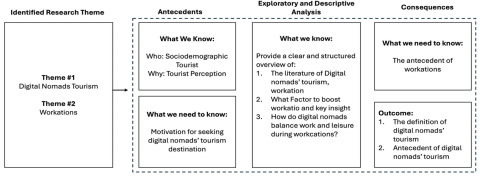
In addition, Figure 1 represents the framework of this research. The research framework started with identified research theme (digital nomads and workation), and the study analyses the antecedents to know ‘who’ and ‘why’ in the context digital nomads’ tourism. Moreover, we must explore more the literature about motivation to know the motive of tourist for doing workation. Finally, we could provide the information about the overview the digital nomads tourism and it leads the outcome about “clear definition of digital nomads’, “factors to boost workation”, and ‘strategy to balance between work and vacation”.
Figure 1. Research framework
3.2 Inclusion and exclusion criteria
The selection process for articles included in this systematic literature review adhered to established Scopus standards for scholarly rigor and thematic relevance. Articles were systematically classified based on publication year, type, research scope, and study context to ensure clarity and comparability. Only articles published in peer-reviewed journals between 2019 and 2025 were considered eligible for inclusion, while proceedings, book chapters, research reports, reference entries, and conference papers were excluded. The review was limited to research from the Business and Management, and Hospitality and Tourism disciplines, with studies from Medicine and Engineering intentionally omitted to maintain a focused scope. Qualified research designs encompassed systematic reviews, qualitative and quantitative studies, as well as empirical investigations; documentation and annual reports were not included. The context for inclusion specifically targeted scholarship addressing digital nomad tourism and workation within the wider field of digital nomadism. Any articles falling outside these predefined criteria were excluded to preserve methodological consistency and relevance.
3.3 The Preferred Reporting Items for Systematic reviews and Meta-Analyses (PRISMA) model
This research employs a Schematic Literature Review (SLR) to systematically examine the literature on Digital Nomads’ tourism. The adoption of the PRISMA (Preferred Reporting Items for Systematic Reviews and Meta-Analyses) statement in this article promotes transparent and complete reporting of the systematic review process. PRISMA helps ensure clarity in documenting how the review was conducted and the findings obtained, which strengthens the trustworthiness and reproducibility of the review. Using PRISMA supports a standardized approach to reporting, facilitating better understanding and evaluation of the review by readers and researchers.
3.4 Determining the data sources
All articles were sourced from Scopus publication databases, utilizing the Publish or Perish tool to validate the search selection process [17]. To ensure a thorough search, study applied advanced search techniques, including Boolean operators (AND, OR, NOT) to refine search queries and retrieve relevant studies [18]. For example, to identify studies focused on digital nomad tourism and workation, the following search string was used: (TITLE-ABS-KEY ("workcation" OR "remote work" OR "digital nomad") AND TITLE-ABS-KEY ("tourism" OR "travel") AND TITLE-ABS-KEY ("work-life balance" OR "productivity") AND TITLE-ABS-KEY ("destination" OR "coworking" OR "internet")).
The data collection process was governed by a purposive sampling strategy, where the Scopus database served as the primary repository for identifying relevant literature. The decision to limit the search to Scopus was a deliberate methodological choice based on the study's purposive objectives. The purposive sampling prioritizes 'information-rich' cases and theoretical relevance over sheer volume, the breadth of Scopus provided a sufficient and robust sample to achieve theoretical saturation. By maintaining a single-database boundary, the study ensured greater consistency in metadata and citation metrics, which were essential for the qualitative synthesis of the 2019-2025 period.
The initial search was performed using the keywords shown in Figure 2, which yielded a total of 780 articles. After screening, 138 articles were selected for their potential relevance. Further refinement, based on the titles and abstracts, narrowed this down to 33 articles. The researcher then examined the full texts of these articles, ultimately identifying 33 that were deemed most relevant. Additionally, to enhance the study's validity and reliability, the researcher applied the purposive sampling, including articles from the reference lists of those already selected [19]. This study employed a purposive sampling strategy to identify and select 'information-rich' cases that provide the greatest insight into the research phenomenon). Unlike a simple random search, purposive sampling in this systematic review allowed for the deliberate selection of articles that contribute significantly to the theoretical development of Digital nomads’ tourism. In the end, 33 articles were included in the systematic literature review. This stage involved analyzing the articles and reviewing details like the authors, publication years, and main research focuses. Following this, a synthesis was conducted to address the research questions and draw meaningful conclusions. Limit to: Article, focus business management and accounting, year focus in 2019-2025.

Figure 2. PRISMA model
4.1 Descriptive analysis
Based on Figure 3, several reputable journals have published research in the analyzed dataset. Journals such as Annals of Tourism Research, Tourism Management Perspectives, Journal of Destination Marketing and Management, and Journal of Hospitality and Tourism Management are considered prestigious, recognized for their scholarly impact and high standards in the field of tourism, hospitality, and destination studies.

Figure 3. Publication sources
Notably, Tourism Management Perspectives has the highest count of publications in the dataset, signifying its leading role and recognition among researchers. The presence of publications in Annals of Tourism Research and the Journal of Destination Marketing and Management further highlights the inclusion of widely respected sources, indicating that the reviewed literature draws from high-impact, peer-reviewed outlets commonly indexed in databases like Scopus and Web of Science. This demonstrates the credibility and academic rigor of the systematic review process, as it encompasses findings from journals that uphold robust peer review and editorial standards.
The distribution of publications by country was presented in Figures 4 and 5 indicating a diverse global contribution to the reviewed literature. The Czech Republic, China, Germany, UK, India, and South Korea appear as leading contributors, with the Czech Republic contributing the most publications (5), followed by China (4), and several other countries contributing 3-4 each. This geographical spread highlights a significant international representation, showcasing research outputs from Europe, Asia, Oceania, and North America. Such diversity enhances the comprehensiveness and generalizability of the systematic review, as findings are informed by multiple regional contexts and research perspectives.

Figure 4. Geographical map

Figure 5. Distribution of country
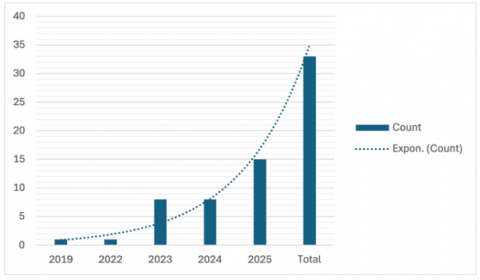
Figure 6 displays the yearly count of publications or studies from 2019 to 2025, along with a total column, and illustrates the trend with an exponential curve. There is a clear pattern of rapid growth, especially after 2022, indicating a rising academic or research interest in the subject over this period. In 2019 and 2022, the number of publications was minimal, but from 2023 onwards, a significant increase occurred, with the count sharply rising in 2025. The "Total" column consolidates all previous years, showing over 30 counts, confirming a trend of exponentially increasing outputs. The exponential trendline further highlights that the growth in related research is accelerating, reflecting heightened attention and possibly increased relevance of the topic in recent years.
Figure 6. Year of publication
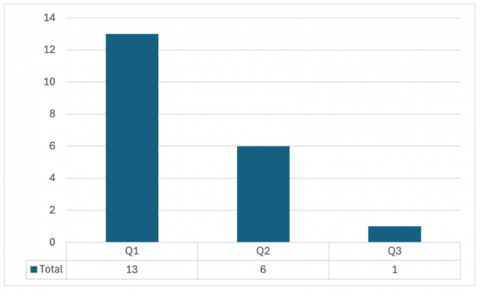
Figure 7 shows the analysis reveals a pronounced concentration of studies published in Q1 journals, with a total of 13 articles, underscoring the predominance of high-impact contributions in top-tier venues. The representation in Q2 journals is notably lower, encompassing 6 articles, while only 1 article was identified from a Q3 outlet. This pattern suggests that research concerning digital nomads, remote work, and workcations not only receives considerable academic attention but is predominantly disseminated through journals with rigorous peer-review standards and international recognition. Such a distribution reflects both the maturity of the topic and its perceived importance within the scholar, as the majority of findings are validated by publication in outlets known for their academic excellence and reach.
Figure 7. Summary of indexed journal
Recent literature (Table 1) has explored the phenomenon of workcations and digital nomadism through various perspectives including psychological, social, and organizational angles. For instance, previous study examined how urban office workers’ willingness to participate in workcations is shaped largely by active lifestyle preferences and positive attitudes toward natural environments surrounding workplaces [20]. The study suggests that managerial strategies fostering nature-integrated workspaces may encourage greater adoption of workcations among employees.
Table 1. Literature summary
|
Title |
Author(s) |
Year |
Method |
Theory Usage |
Result |
|
Structural modeling of the personas of urban office workers and their demands for Japanese-style workcations [20] |
Otsuka and Iwasaki |
2025 |
Quantitative |
Frequency theory |
The key findings revealed that while many office workers showed interest in taking workcations, most employers did not plan to adopt this work style. Workers' willingness to take workcations was positively influenced by active lifestyles and a favorable view of the benefits of nature. The study suggests that the presence and quality of nature around workplaces could encourage employees to embrace workcations. |
|
Exploring motivations for workations: A mixed-methods approach [21] |
Choe et al. |
2025 |
Mix Method |
The means-end chain theory |
The findings highlight the importance of offering a balance of work-friendly environments and relaxation opportunities. Managerial implications suggest that local governments and marketers should focus on these key features when designing and promoting workation tourism products. |
|
Digital nomadism as a form of travel: A phenomenological study of going on a workation [8] |
Koll et al. |
2025 |
Qualitative |
|
This study explores the growing trend of "workations," where employed knowledge workers combine leisure travel with remote work, adopting a digital nomad lifestyle. With the rise of hybrid work models, workations are becoming more popular. The study revisits the relationship between digital nomadism and tourism, expanding it to include workations as a new form of travel and lifestyle mobility. |
|
Escapism as a driver of workcation: The roles of psychological ownership and motivation [22] |
Gong et al. |
2025 |
Qualitative |
Conservation of Resources (COR) theory |
study is that escapism plays a significant role in motivating workcation intentions by fostering psychological ownership. This process is sequentially mediated by perceived control and self-expression. Additionally, utilitarian motivation strengthens the effect of escapism on psychological ownership. These findings suggest that workcations are not only driven by the need for relaxation but also by the desire to maintain control, express oneself, and avoid resource depletion, offering valuable insights for designing workcation experiences that balance work, relaxation, and personal engagement. |
|
From leisure to labor: How workations are reshaping hospitality and destination marketing in the era of New Work [23] |
Wilkesmann and Bassyiouny |
2025 |
Qualitative |
Self Determination Theory |
Workcations are not only driven by the need for relaxation but also by the desire to maintain control, express oneself, and avoid resource depletion, offering valuable insights for designing workcation experiences that balance work, relaxation, and personal engagement. |
|
Mapping of migration motivation from digital nomads in Bali [24] |
Susilo et al. |
2025 |
Qualitative |
Attention Restoration Theory |
The key finding of this study is that digital nomads are primarily motivated to move to Bali due to factors such as mobility, cost, lifestyle convenience, and culture. The study identifies trends among digital nomads and highlights the implications for global tourist marketing and migration policy. |
|
Wayfarers in cyberspace: A temporal investigation of digital nomads based on liquid modernity theory [25] |
Xiao and Lutz |
2025 |
Quantitative |
Modernity Theory |
The key finding of this study is that discussions on the r/digitalnomad subreddit reveal that digital nomads' travel patterns and lifestyle choices are primarily influenced by destination reviews, emotional needs, and lifestyle preferences. |
|
Work, wander and repeat: modeling the enablers of digital nomadic lifestyle [26] |
Vohra et al. |
2025 |
Qualitative |
- |
The research identified nine crucial enablers that facilitate the digital nomad lifestyle. The study effectively maps out their hierarchical relationships and the dynamics of their interactions. |
|
Extending expatriate support theory: a multi-level perspective on organisational, social and family support in remote work transitions [27] |
Végh et al. |
2025 |
Qualitative |
Expatriate Support Theory |
When expatriates transition to remote work as a consequence of a crisis, four factors are crucial for their successful transition and should be actively reinforced by organisations: (1) Awareness of tension between belonging and isolation and uncertainty, (2) Feeling supported, (3) Maintaining a positive approach and (4) JAVA/coffee connections. |
|
Resilience during crisis: COVID-19 and the new age of remote work in higher education—A systematic literature review [31] |
Okeke-Uzodike and Ngo Henha |
2025 |
Qualitative (Review) |
- |
The key finding of this study is that resilience, as a critical component of Crisis Management during the COVID-19 pandemic, has been underexplored in the context of remote work in higher education. The study highlights the growing importance of resilience in addressing the challenges faced by academic institutions and employees during the pandemic. |
|
Balancing work and leisure: Unraveling constraints on work-leisure integration in bleisure travel [30] |
Park et al. |
2025 |
Mix Method |
- |
The key finding of this study is that conflicts between work and leisure during bleisure travel can negatively impact travelers' subjective well-being. These conflicts arise from the contrasting characteristics of work and leisure, as well as limited resources like time and energy. |
|
Living life the nomadic way: Identifying skills of a digital nomad in new forms of organizational employment [29] |
Kulshrestha |
2025 |
Qualitative |
- |
The key finding of this study is that digital nomads (DNs) possess a combination of personal, interpersonal, and organizational skills that enable them to successfully perform remote work in the context of digital transformation. These skills help them effectively navigate the demands of their jobs, despite the challenges of working remotely. |
|
Working from abroad-workation as a mobility flow benefit [28] |
Beno et al. |
2024 |
Quantitative |
- |
The key finding of this study is that workations in Austria are seen by managers as an effective way to recharge while maintaining productivity and efficiency. Workations contribute to job satisfaction, increased productivity, and improved work-life balance. |
|
It's here to stay: Lessons, reflections, and visions on digital transformation amid public crisis [32] |
He et al. |
2024 |
Qualitative (Review) |
- |
The key finding of this study is that digital transformation practices were significantly accelerated during the COVID-19 pandemic across various levels of interaction, including organization-consumer, intra-organizational, organization-employee, inter-organizational, and organization-government. |
|
The utility of remote work solutions in the post-pandemic era: Exploring the mediating effects of productivity and work flexibility [33] |
Yang |
2024 |
Quantitative |
Technology, organization, environment (TOE) Framework |
The key finding of this study is that productivity and work flexibility significantly mediate the intention to continue using remote work solutions (RWS) in the post-pandemic era. The study also validates the influence of technological, organizational, and environmental factors on this intention, with the exception of the relationships between security and work flexibility, and management support and work flexibility. |
|
Investigating the managerial effects of workcations (work (plus) vacations) on digital nomad employees: Workcation satisfaction, work engagement, innovation behavior, intention to stay, and revisit intention [34] |
Lee et al. |
2024 |
Mix Method |
Self-Determination Theory |
The key finding of this study is that workcations can have positive managerial effects, such as increased work engagement, enhanced innovation, and improved employee retention. Specifically, workcation satisfaction was found to boost work engagement, which in turn led to a greater intention to stay with the organization, higher innovative behaviors, and a desire to participate in future workcations. |
|
Attracting digital nomads: Smart destination strategies, innovation and competitiveness [6] |
Zhou et al. |
2024 |
Quantitative |
Agency-structure Theory |
The key finding of this study is that smart destinations are increasingly catering to the unique needs of digital nomads, including work, travel, social, financial, and basic-living requirements, which differ from those of short-term leisure and business tourists. While destinations often treat digital nomads as a homogenous group, the study identifies different segments within the population. |
|
Decoding digital nomad destination decisions through user-generated content [35] |
Lacárcel et al. |
2024 |
Mix Method |
Grounded Theory |
The key finding of this study is that digital nomads' destination choices are influenced by a mix of positive, negative, and neutral factors. Positive factors include job flexibility, the appeal of travel, and cultural immersion, while negative factors involve connectivity issues, visa management, feelings of isolation, and emotional adjustments. |
|
Travel while working remotely: A topological data analysis of well-being in remote work trip experiences [36] |
Chevtaeva et al. |
2024 |
Quantitative |
Subjective well-being theory |
The key finding of this study is that digital nomads' destination choices are shaped by both positive and negative factors. Positive influences include job flexibility, the desire for travel, and cultural immersion, while negative factors such as connectivity issues, visa challenges, loneliness, and emotional adjustments also play a role. |
|
Going on workation – Is tourism research ready to take off? Exploring an emerging phenomenon of hybrid tourism [37] |
Bassyiouny and Wilkesmann |
2023 |
Qualitative |
Boundary Theory |
The key result of this study is that workationers do not fit into the traditional categories of working tourists or traveling workers. The study reveals that the distinction between business and leisure tourism is increasingly outdated, particularly in the digitalized world, where the hybrid concept of workations (combining work and vacation) is becoming more prevalent. |
|
The paradigms of workation for novel destination development: An explorative study based in Himachal Pradesh [38] |
Kumar et al. |
2023 |
Descriptive |
- |
The key result of this study is that the "workation" concept is emerging as a new tourism product, challenging traditional tourism models by blending work and leisure. |
|
What is a digital nomad? Definition and taxonomy in the era of mainstream remote work [39] |
Cook |
2023 |
Narrative elicitation |
- |
The key finding of this study is the development of an updated classification of digital nomadism that recognizes its broad and evolving nature. The paper proposes a new taxonomy subdividing digital nomads into five distinct types: freelance digital nomads, digital nomad business owners, salaried digital nomads, experimental digital nomads, and armchair digital nomads. |
|
“Home office is the here and now.” Digital nomad visa systems and remote work-focused leisure policies [40] |
Sánchez-Vergara et al. |
2023 |
Qualitative |
- |
The study on digital nomad visa policies reveals that these visas are framed not just as legal instruments for stay but also as an engagement experience with the destination. |
|
How the Japanese workcation embraces digital nomadic work style employees [41] |
Matsushita |
2023 |
Qualitative |
- |
Japanese-style workcations are seen as a form of digital nomadism that addresses various societal challenges, such as the concentration of population in cities, an ageing population, and a declining tourism industry. |
|
Understanding digital work and its use in organizations from a literature review [42] |
Wibowo et al. |
2022 |
Qualitative (Review) |
- |
The results of the review lead to the formulation of a working definition for digital work, identification of its key characteristics, and the emerging issues influencing its adoption within organizations. |
|
Workcation (workation) travel experiences, satisfaction and revisit intentions: Focusing on conceptualization, scale development, and nomological network [43] |
Shin et al. |
2024 |
Qualitative |
- |
the nomological network of the developed scale with workcation satisfaction and revisit intentions was investigated. |
|
Work from anywhere: Traditional workation, coworkation and workation retreats: a conceptual review [44] |
Voll et al. |
2023 |
Conceptual review |
- |
The study examines the industries affected by workation and its economic impacts. By offering the first taxonomy of workation, this paper lays the groundwork for future research in this emerging area. |
|
Coworking environments and digital nomadism: Balancing work and leisure whilst on the move [45] |
Orel |
2019 |
Qualitative |
- |
The study identifies that coworking spaces act as vital "work-leisure habitats" for digital nomads, providing the social and digital infrastructure necessary to enhance productivity while mitigating the isolation often associated with a mobile lifestyle. Ultimately, while nomads face challenges like blurred professional boundaries, they strategically use these collaborative environments to maintain a disciplined balance, finding that the benefits of geographical freedom and improved quality of life outweigh the drawbacks. |
|
Workation as a new mode of work-analysis of top European destinations [46] |
Wąsowicz-Zaborek |
2025 |
Quantitative |
|
The findings underscore the significance of coworking spaces, affordability, and digital infrastructure in influencing workation preferences. These insights provide valuable guidance for city planners and tourism stakeholders, offering strategies to attract remote workers and foster regional economic growth by enhancing a city's appeal as a workation destination. |
|
Combining work and vacation: workation as an attractive work arrangement [9] |
Stich et al. |
2025 |
Quantitative |
embeddedness theory |
The results indicate that job offerings featuring workation demonstrate significantly higher organizational attractiveness compared to those featuring other work arrangements. |
|
From tourists to nomads: unveiling the transformative potential of digital nomads in travel and tourism [47] |
Arslan |
2024 |
Qualitative (Review) |
- |
The findings indicate that digital nomadism provides a fresh outlook on travel and tourism mobility, while introducing a unique category of tourist with specific characteristics. This suggests that these individuals are not traditional travelers, but rather a modern "knowmad" society that successfully blurs the lines between work, leisure, and travel. |
|
Working from anywhere? Work from here! Approaches to attract digital nomads [48] |
Bednorz |
2024 |
Qualitative (review) |
- |
This research reveals that digital nomadism creates a new typology of travelers with unique characteristics, where the boundaries between work, travel, and leisure are blurred. This phenomenon provides a fresh perspective on tourism mobility, as travelers seek not only entertainment but also professional productivity within their travel experiences. |
|
Digital nomads’ work-leisure management practices [49] |
Rainoldi et al. |
2025 |
Quantitative |
Practice and Border Theory |
The key finding of this study is that digital nomads face unique challenges in managing the boundaries between work and leisure, despite enjoying autonomy in choosing when, where, and how they perform their work. |
Further studies, such as those by Koll et al. [8] and Choe et al. [21], emphasized the dual necessity for work-friendly settings alongside opportunities for personal relaxation. These findings underline that tourism managers and hospitality providers should focus on balancing professional and leisure experiences, as the rise of remote work and hybrid models motivates a growing demographic to embrace digital nomadism for greater mobility and flexibility. The role of psychological factors in shaping workcation intentions is highlighted by Gong et al. [22], who found escapism and psychological ownership to be central motivational components. Their research reveals that both perceived control and self-expression, mediated by utilitarian motivations, contribute significantly to employees’ desire to engage in relaxing yet productive travel experiences. Study also examined the industry and migration impacts, noting that workcations serve not only relaxation needs but also address deeper desires for control, emotional connectivity, and personal engagement [23, 24]. These insights offer actionable guidance for designing hospitality products and destination marketing strategies that appeal to a broader, more mobile workforce.
Additionally, mapped digital nomads’ behavioral enablers and travel patterns through community platforms and hierarchical relationship models [25, 26]. Their studies indicate that digital nomad choices are strongly influenced by peer recommendations, destination reviews, and the emotional value of local social connections, such as the unique significance of informal coworking or coffee meetups. Finally, identified the organizational supports needed for successful remote work transitions, emphasizing the importance of maintaining emotional stability and social ties during periods of change [27]. The evidence suggests that providing structured, empathetic support systems is critical for expatriates adapting to new digital work paradigms, with broader implications for corporate policy and employee well-being. This analysis synthesizes the key thematic findings and highlights the implications for practitioners in tourism, hospitality, and organizational management, as well as broader social trends in remote work and travel. Several studies focus on the structural enablers of digital nomadism and workcations. In addition, past studies mapped out nine essential factors underpinning digital nomad lifestyles, including hierarchical relationships and peer dynamics, while Beno et al. [28] found that workcations contribute to job satisfaction, productivity, and work-life balance, particularly as perceived by managers in Austria [26]. further identified the vital role of digital nomads’ interpersonal, organizational, and personal skills, which help them adapt to the challenges of remote work, enabling successful digital transformation [29].
Conflicts between work and leisure, particularly in blended "bleisure" travel can negatively affect subjective well-being due to limited resources such as time and energy, underscoring the necessity for clear boundaries and support systems [30]. Thus, resilience, adaptability, and supportive environments emerge as central themes across these studies, shaping the future landscape of remote work, workcations, and digital nomadism.
5.1 Factor to boost digital nomads’ tourism
Recent advancements in the literature highlight several fundamental factors that support digital nomads and the successful implementation of workcation practices. Table 2 presented the summary of factors to boost workation. Flexibility in the management of working hours and the choice of location consistently emerges as a major enabler within this discourse. The ability for professionals to schedule their work and select their environments according to personal and occupational preferences is demonstrated to play a crucial role in facilitating both productivity and autonomy for individuals pursuing remote work or digital nomadism [20, 34-36].
Table 2. Factors to boost workation
|
Factors |
Description |
Implications |
References |
|
Flexibility in Work Arrangements |
Freedom to choose working hours and work location is a major factor for digital nomads. |
Flexible working hours allow digital nomads to choose the destination and time that suits them best for working. |
[20, 34-36] |
|
Quality of Work Environment |
A supportive environment such as security, comfort, and easy access to work facilities is important. |
A location with complete work facilities and environmental quality that supports work comfort. |
[25, 27, 33] |
|
Provision of Digital Infrastructure (Workplace Environment and Support) |
The availability of digital infrastructure such as fast Wi-Fi, access to technology, and workspaces influences destination choice. |
A destination with fast Wi-Fi access and comprehensive digital facilities to support remote work. |
[22-24, 26, 30, 31, 35, 38, 39] |
|
Availability of Friendly Destinations for Digital Nomads |
Destinations that provide digital nomad-friendly facilities such as flexible accommodation and comfortable workspaces. |
Cities like Bali, Lisbon, and Barcelona have workation packages with complete facilities. |
[23, 28] |
|
Supportive Company Policies |
Companies that provide remote work or workation policies support digital nomads in living this lifestyle. |
Companies that provide flexibility to work from anywhere or support workation programs for their employees. |
[21, 27, 29, 33] |
The quality of the work environment is equally recognized as a determinant of success in workcation scenarios. Studies emphasize that settings offering comfort, safety, and convenient access to necessary work facilities contribute significantly to overall well-being and efficiency [50]. Locations that provide comprehensive amenities and supportive environments become strategic in attracting those seeking productive remote-working experiences [27, 51]. Digital infrastructure, including high-speed internet access and technological resources, is identified as a critical factor influencing destination selection among digital nomads. Destinations equipped with robust digital support enable smooth communication, reliable remote access, and effective collaboration, thus expanding the feasibility of work from anywhere [22-24, 26, 30, 31, 35, 38, 39].
In terms of destination readiness, cities and regions offering flexible accommodation and specifically tailored workspaces, such as coworking hubs, appeal strongly to mobile professionals. Popular destinations like Bali, Lisbon, and Barcelona are frequently cited for their comprehensive workcation packages and the provision of facilities conducive to both living and working efficiently [23, 28]. Organizational support also features prominently in the literature as a factor in sustaining successful workcation experiences. Company policies permitting remote work, coupled with dedicated programs and explicit encouragement of workcation practices, are shown to amplify employee satisfaction and commitment to adopting dynamic, mobile lifestyles over the long term [21, 27, 29, 33].
In conclusion, this systematic review demonstrates a convergence of evidence around flexibility, environmental quality, digital infrastructure, destination attractiveness, and organizational support as critical dimensions underpinning the effective practice of digital nomadism and workcations. These insights provide actionable recommendations for practitioners, policymakers, and organizations in responding to the needs of an increasingly mobile and remote workforce.
5.2 Strategy to balance between work and vacation
The review of the 33 included studies reveals that achieving a successful work-leisure balance is an active process rather than a passive outcome of travel. It begins with the exercise of temporal and spatial autonomy, where travelers don't just "have" flexibility, but actively schedule their professional tasks to protect and maximize their leisure windows. This ensures that work and relaxation are synchronized rather than in conflict. This is further supported by a deliberate environmental selection process, where individuals prioritize workspaces that offer high levels of comfort and safety. By choosing these specific settings, workers can effectively lower their stress levels and transition into a "vacation mindset" immediately after their duties are complete.
A critical part of this balance involves pre-emptive infrastructure management, where travelers verify digital support systems, such as high-speed connectivity, before arrival to prevent technical issues from eating into their personal time. On the destination side, the availability of integrated workcation services, such as specialized accommodation packages, allows for a frictionless move between professional and recreational modes. Finally, the success of these individual efforts often rests on institutional legitimacy. When companies formally endorse remote work policies, it removes the "guilt" of working from a holiday destination, providing the professional and psychological security needed for employees to actually enjoy their time off while staying productive.
The most critical strategy involves the strategic deployment of flexibility in work arrangements. Rather than being a static factor, individuals actively utilize the ability to set their own hours and choose locations to synchronize high-productivity windows with optimal relaxation period. Environments that are safe, comfortable, and provide easy access to complete workplace facilities are fundamental. Such settings support both effective work and the opportunity to enjoy vacation-like aspects, reducing stress and promoting well-being [25, 27, 33].
Reliable digital infrastructure and robust workplace support ensure uninterrupted connectivity, allowing remote workers to efficiently handle tasks from varied destinations. Fast internet and access to necessary technology are vital so that work commitments do not interfere with opportunities for relaxation and recreation [22, 24, 26, 30, 31, 35, 38]. Availability of destinations that cater to digital nomad needs, such as cities with flexible accommodations and convenient, comfortable workspaces, further facilitate balancing work and vacation. Destinations with comprehensive workcation packages support seamless transitions between working and leisure time [23, 28]. Finally, supportive company policies that endorse remote work or offer explicit support for workcation programs enhance employees' ability to maintain a healthy balance between professional responsibilities and personal time, fostering greater satisfaction and motivation [21, 27, 29].
This research systematically reviews how digital nomad tourism is evolving, focusing on the factors that enhance workation experience and the balance between work and leisure. The review organizes and synthesizes evidence from diverse studies, identifying critical themes, theoretical models, and analytical approaches. It offers a comprehensive contextualized multidimensional framework that integrates key antecedents such as flexibility in work and location, quality of the work environment, digital infrastructure, supportive destinations, and accommodating company policies. These elements are shown to be essential for enabling digital nomads to effectively combine productivity with meaningful leisure experiences. Specifically, digital nomad tourism stakeholders should implement targeted strategies to maximize workation appeal. This includes creating environments where flexibility and reliable infrastructure are prioritized, ensuring seamless access to work while also offering amenities for relaxation and exploration. By fostering locations that blend professional and vacation opportunities, destinations can enhance the overall appeal for remote workers and digital nomads.
To successfully balance work and vacation, best practices involve not only equipping destinations with technological and physical resources but also fostering community connections, offering authentic local experiences, and providing structural support through company policies. Encouraging work-life integration will lead to higher satisfaction, prolonged stays, and positive sharing of experiences—factors that further boost the reputation and attractiveness of workation destinations. Future research should explore how digital platforms and influencer engagement can further shape digital nomads’ perceptions and decisions, including the role of social media in promoting destination features that enhance both productivity and leisure. Additionally, leveraging data analytics to understand digital nomads’ preferences and needs can inform more effective marketing and service design, while involving local communities helps create deeper, more authentic connections for visitors and supports sustainable tourism practices.
The research funding is provided by the Ministry of Education, Research, and Technology through the grant Program Magister Menuju Doctor Untuk Sarjana Unggul (PMDSU) (Number: 00689/UN10.A0501/B/PT.01.03.2/2025). Moreover, this research is also supported by Universitas Brawijaya Star Program 2025.
[1] Bayu, D.J. (2021). Survey: Remote Work Increasingly Prevalent in Indonesia During the COVID-19 Pandemic. https://databoks.katadata.co.id/en/employment/statistics/2bbb0db6b516074/survey-remote-work-increasingly-prevalent-in-indonesia-during-the-covid-19-pandemic.
[2] Hannonen, O. (2020). In search of a digital nomad: Defining the phenomenon. Information Technology & Tourism, 22(3): 335-353. https://doi.org/10.1007/s40558-020-00177-z
[3] Gupta, R., Nair, K., Mishra, M., Ibrahim, B., Bhardwaj, S. (2024). Adoption and impacts of generative artificial intelligence: Theoretical underpinnings and research agenda. International Journal of Information Management Data Insights, 4(1): 100232. https://doi.org/10.1016/j.jjimei.2024.100232
[4] Arasli, H., Abdullahi, M., Gunay, T. (2021). Social media as a destination marketing tool for a sustainable heritage festival in Nigeria: A moderated mediation study. Sustainability, 13(11): 6191. https://doi.org/10.3390/su13116191
[5] Zhou, G., Chen, W., Wu, Y. (2022). Research on the effect of authenticity on revisit intention in heritage tourism. Frontiers in Psychology, 13: 883380. https://doi.org/10.3389/fpsyg.2022.883380
[6] Zhou, L., Buhalis, D., Fan, D.X., Ladkin, A., Lian, X. (2024). Attracting digital nomads: Smart destination strategies, innovation and competitiveness. Journal of Destination Marketing & Management, 31: 100850. https://doi.org/10.1016/j.jdmm.2023.100850
[7] Trihas, N., Papadaki, E. (2024). Digital nomads: Lifestyle, travel behavior, and the work/leisure balance. In the International Conference on Strategic Innovative Marketing and Tourism, pp. 341-349. https://doi.org/10.1007/978-3-031-81962-9_38
[8] Koll, E., Wang, X., Lin, M.S. (2025). Digital nomadism as a form of travel: A phenomenological study of going on a workation. Tourism Management, 110: 105185. https://doi.org/10.1016/j.tourman.2025.105185
[9] Stich, J.F., Díaz Andrade, A., Kuepers, W.M. (2025). Combining work and vacation: Workation as an attractive work arrangement. Personnel Review, 54(6): 1501-1520. https://doi.org/10.1108/PR-07-2024-0627
[10] Stich, J.F., Díaz Andrade, A., Küpers, W. (2025). Holiworking: Perspectives on new ways of integrating holiday and work. Work, Employment and Society, 09500170251373033. https://doi.org/10.1177/09500170251373033
[11] Heo, J., Zhang, T., Hua, N., Zhao, X. (2025). Exploring the dual-aspect well-being of digital nomads in tourism and hospitality: A conceptual framework. Journal of Smart Tourism, 6(1): 27652157251390605. https://doi.org/10.1177/27652157251390605
[12] Deniz, G., Yetiş, Ş.A. (2025). Tourism in the age of remote work: How digital nomads are changing the game. In Transforming Remote Work and Tourism in the Digital Nomad Era, pp. 51-88. https://doi.org/10.4018/979-8-3373-0076-4.ch003
[13] Ferreira, P., Gomes, S. (2023). Work-life balance and work from home experience: Perceived organizational support and resilience of European workers during COVID-19. Administrative Sciences, 13(6): 153. https://doi.org/10.3390/admsci13060153
[14] Zenkteler, M., Foth, M., Hearn, G. (2021). The role of residential suburbs in the knowledge economy: Insights from a design charrette into nomadic and remote work practices. Journal of Urban Design, 26(4): 422-440. https://doi.org/10.1080/13574809.2020.1860673
[15] Page, M.J., McKenzie, J.E., Bossuyt, P.M., Boutron, I., et al. (2021). The PRISMA 2020 statement: An updated guideline for reporting systematic reviews. BMJ, 372. https://doi.org/10.1136/bmj.n71
[16] Templier, M., Paré, G. (2015). A framework for guiding and evaluating literature reviews. Communications of the Association for Information Systems, 37(1): 112-137. https://doi.org/10.17705/1cais.03706
[17] Ali, N.B., Usman, M. (2018). Reliability of search in systematic reviews: Towards a quality assessment framework for the automated-search strategy. Information and Software Technology, 99: 133-147. https://doi.org/10.1016/j.infsof.2018.02.002
[18] MacFarlane, A., Russell-Rose, T., Shokraneh, F. (2022). Search strategy formulation for systematic reviews: Issues, challenges and opportunities. Intelligent Systems with Applications, 15: 200091. https://doi.org/10.1016/j.iswa.2022.200091
[19] Kitchenham, B.A., Budgen, D., Brereton, O.P. (2011). Using mapping studies as the basis for further research-a participant-observer case study. Information and Software Technology, 53(6): 638-651. https://doi.org/10.1016/j.infsof.2010.12.011
[20] Otsuka, Y., Iwasaki, Y. (2025). Structural modeling of the personas of urban office workers and their demands for Japanese-style workcations. Cities, 167: 106342. https://doi.org/10.1016/j.cities.2025.106342
[21] Choe, J.Y.J., Chen, Z., Kang, S., Kang, J.S.E. (2025). Exploring motivations for workations: A mixed-methods approach. Tourism Management, 111: 105217. https://doi.org/10.1016/j.tourman.2025.105217
[22] Gong, Y., Huang, R., Liu, Y., Chen, Z. (2025). Escapism as a driver of workcation: The roles of psychological ownership and motivation. Journal of Hospitality and Tourism Management, 64: 101309. https://doi.org/10.1016/j.jhtm.2025.101309
[23] Wilkesmann, M., Bassyiouny, M. (2025). From leisure to labor: How workations are reshaping hospitality and destination marketing in the era of New Work. Journal of Destination Marketing & Management, 36: 100991. https://doi.org/10.1016/j.jdmm.2025.100991
[24] Susilo, D., Sari, I.A.L., Thanos, G.A.C., Sam, T.H. (2025). Mapping of migration motivation from digital nomads in Bali. Jurnal Kajian Bali (Journal of Bali Studies), 15(1): 1-36. https://doi.org/10.24843/JKB.2025.v15.i01.p01%20
[25] Xiao, Y., Lutz, C. (2025). Wayfarers in cyberspace: A temporal investigation of digital nomads based on liquid modernity theory. Journal of Travel Research, 64(4): 966-984. https://doi.org/10.1177/00472875231224242
[26] Vohra, V., Banishetty, S., Dutta, T., Joshi, A. (2025). Work, wander and repeat: Modeling the enablers of digital nomadic lifestyle. Journal of Global Mobility: The Home of Expatriate Management Research, 13(1): 77-106. https://doi.org/10.1108/JGM-05-2024-0044
[27] Végh, J., Jenkins, J., Claes, M.T. (2025). Extending expatriate support theory: A multi-level perspective on organisational, social and family support in remote work transitions. Journal of Global Mobility: The Home of Expatriate Management Research, 13(1): 133-153. https://doi.org/10.1108/JGM-04-2024-0038
[28] Beno, M., Caganova, D., Bobinics, B. (2024). Working from abroad-workation as a mobility flow benefit. Acta Logistica (AL), 11(4): 677-685. https://doi.org/10.22306/al.v11i4.566
[29] Kulshrestha, R. (2025). Living life the nomadic way: Identifying skills of a digital nomad in new forms of organizational employment. International Journal of Organizational Analysis. https://doi.org/10.1108/IJOA-09-2024-4853
[30] Park, S., Lehto, X., Kang, J. (2025). Balancing work and leisure: Unraveling constraints on work-leisure integration in bleisure travel. International Journal of Hospitality & Tourism Administration, 26(3): 656-682. https://doi.org/10.1080/15256480.2024.2344226
[31] Okeke-Uzodike, O.E., Ngo Henha, E.P. (2025). Resilience during crisis: COVID-19 and the new age of remote work in higher education-A systematic literature review. Administrative Sciences, 15(3): 92. https://doi.org/10.3390/admsci15030092
[32] He, G.S., Tran, T.T.H., Leonidou, L.C. (2024). It's here to stay: Lessons, reflections, and visions on digital transformation amid public crisis. Technological Forecasting and Social Change, 206: 123557. https://doi.org/10.1016/j.techfore.2024.123557
[33] Yang, H. (2024). The utility of remote work solutions in the post-pandemic era: Exploring the mediating effects of productivity and work flexibility. Technology in Society, 78: 102613. https://doi.org/10.1016/j.techsoc.2024.102613
[34] Lee, J., Shin, H., Kang, J. (2024). Investigating the managerial effects of workcations (work (plus) vacations) on digital nomad employees: Workcation satisfaction, work engagement, innovation behavior, intention to stay, and revisit intention. Journal of Hospitality and Tourism Management, 59: 324-331. https://doi.org/10.1016/j.jhtm.2024.05.003
[35] Lacárcel, F.J.S., Huete, R., Zerva, K. (2024). Decoding digital nomad destination decisions through user-generated content. Technological Forecasting and Social Change, 200: 123098. https://doi.org/10.1016/j.techfore.2023.123098
[36] Chevtaeva, E., Neuhofer, B., Egger, R., Rainoldi, M. (2024). Travel while working remotely: A topological data analysis of well-being in remote work trip experiences. Journal of Travel Research, 63(2): 466-480. https://doi.org/10.1177/00472875231151923
[37] Bassyiouny, M., Wilkesmann, M. (2023). Going on workation-Is tourism research ready to take off? Exploring an emerging phenomenon of hybrid tourism. Tourism Management Perspectives, 46: 101096. https://doi.org/10.1016/j.tmp.2023.101096
[38] Kumar, R., Gautam, P., Sinha, R. (2023). The paradigms of workation for novel destination development: An explorative study based in Himachal Pradesh. International Journal of Hospitality & Tourism Systems, 16(3): 75-85.
[39] Cook, D. (2023). What is a digital nomad? Definition and taxonomy in the era of mainstream remote work. World Leisure Journal, 65(2): 256-275. https://doi.org/10.1080/16078055.2023.2190608
[40] Sánchez-Vergara, J.I., Orel, M., Capdevila, I. (2023). “Home office is the here and now.” Digital nomad visa systems and remote work-focused leisure policies. World Leisure Journal, 65(2): 236-255. https://doi.org/10.1080/16078055.2023.2165142
[41] Matsushita, K. (2023). How the Japanese workcation embraces digital nomadic work style employees. World Leisure Journal, 65(2): 218-235. https://doi.org/10.1080/16078055.2022.2156594
[42] Wibowo, S., Deng, H., Duan, S. (2022). Understanding digital work and its use in organizations from a literature review. Pacific Asia Journal of the Association for Information Systems, 14(3): 2. https://doi.org/10.17705/1pais.14302
[43] Shin, H., Lee, J., Kim, N. (2024). Workcation (workation) travel experiences, satisfaction and revisit intentions: Focusing on conceptualization, scale development, and nomological network. Journal of Travel Research, 63(5): 1150-1168. https://doi.org/10.1177/00472875231188717
[44] Voll, K., Gauger, F., Pfnür, A. (2023). Work from anywhere: Traditional workation, coworkation and workation retreats: A conceptual review. World Leisure Journal, 65(2): 150-174. https://doi.org/10.1080/16078055.2022.2134199
[45] Orel, M. (2019). Coworking environments and digital nomadism: Balancing work and leisure whilst on the move. World Leisure Journal, 61(3): 215-227. https://doi.org/10.1080/16078055.2019.1639275
[46] Wąsowicz-Zaborek, E. (2025). Workation as a new mode of work-analysis of top European destinations. Bulletin of Geography. Socio-Economic Series, 68: 159-174. https://doi.org/10.12775/bgss-2025-0019
[47] Arslan, E. (2024). From tourists to nomads: Unveiling the transformative potential of digital nomads in travel and tourism. Worldwide Hospitality and Tourism Themes, 16(3): 269-281. https://doi.org/10.1108/WHATT-03-2024-0046
[48] Bednorz, J. (2024). Working from anywhere? Work from here! Approaches to attract digital nomads. Annals of Tourism Research, 105: 103715. https://doi.org/10.1016/j.annals.2023.103715
[49] Rainoldi, M., Ladkin, A., Buhalis, D. (2025). Digital nomads' work-leisure management practices. Annals of Tourism Research, 111: 103904. https://doi.org/10.1016/j.annals.2025.103904
[50] Sutata, D.F., Madjid, M.I.N., Lutfiana, E., Ridho, D., Safitri, N.M., Sadono, R. (2024). Evaluating the sustainability status of Pinus Sari Forest as an ecotourism destination using multi-dimensional scaling. International Journal of Environmental Impacts, 7(4): 641-651. https://doi.org/10.18280/ijei.070405
[51] Xiong, J., Lipsitz, O., Nasri, F., Lui, L.M., Gill, H., Phan, L., Chen-Li, D., Iacobucci, M., Ho, R., Majeed, A., McIntyre, R.S. (2020). Impact of COVID-19 pandemic on mental health in the general population: A systematic review. Journal of Affective Disorders, 277: 55-64. https://doi.org/10.1016/j.jad.2020.08.001