Fawwaz Tawfiq Awamleh* | Ahmad A. M. Alwreikat | Mufleh Amin AL Jarrah | Suhaib Al-Khazaleh
© 2026 The authors. This article is published by IIETA and is licensed under the CC BY 4.0 license (http://creativecommons.org/licenses/by/4.0/).
OPEN ACCESS
This study investigates the impact of innovative entrepreneurship (IE) on sustainable development (SD), focusing on business analytics (BA) as a mediator. Higher education institutions are encouraged to become more entrepreneurial and innovative while promoting SD. However, there is still a need to better understand how these entrepreneurial practices can be translated into SD. This study contributes to entrepreneurship and sustainability literature by suggesting that BA can play an instrumental role in helping higher education institutions translate their entrepreneurial practices into informed decisions for SD. A survey of 322 academics at Jordanian higher education institutions was used to collect data. This study employed Partial Least Squares Structural Equation Modeling (PLS-SEM) and SmartPLS software to investigate the relationships between IE and SD and BA as a mediator. The results showed that IE has a positive relationship with BA and SD. Moreover, BA has a significant impact on SD and acts as a partial mediator between IE and SD. This study contributes to entrepreneurship and sustainability literature by providing a better understanding of how BA can facilitate higher education institutions in becoming more entrepreneurial and innovative while promoting SD. This study provides a practical guide for higher education institutions on how to become more entrepreneurial and innovative while promoting SD.
innovative entrepreneurship, business analytics, sustainable development, higher education institutions
However, modern higher education institutions face the challenge of not only responding to the rapidly evolving technological environment, limited resources, and complex socio-economic factors but also contributing to the sustainability of the economy and society [1]. The modern university is not just a teaching and research institution but also a significant contributor to the development of the economy and the broader society. In such a case, it has become imperative to develop concrete research results that can be logically supported in the modern world, where modern academic research has failed to deliver practically applicable results [2]. Despite the significant development in the field of research on entrepreneurship and sustainable development (SD), the modern research in the field has failed to deliver practically applicable results, as the research in the field remains largely theoretical and lacks adequate empirical evidence, especially in the context of higher education institutions [3]. The modern research in the field of entrepreneurship has also identified the importance of digital entrepreneurship, innovation ecosystems, and entrepreneurial education in the development of sustainability in modern organizations [4]. The challenge is significant, considering that modern higher education institutions operate in an environment where technological development, limited resources, and sustainability factors exist [5, 6].
Innovative entrepreneurship (IE) has been widely accepted as one of the factors that can contribute to the development of organizational transformation and sustainability in modern organizations. The modern university that has managed to develop entrepreneurial initiatives and innovative practices has been in a better position to address sustainability challenges in the modern world [4]. However, despite the growing recognition of this relationship, several limitations remain within the existing literature [7]. Much of the previous research has primarily examined the direct influence of entrepreneurship on sustainability outcomes without adequately explaining the mechanisms through which entrepreneurial initiatives are translated into measurable and effective sustainability results [8]. In other words, the literature still lacks a clear understanding of how entrepreneurial intentions within universities are operationalized into data-informed decision-making processes that support SD [9].
One potential mechanism that may explain this relationship is business analytics (BA). BA enables organizations to transform large volumes of institutional data into actionable insights that support strategic planning, performance evaluation, and evidence-based decision-making [10]. Despite its increasing importance, the role of BA as an organizational capability that facilitates the translation of innovative entrepreneurial initiatives into sustainability outcomes has received limited empirical attention in higher education institutions, particularly in emerging economies [11]. Moreover, previous studies have rarely examined the perspectives of academic staff members, even though they represent key actors in generating innovative ideas, research outputs, and institutional initiatives related to sustainability [12]. Consequently, an important research gap remains regarding the role of analytical capabilities in linking IE with SD within the context of universities.
Given these shortcomings, this research aims to examine the relationship between creative entrepreneurship and sustainable growth in higher education institutions, particularly emphasizing the mediating role of BA. Specifically, the study develops and empirically tests a conceptual model that explains how IE can contribute to SD through the enabling capability of BA. The empirical investigation focuses on academic staff members working in public and private universities in Jordan. This study helps improve understanding by offering a tested framework that shows how university entrepreneurial efforts can lead to clear sustainability results.
2.1 Innovative entrepreneurship
IE is a form of organizational orientation characterized by creativity, proactivity, and the ability to pioneer new and innovative ideas [7]. In institutions of higher education, IE refers to a type of innovation that extends beyond the traditional concept of business creation to include innovation in institutions of higher education [1]. The institutions that appropriately apply IE are able to adapt to environmental demands and challenges that emanate from technology [9]. From a theoretical position, IE is based on Schumpeter's theory of innovation that considers innovation as a driving force for positive transformation in both economic and social contexts [7, 13]. In institutions of higher education, academic staff members play a significant role in pioneering innovative practices in research and educational practices [14]. IE is hence a significant means for institutions of higher education to bring value to institutions for future development purposes [8]. Recent research also highlights the increasing role of digital entrepreneurship and social media platforms in strengthening entrepreneurial orientation and opportunity creation [4].
2.2 Sustainable development
SD in higher education institutions is defined as a process whereby economic, social, and environmental factors are made an integral part of long-term planning and operations in these entities [15]. The role of universities in SD involves creating SD knowledge, involving social responsibility, resource management, and economic growth. SD does not emphasize performance results but focuses on sustainability, resilience, and equilibrium [16, 17]. The theoretical foundation that underpins SD is rooted in stakeholder theory as well as the concept of the triple bottom line [18]. This involves economic sustainability, social sustainability, and environmental sustainability. Higher education institutions that integrate SD into their management and operations are more likely to register long-term outcomes consistent with national and world development goals [6]. As a result, SD is a major performance area for modern higher education institutions. In this context, green entrepreneurship and sustainability-oriented innovation have received increasing scholarly attention as key drivers of long-term institutional resilience [19].
2.3 Business analytics as an organizational capability
BA is basically the practice of using data and statistical analysis to make better decisions in an organization [10]. In academic institutions, BA will allow the university to process vast amounts of data that are either academic, administrative, or related to research, with the aim of optimizing decision-making in the university and hence its effectiveness [20]. BA, according to the resource-based view, is a valuable, rare, and non-imitable capability that organizations use for optimizing decision-making and efficiency in their operations [11]. With enhanced analytical capability, institutions of learning are well-positioned within their pursuit for innovation, measurement of sustainability outcomes, and implementation of entrepreneurial endeavors and goals [12]. BA, accordingly, can thus be said to represent a crucial tool that bridges the gap between innovation and its realization. The growing digitalization of organizations has further reinforced the role of data-driven capabilities in supporting innovation, entrepreneurship, and sustainable growth [21].
IE assists in making innovative solutions for the university that may increase its adaptability and interaction with the needs of the community as well [3, 7]. Through the adoption and application of entrepreneurial innovation, scholars can therefore create novel research topics and novel programs covering all subjects that may result in partnerships leading to SD [18, 22]. From the former theoretical perspectives, an enhancement of value for the longer term, as well as that of the organization's sustainability, can be facilitated by innovation-based entrepreneurship [16].
In institutions of higher education, IE can lead to SD, as it can enhance efficiency within the institution, increase the institution's social responsibility, and boost environmental awareness [23]. Hence, a theoretical proposal for a positive association between IE and SD should not be unreasonable [16]. The logic behind the theories leads to the hypothesis that:
H1: IE positively affects SD in higher education institutions.
Innovation-intensive entrepreneurship utilizes information extensively for analysis of complex data to underpin innovative decision-making processes [24]. The entrepreneurial ventures undertaken by universities demand evidence-profiling intelligence for assessment of opportunities, risk management, and analysis of outcomes for innovation [10, 25]. BA is the infrastructure solution that will facilitate entrepreneurial endeavors undertaken by universities. Business-oriented universities that practice IE are likely to adopt analytical solutions for data intelligence to facilitate decision-making for innovations [5]. As such, innovative entrepreneurial endeavors will influence the application of BA in universities to be positively affected. The logic behind the theories leads to the hypothesis that:
H2: IE positively affects BA in higher education institutions.
BA may contribute to the enhancement of the ability of universities to make strategic and well-informed decisions, as well as optimize their ability to manage sustainability performance [23, 26]. Using data-driven insights, universities may improve their ability to remove inefficiencies and optimize processes, including those related to sustainability [27].
According to theoretical perspectives, analytical ability may contribute to a positive influence on governance and accountability in the institutions that provide a vital base for the sustainability of development [20]. The institutions that have successfully used BA may be better positioned to be aligned with the principles of sustainability and perform well in economic and environmental dimensions [3, 23]. The rationale for the theory leads to the hypothesis:
H3: BA positively affects SD in higher educational institutions.
Although IE provides an important foundation for creativity, opportunity recognition, and value creation within organizations, translating these entrepreneurial initiatives into SD outcomes is not always straightforward [18]. To successfully carry out entrepreneurial initiatives, organizations often need organized methods and skills that help them turn creative ideas into real and lasting value [28]. In this respect, BA has emerged as a key organizational competence that can facilitate data-driven decision-making and enable the evaluation of entrepreneurial initiatives in universities [29].
Through the application of analytical competencies, organizations can comprehensively analyze data, assess the practicality and effectiveness of entrepreneurial initiatives, and improve resource management [11, 13]. BA, therefore, assumes a key role in enabling universities to convert the resources created by IE into sustainable outcomes. By leveraging analytical competencies and performance tracking systems, universities can convert the resources created by IE into strategies that can enable the achievement of sustainability goals [28, 29].
In line with a resource-based view and dynamic capabilities, BA can improve organizational learning, adaptability, and knowledge absorption, thereby improving the ability of IE to generate sustainable value [26]. BA, therefore, has the potential to facilitate entrepreneurial initiatives and convert them into sustainability outcomes effectively. In this respect, IE has the potential to influence SD directly and indirectly, depending on the role that analytical competencies play in evaluating entrepreneurial initiatives in universities. Based on the theoretical underpinnings, the following hypothesis is proposed:
H4: BA positively mediates the relationship between IE and SD in higher educational institutions.
4.1 Research design and study context
This study employed a quantitative cross-sectional research design in exploring the relationship that exists between IE, BA, and SD in the context of higher education institutions. A survey was employed as the quantitative research design in this study to obtain the perceptions of academic staff regarding the entrepreneurial practices that have been adopted in their respective institutions of higher learning.
The setting of this study comprised public and private universities in Jordan, an emerging economy with significant contributions from higher education institutions in promoting IE and addressing sustainability challenges. Over the recent past, Jordanian universities have adopted IE practices and strategies for digital transformation while operating in an environment characterized by resource scarcity and sustainability pressures. This setting offers an appropriate context for exploring the relationship that exists between IE and SD in the context of higher education institutions.
The unit of analysis for this study was the individual academic staff. Academic staff were employed as the unit of analysis in this study on the basis of the fact that they play an active role in promoting IE, BA, and sustainability development in the context of higher education institutions.
4.2 Population, sample, and sampling technique
The target group for this particular study is the academic staff working in Jordanian universities, both public and private. This group comprises professors, associate professors, assistant professors, and lecturers. The respondents are involved in a variety of activities that revolve around innovation and sustainability. For this purpose, a non-probability method of sampling was used. Purposive sampling is an ideal method when a sample is selected based on their specific knowledge and experience related to specific variables. Purposive sampling is particularly applicable in organizational and educational settings where respondents are required to have specific professional characteristics related to the purpose of the study. In this particular study, respondents were selected based on their specific roles in institutions and their possible involvement in innovation activities in universities.
The data was collected using an online survey form that was distributed to the academic staff working in different universities in Jordan. Finally, a total of 322 valid responses were included in the final analysis. However, an exact rate could not be determined because the survey link was distributed through various mailing lists of different universities and professional networks for academics. Only complete questionnaires that satisfied the eligibility criteria for participation in the survey were included in the final analysis. Eligibility for participating in the survey was restricted to full-time academic staff working at Jordanian universities, both public and private. The sample size is sufficient for conducting Partial Least Squares Structural Equation Modeling (PLS-SEM), as it meets the minimum requirement for conducting PLS-SEM. Specifically, the sample size is sufficient for conducting PLS-SEM, as it meets the "ten times rule.” In PLS-SEM, the minimum sample size should be ten times the maximum number of paths directed to a particular construct in the model [30].
4.3 Pilot study
Before the actual data collection, a pilot test was performed to assess the clarity, reliability, and structure of the questionnaire. The participants in the pilot test comprised 30 members of the academic staff of Jordanian universities, who were not included in the final sample. The pilot test helped researchers assess the questionnaire's ambiguity and improve some questions. The pilot test also helped the researchers to enhance the structure of the questionnaire to improve the logical sequence of the questions in the final version of the questionnaire. The reliability analysis of the questionnaire revealed that the reliability of the scales measuring the variables was satisfactory, as the value of Cronbach’s alpha exceeded the threshold levels for all the variables.
4.4 Measurement instrument
The data was collected using a structured self-administered questionnaire that was designed based on measurement scales validated in prior empirical studies. The questions in the structured self-administered questionnaire included two sections. The first section included questions related to respondents’ demographic characteristics. Additionally, questions related to respondents’ academic rank and affiliation were included in this section. The second section included questions related to measurement scales for key concepts in the study: IE, BA, and SD. For IE, the questions asked how respondents view creativity, spot opportunities, putting innovations into action, and their entrepreneurial mindset in higher education institutions [3, 7]. For BA, questions related to respondents’ perceptions of data availability, BA capabilities, use of data in decision-making processes in institutions, and BA talent in institutions were included in the questionnaire [10, 11]. For SD, questions related to respondents’ perceptions of economic efficiency, social responsibility, and environmental consciousness in university practices were included in the questionnaire [16, 18, 28].
All questions in the structured self-administered questionnaire were measured using a five-point Likert scale ranging from 1 (strongly disagree) to 5 (strongly agree). Likert scales are commonly used in organizational and social sciences for measuring perceptions and attitudes related to organizational practices. The measurement scales included in the questions in the structured self-administered questionnaire were reviewed for content validity. The appendix includes representative measurement items for key concepts in the study.
4.5 Data collection procedure and ethical considerations
In August 2025, data collection took place. An online questionnaire was used to collect the data, and it was sent to academic staff members at different universities in Jordan through email and academic networking sites. The advantages of using an online data collection instrument are that it is possible to reach respondents from different geographic locations, and the data collection process is conducted in a convenient and easily accessible manner for them. The study participants were provided the opportunity to participate in the study voluntarily, and the respondents were informed about the research purpose prior to answering the questionnaire. The data collection process did not involve any personally identifiable information, and confidentiality and anonymity were ensured throughout the data collection and analysis process, and the study was conducted in accordance with the research ethics principles related to voluntary participation, confidentiality, and research integrity.
To minimize the potential common method bias that might be related to the study, several procedural measures are employed in the study, such as ensuring the respondents' anonymity, keeping the questions clear and concise, and structuring the questions in a specific format that would minimize evaluation apprehension. Moreover, statistical tests are conducted in the data analysis phase to assess the common method bias.
4.6 Data analysis techniques
The data was analyzed using SmartPLS software for carrying out PLS-SEM. PLS-SEM was chosen for data analysis, as it is suitable for use in predictive models of research where relationships between variables are complex. Additionally, PLS-SEM is best applied in exploratory and theory development studies where data normality is not a requirement. The analysis was done in two stages. In the first stage, the measurement model was evaluated to test for construct reliability and validity. In this stage, composite reliability, Cronbach’s alpha, and average variance extracted (AVE) values were used to test for construct reliability and validity. Discriminant validity was checked using the Fornell-Larcker criterion and cross-loading.
In the second stage of analysis, the structural model was evaluated to test for the hypotheses. In this stage, relationships between constructs in the model were checked using path coefficients, t-values, and their corresponding significance levels using bootstrapping techniques. Mediating effects of BA in the model were checked using an indirect effect method recommended for use in PLS-SEM for testing for mediating effects in a model. Additionally, in the second stage of analysis, R² values, f² values, Q² numbers, and VIF values were checked to test for the overall power of the model in explaining relationships between IE, BA, and SD in higher education institutions [31, 32].
As indicated in Table 1, the overall number of respondents was 322. Males dominated in participating in the research compared to females, as indicated by the overall percentage of 62.1% for male respondents and 37.9% for female respondents. Regarding the age distribution of respondents, it is clear that most of them fell within the age range of 35-44 years, accounting for 39.8% of all respondents. However, a small number of respondents fell within the age range of 25-34 years, accounting for 27.3% of all respondents. This result implies that most respondents are in their middle ages as academics. Most respondents were assistant professors at 45.3%, which implies their involvement in learning activities. Regarding the years of experience of respondents, it was established that most respondents had 5-10 years of experience at 36.6%, followed by those with 11-15 years of experience at 24.2%. Most respondents came from public universities at 54.7%, while a significant number of respondents came from private universities at 45.3%.
The descriptive statistics of the study variables are presented in Table 2. The IE variable records a high level with a mean of 3.74 and a standard deviation of 0.71. The BA variable records a similar level of perception with a slightly higher standard deviation of 0.76 and a mean of 3.68. The SD variable records the highest level of agreement with a high mean of 3.79 and a low standard deviation of 0.69. The minimum and maximum of all variables are within a range of 1.40 to 5.00, confirming sufficient variability and no extreme response sets [31].
Table 3 shows the results of the measurement model for the three dimensions: IE, BA, and SD. The outer loading values of the measurement items vary from 0.77 to 0.86, which are greater than the recommended threshold of 0.70. These results indicate that the reliability of the measurement items is satisfactory. The reliability of the three dimensions—IE, BA, and SD—is well established because the values of Cronbach’s alpha vary from 0.86 to 0.90, while composite reliability values vary from 0.90 to 0.93. Convergent validity of the measurement model is also established because AVE values vary from 0.64 to 0.71, which are greater than the recommended threshold of 0.50. Table 3 clearly shows that the reliability and validity of the measurement model are satisfactory, allowing us to proceed with the structural model analysis [31].
The results of discriminant validity using the Fornell-Larcker criterion are presented in Table 4. As can be seen, the square root of the AVE of each construct, as presented along the diagonal, is higher than the correlations between different constructs for all three constructs: for IE, it is 0.80; for BA, it is 0.82; and for SD, it is 0.84. At the same time, correlations between IE and BA (0.63), between IE and SD (0.58), and between BA and SD (0.66) are all below the diagonal values. Thus, it is confirmed that all three constructs are empirically different from one another, thereby proving satisfactory discriminant validity as presented in Table 4 [31].
Table 1. Demographic characteristics of the sample
|
Characteristic |
Category |
Frequency |
Percentage |
|
Gender |
Male |
200 |
62.1% |
|
Female |
122 |
37.9% |
|
|
Age |
25-34 |
88 |
27.3% |
|
35-44 |
128 |
39.8% |
|
|
45-54 |
74 |
23.0% |
|
|
55+ |
32 |
9.9% |
|
|
Academic rank |
Lecturer |
78 |
24.2% |
|
Assistant Professor |
146 |
45.3% |
|
|
Associate Professor |
66 |
20.5% |
|
|
Professor |
32 |
9.9% |
|
|
Experience |
< 5 years |
64 |
19.9% |
|
5-10 years |
118 |
36.6% |
|
|
11-15 years |
78 |
24.2% |
|
|
> 15 years |
62 |
19.3% |
|
|
University type |
Public |
176 |
54.7% |
|
Private |
146 |
45.3% |
Table 2. Descriptive statistics of study variables
|
Construct |
Items |
Mean |
SD |
Min |
Max |
|
Innovative Entrepreneurship (IE) |
5 |
3.74 |
0.71 |
1.60 |
5.00 |
|
Business Analytics (BA) |
5 |
3.68 |
0.76 |
1.40 |
5.00 |
|
Sustainable Development (SD) |
6 |
3.79 |
0.69 |
1.67 |
5.00 |
Table 3. Measurement model
|
Construct |
Code |
Measurement Item |
Outer Loading |
Cronbach’s Alpha |
Composite Reliability (CR) |
AVE |
|
IE |
IE1 |
The university encourages academic staff to propose innovative ideas and initiatives. |
0.82 |
0.86 |
0.90 |
0.64 |
|
IE2 |
The institution supports experimentation with new teaching and research practices. |
0.79 |
||||
|
IE3 |
Entrepreneurial opportunities and strategic partnerships are actively pursued. |
0.85 |
||||
|
IE4 |
Research commercialization and knowledge transfer are institutionally supported. |
0.77 |
||||
|
IE5 |
The university responds proactively to challenges through innovative solutions. |
0.81 |
||||
|
BA |
BA1 |
Reliable institutional data are available to support decision-making processes. |
0.80 |
0.88 |
0.91 |
0.68 |
|
BA2 |
Analytical tools are used to enhance strategic planning and performance evaluation. |
0.83 |
||||
|
BA3 |
Decisions within the university are guided by systematic data analysis. |
0.86 |
||||
|
BA4 |
Academic staff possess adequate analytical skills to interpret institutional data. |
0.78 |
||||
|
BA5 |
Business analytics is integrated into operational and resource management activities. |
0.84 |
||||
|
SD |
SD1 |
The university improves efficiency in the utilization of institutional resources. |
0.79 |
0.90 |
0.93 |
0.71 |
|
SD2 |
Social responsibility and inclusiveness are emphasized in university practices. |
0.81 |
||||
|
SD3 |
Sustainability principles are embedded in teaching and research activities. |
0.85 |
||||
|
SD4 |
Environmentally responsible practices are promoted across the university. |
0.82 |
||||
|
SD5 |
Long-term planning incorporates sustainable development objectives. |
0.86 |
||||
|
SD6 |
The university contributes to sustainable development initiatives within society. |
0.78 |
Table 4. Discriminant validity
|
Construct |
IE |
BA |
SD |
|
IE |
0.80 |
||
|
BA |
0.63 |
0.82 |
|
|
SD |
0.58 |
0.66 |
0.84 |
To assess potential multicollinearity and common method bias, the VIF values were examined. The results presented in Table 5 show that all VIF values are below the conservative threshold of 3.3, indicating that collinearity is not a concern and that common method bias is unlikely to affect the results of the study. These results validate that the structural correlations derived from the model are dependable and not exaggerated by common method variance. This complete collinearity VIF analysis offers more statistical evidence that common method variance is unlikely to distort the estimates [32].
Table 6 displays the results for the predictive power of the structural model. The R² for BA is 0.40, which means that IE contributes significantly to the explained variance of BA. The R² for SD is 0.54, which means that IE, together with BA, contributes moderately to strongly to the explained variance of SD. Furthermore, the Q² values obtained from the blindfolding procedure for both endogenous constructs are greater than zero, indicating that the model demonstrates sufficient predictive relevance [32].
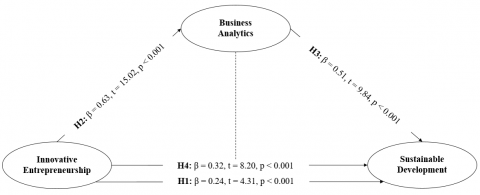
The results of the direct hypothesis testing are provided in Table 7 and Figure 1. As can be seen, the results indicate that IE has a significant positive impact on SD (β = 0.24, t = 4.31, p < 0.001), thus supporting hypothesis 1. Moreover, it is revealed that IE has a strong positive impact on BA (β = 0.63, t = 15.02, p < 0.001), thus supporting hypothesis 2. Furthermore, it is revealed that BA has a significant positive impact on SD (β = 0.51, t = 9.84, p < 0.001), thus supporting hypothesis 3. The statistical significance of the proposed direct relationships aligns with the proposed theory [32]. Bootstrapping confidence intervals also confirmed the statistical significance of the estimated structural paths.
Table 5. Collinearity diagnostics (variance inflation factor (VIF)) and common method bias assessment
|
Construct |
VIF |
|
IE |
2.14 |
|
BA |
2.37 |
Table 6. Structural model predictive power
|
Construct |
R² |
Q² |
|
BA |
0.40 |
0.29 |
|
SD |
0.54 |
0.36 |
Table 7. Path analysis results for direct hypotheses testing
|
Hypothesis |
Path |
β |
T-Value |
P-Value |
Decision |
|
H1 |
IE → SD |
0.24 |
4.31 |
< 0.001 |
Supported |
|
H2 |
IE → BA |
0.63 |
15.02 |
< 0.001 |
Supported |
|
H3 |
BA → SD |
0.51 |
9.84 |
< 0.001 |
Supported |
Figure 1. Mapping of the conceptual structure model
As can be seen, the magnitude of structural paths reveals that the impact of IE on SD is limited compared to the stronger path of BA. This evidence reveals an important role of analytical capabilities in linking entrepreneurial initiatives to sustainability outcomes in higher education institutions.
Effect size (f²) was used to investigate the relative contribution of each exogenous construct to the endogenous constructs. As can be seen in Table 8, IE has a large effect on BA (f² = 0.66), revealing a strong impact of entrepreneurial practices on analytical capabilities in higher education institutions. The impact of IE on SD is found to be limited (f² = 0.07), revealing that entrepreneurial practices alone may not be sufficient to drive sustainability outcomes. However, BA has a moderate impact on SD (f² = 0.35) [31].
Table 8. Effect size (f²)
|
Path |
f² |
Effect Size |
|
IE → BA |
0.66 |
Large |
|
IE → SD |
0.07 |
Small |
|
BA → SD |
0.35 |
Medium |
Table 9. Mediation analysis results
|
Hypothesis |
Effect Type |
Path |
β |
T-Value |
P-Value |
Decision |
|
H4 |
Indirect effect |
IE → BA → SD |
0.32 |
8.20 |
< 0.001 |
Supported |
|
Direct effect |
IE → SD |
0.24 |
4.31 |
< 0.001 |
Supported |
|
|
Total effect |
IE → SD (total) |
0.56 |
12.10 |
< 0.001 |
Supported |
Table 9 shows the findings of the mediation analysis in relation to the mediating effect of BA in linking IE with SD. As depicted in the table above, the indirect effect of IE on SD was statistically significant; therefore, the proposed indirect effect was supported. This is based on the fact that the indirect effect of IE on SD through BA was statistically significant, with β = 0.32 and t = 8.20, p < 0.001. On the other hand, the direct effect of IE on SD was also statistically significant, with β = 0.24, t = 4.31, and p < 0.001. Finally, the total effect of IE on SD was also statistically significant, with β = 0.56, t = 12.10, and p < 0.001. Therefore, the proposed indirect effect was empirically supported by the findings from the structural model generated by the PLS algorithm [32].
Table 10. Model fit indices
|
Fit Index |
Value |
Recommended Threshold |
Interpretation |
|
SRMR |
0.056 |
< 0.080 |
Good fit |
|
NFI |
0.910 |
> 0.900 |
Acceptable fit |
|
RMS_theta |
0.118 |
< 0.120 |
Acceptable/borderline |
Table 10 presents the model fit indices, which are used to test the fit of the model. According to the standardized root mean square residual index, which is 0.056, a lower level is indicated, while the minimum acceptable level is 0.080. Therefore, it is clear that the proposed model has a satisfactory level of fit. It is also clear that the proposed model has a satisfactory level of fit in terms of the normed fit index, as the minimum acceptable level is 0.900, while the index is 0.910. It is also clear that the proposed model has a satisfactory level of fit in terms of the residual covariance, as the minimum acceptable level is 0.120, while the index is 0.118, a lower level [32].
The results of the current study reveal that IE has a positive impact on SD in higher education institutions, which is statistically significant. This finding implies that higher education institutions that encourage the development of creativity, proactiveness, and entrepreneurial initiatives in the university environment can contribute to the improvement of efficiency in the organization, as well as the development of social responsibility and sustainability in the natural environment. IE encourages higher education institutions to develop new concepts, come up with creative solutions to new challenges, and create value through entrepreneurial initiatives [18, 29]. These findings of the current study align with the results of previous studies that highlighted the importance of innovation-oriented entrepreneurship in promoting SD in the organizational environment [16]. The same results about the link between IE and digital entrepreneurship, technological innovation, and sustainable organizational development have been found in other studies [4, 19].
The results of the current study also reveal that there is a strong positive relationship between IE and BA. This finding implies that higher education institutions that exhibit entrepreneurial orientation in the university environment can also exhibit BA in the same environment. Entrepreneurial initiatives often involve uncertainty and strategic risk-taking, which increases the need for reliable data and analytical tools to evaluate opportunities and guide institutional strategies. As a result, creating entrepreneurial programs in universities seems to encourage the use of analytical skills that improve how decisions are made within the institution. This finding agrees with earlier research that shows entrepreneurial orientation and analytical capabilities work together to help organizations innovate and develop strategies [10, 26, 28].
Furthermore, the results reveal that BA has a significant positive impact on SD. This finding highlights the importance of analytical capabilities in enabling universities to monitor performance, allocate resources efficiently, and evaluate the long-term outcomes of institutional initiatives. Higher education institutions that utilize BA are better able to transform institutional data into actionable insights that support sustainability-oriented decision-making processes. By relying on evidence-based strategies, universities can align their operational activities with sustainability objectives and improve institutional performance across economic, social, and environmental dimensions [24, 25]. In this context, BA functions as an important decision-support capability that enables universities to operationalize sustainability strategies more effectively [33]. These findings support previous research showing that analytical skills are becoming increasingly important for helping organizations achieve sustainability and manage their strategies effectively [23].
Finally, the mediation analysis shows that BA is a middleman between IE and SD. This implies that entrepreneurial activities contribute to SD not only through direct innovative activities but also indirectly through the acquisition of BA skills that allow institutions to evaluate and monitor entrepreneurial activities over time. In other words, BA is a translation tool that translates entrepreneurial activities into SD. Universities that use BA skills in decision-making can better link entrepreneurial activities with long-term sustainability goals [5, 10, 34].
The results of the mediation analysis also show that IE influences SD directly, but even more when BA is present. This implies that entrepreneurial activities can contribute to SD individually, but even more when BA are present [28]. In other words, BA is a tool that can inform entrepreneurial activities in a way that makes their contribution to SD even better. We can thus consider BA a critical skill for enhancing the sustainability of entrepreneurial activities in higher education institutions [29]. These results match recent research that highlights how important digital transformation and entrepreneurial systems are for helping institutions run sustainably [21].
The purpose of this research was to explore the relationship that exists between IE and SD in higher education institutions, specifically in the context of the role of BA as a mediator. The research examined the role of IE in promoting sustainability in higher education institutions, specifically in the context of BA among academic staff in Jordanian universities.
The findings of the research revealed that IE and BA work as complementary factors that can promote sustainability in higher education institutions. The findings revealed that IE can promote sustainability in higher education institutions by promoting creativity, opportunity identification, and innovation in the institution, while BA can enhance the sustainability of the innovations that the institutions implement by providing decision-makers in the institutions with the ability to make evidence-based decisions.
Practically speaking, the findings of the research suggest that higher education institutions that seek to enhance sustainability should consider promoting IE initiatives as well as BA capabilities. Although the research's findings are significant, future studies should address their limitations. The limitations of the research include its cross-sectional design, which targeted academic staff in Jordanian higher education institutions and may not be representative of other higher education institutions in different countries.
Future studies can explore the same research relationship in other contexts to help clarify the role of IE in promoting sustainability in higher education institutions. Future studies can also consider the differences in the role of IE across various types of higher education institutions, including public and private institutions, as well as among academic staff with different levels of academic experience.
[1] Barsoum, M.R. (2024). Innovative entrepreneurship "En pointe". The CASE Journal, 21(4): 902-921. https://doi.org/10.1108/tcj-07-2024-0192
[2] Manigandan, R., Raghuram, J.N.V. (2025). Exploring the relationship between entrepreneurial orientation and firm performance in pharmaceutical SMEs: The mediating effect of blockchain technology adoption. International Journal of Work Innovation, 6(2): 111-134. https://doi.org/10.1504/ijwi.2025.145761
[3] Martins de Paiva, E., Rezende da Costa, P. (2024). Intellectual framework for knowledge-intensive innovative entrepreneurship. Journal of International Entrepreneurship, 22(4): 464-494. https://doi.org/10.1007/s10843-024-00351-y
[4] Dana, L.P., Crocco, E., Culasso, F., Giacosa, E. (2023). Mapping the field of digital entrepreneurship: A topic modeling approach. International Entrepreneurship and Management Journal, 20(2): 1011-1045. https://doi.org/10.1007/s11365-023-00926-6
[5] Alarabiat, Y.A., Alayed, H.M., Awamleh, F.T. (2025). Green innovation strategies in achieving corporate sustainable performance through big data analytics. International Journal of Sustainable Development and Planning, 20(2): 751-759. https://doi.org/10.18280/ijsdp.200224
[6] Awamleh, F.T., AL Hawamdeh, H.M., Aldejwi, S.F., Almajali, W.I., Aldalaien, B. (2025). Integrating green logistics and business intelligence models to achieve sustainable development goals. International Journal of Sustainable Development and Planning, 20(11): 4589-4596. https://doi.org/10.18280/ijsdp.201104
[7] Prenzel, P., Bosma, N., Schutjens, V., Stam, E. (2024). Cultural diversity and innovative entrepreneurship. Small Business Economics, 63(4): 1381-1414. https://doi.org/10.1007/s11187-024-00888-1
[8] Basdekidou, V., Papapanagos, H. (2023). Empirical model for estimating sustainable entrepreneurship's growth potential and positive outlook. Baltic Journal of Modern Computing, 11(1): 181-201. https://doi.org/10.22364/bjmc.2023.11.1.11
[9] Neumann, T. (2023). Are greener start-ups of superior quality? The impact of environmental orientation on innovativeness, growth orientation, and international orientation. Journal of Innovation and Entrepreneurship, 12(1): 60. https://doi.org/10.1186/s13731-023-00330-y
[10] Magableh, K.N.Y., Kannan, S., Hmoud, A.Y.R. (2024). Innovation business model: Adoption of blockchain technology and big data analytics. Sustainability, 16(14): 5921. https://doi.org/10.3390/su16145921
[11] Orjatsalo, J., Hussinki, H., Kianto, A. (2026). The role of knowledge-based resources in leveraging business analytics. Knowledge and Process Management, 1-10. https://doi.org/10.1002/kpm.70015
[12] Bustami, A.N., Awamleh, F.T., Al-Momani, A.M. (2025). Leveraging business intelligence and analytics for strategic success in the hospitality industry: Insights from hotels. Journal of Project Management, 10(1): 87-96. https://doi.org/10.5267/j.jpm.2024.10.006
[13] Alayed, H.M., Awamleh, F.T. (2025). Artificial intelligence applications in improving human resources practices: The mediating role of business intelligence tools. Economics, 13(4): 241-256. https://doi.org/10.2478/eoik-2025-0094
[14] Cherniaieva, O., Kulinich, T., Gutsul, T., Korolkov, V., Gubar, O. (2023). Innovative transformations of Ukraine's economy in the context of globalization: Theoretical and analytical aspects. Financial and Credit Activity Problems of Theory and Practice, 1(48): 249-257. https://doi.org/10.55643/fcaptp.1.48.2023.3977
[15] Awamleh, F.T., Alarabiat, Y A., Bustami, A.N. (2024). Enhancing sustainable development through international performance indicators: The role of business intelligence techniques. Challenges in Sustainability, 12(3): 203-218. https://doi.org/10.56578/cis120304
[16] Baiocco, S., Leoni, L., Paniccia, P.M.A. (2023). Entrepreneurship for sustainable development: Co-evolutionary evidence from the tourism sector. Journal of Small Business and Enterprise Development, 30(7): 1521-1546. https://doi.org/10.1108/JSBED-01-2023-0003
[17] Osabohien, R., Imandojemu, K., Jaaffar, A.H. (2025). Clean energy, environmental policy and energy justice as drivers of sustainable development in OECD countries. Scientific Reports, 16(1): 2926. https://doi.org/10.1038/s41598-025-32759-4
[18] Vig, S. (2022). Sustainable development through sustainable entrepreneurship and innovation: A single-case approach. Social Responsibility Journal, 19(7): 1196-1217. https://doi.org/10.1108/SRJ-02-2022-0093
[19] Singh, H., Kumar, P., Dana, L.P. (2025). The green entrepreneurship landscape: Drivers, outcomes, and future directions. International Entrepreneurship and Management Journal, 21(1): 80. https://doi.org/10.1007/s11365-025-01079-4
[20] Matthies, B. (2026). A framework for governing responsibilities in self-service business intelligence & analytics (SSBI&A). Journal of Decision Systems, 35(1): 2603011. https://doi.org/10.1080/12460125.2025.2603011
[21] Kotiranta, A., Puumalainen, K., Sjögren, H., Dana, L.P. (2024). Digitalization as a growth driver for social enterprises. Technological Forecasting and Social Change, 209: 123837. https://doi.org/10.1016/j.techfore.2024.123837
[22] Azubuike, P.C., Uzodimma, E.C., Kanu, P.A., Imo, U.F., Ogbonna, C.K., Akinreni, T., Udofia, M.D., Odo, O.J., Nwadiche, M., Alabi, A.J., Piane, G.M., Ndep, A.O. (2025). A perspective piece on community engagement and buy-in as essential for achieving sustainable development in Nigeria. Discover Sustainability, 7(1): 12. https://doi.org/10.1007/s43621-025-02398-w
[23] Caputo, F., Palazzo, G., Ligorio, L. (2025). Business intelligence in supply chain management: Insights for performance and sustainability. Corporate Social Responsibility and Environmental Management, 33(1): 1446-1464. https://doi.org/10.1002/csr.70239
[24] Blanco-González-Tejero, C., Caño-Marín, E., Ribeiro, B. (2024). Digital innovation towards the sustainable development goals: A mass media analysis. In Digital Entrepreneurship in Science, Technology and Innovation, pp. 225-246. https://doi.org/10.4337/9781035311422.00016
[25] Kowalska-Styczeń, A., Juszczyk, K. (2026). Employer expectations of business analysts: Knowledge and insights from job offer analysis. Journal of Innovation & Knowledge, 11: 100859. https://doi.org/10.1016/j.jik.2025.100859
[26] Abbas, J., Bresciani, S., Subhani, G., De Bernardi, P. (2024). Nexus of ambidexterity and frugal innovation for enhanced ESG performance of entrepreneurial firms. The role of organizational capabilities. International Entrepreneurship and Management Journal, 21(1): 47. https://doi.org/10.1007/s11365-024-01062-5
[27] Almajali, W.I., Awamleh, F.T., Alarabiat, Y.A., Tawalbeh, M. (2025). Business intelligence systems and organization performance the role of competitive advantage as a mediator variable. ECONOMICS, 13(2): 333-349. https://doi.org/10.2478/eoik-2025-0042
[28] Zhanbayev, R.A., Dauletaliyeva, D., Shutaleva, A.V., Beisekova, Z., Irfan, M., Maksimov, D.G., Zhao, T., Abdykadyrkyzy, R. (2025). Modelling relationships between demoethical values and sustainable development using Bayesian networks and foresight. Discover Sustainability, 7(1): 35. https://doi.org/10.1007/s43621-025-02321-3
[29] Pöcher, B., Campbell, D.F.J., Carayannis, E.G. (2025). Innovation and entrepreneurship in organizational university "third space" arrangements: Third space and third mission in mode 3 universities. Journal of Innovation and Entrepreneurship, 15(1): 2. https://doi.org/10.1186/s13731-025-00613-6
[30] Simester, D., Timoshenko, A., Zoumpoulis, S.I. (2025). A sample size calculation for training and certifying targeting policies. Management Science, 71(11): 9503-9522. https://doi.org/10.1287/mnsc.2022.02947
[31] Hair, J.F., Babin, B.J., Ringle, C.M., Sarstedt, M., Becker, J.M. (2025). Covariance-based structural equation modeling (CB-SEM): A SmartPLS 4 software tutorial. Journal of Marketing Analytics, 13(3): 709-724. https://doi.org/10.1057/s41270-025-00414-6
[32] Sarstedt, M., Richter, N.F., Hauff, S., Ringle, C.M. (2024). Combined importance-performance map analysis (cIPMA) in Partial Least Squares Structural Equation Modeling (PLS-SEM): A SmartPLS 4 tutorial. Journal of Marketing Analytics, 12(4): 746-760. https://doi.org/10.1057/s41270-024-00325-y
[33] Altarawneh, A.S., AlAwamleh, H.K., Awamleh, F.T., Bustami, A.N. (2025). Big data backed business intelligence to upthrust commercial banks decision-making processes. International Review of Management and Marketing, 15(2): 180-188. https://doi.org/10.32479/irmm.17709
[34] Garafonova, O., Yankovoi, R., Zhosan, H., Lomachynska, I., Ananiev, M., Dvornyk, I. (2023). International experience in applying innovative financial management strategies for business revitalization in the post-war period in Ukraine. Financial and Credit Activity Problems of Theory and Practice, 6(53): 43-57. https://doi.org/10.55643/fcaptp.6.53.2023.4140