Stivani Ayuning Suwarlan* | Carissa Dinar Aguspriyanti | Lathifa Nursyamsu
© 2025 The authors. This article is published by IIETA and is licensed under the CC BY 4.0 license (http://creativecommons.org/licenses/by/4.0/).
OPEN ACCESS
Traditional coastal settlements in Indonesian islands are among the world’s most climate-vulnerable communities. Although these communities possess adaptive indigenous knowledge to mitigate disaster risks, rapid urbanization and ecological degradation increasingly disrupt their practices, heightening vulnerability. Addressing this challenge is urgent for governments to safeguard resilience under accelerating climate change. This study empirically identifies local disaster-mitigation practices of coastal communities in the Riau Islands and converts them into a prioritized set of adaptive strategies to inform sustainable coastal settlement policy. A mixed-methods design was employed, combining field observations, semi-structured interviews with 48 residents across four traditional coastal settlements, and focus group discussions with local stakeholders and five experts. Thematic analysis was used to triangulate qualitative data and generate adaptive capacity indicators, which were then weighted and prioritized using the Analytic Hierarchy Process. Sixteen adaptive-capacity indicators were identified. Early warning systems emerged as the highest-priority strategy (11.98%), followed by adaptive habitation (9.60%) and accommodative adaptation (8.76%). Social-capital indicators including sense of community and climatic pattern knowledge also ranked highly, highlighting the necessity for integrating indigenous knowledge with institutional support. The findings construct DPSIR-based framework of adaptive strategies, which shows potential for transferability to similar islands upon careful consideration of local socio-ecological conditions.
adaptive strategies, traditional coastal settlement resilience, climate-related disaster mitigation, DPSIR framework, coastal communities
The Djuanda Declaration in 1957 initially declared the Republic of Indonesia officially as an archipelagic state, a country comprising numerous islands and scattered isles. Indonesia is home to approximately 17,500 islands and 300 ethnic groups, many of whom belong to traditional communities living in coastal areas. Coastal settlements across the islands form an essential social-ecological system, rich in biodiversity and cultural heritage. However, climate change presents a serious challenge to long-term sustainability, particularly for settlements located along the coast or at the outermost parts of islands, which are considered high-risk, disaster-prone areas.
According to projections by the Intergovernmental Panel on Climate Change (IPCC), sea level rise is anticipated to range from 0.63 to 1.01 meters by the year 2100 [1], posing existential threats to coastal populations, especially those residing on low-lying islands [2-4]. The phenomena of coastal erosion, saltwater intrusion, elevated sea levels, and intensified storm surges driven by extreme weather conditions jeopardize physical infrastructure and exacerbate socio-economic instability, particularly in archipelagic states such as Indonesia, Philippines, Maldives, the Southeast Asian states and the microstates of Micronesia and Polynesia [4, 5]. The adverse effects of climate change resulting from these challenges include local and global environmental degradation, loss of arable land due to salinization, and the deterioration of marine and coastal ecosystems [6].
Although the global hazards posed by climate change are daunting and hinder the pursuit of sustainability, many traditional coastal communities have historically demonstrated adaptive resilience through indigenous knowledge systems [6-8], including the construction of stilt or elevated houses, the implementation of tidal agriculture, and the conservation of mangroves. However, the impacts of globalization, rapid urbanization, and infrastructural modernization have disrupted these indigenous adaptive strategies, necessitating new approaches that blend local wisdom with scientific innovations to enhance resilience. Moreover, the sequential phenomena of industrialization have inflicted significant environmental impacts, including increased greenhouse gas emissions, alterations in climatic conditions, changes in land use patterns, declines in public health and quality of life, and widespread environmental degradation [9-11]. If these issues are not adequately addressed, they pose risks not only to the sustainability and quality of life of current communities but also to the erosion of their cultural identity and indigenous practices [1].
While there have been numerous studies in Indonesia exploring indigenous knowledge and climate adaptation in regions such as Aceh, Bali, Lingga, and Sulawesi, there is still a notable lack of research focused specifically on climate risks and comprehensive assessments that integrate indigenous knowledge into prioritized adaptive strategies for vulnerable coastal communities on the islands of Indonesia [12-14]. This gap hinders the evidence base necessary for effective policy-making in these susceptible areas.
Moreover, the Meteorology, Climatology, and Geophysical Agency recently indicated that potential coastal flooding events are predicted for the coastal regions of the Riau Islands, reflecting the significant impacts of climate change experienced by most Indonesian provinces over the past three decades [15]. Although various disaster risk reduction strategies have been proposed by the National Agency for Disaster Management, there is a conspicuous absence of adaptation approaches informed by local indigenous knowledge, suggesting a predominant reliance on modernized methods distributed uniformly across Indonesian provinces.
The existing literature predominantly employs qualitative and ethnographic methodologies to explore island or coastal communities within the Indonesian Archipelago. However, while studies regarding the Riau Islands exist, they often focus on a singular regency and a specific ethnic group, thereby limiting the generalizability of findings to represent the entirety of the Riau Islands. This study seeks to address these gaps by exploring the understudied traditional coastal settlements in the Riau Islands, empirically investigating their current coping mechanisms in mitigating disaster-related risks, and proposing these strategies to local governments as potential adaptive measures for enhancing the resilience of traditional coastal settlements.
2.1 Climate-related risks and vulnerability in coastal communities
Coastal regions are rich in natural resources, which serve as critical assets for the survival and livelihoods of local communities. The primary occupations of individuals in these areas typically include land and livestock farming, aquaculture, fishing, and various roles in retail or employment sectors [6, 16, 17]. However, the abundance of resources is juxtaposed with significant climate-related hazards that threaten the sustainability of these communities.
In the context of climate change, vulnerability refers to the degree to which both human populations and the surrounding environment are susceptible to hazards, coupled with a lack of effective coping mechanisms for adaptation to the evolving environmental conditions [18, 19]. Vulnerability within coastal communities is multifaceted, encompassing various indicators that can be systematically identified and assessed. Fundamentally, it consists of three major components: physical, socioeconomic, and ecological aspects [19].
The impacts of climate change exacerbate the frequency and intensity of coastal hazards such as flooding, storm surges, and erosion, resulting in substantial damage to infrastructure and land use, which are vital for community survival. Furthermore, poor governance characterized by inadequate infrastructure and insufficient institutional support alongside challenging socioeconomic conditions, including poverty and limited income sources, acts as an external factor that amplify the vulnerabilities of individuals and communities [20-22]. This deterioration in socio-economic conditions further erodes the quality of life, thereby heightening community vulnerability.
Additionally, the cultural identity of these communities, comprising both tangible assets and intangible elements, faces significant threats as climate-induced natural hazards become increasingly severe. This disruption can adversely affect traditional ways of life and cultural practices [23]. If these challenges remain unaddressed, the long-term ramifications for coastal communities may include loss of livelihoods, displacement, and erosion of cultural heritage, all of which pose serious threats to their existence.
2.2 Resilience in insular coastal settlement against climatic hazards
Coastal communities, particularly those situated on low-lying islands, face significant vulnerabilities to natural hazards predominantly originating from marine environments. This heightened risk is exemplified by the gradual rise in sea levels, which poses existential threats to such populations [2, 3, 24]. To address these climatic challenges, the concept of resilience emerges as a crucial societal framework, designed to minimize vulnerabilities and ensure that communities can sustain their livelihoods using locally available resources in the face of climate-induced natural hazards [18, 25].
In contrast to large coastal cities that often harness advanced scientific knowledge and technology to bolster their resilience, local communities in traditional coastal settlement exhibit greater vulnerability, coupled with limited institutional support to counteract similar threats [26]. However, it is noteworthy that these high-risk communities possess an innate capacity for adaptation, largely derived from traditional techniques and knowledge that have been cultivated over centuries [8, 27].
The observations noted emphasize that resilience functions as a systemic societal construct aimed at diminishing the disaster risks associated with climate change [28, 29]. As with vulnerability, resilience within coastal communities encompasses various indicators that can be classified into four overarching dimensions: societal and economic factors, environmental and climate considerations, infrastructural elements, and governance and institutional frameworks [29]. Dronkers and colleagues, through IPCC in 1990, proposed an adaptive response strategy specifically designed to assist coastal communities in effectively addressing the challenges posed by rising sea levels [30]. This strategy encompasses three primary categories: accommodation, protection, and retreat, as illustrated in Figure 1. In the context of human settlement, accommodation refers to enhancing existing structural elements to mitigate risks associated with climate-driven hazards; protection involves the implementation of supplementary structural measures to alleviate these risks; while retreat signifies the abandonment or relocation from vulnerable zones to minimize exposure to hazards.
Figure 1. Accommodation, protection and retreat visualised in the coastal environmental settings [30]
In summary, conceptualizing resilience as a multidimensional construct which integrates socio-economic, environmental, infrastructural, and governance dimensions provides a systematic basis for reducing vulnerability and enhancing adaptive capacity. Proposed by Dronkers and colleagues [30], the strategy comprising accommodation, protection, and retreat offers a robust and transferable model for sustaining livelihoods and ensuring the long-term viability of both modern and traditional coastal settlements in addressing the global challenges posed by climate change.
2.3 Indigenous knowledge as a coastal adaptation approach
Urbanization and industrialization are accelerating climate change, significantly affecting vulnerable coastal communities [3, 10, 19]. Despite government efforts and disaster risk reduction strategies, many traditional groups within these communities continue to rely on their indigenous knowledge to adapt to worsening climatic conditions. This persistence is partly due to the lack of tangible benefits from government initiatives, which often fail to provide necessary disaster preparedness infrastructure [6, 16, 31].
Indigenous knowledge and practices vary significantly by geography, influenced by local topographies and environmental conditions [6]. For instance, in coastal areas, inhabitants often build homes on elevated terrain to reduce flooding risk [8, 17]. Agricultural practitioners place their farms on higher ground to avoid saline intrusion, while aquaculture farmers use nets to protect fish farms from floodwaters [17, 32]. Additionally, coastal communities employ their indigenous knowledge to develop salt-tolerant cultivars, creating localized solutions to environmental challenges [6, 27]. The socio-cultural elements exhibited by local communities may vary based on settlement locations [33] and can be integral to the indigenous knowledge systems that facilitate adaptation to coastal settings [14]. Examples include spiritual rituals during coastal flooding [34], communal prayers for protection from hazards [14, 27], and the forecasting of seasonal changes or coastal threats based on experiential climatic patterns [6, 12, 17, 27] and culture-specific cosmic or astrological calendar [14, 35]. Additionally, strong kinship bonds and communal ties enhance resilience against climate change adversities [6, 27, 33].
These practices exemplify the adaptive and resilient nature of indigenous knowledge and traditions in the face of climate change. Historically, these distinct traditional practices have been maintained for generations, either as spontaneous responses to environmental challenges or as expressions of spiritual adherence to ancestral beliefs and claims. However, the alarming acceleration of climate change poses increasingly severe challenges to their habitats, compelling communities to adopt modern technologies, which may inadvertently lead to a loss of cultural identity and sense of belonging [36].
In summary, both technical and social practices derived from indigenous knowledge offer valuable adaptive and resilient strategies against climate change. By integrating these traditional practices with modern scientific technologies, there exists the potential to significantly enhance the capacity for mitigating climate-related hazards and to develop inclusive adaptation strategies specifically aimed at traditional coastal communities, which are among the most vulnerable to climate change impacts [8, 37]. Furthermore, a multifaceted approach to alleviating the adverse effects of climate change not only bolsters community resilience but also serves to protect and promote their cultural heritage and identity [38, 39].
2.4 Risk and vulnerability assessment
Risk refers to the probability of adverse events affecting individuals or entities, manifesting universally or specifically, and can be frequent or episodic. It often relates to negative consequences, such as losses and damages suffered by vulnerable communities due to catastrophic events, especially those caused by climate change. The United Nations Office for Disaster Risk Reduction (UNISDR) succinctly encapsulates this relationship through the equation: “Risk = Hazard × Vulnerability” [40]. Vulnerability, as it pertains to existing settlements and their populations, is intricately connected to exposure, sensitivity, and adaptive capacity, as highlighted by the Intergovernmental Panel on Climate Change (IPCC) [1]. Furthermore, adaptive capacity is closely tied to resilience, which refers to the societal mechanisms employed to address risks stemming from hazards. This is characterized by the dynamic interplay between the impacts experienced during an event or in its aftermath, coping strategies, and long-term adaptive adjustments [18, 39].
Many studies focus on risk and vulnerability assessments in coastal environments, considering various variables based on different methodologies. A key approach is the Coastal Vulnerability Index (CVI) [41], a methodological framework introduced by Gornitz in 1991, which remains one of the most widely adopted methods in coastal risk assessments. The CVI encompasses seven fundamental coastal parameters: coastal relief (land elevation), coastal geomorphology (landform and topographic features), tidal range, wave height, shoreline displacement or change rate, relative sea-level rise, and coastal land subsidence. Another significant model is the Driver-Pressure-State-Impact-Response (DPSIR) framework, proposed by the European Environment Agency in 1999 [42]. The DPSIR framework is particularly effective for identifying climate-induced environmental challenges and devising adaptive responses, especially pertinent for communities situated in vulnerable contexts [43]. It is noteworthy that a key distinction between the CVI and DPSIR frameworks lies in their methodological orientations: CVI predominantly employs a quantitative approach, whereas DPSIR generally adopts a qualitative lens.
This study employs an exploratory research design grounded in a post-positivistic paradigm, which facilitates an objective examination of natural phenomena through the lens of empirical findings and precise measurements [44, 45]. The research framework integrates both qualitative and quantitative methodologies. Specifically, a qualitative descriptive approach is adopted to elucidate the current mitigation strategies employed by communities in response to various disaster-related phenomena. Simultaneously, the quantitative aspect includes spatial data collected using a GIS-based risk assessment approach, along with the application of multi-criteria decision-making technique known as the Analytic Hierarchy Process (AHP) [46].
Data collection for this research involves a combination of fieldwork observation, semi-structured interviews, and archival research methodologies to gather both primary and secondary data. The study focuses on four traditional coastal settlement within the Riau Islands, selected as case studies for observation and for conducting interviews with residents. The chosen settlements include Batu Besar and Batu Merah on Batam Island, Buluh on Buluh Island, and Malang Rapat on Bintan Island. Field observations and interviews were executed to scrutinize the phenomena present at the research sites under current conditions, thereby obtaining comprehensive and empirical qualitative data. Outcomes from these observations and interviews will be subjected to triangulation via thematic analysis to discern prominent keywords that signify key elements or criteria contributing to the resilience of coastal settlements [47].
For data analysis, ATLAS.ti software was employed, and subsequent criteria will be validated through AHP analysis. The AHP paradigm necessitates the solicitation of expert opinions from professionals during the focus group discussions (FGDs). This step is imperative to mitigate biases and subjectivities and to quantitatively assess the criteria of highest priority, which will be instrumental in formulating recommendations for local adaptive strategies. During the expert judgment phase, professionals will evaluate the provided criteria and their pairwise comparisons using AHP scale, which ranges from 1 to 9, namely: 1 = Equal importance, 3 = Moderate importance, 5 = Strong importance, 7 = Very vital importance, and 9=Extreme importance with 2, 4, 6 and 8 representing in-between values.
The AHP measurement process in this research is conducted with the involvement of five experts in architecture, urban planning, and disaster management. Selection criteria for experts in this research require a minimum of 20 years of professional experience in these disciplines, ensuring credible and reliable results [48].
The number is within the commonly accepted range of three to seven experts for multi-criteria decision-making, striking a balance between diverse expertise and manageable pairwise comparisons. Subsequently, the aggregated judgments resulted in a consistency ratio (CR) of 0.0946 (≤ 0.1), indicating an acceptable level of reliability in the findings.
4.1 GIS-based climate change risk assessment in coastal settlements
4.1.1 Hazard, adaptive capacity, and vulnerability assessments
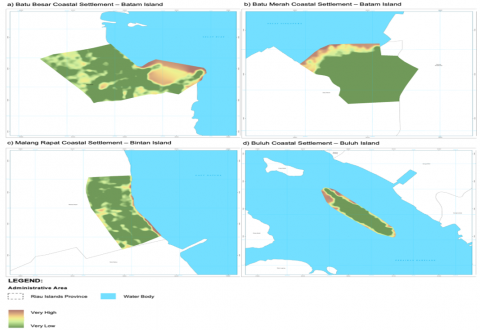
To comprehensively assess risk and develop associated cartographic representations, it is imperative to evaluate the impacts of hazards on traditional coastal settlements, as well as their inherent vulnerabilities and adaptive capacities. Interviews conducted within these communities indicate the prevalence of various natural hazards, including storm surges (typically occurring with low intensity), flash floods (attributable to heavy rainfall), and coastal flooding (which, despite its periodic nature, poses the most significant threat). Figure 2 illustrates hazard mapping of selected traditional coastal settlements within the Riau Islands of Indonesia, specifically Batu Besar, Batam island (a), Batu Merah, Batam island (b), Malang Rapat, Bintan island (c), and Buluh, Buluh island (d).
Figure 2. Hazard maps of traditional coastal settlements
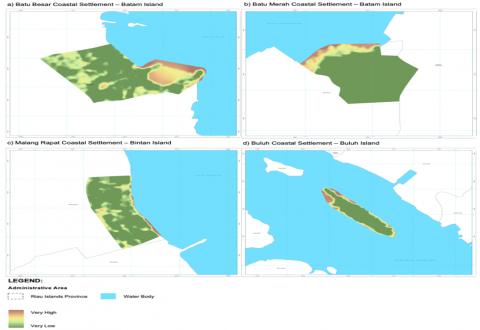
Figures 3 and 4 highlight the adaptive capacities and vulnerability of coastal communities in these traditional settlements concerning disaster events, with red shading indicating higher risk areas and green representing safer zones. The maps also use green and red tones to distinguish between resilient and vulnerable categories. Analysis shows that clusters in Batu Merah and Buluh are particularly vulnerable due to their location closer to shorelines, making them more susceptible to coastal flooding and erosion from tidal waves. Despite these challenges, communities have developed adaptive capacities through local initiatives and government support as seen in Table 1, resulting in improved risk-reducing infrastructure and social assets.
Figure 3. Adaptive capacity maps of traditional coastal settlements
Figure 4. Vulnerability maps of traditional coastal settlements
Table 1. Observational data on local adaptive capacities
|
Forms / Elements |
Criteria |
|
On-ground houses Houses are structurally permanent |
Permanent habitation |
|
On-stilt houses Houses are structurally semi-permanent |
Adaptive habitation |
|
Houses and residential platforms were built elevated |
Accommodative adaptation |
|
A house utilizes tires around the land boundaries Seawall exists along the shore |
Protective adaptation |
|
Mangrove trees grow in certain areas along the shore; some of them were found damaged Wild grasses and fruit trees are plentiful around the settlement |
Ecological preservation; Ecological conservation; Protective adaptation |
|
Abundance of public and semi-public buildings, as well as open spaces to accommodate daily societal needs |
Infrastructural facilities; Public spaces |
4.1.2 Risk assessment
Mitigating damage from natural disasters requires societal capacities that enable communities to respond effectively. Key elements, particularly health-related infrastructure, enhance adaptive capacity and resilience, reducing risks associated with climate-related challenges.
Figure 5 delineates the potential risks facing each coastal settlement when confronted with natural hazards that may escalate into local disasters. While Batu Merah and Buluh are identified as more vulnerable due to their proximity to the open sea, it is noteworthy that these areas possess a significant number of public or semi-public structures that could be repurposed as temporary evacuation centers, ultimately augmenting community resilience. However, the pronounced red shading within the risk maps underscores the insufficient presence of risk-reducing physical infrastructures, such as mangroves and seawalls, along with a sizeable population directly impacted by climatic changes. Governmental authorities must prioritize addressing these critical issues to safeguard the welfare of residents within these coastal settlements.
Figure 5. Risk maps of traditional coastal settlements
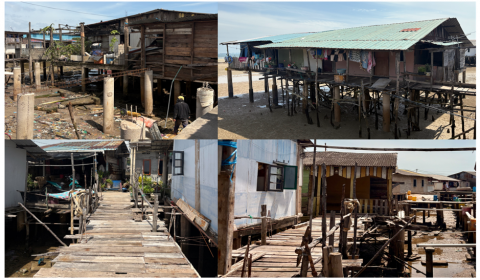
Moreover, it is noteworthy that a significant proportion of residences, irrespective of their proximity to the shoreline, are constructed using ephemeral materials such as fiber boards for wall construction, wooden planks for flooring, and wooden poles as structural supports (see Figure 6). In terms of recent coastal resilience measures, there exists an abundance of vegetation, particularly mangrove trees, in certain traditional coastal settlements. However, Batu Merah traditional coastal settlement is characterized by a marked scarcity or total absence of such vegetation and mangrove forests.
Figure 6. Condition of houses in selected coastal settlements
In addition to these structural considerations, various households have implemented the strategic use of tires around their properties, which may function as protective barriers during flooding events, effectively helping to contain debris transported by aquatic currents. The field survey also highlighted the presence of non-residential structures. Among the four settlements analyzed, only two are equipped with nearby community health centers, necessitating that residents of the remaining two settlements travel considerable distances to access healthcare services in the event of injury during disasters.
Furthermore, the presence of numerous public infrastructures, including educational facilities, places of worship, and multipurpose halls, as well as open spaces that can be utilized as gathering or evacuation points, exemplifies the architectural and planning strategies employed to enhance disaster resilience within these communities. These observations underscore the critical intersection of architectural design and community planning in fostering resilience against natural hazards.
4.1.2 Interview data analysis
Semi-structured interviews were conducted with 48 residents from four traditional coastal settlements in the Riau Islands, Indonesia: Malang Rapat, Batu Merah, Batu Besar, and Buluh. Each settlement contributed approximately 12 participants, aged between 21 and 72, representing a variety of occupations, including housewives, fishermen, and laborers. This interview phase followed an initial round of direct observation in each settlement, which informed the development of context-specific questions. Unlike the analysis of observational findings, this interview data analysis specifically focuses on the dimension of adaptive capacity, with particular attention to the role of indigenous knowledge in shaping community responses. This emphasis is crucial for uncovering and understanding the locally rooted coping mechanisms employed by the communities to mitigate the impacts of disasters. Examples include the use of traditional stilt-house architecture, which can be elevated to adapt to rising sea levels, and the inherited wisdom of interpreting natural signs and climatic patterns as early warning indicators.
Some settlements maintain abundant mangrove vegetation, though Batu Merah is notable for its scarcity. Additionally, residents strategically utilize tires as protective barriers during floods to manage debris.
Table 2. Locals’ coping mechanisms interview data
|
Coping Mechanisms |
Criteria |
|
Help the nearest, most at-risk neighbours in evacuating to the safe place Cleans up surrounding settlement after the disaster Prepare themselves whenever the potential disaster is approaching (relocating goods, evacuating, and so on) Remain in their residence despite the surrounding environment getting more intense |
Sense of community; Individual awareness; Community resilience |
|
Houses nowadays were constructed with permanent structural design Several houses constructed along the shores are semi-permanent in structure |
Permanent habitation; Adaptive habitation |
|
Hoping local government to install and/or widen the greywater drainage canals Hoping local government to construct seawalls Hoping disaster-related agency to provide disaster mitigation physical gears (inflatable boats, warning sirens, and so on) Hoping disaster-related agency to be more responsive to help or rescue affected communities |
Government physical assistance; Government engagement |
|
Experience and memorize how natural hazards work seasonally Receive information on potential hazards or impending disasters |
Climatic pattern knowledge; Early warning system |
|
Preserves tree or plant endangered by climate-induced hazards Replanting mangroves for coastal-related disaster risk reduction |
Ecological preservation; Ecological conservation |
|
Searching alternative jobs because their main livelihood is disrupted by climatic impacts in specific months |
Job availability |
Table 2 outlines the actions that local communities have undertaken or should take before, during, and after a disaster in their area. The interview results indicate that these communities frequently encounter natural disasters. As a result of the recurrent nature of these disasters, residents have learned to recognize patterns in climate variations, which aids them in predicting and preparing for similar hazards in the future. Locally, this pattern is referred to as musim angin utara or the north wind season, which typically occurs from December through February or March. During this period, maritime conditions can become quite perilous, compelling fishermen to pause their activities and heightening the risk of disastrous climatic events for nearby settlements.
If a potential disaster is detected, early warning information from BNPB or related disaster agencies will be communicated to neighborhood heads, who will then relay this information to residents through social media group chats. This strategy is further enhanced by the establishment of a temporary community task force dedicated to assisting with the rescue and evacuation of affected individuals, prioritizing those most at risk, such as the elderly. Once the immediate impacts of the hazard have subsided, the community engages in collective cleaning efforts in their settlement, embodying the spirit of gotong royong, a local term for cooperation.
In terms of vegetation, Buluh still maintains a healthy mangrove forest according to observations. However, representatives from Batu Besar report a decline in mangrove trees, attributed to logging for the development of beaches and commercial properties related to tourism. The other two settlements exhibit the least growth of mangrove trees in their vicinity. Community representatives advocate for the replanting of mangroves, emphasizing their potential to naturally and traditionally mitigate the impacts of disasters.
4.2 Adaptive capacity of the coastal traditional community
The adaptation initiatives to climate change among coastal traditional communities generally manifest through the interplay of human capital, social capital, and physical assets. Within the scope of this study, human capital is characterized by the community's collective knowledge regarding climate change and environmental sensitivity, as well as their competencies in spatial adaptation concerning their residential environments. Physical assets encompass essential facilities and public spaces, augmented by government-funded infrastructures designed to mitigate risks posed by ongoing disasters. The adaptive capacity of these communities is further bolstered by social capital, which includes the involvement of institutions be they governmental or local organizations in disseminating early warning information and providing counseling on disaster mitigation strategies to local populations.
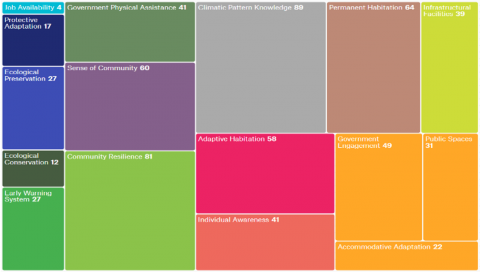
Figure 7 delineates the frequency of keywords derived from a comprehensive analysis of data gathered through 48 interviews and four targeted field observations. These keywords signify the potential criteria for adaptive capacity that are commonly practiced by local communities residing in traditional coastal settlements within the Riau Islands. Notably, the construction of houses utilizing permanent and adaptive architectural designs emerges as a salient element from the real-time data collection. Observational findings affirm that settlement planning reflected in building designs, ecological restoration efforts (such as preservation and conservation), and institutional support (both physical and non-physical) plays a pivotal role in enhancing the resilience of existing settlements against climatic fluctuations, particularly those situated in coastal areas.
Figure 7. Adaptive capacity tree map
Conversely, interviews conducted with residents regarding their response strategies during natural disasters revealed that a strong sense of community, individual awareness and a determined inclination to remain in their residences are the most frequently cited factors. These elements underscore the significance of communal-scale social capital in fostering the community’s resilience.
Table 3. Indicators of adaptive capacity
|
No. |
Indicators |
Key References |
|
1 |
Permanent habitation |
[20, 49] |
|
2 |
Adaptive habitation |
[20, 49] |
|
3 |
Accommodative adaptation |
[17, 49, 50] |
|
4 |
Protective adaptation |
[17, 20, 50] |
|
5 |
Ecological preservation |
[20] |
|
6 |
Ecological conservation |
[20, 51, 52] |
|
7 |
Infrastructural facilities |
[50, 51] |
|
8 |
Public spaces |
[53] |
|
9 |
Sense of community |
[20, 50, 51, 53] |
|
10 |
Individual awareness |
[20, 51, 53] |
|
11 |
Community resilience |
[50, 51, 53] |
|
12 |
Climatic pattern knowledge |
[17, 20, 50, 51] |
|
13 |
Job availability |
[20, 50-52] |
|
14 |
Government engagement |
[20, 50, 51, 53] |
|
15 |
Government physical assistance |
[20, 50, 51] |
|
16 |
Early warning system |
[20] |
The adaptive capacity of local communities inhabiting coastal settlements was empirically assessed through the aforementioned observational and interview phases. By triangulating the collected observational and interview data via thematic analysis, 16 indicators of adaptive capacity were identified, as outlined in Table 3. These indicators will subsequently serve as criteria for evaluation through the Analytical Hierarchy Process (AHP) analysis.
4.3 Local adaptive strategies for coastal community and settlement resilience
The indicators of adaptive capacity have been meticulously identified for analysis. The Analytic Hierarchy Process (AHP) was employed, engaging a panel of five experts to prioritize these indicators effectively. The identified indicators are coded as follows: 1 = Permanent habitation; 2 = Adaptive habitation; 3 = Accommodative adaptation; 4 = Protective adaptation; 5 = Ecological preservation; 6 = Ecological conservation; 7 = Infrastructural facilities; 8 = Public spaces; 9 = Sense of community; 10 = Individual awareness; 11 = Community resilience; 12 = Climatic pattern knowledge; 13 = Job availability; 14 = Government engagement; 15 = Government physical assistance; and 16 = Early warning system.
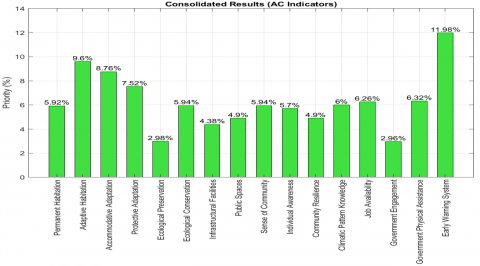
As noted, the 16 generated indicators will undergo rigorous pairwise comparisons, resulting in 120 evaluations aimed at establishing the relative priority of each indicator based on the experts' assessments. Figure 8 illustrates the mean outcomes of the AHP results with a principal eigenvalue (λ) of 18.2694 and a consistency ratio (CR) of 9.46% (0.0946). Notably, a CR value of ≤ 0.1 or 10% indicates that the judgments made are consistent, validating their acceptability for subsequent analyses. Once expert judgments have been rendered and deemed consistent, weight values for each parameter will be computed to determine the highest priorities. The results of this computation are detailed in Table 4.
Figure 8. AHP results
Table 4. Priority of adaptive capacity indicators
|
No. |
Criteria (Indicators) |
Weight (Priority) |
|
1 |
Permanent habitation |
5.92% |
|
2 |
Adaptive habitation |
9.60% |
|
3 |
Accommodative adaptation |
8.76% |
|
4 |
Protective adaptation |
7.52% |
|
5 |
Ecological preservation |
2.98% |
|
6 |
Ecological conservation |
5.94% |
|
7 |
Infrastructural facilities |
4.38% |
|
8 |
Public spaces |
4.90% |
|
9 |
Sense of community |
5.94% |
|
10 |
Individual awareness |
5.70% |
|
11 |
Community resilience |
4.90% |
|
12 |
Climatic pattern knowledge |
6.00% |
|
13 |
Job availability |
6.26% |
|
14 |
Government engagement |
2.96% |
|
15 |
Government physical assistance |
6.32% |
|
16 |
Early warning system |
11.98% |
Table 4 outlines the weights assigned to each criterion, thereby facilitating a comprehensive understanding of the priority strength in the context of adaptive capacity indicators. The results of the priority calculation indicate that the early warning system is regarded as the most crucial indicator for implementing strategies tailored to the needs of traditional communities inhabiting coastal regions. Conversely, government engagement emerges as the least significant indicator. The low priority value of it reflects two interconnected factors, namely the community’s long-standing reliance on internal social capital and self-organized coping mechanisms, and the perception that government involvement tends to be reactive and limited to post-disaster assistance rather than continuous engagement. These findings align with interview data showing that residents often depend more on communal support networks than institutional presence during disaster events.
While all aspects or indicators should be considered, it is essential to identify relevant indicators within a context-specific framework to guide prioritization efforts for communities. The Analytic Hierarchy Process (AHP) has been rigorously applied to minimize biases, allowing for the extraction of the ten most critical indicators from a total of sixteen. This focuses on the development of adaptive strategies for these communities.
Table 5. Adaptive strategy priority strength
|
Strategies |
Priority |
Rank |
|
Early warning system |
11.98% |
1 |
|
Adaptive habitation |
9.60% |
2 |
|
Accommodative adaptation |
8.76% |
3 |
|
Protective adaptation |
7.52% |
4 |
|
Government physical assistance |
6.32% |
5 |
|
Job availability |
6.26% |
6 |
|
Climatic pattern knowledge |
6.00% |
7 |
|
Ecological conservation |
5.94% |
8 |
|
Sense of community |
5.94% |
9 |
|
Permanent habitation |
5.92% |
10 |
Table 5 outlines the ten adaptive capacity indicators that have been prioritized for developing effective strategies to enhance the resilience of traditional coastal settlements. The early warning system emerges as the most crucial strategy for adapting to disaster-prone environments, particularly in coastal regions. This system can be efficiently implemented by disseminating precautionary announcements from relevant agencies to local communities through various channels, including online news platforms, social media group chats, megaphones, and direct interpersonal communication [20].
The adaptive capacity of architecture involves two key indicators: adaptive habitation and permanent habitation. Coastal houses are particularly vulnerable to climate impacts, leading to the deterioration of specific architectural features. To address this, a semi-permanent architectural approach using modular components is recommended for easy repairs. In contrast, permanent habitation relies on durable materials but is often located farther from the coast, indicating a retreat response rather than true adaptability. Collaboration between local communities and government entities is essential to promote adaptive strategies, especially as coastal climates grow more hostile over time.
The other two are adaptation responses within traditional coastal communities, encompassing structural approaches manifested through accommodation and protection. Accommodative adaptation, characterized as an adaptive strategy predominantly employed by local inhabitants, entails the structural renovation exemplified by the construction of stilted buildings. Conversely, the protective adaptation strategy involves the implementation of external infrastructures, such as the installation of seawalls (a man-made intervention) and the reforestation of mangroves (a natural and traditional practice). Both accommodative and protective responses play a pivotal role in mitigating the impacts of disasters, particularly in terms of preventing floodwater ingress into homes and alleviating the detrimental effects of tidal waves, including structural erosion and property damage, as underscored by the findings of this study.
While traditional communities demonstrate resilience through long-standing practices, enhancing adaptive capacity necessitates robust institutional support. Governmental assistance is a critical component in the effective deployment of adaptive strategies. The support should predominantly focus on the establishment of risk-reducing and essential facilities, as there exists a plethora of public spaces that could be repurposed as disaster shelters for those affected by disasters [53]. Within a coastal geographical context, risk-reducing facilities may consist of seawalls and the provision of disaster preparedness equipment, including inflatable boats, first aid kits, emergency rations, and other pertinent emergency apparatus. In tandem, critical facilities would encompass community health centers and evacuation shelters.
Furthermore, ecological restoration emerges as a fundamental approach in operationalizing a resilient social-ecological system. To ensure the sustainability of coastal settlements, it is imperative to encourage the conservation of locally available ecological resources. The preceding analysis posits ecological conservation as a more significant adaptive strategy than mere ecological preservation. This emphasis arises from the understanding that ecological conservation not only promotes the safeguarding of existing natural resources but also fosters the utilization of these resources to stabilize ecosystem services and mitigate disastrous impacts on settlements. Strategies such as sustainable agricultural practices and mangrove reforestation exemplify this duality of conservation and active resource management [20, 51, 52].
Job availability serves as a critical indicator in the implementation of adaptive strategies for traditional coastal communities. It is widely recognized that the rate of climate change is escalating over time, resulting in increasingly hostile environmental conditions. This climatic extremity significantly undermines the economic activities of community members, particularly affecting fishermen in coastal regions who face disruptions from December to February due to intense tidal waves. Potential adaptive solutions to these challenges include cultivating crops within residential zones and pursuing alternative sources of income, such as labor, trade, or employment related to tourism, irrespective of gender [51, 52]. However, for these solutions to be effectively realized, responsive cooperation between communities, especially affected individuals and relevant stakeholders, is essential to ensure knowledge mastery and job availability.
The emphasis on understanding climatic patterns as a high-priority adaptive strategy for enhancing the resilience of coastal settlements underscores the importance of knowledge in identifying and predicting natural hazards. Findings from this study indicate that coastal communities possess an intimate understanding of the climatic patterns of their environment, locally referring to the seasonal phenomenon of rising sea levels as musim angin utara, which typically occurs from early December to late February. In coastal settlements that are geographically isolated from urban centers and subject to minimal institutional oversight, it is imperative to preserve and transmit this local knowledge to younger generations. Such preservation is critical for ensuring their safety through early disaster mitigation preparations, particularly for vulnerable groups such as fishermen and the elderly.
Moreover, the sense of community constitutes an essential adaptive strategy linked to social capital. Interview outcomes reveal that coastal communities exhibit robust communal relationships before, during, and after disasters. For example, neighbors help one another evacuate during natural hazards, assist in relocation during coastal flooding, and engage in collective clean-up efforts following disasters. This high-priority indicator aligns with several global studies that emphasize the significance of social capital in shaping the resilience of both settlements and their communities [50, 51, 53]. Accordingly, the government must prioritize the social capital of existing coastal settlements to enhance their resilience and strengthen the relationships between local communities and governing bodies.
Figure 9 illustrates the causal relationships associated with challenges faced by selected traditional coastal settlements through the DPSIR (Driving Forces-Pressures-State-Impacts-Responses). In summary, climate change is an ongoing phenomenon characterized by an accelerating rate of impacts. Many of the selected traditional coastal settlements are deficient in physical infrastructure and assets necessary for mitigating disaster risks. Furthermore, community representatives have indicated that mangrove deforestation has occurred during the developmental phases of these settlements, thereby undermining regional biodiversity and diminishing both community and settlement resilience.
Figure 9. DPSIR framework as adaptive strategy of traditional coastal settlements
To address these complex challenges, affected communities and local governments need to implement adaptive strategies. Strengthening cohesive social relationships, along with other adaptive measures such as the integration of collective knowledge, technological innovations, sustainable ecological conservation practices, and timely notifications from relevant governmental agencies regarding potential natural hazards, will significantly enhance local adaptability to the coastal environment. This enhancement is vital, given the intrinsic risks associated with residing in such vulnerable areas.
The findings underscore the profound and imminent threats posed by climate change to societies globally, with particular emphasis on traditional coastal settlements. These communities demonstrate a remarkable capacity to utilize indigenous knowledge to mitigate the adverse effects of climatic shifts. While they have relied on traditional practices for generations, it is evident that a significant number of these communities are increasingly integrating contemporary scientific knowledge and technologies with their traditional frameworks. This integration enhances both individual and communal resilience, bolstering the stability of their settlements and the surrounding coastal ecosystems.
This study highlights that communities in traditional coastal settlements of the Riau Islands, Indonesia, are integrating modern technology into their practices and showing robust social networks and collective action against disaster risks. However, insufficient institutional support and ongoing mangrove deforestation threaten their resilience. To tackle these challenges, the authors have developed a climate change-related DPSIR framework that serves as an adaptive strategy for local or regional authorities. The framework aims to enhance the resilience of existing traditional coastal settlements.
In summary, governmental bodies must focus on addressing these specific challenges with tailored strategies that are suitable for coastal environments, thereby ensuring the long-term resilience of these settlements. The proposed adaptive strategies include: the establishment of an early warning system, adaptive habitation designs, both permanent and flexible retreat strategies, government-assisted infrastructure development, enhanced job opportunities, increased awareness of climatic patterns, ecological conservation efforts, and fostering a strong sense of community.
This study offers valuable insights for local governance while contributing to the broader discourse on adaptive capacity in coastal settlements, which is relevant for both practitioners and researchers on a global scale. It is important to note the limitations of the study, as it centers on the domain of adaptive capacity without conducting a rigorous quantitative geographic assessment of the islands, such as Coastal Vulnerability Index (CVI) evaluations. Future research should assess the vulnerability of these islands and specific settlements using more rigorous quantitative geographic data to implement essential adaptive strategies, thereby supporting a sustainable social-ecological system in coastal regions.
This study encompasses macro-scale issues which require the authors to explore in depth at several selected coastal settlements, and took a long time for the on-site data collection. Therefore, an appreciation is given to Kementerian Pendidikan, Kebudayaan, Riset, dan Teknologi (Indonesian Ministry of Education, Culture, Research and Technology) for funding this research, Research Grant Decree Number 0070/C3/AL.04/2025 and Agreement/Contract Number 138/C3/DT.05.00/PL/2025. Gratitude is also extended to all supportive parties, including Universitas Internasional Batam, communities of coastal settlements and professionals from the regional government, as well as corresponding agencies of Batam, Buluh and Bintan Island(s).
[1] IPCC. (2023). Climate change 2023: Synthesis report. Contribution of Working Groups I, II and III to The Sixth Assessment Report of The Intergovernmental Panel on Climate Change. Geneva: IPCC. https://doi.org/10.59327/IPCC/AR6-9789291691647
[2] Oppenheimer, M., Glavovic, B.C., Hinkel, J., van de Wal, R., Magnan, A.K., Abd-Elgawad, A., Cai, R., Cifuentes-Jara, M., DeConto, R.M., Ghosh, T., Hay, J., Isla, F., Marzeion, B., Meyssignac, B., Sebesvari, Z. (2019). Sea level rise and implications for low-lying islands, coasts and communities. In The Ocean and Cryosphere in A Changing Climate: Special Report of The Intergovernmental Panel on Climate Change. Cambridge University Press. Cambridge and New York: Cambridge University Press, pp. 321-445. https://doi.org/10.1017/9781009157964.006
[3] Hauer, M.E., Fussell, E., Mueller, V., Burkett, M., Call, M., Abel, K., McLeman, R., Wrathall, D. (2020). Sea-level rise and human migration. Nature Reviews Earth & Environment, 1(1): 28-39. https://doi.org/10.1038/s43017-019-0002-9
[4] Magnan, A.K., Oppenheimer, M., Garschagen, M., Buchanan, M.K., Duvat, V.K.E., Forbes, D.L., Ford, J. D., Lambert, E., Petzold, J., Renaud, F.G., Sebesvari, Z., van de Wal, R.S.W., Hinkel, J., Pörtner, H.O. (2022). Sea level rise risks and societal adaptation benefits in low-lying coastal areas. Scientific Reports, 12(1): 10677. https://doi.org/10.1038/s41598-022-14303-w
[5] Martyr-Koller, R., Thomas, A., Schleussner, C.F., Nauels, A., Lissner, T. (2021). Loss and damage implications of sea-level rise on small island developing states. Current Opinion in Environmental Sustainability, 50: 245-259. https://doi.org/10.1016/j.cosust.2021.05.001
[6] Nakashima, D., Krupnik, I., Rubis, J.T. (2018). Indigenous knowledge for climate change assessment and adaptation. Cambridge and Paris: Cambridge University Press and UNESCO. https://doi.org/10.1017/9781316481066
[7] Dorji, T., Rinchen, K., Morrison-Saunders, A., Blake, D., Banham, V., Pelden, S. (2024). Understanding how Indigenous knowledge contributes to climate change adaptation and resilience: A systematic literature review. Environmental Management, 74(6): 1101-1123. https://doi.org/10.1007/s00267-024-02032-x
[8] Nunn, P.D., Kumar, R., Barrowman, H.M., Chambers, L., et al. (2024). Traditional knowledge for climate resilience in the pacific islands. Wiley Interdisciplinary Reviews: Climate Change, 15(4): e882. https://doi.org/10.1002/wcc.882
[9] Kabir, M., Habiba, U.E., Khan, W., Shah, A., Rahim, S., Rios-Escalante, P.R.D.L., Farooqi, Z.U.R., Ali, L., Shafiq, M. (2023). Climate change due to increasing concentration of carbon dioxide and its impacts on environment in 21st century; a mini review. Journal of King Saud University-Science, 35(5): 102693. https://doi.org/10.1016/j.jksus.2023.102693
[10] Sarkodie, S.A., Owusu, P.A., Leirvik, T. (2020). Global effect of urban sprawl, industrialization, trade and economic development on carbon dioxide emissions. Environmental Research Letters, 15(3): 034049. https://doi.org/10.1088/1748-9326/ab7640
[11] Ofremu, G.O., Raimi, B.Y., Yusuf, S.O., Dziwornu, B.A., Nnabuife, S.G., Eze, A.M., Nnajiofor, C.A. (2024). Exploring the relationship between climate change, air pollutants and human health: Impacts, adaptation, and mitigation strategies. Green Energy and Resources, 3(2): 100074. https://doi.org/10.1016/j.gerr.2024.100074
[12] Ariando, W. (2018). Traditional ecological knowledge of indigenous peoples on climate change adaptation: A case study of sea nomads “orang suku laut”, Lingga regency, Riau islands province, Indonesia. Master’s Thesis, Chulalongkorn University, Thailand.
[13] Ariando, W. (2021). Developing a model for the integration of Bajau traditional ecological knowledge in the management of locally managed marine at marine area: A case study of Wakatobi regency, Indonesia. Doctoral Dissertation, Chulalongkorn University, Thailand. https://doi.org/10.58837/CHULA.THE.2018.215
[14] Ford, J.D., King, N., Galappaththi, E.K., Pearce, T., McDowell, G., Harper, S.L. (2020). The resilience of indigenous peoples to environmental change. One Earth, 2(6): 532-543. https://doi.org/10.1016/j.oneear.2020.05.014
[15] Sui, L., Wang, J., Yang, X., Wang, Z. (2020). Spatial-temporal characteristics of coastline changes in Indonesia from 1990 to 2018. Sustainability, 12(8): 3242. https://doi.org/10.3390/SU12083242
[16] Mohammed, A.S., Tuokuu, F.X.D., Adda, E.B. (2023). Livelihood access and challenges of coastal communities: Insights from Ghana. Journal of Global Responsibility, 14(4): 452-475. https://doi.org/10.1108/JGR-02-2022-0017
[17] Chen, T.L., Cheng, H.W. (2020). Applying traditional knowledge to resilience in coastal rural villages. International Journal of Disaster Risk Reduction, 47: 101564. https://doi.org/10.1016/j.ijdrr.2020.101564
[18] Lanlan, J., Sarker, M.N.I., Ali, I., Firdaus, R.B.R., Hossin, M.A. (2023). Vulnerability and resilience in the context of natural hazards: A critical conceptual analysis. Environment, Development and Sustainability, 26(8): 19069-19092. https://doi.org/10.1007/s10668-023-03440-5
[19] Bevacqua, A., Yu, D., Zhang, Y. (2018). Coastal vulnerability: Evolving concepts in understanding vulnerable people and places. Environmental Science and Policy, 82: 19-29. https://doi.org/10.1016/j.envsci.2018.01.006
[20] Said, F.F., Kamis, M.M., Abdul Maulud, K.N., Jauhari, A., Mohammed, N. (2024). Assessing climate change vulnerability in coastal communities: A composite vulnerability index approach in Kuala Gula, Malaysia. Environment, Development and Sustainability, 26(12): 32409-32444. https://doi.org/10.1007/s10668-024-05533-1
[21] Maharani, A., Sujarwoto, S., Susanti, H., Brooks, H., Bee, P. (2025). Association between climate related hazards and depression among coastal communities in Indonesia. Scientific Reports, 15(1): 6998. https://doi.org/10.1038/s41598-025-89298-1
[22] Saha, M.K., Biswas, A.A.A., Faisal, M. (2024). Livelihood vulnerability of coastal communities in context of the climate change: A index-based assessment. World Development Sustainability, 4: 100152. https://doi.org/10.1016/j.wds.2024.100152
[23] Sesana, E., Gagnon, A.S., Ciantelli, C., Cassar, J., Hughes, J.J. (2021). Climate change impacts on cultural heritage: A literature review. Wiley Interdisciplinary Reviews: Climate Change, 12(4): e710. https://doi.org/10.1002/wcc.710
[24] Kirezci, E., Young, I.R., Ranasinghe, R., Muis, S., Nicholls, R.J., Lincke, D., Hinkel, J. (2020). Projections of global-scale extreme sea levels and resulting episodic coastal flooding over the 21st century. Scientific Reports, 10(1): 11629. https://doi.org/10.1038/s41598-020-67736-6
[25] Usman, M., Ali, A., Ghafoor, A., Akram, R., Mohamed, R.A., Baig, I.A., Kharal, M., Wudil, A.H. (2024). Sustainable rural livelihoods in the face of climate-induced hazards in Pakistan: Nexus of coping mechanisms, determinants, and benefits. International Journal of Disaster Risk Reduction, 106: 104449. https://doi.org/10.1016/j.ijdrr.2024.104449
[26] Major, D.C., Blaschke, P., Gornitz, V., Hosek, E., Lehmann, M., Lewis, J., Loehr, H., Major-Ex, G.A., Pedersen Zari, M., Vásquez Vargas, M.J., Watterson, E., Wejs, A. (2021). Adaptation to climate change in small island settlements. Ocean & Coastal Management, 212: 105789. https://doi.org/10.1016/j.ocecoaman.2021.105789
[27] Clissold, R., McNamara, K.E., Westoby, R., Wichman, V. (2023). Experiencing and responding to extreme weather: Lessons from the Cook islands. Local Environment, 28(5): 645-661. https://doi.org/10.1080/13549839.2023.2169912
[28] Lin, Y.M., Lin, B.C., Lee, C.H. (2025). Enhancing resilience in isolated island communities: A disaster adaptation framework using importance-performance analysis. Natural Hazards, 121(7): 8327-8346. https://doi.org/10.1007/s11069-024-07103-0
[29] Almutairi, A., Mourshed, M., Ameen, R.F.M. (2020). Coastal community resilience frameworks for disaster risk management. Natural Hazards, 101(2): 595-630. https://doi.org/10.1007/s11069-020-03875-3
[30] Dronkers, J., Gilbert, J.T.E., Butler, L.W., Carey, J.J., Campbell, J., James, E., McKenzie, C., Misdorp, R., Quin, N., Ries, K.L., Schroder, P.C., Spradley, J.R., Titus, J.G., Vallianos, L., von Dadelszen, J. (1990). Strategies for adaptation to sea level rise. Report of the IPCC Coastal Zone Management Subgroup: Intergovernmental Panel on Climate Change.
[31] Maghsoudi, A., Moshtari, M. (2021). Challenges in disaster relief operations: Evidence from the 2017 Kermanshah earthquake. Journal of Humanitarian Logistics and Supply Chain Management, 11(1): 107-134. https://doi.org/10.1108/JHLSCM-08-2019-0054
[32] Amin, M.N., Asaduzzaman, M., Kabir, A., Snigdha, S. S., Hossain, M.S. (2021). Lessons from local indigenous climate adaptation practices: Perceptions and evidence from coastal Bangladesh. Local Environment, 26(8): 967-984. https://doi.org/10.1080/13549839.2021.1937970
[33] Suwarlan, S.A., Lai, L.Y., Said, I. (2024). Socio-cultural resilience framework for the sustainability of the sea tribes community of the insular city. Alam Cipta: International Journal on Sustainable Tropical Design Research, 17(1). https://doi.org/10.47836/AC.17.1.PAPER02
[34] Gbedemah, S.F. (2023). Eruditing from indigenous adaptation strategies for resilient and sustainable coastal erosion management in southeastern Ghana. Discover Sustainability, 4(1): 12. https://doi.org/10.1007/s43621-023-00123-z
[35] Chambers, L.E., Plotz, R.D., Lui, S., Aiono, F., Tofaeono, T., Hiriasia, D., Tahani, L., Fa’anunu, ‘Ofa, Finaulahi, S., Willy, A. (2021). Seasonal calendars enhance climate communication in the Pacific. Weather, Climate, and Society, 13(1): 159-172. https://doi.org/10.1175/WCAS-D-20-0035.s1
[36] Intergovernmental Panel on Climate Change (IPCC). (2022). Climate change 2022: Impacts, adaptation and vulnerability. Working Group II Contribution to The Sixth Assessment Report of The Intergovernmental Panel on Climate Change. Cambridge and New York: Cambridge University Press. https://doi.org/10.1017/9781009325844
[37] Ijatuyi, E.J., Lamm, A., Yessoufou, K., Suinyuy, T., Patrick, H.O. (2025). Integration of indigenous knowledge with scientific knowledge: A systematic review. Environmental Science & Policy, 170: 104119. https://doi.org/10.1016/j.envsci.2025.104119
[38] Mehta, J.M., Chamberlain, E.L., Helmer, M., Haire, E., McCoy, M.D., van Beek, R., Wang, H., Yu, S. (2025). Preserving coastal environments requires an integrated natural and cultural resources management approach. PNAS Nexus, 4(4): pgaf090. https://doi.org/10.1093/pnasnexus/pgaf090
[39] Jozaei, J., Chuang, W.C., Allen, C.R., Garmestani, A. (2022). Social vulnerability, social-ecological resilience and coastal governance. Global Sustainability, 5: e12. https://doi.org/10.1017/sus.2022.10
[40] UNDRR. (2004). Living with risk: A global review of disaster reduction initiatives. https://www.undrr.org/publication/living-risk-global-review-disaster-reduction-initiatives.
[41] Handiani, D.N., Heriati, A., Gunawan, W.A. (2022). Comparison of coastal vulnerability assessment for subang regency in north coast West Java-Indonesia. Geomatics, Natural Hazards and Risk, 13(1): 1178-1206. https://doi.org/10.1080/19475705.2022.2066573
[42] EEA. (1999). Environmental indicators: Typology and overview.
[43] Obubu, J.P., Odong, R., Alamerew, T., Fetahi, T., Mengistou, S. (2022). Application of DPSIR model to identify the drivers and impacts of land use and land cover changes and climate change on land, water, and livelihoods in the L. Kyoga basin: Implications for sustainable management. Environmental Systems Research, 11(1): 11. https://doi.org/10.1186/s40068-022-00254-8
[44] Braun, V., Clarke, V. (2025). Reporting guidelines for qualitative research: A values-based approach. Qualitative Research in Psychology, 22(2): 399-438. https://doi.org/10.1080/14780887.2024.2382244
[45] LaMarre, A., Chamberlain, K. (2022). Innovating qualitative research methods: Proposals and possibilities. Methods in Psychology, 6: 100083. https://doi.org/10.1016/j.metip.2021.100083
[46] Raghav, L.P., Kumar, R.S., Raju, D.K., Singh, A.R. (2022). Analytic hierarchy process (AHP)-swarm intelligence based flexible demand response management of grid-connected microgrid. Applied Energy, 306: 118058. https://doi.org/10.1016/j.apenergy.2021.118058
[47] Braun, V., Clarke, V. (2022). Conceptual and design thinking for thematic analysis. Qualitative Psychology, 9(1): 3-26. https://doi.org/10.1037/qup0000196
[48] Mitchell, C., Ploem, C., Retèl, V., Gevers, S., Hennekam, R. (2020). Experts reflecting on the duty to recontact patients and research participants; why professionals should take the lead in developing guidelines. European Journal of Medical Genetics, 63(2): 103642. https://doi.org/10.1016/j.ejmg.2019.03.006
[49] Huebner, S. (2025). Coastal urban climate adaptation and the advance onto aquatic surfaces using floating solutions: Historical challenges and potential future benefits of floating homes and similar structures. Ocean & Coastal Management, 261: 107433. https://doi.org/10.1016/j.ocecoaman.2024.107433
[50] Chapagain, P.S., Banskota, T.R., Shrestha, S., Khanal, N.R., Yili, Z., Yan, J., Linshan, L., Paudel, B., Rai, S.C., Islam, M.N., Poudel, K.R. (2025). Studies on adaptive capacity to climate change: A synthesis of changing concepts, dimensions, and indicators. Humanities and Social Sciences Communications, 12(1): 331. https://doi.org/10.1057/s41599-025-04453-3
[51] Córdova, F.E., Krause, T., Furlan, E., Allegri, E., O'Leary, B.C., Degia, K., Trégarot, E., Cornet, C.C., de Juan, S., Fonseca, C., Simide, R., Perez, G. (2024). Framing adaptive capacity of coastal communities: A review of the role of scientific framing in indicator-based adaptive capacity assessments in coastal social-ecological systems. Ocean & Coastal Management, 259: 107455. https://doi.org/10.1016/j.ocecoaman.2024.107455
[52] Karmilah, M., Sastrosasmita, S. (2024). Adapting coastal settlement to climate change: Insight from ecofeminist perspective. International Journal of Sustainable Development & Planning, 19(7): 2515-2525. https://doi.org/10.18280/ijsdp.190708
[53] Pazhuhan, M., Amirzadeh, M., Värnik, R., Pietrzykowski, M., Lopez-Carr, D., Azadi, H. (2023). The impact of social capital on the resilience of flood-prone communities: The case study of northern Iran. Environmental Development, 48: 100902. https://doi.org/10.1016/j.envdev.2023.100902