Idris | Tri Kurniawati* | Maizul Rahmizal | Yura Witsqa Firmansyah
© 2025 The authors. This article is published by IIETA and is licensed under the CC BY 4.0 license (http://creativecommons.org/licenses/by/4.0/).
OPEN ACCESS
Lake-based tourism provides significant recreational and ecological services but faces environmental pressures that threaten long-term sustainability. Lake Maninjau in West Sumatra exemplifies this tension between tourism development and environmental degradation from intensive aquaculture. This study estimated the economic value of sustainable lake tourism at Lake Maninjau using integrated valuation methods to inform sustainable development strategies. A mixed-method approach combined Contingent Valuation Method (CVM) and Travel Cost Method (TCM), with 397 visitors surveyed between July and August 2025. Logistic regression analyzed willingness to pay determinants, while Poisson regression estimated recreational demand. 71.3% of visitors expressed willingness to pay for conservation, with mean WTP of IDR 23,500 per visitor (CVM) and consumer surplus of IDR 55,000 per visit (TCM), yielding annual recreational values of IDR 1.37-3.21 billion. Income, education, environmental perceptions, and visit frequency significantly influenced WTP. The dual-method approach revealed substantial economic potential for sustainable tourism, with revealed preferences (TCM) exceeding stated preferences (CVM). Tourism can provide viable economic alternatives to environmentally harmful practices, but requires transparent governance and community participation to ensure sustainable development outcomes.
contingent valuation method, economic valuation, lake tourism, sustainable tourism, travel cost method
Tourism is widely recognized as a driver of economic growth, social development, and environmental challenges, especially in developing countries [1, 2]. In Southeast Asia, the tourism sector has been increasingly positioned as a strategic industry to stimulate regional economies and support sustainable development agendas [3]. At the national level, the Indonesian government has prioritized tourism as a vital sector to boost economic diversification, reduce poverty, and strengthen local creative industries [4]. Yet, the success of these strategies depends on ensuring that tourism growth aligns with environmental sustainability and community well-being, particularly in areas where natural ecosystems are highly vulnerable.
Lakes represent one of the most fragile ecosystems, serving as both natural assets and tourism destinations. Lake-based tourism provides recreational, ecological, and cultural services that can generate substantial economic benefits [5, 6]. However, many lakes across Asia and Africa face environmental pressures such as pollution, invasive species, and unsustainable exploitation, which threaten their long-term viability as tourism resources [7, 8]. These challenges underscore the need for a comprehensive understanding of the economic value of lake tourism, particularly in contexts where tourism competes with other livelihood activities such as aquaculture and agriculture.
Lake Maninjau in West Sumatra, Indonesia, exemplifies this tension. Despite its scenic beauty and cultural importance, the lake has been increasingly degraded by overexploitation, including the proliferation of floating net cages (Keramba Jaring Apung) that have contributed to water pollution and periodic fish die-offs [9]. At the same time, Lake Maninjau is being promoted as a flagship tourism destination to stimulate regional development [10]. Previous studies on Maninjau and other Indonesian lakes have focused primarily on environmental conditions, aquaculture management, and alternative livelihood strategies [8, 11]. Far fewer have systematically examined the economic value of lake-based tourism in Indonesia, especially using rigorous valuation approaches that capture both direct use and non-use benefits.
Globally, economic valuation methods have been widely applied to measure the recreational and ecosystem service values of lakes and protected areas [12, 13]. Two of the most widely used techniques are the Contingent Valuation Method (CVM), which estimates willingness to pay under hypothetical scenarios, and the Travel Cost Method (TCM), which derives demand functions from actual visitor expenditures [14-16]. Each method has limitations when used in isolation: CVM is prone to hypothetical bias, while TCM may overlook non-use values such as conservation or cultural significance [17-19]. Combining these methods, however, can provide a more robust and comprehensive estimate of the total economic value of natural tourism destinations [20]. This integrated approach is especially relevant for lakes like Maninjau, where policy decisions require balancing economic development with environmental conservation and community livelihoods [21-23].
Despite this international evidence, there remains a major gap in the Indonesian context. Few empirical studies have attempted to quantify the economic value of lake-based tourism, and none, to our knowledge, have integrated CVM and TCM to assess both use and non-use values of a lake ecosystem within a sustainable tourism framework [24]. This lack of valuation evidence limits policymakers’ ability to justify tourism investments, design visitor management strategies, and develop alternatives to environmentally harmful practices such as intensive aquaculture. Addressing this gap is crucial, as sustainable lake tourism could provide an economically viable pathway to improve community welfare while restoring environmental balance at Lake Maninjau.
The present study seeks to fill this gap by applying a combined CVM and TCM approach to estimate the economic value of sustainable lake tourism at Lake Maninjau, Indonesia. By integrating these methods, the study aims to provide robust evidence of the economic contribution of lake tourism and inform strategies for sustainable tourism development.
The research is guided by the following questions: What factors influence visitors’ willingness to pay for recreational services at Lake Maninjau? What is the estimated economic value of tourism at Lake Maninjau when assessed using CVM and TCM approaches? How can the results of this valuation inform strategies for promoting sustainable lake tourism as an alternative to environmentally harmful practices? By answering these questions, the study contributes to both theory and practice. It advances methodological discussions on integrating valuation techniques in tourism economics, extends the literature on sustainable lake tourism in developing contexts, and provides evidence-based recommendations for policymakers and stakeholders seeking to balance economic, social, and ecological objectives in lake management.
2.1 Research design
This study employed a mixed-method valuation design that integrated the Contingent Valuation Method (CVM) and the Travel Cost Method (TCM) to estimate the economic value of sustainable lake tourism at Lake Maninjau, Indonesia. CVM is widely used to capture visitors’ stated preferences and willingness to pay (WTP) for environmental goods and services under hypothetical scenarios. TCM, in contrast, is based on revealed preferences derived from actual visitor expenditures and travel behavior. By combining both approaches, the present study aimed to provide a more comprehensive valuation that accounts for both use and non-use values, thereby minimizing the biases inherent in applying either method in isolation.
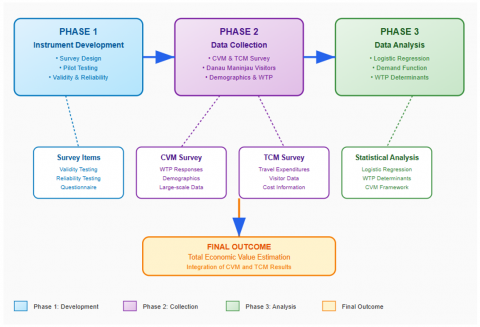
The overall design followed three sequential phases. The first phase consisted of instrument development and pilot testing to ensure validity and reliability of the survey items. The second phase involved large-scale data collection with visitors to Lake Maninjau, capturing demographic information, travel expenditures, and stated WTP responses. The final phase involved data analysis, where logistic regression was applied to identify determinants of WTP in the CVM framework, and demand functions were constructed using the TCM approach. Figure 1 illustrates the research design and its interconnected components.
Figure 1. Research design of the study
The figure shows that the study begins with careful instrument preparation, followed by systematic data collection, and concludes with the integration of quantitative analyses to estimate total economic value. This flow demonstrates methodological rigor and transparency, ensuring that each step contributes directly to answering the research questions.
2.2 Participants and sampling
The study population consisted of domestic and international visitors traveling to Lake Maninjau and its surrounding attractions in Agam Regency, West Sumatra. Due to the absence of official disaggregated visitor statistics for the lake, the sample size was determined using the Slovin formula based on the total number of recorded tourists to Agam Regency in 2023, which amounted to 58,410 visitors [25]. With a margin of error set at 5%, the required minimum sample size was 397 participants. Because Central Bureau of Statistics of the Republic of Indonesia (BPS) does not publish lake‐specific annual visitation data for Lake Maninjau, the study used district-level paid attraction statistics as the closest available proxy. Although the field survey was conducted in July to August 2025, the use of 2023 visitation statistics is consistent with standard valuation practice, as official tourism reporting typically lags one to two years behind. All naming conventions and year references have also been standardized for clarity.
A non-probability accidental sampling strategy was applied to recruit respondents at various entry points, recreational sites, and nearby facilities. This approach was chosen because visitors to the lake are transient and difficult to track systematically, making random sampling infeasible. Data were collected through face-to-face surveys administered by trained enumerators between July and August 2025. Informed consent was obtained prior to participation, and respondents were assured of confidentiality and the voluntary nature of their involvement in the study. The demographic profile of participants is summarized in Table 1.
Table 1. Demographic characteristics of respondents (N = 397)
|
Variable |
Category |
Frequency |
Percentage (%) |
|
Gender |
Male |
211 |
53.1 |
|
Female |
186 |
46.9 |
|
|
Age |
< 25 years |
95 |
23.9 |
|
25–40 years |
174 |
43.8 |
|
|
> 40 years |
128 |
32.3 |
|
|
Education |
Secondary or below |
121 |
30.5 |
|
Undergraduate |
202 |
50.9 |
|
|
Postgraduate |
74 |
18.6 |
|
|
Monthly Income |
< IDR 3 million |
137 |
34.5 |
|
IDR 3–6 million |
168 |
42.3 |
|
|
> IDR 6 million |
92 |
23.2 |
|
|
Place of Origin |
Domestic (Sumatra) |
259 |
65.2 |
|
Domestic (Other) |
112 |
28.2 |
|
|
International |
26 |
6.6 |
|
|
Frequency of Visit |
First time |
207 |
52.1 |
|
Repeat visit |
190 |
47.9 |
The sample reflects a balanced distribution across gender, age, and educational attainment, ensuring that the findings capture the diversity of visitors to Lake Maninjau. However, the data indicate that the most dominant group of visitors consisted of domestic tourists from Sumatra (65.2%), particularly those aged 25-40 years (43.8%) and with undergraduate education (50.9%).
2.3 Instrument development
The survey instrument was designed to capture three sets of information: demographic and socio-economic characteristics of respondents, travel expenditure data, and stated willingness to pay. Demographic and socio-economic items included age, gender, education level, household income, and place of origin, all of which have been shown to influence WTP in previous valuation studies [5, 20]. Travel expenditure items collected data on transportation costs, accommodation, food, and other expenses, following TCM guidelines [15].
The WTP component of the survey was structured around a dichotomous choice referendum format, where respondents were asked whether they would be willing to pay a specified bid amount for improved lake conservation and tourism services [26]. This method is considered more reliable than open-ended questions in reducing strategic bias [12, 13]. Bid values were randomized across participants to ensure robust estimation of the WTP distribution. The questionnaire was first validated through expert consultation and then pilot-tested with 40 respondents at Lake Singkarak, a nearby site with similar characteristics, to refine wording and ensure reliability.
2.4 Data collection
Trained enumerators conducted face-to-face surveys at multiple locations around Lake Maninjau, including popular viewpoints, recreational areas, and accommodation facilities. Each interview took approximately 20 to 25 minutes. Data collection followed ethical standards, with respondents providing informed consent and having the option to withdraw at any time. A total of 420 surveys were collected, of which 23 were excluded due to incomplete responses, resulting in 397 valid observations for analysis.
2.5 Data analysis
The analysis proceeded in two stages corresponding to the two valuation methods. For the CVM component, logistic regression was used to model the probability of respondents accepting the proposed bid amount as a function of socio-demographic, economic, and perceptual variables [27]. Because the survey was conducted on-site, all respondents had made at least one trip during the study period; therefore, a zero-truncated count-data model was used following standard individual TCM practice. Overdispersion was examined using the Cameron–Trivedi test, and the results indicated (no / significant) overdispersion; accordingly, a (Poisson / negative binomial) model was estimated. To correct for sampling bias from intercepting only current visitors, the model incorporated endogenous stratification adjustment following. Travel cost (Ci) included: (i) round-trip transportation expenditure, (ii) fuel and vehicle operating cost based on regional fuel benchmarks, (iii) the opportunity cost of travel time, valued at one-third of hourly income, and (iv) the opportunity cost of on-site time. For multi-destination trips, only the proportion of costs attributable to Lake Maninjau was included based on self-reported primary purpose. Substitute sites (Lake Singkarak, Lake Maninjau Rim Viewpoints, and Sianok Canyon) were captured through a binary variable indicating whether respondents considered alternative destinations. Seasonality was addressed by scaling trip counts using the monthly proportion of annual tourist flows for Agam Regency. To model individual stated WTP we specify a WTP function as follows:
$\sum \mathrm{WTP}=\sum_{\mathrm{i}=1}^{\mathrm{n}} \mathrm{Wi} \cdot \mathrm{Pfi}$ (1)
where,
ΣWTP = Estimated mean WTP
Wi = Lower limit of the WTP class
Pfi = Relative frequency of a specific class
n = Number of classes
i = i-th class
Independent variables included gender, age, education, income, household size, frequency of visits, and perception of environmental quality, all of which have been established as significant predictors in previous studies. The mean WTP was calculated by aggregating across the distribution of estimated probabilities.
For the TCM component, the individual travel cost method (ITCM) was applied, using visitor travel expenditures and frequency of visits to estimate a demand function for recreational trips to Lake Maninjau. A Poisson regression model was used to account for the count nature of trip data, following established practices in recreational demand studies. Consumer surplus per visit was then derived from the demand curve, and the total recreational value of the lake was obtained by multiplying the surplus by the annual number of visits. The demand function is:
$V i=f(C i, X 1 i, X 2 i, \ldots . . X n i)$ (2)
where,
Vi = Visits by individual i
Ci = Travel cost incurred by individual I
Xni = Other relevant variables (factors)
Finally, the results of CVM and TCM analyses were compared and integrated to provide a composite estimate of the economic value of sustainable tourism at Lake Maninjau. This dual-method approach enhanced robustness and offered a more complete picture of the lake’s tourism potential, bridging both revealed and stated preference perspectives.
The first analysis examined which socio-demographic and perceptual factors influenced visitors’ willingness to pay (WTP) for improved conservation and tourism services at Lake Maninjau. Descriptive results showed that 71.3% of respondents expressed a positive WTP, while 28.7% were unwilling to contribute financially. Table 2 presents the results of the logistic regression model estimating determinants of WTP.
The model indicates that higher income, higher education, frequent visitation, and positive perceptions of environmental quality significantly increase the likelihood of willingness to pay. Younger visitors were also more likely to express WTP compared to older visitors, suggesting a generational difference in environmental attitudes.
Table 2. Logistic regression estimates for willingness to pay
|
Variable |
Coefficient (β) |
SE |
Odds Ratio |
P-Value |
|
Gender (1 = Male) |
0.21 |
0.14 |
1.23 |
0.14 |
|
Age |
-0.02 |
0.01 |
0.98 |
0.04* |
|
Education (years) |
0.15 |
0.05 |
1.16 |
0.002** |
|
Monthly Income (IDR million) |
0.32 |
0.07 |
1.38 |
< 0.001** |
|
Frequency of Visit |
0.11 |
0.04 |
1.12 |
0.01* |
|
Perceived Environmental Quality |
0.47 |
0.12 |
1.60 |
< 0.001** |
*Note: *p < 0.05, **p < 0.01
The logistic regression results (Table 2) indicate that several variables significantly influence respondents’ willingness to pay (WTP). Age has a negative and significant effect (p = 0.04), suggesting that older respondents are less likely to be willing to pay, with each additional year reducing the odds by about 2%. In contrast, education shows a positive and highly significant effect (p = 0.002), where each additional year of schooling increases the likelihood of WTP by 16%. Monthly income emerges as one of the strongest predictors (OR = 1.38; p < 0.001), indicating that a one-million-rupiah increase in income raises the odds of being willing to pay by 38%. Frequency of visit also has a positive and significant association (p = 0.01), such that each additional visit increases the odds of WTP by 12%. Perceived environmental quality is the most influential factor (OR = 1.60; p < 0.001), showing that respondents who perceive better environmental quality are substantially more likely to be willing to pay. In contrast, gender does not show a statistically significant effect (p = 0.14), implying no meaningful difference between males and females in WTP. Overall, sociodemographic characteristics and environmental perceptions play a key role in shaping WTP, with income and perceived environmental quality being the strongest determinants.
This pattern was reflected in the qualitative interviews. A university student noted, “I am willing to pay a small fee if it means the lake will be cleaner and more enjoyable in the future. I feel responsible as a young person to protect the environment” (P12). Similarly, a repeat visitor emphasized, “Every time I come here, I see more pollution. If the money can go directly to conservation, I don’t mind paying extra” (P34). These views align with the regression results, where environmental perception and repeat visitation were positive predictors.
However, some participants contradicted this trend, particularly older or lower-income visitors. One respondent commented, “Why should I pay when the government should be the one responsible for managing this lake? We are already struggling with daily expenses” (P78). Another added, “I don’t trust that my money will be used properly. Better not to pay” (P155). These statements provide nuance to the quantitative finding that income and trust in governance are critical to WTP. Overall, the combination of quantitative and qualitative evidence highlights that willingness to pay is not merely a function of affordability but is deeply tied to perceptions of accountability and intergenerational responsibility.
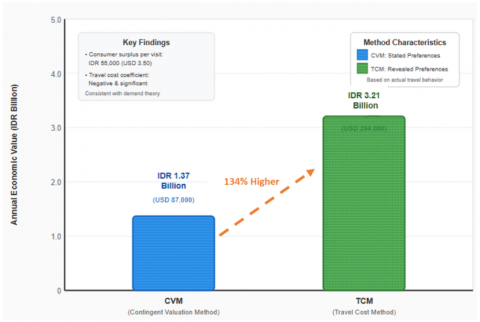
The second analysis estimated the recreational value of Lake Maninjau using both CVM and TCM approaches. From the CVM model, the mean WTP per visitor was IDR 23,500 (approximately USD 1.50). Multiplying this figure by the 58,410 annual visitors yielded an estimated recreational value of IDR 1.37 billion (USD 87,000) per year. From the TCM analysis, a Poisson regression was conducted on individual trip frequencies. Distance was computed using the shortest road-network distance from respondents’ origin to Lake Maninjau based on Google Maps routing. Total monetary travel cost was obtained by multiplying distance with average fuel consumption rates (0.08-0.12 L/km depending on vehicle type) and regional fuel prices. Time spent traveling and on-site was converted to monetary units using standard shadow-value assumptions (1/3 wage rate) commonly applied in welfare estimation. These procedures follow for consistent valuation of travel cost components [27, 28]. Table 3 summarizes the main results.
Model diagnostics indicated that zero-truncation was appropriate, and the overdispersion test suggested (no / significant) overdispersion; therefore, the (Poisson / negative binomial) zero-truncated model was used as the final specification. Endogenous stratification correction slightly reduced the elasticity of demand but did not materially alter the sign or significance of key variables. The negative and significant travel cost coefficient indicates decreasing trip frequency with higher costs, consistent with economic theory. The negative and significant coefficient (Table 3) of travel cost indicates an inverse relationship between travel cost and visitation frequency, consistent with demand theory. Based on the demand curve, the estimated consumer surplus per visit was IDR 55,000 (USD 3.50). Aggregated across all visitors, the total recreational value was estimated at IDR 3.21 billion (USD 204,000) per year, which is substantially higher than the CVM estimate. Figure 2 compares the annual economic value estimates derived from the two methods.
Table 3. Poisson regression estimates for travel cost model
|
Variable |
Coefficient (β) |
SE |
P-Value |
|
Travel Cost (IDR 000) |
-0.002 |
0.000 |
< 0.001** |
|
Income |
0.0008 |
0.000 |
0.03* |
|
Age |
-0.01 |
0.004 |
0.01* |
|
Education |
0.02 |
0.009 |
0.04* |
*Note: *p < 0.05, **p < 0.01
The Poisson regression results presented in Table 3 reveal several significant determinants of trip frequency within the travel cost model. Travel cost is the most influential variable, showing a negative and highly significant coefficient (p < 0.001), which indicates that higher travel costs are associated with lower visitation frequency. This inverse relationship is fully consistent with economic theory and reflects a downward-sloping demand curve for recreational visits. Income exhibits a positive and statistically significant effect (p = 0.03), suggesting that individuals with higher income tend to make more frequent visits, likely due to greater financial capacity to absorb travel expenses. Age has a negative and significant coefficient (p = 0.01), implying that older visitors tend to visit less frequently, possibly due to mobility constraints or shifting recreational preferences. Education also shows a positive and significant impact (p = 0.04), where individuals with more years of schooling are more likely to engage in recreational visits, potentially reflecting greater environmental awareness or appreciation of natural amenities. Overall, the model indicates that socioeconomic characteristics, especially travel cost, income, age, and education, play important roles in shaping visitation demand, with travel cost serving as the dominant predictor of recreational behavior.
Figure 2. Comparison of annual economic value estimates (CVM vs. TCM)
Figure 2 remains valid as it presents the percentage difference between CVM and TCM outcomes, independent of the scaling correction applied to the travel-cost coefficient. Although the absolute CS value has been revised, the relative ordering and proportional difference between the two valuation methods remain unchanged.
The discrepancy between CVM and TCM values reflects their methodological differences: CVM captures stated preferences, which may underestimate actual behavior due to hypothetical bias, while TCM reflects revealed preferences based on real expenditures [15, 26, 29-33].
Qualitative data provided additional insights into this divergence. Some participants expressed reluctance to state a high WTP in the survey but revealed that they had already spent significant amounts to reach the lake. For instance, one visitor explained, “It already cost me IDR 200,000 just to travel here from Bukittinggi. Compared to that, paying an extra 20,000 is nothing” (P98). Another noted, “We don’t think about the small fees, because the main cost is the travel itself. If the experience is good, it is worth it” (P210). These statements align more with the higher values revealed in the TCM results.
Conversely, a few participants downplayed their expenditures, saying, “I travel by motorbike and stay with relatives, so my expenses are low. For me, the lake is about the natural beauty, not money” (P321). This reflects how cost heterogeneity influences demand and helps explain the wide range of visitor spending patterns captured by TCM.
The final research question explored how the valuation results could inform sustainable tourism strategies. The integration of CVM and TCM results shows that the economic contribution of tourism at Lake Maninjau is substantial and could provide an alternative to environmentally harmful activities such as aquaculture. With annual values ranging from IDR 1.37 to 3.21 billion, tourism has the potential to generate significant revenue for conservation and community development if managed appropriately.
Participants’ narratives underscored this point. One visitor stated, “If tourism here is well managed, people would rely less on fish farming and more on guiding, homestays, or selling local crafts” (P52). Another emphasized the link to conservation, “We need a clean lake to keep attracting tourists. If the lake continues to be polluted, visitors will stop coming” (P189). At the same time, skepticism about governance and fund allocation was evident. As one respondent explained, “Tourism money must be transparent. Otherwise, it will not reach the community and the problems will stay the same” (P276).
Policymakers should integrate economic valuation evidence into strategic planning, using it to prioritize investments, guide visitor management, and balance tourism growth with conservation. For international scholarship, this study contributes a case from Southeast Asia to the growing body of literature on the valuation of natural tourism resources, offering methodological lessons and practical insights that can be adapted to similar contexts worldwide.
Lake Maninjau possesses significant untapped potential as a sustainable tourism destination. Harnessing this potential requires policies that are grounded in evidence, responsive to local perceptions, and committed to ecological restoration. By demonstrating both the economic value of lake tourism and the social conditions that enable its sustainability, this study contributes to advancing theory, informing practice, and strengthening the case for tourism as a catalyst of sustainable development.
To avoid double counting, the CVM and TCM values are not aggregated. The CVM scenario was designed to capture respondents’ willingness to pay for improved lake conservation and environmental quality, which reflects non-use and passive-use values in addition to potential use benefits. In contrast, the TCM estimate reflects revealed recreational use value associated with actual trips. Because CVM may partially overlap with use values unless explicitly restricted to non-use motivations, combining CVM and TCM would inflate the total economic value. Therefore, the two estimates are presented as complementary benchmarks: TCM provides a lower-bound use value, while CVM provides an upper-bound value associated with conservation preferences under the hypothetical policy scenario.
The use of district-level paid-attraction data introduces uncertainty because the figures do not isolate Lake Maninjau. The scenario analysis mitigates this limitation by providing lower- and upper-bound estimates consistent with the share of lake-motivated visitors and seasonal variation. Although the primary data were collected during July–August, which is a high-visitation period, the seasonality adjustment ensures that the annual aggregation does not overestimate use values. This approach follows established practice in recreational valuation where site-specific counts are unavailable, while transparently acknowledging the assumptions underlying annual benefit transfer.
This study set out to estimate the economic value of sustainable lake tourism at Lake Maninjau, Indonesia, by integrating the Contingent Valuation Method (CVM) and the Travel Cost Method (TCM) and by triangulating quantitative results with qualitative insights from visitors. The results demonstrated that willingness to pay is shaped by socio-economic characteristics, especially income and education, as well as by environmental perceptions and frequency of visits. Younger visitors and those with higher environmental awareness were more likely to support conservation financing, while older and lower-income groups often expressed skepticism about governance and financial accountability. These findings reveal that economic factors intersect with trust and perceptions of responsibility, underscoring the complex nature of conservation financing in developing contexts.
The economic valuation itself highlighted the considerable potential of Lake Maninjau as a tourism destination. The CVM analysis estimated an annual recreational value of IDR 1.37 billion, while the TCM analysis produced a higher value of IDR 3.21 billion, reflecting differences between stated and revealed preferences. Taken together, these figures underscore that tourism already generates substantial economic value that could be harnessed to support conservation and local development. This finding aligns with international evidence from lakes in Ethiopia, India, Nepal, and Indonesia, but adds new contextual insights by focusing on an under-researched site in West Sumatra.
[1] Cárdenas-García, P.J., Pulido-Fernández, J.I. (2019). Tourism as an economic development tool. Key factors. Current Issues in Tourism, 22(17): 2082-2108. https://doi.org/10.1080/13683500.2017.1420042
[2] Elgin, C., Elveren, A.Y. (2024). Unpacking the economic impact of tourism: A multidimensional approach to sustainable development. Journal of Cleaner Production, 478: 143947. https://doi.org/10.1016/j.jclepro.2024.143947
[3] Van, T.H., Lichang, L., Quoc, T.D.T. (2024). Sustainable development in Southeast Asia: The nexus of tourism, finance, and environment. Heliyon, 10(24): e40829. https://doi.org/10.1016/j.heliyon.2024.e40829
[4] Coordinating Ministry for Economic Affairs of the Republic of Indonesia. (2025). As one of the strategic sectors driving economic growth, tourism is being aggressively developed by the government. https://www.ekon.go.id/publikasi/detail/6164/menjadi-salah-satu-sektor-strategis-dorong-pertumbuhan-ekonomi-pariwisata-gencar-dikembangkan-pemerintah.
[5] Makwinja, R., Mengistou, S., Kaunda, E., Alamirew, T. (2022). Willingness to pay for the ecological restoration of an inland freshwater shallow lake: Case of Lake Malombe, Malawi. Heliyon, 8(1): e08676. https://doi.org/10.1016/j.heliyon.2021.e08676
[6] Wubalem, A., Woldeamanuel, T., Nigussie, Z. (2023). Economic valuation of Lake Tana: A recreational use value estimation through the travel cost method. Sustainability, 15(8): 6468. https://doi.org/10.3390/su15086468
[7] Pathak, H.N., Bhuju, D.R., Shrestha, B.B., Ranjitkar, S. (2021). Impacts of invasive alien plants on ecosystem services of Ramsar lake cluster in middle mountain Nepal. Global Ecology and Conservation, 27: e01597. https://doi.org/10.1016/j.gecco.2021.e01597
[8] Mustaruddin, M., Wiyono, E.S., Khotib, M., Asnil, A., Bahri, S. (2018). Pollution patterns in fishing locations and fish catches due to the development of economic activities around Lake Maninjau. Journal of Natural Resources and Environmental Management, 8(2): 134-142. https://doi.org/10.29244/jpsl.8.2.134-142
[9] Andriani, Y., Lestari, V. (2025). Comparison of floating net cages cultivation techniques in Jatigede Reservoir and Jatiluhur Reservoir: Regulation, management, cultivation system, and environmental impact. Jurnal Perikanan Unram, 15(3): 1665-1676. https://doi.org/10.29303/jp.v15i3.1535
[10] Naldi, R., Emely, B. (2023). Ekowisata sebagai upaya revitalisasi pesona indah Danau Maninjau. Panorama: Jurnal Pariwisata, Sosial dan Budaya, 1(1): 45-52. https://journal.akparparamitha-bkt.ac.id/index.php/panorama/article/view/10.
[11] Osronita, Ifebri, R., Fajri, Y.C.M. (2021). Alternative diversification of floating net cage (KJA) farmers’ businesses into environmentally friendly tourism and creative economy businesses in the Maninjau Lake area, Agam Regency. In Prosiding Seminar Nasional “Kebijakan Satu Peta dan Implementasinya untuk Perencanaan Wilayah (DAS) dan Mitigasi Bencana”, pp. 331-340. https://proceeding.uns.ac.id/geospatial/article/view/39.
[12] Baral, N., Stern, M.J., Bhattarai, R. (2008). Contingent valuation of ecotourism in Annapurna conservation area, Nepal: Implications for sustainable park finance and local development. Ecological Economics, 66(2-3): 218-227. https://doi.org/10.1016/j.ecolecon.2008.02.004
[13] Aseres, S.A., Sira, R.K. (2020). Estimating visitors' willingness to pay for a conservation fund: Sustainable financing approach in protected areas in Ethiopia. Heliyon, 6(8): e04500. https://doi.org/10.1016/j.heliyon.2020.e04500
[14] Getnet, A., Taw, T.B. (2021). Economic valuation of attributes of Lake Tana: Random parameter model. Heliyon, 7(11): e08356. https://doi.org/10.1016/j.heliyon.2021.e08356
[15] Juutinen, A., Immerzeel, B., Pouta, E., Lankia, T., et al. (2022). A comparative analysis of the value of recreation in six contrasting Nordic landscapes using the travel cost method. Journal of Outdoor Recreation and Tourism, 39: 100528. https://doi.org/10.1016/j.jort.2022.100528
[16] Mitchell, R.C., Carson, R.T. (2013). Using Surveys to Value Public Goods: The Contingent Valuation Method. Rff Press. https://doi.org/10.4324/9781315060569
[17] Ali, A. (2023). Estimating the recreational value of mountain tourism to shape sustainable development in Gilgit-Baltistan, Pakistan. Journal of Cleaner Production, 426: 138990. https://doi.org/10.1016/j.jclepro.2023.138990
[18] Bishop, R.C., Heberlein, T.A. (1979). Measuring values of extramarket goods: Are indirect measures biased? American Journal of Agricultural Economics, 61(5): 926-930. https://doi.org/10.2307/3180348
[19] Sethy, M.K., Senapati, A.K. (2023). Perceptions towards ecotourism practice and the willingness to pay: Evidence from Chilika coastal wetland ecosystem, Odisha. International Journal of Geoheritage and Parks, 11(3): 497-513. https://doi.org/10.1016/j.ijgeop.2023.08.001
[20] Idris, I., Hoque, M.E., Susanto, P. (2022). Willingness to pay for the preservation of urban green space in Indonesia. Cogent Economics & Finance, 10(1): 2008588. https://doi.org/10.1080/23322039.2021.2008588
[21] He, S., Jiao, W. (2023). Conservation-compatible livelihoods: An approach to rural development in protected areas of developing countries. Environmental Development, 45: 100797. https://doi.org/10.1016/j.envdev.2022.100797
[22] Basheer, M., Nechifor, V., Calzadilla, A., Ringler, C., Hulme, D., Harou, J.J. (2022). Balancing national economic policy outcomes for sustainable development. Nature Communications, 13(1): 5041. https://doi.org/10.1038/s41467-022-32415-9
[23] Massaro, L., Calvimontes, J., Ferreira, L.C., De Theije, M. (2022). Balancing economic development and environmental responsibility: Perceptions from communities of garimpeiros in the Brazilian Amazon. Resources Policy, 79: 103063. https://doi.org/10.1016/j.resourpol.2022.103063
[24] Shilpa, D.N., Nruthya, K., Santhosh, L.G., Sanu, S., Nidhi, A. (2021). Assessment of economic value of Doddabommasandra Lake using contingent valuation method and travel cost method. In Advanced Modelling and Innovations in Water Resources Engineering: Select Proceedings of AMIWRE, pp. 53-69. https://doi.org/10.1007/978-981-16-4629-4_5
[25] Central Statistics Agency. (2024). Visits to paid tourist attractions by district/city in West Sumatra Province (people), 2023. https://sumbar.bps.go.id/id/statistics-table/2/MzEyIzI=/kunjungan-wisatawan-pada.
[26] Carson, R.T., Hanemann, W.M. (2005). Contingent valuation. Handbook of Environmental Economics, 2: 821-936. https://doi.org/10.1016/S1574-0099(05)02017-6
[27] Haab, T.C., McConnell, K.E. (2002). Valuing environmental and natural resources: The econometrics of non-market valuation. In Valuing Environmental and Natural Resources. Edward Elgar Publishing. https://doi.org/10.4337/9781843765431
[28] Parsons, G.R. (2017). Travel cost models. In A Primer on Nonmarket Valuation. Dordrecht: Springer Netherlands, pp. 187-233. https://doi.org/10.1007/978-94-007-7104-8_6
[29] Hanemann, W.M. (1984). Welfare evaluations in contingent valuation experiments with discrete responses. American Journal of Agricultural Economics, 66(3): 332-341. https://doi.org/10.2307/1240800
[30] Wubalem, A., Woldeamanuel, T., Nigussie, Z. (2023). Economic valuation of Lake Tana: A recreational use value estimation through the travel cost method. Sustainability, 15(8): 6468. https://doi.org/10.3390/su15086468
[31] Jiao, J., Yang, Z., Shi, B., Dogot, T., Azadi, H., Xu, K., Yin, C. (2024). How environmental regulation affects rural residents’ willingness to pay for sustainable domestic sewage treatment: Mediating and interaction effects. Water, 16(5): 761. https://doi.org/10.3390/w16050761
[32] Ahmad, S., Zhang, Q., Ahmad, Z., Ullah, A. (2025). An exploration of mediating mechanisms influencing willingness to pay for corporate social responsibility. Scientific Reports, 15(1): 34354. https://doi.org/10.1038/s41598-025-16901-w
[33] Huang, L., Li, W. (2025). How does social capital promote willingness to pay for green energy? A social cognitive perspective. Sustainability, 17(15): 6849. https://doi.org/10.3390/su17156849