Dessy Isfianadewi* | Tri Lestari Wahyuning Utami | Sita Dewi Kusumaningrum
© 2025 The authors. This article is published by IIETA and is licensed under the CC BY 4.0 license (http://creativecommons.org/licenses/by/4.0/).
OPEN ACCESS
Businesses that practice environmental sustainability may find new ways to outperform their rivals. In this matter, SCM, which facilitates the integration of internal and external stakeholders, has an ideal position as a potent management technique for the performance of sustainable organizations. The relationship between SCM and sustainability has occurred through GSCM and SFP. Further, innovation can be linked to manufacturing processes to protect the environment. Therefore, this study aimed to test and determine the role of GSCM and GI on SFP. Data from the Eco-print Micro, Small, and Medium Enterprises (MSME) Association members in Yogyakarta and Central Java were collected through a quantitative approach using a purposive sampling method. Following the hypothesis, it found that 1) GSCM has proven to have a positive and significant effect on GI; 2) GSCM has proven to have a positive and significant effect on SFP; 3) GI has proven to have a positive and significant effect on SFP; and 4) GI acts as a mediator between GSCM and SFP.
GSCM, GI, SFP, Eco-print
The shifting of consumer behavior that prefers green and environmentally friendly products encourages companies to find ways to add value to their business that are more environmentally friendly. Ecologically friendly businesses can open new opportunities for companies to win competition. To move into environmentally friendly businesses, companies must be aware of making clean products, environmental management systems, green efficiency, and implementing green management practices [1].
An environmentally friendly business can start with supply chain management (SCM). SCM is related to integration between several parties, including the customer base, distribution network, internal company activities, and supply base. SCM practices can influence organizational performance, sustainable performance, and stakeholders within the company, both internal and external stakeholders. SCM practices influence organizational performance, sustainability performance, and how the company's external stakeholders perceive it. SCM is vital in improving the organization's sustainability performance [2, 3].
Sustainability initiatives in SCM focus heavily on environmental issues, even though the concept of being environmentally friendly can also be approached with a triple bottom line (environmental, economic, and social). Concepts of SCM and sustainable performance better known as Green Supply Chain Management (GSCM) and Sustainable Firm Performance (SFP) [4]. The concept of GSCM started with the term green production or "The Green Production." It is related to 3R or reuse, reduce, and recycle. This concept describes how to save raw material costs and total product costs.
In industrial competitiveness, every firm is forced to apply efficient production that requires the efforts of the supply chain to develop processes, 'green products,' and environmentally friendly services. Implementing green purchasing is an expensive undertaking, even though it produces economic value, such as reducing disposal costs, increasing resource conservation, and improving the company's image, ultimately impacting its competitiveness. Green purchasing environmental processes include selecting "green suppliers," purchasing environmentally friendly products, establishing "green" criteria when evaluating suppliers, and considering 'green' aspects for second-tier suppliers [5].
In manufacturing industries, green or environmentally friendly is applied in green procurement, green manufacturing, green distribution and logistics [6, 7], known as GSCM. GSCM represents how supply chain activities have an impact on the environment. It also contributes to sustainable improvement in company performance [6]. Therefore, some companies are taking the initiative to apply their GSCM in response to government regulations and promote environmental awareness [8, 9]. Adopting GSCM provides two benefits: reducing ecological threats and achieving sustainable competitive advantage.
The implementation of GSCM can impact SFP. A company that adopts GSCM is encouraged to enhance SFP [10]. SFP consists of economic, environmental, and social performance [6]. SFP can be defined as the management of material, information, and capital flows, as well as cooperation between companies along the supply chain, by considering the objectives of all three dimensions of sustainable development (economic, environmental, and social) derived from customer and stakeholder requirements. Companies implement SFP through environmental programs (such as recycled product design ecological certification) and social practices (such as programs to improve employee working conditions or support community activities). Therefore, companies apply the GSCM concept not only to the sustainability of their management but also to the management of all supply chain members.
The relationship between GSCM and SFP is not directly affected. Innovation related to environmentally friendly or Green Innovation (GI) can mediate the effect of GSCM on SFP. GI is how organizations try to minimize or eliminate the adverse impact of their production and manufacturing operations on the natural environment [11]. GI is realized through processes, products, technology, and management structures that minimize waste and pollution to protect the environment. Environmental cooperation between companies and suppliers in developing new green products is part of the implementation GI carried out by the company [12, 13]. So, green suppliers can lead to GI in companies [14, 15].
The relationship between GSCM, GI, and SFP illustrates the development of companies that focus on environmentally friendly business. In Indonesia, one of the developments in environmentally friendly companies is MSMEs that operate in Eco-print. Eco-print is a business that uses environmentally friendly materials and environmentally friendly production, which produces environmentally friendly products. Implementing environmental friendliness in business SCM also impacts GI and, of course, SFP.
This research confirms the relationship between GSCM, GI, and SFP tested whether GSCM and GI influence SFP. This research aims to determine the role of GSCM and GI in SFP.
2.1 Green supply management and GI
Implementation of GI can be increased by supporting GSCM in a company. The Resource-Based View (RBV) offers a compelling framework for understanding how GSCM capabilities contribute to competitive advantage through GI. The RBV posits that firms can achieve sustainable competitive advantages by leveraging their unique resources and capabilities. They are valuable, rare, inimitable, and non-substitutable [16, 17]. By adopting GSCM practices, firms can differentiate themselves from competitors, thereby creating a unique value proposition that enhances their competitive advantage [18, 19]. For instance, firms that effectively implement GSCM can reduce operational costs through improved resource efficiency and waste management, leading to higher profit margins and customer loyalty [18].
Firms that adopt GSCM practices may find it easier to implement GI due to the established frameworks for collaboration and resource sharing within their supply chains [19]. For example, GSCM, which represents choosing green suppliers, can lead GI in a company [14, 15]. A company can be triggered to develop green products based on ideas from suppliers. With the increasing concern for environmental problems and regulations, companies collaborate with stakeholders (such as suppliers, customers, and society) and urge companies to cooperate with them in product process development [15]. This collaboration encourages companies to create innovation, improve product design and manufacturing processes, and develop overall compliance with environmental regulations [15].
Through cooperation between companies and suppliers, companies can also access knowledge that benefits the promotion of GSCM and provides a space for exchanging information and knowledge between companies and their supply chain partners [20]. Companies rely on suppliers as external sources of new knowledge that give greater specialization and faster technical transformation [21].
When a company focuses on monitoring environmentally friendly suppliers, if the assessment results are negative, it can cause suspension or termination of business connections, so it will require a search for the proper and new supplier selection to expand the scope of the purchasing company's search [22]. Meanwhile, by responding to green requirements and customers' instructions, companies must have knowledge sources to acquire market-related knowledge [23, 24]. In addition, the green collaboration between companies and supplier partners encourages activities to grow rapidly to contribute to future generations [20].
GSCM is essential in improving cooperation between companies and supply chain partners, generating better knowledge for shared goals [25]. Meanwhile, the GSCM concept means companies can obtain information and knowledge related to production, inventory, technology, and marketing from various supply chain partners [26]. Comprehensive and appropriate green knowledge expands a company's knowledge base and plays a vital role in GI implementation.
Moreover, the RBV emphasizes the importance of dynamic capabilities—an organization's ability to integrate, build, and reconfigure internal and external competencies to address rapidly changing environments [27]. In the context of GSCM, dynamic capabilities enable firms to adapt their supply chain processes to incorporate innovative green practices, continuously improving responsiveness to market changes [27]. Therefore, the implementation of GSCM supports the development of new green products. By GSCM, companies obtain new ideas, approaches, and technologies for manufacturers to develop new products. GI provides a continuous way to innovate in every stage of the supply chain to gain a competitive advantage and reduce environmental problems in the industry [28].
H1. GSCM has a positive influence on GI.
2.2 GI and SFP
The RBV provides another lens through which the relationship between GI and sustainable performance can be reached. In the context of GI, firms that invest in sustainable practices and technologies can differentiate themselves in the marketplace. For example, Becker's research indicates that firms adopting green innovation strategies can build substantial green capabilities that lead to higher turnover through radical innovations [29]. It aligns with the RBV's assertion that valuable, rare, and inimitable resources contribute to sustained competitive advantage.
In other practice, GI can also encourage an organization to promote the adverse effects of manufacturing [11]. Reducing resource consumption and minimizing waste and pollution can be ways to protect the environment [12, 13]. The goal of creating new products or processes and reducing the impact of business operations is an essential factor in the success of SFP. It offers flexibility and better performance through employee knowledge resources [30] and advanced technology [31].
Technological development provides benefits such as reducing energy use, preventing pollution, recycling waste, and managing the environment. Innovative technology offers commercial benefits for making environmentally friendly products and economic benefits that can increase competitiveness [32]. The GI process is a strategic construct that ensures lasting corporate performance [13]. It helps companies achieve environmentally friendly targets, promoting sustainable operations [33].
H2. GI has a positive effect on SFP.
2.3 GSCM and SFP
Institutional pressure encourages companies to choose internal GSCM practices that are related to the adoption of external GSCM practices. The GSCM practices do not directly influence economic performance. Still, they can directly contribute to institutions in environmental practices and, at the same time, provide valuable insights for managers in adopting GSCM practices. So, policy insights are needed further for professional organizations, regulators, and legislators to promote GSCM [34, 35].
SFP is a factor that can encourage companies to focus on alleviating environmental problems and providing economic and social benefits [10, 28]. A company's environmental performance ensures the company's ability to reduce hazardous substances, pollution, environmental accidents, and solid waste [36, 37]. Companies use minimum resources to minimize environmental pollution caused by hazardous waste in land, air, and water. GSCM is applied to reduce ecological accidents (materials, waste production, liquid waste) and improve organizational performance and public health [10]. In line with this concept, companies identify environmental issues such as procurement, manufacturing, and transportation [38].
GSCM improves an organization's economic performance [39, 40]. In financial performance research, the ability of manufacturing companies to reduce costs associated with materials, water treatment, energy consumption, waste disposal, and lower environmental accidents [41]. In this concept, sales and profitability must be considered.
In social performance, GSCM principles and policy improve the organization's image, protect safety and worker health, and ensure customer satisfaction and loyalty [10, 42]. However, GSCM topics on social performance are generally ignored. To raise awareness of the role of GSCM in social performance, companies need to implement corporate social responsibility by caring about social issues while managing supply chain activities. It can increase a positive image in the government, community, stakeholders, and customers. GSCM allows companies to improve their brand image and build strong stakeholder relationships [43]. In addition, the RBV posits that a firm's unique resources and capabilities are fundamental to achieving competitive advantage and superior performance. In the context of GSCM, firms can leverage their environmental capabilities—such as sustainable sourcing, eco-design, and waste management—as strategic resources [44]. For instance, Abdallah and Al-Ghwayeen [44] emphasize that GSCM practices, which include environmental audits and supplier collaboration, can enhance a firm's operational efficiency and compliance with environmental regulations, thereby improving overall business performance. It aligns with the RBV's assertion that valuable and rare resources contribute to sustained competitive advantage. According to the research above, if the GSCM concept is applied, it will be more effective in improving company performance [45, 46].
H3. GSCM has a positive effect on SFP.
2.4 The role of GI in mediating the effect of GSCM on SFP
As is known in the research studies discussed previously, GSCM can influence SFP. However, in the direct relationship between GSCM and SFP, adding other variables, such as mediation, is necessary. The mediating variable in this study is GI. GI practices can support the implementation of GSCM in SFP by providing new ideas, approaches, or technologies to manufacturers when developing new products or processes. GI is believed to provide a way of continuously seeking to innovate every stage of supply to gain a competitive advantage and reduce environmental problems in the industry.
High levels of productivity and innovation can help companies achieve and maintain company value. The company's value is not only from economic and social performance, but environmental performance is also an aspect that stakeholders pay attention to. Innovation in the form of GI is key for companies to achieve goals in high levels of competition and an unstable environment. The role of GI is it can be a competitive advantage for companies if it is carried out regularly and applied to all business processes.
In the mediation model, GSCM contributes to product innovation, green process innovation, and green managerial innovation, improving environmental performance and competitive advantage [15]. GSCM and GI may be highly related to organizational ecological performance and competitive advantage, which verifies the mediating role of GI between GSCM and SFP-environmental performance.
GI also creates value for new and more established companies [47]. GI supports company performance by increasing market share or reducing operational costs [48]. GI also improves company performance by efficiently using materials and energy, creating market shares, and product competitive advantages [4]. In addition, GI can also be used as a unique tool for marketing activities to increase market share [49] continuously.
The concept of sustainability has emphasized the need to encourage innovative GSCM [50]. Today's sustainable companies have initiated today's sustainability challenges business processes to stimulate environmentally friendly production to promote social, environmental, and economic performance for companies. Environmentally friendly products have become the most fundamental tool in improving a company's sustainable operations. Environment-friendly product innovation has emerged as an essential driver of corporate sustainability activities [51]. Significantly, the company's green process innovation rapidly improved its production activities, ultimately contributing to its environmental performance [52].
The increasing demand for more environmentally friendly products strengthens the company's processes and sustainability. Green products and process innovations radically change the company's ecological activities, supporting sustainable performance. Overall, the relationship between the GSCM approach, namely GI and SFP processes, inspires organizations to exploit new business processes to achieve sustainable development [33].
The literature review shows that implementing GSCM practices in an organization will influence SFP. However, to measure the direct effect of GSCM on SFP, it is necessary to consider a mediating variable, such as GI. In other words, the direct influence of GSCM on SFP is that GSCM first affects GI, which in turn affects SFP. These are known as direct and indirect effects [48].
H4. GI mediates the relationship between GSCM and SFP.
Research on this topic has not been carried out on eco-print, so it is essential and enjoyable to conduct research, considering that eco-print products are very concerned with GSCM, GI, and SFP. So, it will become a reference for other MSMEs in carrying out product and process innovations by paying attention to the GSCM network, which ensures the company's SFP from an economic, social, and environmental perspective (see Figure 1).
A quantitative approach analyzes the relationship between GSCM, GI, and SFP. This research focused on the mediation effect of GI in the relation of GSCM and SFP. To test this model, the sample of this study is the Eco-print MSME in Indonesia. This study applied a survey by personal interview in data collection. The sampling technique used was purposive and snowball sampling to reach the sample. The primary data is collected through surveys, individual interviews, and Google Forms. Each statement in the questionnaire was measured using a 5 Likert scale (1 = strongly disagree to 5 = strongly agree) (see Table 1).
This research uses SFP as the dependent variable. It is measured by three dimensions: economic performance (ECP), environmental performance (EVP), and social performance (SCP). The independent variable is GSCM, which consists of three dimensions: green purchasing (GDP), green manufacturing (GM), and green distribution and packaging (GP). GI, as the mediating variable, is measured by eight items (see Figure 1).
Figure 1. Research framework
Table 1. Indicators
|
Variable |
Code |
Items |
Sources |
|
GSCM |
|||
|
GP |
GP1 |
In purchasing, our company requires suppliers to provide certification of testing for green product conformance |
[53, 54] |
|
GP2 |
Our company is urging/pressuring suppliers to take environmental actions |
||
|
GP3 |
Our company chooses suppliers based on environmental criteria |
||
|
GP4 |
Our company requires Suppliers' ISO14000 certification |
||
|
GP5 |
Our company provides suppliers with design specifications that include environmental requirements for purchased items |
||
|
GM |
GM1 |
Products made or produced by our company can be recycled and reused |
[53, 54] |
|
GM2 |
Our company's process design focuses on reducing energy and natural resource consumption in operations |
||
|
GM3 |
In our company's production process, energy obtained from surrounding resources can be maximized |
||
|
GM4 |
Our company's design of products to avoid or reduce the use of hazardous products and manufacturing processes |
||
|
GM5 |
Our company's manufacturing process will reduce noise pollution to the minimum |
||
|
GDP |
GDP1 |
Our company aims to improve and design environmentally friendly packaging (e.g., less paper and plastic materials are used) for existing and new products |
[15, 54-56] |
|
GDP2 |
Our company has ecological materials for primary packaging |
||
|
GDP3 |
Our company has a selection of cleaner transportation methods |
||
|
GDP4 |
Our company has a supply chain response time |
||
|
GDP5 |
Our company has delivery/handling performance |
||
|
SFP |
|||
|
EVP |
EVP1 |
Our company decreases the consumption of hazardous/ harmful/ toxic materials |
[35, 54] |
|
EVP2 |
Our company reduces air emissions, wastewater, and solid wastes in the production process |
||
|
EVP3 |
Our company uses volumes of water, energy, and materials in the production process that can be recycled and reused |
||
|
EVP4 |
After production, our company ensures that the materials used do not pollute the environment |
||
|
EVP5 |
Our company has places to store materials, water, and energy to reuse them |
||
|
SCP |
SCP1 |
Our company sponsors environmental events/collaboration with ecological organizations |
[54] |
|
SCP2 |
Our company has natural environment training programs for managers and employees |
||
|
SCP3 |
Our company has environmental emergency plans |
||
|
SCP4 |
Our company cooperates with partners and shops |
||
|
SCP5 |
Our company is improving our services to meet customer satisfaction |
||
|
ECP |
ECP1 |
Our company discusses sales results, market share, and profits with staff/employees |
[14, 54] |
|
ECP2 |
Our company's eco products boost consumers' willingness to purchase |
||
|
ECP3 |
Our company conducts surveys and responds quickly to changes in market demand |
||
|
ECP4 |
Our company is Reducing the cost of purchased materials and the cost of energy consumption used |
||
|
ECP5 |
Our company has budgeting reports and results that have been used |
||
|
GI |
|||
|
GI |
GI1 |
Our company has environment-friendly raw materials |
[14, 15, 53, 54] |
|
GI2 |
Our company has used energy-efficient raw materials in product development |
||
|
GI3 |
Our company has streamlined raw materials for the production process in product development |
||
|
GI4 |
Our company has recycled, reused, and remanufactured material. |
||
|
GI5 |
Our company has reduced hazardous waste, emissions, etc. |
||
|
GI6 |
Our company has recuperation and recycling systems |
||
|
GI7 |
Our company has low energy consumption, including water, electricity, gas, and petrol during production/ use/disposal |
||
|
GI8 |
Our company has design of products for reduced consumption of material/energy |
||
The data analysis technique used in this research is the Partial Least Square-Structural Equation Model (PLS-SEM) with SmartPLS 3 software. There are two stages in SmartPLS 3, as follows [57]:
1. Carrying out a measurement model analysis to test each indicator's reliability and construct validity. In the measurement model, the technique is embedded in two stages: testing on dimensions and testing on the structural model. This stage is separated into first-order and second-order analysis.
2. Carrying out a structural model test to determine whether there is an influence between the variables tested using the PLS t-test.
4.1 Profile of respondents
The unit of analysis used in this research is the organizational level, namely Eco-print enterprises. Data collection was carried out using a survey by personal interview. The study collected 102 questionnaires, and all of them (100%) could be processed.
Most respondents were women, namely 92 respondents (90%). Then, judging from their work experience, as many as 64 Eco-print entrepreneur respondents (63%) had work experience as teachers, government agencies, private companies, or entrepreneurs. Even when running this business, only 21 respondents (21%) still have other jobs outside their Eco-print business, meaning that 81 respondents (79%) are already focused on the Eco-print business.
Eco-print business actors were also asked questions regarding the promotional media used. Most (more than 60%) entrepreneurs use word of mouth, Instagram, Facebook, bazaars, and communities/associations to market their Eco-print products. Media such as TikTok and websites are not yet familiar with use.
The respondents of this study are eco-print enterprises on a similar business scale, namely MSMEs. They operate in the same industry and market. Companies engaged in this field are also members of several MSME associations.
4.2 Model specification
This study uses two embedded stages divided into first-order and second-order. Reflective-reflective models are used in the first-order and second-order models [58]. First-order is done by creating a path on Smart PLS to analyze the validity and reliability of indicators on latent variables. The results are latent variable scores, which are then used in the second order. In this study, the latent variable scores GP, GM, GDP, EVP, SCP, and ECP generated from the first-order are used in the second-order stage.
4.3 Measurement model
Measurement models are used to test the validity and reliability of an instrument. The validity test determines whether the measurements used represent the construct being measured. This research uses convergent validity and discriminant validity.
First-order is conducted to test the measurement model. Confirmatory Factor Analysis (CFA) and Average Variance Extracted (AVE) were used to test construct validity. Outer loading must be greater than 0.7 to be said to be valid [57]. The first-order results showed that several items should be deleted, namely GM1, EVP5, SCP1, SCP5, ECP2, and ECP4. Furthermore, the following test results showed that GP4 and GM2 were deleted because outer loading < 0.7, then GP5 followed to be deleted. GP2 was also deleted because of the Variance Inflation Factor (VIF) score. The final result in Table 2 shows that the outer loading of each item shows a value > 0.7, which means that the item has passed the convergent validity test.
Table 2. First-order construct validation
|
Outer Loadings |
Cronbach's Alpha |
rho_A |
Composite Reliability |
AVE |
VIF |
||
|
GSCM |
|||||||
|
GP |
GP1 |
0.913 |
0.782 |
0.785 |
0.902 |
0.821 |
1.702 |
|
|
GP3 |
0.899 |
|
|
|
|
1.702 |
|
GM |
GM3 |
0.745 |
0.743 |
0.759 |
0.854 |
0.661 |
1.323 |
|
|
GM4 |
0.819 |
|
|
|
|
1.607 |
|
|
GM5 |
0.870 |
|
|
|
|
1.698 |
|
GDP |
GDP1 |
0.714 |
0.798 |
0.799 |
0.860 |
0.552 |
1.484 |
|
|
GDP2 |
0.756 |
|
|
|
|
1.607 |
|
|
GDP3 |
0.725 |
|
|
|
|
1.555 |
|
|
GDP4 |
0.762 |
|
|
|
|
1.694 |
|
|
GDP5 |
0.757 |
|
|
|
|
1.711 |
|
SFP |
|||||||
|
EVP |
EVP1 |
0.861 |
0.859 |
0.870 |
0.905 |
0.706 |
2.208 |
|
|
EVP2 |
0.739 |
|
|
|
|
1.606 |
|
|
EVP3 |
0.854 |
|
|
|
|
2.288 |
|
|
EVP4 |
0.898 |
|
|
|
|
2.768 |
|
SCP |
SCP2 |
0.870 |
|
|
|
|
1.936 |
|
|
SCP3 |
0.857 |
|
|
|
|
1.888 |
|
|
SCP4 |
0.735 |
|
|
|
|
1.287 |
|
ECP |
ECP1 |
0.778 |
0.727 |
0.727 |
0.846 |
0.647 |
1.323 |
|
|
ECP3 |
0.824 |
|
|
|
|
1.519 |
|
|
ECP5 |
0.811 |
|
|
|
|
1.524 |
|
GI |
|||||||
|
GI1 |
0.738 |
0.898 |
0.899 |
0.918 |
0.585 |
2.152 |
|
|
GI2 |
0.826 |
|
|
|
|
2.949 |
|
|
GI3 |
0.786 |
|
|
|
|
2.110 |
|
|
GI4 |
0.750 |
|
|
|
|
2.270 |
|
|
GI5 |
0.817 |
|
|
|
|
2.506 |
|
|
GI6 |
0.713 |
|
|
|
|
1.738 |
|
|
GI7 |
0.763 |
|
|
|
|
2.588 |
|
|
GI8 |
0.717 |
|
|
|
|
2.380 |
|
Table 3. Second-order construct validation
|
|
Outer Loadings |
Cronbach's Alpha |
rho_A |
Composite Reliability |
AVE |
VIF |
|
|
GSCM |
GP |
0.762 |
0.767 |
0.786 |
0.866 |
0.683 |
1.466 |
|
|
GM |
0.816 |
|
|
|
|
1.610 |
|
|
GDP |
0.896 |
|
|
|
|
1.976 |
|
SFP |
EVP |
0.798 |
0.785 |
0.784 |
0.875 |
0.700 |
1.431 |
|
|
SCP |
0.861 |
|
|
|
|
1.907 |
|
|
ECP |
0.849 |
|
|
|
|
1.832 |
|
GI |
GI1 |
0.737 |
0.898 |
0.899 |
0.918 |
0.585 |
2.152 |
|
|
GI2 |
0.825 |
|
|
|
|
2.949 |
|
|
GI3 |
0.786 |
|
|
|
|
2.110 |
|
|
GI4 |
0.750 |
|
|
|
|
2.270 |
|
|
GI5 |
0.818 |
|
|
|
|
2.506 |
|
|
GI6 |
0.714 |
|
|
|
|
1.738 |
|
|
GI7 |
0.763 |
|
|
|
|
2.588 |
|
|
GI8 |
0.716 |
|
|
|
|
2.380 |
Apart from outer loading values, convergent validity tests can also be carried out by looking at the AVE values. In the concurrent validity test, an indicator is considered valid if the AVE shows a result of ≥ 0.50 [57]. Table 2 shows that all AVE values meet the requirement. It can be concluded that all variables have good convergent validity. Multicollinearity testing shows VIF scores that meet the threshold.
Next, validity and reliability testing are carried out in the second order. This stage uses latent variable dimensions of GP, GM, and GDP as GSCM and latent variable scores of EVP, SCP, and ECP as SFP dimensions. Table 3 shows that the outer loading score is > 0.7, which means it meets the validity test. The AVE score on each latent variable is > 0.5, indicating that this indicator is valid.
Discriminant validity is also assessed by looking at how the correlation between items in the same construct has a high correlation and that in different constructs, it has a low correlation. Based on the Fornell-Larcker Criterion (Table 4), the measurements used meet the requirements for discriminant validity.
Reliability tests are used to assess the level of consistency between various measurement variables [57]. This research uses Cronbach's alpha to conduct reliability tests. The level of reliability is acceptable if the Cronbach's alpha value is above 0.6 (see Table 3). The results show that all variables are reliable [59]. The Q square values for the model's endogenous variables > 0. It confirms the quality of the structural model.
Table 4. Discriminant validity (Fornell larcker criterion)
|
|
GI |
GSCM |
SFP |
|
GI |
0.765 |
|
|
|
GSCM |
0.565 |
0.826 |
|
|
SFP |
0.756 |
0.711 |
0.837 |
4.4 Structural model and hypotheses testing
The measurement model confirms that validity and reliability tests meet requirements. Then, the structural model is intended to assess the results of hypothesis testing. This study also evaluated R square (see Table 5). GI has an R Square value of 0.320, meaning that GSCM can explain 32% of GI while other variables outside the research model describe the rest (68%). Meanwhile, SFP has an R Square value of 0.689, meaning that GSCM and GI can explain SFP by 68.9%, while other variables outside the research model describe the rest (31.1%).
Table 5. R Square values
|
|
R Square |
R Square Adjusted |
|
GI |
0.320 |
0.313 |
|
SFP |
0.689 |
0.683 |
Model fit shows that the Standardized Root Mean Square Residual (SRMR) score is 0.087 (below 0.1), which means the model is acceptable. Meanwhile, the Normed Fit Index (NFI) score is 0.741 or close to 1, considered the model fit. These results indicate that the observed data follows the hypothesized model.
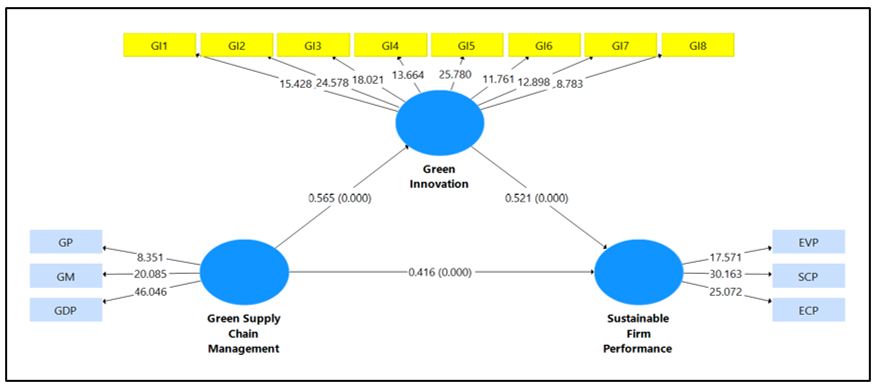
Based on Figure 2, the hypothesis test results can be summarized in Table 6. The coefficient of influence of GSCM on GI is 0.565 with a t statistic of 7.297 and a p-value of 0.000. Because the coefficient is positive and the p-value<0.05, hypothesis 1 is supported. The coefficient influence of GSCM on SFP is 0.416 with a t statistic of 5.438 and a p-value of 0.000. Because the coefficient is positive and p-value<0.05, it can be concluded that GSCM has a positive and significant effect on SFP, and hypothesis 2 is supported. The coefficient of influence of GI on SFP is 0.521 with a t statistic of 6.986 and a p-value of 0.000. The coefficient is positive, and the p-value<0.05 indicates that hypothesis 3 is supported.
This research also conducted a mediation test. The results show that the coefficient of influence of GSCM on SFP with GI as mediation is 0.294 with a t statistic of 4.227 and a p-value of 0.000. Because the coefficient is positive and p-value<0.05, it can be concluded that hypothesis 4 is supported.
Figure 2. Final model
Table 6. Hypothesis testing
|
Hypothesis |
Path Coefficients |
Mean |
Standard Deviation (STDEV) |
t Statistics |
p Values |
Result |
|
|
H1 |
GSCM -> GI |
0.565 |
0.576 |
0.077 |
7.297 |
0.000 |
Supported |
|
H2 |
GSCM -> SFP |
0.416 |
0.415 |
0.077 |
5.438 |
0.000 |
Supported |
|
H3 |
GI -> SFP |
0.521 |
0.526 |
0.075 |
6.986 |
0.000 |
Supported |
|
H4 |
GSCM -> GI -> SFP |
0.294 |
0.305 |
0.070 |
4.227 |
0.000 |
Supported |
Note: p <0.05
Companies that focus on SFP can implement GSCM in their supply chains and support GI at the same time. In implementing GSCM, the company ensures that all activities in its supply chain are environmentally friendly. In Eco-Print MSMEs, the GSCM concept is reflected in the selection of suppliers and raw materials. Furthermore, the production process also uses traditional and environmentally friendly equipment. Innovation products from Eco-Print MSMEs are also ecologically friendly innovation products.
The application of GSCM in Eco-Print MSMEs can be seen from the raw materials chosen, starting from fabric and dyes. Apart from that, using leaves and plants to produce Eco-print fabric is also a form of GSCM. Apart from an environmentally friendly supply chain, Eco-print MSMEs reflect GI, which can be seen in Eco-print fabric products resulting from ecologically friendly innovation. Environmentally friendly raw materials, tools, and production methods can support company sustainability. Companies choose suppliers with environmentally friendly products, use environmentally friendly raw materials/materials, carry out environmentally friendly production, and produce environmentally friendly products, showing the existence of a GSCM, GI, and SFP relationship.
This research shows that GSCM in Eco-Print MSMEs positively affects GI. It follows the conditions where Eco-Print MSMEs use environmentally friendly raw and supporting materials to produce innovative products in Eco-print fabrics included in the green product category. A supply chain that considers the environment will influence a company's GI value products. The implementation of GSCM in Eco-Print MSMEs also positively influences SFP. It cannot be separated from how the supply chain has paid attention to behavior and products that support sustainability. The selection of suppliers and raw materials/environmentally friendly materials impacts the company's sustainability. This condition certainly has a positive effect on the company's SFP. GI is shown in the results of Eco-Print MSME products based on an environmentally friendly concept. This environmentally friendly product innovation positively affects the company's SFP.
The effect of GSCM on SFP was found to be mediated by GI. Implementing GSCM in Eco-Print MSMEs has produced environmentally friendly innovative products that GI creates. These products support the Eco-Print MSME SFP.
This research shows that Eco-print MSMEs not only produce environmentally friendly products but have also implemented GSCM. The application of GSCM can be seen from the use of environmentally friendly raw materials. Implementing GSCM affects SFP, where companies with sustainability in their SCM can support their performance. The influence of GSCM on SFP is mediated by GI, meaning that the implementation of sustainability in the supply chain, such as environmentally friendly raw materials, must also be supported by the results of ecologically friendly product innovation. The result is to help the company's SFP.
This research still uses a sample of companies with environmentally friendly products and raw materials. Future research can be conducted on companies that do not explicitly focus on environmentally friendly companies and also on large companies. It can enrich the literature on applying GSCM, GI, and SFP in other companies.
This work is supported by the Center for Development of Management Studies, Department of Management, Faculty of Business and Economics, Universitas Islam Indonesia (Grant no.: 9/P/ Collaboration Grant /PPMJur.Mj/XII/2022).
[1] Zhu, Q., Sarkis, J. (2006). An inter-sectoral comparison of green supply chain management in China: Drivers and practices. Journal of Cleaner Production, 14(5): 472-486. https://doi.org/10.1016/j.jclepro.2005.01.003
[2] Linton, J.D., Klassen, R., Jayaraman, V. (2007). Sustainable supply chains: An introduction. Journal of Operations Management, 25(6): 1075-1082. https://doi.org/10.1016/j.jom.2007.01.012
[3] Reefke, H., Sundaram, D. (2017). Key themes and research opportunities in sustainable supply chain management-identification and evaluation. Omega, 66: 195-211. https://doi.org/10.1016/j.omega.2016.02.003
[4] Ashby, A., Leat, M., Hudson‐Smith, M. (2012). Making connections: A review of supply chain management and sustainability literature. Supply Chain Management: An International Journal, 17(5): 497-516. https://doi.org/10.1108/13598541211258573
[5] Syakila, N. (2016). The influence of green supply chain management practices on firm competitiveness performances. https://ssrn.com/abstract=2882969.
[6] Chin, T.A., Tat, H.H., Sulaiman, Z. (2015). Green supply chain management, environmental collaboration and sustainability performance. Procedia Cirp, 26: 695-699. https://doi.org/10.1016/j.procir.2014.07.035
[7] Mafini, C., Muposhi, A. (2017). The impact of green supply chain management in small to medium enterprises: Cross-sectional evidence. Journal of Transport and Supply Chain Management, 11(1): 1-11. https://doi.org/10.4102/jtscm.v11i0.270
[8] Zhu, Q., Sarkis, J., Lai, K.H. (2013). Institutional-based antecedents and performance outcomes of internal and external green supply chain management practices. Journal of Purchasing and Supply Management, 19(2): 106-117. https://doi.org/10.1016/j.pursup.2012.12.001
[9] Mirhedayatian, S.M., Azadi, M., Saen, R.F. (2014). A novel network data envelopment analysis model for evaluating green supply chain management. International Journal of Production Economics, 147: 544-554. https://doi.org/10.1016/j.ijpe.2013.02.009
[10] Antwi, B.O., Agyapong, D., Owusu, D. (2022). Green supply chain practices and sustainable performance of mining firms: Evidence from a developing country. Cleaner Logistics and Supply Chain, 4: 100046. https://doi.org/10.1016/j.clscn.2022.100046
[11] Fernando, Y., Jabbour, C.J.C., Wah, W.X. (2019). Pursuing green growth in technology firms through the connections between environmental innovation and sustainable business performance: Does service capability matter? Resources, Conservation and Recycling, 141: 8-20. https://doi.org/10.1016/j.resconrec.2018.09.031
[12] Li, D., Zheng, M., Cao, C., Chen, X., Ren, S., Huang, M. (2017). The impact of legitimacy pressure and corporate profitability on green innovation: Evidence from China top 100. Journal of Cleaner Production, 141: 41-49. https://doi.org/10.1016/j.jclepro.2016.08.123
[13] Xie, X., Huo, J., Zou, H. (2019). Green process innovation, green product innovation, and corporate financial performance: A content analysis method. Journal of Business Research, 101: 697-706. https://doi.org/10.1016/j.jbusres.2019.01.010
[14] Rao, P., Holt, D. (2005). Do green supply chains lead to competitiveness and economic performance? International Journal of Operations & Production Management, 25(9): 898-916. https://doi.org/10.1108/01443570510613956
[15] Chiou, T.Y., Chan, H.K., Lettice, F., Chung, S.H. (2011). The influence of greening the suppliers and green innovation on environmental performance and competitive advantage in Taiwan. Transportation Research Part E: Logistics and Transportation Review, 47(6): 822-836. https://doi.org/10.1016/j.tre.2011.05.016
[16] Uyanik, M. (2023). Resource-based view in marketing literature. Journal of Business and Management Studies, 5(4): 29-39. https://doi.org/10.32996/jbms.2023.5.4.4
[17] Piao, X., Choi, M. C. (2021). Organizations' resource and fluctuation. Journal of Human-Centric Science and Technology Innovation, 1(3): 33-40. https://doi.org/10.21742/jhsti.2021.1.3.05
[18] Hu, M.K., Kee, D.M.H. (2021). Fostering sustainability: Reinventing SME strategy in the new normal. Foresight, 24(3/4): 301-318. https://doi.org/10.1108/fs-03-2021-0080
[19] Chen, Y.S., Chang, C.H., Wu, F. (2012). Origins of green innovations: The differences between proactive and reactive green innovations. Management Decision, 50(3): 368-398. https://doi.org/10.1108/00251741211216197
[20] Ojha, D., Struckell, E., Acharya, C., Patel, P.C. (2018). Supply chain organizational learning, exploration, exploitation, and firm performance: A creation-dispersion perspective. International Journal of Production Economics, 204: 70-82. https://doi.org/10.1016/j.ijpe.2018.07.025
[21] Selviaridis, K., Spring, M. (2022). Fostering SME supplier‐enabled innovation in the supply chain: The role of innovation policy. Journal of Supply Chain Management, 58(1): 92-123. https://doi.org/10.1111/jscm.12274
[22] Harms, D., Hansen, E.G., Schaltegger, S. (2013). Strategies in sustainable supply chain management: An empirical investigation of large German companies. Corporate Social Responsibility and Environmental Management, 20(4): 205-218. https://doi.org/10.1002/csr.1293
[23] Lisi, W., Zhu, R., Yuan, C. (2020). Embracing green innovation via green supply chain learning: The moderating role of green technology turbulence. Sustainable Development, 28(1): 155-168. https://doi.org/10.1002/sd.1979
[24] Song, M., Yang, M. X., Zeng, K.J., Feng, W. (2020). Green knowledge sharing, stakeholder pressure, absorptive capacity, and green innovation: Evidence from Chinese manufacturing firms. Business Strategy and the Environment, 29(3): 1517-1531. https://doi.org/10.1002/bse.2450
[25] Grekova, K., Calantone, R.J., Bremmers, H.J., Trienekens, J.H., Omta, S.W.F. (2016). How environmental collaboration with suppliers and customers influences firm performance: Evidence from Dutch food and beverage processors. Journal of Cleaner Production, 112: 1861-1871. https://doi.org/10.1016/j.jclepro.2015.03.022
[26] Kobarg, S., Stumpf-Wollersheim, J., Schlägel, C., Welpe, I.M. (2020). Green together? The effects of companies' innovation collaboration with different partner types on ecological process and product innovation. Industry and Innovation, 27(9): 953-990. https://doi.org/10.1080/13662716.2020.1713733
[27] Jin, Y., Edmunds, P. (2015). Achieving a competitive supply chain network for a manufacturer. Journal of Manufacturing Technology Management, 26(5): 744-762. https://doi.org/10.1108/jmtm-01-2013-0004
[28] Zailani, S., Jeyaraman, K., Vengadasan, G., Premkumar, R. (2012). Sustainable supply chain management (SSCM) in Malaysia: A survey. International Journal of Production Economics, 140(1): 330-340. https://doi.org/10.1016/j.ijpe.2012.02.008
[29] Becker, B. (2023). Green innovation strategies, innovation success, and firm performance—Evidence from a panel of Spanish firms. Sustainability, 15(2): 1656. https://doi.org/10.3390/su15021656
[30] Lopes, C.M., Scavarda, A., Hofmeister, L.F., Thomé, A.M.T., Vaccaro, G.L.R. (2017). An analysis of the interplay between organizational sustainability, knowledge management, and open innovation. Journal of Cleaner Production, 142: 476-488. https://doi.org/10.1016/j.jclepro.2016.10.083
[31] Schaltegger, S., Lüdeke-Freund, F., Hansen, E.G. (2012). Business cases for sustainability: The role of business model innovation for corporate sustainability. International Journal of Innovation and Sustainable Development, 6(2): 95-119. http://doi.org/10.1504/IJISD.2012.046944
[32] Albort-Morant, G., Leal-Millán, A., Cepeda-Carrión, G. (2016). The antecedents of green innovation performance: A model of learning and capabilities. Journal of Business Research, 69(11): 4912-4917. https://doi.org/10.1016/j.jbusres.2016.04.052
[33] Shahid, H.M., Waseem, R., Khan, H., Waseem, F., Hasheem, M.J., Shi, Y. (2020). Process innovation as a moderator linking sustainable supply chain management with sustainable performance in the manufacturing sector of Pakistan. Sustainability, 12(6): 2303. https://doi.org/10.3390/su12062303
[34] Zhu, Q., Sarkis, J., Lai, K.H. (2007). Green supply chain management: Pressures, practices, and performance within the Chinese automobile industry. Journal of Cleaner Production, 15(11-12): 1041-1052. https://doi.org/10.1016/j.jclepro.2006.05.021
[35] Zhu, Q., Sarkis, J., Lai, K.H. (2012). Examining the effects of green supply chain management practices and their mediations on performance improvements. International Journal of Production Research, 50(5): 1377-1394. https://doi.org/10.1080/00207543.2011.571937
[36] Bolaji, B.H., Abdul Rahim, M.K.I., Omar, S. (2024). Integrating green practices and environmental performance; Evidence from Nigeria's SME sector. International Journal of Sustainable Development and Planning, 19(2): 469-480. https://doi.org/10.18280/ijsdp.190206
[37] Esfahbodi, A., Zhang, Y., Watson, G. (2016). Sustainable supply chain management in emerging economies: Trade-offs between environmental and cost performance. International Journal of Production Economics, 181: 350-366. https://doi.org/10.1016/j.ijpe.2016.02.013
[38] Azevedo, S.G., Carvalho, H., Machado, V.C. (2011). The influence of green practices on supply chain performance: A case study approach. Transportation Research Part E: Logistics and Transportation Review, 47(6): 850-871. https://doi.org/10.1016/j.tre.2011.05.017
[39] Albhirat, M.M., Zulkiffli, S.N.A., Salleh, H.S., Zaki, N.A.M. (2023). The moderating role of social capital in the relationship between green supply chain management and sustainable business performance: Evidence from Jordanian SMEs. International Journal of Sustainable Development and Planning, 18(6): 1733-1747. https://doi.org/10.18280/ijsdp.180609
[40] Mutingi, M., Mapfaira, H., Monageng, R. (2014). Developing performance management systems for the green supply chain. Journal of Remanufacturing, 4: 1-20. https://doi.org/10.1186/s13243-014-0006-z
[41] Micheli, G.J., Cagno, E., Mustillo, G., Trianni, A. (2020). Green supply chain management drivers, practices and performance: A comprehensive study on the moderators. Journal of Cleaner Production, 259: 121024. https://doi.org/10.1016/j.jclepro.2020.121024
[42] Cousins, P.D., Lawson, B., Petersen, K.J., Fugate, B. (2019). Investigating green supply chain management practices and performance: The moderating roles of supply chain ecocentricity and traceability. International Journal of Operations & Production Management, 39(5): 767-786. https://doi.org/10.1108/IJOPM-11-2018-0676
[43] Laari, S., Töyli, J., Solakivi, T., Ojala, L. (2016). Firm performance and customer-driven green supply chain management. Journal of Cleaner Production, 112: 1960-1970. https://doi.org/10.1016/j.jclepro.2015.06.150
[44] Abdallah, A.B., Al-Ghwayeen, W.S. (2019). Green supply chain management and business performance. Business Process Management Journal, 26(2): 489-512. https://doi.org/10.1108/bpmj-03-2018-0091
[45] Srivastava, S.K. (2007). Green supply‐chain management: A state‐of‐the‐art literature review. International Journal of Management Reviews, 9(1): 53-80. https://doi.org/10.1111/j.1468-2370.2007.00202.x
[46] Min, H., Kim, I. (2012). Green supply chain research: Past, present, and future. Logistics Research, 4 (1-2): 39-47. https://doi.org/10.1007/s12159-012-0071-3
[47] Rosenbusch, N., Rauch, A., Bausch, A. (2013). The mediating role of entrepreneurial orientation in the task environment-performance relationship: A meta-analysis. Journal of Management, 39(3): 633-659. https://doi.org/10.1177/0149206311425612
[48] Sezen, B., Cankaya, S.Y. (2013). Effects of green manufacturing and eco-innovation on sustainability performance. Procedia-Social and Behavioral Sciences, 99: 154-163. https://doi.org/10.1016/j.sbspro.2013.10.481
[49] Küçükoğlu, M.T., Pınar, R.İ. (2015). Positive influences of green innovation on company performance. Procedia-Social and Behavioral Sciences, 195: 1232-1237. https://doi.org/10.1016/j.sbspro.2015.06.261
[50] Singh, S.K., Del Giudice, M., Chierici, R., Graziano, D. (2020). Green innovation and environmental performance: The role of green transformational leadership and green human resource management. Technological Forecasting and Social Change, 150: 119762. https://doi.org/10.1016/j.techfore.2019.119762
[51] Elzek, Y., Gaafar, H., Abdelsamie, H. (2021). The impact of green innovation on sustainability performance in travel agencies and hotels: The moderating role of environmental commitment. International Journal of Hospitality and Tourism Systems, 14(2): 15-24. https://www.proquest.com/scholarly-journals/impact-green-innovation-on-sustainability/docview/2503305563/se-2.
[52] Afum, E., Zhang, R., Agyabeng-Mensah, Y., Sun, Z. (2021). Sustainability excellence: The interactions of lean production, internal green practices, and green product innovation. International Journal of Lean Six Sigma, 12(6): 1089-1114. https://doi.org/10.1108/IJLSS-07-2020-0109
[53] Zhu, Q., Sarkis, J. (2004). Relationships between operational practices and performance among early adopters of green supply chain management practices in Chinese manufacturing enterprises. Journal of Operations Management, 22(3): 265-289. https://doi.org/10.1016/j.jom.2004.01.005
[54] Shang, K.C., Lu, C.S., Li, S. (2010). A taxonomy of green supply chain management capability among electronics-related manufacturing firms in Taiwan. Journal of Environmental Management, 91(5): 1218-1226. http://doi.org/10.1016/j.jenvman.2010.01.016
[55] Lai, K., Ngai, E.W., Cheng, T.C. (2002). Measures for evaluating supply chain performance in transport logistics. Transportation Research Part E: Logistics and Transportation Review, 38(6): 439-456. https://doi.org/10.1016/S1366-5545(02)00019-4
[56] Dang, S., Chu, L. (2016). Evaluation framework and verification for sustainable container management as reusable packaging. Journal of Business Research, 69(5): 1949-1955. https://doi.org/10.1016/j.jbusres.2015.10.086
[57] Hair, J.F., Black, W.C., Babin, B.J., Anderson, R.E. (2019). Multivariate data analysis. Cengage Learning EMEA, Hampshire, United Kingdom.
[58] Henseler, J., Ringle, C.M., Sarstedt, M. (2015). A new criterion for assessing discriminant validity in variance-based structural equation modeling. Journal of the Academy of Marketing Science, 43(1): 115-135. https://doi.org/10.1007/s11747-014-0403-8
[59] Sekaran, U., Bougie, R. (2019). Research Methods for Business: A Skill Building Approach. Wiley, United Kingdom.