Husna Tiara Putri* | Kosuke Mizuno | Djoko Mulyo Hartono | Hayati Sari Hasibuan | Sri Maryati
© 2025 The authors. This article is published by IIETA and is licensed under the CC BY 4.0 license (http://creativecommons.org/licenses/by/4.0/).
OPEN ACCESS
The phenomenon of urbanization has driven the formation of settlements along the coast of Bandar Lampung, directly impacting coastal ecosystem functions and conflicting with the principles of Sustainable Development Goals (SDGs) 11 and 14. Consequently, appropriate policy instruments are required to manage these settlements. Meanwhile, the coastal area, being a strategic region with overlapping multi-stakeholder authorities, necessitates specific and clear management instruments. This research aims to formulate a sustainable coastal settlement management strategy using a quantitative approach and mixed methods through observations, questionnaires, and interviews. The analysis reveals that coastal settlements have long been established, continue to grow, and are crucial for community survival. However, they face specific issues related to coastal areas, including land tenure, household waste and wastewater management, and susceptibility to coastal disasters, which can increase community vulnerability. Implementing specific coastal zone regulations and providing basic infrastructure are essential for managing settlements and addressing these issues to support the achievement of sustainable cities.
coastal sustainability, coastal waterfront settlement, management strategies
Coastal areas represent a critical transition zone between terrestrial and marine environments, characterized by high biodiversity and significant vulnerability to sustainability issues [1]. These areas offer essential ecosystem services, such as protection for communities, food provisioning, and environmental restoration, which makes them attractive places for human settlement [1, 2]. Consequently, coastal regions have experienced rapid urbanization, with over half of the world’s population—approximately 1.39 billion people-residing in these areas [3]. This urban expansion increases their susceptibility to various coastal disaster risks, particularly those exacerbated by climate change [4, 5]. However, human presence in these areas also poses a significant threat to the integrity of coastal ecosystems, leading to their degradation and complicating efforts to achieve sustainability [6, 7].
Indonesia, an archipelagic country located in Southeast Asia along the equator, has a unique geographical configuration with approximately two-thirds of its 8.3 million km² area covered by marine waters. As a result, more than 300 cities across Indonesia exhibit coastal characteristics [8]. Each of these coastal cities possesses distinct characteristics and faces unique challenges, particularly in managing and utilizing coastal resources effectively. These diverse conditions reflect the broader issues encountered by coastal cities globally and provide valuable insights for understanding and addressing the complexities of coastal management.
According to the Central Bureu of Statistic of Indonesia, many coastal cities in Indonesia are currently dominated by inadequate settlements inhabited by low-income urban residents and fishermen [9]. These communities often have limited resources to secure adequate housing, resulting in the development of informal, densely populated, and vulnerable settlements along Indonesia's coastal areas. Previous studies show these conditions are prevalent in fishing communities, reflecting broader challenges in coastal settlement management [10-12]. This situation underscores the need for targeted strategies to improve living conditions and sustainability in these vulnerable coastal environments.
Despite the substantial body of research on coastal settlements in Indonesia, focusing particularly on their vulnerabilities [13-16], there remains a notable gap in studies oriented towards practical solutions. While other research has emphasized the impact of settlements on coastal ecosystem conditions, there is a shortage of comprehensive studies that address actionable strategies for improving these conditions [17, 18]. Existing solution-oriented research is still limited, highlighting the need for further investigation into sustainable coastal settlement practices [19-22]. This gap presents an opportunity for new research aimed at developing and implementing strategies that contribute to the sustainability of coastal areas, aligning with the broader goals of coastal management and environmental stewardship [23].
This study focuses on Bandar Lampung as the case study area. As the capital of Lampung Province, Bandar Lampung plays a key role in providing national-level services and functions. Located at the southern tip of Sumatra Island, the city directly borders Lampung Bay, which contributes to its distinct coastal character. Bandar Lampung covers an area of 197.22 km² and had a population of 1,209,937 as of 2022 [24]. The city's development plan emphasizes growth in the trade and service sectors, reflecting its status as a major economic and commercial center in the region. Additionally, Bandar Lampung's strategic coastal location and its economic activities make it a pertinent area for investigating the complexities of coastal settlement management and sustainability challenges.
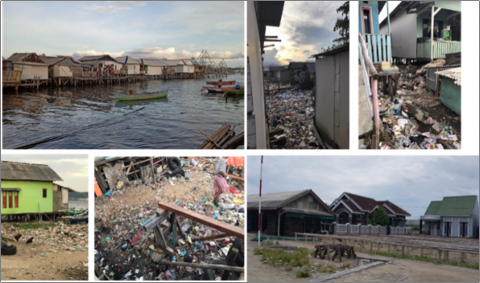
Satellite imagery from 2022 reveals that along the coast of Bandar Lampung, there are informal settlements characterized by their dense, unplanned, and sprawling nature extending into the waters. These areas feature permanent structures, including self-built houses on reclaimed land and stilt houses over the coastal waters, significantly altering the natural coastal landscape. These informal settlements have developed over time, becoming an integral part of the urban fabric. Residents have progressively enhanced their stilt houses to improve resilience and living conditions. Bandar Lampung, situated at the mouth of Lampung Bay, faces distinctive environmental challenges, including coastal waste management and disaster risks, exacerbated by urban activities and high marine conditions (Figure 1). Notably, these settlements are concentrated in Bumi Waras District.
Figure 1. Waterfront coastal settlement in Bandar Lampung
In the context of urban and coastal management, the issues surrounding coastal settlements in Bandar Lampung remain unresolved. According to national regulations governing coastal zone management under Law No. 1 of 2014 on the Amendment to Law Number 27 of 2007 concerning the Management of Coastal Areas and Small Islands, these settlements fall within a jurisdictional overlap between provincial and municipal authorities. As of 2023, there was no formal policy framework specifically addressing the management of coastal settlements in Bandar Lampung. Settlements extending into coastal waters up to 12 miles fall under provincial management, while the residents are part of the Bandar Lampung urban community. This jurisdictional ambiguity creates gaps in planning and management. However, recent developments, such as the Ministry of Maritime Affairs and Fisheries Regulation No. 28 of 2021 on Spatial Planning, which has been incorporated into the Lampung Province Spatial Plan 2023-2043 and the Bandar Lampung City Spatial Plan 2021─2041, provide a clearer and more formal basis for coastal settlement management. Despite these advances, the current policies are still broadly defined and lack technical specifics, presenting an opportunity for research to address these issues within the specific context of Bandar Lampung’s coastal settlements.
Based on the aforementioned issues, this study addresses the research question: “What strategies can be implemented for waterfront coastal settlements in Bandar Lampung?” To answer this question, the research has two primary objectives: first, to identify the current conditions and challenges associated with coastal settlements in Bandar Lampung, and second, to develop effective and sustainable management strategies for these settlements. The findings from this study not only serve as a foundational basis for formulating practical and sector-specific policies in Bandar Lampung but also provide insights that can be adapted to similar coastal cities globally. By addressing issues such as informal settlements, land tenure, and environmental degradation in coastal areas, this research contributes to the broader discourse on sustainable urban coastal management, offering strategies that are applicable to cities facing rapid coastal urbanization and environmental pressures worldwide.
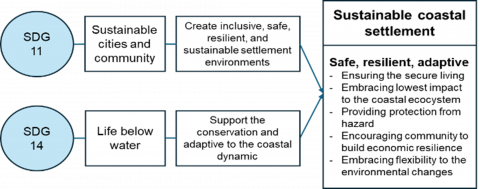
Sustainable development can be simply defined as development that provides economic benefits to improve the well-being of communities without degrading the environment. In the context of coastal settlements, sustainable management is intrinsically linked to Sustainable Development Goals (SDGs) 11 and 14 which emphasize the creation of inclusive, safe, resilient, and environmentally friendly urban areas [25] (refer to Figure 2). SDG 11 focuses on making cities and human settlements inclusive, safe, resilient, and sustainable, ensuring that urban development does not compromise the ability of future generations to meet their own needs. Meanwhile, SDG 14 addresses the sustainable use of oceans, seas, and marine resources, recognizing the critical role of healthy marine ecosystems in supporting livelihoods, food security, and economic prosperity for coastal communities.
Figure 2. Sustainable coastal settlement framework
The concept of sustainability remains highly relevant for coastal areas, which require comprehensive development strategies [26]. The four pillars of sustainable development—environmental, social, economic, and institutional—can be explored to identify critical factors underlying the challenges faced by these regions. Integratively, this concept can be implemented to create settlements that are harmonious with coastal ecosystems.
Effective management of these areas requires harmonizing urban development with environmental stewardship, ensuring that the expansion and growth of coastal settlements do not come at the expense of the natural ecosystems that provide essential services to both humans and wildlife [27, 28]. This balance is crucial for fostering overall resilience and sustainability, particularly in coastal areas that are increasingly vulnerable to the impacts of climate change, such as rising sea levels, storm surges, and coastal erosion [29, 30]. Additionally, economic resilience in coastal communities can be strengthened through sustainable utilization of fisheries resources [11, 31, 32]. By integrating sustainable practices into the planning and development of coastal settlements, cities can not only enhance the well-being of their populations but also protect and preserve vital coastal and marine environments for future generations [33].
3.1 Study area
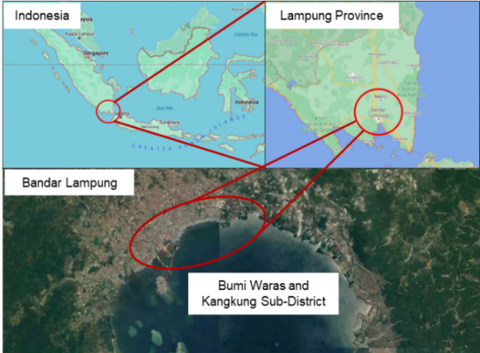
The research is Kangkung and Bumi Waras Sub-District, Bumi Waras District, Bandar Lampung (Figure 3, processed based on data from Google imagery data). Bumi Waras District is one of the most densely populated districts in Bandar Lampung City, covering an area of 3.75 hectares with a population of 65,542 and a density of 174.78 people per hectare [24]. The study focuses on settlements built over coastal waters, comprising traditional stilt houses or areas reclaimed as land.
Figure 3. Location of study area
3.2 Data and survey
Data collection was carried out through a combination of primary surveys and secondary sources. The primary surveys included the distribution of questionnaires, observational assessments, and in-depth interviews conducted between 2020 and 2022. The survey process was divided into two main stages: an initial mapping phase and a detailed survey phase. During the initial phase, a spatial analysis was performed using high-resolution imagery from aerial photographs (May 2021) processed with ArcGIS Pro 3.1.2 2023. This phase involved mapping the spatial distribution and extent of the settlements based on land use and ontological criteria, focusing on those built on coastal waters. Key attributes considered included road networks, building footprints, urban boundaries, and coastal areas. The spatial data provided a foundation for understanding the physical growth and layout of the settlements and was cross-referenced with survey findings to validate the results.
The core survey phase involved administering questionnaires to 178 respondents from Bumi Waras, facilitated by trained enumerators adhering to strict health protocols during the COVID-19 pandemic. Respondents were selected using an incidental sampling technique based on settlement accessibility and willingness to participate. Each household was represented by one respondent, ensuring diverse perspectives. The questionnaire captured comprehensive data on settlement conditions, including physical infrastructure, socio-economic status, community activities, accessibility, and disaster preparedness. Observational assessments focused on physical infrastructure and environmental attributes, while in-depth interviews were conducted with local leaders and community representatives to gather qualitative insights into settlement challenges and opportunities. The collected data was used to identify and analyze the various issues faced by the settlements. Additionally, secondary data was gathered through a review of planning documents related to coastal settlement management in Bandar Lampung. These documents provided insights into policy directions and management strategies for coastal areas until 2023.
The research in Bandar Lampung employs spatial, quantitative, and qualitative methods. Spatial analysis using ArcGIS Pro 3.1.2 2023 maps the settlements, while quantitative analysis evaluates survey data to measure physical conditions, socio-economic factors, and infrastructure quality. Qualitative analysis examines interview and observational data, offering insights into community dynamics and informal settlement development. Integrating these approaches provides a comprehensive understanding of settlement conditions and challenges. Policy recommendations are formulated to improve the social and environmental sustainability of coastal areas, addressing the needs of low-income, informal communities.
4.1 Current condition of coastal settlement in study area
4.1.1 Physic and building
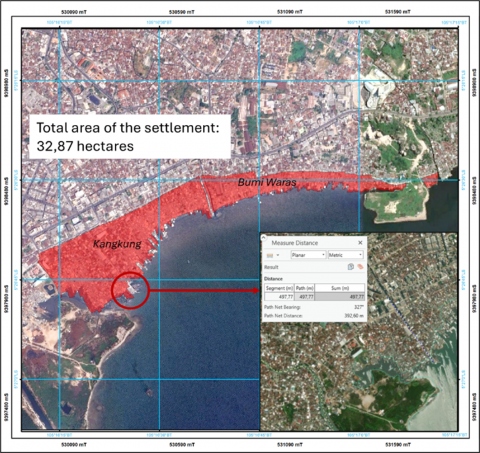
The survey results reveal a significant distinction in the types of buildings within the coastal settlements. The majority of the settlement area, accounting for 79,62%, consists of permanent houses constructed on land reclaimed by the community (Figure 4 and Table 1). These reclaimed areas are created using a mixture of waste, rocks, and soil, with waste materials accumulated along the coastal waters being repurposed to build stable land for housing. This practice has substantially altered the natural coastal morphology and landscape. The remaining 20.38% of the settlement area is occupied by stilt houses, which are constructed from semi-permanent and non-permanent materials. These stilt houses are less stable and more vulnerable to coastal disaster risks.
The settlement area extends up to 0.50 km from the main urban road network, further integrating the coastal community with the urban fabric. The extensive use of reclaimed land and the construction of permanent structures have had a profound impact on the coastal environment, highlighting the need for improved management practices to address the environmental and safety challenges associated with these settlements.
Figure 4. Distribution of the coastal waterfront settlement in Bumi Waras District as the study area
Table 1. Physical building component
|
Aspect |
Detail |
|
Total area |
32.87 hectares |
|
Permanent housing (reclaimed settlement) |
26.17 hectares (79.62%) |
|
Semi permanent housing (using semi material permanent and concrete road) |
5.74 hectares (17.64%) |
|
Non permanent housing (above the water) |
0.96 hectares (2.92%) |
|
Distance to the main road |
0.50 km |
Table 2. Accessibility to basic infrastructure
|
Aspect |
Detail |
|
Electricity (PLN) |
100% |
|
Clean water access (PDAM, self sufficient, and private sector) |
100% |
|
Managed waste |
11.36% |
|
Unmanaged waste (dumped to the coastal water) |
88.64% |
|
Septic tank ownership |
61.36% |
4.1.2 Electrification
According to the survey, 100% of respondents reported having access to electricity (Table 2). All surveyed coastal settlements are serviced by the national electricity provider (Perusahaan Listrik Negara/PLN). Residents have the option to register as new customers or connect to the electricity network of registered neighbors through a monthly payment scheme. This service provision is facilitated based on community requests conveyed through local neighborhood association leaders (Ketua RT). The establishment of this electrical infrastructure highlights the government's effort to support local industries and improve the overall quality of life for residents.
4.1.3 Clean water access
Based on the survey, 100% of respondents have access to clean water from various sources, through both piped and non-piped systems (Table 2). Clean water is supplied by PDAM Way Rilau, the local water utility of Bandar Lampung, which operates in service zone 75. Water is provided via household connections and public taps accessible to all residents within the settlements. Residents with bore wells also offer water to their neighbors, charging fees set by the well owners. For consumption needs, residents use refillable water or purchase bottled water from mobile vendors, with prices ranging from Rp3,000.00 to Rp4,000.00 per drum [34]. Despite these varying sources of water, residents reported no significant issues regarding the availability of clean water.
4.1.4 Waste management
Based on the survey, the majority of residential waste remains unmanaged, as indicated by 88.64% of respondents who dispose of their waste directly into the sea without any specific treatment (Table 2). Meanwhile, a small portion of the remaining waste is managed through the municipal waste management system. Although the government has provided waste collection points and waste transportation vehicles (SOKLI) within the settlements, only a small fraction of the population utilizes these facilities. This widespread practice of direct waste disposal underscores the urgent need for improved waste management solutions in these communities. The continued disposal of waste into the sea poses significant environmental health risks and exacerbates pollution in coastal waters.
4.1.5 Wastewater treatment and sanitation
According to the survey, 61,36% of respondents have installed a communal sanitation facility with a septic tank, while the remaining respondents do not have septic tanks and rely on direct discharge of wastewater into the sea (Table 2). There is no centralized wastewater treatment network within the settlements for the processing of wastewater. Wastewater management is exclusively handled through septic tanks, and untreated wastewater poses a significant risk as it can contribute to the pollution of coastal waters. This lack of effective wastewater treatment highlights an urgent need for improved sanitation infrastructure to prevent environmental contamination and protect coastal ecosystems.
4.1.6 Community activity
The activities of communities within the coastal settlements are closely tied to their livelihoods and the utilization of coastal resources. According to the survey data, the distribution of occupations among respondents is as follows: fishermen (33.27%), traders (36.36%), private sector employees (15.38%), entrepreneurs (15.38%), civil servants (1.40%), and laborers (12.59%).
Notably, 65.91% of respondents engage in fishing activities for daily consumption, even if fishing is not their primary occupation. Bumi Waras is home to the Gudang Lelang Fish Auction Center, which serves as a central marketplace for fish and processed fish products. The coastal waters in these areas are dotted with fishing boats, highlighting the strategic role of Bumi Waras in supporting local fishing activities. This distribution underscores the integration of fishing into the urban-focused economic dynamics of the region.
4.1.7 Coastal disaster
Tidal flooding is the most frequent disaster experienced in the coastal settlements. According to the survey, 34% of respondents reported an increase in tidal flooding events in their areas. However, the community tends to view these occurrences as routine and not particularly concerning, as the floodwaters typically recede within 2 to 3 hours.
The impact of flooding is particularly felt by semi-permanent houses located close to the sea. Flooding often occurs during heavy rainfall, and although the waters subside quickly, coastal debris carried by the waves accumulates within the settlement area. The maximum observed flooding height reaches 40 cm, with the furthest extent reaching up to 40 meters from the nearest house to the sea.
On the other hand, stilt houses built above the maximum sea level provide better resilience, reducing the risk of disaster from tidal flooding. This architectural approach demonstrates an adaptive strategy for mitigating the impacts of coastal flooding in these vulnerable areas.
4.1.8 Policies and regulations
Local policies are pivotal in guiding the management and development of coastal settlements in Bandar Lampung. The Bandar Lampung City Regulation No. 4 of 2021 on the City Spatial Plan 2021-2041 designates coastal areas as residential zones, prioritizing the development of infrastructure to mitigate erosion and saltwater intrusion [35]. Additionally, coastal zones with high tsunami risk are specifically allocated for mangrove planting as a disaster mitigation strategy.
In contrast, The Regional Regulation of Lampung Province No. 14 of 2023 on the Provincial Spatial Plan 2023-2043 classifies the coastal waters of Bumi Waras as fishing areas [36]. This regulation also incorporates the Suitability of Marine Spatial Utilization Activities (Kesesuaian Kegiataan Pemanfaatan Ruang Laut/KKPRL) scheme, which legitimizes the presence of stilt houses over coastal waters, particularly in Bumi Waras and Kangkung Sub-District. This KKPRL scheme is designed to formalize the status of fishing settlements built on water, which are typically developed independently by local communities. In Indonesia, the KKPRL scheme has also been implemented in several other coastal cities, such as Tangerang, North Jakarta, Makassar, and Riau Islands. These policies represent significant institutional and regulatory advancements, addressing the challenges faced by coastal settlements, formalizing their status, and integrating disaster risk mitigation measures into spatial planning frameworks.
4.2 Effective management strategies
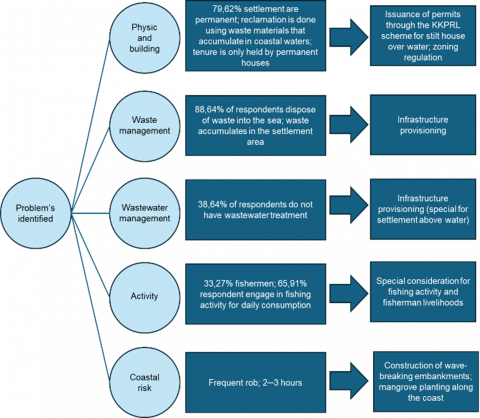
Effective management strategies for coastal settlements are developed based on the specific conditions and challenges faced within these environments. Each issue requires a tailored management approach to address its unique aspects. As outlined in the findings, a range of settlement problems has been identified (Figure 5 and Table 3). These issues necessitate the formulation of targeted strategies that account for the distinct characteristics and needs of each settlement. By addressing these specific problems through well-defined management strategies, it is possible to improve the overall sustainability and resilience of the coastal settlements.
4.2.1 Zoning recommendation
The zoning of coastal water areas is based on the current condition of settlements, ensuring that expansion beyond designated zones is not permitted. Stilt houses over water can be regulated and permitted under the KKPRL scheme, which has been incorporated into the Lampung Provincial Spatial Plan. According to its authority, residential zones can be categorized into two classifications: land-based settlements and water-based settlements, which can be detailed based on the characteristics and activities of the communities. Additionally, areas for boat docking and mangrove planting can be considered as inputs for zoning regulations. Settlements classified within these zones can be granted tenure rights in accordance with existing mechanisms.
4.2.2 Provision of basic infrastructure
The essential infrastructure that needs to be prioritized for coastal edge settlements includes waste and wastewater management.
Waste management: The accumulation of waste in coastal settlements consists of marine debris carried by waves and settlement waste that is continuously discarded and piled up. Therefore, the required waste management includes handling the existing accumulation of waste along the coast and expanding the coverage of urban waste services. The government can provide communal bins for waste disposal, which can then be managed through municipal waste services. However, the provision of such infrastructure also requires active community participation to manage and maintain the facilities provided.
Wastewater management: Managing wastewater in water-based settlements presents a significant challenge due to the limited land and buildings directly adjacent to the sea. One alternative approach is to develop a wastewater management scheme and floating sanitation facilities, such as floating toilets. In some locations, floating toilets have proven effective in enhancing sanitation coverage and public health in coastal communities.
4.2.3 Provision of disaster mitigation infrastructure
The provision of disaster mitigation infrastructure is aimed at enhancing community resilience against tidal flooding, which frequently occurs in the study area. This infrastructure may include the construction of breakwaters or the planting of mangroves along the coastline. However, such disaster mitigation infrastructure represents long-term solutions and requires significant financial investment. It is crucial to integrate these plans into medium-term development strategies to ensure their effective implementation and sustainability.
Figure 5. Recommendation for management strategies
Table 3. Alternative management strategies
|
Alternative Strategies |
|
Zoning Regulation |
|
1. Designation of land and water-based settlement zones: establishment of land-based and water-based settlement zones. 2. Prohibition of building on coastal waters: a) Formalization and socialization of the prohibition policy for building houses. b) Creation of physical boundaries for settlements. 3. Regulation of environmentally friendly building design standards: establishing standards for eco-friendly building designs. 4. Provision of housing for low-income fisherfolk: allocation of special housing for low-income fishing communities. |
|
Management of Coastal Settlement Tenure |
|
1. Mapping of settlement land ownership status: mapping and documentation of land ownership statuses. 2. Issuance of ownership certificates: granting of land ownership certificates. 3. Provision/application of rights through KKPRL scheme: issuing or applying for rights under the KKPRL scheme. |
|
Optimization of Waste Management in Coastal Areas |
|
1. Optimization of urban waste management services: enhancing the efficiency of urban waste management services. 2. Handling of accumulated marine waste: addressing the issue of accumulated marine waste. 3. Inter-regional collaboration for marine waste management: collaborating with neighboring regions to manage marine waste. |
|
Enhancing Wastewater Treatment Services in Settlements |
|
1. Community education: providing educational outreach to communities. 2. Provision of communal sanitation facilities with septic tanks: setting up communal sanitation facilities equipped with septic tanks. 3. Provision of floating toilets for water-based settlements: installing floating toilets for settlements located above water. |
|
Increasing Disaster Preparedness for Coastal Communities |
|
1. Construction of seawalls and breakwaters: building protective seawalls and breakwaters. 2. Provision of disaster shelters: establishing shelters for disaster situations. 3. Planting mangroves along the coastline: Implementing mangrove reforestation along the coast. |
|
Use of Environmentally Friendly Fishing Technologies |
|
1. Community education: educating communities on sustainable fishing practices. 2. Initiation of collaborative programs for coastal resource management: starting joint programs to manage coastal resources effectively. |
Coastal urbanization is a global phenomenon that significantly impacts the natural conditions of coastal ecosystems and the economic structures of coastal cities worldwide. Balancing urban development with environmental conservation is crucial to achieving sustainability in coastal regions [37-39]. This study contributes to this global discourse by addressing key challenges, such as land reclamation, waste management, and disaster risks in coastal settlements, which are similarly pressing issues in other urbanized coastal zones worldwide.
In the context of SDG implementation, this research directly supports SDG 11 (Sustainable Cities and Communities) by proposing strategies that enhance urban resilience and adaptability in Bandar Lampung’s coastal settlements. Furthermore, it aligns with SDG 14 (Life Below Water) by emphasizing sustainable fisheries practices and the preservation of marine ecosystems. By integrating strategies such as improved waste management systems, zoning regulations, and disaster risk reduction measures, this research provides a replicable framework for other urbanized coastal regions facing similar challenges [40]. Effective implementation of these strategies requires stakeholder collaboration, robust policies, and active community participation, which are identified as critical success factors in this study.
The findings of this study align with and expand upon prior research on the complex relationship between coastal settlements and their surrounding ecosystems. Effective management of these areas requires harmonizing urban development with environmental stewardship, ensuring that the expansion and growth of coastal settlements do not compromise the natural ecosystems that provide critical services to both humans and wildlife [27, 28]. This is particularly important as coastal areas are increasingly vulnerable to climate change impacts such as rising sea levels, storm surges, and coastal erosion [29, 30]. Similarly, this study highlights the role of land reclamation driven by tenure insecurity, which exacerbates these vulnerabilities, reflecting broader concerns about unregulated settlement practices in coastal areas [13, 16].
The findings also underscore the importance of waste and wastewater management, a critical issue identified in previous studies [39, 41]. Poor waste management practices, such as direct disposal into the sea, not only degrade coastal ecosystems but also threaten community health and well-being. This study emphasizes the need for participatory approaches and infrastructure improvements, resonating with the recommendations for integrating community-based solutions into waste management systems in coastal areas [33].
Moreover, the study builds on previous research [11, 32], which highlight the potential of sustainable fisheries management to enhance economic resilience in coastal communities. The findings here emphasize the dual need for economic sustainability and environmental conservation, reinforcing the argument [31] that environmentally friendly fisheries practices can ensure long-term resource availability and economic stability for coastal communities.
Finally, this study contributes to ongoing discussions about disaster risk reduction in coastal settlements, particularly in the context of informal and semi-permanent structures. Previous research [5, 42] emphasizes the importance of integrating nature-based solutions, such as mangrove planting and sustainable zoning, to mitigate disaster risks. The observed success of these approaches in other regions supports the need for their implementation in Bandar Lampung.
In conclusion, this research underscores the intricate relationship between coastal waterfront settlements in Bandar Lampung and their surrounding coastal environments, emphasizing the delicate balance required to achieve sustainability. The findings reveal that while these settlements provide essential housing and economic opportunities for local communities, they also present significant challenges to coastal management, including land reclamation, waste management, tenure insecurity, and disaster risks. These challenges highlight the urgent need for effective policy instruments and regulatory frameworks to manage settlement growth and mitigate environmental impacts.
This study further highlights the importance of integrating Sustainable Development Goals (SDGs) 11 and 14 into local planning efforts to foster resilient, adaptive, and environmentally friendly coastal settlements. The proposed strategies, such as improved waste management systems, strengthened zoning regulations through the KKPRL scheme, mangrove planting, and disaster mitigation infrastructure, demonstrate how a comprehensive approach can simultaneously enhance living conditions and ensure the protection and restoration of critical coastal ecosystems.
Ultimately, this research advocates for a holistic and adaptive management strategy that aligns development with environmental stewardship. By incorporating these insights into future planning and policy efforts, Bandar Lampung has the potential to serve as a model for sustainable coastal settlement management, fostering a balance that benefits both communities and the environment, while contributing to the long-term resilience and sustainability of coastal regions.
This article is part of the doctoral dissertation of a student from the School of Environmental Science, Universitas Indonesia. The author extends gratitude to Universitas Indonesia for the support and resources provided throughout the research process. Special thanks are also directed to the academic supervisors and fellow researchers for their invaluable insights and contributions, which greatly enriched the completion of this study.
[1] Miller, G.T., Spoolman, S.E. (2016). Environmental Science: Fifteenth Edition. Cengage Learning.
[2] Barbier, E.B. (2017). Marine ecosystem services. Current Biology, 27(11): R507-R510. https://doi.org/10.1016/j.cub.2017.03.020
[3] Neumann, B., Vafeidis, A.T., Zimmermann, J., Nicholls, R.J. (2015). Future coastal population growth and exposure to sea-level rise and coastal flooding - A global assessment. PLoS ONE, 10(3): e0118571. https://doi.org/10.1371/journal.pone.0118571
[4] Barragán, J.M., de Andrés, M. (2016). Basic aspects for an integrated management of the areas Coastlines of Spain: Concepts, terminology, context and delimitation criteria. Journal of Integrated Coastal Zone Management, 16(2): 171-183. https://doi.org/10.5894/rgci638
[5] Sterzel, T., Ludeke, M.K.B., Walther, C., Kok, M.T., Sietz, D., Lucas, P.L. (2020). Typology of coastal urban vulnerability under rapid urbanization. PLoS ONE, 15(1): e0220936. https://doi.org/10.1371/journal.pone.0220936
[6] Sama, A., Jamal, M.A. (2018). Impact of urbanisation and its effect on coastal communities in Chennai region. International Review of Business and Economics, 1(3): 28. https://doi.org/10.56902/IRBE.2018.1.3.28
[7] Zheng, Z., Wu, Z., Chen, Y., Yang, Z., Marinello, F. (2020). Exploration of eco-environment and urbanization changes in coastal zones: A case study in China over the past 20 years. Ecological Indicators, 119: 106847. https://doi.org/10.1016/j.ecolind.2020.106847
[8] Kementerian Kelautan dan Perikanan. (2018). Ministry of Maritime Affairs and Fisheries Smart Book. https://perpustakaan.kkp.go.id/knowledgerepository/index.php?p=show_detail&id=1073780.
[9] Badan Pusat Statistik. (2020). Marine and Coastal Resources Statistics 2020. https://www.bps.go.id/id/publication/2020/11/27/643ef35d3f0ddd761b85d074/statistik-sumber-daya-laut-dan-pesisir-2020.html.
[10] Zain, D.P., Salman, D., Baja, S. (2018). Model of slum area management based on socio-spatial approach. The case of Baubau City, Indonesia. Journal of Settlements and Spatial Planning, 9(2): 103-115. https://doi.org/10.24193/JSSP.2018.2.03
[11] Sharvina, A.N., Faqih, M., Santosa, H.R., Hayati, A. (2018). Sustainable development of fishermen settlement based on cultural aspects. Journal of Settlements and Spatial Planning, 9(2): 117-125. https://doi.org/10.24193/JSSP.2018.2.04
[12] Amin, C., Sukamdi, Rijanta, R. (2019). Livelihood changes of fisherman community driven by climate change: A case study in Semarang coastal region, Central Java, Indonesia. Humanities and Social Sciences Reviews, 7(3): 267-273. https://doi.org/10.18510/hssr.2019.7341
[13] Jihad, A., Muksin, U., Suppasri, A., Ramli, M., Banyunegoro, V.H. (2020). Coastal and settlement typologies-based tsunami modeling along the northern Sumatra seismic gap zone for disaster risk reduction action plans. International Journal of Disaster Risk Reduction, 51: 101800. https://doi.org/10.1016/j.ijdrr.2020.101800
[14] Lumban-Gaol, J., Sumantyo, J.T.S., Tambunan, E., Situmorang, D., Antara, I.M.O.G., Sinurat, M.E., Suhita, N.P.A.R., Osawa, T., Arhatin, R.E. (2024). Sea level rise, land subsidence, and flood disaster vulnerability assessment: A case study in Medan City, Indonesia. Remote Sensing, 16(5): 865. https://doi.org/10.3390/rs16050865
[15] Ramadhan, C., Ruslanjari, D., Puspitasari, D., Indasari, G.D., Sandro, N. (2022). Coastal vulnerability assessment for community resilience on abrasion: Case of Bugel Coast, Kulon Progo Regency, Indonesia. ASEAN Journal on Science and Technology for Development, 39(1): 3. https://doi.org/10.29037/ajstd.715
[16] Rudiarto, I., Pamungkas, D. (2020). Spatial exposure and livelihood vulnerability to climate-related disasters in the north coast of Tegal City, Indonesia. International Review for Spatial Planning and Sustainable Development, 8(3): 34-53. https://doi.org/10.14246/irspsd.8.3_34
[17] Surya, B., Saleh, H., Abubakr, H. (2020). Sustainability of slum-based settlement management community socio-economic empowerment (Study on slum settlements in Panakkukang district, Makassar City). Journal of Engineering and Applied Sciences, 15(1): 141-152. http://doi.org/10.36478/jeasci.2020.141.152
[18] Turisno, B.E., Mahmudah, S., Dewi, I.G.A.G.S., Soemarmi, A. (2024). Assessing human impact on coral reef ecosystems in Berau regency, Indonesia: Implications for conservation and sustainable tourism development. Pakistan Journal of Criminology, 16(3): 1257-1268. https://doi.org/10.62271/pjc.16.3.1257.1268
[19] Mardiatno, D., Malawani, M.N., Annisa, D.N., Wacano, D. (2017). Review on tsunami risk reduction in Indonesia based on coastal and settlement typology. Indonesian Journal of Geography, 49(2): 186-194. https://doi.org/10.22146/ijg.28406
[20] Ristya, Y., Hasibuan, H.S., Lubis, R.H. (2022). Analysis of physical dimensions in tsunami disaster resilience in Tanjung Lesung Special Economic Zone, Indonesia. Journal of Degraded and Mining Lands Management, 10(1): 3809-3819. https://doi.org/10.15243/jdmlm.2022.101.3809
[21] Harahap, R.H., Mulya, M.B., Andayani, L.S., Falefi, R. (2023). Assessment of community-based sanitation management in coastal areas from an economic and financial perspective. Pharmacy Education, 23(4): 219-223. https://doi.org/10.46542/pe.2023.234.219223
[22] Prana, A.M., Dionisio, R., Curl, A., Hart, D., Gomez, C., Apriyanto, H., Prasetya, H. (2024). Informal adaptation to flooding in North Jakarta, Indonesia. Progress in Planning, 186: 100851. https://doi.org/10.1016/j.progress.2024.100851
[23] Kullenberg, G. (2001). Contributions of marine and coastal area research and observations towards sustainable development of large coastal cities. Ocean and Coastal Management, 44(5-6): 283-291. https://doi.org/10.1016/S0964-5691(01)00051-5
[24] Badan Pusat Statistik. (2023). Bandar Lampung City in 2023 Figures. https://bandarlampungkota.bps.go.id/id/publication/2023/02/28/a0d8c9198a74bfcb98bd0902/kota-bandar-lampung-dalam-angka-2023.html.
[25] United Nation. (2015). Sustainable Development: The 17 Goals. United Nation. https://sdgs.un.org/goals.
[26] Basiago, A.D. (1995). Methods of defining ‘sustainability’. Sustainable Development, 3(3): 109-119. https://doi.org/10.1002/sd.3460030302
[27] Ford, J.R., Williams, R.J., Fowler, A.M., Cox, D.R., Suthers, I.M. (2010). Identifying critical estuarine seagrass habitat for settlement of coastally spawned fish. Marine Ecology Progress Series, 408: 181-193. https://doi.org/10.3354/meps08582
[28] Moschetto, F.A., Ribeiro, R.B., De Freitas, D.M. (2021). Urban expansion, regeneration and socioenvironmental vulnerability in a mangrove ecosystem at the southeast coastal of São Paulo, Brazil. Ocean and Coastal Management, 200: 105418. https://doi.org/10.1016/j.ocecoaman.2020.105418
[29] Okaka, F.O., Odhiambo, B.D.O. (2019). Health vulnerability to flood-induced risks of households in flood-prone informal settlements in the Coastal City of Mombasa, Kenya. Natural Hazards, 99(2): 1007-1029. https://doi.org/10.1007/s11069-019-03792-0
[30] Apenuwa, O.S., Dafiewhare, E.O., Owosho, O., Adeyemo, O.T., Ayeni, A.O., Agoni, C. (2022). Resilient housing provision for coastal settlements in Ondo State, Nigeria. British Journal of Environmental Sciences, 10(4): 28-46. https://doi.org/10.37745/bjes.2013/vol10n4pp2846
[31] Yulisti, M., Hidayat, A.S., Firdausy, C.M., Mu’awanah, U., Kurniasari, N., Nurjati, E. (2024). Effects of eco-friendly fishing gears on fishermen’s welfare and sustainable fisheries: Lessons learned from Indonesia. Marine Pollution Bulletin, 198: 115888. https://doi.org/10.1016/j.marpolbul.2023.115888
[32] Jeevamani, J.J.J., Priya, P., Infantina, J.A., Abhilash, K.R., Behera, D.P., Samuel, V.D., Soundararajan, R., Purvaja, R., Ramesh, R. (2020). An integrated approach to assess coastal vulnerability versus fisheries livelihood sustainability: Strategies for climate change adaptation in Sindhudurg, west coast of India. Environment, Development and Sustainability, 23(3): 4011-4042. https://doi.org/10.1007/s10668-020-00754-6
[33] Sulistyadi, Y., Demolingo, R.H., Latif, B.S., Indrajaya, T., Adnyana, P.P., Wiweka, K. (2024). The implementation of integrated coastal management in the development of sustainability-based geotourism: A case study of Olele, Indonesia. Sustainability, 16(3): 1272. https://doi.org/10.3390/su16031272
[34] Putri, H.T., Putri, K.S. (2023). Towards coastal community access to clean water: Waterfront settlement, Bumi Waras district, Lampung. IOP Conference Series: Earth and Environmental Science, 1275(1): 012043. https://doi.org/10.1088/1755-1315/1275/1/012043
[35] Pemerintah Kota Bandar Lampung. (2021). Regional spatial plan for 2021-2041. https://dev-jdih.bandarlampungkota.go.id/view-dokumen/112-7-peraturan.
[36] Pemerintah Provinsi Lampung. (2023). Lampung provincial regional regulation number 14 of 2023. https://infoperaturan.id/provinsi/peraturan-daerah-provinsi-lampung-nomor-14-tahun-2023/.
[37] Singh, S., Rao, M.J., Baranval, N.K., Kumar, K.V., Kumar, Y.V. (2023). Geoenvironment factors guided coastal urban growth prospect (UGP) delineation using heuristic and machine learning models. Ocean & Coastal Management, 236: 106496. https://doi.org/10.1016/j.ocecoaman.2023.106496
[38] Novoa, V., Rojas, O., Ahumada-Rudolph, R., Sáez, K., Fierro, P., Rojas, C. (2020). Coastal wetlands: Ecosystems affected by urbanization? Water, 12(3): 698. https://doi.org/10.3390/w12030698
[39] Wang, X., Su, F., Yan, F., Zhang, X., Wang, X. (2022). Effects of coastal urbanization on habitat quality: A case study in Guangdong-Hong Kong-Macao greater bay area. Land, 12(1): 34. https://doi.org/10.3390/land12010034
[40] Rizk Hegazy, I. (2021). Towards sustainable urbanization of coastal cities: The case of Al-Arish City, Egypt. Ain Shams Engineering Journal, 12(2): 2275-2284. https://doi.org/10.1016/j.asej.2020.07.027
[41] Jambeck, J.R., Geyer, R., Wilcox, C., Siegler, T.R., Perryman, M., Andrady, A., Narayan, R., Law, K.L. (2015). Plastic waste inputs from land into the ocean. Science, 347(6223): 768-771. https://doi.org/10.1126/science.1260352
[42] Yuanita, N., Kurniawan, A., Muhamad, I., Maureza, F. (2021). A physical model simulation of combination of a geo-bag dike and mangrove vegetation as a natural coastal protection system for the Indonesian shoreline. Applied Ocean Research, 108: 102516. https://doi.org/10.1016/j.apor.2020.102516