Bambang Widagdo | Kenny Roz*
© 2024 The authors. This article is published by IIETA and is licensed under the CC BY 4.0 license (http://creativecommons.org/licenses/by/4.0/).
OPEN ACCESS
The presence of the COVID-19 pandemic has brought about an unusual global change. The impact of COVID-19 is not only limited to the health and social sectors, but also disrupts the global economy, including the hotel industry. This study aims to determine the effect of readiness to change, technology adoption and organizational culture that affect the intention to stay on hotel employees in Indonesia. This study uses a quantitative explanatory approach, namely research based on a theory or hypothesis that will be used to test a phenomenon that occurs. The population in this study were employees working in the hotel sector in Indonesia. A total of 207 employees were used as respondents in this study based on predetermined criteria. Data collection was carried out by online survey with 5 Likert scales. The results of the study indicate that readiness to change and organizational culture have a positive effect on the intention to stay, but the application of technology has a positive but not significant effect. While organizational culture mediates the effect of readiness to change into the intention to stay, the use of technology cannot mediate the relationship both. This means that the presence or absence of technology implementation does not affect an employee to stay in the company. These findings provide practical implications for hotel managers in making managerial decisions.
readiness to change, technology adoption, organizational culture, intention to stay
With the emergence of the COVID-19 outbreak at the end of 2019, the world is facing unprecedented challenges. COVID-19 has become a global pandemic which has had a huge impact. The impact of COVID-19 is not only limited to the health and social sectors but has also disrupted the global economy. Many countries face significant economic contractions, with the industrial, tourism, and travel sectors being the worst hit. Many service companies were forced to lay off workers or go bankrupt, while millions of people lost their livelihoods. Hotel service managers also feel this is in accordance with government regulations that close tourism, activism activities, and overcrowding [1]. This policy means that the management of the hotel service industry will inevitably survive and continue to operate with extraordinary changes. This change is marked by the organization's readiness to adapt to situations and conditions. This adjustment requires time and energy as well as resistance from existing resources. For employees who can accept change, they choose to stay for various reasons, whereas employees who are not willing and able to accept change choose to leave the company [2].
Companies do many ways to keep their employees persistent and loyal to the company. This makes it a challenge for management to implement the right strategy to provide benefits, among others. Starting from changing the organizational culture that they have emphasized at the beginning. This organizational culture includes the values, norms, beliefs, and practices contained within an organization [3]. For example, an employee is allowed to work remotely (teleworking) due to changes that are required to avoid crowds and physical contact with other employees [4]. This was welcomed positively by employees, they considered the flexibility and freedom provided by the company to continue working [5].
Another thing that organizations can do to retain employees to continue working is the use of technology. Adopting technology is considered to be something that an organization needs to do in times of uncertainty regarding the changes that are occurring [6]. Employees are required to be ready to change supported by technology [7]. McCarthy et al. [8] revealed that by adopting existing technology, employees are helped to complete their duties and feel comfortable with the work environment conditions even though they are required to be ready to change. Furthermore, Carvalho and d’Angelo [9] explained that utilizing technology such as remote work makes it easier for employees to continue working, and this provides benefits for employees.
Currently, post-COVID pandemic conditions are experiencing operational adjustments and visitor requests such as: guaranteeing health protocols with tourists tending to choose destinations that offer security, cleanliness, and privacy, the use of mobile applications for check-in/check-out, contactless services, and digital payment systems are becoming increasingly common. Based on the explanation that the researcher has expressed, this study aims to reveal the readiness to change, adoption of technology and organizational culture that influence an employee to remain in a company in the hospitality services sector in Indonesia.
When carrying out work activities, an employee is required to always be ready to accept existing changes. Sometimes changes within an organization have pros and cons. If employees are not ready to accept change then they have to leave the organization and look for another organization that they consider suitable. However, some employees choose to stay for various reasons and are starting to accept and follow the existing changes [10]. Readiness to change is the extent to which an individual is or is cognitively inclined to accept, embrace, and adopt a particular plan to change status intentionally [11].
When an organization's readiness for change is high, experts argue, organizational members invest more in the change effort, expend greater effort in the change process, and demonstrate greater persistence in the face of obstacles or setbacks all of which contribute to more successful change implementation [12]. Persisting to continue contributing and developing a career in the organization is a success that the organization feels with change. Intent to remain refers to an employee's desire to remain in the organization, realizing their decision after careful consideration [13]. Based on this explanation, the researcher formulated the following hypothesis:
H1: readiness to change influences the intention to stay
Along with current globalization, both organizations and resources are required to keep up with existing changes. It is known that change occurs so quickly because it adapts to existing social conditions and dynamics. Readiness to accept change is something that is a challenge for organizations, including the employees who work in them [5]. Several literature studies explain that readiness to change is interpreted as employees' belief that they can implement the proposed change (self-efficacy), the change is appropriate for the organization, the leader is committed to the change, and this change will provide benefits for the members of the organization [2, 14]. One step that organizations can take to face change is to adopt existing technology [15]. Adopting technology is defined as applying existing technology by adapting to needs to solve problems faced by the organization [16]. Based on this explanation, the researcher formulated the following hypothesis:
H2: readiness to change influences technology adoption
The relationship between readiness to change and organizational culture is very important in facing an era of rapid change caused by technological developments. Organizational culture reflects the values, norms, and beliefs that guide the actions and behavior of individuals in an organization. Readiness for change, on the other hand, includes the ability and willingness of individuals and organizations to face change and adapt to it quickly. Readiness to change requires an open attitude towards change, the ability to learn and adapt quickly, and a readiness to overcome obstacles and challenges that arise during the change process. An organizational culture that encourages and supports readiness for change will create an environment that facilitates innovation, collaboration, and improved performance [17].
Organizational cultures supporting readiness for change tend to have several characteristics. Furthermore, a culture that encourages problem-solving, collaboration, and experimentation will create an environment conducive to innovation and change [17]. Additionally, a culture that creates trust, open communication, and support from all levels of the organization will help individuals and teams to overcome the uncertainty and fear that often arises during the change process [2]. Based on this explanation, the researcher formulated the following hypothesis:
H3: readiness to change influences organizational culture
Organizational culture and the intention to continue working have a close relationship in the context of the current world of work. Organizational culture includes the values, norms, beliefs, and practices found within an organization, while intent to remain at work refers to an individual's desire to continue working within the organization [3]. A strong and positive organizational culture can influence an individual's intention to remain at work. In a broader context, a positive and supportive organizational culture can create a work climate that builds, motivates, and increases individual attachment to the organization. This can have a positive impact on individuals' intentions to remain at work, reduce turnover rates, increase productivity, and create a more stable and harmonious work environment) [18, 19].
Current advances in technology and information are also things that make employees stay with the organization. Lee et al. [20] explain that adopting technology refers to the acceptance and use of new technology by individuals in the workplace, while the intention to remain in work includes the individual's desire to continue contributing and working in the organization [21]. There are many things that employees can experience by adopting technology, including increased efficiency and productivity, opportunities for learning development, work flexibility and mobility, increased involvement and engagement, and professional development [22]. Overall, technology adoption can influence intentions to remain at work through increased efficiency, development opportunities, work flexibility, engagement, and professional development. Organizations that encourage positive technology adoption and provide support in its use tend to create innovative and attractive work environments for employees, which in turn can increase individuals' intentions to remain employed and contribute to the organization. Based on this explanation, the researcher formulated the following hypothesis:
H4: organizational culture influences the intention to stay
H5: technology adoption influences the intention to stay
Readiness to change is an individual's ability which is defined as an employee in a company or organization in facing change and being ready to adapt to the existing environment. This readiness to change has an impact that is sometimes beyond a leader's expectations in the organization. Some empirical evidence explains that there are two things that companies will get when they are ready to change, namely a high level of employees moving or leaving and taking the initiative to stay at the company [23]. Readiness to change is defined as the extent to which an individual is or is cognitively inclined to accept, embrace, and adopt a particular plan to change status intentionally [11].
The role of technology is considered to have a good impact on a person's readiness to change. Having awareness and dexterity in using technology in business is the first step to adapting. Readiness for change involves the ability to be flexible and adaptive to change. Technology is constantly evolving, and it is often necessary to abandon old methods and adopt new ones. In this case, having an open attitude and the ability to learn and master new technologies is very important [24, 25]. Another thing that underlies someone's ability to survive despite changes is the culture built by the organization itself. Studies that have been carried out [18] provide empirical evidence, that with a strong organizational culture organizational members feel comfortable and will remain loyal even though there are things that disrupt the organizational system itself [26]. Based on this explanation, the researcher formulated the following hypothesis:
H6: readiness to change influences intention to stay through technology adoption
H7: readiness to change influences intention to stay through organizational culture
Based on the explanation of the relationship between variables, the following is the conceptual framework of this research, see Figure 1.
Figure 1. Conceptual framework
The research uses an explanatory quantitative approach, namely research that is based on a theory or hypothesis that will be used to test a phenomenon that occurs [27]. The main reason for choosing this type of explanatory research is to test the proposed hypothesis to explain the influence of the independent variables (readiness to change, IT Adoption, and Organizational Culture) on the dependent variable (intention to stay) either partially or simultaneously. Data was collected by distributing questionnaires online using a 1-5 Likert scale measurement. The Likert scale of 1-5 is used to measure respondents' attitudes, opinions, or perceptions on a particular topic. This scale usually ranges from 1 (Strongly Disagree) to 5 (Strongly Agree). To ensure the reliability of the data, researchers have used a questionnaire instrument that is distributed using boldly by adopting several studies used as references. The population in this research are employees in the hotel services sector. The sample determination in this study used non-probability because the population size could not be identified.
As for determining the minimum sample size with variables ≤ 5, the number of samples is 100, while for variables ≤ 7 the minimum is 150, and for variables ≥ 7 the minimum is 150 until 300 [28]. Readiness to change is measured using 4 indicators, namely: vision clarity, change appropriateness, change efficacy, and management support adapted by previous studies [3, 15]. Technology adoption is measured using 3 indicators, namely: technology change, IT knowledge management, and IT Infrastructure which are adapted from previous studies [6, 24]. Organizational culture is measured using 4 indicators adapted from previous study [29] which consists of involvement, consistency, adaptability, and mission. For the intention to stay, 2 indicators are used, namely: thinking to stay and thinking to work which is adapted [21, 30].
This research uses SPSS Version 25 software as a tool for data processing. Researchers use SPSS Version 25 because before conducting further analysis, they must first be convinced that the data to be processed is valid and reliable by using this application such as instrument testing. Next test the research model using Partial Least Square (PLS). PLS is also used to measure the relationship of each indicator with its construct. To make it easier to conduct this research, the following are the stages in this research [27], see Figure 2.
Figure 2. Flowchart of the research methodology
4.1 Respondent demography
Based on respondent data collected through an online questionnaire, 207 respondents met the criteria including Gender, Age, Last Education, Marital Status, and Length of Work.
Based on the results of data processing carried out by researchers, table 1 shows that the demographics of respondents in this study are employees who work in the service sector, especially in hotel services, with several criteria including gender, age, highest level of education, length of service, and marital status. Table 1 shows that the respondents in this study were dominated by men with an age range of 31-35 years. This can be interpreted as being in the age range as being mature and wise in making decisions. The educational background is dominated by employees who have a bachelor's degree and have worked for a period of 1 - 3 years. This can be interpreted as meaning that employees have above average abilities in completing work and are able to solve the problems they face and are familiar enough with the company's culture and work rhythm. Meanwhile, marital status is dominated by employees with married status. This means that they work and choose to continue working because of the demands of life and the need to meet family needs.
Table 1. Respondent demographics
|
Variable |
Category |
Frequency |
Percentage % |
|
Sex |
Male |
122 |
58.93% |
|
Female |
85 |
41.07% |
|
|
Age |
20 – 25 years old |
45 |
21.73% |
|
26 – 30 years old |
64 |
30.90% |
|
|
31 – 35 years old |
78 |
37.67% |
|
|
> 36 years old |
20 |
9.67% |
|
|
Qualifications |
High School |
15 |
24.15% |
|
Diploma |
29 |
53.14% |
|
|
S1 |
105 |
17.86% |
|
|
S2 |
57 |
4.84% |
|
|
Experience |
Less than 1 year |
75 |
36.23% |
|
1 to less than 3 years |
90 |
43.48% |
|
|
More than 3 years |
42 |
20.29% |
|
|
Marital status |
Married |
160 |
77.30% |
|
Not Married yet |
47 |
22.70% |
Source: own
4.2 Construct validity and reliability test
The Goodness of Fit test on the outer model is carried out with three measurements, including convergent validity, discriminant validity, and composite reliability.
4.2.1 Convergent validity
Judging from the outer loading value for each variable. It is declared valid if the loading value is above 0.5. The test results are presented as follows, see Table 2:
Table 2. Convergent validity test results
|
Variable |
Indicator |
Outer Loading |
Results |
|
Readiness to Change (RC) |
vision clarity |
0.892 |
Valid |
|
change appropriateness |
0.878 |
Valid |
|
|
change efficacy |
0.888 |
Valid |
|
|
management support |
0.730 |
Valid |
|
|
Technology Adoption (TA) |
technology change |
0.786 |
Valid |
|
IT knowledge management |
0.836 |
Valid |
|
|
IT Infrastructure |
0.831 |
Valid |
|
|
Organizational Culture (OC) |
involvement |
0.820 |
Valid |
|
consistency |
0.868 |
Valid |
|
|
adaptability |
0.869 |
Valid |
|
|
mission |
0.838 |
Valid |
|
|
Intention to Stay (IS) |
thinking to stay |
0.907 |
Valid |
|
thinking to job |
0.899 |
Valid |
Source: own
4.2.2 Composite reliability
If the composite reliability value is above 0.7 then the variable is declared construct reliable. The following are the results of reliability measurements (refer to Table 3):
Table 3. Composite reliability test results
|
Variable |
Composite Reliability |
Results |
|
Readiness to Change (RC) |
0.912 |
Reliable |
|
Technology Adoption (TA) |
0.859 |
Reliable |
|
Organizational Culture (OC) |
0.912 |
Reliable |
|
Intention to Stay (IS) |
0.898 |
Reliable |
Source: own
4.2.3 PLS analysis
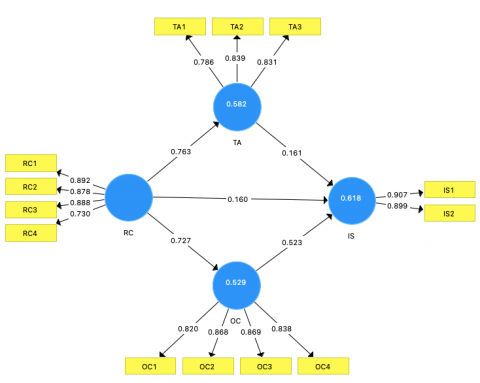
PLS testing is carried out in several steps, including the Goodness-of-Fit model, evaluating the results of the outer model and inner model. Figure 3 is the result of data processing using PLS software.
Figure 3. Data processing results using SmartPLS
Source: own
4.2.4 Goodness of fit model
Each endogenous variable expressed by the R2 value includes:
1. The endogenous variable Technology Adoption (TA) has a value of 0.582 or 58.2% of Technology Adoption (TA) is influenced by Readiness to Change (RC).
2. The endogenous variable Organizational Culture (OC) has a value of 0.529 or 52.9% of Organizational Culture (OC) is influenced by Readiness to Change (RC).
3. The endogenous variable Intention to Stay (IS) has a value of 0.618 or 61.8%. Intention to Stay (IS) is influenced by Readiness to Change (RC), Technology Adoption (TA), and Organizational Culture (OC).
The predictive relevance value (Q2) can be calculated as follows:
Q2=1–(1–R12)(1–R22) (1–R32)
Q2=1–(1–0.582)(1–0.529) (1–0.618)
Q2=1–(0.418)(0.471)(0.382)
Q2=1–0.075
Q2=0.925
4.2.5 Outer model
The largest outer loading gives the idea that the indicator for that variable is dominant. It is concluded that it is significant if the t-test value is more than 1.96 and the P-value is less than 0.05 (refer to Table 4).
Table 4. Outer model test results
|
Indicator |
Outer Loading |
T-Statistic |
P-Value |
Results |
|
RC1 |
0.892 |
47.033 |
0.000 |
Sig. |
|
RC2 |
0.878 |
39.779 |
0.000 |
Sig. |
|
RC3 |
0.888 |
50.074 |
0.000 |
Sig. |
|
RC4 |
0.730 |
20.127 |
0.000 |
Sig. |
|
TA1 |
0.786 |
29.981 |
0.000 |
Sig. |
|
TA2 |
0.839 |
37.049 |
0.000 |
Sig. |
|
TA3 |
0.831 |
37.229 |
0.000 |
Sig. |
|
OC1 |
0.820 |
31.463 |
0.000 |
Sig. |
|
OC2 |
0.868 |
43.517 |
0.000 |
Sig. |
|
OC3 |
0.869 |
45.619 |
0.000 |
Sig. |
|
OC4 |
0.838 |
34.782 |
0.000 |
Sig. |
|
IS1 |
0.907 |
52.090 |
0.000 |
Sig. |
|
IS2 |
0.899 |
52.756 |
0.000 |
Sig. |
Source: own
4.2.6 Inner model
Testing was carried out with the t-test and P-value on each path. There are two types of influence, namely direct influence and indirect influence, see Table 5.
Table 5. Direct and indirect effect test results
|
Description |
Original Sample |
T-Statistic |
P-Value |
Results |
|
Readiness to Change -> Technology Adoption |
0.763 |
26.315 |
0.000 |
Sig. |
|
Readiness to Change -> Organizational Culture |
0.727 |
24.749 |
0.00 |
Sig. |
|
Readiness to Change -> Intention to Stay |
0.160 |
2.577 |
0.001 |
Sig. |
|
Technology Adoption -> Intention to Stay |
0.161 |
1.834 |
0.067 |
Not Sig. |
|
Organizational Culture -> Intention to Stay |
0.523 |
6.379 |
0.000 |
Sig. |
|
Readiness to Change -> Technology Adoption -> Intention to Stay |
0.123 |
1.819 |
0.070 |
Not Sig. |
|
Readiness to Change -> Organizational Culture -> Intention to Stay |
0.380 |
6.185 |
0.00 |
Sig. |
Source: own
This research tries to explain the model built by researchers to measure readiness to change against intention to survive which is mediated by technology adoption and organizational culture in hotel services in Indonesia. Based on the hypotheses proposed in this study, 5 of them were rejected. Based on the results of data analysis, it was found that hypothesis 1 revealed that readiness to change has a positive and significant relationship with the adoption of technology. The results of these findings indicate that the existence of psychological processes that an employee has, which are latent in their abilities, can influence a person in adapting to the use of technology. This is supported by the findings carried out [31] state that employee readiness before adopting advanced technology has a good impact on workplace sustainability [15]. What has been done explains that one of the steps that organizations can take to deal with change is to adopt existing technology. Previous studies expressed the same thing that readiness to change has implications for adopting technology as one of the changes [5, 14].
Hypothesis 2 proposed by the researcher explains that readiness to change positively and significantly influences organizational culture. The positive direction shows that the willingness to change that employees have will have an impact on improving the organizational culture [2]. Readiness to change to adapt to existing needs, clarity and responsibility has an impact on improving organizational culture in companies, especially in the hotel services sector in Indonesia [32]. In line with the findings obtained by researchers, the empirical evidence collected reveals that readiness to change makes organizational culture better so that the company can achieve the desired goals [33, 34].
The third hypothesis reveals that readiness to change has a positive and significant effect on the intention to persist. Readiness to change is defined as a cognitive state that occurs when organizational members have positive attitudes, beliefs and intentions toward the change [35]. The purpose of readiness to change is as a way to identify members/employees in the company to make changes for the better, as well as clarify the consequences of change [36]. Clarity in the process for making changes is considered important for someone to survive in the company [37]. The results of this research are in line with the findings carried out [38]. The clarity and suitability factors that exist in the company result in someone choosing to stay in the company or organization.
The fourth hypothesis reveals that technology adoption has a positive but not significant effect on intention to stay. Technology adoption refers to the process of accepting, integrating, and using new technology in a job [8]. Whether or not there is current technological sophistication does not guarantee that someone will continue to work. Other things are more prioritized for an employee to continue working in an organization/company such as social demands, living needs, and for married employees they choose to stay because of the family's economic needs. These findings are different from the research results [6, 7, 13] which explains that adopting technology makes it easier for employees to complete tasks.
The fifth hypothesis shows empirical evidence that organizational culture has a positive and significant effect on intention to stay. Culture is an important factor for organizations and their activities [39]. In the literature, many definitions have been given regarding organizational culture, each from a different perspective. Overall, organizational culture generally represents the routine activities that occur within an organization [37, 40]. The study explains that a good organizational culture provides good opportunities for employees to continue working [18, 41]. This is supported by research conducted [42, 43] revealed that the implementation of a good and strong culture that is built with the readiness of all members of the organization within it has a good effect on employee comfort while working. It can be concluded that the better the organizational culture, the stronger the intention to continue working.
The sixth and seventh hypotheses explain the role of organizational culture and apposition technology as mediating variables on the influence of readiness to change on the intention to remain among employees in the hotel sector in Indonesia. This study provides an interesting fact that organizational culture can mediate between readiness to change and intention to persist. This makes organizational culture play an important role in why employees remain gradual while the organization guides them to change from what they usually do [17, 29] explains that the existence of a strong organizational culture can retain employees to stay for the continuity of the organization they support. Meanwhile, the adoption of technology is not able to mediate employees to remain with the organization when changes are required. The positive direction shows that there is a good relationship between readiness to change and technology adoption, even though it does not have a big impact on employees remaining in the organization.
Based on the results of the testing and data analysis that have been carried out, it can be concluded that of the 7 hypotheses proposed by the researcher, 5 hypotheses were accepted while 2 hypotheses were rejected. The 5 accepted hypotheses include: readiness to change has a positive effect on technology adoption, readiness to change has a positive effect on organizational culture, Intention to survive is positively influenced by organizational culture, Readiness to change affects intention to survive, and organizational culture can mediate the influence of readiness to change on an employee to remain in the hospitality service in Indonesia. Meanwhile, there are 2 rejected hypotheses, namely: technology adoption has no significant effect on intention to survive and is unable to mediate the influence of readiness to change on intention to survive. The absence of technology implementation in companies in the service sector does not make someone choose to survive. This study focuses on finding determinants of interest in staying in employees in the hospitality sector in Indonesia.
After the COVID-19 pandemic, management tried to change the concept by preparing themselves to change. In this study, the increasingly sophisticated technology adopted does not guarantee that employees will remain loyal to the organization or company. However, the better the organizational culture is expected to be able to maintain employees to survive and survive. This study reveals that when employees can adapt to existing needs, clarity and responsibility have a stronger impact on their retention intentions. This study provides several practical implications for implementing management policies to retain employees to remain loyal, especially after the COVID-19 pandemic. This study has limitations, although using a bold questionnaire distributed through personal networks that can reach all respondents from all over Indonesia, the answers are incomplete not explained due to time constraints to achieve survey completion. Suggestions for future research are expected for other researchers to collaborate on relevant variables such as leadership style, uncertainty, and organizational commitment that are adjusted to the phenomena and problems faced by the company.
[1] Roz, K., Riyanto, D.W., Marsudi, M., Salahudin, S. (2020). Analysis of COVID-19 impact on virtual hotel operation in Indonesia. Technium Social Sciences Journal, 7: 312-320. https://techniumscience.com/index.php/socialsciences/article/view/332/124.
[2] Holt, D.T., Armenakis, A.A., Feild, H.S., Harris, S.G. (2007). Readiness for organizational change: The systematic development of a scale. Journal of Applied Behavioral Science, 43(2): 232-255. https://doi.org/10.1177/0021886306295295
[3] Aboramadan, M., Albashiti, B., Alharazin, H., Zaidoune, S. (2020). Organizational culture, innovation and performance: A study from a non-western context. Journal of Management Development, 39(4): 437-451. https://doi.org/10.1108/JMD-06-2019-0253
[4] Irawanto, D.W., Novianti, K.R., Roz, K. (2021). Work from home: Measuring satisfaction between work-life balance and work stress during the COVID-19 pandemic in Indonesia. Economies, 9(3): 96. https://doi.org/10.3390/economies9030096
[5] Erlyani, N., Suhariadi, F. (2021). Literature review: Readiness to change at the university. Journal of Medical Sciences, 9: 464-469. https://doi.org/10.3889/oamjms.2021.
[6] Parvari, A., Anvari, R., Mansor, N.N.B.A., Jafarpoor, M., Parvari, M. (2015). Technology acceptance model, organizational commitment and turnover intention: A conceptual framework. Review of European Studies, 7(12): 146. https://doi.org/10.5539/res.v7n12p146
[7] Gupta, A., Singh, V. (2018). Enhancing intention to stay among software professionals. Academia Revista Latinoamericana de Administracion, 31(3): 569-584. https://doi.org/10.1108/ARLA-11-2017-0319
[8] McCarthy, G., Tyrrell, M.P., Lehane, E. (2007). Intention to “leave” or “stay” in nursing. Journal of Nursing Management, 15(3): 248-255. https://doi.org/10.1111/j.1365-2834.2007.00648.x
[9] Carvalho, O.W.F., d’Angelo, M.J. (2021). Technological stress and the intention to stay in organizations: Do the quality of life and work-home conflict mediate this relationship? Contextus-Revista Contemporânea de Economia e Gestão, 19: 176-195. https://doi.org/10.19094/contextus.2021.
[10] Abdel-Ghany, M.M.M. (2014). Readiness for change, change beliefs and resistance to change of extension personnel in the New Valley Governorate about mobile extension. Annals of agricultural Sciences, 59(2): 297-303. https://doi.org/10.1016/j.aoas.2014.11.019
[11] Rafferty, A.E., Jimmieson, N.L., Armenakis, A.A. (2013). Change readiness: A multilevel review. Journal of Management, 39(1): 110-135. https://doi.org/10.1177/0149206312457417
[12] Weiner, B.J., Amick, H., Lee, S.Y.D. (2008). Conceptualization and measurement of organizational readiness for change: A review of the literature in health services research and other fields. Medical Care Research and Review, 65(4): 379-436. https://doi.org/10.1177/1077558708317802
[13] Bello, S.M. (2012). Impact of ethical leadership on employee job performance. International Journal of Business and Social Science, 3(11): 228-237.
[14] Kebede, S., Wang, A. (2022). Organizational justice and employee readiness for change: The mediating role of perceived organizational support. Frontiers in Psychology, 13: 1-14. https://doi.org/10.3389/fpsyg.2022.806109
[15] Aziz, M.R.A., Yusof, M.M. (2018). Managing change: A model for organisational readiness to adopt pharmacy information systems. Jurnal Pengurusan, 52: 193-205. https://doi.org/10.17576/pengurusan-2018-52-16
[16] Shein, E.H. (2010). Organizational Culture and Leadership (4th). Wiley Publishers.
[17] Eby, L.T., Adams, D.M., Russell, J.E.A., Gaby, S.H. (2000). Perceptions of organizational readiness for change: Factors related to employees’ reactions to the implementation of team-based selling. Human Relations, 53(3): 419-442. https://doi.org/10.1177/0018726700533006
[18] AbuAlRub, R.F., Nasrallah, M.A. (2017). Leadership behaviours, organizational culture and intention to stay amongst Jordanian nurses. International Nursing Review, 64(4): 520-527. https://doi.org/10.1111/inr.12368
[19] Eketu, C.A., Edeh, F.O. (2015). Social intelligence and employee intention to stay. International Journal of Novel Research in Marketing Management and Economics, 2(1): 27-34. https://doi.org/10.2139/ssrn.3480576
[20] Lee, S.G., Trimi, S., Kim, C. (2013). The impact of cultural differences on technology adoption. Journal of World Business, 48(1): 20-29. https://doi.org/10.1016/j.jwb.2012.06.003
[21] Bello, J.S.A., Steil, A.V. (2020). Intent to leave versus intent to stay in technology organizations. International Journal of Human Capital and Information Technology Professionals, 11(2): 79-90. https://doi.org/10.4018/IJHCITP.2020040106
[22] Dissanayake, C.A.K., Jayathilake, W., Wickramasuriya, H.V.A., Dissanayake, U., Kopiyawattage, K.P.P., Wasala, W.M.C.B. (2022). Theories and models of technology adoption in agricultural sector. Human Behavior and Emerging Technologies, 2022: 9258317. https://doi.org/10.1155/2022/9258317
[23] Novianti, K.R., Roz, K. (2020). Teleworking and workload balance on job satisfaction: Indonesian public sector workers during COVID-19 pandemic. Asia-Pacific Management and Business Application, 9(1): 1-10. https://doi.org/10.21776/ub.apmba.2020.009.01.1
[24] Lakhwani, M., Dastane, O., Satar, N.S.M., Johari, Z. (2020). The impact of technology adoption on organizational productivity. Journal of Industrial Distribution & Business, 11(4): 7-18. https://doi.org/10.13106/jidb.2020.vol11.no4.7
[25] Uren, V., Edwards, J.S. (2023). Technology readiness and the organizational journey towards AI adoption: An empirical study. International Journal of Information Management, 68: 102588. https://doi.org/10.1016/j.ijinfomgt.2022.102588
[26] Islam, M.A., Jantan, A.H., Hashim, H., Chong, C.W. (2022). Organisational culture and the millennials’ intention to stay: The mediating role of leadership management practices. International Journal of Business Excellence, 26(4): 456-476. https://doi.org/10.1504/IJBEX.2022.122745
[27] Cooper, D., Schindler, P. (2013). Business Research Method: 12th Edition. Mcgraw-Hill Us Higher.
[28] Sarstedt, M., Ringle, C.M., Hair, J.F. (2021). Partial least squares structural equation modeling. In Handbook of Market Research, pp. 587-632. https://doi.org/10.1007/978-3-319-57413-4_15
[29] Saripudin, S., Hubeis, M., Yusnita, N. (2023). The influence of organizational culture on turnover through the quality of work life. Journal of Social Science, 4(1): 215-231. https://doi.org/10.46799/jss.v4i1.514 2721-5202
[30] Santoso, A.B., Yuliantika, R. (2022). Pengaruh kepuasan kerja dan kompensasi terhadap intention to stay (Studi kasus pengemudi gojek di kota bandung). Jurnal Ilmiah MEA (Manajemen, Ekonomi, Dan Akuntansi), 6(3): 1407-1422.
[31] Susitha, S.D.E. (2021). Influencing factors of employee readiness to adopt advanced manufacturing technology (AMT) on apparel shop floor in Sri Lanka. International Journal of Multidisciplinary Studies, 8(3): 1-32. https://doi.org/10.4038/ijms.v8i3.146
[32] Samal, A., Patra, S., Chatterjee, D. (2020). Impact of culture on organizational readiness to change: Context of bank M&A. Benchmarking, 28(5): 1503-1523. https://doi.org/10.1108/BIJ-10-2019-0454
[33] Diwanti, D.P., Suryanto, S., Iswati, S., Agustina, T.S., Notobroto, H.B. (2021). The effect of organizational culture and readiness to change on organizational entrepreneurship: The role of competence. Jurnal Manajemen Bisnis, 12(2): 248-265. https://doi.org/10.18196/mb.v12i2.10330
[34] Olafsen, A.H., Nilsen, E.R., Smedsrud, S., Kamaric, D. (2020). Sustainable development through commitment to organizational change: The implications of organizational culture and individual readiness for change. Journal of Workplace Learning, 33(3): 180-196. https://doi.org/10.1108/JWL-05-2020-0093
[35] Engida, Z.M., Alemu, A.E., Mulugeta, M.A. (2022). The effect of change leadership on employees’ readiness to change: The mediating role of organizational culture. Future Business Journal, 8(1): 1-13. https://doi.org/10.1186/s43093-022-00148-2
[36] Lizar, A.A., Mangundjaya, W.L.H., Rachmawan, A. (2015). The role of psychological capital and psychological empowerment on individual readiness for change. The Journal of Developing Areas, 49(5): 343-352. https://doi.org/10.1353/jda.2015.0063
[37] Bloom, N., Reenen, J.V. (2020). Encouraging behavior support to change: The role of individual readiness to change and commitment to change. International Journal of Economics, Business and Accounting Research, 3(4): 89. http://www.nber.org/papers/w16019
[38] Chen, Y.S., Rasdi, R.M., Ismail, M., Asmuni, A. (2018). Predictors of intention to stay and moderating role of gender among executives in the Malaysian manufacturing organizations. International Journal of Academic Research in Business and Social Sciences, 7(14): 135-146. https://doi.org/10.6007/ijarbss/v7-i14/3658
[39] Novianti, K.R., Roz, K. (2023). Cyberloafing behavior: The determinant factors related to work stress and workload in the banking sector. Jurnal Aplikasi Bisnis Dan Manajemen, 9(2): 378-385. https://doi.org/10.17358/jabm.9.2.378
[40] Chang, S.E., Lin, C.S. (2007). Exploring organizational culture for information security management. Industrial Management & Data Systems, 107(3): 438-458. http://doi.org/10.1108/02635570710734316
[41] Sarpong, S.A., Akom, M.S., Kusi-Owusu, E., Ofosua-Adjei, I., Lee, Y. (2021). The role of commitment in the relationship between components of organizational culture and intention to stay. Sustainability, 13(9): 1-15. https://doi.org/10.3390/su13095151
[42] Cam, T.T.A. (2019). The impact of organizational culture on the employee intention to stay and the mediating role of remuneration. Science & Technology Development Journal: Economics-Law & Management, 3(4): 367-378. https://doi.org/10.32508/stdjelm.v3i4.580
[43] Mahfouz, S., Halim, M.S.A., Bahkia, A.S., Alias, N. (2022). The impact of organizational justice on intention to stay: The mediating role of organizational commitment. Corporate Governance and Organizational Behavior Review, 6(1): 139-149. https://doi.org/10.22495/cgobrv6i1p10