Sri Wahyu Lelly Hana Setyanti* | Diah Yulisetiarini | Hadi Paramu
© 2024 The authors. This article is published by IIETA and is licensed under the CC BY 4.0 license (http://creativecommons.org/licenses/by/4.0/).
OPEN ACCESS
The aim of this research is to create a strategy model for green HRM and community-based tourism for sustainable tourism development in Indonesia. This research was conducted qualitatively using literature studies and case studies on beaches in Jember Regency. We identified four ecotourism areas in Jember, namely Watu Ulo Beach, Papuma Beach, Payangan Beach and Paseban Beach. Then we strengthened this research by conducting interviews with experts including pokdarwis (tourism awareness groups) to get an overview of the research. The results of our research form a green HRM and community-based tourism model strategy. Analyzing the findings, after carrying out several previous stages the researcher analyzed the findings based on literature, direct observation results and interviews to form a tourism development strategy model starting from the green HRM model for sustainable tourism, community-based tourism for sustainable tourism, actors for sustainable development tourism, and strategy model for green HRM and community-based tourism for sustainable tourism in Indonesia. The research contribution is as additional literature for further research related to this topic and as a basis for decision making for the development of sustainable tourism for stakeholders both in and outside Indonesia.
community-based tourism, green HRM, sustainable tourism
Tourism is both one of the world's fastest-growing sectors and one of the most notable socioeconomic developments of the modern period [1, 2]. The sustainability of tourism destinations across the globe has emerged as a key objective in the context of growing the tourism industry globally, and sustainability is now the primary instrument for preserving equilibrium between the sector's present and future development prospects. Sustainable tourism may preserve a balance between environmental protection, social and cultural advancement, and economic growth, particularly in areas where tourism is the primary industry [3]. Like other economic sectors, tourism does, however, not only benefit the nation economically; it also brings up a number of grave issues, such as excessive energy consumption and detrimental effects on the environment, such as climate change [4].
The world is dealing with issues including climate change and resource depletion; in addition, the constant rise in consumption has placed significant strain on natural resources. Due to these difficulties, there is a shortage of food and water, there is a rise in poverty, there are more natural disasters, and there is more pollution [3]. The governance of tourist places continues to be a difficulty in ensuring sustainability. Stakeholder engagement and partnerships must be reinforced in order to implement the 2030 Tourism Roadmap for inclusive partnerships for the goals, as outlined by the United Nations World Tourism Organization (UNWTO) [5]. So, a sustainable tourism concept is needed to overcome these problems.
Sustainable development tourism is the central idea of development, it is connected to all three of the sustainability elements [4]. The concept needed to achieve sustainable development is Green HRM. Green human resources management is a collection of policies and practices that support the environmental, social, and economic pillars of sustainability while honoring people and the environment, and it is crucial to ecologically conscious businesses, as it is crucial for organizations all over the world to address environmental issues and protect their internal and external surroundings, Furthermore, organizations that implement green HRM policies and practices typically further the cause of environmental conservation. Furthermore, the implementation of its practices will guarantee the achievement of sustainable development [3].
Another concept is needed is community-based tourism. A CBT initiative is an initiative, program, or group effort of members of a community who have resolved to work together to build a small- to medium-sized local tourism sector [6]. Community-based tourism (CBT) is a form of tourism that is conducted by community stakeholders or by individuals within the community and is reliant on resources that are owned or managed by the community. The community as a whole obtains just compensation for using these resources [7].
The object of this research is the country of Indonesia. According to the Ministry of Tourism and Creative Economy (Kemenparekraf), up until September 2023, tourism would account for 3.83% of Indonesia's GDP. Although Indonesia has potential for marine tourism, it has not been effectively managed [8]. Environmental issues that are currently unavoidable are one possible cause that has not been adequately addressed. Due to a number of variables, Indonesia emits greenhouse gases at the sixth-highest rate [9]. In some economies, tourism is having a negative impact on environmental sustainability.
There is a widespread perception that the tourism industry's inadequate alternatives for mitigating emissions are the cause of rising emissions. As a result, policy experts ought to endeavor to implement energy-efficient infrastructure for the tourism sector in order to reduce emissions [10]. Several previous studies have created this research gap: one analyzes sustainable coastal tourism and development strategies in Tanjung Bira and Lemo-lemo Tourism Area [11], another examines tourism in Malaysia from a community development perspective [12], and a third examines collaboration-based halal tourism in Central Java, Indonesia [13]. The differences in perspectives and research objects become a research gap so that this research becomes a novelty in that it wants to form a model of tourism development strategy in Indonesia.
Other researchers in the same country research sustainable tourism on Komodo Island [14], strategies for developing sustainable tourism in Indonesia [15], stakeholders and policymakers in tourism in Lake Toba [16], sustainable tourism in South Sulawesi Province [17], using sustainable tourism in Central Jawa Province [18], and using Gunung Ciremai National Park as object [19].
Some of the research is related to the topics we have raised, namely green HRM and community-based tourism to sustainable tourism. Green human resources management includes participation in environmentally can reach sustainable tourism [3, 20, 21]. Regarding community-based tourism, several researchers conducted CBT in Kenya [7], and CBT in Pakistan [22]. Last but not least, about sustainable tourism, some researchers developed sustainable tourism in rural tourism [23-25], even in small island tourism [26, 27]. In light of the numerous earlier studies conducted in Indonesia, scientists aim to investigate sustainable tourism in distinct locations, specifically Jember Regency, by creating a model based on green human resource management and community-based tourism development.
This study aims to:
2.1 Green HRM
Green HRM as a useful tactic aids companies in achieving their environmental objectives by fostering a green workplace culture and environmentally conscious staff members [28]. The adoption of Green Human Resource Management (GHRM) practices continues to evolve to engage HR in sustainable behavior [21]. Green human resources management incorporates taking part in eco-friendly initiatives both inside and outside the company, which will boost productivity, cut expenses, enhance staff engagement, lower employee churn, and boost retention [3].
Green HRM is in line with the tenets of soft HRM and benefits businesses as well as the community by helping staff members understand sustainability and encouraging a feeling of social responsibility [29]. Green HRM is now an inseparable part [30]. GHRM practices can draw in, choose out, and keep workers who are enthusiastic about protecting the environment. They can also give staff members the education and training required to adopt sustainable practices. Furthermore, GHRM procedures can support the development of an environmental responsibility-focused workplace culture [20].
2.2 Community-based tourism
Community-based tourism is an initiative, program, or collective action of a community's members who have chosen to work together to build a small- to medium-sized local tourism sector [31]. CBT is typically identified by specific characteristics, such as the engagement and involvement of community residents in tourism, community control and empowerment, conservation, and its contribution to the development and well-being of the community [32].
Community-based tourism development as a concept and approach is viewed as an alternative tourist model strategy [33]. A variety of institutional, operational, and cultural factors influence whether community-based tourism (CBT) projects succeed or fail. Understanding these elements is essential for developing, assessing, and overseeing CBT [6, 34].
2.3 Sustainable tourism
According to UNESCO, the term “sustainable tourism” is described as the tourism idea that guarantees favorable effects on the nation's economy, social structure, and environment while simultaneously boosting visitor arrivals [35]. Three elements of sustainable tourism are economic, environmental and socio-economic [3, 36]. One may also argue that the goal of promoting creative and, more significantly, sustainable tourist practices that balance the economic, social, cultural, and environmental results for communities [33].
Sustainable development is the main concept of development, and as tourism has a big impact on the modern world's economy, ecology, and society, its growth is connected with all three of the sustainability traits we covered earlier [4]. To achieve sustainable tourism development, it is imperative to analyze novel and distinctive forms of business in the tourism industry, given the ongoing expansion of the global economy [36].
3.1 Design
This approach, which is frequently employed in qualitative investigations, is related to subjective or selective judgment and is typified by the intention of acquiring a representative sample through the participation of persons in order to support the accomplishment of research goals. To reach theoretical saturation a compelling validation of the collected data—samples were made. The study has particular value because sampling was carried out by choosing respondents from the local population, or from among us, who are knowledgeable about the topic and goals of the research, the laws that are in place, and who reside, invest, and take part in the development processes within the investigated area [37].
3.2 Study area
This study was carried out at Jember Regency in 2024. Objects in Jember Regency sites are depicted in Figure 1. Jember Regency is well-known for its potential for beach tourism. Many travelers from different areas frequent the beach there because of its amazing potential and amenities. However, there is a major worry in this research regarding the poorly established human resource management associated with the tourism awareness group (pokdarwis). Because of this, we picked four ecotourism places in Jember for our research, namely Watu Ulo Beach, Papuma Beach, Payangan Beach, and Paseban Beach, based on the researchers' first survey.
Figure 1. Research objects (i) Papuma Beach (ii) Watu Ulo Beach (iii) Payangan Beach (iv) Paseban Beach
3.3 Data source
There are two categories of data sources [38]: 1) Primary data, which is information that researchers receive directly from this source through surveys or interviews. 2) Secondary data, which refers to information that researchers obtain indirectly from the source. Interviews with professionals in the field—in this case, the four beaches the object studied—are used to collect primary data for the study.
In order to validate the issues at the research object, the conditions there, the advancements that have occurred, and to design model solutions for the issues there, researchers carry out direct questions and answers. Then, the secondary data in this research is based on a literature study from Scopus, totaling around 70 articles and supported with statistic data so that this research is validated from various theories that have been carried out previously. The reason is that Scopus is a curated database, meaning that content is selected for inclusion in the database through a rigorous process: Serialized content (i.e., journals, conference proceedings, and book series) submitted for possible inclusion in Scopus by the editor and publisher are reviewed [39].
As one of the most significant economic sectors in Indonesia and a conduit for integration across other development areas, tourism is expected to rise to the top of the country's development agenda [18] connections between remote and local regions are crucial for the development of the tourism industry, and it not only helps Indonesia's sources of foreign money and earnings but also serves as a vehicle to expand job possibilities and provide better income distribution to the local people. The creation of crafts, the distinctiveness of the local culture, and historical remnants are all noteworthy attractions found in the area, but locals lack the expertise to know how to make the most of these production and interest areas [16].
3.4 Data analysis process
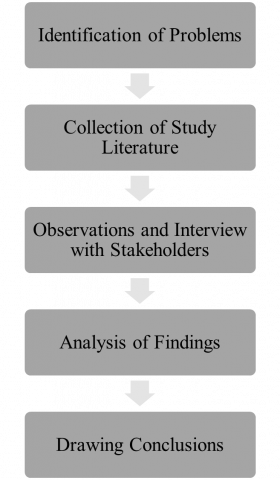
The steps in this research data process are as follows:
1) Problem identification. Basically, problem identification is the initial stage of mastering the problem of a particular object in a particular situation which can be recognized as a problem. Identification of problems in this research can be done through websites, official sites or initial observations of research objects directly at beach tourism in Jember Regency, especially on the 4 beaches of Papuma Beach, Watu Ulo Beach, Payangan Beach, and Paseban Beach.
2) Collection of literature studies, a series of activities related to methods of collecting library data, reading and taking notes, and managing research materials. Researchers studied using article-based data from Scopus, Emerald and others to identify previous literature to support the results of the research carried out.
3) Direct observation and interviews, the researcher comes directly to the research object and conducts interviews with several parties who want to be researched, such as the local government, community, tourism managers and visitors to develop the study researched by the researcher.
4) Analyzing the findings, after carrying out several previous stages the researcher analyzed the findings based on literature, direct observation results and interviews to form a tourism development strategy model starting from the green HRM model for sustainable tourism, community-based tourism for sustainable tourism, actors for sustainable development tourism, and strategy model for green HRM and community-based tourism for sustainable tourism in Indonesia.
5) Drawing conclusions. This is the final step in the research, namely drawing conclusions from the research results. Apart from that, analysis of research implications, research limitations, and suggestions or recommendations for further research was also carried out.
The process of analyzing our research data is in Figure 2 below:
Figure 2. Data analysis process
4.1 Green HRM model for sustainable tourism
Green human resource management is one of the modern management styles that are being used more and more in the business sector these days. As a result, travel agencies worldwide have adopted the trend of creating and broadening their strategies, particularly those pertaining to the roles and responsibilities of human resources in a way that achieves environmental sustainability, by putting new policies and environmentally friendly initiatives into place that support the preservation and sustainable use of resources [3]. The green HRM model for sustainable tourism is in Figure 3.
Figure 3. Green HRM model for sustainable tourism
Source: Developed by Researchers (2024)
From the many perspectives of researchers and writers, there are numerous functions (practices) of green human resources; in order to define the functions of green human resource management, such as:
1) Green training and development
Developing the necessary skills and capabilities for businesses involves several aspects, one of which is training in green HRM [3]. Green training and development is a method for strengthening staff members' problem-solving skills so they can create solutions for environmental problems and match business policies with environmental protection plans to achieve sustainability objectives for the organization [40]. Employees can learn about pro-environmental practices through training [41].
2) Green knowledge sharing
Green knowledge sharing as a result of senior management's collaboration and pursuit of green objectives. Being giving in nature makes being green conduct important for the environment and for the social welfare of employees [42]. When someone shares their information, they are assisting others in learning and acquiring new skills. This is known as knowledge sharing. One type of transfer behavior that occurs during the learning process is knowledge sharing [43]. Local expertise enhances co-creation procedures and promotes sustainable value development [44].
3) Green organizational culture
The inhabitants of this culture have loved and cared for the rich natural system and cultural heritage for many generations, deeply ingrained in their "personal connection" ideals. Beyond any set rules or legal requirements, the community's living philosophy and way of life are preserving the environment and promoting biodiversity. The community views nature as a key symbol of life on earth and has a profound spiritual bond with it. It also shows great respect for Mother Earth, including all of her trees, rivers, and oceans [45].
4) Green performance management
Environmental performance requirements for employees across departments and organizational units, as well as the creation of performance indicators for every environmental risk area, are areas of interest for green human resources management. In GHRM methods, "green performance management" refers to the performances and green habits of employees. It enables the staff members to receive prompt feedback on their environmentally friendly actions [46].
5) Green community participation
In the field of tourism academics, community involvement has gained prominence as a means of promoting sustainable tourist growth [47]. Therefore, securing the support and involvement of locals is crucial to the prosperity and sustainability of tourism growth [48, 49]. When humans are able to adapt to shifting conditions in delicate surroundings, bounce back from shocks from the outside world, and preserve or build assets and capacities for the benefit of the next generations without depleting natural resources [50].
4.2 Community-based tourism for sustainable tourism
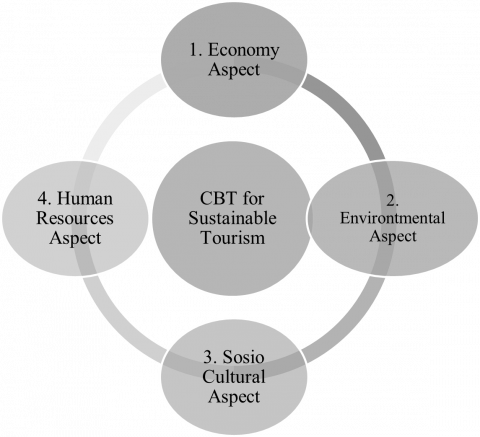
Sustainable tourism is more than just protecting the environment or running a socially conscious company. It is important to remember that aspects of economic, social, and environmental preservation are included in the theoretical definition of sustainable tourism [4]. The community-based tourism for sustainable tourism is in Figure 4 below:
Figure 4. Community-based tourism for sustainable tourism
Source: Developed by researchers (2024)
1) Economy aspect
Even in developed and emerging nations, the economy is growing moderately, but the travel and tourism sector is still doing well globally. Due to its many links with other economic sectors, tourism can favorably impact economic growth if it is appropriately included in a country's strategic developmental goals and has enough room for intersectoral relationships [51]. It means generating prosperity across all societal levels by emphasizing how cost-effective any economic activity is. The businesses and endeavors must be sustainable over the long run and be financially feasible [52].
2) Environmental aspect
The management of tourism and cultural preservation are significantly impacted by the environmental sustainability of tourist destinations [53]. This pertains to the preservation and management of natural resources, particularly those that are valuable or non-renewable. Minimize pollution of the land, water, and air in order to safeguard biodiversity, cultural heritage, and the natural world [52]. Communities and their governments are under increasing pressure to meet local and national socioeconomic development goals, which makes natural resources scarcer [7].
3) Social culture aspect
The physical evolution of social institutions to satisfy tourists' expectations in terms of history, art, culture, and other aspects is also referred to as tourism [54]. When it comes to tourism, cultural tourism refers to travel activities where visitors' main goals are to learn about, explore, experience, and consume both tangible and intangible cultural goods, services, and attractions at travel locations [53].
This has to do with everyone's human rights, equality of opportunity, and equitable benefit sharing within a community [52, 55]. The entirety of a community's way of life, including its rituals and practices influences its members' behavior and worldview, which in turn influences how tourism experiences are created and delivered [32]. Apart from sharing a common ancestor, the community's practices are what truly define its cultural identity [56].
4) Human resource aspect
Human resource development is among the few important issues that receive financing and outside assistance in comparison to other program goals [51]. This is known as the labor force's reservoir of knowledge, personality, and social characteristics, including creativity and habit, that are integrated into the ability of labor to create economic value. Humans in this study are the abilities, knowledge, and skills of the community that will allow them to use and enhance their resources, outsource resources that are not available in their area, and carry out particular tasks [32]. The tourism industry has unique knowledge management requirements [44].
4.3 Actor for sustainable tourism development
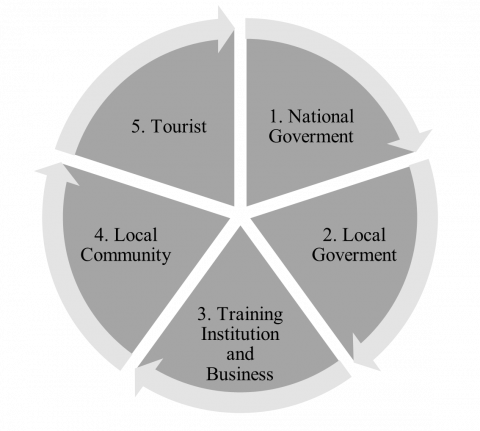
The actor for sustainable tourism development is in Figure 5 below.
Figure 5. Actor for sustainable tourism development
Source: Developed by researchers (2024) [5]
1) National government
The involvement of the national government is significant, particularly with regard to regulation. One approach is through the provision of standardized rules by groups that promote tourism and have more commercial goals, as well as by an entity whose institutional responsibility is the sustainable management of the area. If government agencies have inconsistent power structures, this could lead to a lack of local cooperation, disconnected planning, poorly executed tourism initiatives, and lax tourism laws in popular tourist areas [30] and the government must be able to overcome this problem.
National government can take several steps, such as: enabling community empowerment through participatory planning and monitoring [5], encouraging travel as a "people to people activity" as opposed to a product, and providing systems for evaluating community monitoring and indicators depending on destinations.
2) Local government
Local government representatives are typically given specific responsibilities and obligations, including ones pertaining to the tourism industry [57]. Tourism is pushed as a development tool by governments and development organizations [32]. This metric comprises donor funding allocated for long-term infrastructure and asset subsidies (such as those for transportation, energy, and social infrastructure) as well as for the construction of new environmentally friendly installations (such as research and development centers) [2]. The goal of policy strategies should be to reduce the administrative burden, perhaps by implementing e-government services on a broad scale. The government assumes a more central role in the network of relationships, mutual reliance, and collaboration between many actors [58].
Local government can take several steps including impacting how local communities are seen in society when it comes to tourism and how its actions can assist them [5] influencing the perceptions and expectations of travelers toward a destination; and establishing institutional frameworks that support destinations' sustainable development.
3) Training institution or business
Additionally, if required by society or provided by institutions and intermediary institutions pertinent to the success of its initiation, this involves providing efficient support for meeting organizing and capacity building [30]. organizational dimension (processes and capabilities): routines for converting recently learned information and adding it to the organization's knowledge repositories [44].
Training institution or business can take several steps. responsible marketing and promotion is something that other travel-related firms, tour operators, and agencies, among others, practice and encourage the promotion of environmentally friendly and culturally sensitive tourism and community images. One way to connect a core business concept with social and environmental challenges is to make the case for the need to rethink company procedures in order to create value in a sustainable way [5].
4) Local community
Local communities are at the forefront of these cutting-edge approaches to development and tourism. The subjective and potentially multidimensional sense of this diffuse identity within the local community [59]. Local community that uses innovative techniques in product and service offerings, organizational structure, operational procedures, logistics, and marketing should be the paradigm for local tourism. It should be highlighted that this innovative competitive advantage should not only result in higher financial returns but also contribute to society [32]. Families are the foundation of a community's cohesive social structure, which is evident in the members' shared historical ancestry [56] who lived near the coast. Informal and useful channels (local embeddedness) include residing and interacting in the community, exchanging tales and experiences, engaging in dialogue, observing and paying attention, in collaboration with other interested parties, being near customers [44].
Local community can also take several steps [5]. Thus, even though they actively contribute to the development of a destination's image that draws in specific kinds of tourists, the local community may relinquish control over the development of destinations by accepting a social representation promoted by external actors (e.g., NGOs, government, tourism marketers, businesses).
5) Tourist
When creating tourism attractions, the interests and preferences of tourists frequently take precedence over those of local residents and employees [60]. Thus, meeting visitor needs is a key objective of environmental tourism. Many places manage to maintain their traditional way of life while making good use of their natural and cultural resources to draw tourists. The greater interest that visitors are showing in authenticity enhances these prospects [23].
Several steps can be taken by tourists [5]. They have the power to determine what goods and services are produced and in demand when it comes to creating livelihoods. If necessary, it can provide employment possibilities. In terms of management and regulation, it can push for the implementation of specific policies, engage in lobbying, and increase awareness of problems and appropriate solutions. Their collaboration is essential to the implementation's success, and the growing number of sustainable tourists indicates their propensity for sustainable consumption.
Based on the results of observations and interviews with stakeholders on the four beaches, namely Papuma Beach, Watu Ulo Beach, Payangan Beach and Paseban Beach, several important roles were found for each actor in Table 1 below.
Table 1. Role of actor in tourism Jember Regency
| Actor | Roles |
| National Government | Acting as a regulator that makes regulations related to tourism, for example collaborating with various creative economy ministries to optimize tourism, facilitate access for foreign tourists to enter the country, and promote tourism to foreign countries. |
| Local Government | Serves as a regulator at the regional level, especially Jember Regency, which facilitates regional tourism management, support funding, coordinates with regional policy makers and optimizes tourism promotion. |
| Training Institution | Institutional institutions play a role in optimizing the quality of human resources to be able to manage tourism by conducting several trainings such as training in managing tourism potential, developing community creativity, as well as training in expanding awareness so that tourism is known to the wider community. |
| Local Community | The local community acts as an accelerator, in this case, the community or what is often called the Tourism Awareness Group works together to develop tourism and develop the potential of both humans and nature. |
| Tourist | Play a role in enjoying tourism and promoting it so that it is increasingly known to the wider community. Apart from that, tourists can also provide evaluations for further improvements and must take part in maintaining tourism itself while visiting. |
4.4 Strategy model green HRM and community-based tourism for sustainable tourism in Indonesia
Green human resource management (HRM) literature has focused on the quest of finding the appropriate HRM practices that will contribute to a system [61]. It seeks to promote green company practices, increase employee understanding, and foster participation in environmental initiatives. The goal of funding GHRM in the tourism sector is to develop a moral and ecologically conscious culture that will support the development of a long-term business model for the sector [21].
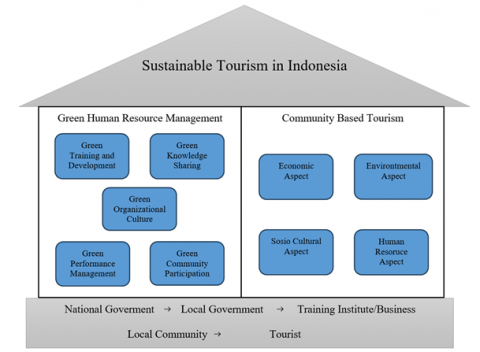
Community-based tourism (CBT) is a well-liked tourism strategy that is thought to be compatible with tourism-based sustainable development [62]. First, for a number of reasons, community-based tourism has become more popular as a strategy for sustainable development. First and foremost, it ought to benefit the preservation of local natural and cultural resources. Second, CBT must encourage the neighborhood's socioeconomic development. Thirdly, more locally owned businesses need to be established through effective tourism planning and management [7]. In the current world, sustainable development is fast rising to the top of the priority list when it comes to tourism development. Teaching local communities, the fundamentals of this new strategy is the main objective [57]. The Strategy model green HRM and community-based tourism for sustainable tourism in Indonesia is in Figure 6 below.
Figure 6. Strategy model green HRM and community-based tourism for sustainable tourism
Source: Developed by researchers from several literatures [15, 47, 52, 63]
Table 2. Implementation of sustainable tourism in various countries
| Ref. | Location | Results |
| [21] | Indonesia |
This study offers fresh perspectives on the factors influencing workers' green HRM practices for environmentally conscious travel. |
| [20] | Indonesia |
The study's conclusions have significant ramifications for decision-makers in Indonesia and other developing nations as well as players in the tourism industry. |
| [31] | Brunei Darussalam |
This paper provides a detailed account of community-based commercial operations from the owners' viewpoints, using the example of CBT operations in Brunei. |
| [52] | Indian Himalayan |
The end outcomes verified both the suggested approach's effectiveness and consistency with the current ones. |
| [58] | African |
The research indicates that neoliberal development techniques are primarily responsible for the growth of tourism in Africa, posing a threat to the industry's viability. |
| [64] | Iran |
The opportunities in this region were found to be the most significant criterion for the SED in Gahar Lake Iran's tourism. |
| [34] | Southeast Asia |
This study offers empirical insights into the financial advantages and practical conservation and preservation tactics for Southeast Asian heritage sites. |
| [65] | Taiwan |
The analysis's findings clarified the sustainability of nature-based tourism even further and revealed that there were substantial differences in the stages of community-based tourism, development. |
The implementation level is where strategy formulation should occur. The strategic relational level creates a territorial and sustainable tourism model that is owned by local communities and is founded on innovation, sustainability, and proper governance [66]. Communities lacking the knowledge and financial means to engage in tourist development might profit greatly economically from the tourism sector in developing nations [67]. Under the heading of sustainability, concepts that promote and foster individuality, empowerment, and communal independence are introduced [6]. The Implementation of sustainable tourism in various countries is in Table 2.
Local community impression of a community, as well as their social interactions with other members of their local and wider communities, might affect how they feel about the built and natural environments that make up their local community. Take into account the benefits of tourism to the economy, society, and environment. How locals view these effects can have a significant impact on the communities surrounding tourist attractions [48]. In order to achieve the shared objectives of public and private players, governance refers to shifts in the government's function as well as an increased role for non-governmental actors. In essence, governance is the culmination of all the various ways that people and organizations both public and private manage their shared concerns [68]. It is a continuous procedure that permits the acceptance of cooperative measures and the accommodation of divergent or competing objectives. It includes unofficial agreements that people and institutions have either accepted or feel are in their best interests, as well as official organizations and regimes with the power to enforce compliance [5].
Develop sustainable ecotourism as a means of providing both a leisure area for visitors and a steady source of revenue for the community's citizens [64, 69]. In other economies, tourism is also having a negative impact on environmental sustainability. There is a widespread perception that the tourism industry's inadequate alternatives for mitigating emissions are the cause of rising emissions. As a result, policy experts ought to endeavor to implement energy-efficient infrastructure for the tourism sector to reduce emissions [10].
The results of our research form a green HRM and community-based tourism model strategy produce several conclusions. Firstly, Green HRM consists of green training and development for developing the necessary skills and capabilities for businesses involves several aspects, green knowledge sharing like local expertise enhances co-creation procedures and promotes sustainable value development, green organizational culture with community's living philosophy and way of life become preserving the environment and promoting biodiversity, green performance management for environmental performance requirements for employees across departments and organizational units, and green community participation, community involvement has gained prominence as means of promoting sustainable growth.
Secondly, community-based tourism consists of economic aspects in many links with other economic sectors, environmental aspect with the management of tourism and cultural preservation are significantly impacted by the environmental sustainability of tourist destinations, sociocultural aspect refers to travel activities where visitors' main goals are to learn about tourism, and human resource aspect is among the few important issues that receives financing and outside assistance in comparison to other program goals.
Thirdly, Then the actors who play a role in tourism development are the national government with involvement of the national government is significant particularly with regard to regulation, local government representatives are typically given specific responsibilities and obligations in tourism, training institutions/businesses pertinent to the success of its initiation, this involves providing efficient support for meeting organizing and capacity building, local community are at the forefront of these cutting-edge approaches to development and tourism, and tourists the interests and preferences of tourists frequently take precedence over those of local residents and employees, which is the model for achieving sustainable tourism in Indonesia, especially Jember Regency.
Based on the analysis of these findings, a green HRM and community-based development strategy model to achieve sustainable tourism was formed. Green human resource management (HRM) literature has focused on the quest of finding the appropriate HRM practices that will contribute to a system [63]. The goal of funding GHRM in the tourism sector is to develop a moral and ecologically conscious culture that will support the development of a long-term business model for the sector [21] and community-based tourism (CBT) is a well-liked tourism strategy that is thought to be compatible with tourism-based sustainable development [68].
The findings of this study are supported by research results which studied sustainable tourism on Komodo Island [14] and which developed sustainable tourism in rural tourism [23-25]. Green HRM is in line with the tenets of soft HRM and benefits businesses as well as the community by helping staff members understand sustainability and encouraging a feeling of social responsibility [29]. Furthermore, the implementation of its practices will guarantee the achievement of sustainable development [3].
Sustainable tourism requires the collaboration of stakeholders. Stakeholder collaboration is described as a process of cooperative decision-making among independent, significant stakeholders in an interorganizational, community tourist domain to address planning challenges and manage concerns pertaining to the domain's development and planning [35]. It should be highlighted that, although being a fully defined policy, ecotourism is a form of community-based tourism [31]. The research contribution is as additional literature for further research related to this topic and as a basis for decision making for the development of sustainable tourism both in and outside Indonesia.
The recommendations of this research are as follows:
The results that we have developed certainly have limitations, namely: First, this research is only limited to the topics of green HRM, community-based tourism and sustainable tourism. Second, this research was only conducted on several beaches in Jember Regency so it does not describe other tourist attractions because is due to the small sample to represent and make a generalization on overall community-supportive behaviors in Indonesia. Third, this research only uses qualitative research methods with case studies to describe strategy models with the topics raised by researchers.
The researcher has several suggestions for future researchers, namely: 1) use other topics such as technology, digital economy, or others so that you know the results with other topics; 2) be able to expand tourism objects such as mountains or rural destinations because of course there will be renewed results; 3) it is hoped that future research can use mixed methods (qualitative and quantitative) so as to obtain more comprehensive results. If this research is to be used on a wider or international scale, future researchers can also combine other methods such as the quintuple helix to get more comprehensive results.
[1] Faber, B., Gaubert, C. (2019). Tourism and economic development: Evidence from Mexico’s coastline. American Economic Review, 109(6): 2245-2293. https://doi.org/10.1257/aer.20161434
[2] Falcone, P.M. (2019). Tourism-based circular economy in Salento (South Italy): A SWOT-ANP analysis. Social Sciences, 8(7): 216. https://doi.org/10.3390/socsci8070216
[3] Alwan, N.A.R., Nori, S.S.A. (2021). Green human resource management and its impact on sustainable tourism development (An exploratory study of the green parks of the mayoralty of Baghdad). Special Issue on Management and Social Media, 18: 419-450. https://doi.org/10.14704/WEB/V18SI03/WEB18103
[4] Streimikiene, D., Svagzdiene, B., Jasinskas, E., Simanavicius, A. (2021). Sustainable tourism development and competitiveness: The systematic literature review. Sustainable Development, 29(1): 259-271. https://doi.org/10.1002/sd.2133
[5] Roxas, F.M.Y., Rivera, J.P.R., Gutierrez, E.L.M. (2020). Mapping stakeholders’ roles in governing sustainable tourism destinations. Journal of Hospitality and Tourism Management, 45: 387-398. https://doi.org/10.1016/j.jhtm.2020.09.005
[6] Zielinski, S., Kim, S., Botero, C., Yanes, A. (2020). Factors that facilitate and inhibit community-based tourism initiatives in developing countries. Current Issues in Tourism, 23(6): 723-739. https://doi.org/10.1080/13683500.2018.1543254
[7] Juma, L.O., Khademi-Vidra, A. (2019). Community-based tourism and sustainable development of rural regions in Kenya; Perceptions of the citizenry. Sustainability, 11(17): 4733. https://doi.org/10.3390/su11174733
[8] Setyanti, S.W.L.H. (2022). Pengelolaan Ekowisata Bahari. Inara Publisher: Malang.
[9] Hastings, D.P. (2018). Risky Business: Agricultural Development and Environmental Consequences in Indonesia and Ecuador. Global Majority E-Journal, 9(2): 71-83.
[10] Wang, S., Abbas, J., Al-Sulati, K.I., Shah, S.A.R. (2024). The impact of economic corridor and tourism on local community’s quality of life under one belt one road context. Evaluation Review, 48(2): 312-345. https://doi.org/10.1177/0193841X231182749
[11] Ali, M., Ekawati, S.A., Taskirawati, I., Nur, D.S.A., Irfan, M., Nasaruddin, Inayah, A.N., Zaira, M.R., Hasnah, D.H. (2024). Sustainable coastal tourism: A comprehensive development strategies (Tanjung Bira and Lemo-lemo tourism area as a case study). International Journal of Sustainable Development and Planning, 19(7): 2489-2499. https://doi.org/10.18280/ijsdp.190706
[12] Shaari, H., Ahmad, N., Saad, S., Perumal, S., Sulaiman, Y. (2024). Assessing the issues and community-supportive behaviors in Malaysia’s rural tourism. International Journal of Sustainable Development and Planning, 19(7): 2615-2625. https://doi.org/10.18280/ijsdp.190718
[13] Pratiwi, R., Takhim, M., Novia, W., Wardhani, R., Sonjaya, A. (2024). The collaboration of penta helix to develop halal tourism villages in Batang, Central Java. International Journal of Sustainable Development and Planning, 19(7): 2753-2761. https://doi.org/10.18280/ijsdp.190732
[14] Lasso, A., Dahles, H. (2018). Are tourism livelihoods sustainable? Tourism development and economic transformation on Komodo Island, Indonesia. Asia Pacific Journal of Tourism Research, 23(5): 473-485. https://doi.org/10.1080/10941665.2018.1467939
[15] Lemy, D.M., Teguh, F., Pramezwary, A. (2019). Tourism development in Indonesia: Establishment of sustainable strategies. Bridging Tourism Theory and Practice, 11: 91-108. https://doi.org/10.1108/S2042-144320190000011009
[16] Situmorang, R., Trilaksono, T., Japutra, A. (2019). Friend or foe? The complex relationship between indigenous people and policymakers regarding rural tourism in Indonesia. Journal of Hospitality and Tourism Management, 39: 20-29. https://doi.org/10.1016/j.jhtm.2019.02.001
[17] Phelan, A., Ruhanen, L., Mair, J. (2020). Ecosystem services approach for community-based ecotourism: Towards an equitable and sustainable blue economy. Journal of Sustainable Tourism, 28(10): 1665-1685. https://doi.org/10.1080/09669582.2020.1747475
[18] Purnomo, S., Rahayu, E.S., Riani, A.L., Suminah, S., Udin, U. (2020). Empowerment model for sustainable tourism village in an emerging country. Journal of Asian Finance, Economics and Business, 7(2): 261-270. https://doi.org/10.13106/jafeb.2020.vol7.no2.261
[19] Nugroho, P., Numata, S. (2020). Resident support of community-based tourism development: Evidence from Gunung Ciremai National Park, Indonesia. Journal of Sustainable Tourism, 2020: 1-16. https://doi.org/10.1080/09669582.2020.1755675
[20] Hadi, S., Mutiani, E.W. Abbas, Jumriani, Ilhami, M.R. (2023). Green human resource management for tourism sustainability. Polish Journal of Management Studies, 28(1): 139-156. https://doi.org/10.17512/pjms.2023.28.1.08
[21] Sinaga, E.K., Suryadi, E., Goeltom, A.D.L., Rakhman, C.U., Susanto, E. (2024). Personal and organizational factors supporting green HRM performance in the tourism industry. Journal of Eastern European and Central Asian Research, 11(2): 272-289. https://doi.org/10.15549/jeecar.v11i2.1623
[22] Khalid, S., Ahmad, M.S., Ramayah, T., Hwang, J., Kim, I. (2019). Community empowerment and sustainable tourism development: The mediating role of community support for tourism. Sustainability, 11(22): 6248. https://doi.org/10.3390/su11226248
[23] Ibanescu, B.C., Stoleriu, O.M., Munteanu, A., Iaţu, C. (2018). The impact of tourism on sustainable development of rural areas: Evidence from Romania. Sustainability, 10(10): 1-19. https://doi.org/10.3390/su10103529
[24] Nordberg, K., Mariussen, Å., Virkkala, S. (2020). Community-driven social innovation and quadruple helix coordination in rural development. Case study on LEADER group Aktion Österbotten. Journal of Rural Studies, 79: 157-168. https://doi.org/10.1016/j.jrurstud.2020.08.001
[25] Walker, T.B., Lee, T.J., Li, X. (2021). Sustainable development for small island tourism: Developing slow tourism in the Caribbean. Journal of Travel & Tourism Marketing, 38(1): 1-15. https://doi.org/10.1080/10548408.2020.1842289
[26] Fuldauer, L.I., Ives, M.C., Adshead, D., Thacker, S., Hall, J.W. (2019). Participatory planning of the future of waste management in small island developing states to deliver on the Sustainable Development Goals. Journal of Cleaner Production, 223: 147-162. https://doi.org/10.1016/j.jclepro.2019.02.269
[27] Shafaei, A., Nejati, M., Yusoff, Y.M. (2020). Green human resource management: A two-study investigation of antecedents and outcomes. International Journal of Manpower, 41(7): 1041-1060. https://doi.org/10.1108/IJM-08-2019-0406
[28] Yin, Q. (2023). The impact of green human resource management on organizational performance. Frontiers in Business, Economics and Management, 11(3): 5-8. https://doi.org/10.54097/fbem.v11i3.13198
[29] Pham, N.T., Tučková, Z., Chiappetta Jabbour, C.J. (2019). Greening the hospitality industry: How do green human resource management practices influence organizational citizenship behavior in hotels? A mixed-methods study. Tourism Management, 72: 386-399. https://doi.org/10.1016/j.tourman.2018.12.008
[30] Yanes, A., Zielinski, S., Cano, M.D., Kim, S.I. (2019). Community-based tourism in developing countries: A framework for policy evaluation. Sustainability, 11(9): 1-23. https://doi.org/10.3390/su11092506
[31] Noorashid, N., Chin, W.L. (2021). Coping with COVID-19: The resilience and transformation of community-based tourism in Brunei Darussalam. Sustainability, 13(15): 1-28. https://doi.org/10.3390/su13158618
[32] Aquino, R.S., Lück, M., Schänzel, H.A. (2018). A conceptual framework of tourism social entrepreneurship for sustainable community development. Journal of Hospitality and Tourism Management, 37: 23-32. https://doi.org/10.1016/j.jhtm.2018.09.001
[33] Cheer, J.M., Milano, C., Novelli, M. (2019). Tourism and community resilience in the Anthropocene: Accentuating temporal overtourism. Journal of Sustainable Tourism, 27(4): 554-572. https://doi.org/10.1080/09669582.2019.1578363
[34] Chong, K.Y., Balasingam, A.S. (2019). Tourism sustainability: Economic benefits and strategies for preservation and conservation of heritage sites in Southeast Asia. Tourism Review, 74(2): 281-292. https://doi.org/10.1108/TR-11-2017-0182
[35] Elmo, G.C., Arcese, G., Valeri, M., Poponi, S., Pacchera, F. (2020). Sustainability in tourism as an innovation driver: An analysis of family business reality. Sustainability, 12(15): 1-14. https://doi.org/10.3390/su12156149
[36] Mihalic, T. (2020). Conceptualising overtourism: A sustainability approach. Annals of Tourism Research, 84: 103025. https://doi.org/10.1016/j.annals.2020.103025
[37] Ristić, D., Vukojičić, D., Milinčić, M. (2019). Tourism and sustainable development of rural settlements in protected areas. Land Use Policy, 89: 104231. https://doi.org/10.1016/j.landusepol.2019.104231
[38] Suliyanto, S.E., Suliyanto, M.M. (2019). Metode Penelitian Kuantitatif.
[39] Baas, J., Schotten, M., Plume, A., Côté, G., Karimi, R. (2020). Scopus as a curated, high-quality bibliometric data source for academic research in quantitative science studies. Quantitative Science Studies, 1(1): 377-386. https://doi.org/10.1162/qss_a_00019
[40] Amrutha, V.N., Geetha, S.N. (2021). Linking organizational green training and voluntary workplace green behavior: Mediating role of green supporting climate and employees’ green satisfaction. Journal of Cleaner Production, 290: 125876. https://doi.org/10.1016/j.jclepro.2021.125876
[41] Ahmad, I., Ullah, K., Khan, A. (2022). The impact of green HRM on green creativity: Mediating role of pro-environmental behaviors and moderating role of ethical leadership style. The International Journal of Human Resource Management, 33(19): 3789-3821. https://doi.org/10.1080/09585192.2021.1931938
[42] Rashid, W., Ghani, U., Khan, K., Usman, M. (2023). If you care I care: Role of green human resource management in employees' green behaviors. Cogent Business & Management, 10(1): 2189768. https://doi.org/10.1080/23311975.2023.2189768
[43] Chang, T.W., Hung, C.Z. (2021). How to shape the employees’ organization sustainable green knowledge sharing: Cross-level effect of green organizational identity effect on green management behavior and performance of members. Sustainability, 13(2): 1-19. https://doi.org/10.3390/su13020626
[44] Dias, Á., Silva, G.M., Patuleia, M., González-Rodríguez, M.R. (2023). Developing sustainable business models: Local knowledge acquisition and tourism lifestyle entrepreneurship. Journal of Sustainable Tourism, 31(4): 931-950. https://doi.org/10.1080/09669582.2020.1835931
[45] Suriyankietkaew, S., Krittayaruangroj, K., Iamsawan, N. (2022). Sustainable leadership practices and competencies of SMEs for sustainability and resilience: A community-based social enterprise study. Sustainability, 14(10): 1-36. https://doi.org/10.3390/su14105762
[46] Khan, S. (2022). Effects of green human resource management practices on environmental performance: Evidence from textile sector of emerging country. Munich Personal RePEc Archive. https://mpra.ub.uni-muenchen.de/112379/.
[47] Wondirad, A., Ewnetu, B. (2019). Community participation in tourism development as a tool to foster sustainable land and resource use practices in a national park milieu. Land Use Policy, 88: 104155. https://doi.org/10.1016/j.landusepol.2019.104155
[48] Gursoy, D., Boğan, E., Dedeoğlu, B.B., Çalışkan, C. (2019). Residents’ perceptions of hotels’ corporate social responsibility initiatives and its impact on residents’ sentiments to community and support for additional tourism development. Journal of Hospitality and Tourism Management, 39: 117-128. https://doi.org/10.1016/j.jhtm.2019.03.005
[49] Rahman, M.K., Masud, M.M., Akhtar, R., Hossain, M.M. (2022). Impact of community participation on sustainable development of marine protected areas: Assessment of ecotourism development. International Journal of Tourism Research, 24(1): 33-43. https://doi.org/10.1002/jtr.2480
[50] Li, W., Bhutto, T.A., Wang, X., Maitlo, Q., Zafar, A.U., Bhutto, N.A. (2020). Unlocking employees’ green creativity: The effects of green transformational leadership, green intrinsic, and extrinsic motivation. Journal of Cleaner Production, 255: 120229. https://doi.org/10.1016/j.jclepro.2020.120229
[51] Fahimi, A., Saint Akadiri, S., Seraj, M., Akadiri, A.C. (2018). Testing the role of tourism and human capital development in economic growth. A panel causality study of micro states. Tourism Management Perspectives, 28: 62-70. https://doi.org/10.1016/j.tmp.2018.08.004
[52] He, J., Huang, Z., Mishra, A.R., Alrasheedi, M. (2021). Developing a new framework for conceptualizing the emerging sustainable community-based tourism using an extended interval-valued Pythagorean fuzzy SWARA-MULTIMOORA. Technological Forecasting and Social Change, 171: 120955. https://doi.org/10.1016/j.techfore.2021.120955
[53] Li, X., Abbas, J., Dongling, W., Baig, N.U.A., Zhang, R. (2022). From cultural tourism to social entrepreneurship: Role of social value creation for environmental sustainability. Frontiers in Psychology, 13: 925768. https://doi.org/10.3389/fpsyg.2022.925768
[54] Roslan, Z.B., Ramli, Z., Razman, M.R., Asyraf, M.R.M., Ishak, M.R., Ilyas, R.A., Nurazzi, N.M. (2021). Reflections on local community identity by evaluating heritage sustainability protection in Jugra, Selangor, Malaysia. Sustainability, 13(16): 8705. https://doi.org/10.3390/su13168705
[55] Kanwal, S., Rasheed, M.I., Pitafi, A.H., Pitafi, A., Ren, M. (2020). Road and transport infrastructure development and community support for tourism: The role of perceived benefits, and community satisfaction. Tourism Management, 77: 104014. https://doi.org/10.1016/j.tourman.2019.104014
[56] Gabriel-Campos, E., Werner-Masters, K., Cordova-Buiza, F., Paucar-Caceres, A. (2021). Community eco-tourism in rural Peru: Resilience and adaptive capacities to the COVID-19 pandemic and climate change. Journal of Hospitality and Tourism Management, 48: 416-427. https://doi.org/10.1016/j.jhtm.2021.07.016
[57] Kapera, I. (2018). Sustainable tourism development efforts by local governments in Poland. Sustainable Cities and Society, 40: 581-588. https://doi.org/10.1016/j.scs.2018.05.001
[58] Musavengane, R., Siakwah, P., Leonard, L. (2020). The nexus between tourism and urban risk: Towards inclusive, safe, resilient and sustainable outdoor tourism in African cities. Journal of Outdoor Recreation and Tourism, 29: 100254. https://doi.org/10.1016/j.jort.2019.100254
[59] Bouchon, F., Rauscher, M. (2019). Cities and tourism, a love and hate story; towards a conceptual framework for urban overtourism management. International Journal of Tourism Cities, 5(4): 598-619. https://doi.org/10.1108/IJTC-06-2019-0080
[60] Eusébio, C., Vieira, A.L., Lima, S. (2018). Place attachment, host-tourist interactions, and residents’ attitudes towards tourism development: The case of Boa Vista Island in Cape Verde. Journal of Sustainable Tourism, 26(6): 890-909. https://doi.org/10.1080/09669582.2018.1425695
[61] Kloutsiniotis, P.V., Mihail, D.M. (2020). High performance work systems in the tourism and hospitality industry: A critical review. International Journal of Contemporary Hospitality Management, 32(7): 2365-2395. https://doi.org/10.1108/IJCHM-10-2019-0864
[62] Pasanchay, K., Schott, C. (2021). Community-based tourism homestays’ capacity to advance the sustainable development goals: A holistic sustainable livelihood perspective. Tourism Management Perspectives, 37: 100784. https://doi.org/10.1016/j.tmp.2020.100784
[63] Mtapuri, O., Camilleri, M.A., Dłużewska, A. (2022). Advancing community-based tourism approaches for the sustainable development of destinations. Sustainable Development, 30(3): 423-432. https://doi.org/10.1002/sd.2257
[64] Asadpourian, Z., Rahimian, M., Gholamrezai, S. (2020). SWOT-AHP-TOWS analysis for sustainable ecotourism development in the best area in Lorestan Province, Iran. Social Indicators Research, 152(1): 289-315. https://doi.org/10.1007/s11205-020-02438-0
[65] Lee, T.H., Jan, F.H. (2019). Can community-based tourism contribute to sustainable development? Evidence from residents’ perceptions of the sustainability. Tourism Management, 70: 368-380. https://doi.org/10.1016/j.tourman.2018.09.003
[66] Li, Z., Wang, D., Abbas, J., Mubeen, R. (2022). Tourists’ health risk threats amid COVID-19 era: Role of technology innovation, Transformation, and recovery implications for sustainable tourism. Frontiers in Psychology, 12: 769175. https://doi.org/10.3389/fpsyg.2021.769175
[67] Soulard, J., McGehee, N.G., Stern, M. (2019). Transformative tourism organizations and glocalization. Annals of Tourism Research, 76: 91-104. https://doi.org/10.1016/j.annals.2019.03.007
[68] González-Reverté, F. (2019). Building sustainable smart destinations: An approach based on the development of Spanish smart tourism plans. Sustainability, 11(23): 1-24. https://doi.org/10.3390/SU11236874
[69] Bertocchi, D., Camatti, N., Giove, S., van Der Borg, J. (2020). Venice and overtourism: Simulating sustainable development scenarios through a tourism carrying capacity model. Sustainability, 12(2): 512. https://doi.org/10.3390/su12020512