Hajir Mohammed Ali | Alaa Raad Hussein* | Monis Abdulmanan Abdullah | Anwar Luay Khaleel
© 2026 The authors. This article is published by IIETA and is licensed under the CC BY 4.0 license (http://creativecommons.org/licenses/by/4.0/).
OPEN ACCESS
Polymethyl methacrylate (PMMA) composites reinforced with natural nanomaterials have been developed recently for dental applications due to their unique properties and biological interest. Various additives such as natural, organic and refractory materials have been employed as an enhancement for PMMA. In this study, nano-sized walnut shell powder has been used as a natural reinforcement for PMMA at different weight ratios (0, 0.5, 1, 1.5, 2) wt.%. The investigation evaluates their effect on tensile, flexural, hardness, impact and bacteriological properties of the PMMA composites. In addition to that, a weathering process was performed on all samples to examine the effect of the aging environment on the mechanical properties and bacterial response. The walnut powder has demonstrated a noticeable effect on the mechanical and bacterial properties of PMMA. All samples exhibited an increase in tensile and flexural strength when nano walnut powder was used compared to pure PMMA. The maximum tensile strength was found to be around 92.36 MPa at (0.5% walnut shell), whereas (2% walnut shell) was found to have the highest flexural strength of 107.78 MPa. When considering the aging process, mechanical properties noticeably dropped, with maximum tensile and flexural properties of 89.19 MPa and 61.05 MPa, respectively. Similarly, aged samples exhibited a reduction in the surface hardness compared to the unaged composites due to surface layer softening caused by the process. Scanning electron microscopy (SEM) analysis revealed polymerization enhancement in the aged samples accompanied by an increase in the weight ratio. Furthermore, bacterial tests at concentrations of 0.5 wt.% and 2 wt.% showed enhanced inhibitory activity of PMMA composite against Streptococcus mutans, with an inhibitory zone of 60 mm compared to 52 mm for pure PMMA. Both the aging process and walnut nano-sized powder have a positive influence on PMMA composite, resulting in a natural, biocompatible, low-cost material capable of withstanding the harsh oral environment.
biomaterials, denture materials, mechanical characteristics, polymethyl methacrylate, aging process, walnut nano powder
Biomaterials are considered one of the most demanded materials that have been researched recently, due to their biocompatibility properties and natural components similar to what exists in the human body. Biomaterials require comprehensive characterization of their mechanical, physical, biological, immunological, and degradation properties [1]. The selected biomaterial should possess ease of processability properties to avoid any complexity that may add extra cost during fabrication or formation of the composite [2]. However, most biomaterials show ease of use and can be formed in any desired shapes. Many researchers have been trying to optimize the optimal biomaterial for human utilization; however, it is very difficult to obtain a single material gather all good properties to be the most suitable one for denture or medical application. Many biomaterials are combined and mixed with polymers to form inorganic/organic composites. Such composites can be said to be bioactive composites, in which their mechanical properties are said to be improved to gain extra working life to the base material [3, 4]. Based on Kanie et al. [5], the mechanical properties of continues phase of the polymer can be improved by adding fillers to the base material. Polymethyl methacrylate (PMMA) is a polymer that has been used intensively for medical applications such as contact lenses, dialysis machines, dental usage, cranioplasty implants, and so on [6]. PMMA inherits suitable mechanical properties that make it suitable for denture utilization. PMMA is exposed to high aeration rates and to periodic temperatures of food and beverages that range from 20 to 50 times per day. In addition, the harsh environment from saliva and bacteria works on changing some physical properties [3, 7]. Accelerated aging and weathering tests are therefore necessary to evaluate changes in polymer properties under controlled environmental conditions. Such tests have been widely used to relate temperature and exposure duration to the degradation of mechanical properties in polymeric materials, although the accelerated conditions should be distinguished from the actual service environment [8]. This consideration is particularly important when PMMA is reinforced with natural fillers, because moisture, temperature, and interfacial degradation may alter the long-term response of the composite.
Many studies have been performed to improve the weathering and mechanical properties of PMMA by adding natural fillers such as seashells [9], eggshell [10], sisal fibers and fish scales [11]. Metal-based composites have also been used to improve the hardness and flexural strength of PMMA composites, such as TiO2 nanoparticles, MgO [12], Antimicrobial graphene oxide nanosheets [13], nanographene oxide and Boron nitride [14]. In contrast, PMMA has been considered a promising choice in the field of dentistry due to its properties. Such properties include corrosion resistance, especially since the teeth are exposed to a wide range of aeration, ease of formation, and low cost compared to metal-based denture materials. On the other hand, its antibacterial properties and resistance to acids and bases are relatively good [15, 16]. The strength and brittleness need to be improved, as they have low mechanical properties [12, 17]. However, this limitation has been addressed by researchers to enhance and advance the material in terms of bio-composites.
Karthick et al. [9] used natural reinforcement nano-sized (seashells and ceramic material) compatible with human bone and teeth to enhance wear resistance and microhardness of PMMA composites. The microhardness was improved to the maximum value at 12%. Short ramie fiber was used by Xu et al. [18] as a natural reinforcing material. This type of material was recommended by the author for further investigation because of the lower strength due to weak interfacial adhesion, but a high flexural modulus was noticed in the composite. Jassam et al. [19] have investigated the influence of Olives, Pomegranate, and Siwak on the mechanical properties of PMMA for denture use. It was revealed that Siwak had the most significant influence as a filler on PMMA; on the other hand, tensile strength was significantly influenced by the grain size compared to other mechanical properties. This contribution ranged from 25% to 52%. Pomegranate peels or clove powders have been used to strengthen the PMMA composite, as indicated by Salih et al. [20]. Their investigation reinforced PMMA and natural rubber with natural nano-sized powder. Both flexural strength and maximum shear stress reached the highest values of 144 and 3 MPa, respectively. In their study, they considered the effect of biomaterials to be promising for the improvement of mechanical properties of PMMA, especially for fracture strength.
Walnut shell has been widely used as a reinforcement in various polymer composites [21]. Sutivisedsak et al. [22] incorporated walnut with other natural fillers into low-density polyethylene and poly(lactic acid), reporting a slight reduction in mechanical properties depending on filler type and concentration. Sarraj et al. [23] observed a density increase of approximately 1.5% in walnut-filled polymer composites. Ahmed and Salih [24] improved the mechanical properties of PMMA using 0.3% walnut powder combined with natural fibers, particularly enhancing the elastic modulus and tensile strength. Building on these findings, this study aims to investigate the effects of nano-walnut powder and weathering conditions on the mechanical properties and biocompatibility of PMMA to develop a low-cost PMMA composite for dental applications.
2.1 Selected materials
The selected starting materials in this experiment were PMMA and MMA as a matrix material in powder and liquid form, having a color similar to that of human tissue, both of which are commonly used for prosthetic dental applications. These materials were supplied by new Auto-polymerizable Veracril, Stetic S.A, Colombia. The reinforcing material that was mixed with PMMA is nano walnut shells powder.
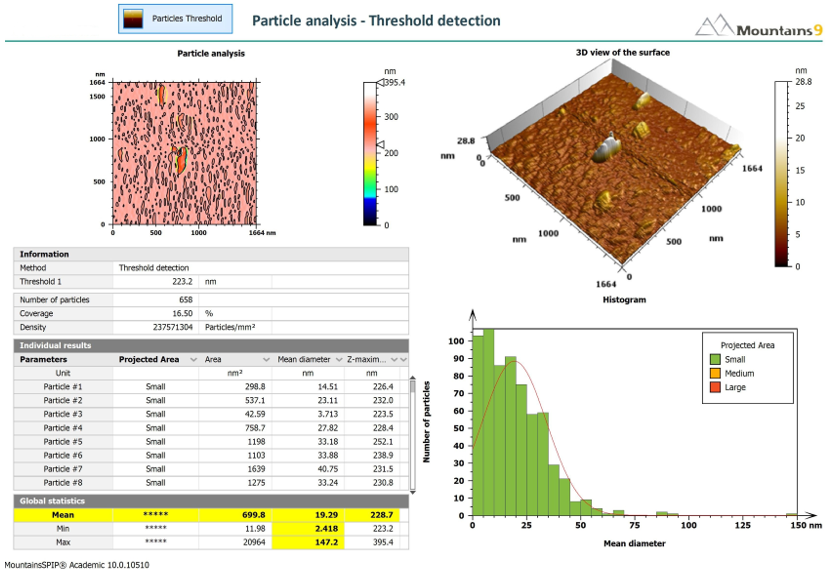
The preparation of the nano walnut powder was started by flushing the walnut shells with running water to remove dust or impurities that were bonded to the surface of the shell. Afterward, the surface was treated with a 5% alkaline solution (sodium hydroxide) at 25 ℃ for 24 hours. Then all shells were rinsed several times with distilled water to remove the solution from the surface and to control the pH level at 7 who was measured using a pH meter. Following the cleaning process, a drying of the shell was kept for 5 days at room temperature, then they were placed in an oven at 50 ℃ for 5 minutes for intensified drying. The shell was then taken to the grinding process; the process includes two stages of preparation. A mortar was used as the first grinding stage for around 20 min. to ensure the shell was converted into small pieces that were easier for the next process. The second stage utilized a planetary ball milling machine for a duration of 6 h at 200 rpm with a ball-to-powder ratio of 10:1 to ensure they were converted into nano powder. The shell, grinding machine, and the final powder can be seen in Figure 1. The particle size of the powder produced by this process was 19.29 nm; the chemical compositions are illustrated in Table 1. As per the Energy-Dispersive X-ray Spectroscopy (EDX) analysis, the average particle size and particle distribution were investigated using Atomic Force Microscopy (AFM), as shown in Figure 2.
Figure 1. Walnut shell used in the experiment (a) before grinding, (b) planetary ball mill machine, and (c) after grinding
Table 1. Chemical composition of walnut shell powder
|
Element |
Element Name |
C Norm, wt.% |
C Atom, % |
|
C |
Carbon |
79.23 |
85.45 |
|
O |
Oxygen |
17.25 |
13.97 |
|
In |
Indium |
1.67 |
0.19 |
|
Sb |
Antimony |
1.32 |
0.14 |
|
Al |
Aluminum |
0.52 |
0.25 |
Figure 2. Atomic Force Microscopy (AFM) of walnut nano powder
2.2 Composite fabrication
The mixing ratios of the nanocomposite are illustrated in Table 2. The preparation process began by weighing the desired amount of PMMA powder according to the selected mixing ratios, followed by measuring the required volume of MMA monomer based on the manufacturer's recommendations.
Table 2. Selected ratios of polymer nanocomposites
|
No. |
Composition (wt.%) |
|
|
PMMA and MMA |
Walnut Shell Nanoparticles |
|
|
1 |
100 |
0 |
|
2 |
99.5 |
0.5 |
|
3 |
99 |
1 |
|
4 |
98.5 |
1.5 |
|
5 |
98 |
2 |
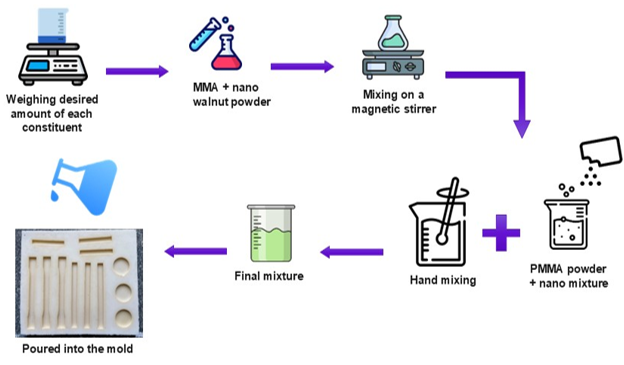
The composite preparation started by mixing each mixing ratio of the nano walnut shell mentioned in Table 1 with liquid monomer MMA. The mixing was performed by utilizing a magnetic stirrer for approximately 10 min. to ensure a good dispersion and facilitate ease of mixing with the PMMA in the later stage. A desired amount of PMMA powder was measured and prepared to be mixed with the monomer mixture according to the manufacturer’s recommendation in an amount of 2:1. It is well noted that a direct addition of nano powder to PMMA powder would cause agglomeration inside the composite due to rapid polymerization. This might reduce the mixing time, especially when adding MMA. The second step was the gradual addition of the PMMA to the MMA and walnut nanoparticle mixture. The mixing method was manual mixing for a duration of 20 to 25 seconds. The final mixture was poured into a silicone mold and kept curing at room temperature for around 2 hours. After this curing period, all samples were removed from the mold, all excess material was removed from the edges and prepared for further testing and analysis. It is worth noting that no alteration or change was made to the surface or to the dimensions of the samples. Figures 3 and 4 illustrate the complete fabrication process and the final samples obtained, respectively.
Figure 3. Fabrication process of the nano-polymethyl methacrylate (PMMA) composite
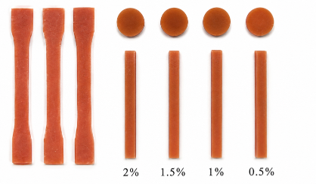
Figure 4. Fabricated samples after adding filler
3.1 Mechanical test
The final composites were subjected to tensile, bending, hardness, impact, weathering (aging), antimicrobial, and water absorption tests, as well as scanning electron microscopy (SEM) analysis, as shown in Figure 4.
The mold was designed to provide a test-ready specimen for bending (flexural), tensile and hardness testing. Tensile and flexural tests were carried out at room temperature using a UTM (Laryee in China, type WDW-50) according to the international standards ASTM D638 and ISO 178, respectively, at a crosshead speed of 2 mm/min for both tests.
The hardness test was performed using a hardness tester, type Shore D, according to the international standard ASTM D2240. The measurements were taken at three different locations on each specimen. The final mechanical test was an impact test that was conducted based on ISO 180 using an Izod impact tester (XJU series, Time Testing Machine Company, China), group (Pendul Charpy/Izod Tester); the pendulum impact velocity was 3.5 m/s. Table 3 illustrates the dimensions of each sample shown in Figure 4.
Table 3. Sample dimensions for mechanical tests
|
Test Type |
Dimensions (mm) |
||
|
Tensile |
150 |
5 |
4 |
|
Flexural |
100 |
10 |
4 |
|
Impact |
80 |
10 |
4 |
|
Hardness (diameter) |
50.8 |
- |
- |
3.2 Weathering (aging) test
The weathering test was performed to evaluate the mechanical properties under accelerated aging (humidity and UV) of PMMA nanocomposite denture materials. The test was performed according to ISO 4892-3 using a QUV accelerated weathering tester; the method of exposure is a laboratory light source, part 3: Fluorescent UV lamps with method A, cycle No. 4. The device is model QUV/spray, manufactured by Q-labs in Australia, type UV-A340. Fluorescent UV devices provide a condensation cycle during the lights-out period to produce humidity (water spray) for 2 hr direct spray; therefore, the surface of the test specimen is exposed to hot, saturated humidity from the air and water vapor. The temperature inside the device was 55 ℃, and the incident UV irradiance on the specimens was 0.58 W/m2 at 340 nm. The total test time was 120 h, including 2 h of UV exposure and 2 h of humidity exposure. The exposure was from both sides of the specimens during the test. All samples were examined for their Fourier transform infrared (FTIR) and water absorption after being exposed to aging conditions.
3.3 In vitro biological activity test
A biological activity test was conducted to measure the biological effect of the nanocomposite against Streptococcus mutans. This test aims to suggest the use of these Nano powders as reinforcement materials for denture bases in the oral cavity.
The biological activity test was conducted using the agar well diffusion method. The agar well diffusion method was used to test the antibacterial activity of all samples. One milliliter of fresh bacterial inoculum was pipetted into the center of a sterile Petri dish. Cooled and thawed Mueller-Hinton agar was poured into the Petri dish containing the inoculum and mixed well. After solidification, wells were drilled using a sterile cork drill (5 mm diameter) in the agar plates containing the inoculum, with a sample diameter of 10 mm in the positive control group. Sample discs were added to the corresponding plates to conduct the test. The plates were then incubated at 37 ℃ for 18 h. Antimicrobial activity was detected by measuring the zone of inhibition (including the diameter of the wells) that appeared after the incubation period. Distilled water was used as a negative control sample.
4.1 Mechanical characteristics
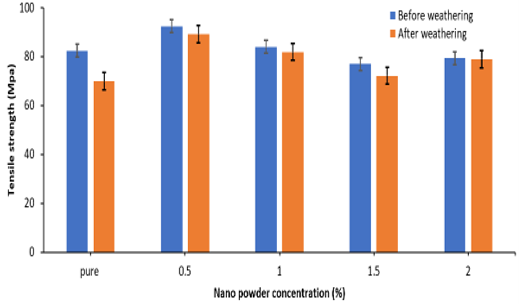
Figure 5 shows the tensile strength of PMMA nanocomposites at different concentrations of walnut nano powder under two different cases: before and after weathering. Powder concentration exerts a diverse effect on the mechanical properties of the PMMA polymer matrix. Specifically, among the unaged samples, 0.5 wt.% concentration yields the highest effect on the tensile strength compared to other weight ratios, reaching 92.36 MPa. The obtained increment in tensile strength may be attributed to the continuation of the post-polymerization process, the decrease in residual monomer content, and/or the physical aging of the polymer matrix. Similar improvements in the mechanical performance of PMMA dental materials have been reported following post-polymerization treatments that increased the conversion temperature and the glass transition temperature [25, 26]. On the other hand, a 1.5 wt.% concentration, associated with the lowest value among all other mixing ratios, resulted in approximately 76.95 MPa. Generally, aging processes lead to a minor reduction in tensile strength, and this reduction converts the composite to a brittle material due to environmental aging [27], a decrease in residual monomer content, and/or the physical aging of the polymer matrix. In comparison with the unaged samples, the reduction in tensile strength is considered not particularly severe, and the deviation compared with the pure PMMA is showing small values. This tiny difference may relate to relatively short UV exposure duration, as significant changes in tensile strength typically require longer exposure to an aging environment, as proven [28].
Figure 5. Tensile strength of nanocomposites
Weathering and moisture exposure can increase internal stress within the composite, and this can lead to micro-voids [24]. Hence, the value of reduction reaches its lowest value at 72.1 MPa for 1.5 wt% compared to the pure PMMA, which was around 69.88 MPa. Furthermore, the other concentrations of nano walnut powder also influenced tensile strength. This noticeable drop is related to nano walnut particle agglomeration, or it can be said that the formation of micro voids occurs during the mixing process. In addition to that, the reduction in tensile strength may also occur due to surface layer cracks that act as notches, working to reduce material strength or toughness, delaying polymerization of the residual monomers within the matrix. Consequently, crack propagation and structural defects are increasing as a result of the changing crosslink density [26].
Thus, the interfacial bonding between the PMMA matrix and walnut nano powder of the unaged samples was enhanced. The improvement in the hydrogen bonding and secondary interactions between hydroxyl groups on the nanoparticle surface and the polymer matrix led to this enhancement, revealing efficient stress distribution. As can be noticed from Table 4, the modulus of elasticity of aging composites is consistently lower than that of the unaged composite, which reflects the effect of the aging process on the overall tensile strength property. The reduction in tensile strength at concentrations of 1, 1.5 and 2% compared to 0.5 wt.% resulted from some agglomeration of the nano walnut powder during the mixing process. These agglomerated particles act as stress concentration sites in the composite, preventing stress from flowing smoothly through the material. Furthermore, the maximum tensile strength was found at 0.5 wt.% in the case of unaged samples. When it comes to the aging process, the value of tensile strength is reduced. This decline in the modulus of elasticity is related to increased surface degradation and embrittlement, resulting in reduced structural stiffness and low efficiency of stress transfer.
The mean and standard deviation of tensile strength of the unaged composites are 82.8 and 5.89, respectively. For aged samples, the mean and SD are 78.09 and 7.76, respectively. The p-value is >0.05, which indicates a non-significant variation between the aged and unaged samples in terms of tensile strength.
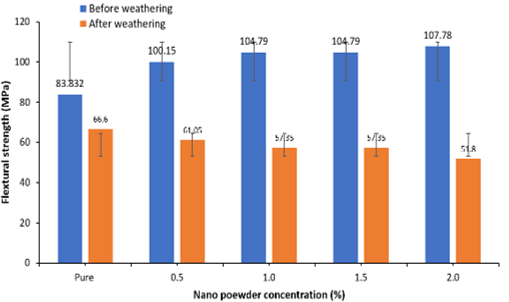
Flexural strength is shown in Figure 6. Before aging, the flexural strength is significantly higher than that of the after-aging samples and for all concentrations. 2 wt.% demonstrates the highest flexural strength among all samples, whereby decreasing flexural strength corresponds to a reduction in filler percentage. Exposure to weathering can introduce some defects into the composite, ultimately weakening flexural strength to a certain level and assisting in degrading the composite. The bending properties are heavily influenced by matrix splitting or changes in the polymer microstructure and interface bonding, which induce debonding and decohesion of the molecules and loss of flexibility of the matrix. On the other hand, fillers can control the ability of the composite to withstand bending loads; for example, nanoparticles could reduce the bending properties if agglomeration occurs during polymerization, which results in decreased load transfer efficiency throughout the composite. However, the aging process works on molecular rearrangement within the polymer, and the nanocomposite maintains its structural stability after weathering, as reported by Sun et al. [29]. The aging time significantly influences the flexural and tensile properties of the PMMA. The mean and standard deviation of flexural strength of the unaged composites are 99.87 and 9.58, respectively. For aged samples, the mean and SD are 58.62 and 5.45, respectively. The p-value is <0.05, which indicates a significant variation between the aged and unaged samples in terms of flexural strength.
Figure 6. Flexural strength of nano composites
Regarding Table 4, hardness properties exhibited a similar response in the case of the aging process, similar to that found in flexural and tensile properties. All aged composites resulted in a low hardness value compared to that of the unaged samples. The magnitude of the hardness shows a non-significant variation within all mixing ratios, ranging from 82 to 84 HV. This outcome is consistent with Çakmak et al. [30] and slightly different from AL-Jmmal et al. [31], who reported that minor changes could occur when thermal aging exposes the composite. Hardness is a measure of surface resistance to permanent deformation; therefore, in all unaged samples, the surface possesses a harder surface compared to the aged composites due to the inclusion of the walnut particles, which possess a hard surface energy relative to their nano size. This adds extra value to the hardness property of the composite surface. On the other hand, aging reduced this characteristic, causing partial softening of the surface layer to result in minor structural relaxation. Also, the high oxidation during the aging process leads to inherent degradation of the composite surface, especially at the nanoparticle-polymer interface, which releases internal stresses and limits segmental movement of the polymer chains.
Table 4. Young’s modulus and hardness of polymethyl methacrylate (PMMA) composite before and after weathering
|
wt.% of Nano Walnut |
Before Weathering |
After Weathering |
||||||
|
Tensile Strength (MPa) |
Flexural Strength (MPa) |
Modulus of Elasticity (GPa) |
Hardness (HV) |
Tensile Strength (MPa) |
Flexural Strength (MPa) |
Modulus of Elasticity (GPa) |
Hardness (HV) |
|
|
Pure |
82.325 |
83.832 |
0.83 |
97.5 |
69.888 |
66.6 |
0.743 |
83 |
|
0.5 |
92.36 |
100.15 |
0.92 |
97.7 |
89.199 |
61.05 |
0.89 |
82 |
|
1 |
83.9 |
104.79 |
0.901 |
97.8 |
81.9 |
57.35 |
0.85 |
83 |
|
1.5 |
76.953 |
104.79 |
0.78 |
98.7 |
72.1 |
57.35 |
0.73 |
84 |
|
2 |
79.3215 |
107.78 |
0.852 |
99.01 |
78.9 |
51.8 |
0.83 |
83 |
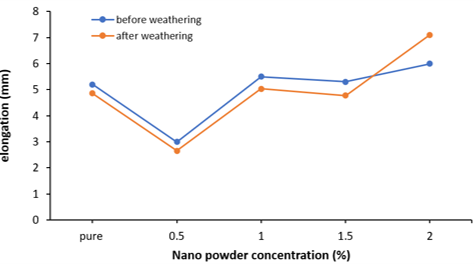
The elongation behavior of the PMMA/walnut shell nanoparticle composite showed minimal variation for the two cases of aged and unaged samples, as shown in Figure 7. The elongation ranging from 5.2% at pure PMMA sample to 3 % and then gradual increase to 6% for the unaged samples. When the aging process was performed, the elongation reduced and exhibited a similar variation to that of the aged samples, starting from 4.86% to 7.1% at 2 wt%. This differentiation in elongation is attributed to the effect of walnut nano powder concentration and to the weathering process. At a high concentration ratio, the particles tend to partially agglomerate during the mixing process because of moisture from the surrounding air. This partial agglomeration generates micro voids during the plasticization process.
Figure 7. Elongation in tensile testing of nanocomposites
On the other hand, the effect of the aging environment is clearly observed by increasing surface oxidation and/or particle orientation, slight structural relaxation and limited molecular rearrangement within the polymer matrix.
In general, the limited variation in elongation values demonstrates that the nanocomposite maintained effective surface bonding and structural integrity after weathering, confirming its mechanical stability and resistance to environmental degradation.
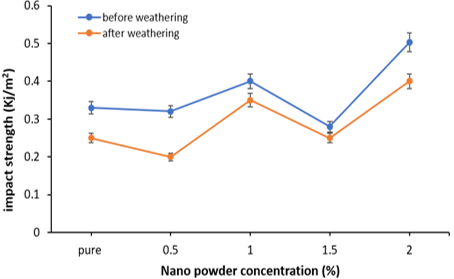
Figure 8 shows the impact strength of PMMA composites before and after the aging process. The significance of the tested results exhibits a p-value of 0.06, which is very close to the confidence level of 0.05. This variation is mainly attributed to some defects in the fabrication process, such as agglomeration or air traps inside the composite. Increasing filler percentage resulted in a gradual increase in the impact strength of the composite and a gradual crosslinking enhancement of the PMMA. The aging process significantly influenced the impact strength, reaching the lowest value at 0.5 wt.% of 0.20 KJ/m2, and the maximum at 2 wt.% corresponds to 0.4 KJ/m2. A similar trend can be observed in the case of unaged samples having at 0.5 wt.% and 2 wt.% impact strength of 0.33 KJ/m2 and 0.503 KJ/m2 respectively.
Figure 8. Impact strength of polymethyl methacrylate (PMMA) nanocomposites
The variation between aged and unaged samples provides information that the aged composites have low energy absorption, leading to rapid fracture compared to the unaged composites due to surface softening. The impact results, especially at the maximum value, correspond to maximum flexural strength at 2 wt%. This can provide information about the positive effect of walnut strength even if agglomeration occurred, but still active in impact and flexural, but not in tensile. According to Ortensi et. al. [32], the mechanical properties of PMMA can be significantly affected by the aging process. In the case of tensile strength, it requires a lower filler percentage to obtain higher strength, in which the continuity may not be disrupted.
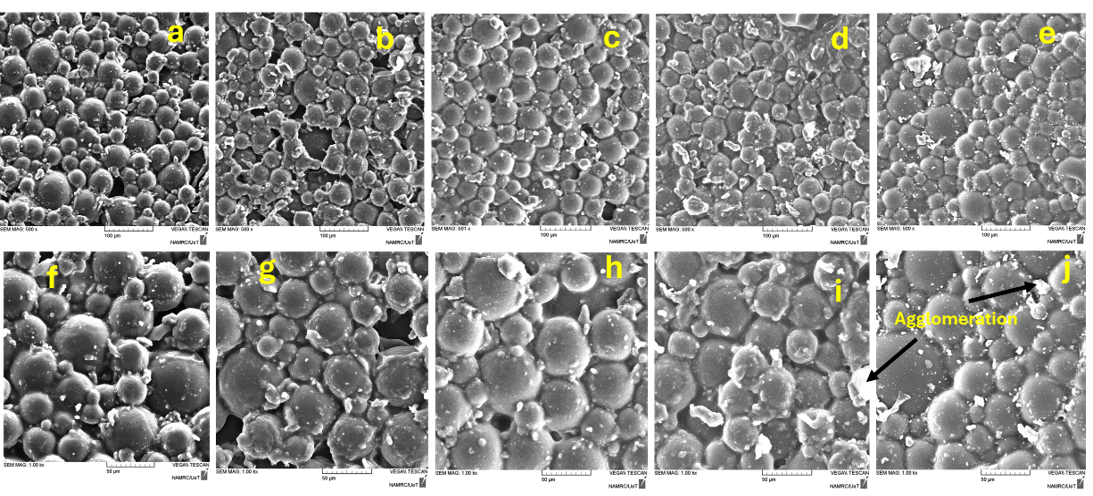
Figure 9 shows SEM images of the aged surface of PMMA nanocomposites. The morphology of a polymeric composite significantly depends on various factors, such as manufacturing conditions, particle size of fillers, chemical nature of the filler components, product design, and component mixing ratio.
The pure PMMA sample (Figure 9(a)) exhibited spherical particles with a smooth and relatively homogeneous shape, reflecting a uniform polymer structure. At concentrations of 0.5% and 1% nanoparticles (Figure 9 (b) and (c)), the morphology demonstrated good nanoparticle dispersion and surface adhesion with fine nanostructured distribution. This fine distribution optimizes stress transfer between the reinforcement nanoparticles and PMMA matrix, resulting in a homogeneous morphology and high filler distribution. Conversely, slight nanoparticle agglomerations appeared at 1.5% and 2% walnut shell nanoparticle concentrations (Figure 9(d) and (e)); the dispersion was relatively acceptable, and the surface showed uniform polymerization with fewer voids and pores on the surface. These localized agglomerations are accompanied by microscopic gaps and interfacial cracks. Overall, the morphological results indicate that moderate nanoparticle incorporation leads to moderate structural homogeneity, improved mechanical performance, and surface integrity, whereas higher concentrations tend to induce microagglomeration [33].
Figure 9. Scanning electron microscopy (SEM) images of the composite surface at different concentrations: (a) pure polymethyl methacrylate (PMMA), (b) 0.5%, (c) 1%, (d) 1.5%, (e) 2%, and (f)-(j) magnification of each concentration, respectively
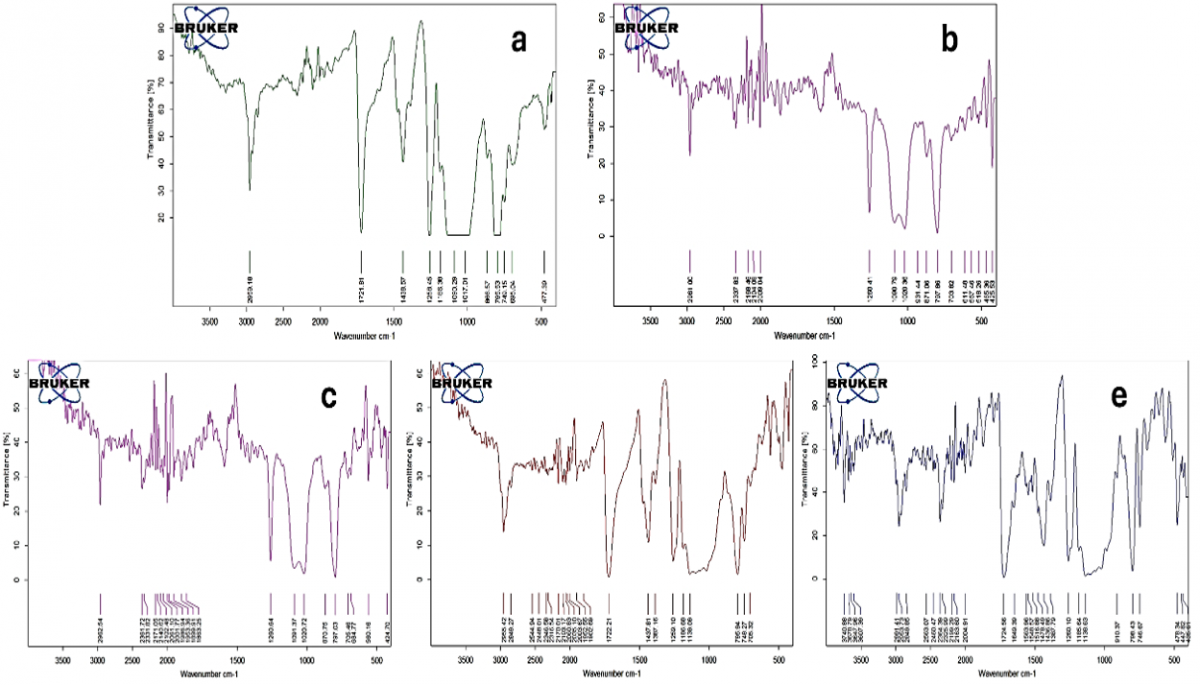
The characteristic absorption bands of PMMA, as shown in Figure 10, were obtained from FTIR spectra. The stretching vibration of the ester carbonyl group (C = O) is represented by a prominent peak at approximately 1722–1724 cm⁻¹, while the absorption bands near 2950–2962 cm⁻¹ are attributed to C–H stretching vibrations [34]. The C–O–C and C–O stretching vibrations of the ester groups are associated with peaks in the 1260–1020 cm⁻¹ range. PMMA reacted with the cellulose, hemicellulose, and lignin components of walnut shell nanoparticles, as evidenced by slight shifts in peak positions and changes in beam intensity with increasing walnut shell nanoparticle content. The presence of cellulose and lignin components was confirmed by the more pronounced broad O–H absorption band in the 2 wt.% composite. The absence of new absorption bands indicates the lack of new covalent bond formation. The interaction between PMMA and walnut shell nanoparticles occurs primarily through physical interactions and hydrogen bonding. These results confirm the successful incorporation and excellent dispersion of walnut shell nanoparticles within the PMMA matrix while preserving their basic chemical structure. Furthermore, no chemical formula appeared in the composite after aging.
Figure 10. Fourier transform infrared (FTIR) spectra of pure polymethyl methacrylate (PMMA) and PMMA reinforced with walnut shell nanoparticles: (a) pure, (b) 0.5%, (c) 1%, (d) 1.5%, and (e) 2%
Table 5 illustrates the water absorption behavior of all unaged and aged composites. The results reveal that no significant water absorption occurred after aging, indicating that the PMMA material maintained good optical and chemical stability under the applied aging conditions. The values are very low, indicating that the developed nanocomposites can effectively withstand prolonged exposure to high humidity and wet environmental conditions without undergoing moisture-induced swelling or hydrolytic degradation [35].
Table 5. Water absorption of the polymethyl methacrylate (PMMA) composite
|
wt.% of Nano Walnut |
Absorption % |
|
|
Before Weathering |
After Weathering |
|
|
Pure |
0.928 |
0.9906 |
|
0.5 |
0.782 |
0.9926 |
|
1 |
0.636 |
0.9928 |
|
1.5 |
0.1068 |
0.9853 |
|
2 |
0.983 |
0.9906 |
4.2 Antibacterial activity test
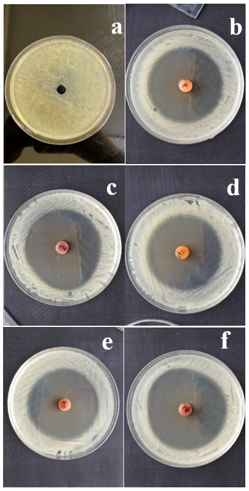
The results of the antibacterial activity test shown in Figure 10 demonstrate that adding walnut shell nanoparticles to PMMA enhances its inhibitory effect against Streptococcus mutans, a Gram-positive oral bacterium closely associated with tooth decay. As shown in Table 6 and Figure 11, pure PMMA exhibits an inhibition zone of 52 mm, while the composite nanoparticles containing 0.5%, 1%, 1.5%, and 2% walnut shell nanoparticles showed larger zones of 60, 54, 55, and 60 mm, respectively, excluding the radius of the sample, which is 5 mm each. This indicates that adding walnut shell nanoparticles effectively enhances the antibacterial performance of the polymer matrix. Furthermore, the increased surface area and nano-interactions between the walnut shell nanoparticles and bacterial cells may enhance contact and antimicrobial activity. This is attributed to the bioactive phytochemicals present in walnut shells (phenols and flavonoids), which possess potent antibacterial effects by inhibiting cell walls and increasing membrane permeability.
The high levels of inhibition induced by the nanoparticles enhanced the surface interaction and diffusion of antimicrobial agents, with the highest activity recorded at concentrations of 0.5% and 2%. Slight agglomeration may occur at higher dispersion levels compared to other concentrations.
Table 6. Antibacterial activity of pure polymethyl methacrylate (PMMA) and PMMA with walnut shell nanoparticles against Streptococcus mutans
|
Nano Walnut Shell wt.% |
Inhibition Zone (mm) Against Streptococcus Mutans |
|
Pure PMMA |
52 |
|
0.5% |
60 |
|
1% |
54 |
|
1.5% |
55 |
|
2% |
60 |
Figure 11. Antibacterial activity of pure polymethyl methacrylate (PMMA) and PMMA with walnut shell nanoparticles against Streptococcus mutans: (a) control sample, (b) pure PMMA, (c) 0.5%, (d) 1%, (e) 1.5%, and (f) 2% wt.%)
Based on the above results, the high antibacterial activity of the polymer compound makes it suitable for use in dentures. Walnut shells, used in the manufacture of medical or dental polymers such as PMMA, exhibit resistance to these bacteria, making them a promising material for denture applications as they reduce the risk of infection and biofilm formation.
The addition of nano-walnut shell reinforcement significantly enhanced the mechanical properties of the PMMA. 0.5 and 2 wt.% have the highest tensile and flexural characteristics compared to the other unaged mixing ratios. Furthermore, the addition of nano walnut shell as a reinforcement slightly increased the hardness of PMMA composites due to the rigid nature of the walnut shell. On the other hand, weathering of PMMA composites has shown different impacts across PMMA composites. All aged composites exhibited a reduction in tensile and flexural strength. Under tensile load, all aged samples revealed less tensile strength compared to the unaged composites; the maximum value reached 89.19 MPa at 0.5 wt.% filler concentration, compared to pure PMMA, which has 69.88 MPa. The weathering conditions introduce micro-voids and reduce structural homogeneity, leading to a reduction in tensile resistance due to the oxidation process. Meanwhile, the flexural properties have also been reduced compared to the unaged composite due to a decrease in matrix flexibility, especially when localized agglomeration occurs across the thickness of the matrix. The aging process resulted in a reduction in hardness of the surface. This reduction occurs due to the oxidation process that revealed slight structural relaxation and partial softening of the surface layer. It can be concluded that aging influences the mechanical properties of the composites.
On the other hand, successful bacterial resistance was observed in all aged composites. The standard control sample showed massive bacterial growth, whereas the aged pure PMMA exhibited a significant inhibition zone of 52 mm, while the concentrations of 0.5%, 1%, 1.5%, and 2% walnut shell nanoparticles revealed larger zones of 60 mm, 54 mm, 55 mm, and 60 mm, respectively.
The authors would like to express their gratitude to the Department of Biomedical Engineering at Al‑Khwarizmi College of Engineering for their technical cooperation and support regarding the publication of this research paper.
|
UV |
ultraviolet |
|
PMMA |
polymethyl methacrylate |
|
SEM |
scanning electron microscopy |
[1] Wanas, A.A., Rashad, H.A., El-ebiary, M.A., Abdelaal, Z. (2024). Effect of aging on mechanical properties of polymethyl methacrylate reinforced by nano zirconium or nano silver. Tanta Dental Journal, 21(4): 433-440. https://doi.org/10.4103/tdj.tdj_75_23
[2] Fereidooni, L., Morais, A.R.C., Shiflett, M.B. (2024). Application of pistachio shell waste in composites, nanocomposites, and carbon electrode fabrication: A review. Resources, Conservation and Recycling, 203: 107403. https://doi.org/10.1016/j.resconrec.2023.107403
[3] Sezavar, A., Zebarjad, S.M., Sajjadi, S.A. (2015). A study on the effect of nano alumina particles on fracture behavior of PMMA. Technologies, 3(2): 94-102. https://doi.org/10.3390/technologies3020094
[4] Fadhil, H.S., Oleiwi, J.K., Hamad, Q.A. (2025). Investigation of tensile, and morphological characteristic of laminated bio-composite for bone plate fixation applications. Journal of Composite & Advanced Materials/Revue des Composites et des Matériaux Avancés, 35(2): 295-302. https://doi.org/10.18280/rcma.350211
[5] Kanie, T., Fujii, K., Arikawa, H., Inoue, K. (2000). Flexural properties and impact strength of denture base polymer reinforced with woven glass fibers. Dental Materials, 16(2): 150-158. https://doi.org/10.1016/S0109-5641(99)00097-4
[6] Al-Ameri, A., Alothman, O.Y., Alsadon, O., Bangalore, D. (2025). An in-vitro evaluation of strength, hardness, and color stability of heat-polymerized and 3D-printed denture base polymers after aging. Polymers, 17(3): 288. https://doi.org/10.3390/polym17030288
[7] Gad, M.M., Fouda, S.M., Abualsaud, R., et al. (2022). Strength and surface properties of a 3D-printed denture base polymer. Journal of Prosthodontics, 31(5): 412-418. https://doi.org/10.1111/jopr.13413
[8] Zhang, X., Liu, H., Ma, S., Yang, P. (2023). Thermal air aging and lifespan prediction of PVC-P geomembranes: An Arrhenius equation-based approach. Power Engineering and Engineering Thermophysics, 2(4): 199-211. https://doi.org/10.56578/peet020402
[9] Karthick, R., Sirisha, P., Sankar, M.R. (2014). Mechanical and tribological properties of PMMA-sea shell based biocomposite for dental application. Procedia Materials Science, 6: 1989-2000. https://doi.org/10.1016/j.mspro.2014.07.234
[10] Allam, G., Abd El-Geleel, O. (2018). Evaluating the mechanical properties, and calcium and fluoride release of glass-ionomer cement modified with chicken eggshell powder. Dentistry Journal, 6(3): 40. https://doi.org/10.3390/dj6030040
[11] Sosiati, H., Rizky, A.M., Latief, A.L.M., Adi, R.K., Hamdan, S. (2023). The mechanical and physical properties of microcrystalline cellulose (MCC)/sisal/PMMA hybrid composites for dental applications. Materials Research Express, 10(3): 035301. https://doi.org/10.1088/2053-1591/acbb57
[12] Kumari, S., Mishra, R.K., Parveen, S., et al. (2024). Fabrication, structural, and enhanced mechanical behavior of MgO substituted PMMA composites for dental applications. Scientific Reports, 14(1): 2128. https://doi.org/10.1038/s41598-024-52202-4
[13] Khalil, M., Enaba, L. (2021). Influence of antimicrobial nanoparticles on flexural strength and hardness of polymethylmethacrylate. Open Access Macedonian Journal of Medical Sciences, 9(D): 314-318. https://doi.org/10.3889/oamjms.2021.7565
[14] Alahmad, H., Alamir, R., Asadzadeh, M., Daood, U., Qasim, S.S.B. (2025). Enhancing PMMA properties: A comprehensive study of nanographene oxide and boron nitride impact through in-vitro analysis. BMC Oral Health, 25(1): 659. https://doi.org/10.1186/s12903-025-05994-4
[15] Shahkar, L., Khachatourian, A.M., Nemati, A. (2024). Fabrication and characterization of PMMA denture base nanocomposite reinforced with hydroxyapatite and multi-walled carbon nanotubes. Diamond and Related Materials, 147: 111377. https://doi.org/10.1016/j.diamond.2024.111377
[16] Kim, H.A., Kim, B.K. (2019). Synthesis and properties of waterborne polyurethane/hydroxyapatite chemical hybrids. Progress in Organic Coatings, 128: 69-74. https://doi.org/10.1016/j.porgcoat.2018.12.009
[17] Król-Morkisz, K., Pielichowska, K. (2019). Thermal decomposition of polymer nanocomposites with functionalized nanoparticles. In Polymer Composites with Functionalized Nanoparticles, pp. 405-435. https://doi.org/10.1016/B978-0-12-814064-2.00013-5
[18] Xu, J., Li, Y., Yu, T., Cong, L. (2013). Reinforcement of denture base resin with short vegetable fiber. Dental Materials, 29(12): 1273-1279. https://doi.org/10.1016/j.dental.2013.09.013
[19] Jassam, A., Mohammed, F.M., Hamad, H.M. (2021). Effect of natural fillers on the tensile and flexural properties of PMMA used in denture manufacture. IOP Conference Series: Materials Science and Engineering, 1094(1): 012080. https://doi.org/10.1088/1757-899X/1094/1/012080
[20] Salih, S.I., Braihi, A.J., Sadeq, H.M. (2019). Comparative study of some mechanical properties of nanocomposites based on the polymer's blends used for dentures base applications. Materials Research Express, 6(12): 125429. https://doi.org/10.1088/2053-1591/ab7dfe
[21] Wang, L., Li, W., Li, X., Liu, J., Chen, Y. (2023). Antimicrobial activity and mechanisms of walnut green husk extract. Molecules, 28(24): 7981. https://doi.org/10.3390/molecules28247981
[22] Sutivisedsak, N., Cheng, H.N., Burks, C.S., et al. (2012). Use of nutshells as fillers in polymer composites. Journal of Polymers and the Environment, 20(2): 305-314. https://doi.org/10.1007/s10924-012-0420-y
[23] Sarraj, S., Szymiczek, M., Machoczek, T., Mrówka, M. (2021). Evaluation of the impact of organic fillers on selected properties of organosilicon polymer. Polymers, 13(7): 1103. https://doi.org/10.3390/polym13071103
[24] Ahmed, S.H., Salih, W.M. (2021). Mechanical properties of acrylic laminations resin (PMMA) reinforced by natural nanoparticles and hemp fibers. IOP Conference Series: Materials Science and Engineering, 1094(1): 012136. https://doi.org/10.1088/1757-899X/1094/1/012136
[25] Wee, J.W., Choi, M.S., Hyun, H.C., Hwang, J.H., Choi, B.H. (2018). Effect of weathering-induced degradation on the fracture and fatigue characteristics of injection-molded polypropylene/talc composites. International Journal of Fatigue, 117: 111-120. https://doi.org/10.1016/j.ijfatigue.2018.07.022
[26] Rećko, M., Aladag, M., Błaszczak, U., Dzierżek, K., Kurzydłowski, K.J. (2024). Effect of UV-C long-time irradiation on mechanical properties of PMMA. Results in Materials, 22: 100567. https://doi.org/10.1016/j.rinma.2024.100567
[27] Yildirim, F.F., Hicyilmaz, A.S., Yildirim, K. (2022). The effects of the weathering methods on the properties of the ABS, ASA and PMMA polymers. Polymer Testing, 107: 107484. https://doi.org/10.1016/j.polymertesting.2022.107484
[28] Kuvshinnikova, O., Boven, G., Pickett, J.E. (2019). Weathering of aromatic engineering thermoplastics: Comparison of outdoor and xenon arc exposures. Polymer Degradation and Stability, 160: 177-194. https://doi.org/10.1016/j.polymdegradstab.2018.12.011
[29] Sun, H., Zhao, W., Tabrizian, P., Ireland, T., Wei, C., Su, B. (2026). Hydrothermal ageing behaviour of nacre-like zirconia/PMMA and ZTA/PMMA composites for dental applications. Ceramics International, 52(20): 36116-36127. https://doi.org/10.1016/j.ceramint.2026.06.119
[30] Çakmak, G., Donmez, M.B., Akay, C., Abou-Ayash, S., Schimmel, M., Yilmaz, B. (2023). Effect of thermal cycling on the flexural strength and hardness of new-generation denture base materials. Journal of Prosthodontics, 32(S1): 81-86. https://doi.org/10.1111/jopr.13615
[31] AL-Jmmal, A.Y., Mohammed, N.Z., AL-kateb, H.M. (2024). The effect of aging on hardness of heat cured denture base resin modified with recycled acrylic resin. Clinical and Experimental Dental Research, 10(1): e828. https://doi.org/10.1002/cre2.828
[32] Ortensi, L., Grande, F., Testa, C., et al. (2024). Fracture strength of 3-units fixed partial dentures fabricated with metal-ceramic, graphene doped PMMA and PMMA before and after ageing: An in-vitro study. Journal of Dentistry, 142: 104865. https://doi.org/10.1016/j.jdent.2024.104865
[33] Kubiak, J.M., Li, B., Suazo, M., Macfarlane, R.J. (2022). Polymer grafted nanoparticle composites with enhanced thermal and mechanical properties. ACS Applied Materials & Interfaces, 14(18): 21535-21543. https://doi.org/10.1021/acsami.2c03797
[34] Motaung, T.E., Luyt, A.S., Saladino, M.L., Martino, D.C., Caponetti, E. (2012). Morphology, mechanical properties and thermal degradation kinetics of PMMA-zirconia nanocomposites prepared by melt compounding. Express Polymer Letters, 6(11). https://doi.org/10.3144/expresspolymlett.2012.93
[35] Giti, R., Firouzmandi, M., Zare Khafri, N., Ansarifard, E. (2022). Influence of different concentrations of titanium dioxide and copper oxide nanoparticles on water sorption and solubility of heat-cured PMMA denture base resin. Clinical and Experimental Dental Research, 8(1): 287-293. https://doi.org/10.1002/cre2.527